
Crypto World
Another Setback for CLARITY Act as White House Stays Silent (Flash News)


After the highly expected weekend in which supporters of the bill expected some sort of an advancement, Eleanor Terrett reported that the White House has failed to respond to a key counterproposal.
The popular journalist noted a few days ago that Senator Thom Tillis and Senator Ruben Gallego had pushed for stronger ethics provisions, indicating that state attorneys general should enforce laws against federal officials.
However, she updated on Monday that the White House has failed to respond to the counterproposal after citing a source familiar with the matter.
“A deal on the CLARITY Act’s biggest outstanding issue has yet to materialize heading into the week of a potential vote,” she added.
The odds for approval of the legislation continue to decline as there’s no real progress made. Current data from Washington experts and prediction markets show that the percentage is down to 28%. It used to be at roughly 70% earlier this year.
The post Another Setback for CLARITY Act as White House Stays Silent (Flash News) appeared first on CryptoPotato.


Net loss came to $57.2 million, narrowed from $81.8 million in the first quarter. A $71.2 million non-cash loss on digital assets ran through operating expenses, and the operating loss was $74.1 million while Bitcoin fell about 12% over the quarter.
CryptoPotato reported on the $81.8 million first-quarter loss that landed alongside a then-record 817 Bitcoin mined in May.
Reserve Climbs Toward 8,300 Bitcoin
Eric Trump, Co-Founder and Chief Strategy Officer, said on X that the reserve had grown to roughly 8,300 BTC as of August 3 and described American Bitcoin as the “#16 Largest Publicly Traded Bitcoin Company in the World.”
Just wrapped $ABTC‘s earnings call
Q2 2026 was our strongest quarter of Bitcoin production yet. As of today, our Bitcoin reserve has grown to ~8,300 BTC!
Gross margins have held at ~49%+ every quarter since launch. SG&A was just ~11% of revenue in Q2, one of the leanest cost… pic.twitter.com/4qLT2YeILJ
— Eric Trump (@EricTrump) August 3, 2026
The company has traded on Nasdaq since its September 2025 debut through a stock merger with Gryphon Digital Mining.
“Our conviction in Bitcoin remains absolute, and our goal is simple: to deliver relentless growth, quarter after quarter, and build the preeminent American Bitcoin powerhouse for the long haul,” Trump noted in the earnings release.
The owned fleet stood at about 89,242 miners and 28.1 EH/s at quarter-end, with the 11,298 Bitmain units that added 3.05 EH/s at Hut 8’s Drumheller site fully energized in April. The operational fleet ran 58,999 miners at 25.0 EH/s.
American Bitcoin valued the reserve at about $478.9 million in its quarterly report, against a Bitcoin price of $59,847 on June 30.
Mining Revenue Up 8%
Mining revenue reached $67.0 million, up about 8% from $62.1 million in the first quarter. Moreover, revenue per Bitcoin mined slipped roughly 5% to about $71,900.
Cost to mine held near flat at about $36,500 per Bitcoin, driven by marginally higher energy costs at selective sites. General and administrative expense was $7.7 million, close to 11% of revenue.
American Bitcoin effected a 1-for-15 reverse stock split on July 2, cutting shares issued from 1,092,295,800 to roughly 73 million. Class A stock resumed split-adjusted trading on The Nasdaq Capital Market on July 6 under the same ticker.
The split was “primarily intended to increase the per-share price” of the stock, the firm stated in its July 1 announcement, and “to maintain compliance with the minimum bid price requirement for maintaining its Nasdaq listing.” Stockholders approved the measure at the annual meeting on June 22.
The post American Bitcoin Mines Record 932 BTC in Q2, Reserve Tops 8,000 appeared first on CryptoPotato.
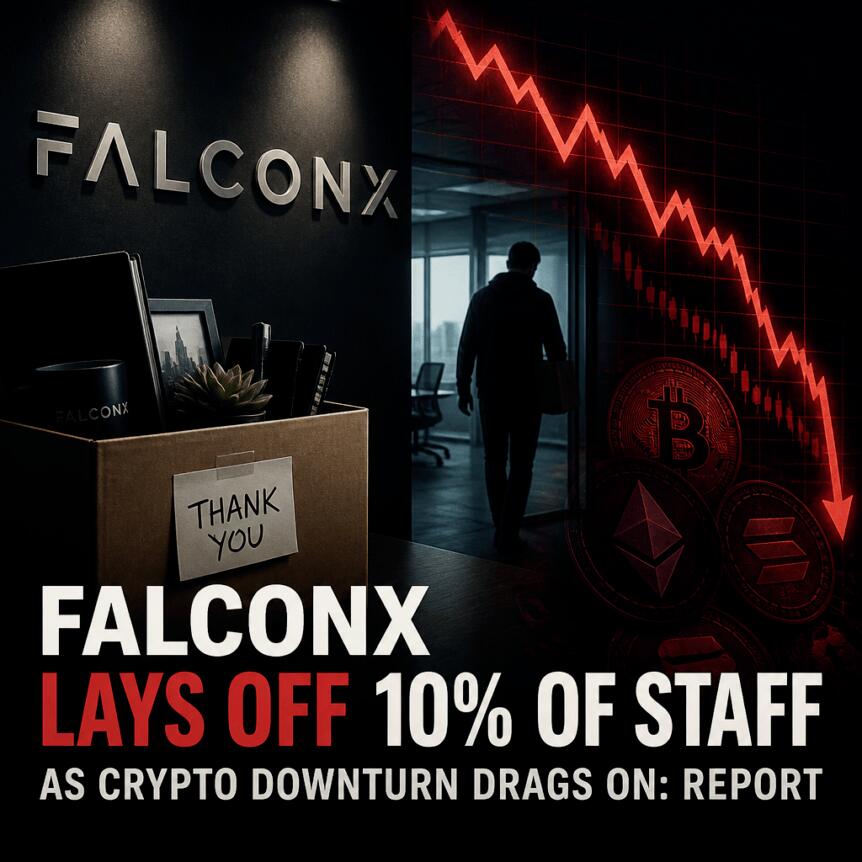
FalconX, the digital-asset prime brokerage that acquired crypto ETF issuer 21Shares in November, has laid off about 10% of its workforce as it braces for a longer crypto market downturn, Bloomberg reported Monday.
Bloomberg, citing people familiar with the matter, also said the firm is reshaping its Singapore approach—shifting emphasis toward crypto derivatives trading and planning to withdraw its license application with the Monetary Authority of Singapore. The company intends to keep a presence in Asia while expanding its business in Europe.
Key takeaways
- FalconX reportedly cut roughly 10% of staff amid expectations of an extended downturn, according to Bloomberg.
- The firm is reportedly pivoting its Singapore strategy toward crypto derivatives while preparing to withdraw its MAS license application.
- FalconX plans to maintain operations in Asia but is looking to grow its footprint in Europe, Bloomberg said.
- The move aligns FalconX with other crypto firms that have reduced headcount during the market slowdown.
- Broader exchange activity is shifting beyond spot trading toward derivatives and tokenized real-world assets, CoinGecko and Coinbase reporting suggest.
FalconX cuts staff as it plans a longer runway
Before the layoffs, FalconX employed about 350 people across the United States, the United Kingdom, Singapore, and Hong Kong, Bloomberg said. The report frames the cuts as part of a broader effort to operate through what it describes as a prolonged market slump.
Cointelegraph reached out to FalconX for comment but did not receive an immediate response.
Strategic pivot in Singapore, expansion in Europe
Beyond the workforce reduction, Bloomberg reported that FalconX is changing course in Singapore. The company is reportedly concentrating on crypto derivatives trading there, while planning to withdraw its license application with the Monetary Authority of Singapore.
While that withdrawal would mark a significant shift in its regulatory posture, Bloomberg also said FalconX expects to remain active in Asia. At the same time, the firm intends to expand its European operations—suggesting management is reallocating risk and resources toward regions it believes can better support its near- to mid-term growth plans.
Part of a wider wave of crypto downsizing
FalconX’s reported cuts add to a growing list of crypto companies scaling back operations during the downturn. Bloomberg’s report places FalconX alongside headcount reductions at exchanges and infrastructure providers mentioned by Cointelegraph, including Coinbase, Crypto.com, Luno, Gemini, and BitGo.
The shared theme is not just lower demand for trading products during a market cool-off, but also an industry-wide reassessment of costs, regulatory exposure, and product focus—particularly as volumes and retail participation tend to soften when asset prices pull back from prior peaks.
Exchanges broaden beyond spot as tokenized finance grows
Market pressure has been felt across trading venues. With Bitcoin and other digital assets retreating from last year’s highs, exchanges have seen trading volumes and retail engagement weigh on performance, and some analysts have argued that the market may still be finding its base rather than having fully bottomed.
Cointelegraph previously noted that some market participants believe Bitcoin has not yet reached a market bottom. At the time of the earlier reporting referenced in the source material, Bitcoin was trading below $64,000—about 50% under its October peak above $126,000.
In response, many exchanges are pushing into areas that can support activity even when spot momentum fades. CoinGecko, as cited in the source, reported that the “crypto TradFi” sector—which includes tokenized assets, derivatives, and other traditional finance products—grew fivefold to $6.6 billion between January 2025 and June 2026. That growth profile points to a strategic shift toward revenue streams less dependent on purely spot-driven cycles.
Coinbase’s latest earnings, cited in the source, also illustrate how some major platforms are positioning around products beyond spot Bitcoin trading. While Coinbase missed earnings expectations, it reported that 88% of second-quarter net revenue came from businesses other than spot Bitcoin trading, with derivatives, prediction markets, and tokenized assets cited as increasingly important contributors.
For FalconX, the reported emphasis on derivatives in Singapore fits this broader industry pattern: when spot trading slows, derivatives and structured products can help sustain engagement from more sophisticated participants and hedgers. However, the operational implications of withdrawing a license application—while still planning to operate in the region—will be something investors and clients may want to watch closely, since regulatory access can materially affect product availability and timelines.
Going forward, readers should monitor two things: whether FalconX’s European expansion accelerates in tandem with the Singapore changes, and how the firm’s reported shift toward derivatives aligns with the wider migration toward tokenized and TradFi-linked offerings as the market’s next phase remains uncertain.


A new ransomware group is threatening to leak contact details of over 100,000 UK police officers after stealing data from government departments, including the Ministry of Defence (MoD), the Home Office, the National Crime Agency (NCA), and the Crown Prosecution Service (CPS).
The Times confirmed that a dark web listing from the group, known as ExfilSquad, in late July was legitimate, and that it had leaked the full names, email addresses, area of work details, and more, of over 100,000 staff listed on the Police National Legal Database (PNLD).
Police revealed that the data of 114,000 PNLD subscribers were leaked, and that most of these individuals were police officers.
The leak also included data from 2,615 CPS staff, 617 Home Office employees, 588 NCA staff and 402 MoD personnel
In all, ExfilSquad claimed to have hacked 15 firms and government bodies, including Microsoft and the UK’s Department for Education.
It had claimed that 135,000 law enforcement records were stolen, but the validity of these claims was reportedly doubted by researchers when it was listed.
Read more: Iranian hackers suspected of attacking 30 Minnesota water companies
The ExfilSquad page reads, “Once your company’s data is posted here, it’s NEVER leaving the public eye and it will be passed around the internet FOREVER. The payment we request of you is simply a rounding error compared to the litigation costs of your data leaking. Be smart and just pay.”
Hacked firms were given until August 5 to contact ExfilSquad, with The Times reporting that the hack appears to be financially rather than politically motivated.
ExfilSquad will likely demand a cryptocurrency-based ransom as, like most ransomware and hacker groups, it can move the crypto into mixers, privacy coins, and unregulated exchanges in order to launder the stolen gains.
Iranian hacking collective CyberAv3ngers, which allegedly disrupted the services of 30 Minnesota water firms last week, has previously tried to sell illegally obtained data for BTC.
The UK is currently planning to ban public sector bodies from paying ransomware groups in a bid to make hacking government bodies unattractive for criminals.
Leaked data from these attacks can be used in a variety of ways to orchestrate targeted attacks against officials. Indeed, in 2025, a French tax official was arrested after she was found to have used government software to leak the data of prison officials and crypto specialists to criminals.
A court later denied her request to be released from prison after she tried to argue that she didn’t know who the criminals were.
Got a tip? Send us an email securely via Protos Leaks. For more informed news and investigations, follow us on X, Bluesky, and Google News, or subscribe to our YouTube channel.


Mastercard has completed its acquisition of stablecoin infrastructure provider BVNK, bringing on-chain payment technology into its global network.
Summary
- Mastercard finalized the up to $1.8 billion acquisition first announced in March.
- BVNK connects fiat and blockchain networks for payments, settlement, payouts, and treasury flows.
- The deal expands Mastercard’s ability to support stablecoins and tokenized assets alongside traditional currencies.
- Mastercard is also backing Open USD and developing stablecoin payments for autonomous AI agents.
Mastercard closes deal for BVNK
Mastercard confirmed on Aug. 3 that it had completed the acquisition of BVNK, expanding its infrastructure for moving value between fiat currencies and digital assets. The payments company first announced the agreement in March, valuing the transaction at up to $1.8 billion, including $300 million in contingent payments.
BVNK provides the underlying infrastructure for businesses and financial institutions to hold, move, manage, and convert money across traditional banking systems and blockchain networks. Its APIs support stablecoin payments, cross-border transfers, payouts, settlements, and treasury operations.
Mastercard said integrating that technology will help connect payment systems that currently operate across separate fiat and blockchain rails.
“Digital currencies — particularly stablecoins — are increasingly addressing real-world needs in areas like cross-border B2B payments, remittances, payouts, settlement and treasury flows,” Mastercard chief product officer Jorn Lambert said.
Lambert added that the company expects fiat currencies, stablecoins, tokenized deposits, and other forms of value to coexist within a connected payment system.
Why BVNK strengthens Mastercard’s stablecoin business
The acquisition gives Mastercard direct control over infrastructure that businesses can use to move between fiat money and blockchain-based assets. That could help the card network provide stablecoin services without requiring clients to build their own on-chain systems.
BVNK operates from London and San Francisco and has spent years securing licenses in multiple jurisdictions. When Mastercard announced the agreement in March, Lambert said buying the company would allow it to enter the market faster than developing comparable technology internally.
The platform’s use cases extend beyond crypto trading. Stablecoins can support round-the-clock settlement, international business payments, remittances, and treasury transfers without relying entirely on traditional correspondent banking channels.
BVNK previously received backing from Concentric, Tiger Global, Haun Ventures, Visa Ventures, Citi Ventures, and Coinbase Ventures.
“When we first invested, stablecoins were far from the financial mainstream,” Concentric co-founder and managing partner Kjartan Rist said.
Rist said the investor viewed stablecoins as an opportunity to rebuild the infrastructure supporting global payments.
Mastercard expands beyond traditional card payments
The BVNK deal forms part of a wider effort by Mastercard to secure a role in blockchain-based commerce.
Mastercard joined Visa, Coinbase, and more than 140 other businesses in June to support Open Standard, a consortium preparing to issue the dollar-pegged Open USD stablecoin. The proposed token will allow businesses to mint and redeem Open USD without fees or volume limits, while participating companies will share earnings from its reserves after management costs. The consortium intends to make stablecoin payments cheaper and easier to scale.
Mastercard also launched Agent Pay for Machines in June with support from more than 30 companies, including Coinbase, Ripple, BVNK, and the Solana Foundation. The service is designed for autonomous software agents conducting high-volume, low-value transactions across cards and stablecoins. Mastercard said users can apply authorization controls and settlement conditions to automated payments.
Together, the initiatives position stablecoins as an additional payment rail within Mastercard’s network rather than a separate system competing only with cards.
What comes next for the BVNK integration
Mastercard must now integrate BVNK’s technology, licenses, and business relationships into its broader payments network. The company has not provided a detailed rollout schedule or disclosed whether BVNK will continue operating under its existing brand.
The transaction also adds another major payment company to the competition over stablecoin infrastructure. Mastercard and Visa are both developing services that connect regulated financial institutions with blockchain settlement systems as U.S. rules give payment providers a clearer framework for using dollar-backed tokens.
Mastercard shares closed Monday at $570.97, down about 0.4%, suggesting the acquisition’s completion produced little immediate reaction from investors.


More than 4,585 BTC wallet owners are victims of Coinkite’s firmware bug and its compromised Coldcard hardware wallets, including devices with and without passphrases.
At time of writing, no one has publicly confirmed the identity(ies) of the hacker(s).
If you’re a victim, it is important to take immediate action to protect any remaining funds and document your loss for legal and criminal procedures.
The flaw traces to faulty firmware (on-device software) on Coldcards from March 2021 through late last week. Thousands of customers bought and trusted the devices to secure untold sums of money.
Founder Rodolfo Novak, known as “NVK,” apologized on social media, saying, “I’m sorry and I’m devastated,” pledging Coinkite is “committed to working with affected users who want to pursue a police report, insurance claim, or their own investigation.”
Coldcard victims should report to law enforcement
US residents can always call their local police department to file a complaint. Formal local police reports are important for many reasons, since a report often precedes insurance claims or civil suits.
Although police departments vary in crypto expertise by location, anybody making a complaint will need to provide any evidence that a police officer requests, such as transaction IDs, the drained addresses, balance screenshots, receipts, or a written timeline.
When filing the report, ask the police officer whether you should also file a complaint with the FBI, or whether they will submit one on your behalf.
The FBI’s Internet Crime Complaint Center, IC3, is the primary federal intake point for crypto theft. Victims of the Coldcard hack may access https://complaint.ic3.gov and submit their documentation.
Victims over the age of 60 who have visual difficulty accessing this website can also call the FBI’s Elder Fraud Hotline at (833) 372-8311.
Again, residents of any municipality may ask for assistance from their local police officer.
Beware fake ‘law enforcement’ inquiries
IC3 states it “does not work with any non-law enforcement entity, such as law firms or crypto services, to recuperate lost funds,” and warns it “will never directly contact victims for information or money.”
Don’t trust any unsolicited inbound call, text, email, or other message from someone claiming to work for the FBI or IC3. Victims should initiate a report themselves, not respond to an unsolicited inquiry from someone who might be faking credentials.
After submitting these police and FBI report(s), sophisticated victims may consult their attorney as to the suitability of their loss for filing a fraud report at https://reportfraud.ftc.gov regarding Coinkite’s advertising or business practices.
Victims should also consult their tax professional or attorney regarding the suitability of documenting or timestamping evidence of their loss for IRS tax forms.
Protos doesn’t offer legal or tax advice. Please consult a licensed professional for personalized legal advice that suits your individual situation.
Read more: Ledger scammers are sending letters to steal your recovery phase
Considerations for civil legal actions
Outside of the criminal legal system, victims may consider civil claims against Coinkite.
The most important consideration regarding lawsuits, including class action suits, is to ensure that your attorney is licensed, reputable, and in good standing with their state’s bar association.
Lawyers are licensed by a state agency, not on a federal level. The American Bar Association has links to all 50 states here so that you can check the license status of your attorney.
Don’t trust unsolicited messages from phone calls, text, direct messages, emails, or other methods of contact. Independently verify the license status and contact information of an attorney through a state bar association.
AI websites, official-looking credentials, and social media clout can mislead victims into revealing personal information to scammers pretending to be attorneys. Be careful to call an attorney on a phone number registered with their state bar association.
The FBI has already issued a public service announcement about fictitious law firms targeting crypto scam victims.
Coinkite Inc. is a small, Toronto-based private company, according to the Better Business Bureau. Co-founders Rodolfo Novak and Peter Gray built it as a self-funded hardware maker.
Got a tip? Send us an email securely via Protos Leaks. For more informed news and investigations, follow us on X, Bluesky, and Google News, or subscribe to our YouTube channel.

“While most people recover from cyclosporiasis, individuals with underlying medical conditions or those in higher-risk groups may be more susceptible to serious complications, especially if prolonged diarrhea results in dehydration,” says Wade Syers, a food-safety specialist at Michigan State University Extension. “Anyone experiencing persistent diarrhea, signs of dehydration, or worsening symptoms should seek medical attention, particularly if they are in a higher-risk group.”
People who are elderly or have weakened immune systems, including people who are undergoing chemotherapy or who have advanced HIV, are at greater risk of cyclosporiasis complications, says Rohde. Early diagnosis and treatment with antibiotics, along with aggressive fluid replacement when needed, can significantly reduce the risks of complications, he says.
To reduce potential exposure to Cyclospora, food-safety experts recommend buying intact heads of lettuce and whole fruits and vegetables over bagged, boxed, or pre-cut produce. They also advise people to wash produce thoroughly under running water and follow other food-safety best practices, such as keeping raw meat and vegetables separate when preparing and cooking food. Cooking food to an internal temperature of at least 158°F can kill Cyclospora.
The Sunday morning minor relief rally couldn’t continue for long, and bitcoin dived below $63,000 again on Monday and even dipped to $62,200 for the second time in just a few days.
The larger-cap alts have joined the ride, with ETH sliding below $1,850, and XRP heading towards a familiar support level.
BTC Dips Toward $62K
The previous business week began on a significantly more positive note, with BTC defending the $64,000 support and jumping to $65,600 on a couple of occasions. However, the second rejection was quite painful, pushing the cryptocurrency to under $62,800 just a day before the FOMC meeting.
Bitcoin’s volatility intensified in the hours before and after the event, in which the Fed ultimately maintained the rates unchanged, despite numerous calls for a hike. BTC jumped on Friday morning once again, reaching $65,400, where the bears stepped up a lot more viciously and drove it south hard.
In the following hours, the asset lost roughly three grand and dropped to $62,400. It rebounded to $63,000 on Saturday but dipped to $62,200 later that day. US President Trump’s canceled attacks against Iran and the promise of a new deal to reopen the Strait of Hormuz brought a relief rally on Sunday morning, but BTC was halted at $63,700.
The leg down on Monday was also unfavorable for the bulls, driving the cryptocurrency south to $62,200 once again. Although that level has stopped the free-fall, BTC remains over 4% down weekly. Its market cap has tumbled to $1.250 trillion, while its dominance over the alts is below 56.5% on CG.

Alts Back in Red
Ethereum was rejected at $1,980 during the July rally, and now struggles below $1,850 after another minor daily decline. XRP fights to stay above $1.05, a support level that was categorized as its ‘battlefield.’ If held, the token still has the chance for a major rebound, analysts asserted.
SOL, DOGE, RAIN, ADA, and XMR are also in the red, while HYPE and BNB have posted insignificant gains. Pi Network’s PI impressed over the weekend, posting some notable gains of 5-6% even as the market stalled. Today, though, its progress has stalled, and the asset is down over 5% to under $0.084.
MemeCore and Algorand are among the few alts in the green daily, while BEAT has plunged by 24%, followed by ONDO’s 6% crash.
The total crypto market cap has shed around $40 billion in a day and is down to $2.220 trillion on CG.

The post Pi Network (PI) Rally Fades, Bitcoin (BTC) Loses $63K: Market Watch appeared first on CryptoPotato.

Michael Saylor, co-founder, former CEO, and current Chairman of the world’s largest corporate holder of bitcoin, spoke after the company announced its third BTC sale in the past few months.
He weighed in on a statement he had made countless times in the past: “Never sell your bitcoin,” but noted that it was meant for “savers.”
Saylor assured that he, as an individual investor, has never sold a single BTC, but Strategy is a public company, “not my wallet.”
“Since 2020, it has disclosed it may buy or sell BTC to manage capital. Our shared conviction in Bitcoin remains unchanged.”
Strategy disposed of another 1,638 BTC in the past week, which builds on the 3,588 units sold at the end of June.
The company also used the capital to repurchase more of its own STRC shares. This reinforced the asset’s price, which has climbed to $92. Although it’s still below its par price of $100, it has rebounded swiftly from the recent lows of $75.
The post Michael Saylor Breaks Silence After Strategy’s Third BTC Sale (Flash News) appeared first on CryptoPotato.

Michigan, where Donald Trump won both times he reached the White House, is a useful miniature of what the loitering gallery of presidential aspirants face across the country in two years. Not all lessons will be welcome for the would-be candidates, nor will they be fully understood until we know the outcome in November.
But if the tone in this race’s final days is a hint, it signals that the win-at-all-costs footing that has defined the era of Trump has crept into the Democratic ether. Acrimony doesn’t even begin to get at the mood on the ground, according to operatives in both camps. In a recent podcast interview, El-Sayed called Stevens “the least capable candidate in America.” Stevens responded with a message on her social media on Thursday that showed how raw feelings have become: “Everyone in America understands you want to blame all of your problems on Jewish Americans.”
This primary is about as perfect a snapshot as you could find of the tensions playing out among Democrats. In a swing state like Michigan, Stevens was widely acknowledged as the stronger candidate to go against the presumptive Republican nominee, former Rep. Mike Rogers. Her supporters include outgoing Sen. Gary Peters, and party heavyweights like Chuck Schumer (but not, notably, Sen. Elissa Slotkin, who was Stevens’ former House colleague, but has stayed out of the primary). Meanwhile, El-Sayed—who would be the country’s first Muslim U.S. Senator—has captured the imagination of the left wing of the Democratic Party, drawing visits from Sen. Bernie Sanders and Rep. Alexandria Ocasio-Cortez. At the same time, his unrelenting criticism of Israel has opened wounds inside the Jewish community in Michigan—and beyond—as his detractors say he is venturing into dangerous anti-semititic territory. Add in the race and religion factors animating the race, and Tuesday’s primary in Michigan could lay bare which litmus tests are likely to shape the 2028 presidential contest.


President Donald Trump called on ExxonMobil and Chevron to cut US fuel prices after the oil majors earned roughly $26.5 billion combined during the second quarter.
Summary
- ExxonMobil earned $14.5 billion, more than double its profit from the same quarter last year.
- Chevron posted $12.1 billion in earnings, nearly five times its year-ago result.
- Trump said the companies were making “too much money” from an oil shortage.
- US gasoline prices have risen more than 30% since the Iran war began.
Trump demands lower fuel prices
Trump criticized ExxonMobil and Chevron at the White House on Monday, arguing that supply pressure linked to the Iran war had allowed the companies to earn excessive profits.
“They’re making too much money based on a shortage,” Trump told reporters. “I don’t like it.”
The president urged both companies to pass part of their gains back to consumers through lower retail prices.
“Chevron, too much money. ExxonMobil, too much money,” Trump said. “They’re going to give some of that back to the public.”
The remarks marked an unusual rebuke of two companies that have generally benefited from Trump’s support for expanded US oil and gas production. Trump also criticized Chevron CEO Mike Wirth, claiming he had not given the administration enough credit for policies that supported the company’s operations in Venezuela.
Exxon and Chevron profits surge
ExxonMobil reported second-quarter earnings of $14.5 billion, or $3.48 per share, compared with $7.1 billion a year earlier. Adjusted earnings reached $14.7 billion, while operating cash flow totaled $23.6 billion.
The company returned $9.4 billion to shareholders through $4.3 billion in dividends and $5.1 billion in share buybacks, according to its quarterly results.
Chevron earned $12.1 billion during the same period, up from about $2.5 billion in the second quarter of 2025. The company also reported record US production and a 20% increase in worldwide output, according to Chevron.
Higher crude prices and wider refining margins helped both companies offset rising costs. The Iran war pushed West Texas Intermediate crude as high as $109.64 per barrel during the quarter, compared with $65.17 before the conflict intensified.
Iran war keeps pressure on US consumers
US gasoline prices have climbed by more than 30% since the United States and Israel began strikes against Iran, increasing pressure on household budgets ahead of the midterm elections.
The Strait of Hormuz remains central to the price outlook because it serves as a major route for global oil and liquefied natural gas shipments. Restrictions, tanker attacks, and the US blockade have disrupted normal traffic through the waterway.
The American Petroleum Institute defended the industry’s earnings, saying fuel prices reflect global market conditions rather than decisions by individual producers. Crude oil costs, refining margins, distribution expenses, and taxes all contribute to retail gasoline prices.
Trump said prices would fall sharply if the war ended. However, the administration has no direct authority to set the retail prices charged by oil companies or independent fuel stations.
Oil falls as Trump pauses Iran strikes
Oil prices dropped on Monday after Trump called off another planned strike against Iran and said negotiations could reopen the Strait of Hormuz.
WTI crude fell more than 5% to around $80 per barrel, while US gasoline futures also declined nearly 5%. The retreat reflected expectations that a diplomatic agreement could restore more shipping activity and reduce supply risks.
Trump described the negotiations as Iran’s “last chance” to secure an agreement. He said the proposed talks would address the strait first before moving to Iran’s nuclear program.
Tehran disputed Trump’s account, saying it was not negotiating directly with Washington. Iranian officials said they were instead holding discussions with Oman over a temporary safe route through the strait, leaving the timing and scope of any agreement uncertain.

XRP & HBAR BREAKING NEWS!!! (KEVIN O’LEARY DROPS A HUGE WARNING ON CRYPTO!)

Harrowing CCTV footage captures moment man ‘wheels suitcase with body of Scots woman’

ENAV S.p.A. (EENNF) Q2 2026 Earnings Call Transcript


-

 Business5 days ago
Why Trees Belong on the Risk Register
-

 Fashion3 days ago
Weekend Open Thread: Wit & Wisdom
-

 Politics3 days ago
Meta enters AI-training agreement with far-right ‘propaganda rag’ Newsmax
-
 Entertainment6 days ago
‘Stargate’ Creator’s New Sci-Fi Series Returns for Season 3 Tomorrow
-

 Crypto World2 days ago
MicroStrategy Post-Earnings CLARITY Act Push Could Add New Catalyst for Its Stock
-

 Politics7 days ago
The Part of the Electric Transition Nobody Wants to Discuss
-

 Business6 days ago
Major shareholder moves on Canyon
-

 Crypto World3 days ago
XRP Ledger v3.3.0 brings five institutional features
-

 News Videos4 days ago
Bitcoin Enters the 3rd Stage of the Bear Market
-

 Crypto World6 days ago
Kraken Enables Retail Access to Jersey Mike’s IPO via Tokenized Shares
-

 Tech7 days ago
New macOS Sequoia & Sonoma security updates for older Macs
-

 Politics4 days ago
Luke Littler’s dominance sparks GOAT debate
-

 News Videos6 days ago
Claude: Build Financial Dashboards in Minutes (2026)
-

 Sports4 days ago
Seema Kaliramna Wins Discus Throw Bronze, Takes India’s CWG Medals Tally To 17
-

 Business6 days ago
Johnson & Johnson agrees to $5.5B settlement over talc cancer claims
-

 Crypto World2 days ago
Crypto PAC spending tops $2M in Michigan House race
-

 Crypto World3 days ago
New York sues Kalshi over prediction market gambling
-

 Business3 days ago
Trump Announces Hamas Disarmament Agreement as Iran Strikes Kuwait Air Base and US Attacks Pause Overnight
-

 Tech5 days ago
Gemini can now summarize the messiest comment threads in Google Docs
-

 Politics5 days ago
Reform UK betrays West Mids residents by running from party pledges
You must be logged in to post a comment Login