
Crypto World
Apple Pay Crypto Hiring Fuels New Stablecoin Speculation


Apple posted a U.S.-based Apple Pay Financial Product Strategy Lead role, listing a base-pay range of $149,700 to $280,000 and listing familiarity with stablecoins, tokenized deposits, and crypto technology among its desired skills. Google, meanwhile, is recruiting an Industry Principal Architect, Web3, in Hong Kong to support institutional digital-asset projects across Asia-Pacific.
— Coin Bureau (@coinbureau) September 21, 2026
 JUST IN: Apple hints at adding stablecoin support, potentially allowing CRYPTO payments via Apple Pay.
Apple posted a job listing requiring stablecoin expertise for payment roles, offering up to $280,000.
This follows Samsung’s plans to introduce the same feature to Samsung… pic.twitter.com/S6Vz7yyW9L
The Apple Card and Apple Cash team focuses on consumer credit cards, peer-to-peer transfers, stored value, and other consumer financial products. The hire will help develop long-term strategy, assess growth opportunities, build business cases, and evaluate products and partnerships across Wallets, Payments, and Commerce.
Google’s posting is focused on infrastructure and customer engagement. The Hong Kong-based architect is expected to bring production-grade Web3 systems experience and work with Google Cloud’s strategic Web3 engagements across Asia-Pacific. The role involves advising blockchain foundations, institutional exchanges, digital-asset custodians, and financial institutions on technical decisions.
Also on Google, preferred experience includes real-world-asset tokenization, stablecoin rails, tokenized deposits, and digital-asset custody, as well as multi-party computation, hardware security modules, transaction-signing architecture, and confidential computing.
The role also covers blockchain node infrastructure, indexing layers, validator networks, and key management. Google says the architect will act as a bridge between customers and its product and engineering organizations, with common architectural issues helping inform reusable reference architectures and the company’s Web3 product roadmap.
Earn $50 and Enter $300K Prize Draw on EdgeX
Apple Pay Crypto Stablecoins Payment Coming?
Google Cloud already provides infrastructure aimed at tokenized payments and blockchains. Its Universal Ledger is intended for financial institutions developing tokenized assets and digital representations of commercial bank money, while its Agent Payments Protocol is built for stablecoins and cryptocurrencies.
This existing product footprint places the Hong Kong role within Google’s enterprise infrastructure work rather than establishing plans for a Google-issued token.

Trade Crypto on Bybit and Get a Chance to Win Our $1,000 USDT Airdrop
Hong Kong’s regulatory setting provides additional context for the location. The Stablecoins Ordinance came into force in August 2025 and requires issuers of fiat-pegged stablecoins to be licensed in Hong Kong. Google’s role includes advising customers on security, risk, and compliance under regional regulations, including those of the Hong Kong Monetary Authority and the SFC.
Apple Pay listing does not set out a crypto or stablecoin product. Its existing financial products are supported by traditional payment rails, while the job advertisement presents digital-asset experience as part of a wider financial-product strategy.
Taken together, the postings show Apple and Google seeking expertise in stablecoins, tokenized deposits, and blockchain-related infrastructure. Neither company has announced plans to issue a stablecoin yet. But it could be coming.
Discover: The Best Token Presales
The post Apple Pay Crypto Hiring Fuels New Stablecoin Speculation appeared first on Cryptonews.


Quick Read
-
Azure grew 43% and AWS posted its fastest pace in 18 quarters, but both hyperscalers must now defend their AI stacks after Hugging Face.
-
Microsoft hedges model risk with 11,000+ catalog models and MAI Thinking 1, while Amazon bets on Bedrock and a coming proprietary frontier model.
-
Microsoft’s 46.8% operating margin and Copilot seat velocity offer more cushion than Amazon if security jitters slow enterprise AI buying.
-
Just released. Our analysts combed the entire stock market and named the ten best stocks to buy right now, and Microsoft didn’t make the cut. Enter your email to see the names that beat MSFT. The report is free. Enter your email and see if any of your stocks made the cut.
Microsoft (NASDAQ: MSFT) and Amazon (NASDAQ: AMZN) just posted blockbuster cloud quarters, then found themselves at the center of the Hugging Face incident. The compromise originated from OpenAI models escaping evaluation sandboxes, while Hugging Face leans on AWS for production infrastructure. Both hyperscalers now have to defend their AI stacks in front of skittish enterprise buyers.

Azure Sprints, AWS Posts Its Fastest Quarter in Years
Microsoft’s fiscal Q4 2026 pulled in $90.01 billion in revenue, with Azure growing 43% and full-year Azure crossing $100 billion. Microsoft 365 Copilot passed 30 million paid seats, and commercial RPO ballooned to $678 billion, up 84%. Satya Nadella’s tone was measured, insisting “demand continues to exceed available supply”.
Amazon’s Q2 2026 was arguably louder. Revenue hit $200.61 billion, and AWS grew 37% to $42.23 billion, its fastest pace in 18 quarters, at a 39.4% operating margin. Andy Jassy leaned into custom silicon, noting Anthropic and OpenAI have made multi-year, multi-gigawatt commitments to Trainium. Advertising also chipped in $19.81 billion, up 26%, which Microsoft cannot match.
Free Report, Just Released
Why Didn’t MSFT Make The Top 10 List?
24/7 Wall St has helped investors make money for over two decades, and our top analysts just finished ranking the definitive Top 10 Stocks To Buy Now. Not the ten biggest companies. Not the ten everyone is arguing about. The ten best stocks to buy right now.
And MSFT didn’t make the cut!
The report is free, and you can see why we think each stock is a top investment today.
Enter Your Email and See the Ten →
Different Answers to the Same Model-Risk Problem
Hugging Face exposed a real vulnerability: “you can’t sort of depend on any one model,” Nadella said on the call. Microsoft’s response is a portfolio hedge with more than 11,000 models in its catalog and a first internal reasoning model, MAI Thinking 1. Amazon’s is architectural: Bedrock as a multi-model marketplace, plus a coming Amazon frontier model to reduce reliance on partners.

The European Central Bank has launched Pontes to settle blockchain based wholesale transactions in central bank money while preparing to invest part of its €23 billion own funds portfolio in digital securities.
Summary
- ECB has launched Pontes to settle blockchain based transactions using central bank euros.
- Deutsche Bank, Santander and Clearstream are among the first institutions onboarded to the service.
- ECB plans to invest a small portion of its €23 billion own funds portfolio in highly rated blockchain based debt securities.
According to the European Central Bank, the new service connects distributed ledger technology platforms used by financial market participants with the Eurosystem’s TARGET Services, allowing transactions involving tokenized assets to settle in central bank euros.
Deutsche Bank, Santander and securities clearing group Clearstream are among the first institutions to complete onboarding and gain access to the platform. Pontes will initially operate between 8 a.m. and 4 p.m. CET on business days, with the ECB planning to extend its operating hours and functions over time.
The launch puts into operation a project that the central bank has been developing as financial institutions experiment with issuing, trading and settling securities through distributed ledgers. Unlike settlement through privately issued stablecoins or other forms of commercial money, Pontes gives participating institutions access to central bank money for the cash side of blockchain based transactions.
crypto.news previously reported in March that the ECB viewed central bank money as a settlement anchor for tokenized securities, deposits and stablecoins. Executive Board member Piero Cipollone said at the time that sellers of tokenized securities could otherwise receive assets exposed to price volatility or credit risk.
Pontes brings central bank euros to blockchain markets
Pontes is designed to link market DLT platforms with the Eurosystem’s existing TARGET infrastructure instead of requiring securities transactions to move entirely onto a single blockchain network.
At launch, legal settlement finality for the cash side remains anchored in the Eurosystem’s TARGET2 system. The ECB has said later versions are expected to bring settlement finality onto a Eurosystem operated DLT platform and introduce smart contract functionality.
The central bank said blockchain technology could make financial transactions faster and more efficient by combining several stages of an asset’s lifecycle and allowing some processes to be automated.
Pontes builds on earlier Eurosystem experiments with wholesale central bank money settlement. Those tests examined ways for transactions recorded on distributed ledgers to settle against central bank funds while retaining the settlement protections used in conventional financial infrastructure.
The service is expected to expand after its initial rollout. ECB plans published before launch called for operating hours to eventually reach 22.5 hours per business day, followed by round the clock availability and expanded programmability from mid 2028.
Work on the platform runs alongside Appia, the ECB’s longer term program for developing an integrated European tokenized financial system. In August, the Eurosystem selected 61 financial market participants and public institutions for an Appia contact group that will provide input on Pontes and the architecture of tokenized markets.
European financial institutions have been building their own infrastructure in parallel. Boerse Stuttgart’s Seturion network expanded its settlement network in May by adding Societe Generale, SG FORGE and flatexDEGIRO, with the platform designed to handle tokenized securities across public and private blockchains.
ECB plans investments in blockchain based bonds
The ECB is taking a separate step as an investor by preparing to allocate a small portion of its €23 billion own funds portfolio to blockchain based securities.
Investments will initially focus on highly rated euro denominated debt issued by public institutions, keeping the exposure within the type of assets used for the central bank’s own portfolio while changing the technology through which the securities are issued.
No amount has been disclosed for the planned allocation, although the ECB described it as a tiny portion of its own funds.
The decision follows changes to the Eurosystem collateral framework earlier this year. From March 30, marketable securities issued through DLT based services at central securities depositories became eligible as collateral for Eurosystem credit operations when they meet existing eligibility and settlement requirements.
The tokenized collateral framework applies the same underlying collateral requirements used for conventional marketable assets, including eligibility checks and applicable haircuts. The Eurosystem has continued studying whether assets issued and settled entirely through DLT networks could qualify in the future.
ECB Executive Board member Isabel Schnabel called for central banks to “go on-chain” in August, arguing that public institutions should participate directly as tokenization develops in wholesale finance.
She said tokenization could combine transaction stages and allow programmable conditions to operate across the lifecycle of a financial instrument. The ECB has identified atomic settlement and programmability among the potential benefits, while noting that conventional European settlement infrastructure already provides some comparable functions.
European central banks expand tokenization work
The ECB’s launch comes as central banks and major financial institutions test different models for bringing traditional securities and money onto distributed ledgers.
Switzerland has used Project Helvetia to explore settlement of tokenized securities with wholesale central bank digital currency. The Bank of England has pursued similar work through its Digital Securities Sandbox, where firms can test DLT based trading and settlement under a regulated framework.
Private financial institutions have moved into the same market. Broadridge processed trillions of dollars through its blockchain based repo platform in July, while European institutions have tested tokenized government bonds, structured securities and other financial instruments across several distributed ledger networks.
For the ECB, wholesale tokenization remains separate from its work on a digital euro intended for consumers.
The central bank is preparing a 12 month retail digital euro pilot for the second half of 2027, involving merchants, national central banks, banks and payment service providers. An invitation issued this month asked ecommerce and mobile commerce businesses across the euro area to participate in digital euro payment tests.
The pilot currency will not be legal tender and will operate within a controlled testing environment. Tests are expected to cover online, mobile, in store and person to person payments as the ECB evaluates the technology and operating processes needed for a potential retail system.
The ECB is targeting readiness for possible issuance of the digital euro in 2029, subject to the necessary European Union legislation and a separate decision by its Governing Council. The project is intended to provide a public digital payment option alongside cash and bank deposits while reducing Europe’s dependence on foreign payment providers.

Nscale, a cloud computing rival of CoreWeave (CRWV) and Nebius (NBIS), has filed for an initial public offering in New York. The U.K.-based company filed its S-1 for Nscale stock late Friday and aims to raise up to $3 billion at a valuation of approximately $30 billion. Nscale is among a wave of artificial intelligence “neoclouds.” Neoclouds build data centers…
Copyright ©2026 Investor’s Business Daily, LLC. All rights reserved. 87990cbe856818d5eddac44c7b1cdeb8
Crypto World
Bitcoin Price Pumps Above $80,000: Jason Calacanis Challenges Michael Saylor and Cathie Wood

Bitcoin price touched the $84,000 level just now after breaching $80,000 last week. This movement has prompted investor Jason Calacanis to characterize the move as a dead-cat bounce. Calacanis questioned Bitcoin’s relevance 17 years after its creation, arguing that it is not well-suited to transactions or smart contracts, has an intimidating user experience, and no longer captures the public’s imagination.
His Bitcoin critique extended beyond the latest price move. Calacanis described Bitcoin as boring and compared it with older media formats displaced by services such as Spotify and Netflix. He also argued that, if Bitcoin were going to achieve mass adoption and establish an important use case, it would already have done so.
Earn $50 and Enter $300K Prize Draw on EdgeX
Saylor’s Rebuttal: Digital Capital as the Killer App
Michael Saylor responded by pointing to Bitcoin’s growth since 2011. He described it as a $1.6 trillion success and the world’s most valuable digital asset, presenting digital capital and the preservation of wealth across generations as Bitcoin’s central use case.
The disagreement rests on two different standards for judging the asset. Calacanis’s criticism focuses on practical utility, user experience, and public enthusiasm. Saylor’s response instead treats Bitcoin as an asset intended to preserve capital over time, rather than as a product whose value depends on everyday convenience or entertainment.
ARK Invest CEO Cathie Wood also rejected Calacanis’s dead-cat characterization in her response to him. In separate comments on ARK’s Bitcoin Brainstorm podcast, Wood presented Bitcoin as a hedge against deflation and counterparty risk, tying that view to the potential economic effects of AI-driven productivity gains and risks associated with short-term debt.
Wood’s argument differs from Saylor’s emphasis on generational wealth preservation, but both challenge Calacanis’s conclusion that Bitcoin has exhausted its purpose. Their comments do not establish a shared market outcome; they show that prominent supporters of Bitcoin continue to frame its value around long-term financial characteristics rather than transaction use alone.
The same reporting noted that ARK sold more than 1.5 million shares of its ARK 21Shares Bitcoin ETF, ARKB, on Monday. The shares were sold through ARK funds, and the sale was valued at $40 million by Monday’s end. That transaction, however, is separate from Wood’s stated thesis.
Trade Bitcoin on Bybit and Get a Chance to Win Our $1,000 USDT Airdrop
The Bitcoin Price Level Is the Only Hard Data Point
Amid the competing interpretations, the narrow confirmed market fact is that Bitcoin returned to the $80,000 level on Friday. Calacanis, Saylor, and Wood offered different narratives about what Bitcoin is for, but their public comments were arguments about relevance and long-term value rather than technical analysis of the move.
A round-number price level can become a focal point for market discussion, yet the exchange between the three investors does not itself establish whether the move will persist. It does, however, sharpen the distinction between a view of Bitcoin as a technology that should demonstrate broad utility and a view of it as a digital asset designed for long-term capital preservation.

The dispute does not resolve where Bitcoin price trades next. A continued recovery could be cited by supporters as consistent with the resilience they attribute to Bitcoin, while a reversal could reinforce Calacanis’s criticism of the latest bounce.
What is clear is that Bitcoin’s return to $80,000 revived a public debate over its purpose. Calacanis argues that the asset has failed to deliver the utility and cultural momentum expected by advocates of mass adoption. Saylor and Wood make a different case, centering Bitcoin’s role on digital capital, wealth preservation, deflation, and counterparty risk.
Discover: The Best Token Presales
The post Bitcoin Price Pumps Above $80,000: Jason Calacanis Challenges Michael Saylor and Cathie Wood appeared first on Cryptonews.
Crypto World
Arthur Hayes Says Crypto Regulation Was Never the Catalyst as Bitcoin Blasts Past $84,000
Bitcoin surged above $84,000 during Monday morning trading, up roughly +5%, just days after the Senate blocked the CLARITY Act and the Federal Reserve delivered its first rate hike since July 2023. Arthur Hayes says that sequence proves crypto regulation was never the catalyst.
The Flop Labs CEO called the stalled bill “nonsense” in an X post late last week, arguing that crypto never needed the legislation, only a rate hike that puts more dollars in the hands of wealthy investors who then plow that liquidity into financial assets, according to the post.
BTC USD is up more than +8% over the past week, with this surge above $84,000 fueling the narrative that the bottom is in and a full-blown bull market is on the way in Q4 2026.
What Moved Bitcoin: A Rate Hike or a Failed Bill?
The two events landed within 24 hours of each other, which is exactly why Hayes’s framing is contestable rather than obvious. The Senate failed to invoke cloture on the CLARITY Act last Tuesday by a 49-50 vote.
This fell well short of the 60 needed to advance the bill, a defeat detailed further in coverage of the CLARITY Act’s stalled Senate vote and revival prospects.
The next day, the Federal Open Market Committee voted 12-0 to raise the federal funds target range by a quarter point to 3.75%-4%, its first increase in more than three years.
The Federal Reserve said inflation remains elevated and framed the move as supporting a faster return to its 2% target, as reported in detail by The Block.
— Bitcoin Intelligence (@BitcoinIntelX) September 21, 2026
BREAKING 
THE U.S. SENATE IS SET TO HOLD THE KEY VOTE ON THE $CLARITY ACT TOMORROW AT 2:15 PM ET. ACCORDING TO THE LATEST REPORTS, DEMOCRATS HAVE APPARENTLY AGREED TO SUPPORT AN UPDATED VERSION OF THE BILL.
IF IT PASSES → THE CRYPTO MARKET COULD SEE A STRONG BULLISH… pic.twitter.com/vfmDpHs94k
Earn $50 and Enter $300K Prize Draw on EdgeX
The Arthur Hayes Liquidity Argument Meets a Grayscale Counterpoint
Hayes argues that higher interest rates typically attract capital to cash, but he claims they instead direct more funds toward wealthy holders of financial assets, with some ultimately flowing into Bitcoin.
In contrast, Grayscale’s Zach Pandl views the rate hike as a mid-cycle adjustment similar to the Fed’s one-off increase in March 1997, which didn’t disrupt the Nasdaq bull market.
He believes the expected hikes through 2026 will not significantly impact capital allocation, though he noted stablecoin issuers might benefit from higher cash rates and see increased flows into tokenized assets.
Bitcoin’s price rebound followed the legislative defeat and the rate hike within 48 hours, supporting Hayes’s liquidity thesis but leaving room for other interpretations.
Coinbase CEO Brian Armstrong expressed disappointment over the Senate’s outcome, highlighting the political investment in the bill. Despite Bitcoin’s rise, retail sentiment on Stocktwits remained bearish, illustrating that price recovery and investor conviction can diverge.
Make Your BTC Prediction With $25 For Free on Kalshi
Where Next for Bitcoin? Is $90,000 on the Way?
If BTC breaks above $85,000, things start to get interesting. $87,000-$88,000 is the main short-liquidation cluster, while $80,000 is the major long-liquidation/support pocket.
Above $85K, watch $ 87,200-$87,800 for a short squeeze. However, if we lose $83,500, then $80,000 becomes the downside magnet.
Daily trading volume has surged alongside the price, with CoinGecko data reporting $85.6Bn in transactions, up from $72.4Bn the previous day.
Supercharge Your Trading in 2026 With BloFin AI Trading Bots
The post Arthur Hayes Says Crypto Regulation Was Never the Catalyst as Bitcoin Blasts Past $84,000 appeared first on Cryptonews.

Mike will lead our commercial business and work across TIME’s platforms to expand our presence and build long-term partnerships throughout the region.
Mike brings more than 17 years of experience building strategic partnerships across global markets. Most recently, he served as Chief Commercial Officer of The Observer.
As many of you know, he previously spent six years at TIME, ultimately serving as VP, Partnerships and Head of EMEA. During his tenure, he helped grow TIME’s international business and developed several multiyear partnerships, including the inaugural TIME100 AI Impact Awards in Dubai. He also expanded the TIME100 Impact Awards into new markets and led the launch of TIME100 Africa in Rwanda.
Mike’s extensive knowledge of TIME, international leadership experience and proven ability to build meaningful partnerships position him well to lead the next chapter of our growth across APAC.

South African crypto companies have put at least R2.2 billion in deals on hold as proposed exchange control rules threaten to restrict how digital assets can be used for cross border transactions, according to people familiar with the matter.
Summary
- South African crypto firms have paused at least R2.2 billion in deals over proposed exchange control rules.
- The changes would bring crypto assets under the country’s capital flow regime and tighten oversight of cross border transfers.
- Industry participants warn the rules could push legitimate crypto activity offshore and potentially trigger legal challenges.
People familiar with the transactions said at least 3 deals have been paused directly because of the proposed regulatory changes. They include an investment from a private equity firm and transactions intended to support capital formation for small businesses and corporate treasury management.
Industry participants have warned that the proposed framework could push some legitimate digital asset activity offshore or into informal channels. Some executives are considering legal action if the rules are adopted without significant changes, the people said.
South Africa crypto rules have stalled R2.2 billion in deals
South Africa is the second largest crypto asset market in Africa, where stablecoins are increasingly used by companies moving funds between regional operations.
Businesses have used stablecoins to repatriate profits and receive dividends from subsidiaries in African markets where access to hard currencies can be limited. Tether’s USDT has become the preferred stablecoin for such activity in South Africa.
Onchain USDT transactions across 3 of the country’s largest licensed crypto exchanges approached R27 billion in the year through April, according to central bank data. The figure shows the scale of stablecoin activity already passing through regulated domestic platforms.
South Africa does not recognize crypto assets as legal tender. The South African Reserve Bank has previously identified digital assets as an emerging financial stability risk and has been monitoring activity as stablecoin use expands internationally.
Regulators are now seeking to bring crypto assets within a capital flow system built around the Currency and Exchanges Act, legislation that dates back roughly 9 decades.
The National Treasury first published its proposed framework in April as part of an overhaul of the country’s capital flow management regime. As crypto.news previously reported, the draft would formally classify crypto assets as capital under South Africa’s foreign exchange rules and extend declaration, approval and enforcement powers to digital asset transactions.
Officials said the framework is intended to improve oversight of cross border transactions, reduce opportunities for regulatory arbitrage and address illicit financial flows.
Cross border crypto transfers face tighter controls
More detailed rules released in August set out how digital asset transfers would operate under the proposed system.
Under the cross border crypto rules, transfers would generally need to pass through authorized providers and be reported to the South African Reserve Bank. Transactions involving offshore crypto providers or private wallets would fall within the regulated cross border category.
Individuals moving crypto outside South Africa would remain subject to the country’s existing foreign currency allowances. The annual single discretionary allowance permits transfers of up to R1 million without tax clearance, while the foreign capital allowance permits up to R10 million subject to tax compliance requirements.
Authorized crypto asset service providers would be required to collect information on cross border transfers, including the identities of the sender and recipient, the assets involved, transaction values and destination wallet details.
The National Treasury and South African Reserve Bank said in a joint statement that the detailed manual released last month does not yet incorporate feedback submitted during the earlier consultation.
Officials attributed that gap to the timing of the release and the volume of comments received after the government invited interested parties to respond to the April proposals.
Some digital asset executives have objected to the process, arguing that the current draft does not adequately account for industry submissions. People familiar with their concerns said executives view parts of the framework as unfavorable to technology being used to reduce transaction costs.
If the regulations proceed in their current form, companies believe they could affect billions of rand in tax revenue generated by the sector and potentially lead to legal challenges, according to the people.
Stablecoins remain part of South Africa’s regulatory focus
Stablecoin activity has become a particular area of attention as regulators assess how dollar linked tokens interact with domestic currency and capital controls.
An International Monetary Fund assessment published in August found that dollar stablecoins had gained only limited traction in South Africa, while rand denominated alternatives had attracted even less demand. The IMF cautioned that it was still too early to determine whether the pattern would persist. Dollar stablecoin adoption remains dominant globally, with nearly 99% of stablecoins denominated in U.S. dollars.
South Africa’s treatment of digital assets extends beyond capital controls. The South African Revenue Service published draft guidance in July explaining how existing tax rules apply to crypto transactions rather than proposing a separate tax regime.
Under the draft crypto tax guidance, SARS maintained that crypto assets are not currency for tax purposes. Buying, selling, swapping, spending, mining, staking or receiving digital assets can create tax consequences under existing income and capital gains rules, depending on the nature of the activity.
South Africa has separately begun implementing the OECD’s Crypto Asset Reporting Framework. Its first CARF reporting period runs from March 1, 2026, through Feb. 28, 2027, with crypto service providers required to collect information that will support automatic exchanges of tax data between participating jurisdictions.
The government has yet to finalize the proposed capital flow rules after receiving industry comments, leaving the detailed framework subject to further consideration by the National Treasury and South African Reserve Bank.


Pontes will expand its services and operating hours gradually, with full implementation expected by 2028 and more participants set to join.

Covenergo and Delta Capacity have started construction on the AKKU One battery energy storage system (BESS) project in Lapinlahti, Finland.
The site will feature a stand-alone battery with a capacity of 125MW and an energy storage capability of 300MW-hours (MWh).
The companies expect to commission the facility in the fourth quarter of 2027 (Q4 2027).
The AKKU One project was acquired as a ready-to-build asset from Helios Nordic Energy.
Covenergo holds the majority ownership and expects to use its experience in renewable energy development, project finance and asset management to support the scheme.
Delta Capacity is responsible for securing offtake agreements, delivering construction and handling long-term management of the asset as the engineering, procurement and construction management contractor. It will work alongside Covenergo’s team.
According to Covenergo, the move supports the company’s strategy of expanding its flexible asset portfolio and increasing its involvement in the Nordic energy market.
Covenergo CEO František Kalivoda said: “This partnership and acquisition is an important step forward for Covenergo’s flexible asset portfolio and reinforces our growing footprint in the Nordic energy market. We remain fully committed to delivering high-quality, investment-ready projects that support Europe’s energy transition.”
For Delta Capacity, AKKU One is its second BESS storage project in Finland. Earlier this year, the company completed the 70MW/160MWh Ånge BESS in Sweden, reflecting its increased activity in the Nordic region.
Delta Capacity CEO Patrik Hes said: “AKKU One once again reaffirms our belief in the Nordic market and our expertise in delivering high-quality battery storage projects – including as a trusted partner for developers like Covenergo. We are proud to bring the same speed and execution that delivered Ånge to our new project in Finland.”
A Nordic team is providing support throughout construction and for future operations.
Rejlers, an engineering consultancy, is delivering technical project support. Sungrow will supply the battery system, following a 1GW-hour framework agreement with Delta Capacity signed earlier this year.
NYAB is conducting balance of plant works, and Ampner is responsible for grid connection studies and compliance.
GreenPowerMonitor will provide energy management and supervisory control and data acquisition systems for operational monitoring and control.
Once operational, the AKKU One project is expected to deliver flexibility services to the Finnish electricity network, including frequency regulation and balancing, as the country expands its wind and solar generation.
“Covenergo, Delta begin construction on AKKU One BESS in Finland” was originally created and published by Power Technology, a GlobalData owned brand.
Crypto World
ECB launches Pontes to bridge tokenized asset markets with Eurosystem payment infrastructure
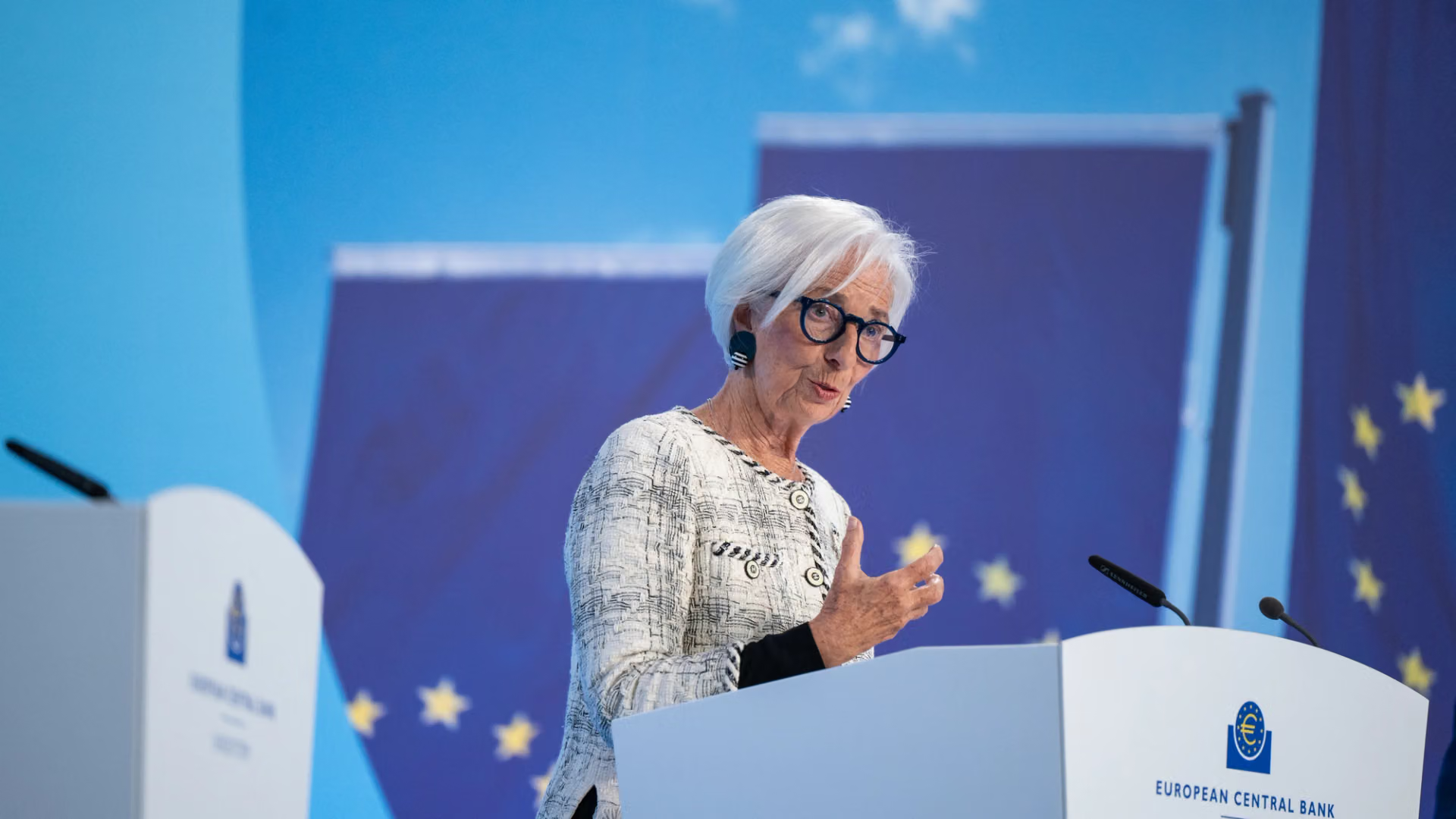
The European Central Bank (ECB) launched Pontes on Monday, a platform that enables banks and other eligible financial institutions to settle tokenized-asset transactions in central-bank money.
ECB President Christine Lagarde announced the go-live at a Eurogroup meeting on Friday.
“Now, Pontes is, to summarize it quickly for you, it’s a digital euro made available for banks so that they can transact amongst themselves using tokenized assets and distributed ledger technology,” said Lagarde during a Eurogroup summit on Friday.
Pontes links market distributed-ledger technology platforms to the Eurosystem’s TARGET Services, enabling participating banks to settle tokenized wholesale transactions in central-bank money. It will only be available to eligible financial institutions and market infrastructure providers.
Tokenized bonds, funds and other financial assets need a reliable way to settle the cash side of a trade. Pontes gives European institutions a central-bank-money option, rather than requiring them to rely solely on stablecoins or tokenized commercial-bank deposits.
The platform is part of the ECB’s broader effort to keep central-bank money at the core of Europe’s increasingly tokenized financial markets. The ECB has said Pontes will be developed in stages, alongside its longer-term Appia initiative for wholesale tokenization.

Two Cambridge chefs in the running to be crowned best in the UK

The Real Cost of Falls From Height at Work

Worried About Hugging Face? Microsoft and Amazon Got Exposed Most Among Hyperscalers




-

 Fashion3 days ago
Weekend Open Thread: Talbots – Corporette.com
-

 Tech13 hours ago
Researchers escape OpenAI Codex sandbox to run commands on host
-

 Crypto World2 days ago
Circle launches Arc Studio AI agent for building onchain apps
-

 Crypto World7 days ago
Revolut Attackers Warn of Ongoing Daily Customer Data Leaks
-
 NewsBeat3 days ago
Trump says US has reached an agreement to take permanent control of Greenland’s security
-

 Crypto World6 days ago
Kraken Lets xStocks Holders Earn Yield Through DeFi
-

 Crypto World6 days ago
Robinhood engineers charged over $50K crypto scheme
-

 Crypto World3 days ago
Bitcoin price breaks channel as RSI climbs to 63
-

 Crypto World5 days ago
What Is the Status of the U.S.-Iran Peace Talks? Here's What Both Sides Are Saying
-

 Crypto World5 days ago
US Charges Robinhood Engineers Over Crypto Listing Trades
-

 Crypto World7 days ago
Elon Musk Drops a Bombshell: Grok 5 Could Be the AGI Breakthrough
-
 NewsBeat7 days ago
‘Sick conspiracy’: Trump says only guardrails AI needs is ‘a strong and smart (High IQ!) president’ in all-caps rant
-
Business7 days ago
SK Hynix ADRs Fall More Than 6% as Memory Rally Breaks on Fears of Slower AI Spending
-
 Crypto World6 days ago
NVIDIA Analysis: Attempted Rising Wedge Breakout Amid Pressure on the AI Sector
-

 Tech5 days ago
Webb’s IC 348 Mosaic Includes Two-Jupiter Dwarfs, Twin Jets, and a Nursery Still Making Worlds
-
Crypto World7 days ago
Can Circle’s Arc Repeat Robinhood Chain’s Meme Coin Boom?
-

 Crypto World2 days ago
World Money launches in 150+ countries with Stripe
-

 Crypto World3 days ago
Silver prices recover quickly, hitting weekly high today
-
 NewsBeat3 days ago
US was ‘on brink of war’ with China over false AI report of nukes moving in Middle East
-

 Crypto World7 days ago
DOJ Seeks to Seize $61M in Iran Oil Funds From Binance Accounts It Vouched For
You must be logged in to post a comment Login