
Crypto World
Argentina Congress Blocks Right To Take Salary In Crypto



Argentine fintech groups had welcomed the possibility that, for the first time, workers could deposit their salaries into virtual wallets. However, lawmakers removed the provision, a move widely seen as favoring traditional banking interests.
During negotiations to secure broader support for the bill, President Javier Milei’s party agreed to exclude the article, despite polls indicating that a large majority of Argentines prefer the freedom to choose where their salaries are deposited.
Sponsored
Distrust In Banks Drives Wallet Adoption
Argentine law today stipulates that workers must deposit their salaries into traditional bank accounts. Despite that law, digital wallet adoption in Argentina has soared over the past few decades.
In part, that growth reflects limited access to banking. A 2022 Central Bank survey found that only 47% of Argentines had a bank account, a gap largely driven by longstanding distrust of traditional systems.
Decades of financial instability, including the 2001 “corralito” deposit freeze, persistent inflation, and repeated restrictions on access to funds, have eroded public trust in banks and accelerated a shift toward cash and dollar-denominated savings.
In response, fintech-run digital wallets, operated by non-bank payment service providers, have expanded access to financial services across Argentina.
Sponsored
Platforms such as Mercado Pago, Modo, Ualá, and Lemon now rank among the most widely used. Many users without access to traditional bank accounts rely on these apps as their first point of entry into the formal digital financial system.
That’s why fintech leaders welcomed a provision that would have allowed Argentines to deposit their salaries directly into virtual wallets. However, the article was cut out of the proposed labor reform before it was even debated in Congress.
“The exclusion of Article 35 from the labor reform eliminated the possibility for Argentinians to freely choose where to receive their salary. In practice, the obligation to channel salaries through traditional banks was maintained, following strong pressure from the sector,” Maximiliano Raimondi, CFO of Lemon told BeInCrypto. “Governing involves negotiation, but it’s paradoxical that in a context where economic freedom is a central tenet, there has been a setback on a point that expanded a concrete freedom.”
That setback followed an intense lobbying effort by Argentina’s banking sector, which moved quickly to block the proposal.
Sponsored
Political Trade Off Favors Banks
Banking associations sent letters to key senators this week outlining their objections to allowing salary deposits into digital wallets.
They argued that digital wallets lack adequate regulation, pose potential systemic risks, and could deepen financial exclusion.
“They do not have a regulatory, prudential or supervisory framework equivalent to that of banks and their approval would generate legal, financial, asset and systemic risks that would directly affect workers and the functioning of the financial system,” said Banco Provincia, a leading Argentine bank, in a statement.
Sponsored
Fintech organizations pushed back, arguing that these claims were false.
“All Payment Service Providers (PSPs) are regulated and supervised by the Central Bank of Argentina (BCRA)… digital wallets were the gateway to financial services for millions of people who were able to open a virtual account easily and free of charge, and access better financial solutions,” Lemon said in a statement.
A recent study by consulting firm Isonomía also found that 9 out of 10 Argentines wanted the option to choose where to deposit their salaries. The tendency was even stronger among independent workers and those who work in the informal sector. The report also revealed that 75% of Argentines already use digital wallets daily.
Ultimately, the banking sector prevailed before the bill reached a Senate vote. According to reports, the government removed the provision to avoid straining relations with banks and to improve the bill’s chances of securing final approval.


Venture capital firm Paradigm is reportedly developing a prediction markets trading terminal aimed at professional traders and market makers, according to Fortune.
Paradigm partner Arjun Balaji is spearheading the effort, which sources say has been underway since the late 2025.
The venture capital firm has been one of the most active backers of Kalshi, a leading prediction market platform. The firm participated in three successive funding rounds for Kalshi in 2025.
The prediction market platform recently raised more than $1 billion in a new round, pushing its valuation to $22 billion.
“Matt Huang, the venture firm’s cofounder and managing partner, is on the startup’s board of directors. Paradigm’s development of a prediction markets trading terminal isn’t competitive with Kalshi’s platform, said a source,” the report read.
Follow us on X to get the latest news as it happens
Beyond the terminal, sources suggest that Paradigm has considered establishing an internal market-making desk. A separate source said the firm has also engaged researchers to explore the feasibility of creating prediction market indexes.
Meanwhile, Paradigm has started to collect prediction market data into a public dashboard.
A Sector Gaining Institutional and Retail Momentum
Paradigm’s infrastructure push arrives at a time of rapid growth. Prediction market transactions surpassed a record high of 207 million in March, according to Dune data.
Monthly notional volume reached roughly $25.7 billion, up from $1.2 billion in early 2025. Meanwhile, major exchanges are also moving into the space. Binance is beta-testing an in-app prediction market feature inside its Wallet app.
Coinbase unveiled its prediction market offering through a partnership with Kalshi in January. Moreover, Crypto.com launched a standalone platform called OG.
Subscribe to our YouTube channel to watch leaders and journalists provide expert insights
The post Paradigm Targets Pro Traders and Market Makers in Latest Prediction Markets Push appeared first on BeInCrypto.
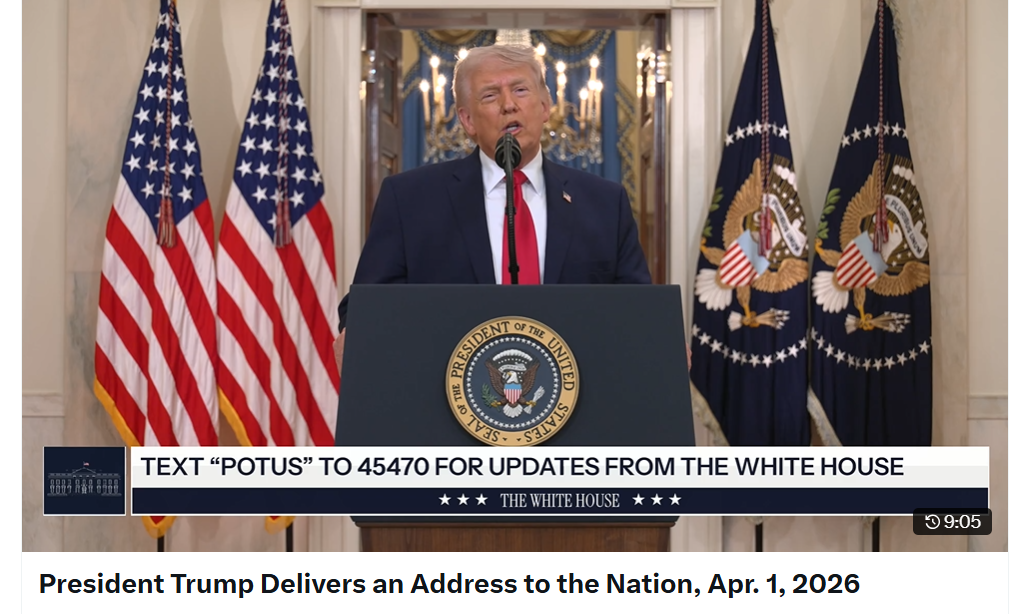
Crude oil rose to over $100 a barrel while Bitcoin fell 2% after a national address by US President Donald Trump on the conflict in Iran, where he vowed to hit Iran “extremely hard” over the next few weeks.
Speaking at the White House on Wednesday during an address to the nation, Trump said the US military is “very close” to finishing “Operation Epic Fury,” claiming to have wiped out Iran’s nuclear and naval capabilities while also significantly hampering its drones, missiles and weapon factories.
“I can say tonight that we are on track to complete all of America’s military objectives shortly. Very shortly, we are going to hit them extremely hard over the next 2 to 3 weeks.”
Stocks, crude oil, and crypto prices have been impacted by conflict in the Middle East over the last few months. Oil prices eased on Tuesday after Trump said the war would be wrapping up in the next few weeks, though his latest speech has seen it rise again.
At the time of writing, the price of crude oil has spiked back above $100 per barrel to $103.59. Meanwhile, Bitcoin dipped by around 1% over the course of the speech and has since fallen further to $66,904, down 2% since the start of the speech.
However, Trump also said discussions are ongoing. Both sides have made key demands for ending the conflict, with the US pushing for Iran to dismantle its nuclear programs, open up commercial shipping channels and stop regional support for proxy groups.
Iran wants a permanent end to the war, compensation for damages and an end to US military presence in the region, among other demands.
“The new group is less radical and much more reasonable. Yet, if during this period of time no deal is made, we have our eyes on key targets.”

Trump says oil blockade will end soon
Conflict in the Middle East intensified in February after the US and Israel launched strikes against Iran. This ultimately saw Iran respond by leading a blockade of the Strait of Hormuz in a bid to cut oil supply on one of the world’s busiest shipping channels.
Related: Who is Kevin Warsh? Trump’s Fed pick wants ‘regime change’ at central bank
The president claimed that the stock market will pick back up soon as the conflict begins to wind down, while gas prices will drop as he argued that Iran will remove the blockade “naturally” so that it can start rebuilding the economy.
“And in any event, when this conflict is over, the strait will open up naturally. It’ll just open up naturally. They’re going to want to be able to sell oil because that’s all they have to try and rebuild. It will resume flowing and the gas prices will rapidly come back down. Stock prices will rapidly go back up,” he said.
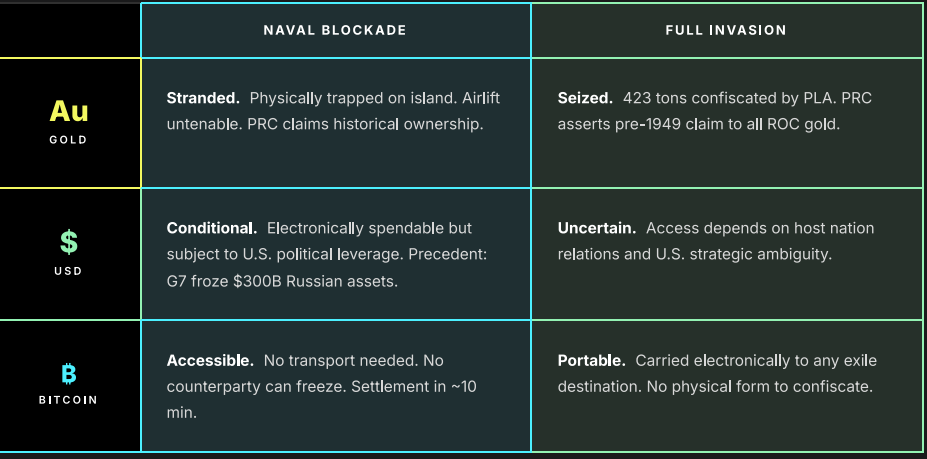
Taiwan should reconsider adopting Bitcoin as a reserve asset to hedge against global turmoil and the risk of war, according to a research fellow at the Bitcoin Policy Institute.
In a report on Tuesday, Jacob Langenkamp said that should China pursue reunification with Taiwan by military force, either through a blockade or full invasion, Bitcoin (BTC) would be the only reserve asset that would remain fully accessible and spendable.
“Uniquely for Taiwan, Bitcoin provides geopolitical resilience: in a PRC blockade or invasion, gold is stranded or seized and USD reserves face potential restrictions, but Bitcoin remains fully accessible without physical transport,” he added.

Nation-states have begun to explore the idea of launching strategic Bitcoin reserves, seen as a bullish signal for Bitcoin.
Last year, Taiwan’s central bank sought to investigate establishing a national Bitcoin reserve. However, the bank ruled it out in December, citing volatility, liquidity and custody concerns and instead identified the US dollar as a safer alternative.
US currency debasement is a risk to Taiwan: Langenkamp
Taiwan is heavily exposed to the risks of US dollar debasement, Langenkamp said, because its central bank reserves are at least 80% in USD-denominated assets, as is most of its trade.
Growing US debt, Federal Reserve monetary expansion, a potential AI market downturn and declining semiconductor revenues could also accelerate dollar debasement, he said.

“Bitcoin can couple with gold to offer that hedge against USD debasement. It can provide another opportunity for the CBC to adopt a reserve asset before its peers and benefit the people of Taiwan with the subsequent price appreciation,” Langenkamp added.
“It can offer geopolitical insurance against scenarios that hopefully do not come to pass. It can open new methods of trade with less friction. Bitcoin can provide Taiwan with a great measure of monetary resilience.”
Related: US Bitcoin reserve still has no plan to stack sats
Langenkamp also argued that the CBC’s concerns about Bitcoin’s liquidity and volatility are valid, but contended that both issues will diminish as the asset matures and gains adoption among nations.
“The CBC’s concerns are valid but addressable with institutional expertise on custody, liquidity, and volatility,” he added.
Taiwan has at least 210 Bitcoin
Despite ruling out a Bitcoin reserve for now, the CBC committed to testing the technology further in a digital asset sandbox using the crypto the country already holds.
Taiwanese lawmaker Ko Ju-Chun revealed on X last year that the country’s Ministry of Justice holds 210 Bitcoin, worth $14 million, confiscated during criminal investigations.
BitBo doesn’t list Taiwan in its country reserve rankings; its disclosed holdings would make it the seventh-largest national Bitcoin holder, behind El Salvador but ahead of Finland.
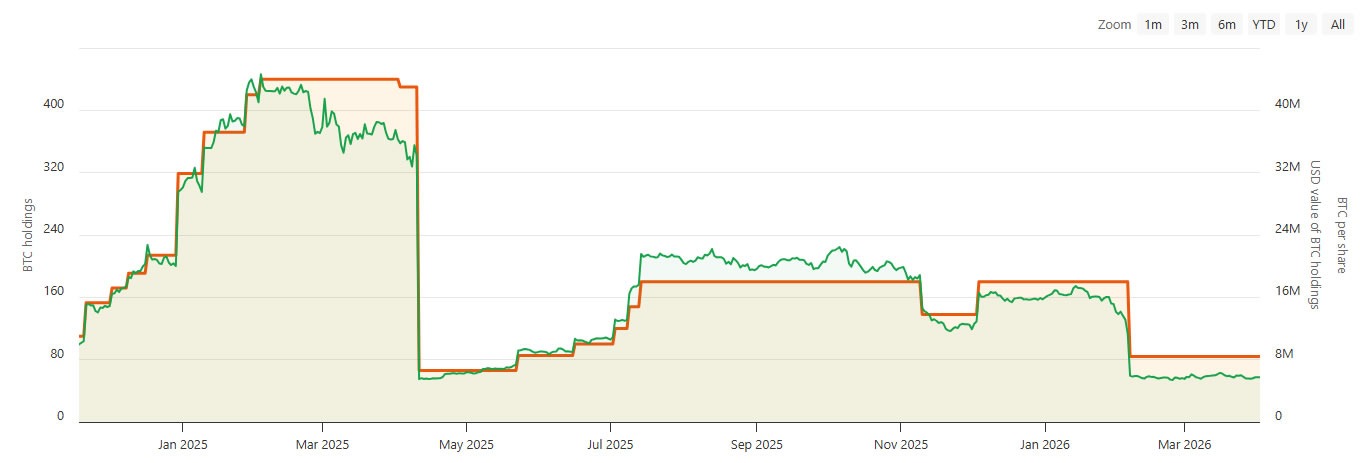
AI-powered Bitcoin treasury and education company Genius Group revealed on Tuesday that it sold the remainder of its Bitcoin in Q1 to pay off debt, adding to a recent wave of companies offloading assets amid a crypto bear market.
“The company will recommence building its Bitcoin Treasury when it believes market conditions are more favorable,” it stated.
The move appears to go against its “Bitcoin first” strategy, which it touted in November 2024, vowing at the time to commit 90% or more of its current and future reserves to be held in Bitcoin.
Genius Group held 84 BTC worth around $5.7 million as of March 2026, but holdings have declined since April 2025, around the time it was temporarily barred by a US court from expanding its Bitcoin treasury. It resumed buying in June of that year.
The recent announcement came as Genius Group reported strong results in Q1, with revenue up 171% year-on-year to $3.3 million and gross profit up 228% to $2 million. The company swung from a $500,000 operating loss in Q1 2025 to a $2.7 million net profit in Q1 2026.

Bitcoin treasuries liquidating in 2026
Genius Group is not the only Bitcoin-related company to offload assets in recent months.
MARA Holdings sold 15,133 BTC for around $1.1 billion in March, dropping its treasury to 38,689 BTC and down to the third largest corporate Bitcoin treasury, behind Twenty One Capital.
The proceeds were used to repurchase approximately $1 billion of convertible senior notes and the remainder for general corporate purposes.
Related: Bhutan offloads another $37M in Bitcoin as sovereign wallet shrinks
Meanwhile, mining company Bitdeer liquidated its entire stash of 943 BTC and sold newly mined coins, cutting corporate holdings to zero in February.
Other notable recent sales include Bitcoin miner Cango Inc., which sold 4,451 BTC, and AI tech firm GD Culture Group, confirming authorization of the sale of some of its 7,500 BTC treasury in February.
Stalwart Strategy keeps on buying
Michael Saylor’s Strategy, the world’s largest corporate Bitcoin treasury, has bucked the trend and has continued buying Bitcoin, dominating purchases this year.
“Strip out Strategy, and the rest of the ecosystem’s buying pace has collapsed,” reported BTC mining analytics outlet BitcoinMiningStock in March.
The firm’s last purchase was 1,031 BTC on March 23, and it has accumulated 89,581 BTC worth around $6.1 billion at current market prices so far this year, according to the Saylor Tracker.
Magazine: Nobody knows if quantum secure cryptography will even work
US-listed spot Bitcoin ETFs ended the first quarter of 2026 in negative territory. March did see a return of inflows, but that came only after two straight months of steady withdrawals.
Summary
- US spot Bitcoin ETFs ended Q1 2026 with about $500 million in net outflows, as early-quarter redemptions outweighed March inflows of $1.32 billion.
- Ether ETFs saw $769 million in quarterly outflows, while Solana funds attracted $213 million.
Figures from SoSoValue show that the funds added $1.32 billion in March and ended a dry spell that had lasted since October 2025.
Yet the inflows were not enough to offset the heavy redemptions that occurred in January, when $1.61 billion was pulled from the funds. Subsequently, February saw further withdrawals of $207 million, leaving the quarter with roughly $500 million in net outflows.
Outflows picked up pace as Bitcoin fell by more than 22% over the quarter, extending losses after a 23% drop in the final quarter of 2025. Consecutive declines across two quarters added pressure on investor positioning and fund flows.
Investor sentiment remained fragile even as capital returned in March. Readings from the Crypto Fear & Greed Index stayed under 20 for most of the month, a range tied to “Extreme Fear.”
Even under those conditions, ETF inflows picked up toward the end of the quarter. Some analysts link that resilience to continued institutional participation, despite uncertainty tied to geopolitical tensions in the Middle East.
However, trading activity slowed, with spot Bitcoin ETF volumes falling to around $79 billion in March, compared with $93 billion in February and $87 billion in January. By the end of the quarter, cumulative inflows into the segment reached close to $56 billion, while total assets under management stood near $87.5 billion.
Spot Ether ETFs recorded the largest quarterly losses among altcoins at about $769 million. These products have recorded three consecutive months of outflows after closing March with $46 million in net withdrawals.
XRP ETFs also recorded outflows in March with roughly $31 million exiting the funds. Earlier inflows kept the quarterly figure positive, with net additions of roughly $43 million.
Meanwhile, Solana ETFs brought in a combined $213 million over the quarter. Since their launch in October 2025, they have yet to post a month of net outflows.
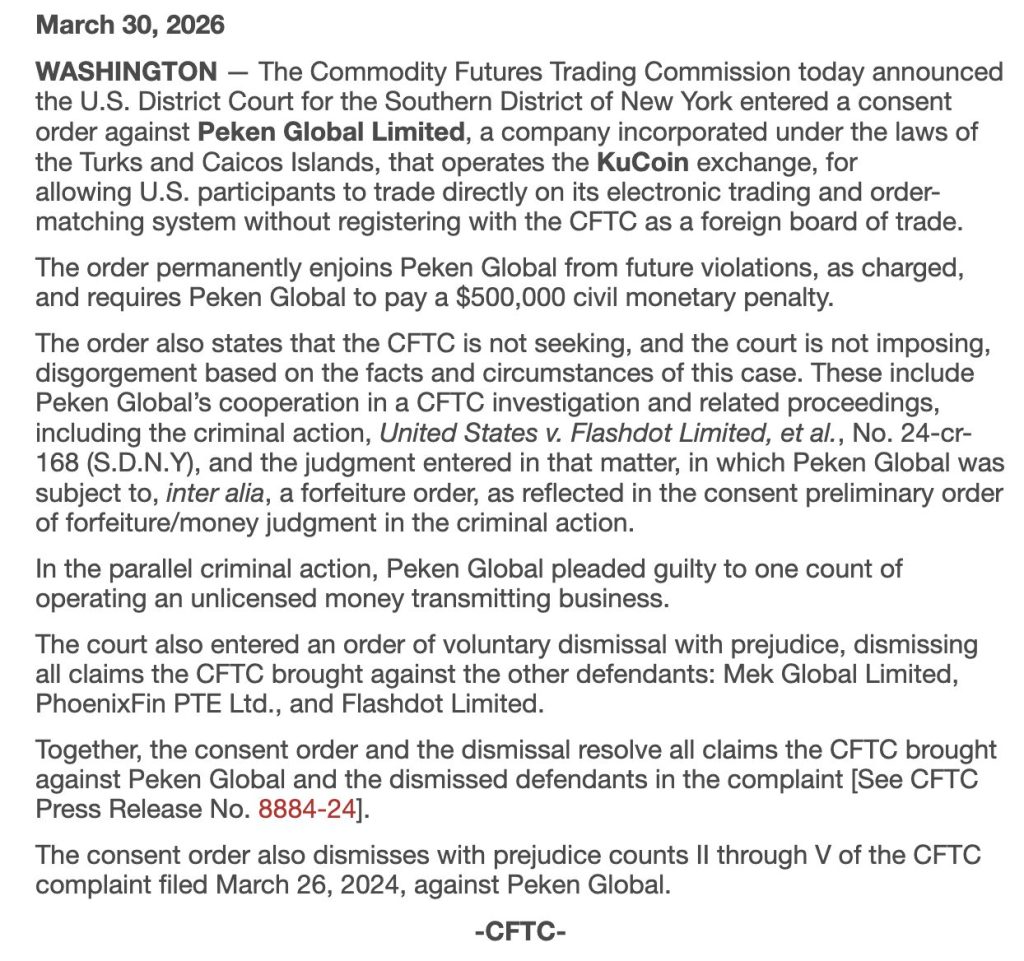
The CFTC has fined Peken Global Limited – the KuCoin operating entity – $500,000 and issued a permanent injunction barring the exchange from serving U.S. traders, closing a civil enforcement loop that began with a March 2024 complaint against the platform for running an unregistered futures commission merchant and swap execution facility.
The order mandates active blocking of U.S. user access, not merely a policy update – KuCoin must implement technical controls to prevent American traders from opening accounts or accessing derivatives products.
That requirement, paired with the $297 million the exchange already forfeited under a January 2025 DOJ guilty plea, makes this one of the most consequential offshore exchange enforcement sequences in CFTC history.
- Penalty Amount: $500,000 civil fine levied against Peken Global Limited by the CFTC
- Restriction Scope: Permanent injunction barring KuCoin from onboarding or serving U.S. traders across spot and derivatives products
- Prior Resolution: $297 million in penalties and forfeitures under January 2025 DOJ guilty plea; 1.5 million registered U.S. users generated at least $184.5 million in fees
- Precedent Signal: CFTC isolated liability to Peken Global; claims against Mek Global, PhoenixFin, and Flashdot were dismissed in the final order
What the CFTC Order Actually Requires – and What the $500K Kucoin Charge Covers
The CFTC’s civil complaint, filed March 26, 2024, in the U.S. District Court for the Southern District of New York, charged KuCoin’s operators with violating the Commodity Exchange Act across a four-year window – July 2019 to June 2023 – by operating as an unregistered futures commission merchant and swap execution facility without the required CFTC registration.
The complaint also alleged sham KYC procedures: KuCoin publicly claimed U.S. users couldn’t access the platform while simultaneously allowing them through via VPN with no IP-level restrictions in place.
The final order isolates the $500,000 civil monetary penalty to Peken Global Limited – the entity the CFTC determined held primary operational liability. Claims against affiliated entities Mek Global Limited, PhoenixFin PTE Ltd., and Flashdot Limited were dismissed.
That distinction matters: the CFTC is not pursuing a blanket penalty across the corporate structure but targeting the specific operator responsible for U.S.-facing derivatives access.
CFTC Enforcement Director Ian McGinley framed the issue directly: “For too long, some offshore crypto exchanges have followed a now-familiar playbook by offering derivative products and falsely claiming people in the United States cannot use their platforms.” The $500,000 fine covers the civil derivatives violations – it is separate from, and much smaller than, the $297 million resolved through the parallel DOJ criminal track.
Discover: Best Crypto Exchanges for Active Traders in 2026
What U.S. Traders Actually Lose – and How This Compares
The injunction covers the full scope of KuCoin’s U.S.-facing access – derivatives trading, account creation, and ongoing service to existing American accounts.
KuCoin had roughly 1.5 million registered U.S. users before its partial July 2023 KYC rollout, which itself was triggered by knowledge of the federal probe and excluded millions of existing users. Those accounts are now subject to forced exit under the permanent bar.
The products at stake are not marginal. KuCoin offered leveraged perpetual futures and margin trading – the same derivatives categories that put BitMEX and, later, Binance in the CFTC’s crosshairs.
For active traders who relied on KuCoin for offshore derivatives access, the injunction closes that channel permanently, not provisionally. There is no compliance pathway back to U.S. market access under this order.
The practical consequence is straightforward: U.S. traders holding open positions or balances on KuCoin need to treat this as a wind-down event, not a temporary disruption.
The broader question – whether centralized exchange platforms serving U.S. users can sustain their market share amid accelerating enforcement – is now sharper than ever.
Discover: Top Crypto Presales to Watch Before They Launch
The post KuCoin Ordered to Block US Traders and Pay $500,000 CFTC Penalty appeared first on Cryptonews.
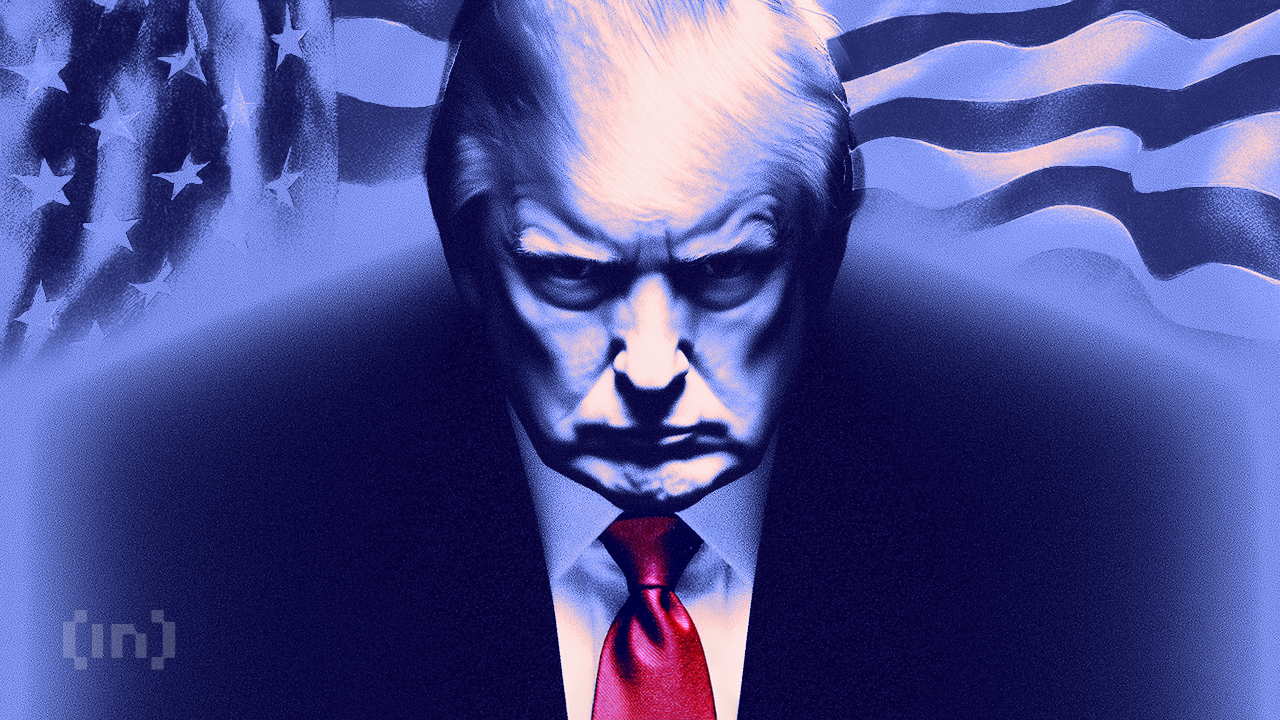
President Donald Trump delivered his first prime-time address on the Iran war on Wednesday night. He told the nation that “core strategic objectives are nearing completion.” He then promised to escalate.
Oil was falling when Trump started talking. It was up 5% by the time he stopped — and that tells the whole story.
Markets Expected Peace. They Got ‘Stone Ages.’
“We are going to hit them extremely hard over the next two to three weeks,” Trump said. “We’re going to bring them back to the Stone Ages, where they belong.”
The speech lasted 19 minutes. It contained no new information, no timeline to end the war, and no plan to reopen the Strait of Hormuz. Markets had spent two days rallying on hopes that Trump would announce an off-ramp. Instead, he promised more bombs.
Brent crude surged 5% to above $106 per barrel. West Texas Intermediate jumped 4.1% to $104. The S&P 500 futures fell 1.1%. European futures dropped 1.5%. Gold lost 1.4% to $4,691 per ounce. Silver fell 3%. The 10-year Treasury yield climbed to 4.36%.
Bitcoin dropped from an intraday high of $69,135 to $66,818, a 3.3% decline. Ethereum fell 2.8% to $2,084. The entire two-day relief rally in crypto evaporated in a single evening.
Asia took the hardest hit. South Korea’s KOSPI fell 3.5%, the worst performer in the region. Japan’s Nikkei lost 1.8%. Hong Kong’s Hang Seng dropped about 1%.
‘Just Take It’ — Trump Tells Allies to Secure Hormuz
Trump said the Strait of Hormuz would “open up naturally” once the war ends. He urged oil-importing nations to “build some delayed courage” and secure the waterway themselves. He did not explain how or when that might happen.
Hours earlier, at a White House Easter lunch, Trump was more blunt. He said the US could “just take their oil,” but added that Americans lack “the patience” for it. He also named South Korea, Japan, and China directly, telling each to step up on Hormuz.
That message landed hard in Seoul. The KOSPI’s 3.5% decline reflected both energy import vulnerability and the shock of being singled out by the US president.
Trump also dropped his April 6 deadline threat to bomb Iran’s power grid. He made no mention of NATO, ground troops, or ongoing negotiations. The absence of specifics was itself a signal. Investors had hoped for clarity. They received ambiguity.
Iran Holds Firm, Toll Booth Stays Open
Iran showed no interest in backing down. Foreign Minister Abbas Araghchi said there are no direct negotiations with Washington and that Tehran’s trust in the US stands at zero. President Masoud Pezeshkian posted an open letter in English asking Americans which of their interests this war truly serves.
Meanwhile, Iran’s parliament continues working on legislation to make its Hormuz toll system permanent. The IRGC already charges vessels up to $2 million per transit, settled in stablecoins or Chinese yuan. If codified into law, this regime would outlast any ceasefire.
That is the gap the market is now pricing in. Trump says the strait will open naturally. Iran is building a toll booth designed to last forever. Oil traders, bond traders, and crypto traders all reached the same conclusion Wednesday night: this war is not ending soon.
The post Trump’s ‘Stone Ages’ Threat Sends Bitcoin Below $67K appeared first on BeInCrypto.
Hyperliquid price is close to confirming multiple bullish patterns as futures traders show increased interest in the token.
Summary
- Hyperliquid price has risen up 22% over the past month, supported by rising open interest and increased futures market activity.
- Growth in commodity perpetuals and event-based contracts, alongside rising trading volumes, has boosted token demand through increased burn mechanisms.
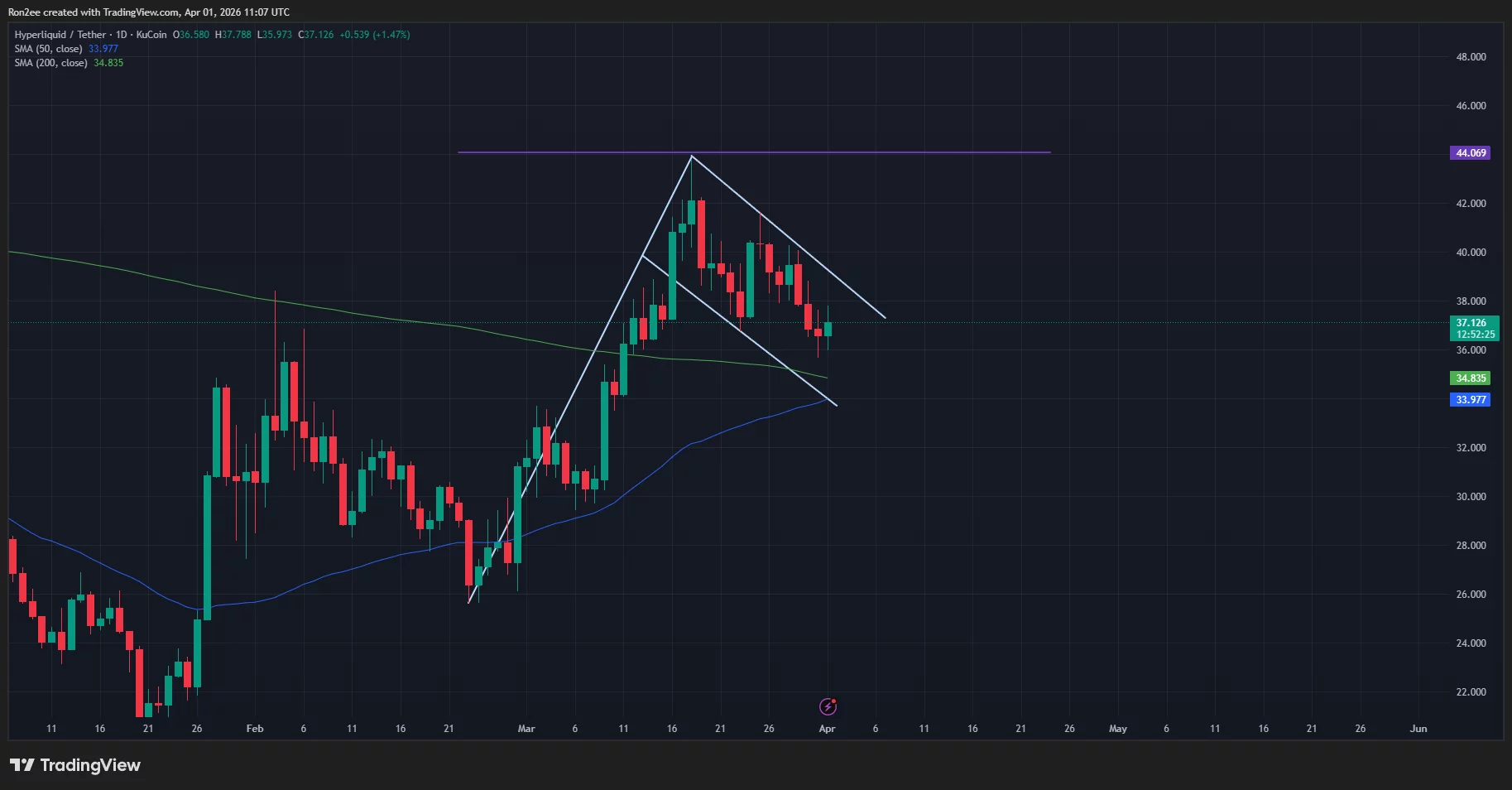
- Technical setup shows a bullish flag and a potential golden cross, with upside targets near $44, while a drop below $34.8 could invalidate the bullish outlook.
According to data from crypto.news, Hyperliquid (HYPE) price was trading at $36.9, up 22% over the past month and 78% higher than its year-to-date low.
Hyperliquid price rallied as it witnessed a massive surge in real-world asset trading volumes.
Notably, following the implementation of HIP-3, which expanded the protocol capabilities, investors can now trade decentralized perpetual contracts on commodities like gold, silver, and crude oil.
Amidst escalating tensions in the Middle East, a massive jump in volume was observed in Hyperliquid’s 24/7 crude oil perpetuals, which topped $1 billion in a single day in March.
Unlike traditional markets, Hyperliquid provides round-the-clock access to its commodity markets, making it a pressure valve for macro traders amidst geopolitical events that often unfold over the weekend.
Furthermore, the project’s expansion into prediction markets from its introduction of event-based contracts has added another layer of utility and attracted fresh participants who can now trade on the outcome of real-world events natively alongside their futures positions.
In the last 24 hours, open interest on Hyperliquid hit over $1.61 billion. A surge in open interest suggests more active participation from traders and is a sign that the current trend has significant backing.
The HYPE token has also benefited from increased trading volumes. Trading volumes on the platform have hit a record high of over $2.4 billion.
As Hyperliquid’s Assistance Fund uses up to 97% of protocol fees to buy back and burn HYPE tokens, the latest surge has significantly increased the burn rate of tokens and hence has helped drive the asset price higher through deflationary pressure.
On the daily chart, Hyperliquid price has formed a bullish flag pattern after a steep vertical move known as a pole, followed by a brief period of consolidation. A bullish flag is one of the most well-known bullish continuation patterns in technical analysis.
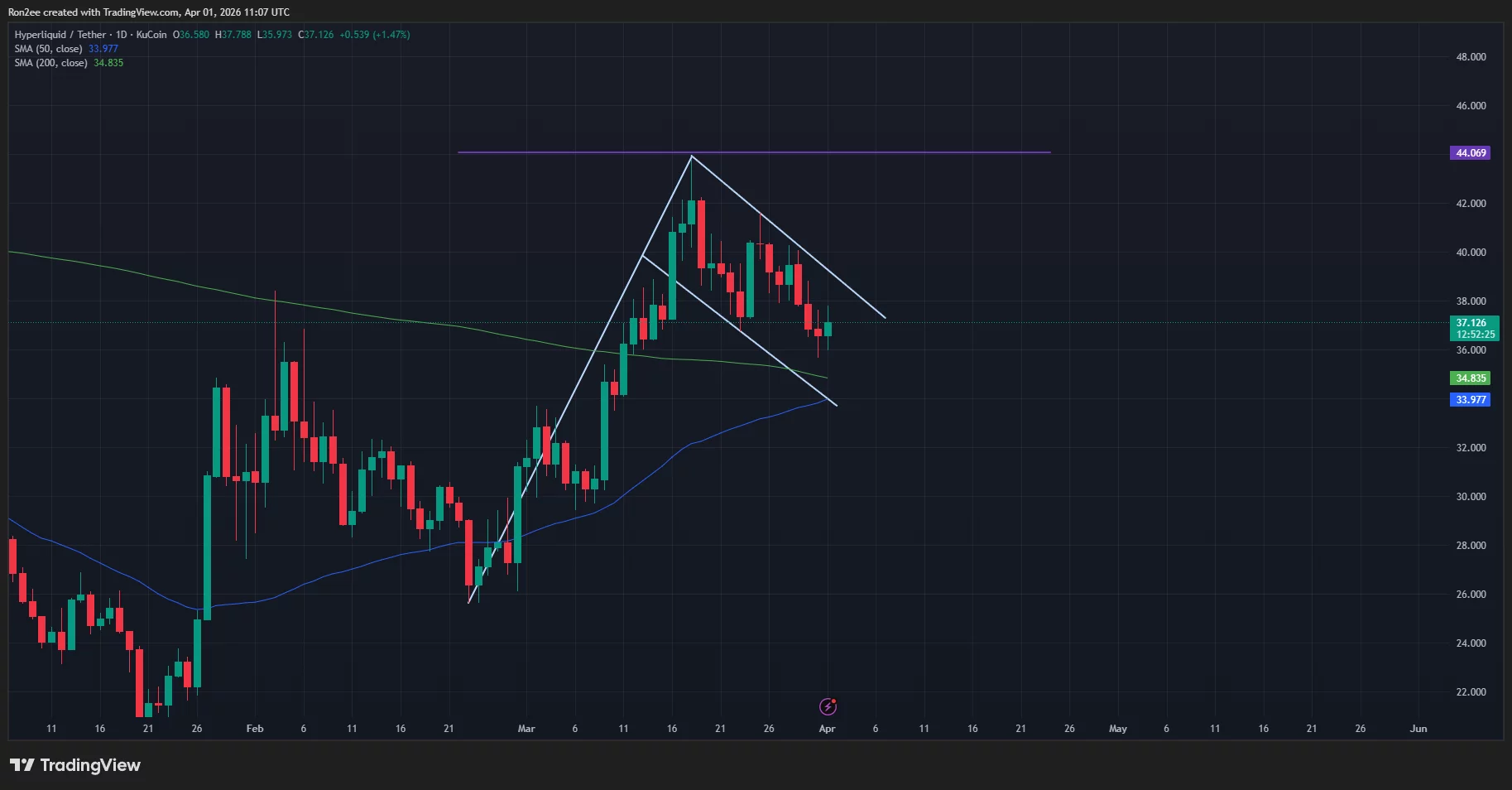
It is also close to confirming a golden cross, which occurs when the 50-day SMA crosses over the 200-day SMA. Traders view such pattern confirmations as a major signal of long-term trend reversal and sustained buying momentum.
Hence, if a golden cross is confirmed, Hyperliquid price would likely confirm the bullish flag pattern, which would propel it toward the upside of $44, the highest point of the flag formation. A breakout above it could set the stage for a push toward new all-time highs.
On the contrary, if Hyperliquid price drops below the 200-day SMA at $34.8, the bullish thesis would be invalidated and could lead to further downside.
Disclosure: This article does not represent investment advice. The content and materials featured on this page are for educational purposes only.

Li Xiong, a key member of a group that allegedly helped crypto scam rings in Asia to move money, has been extradited from Cambodia to China, where he will face fraud and money laundering charges, according to Hong Kong-based news outlet Ta Kung Wen Wei.
“On April 1, with strong support from the relevant authorities in Cambodia, a task force sent by China’s Ministry of Public Security successfully escorted Li Xiong, a core key member of the Chen Zhi criminal syndicate, back to China from Phnom Penh, Cambodia,” it said on Wednesday, citing a statement from China’s Ministry of Public Security on WeChat.
Xiong previously served as chairman of Huione Group, an alleged criminal organization that served scam centers in Cambodia that carried out “pig butchering” scams and other investment schemes to steal crypto from victims around the world.
Huione Group was responsible for one of the largest illicit online marketplaces in the world, handling over $89 billion in cryptoassets.

His extradition comes three months after the arrest of Chen Zhi, the head of Prince Group, which operates Huione Group. In October, it was reported that the US Department of Justice seized 127,271 Bitcoin (BTC) worth more than $15 billion from Zhi.
Related: Hong Kong retiree loses $840K in triple ‘crypto expert’ scam
The US Treasury Department’s Financial Crimes Enforcement Network directed US banks to cut payments and accounts tied to the Huione Group in October.
Authorities ask other Huione members to surrender
Ta Kung Wen Wei noted that several other members of Zhi’s criminal syndicate have been brought to justice “one after another,” citing comments from Chinese public officials.
“Public security authorities will continue to intensify efforts to capture fugitives,” it said, adding:
“At the same time, they once again warn criminals to recognize the situation, stop before it is too late, surrender as soon as possible, and strive for lenient treatment.”
Magazine: Banks want to run Vietnam’s crypto exchanges, Boyaa’s $70M BTC plan


The United States Department of Justice has brought charges against 10 individuals for allegedly manipulating digital asset prices through so-called “pump-and-dump” schemes.
Summary
- The US Department of Justice charged 10 individuals linked to four crypto market making firms for alleged pump and dump schemes dating back to 2018.
- Prosecutors said the group inflated trading volumes through wash trading and coordinated transactions before selling assets to unsuspecting investors at higher prices.
- Three of the defendants were extradited from Singapore to the US.
In a Tuesday press release, federal prosecutors alleged that the defendants conspired to artificially inflate trading volumes and cryptocurrency prices before selling to unwitting investors at inflated valuations. The case centers on four market maker firms, Gotbit, Vortex, Antier, and Contrarian, with the incident dating back to 2018.
The cases have unfolded over the years, with the first phase emerging in October 2024, followed by the Gotbit-related indictment filed in March 2025, subsequently expanding with a Vortex case in August 2025 and further charges tied to Contrarian and Antier in September 2025.
Three defendants, including Vortex CEO Gleb Gora, Contrarian CEO Manu Singh, and Contrarian employee Vasu Sharma, have been arrested in Singapore and extradited to the United States, where they appeared in federal court on Monday.
The indictments claim that the defendants employed tactics including wash trading, matched orders, and other prearranged transactions to generate fake volume and support token prices, creating the illusion of genuine market demand.
“These so-called pump-and-dump schemes caused losses to investors in the United States and elsewhere,” prosecutors said. The release noted that authorities have seized more than $1 million in cryptocurrency.
Gotbit founder Aleksei Andriunin had already pleaded guilty in 2025 and agreed to forfeit approximately $23 million in crypto assets as part of a plea deal.
The DOJ has previously brought related charges against CLS Global through an FBI undercover operation, which used a bureau-created token to expose alleged market manipulation services.

All-time Fast Money score! (For the wrong reasons.)
Easter bank holiday 2026 opening times for DVLA and DWP contact centres

Oil jumps and shares fall after Trump Iran address


-

 Business6 days ago
Instagram, YouTube Found Responsible for Teen’s Mental Health Struggle in Historic Ruling
-
 Tech7 days ago
Intercom’s new post-trained Fin Apex 1.0 beats GPT-5.4 and Claude Sonnet 4.6 at customer service resolutions
-

 NewsBeat5 days ago
The Story hosts event on Durham’s historic registers
-

 Sports5 days ago
Sweet Sixteen Game Thread: Tide vs Michigan
-
Entertainment3 days ago
Fans slam 'heartbreaking' Barbie Dream Fest convention debacle with 'cardboard cutout' experience
-
 Entertainment4 days ago
Lana Del Rey Celebrates Her Husband’s 51st Birthday In New Post
-
Crypto World2 days ago
Dems press CFTC, ethics board on prediction-market insider trades
-

 Tech3 days ago
The Pixel 10a doesn’t have a camera bump, and it’s great
-

 Crypto World8 hours ago
Gold Price Prediction: Worst Month in 17 Years fo Save Haven Rock
-

 Sports2 days ago
Tallest college basketball player ever, standing at 7-foot-9, entering transfer portal
-

 Tech2 days ago
EE TV is using AI to help you find something to watch
-

 Tech3 days ago
Apple will hide your email address from apps and websites, but not cops
-

 Tech2 days ago
Flipsnack and the shift toward motion-first business content with living visuals
-

 Tech2 days ago
How to back up your iPhone & iPad to your Mac before something goes wrong
-

 Fashion7 days ago
En Vogue in Brown Leather and Tailored Neutrals by Atelier Savoir, Styled by J Bolin
-

 Politics2 days ago
Should Trump Be Scared Strait?
-

 Crypto World2 days ago
U.S. rule change may open trillions in 401(k) funds to crypto
-

 Fashion7 days ago
What Are Your Favorite T-Shirts for the Weekend?
-

 Fashion6 days ago
Weekly News Update, 3.27.26 – Corporette.com
-

 Fashion4 days ago
Amazon Sundays: Soft Spring Layers
You must be logged in to post a comment Login