

Crypto World
As Mass Adoption Approaches, Crypto Has Forgotten Its Roots



Opinion by: Dr Corey Petty, chief evangelist at Logos
When early cryptocurrencies were conceptualized, the vision was not one of complex leverage strategies, celebrity rugpulls and government treasuries. Rather, cypherpunks sought, through cryptographic tools, to empower people through the privacy-given freedom to exchange goods and services without the threat of government overreach and mass corporate surveillance
The crypto landscape is turning from one of decentralized networks into an extension of traditional finance. Centralized exchanges regularly account for over 80% of daily crypto transactions. If crypto is to hold onto its original ethos, privacy cannot be optional.
Privacy is a tool for carving out the most important properties that support individual freedom in the digital realm: permissionlessness and censorship resistance.
Privacy as a principle to surveillance capitalism
In this era of regulation, blockchain’s peer-to-peer value proposition means little to institutions. With a pro-crypto administration in the United States, institutions have poured billions into decentralized finance (DeFi). This liberatory technology is quickly becoming a backend for institutional finance, complete with surveillance architecture and walled gardens.
A recent report by Samsung showed that nine out of 10 Europeans are worried about their online privacy while remaining unaware of the options available to them, like the potential of blockchain to safeguard this privacy. Policies like the UK’s push for crypto firms to report customer data have been accepted across industries. Protocols are hardwiring surveillance architecture and compliance-heavy frameworks that mandate data tracking into their offerings — all in an effort to secure institutional validation and large-scale inflows.
Prioritizing profit over purpose by design, perpetuates inequality. The unique properties of blockchain allowed for censorship-resistant solutions that have more recently been used to leverage highly lucrative airdrops, memecoins and casino-style trading strategies, as flagship cryptocurrencies have grown in value.
Products have begun to alienate the very people that crypto was designed to uplift. Instead of get-rich-quick schemes and institutional lobbying, DeFi should be prioritizing accessible financial tools: low-cost layer-2 solutions that reduce transaction fees to pennies, intuitive user interfaces that don’t require technical expertise and products that address real-world needs with the end goal of enabling financial freedom for millions of people.
From a lost cause to a brighter future
If DeFi will not advocate for crypto’s potential for self-sovereignty, then it is up to the remaining cypherpunks to find other avenues to apply it. Self-governance is perhaps the most comprehensive example of such an application, offering freedom of choice for people over how they wish to be governed and by whom, providing an exit from financial institutions and state-corporate surveillance.
In blockchain governance, the same ledger that supports transparent financial transactions ensures open and immutable voting systems. Tokenized citizenship models can enable fluid participation and serve as an anonymous yet functional digital ID, ensuring access to services.
Using smart contracts, cyberstates — also called network states — enable communities to form voluntary associations based on shared values rather than geographic boundaries. Citizens can exit oppressive jurisdictions and opt into governance systems that align with their principles, creating competitive markets for governance where the best systems attract the most participants.
Rather than being subject to the surveillance and control of traditional nation-states through cryptographically secured systems that take privacy as a cornerstone principle, individuals can organize in decentralized communities, govern themselves through direct democracy, and return sovereignty to the individual, fulfilling the original cypherpunk vision.
Related: Network states will one day compete with nation-states
Early visions are already being built. Charter cities and projects are pioneering experiments that combine blockchain governance with physical communities. Meanwhile, decentralized physical infrastructure networks are demonstrating that blockchain has transformative functions far beyond finance, enabling communities to collectively own and operate real-world infrastructure from agricultural supply chains to computing power.
As blockchain technology reaches the masses and institutional adoption becomes inevitable, it is time to reclaim the founding mission. The technology that was built to free individuals from centralized control must not become another tool of that control.
Opinion by: Dr Corey Petty, chief evangelist at Logos.
This opinion article presents the author’s expert view, and it may not reflect the views of Cointelegraph.com. This content has undergone editorial review to ensure clarity and relevance. Cointelegraph remains committed to transparent reporting and upholding the highest standards of journalism. Readers are encouraged to conduct their own research before taking any actions related to the company.


TLDR:
- Stellar now hosts over $2 billion in tokenized assets from major institutional players across the network.
- Franklin Templeton and Circle are among the firms actively deploying capital and infrastructure on Stellar.
- XLM is trading at $0.1600, testing critical trendline support at $0.1590 after pulling back from $0.1850.
- A hold above $0.1590 keeps recovery toward $0.1700 to $0.1750 in play for XLM bulls watching the chart.
Stellar is drawing major tokenization players as XLM adoption quietly grows across institutional finance. The network, long associated with cross-border payments, is now hosting billions in real-world asset activity.
Data from on-chain sources shows established financial names actively building on the blockchain. The scale of capital already settled on Stellar points to a deeper trend that many retail observers have yet to fully recognize.
Major Financial Names Are Building Tokenized Assets on Stellar
Stellar draws major tokenization players at a pace that is hard to ignore when the numbers are laid out. X Finance Bull posted data showing Spiko has deployed $776.8 million on the network.
Franklin Templeton follows with $657.9 million, while Bitbond accounts for $463.1 million. Circle sits at $270.1 million, and Ondo has committed $124.0 million to the chain.
These figures represent capital decisions, not experimental pilots. Firms of this caliber operate under strict compliance and fiduciary frameworks. Their presence on Stellar carries weight beyond the dollar amounts alone.
When Franklin Templeton, a firm managing trillions globally, chooses a blockchain for tokenized fund infrastructure, that choice goes through multiple layers of due diligence.
The same applies to Circle, which operates at the center of regulated stablecoin issuance. Their activity on Stellar reflects a deliberate infrastructure decision.
Combined, these players represent over $2 billion in tokenized value already running on the network. That volume positions Stellar as a live settlement layer for real-world assets, not a future possibility.
XLM Price Tests Key Support While Adoption Narrative Builds
As Stellar draws major tokenization players, XLM’s price is navigating a technical reset after a recent rally. The token climbed to $0.1850 before pulling back to the current level of $0.1600.
Binance Killers flagged on their platform that the 8-hour chart shows price sitting at a confluence of horizontal support and an ascending trendline near $0.1590.
That zone is now the key level traders are monitoring. A hold above $0.1590 keeps the recovery scenario toward $0.1700 and $0.1750 in play. The trendline support adds a structural argument for bulls at this range.
On the other hand, a close below $0.1590 would shift attention to the $0.1510 to $0.1550 band. That lower range would then serve as the next area where buying interest may re-enter. The setup is clean and defined, which makes it easier for traders to manage positions around current prices.
What makes this technical moment more compelling is the backdrop. Price consolidation during a period of growing institutional activity on the network tends to attract informed buyers.
The combination of a tested support zone and an expanding adoption story gives XLM a dual narrative that goes beyond short-term chart movements.



LayerZero Labs acknowledged a Lazarus Group attack on internal RPCs and a multisig signer’s unauthorized personal trade, impacting 0.36% of assets on the protocol.

In early 2026, as the United States Senate weighs a comprehensive digital asset market structure bill, leading crypto exchanges pressed lawmakers to remove a provision that could hamper token listings. Politico reported that Coinbase, Kraken and Gemini asked lawmakers to excise language requiring trading platforms to offer only assets that are “not readily susceptible to manipulation.” The appeal underscores how industry stakeholders may influence drafting that governs listing standards, exchange compliance, and market integrity.
The reported intervention followed the US Senate Agriculture Committee’s January vote to advance its version of the bill, signaling that industry input is shaping legislative text even as committees refine policy details. Separately, Coinbase Chief Policy Officer Faryar Shirzad said on social channels that the issue was “old news” and had already been included in the committee’s markup, highlighting the persistent tensions around tokenized equities and other complex instruments.
Under the market-structure framework, known as the CLARITY Act after its partisan maneuvering, the Commodity Futures Trading Commission would gain enhanced authority to oversee digital assets. In March, both the CFTC and the Securities and Exchange Commission announced intentions to coordinate oversight of the crypto markets, denoting a pragmatic approach to regulation in the absence of a comprehensive congressional accord. This coordination would influence licensing, enforcement, and cross-agency policy harmonization as firms navigate a bifurcated regulatory landscape.
Industry and policymakers have also been exploring a path forward on related questions, including stablecoins. Reports of a compromise between crypto and banking representatives on stablecoin yield circulated last week, with some lawmakers signaling a push for ethics language addressing conflicts of interest as the bill advances through the banking committee. Meanwhile, observers have widely anticipated a markup in the banking committee in the near term, with projections that the legislation could reach floor consideration before the Senate recess in August. White House crypto adviser Patrick Witt indicated the administration’s objective of shepherding House passage around early July, contingent on a vote in the Senate in June.
For market participants, these developments carry significant regulatory and compliance implications. The proposed standard that assets be “not readily susceptible to manipulation” would tighten the criteria for listing, potentially constraining smaller or newer tokens and altering traditional exchange onboarding practices. The tension between investor protection and market access remains central to the debate, with industry voices warning that overly aggressive constraints could impair liquidity or hinder innovation, particularly in tokenized assets and new digital-asset classes.
Key takeaways
- Major exchanges reportedly urged lawmakers to remove a clause linking listing eligibility to manipulation-resistance, a change that could affect the breadth of tokens that exchanges feel comfortable listing.
- The CLARITY Act, passed by the House in July 2025, would expand CFTC authority over digital assets and push for closer regulatory coordination with the SEC.
- Regulators signaled ongoing coordination between the CFTC and SEC to supervise the crypto markets, a development with material implications for licensing, enforcement, and cross-border compliance.
- The Banking Committee appears poised to markup the bill soon, with some observers predicting passage before the August recess and a White House timeline targeting early July for House approval after a Senate vote.
- Industry–regulator dialogue on stablecoins and yields signals attention to risk frameworks, fiduciary standards, and potential conflicts of interest in governance and custody arrangements.
Policy architecture and oversight shifts under CLARITY Act
The proposed market-structure framework would reallocate regulatory authority toward the CFTC, enlarging its remit over digital assets that operate outside traditional securities or commodities regimes. In parallel, the agreement among regulators to coordinate oversight reflects a move away from siloed supervision toward a layered, cross-agency approach. For market infrastructure providers—exchanges, liquidity venues and token issuers—this coordination could shape requirements for registration, surveillance, AML/KYC controls, and ongoing reporting obligations.
From a compliance standpoint, the shift amplifies the importance of accurate asset classification, as enforcement actions could hinge on whether a given token falls within a commodity, a security, or a digital asset category with bespoke regulatory rules. Firms may need to align programmatic controls—transaction monitoring, risk assessments, and governance frameworks—with expectations that both the CFTC and SEC will monitor market integrity, disclosure, and conflict-of-interest risks. The prospect of tighter, harmonized oversight also raises questions about licensing pathways for new products and the pace at which firms must adapt their compliance tooling to accommodate dual- or cross-registrations.
Industry leverage, listing dynamics, and token risk
The contested provision on manipulation risk reveals a core tension in contemporary market structure debates: balancing investor protection with practical liquidity and innovation. If the requirement to list only manipulation-resistant assets remains in flux or is softened, exchanges could maintain a broader token catalog, including smaller-cap tokens that typically face higher liquidity and surveillance costs. Conversely, stricter standards could narrow the universe of admissible assets, affecting portfolio construction for institutional traders, market-making desks, and fund liquidity programs.
Beyond listing mechanics, the episode underscores how public policy within a highly technical sector depends on input from market participants. Coinbase’s public commentary around the bill’s wording signals that industry players are monitoring both text changes and the process by which committee marks shape final policy. For participants, this means heightened sensitivity to legislative text and the timing of committee actions, with compliance teams tracking changes that affect onboarding, risk categorization, and disclosure obligations tied to asset classes and product design.
Regulatory coordination, enforcement, and licensing implications
With the CFTC and SEC signaling coordinated oversight, firms face an enhanced expectation of consistent implementation across agencies. This alignment bears directly on licensing regimes, registration expectations, and ongoing compliance monitoring. Institutions may need to revisit risk governance frameworks to reflect potential shifts in enforcement priorities, particularly around asset classification, listing standards, and disclosures related to custody and settlement risk. In addition, the broader regulatory stance on stablecoins—an area under intense congressional and executive scrutiny—could influence banking relationships, as regulators assess reserves, liquidity management, and customer protections in stablecoin programs.
Cross-border considerations remain salient. The United States’ regulatory posture often interacts with international frameworks, including MiCA in the European Union and various national regimes. Institutions operating globally must map how U.S. rules interface with overseas jurisdictions, ensuring that policy alignment, risk controls, and reporting obligations satisfy multiple legal regimes while maintaining consistency in risk signaling and governance practices.
Timeline, negotiations, and governance signals
Market participants have tracked a signal-rich window as negotiations proceed. Reports of a compromise on stablecoin yields indicate ongoing sector-into-policy dialogue, with the aim of advancing the bill through the banking committee. While some lawmakers advocate adding ethics language to address conflicts of interest, others anticipate a relatively rapid passage timeline, potentially before the August recess. A White House adviser’s comments regarding a July 4 target for House passage, after a Senate vote in June, illustrate the administration’s eagerness to see a coordinated framework come into effect within a defined cycle. For compliance and risk teams, this translates into windows of opportunity for policy finalization and corresponding readiness testing across internal control systems and audit programs.
Closing perspective
As the United States contemplates a broader framework for digital-asset market structure, the interplay between legislative text, industry engagement, and regulator coordination will shape the pace and scope of enforcement, licensing, and risk management. Institutions should monitor committee marks, enforcement signals, and cross-agency guidance to calibrate listing policies, product design, and compliance programs for the evolving regulatory landscape.
Key takeaways:
- A weakening US dollar and higher government debt favor scarce assets, even as spot Bitcoin ETF outflows and low retail demand spark some concern.
- Traders expect Kevin Warsh to become Fed Chair, which could benefit Bitcoin.
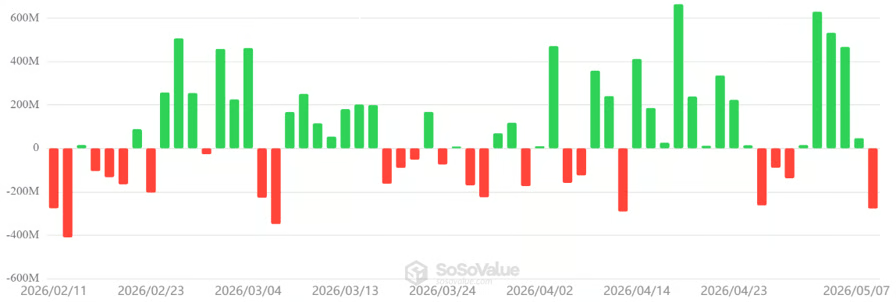
Bitcoin (BTC) stagnated near $80,000 on Friday following a rejection at $82,500. Traders grew anxious after US-listed spot Bitcoin exchange-traded funds (ETFs) posted $268 million in net outflows on Thursday.
Meanwhile, $270 million in leveraged bullish Bitcoin futures positions were liquidated within 24 hours, forcing investors to evaluate whether a sustained bear market is finally taking hold.

Bitcoin US-listed spot ETFs daily net flows, USD. Source: SoSoValue
The reversal in Bitcoin spot ETF flows on Thursday broke a four-day positive streak. This shift is particularly notable because the S&P 500 Index surged to an all-time high on Friday. There is no evidence of a broad derisking trend across traditional markets, as the US small-cap Russell 2000 Index remains within 2% of its own record peak.
Are Bitcoin retail traders jumping ship?
Underwhelming earnings reports from Coinbase and Robinhood indicated a sharp drop in retail engagement, sparking concerns about Bitcoin’s bull run sustainability. Coinbase recorded a 31% revenue decline compared to the first quarter of 2025, while crypto-related revenue on Robinhood plummeted by 47% over the same period.

Exchanges’ top traders Bitcoin long-to-short ratio. Source: CoinGlass
Top traders at Binance have slashed their Bitcoin longs to the lowest levels in over four weeks. In contrast, whales and market makers at OKX added bullish exposure as the Bitcoin price broke above $80,000 on Tuesday, but they subsequently reduced those positions on Friday.
Overall, the 0.27 long-to-short ratio among top traders at OKX remains a far cry from the 1.20 mark seen just ten days prior.
Weaker US dollar and odds of Strategic Bitcoin Reserves
While Bitcoin derivatives show moderate bearishness, two distinct factors support a sustained bull run. The US dollar has weakened against other major fiat currencies over the past two months. Whether intended by the US administration or not, this move reduces incentives to hold US Treasuries, especially given the current high oil prices.

Brent crude oil, USD (left) vs. US dollar strength index (right). Source: TradingView
The growing US government debt creates an environment favoring scarce assets. Even if the stock market and gold remain the primary options for most investors, Bitcoin tends to benefit from a weaker US dollar.
Regardless of the macroeconomic environment, expectations are rising that the US Strategic Bitcoin Reserve could start adding BTC, and Kevin Warsh is expected to replace Fed Chair Jerome Powell in the near term. Warsh recently reported significant holdings in cryptocurrency assets and companies and has previously expressed pro-Bitcoin views.
Related: Bitcoin bulls target $115K by December–Does data back the expectation?

Odds of the US adding any amount of Bitcoin to its reserves by 2027. Source: Polymarket
While still considered a long shot, the path to budget-neutral strategies for acquiring Bitcoin has been cited by US Treasury Secretary Scott Bessent in the past. Consequently, potential outflows from fixed-income investments due to a weaker US dollar and higher inflation increase the odds of sustained bullish momentum in Bitcoin.
The recent outflows from spot Bitcoin ETFs do not necessarily indicate that a bear market is underway, even if top traders’ current positioning signals a lack of confidence in a short-term rally.


Google Chrome has been silently installing a 4GB AI model called Gemini Nano on users’ devices without consent, a researcher found.
Summary
- Researcher Alexander Hanff documented Chrome secretly downloading a 4GB AI model called Gemini Nano to eligible devices without user notification or consent.
- The model reinstalls itself automatically if users delete it, and Chrome does not offer an opt-out prompt during installation.
- Hanff argues the practice likely violates the EU’s ePrivacy Directive and GDPR, raising legal questions that have not yet been tested in court.
Google Chrome is silently installing a 4GB AI model on users’ devices without consent, a researcher found. Privacy researcher and computer scientist Alexander Hanff documented the installation after discovering that a Chrome profile he created for automated privacy audits had accumulated 4GB of model files called weights.bin inside a folder named OptGuideOnDeviceModel, despite receiving zero human input at any point.
The model is Google’s Gemini Nano, a lightweight on-device large language model. Hanff’s evidence chain shows Chrome downloading the 4GB file in 14 minutes and 28 seconds on April 24, 2026, without a consent prompt, without a settings notification, and without a checkbox.
The file reinstalls automatically when restarted after deletion, according to multiple independent reports across Windows, macOS, and Linux.
What Chrome does with the model
Chrome 147 displays an “AI Mode” pill in the address bar, which users might reasonably assume routes queries to the local on-device model. According to Hanff’s investigation, that assumption is wrong.
The AI Mode pill is a cloud-backed Search Generative Experience that sends every query to Google’s servers. The on-device Gemini Nano powers right-click menu features that most users never access.
Snopes verified the claim as mostly true, finding the weights.bin file on the devices of three of six staffers checked, spanning both macOS and Windows machines. Google told Snopes it began rolling out an opt-out option in Chrome settings in February 2026, though this setting was not available to all users.
As crypto.news reported, unsolicited data collection and silent software behavior from major tech platforms have become a growing concern in 2026, with CZ and others warning that transparency failures across digital systems are eroding user trust at scale.
Legal and environmental risks
Hanff argues the practice likely violates the EU’s ePrivacy Directive, which governs storage of data on user devices, and GDPR transparency requirements.
Those claims have not been tested in court. He also calculated that at Chrome’s approximately one-billion-device scale, distributing the 4GB file generates between 6,000 and 60,000 tonnes of CO2-equivalent emissions.
The Malwarebytes security blog noted that a similar pattern emerged weeks earlier when Hanff documented Anthropic’s Claude Desktop silently installing browser integration files across multiple Chromium browsers without meaningful user disclosure, also arguing those installs likely violated EU law.
As crypto.news tracked, AI-driven security and privacy risks are accelerating in 2026, with CertiK warning that AI tools are making attacks faster and harder to detect across the digital ecosystem.
Crypto World
Consensys’ Bill Hughes to Senate: Pass the CLARITY Act Now or Lose the Crypto Market for Years
TLDR:
- U.S. users drove over $1 trillion in crypto volume in early 2025, yet offshore exchanges captured most of the trading activity.
- Binance held 38% of global spot market share while Coinbase, the top U.S. platform, sat below 7% of worldwide volume.
- Sanctioned actors from Russia, Iran, and North Korea have exploited offshore venues to move funds beyond U.S. regulatory reach.
- A HarrisX poll shows 52% of voters support the CLARITY Act, with majorities of both Republicans and Democrats backing the bill.
The CLARITY Act stands at the center of a growing debate over America’s role in the global crypto economy. The United States processes the largest cryptocurrency volume on the planet, yet offshore exchanges continue to dominate global trading.
Consensys’ Bill Hughes argues the Senate must act before the window closes. Without a clear legal framework, America risks losing both economic ground and national security leverage to foreign competitors operating beyond U.S. regulatory reach.
Foreign Exchanges Are Winning the Market America Built
The U.S. accounted for over $2.4 trillion in fiat-to-crypto volume between July 2024 and June 2025. American users alone moved more than $1 trillion in crypto transactions in the first seven months of 2025. Yet the bulk of that trading activity is flowing to exchanges based in the Cayman Islands and the Seychelles.
Binance, the largest offshore venue, controlled roughly 38% of all centralized spot market share in late 2025. Coinbase, the top U.S.-regulated exchange, sat below 7% of global spot volume over the same period.
Hughes noted that the gap “reflects a regulatory environment that made it easier to build a digital asset business abroad than at home.”
The derivatives market tells an even sharper story. Four offshore platforms—Binance, OKX, Bybit, and Bitget—together held roughly 62% of $86 trillion in 2025 perpetuals volume.
Not one U.S.-regulated platform appeared among them, leaving American regulators, courts, and tax collection with limited reach over a market U.S. users are actively driving.
The Competitiveness Gap Is Also a National Security Gap
Hughes argues that offshore dominance does more than hurt American business — it weakens U.S. law enforcement reach.
Sanctioned actors tied to Russia, Iran, North Korea, and Venezuela have routed stablecoins through offshore venues to move value outside conventional financial controls. That reality, he contends, makes the CLARITY Act a national security matter as much as an economic one.
The bill establishes a federal registration framework covering digital commodity exchanges, brokers, dealers, and certain intermediaries.
Treasury and FinCEN would gain broader visibility across the digital asset ecosystem through expanded Bank Secrecy Act and sanctions compliance requirements.
The legislation also introduces enhanced Section 311 authority, new transaction monitoring requirements, and targeted anti-fraud rules for digital asset kiosks.
Hughes described the cumulative effect as “a significantly more robust U.S. regulatory perimeter around the digital asset venues and intermediaries used by illicit actors.”
For major U.S. financial institutions exploring blockchain infrastructure, the bill would also provide the legal foundation that prudential regulators and fiduciary duties currently require before meaningful investment can follow.
Good Policy and Good Politics With a Closing Window
Hughes has been direct in framing the stakes: “CLARITY is not just good policy, it’s good politics. It ensures a market that works for Americans and the U.S. dollar, provides law enforcement with durable tools against illicit finance, and allows American institutions to modernize the rails on which finance runs.” That argument is finding broad support beyond the industry.
A HarrisX poll from May 2026 found that 52% of registered voters support the bill, with only 11% opposed. Majorities of both Republicans, at 58%, and Democrats, at 55%, back the legislation.
Senator Lummis has warned that failure to pass it this year could push progress back “until at least 2030,” with the August recess and midterm calendar rapidly narrowing the available time.
The bill passed the House in July 2025 with a bipartisan vote of 294 to 134. Meanwhile, the EU under MiCA, the UK, Singapore, and Dubai are all advancing competing frameworks.
U.S. blockchain job postings rose 26% year-over-year in 2025, with developers earning an average of $146,250 annually.
Hughes concluded that the durability of America’s position depends on “Congress turning the Executive Branch’s reset into permanent law” — and the Senate has only weeks left to do it.


Kalshi’s valuation has hit $22bn after a $1bn Series F led by Coatue, doubling its worth in just five months.
Summary
- Kalshi raised $1bn in a Series F round led by Coatue at a $22bn valuation, doubling the $11bn it achieved just five months ago.
- Institutional trading volume on the platform surged 800% in six months, while annualized trading volume tripled from $52bn to $178bn.
- Kalshi accounts for over 90% of US prediction market activity and reports $1.5bn in annualized revenue with two million monthly users.
Kalshi’s valuation has hit $22bn after a $1bn Series F led by Coatue, doubling its worth in just five months. The New York-based prediction market platform confirmed the round on May 7, formalizing a Bloomberg report from March. Sequoia Capital, Andreessen Horowitz, IVP, Paradigm, Morgan Stanley, and ARK Invest all participated in the raise.
The round is Kalshi’s third in seven months, with each successive raise roughly doubling its valuation. The company was valued at $5bn in a $300m round less than two months before the $11bn Series E, making its current $22bn valuation roughly quadruple what it was under a year ago.
Kalshi CEO Tarek Mansour said in a statement: “There are few categories in recent history that have scaled this quickly outside of AI. Event contracts could become a trillion-dollar market, and we’re still in the early stages of that transition.”
What the growth numbers show
Annualized trading volume on the platform has more than tripled in six months, growing from $52bn to $178bn. Institutional trading volume specifically surged 800% over the same period.
Kalshi says it accounts for more than 90% of US prediction market activity and generates $1.5bn in annualized revenue from two million monthly users.
Kalshi will use the new capital to scale adoption across hedge funds, asset managers, proprietary trading firms, and insurance companies, and will expand its product suite including recently launched block trading capabilities and deeper broker integrations.
As crypto.news reported, Kalshi’s first bespoke institutional block trade, brokered by Greenlight with Jump Trading providing liquidity on a carbon allowance contract, marked a signal shift toward direct event-risk exposure for large institutional players.
Regulatory headwinds persist
The growth sits against a clouded regulatory backdrop. Nevada, New Jersey, Illinois, and several other states have issued cease-and-desist orders or launched legal challenges against Kalshi, arguing some event contracts resemble unlicensed sports betting.
Kalshi has pushed back, saying its exchange falls under CFTC oversight and that state-level challenges are jurisdictionally misplaced.
The SEC also delayed more than two dozen proposed prediction market ETFs this week, asking issuers for more information on mechanics and investor disclosures.
As crypto.news tracked, Kalshi is also exploring crypto perpetual futures as its next expansion move, a product that would place it in direct competition with Binance, Coinbase, and Kraken in derivatives trading.


Kraken’s Etana fraud case alleges a Ponzi-like scheme diverted more than $25m in client funds.
Summary
- Kraken parent Payward filed a second amended complaint in Colorado federal court accusing Etana Custody and CEO Dion Russell of misappropriating over $25m in client funds.
- The complaint alleges Etana commingled custodial assets with operating funds, made risky bets totaling $16m through Seabury Trade Capital notes, and issued falsified account statements.
- Etana entered court-supervised liquidation in November 2025 with just $6.83m in cash against more than $26m in liabilities.
Kraken’s Etana fraud case alleges a Ponzi-like scheme diverted more than $25m in client funds. Kraken’s parent company Payward filed a second amended complaint on May 4 in the US District Court for the District of Colorado, accusing Etana Custody and its CEO Dion Brandon Russell of commingling custodial assets with operating funds, financing risky bets, and sending falsified account reports that showed balances as fully intact while a funding gap widened.
Payward says Etana operated a “Ponzi-like enterprise” that recycled incoming client deposits to cover prior shortfalls. When Kraken attempted to withdraw roughly $25m in reserve funds in April 2025, Etana stalled with what the complaint calls fabricated reconciliation issues. At least $16m of the shortfall is tied to promissory notes issued by Seabury Trade Capital, which later defaulted.
What the court records show
Etana entered statutory liquidation in November 2025 after Colorado regulators issued a cease-and-desist order and increased capital requirements. Court filings show roughly $6.83m in cash against liabilities exceeding $26m, most of which represents the Kraken claim.
The federal case against Etana entities is currently stayed, with proceedings continuing against Russell personally.
Kraken is seeking at least $25m in compensatory damages, potential treble damages under civil theft claims, injunctive relief, and attorneys’ fees. The complaint also names Russell personally, alleging he exercised near-total control over Etana’s operations and personally directed the misuse and concealment of funds.
As crypto.news reported, Kraken has faced a wave of security and custody-related incidents in 2026, including a separate extortion attempt involving internal system access.
Industry context
The collapse follows a pattern of crypto custody failures. Institutional lender Blockfills filed for bankruptcy in March 2026 after halting withdrawals and reporting roughly $75m in losses.
The Etana case is being watched as a test of how courts treat custodians that commingle client funds, especially once those custodians are already under state liquidation orders.
As crypto.news documented, custody, payments, and financing contributed 53% of Kraken’s $2.2b adjusted revenue in 2025, making the integrity of its custody partnerships a core business question.
The case also arrives as the industry pushes for the CLARITY Act to create clearer custody frameworks, with crypto.news reporting that a Senate Banking Committee markup is targeted for the week of May 11.
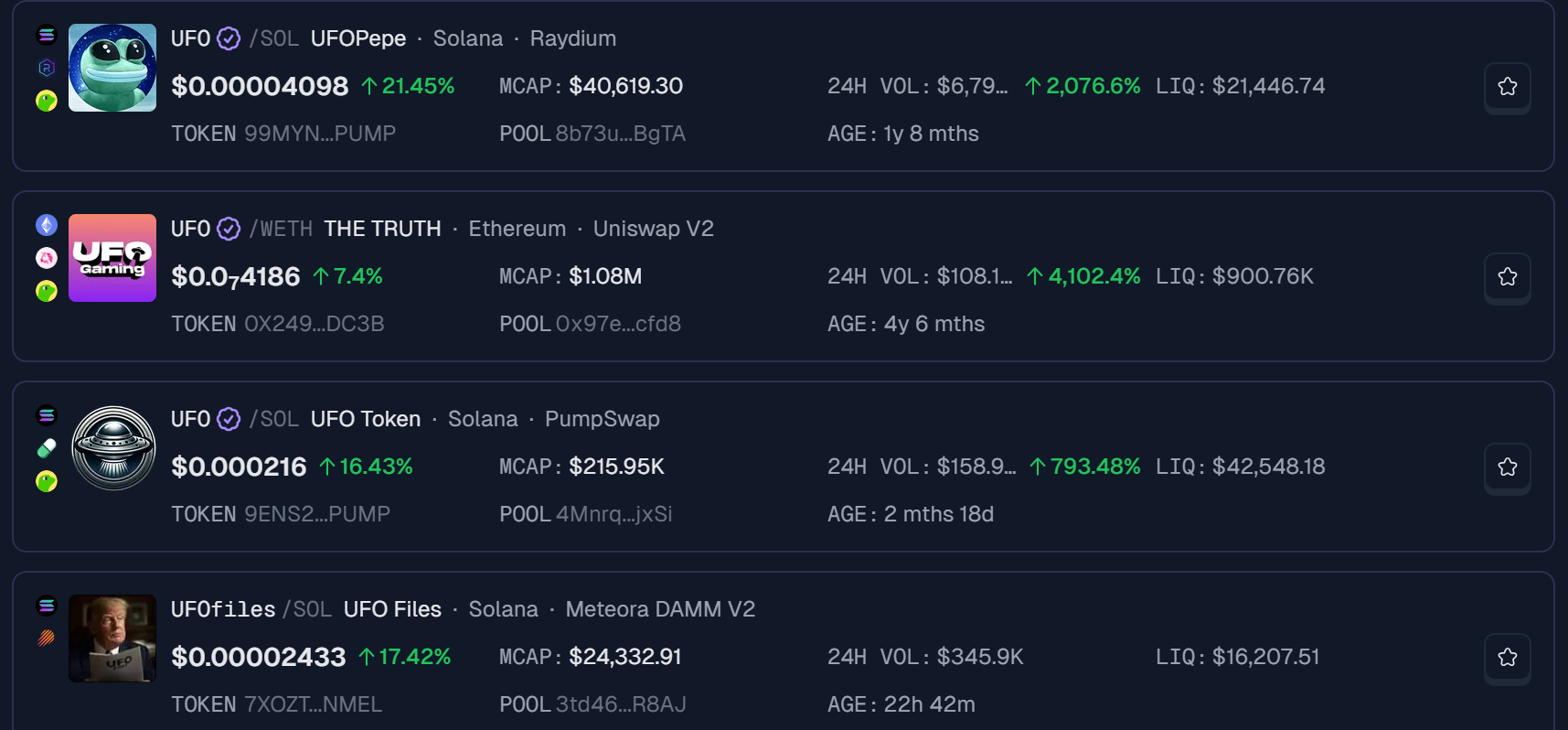
UFO-themed Solana meme coins lit up following the Pentagon’s first declassified UAP file release on Friday. Multiple tokens posted double-digit gains as the disclosure narrative gathered steam.
The Department of War launched the Presidential Unsealing and Reporting System for UAP Encounters (PURSUE) on Friday. Officials posted Release 01 to a public WAR.GOV/UFO portal, with rolling tranches every few weeks.
UFOPEPE Leads the UFO Ticker Pack
UFOPEPE (UFO), a Solana token blending Pepe with UFO imagery, gained about 44.68%, while a separate UFO Token climbed 30.79%. Meanwhile, UFO Gaming added 5.98%.

However, the original UFO Token slipped almost 5%, showing how speculative flows split across competing tickers sharing the same theme.

Solana remains the home turf for low-cap narrative trades. Pump.fun activity has hit fresh highs in 2026, with the launchpad’s DEX volume reaching all-time records on retail-driven momentum.
Pump-and-Dump Risk Remains
Bot activity accounts for 60% to 80% of trading volume on Solana meme coin venues. That dynamic distorts price signals and triggers rapid rotations.

Meme coin pumps on event-driven narratives also tend to fade within hours or days.
UFO-themed assets carry no fundamental link to the Pentagon release. Their volatility tracks social media buzz rather than file content.
Recent surges in tokens like PUNCH show how fragmented UFO tickers raise execution risk for retail.
Why the Files Could Keep Meme Coins Alive
The Department of War plans rolling drops every few weeks. Each new tranche could trigger fresh meme coin cycles on Solana launchpads.
“Based on the tremendous interest shown, I will be directing the Secretary of War, and other relevant Departments and Agencies, to begin the process of identifying and releasing Government files related to alien and extraterrestrial life, unidentified aerial phenomena (UAP), and unidentified flying objects (UFOs), and any and all other information connected to these highly complex, but extremely interesting and important, matters,” Trump wrote in a recent Truth Social post.
Traders treating these events as catalysts may find short-lived liquidity windows. Most positions retrace once the news flow ends, and if unresolved cases produce viral imagery, expect fast tokens to follow within hours.
The post Solana UFO Meme Coins Surge After Pentagon Reveals Alien Files appeared first on BeInCrypto.
Earlier in 2026, as a digital asset market structure bill was under consideration in the US Senate, cryptocurrency exchanges Coinbase, Kraken and Gemini reportedly pressed to remove language in the legislation that could have affected their token listings.
According to a Friday Politico report, the three exchanges asked US lawmakers to scrap a provision in the market structure bill that would have required platforms to only offer trading on digital assets “not readily susceptible to manipulation.” The companies reportedly pressed senators to remove the language as it could have made it difficult for exchanges to list smaller tokens.
The edit, which the news outlet reported occurred after the US Senate Agriculture Committee voted to advance its version of the bill in January, signaled the influence crypto companies in communication with the Trump administration and lawmakers could have in legislation affecting the industry. The US Senate Banking Committee postponed its markup on the bill hours after Coinbase CEO Brian Armstrong said that the exchange could not support the legislation “as written,” citing concerns with tokenized equities.
Under the market structure bill, called the CLARITY Act when it passed the US House of Representatives in July 2025, the Commodity Futures Trading Commission (CFTC) would be given more authority in overseeing and regulating digital assets. Both US financial regulators, the CFTC and Securities and Exchange Commission (SEC), announced their intention to coordinate oversight of the crypto industry in March, even in the absence of action from Congress.
Related: US Senator questions Mark Zuckerberg on Meta’s stablecoin plans
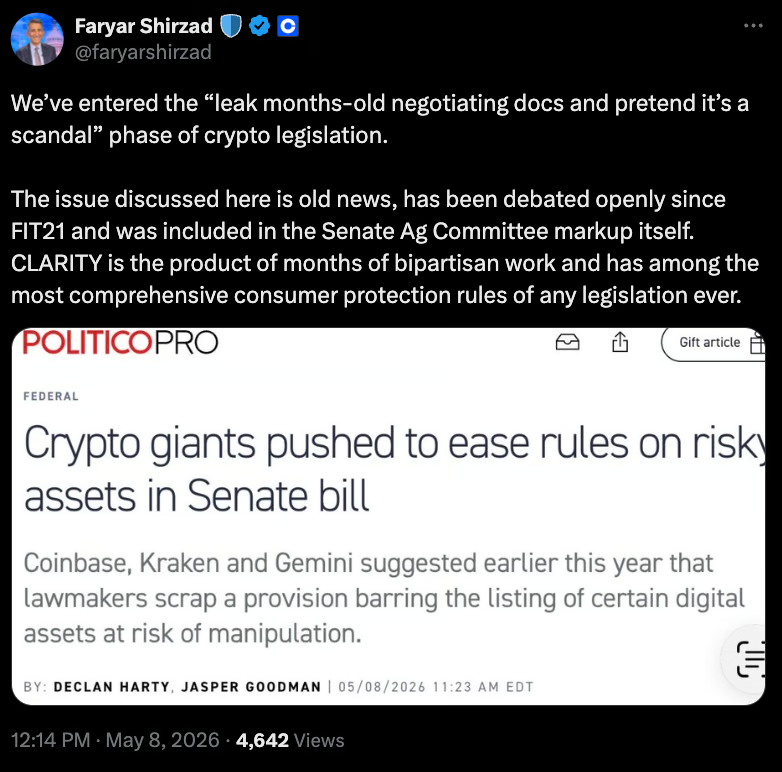
Coinbase chief policy officer Faryar Shirzad responded to the report on social media, calling it “old news” and an issue that was included in the markup by the Senate Agriculture Committee.

Source: Faryar Shirzad
Industry leaders, lawmakers speculate on timeline for market structure bill
Last week, two US senators announced a compromise deal on stablecoin yield between representatives of the crypto and banking industries that could allow the CLARITY Act to advance in the banking committee. Although some lawmakers said they intended to push for ethics language on potential conflicts of interest to be included in the bill, many are speculating that passage could be in a matter of weeks.
Coinbase‘s US policy vice president, Kara Calvert, said on Thursday that the exchange expected a markup in the banking committee by next week. Other lawmakers predicted that the bill would become law before the Senate broke for August recess, while White House crypto adviser Patrick Witt said that the administration was aiming for a July 4 deadline for the bill to pass the House after a June Senate vote.
Magazine: XRP ‘probably going to $12,’ Bitcoin ETFs add $1B: Market Moves

GWS Giants vs Essendon Bombers Tips, Odds and Teams – AFL Round 9 2026

Trying to cancel Netflix isn’t going smoothly for some right now

Man rushed to hospital after ‘stabbing’ near Scots shopping centre

Manchester United reach agreement with Casemiro over contract clause amid transfer speculation

US brings back mandatory military draft registration

Steven Gerrard disagrees with Gary Neville over ‘shock’ Chelsea and Arsenal claim | Football


-
 Crypto World16 hours ago
HarrisX Poll Found 52% of Registered Voters Support the CLARITY Act
-

 NewsBeat5 days ago
Channel 5 – All Creatures Great and Small series 7 new post
-

 Crypto World2 days ago
Upbit adds B3 Korean won pair as Base token gains Korea access
-

 Tech4 days ago
Image AI models now drive app growth, beating chatbot upgrades
-
 NewsBeat2 days ago
NCP car park operator enters administration putting 340 UK sites at risk of closure
-

 Entertainment7 days ago
Young and the Restless Next Week: Cane Arrested & Matt’s Deadly New Scheme!
-

 Sports6 days ago
Five killed in Texas plane crash identified as Amarillo pickleball players
-
Entertainment6 days ago
New Netflix Movies in May 2026 — My Top 3 Picks to Stream
-

 Entertainment6 days ago
Melissa Joan Hart and More Stars Attend 2026 Kentucky Derby
-

 Fashion7 hours ago
Weekend Open Thread: Marianne Dress
-
Entertainment6 days ago
Anna Nicole Smith’s Daughter Attends 2026 Kentucky Derby
-

 Crypto World6 days ago
Bitcoin mining equities rise in 2026 as BTC lags behind
-
Crypto World6 days ago
Pi Network Mandates Protocol 23 Upgrade for All Mainnet Nodes Before May 15 Deadline
-
Entertainment6 days ago
Venus Williams’ Best Met Gala Looks Over the Years
-

 Business6 days ago
Luka Doncic Injury Update: Doncic’s Hamstring Recovery Slows Lakers’ Hopes Against Thunder: Can He Run Yet?
-

 Sports6 days ago
Is Man United v Liverpool on TV? Channel, streaming and how to watch Premier League fixture
-
 Entertainment6 days ago
Netflix’s 10-Part Miniseries Based on a True Story Is a Perfect Weekend Binge
-

 Business6 days ago
Kuwait International Airport Resumes Operations After Closure as Regional Tensions Ease in 2026
-
 Entertainment6 days ago
After 2 Years, This Taylor Sheridan Neo-Western Doesn’t Have a Single Bad Episode
-
Entertainment6 days ago
“Storage Wars” star Darrell Sheets' ex-wife breaks silence on his death
You must be logged in to post a comment Login