

Crypto World
AscendEX Exchange Reportedly Faces Liquidity Issues: ZachXBT

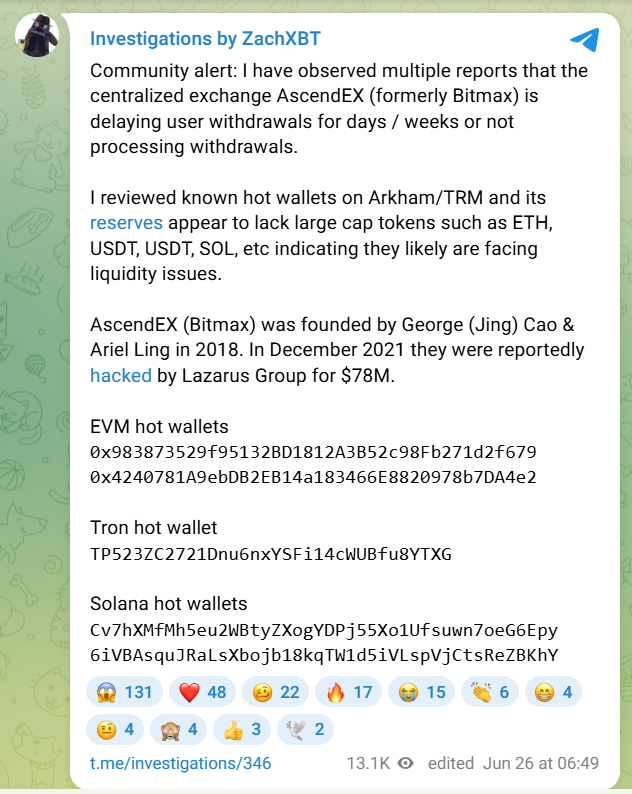
Multiple users have reported issues withdrawing funds from cryptocurrency exchange AscendEX, which blockchain investigator ZachXBT said may be showing signs of liquidity issues.
An X account using the name Lorenzo Navarro Rodriguez said in a Tuesday post that a 4,196 USDT withdrawal had remained stuck in an “initiating” state since June 10. The account also said repeated customer support inquiries had gone unanswered.
At least five other users replied to the post over the following days, reporting similar withdrawal issues.
On Friday, ZachXBT said in a Telegram post that the exchange lacked large-cap reserves for tokens such as Ether (ETH), USDT (USDT) and Solana (SOL), indicating potential “liquidity issues” on the platform. ZachXBT urged the platform to respond to the reports about delayed withdrawal requests and provide more clarity on why its hot wallets have low liquidity.
Related: Polymarket hit by $2.9M theft, users to be refunded
Exchanges rely on liquid reserves of widely traded assets to process customer withdrawals. A shortage of those assets can lead to delayed withdrawals or, in severe cases, insolvency.
ZachXBT flags liquidity and withdrawal issues on AscendEX via Telegram. Source: ZachXBT
AscendEX’s reserves are dominated by small-cap holdings
Blockchain data on Arkham viewed by Cointelegraph on Friday showed that AscendEX-tagged wallets held about $20.2 million in crypto. Arkham-tagged wallets were concentrated in smaller-cap assets, with relatively limited holdings of major cryptocurrencies.
AscendEx had $10 million in UNITE tokens as its largest holding, followed by $5.24 million worth of REUR, $2.9 million in ASD and $600,000 worth of Reservoir rUSD stablecoins, among other smaller tokens.
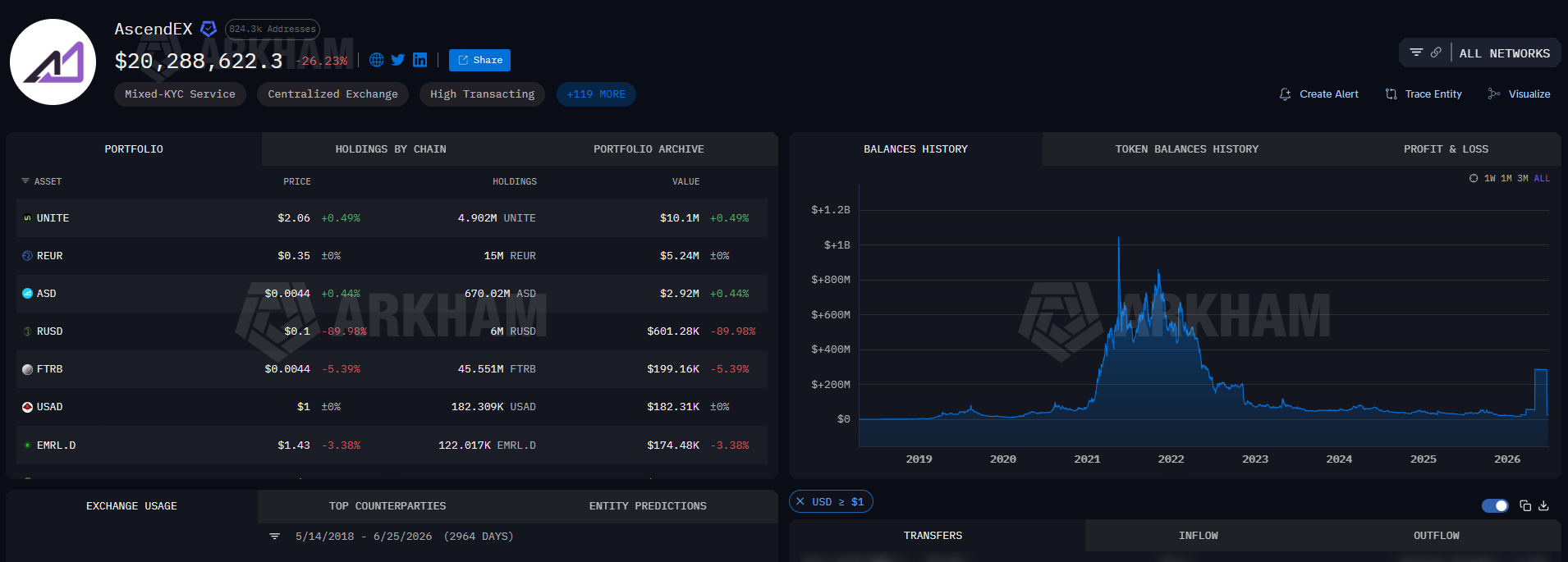
AscendEX-tagged wallet, top token holdings. Source: Arkham
Cointelegraph has approached AscendEX for comment but not received a response before publishing.
Questions about an exchange’s liquidity are highly sensitive in the crypto industry following the collapse of FTX in 2022, when customer withdrawal requests exposed a multibillion-dollar shortfall that ultimately led to the exchange’s bankruptcy.
The failure triggered a wave of customer withdrawals across the industry, intensified regulatory scrutiny and prompted many exchanges to publish proof-of-reserves reports in an effort to reassure users.
Magazine: Bitcoin slides to $58K, XRP hits $1 but onchain data promising: Market Moves



Latest developments: The Alliance to End Human Trafficking is urging lawmakers to revisit Section 604 of the Clarity Act, arguing the provision could make it harder to hold some crypto platform developers accountable when their technology is used to facilitate human trafficking.
- Katie Boller Gosewisch, executive director of the Alliance to End Human Trafficking, said her organization’s primary concern is language stating that developers who do not control user funds are not money transmitters.
- Boller Gosewisch argued the provision could allow some third-party platform developers to “hide behind” a lack of liability if their software is used to facilitate trafficking-related payments.
- The Alliance and Catholic Charities recently sent a letter to Senate Majority Leader John Thune and Senate Minority Leader Chuck Schumer outlining their concerns with the legislation.
- Boller Gosewisch joined Rebecca Rettig and Renato Mariotti on CoinDesk’s The Policy Protocol.
The debate: Rettig argued Section 604 reflects longstanding U.S. anti-money laundering policy rather than creating a new legal shield.
- Rettig said the provision simply clarifies that developers who do not control customer assets are not considered money transmitters, consistent with existing Bank Secrecy Act and FinCEN guidance.
- She argued the bill preserves liability for parties that do control user funds and does not eliminate exposure under other criminal statutes.
- She also pointed to existing money laundering laws, including 18 U.S.C. § 1956, as tools prosecutors can use against developers who knowingly facilitate criminal activity.

Signage at the Situation Room by Polymarket pop-up bar in Washington, DC, US, on Friday, March 20, 2026.
Graeme Sloan | Bloomberg | Getty Images
The Commodity Futures Trading Commission has an ongoing, extensive investigation into prediction market platform Polymarket, according to a person familiar with the inquiry.
The Wall Street Journal first reported the investigation on Friday.
A spokesperson for the CFTC and another for Polymarket both declined to comment.
News of the investigation comes more than a week after a Wall Street Journal story revealed that Polymarket conducted a misleading marketing campaign, making content creators appear as though they were winning on the platform when in reality they weren’t putting any money down.
The person familiar with the inquiry, who was not authorized to speak publicly, did not disclose a timeline for when the commission’s investigation into Polymarket began.
CEO and founder of Polymarket US Shayne Coplan speaks during the FIA Global Cleared Markets Conference Boca 2026, in Boca Raton, Florida, U.S., March 10, 2026.
Marco Bello | Reuters
Polymarket reiterated to CNBC that it is taking steps in response to the Journal’s investigation into its marketing .
“We are conducting a comprehensive audit of active promotional content to ensure it complies with our standards, as well as applicable regulatory and legal disclosure requirements,” a spokesperson said in a statement.
The CFTC investigation marks a reversal for Polymarket’s regulatory fortunes over the past year. While the company was originally banned from allowing U.S. users in 2022 for not properly registering with regulators, investigations by the CFTC and the Department of Justice were later dropped in July of last year without charges.
Polymarket’s CFTC-regulated U.S. exchange launched in December, reopening access to domestic users, and had a waitlist to access the platform lifted six weeks ago.
The CFTC under Chairman Michael Selig has been aggressive in its support for prediction markets, but the investigation into Polymarket would mark the commission’s first high-profile inquiry into an event contract platform under his leadership.
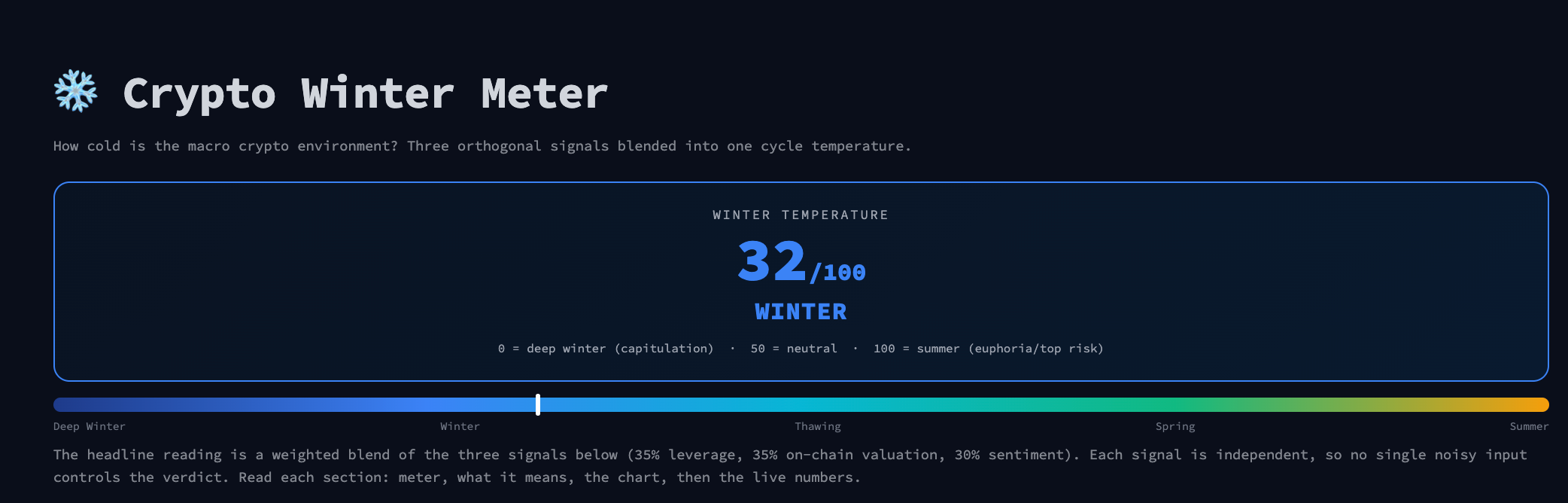
With the crypto winter meter stuck at 32, capital is leaking out of digital assets and hunting elsewhere.
BeInCrypto’s tracking shows it landing in commodities and stocks, where the assets smart money is buying point to early positioning rather than chasing.

Across two metals and a hyperscaler, the pattern repeats: quiet accumulation into a pullback, not a crowded trade.
Gold (XAU)
Gold leads the assets that the smart money is buying into in the second half of 2026. Bullion peaked early in the year, then corrected hard, and with oil soft and inflation cooling, it has slowly clawed back toward $4,000.
Want more insights like this? Sign up for Editor Harsh Notariya’s Daily Newsletter here.
The backdrop was hawkish, with a hotter May inflation reading and a firm dollar following the June Federal Reserve meeting. A pause in the dollar’s rally gave bullion room to stabilize.
The gold-silver ratio has climbed from about 52 on May 13 to near 69. A rising ratio means gold is outpacing silver. It is a classic tell that investors could be leaning into the harder safe-haven metal.
Gold, in short, is the stronger leg of the precious-metals trade right now.

The Commitments of Traders (COT) report, the Commodity Futures Trading Commission’s weekly snapshot of futures positioning, shows non-commercial traders net long 180,220 COMEX gold contracts as of June 16. These are the large speculators, including hedge funds.
On the week, they added roughly 3,100 longs and cut about 3,200 shorts. So even as some retail holders trim exposure, smart money is adding to gold. This could hint at early positioning.

Note: Non-commercial is the cohort most people mean when they say “smart money is buying”; they take directional positions, and right now they’re net long gold and adding.
COT figures carry a lag. This is because the CFTC publishes positions held on the prior Tuesday each Friday. Therefore, they trail the live market by several days. The next COT report for this week is due this Friday and should tell a stronger smart-money positioning story.
Alphabet (GOOGL)
Smart money is quietly building a position in gold. That same early positioning is showing up in stocks. Alphabet sits in the AI hyperscaler layer, the cloud and compute giants that own the data centers, chips, and capacity on which every AI application runs. That is why the group is in demand.
Alphabet runs the full stack, with custom TPU chips, Google Cloud, the Gemini models, and distribution through Search and Android, which gives it rare end-to-end exposure to AI spending. A proprietary deep-dive scores its relative strength against the hyperscaler basket near 125, ahead of its peers.

The Smart Money Index (SMI), a gauge of informed traders, tells the story of positioning. From April 1 to June 9, the index climbed, a long stretch of net buying by smart money. It has started to turn up again near the signal line.
Chaikin Money Flow (CMF), a proxy for institutional money, now reads near zero. Rather than distribution, that pause points to early positioning as the CMF indicator is not diverging but moving closer to the zero line.

The 13F filings, the quarterly disclosures every large institution must submit, back it up. Berkshire Hathaway, run by Warren Buffett, stands out as one of the key buyers, having lifted its Class A stake by around 200%.
Alphabet fell about 11% in a month on AI talent and competition worries, yet it still leads its layer. Smart money appears to have started buying a quality dip early rather than chasing a top, as evidenced by the SMI and CMF indicators turning up.

One caveat. 13F filings disclose positions up to 45 days after quarter-end, and the Smart Money Index reflects flow trends rather than confirmed trades.
Silver (XAG)
Gold is not the only metal-specific asset smart money is buying. The signal repeats next door in silver, the cheaper, higher-beta cousin. With the gold-silver ratio near 69, silver looks historically cheap against gold. Gold is the safe-haven metal. Silver adds an industrial kicker.
The same non-commercial gold-adders are net long silver, too, and they increased their bets. These large speculators added 3,124 long contracts in the week to June 16, leaving a net long of 24,500. The hedgers or the commercial cohort is still net short, showing how early “smart money” is.

Demand gives it a reason. Silver runs through solar panels, electric vehicles, data centers, and power grids, with the market facing another supply deficit near 46 million ounces. AI-driven data center and grid build-outs keep industrial demand firm.
Silver also moves opposite the US Dollar Index (DXY), with a 30-day correlation near negative 0.59. The DXY hit a 13-month high above 100 a few days back, and sticky real yields add to the pressure.

That headwind is also the setup. If inflation cools, real yields drop, and the dollar eases, the same inverse correlation flips into a tailwind, leaving the early longs well placed.
The post 3 Assets Smart Money Is Buying as the Crypto Winter Drags On appeared first on BeInCrypto.


Ethra Ship has launched a blockchain protocol backed by four years of maritime operations, opening access to an asset class where individual vessels can cost between $30 million and $120 million.
Summary
- Ethra Ship has launched a blockchain protocol that tokenizes investments in operating maritime shipping assets.
- The platform separates its $SHIP governance token from a regulated RWA investment layer backed by vessel-owning SPVs.
- The launch comes as tokenized real-world assets continue expanding, with Wall Street forecasting multi-trillion-dollar market growth.
According to a recent announcement from Ethra Ship, the company has introduced a two-layer real-world asset tokenization protocol designed to connect crypto users and institutional investors with operating dry bulk shipping assets.
The platform is supported by Ethra Invest, which has been acquiring, managing, and commercially operating vessels since 2021, providing the protocol with an existing revenue-generating business rather than a pipeline of future acquisitions.
Speaking about the launch, Ethra Chief Executive Officer Saeed Al-Marri said tokenization only succeeds when it is built on top of an operating business rather than an idea.
“Tokenization only works when there is a real business underneath it. We bring four years of vessel operations, live charter revenue, and operational data to the protocol from day one, setting the standard maritime RWAs should be held to.”
Ethra said its portfolio has generated Time Charter Equivalent (TCE) revenue through commercial vessel operations while establishing the infrastructure required to manage maritime assets before introducing blockchain technology. According to the company, this approach differs from projects that issue tokens first and seek to acquire underlying assets later.
The protocol separates governance from regulated vessel investments
Under the announced structure, the first layer revolves around the SHIP token, which serves as the ecosystem’s utility and governance asset. Ethra said token holders will be able to stake their holdings for access to its Fleet Visibility Dashboard, which provides real-time fleet performance data, while also participating in governance decisions as the protocol develops.
Alongside the public token layer, the company has created a regulated investment tier for eligible investors who complete KYC and AML checks. According to Ethra, participants in this layer receive fractional exposure to Special Purpose Vehicles that own operating dry bulk vessels, allowing them to share in cash flows generated through commercial freight charters.
Commenting on the rollout, Ethra Chief Operating Officer Emad Shahin said the protocol combines blockchain infrastructure with a shipping business the company has operated for several years.
“Ethra Ship Protocol gives both Web3 and traditional investors a structured way to engage with an asset class that we have been operating and investing in since 2021. The infrastructure exists around our track record in the maritime sector, giving participants confidence that we have experience operating a fleet of revenue-producing ships.”
Ethra added that future development phases will expand staking features, institutional participation, and on-chain data services before eventually introducing tokenized vessel ownership.
RWA markets continue expanding beyond traditional asset classes
Maritime shipping enters the tokenization market as real-world assets continue attracting institutional attention.
As crypto.news reported in May, the value of tokenized real-world assets on public blockchains climbed to nearly $34 billion, up from roughly $5.4 billion at the beginning of 2025. Ethereum currently carries about 60% of that market, while tokenized U.S. Treasuries account for around $15 billion.
New asset categories have also continued to emerge. Earlier this month, DBS Bank announced plans to launch tokenized physical gold backed by bullion stored in Singapore, extending its digital asset strategy beyond tokenized money market funds and stablecoin services.
Wall Street institutions have also projected substantial growth for the sector. In its Tokenization 2030: Wall Street On-Chain report, Citi estimated the tokenized securities market could reach $5.5 trillion by 2030 under its base-case scenario, with projections ranging from $2.7 trillion to $8.2 trillion depending on adoption. The bank expects blockchain infrastructure to support an increasing share of Treasury bills, equities, funds, and other financial assets during the decade.
Morgan Stanley has warned that the Federal Reserve could still be forced to raise interest rates this year under certain economic conditions, even as it maintains its forecast for unchanged policy.
Summary
- Morgan Stanley expects the Fed to hold rates steady, but warns two conditions could change that outlook.
- BNP Paribas and Citadel Securities forecast Fed rate hikes later this year on persistent inflation concerns.
- Neel Kashkari and market pricing indicate investors remain alert to the risk of renewed policy tightening.
According to Morgan Stanley, its base-case forecast remains that the Federal Reserve will leave interest rates unchanged this year. Even so, the bank cautioned that a stronger labor market or stubborn inflation could require policymakers to tighten monetary policy again.
The bank pointed to two specific risks. A decline in the unemployment rate below 4% would indicate continued strength in the labor market, while inflation remaining above the Fed’s target could leave officials with little choice but to remove monetary accommodation.
Recent inflation data has kept those concerns in focus. As reported by crypto.news earlier, the U.S. Personal Consumption Expenditures price index accelerated to 4.1%, its highest reading since 2023. At the same time, oil prices have fallen following the U.S.-Iran peace agreement, a development that could ease energy-driven inflation and support Morgan Stanley’s expectation that rates remain on hold.
Other institutions continue to expect rate increases
Although Morgan Stanley does not currently forecast a rate increase, several financial institutions have adopted a more hawkish outlook.
As reported by crypto.news earlier in June, BNP Paribas abandoned its previous expectation that rates would remain steady and now expects the Federal Reserve to reverse the three interest-rate cuts delivered in 2025. The bank projected three consecutive rate hikes beginning with the December Federal Open Market Committee meeting.
BNP Paribas said policymakers may need to withdraw part of the monetary stimulus if inflation continues to strengthen while employment conditions remain resilient. The bank also projected the unemployment rate could gradually decline to around 4% by the end of the year, giving the Federal Reserve more room to prioritize inflation over labor-market support.
Citadel Securities has taken an even more aggressive position. In a recent client note, the firm warned that the Federal Reserve could begin raising rates as early as September 2026 if inflation continues spreading through the economy.
According to Citadel, inflation is no longer being driven only by energy prices. The firm argued that accommodative financial conditions, persistent supply-chain disruptions, continued labor-market strength, and rapidly growing artificial intelligence investment are all contributing to sustained price pressures.
Citadel estimated AI-related capital expenditures could reach about $750 billion in 2026 before increasing to approximately $1.25 trillion in 2027.
The firm’s projected policy path includes rate hikes in September and December 2026, followed by another increase in March 2027.
Fed officials and markets remain divided on the outlook
Federal Reserve officials have also acknowledged the possibility of additional tightening if inflation fails to moderate.
Speaking in an interview with Bloomberg, Minneapolis Fed President Neel Kashkari said he was among the policymakers who projected a rate hike this year. He explained that his decision was based on signs of persistent inflation across the economy rather than concerns limited to the conflict in the Middle East or disruptions to global oil supplies.
Following the June Federal Open Market Committee meeting, nine of the 18 Federal Reserve officials projected at least one rate increase this year, while six of those policymakers anticipated multiple hikes, according to earlier reporting by crypto.news.
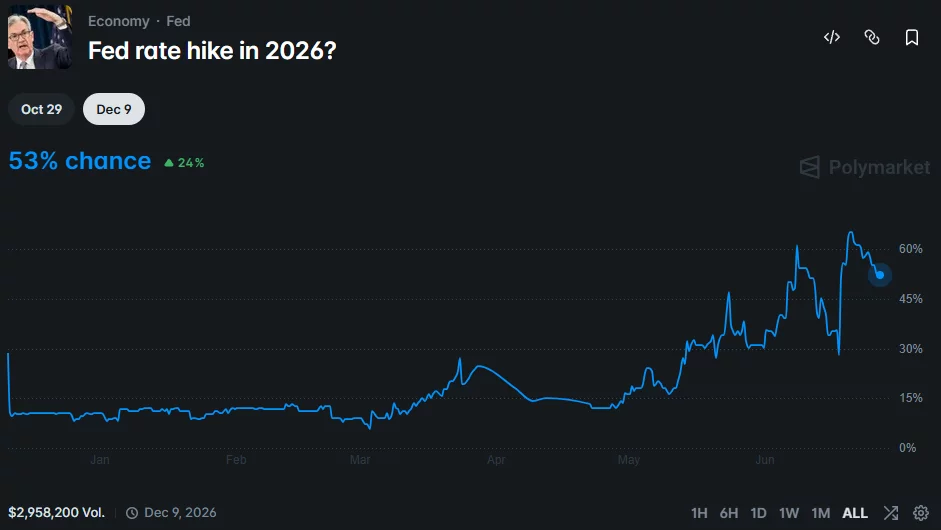
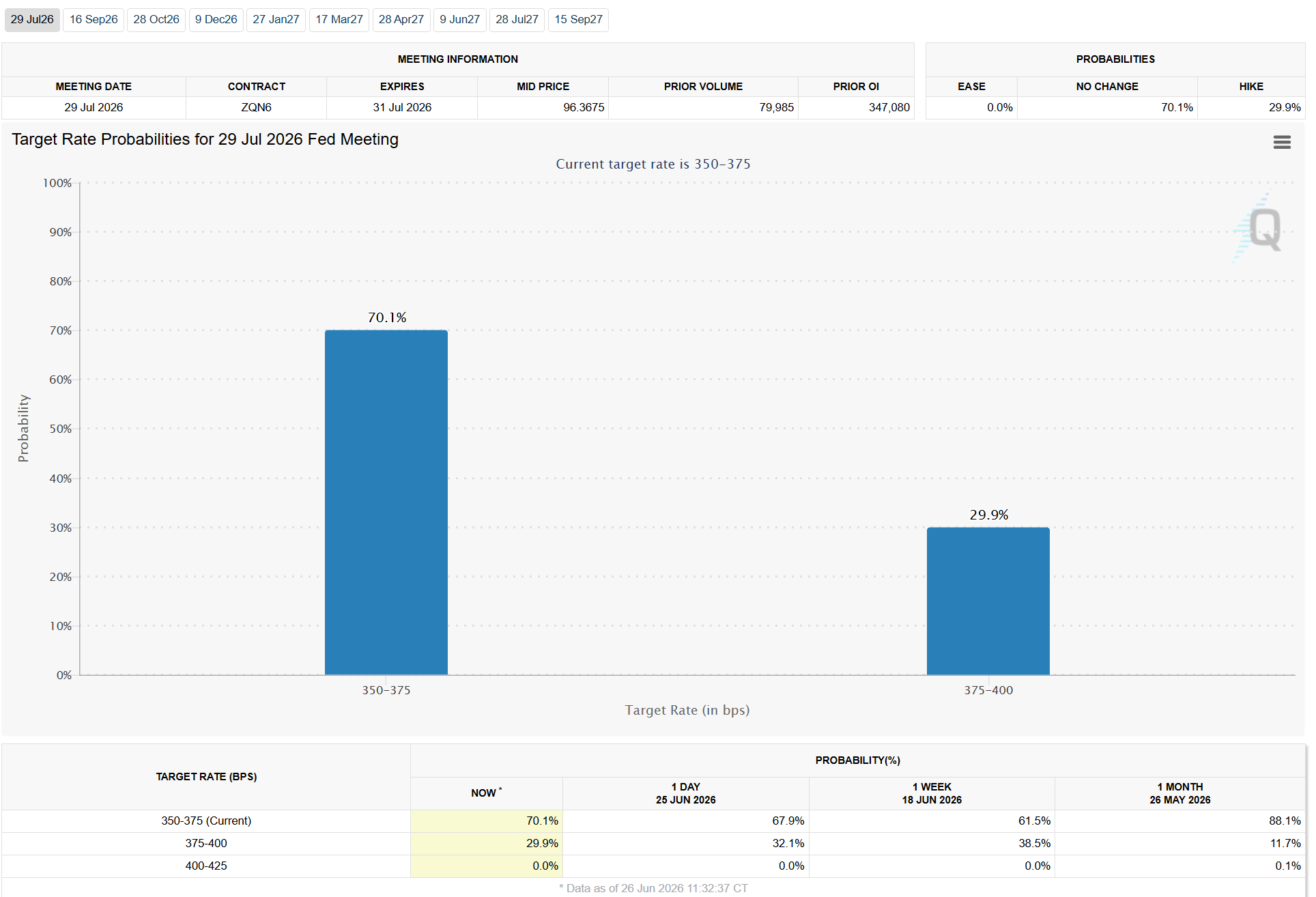
Financial markets also continue to assign meaningful odds to tighter policy. Polymarket data indicates a 53% probability that the Federal Reserve raises interest rates this year, while CME FedWatch data shows traders are pricing in possible increases at the September, October, and December policy meetings. The September meeting currently carries a 46.8% probability of a rate hike.


Binance has started telling European Union users it will wind down services in the bloc after failing to secure a license under the Markets in Crypto-Assets framework, the realization of an EU-exit risk that surfaced earlier this month. The world's largest exchange emailed customers in France,… Read the full story at The Defiant


Latest developments: Trent Van Epps says Ethereum’s long-term decentralization strategy is entering a critical transition phase.
- Van Epps said he left the Ethereum Foundation after it became clear the organization would accelerate its “subtraction” philosophy of pushing authority and legitimacy into the broader ecosystem.
- He described the Ethereum Foundation as intentionally reducing its central role rather than consolidating power, arguing that multiple independent institutions should eventually coordinate the ecosystem.
- The comments come after recent Ethereum Foundation leadership changes and workforce reductions, which have fueled questions about Ethereum’s future governance.
- Van Epps joined CoinDesk’s Jennifer Sanasie on Markets Outlook.
What this means: Van Epps argues Ethereum faces a practical funding challenge rather than an existential crisis.
- He estimated core protocol development requires roughly $30 million annually, even as the Ethereum Foundation’s treasury gradually declines over time.
- According to Van Epps, the issue is not shrinking technical needs but identifying new organizations willing to finance public goods that keep the network reliable and secure.
- He said his Protocol Guild initiative has distributed nearly $40 million to Ethereum core developers over roughly four years but is not sufficient on its own to replace broader ecosystem funding.
Crypto World
Why Wall Street's Biggest Traders Are Abandoning Crypto for Prediction Markets | Alex Momot
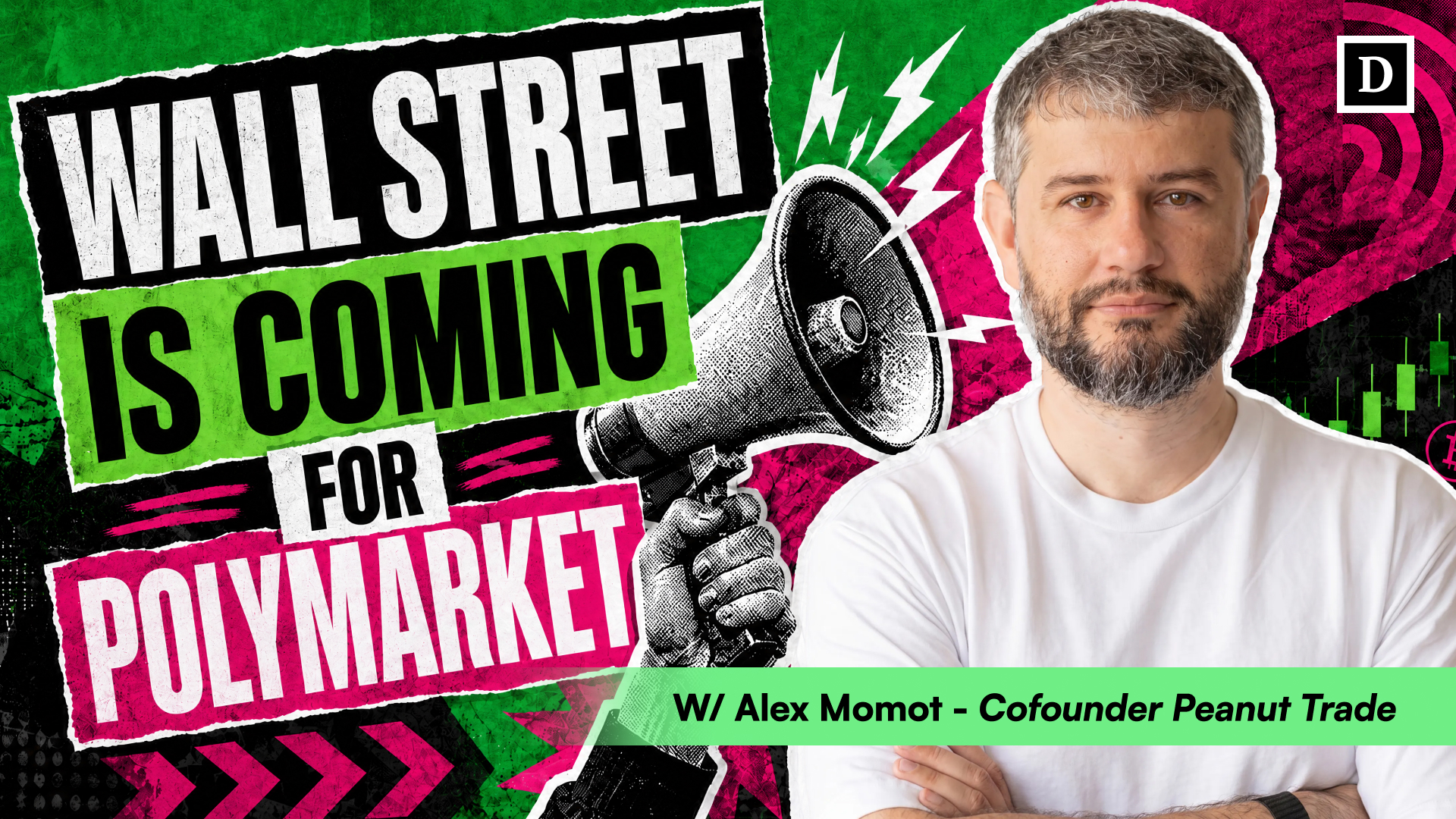
💻 Watch Video… Read the full story at The Defiant
Crypto World
XRP Price Prediction 2026: Pepeto Presale Math Beats XRP $10 Target as Bill Morgan Pushes Ripple to Unlock Faster
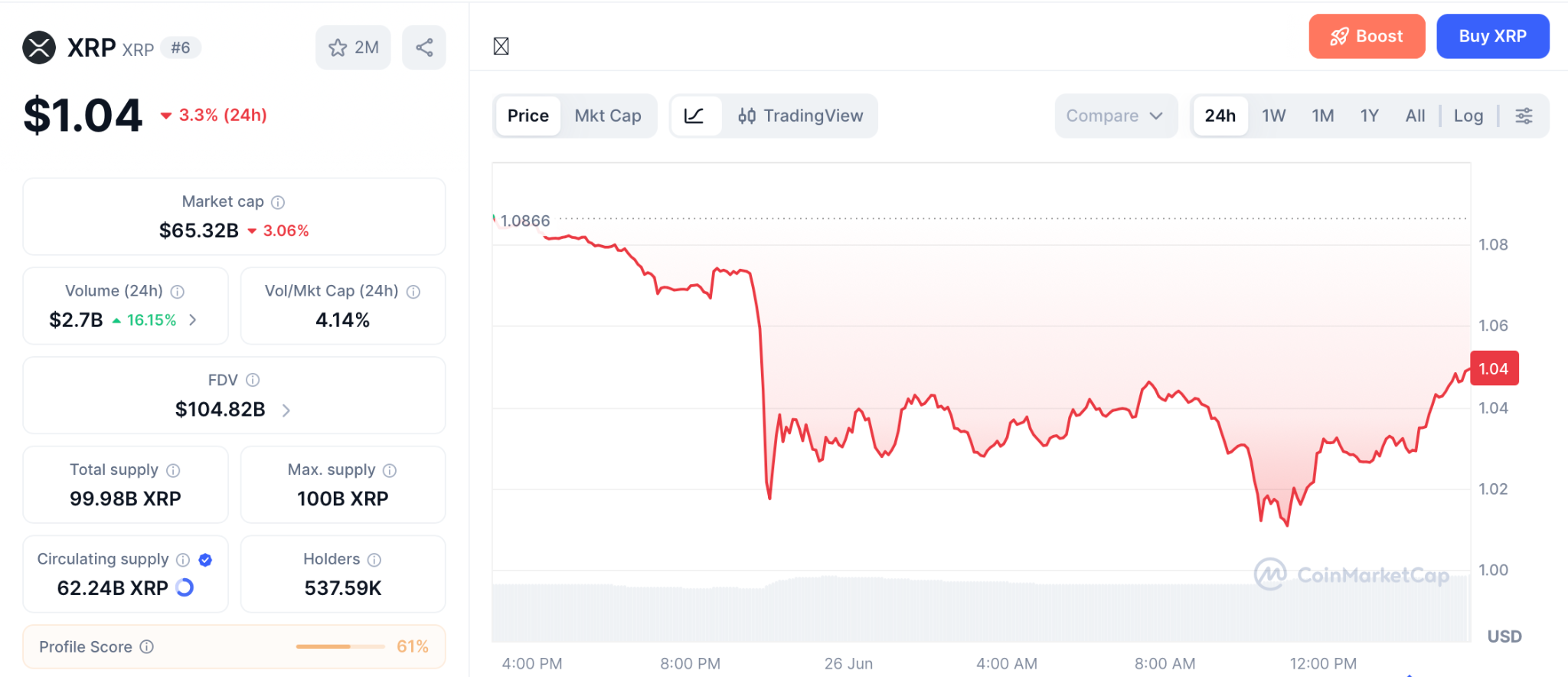
The xrp price prediction shifted again after pro-XRP lawyer Bill Morgan demanded Ripple release more of the monthly 1 billion XRP unlock instead of looping it back into escrow per Benzinga. The note dropped while XRP slid to $1.04. Benzinga still calls $10 a real long-term target, with Standard Chartered projecting $8 by year end.
The xrp price prediction now runs alongside record ETF activity. Seven U.S. spot XRP ETFs hold $1 billion AUM and 938.7 million tokens in custody on June 25, but the early high-multiple window for XRP and Solana closed at $67 billion and $40 billion in market cap.
CoinDesk reported XRP slid 2.8% to $1.04 on June 25, losing the $1.0850 support and parking at the lower end of its June trading range. Bulls need to reclaim $1.10 to flip the shakeout narrative. Solana (SOL) sits at $69.25, down 0.52%, while broader risk turned cautious across the CD20 index.
For the wider tape, the XRP setup confirms both tokens lean on institutional flow for price support, but the early returns are already behind them. The traders hunting 267x are no longer looking at assets where the chart fights over a $1 floor.
Top Cryptocurrencies to Position Before the Next Breakout
Pepeto: The Exchange Token Where $0.0000001879 Could Become 267x Before Institutions Find It
XRP traders sit on resistance levels waiting for steady percentage gains, but Pepeto at $0.0000001879 runs on different math. The ticket price is a fraction of a cent, the runway scales for years, and presale wallets stand in front of every public buyer that arrives later.
A live exchange under construction at the presale stage is rare on its own. Add $10,334,426 already inside the raise during a Fear and Greed reading of 12, a SolidProof reviewed contract, the cofounder who walked Pepe to $7 billion, and a former Binance executive shaping the listing.
Pepeto targets a meme coin trading market worth more than $45 billion with zero-fee infrastructure spanning three chains. Hitting 267x only requires the token to trade at a fraction of what Pepe achieved with the same 420 trillion supply.
The xrp price prediction has a ceiling. Pepeto does not, and the Binance listing is the event that wipes this entry off the screen for good.
XRP Price Prediction: Validated by Institutions but Returns Stay Range Locked
XRP trades near $1.04 per CoinmarketCap after losing key support under $1.0850. Benzinga still maps $10 as a possible long-term target, with Standard Chartered projecting $8 by year end and Coinpedia mapping $5 to $6 later this cycle.
The xrp price prediction targets $10 if ETF flows and CLARITY clarity keep stacking, roughly 9x over years, but moving averages stack between $1.13 and $1.19 and block every rally attempt.
Solana (SOL) Price at $69.25 as Risk Sentiment Cools Across Major Tokens
Solana traded at $69.25 per CoinDesk, down 0.52% across a broader pullback on June 25. SOL ETFs continue to attract incremental flows while support sits at $65 with $89 the key resistance. Losing $65 opens $58.
Conclusion
Ripple will still be trading next week no matter what the xrp price prediction lands on. The Pepeto presale will not. The June 25 break under $1.0850 confirms the early high-multiplier window for both XRP and SOL is already closed. A $1,000 XRP position buys 935 tokens and stretches to about $9,000 even at the bullish $10 target.
The same $1,000 in Pepeto secures 5.32 billion units, a position that pays out between $100,000 and $150,000 once the listing hits Pepe’s ATH math, and $10,000 on the same ticket is the million-dollar wallet most readers spent last cycle wishing they had.
One wallet got in before listing and walked out of this cycle with a portfolio between $150,000 and a million on a single position. The other hesitated like buyers who passed on Shiba Inu and carries that regret forever. The window is still open, but at the pace demand is hitting the raise, days are all that is left.
Click To Visit Pepeto Website To Enter The Presale

FAQs
What is the xrp price prediction target after Bill Morgan called for faster escrow releases?
The xrp price prediction targets $10 long term per Benzinga if ETF demand and CLARITY Act clarity keep stacking. XRP’s $67 billion cap caps near-term upside to percentages, not the multiples a presale entry can deliver.
How does Pepeto’s return math compare to holding XRP or SOL?
Pepeto secures 5.32 billion units per $1,000 at $0.0000001879, a position that pays between $100,000 and $150,000 at listing on Pepe’s ATH math. XRP at $67 billion and Solana at $40 billion cannot support a 100x to 150x outcome from their current caps.
What does the June 25 XRP breakdown mean for XRP and Solana?
XRP losing $1.0850 confirms both tokens lean on institutional ETF flows for price support. Neither offers the presale upside Pepeto carries ahead of a confirmed Binance listing at $0.0000001879.
Disclaimer: This is a Press Release provided by a third party who is responsible for the content. Please conduct your own research before taking any action based on the content.

A senior Federal Reserve official has put a possible 2026 interest rate hike back in focus, adding new pressure on US stocks. Neel Kashkari, president of the Federal Reserve Bank of Minneapolis, said Friday that he now expects one rate increase in 2026 and does not see cuts coming soon.
His comments are critical because Kashkari has long been seen as one of the Fed’s more dovish policymakers. His shift suggests inflation concerns are spreading inside the central bank, leaving investors to rethink how long borrowing costs may stay high.
Why the Kashkari Rate Hike Call Matters for Stocks
Kashkari’s comments came shortly after the Fed’s June policy meeting, where officials voted 12-0 to hold interest rates between 3.50% and 3.75%.
The bigger signal came from the Fed’s own projections. Nine of the 18 officials now expect at least one rate hike in 2026. The median forecast also moved higher, rising to 3.8% from 3.4% in March.
Investors had spent much of the year expecting the next major move to be a cut. The June meeting weakened that assumption and pushed markets toward a more uncomfortable possibility: borrowing costs may stay higher for longer.
Fed Chair Kevin Warsh also moved away from forward guidance, the practice of giving markets a clearer sense of where policy may go next. That makes each inflation report and jobs report more important, because traders now have fewer signals from the central bank in advance.
Markets are already reacting to that risk. Futures prices show traders see about a 30% chance of a July hike, according to CME FedWatch data. They also put the odds of at least one rate increase by December at roughly 76%, keeping the risk of another Fed hike firmly in view.

“I’m concerned about inflation, and it’s not only tied to what’s happening in the Middle East, it’s just the impression of broader inflationary pressures in the economy,” Kashkari said.
Follow us on X to get the latest news as it happens
Higher Rates Squeeze Growth Stocks and Bitcoin
Higher-for-longer rates weigh on growth and technology stocks. They raise discount rates and borrowing costs for companies that carry debt.
Crypto sits in the same rate-sensitive camp. Bitcoin recently traded near $60,000, up about 1.3% in 24 hours.

The last hiking cycle shows the stakes. As the Fed raised rates through 2022, Bitcoin fell from about $69,000 to near $15,500.
A late-2026 hike would reinforce the backdrop behind recent bearish calls.
BitMEX co-founder Arthur Hayes sees a $40,000 Bitcoin bottom within six months, citing a hawkish Fed. His six-month window runs into late 2026, the same stretch Kashkari flagged for a possible hike.
China’s top Bitcoin miner, Jiang Zhuoer, expects a similar floor around $42,000 to $44,000 in late 2026. He built the call on Strategy’s mNAV near 0.72, close to its 2022 bear-market low. Both targets sit between about 27% and 34% below current levels.
Other signals cut the other way. Wintermute says leverage has largely cleared, while Hayes still holds a year-end target above $200,000.
Investors now look to upcoming inflation and jobs data for the next signal. Whether Kashkari’s hike lands in late 2026 may shape equity valuations and Bitcoin price forecasts into year-end.
The post Fed Official Kashkari Gives Rate Hike Warning: How Will US Stocks and Bitcoin React? appeared first on BeInCrypto.

Walmart heir Lukas Walton buys minority stake in Chicago Bulls

Anti-trafficking group says CLARITY Act’s Section 604 could weaken accountability

WWE’s Sami Zayn talks recent character development that has fans booing more often


-

 Entertainment6 days ago
Renter of Home in Anne Heche Crash Denies Settlement With Son
-
 Sports3 days ago
Two goals and an assist by sheer aura: Cristiano Ronaldo just entered the World Cup chat
-

 Tech4 days ago
Microsoft accidentally kills epic Outlook email threads
-

 Business6 days ago
Soccer-U.S. defends Iran World Cup travel restrictions, says discussions ongoing
-

 Politics13 hours ago
The House | Manchesterism won’t survive the painful trade-offs unless it gets citizens on board
-

 Politics6 days ago
Andy Burnham and the meaning of Makerfield
-

 Politics17 hours ago
Potential 2028er World Cup attendee leaderboard
-

 Tech24 hours ago
A Look At A Gaggle Of Transputer Boards
-
Crypto World3 days ago
Bitcoin (BTC) Dips Below $62K, Ethereum (ETH) Plunges 6% Daily: Market Watch
-

 Crypto World3 days ago
Securitize Wraps Roubini's SEC-Registered ETF as Dubai VARA Digital Security
-
 Crypto World1 day ago
Dell (DELL) Shares Tumble Over 5% Following Analyst Downgrade to Hold
-

 Business12 hours ago
Asia stock markets slide as tech shares slump
-
Business3 days ago
Entergy settles forward sale agreements, raises $672 million in cash proceeds
-
 Crypto World6 days ago
Can Charles Hoskinson Really Rescue Cardano?
-
 Business7 days ago
Wall Street Week Ahead: Investors see Micron earnings as pulse check of AI rally momentum
-

 Entertainment7 days ago
Jose Alvarado Wants Taylor Swift at More Knicks Games
-

 Fashion2 hours ago
Weekend Open Thread: Staud – Corporette.com
-

 Crypto World7 days ago
HIVE shares jump as $220M AI deal speeds Bitcoin mining pivot
-
 Crypto World5 hours ago
Hyperliquid Named on Singapore MAS Investor Alert Register
-

 Crypto World6 days ago
Jake Chervinsky accuses CME of protecting derivatives monopoly
You must be logged in to post a comment Login