
Crypto World
Ethra Ship brings billion-dollar shipping market onto the blockchain



Ethra Ship has launched a blockchain protocol backed by four years of maritime operations, opening access to an asset class where individual vessels can cost between $30 million and $120 million.
Summary
- Ethra Ship has launched a blockchain protocol that tokenizes investments in operating maritime shipping assets.
- The platform separates its $SHIP governance token from a regulated RWA investment layer backed by vessel-owning SPVs.
- The launch comes as tokenized real-world assets continue expanding, with Wall Street forecasting multi-trillion-dollar market growth.
According to a recent announcement from Ethra Ship, the company has introduced a two-layer real-world asset tokenization protocol designed to connect crypto users and institutional investors with operating dry bulk shipping assets.
The platform is supported by Ethra Invest, which has been acquiring, managing, and commercially operating vessels since 2021, providing the protocol with an existing revenue-generating business rather than a pipeline of future acquisitions.
Speaking about the launch, Ethra Chief Executive Officer Saeed Al-Marri said tokenization only succeeds when it is built on top of an operating business rather than an idea.
“Tokenization only works when there is a real business underneath it. We bring four years of vessel operations, live charter revenue, and operational data to the protocol from day one, setting the standard maritime RWAs should be held to.”
Ethra said its portfolio has generated Time Charter Equivalent (TCE) revenue through commercial vessel operations while establishing the infrastructure required to manage maritime assets before introducing blockchain technology. According to the company, this approach differs from projects that issue tokens first and seek to acquire underlying assets later.
The protocol separates governance from regulated vessel investments
Under the announced structure, the first layer revolves around the SHIP token, which serves as the ecosystem’s utility and governance asset. Ethra said token holders will be able to stake their holdings for access to its Fleet Visibility Dashboard, which provides real-time fleet performance data, while also participating in governance decisions as the protocol develops.
Alongside the public token layer, the company has created a regulated investment tier for eligible investors who complete KYC and AML checks. According to Ethra, participants in this layer receive fractional exposure to Special Purpose Vehicles that own operating dry bulk vessels, allowing them to share in cash flows generated through commercial freight charters.
Commenting on the rollout, Ethra Chief Operating Officer Emad Shahin said the protocol combines blockchain infrastructure with a shipping business the company has operated for several years.
“Ethra Ship Protocol gives both Web3 and traditional investors a structured way to engage with an asset class that we have been operating and investing in since 2021. The infrastructure exists around our track record in the maritime sector, giving participants confidence that we have experience operating a fleet of revenue-producing ships.”
Ethra added that future development phases will expand staking features, institutional participation, and on-chain data services before eventually introducing tokenized vessel ownership.
RWA markets continue expanding beyond traditional asset classes
Maritime shipping enters the tokenization market as real-world assets continue attracting institutional attention.
As crypto.news reported in May, the value of tokenized real-world assets on public blockchains climbed to nearly $34 billion, up from roughly $5.4 billion at the beginning of 2025. Ethereum currently carries about 60% of that market, while tokenized U.S. Treasuries account for around $15 billion.
New asset categories have also continued to emerge. Earlier this month, DBS Bank announced plans to launch tokenized physical gold backed by bullion stored in Singapore, extending its digital asset strategy beyond tokenized money market funds and stablecoin services.
Wall Street institutions have also projected substantial growth for the sector. In its Tokenization 2030: Wall Street On-Chain report, Citi estimated the tokenized securities market could reach $5.5 trillion by 2030 under its base-case scenario, with projections ranging from $2.7 trillion to $8.2 trillion depending on adoption. The bank expects blockchain infrastructure to support an increasing share of Treasury bills, equities, funds, and other financial assets during the decade.


US law-enforcement–linked prosecutors’ groups are asking for targeted changes to the CLARITY Act, a sweeping cryptocurrency market structure bill moving through the US Senate, according to a Politico report published this week.
With the Senate approaching a month-long break, the proposals focus on how the legislation addresses developer-related obligations inside the Digital Asset Market Clarity (CLARITY) Act—particularly within provisions tied to the Blockchain Regulatory Certainty Act (BRCA). The White House’s crypto adviser, Patrick Witt, publicly pushed back on the idea that the administration is aligned with the changes, describing them as far from the Trump administration’s position.
Key takeaways
- Prosecutors’ groups reportedly urged the White House to adjust BRCA provisions in the CLARITY Act, including language aimed at developer conduct and criminal liability.
- White House adviser Patrick Witt said the reported proposals are “not even close” to the administration’s position and suggested the process wasn’t the product of “productive negotiations.”
- Democratic lawmakers have also signaled concerns about ethics rules in the CLARITY Act related to Donald Trump’s crypto investments, intensifying internal opposition.
- The Senate is not scheduled to vote on the bill before a planned summer recess, shrinking the time window for resolution.
- At the policy level, CLARITY’s market structure proposal would shift oversight from the SEC toward the CFTC, a move that would change the enforcement and regulatory toolkit for digital assets.
Prosecutors ask to narrow developer liability language
In a letter to the White House, the National Association of Assistant US Attorneys and the National District Attorneys Association reportedly requested changes to specific provisions regarding developers in the CLARITY Act, Politico reported on Tuesday.
Under the proposal, the groups want adjustments within the BRCA sections that are embedded in the larger CLARITY framework. The reported language would ensure guidelines for developers do not “create, expand, or modify criminal liability under Federal law.”
For developers and compliance teams, this kind of drafting is more than semantic. If regulatory certainty language is read to broaden exposure to federal criminal theories, it can influence how teams document releases, build features, manage tokens and smart contracts, and interpret what actions might be treated as legally risky. Conversely, if the goal is to prevent the bill from being interpreted as expanding criminal liability, it signals an attempt to narrow enforcement hooks that could arise from new obligations.
White House pushback complicates talks
White House crypto adviser Patrick Witt responded to the reports by arguing the proposals are not aligned with the administration’s stance. In a post on X, Witt said the provisions were “not even close” to the Trump administration’s position and implied there had been no “productive negotiations” behind the letter.
Separately, Politico reported that Senator Catherine Cortez Masto has been pressing the White House to address the BRCA before any potential vote on CLARITY.
That sequence matters for the bill’s timing. If lawmakers believe the BRCA language remains unresolved, they may resist moving the bill forward procedurally—especially when opposition from other quarters, such as ethics concerns, remains active.
Ethics controversy and party-level resistance
The CLARITY Act has faced additional headwinds among Democrats, with reported criticism centered on ethics rules related to President Donald Trump’s crypto investments. According to the article coverage referenced in the source material, Trump’s crypto holdings were reported to be worth $1.4 billion in 2025.
Earlier coverage from Cointelegraph noted that objections are tied to ethics restrictions within the bill for US President Trump’s crypto investments. In the broader political environment, ethics provisions often become a focal point for party discipline: opponents can use them to unify resistance even if they otherwise accept parts of the market structure framework.
As of Wednesday, the Senate Majority Leader John Thune had not scheduled a vote on the legislation before the chamber breaks, leaving uncertainty around whether negotiations can resolve both the ethics dispute and the BRCA/developer language before Senate procedures become harder to complete.
Timing pressure before the summer recess
The Senate is set to hold state work periods from Aug. 7 to Sept. 14, creating a compressed window for any vote or late-stage compromise. Thune told reporters last week that the Senate was unlikely to vote on the bill before the August recess.
One procedural complication highlighted in the source material is the difficulty of moving a contested bill through a full sequence of steps. Anne Kelley, a partner at Mercury Strategies, wrote on X that even if CLARITY were introduced “today,” the procedural steps—cloture, amendment processing, a second cloture, and as much as 30 hours of debate—would make finishing before recess extremely difficult without unanimous consent to waive process, which she described as rare for contested bills.
For readers watching legislative momentum, this is a key point: when the political environment is split, the Senate’s floor mechanics become a practical gatekeeper. Even if there is willingness to compromise, the calendar can determine whether changes occur in time to shape the final text.
What CLARITY aims to change: SEC versus CFTC authority
Beyond the fight over ethics and developer language, CLARITY’s central market-structure proposal would shift regulatory focus over digital assets largely from the US Securities and Exchange Commission (SEC) to the US Commodity Futures Trading Commission (CFTC). The source material also notes that the CFTC currently has fewer tools and resources than the SEC for enforcement and oversight in certain contexts.
At the staffing and leadership level, both agencies have been described as understaffed at the leadership level, with the CFTC having one chair and the SEC having three commissioners—an imbalance that can affect how quickly agencies can operationalize new authorities, issue guidance, or prioritize enforcement.
For market participants, the SEC-to-CFTC shift matters because it can change how enforcement risk is assessed and how compliance is designed. Different agencies can interpret market conduct, custody, derivatives-related activity, and token classifications through different legal frameworks and enforcement priorities.
That institutional reshuffling is also why the BRCA debate may be consequential. If developer protections are intended to prevent criminal-liability expansion, the bill’s final language will determine how broadly those boundaries apply—and which regulator’s view ends up carrying more practical weight for day-to-day decision-making by builders.
As the Senate approaches its August recess, the immediate question is whether lawmakers can reconcile both the BRCA/developer provisions and the ethics-related objections without derailing the bill procedurally. The next signals to watch are whether the White House engages directly on the BRCA language and whether a vote is even realistically possible before the chamber pauses for the state work period.


BIP-360, the proposal to give bitcoin quantum-resistant addresses, specifies three algorithms NIST has already standardized, and includes several deliberately so users have fallbacks if one is later broken by quantum or classical advances.
What changed is the speed of the classical side. BIP-361, the companion proposal that would freeze more than a third of bitcoin’s supply, argues that the migration window is closing because cryptographic attacks are improving by up to 20-fold. Anthropic’s results align with that trend, with a model behind it.
Against HAWK’s smallest parameter set, Anthropic said the expected cost of recovering a key fell from about 2^64 operations to 2^38. Larger keys remain impractical to attack, but doubling key sizes to compensate removes most of what made HAWK attractive.
The company disclosed the attack to HAWK’s authors in June and coordinated publication with NIST’s public mailing list.
A second result improved attacks on a deliberately weakened version of AES, the cipher used across the industry to encrypt wallet files, by factors of 200 to 800.
Importantly for crypto developers, Anthropic said the model produced smaller improvements, under tenfold, against Poseidon, the hash function that underpins many zero-knowledge proof systems, including those securing rollups and privacy protocols.


The US Treasury has sanctioned two Iranian maritime firms involved in an alleged Islamic Revolutionary Guard Corps (IRGC)-backed insurance network, saying one accepted Bitcoin (BTC) and other digital assets to bypass Western sanctions.
On Wednesday, the Treasury’s Office of Foreign Assets Control (OFAC) said that Persian Gulf Marine Insurance Company and HormuzSafe Marine Services Authority were integral to what it described as an IRGC-backed insurance network that required commercial vessels to buy approved coverage before transiting the Strait of Hormuz. The firms were designated for operating in Iran’s financial sector.
The action comes after earlier reports that Iran was considering a Bitcoin-based maritime insurance platform. US authorities now allege the network generated revenue for the IRGC. Treasury also sanctioned eight companies linked to Iran’s shadow fleet and identified eight vessels as blocked property.
OFAC said HormuzSafe accepted BTC and other crypto as part of efforts to evade sanctions. It alleged that the platform generated revenue on behalf of the IRGC while helping Iran exert greater control over shipping through the strait.
“The United States will not allow Iran to hold global commerce hostage,” Treasury Secretary Scott Bessent said, accusing the regime of using international shipping to finance the IRGC.
HormuzSafe shifts from reported proposal to sanctions target
On May 18, screenshots of the HormuzSafe website had circulated online offering “digital insurance” for maritime cargo, with policies payable in Bitcoin. At the time, reports suggested Iran was still considering the insurance-based model, and the website was inaccessible when checked.
Iranian state-linked media Fars News Agency said the proposed platform could issue marine insurance policies and certificates of financial responsibility while potentially generating over $10 billion in revenue.
The Strait of Hormuz handles about one-fifth of the global oil trade, meaning efforts to monetize or control traffic through the waterway carry significant implications for international energy markets.
Related: Bitcoin threatens $62K in risk-asset rout as President Trump says US will ‘run’ closed Hormuz Strait
Earlier reports, citing the Bitcoin Policy Institute, said Iran accepted oil toll payments in Chinese yuan, Tether USDt (USDT) and Bitcoin, though there was no onchain evidence that any Bitcoin payments had yet been made.
Bitcoin may be attractive to sanctioned actors because it has no centralized issuer capable of freezing funds, unlike centralized stablecoins whose issuers can block addresses. In April, US authorities froze $344 million in USDT stablecoin linked to Iran.
Magazine: Inside the ‘fake police raid’ that forced a $1M Bitcoin transfer
Crypto’s largest tokens were close to unchanged on Thursday as the semiconductor selloff that has driven markets for two weeks showed its first real sign of easing.
Ether traded at about $1,905 and bitcoin at $64,100, both flat on the day, with XRP at $1.07, solana at $74, BNB at $572 and TRON at 33 cents. Hyperliquid’s HYPE slipped to $54. Volumes were modest, with roughly $28 billion changing hands in bitcoin and $10 billion in ether.
Electronics giant Samsung said chip profit rose more than 250-fold on AI memory shortages, and the Kospi swung between a 6% gain and a 2% loss before settling, after a stretch that took the index down more than 40% from its June peak.
Samsung’s reaction is the tell on how high the bar has become. Profit up 250-fold moved the shares 2%. SK Hynix reported profit up 557% on Wednesday and fell 17%. Results are not the problem, expectations are.
U.S. earnings split overnight. Microsoft gained nearly 9% in extended trading on its fastest cloud growth in four years, while Meta fell 8% on a weak revenue forecast. Nasdaq 100 futures rose 1% after the index entered a technical correction on Wednesday.


Ten European financial institutions have launched Regulated Layer One (RL1), a jointly owned blockchain cooperative designed for regulated financial markets and tokenized assets.
On Tuesday, the group announced that RL1 had been established as a European Cooperative Society in Luxembourg and had begun operations with founding members including ABN AMRO, Cecabank, Chartered Investment, Crédit Mutuel Alliance Fédérale, DekaBank, DZ BANK, LBBW, Natixis CIB, SC Ventures and Seturion.
RL1 said each member will have equal decision-making rights over the network’s governance and development.
The private, permissioned network is based on infrastructure developed by German fintech Secure Worldwide Interbank Asset Transfer (SWIAT), which has now transferred ownership of the network to the cooperative.
SWIAT said the platform has processed more than 50 transactions worth over 700 million euros (about $808 million) during three years of production use.
The blockchain is designed to support institutional use cases including digital money, tokenized bonds, collateral and blockchain-based settlement. RL1 said the shared network could reduce fragmentation caused by financial institutions operating separate distributed ledger systems.
Former SWIAT managing director Henning Vollbehr will lead RL1. KfW and L-Bank will continue supporting the initiative, while RL1 said it is in discussions with additional institutions, including NatWest, about joining the network.
Related: CoinShares debuts Bitcoin mining ETF in Europe entrance

Crypto exchange Luno is reportedly cutting about 20% of its workforce as it restructures operations and reallocates resources toward institutional clients, financial infrastructure, and business-to-business services. The move, first reported by Bloomberg, reflects a broader cost-and-efficiency push in the crypto industry amid pressured growth expectations and tighter budgets.
According to the report, Luno CEO James Lanigan said the company’s previous investments in automation and operational upgrades have changed what it needs to run the business. Alongside further cost trimming aligned with market conditions, Luno plans to continue investing in areas including compliance, core infrastructure, and retail products—suggesting the reorganization is intended to reduce burn without abandoning key regulatory and product priorities.
Key takeaways
- Luno is reportedly cutting roughly 20% of global staff as it shifts resources toward institutional and infrastructure-focused lines of business.
- Company leadership attributes the reduction to automation and operational improvements that have reduced the resources needed to run day-to-day activities.
- In addition to cost cuts, Luno plans to keep investing in compliance, core infrastructure, and retail offerings.
- Luno’s layoffs fit a wider industry pattern: job cuts across crypto companies have increasingly been linked to efficiency drives and automated operations.
- CryptoJobsList data shows July restructuring activity across multiple firms, though the dataset includes crypto-adjacent tech and is skewed by some very large reductions.
Luno’s restructuring: fewer people, different priorities
Luno, founded in South Africa and owned by Digital Currency Group, serves about 16 million users across Africa and the Asia-Pacific region. While the exchange has historically been associated with retail trading, the firm has broadened its business into crypto infrastructure and institutional services—areas that can demand different operating capabilities than consumer exchange support.
Bloomberg reports that the latest job cuts are part of that operational pivot. Lanigan reportedly said the company invested in automation and broader changes to how work is performed, which altered staffing needs. The company will also trim costs while investing in compliance and core infrastructure, according to the same account.
For investors and market observers, the key point is that the cuts are not presented as a retreat from regulation-heavy infrastructure or core product development. Instead, Luno appears to be aiming for a more scalable operational model—one that can support institutional and business-to-business customers without matching headcount growth to revenue expectations.
Not Luno’s first workforce reduction
Luno’s reported 20% cut follows earlier staffing actions. In January 2023, the exchange cut 35% of its staff, affecting nearly 330 employees, as turbulence across the technology and crypto sectors weighed on its growth and revenue. That earlier round was covered by Cointelegraph, highlighting that Luno has already been navigating a challenging environment for crypto companies seeking consistent expansion.
Taken together, the two waves suggest Luno is actively recalibrating its cost structure rather than treating layoffs as a one-off response. This matters because repeated restructuring can change how quickly an exchange adapts to market shifts—particularly when compliance requirements and infrastructure demands continue to rise even when retail activity becomes more cyclical.
Crypto layoffs in July: a pattern of efficiency-driven cuts
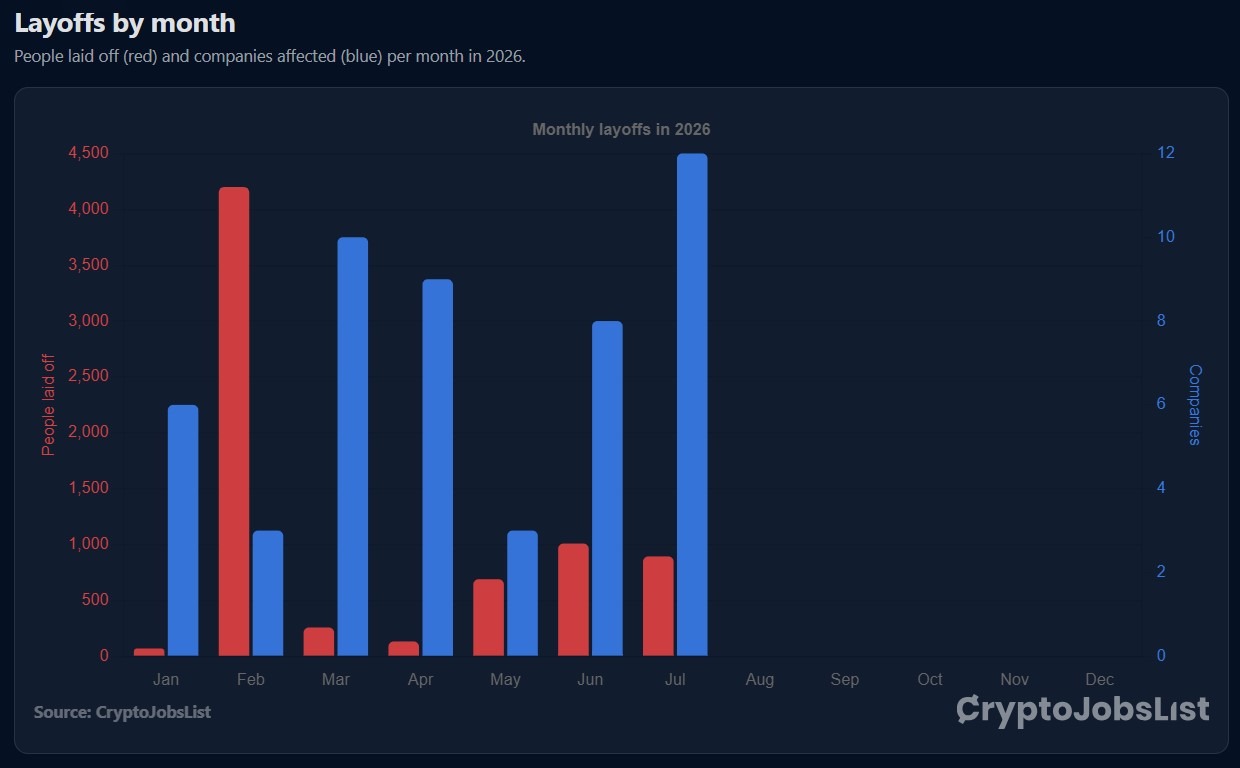
Luno’s move aligns with broader industry downsizing and reorganization efforts. CryptoJobsList, a tracker of crypto and related job changes, recorded layoffs or restructurings at 12 crypto and crypto-adjacent companies during July. Disclosed figures in that period total 894 jobs affected.
The data is useful as a high-level indicator, but CryptoJobsList also notes that it includes financial-technology adjacent companies and that the figures can be skewed by large reductions. For example, Block’s 4,000-person reduction in February—also tracked in CryptoJobsList’s reporting—means some months can look unusually severe even when the rest of the sector is less affected. Earlier coverage from Cointelegraph has also described how AI, automation, and operational efficiency have become recurring explanations behind staff reductions across crypto.
Earlier in July, crypto wallet company Exodus announced plans to cut 25% of its staff while reorganizing around a full-stack card-issuance and stablecoin-payments platform. Exodus said the plan could generate between $10 million and $13 million in annual operating savings, according to Cointelegraph reporting.
Separately, blockchain infrastructure developer Gnosis reportedly took steps linked to its consumer-facing Gnosis App. On Tuesday, it invited companies to contact it for introductions to former employees affected by a recent restructuring. The company said on July 17 that it had reduced its workforce after reviewing the Gnosis App, as referenced by a report on the Gnosis forum.
Why this matters: the industry is shifting labor toward infrastructure
Luno’s layoffs are framed not just as belt-tightening, but as a response to changed operational requirements. In practice, that often means fewer roles tied to manual processes and more emphasis on areas like compliance and core infrastructure—especially where institutional clients and regulated financial partners are involved.
At the same time, the pattern visible across July reporting suggests companies across crypto are treating headcount as a variable they can re-engineer through automation, AI-enabled workflows, and redesigned products. The uncertain part for employees and the market is how these efficiency moves translate into sustainable growth: cost reductions can stabilize budgets, but they may also reflect caution about near-term demand.
Looking ahead, readers should watch whether Luno’s institutional and infrastructure focus delivers measurable traction in new partnerships and service expansion, and whether the broader wave of restructurings continues to concentrate around automation-led operating models rather than a broader collapse in activity.
Crypto exchange Luno is reportedly cutting about 20% of its global workforce as it restructures operations and shifts more resources toward institutional clients, financial infrastructure and business-to-business services.
According to a Bloomberg report on Tuesday, Luno CEO James Lanigan said the company had invested in automation and broader operational improvements that changed the resources needed to run the business. Luno will also trim costs in line with market conditions while investing in compliance, core infrastructure and retail products.
Luno has previously made larger workforce reductions. In January 2023, the exchange cut 35% of its staff, affecting nearly 330 employees, as turbulence across the technology and crypto sectors weighed on its growth and revenue.
Founded in South Africa and owned by Digital Currency Group, Luno serves about 16 million users across Africa and the Asia-Pacific region. The company has expanded beyond retail trading into infrastructure and institutional services, including providing crypto infrastructure for banks and fintech firms.
Luno’s rationale for the layoffs reflects a wider industry trend, with several crypto companies citing AI, automation and operational efficiency when cutting staff.
Related: BitGo cuts 15% of staff to sharpen focus on AI, stablecoins
Crypto layoffs spread across industry
Jobs tracker CryptoJobsList recorded layoffs or restructurings at 12 crypto and crypto-adjacent companies in July, with disclosed figures totaling 894 jobs affected. CryptoJobsList has tracked more than 7,254 disclosed job cuts across 47 companies in 2026, with market conditions cited most often as the reason.
The data serves as a broad industry indicator rather than a definitive crypto-only total, as it includes adjacent financial technology companies and is heavily skewed by Block’s 4,000-person reduction in February.
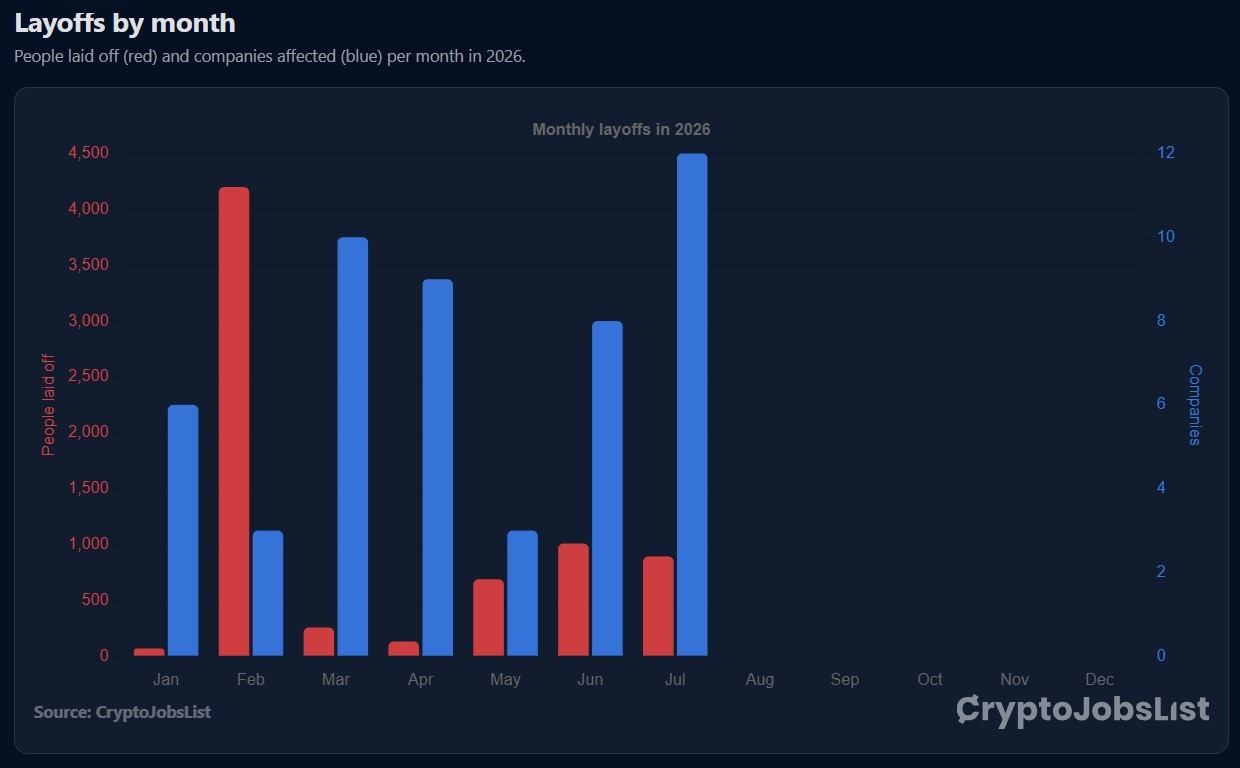
Layoffs by month. Source: CryptoJobsList
Earlier in July, crypto wallet company Exodus announced plans to cut 25% of its staff while reorganizing around a full-stack card-issuance and stablecoin-payments platform. Exodus said the move could produce between $10 million and $13 million in annual operating savings.
On Tuesday, blockchain infrastructure developer Gnosis invited companies hiring across engineering, product, design, marketing, developer relations and customer relations to contact it for introductions to former employees affected by a recent restructuring. The company said on July 17 that it had reduced its workforce following a review of its consumer-facing Gnosis App.
Magazine: Ethereum risks losing No. 2 spot as stablecoins gain ground

Bitcoin (BTC) could climb to between $380,000 and $450,000 from March 2028, according to crypto analyst Sykodelic, whose latest market outlook has sparked a heated debate on X over whether the current bear market is actually a mid-cycle correction.
The forecast stands out because it argues that BTC has not yet completed its broader bull cycle, even with many traders believing that the market topped in October 2025.
Analyst Says Bitcoin Is Still in the Middle of a Larger Cycle
In a July 29 newsletter preview shared on X, Sykodelic said the current bear market is a mid-cycle correction and not the end of the cycle, comparing it to stretches from 2011 to 2013 and 2019 to 2021. With that in mind, the analyst predicted the OG cryptocurrency will reach between $380,000 and $450,000 starting in March 2028.
His price target leans on two tools: the 200-week simple moving average multiplied by five and a quantile-95 statistical band already sitting near $330,000.
“Every cycle top has hit the 200w SMA x5. That already sits at $320,000,” he wrote. “As price moves higher that will go up.”
The market watcher pointed out that from BTC’s current price level to $380,000 is only a 5.5x move, way smaller than the asset’s 23x run from $3,000 to $69,000 in 2020, meaning such a jump isn’t just possible but quite probable.
At the time of writing, the asset was changing hands above $64,000 after recovering modestly over the past day. That recent weakness was linked to several factors, including investor caution ahead of the US Federal Reserve’s policy decision, weakness across broader financial markets, and continued outflows from spot Bitcoin exchange-traded funds.
Naysayers Dig In
That forecast drew immediate criticism. One of the doubters, X user Bitcoin Daily, who identified themselves as a data scientist, said they ran Sykodelic’s own 890-day spacing rule backward from the October 2025 high and landed in spring 2023, which, by his own framework, would make October 2025 the top, not the midpoint.
They also noted that Sykodelic’s chart had entirely skipped the 2015 to 2017 cycle. Furthermore, his two reference rallies measured different things, with June 2011 being a full cycle top followed by an 89% drop, while June 2019 was a bear market rally high that fell 55%.
Another thing Bitcoin Daily highlighted was that the last three cycle tops landed 525, 546, and 534 days after their halving. Meanwhile, March 2028 falls 38 days before next year’s halving, meaning Sykodelic’s $380,000 top would come in a period where such an event has never happened before.
“No Bitcoin top has ever arrived before a halving,” the data scientist stated.
Additionally, running the 890-day spacing from four other local highs since June 2024 produced targets spanning May 2027 to October 2028, a 17-month window that, according to Bitcoin Daily, shows Sykodelic’s March 2028 date was chosen and not calculated.
Sykodelic dismissed those objections, questioning the claim that spring 2023 could be considered a mid-cycle high only months after the November 2022 bear market low. He also said that he didn’t include the period between 2013 and 2019 since it never experienced a mid-cycle correction.
The post Bitcoin Could Hit $380K-$450K by March 2028, Says Analyst appeared first on CryptoPotato.
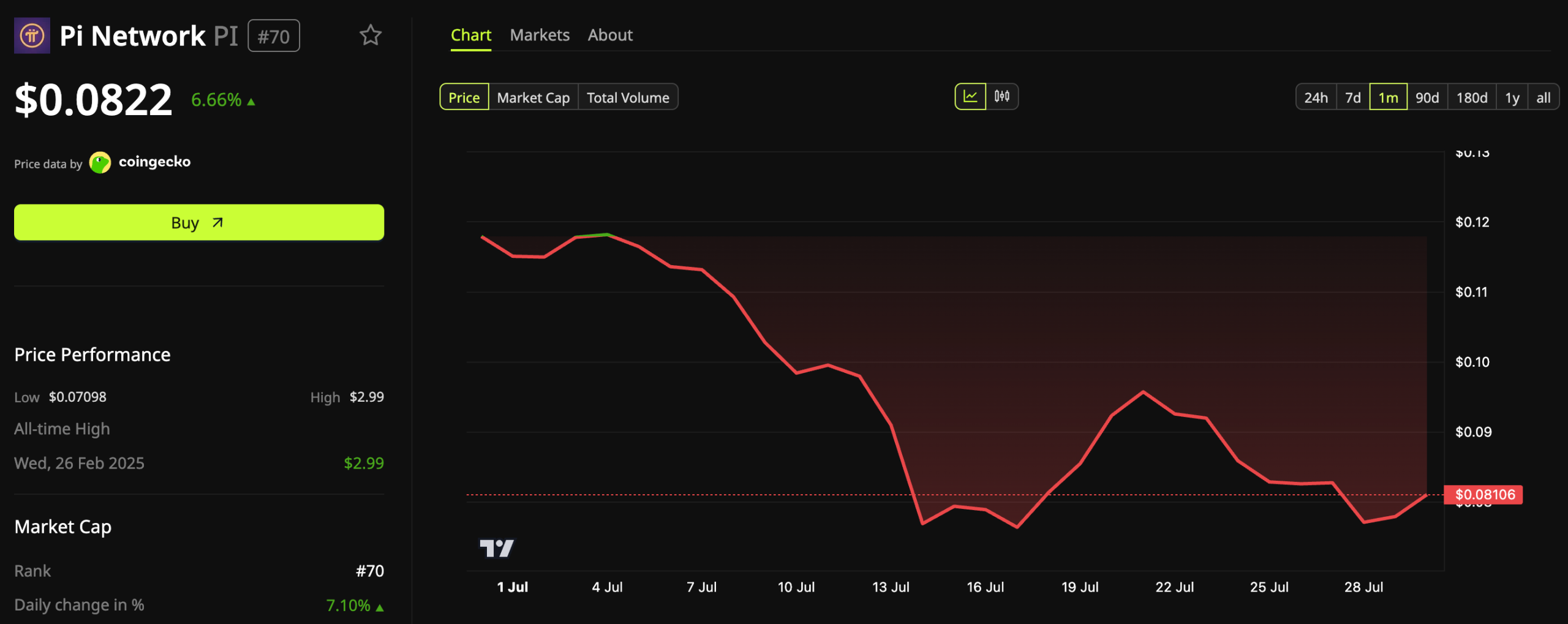
Pi Network (PI) saw a modest rise as the Pi Core Team began rolling out Protocol 26, the first of two remaining upgrades to its Mainnet.
Node operators have until August 11 to finish the update to maintain their connection to the Mainnet.
Pi Network Sets an August 11 Deadline for Node Operators
The Pi Core Team announced the rollout on Wednesday and directed operators to its node page for instructions.
“This migration is straightforward and should complete in under 5 minutes; in rare cases, restarts may take longer—please allow them to finish. Do not perform it to all of your nodes at the same time,” the instructions read.
Protocol 26 is the ninth protocol upgrade Pi has shipped over the past few months. Protocol 27 will close the current sequence.
The team stated that together, the two releases will bring the Mainnet up to date with the network’s latest protocol features and functionality.
Follow us on X to get the latest news as it happens
Upgrade News Lifts PI Price, but Rallies Keep Fading
Meanwhile, PI price ticked higher on the upgrade development. The token was up 6.66% to $0.0822 over 24 hours, outpacing the broader crypto market’s 0.71% gain.

A similar reaction followed the network’s product work. PI gained more than 3.5% in mid-July when Pi redesigned its mining app menu and profile page.
The rebound remains narrow, however. PI trades down 11.7% over the past 7 days and 29% over the past 30 days.
Earlier upgrades produced the same pattern. Pi activated Protocol 25 on July 22, and PI briefly tagged $0.103 days earlier before losing the $0.10 level.
Supply explains part of that ceiling. PiScan data showed roughly 4.25 million PI unlocking each day, with about 1.71 billion scheduled to enter circulation over 12 months.
The August 11 cutoff hands traders another dated catalyst. Prior deadlines delivered short bounces rather than a durable trend, and the upcoming upgrades will test whether that changes.
Subscribe to our YouTube channel to watch leaders and journalists provide expert insights
The post Pi Network Begins Ninth Protocol Upgrade Ahead of Final Version 27 appeared first on BeInCrypto.
Perplexity AI predicts an explosive rally for Bitcoin, and this Bitcoin price prediction does not hold back on the number. The call is $180,000 to $230,000 by the end of 2026, a target built on what the model calls a slow bull institutional phase rather than a sharp speculative spike.
Record ETF inflows are projected to top $300 billion, layered against sovereign adoption through a US Strategic Reserve. That combination is framed as overwhelming the post-halving supply shock entirely, meaning demand simply outpaces the reduced flow of new coins hitting the market.
Potential Fed rate cuts add a second structural bid on top of that. Enhanced liquidity tends to push capital toward risk assets, and Bitcoin has historically been a major beneficiary of exactly that kind of environment.
Regulatory clarity through the GENIUS Act rounds out the case. Perplexity frames this as the piece that legitimizes corporate treasury allocation, effectively giving more companies permission to hold Bitcoin on their balance sheets the way a handful of early movers already have.
Even the base case here is aggressive. A new all time high near $150,000 to $200,000 is treated as the expected outcome rather than the stretch scenario.
The bear case is not dismissed though. If ETF flows stall or a macro recession triggers deleveraging, Perplexity sees Bitcoin retesting support between $60,000 and $80,000.
The model still frames a collapse below current levels as increasingly unlikely, arguing the institutional floor beneath this market has genuinely strengthened compared to prior cycles.

Bitcoin Price Prediction: BTC Has Spent Six Months Retracing The Same 20,000 Dollar Range
Price closed at $63,835, up 0.22%, in a session ranging between $62,684 and $64,035. That modest green day sits inside a chart that has been repeating itself since spring.
Zoom out and the shape is unmistakable. Bitcoin topped near $128,000 in October 2025, then broke down hard through January, gapping from above $96,000 to under $72,000 in a matter of weeks.
Since that crash, price built a rounded recovery through spring that peaked near $82,000 in May, then rolled over into a sharp flush back to $60,000 in June. The climb since that June low has been steady, and it has now pushed BTC price back to almost exactly where the May rally first started.
Support sits at $60,000, the level defended through June. Below that, $52,000 marks the last major shelf from earlier in the cycle.
Resistance stacks at $66,000, then $70,000, then the heavier May ceiling near $82,000 that has already rejected one full rally attempt this year. Momentum here is mildly positive but not extended, consistent with a market grinding sideways rather than breaking out in either direction.
For Perplexity’s base case to gain real traction, Bitcoin needs to clear $82,000, a level this exact chart has already failed at once this year. Until that happens, this remains the same range it has been trading since May, just retraced from a different direction.
Don’t Miss Out on Our $1,000 USDT Airdrop on ByBit
Here is What Perplexity AI Predicts About LiquidChain
The rotation has already happened. Most people will realize it too late.
Large caps are boxed in. Bitcoin, Ethereum, and XRP keep testing the same ceilings with nothing giving way. Every macro catalyst has a new date. Every institutional wave arrives next quarter. Waiting on someone else’s timeline is not a trade.
A capital that has navigated enough cycles moves before the destination has a name.
Small market cap infrastructure plays on different physics entirely. A modest rotation that vanishes as noise at Bitcoin’s scale can reprice an undiscovered project by multiples. The returns live in the gap between what something is genuinely worth and what the market has assigned it. That gap closes permanently the moment discovery happens.
Multi-chain fragmentation bleeds DeFi every single day. Bitcoin, Ethereum, and Solana run as completely isolated systems. Every user crossing those boundaries pays in fees, slippage, and failed transactions. Every single time.
Perplexity AI predicts LiquidChain fixes that will entirely fix it. All 3 networks inside one execution layer. One deployment. Zero cross-chain tax anywhere.
The presale is at $0.01454 with just over $900,000 raised. The market has not found this yet. That is exactly the point.
Execution is unproven. Adoption is unknown. LiquidChain is an entry point that disappears the moment the market looks up.
The post Perplexity AI Just Dropped a Bitcoin Predicts That Has Traders Worried appeared first on Cryptonews.

Apple TV’s Twisted 10-Part Book Adaptation Is Rising on Streaming Ahead of the Finale

Fears over Light Valley Solar Scheme between York and Selby

Boss achieves revised FY26 guidance


-

 Fashion6 days ago
Weekend Open Thread: Brooks Brothers
-
 Sports3 days ago
Commonwealth Games boxing: Jadumani Singh seals dominant 5-0 win over Pakistan’s Sumama Rehman to enter quarter-finals | Commonwealth Games News
-

 Tech3 days ago
Intel is reversing course and bringing hyper-threading back to its server chips
-

 Business9 hours ago
Why Trees Belong on the Risk Register
-

 Politics3 days ago
Luke Littler dismantles Gerwyn Price to retain title in Blackpool
-

 Crypto World4 days ago
Ripple bought a bank in pieces. The $4 billion audit
-

 Politics2 days ago
The Part of the Electric Transition Nobody Wants to Discuss
-
 Entertainment6 days ago
A New Post-Apocalyptic Gundam Anime Series Blasts Into SDCC
-

 News Videos3 days ago
BITCOIN JUST ENTERED THIS CRITICAL ZONE…
-

 Fashion6 days ago
16 Dresses for the High Summer Event
-

 Sports6 days ago
2026 3M Open leaderboard: Scottie Scheffler finds putter in Round 1, sits three back
-

 News Videos6 days ago
The Peugeot Family: How 200 Years of an “Old Money” Dynasty Died in A Boardroom
-

 Business1 day ago
Major shareholder moves on Canyon
-

 Crypto World4 days ago
XRP Ledger adds $2.6B as RWA inflows rank second
-

 Politics4 days ago
Spain sweeps the board at 2026 World Cup with individual awards
-

 Crypto World7 days ago
Uniswap (UNI) pushes deeper into tokenized RWAs with permissioned trading pools
-
 Entertainment1 day ago
‘Stargate’ Creator’s New Sci-Fi Series Returns for Season 3 Tomorrow
-

 Tech5 days ago
Anthropic launches Claude Opus 5, a cheaper AI model for coding, agents and enterprise workflows
-

 Entertainment4 days ago
Sara Gilson Killed By Husband After Viral “Pedophile” TikTok Video
-

 News Videos1 day ago
Claude: Build Financial Dashboards in Minutes (2026)
You must be logged in to post a comment Login