
Crypto World
Aster Crypto Falls 7.7% as Hyperliquid Faces Token Unlock Selling Pressure


TLDR:
- Aster crypto fell 7.7% to around $0.62 as broader market weakness triggered heavy selling pressure.
- CZ stated that Aster and Hyperliquid serve different trading needs rather than direct competition.
- Hyperliquid faced added pressure after a $700 million token unlock increased circulating supply.
- Arthur Hayes exited his HYPE position as the token retreated from its recent record high.
Aster crypto traded lower on June 6 as weakness across the digital asset market weighed on prices. The token fell about 7.7% and hovered near $0.62. At the same time, Hyperliquid came under pressure as a major token unlock added fresh supply to the market.
Aster Crypto Tests Key Support as Traders Watch Market Direction
Aster crypto moved lower alongside Bitcoin during Friday’s market decline. However, the token recorded a steeper drop than the broader market, pushing its price into the $0.61-$0.62 range.
Meanwhile, a post shared by Wu Blockchain brought renewed attention to Aster crypto and its position within the perpetual futures sector.
The post referenced comments from Binance founder Changpeng Zhao (CZ) during an October 2025 interview on the Threadguy channel.
According to the post, CZ said Aster and Hyperliquid address different trading needs rather than competing directly.
He described Hyperliquid as a platform designed for open and transparent trading activity. In contrast, he said Aster offers greater privacy features and supports native asset deposits beyond a BNB Chain-focused structure.
CZ also noted that both projects remain relatively young. As a result, future market leadership could still shift as new platforms enter the sector.
Despite the latest decline, Aster crypto continued to post strong trading activity. Elevated volume suggested that traders remained active even as prices moved lower. Market participants are now watching whether Aster crypto can maintain support above the $0.60 level.
Analysts cited on CoinMarketCap noted that holding above that area could help stabilize price action. If support fails, attention may shift toward the $0.55 region.
Hyperliquid Faces New Selling Pressure From Scheduled Unlock
While Aster crypto struggled with market weakness, Hyperliquid faced a separate challenge linked to token supply. A scheduled $700 million token unlock took place on June 6 as part of an ongoing monthly vesting schedule.
The release increased the number of tokens entering circulation. Consequently, traders monitored the market closely for signs of additional selling activity.
Pressure also increased after reports emerged that investor Arthur Hayes had liquidated his entire HYPE position. The move attracted attention across the crypto market and coincided with renewed weakness in the token’s price.
HYPE traded near $59.35 during the session. The token remained well below its June 1 all-time high of $75.51 and was down roughly 12% over the past week.
Even so, Hyperliquid’s treasury position remained a focus for market participants. Reports showed approximately $1.1 billion in unrealized token gains within the project’s treasury holdings.
As traders assess current market conditions, attention remains on two key developments. Investors are watching whether Aster crypto can defend support above $0.60.
They are also monitoring how Hyperliquid performs following the large token release and recent selling activity.
For now, both assets remain among the most closely watched cryptocurrencies as market participants evaluate near-term price direction.


Pi Network’s Core Team announced the date by which the next protocol update must be completed, which automatically means that version 25 has already been deployed without an official confirmation.
Meanwhile, the project’s native token has shown resilience and is well in the green on a daily scale after a catastrophic crash earlier this month.
Protocol V26 Incoming
Recall that the team announced in mid-July that the protocol version 25 should have been deployed by July 22. This came after several other upgrades that were completed earlier this year. It all began in February with the implementation of v19.6, followed by subsequent updates that brought it to the aforementioned deadline in July.
Unlike most previous upgrades, though, the Core Team didn’t announce on X or on its website that version 25 was indeed deployed within the given timeframe. However, there were multiple reports online from users who claimed that it was in effect. Now that the team has provided further details on the next protocol update (version 26), it essentially guarantees that v25 has been implemented.
As with all previous upgrades, Pi Network urged all Mainnet validators to complete the necessary steps before the next deadline, which is now August 11, to ensure that they remain connected to the blockchain. The team described version 26 as a “major milestone ahead of the final planned upgrade,” which will be v27.
“With 8 successful upgrades completed over the past few months, these final two upgrades will bring the network up to date with the latest protocol features, improvements, and functionality,” reads the statement.
PI Already Rockets
Despite the impressive number of updates, new product lines, or redesigns announced by the Core Team lately, many of which came in the past month, the project’s native token failed to capitalize and rally. Just the opposite, it nosedived to a few consecutive all-time lows in July, the latest being at just over $0.07, marked in the middle of the month.
Each breakout attempt was halted in its tracks. The big rejection at $0.10 pushed it south to under $0.09 and $0.08. The token tanked to $0.074 just a few days ago, thus coming inches away from posting a new low.
However, it managed to rebound yesterday and has rallied even further today, perhaps due to the announcement above. PI is up by over 6% on a 24-hour scale and has seemingly reclaimed the $0.08 level.

The post Pi Network Sets Major Update Deadline as PI Surges Past Key Resistance appeared first on CryptoPotato.

Binance is moving deeper into regulated traditional finance by launching USDT-settled options on gold and silver via its Abu Dhabi exchange platform. The contracts are designed to let traders express a view on commodity price movements without taking physical delivery of the metals.
The new options will be listed through Nest Exchange Limited, a Binance-operated venue under the Abu Dhabi Global Market (ADGM) framework. For market participants, the key change is that exposure will be settled in USDT rather than the underlying commodities—potentially lowering friction for crypto-native traders who already hedge or speculate using stablecoin-denominated instruments.
Key takeaways
- Binance will list USDT-settled gold and silver options through its ADGM-regulated Nest Exchange Limited.
- Options provide commodity exposure without physical delivery of gold or silver.
- Retail users can only buy options, while eligible institutions and liquidity providers can also write (sell) options.
- The launch complements Binance’s earlier gold and silver perpetual futures, introduced in January.
- The rollout adds to a broader push across crypto firms toward regulated commodity-linked products and tokenized bullion.
How Binance’s gold and silver options are structured
According to Binance, the options will be available as USDT-settled contracts, allowing traders to position for changes in gold and silver prices while remaining within a stablecoin settlement model. The exchange says the design avoids the need for holders to physically handle the underlying metals—one reason derivatives often attract both hedgers and speculative users who want exposure without logistics.
Binance also drew a clear distinction between retail access and institutional participation. Retail users will be limited to buying options only. By contrast, eligible institutional users and liquidity providers can write options in addition to buying. The company frames this as a risk-control measure: restricting retail users to buying limits downside risk to the premium paid, while enabling institutional participants to write options can support premium collection strategies.
Regulated expansion: from perpetuals to options
This new offering builds on Binance’s earlier step into commodities derivatives. In January, the exchange introduced gold and silver perpetual futures, and the options launch signals a broader expansion of regulated access to traditional assets through crypto-native trading formats.
The shift matters because options introduce a different toolkit than perpetuals. Perpetual futures primarily support directional exposure and leverage-based strategies, while options can be used to hedge downside, structure spreads, or target volatility and payoff profiles that are harder to replicate with linear instruments. For traders operating in the USDT settlement ecosystem, moving from perpetuals to options may increase the range of risk management approaches available on regulated venues.
Still, the practical impact for most users will depend on how liquidity develops and how tight spreads and market depth look once contracts begin trading. Options markets tend to vary widely in execution quality, and those conditions can influence whether hedging or structured trading is economical for smaller participants.
Commodity-linked products beyond derivatives
Binance’s options are part of a wider trend in crypto markets: product development that ties to commodities while navigating different regulatory and market access pathways.
Alongside derivatives exchanges, companies have also focused on tokenizing physical bullion. Tether and Paxos, for example, have pursued tokenized gold products rather than exchange-traded derivatives. Tether’s XAUt—designed to represent one troy ounce of gold stored in Swiss vaults—has been working to broaden compatibility with financial institutions outside traditional crypto rails.
Recent developments include XAUt receiving Shariah certification from Amanah Advisors, an effort intended to expand adoption within Islamic finance contexts. In addition, ADGM recognized XAUt as an accepted spot commodity, allowing regulated firms to offer services tied to the tokenized gold asset in that jurisdiction.
These moves highlight an industry split in approach: exchange-traded options aim to deliver commodity exposure through contracts and stablecoin settlement, while tokenized bullion products aim to bring physical-backed assets into regulated service models for spot usage.
RWA.xyz has estimated that tokenized commodities now sit at about $4.56 billion in distributed value, with Tether Gold and Paxos Gold accounting for more than 90% of the market. That concentration suggests that, so far, the majority of tokenized commodity activity is centered around a small set of products—something that may affect how quickly new offerings gain traction.
What investors and traders should watch next
Binance’s move into USDT-settled options on gold and silver is likely to appeal to traders looking for more flexible hedging and payoff structures within a regulated framework. However, the real test will be how quickly liquidity builds on Nest Exchange Limited and whether market participants can execute strategies efficiently as volatility conditions change.
As commodity-linked crypto products continue to proliferate—ranging from regulated derivatives to tokenized physical bullion—readers should track not only product launches, but also how regulators define permitted access, how institutions participate through options writing, and whether liquidity and spreads meaningfully improve for end users over time.
Crypto World
Pi Network’s PI Extends Recovery as Bitcoin (BTC) Settles After FOMC Meeting: Market Watch
The highly anticipated FOMC meeting yesterday didn’t bring any surprises despite some expectations of a rate hike, and bitcoin’s price has calmed at around $64,000 after the recent volatility.
Most larger-cap alts have posted minor losses over the past 24 hours, led by HYPE’s 3% drop to under $54. In contrast, UNI has pumped to $4.
BTC Settles
Bitcoin rallied hard last week, going from under $64,000 to a monthly peak of $67,000. That resistance, though, turned out to be too strong given the current lack of substantial bullish catalysts, and the asset fell to $64,600 within a day or so, and dipped by another grand on Friday.
The bulls didn’t allow another breakdown, as BTC remained at around $64,000 during the weekend. It climbed to $64,500 on Sunday and jumped by another $1,000 on Monday as the markets priced in the de-escalation news on the Middle East war from that weekend.
Nevertheless, bitcoin was almost instantly rejected again, and the subsequent dip pushed it to under $62,800 on Tuesday ahead of the FOMC meeting in what appeared to be a de-risking move from investors. In the hours before and after the event, in which the Fed maintained interest rates at 3.50%-3.75%, BTC experienced some volatility, which included a rise to $64,600 and a dip to $63,200.
It has remained in the middle of this range since then, currently trading inches below $64,000. Its market cap is down to $1.280 trillion on CG, while its dominance over the alts has dropped to 56.3%.

US Enters Top 100, PI Keeps Pumping
Pi Network’s native token was among the top performers yesterday and has doubled down in the past 24 hours. PI has reclaimed the $0.08 resistance (now support) after another 6% rally as the team behind the project announced when the next protocol update should be deployed.
Talus (US) has skyrocketed by 20% daily and 600% monthly and is now within the top 100 alts by market cap. The larger-cap alts are a lot calmer, with UNI and BEAT posting 4-5% gains.
In contrast, HYPE has dropped by 3% to under $54, DOGE is down by over 1%, while ETH, XRP, SOL, and RAIN have slipped by up to 1%.

The post Pi Network’s PI Extends Recovery as Bitcoin (BTC) Settles After FOMC Meeting: Market Watch appeared first on CryptoPotato.
On 29 July 2026, Microsoft reported its results for the fourth quarter of fiscal year 2026. Revenue reached $90 billion, up 18% year-on-year, while adjusted earnings per share came in at $4.74, comfortably ahead of analysts’ expectations of $4.24. The company exceeded consensus forecasts for both revenue and its cloud business, reflecting continued strong demand for AI infrastructure. The earnings release came after months of pressure on the stock, driven by investor concerns over the scale of capital expenditure required to expand Microsoft’s cloud and AI capabilities.
Technical Analysis of Microsoft
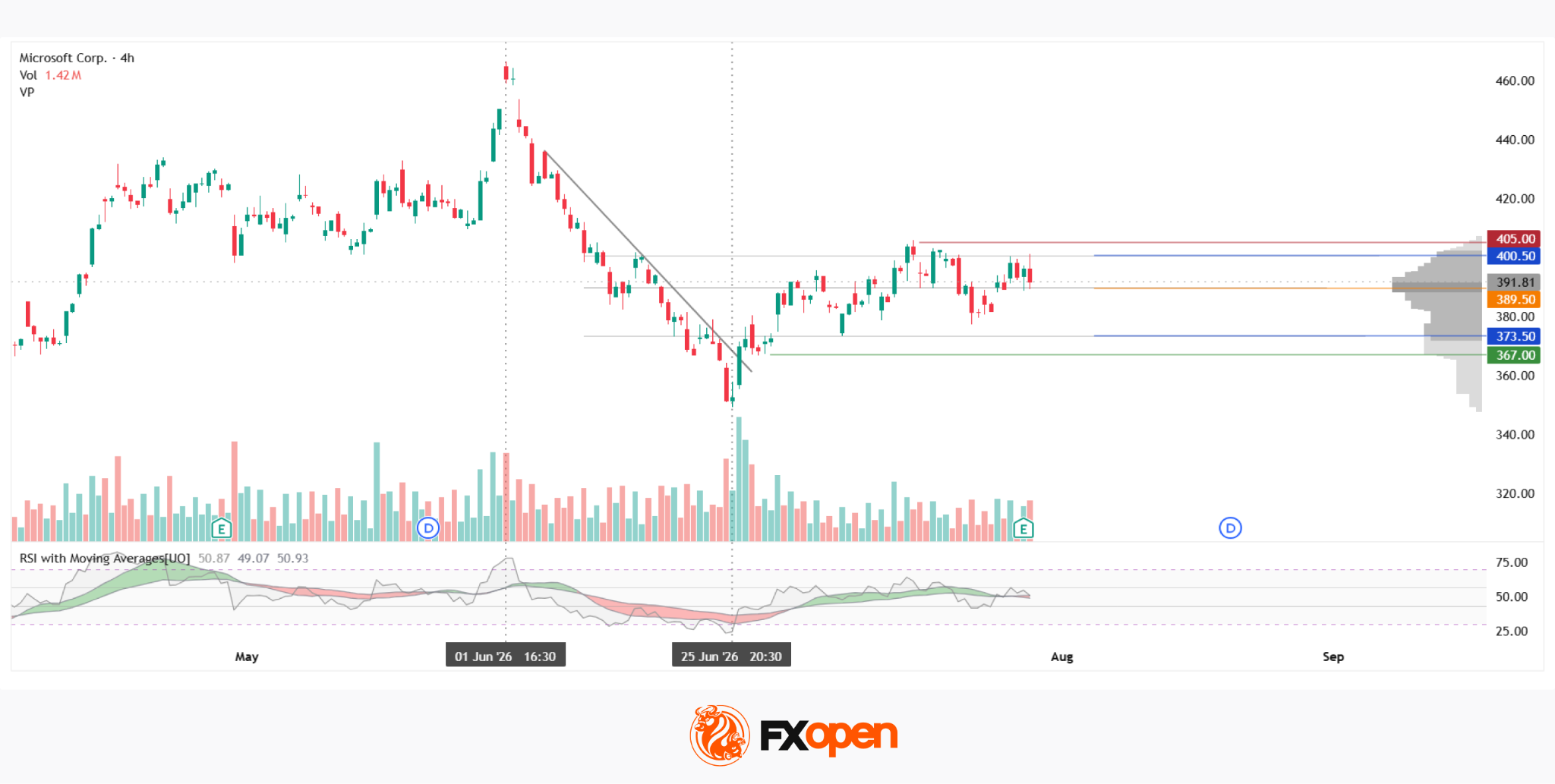
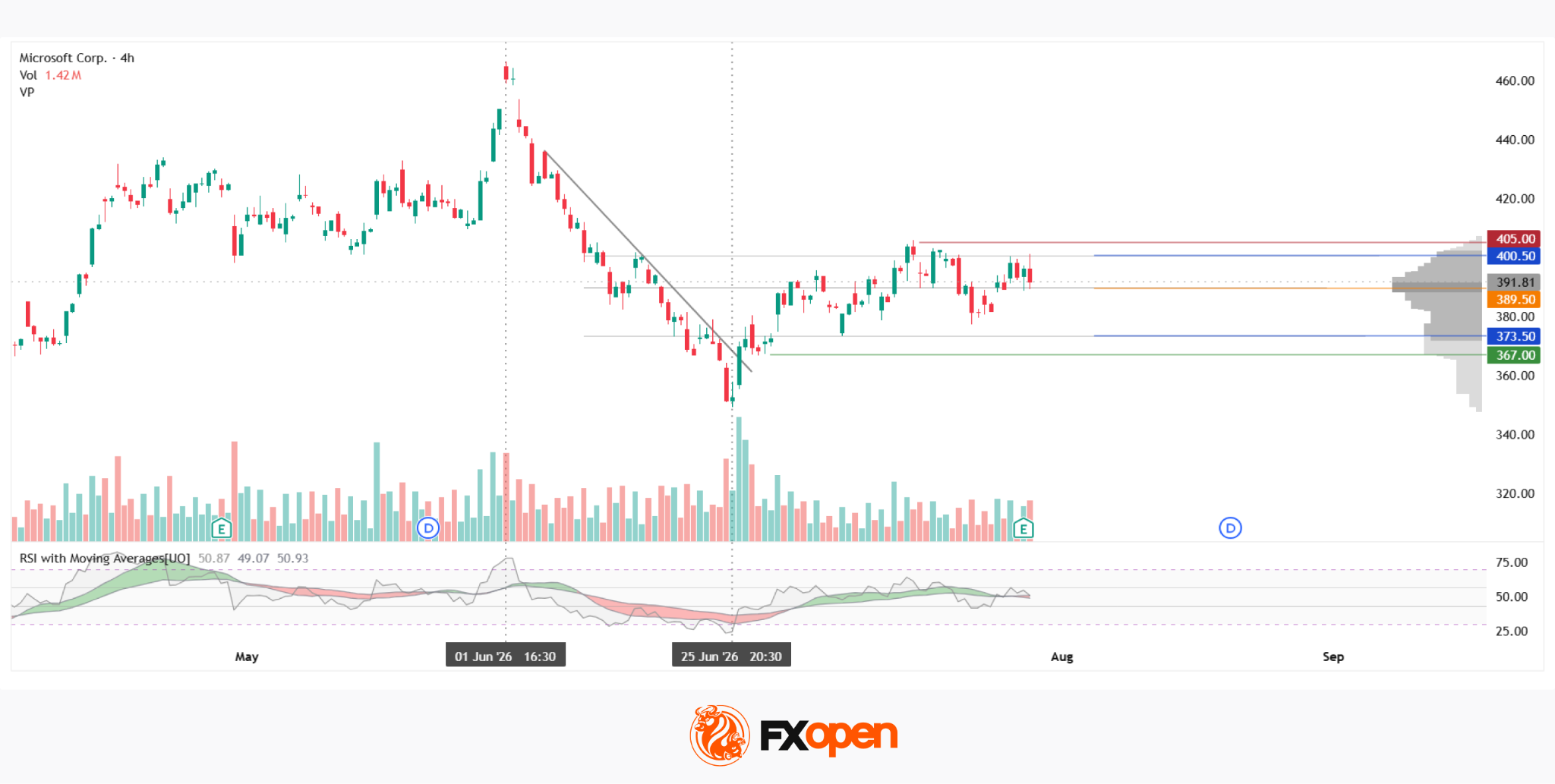
Since the beginning of June, the MSFT chart has developed a clear short-term downtrend. After peaking near $465, the stock declined sharply along a descending trendline before finding support around $350 on 25 June. An unusually large bullish trading volume was recorded during the rebound from this area.
Since then, the stock has entered a recovery phase and is now trading between the POC (Point of Control) at $389.5 and the upper boundary of the current market profile at $400.5. The $405 resistance level sits just above the profile boundary and could reinforce resistance in this area.
Below the current price, two nearby support levels stand out: the lower boundary of the profile at $373.5 and the support level at $367. The RSI + MAs indicator currently shows readings of 50, 49 and 50, with all three values positioned in the middle of the neutral zone. Such a configuration is typically associated with a period of consolidation before the market develops its next directional move.
Summary
The near-term performance of Microsoft shares is likely to depend more on how investors reassess the company’s recently reported operating results than on the reaction to individual technical levels. For now, the debate surrounding capital expenditure on AI infrastructure remains the dominant fundamental theme shaping market sentiment.
Buy and sell stocks of the world’s biggest publicly-listed companies with CFDs on FXOpen’s trading platform. Open your FXOpen account now or learn more about trading share CFDs with FXOpen.
This article represents the opinion of the Companies operating under the FXOpen brand only. It is not to be construed as an offer, solicitation, or recommendation with respect to products and services provided by the Companies operating under the FXOpen brand, nor is it to be considered financial advice.


MEXC Ventures today announced its support for the expansion of Alpha Arena, a global esports-inspired live trading tournament, into the APAC region. As part of the partnership, MEXC Ventures will serve as the Main Sponsor of Alpha Arena S03, with TRIV serving as the Co-host.
The APAC-focused trading competition will bring participants from online qualification to a live final in Bali, Indonesia, on August 20, 2026. Taking place during Coinfest week, the event will bring together traders, creators, and regional Web3 communities through a season of competition, learning, and community engagement. Updates will be shared through the Alpha Arena X account, with live coverage available via the Alpha Arena livestream.
From Europe to APAC: Alpha Arena Enters Its Next Stage
Alpha Arena is a global live trading tournament that brings market competition into an offline, esports-inspired format. Previous editions were staged in European cities including Amsterdam and Berlin, combining real-time trading battles with a physical stage, livestream content, host commentary, and live audience interaction.
Alpha Arena S03 is expanding into APAC and scaling up its regional reach and competition format. More than 50 traders from three participating markets are expected to compete for a total prize pool of $100,000.
The season will feature performance-based selection, visible leaderboards, and 10 live pressure rounds. This structure gives participants a clear path to demonstrate their market awareness, risk management, consistency, and ability to make decisions under time constraints.
The Bali final will feature timed trading rounds, host commentary, livestream coverage, audience interaction, and a winner ceremony, bringing Alpha Arena’s esports-inspired format to one of APAC’s most active Web3 gatherings.
By combining digital participation with an immersive live experience, Alpha Arena S03 gives traders a broader stage to test their capabilities while offering audiences a closer look at real-time market decision-making.
Supporting the Next Generation of Trading Talent
MEXC Ventures supports projects and initiatives that contribute to the development of the broader digital asset ecosystem. Beyond investing in emerging technologies and infrastructure, MEXC Ventures also recognizes the value of platforms that identify talent, encourage knowledge exchange, and create meaningful participation across the industry.
Alpha Arena’s focus on market decision-making, risk management, and talent development closely aligns with this approach. Through its sponsorship of Alpha Arena S03, MEXC Ventures aims to give emerging traders greater visibility and make trading knowledge more accessible through an engaging, audience-friendly format.
A Growing Regional Ecosystem
Alpha Arena S03 is co-hosted by TRIV and supported by a growing network of strategic, media, community, and tournament partners.
Strategic Partners include BeInCrypto, WuBlockchain, ChainCatcher, RootDataCrypto, and Tencent Cloud. Media Partners include BlockBeats, Odaily, BlockTempo, Bitcoin, PANews, and TechFlow.
Community Partners include Mochi Web3, Alpha Intel, One Percent, The Grind, and The Hideout. Tournament Partners include BitArcade, Remember Us, DTC Group, Crypto Esports League, and Supr Community.
Through its expanded APAC edition, Alpha Arena S03 will provide regional trading talent with greater exposure, introduce audiences to the discipline behind competitive trading, and establish a more visible platform for market education and participation.
About MEXC Ventures
MEXC Ventures is a comprehensive fund under MEXC dedicated to driving innovation in the cryptocurrency sector through investments in L1/L2 ecosystems, strategic investments, M&A and incubation. Upholding the principle of “Empowering Growth Through Synergy,” MEXC Ventures is committed to supporting innovative ideas and active builders in crypto. As an investor and supporter of TON and Aptos, MEXC Ventures looks forward to being at the forefront of TON and Aptos innovations and to actively partnering with builders to drive the ecosystem forward.
For more information, visit: MEXC Ventures Website
The post MEXC Ventures Supports Alpha Arena’s APAC Debut at Coinfest Bali appeared first on BeInCrypto.
The pound strengthened following the outcome of the US Federal Reserve meeting, where the central bank, as expected, kept interest rates unchanged. However, the Fed did not provide the market with clear signals of an imminent shift towards rate cuts, maintaining a cautious approach to future monetary policy. Despite the Fed’s cautious tone, the dollar failed to gain fresh momentum, allowing the British currency to partially recover its recent losses.
Market attention is now almost entirely focused on the Bank of England meeting, as its decision is expected to be the main driver for sterling through the end of the week. Investors also do not expect a change in interest rates, but the key factors will be the Monetary Policy Committee’s vote split, the accompanying statement and comments from Bank of England Governor Andrew Bailey. Any signals regarding the timing of potential monetary policy easing could trigger notable volatility in the pound.
For the euro, today will also bring a number of important macroeconomic releases. Markets will focus on preliminary inflation and GDP data from Germany, as well as GDP and inflation figures from Spain. These reports will help investors assess the resilience of the eurozone economy and adjust expectations regarding the European Central Bank’s future actions. Stronger data could support the euro, while weaker figures may reinforce expectations of further ECB policy easing.
GBP/USD
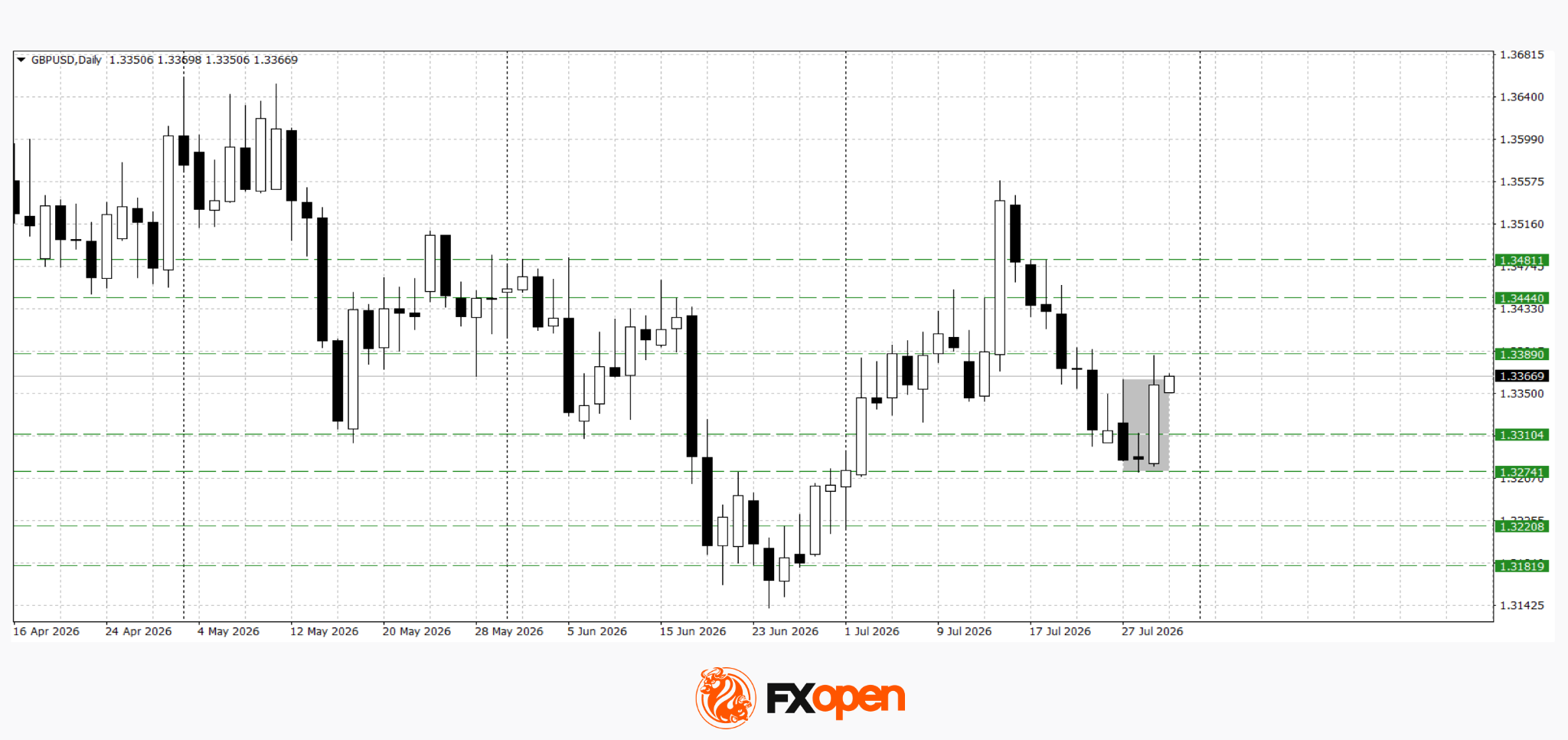
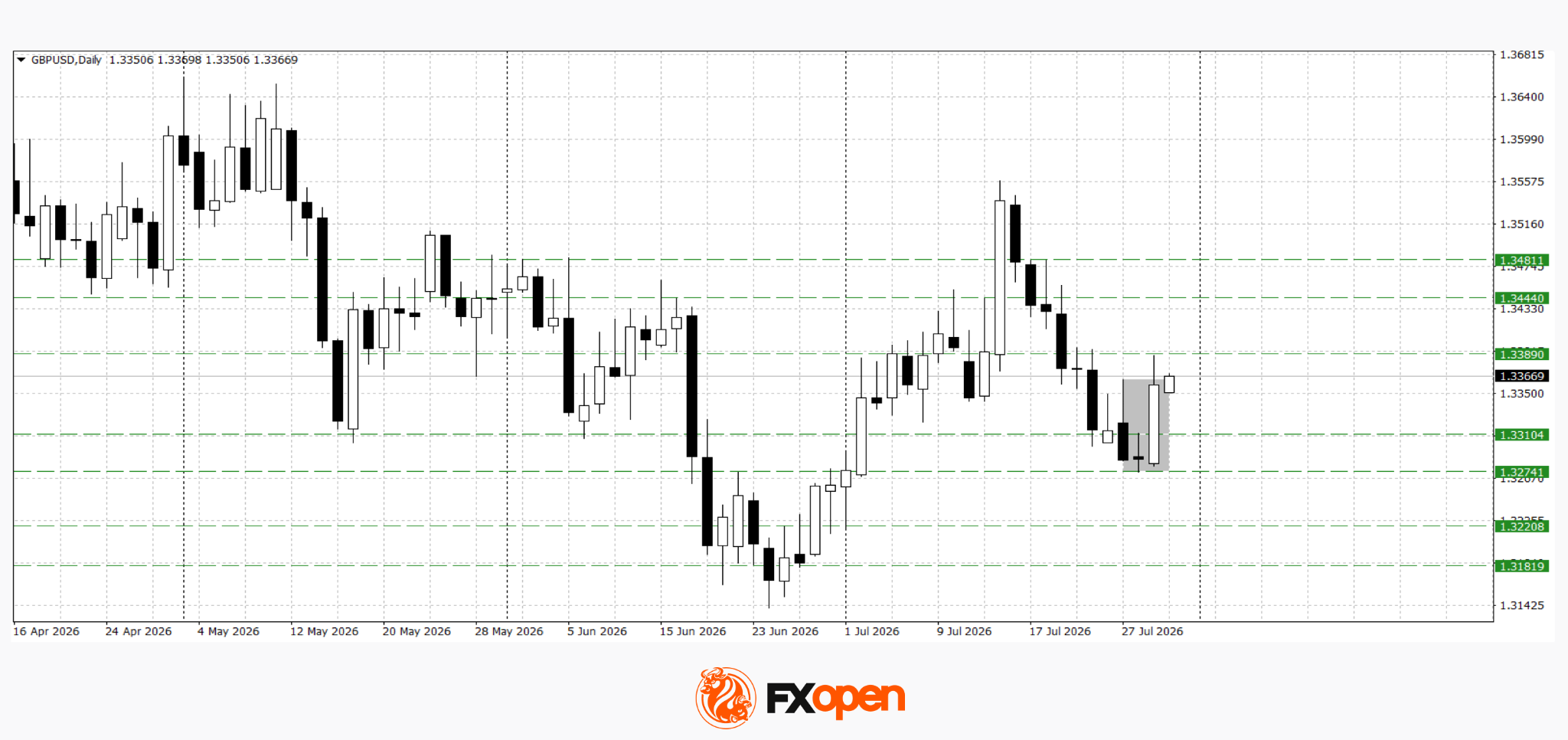
Following yesterday’s Fed meeting, GBP/USD moved towards the 1.3400 area. A rebound from the 1.3270 support level and a sharp daily rally allowed buyers to form a bullish engulfing pattern. Technical analysis of GBP/USD points to the possibility of further gains towards 1.3440–1.3480 if the 1.3270–1.3300 range becomes established as support. A decisive move below yesterday’s low could trigger a renewed decline towards 1.3180–1.3220.
Key events for GBP/USD:
- Today at 14:00 (GMT+3): Bank of England interest rate decision;
- Today at 14:30 (GMT+3): speech by Bank of England Governor Andrew Bailey;
- Today at 15:30 (GMT+3): US initial jobless claims.
EUR/GBP
EUR/GBP is showing signs of recovery after forming a bullish harami pattern on the daily timeframe. If market participants are disappointed by today’s Bank of England decision, the pair could extend its advance towards 0.8600–0.8620. The bullish scenario would be invalidated after a decisive break below the 0.8540–0.8560 support area.
Key events for EUR/GBP:
- Today at 08:30 (GMT+3): France GDP;
- Today at 11:00 (GMT+3): Germany GDP;
- Today at 15:00 (GMT+3): Germany Consumer Price Index (CPI).
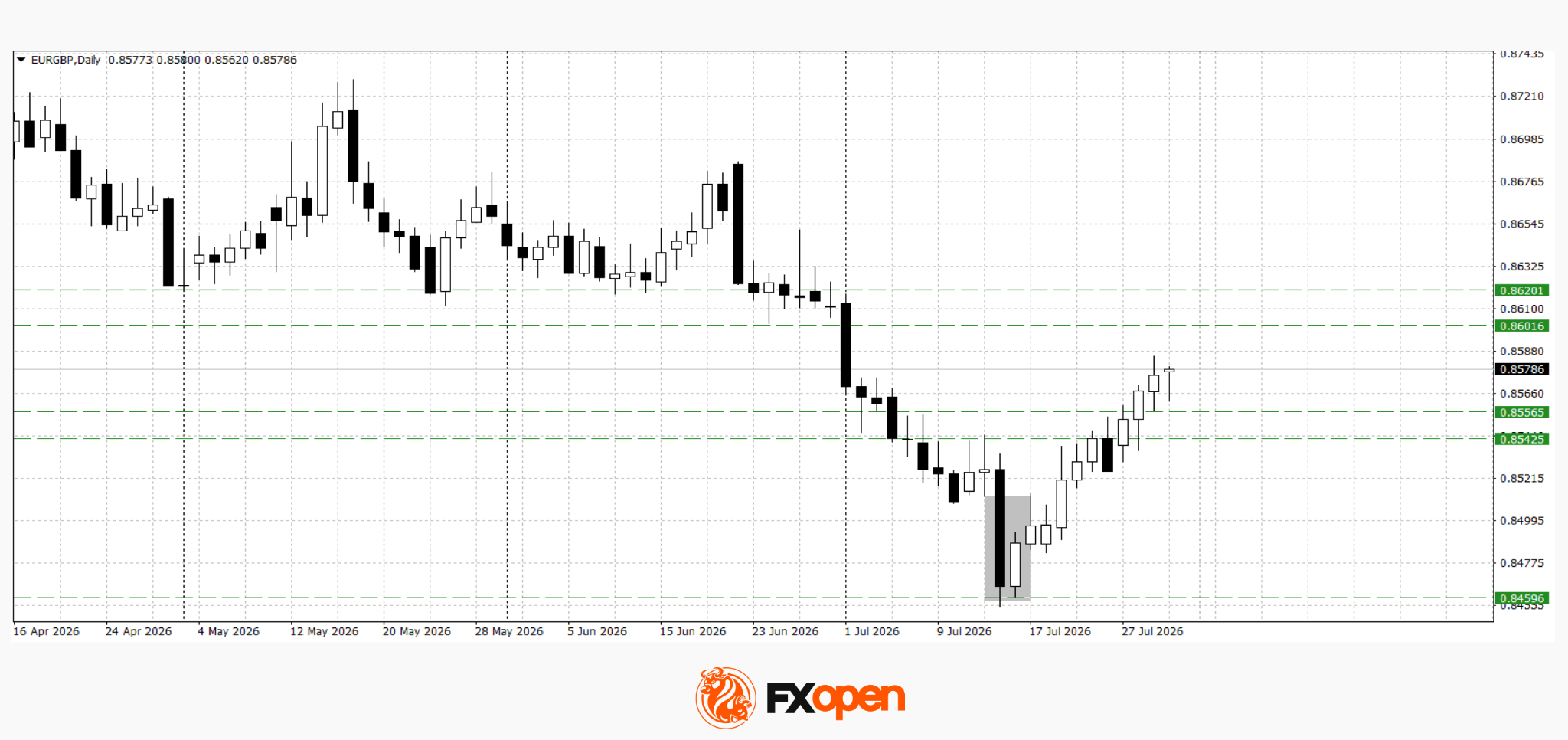
Overall, the near-term direction of sterling will depend primarily on the Bank of England’s decision, the Monetary Policy Committee’s vote split and Andrew Bailey’s comments on the future outlook for interest rates. For the euro, inflation and GDP releases from the eurozone’s largest economies will remain important, as they could influence expectations for the European Central Bank’s next policy steps. With the market impact of the Fed meeting now fading, European economic data and signals from the Bank of England could become the main drivers of GBP/USD and EUR/GBP through the end of the week.
Trade over 50 forex markets 24 hours a day with FXOpen. Take advantage of low commissions, deep liquidity, and spreads from 0.0 pips (additional fees may apply). Open your FXOpen account now or learn more about trading forex with FXOpen.
This article represents the opinion of the Companies operating under the FXOpen brand only. It is not to be construed as an offer, solicitation, or recommendation with respect to products and services provided by the Companies operating under the FXOpen brand, nor is it to be considered financial advice.


China Business Journal says fraudsters impersonated the publication, demanding Bitcoin to suppress purported investigative reports about targeted companies.

Firefighters in France and Spain are battling ferocious wildfires in an effort to control the blazes before the next heat wave arrives later this week.
French President Emmanuel Macron on Monday described the “completely unprecedented” crisis as the “toughest since the Second World War.” He urged firefighters to “stay strong” as they prepared to face the wildfire in the Gironde region, near Bordeaux.
An estimated 220,000 people have been evacuated in the Gironde region, since the most pervasive fire broke out last week. The Landes region further south has seen at least 30,000 people evacuated.
The fire in Landes is now under control, Macron said, but he warned it “remains virulent” and urged extreme caution over the coming days.
“Our country is going through an unprecedented fire season: 116,085 hectares have already burned and 13,566 fire starts have been recorded since January,” France’s Prime Minister Sébastien Lecornu said on Monday. (116,000 hectares is roughly 287,000 acres.)
In Spain, officials fighting the blazes near Madrid say they are the worst the region has ever experienced. Firefighters are also battling a wildfire in Castellón, a province near Valencia.
More than 100,000 people have been ordered to evacuate their homes or take shelter as emergency services attempt to get the flames under control in the face of changing winds.
Spanish Prime Minister Pedro Sánchez told reporters Tuesday that the authorities “can begin to see the light at the end of the tunnel” in the fight against the wildfires, but he expressed concern about the approaching heat wave.
The authorities “will continue to mobilize all resources until the last flame is extinguished,” he vowed.
Sánchez has referred to the wildfire crisis as “the most painful expression” of the climate emergency.
As the European countries reckon with the remaining blazes and brace for the potential impact of the incoming heat wave, here are photos showing the devastation caused by the wildfires so far.
















Crypto exchange Luno is reportedly cutting around 20% of its workforce as it restructures operations and shifts more focus toward institutional clients, financial infrastructure, and business-to-business services. The move follows earlier headcount reductions and comes as many crypto firms continue to prioritize cost control and automation amid uneven market conditions.
In a report published by Bloomberg on Tuesday, Luno CEO James Lanigan said the company has invested in automation and other operational improvements, changing the resources required to run the business. He also indicated that further cost trimming will be paired with ongoing investments in compliance, core infrastructure, and retail products. According to the filing discussed in earlier coverage, Luno is owned by Digital Currency Group and operates in Africa and the Asia-Pacific region, serving roughly 16 million users.
Key takeaways
- Luno is reportedly reducing headcount by about 20%, citing automation and operational changes that alter staffing needs.
- The exchange says it will also pursue cost reductions while continuing investment in compliance, core infrastructure, and retail offerings.
- This is not Luno’s first major restructuring; the company previously cut 35% of staff in January 2023.
- July 2026 saw a cluster of disclosed layoffs and restructurings across crypto, with industry tracker CryptoJobsList recording hundreds of roles affected.
- Several firms point to AI and efficiency upgrades as a common factor behind staffing changes, though the scale and drivers vary by company.
Luno’s restructuring and why staffing is changing
Luno’s reported layoffs are framed as an outcome of “run-rate” changes rather than a simple demand shock. Bloomberg reports that CEO James Lanigan attributed the restructuring to investments in automation and broader operational improvements, which in turn reduced the staffing required for core functions. The company also plans to trim costs in line with market conditions, while directing resources toward areas it views as strategic—compliance, core infrastructure, and retail products.
For users and customers, this type of restructuring can translate into slower expansion in some areas, but it can also mean that teams previously handling manual processes are redeployed toward system reliability, risk controls, and institutional service delivery. Luno has previously expanded beyond retail trading into infrastructure and institutional offerings, including providing crypto infrastructure for banks and fintech firms—an angle that typically requires different operational capabilities than consumer exchange experiences.
Importantly, Luno has already gone through a larger round of reductions before. In January 2023, Cointelegraph reported that DCG-affiliated companies laid off more than 500 employees, with Luno cutting 35% of its staff—affecting nearly 330 employees—during a period of turbulence across parts of the technology and crypto sectors.
Automation, AI, and cost controls spreading across the sector
Luno’s stated rationale echoes a pattern other crypto companies have cited in recent months: automation, AI, and efficiency improvements are often presented as reasons to reduce staffing. While the details differ by firm—ranging from internal process upgrades to product and platform changes—the theme is consistent: companies are trying to maintain or improve service levels while reducing operating costs.
One reason this matters for the industry is that layoffs can reshape what businesses prioritize. Where consumer-focused teams previously led growth efforts, many companies now appear to be redirecting investment toward infrastructure, compliance, and enterprise-grade services—areas where budgets can be more predictable and where automation may reduce operational friction.
What July’s layoff data suggests (and what it can’t tell)
Beyond Luno, the broader wave of job cuts continues to show up in public trackers. CryptoJobsList, which monitors crypto and crypto-adjacent workforce reductions, recorded layoffs or restructurings at 12 crypto and crypto-adjacent companies in July. Disclosed figures totaled 894 jobs affected, according to the tracker’s reporting.
CryptoJobsList’s data is meant to be an indicator of sector activity rather than a complete measure of all crypto-related cuts. The tracker notes that its figures include adjacent financial technology firms, and they are also skewed by unusually large reductions such as Block’s reported 4,000-person layoff in February.
Still, the concentration of announcements in a short period gives investors and builders a practical signal: staffing is being reassessed across multiple segments of the crypto ecosystem, and companies appear to be acting faster than in downturn cycles when cost reductions sometimes lag demand shifts.
Other notable restructurings in July
Earlier in July, Cointelegraph reported that crypto wallet company Exodus announced plans to cut 25% of its staff while reorganizing around a full-stack card-issuance and stablecoin-payments platform. Exodus said the changes could produce between $10 million and $13 million in annual operating savings, positioning the restructuring as an effort to concentrate resources on a specific product direction.
Separately, blockchain infrastructure developer Gnosis took a different approach to workforce reductions. In July, the company invited organizations hiring across roles including engineering, product, design, marketing, developer relations, and customer relations to contact it for introductions to former employees affected by a recent restructuring. In a statement dated July 17, Gnosis said it reduced its workforce following a review of its consumer-facing Gnosis App.
These examples show how restructuring rationales can vary: some companies cite platform efficiency and automation, while others tie changes to product review cycles or a strategic pivot. For employees, the practical impact differs as well—some reorganizations focus on relocating talent, while others involve more direct role elimination.
What to watch next
With Luno’s reported cut and a continuing pattern of restructurings recorded across the sector, the next question for readers is whether these moves translate into measurable improvements—such as higher reliability, faster enterprise onboarding, or more consistent compliance execution—or whether they mainly reduce capacity at the cost of long-term growth. Investors and builders should keep an eye on how companies balance automation-driven efficiency with the operational load required by regulators, institutional clients, and evolving product demands.
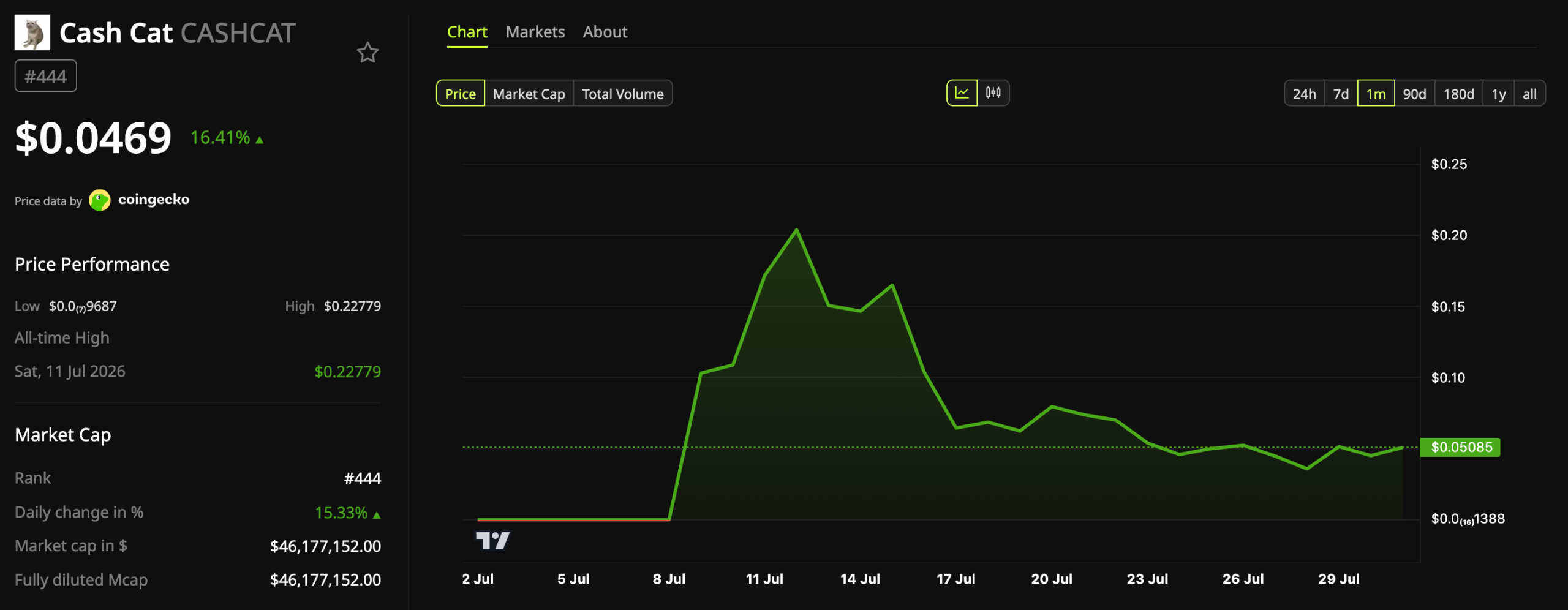
Cash Cat (CASHCAT) rose about 16% in 24 hours and reclaimed its spot as the top token by market capitalization on Robinhood Chain, after the company’s second-quarter earnings call.
The move pushed the token back past Pons (PONS), which had taken the spot while CASHCAT drifted lower through July. Its trading volume still dwarfs every other asset on the network.
What Happened on the Robinhood Earnings Call
Robinhood reported record second-quarter revenue of $1.3 billion on July 29, up 32% from a year earlier. Earnings per share reached $0.62. Moreover, cryptocurrency transaction revenue reached $100 million.
Tenev spent part of the call demonstrating the Robinhood apps and the stock tokens on his phone. Traders spotted CASHCAT sitting in his recent search list. The token climbed shortly afterward. He also addressed the Robinhood chain during the call.
“I mean, I think that we built Robinhood chain to be purpose-built for real-world assets. I should clarify, I like memes as well,” Tenev said during the call.
Follow us on X to get the latest news as it happens
CASHCAT Retakes the Lead After a 47% Slide
CASHCAT borrows its name from the working title Robinhood used before its rebrand. Its initial rally arrived after the chain went live on July 1. The token pushed past a $200 million market cap before stalling.
The token fell roughly 47.2% over the past two weeks. PONS overtook it as the chain’s largest token by market cap. That position has now reversed. At press time, CASHCAT traded near $0.0469, up about 16% on the day.

CASHCAT also remains the most traded asset on the network. It has logged 1.57 million trades from 51,638 unique traders since launch. Cumulative volume stands at $890.5 million, according to Dune data.
Its $28.2 million in 24-hour volume is more than four times that of second-placed PONS, which traded $6.3 million.
CASHCAT sits about 79% below its record high of $0.228, set on July 11. The near-term test is whether demand holds once the earnings attention fades.
Subscribe to our YouTube channel to watch leaders and journalists provide expert insights
The post Cash Cat Reclaims Robinhood Chain Crown After Q2 Earnings Call appeared first on BeInCrypto.
Pi Network Sets Major Update Deadline as PI Surges Past Key Resistance
Ashton Kutcher makes rare cameo as wife Mila Kunis fills in for Kelly Ripa on “Live”

Thailand News Update: Crime and Security Concerns


-

 Fashion6 days ago
Weekend Open Thread: Brooks Brothers
-
 Sports4 days ago
Commonwealth Games boxing: Jadumani Singh seals dominant 5-0 win over Pakistan’s Sumama Rehman to enter quarter-finals | Commonwealth Games News
-

 Business12 hours ago
Why Trees Belong on the Risk Register
-

 Tech3 days ago
Intel is reversing course and bringing hyper-threading back to its server chips
-

 Politics3 days ago
Luke Littler dismantles Gerwyn Price to retain title in Blackpool
-

 Crypto World5 days ago
Ripple bought a bank in pieces. The $4 billion audit
-

 Politics2 days ago
The Part of the Electric Transition Nobody Wants to Discuss
-
 Entertainment6 days ago
A New Post-Apocalyptic Gundam Anime Series Blasts Into SDCC
-

 News Videos3 days ago
BITCOIN JUST ENTERED THIS CRITICAL ZONE…
-

 Fashion6 days ago
16 Dresses for the High Summer Event
-

 Sports6 days ago
2026 3M Open leaderboard: Scottie Scheffler finds putter in Round 1, sits three back
-

 News Videos7 days ago
The Peugeot Family: How 200 Years of an “Old Money” Dynasty Died in A Boardroom
-

 Business1 day ago
Major shareholder moves on Canyon
-

 Crypto World4 days ago
XRP Ledger adds $2.6B as RWA inflows rank second
-

 Politics4 days ago
Spain sweeps the board at 2026 World Cup with individual awards
-

 Crypto World7 days ago
Uniswap (UNI) pushes deeper into tokenized RWAs with permissioned trading pools
-
 Entertainment2 days ago
‘Stargate’ Creator’s New Sci-Fi Series Returns for Season 3 Tomorrow
-

 Tech5 days ago
Anthropic launches Claude Opus 5, a cheaper AI model for coding, agents and enterprise workflows
-

 Entertainment4 days ago
Sara Gilson Killed By Husband After Viral “Pedophile” TikTok Video
-

 News Videos2 days ago
Claude: Build Financial Dashboards in Minutes (2026)
You must be logged in to post a comment Login