

Crypto World
Australia Proposes CGT Change for Crypto, Raising Compliance Risk


The Australian government appears poised to replace the current 50% capital gains tax (CGT) discount on assets held for more than 12 months with an inflation-indexed taxation approach. The proposed reform, part of the Albanese administration’s FY2027 budget blueprint, would shift how long-term gains are taxed and could raise the tax burden on crypto and other asset holders over time, according to the Australian Financial Review’s coverage of confidential budget briefings.
Under the plan, the CGT discount would be scrapped in favor of tax treatment that applies to full real gains, adjusted for inflation, over the period that an asset is held. The reform is anticipated to affect long-term investors across asset classes, with crypto included in the scope of assets subject to the new regime. The changes are scheduled to take effect at the end of the 2027 fiscal year, with a transitional arrangement providing a one-year grace period for assets acquired after May 10 of the budget year. During the transition, the existing 50% CGT discount would continue to apply for those assets.
Australian investors currently enjoy a 50% CGT discount on qualifying assets held for more than a year. The AFR report indicates the budget would replace this incentive with an inflation-indexed framework, which could significantly alter long-horizon tax outcomes for high-income earners and for assets whose real returns lag inflation. The shift has already drawn immediate commentary from market participants and tax analysts alike.
The proposal has drawn criticism from some market observers. Chris Joye, portfolio manager at Coolabah Capital Investments and a commentator for the AFR, argued on social media that the overhaul would push Australians away from a broad range of investment forms and toward tax-favored assets such as owner-occupied housing. Joye stated that “After the budget doubles the capital gains tax on productive businesses and assets from about 23.5% to 46-47%, investors will understandably pull money from businesses, shares, commercial property and rental housing and plough it into their tax-free owner-occupied home.” He added that “The single biggest winner from the budget: the tax-free owner-occupied home, which is where people will put their money.”
Scott Phillips, chief investment officer at The Motley Fool, offered a different perspective, noting that while tax obligations could rise, investors would still seek substantial returns and maintain incentives to invest. “Not for nothing, but when people say a CGT change would hit founders and growth investors, they’re not wrong. But implicit in that argument is that those groups will be making a motza in the first place. That’s all the incentive they will need,” Phillips commented in coverage cited by the AFR.
The transitional policy contemplates that assets purchased prior to May 10 would be partially exempt, with the final CGT discount calculated on a proportional basis reflecting the time held under each regime. In practical terms, this means a blended tax outcome for assets accumulated across the transition, with the new inflation-adjusted regime applying for the period after the grace window. The AFR’s reporting indicates the budget’s design aims to phase in the new regime while preserving a degree of continuity for existing holdings.
For context, coverage in Cointelegraph has highlighted ongoing discussions around crypto licensing and regulatory milestones in Australia, including developments related to crypto services for retirement accounts and other financial products. While the budget framework focuses on tax design, the shift intersects with broader regulatory and compliance considerations facing crypto firms, exchanges, and institutional investors operating in Australia. The policy move thus sits at the nexus of fiscal design and financial-sector oversight, with potential implications for AML/KYC frameworks, licensing, and cross-border operations as markets seek clarity on how crypto assets are taxed over extended holding periods.
In parallel, industry observers note that any move toward inflation-indexed taxation elevates the importance of robust cost-basis reporting, transparent valuation, and rigorous tax risk management for both investors and platforms. The transition raises questions for custodians, brokers, and exchange operators about how to communicate, calculate, and report real gains in real time, especially across multi-asset portfolios that include crypto, equities, and real estate-linked exposures. Regulators and tax authorities are expected to scrutinize these mechanisms to ensure accurate real-time reporting and to prevent opportunities for misreporting or tax avoidance during the transition.
Key takeaways
- The budget reportedly intends to replace the 50% CGT discount with an inflation-indexed regime that taxes full real gains over the holding period; crypto would be affected under the new framework.
- Changes would take effect at the end of the 2027 fiscal year, with a one-year grace period for assets acquired after May 10; assets held before that date receive partial exemptions based on holding duration.
- Industry reaction is mixed: critics warn of higher tax burdens and potential reallocation of investment elsewhere, while some observers expect continued substantial returns that sustain investment incentives.
- Regulatory and compliance considerations loom large for crypto firms, exchanges, and financial institutions, particularly around cost-basis reporting, AML/KYC obligations, and cross-border operations as tax rules evolve.
- The reforms exist within a broader, global policy conversation on crypto taxation and asset-based levies, highlighting the need for clear licensing regimes and robust enforcement to support investor protection and regulatory oversight.
Policy design and transition mechanics
The core design change under consideration would substitute the existing 50% CGT discount with an inflation-indexed approach that taxes real gains, adjusted for inflation, over the duration that an asset is held. The proposal, described by the AFR as part of the budget framework, signals a shift from a favorable tax treatment for long-term holdings to a regime that measures gains in real terms. The mechanism is intended to align tax outcomes with price-level changes, potentially reducing the parity between nominal gains and actual purchasing-power growth.
Key transitional details include a July 2027 implementation target, a one-year grace period for assets acquired after May 10 of the budget year, and a partial exemption for assets purchased before that date. The final CGT discount would be calculated proportionally to reflect the time under each regime, resulting in a blended tax outcome for holdings straddling the transition. The intention appears to provide a controlled path toward the new regime while preserving some protection for existing investments during the transition.
Investor impact and market response
The tax design change carries potential consequences for how crypto assets are managed within diversified portfolios. Long-horizon holdings could see elevated tax obligations if inflation outpaces nominal gains, especially for assets with relatively modest inflation-adjusted returns. The discourse around this shift has drawn prominent voices from financial commentary circles. Joye’s critique emphasizes a broader reallocation pressure, suggesting that a higher CGT burden could deter investment in a wide range of productive assets beyond crypto, with housing potentially benefiting from the tighter tax environment for other asset classes. As Joye stated in a public post cited by AFR, the impact would extend beyond crypto, reshaping investor behavior across equities, commercial property, and rental markets.
Conversely, some market observers argue that, despite higher taxes, investors have historically achieved substantial absolute returns and would adapt to the new regime. Phillips of The Motley Fool remarked that the sustained profitability of ventures and growth opportunities could preserve incentives to invest, even if the tax environment becomes more stringent. The framing suggests a nuanced outcome: higher tax exposure for some, but continued capital formation driven by core investment objectives.
Regulatory environment and compliance considerations
The fiscal proposal sits alongside Australia’s ongoing regulatory evolution in the crypto space. While the budget focuses on taxation, the broader policy landscape emphasizes licensing, AML/KYC compliance, and oversight of crypto-related financial services. For exchanges, custodians, and financial institutions operating in Australia, the shift underscores the need for transparent tax reporting, accurate cost basis calculations, and clear guidance on how inflation indexing will be applied to diverse asset classes, including digital assets. The policy momentum also intersects with global regulatory dialogues on crypto tax, licensing, and cross-border coordination, where jurisdictions are increasingly aligning on reporting standards and enforcement frameworks to mitigate risk and safeguard investor interests.
Public and industry commentary highlights the importance of robust data, clear interpretation of transitional rules, and consistent enforcement to prevent ambiguous tax outcomes. As authorities move toward implementing inflation-indexed taxation, firms will need to adapt tax-technology infrastructure, ensure compliant disclosure practices, and monitor any cross-border implications for clients with holdings overseas or with foreign-sourced portfolios.
Broader policy context and next steps
The proposed fiscal changes appear in the context of a wider policy debate about how crypto assets should be taxed and regulated in Australia. Observers note that tax design choices can influence market structure, capital formation, and the relative attractiveness of different asset classes. In the global policy environment, such measures are part of a broader discourse on crypto taxation, licensing, and financial stability, with cross-border differences shaping how investors, exchanges, and banking partners operate across jurisdictions.
As the FY2027 budget cycle progresses, stakeholders will be watching how the inflation-indexation concept is operationalized, how transitional rules are implemented, and what guidance regulators publish to support compliant reporting and enforcement. The evolving framework will influence compliance programs, tax advisory services, and the strategic planning of institutions with exposure to Australian markets.
Closing perspective
Australia’s contemplated shift from aCGT discount to inflation-indexed taxation marks a significant policy pivot with material implications for crypto investors, tax professionals, and financial institutions. The final design, transition mechanics, and regulatory clarifications will determine whether the change sharpens tax certainty or introduces new compliance complexities. Monitoring forthcoming official guidance and regulatory updates will be essential for institutional players navigating this transition.


Bitcoin News: Circle has launched cirBTC, a 1:1 BTC-backed ERC-20 token now live on Ethereum mainnet, positioning it directly against WBTC’s roughly $9 billion market and approximately 85% market share with a feature its competitors do not offer: real-time on-chain reserve verification with no reliance on third-party attestations.
The product went live June 8, 2026, and is built exclusively for institutional participants, OTC desks, market makers, lenders, and DeFi protocols deploying Bitcoin as collateral inside Ethereum-based smart contract ecosystems.
The competitive target is explicit. BitGo’s Wrapped Bitcoin has dominated tokenized BTC since its January 2019 launch, and Coinbase’s cbBTC has emerged as the primary institutional challenger since September 2024, reaching approximately $5.9 billion in market value.
Circle is entering that race with a specific transparency argument and the institutional trust built over years of USDC issuance.

Bitcoin News: cirBTC’s Reserve Verification Model, What Real-Time On-Chain Proof Actually Means
The core technical differentiator is Chainlink Proof of Reserve. Each cirBTC token issued as an ERC-20 on Ethereum is backed by native Bitcoin held in segregated regulated custody, and counterparties can verify that backing in real time through multiple wallet addresses visible directly on the Bitcoin blockchain, no waiting for monthly audits, no relying on custodian claims, no off-chain attestation lag.
This is structurally different from the WBTC model, where BitGo operates as the sole custodian and publishes wallet addresses for manual verification, but reserve confirmation still depends on BitGo’s centralized control and governance multisig for contract changes.
Tokenized Bitcoin – programmable and composable digital gold.
https://t.co/XVCXVzLfLi
— Jeremy Allaire – jerallaire.arc (@jerallaire) June 8, 2026
The RenBTC wind-down and broader criticism of custodial bridge opacity established the trust gap Circle is explicitly targeting. Chainlink’s automated feed closes the verification loop at the contract level rather than at the audit cycle.
Bitcoin assets are kept separate from Circle’s corporate holdings, and minting and redemption run through Circle Mint, its institutional liquidity management platform.
The same infrastructure that powers USDC settlement rails is now extended to wrapped Bitcoin collateral, allowing firms to hold native BTC in custody while cirBTC moves through on-chain financial applications without ever selling the underlying position.
Discover: The Best Crypto to Diversify Your Portfolio
The $15–20B Tokenized BTC Market: Where cirBTC Fits Against WBTC and cbBTC
The total tokenized Bitcoin supply across all wrapped products sits at approximately $15–20 billion in Q2 2026, still under 2% of Bitcoin’s roughly $1.7 trillion market capitalization.
That number is either a ceiling that reflects structural barriers to institutional DeFi adoption or an enormous runway.
The evidence points firmly toward runway: institutional demand for Bitcoin exposure in regulated on-chain formats has accelerated materially since 2024, and the products capturing that demand are precisely the regulated, exchange-native wrappers cirBTC is competing against.
WBTC holds approximately 119,000 tokens in circulation at roughly $8–9 billion market cap, controlling close to 85% of the wrapped BTC segment. cbBTC trails at approximately $5.9 billion but has grown faster than any comparable product since launch.
Other exchange-backed offerings, Kraken Wrapped BTC, Binance Wrapped BTC, Bitget Wrapped BTC, OKX Wrapped BTC, collectively hold the remaining margin.
Circle’s entry does not change the market structure overnight, but it introduces a credentialed issuer with an existing institutional distribution network that none of those exchange-native products can fully replicate.
Circle’s stated structural advantage over cbBTC and exchange-issued wrappers is neutrality: it does not operate a centralized exchange, DEX, or lending protocol.
Institutions using cirBTC as DeFi collateral are not simultaneously providing liquidity intelligence to a competing trading desk. That separation matters to prime brokerage clients and multi-venue market makers who treat information leakage as a material risk.
Discover: The Best Token Presales
The post Bitcoin On Ethereum? Circle Launches cirBTC on ETH Targeting $9B WBTC Market appeared first on Cryptonews.
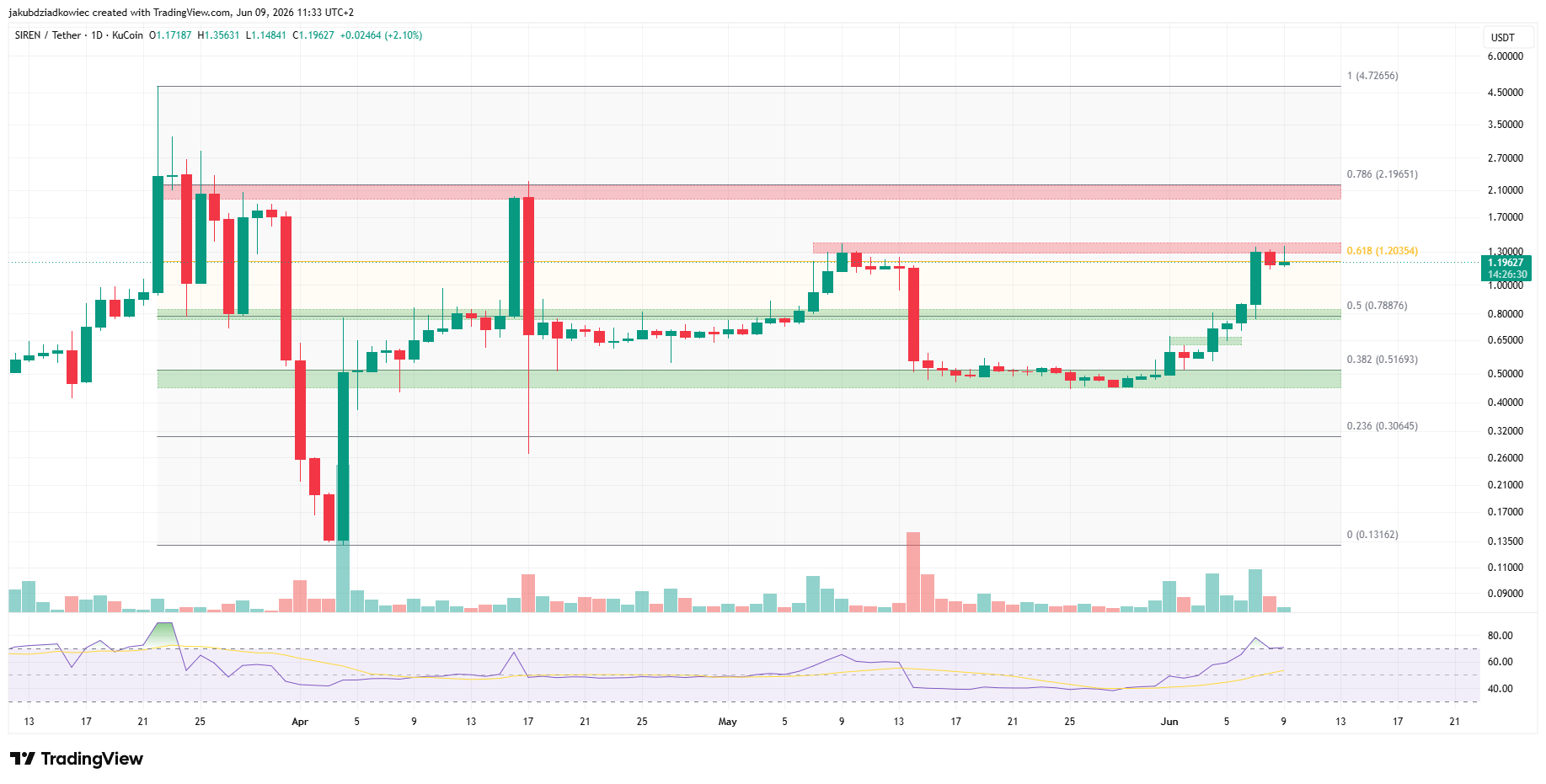
Meme coin traders enter the second week of June 2026 with three setups worth watching. SIREN presses against breakout resistance, BinanceLife cools near record highs, and BUILDON climbs back from a sharp correction.
Each token shows a different momentum picture this week. The charts below map the key levels, the indicators behind them, and what would confirm or break every move.
Meme Coins to Watch: SIREN Tests Breakout Resistance Near $1.20
Siren (SIREN) trades around $1.22 after a 4% gain on the day. The token has climbed roughly 113% over the past week. Its market cap sits near $887 million, ranking it 74th.
SIREN also topped last week’s meme coin watchlist and keeps building on that move.
On the daily chart, price is pressing into resistance at the 0.618 Fibonacci retracement level near $1.20. A daily close above this zone would mark the breakout. The next resistance stands at the 0.786 level near $2.20.

Beyond that, the token’s record high sits at $3.61. The chart’s upper Fibonacci extension reaches $4.72. Both mark longer-term targets if momentum holds.
The Relative Strength Index (RSI) has pushed above 70. That reading signals strong momentum, but it also flags overbought conditions. A rejection here could send the price lower.
The first support sits at the 0.5 Fibonacci level near $0.79. A deeper pullback would test the 0.382 level near $0.52. A renewed AI-token rally has driven much of this momentum.
BinanceLife Holds Near Record Highs Despite RSI Divergence
BinanceLife (BINANCELIFE) trades near $0.69 after a 12% drop on the day. Despite the decline, the token remains up about 9% on the week. Its market cap stands at $687 million, ranking it 86th.
The token sits in a price-discovery phase after setting a record high near $0.90 on June 7. It broke out of a symmetrical triangle around May 13 and ran straight to that resistance box.

However, the daily chart now shows a bearish RSI divergence. Price made higher highs while the RSI made lower highs. That pattern often warns that an uptrend is losing strength.
A correction could send the price back to the former swing high near $0.46. A deeper drop would test the 0.382 Fibonacci level near $0.27. The token’s role in the BNB meme season remains a key driver.
BUILDon Recovers After an A-B-C Correction
BUILDon (B) trades near $0.27 after a 6% decline on the day. The token has gained almost 14% over the past week. Its market cap sits near $273 million, ranking it 138th.
The daily chart shows a five-wave Elliott impulse to a high near $0.76. An A-B-C correction then followed. The C wave bottomed close to the 0.618 Fibonacci retracement near $0.20.
Price now recovers between the 0.5 and 0.382 Fibonacci levels. A move above $0.33 would open the path toward the 0.236 level near $0.46. That level marks the next major resistance.

The RSI hovers near 50, a neutral reading with no clear momentum. Volume is also contracting into the bounce. Both signals suggest traders should wait for confirmation.
The main support sits at the 0.786 Fibonacci level near $0.14. BUILDon gained wider attention after its Binance Alpha listing earlier this year.
The post 3 Meme Coins to Watch in the Second Week of June 2026 appeared first on BeInCrypto.
Crypto World
Citrini Research Calls Hyperliquid a Compelling Investment, Citing Nearly Half of All Crypto Token Buybacks

Citrini Research, the subscription analytics firm whose reports have previously triggered sharp moves in AI-linked equities, published an analysis Monday calling Hyperliquid a compelling investment thesis. The firm argues the decentralized exchange accounts for nearly half of all token buyback… Read the full story at The Defiant
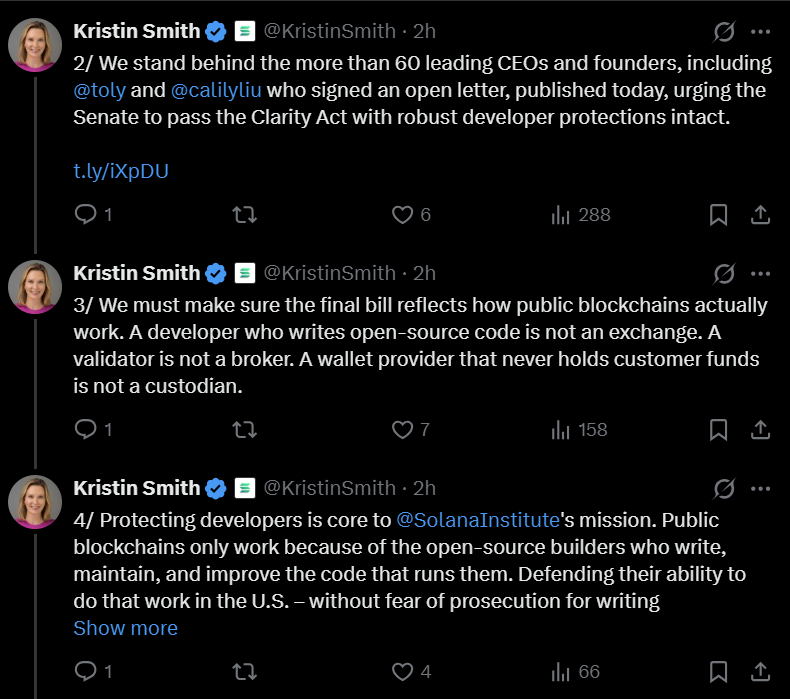
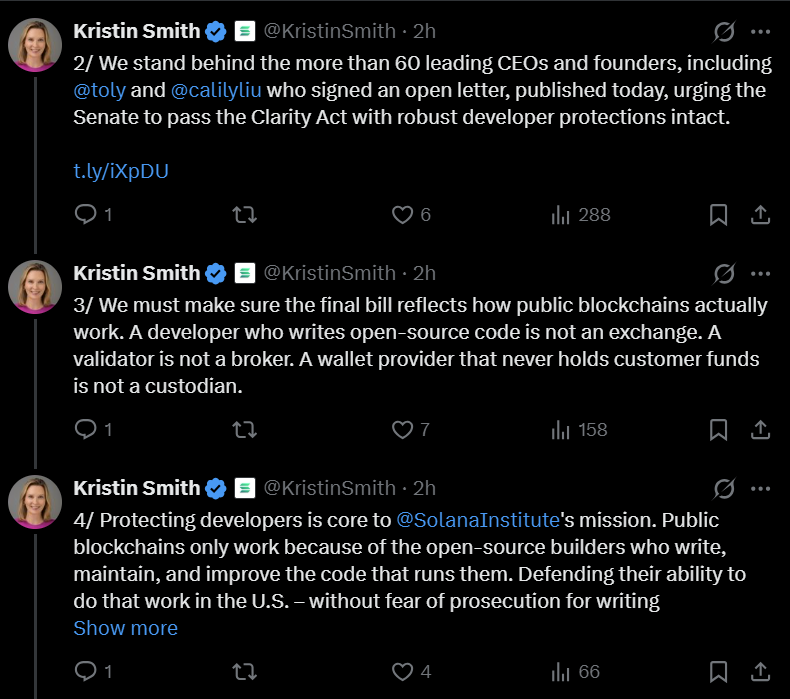
Solana Institute CEO Kristin Smith is urging the US Senate to pass the CLARITY crypto market structure bill with developer protections intact, arguing that open-source developers and blockchain infrastructure providers should not be regulated as financial intermediaries.
In a thread on the X social media platform, Smith said the market structure legislation “has a real shot at passing the Senate,” making it critical for lawmakers to preserve protections for software developers.
Source: Kristin Smith on X.com
Smith said more than 60 crypto CEOs and founders, including Solana co-founder Anatoly Yakovenko, signed an open letter urging the Senate to maintain robust developer protections in the CLARITY Act.
She said that open-source developers, validators and non-custodial wallet providers do not control user funds or execute transactions and therefore should not be treated as brokers or custodians.
Smith pointed to the Blockchain Regulatory Certainty Act (BRCA), which would provide legal certainty for noncontrolling software developers and blockchain infrastructure providers that do not custody customer assets or control transactions.
Introduced in January by Senators Cynthia Lummis and Ron Wyden, the bipartisan BRCA aims to prevent open-source developers from being classified as “money transmitters” solely for publishing software code.
The CLARITY Act cleared the Senate Banking Committee in May and was recently placed on the Senate Legislative Calendar, setting the stage for a possible floor vote later this summer.
Related: CLARITY Act will help reshore US crypto industry, attorney says
Echoes SEC commissioner Peirce’s calls for developer protections
Smith’s comments echo recent remarks by US Securities and Exchange Commission Commissioner (SEC) Hester Peirce, who argued last week that publishing open-source blockchain code is protected speech and that developers should not be treated as financial intermediaries simply because others use their software.
Speaking at the IC3 Blockchain Camp at Princeton University, Peirce said that “many blockchain projects involve publishing open-source software, which is generally a protected activity under the First Amendment.”

Source: CoinMarketCap on X.com
The SEC’s mandate regarding digital assets has evolved significantly under current Chair Paul Atkins, who vowed to end the agency’s “regulation through enforcement” approach to the industry.
Related: US lawmakers push back on Labor Department plans to include crypto in 401(k)s

Cardano’s ecosystem health, tracked across DeFi value, network use, and positioning, has slipped into outright collapse, according to BeInCrypto’s read of the data. Yet on June 7, the largest ADA wallets quietly started buying.
That contradiction is the story. Whales accumulating into a measured collapse is rarely a bottom call, and the derivatives data points to a colder motive than recovery.
The Cardano Decay Tracker Hit Collapse
Start with the signal in the headline. The ecosystem read on Cardano, which weighs DeFi value against network activity, has reached its worst level.
Want more token insights like this? Sign up for Editor Harsh Notariya’s Daily Crypto Newsletter here.
The core input is total value locked, the dollar sum staked across a chain’s apps. Cardano’s TVL sits near $94 million, down about 31% on the month and roughly 87% from its $721 million peak.

By this framing, a chain shedding that much locked value with no offsetting growth is in collapse, not correction. The label is a measured verdict, not a mood.
This was already an ecosystem in trouble. Analytics platform TapTools shut down, and its founder, Charles Hoskinson, warned of a coming wave of failures.

Into that backdrop, the whales did the one thing the data says they should not. They started buying.
The Whales Bought on the Worst Day
Here is the twist. Two whale cohorts, meaning wallets large enough to move the Cardano price when they trade, began adding ADA on June 7.
Wallets holding 1 million to 10 million ADA lifted their share of supply from 15.24% to 15.28%. The largest tier, 100 million to 1 billion ADA, grew its stash from 5.83% to 6.16%.

The date matters. June 7-8 brought no good news. Investigator Thomas Braziel escalated a probe into Cardano’s founder that day, naming the original 2016 foundation board and pressing on roughly 1,090 Bitcoin missing from the early foundation.
The Cardano price was already near $0.16, a five-year low. Accumulating into a deepening scandal and a collapsing ecosystem is not how conviction buying usually looks. So the buying is real, but the reason is not fundamental. The derivatives data reveal what it likely is.
Big Traders Short, Retail Long
The motive sharpens on the futures side. The largest accounts and the crowd sit on opposite sides of the trade.
The top-trader long-short ratio, which tracks how accounts in the top 20% by margin are positioned, is 1.53. The all-accounts ratio sits at 2.09, a divergence of 0.57.

Retail is far more aggressively long than the biggest traders, the widest gap in weeks. When informed accounts lean against the crowd this hard, the crowd usually ends up wrong.
Note: Both cohorts are still net long, but the top traders are short relative to retail, holding far fewer longs than the crowd. That relative gap is the widest in weeks, and informed money leaning back while retail piles in is the classic shape of a top, not a floor.
Leverage has also drained. Open interest, the total value of live futures contracts, fell about 39% over 30 days to $70.6 million, with funding near neutral. That thins the fuel, so any squeeze would be smaller than the lopsided positioning alone suggests.

Still, the skew is what matters here. Big traders short against a heavily long crowd is the setup for a squeeze, and that skew is the missing piece of the whale puzzle.
The Dark Theory: Engineered Exit Liquidity
Now the pieces lock. The accumulation reads less like a bottom and more like a setup for exit liquidity.
Retail spot selling has cooled. The net outflows that ran through June 7 eased by June 8, hinting retail is ready to buy again rather than dump.

The likely sequence follows. Whales accumulate spot, retail buying lifts the Cardano price, and that push forces heavy shorts to cover, triggering a short squeeze where forced buying accelerates the move higher.
A sharp squeeze would hand the accumulating Cardano whales the liquidity to sell into. Retail supplies the exit, the shorts supply the fuel, and the whales step out near the top.
It is a cynical read, not a certainty. But with the decay tracker at collapse and no catalyst in sight, exit liquidity explains the buying better than recovery does.
What Would Break this Cardano Theory
Because the thesis is dark, the counter-signals matter. A few developments would flip it.
Whale accumulation sustained over weeks rather than days would point to real conviction. A genuine rebound in TVL or a credible answer to the governance probe would give the buyer a fundamental floor.
None of that exists yet. The most grounded reading is that the whales are not calling a Cardano bottom. They are building a position to sell into whoever buys the bounce.
The decay tracker was already flashing collapse. The whales did not ignore it. They may be planning to profit from everyone who does.
The post Cardano Whales are Quietly Buying a Collapsing Chain, and the Motive is Dark appeared first on BeInCrypto.

XRP price is trading at $1.16–$1.18, up more than 2% today, while Bitcoin consolidates below key resistance and Solana drifts without a clear prediction. The split is sharp enough to demand attention.
The rally was not much, but the weekly drawdown is less than 8%, outperforming Bitcoin 10% and Solana 16%.
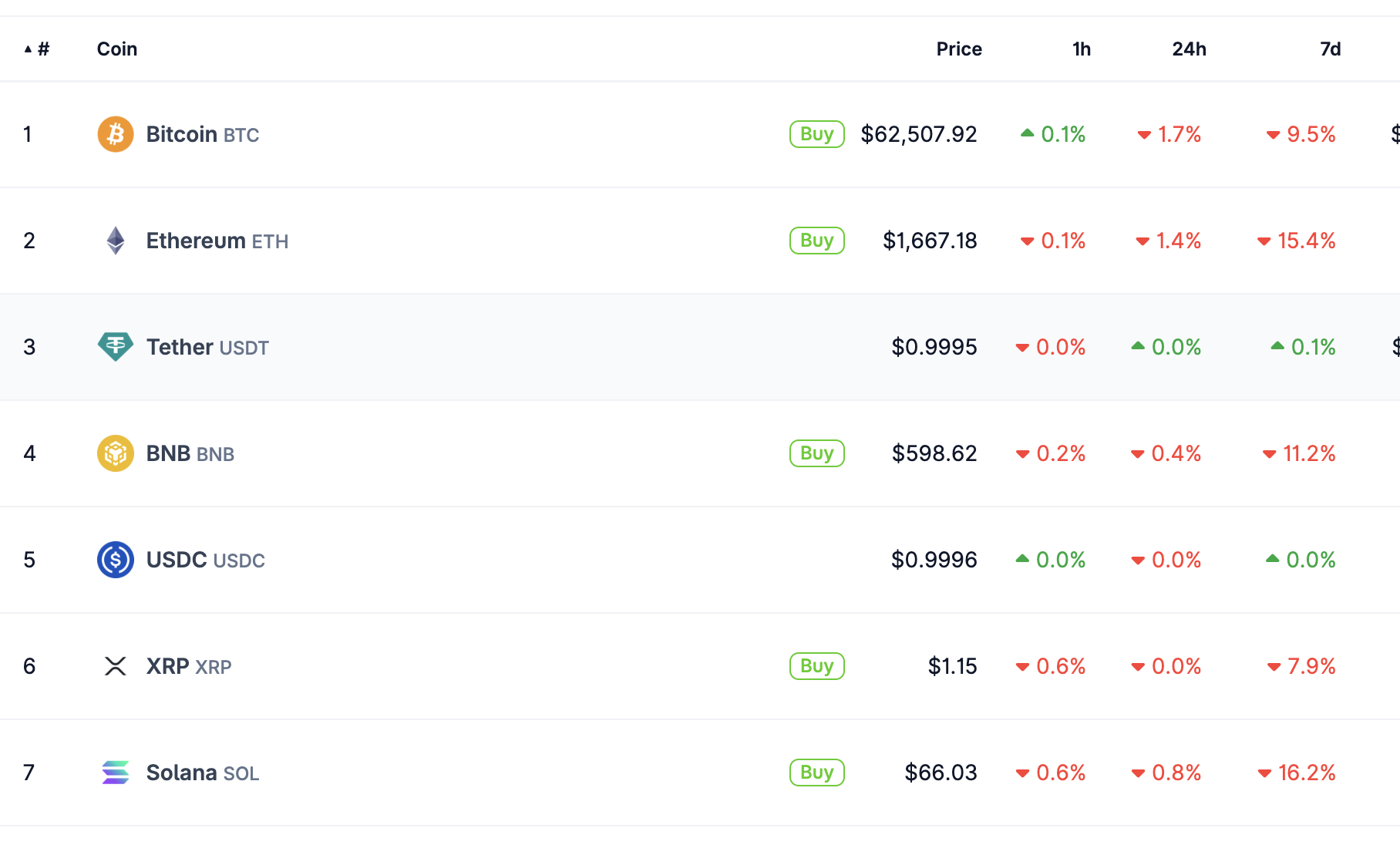
Macro headwinds, like stubborn Fed rate-cut and risk-off positioning are suppressing the wider market. XRP is simply absorbing those headwinds better than its peers right now.
Discover: The Best Crypto to Diversify Your Portfolio
XRP Price Prediction: $1.35 or Does the Retrace Come First?
XRP is pressing against immediate resistance at $1.18, with the next meaningful ceiling at $1.21 and then $1.26. A clean break above $1.26 opens the path toward $1.37, which our analyst flags as the first major resistance level on a longer timeframe.
Support layers sit at $1.10, $1.06, and $1.03. Our technical team warns that a retrace to $0.47 is possible in a worst-case scenario if macro conditions deteriorate sharply, though that would represent a deep flush with a very low chance.

If XRP can hold above $1.18, it could as well reclaim $1.26, and Clarity Act catalyst could push a run toward $1.6. Although price could likely consolidate between $1.10 and $1.21 over the next week as macro noise persists, building a tighter coil for the next move.
But a close below $1.0 would break the post-breakout structure entirely and likely drag XRP back toward the $0.90 range. Relative to Bitcoin, XRP still holds a performance edge, but that edge narrows quickly if risk appetite deteriorates further.
Longer-dated targets remain aggressive: AI-driven scenarios project $5 by late 2025 via a $2.20 interim level, while community analysts openly discuss $4–$7 by year-end.
Discover: The Best Token Presales
LiquidChain Targets Early-Mover Upside as XRP Tests Key Levels
XRP’s outperformance makes the bull case feel obvious. But at a current price of above a dollar with resistance stacked immediately overhead, the asymmetric window may already be narrowing. That’s where early-stage infrastructure plays attract attention.
LiquidChain is an L3 infrastructure project currently in presale at $0.01468 per $LIQUID token, with $830K raised to date. Its core proposition is a Unified Liquidity Layer that fuses Bitcoin, Ethereum, and Solana liquidity into a single execution environment. Developers deploy once and access all three ecosystems simultaneously.
How it feels wielding the LiquidChain L3. — LiquidChain (@getliquidchain) June 9, 2026
 ⟁https://t.co/vqvBcdSQYC pic.twitter.com/S88rm89ybb
Single-Step Execution and Verifiable Settlement are the two architectural features that differentiate it from existing cross-chain bridges, which typically fragment liquidity rather than consolidate it. The addressable market is real: fragmented liquidity across BTC, ETH, and SOL chains is one of the most persistent inefficiencies in the current infrastructure stack.
Research LiquidChain before the presale concludes.
The post XRP Price Prediction: Market Falling But XRP Outperforms Bitcoin and Solana appeared first on Cryptonews.

TLDR
- Bitwise says Bitcoin often reacts before equities during liquidity shifts.
- Bitcoin and Ether hit cycle lows as the Nasdaq fell 5%.
- US 10-year Treasury yield held near 4.53% after strong labor data.
- Global M2 climbed to $122.6 trillion despite a crypto retracement.
- SSR RSI dropped to 13, signaling oversold liquidity conditions.
Bitcoin traded near $62,000 as Bitwise linked its pullback to tightening financial conditions. The asset manager said BTC often acts as a “canary in the macro coal mine.” It argued that recent price action reflects a broader risk-off shift across global markets.
Bitcoin Moves Ahead of Equities in Risk Repricing
Bitwise reported that Bitcoin and Ether fell to $58,000 and $1,507 during the recent downturn. At the same time, the Nasdaq posted a 5% daily decline, its sharpest drop in months. South Korea’s KOSPI also halted trading temporarily after a heavy sell-off in semiconductor stocks.
The firm said Bitcoin usually reacts before traditional markets because it trades around the clock. “BTC often acts as a canary in the macro coal mine,” Bitwise stated. It added that crypto prices adjust quickly to liquidity changes while equities respond later.
Stronger US labor data reduced expectations for Federal Reserve rate cuts. As a result, the US 10-year Treasury yield held near 4.53% after reaching 4.68% last month. Higher-for-longer rate expectations pressured growth-sensitive assets across markets.
Liquidity Data Shows Stablecoin Buying Power
A chart comparing Bitcoin, the Nasdaq, and Global M2 shows diverging trends. Global M2 rose to about $122.6 trillion over the past year. Meanwhile, Bitcoin retreated sharply from its $126,000 cycle high.
Bitwise said the pattern suggests Bitcoin may have repriced earlier than equities. If liquidity conditions improve later, the firm sees room for renewed price response. It noted that global liquidity continues to expand despite recent volatility.
Onchain metrics also highlight available capital within crypto markets. Independent analyst Maartunn said the stablecoin supply ratio RSI fell to 13, an oversold level. He explained that lower SSR readings indicate larger stablecoin balances relative to Bitcoin’s market value.
The SSR compares Bitcoin’s market capitalization with major stablecoins like USDT and USDC. Historically, similar readings appeared near accumulation zones before stronger price periods. Exchange data supports this view with stablecoin reserves near $72 billion.
USDT accounts for $57.7 billion of exchange balances, while USDC holds about $12 billion. Although reserves declined from peaks above $80 billion in late 2025, levels remain elevated. Bitcoin now trades near the lower end of its recent range as liquidity stays positioned on exchanges.


Anthropic is reportedly set to release a public version of its Mythos AI model, and crypto analyst The DeFi Investor is urging decentralized finance users to act before that happens.
The concern is based on how good Mythos is at finding software vulnerabilities, and a version of it becoming widely accessible could accelerate the speed at which attackers discover and exploit weaknesses in DeFi protocols.
What the DeFi Community Needs to Do
In a June 9 post on X, The DeFi Investor advised followers to revoke all token approvals, use only heavily audited dApps, and spread funds across several wallets to reduce single points of failure.
For those who are not familiar, token approvals are permissions that users give to smart contracts, allowing the contracts to spend tokens on their behalf. They tend to accumulate silently over time, and they represent a standing attack surface if any approved contract is later found to be vulnerable.
“What’s scary about Mythos is that it’s insanely good at finding severe vulnerabilities,” wrote The DeFi Investor. “Claude Opus 4.8 has also recently identified a critical bug for Zcash, and Mythos is supposed to be even better than Opus 4.8.”
They added that DeFi will face a huge stress test in the next few months, and indeed, the Zcash vulnerability they mentioned gave a concrete illustration of this.
The privacy coin lost more than 35% of its value in one day after a security researcher using AI discovered a bug in its shielded Orchard pool that would’ve allowed bad actors to endlessly mint new ZEC tokens. It saw big-time crypto investor Arthur Hayes exit his entire ZEC position, as uncertainty mounted on whether anyone might have already exploited the flaw.
Mythos has been restricted since April to about 50 organizations, including Amazon, Apple, Google, and Microsoft, through an Anthropic initiative known as Project Glasswing, in an attempt to put the model’s capabilities to work for defensive purposes. According to Bloomberg, Anthropic plans to expand that circle by 150 more organizations across 15 countries.
However, multiple sources, including TFTC and journalist Alex Heath, have claimed that the public version of Mythos will carry “substantial guardrails” and will not be as permissive as what Project Glasswing partners can access.
A Debate DeFi Was Already Having
The DeFi Investor’s security tips have come at a time when a conversation has been building around the viability of decentralized finance.
In late May, OpenZeppelin co-founder Manuel Aráoz declared “all of DeFi unsafe” and said he had advised people to exit positions in major protocols, including Aave, MakerDAO, and Compound. His reason for doing that was that AI has tilted the security balance so far toward attackers that no protocol can currently be trusted to safely hold users’ funds.
And truly, many crypto projects have been hit in the last few months, including attacks on KelpDAO and Drift Protocol in April, which led to the loss of more than $570 million combined. More recently, hackers reportedly siphoned at least $30 million worth of Humanity Protocol’s H token from 17 wallets.
However, according to Aave Chan Initiative founder Mark Zeller, the fears about AI have been overblown, with fewer than 10% of DeFi security failures in the past year having been caused by code-level vulnerabilities.
Anthropic’s own position, per Bloomberg, is that in the long run, AI will favor defenders, but “the transitional period will be fraught.”
The post DeFi Users Warned to Revoke Approvals Before Anthropic’s Mythos AI Launches appeared first on CryptoPotato.
A package of several crypto tax bills may not be ready yet for prime time, as a U.S. House Ways and Means Committee hearing revealed potentially significant questions from lawmakers that suggested the panel hasn’t achieved a bipartisan embrace of the bills that would tailor a clearer tax code for digital asset gains.
The latest legislative drafts are meant to address tax-filing burdens from crypto users and investors, though House lawmakers — especially Democrats — raised pointed questions about the proposed tax treatments during a Tuesday hearing to discuss the bills, and some key members reportedly objected in advance of the session. This preliminary hearing is an opening step of a process that would typically proceed through revisions and markup before the bills could be considered by the wider House of Representatives, and committee Chairman Jason Smith indicated an intent for bipartisan progress.
“I’m aligned with that goal — eventually,” said Richard Neal, the committee’s ranking Democrat, during the hearing. “There’s healthy skepticism on both sides.”
Though the Digital Asset Market Clarity Act that’s slowly winding its way through the U.S. Senate represents the crypto industry’s top policy effort in Washington, a set of new crypto tax laws would rank second on the priority list. As the U.S. rules stand, the taxes on digital asset gains are difficult for investors to manage — especially those who benefit from mining, staking or who make a high number of transactions.
“The committee’s legislation addresses key gaps in the tax code, including parity in tax treatment with comparable traditional financial asset transactions, clarity for tax situations unique to digital assets, and reduction in paperwork burdens for digital asset owners and brokers,” the chairman, Smith, summarized in a statement before the hearing.
One of the bills would address the longtime industry request that small transactions with very minimal gains should be exempted from tax reporting, which could ease the accounting burdens on users as well as freeing up digital assets to be used for routine payments. Another bill would eliminate the double-taxed scenario for mining and staking proceeds, which are taxed upon receipt and when they’re sold.
“If Americans want to pay with a stablecoin instead of a credit card or cash, they should be able to without a pile of tax paperwork,” Smith said during the hearing.
Mining deferrals
But one of the hearing’s witnesses, Mike Kaercher, deputy director of the Tax Law Center at NYU Law, said the bills still contain pitfalls, including his own objection to the mining-and-staking provision that could be abused.
“The problem is that the bill then provides an election for stakers and miners to defer income paid in the form of newly minted coins until disposition,” he said, suggesting it could create a new tax subsidy. He argued that it “violates parity with traditional finance and the principle that income is taxed on receipt.”
“Despite some thoughtful guardrails in the bill, it may be possible for taxpayers to permanently escape tax by earning rewards through certain business structures,” he said.
That concept drew significant attention from the committee’s Democrats, concerned about abuse of such deferral.
It’s unclear whether there will be a viable window for major crypto tax legislation before the current session of Congress ends at the close of 2026. It’s late in that session, and the agenda is already crowded, including with the remaining work on the crypto Clarity Act.
“Regulatory clarity and tax clarity go hand in hand,” said Kevin Wysocki, Anchorage Digital’s head of policy, in a post on social media site X. “If we want innovation, investment, and jobs to stay in America, policymakers need rules that are clear, workable, and built for modern technology.
For its part, the U.S. Senate hasn’t made significant progress on crypto tax bills, though Senator Cynthia Lummis has sought to move similar legislation through Congress’ upper chamber — so far unsuccessfully. Both chambers would ultimately need to approve legislation before it could become law that governs U.S. crypto activity.
A potential reduction of burden on taxpayers in the newly unveiled bills would also be shared by the Internal Revenue Services, which has already been inundated this year with a new tax-reporting regime. The U.S. tax agency has cut a significant portion of its staff under the administration of President Donald Trump at the same time as getting a rapidly increasing influx of crypto filings.
“Millions of Americans own or use digital assets, yet much of the tax code still treats this technology as though it were a niche experiment rather than a growing part of the financial system,” said Coinbase’s vice president of tax, Lawrence Zlatkin. “The result has been confusion for taxpayers, compliance challenges for businesses and unnecessary burdens for the IRS.”
Read More: U.S. House tax committee weighs crypto bills, including relief for small transactions


Wirex has joined Visa’s Agentic Ready programme to help test how artificial intelligence agents can initiate and complete payments using stablecoins.
Summary
- Wirex has joined Visa’s Agentic Ready programme to test AI agents making payments using stablecoins.
- Initial trials will focus on SaaS subscriptions, marketing spend management, and procurement automation.
- The initiative expands Visa’s ongoing work in stablecoin payments and blockchain-based settlement systems.
According to an announcement from Wirex, the company will participate as an issuer in Visa’s new initiative, which is focused on developing payment systems that allow software agents to carry out financial transactions on behalf of users while maintaining security and consumer controls.
The programme comes as businesses increasingly experiment with AI-powered tools capable of handling tasks without constant human input.
Wirex said the agentic economy is expanding at an annual rate of 44% and argued that stablecoins offer payment infrastructure that can operate continuously without the limitations of traditional banking systems.
Visa is testing stablecoins across multiple payment use cases
Under the programme, Wirex will work alongside Visa and other ecosystem participants to test how AI-driven agents can execute payments in real-world environments.
According to Wirex, the trials will focus on making sure transactions remain secure, reliable, and consistent with consumer expectations around transparency and control.
Early testing will examine use cases including software-as-a-service subscriptions, marketing budget management, and procurement processes for businesses.
The latest initiative adds to Visa’s growing involvement in blockchain-based payments. As reported by crypto.news earlier, Visa recently worked with Brale and participants on the Canton Network to test stablecoin settlement using Brale’s SBC token.
According to the companies involved, the proof-of-concept explored whether privacy-enabled blockchain infrastructure could support institutional payments without exposing sensitive transaction information.
Rather than using public blockchain networks, the Canton project examined settlement activity within a permissioned environment designed for financial institutions that require greater control over transaction visibility.
Over the past several years, Visa has also expanded stablecoin-related payment programs. Earlier efforts included settlement using Circle’s USDC on Ethereum, while newer projects have explored stablecoin-funded payments, tokenized asset spending, and crypto rewards products.
Wirex says business demand for agentic payments is increasing
Wirex said its participation builds on an existing relationship with Visa, of which the company is already a principal member. According to Wirex, the collaboration will explore how AI systems can handle payment-related tasks such as booking travel, managing subscriptions, and executing transactions without requiring approval at every stage.
While discussing the project, Wirex emphasized that users will continue to provide consent and retain visibility over how transactions are carried out.
Commenting on the announcement, Wirex co-founder and CEO Pavel Matveev said agent-driven interactions are becoming more common across the company’s business customer base.
“Together with Visa, we want to introduce a trusted model for payments to lead this shift, delegating financial actions to software whilst operating within Visa’s global payment networks and Wirex’s decade-long track record of compliance.”
Recent Visa-linked crypto payment initiatives have extended beyond stablecoin settlement. Earlier this month, a Visa card issued through Tether and Fasset enabled users to spend tokenized gold while earning rewards denominated in Tether Gold. Separately, SBI Group launched a Visa-linked card in Japan that offers Bitcoin, Ethereum, and XRP rewards through SBI VC Trade.

England settle for Women’s World Cup play-off place despite comfortable win over Ukraine

Fidelity Select Utilities Portfolio Q1 2026 Commentary (FSUTX)
Bitcoin On Ethereum? Circle Launches cirBTC on ETH Targeting $9B WBTC Market



-

 Fashion4 days ago
Weekend Open Thread: Evereve – Corporette.com
-

 Sports7 days ago
French Open 2026 results: Alexander Zverev beats Rafael Jodar and will play Jakub Mensik in semi-finals
-
 Crypto World4 days ago
Jensen Huang Approves Samsung, SK Hynix, and Micron for NVIDIA (NVDA) HBM4 Memory Supply
-

 Crypto World2 days ago
Anatomy of the June crypto crash: Fed, Iran, Saylor
-

 Business7 days ago
Trump Taps Housing Chief Bill Pulte as Acting Intelligence Director After Gabbard Exit
-
 NewsBeat7 days ago
Republicans balk at Trump’s attempt to appoint a MAGA enforcer to lead National Intelligence
-
Crypto World3 days ago
Senator Cynthia Lummis Calls CLARITY Act the Most Consequential Financial Legislation of This Generation
-
 Business3 days ago
The Pain Points Taking a Fragile Tech Rally Down a Notch
-
 Entertainment3 days ago
The Best Mystery Series of All Time Is Surging on Streaming 30 Years After It Ended
-

 Tech5 days ago
Microsoft launches MXC, an OS-level sandbox for AI agents, with OpenAI and Nvidia already on board
-

 Tech2 days ago
Microsoft unveils seven homegrown AI models in new bid for ‘long term self-sufficiency’
-

 NewsBeat2 days ago
Alexander Zverev wins the French Open to finally earn a 1st Grand Slam title
-
Crypto World5 days ago
LBank Surpasses 25 Million Users Worldwide as AFA Partnership Continues to Drive Global Growth
-

 Business7 days ago
PagerDuty, Inc. (PD) Presents at Bank of America 2026 Global Technology Conference Transcript
-

 Tech4 days ago
Suspicious Polyfill login prompts pop up on Toshiba, Muji websites
-

 Crypto World2 days ago
Trump’s AI Ownership Plan Could Benefit Anthropic at OpenAI’s Expense
-
 Sports6 hours ago
Bangladesh beat Australia after 20 years in ODIs, register only their second win over six-time world champions | Cricket News
-

 Business4 days ago
(VIDEO) Justin Bieber Delivers Surprise Happy Birthday Serenade to Diners at Los Angeles Mexican Restaurant
-

 Tech4 days ago
RCS Messages Between iPhone and Android Get End-to-End Encryption With iOS 26.5
-

 Tech4 days ago
Meta steals a tactic from Tesla and builds data centers in tents
You must be logged in to post a comment Login