

Crypto World
Avalanche lands $11B Bridgetower deal as RWA assets hit $2.1B

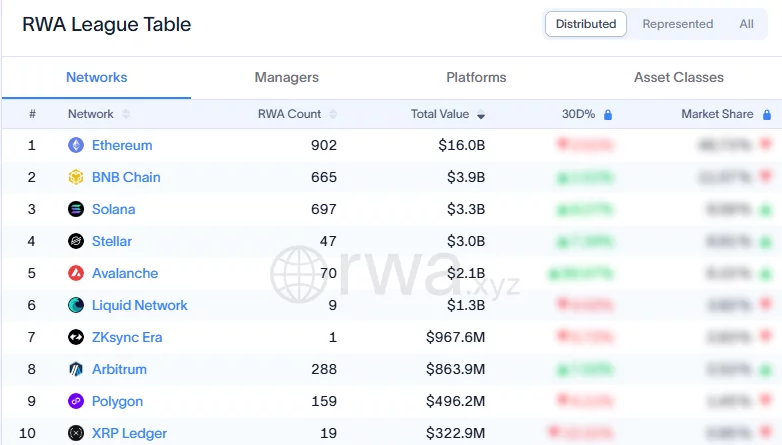
Avalanche has reached $2.1 billion in distributed tokenized real-world asset value after a 60.47% monthly increase, supported by a newly announced $11 billion institutional tokenization deal with Bridgetower.
Summary
- Avalanche’s tokenized RWA value has climbed to $2.1 billion after a 60.47% monthly increase.
- Bridgetower’s $11 billion tokenization deal has pushed Avalanche into the top five for net RWA inflows.
- BlackRock, VanEck and Franklin Templeton continue expanding institutional activity on Avalanche.
According to data from RWA.xyz, Avalanche’s distributed tokenized asset value climbed to $2.1 billion over the past 30 days, lifting the network to fifth place among tokenization blockchains by distributed value.
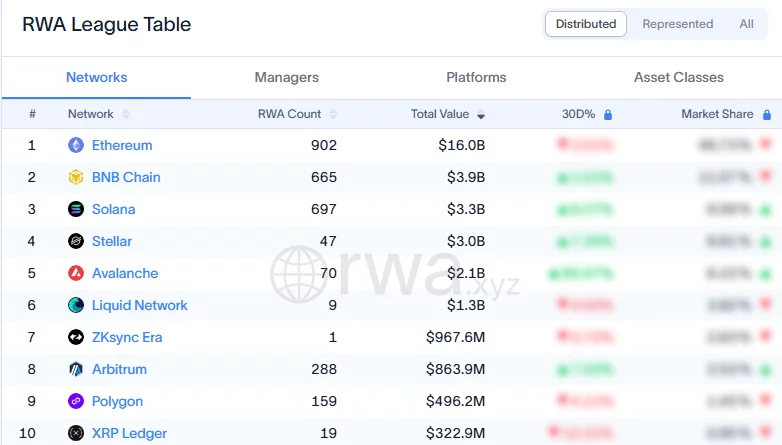
The latest increase came as institutional issuers expanded their use of Avalanche for real-world asset deployments, strengthening its position in one of crypto’s fastest-growing sectors.
Bridgetower expansion has accelerated institutional adoption
Fresh momentum followed Bridgetower’s July 13 announcement that it had tokenized more than $11 billion in production-linked real-world assets on Avalanche using Chainlink infrastructure. The portfolio includes the Arizona Copper-Gold project and pushed Avalanche into the top five networks for net RWA inflows on RWA.xyz shortly after the announcement.
Commenting on the milestone, Ava Labs Vice President of Business Development Morgan Krupetsky wrote on X that Avalanche now ranks among the top five blockchain networks for tokenized assets by both distributed and represented value, adding that the network’s progress is “still just the beginning.”
Bridgetower’s deployment builds on an institutional base that was already expanding before the latest transaction. BlackRock’s BUIDL tokenized U.S. Treasury fund has grown to more than $900 million on Avalanche, making it the network’s second-largest tokenized asset after Ethereum, according to publicly available on-chain data.
Institutional participation has continued to widen beyond treasury products. Investment manager VanEck has announced plans for a portfolio focused on gaming, decentralized finance, artificial intelligence and real-world assets on Avalanche, while unused capital in the strategy will be allocated to tokenized money market instruments issued on the network.
Other financial institutions have also selected Avalanche for tokenized financial products. Franklin Templeton’s BENJI fund and Littio Bank both chose Avalanche for yield-related offerings, while previous industry research has identified the blockchain as one of the leading infrastructures for real-world asset tokenization.
Competition with Ethereum remains intense
Even after the recent growth, Avalanche remains well behind Ethereum in overall tokenized asset value. According to RWA.xyz, Ethereum continues to host roughly $16 billion in tokenized real-world assets, keeping a significant lead despite Avalanche’s recent gains.
Avalanche’s institutional appeal has largely centered on its subnet architecture, which allows organizations to launch dedicated blockchains with high throughput, low latency, and full Ethereum Virtual Machine compatibility. Ava Labs has consistently promoted these technical features as suitable for enterprise deployments requiring customized blockchain environments.
Growing tokenized asset activity also increases network usage because AVAX is required for transaction fees, staking and subnet deployment. The 60.47% monthly increase recorded by RWA.xyz therefore coincides with measurable on-chain activity rather than speculative trading alone.
Meanwhile, the Avalanche Foundation continues to support tokenization projects through its $50 million real-world asset initiative, with additional subnet launches expected as more institutions explore blockchain-based financial products.
Regulatory developments could also influence adoption. Earlier this year, the U.S. Securities and Exchange Commission discussed tokenization during a public roundtable, where Avalanche was identified among the blockchain networks attracting industry attention.
At the same time, competition remains strong as Ethereum layer-2 networks and other high-performance blockchains continue competing for institutional tokenization projects, leaving future market share dependent on adoption and regulatory progress rather than a single transaction.

In March 2000, Strategy executive chairman Michael Saylor watched more than $6 billion disappear from his fortune in a single day.
MicroStrategy’s shares had plummeted more than 60%, thrusting the thirty-five year old software entrepreneur into the center of the dot-com crash.
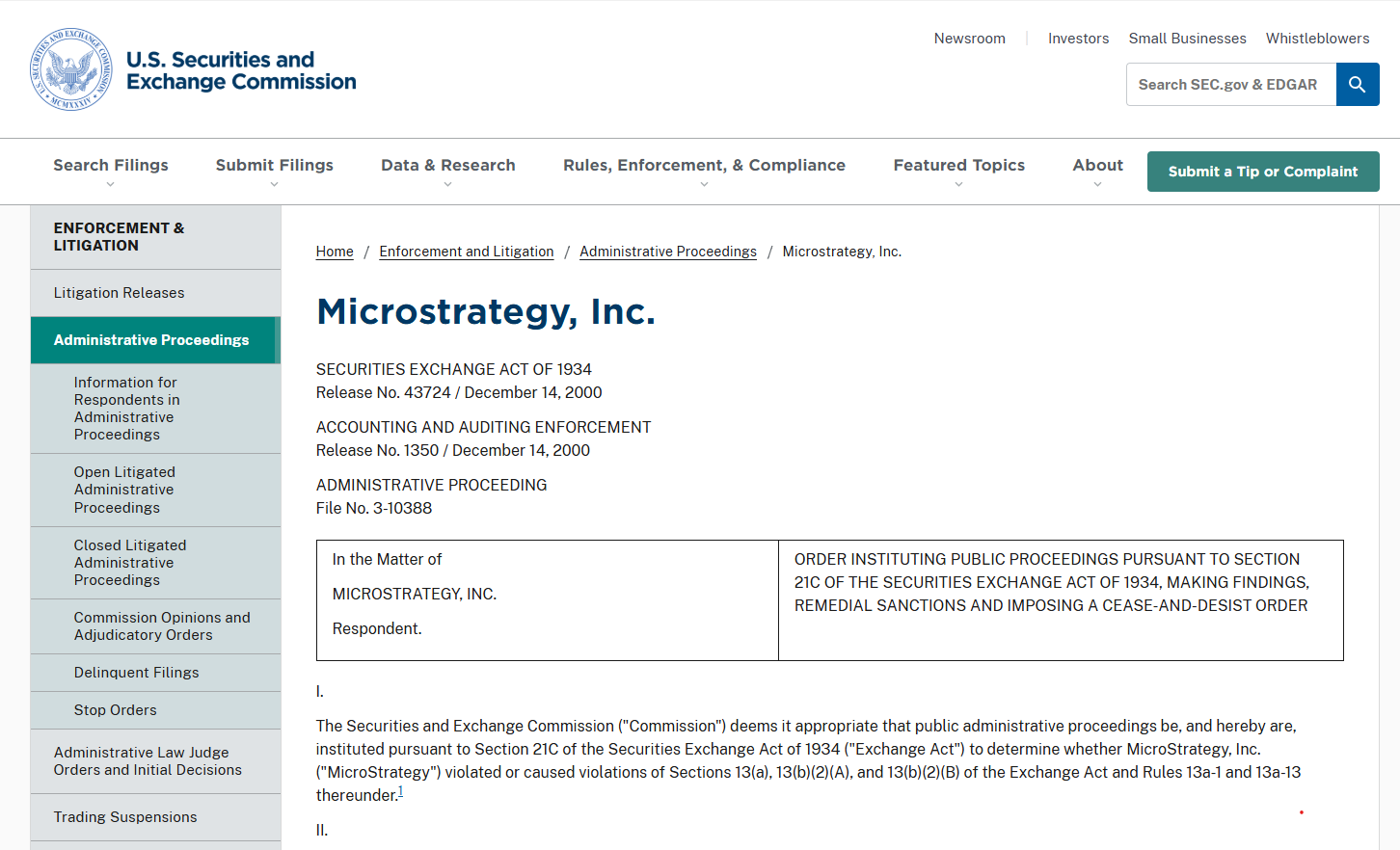
The company later settled civil fraud charges with the US Securities and Exchange Commission over its accounting practices without admitting or denying wrongdoing. MicroStrategy did not cause the dot-com bubble to burst, but the saga was one of the era’s high-profile corporate blowups and the company became a symbol of the periods excesses and risks.
Now, more than 25 years later, the Bitcoin true-believer once again finds himself in the eye of one of Wall Street’s most closely watched financial experiments.
The company, now known simply as Strategy, holds 843,775 Bitcoin, more than any other public company. It has inspired dozens of listed firms to adopt Bitcoin treasury strategies of their own.
But Strategy is no longer simply accumulating Bitcoin, it has developed a series of financial engineering strategies that divide investors and analysts. Some see it as a sophisticated corporate treasury model that can’t lose, while others believe the risks are piling up on top of one another.
“The conversation shifts beyond simply acquiring Bitcoin to how those positions are financed, managed and, when necessary, traded or monetized,” Drew Forman, senior vice president and head of strategy at Talos, told Cointelegraph.
From accumulation to management
On June 29, Strategy unveiled a new capital framework allowing it to sell Bitcoin to fund preferred stock dividends, build its cash reserves and repurchase securities.
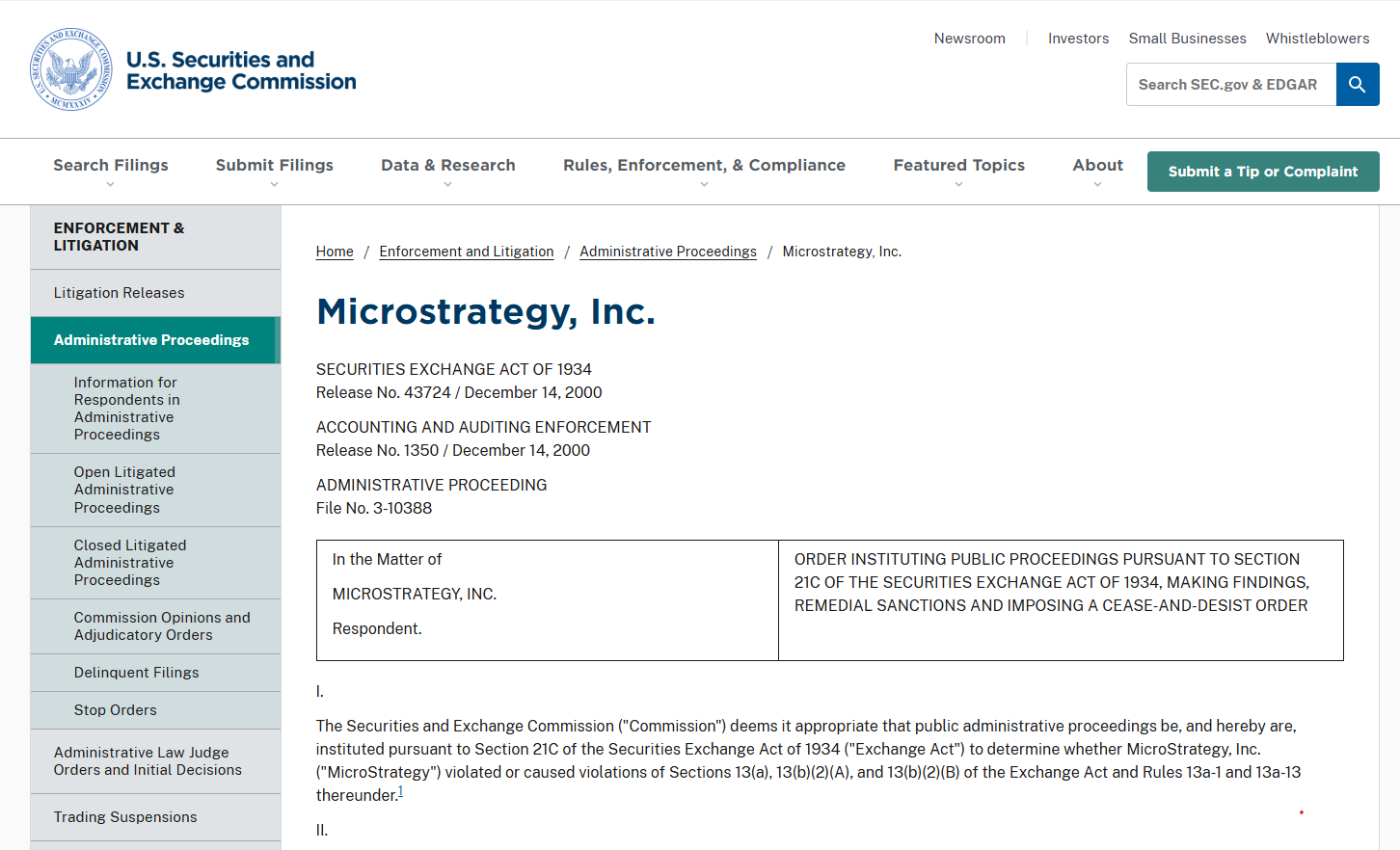
The case against MicroStrategy in 2000. Source: SEC
For a company that spent more than half a decade insisting its Bitcoin was to be accumulated rather than sold, the move caused alarm bells to ring.
Related: Lyn Alden says Bitcoin needs no savior as Strategy sells $216M of BTC
Days later, Strategy disclosed the sale of 3,588 Bitcoin, its largest disposal since adopting BTC as its primary treasury reserve asset in 2020.
To Strategy evangelists, these changes reflect the natural evolution of a company managing a multi-billion-dollar Bitcoin treasury, rather than a sharp about-turn.
Yet critics argue that Strategy’s growing reliance on preferred stock, dividend obligations and external financing has made the model more complex and interdependent, rather than more resilient.
MicroStrategy’s road to Bitcoin
MicroStrategy was one of the fastest-growing software companies of the internet boom in the 1990s, selling business intelligence software to blue-chip clients including McDonald’s, Nike and eBay, and making Saylor one of America’s richest entrepreneurs.
But on March 20, 2000, that momentum came to a sudden halt when MicroStrategy announced that it needed to restate its financial results for the fiscal years 1998 and 1999 due to accounting errors.
The company’s stock nosedived, dropping from $260 per share to just $86 in a single session. It continued to plummet over the following weeks. On April 13, when MicroStrategy announced that it would also need to restate its 1997 financial results, the stock closed at $33 per share.
That episode may have defined many executives’ careers, but Saylor spent the next two decades rebuilding the company largely outside the spotlight until the summer of 2020, when MicroStrategy announced that it would make Bitcoin its primary treasury reserve asset, and Saylor became its most vocal evangelist.

MicroStrategy settled charges with the US Securities and Exchange Commission. Source: SEC
He likened holding cash reserves during a time of unprecedented pandemic-era stimulus to holding “a melting ice cube.” The company bought its first $250 million Bitcoin on August 11.
Few public companies held Bitcoin on their balance sheets at the time, and the move was widely viewed as a high-risk experiment rather than a blueprint for corporate finance.
But Bitcoin’s price soon began to soar, bolstered by the excess liquidity, and Strategy’s valuation ballooned. Suddenly, Saylor’s controversial decision looked more like a stroke of genius and the company quickly became a leveraged proxy for Bitcoin on Wall Street.
Related: Strategy’s MSTR may plunge 80% if it repeats this dot-com-era fractal
Dozens of listed firms adopted variations of its treasury strategy, and today, Strategy’s Bitcoin stack is worth more than $54 billion. But with BTC languishing far from its all-time high above $126,000 in October 2025, the company’s Bitcoin play has been repeatedly called into question.
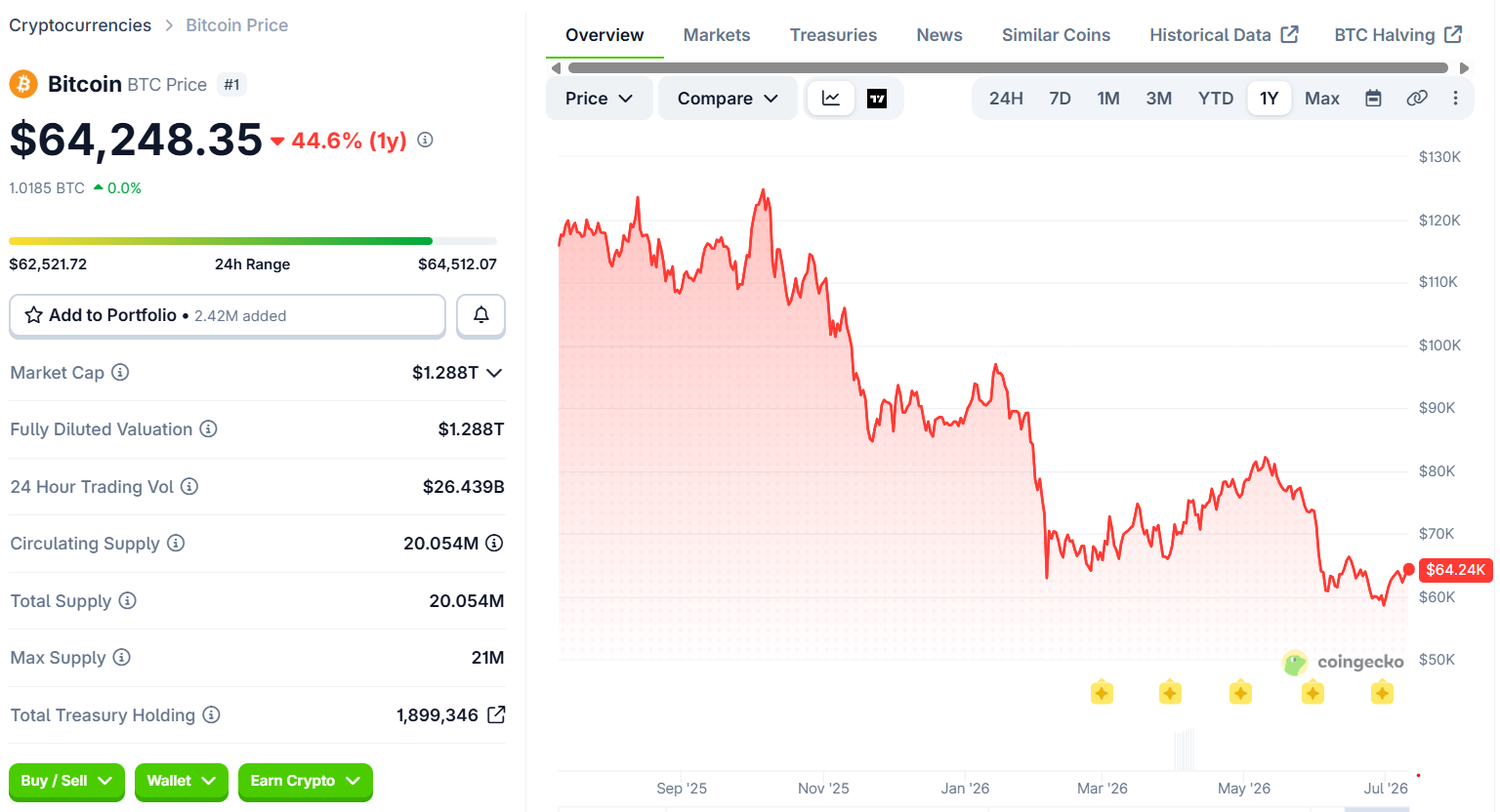
Bitcoin price is far from its all-time high. Source: Coingecko
Skeptics argue Strategy’s model only works if Bitcoin keeps appreciating and investors continue providing new capital. Some have even warned that, under prolonged market stress, those dynamics could contribute to a so-called death spiral in Strategy’s financial model.
Different mechanism, same problem
Whether Strategy represents a radical reinvention or history repeating itself depends largely on how investors interpret the risks.
To some critics, the similarities with 2000 are less about accounting than Saylor’s willingness to build his company around a high-risk corporate model that few other chief executives would even contemplate.
“Saylor is insane (not an insult, just a diagnosis) and is either a fool or a knave,” Aswath Damodaran, professor of finance at NYU Stern School of Business, told Cointelegraph in an email.
“It hurts my brain cells just thinking about MSTR and I don’t have enough to waste on it.”
David Trainer, chief executive of investment research firm New Constructs, also holds a hawkish view. He argued that while today’s Strategy looks very different from the company that collapsed during the dot-com era, investors are still being asked to place extraordinary faith in Saylor’s latest corporate experiment.
“Different mechanism, same underlying problem: the equity is a leveraged wrapper around a volatile asset, with no fundamental earnings power supporting the valuation,” he said.
He said that the dot-com blow-up was due to incorrect financial reporting. The SEC claimed in 2000 the company’s financial reports had “showed positive net income” when it should have “should have reported net losses from 1997 through the present.” While Saylor and two executives agreed to pay a $10 million fine to settle the case, they did not admit liability to any of the SEC’s allegations.
“That was a […] mismanagement risk layered on a real (if over-hyped) software business,” he said.
Today, the company’s books are “cleaner,” he argued, with the risks embedded in a capital structure built around financing ever-larger Bitcoin purchases rather than software.
Strategy now runs a “large and growing balance of convertible debt and perpetual preferred stock,” he said, pointing to the $6.7 billion in convertible notes and $15.5 billion in preferred stock outstanding as of late May 2026, used specifically to buy more Bitcoin.
“The software business is now a rounding error next to the balance sheet,” he said.
Related: Grayscale’s Pandl says Strategy should sell $3B Bitcoin to restore confidence
According to Trainer, the bigger concern is not Bitcoin itself, but the premium investors are willing to pay for exposure through Strategy. If that premium disappears, one of the company’s key advantages disappears with it.
“Once you’re structurally reliant on issuance and issuance becomes value-destructive, the company has to either sell Bitcoin, take on more expensive financing or simply stop growing,” Trainer said.
Treasury management, not just HODLing
Forman said that investors should focus on how the company manages its increasingly sophisticated corporate treasury strategy.
“Strategy’s position can’t be understood simply by looking at the size of its Bitcoin holdings,” Forman told Cointelegraph.
He said Strategy’s willingness to sell Bitcoin is less a departure from Saylor’s long-held accumulation strategy than a practical reality of managing a corporate balance sheet. “I see it as a pragmatic evolution of a more complex treasury strategy,” he said.
“The broader takeaway is that Bitcoin is increasingly being treated as an institutional asset class,” he added, stressing that rather than simply deciding whether to buy Bitcoin, companies will increasingly need to think about governance, liquidity management, execution and risk management.
So, has Saylor rewritten his legacy?
26 years after MicroStrategy’s accounting scandal, the questions surrounding Strategy have changed.
Few critics question the integrity of the company’s financial reporting, but whether its increasingly complex Bitcoin strategy can endure prolonged market stress.
Saylor has fundamentally changed the way many public companies think about corporate treasuries, and many have followed his lead.
But whether Saylor has rewritten his legacy won’t be decided by the next bull run, but on how well Strategy performs if the markets continue to turn against it.
Cointelegraph reached out to Strategy but did not receive a response. A spokesperson from the SEC declined to comment on the settlement case.
Magazine: Bitcoin will not hit $1M by 2030, says veteran trader Peter Brandt

Bitcoin pushed above $64,000 during Tuesday’s Wall Street open as US inflation data printed cooler than expected, lifting broader risk sentiment and bringing crypto back toward the top end of its recent trading range. The move came on the heels of a surprise drop in June’s Consumer Price Index (CPI), with energy costs driving much of the decline.
While the CPI release improved the near-term outlook for monetary policy expectations, traders were still cautious about whether Bitcoin can convincingly break above nearby resistance levels and sustain gains. That tension—between relief from macro data and technical hesitation—shaped market action into the early US session.
Key takeaways
- June CPI came in at 3.5% year over year versus 3.8% expected, marking the biggest monthly decline since April 2020, according to the US Bureau of Labor Statistics.
- Energy fell sharply in June, outweighing increases in other categories such as shelter and food, helping risk assets and Bitcoin trade higher.
- Monetary-policy expectations shifted more dovish after the print, even as the CME Group FedWatch Tool still pointed to a 0.25% hike at the September meeting as the baseline.
- Crypto traders remain focused on whether Bitcoin can hold above resistance near $64,000, with some analysis warning of potential rejection if levels aren’t reclaimed and defended.
- Short liquidations in crypto were elevated after the move, but data indicates the market is still range-bound rather than decisively trending.
US CPI’s sharp energy-led drop changes the near-term macro tone
BTC/USD gained more than 2% on the day, according to price tracking on TradingView, as the June CPI release came in below expectations. The key headline was the year-over-year CPI reading at 3.5% against the 3.8% forecast.
More importantly for markets, the CPI report showed a sharp month-to-month decline. The Bureau of Labor Statistics (BLS) said June marked the largest monthly fall in CPI since April 2020. The driver was energy: BLS reported that the energy index fell 5.7% in June after rising 3.9% in May, 3.8% in April, and 10.9% in March.
“The energy index was the largest contributor to the monthly all items decrease, more than offsetting increases in other indexes including those for shelter and food.”
The CPI print landed despite other geopolitical pressures tied to the US-Iran conflict, including concerns around supply routes connected to the Strait of Hormuz referenced in earlier market coverage. However, on this inflation reading, energy prices provided the “shock absorber” that swung the inflation profile downward.
Risk assets rally as markets tilt more dovish—CME still sees September hike
Stocks traded higher following the release, and crypto investors appeared to take the macro relief in stride. The immediate impact was visible in pricing of future Federal Reserve policy: expectations shifted more dovish, with traders reducing the perceived likelihood of additional near-term tightening.
Still, the market’s baseline case did not fully break from the probability framework seen before the release. According to CME Group’s FedWatch Tool, the consensus scenario continued to lean toward a 0.25% increase at the Fed’s September meeting. In other words, the CPI outcome appeared to cool the urgency of hikes rather than eliminate the expectation of one later in the year.
Economist Mohamed El-Erian characterized the release as a counterweight to an overly hawkish tilt in rates pricing, writing that the data should temper what had become “excessively hawkish” market assumptions about monetary policy—an observation he posted in a response on X.
Bitcoin tests the $64,000 ceiling as traders debate breakout odds
Even with the macro tailwind, traders largely treated Bitcoin’s advance as a test rather than a resolution. Several market observers pointed to local resistance just above $64,000 as the area that must be cleared to confirm a genuine upswing. Earlier coverage noted that Bitcoin had returned to the upper portion of its range, but that the $64,000 level remained a key decision point.
In ongoing market analysis posted on X, commentator Exitpump argued that the CPI print contributed to a squeeze effect: short sellers were not able to drive price lower as positions were forced to unwind. The takeaway was that passive demand and closing shorts helped push price higher, but the broader market still looked like it could remain range-bound.
“Still a range trading environment.”
Data from CoinGlass showed that crypto short liquidations over the prior 24 hours totaled just over $220 million. Liquidation spikes are often a byproduct of sharp moves against crowded positioning, but they do not automatically confirm a lasting trend—especially when price is already near technically significant levels.
What to watch next: whether $64,000 holds—or becomes a lower high
Trader Killa highlighted the importance of follow-through above recent highs. In an X post, Killa described liquidity located above $64.8K and explained that price was testing the weekly open. The warning was conditional: if Bitcoin could not reclaim and hold the weekly open, the move might turn into a “lower high,” potentially setting up a pullback toward the $60,000 region.
For traders and investors, the practical implication is that the CPI-driven rally may be less about a confirmed trend reversal and more about whether momentum can overcome near-term resistance. In range conditions, breakouts typically need sustained holding above key levels, not just a momentary spike.
As the market digests the inflation surprise, the immediate question is whether Bitcoin can convert CPI-fueled optimism into structural strength above $64,000 and follow-through toward higher liquidity zones. If it fails to hold, traders may treat the rally as a volatility event within a broader sideways framework until new macro data or positioning shifts provide clearer directional evidence.


On July 13, one of Japan’s largest financial conglomerates rewired its blockchain strategy in a single press release. SBI Holdings announced that the Solana Foundation will take an equity stake in SBI R3 Japan, the joint venture it shares with Sumitomo Mitsui Financial Group, and that the entity will be renamed SBI Solana Global.
Summary
- SBI Holdings and the Solana Foundation formed SBI Solana Global to support yen stablecoins, tokenized assets, and institutional blockchain services in Japan.
- The venture gives Solana one of its strongest institutional partnerships in Asia, though key commercial details and launch timelines remain undisclosed.
- The announcement had little immediate impact on SOL price as markets continued waiting for products and measurable on chain adoption.
The new company’s mandate reads like a full-stack blueprint for moving Japanese finance onto a public blockchain: yen stablecoin issuance and distribution, tokenization of corporate bonds, commercial paper, funds, and real estate, cross-border settlement rails, institutional on-chain services, and payment infrastructure for AI agents. For Solana, it is the deepest institutional embrace the network has received in Asia. For SBI, a company that spent nearly a decade as Ripple’s most committed champion in the region, it is a pivot loaded with signal. The question the market spent July 14 arguing about is which signal: validation of Solana as institutional infrastructure, or a reminder of how much distance separates a memorandum from a market.
The price answered with a shrug. SOL traded near $76 as the announcement circulated, slipping roughly 3.5 percent in line with a broader risk-off session, its market capitalization holding above $44 billion. That muted reaction is itself the story.
A G-SIB-adjacent joint venture with equity participation from the Solana Foundation would have produced a double-digit candle in any prior cycle. In this one, it landed on a market that has learned to discount institutional announcements until they ship products, and the gap between the announcement’s strategic weight and its price impact frames both sides of the debate that follows.
What was actually announced
Strip the release to its verifiable commitments and the structure is more concrete than the usual partnership language. SBI R3 Japan, the existing entity, adopts the planned trade name SBI Solana Global following standard corporate procedures. The Solana Foundation, the Swiss organization that stewards the network, acquires a fresh equity stake alongside existing shareholders SBI Holdings and Sumitomo Mitsui Financial Group. Equity matters here: foundations typically sign memoranda and grant programs, not cap tables. Taking ownership in the operating company aligns the foundation’s incentives with the venture’s commercial outcomes and gives Solana a seat inside a regulated Japanese financial group rather than a logo on its slide deck.
The mandate spans five areas. First, supporting the issuance and circulation of stablecoins, explicitly including JPYSC, the yen-denominated stablecoin SBI launched in June. Second, structuring and distributing tokenized real-world assets: corporate bonds, commercial paper, investment funds, and real estate, the deepest asset pools in Japanese finance. Third, cross-border payment and settlement infrastructure connecting Japan-originated assets to global liquidity. Fourth, on-chain financial services for institutional investors, covering issuance, transfer, recordkeeping, and settlement. Fifth, and most speculative, next-generation payment systems for the AI agent economy, in which automated software transacts under defined controls without human initiation. SBI framed the collective ambition as making Japan a core hub for on-chain finance in Asia by creating a new market for Japanese digital assets.
What was not announced matters equally. The size of the foundation’s stake is undisclosed. So are product launch dates, fee structures, revenue expectations, and the distribution channel: whether products flow through SBI VC Trade, through Bitbank, the exchange SBI has moved to acquire in a deal reported around 46.7 billion yen, or through another group entity. The venture, as of today, is a structure and a mandate. Everything commercial remains to be built.
The JPYSC foundation
The announcement builds directly on a milestone from three weeks earlier. On June 24, Japan launched its first trust-backed yen stablecoin, JPYSC, through a joint initiative between SBI Group and Web3 infrastructure firm Startale Group. SBI Shinsei Trust Bank serves as issuer, SBI VC Trade handles primary distribution, and the token operates as a Type III Electronic Payment Instrument under Japan’s amended Payment Services Act. That classification is the quiet breakthrough: it places a yen token inside a dedicated regulatory category with defined reserve, redemption, and disclosure obligations, which is precisely the legal scaffolding that lets regulated institutions touch the product.
A yen stablecoin with trust-bank issuance is the keystone asset for everything else in the SBI Solana Global mandate. Tokenized bonds need a settlement leg. Cross-border corridors need a regulated on-ramp on the Japanese side. Institutional on-chain services need a cash instrument that compliance departments recognize. One caveat belongs in every analysis: SBI has not confirmed that JPYSC has been issued on Solana or that Solana will become its primary network. The venture will support the token’s issuance and circulation, but the chain-level architecture remains unstated, and the distinction between a Solana-native yen stablecoin and a multi-chain one materially changes how much of the resulting activity accrues to the network the foundation just bought into.
Why Japan, and why now
Japan is an unusual candidate for on-chain finance leadership until you look at its rulebook. The country moved earlier than nearly every major market to build statutory frameworks for both stablecoins and security tokens. Stablecoins sit under the Payment Services Act with its dedicated electronic payment instrument categories. Tokenized securities operate inside existing disclosure law through a security token offering regime that domestic institutions have already used for bond and real estate issuance. While the United States argues over the CLARITY Act and its committee reconciliations, as crypto.news has tracked through the bill’s collapsing passage odds, Japan’s equivalent questions were answered by statute years ago. The venture is not waiting on a legal gate. It is standing on one.
That regulatory position explains the timing from the Japanese side. Domestic competition to build the tokenization stack has intensified: SMBC Group has explored stablecoin issuance with Ava Labs, Fireblocks, and TIS. The Progmat platform, backed by a consortium of Japan’s megabanks, has advanced tokenized bonds. Japan Open Chain pursues a similar mandate on domestic rails. SBI itself has worked with Chainlink on tokenized asset infrastructure and led a $125 million round in risk-modeling firm Gauntlet to build institutional DeFi capability. The race is domestic before it is global, and locking a major public network into an equity structure is a differentiating move no rival has matched. For the Solana side, Japan offers what every layer-1 foundation wants and few can get: a G-SIB shareholder, a compliant asset pipeline, and a jurisdiction where the products are legal before they launch.
How Solana became the institutional candidate
The selection deserves its own examination, because five years ago the sentence “a Japanese megabank consortium chose Solana for bond settlement” would have read as satire. The network’s early institutional reputation was defined by outages and by an ecosystem culture built around memecoins and retail speculation. The rehabilitation happened in layers. Client diversity and successive network upgrades pushed reliability into territory institutions could underwrite. The validator economics and fee markets matured. The developer ecosystem, measured by shipped applications, kept compounding through the bear market. And critically for this use case, the network’s core design tradeoff, maximal throughput and minimal cost on a single integrated layer, maps cleanly onto what securities settlement actually requires: high message volume, deterministic finality, and fees small enough to vanish inside institutional operating costs.
The contrast with the alternative public-chain path is instructive. Ethereum’s institutional pitch routes through its layer-2 architecture, which offers deep liquidity and conservative security assumptions at the cost of fragmentation: assets and settlement scattered across rollups with distinct trust models and bridging risk. For a regulated issuer building a national market from scratch, a single high-capacity layer with one operational model is an easier system to document, audit, and explain to a financial regulator. That does not make it the winning choice in every jurisdiction, and Ethereum’s institutional footprint in tokenized funds remains the largest in the world. It explains why a greenfield national buildout, with no legacy liquidity to protect, optimized for integration simplicity. SBI ran production systems on permissioned rails for a decade; its engineers know exactly what operational complexity costs.
The market Japan is playing for
The prize behind the mandate is the tokenization of conventional assets, the one crypto vertical where institutional forecasts and shipped products have both kept growing through the bear market. Tokenized money market funds and treasuries crossed from pilot to product globally, stablecoin settlement volumes now rival card networks on some corridors, and every major custodian has a tokenization roadmap. The economics driving it are prosaic: settlement compression from days to minutes, collateral mobility across time zones, fractionalization of large-ticket assets like real estate, and the removal of reconciliation layers that exist only because ledgers do not talk to each other.
Japan’s specific opportunity is scale plus stagnation. The country holds one of the deepest bond markets on earth, a vast commercial paper market, and household financial assets in the quadrillions of yen, overwhelmingly parked in instruments whose infrastructure has not changed in decades. A regulated tokenization pipeline that moved even a fraction of a percent of that stock would dwarf every crypto-native RWA experiment to date. That is the arithmetic that makes a cautious conglomerate move: the venture is not chasing crypto volumes, it is positioning for the plumbing upgrade of a domestic capital market, with the yen stablecoin as the settlement layer and the public chain as the registry. Whether that flow prices SOL is a separate question, and an honest one, but the flow itself is the largest addressable market any layer-1 has been formally pointed at in Asia.
The Ripple question
No analysis of this announcement is complete without the elephant in SBI’s portfolio. SBI spent close to a decade as Ripple’s anchor partner in Asia: joint ventures, board relationships, XRP-based remittance corridors, and most recently the distribution of Ripple’s RLUSD stablecoin in Japan. The reflexive reading of the Solana pivot is that SBI is diversifying away from a partner whose token has spent 2026 pinned near $1, and the crypto commentariat spent the announcement day running exactly that narrative.
The evidence supports a more boring conclusion: addition, not substitution. The RLUSD distribution agreement stands. The remittance businesses continue. SBI’s investor materials describe a multi-stablecoin, multi-chain architecture in which USDC, RLUSD, and JPYSC serve different corridors and client bases. What the Solana venture adds is a public-chain execution layer for the tokenized asset and institutional settlement businesses, a lane Ripple’s enterprise stack was never positioned to own in Japan. The sharper competitive reading runs the other direction: SBI has effectively decided that no single network gets exclusivity over Japanese on-chain finance, and every foundation and issuer now knows the anchor client is polyamorous. That is worse news for maximalists of every persuasion than for any specific chain.
The same logic governs the R3 legacy. SBI R3 Japan was built to commercialize Corda, the permissioned ledger that defined the previous era of institutional blockchain strategy. Renaming the entity around a public network is a clean marker of where that era ended: the consortium chains produced pilots, and the public chains produced markets. The rebrand does not confirm SBI is abandoning Corda-based systems already in production, but the naming decision tells you where the growth budget goes.
There is also a precedent dimension worth naming directly, because it changes how other jurisdictions read the deal. Financial institutions worldwide have partnered with blockchain firms for years, but the standard structures kept the chains at arm’s length: vendor contracts, pilots, consortium memberships that could be exited by memo. An equity joint venture with a foundation, a megabank on the register, and a mandate over core capital markets is a different category of commitment, visible to every regulator and rival that studies it. If the structure works, it becomes the template that other national markets copy, and the foundations of competing networks will be pushed by their own ecosystems to offer equivalent skin. If it stalls, it becomes the cautionary slide in every consultant’s deck for a decade. Either way, the arms-length era of bank-blockchain relations ended in Tokyo this week, and the industry will be arguing about the terms of its replacement for years.
The stablecoin geography taking shape
Zoom out from the single announcement and a regional architecture becomes visible. SBI’s portfolio now spans three stablecoin lanes with distinct jurisdictions and jobs: USDC for global dollar liquidity, where SBI’s crypto arm has already built retail lending products; RLUSD for the enterprise settlement corridors it operates with Ripple; and JPYSC for the domestic yen leg that everything Japanese ultimately touches. The Solana Foundation’s parallel moves fill in the map: the KG Inicis work in South Korea targets merchant settlement and loyalty on the peninsula, Circle keeps expanding USDC issuance on the network, and the SBI venture now anchors the Japanese corner. The pattern is a network positioning itself as the neutral settlement layer for Asian currency tokens rather than betting on any single issuer.
The strategic logic runs through corridors. The yen-dollar corridor is among the largest foreign exchange pairs in the world, and the remittance and trade flows between Japan, Korea, and Southeast Asia move through correspondent banking machinery whose costs stablecoin rails undercut by an order of magnitude. A regulated yen token, a regulated dollar token, and a common high-throughput chain turn cross-currency settlement from a messaging problem into an atomic transaction, which is the actual product hiding inside the venture’s cross-border mandate. Every incumbent in that machinery, from correspondent banks to card networks, has noticed, which is why the same months produced bank-led stablecoin consortiums on three continents.
The AI agent wildcard
The fifth mandate area drew the most skepticism and deserves a fair reading. Payment infrastructure for AI agents means rails on which software authorized by humans or corporations transacts autonomously: procurement bots settling invoices, data services metering usage by the second, machine-to-machine markets for compute and content. Dismissing it as buzzword compliance is tempting, and until volumes exist, partially correct. But the design requirements are real and specific: sub-cent fees, instant finality, programmable controls, and no dependence on card networks built around human cardholders. Those requirements describe a public high-throughput chain settling in stablecoins more than they describe any legacy system, which is why agent payments appear in the roadmaps of nearly every serious payments company this year.
For the venture, the practical significance is optionality. The stablecoin and tokenization lanes justify the buildout on their own; the agent lane is a cheap call option on a category that could grow discontinuously if agentic commerce arrives on the schedule its promoters claim. A conglomerate writing that option into a joint venture mandate in 2026 costs nothing. Owning the regulated yen settlement layer if the option pays would be worth more than the rest of the mandate combined.
The bull case: the pipeline is the prize
The bullish argument begins with what Solana receives that no marketing spend could buy. Direct equity participation embeds the foundation in a regulated Japanese financial group with Sumitomo Mitsui, a global systemically important bank, as co-shareholder. The venture’s mandate points Japan’s deepest asset classes, government-adjacent bonds, commercial paper, funds, and real estate, at Solana’s rails. Japan’s regulatory clarity means product launches face licensing work, not legislative risk. And the choice itself is a technical endorsement: a conglomerate that has run production blockchain systems for a decade evaluated the field and selected Solana’s throughput, cost profile, and developer ecosystem for institutional settlement.
The network context strengthens the case. Solana’s institutional year has compounded: Circle expanding USDC issuance on the network, payment processors in South Korea examining stablecoin checkout through KG Inicis, and a steady migration of tokenization pilots from private chains to public rails. The SBI venture slots into that pattern as its largest and most structurally committed Asian instance. If even the stablecoin and bond tokenization lanes ship at modest scale, Solana becomes the default public network for regulated Japanese assets, a position with compounding returns as the tokenization market grows. Institutional adoption is a coordination game, and Japan just coordinated.
The bear case: a mandate is not a market
The skeptical argument starts with the same undisclosed list the release left behind. No stake size, no timelines, no revenue targets, no confirmed distribution channel, and no confirmation that even JPYSC, the venture’s flagship asset, runs primarily on Solana.
Japanese financial conglomerates are famously deliberate: the gap between a joint venture announcement and a product at scale is measured in years, and SBI’s own blockchain history includes ventures whose ambitions outran their shipped products. Corda was itself once the announced future of Japanese institutional blockchain, under the very entity being renamed.
The bear case also notes what the price action already said. SOL fell on announcement day, and not because the market misread the release. Institutional partnerships accrue value to the network’s fee economy slowly and to the token’s price more slowly still: tokenized bonds settle in stablecoins, not in SOL, and the network’s revenue capture from regulated asset flows runs through transaction fees that Solana’s architecture deliberately keeps near zero. The venture can succeed completely and still contribute little near-term to the token, which is the asset most readers of the announcement actually hold. Layer on the competitive risk that Progmat and the megabank consortiums keep Japan’s most conservative issuers on domestic rails, and the realistic bear scenario is not failure but marginalization: a venture that ships a stablecoin corridor and some real estate tokens while the core bond market stays where it is.
Finally, the macro caveat applies here as everywhere. Japan’s on-chain ambitions launch into a global regulation and rate environment that has compressed every crypto asset, and institutional programs approved in bull markets have a documented habit of shrinking in committee during bear ones. SMFG’s presence on the cap table is a commitment, not a guarantee of pace.
Where SOL the asset stands while the venture builds
The token’s position entering this news cycle explains the muted reaction as much as any skepticism about the deal. SOL near $76 sits far below its cycle highs, compressed by the same Federal Reserve repricing and risk-off rotation that pulled Bitcoin toward $60,000 and drained the altcoin complex. The network’s fundamental dashboard has diverged from its price for months: application revenue, stablecoin supply, and developer activity holding up while the token trades with the market’s beta. Spot Solana ETFs exist in the United States, giving the asset the same wrapper infrastructure as Bitcoin, Ethereum, and XRP, and the March interpretive release that classified the major assets as digital commodities covered the top of the market broadly, leaving Solana’s institutional access story more mature than its price suggests.
That divergence frames how institutional news gets absorbed in this tape. Announcements that would have been front-run violently in a bull regime now enter a market where the marginal price-setter is a macro fund watching rate expectations, not a crypto fund watching partnerships. The historical pattern is that fundamental accumulation during such regimes expresses itself only when the macro binding constraint releases, at which point the assets with the strongest accumulated institutional stories tend to lead. Whether SOL occupies that position at the turn depends on execution stories exactly like this one converting into measurable on-chain flows before the regime changes. The venture’s builders and the token’s holders are, in that sense, racing different clocks toward the same event.
What would make this pivot real
The venture converts from announcement to market on a short list of observable milestones, and each has a rough clock. The corporate rebrand completing is trivial but confirms the procedures are moving. Confirmation of JPYSC issuance on Solana, or of a Solana-native issuance track, is the first substantive tell, because the stablecoin is the settlement asset every other product needs. The first tokenized instrument, most plausibly commercial paper or a fund vehicle before a full corporate bond, would prove the issuance pipeline, and its distribution channel would answer the Bitbank question. Disclosure of the foundation’s stake size, whenever it comes, will calibrate how much skin accompanies the signal. And the first cross-border corridor, connecting a Japanese issuer to offshore liquidity through the venture’s rails, would validate the thesis that Japan-originated assets can find global buyers on a public chain.
A realistic clock helps calibrate expectations against Japanese corporate practice. The rebrand and stake completion should land within one to two quarters, since both run on procedure. A first product announcement inside 2026 would count as fast by the standards of the institutions involved; the first tokenized issuance reaching external investors in 2027 would still qualify as on schedule. Anyone trading SOL on this news should hold that timeline against their horizon, because the venture is built to pay off in infrastructure years, not in market weeks, and the mismatch between those clocks is where most disappointment in institutional crypto news is manufactured.
For DeFi and tokenization watchers, the wider significance does not depend on SBI’s execution speed. July 13 marked the first time a public blockchain foundation took equity in a regulated joint venture with a Japanese megabank group on the shareholder register, aimed at the country’s core capital markets. Whether Solana captures the resulting value in one year or five, the direction of institutional travel is no longer contested: the pilots era ran on private chains, and the production era is being built on public ones, with Japan, of all markets, moving first. The announcement’s price impact was a rounding error. Its precedent is not.
Disclaimer: This article is information, not investment advice. Deal terms, product plans, and market figures reflect reporting available as of July 14, 2026, and can change quickly. Key commercial details of the SBI Solana Global venture, including the equity stake size and launch timelines, remain undisclosed. Nothing here is a recommendation to buy or sell SOL or any other asset. Verify current developments from primary sources and consider your own circumstances before making any decision.


The most instructive XRP trade of 2026 was an exit. When it emerged this month that Goldman Sachs, once the largest XRP holder among Wall Street institutions, had sold down its position, the reaction split along familiar lines: bears read it as the smartest money leaving a stalled asset, bulls read it as a bank taking profits on ETF seeding and creation-desk inventory it never intended to hold.
Both camps then arrived at the same, more interesting question, and it is the one that will define XRP’s next year. The first $1.5 billion of ETF money is in. Goldman’s chapter is closed. Standard Chartered says the next tranche is worth $4 billion to $8 billion. So who, exactly, buys it, what has to happen first, and what does XRP look like if they do?
Summary
- XRP ETFs have attracted about $1.5 billion in net inflows, with Standard Chartered estimating another $4 billion to $8 billion could follow if the CLARITY Act becomes law.
- Registered investment advisors, model portfolios, wirehouses, corporate treasuries, and sovereign investors are expected to drive the next wave of institutional XRP ETF demand over time.
- ETF inflows have continued despite weak price action as long term accumulation, lower exchange balances, and regulatory progress compete with macro pressure and ongoing supply.
The question matters because XRP has spent 2026 as the market’s cleanest natural experiment in whether flows alone can move a price. The token trades near $1.08 inside a range that has compressed to roughly $1.00 to $1.13, down around 40 percent on the year, while nearly every input a flow analyst would track has pointed the other way: sustained ETF creations, whale accumulation running at multiples of last year’s pace, exchange balances at multi-year lows, and a parent company stacking regulatory wins across three continents. The demand arrived. The price did not respond. Resolving that contradiction requires taking the flow machine apart piece by piece.
What the first $1.5 billion proved
Five spot XRP exchange-traded funds launched in the United States between November and December 2025, arriving in the window after the SEC’s posture shifted and before any statute confirmed it. Through mid-2026 the products have gathered roughly $1.5 billion in net inflows, a figure that deserves more context than it usually gets. That total accumulated during the worst crypto tape since 2022, with Bitcoin falling from the $90,000s toward $60,000, the Federal Reserve pivoting from expected cuts toward a possible hike, and the Fear and Greed Index pinned in the twenties. Gathering $1.5 billion into a falling altcoin during a fear regime is not failure. It is evidence of a persistent bid that did not exist in any prior cycle, because the wrapper that carries it did not exist.
The composition of that bid matters as much as its size. ETF flows in the launch phase come disproportionately from three sources: self-directed retail moving out of exchange custody and into brokerage accounts, hedge funds running basis and arbitrage strategies, and early-adopter advisors making small allocations for aggressive clients. What launch-phase flows conspicuously exclude is the slow money: the wirehouse model portfolios, the pension consultants, the bank trust departments, and the insurance general accounts. Those channels move on compliance calendars, not conviction, and their compliance calendars all point at the same gate.
Benchmarking the figure against the category sharpens the point. The five XRP products collectively rank behind only the Bitcoin and Ethereum complexes among American crypto ETFs by assets gathered, ahead of the Solana products that launched into the same window with a stronger price narrative. Monthly net flows have oscillated with the tape, including redemption stretches during the worst weeks of the drawdown, but the cumulative line has kept its upward slope through eight months that destroyed weaker products across the fund industry. Whatever the price chart says, the wrapper found a durable audience on its first attempt, and product durability is the precondition every larger channel checks before it checks anything else.
The gate: statute, not classification
That gate is legal permanence. The SEC and CFTC jointly classified XRP as a digital commodity in March 2026, an interpretive release that ended, in practical terms, the five-year war that began with the SEC’s 2020 lawsuit against Ripple. But an interpretive release binds nobody past the current commissions, and the institutional legal departments that gatekeep the largest pools of American wealth have been explicit about the distinction. Their memos approve products backed by law and defer products backed by guidance. The CLARITY Act, the market structure bill now sitting on the Senate calendar, is the instrument that converts one into the other, which is why Standard Chartered’s $4 billion to $8 billion projection is written as conditional: those flows unlock if the bill becomes law.
The mechanics of the projection are worth spelling out, because the number is not a guess about sentiment. Analysts build it from allocation math: take the advised wealth channels that currently exclude crypto ETFs, apply the small percentage allocations their model portfolios assign to alternatives when products clear compliance, weight by XRP’s likely share of a multi-asset crypto sleeve alongside Bitcoin, Ethereum, and Solana products, and discount for adoption lag. Run that arithmetic across several trillion dollars of advised assets and single-digit billions fall out quickly. The projection’s fragility is equally visible in its assumptions: it requires the law to pass, the wirehouses to act on it within quarters instead of years, and XRP to hold its place in the standard institutional basket. As crypto.news examined in its analysis of the bill’s falling odds, the first assumption alone now carries roughly 43 percent probability for 2026, which means the headline flow number should be probability-weighted by anyone using it seriously.
The buyers, ranked by likelihood
Ranking the candidate buyers of the next $4 billion produces a clearer picture than the generic institutional label. The most probable early source is the registered investment advisor channel, roughly $8 trillion of American wealth where individual firms make their own compliance decisions and where crypto allocations have already normalized at the aggressive end. RIA flows into Bitcoin ETFs led every other channel in that product’s first year, and the pattern would likely repeat down the risk curve.
Second come the model portfolio and turnkey asset management platforms, which matter less for their size than for their automation: once an XRP product enters a model, flows recur monthly with rebalancing, indifferent to headlines. Third, the wirehouses, the largest and slowest pool, where solicited recommendations require the statutory green light and where internal approval processes run quarters after that. Fourth, corporate treasuries, a wildcard channel that Bitcoin normalized and that a handful of firms have already extended to XRP; permanence in law plus an accounting framework would widen that experiment. Fifth and most speculative, sovereign and quasi-sovereign buyers in jurisdictions where Ripple’s payment infrastructure is operationally embedded, a category that generates headlines out of proportion to its realistic near-term size.
The timing across these channels is sequential, not simultaneous, and the sequence is the part most projections flatten. RIA adoption can begin within weeks of a statutory trigger because the decision sits with thousands of small compliance committees rather than a handful of large ones. Model platforms follow within one to two quarters, on their scheduled review cycles. Wirehouse approval historically lags by two to four quarters even after the stated objection is removed, because internal product committees, training requirements, and suitability frameworks each add their own clock. Stacking those lags against Standard Chartered’s range suggests the honest shape of the projection: a thin front edge arriving within months of passage, and the bulk arriving across 2027, which is a materially different trade than the headline number implies.
Against these stand the sellers. Launch-phase arbitrageurs exit as basis compresses. Early holders use ETF liquidity as an exit ramp, which is partly what the Goldman episode illustrated. And Ripple itself remains a structural source of supply through its escrow releases, a flow bulls prefer not to model and bears never stop modeling. Net flow, not gross inflow, is what moves price, and the first eight months of ETF trading have shown the net figure can stay positive while the price goes nowhere if enough legacy supply uses the new demand as liquidity.
The demand stack beneath the ETFs
The ETF story sits on top of an on-chain demand picture that has quietly strengthened all year. Whale accumulation, measured by large-wallet inflows and exchange outflows, has run at roughly triple last year’s pace during the 2026 drawdown, the classic accumulation-into-weakness pattern that preceded prior cycle turns. Exchange balances have fallen toward multi-year lows, shrinking the tradable float. XRP Ledger activity has grown across payments, tokenized real-world assets, and the RLUSD stablecoin, which has become the settlement asset for an expanding share of Ripple’s enterprise volume.
The corporate side reads the same direction. Ripple holds more than 75 regulatory licenses and registrations worldwide. It secured full authorization under the European Union’s MiCA framework in Luxembourg this month, opening the entire European Economic Area under a single passport. Mastercard named Ripple a settlement partner in its AI payments network. SWIFT-connected banks have begun routing blockchain settlement pilots through Ripple-linked institutions. And the company stages its largest event of the year, Swell, alongside the XRPL developer summit in New York in late October, a traditional venue for partnership announcements. On any fundamental checklist an equity analyst would recognize, the boxes are ticked. That is precisely what makes the price action so uncomfortable.
The RLUSD complication
One development the flow models handle awkwardly is that Ripple’s fastest-growing product is no longer XRP. RLUSD, the company’s regulated stablecoin, has become the settlement asset for a rising share of enterprise volume, the collateral base for Ripple Prime’s institutional services, and the instrument through which many of the bank partnerships actually clear. Every corporate win that routes through RLUSD strengthens Ripple the company while contributing nothing direct to XRP the asset, and the divergence has become a live debate among holders: whether the stablecoin is the wedge that eventually drives ledger activity and XRP demand for bridging and fees, or the quiet replacement of the token’s original use case with a product institutions find easier to hold.
For the ETF flow question, the debate cuts a specific way. Allocators buying an XRP product are buying the token’s monetary premium and its role in the ledger economy, not Ripple’s equity story. If the company’s growth increasingly expresses itself through RLUSD and through services revenue, the fundamental narrative that supports a dedicated single-token allocation weakens at the margin, even as the company itself strengthens. Bulls answer that stablecoin settlement and tokenized asset growth raise ledger throughput, and throughput ultimately prices the native asset. The honest status of that argument is unresolved, and it is the fundamental question hiding inside the flow question: $4 billion buys exposure to XRP, and the market is still deciding what XRP is exposure to.
Why ETF demand behaves differently from spot demand
The distinction between a billion dollars of exchange buying and a billion dollars of ETF creations is mechanical, and it decides how the next tranche would express itself in price. Spot demand on exchanges is discretionary and reflexive: it arrives with momentum, leaves with drawdowns, and concentrates in the leveraged venues where liquidations amplify both directions. ETF demand routes through authorized participants who create and redeem shares against the net of each day’s orders. The flow that survives that netting is disproportionately allocation flow: advisors rebalancing models, platforms deploying scheduled contributions, funds equitizing mandates. It arrives on calendars, ignores intraday narrative, and, critically, keeps arriving through drawdowns because rebalancing into weakness is what model portfolios are built to do.
That character difference explains an apparent paradox in the 2026 data: steady net creations against a falling price. The creations were real, but they were met by discretionary sellers using the wrapper’s liquidity as an exit, including, evidently, the largest bank holder on the street. The bull interpretation is that this is exactly what accumulation phases look like when a new demand channel opens into an old holder base: impatient supply migrates to patient hands, the float thins, and the price stays flat until the migration completes. The bear interpretation is that the patient hands are simply early, and patience is not a catalyst. The data cannot distinguish the two until a demand shock tests the thinner book. What the data does show is that the pipe works: shares get created, spreads stay tight, and the products tracked their net asset values through the year’s worst volatility, which is the operational track record the slower channels required before even beginning their reviews.
The Bitcoin ETF playbook, one asset down the curve
There is a map for how the channels open, because Bitcoin walked it in 2024 and 2025. The Bitcoin spot ETFs launched into self-directed and hedge fund demand, spent roughly two quarters dominated by basis trades, then inflected when the RIA channel cleared the products for solicited use and the first wirehouses followed. Each gate that opened produced a step change in cumulative flows, and the price responded with a lag measured in weeks, not days, because allocation flow does not chase. By the time the largest platforms had fully opened, the products held a meaningful share of circulating supply and the asset’s volatility profile had visibly compressed.
XRP’s products are one asset class rung below on the institutional risk ladder and roughly three quarters into the equivalent timeline, still waiting on the gate that Bitcoin never needed: statutory classification. Bitcoin entered its ETF era with a commodity status nobody seriously disputed. XRP entered with a court ruling, an interpretive release, and a pending bill, which is why its channel-opening sequence stalled at the compliance stage that Bitcoin’s cleared automatically. The playbook’s lesson is not that XRP repeats Bitcoin’s flow curve at smaller scale, though the analog is tempting. The lesson is that the curve is gated by legal events, and the gates open in order. The March release opened the first. The Senate holds the second.
The supply side of the ledger
Flow analysis that counts only buyers is half an analysis, and XRP’s supply side has features Bitcoin’s does not. Ripple’s escrow releases up to one billion XRP monthly, with unused portions returning to new escrow contracts. The net escrow contribution to circulating supply has trended well below the headline figure, and the company has leaned on programmatic sales less as institutional revenue lines have grown, but the overhang is structural: the market prices the possibility of supply even in months when little arrives. Layer on the launch-era holders for whom regulated products finally offered institutional-grade exit liquidity, and the absorption burden on the first $1.5 billion becomes clearer. New demand did not meet a fixed float. It met a float with a scheduled faucet and a queue at the exit.
The counterweight is the on-chain float data. Exchange balances at multi-year lows mean the discretionary sell-side has thinned even as the escrow schedule persists, and RLUSD settlement growth gives a share of monthly releases an internal destination that did not previously exist. The supply picture, like everything else in this asset, resolves into a timing question: whether the faucet or the gate moves first.
Why the price has not followed
The bear explanation for the standoff is the simplest and has been the best trade of the year: XRP is a high-beta risk asset in a market being repriced by the Federal Reserve, and no token-specific story survives a regime where inflation prints at three-year highs and rate expectations invert. XRP’s correlation with Bitcoin has remained high through the drawdown, and Bitcoin itself has ignored its own bullish supply dynamics for months. In this reading, the flows are real but small against the macro tide, the $1.5 billion of ETF demand was absorbed by sellers grateful for the liquidity, and the next $4 billion, if it comes, arrives only after the Fed turns, at which point every risk asset rallies and XRP’s story adds beta instead of alpha.
The structural bear adds a colder point: XRP’s investment case has become a regulatory derivative. Strip out the CLARITY Act and the token trades on cross-border payment adoption that, while real, has never been priced by the market as sufficient on its own. If the bill slips to 2027, the one catalyst distinguishing XRP from the general altcoin complex slips with it, ETF inflows could reverse the way they briefly did earlier this year, and analysts have flagged the zone below $1.00 as thin support down to materially lower levels. The Goldman exit, in this telling, was not noise. It was a sophisticated holder concluding that the probability-weighted return of waiting had fallen below its hurdle.
The bull rebuttal: coiled, not broken
The bull case does not dispute the macro pressure; it disputes the conclusion. Prices that refuse to fall on bad tape while accumulation triples are compressing, not failing, and the float shrinkage means any demand shock hits a thinner order book than at any point in XRP’s modern history. Seasonality offers a minor tailwind with a major caveat: July has historically been XRP’s strongest month, averaging roughly 10 percent gains, though this July opened deep in a fear regime that blunts seasonal patterns. The levels are unusually clean. The $1.00 floor has been defended repeatedly, resistance sits at $1.13 and then the $1.18 to $1.20 zone, and a legislative surprise into light positioning would find little supply between the breakout level and the low $1.40s where the year’s earlier ranges sat, as crypto.news mapped in its July price prediction.
The deeper bull argument is about market structure rather than price. Every prior XRP cycle ran on retail exchanges and offshore leverage. This one is the first where a regulated wrapper connects the token to the advised wealth system, and wrappers change the character of demand: slower to arrive, slower to leave, price-insensitive on schedule. The first $1.5 billion built the pipe. The debate over the next $4 billion is really a debate over timing, because the channels themselves, once compliance-cleared, allocate mechanically. Bulls can be wrong about 2026 and right about the asset, which is an argument for position sizing instead of abstinence.
What would invalidate the flow thesis
Intellectual honesty requires listing the ways the $4 billion never arrives even if the bill passes. The first is product cannibalization. The next generation of crypto ETFs is multi-asset: index products holding baskets weighted by market capitalization, which institutional buyers often prefer to single-token bets. If the advised channels open and allocate through baskets, XRP captures only its index weight of the flows, a fraction of the headline projection built on dedicated products. The second is fee and liquidity concentration. ETF flows historically consolidate into one or two winners per category, and a fragmented five-issuer field splits liquidity in ways that keep the largest allocators waiting for a dominant product to emerge.
The third invalidator is reputational path dependence. A single adverse event, an issuer failure, a custody incident, an escrow controversy, would reset the compliance clocks that took years to run, and crypto’s history suggests assigning that tail a nonzero weight. The fourth is simple opportunity cost: if the gate opens during a macro regime where advisors are cutting risk, the mechanical allocations shrink with the risk budgets they draw from. None of these kills the asset. Each of them turns the projection’s midpoint into its ceiling, and collectively they are why serious flow forecasts carry ranges wide enough to drive a truck through.
What Ripple controls and what it does not
It is worth separating the variables by who holds them. Ripple controls its licensing map, its product velocity, RLUSD’s growth, escrow release policy, and the October event calendar. It controls none of the three variables that will actually decide the flow question: the Senate schedule, the Federal Reserve, and the oil price. That asymmetry explains the company’s visible strategy of building the institutional rails before the demand arrives, so that when the gate opens, adoption is an integration task rather than a construction project. It also explains why company news has stopped moving the token: the market has correctly identified which variables bind.
For regulation watchers, the checklist between now and the August recess is short. A scheduled Senate floor vote is the unlock signal. The reconciliation of the two committee texts is its precondition. Public declarations from additional Democratic senators are the vote-count tell. And ETF net flows themselves are the real-time referendum: sustained creations through a stalled news cycle would show the slow money starting to front-run the statute, while accelerating redemptions would show the hope premium leaking out.
The scoreboard to watch through August
Condensing the analysis into a watchlist: Senate floor scheduling is the master variable, and everything else is downstream. Weekly ETF net flows are the highest-frequency tell, with sustained creations through stalled news indicating front-running and accelerating redemptions indicating the hope premium unwinding. Exchange balance trends and large-wallet accumulation show whether the patient-hands migration continues. RLUSD supply growth versus XRP ledger fee volume tracks the internal debate about what the token captures. And the $1.00 and $1.13 levels frame the range until one of the above breaks it.
The next $4 billion is neither a fantasy nor a schedule. It is a documented pipeline behind a legal gate, with a probability attached that the market itself now prices below even odds for this year. If the gate opens, the buyer list is specific, the mechanics are boring, and boring is what durable repricings are made of. If it does not, XRP spends the midterm season as a range asset defending $1.00 with strong hands accumulating and weak hands gone, which is not the worst setup an asset has entered a year with.
Goldman answered the question of who sells. The Senate, not the market, holds the answer to who buys.
Disclaimer: This article is information, not investment advice. Prices, flow figures, analyst projections, and legislative timelines reflect reporting available as of July 14, 2026, and can change quickly. ETF flow projections are conditional estimates, not commitments. Nothing here is a recommendation to buy or sell XRP or any other asset. Verify current developments from primary sources and consider your own circumstances before making any decision.


Bitmine Immersion Technologies recorded $45.7 million in revenue from Ether staking and validation last quarter, following the launch of its institutional-grade Ethereum staking platform in March.
Staking revenue accounted for 98% of total revenue for the three months ended May 31, far outpacing the $624,000 from self-mining Bitcoin (BTC) and the $168,000 from consulting services, according to Bitmine’s latest 10-Q filing. On Monday, Bitmine said it had staked 85% of its ETH holdings, equating to around 4.9 million Ether (ETH).
“Bitmine has staked more ETH than other entities in the world. At scale (when Bitmine’s ETH is fully staked by MAVAN and its staking partners), the projected ETH staking reward is $284 million on an annualized basis,” said Tom Lee, chairman of Bitmine.
The latest quarterly results show how Bitmine’s pivot to Ethereum has reshaped its revenue mix. A year ago, Bitmine recorded just $2 million in total revenue for the quarter ended May 31, 2025, primarily from machine leasing.
The results also reflect the March launch of MAVAN, an institutional-grade Ethereum staking platform that operates validator infrastructure for its own holdings and external clients.
Related: Ethereum backers launch nonprofit to lead institutional adoption efforts
MAVAN, short for “Made in America VAlidator Network,” followed the acquisition of Australia-based non-custodial validator operator Pier Two Holdings. It was originally developed to support Bitmine’s own Ethereum treasury; its scope expanded to serve institutional investors, custodians and ecosystem partners.
Lee calls Robinhood Chain a “breakaway success”
On Monday, Lee highlighted the success of the newly launched Robinhood Chain, with dollar volumes exceeding $1 billion since its July 1 launch.
“Robinhood Chain now has more trading volume than any other decentralized exchange (DEX), demonstrating the outstanding utility and product market fit for Ethereum, which is the underlying chain,” he said.
“Robinhood Chain uses ETH as the native gas token. And transaction fees are denominated in ETH and the finality is settled on Ethereum. Robinhood’s 27 million users are paying crypto fees denominated in ETH. In other words, everyday users are starting to see ETH as money,” he added.
Magazine: Strategy became a symbol of the dot-com crash: Could history repeat?
Crypto World
TxFlow L1 Introduces Probly as Its Second Channel, Marking the Next Stage of Its Multi-Application Ecosystem with Prediction Markets
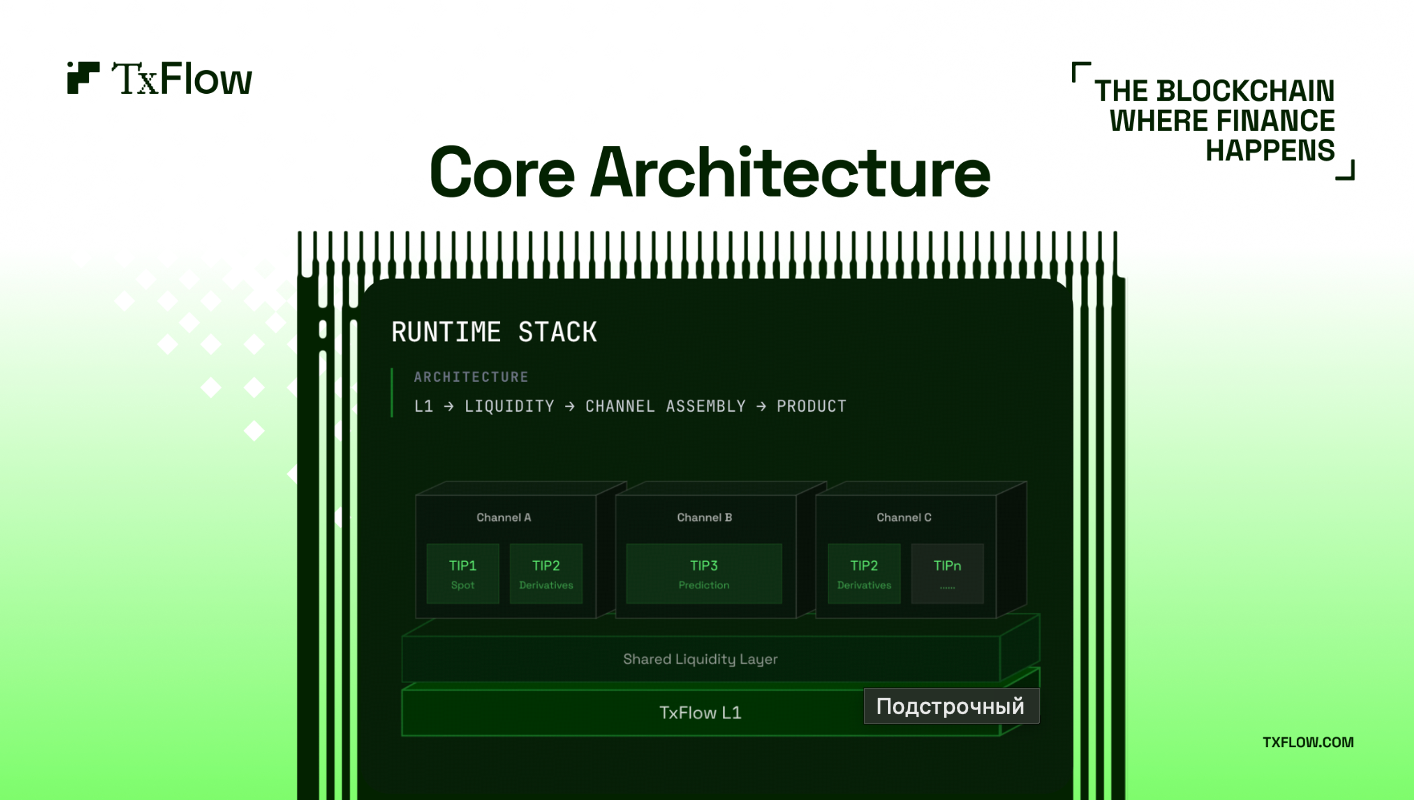
TxFlow L1, the Layer 1 blockchain powering a multi-application onchain financial ecosystem built around its TIP Liquidity Standards, today announced its second Channel: Probly, the first prediction-market application built on TxFlow Improvement Protocol 3 (TIP3).
Following TxFlow DEX—the blockchain’s first application and a central limit order book (CLOB) decentralized exchange for perpetual trading, Probly expands the TxFlow L1 ecosystem into real-time prediction markets. At launch, the platform offers 172 live markets covering more than 7,000 events, including continuously rolling markets with durations as short as five minutes, backed by fully onchain settlement and TxFlow L1’s shared financial infrastructure. The launch marks the next stage in TxFlow L1’s expansion from a network anchored by a flagship onchain exchange into a multi-application financial ecosystem.
TxFlow L1 was designed around a different structure. Through its TxFlow Improvement Protocol standards and Channel architecture, financial applications can operate on the same purpose-built network while connecting to shared execution and settlement infrastructure. Probly extends the ecosystem into prediction markets as the second.
TIP3(TxFlow Improvement Protocol 3) Makes Prediction Markets Native to TxFlow L1
TxFlow Improvement Protocol, or TIP, is the standards framework that defines how financial products are built and connected on TxFlow L1.
Within the framework, TIP1 supports spot markets, TIP2 supports derivatives and TIP3 establishes the standard for prediction-market Channels. TIPn remains open for future products, including real-world assets, structured products and financial instruments that have not yet been developed onchain.

TIP3 defines how prediction-market applications connect to TxFlow L1’s execution, settlement and Shared Liquidity Layer. Rather than operating through an independent infrastructure stack, a TIP3 Channel can build on the same financial foundation supporting the wider TxFlow L1 ecosystem. Its architecture uses DAG-based parallel execution and a multi-threaded processing pipeline, enabling non-conflicting transactions to be processed simultaneously. Market activity and settlement records are executed onchain, providing an open and verifiable system. Probly therefore settles directly on TxFlow L1 instead of relying on a shared general-purpose network or a centralized offchain ledger.
Markets are resolved through designated oracle sources. Automatically resolved price-source markets can settle immediately, while manually adjudicated markets are expected to settle within 24 to 72 hours. Following resolution, eligible settlement amounts are credited automatically in USDC without a separate claim step.
This creates a direct infrastructure advantage for Probly: fully onchain settlement and native connectivity to the broader TxFlow L1 ecosystem.
Probly Brings Real-Time Probability Signals to TxFlow TIP3

Probly comes from “probably”, the word we use when the future is still open. Inspired by P(A), the notation for the probability of an event, Probly turns individual perspectives into a live collective signal: before it happens. At launch, Probly features 172 live event pages across 15 categories, including politics, sports, crypto, finance, geopolitical events. Discovery tools help users explore trending, highly active, fast-moving and soon-to-conclude events, while lightweight polls offer a simple way to engage with topics attracting attention.

Probly also introduces continuously refreshed five-minute, 15-minute, one-hour and four-hour experiences covering BTC, ETH, SOL and XRP price movements. Each page includes live data, a real-time countdown and automatically refreshed rounds, helping users follow changing expectations as events unfold. The platform combines fully onchain infrastructure with a clear, accessible interface designed for both new and experienced users. Probly presents real-time information, probability changes and event timelines in one streamlined experience. Users can access Probly through an email-based embedded wallet without managing a seed phrase, or connect compatible wallets including MetaMask, Coinbase Wallet, Phantom and Uniswap Wallet.
A consolidated account interface provides a clear view of activity, history and ongoing event engagement. Combined with TxFlow L1’s transparent onchain infrastructure and automated resolution process, these features reduce friction from access through completion.
A Different Infrastructure Approach to Prediction Markets
Probly enters a prediction-market category shaped by platforms such as Polymarket and Kalshi, but is built on a different infrastructure model. Probly operates and settles directly on TxFlow L1, a Layer 1 designed for onchain financial applications, bringing real-time probability signals, verifiable onchain records and automatic USDC settlement into one financial stack. Probly extends the same architecture into prediction markets through TIP3.
About Probly
Probly is a prediction market built on TxFlow L1 through TxFlow Improvement Protocol 3 (TIP3). It turns views about future events into continuously updated market signals across sports, crypto, economics, news, culture, weather and other real-world categories.
Probly combines real-time markets, broad event coverage, fully onchain settlement and self-custodied USDC infrastructure. Its mission is to make collective expectations more immediate, transparent and useful by converting uncertainty into a price.
Before It Happens.
About TxFlow L1
TxFlow L1 is a high-performance blockchain built for on-chain financial infrastructure, organized around TIP Liquidity Standards that define how financial products are built, composed, and settled on-chain. TxFlow DEX is the first Channel on TxFlow L1, a CLOB orderbook DEX for perpetual trading, processing over 250,000 TPS with one-block finality. Through its TxFlow Improvement Protocol standards and Channel architecture, TxFlow enables spot markets, derivatives, prediction markets and future financial products to operate on the same chain while connecting to shared execution and settlement infrastructure where all finance happens.
TxFlow L1 is building an open, composable and community-owned financial ecosystem in which each new application can strengthen the infrastructure available to those that follow.
Important Notice
This press release is provided for informational purposes only and does not constitute an offer, solicitation, recommendation or invitation to access or participate in any financial, event-based or prediction-market product.
Probly is available only to eligible users in jurisdictions where access is permitted under applicable law. Product availability, market coverage and functionality may vary by jurisdiction and are subject to applicable terms, eligibility requirements and geographic restrictions.
Participation in prediction markets involves risk, including the possible loss of funds. Market prices reflect participant expectations at a particular time and do not guarantee any outcome. Nothing in this release constitutes financial, investment, trading, legal, tax or any other advice.
The post TxFlow L1 Introduces Probly as Its Second Channel, Marking the Next Stage of Its Multi-Application Ecosystem with Prediction Markets appeared first on BeInCrypto.
Crypto World
VAP Group Unveils VAP Ventures to Back 100 Startups by 2030, Marking Its Next Chapter in Building the Global Innovation Ecosystem

Riyadh, Saudi Arabia | 30 June 2026: VAP Group announced the launch of VAP Ventures, its dedicated investment arm, marking a significant milestone in the company’s evolution from building global platforms for innovation to directly supporting the founders shaping the future of technology.
The announcement was made at the Global AI Show, Global Games Show, and Global Blockchain Show Riyadh 2026, from 29-30 June, where thousands of global industry leaders, innovators, investors and decision-makers have gathered to explore the technologies defining the next decade. The introduction of VAP Ventures represents one of the flagship announcements of this year’s Riyadh editions.
For years, VAP Group’s global stages have brought together founders, enterprises, governments and investors across AI, Web3, blockchain, gaming and emerging technologies. Through VAP Ventures, the company is taking the next step moving beyond creating opportunities for conversations to building the next generation of high-impact startups..
Over the next five years, VAP Ventures will back 100 startups by 2030 building across AI, Web3 & Blockchain, and Digital Games. The initiative reflects VAP Group’s long-term commitment to strengthening the global innovation economy through an integrated ecosystem that combines investment with market access and strategic growth support.
Unlike traditional investment models, VAP Ventures is designed to provide more than funding. Each selected startup will receive a blended support with direct capital alongside access to VAP Group’s media ecosystem, marketing capabilities, talent network and globally recognised event platforms. The objective is to help founders move from early-stage ideas to scalable businesses with the resources needed beyond investment alone.
VAP Ventures will focus on technologies shaping the future of the digital economy, including enterprise AI, Web3 infrastructure, blockchain innovation and next-generation gaming ecosystems. The initiative is strategically aligned with the Kingdom’s vision of fostering innovation, entrepreneurship and knowledge-based industries while supporting globally ambitious founders.
Key Highlights
- 100 startups to be backed by 2030
- Launching from Riyadh, KSA
- Focus sectors: Artificial Intelligence, Web3 & Blockchain, and Digital Games
- Support extending beyond capital to include media, marketing, talent and global stage access
“We gave founders a stage for years. Now we’re backing them. VAP Ventures will invest in more than 100 startups across AI, Web3, and gaming over five years in capital, media, talent, and reach, all under one roof. This is visibility turning into vital support” Vishal Parmar, Founder & CEO, VAP Group.
The launch of VAP Ventures reinforces VAP Group’s broader mission to strengthen the global innovation economy by bringing together capital, media, talent and international platforms under one roof. By expanding from convening innovators to backing them, the company aims to create lasting impact across the startup ecosystem while enabling the next generation of technology companies to grow from the region onto the global stage.
Startups interested in applying to VAP Ventures will be able to submit their details through the dedicated application platform, including company information and pitch materials, as the initiative begins building its inaugural cohort.
About VAP Group
With 13+ years of expertise, VAP Group is a premier global consulting and media powerhouse driving the next wave of technology-led growth.
Through its media ecosystem and flagship events, including the Global AI Show, Global Games Show, and Global Blockchain Show, VAP Group connects policymakers, enterprises, and innovators worldwide, enabling strategic communications, ecosystem-building, and talent solutions.
For more information: https://www.vapgroup.co/vap-ventures/
Media Enquiries:
media@vapgroup.co


The United States Senate returned from its holiday recess on July 13 with one piece of paper waiting on its desk that matters more to crypto markets than any price chart. The Digital Asset Market Clarity Act, the market structure bill the industry has chased for the better part of two years, sits on the Senate Legislative Calendar with no floor vote scheduled, a shrinking window before the August recess, and prediction market odds that have collapsed from the low seventies to roughly 43 percent.
On July 17, the House Financial Services Committee takes the unusual step of holding a field hearing in New York titled Building the Future of Finance: How CLARITY Act Unlocks Innovation. The hearing cannot pass anything. What it can do is force every participant in this fight, from Senate holdouts to ETF issuers to the White House, to show their cards in public during the exact week when the bill’s fate for 2026 gets decided.
Summary
- The CLARITY Act faces a narrowing path to Senate approval before the August recess as prediction market odds of passage have fallen to about 43%.
- A July 17 House hearing is expected to reveal whether lawmakers are moving closer to resolving key disputes that continue to delay the bill.
- Passage could provide a permanent legal framework for digital assets, while further delays may leave crypto markets dependent on macroeconomic factors and existing regulatory guidance.
The stakes are not abstract. Bitcoin trades near $63,000 after months of pressure from a Federal Reserve that markets now expect to raise rates instead of cutting them. Ethereum sits under $1,800. XRP clings to the $1 level it has defended all summer. The total crypto market capitalization hovers around $2.17 trillion, and the Fear and Greed Index has spent weeks in the twenties, deep in fear territory. Against that backdrop, the CLARITY Act has become the one catalyst that does not depend on the Fed, on oil prices, or on the war headlines out of the Middle East. It is the single lever Washington can still pull this year, and the market knows it.
What the bill actually does
The CLARITY Act is a market structure law, not a price support program. Its core function is taxonomy: it draws a statutory line between digital assets that count as commodities, overseen by the Commodity Futures Trading Commission, and those that count as securities, overseen by the Securities and Exchange Commission. For a decade, that line existed only in enforcement actions, court rulings, and agency guidance that shifted with each administration. The bill would replace that patchwork with a durable federal framework covering how tokens are issued, how exchanges register, how custody works, and which regulator answers for which market.
That distinction sounds technical until you consider what currently protects the industry’s legal footing. On March 17, 2026, the SEC and CFTC issued a joint interpretive release that classified 16 digital assets, including Bitcoin, Ethereum, and XRP, as digital commodities. That release did enormous practical work. It handed day-to-day oversight to the CFTC, lifted the threat of unregistered securities treatment from the largest tokens, and cleared the path for the spot ETFs that now trade on all three assets. But an interpretive release is not a statute. A future administration, or even a future commission majority, could withdraw or rewrite it. The CLARITY Act exists to convert that reversible administrative posture into permanent law. For holders of the affected assets, the difference is the difference between renting legal certainty and owning it.
A decade of rule by enforcement
Understanding why the industry treats this bill as existential requires remembering what the alternative looked like. From roughly 2017 through 2024, the primary mechanism of American crypto regulation was the enforcement action. The SEC sued issuers, exchanges, and founders under a securities framework built in 1946 for orange groves, and courts were left to decide, token by token and sale by sale, what the Howey test meant for programmable assets. The results were incoherent by design. The 2023 ruling in the SEC’s case against Ripple found that XRP sold programmatically to retail buyers on public exchanges did not amount to a securities transaction, while institutional sales of the same token did. The same asset was simultaneously a security and not a security depending on who bought it and how.
That ambiguity was not a side effect. It was the operating system. Every project launching in the United States priced in legal risk that its competitors in Zug, Singapore, or Dubai did not carry. Every exchange listing decision ran through outside counsel. Every custodian, market maker, and fund administrator built compliance programs around guidance that could be withdrawn without a vote by anyone. When the administration changed and the agencies pivoted toward accommodation, the pivot proved the point: what one commission gives, another can take. The industry did not spend two years and nine figures of lobbying money on the CLARITY Act because it loves paperwork. It did so because rule by enforcement is rule by whoever runs the agencies, and the 2028 election is already visible on the horizon.
The March 17 interpretive release is the high-water mark of the accommodation era, and it is also its clearest illustration. Sixteen assets received commodity classification through a document that no court ratified and no Congress passed. Institutional allocators read that release two ways at once: as permission to build, and as a reminder that permission can expire. That double reading is why flows into the spot ETFs have been steady but not explosive, and why the legal departments of the largest asset managers keep telling their product teams the same thing: statute or nothing.
The GENIUS Act precedent
There is one recent proof that Washington can finish a crypto bill, and both camps cite it. The GENIUS Act, the federal stablecoin framework, followed a trajectory that looked hopeless at several points: committee fights over yield, bank lobby resistance, procedural stalls, and floor delays. It still became law, and the aftermath reshaped the market. Regulated issuance expanded, banks entered custody and reserve services, and the stablecoin sector grew into the settlement layer that traditional payment companies now build against.
Optimists read GENIUS as the template: contested crypto bills stall loudly and then pass quickly once leadership decides the votes exist. The final weeks of the stablecoin fight looked as bleak as CLARITY’s odds look now, and the lesson traders took away is that legislative prediction markets underprice how fast the Senate can move when it chooses to. Pessimists read the same history differently. GENIUS passed because stablecoins had a natural constituency inside traditional finance: banks and payment networks stood to profit from a regulated dollar token. The CLARITY Act’s beneficiaries are crypto exchanges, token issuers, and asset managers, a smaller and less beloved lobby, while its costs fall on agencies defending turf and on lawmakers wary of blessing an asset class the president trades personally. The precedent proves the mechanism exists. It does not prove the motive does.
How the bill got here
The legislative record explains why expectations ran so hot earlier this year. The House passed H.R. 3633 on July 17, 2025, by a bipartisan vote of 294 to 134, a margin large enough to survive most political weather. The bill then moved to the Senate, where the Banking Committee advanced its version on May 14, 2026, with two Democrats crossing over in a 15 to 9 committee vote. On June 1, a revised Senate text was published and the bill was placed on the Senate Legislative Calendar under General Orders as Calendar No. 423, making it formally eligible for floor consideration. That is the closest a comprehensive crypto market structure bill has ever come to becoming American law.
Momentum then met the calendar. The White House had pushed for the bill to be signed around July 4, a target officials privately conceded was tight. The Senate left for its holiday recess on June 29 without acting, and leadership earmarked the first week back for the defense authorization bill. That sequencing pushes any CLARITY floor vote to late July or the first week of August at the earliest. The Senate’s August recess is not merely a break: once lawmakers scatter for midterm campaigning, the floor schedule effectively closes to contested votes for the rest of the year. Miss August, and the realistic next window is 2027, after an election that could reshape both chambers.
The three fights stalling the vote
The bill is not stuck because senators dislike crypto regulation in principle. It is stuck because three specific disputes have hardened, and each one touches a different fault line in the coalition needed to reach 60 votes.
The first fight is about the president. Democrats have pressed for ethics provisions responding to the Trump family’s crypto ventures, arguing that a market structure law without conflict-of-interest language would bless a sitting president’s personal exposure to the asset class it regulates. Republicans counter that ethics riders are a poison pill designed to peel off GOP votes. Neither side has moved meaningfully, and the dispute consumes negotiating time the calendar no longer offers.
The second fight is about decentralized finance. The Senate Banking and Agriculture committees produced texts that differ on how DeFi protocols should be treated, including whether software developers and front-end operators face registration obligations. Industry groups warn that a badly drawn DeFi section could push development offshore, while consumer advocates argue a carve-out would create a loophole large enough to swallow the rest of the bill. The two committee versions must be reconciled before any floor vote can happen, which makes the reconciliation timeline itself a leading indicator.
The third fight is about stablecoin yield and rewards, the question of whether issuers or platforms can pass interest-like returns to holders. Banks lobbied hard on this point during the GENIUS Act debate and have returned to press it here, viewing yield-bearing stablecoins as direct competition for deposits. Layered on top is a narrower objection around Section 604, a provision opponents have tied to illicit finance and trafficking concerns, which has given undecided senators a politically safe reason to withhold support.
The raw math frames all three disputes. Passage requires 60 votes, which means at least seven Democrats must join a united Republican caucus. The committee stage produced two Democratic crossovers. Finding five more, in an election year, on a bill the White House has loudly claimed as a priority, is the entire game. As crypto.news reported when it examined the bill’s collapsing prediction market odds, traders have concluded that the coalition is fraying precisely when it needs to consolidate. Polymarket pricing on 2026 passage has fallen by more than 20 points from its spring highs to roughly 43 percent.
What July 17 can and cannot change
A field hearing is theater, but theater has uses. The House Financial Services Committee convenes at 10:00 a.m. in New York, the financial capital the bill’s sponsors want as a backdrop, to argue that the CLARITY Act unlocks innovation without gutting user protection. The House already passed its version, so the hearing changes no vote count directly. Its function is pressure: on Senate leadership to schedule floor time, on undecided Democrats facing constituents in the financial industry, and on the news cycle during the exact week the Senate decides what its July looks like.
The hearing also carries information value for markets. Witnesses and members will signal, intentionally or not, whether the reconciliation between the Banking and Agriculture texts is progressing, whether the Section 604 objection is being negotiated or entrenched, and whether leadership views the bill as a July priority or an August casualty. Traders who watched the GENIUS Act stablecoin bill move from stalled to signed in a matter of weeks last year know that these procedural signals move faster than the price charts that eventually reflect them.
What the hearing cannot do is manufacture seven Democratic votes, compress the defense bill’s floor time, or reopen a calendar that has perhaps three working weeks left before the recess. The gap between what the hearing dramatizes and what the Senate can physically schedule is exactly where the 43 percent number lives.
The bull case: what passage unlocks
If the Senate finds the votes before August, the payoff structure is unusually well documented. Standard Chartered projects between $4 billion and $8 billion in inflows to spot XRP exchange-traded funds alone if the bill becomes law, on top of the roughly $1.5 billion those products attracted between their November 2025 launches and mid-2026. The logic extends across the asset class: wirehouses, registered investment advisors, and pension consultants that currently limit crypto allocations because the regulatory perimeter could shift under a future SEC have their stated objection removed by statute. Permanence, not classification, is the product being sold.
For XRP, the effect is sharpest because the token spent five years under a securities cloud that the March interpretive release only partially dispersed. For Ethereum, the bill would lock in the treatment of staking and the yield its ETFs can pass through, a question the current guidance answers only provisionally. For Bitcoin, the gain is structural: a full market framework around custody, exchange registration, and market surveillance that institutional compliance departments can cite. Each asset gets something different, and each gets it permanently.
There is also a second-order effect on the legislative pipeline. A market structure law would arrive with the exemption architecture the SEC has been building in parallel, including the small-offering relief the agency has floated for token projects. Passage would signal that the United States intends to compete with the European Union’s MiCA framework for issuer domicile, a competition Washington has been losing by forfeit while regulation advanced faster in Brussels, London, and Singapore.
Who is actually waiting on this law
The abstraction of “institutional adoption” hides a specific queue of actors whose next move is conditioned on statute. Start with the wirehouses and the registered investment advisor platforms that gatekeep several trillion dollars of American retail wealth. Most still restrict crypto ETF access to unsolicited orders or exclude the products from model portfolios entirely, and their compliance memos cite regulatory uncertainty as the controlling reason. A statutory framework removes the stated objection. It does not force allocation, but it converts a prohibited conversation into a permitted one, and distribution decisions at that scale move billions before a single risk committee turns bullish.
Next in the queue are the corporate and treasury buyers. The digital asset treasury wave that put Bitcoin and Ethereum on public company balance sheets ran ahead of the law, and the firms that followed the pioneers now face auditors and insurers who price legal ambiguity into every engagement. Statutory classification simplifies the accounting treatment, the custody insurance, and the board approval process at once. Behind them stand the banks, which under current guidance can custody digital commodities but plan product roadmaps in pencil, knowing the guidance could rotate with the next administration.
Then there is the international dimension. The European Union’s MiCA regime is operational, and Ripple’s full authorization in Luxembourg this month showed how quickly firms redomicile compliance functions toward whichever jurisdiction offers durable rules. The United Kingdom opened its market to global crypto trading platforms this summer, and Singapore’s central bank has tested settlement on public ledgers. Every quarter the Senate delays, the coordination game tilts toward frameworks that already exist. American exchanges have been explicit that listing decisions, product launches, and headquarters questions all key off the August window. The bill’s supporters call this competitive urgency. Its opponents call it hostage-taking. Both descriptions point at the same calendar.
The macro tape the vote lands on
Whatever the Senate does, it does it into the most hostile macro environment crypto has faced since 2022. Inflation has returned to a three-year high, and futures markets have flipped from pricing Federal Reserve cuts to pricing a possible hike, a reversal that drained risk appetite across every speculative asset class. The Iran conflict adds an oil transmission channel: each escalation around the Strait of Hormuz pushes crude higher, feeds the inflation print, and hardens the Fed’s posture, a loop that has repeatedly knocked Bitcoin down toward $60,000 and dragged the rest of the market with it.
That context cuts both ways for the bill. On one hand, a hostile tape means even a successful vote may produce a smaller rally than advocates expect, because the marginal buyer is pinned down by rates rather than by regulatory doubt. On the other hand, the fear regime means positioning is light, sentiment indicators sit near capitulation levels, and the market has almost nothing crypto-specific priced for good news. Catalysts landing on empty positioning historically produce outsized moves. The honest answer is that nobody knows which effect dominates, which is precisely why the prediction market on the bill and the spot market on the assets have decoupled: one prices probability, the other prices exhaustion.
The bear case: priced in, timed out
The skeptical read starts with the same 43 percent number and draws the opposite conclusion. Prediction markets are not always right, but they aggregate the private assessments of people paid to count votes, and the direction of travel since spring has been relentlessly downward. If the bill misses the August recess, the midterm campaign consumes the fall, and a lame-duck session is a poor venue for a 60-vote financial regulation bill. The realistic slip is not to September but to 2027, under a Congress whose composition nobody can guarantee.
The second bear argument is that much of the good news is already in prices. XRP ETFs launched and gathered $1.5 billion without the law. Bitcoin and Ethereum ETFs trade freely. The March interpretive release already delivers, day to day, most of what the statute would make permanent. On this view, passage buys a relief rally in the most exposed assets and little more, while failure removes a hope premium that has quietly supported prices through an otherwise brutal first half. The asymmetry may actually run downward: markets have partially priced success and only partially priced the multi-year delay that failure implies.
The third argument is macro. The Fed’s turn toward higher-for-longer rates, inflation at a three-year high, and the oil shock risk from the Iran conflict have overwhelmed every crypto-specific catalyst this year. Ripple’s MiCA authorization, sustained ETF inflows, and whale accumulation did not move XRP off its $1 floor. If unambiguous bullish flows cannot move prices in this tape, a Senate vote may not either, at least not durably. Legislation changes the demand curve over quarters, not the fear index over days.
Three scenarios, three tapes
Mapping the legislative outcomes to market behavior produces three broad paths. In the first, the reconciled text reaches the floor in late July, clears 60 votes, and heads to a signature before the recess. The most exposed assets reprice first: XRP, where Standard Chartered’s flow projection concentrates, then Ethereum on the staking permanence question, then the exchange equities and the broader altcoin complex. The move’s durability would depend on whether the Fed backdrop allows follow-through, but the initial repricing of a 43 percent probability resolving to 100 would be mechanical and fast.
In the second scenario, the vote is scheduled but fails or gets pulled for lack of support. This is the worst path, and the least priced. A failed floor vote does not merely delay the bill; it marks the coalition as broken and invites every opponent to treat the 2027 rewrite as an open negotiation. The hope premium embedded in current prices, modest as it is, would come out quickly, and the assets most dependent on the regulatory story would give back their relative strength against Bitcoin.
In the third and most likely scenario given current odds, no vote is scheduled and the bill simply slips past the recess without a formal death. Markets have partially priced this, which is why the reaction would likely be a grind lower rather than a crash: a slow removal of the catalyst from the front of the calendar, with attention rotating fully back to the Fed, oil, and the midterm map. The under-appreciated risk in this path is duration. A slip is not a pause; it is a handoff to a Congress that does not exist yet, elected in a cycle where crypto money is spending heavily on both sides and the issue itself is on the ballot in a dozen Senate races.
The scoreboard through August
Between July 14 and the recess, the outcome reduces to a short list of observable events, in rough order of importance. First, whether Senate leadership schedules a floor vote at all: the absence of scheduled time by the last full week of July would be the clearest sell signal on 2026 passage. Second, whether the Banking and Agriculture reconciliation produces a single merged text, since no floor vote can precede it. Third, whether any additional Democrats declare support publicly, because the distance between two crossovers and seven is the entire outstanding question. Fourth, how the Section 604 and stablecoin yield objections resolve, since each represents a bloc of gettable votes. And fifth, the tone of the July 17 hearing itself, which will reveal whether the House majority treats the bill as pending business or as a campaign message.
For traders, the cleanest expression of the setup is the gap between the legislative calendar and the price action. XRP holds $1 with roughly 43 percent odds of its defining catalyst arriving this year. Bitcoin consolidates above $62,000 with the same binary in the background. If the vote lands, the market gets its first statutory foundation and a documented multi-billion dollar flow pipeline. If it slips, crypto spends the midterm season trading purely on the Fed and on war headlines, with its Washington story frozen at the committee stage. Few single weeks this year have carried as much of that decision as the one that starts with the New York hearing.
The honest framing is conditional on both sides. The CLARITY Act is neither the guaranteed rocket fuel its loudest advocates promise nor the irrelevant paperwork its critics describe. It is a genuine structural upgrade with a genuine risk of missing its window, and the distribution of outcomes narrows to a decision point over the next three weeks. Markets spend most of their time waiting. This is one of the rare stretches where the waiting ends on a schedule.
Disclaimer: This article is information, not investment advice. Legislative timelines, prediction market odds, prices, and analyst projections reflect reporting available as of July 14, 2026, and can change quickly. The status and prospects of the CLARITY Act are uncertain and contested. Nothing here is a recommendation to buy or sell any digital asset. Verify current developments from primary sources and consider your own circumstances before making any decision.

Coinbase says it has moved far beyond early experiments with artificial intelligence, with executives describing AI as now being deeply embedded in how the exchange builds and tests software. In the wake of a May workforce reduction, the company’s leaders pointed to AI as a central reason it has been able to speed up development and reorganize teams.
According to Coinbase executives, more than 95% of the company’s code is now written by or with large language models (LLMs). That figure marks a sharp jump from an earlier estimate Coinbase shared in February, when it said AI supported about 40% of its code.
Key takeaways
- Coinbase reports that between 95% and 100% of its code is written by or with LLMs, according to platform chief Rob Witoff.
- The company links its May layoffs to a need to restore the “speed and focus” of its startup-era operations, placing AI at the core.
- Witoff describes a “wide spectrum” of AI usage—from human-led work on core cryptography to fully automated prototyping.
- Coinbase says smaller, senior teams can handle work that previously required far larger groups, with AI agents running continuously.
From “helping” to “writing”: Coinbase’s evolving AI role
Coinbase cut roughly 14% of its workforce in May, laying off about 700 employees. In an email to staff, CEO Brian Armstrong said the company needed to “return to the speed and focus of our startup founding, with AI at our core,” framing AI as a major shift in how work moves.
Speaking to Cointelegraph, Coinbase’s head of platform, Rob Witoff, said the company has reached a state where AI is used on an everyday basis. “Effectively, 100% of our employees are using AI on a daily basis,” Witoff said. He added that “close to 100% of our code” is written by or with LLMs—“probably somewhere between 95% and 100%.”
The size of that jump matters because it signals how quickly AI adoption has progressed within crypto infrastructure, not just as a productivity tool but as part of the coding workflow. Coinbase’s earlier February estimate—AI supporting around 40% of its code—suggests a rapid acceleration in how the exchange operationalizes AI in engineering.
Human oversight stays central for high-stakes cryptography
Even with such high automation claims, Witoff emphasized that Coinbase’s use of AI isn’t uniform across all parts of its stack. He described a “wide spectrum” in the way AI is deployed, depending on risk and complexity.
“For example, when we’re writing core cryptography, we have industry-leading cryptographers that are meticulously researching and reviewing one line at a time.”
In other areas, AI plays a different role. Witoff said AI is used heavily to test and verify that code behaves correctly and to help check for vulnerabilities. However, he portrayed this work as still requiring more manual oversight than the prototyping pipeline.
“We’re using AI quite a bit to test and make sure the code we’ve written is working the way it should, there’s no vulnerabilities, we’re verifying the math,” Witoff said, adding that this verification process remains more hands-on. By contrast, he said internal prototyping is now “effectively a 100% automated” workflow.
For builders and investors watching how AI reshapes crypto companies, this distinction is important: the move toward AI-driven development appears strongest in low-to-medium risk areas like prototyping and iteration, while core security work remains tightly supervised by specialized experts.
Smaller teams, more senior judgment—and the “agent” layer
Coinbase also linked its AI-driven coding changes to a reorganization of how teams are structured. Witoff said the company has been able to move toward smaller, more senior groups, where two or three employees can handle work that previously required 10 or more people.
He noted that the May layoffs disproportionately affected junior roles, describing “a lot of junior development roles” among those impacted. While engineering saw major changes, he also said cuts extended beyond developer functions, including positions in marketing, legal, customer support, and compliance.
“For those smaller teams to work, for people to have the taste, the judgment, I think a lot about people having the battle scars so they know how to point agents in the right direction.”
The “agent” concept is a key part of the operational picture. Witoff said most Coinbase engineers now work with five to 10 AI agents running at any given time, and that these agents collectively perform coding work equivalent to about 1,200 employees.
Looking further ahead, Witoff suggested that by 2030 AI agents could do the equivalent work of 100,000 employees. While such projections are inherently speculative, the company’s internal framing underscores a broader industry belief: once AI agents are integrated into development processes, the bottleneck shifts from generating code to steering systems responsibly and validating outcomes—especially where security and correctness are non-negotiable.
AI-led restructuring is spreading across crypto
Coinbase’s story fits into a wider pattern seen across the sector this year, where multiple crypto firms cited AI-driven efficiency as they rebalanced headcount.
In March, crypto exchange Crypto.com cut about 12% of staff, according to Cointelegraph reporting, affecting roles that “do not adapt in our new world.” Earlier, Block CEO Jack Dorsey said he was cutting about 40% of the company’s workforce, describing AI-enabled changes to how companies build and operate.
Other crypto organizations mentioned in the same broader wave include Kraken, Gemini, Messari, and Dune, each of which has been reported to have adjusted staffing in part as they increased AI use.
For market participants, this matters beyond workforce headlines. When exchanges and crypto services reduce layers of staffing while increasing reliance on AI-driven workflows, it can change how quickly they ship product, how they manage operational risk, and how they allocate resources between core engineering and support functions.
There is still an open question for readers: how sustainable and measurable these gains are over time, especially for the parts of the stack that require specialized security review. Coinbase’s next signal will likely be whether its AI-heavy approach continues to hold up under stress—whether in scaling performance, minimizing vulnerabilities, or maintaining reliability as token and user activity grows.
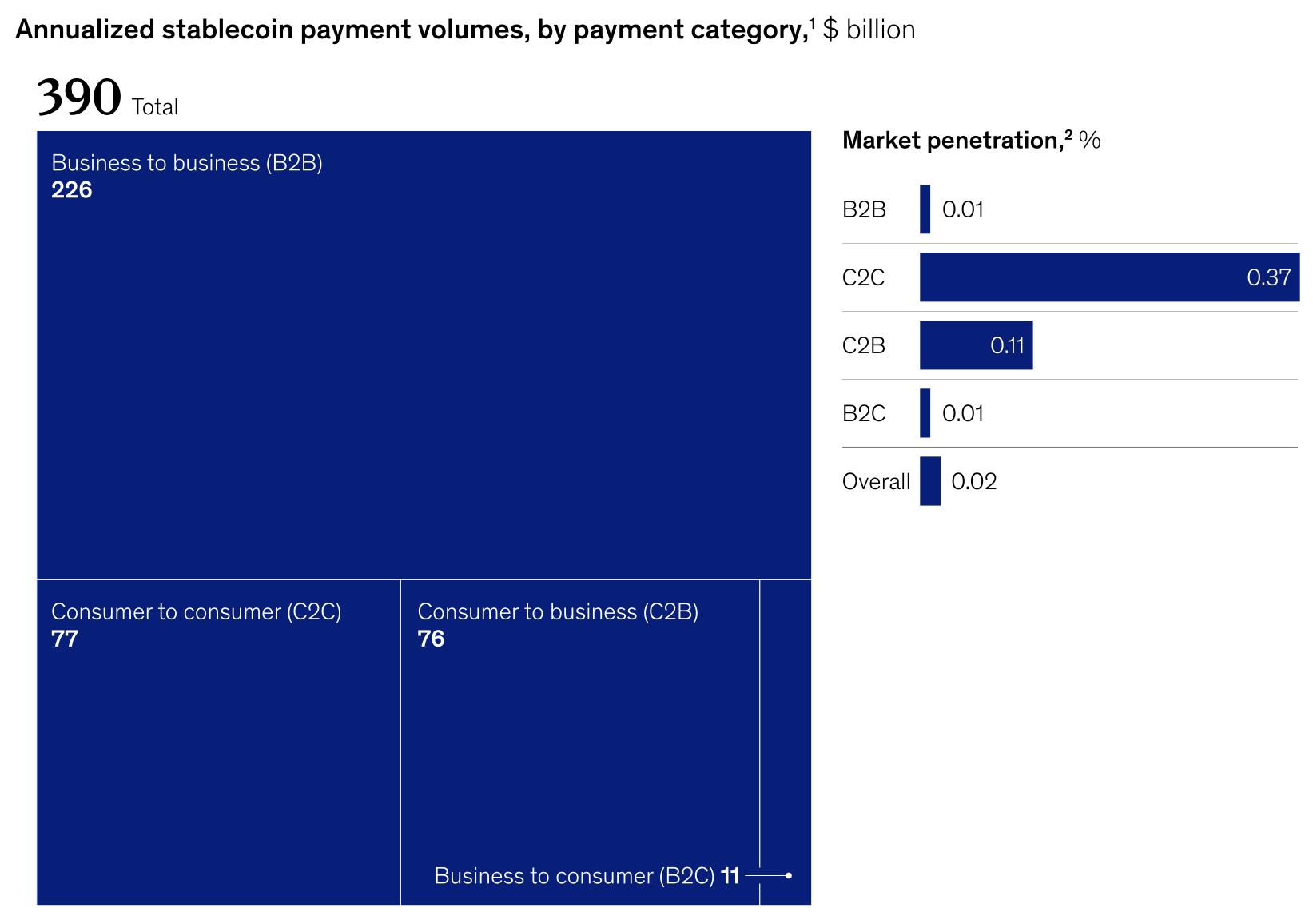
Stablecoin treasury platform Velocity has raised $38 million in a Series A funding round to expand infrastructure that helps enterprises and financial institutions use stablecoins for cross-border settlement and treasury operations.
The funding round was led by Dragonfly and FirstMark, with participation from Activant Capital, Capital One Ventures, QED Investors, Coinbase Ventures, Wintermute Ventures and Ripple. Velocity said it plans to use the capital to expand its banking and payments network, develop new products and strengthen its regulatory capabilities.
Founded in 2025, Velocity develops software that connects stablecoin networks with banking, custody, compliance and settlement systems. The company targets enterprise finance teams, payment providers, fintech firms and financial institutions using stablecoins for cross-border payments and treasury operations.
The latest financing brings Velocity’s total funding to nearly $50 million since it launched in 2025, according to the company.
Related: JCB signs Circle MOU to test stablecoin payments in Japan
The funding comes as competition in the enterprise stablecoin market intensifies. In June, more than 140 companies backed the launch of Open USD (OUSD), a dollar-pegged stablecoin supported by companies including Visa, Mastercard, Coinbase and Ripple.
Stablecoin infrastructure investment accelerates
Investment in stablecoin infrastructure has accelerated this year as companies build the software and network infrastructure supporting payments, settlement and enterprise financial services.
In March, Tether participated in a $5.2 million funding round for Ark Labs, a startup building infrastructure for stablecoin issuance and settlement on Bitcoin. The company is developing a programmable execution layer to enable faster payments and more complex financial applications on the network.
Later that month, OpenFX raised $94 million in a Series A funding round to expand its stablecoin-based foreign exchange network, which is designed to speed up cross-border payments for businesses. The company said it would use the capital to expand into Southeast Asia and Latin America while increasing liquidity across its network.
Trace Finance secured $32 million the following month to expand its cross-border payment infrastructure, which combines banking, foreign exchange and stablecoin settlement services for businesses operating across multiple markets.
The investments come as stablecoin payments continue to expand. A joint analysis by McKinsey and Artemis Analytics estimated that stablecoins processed $390 billion in annualized real-world payments in 2025, including about $226 billion in business-to-business transactions.
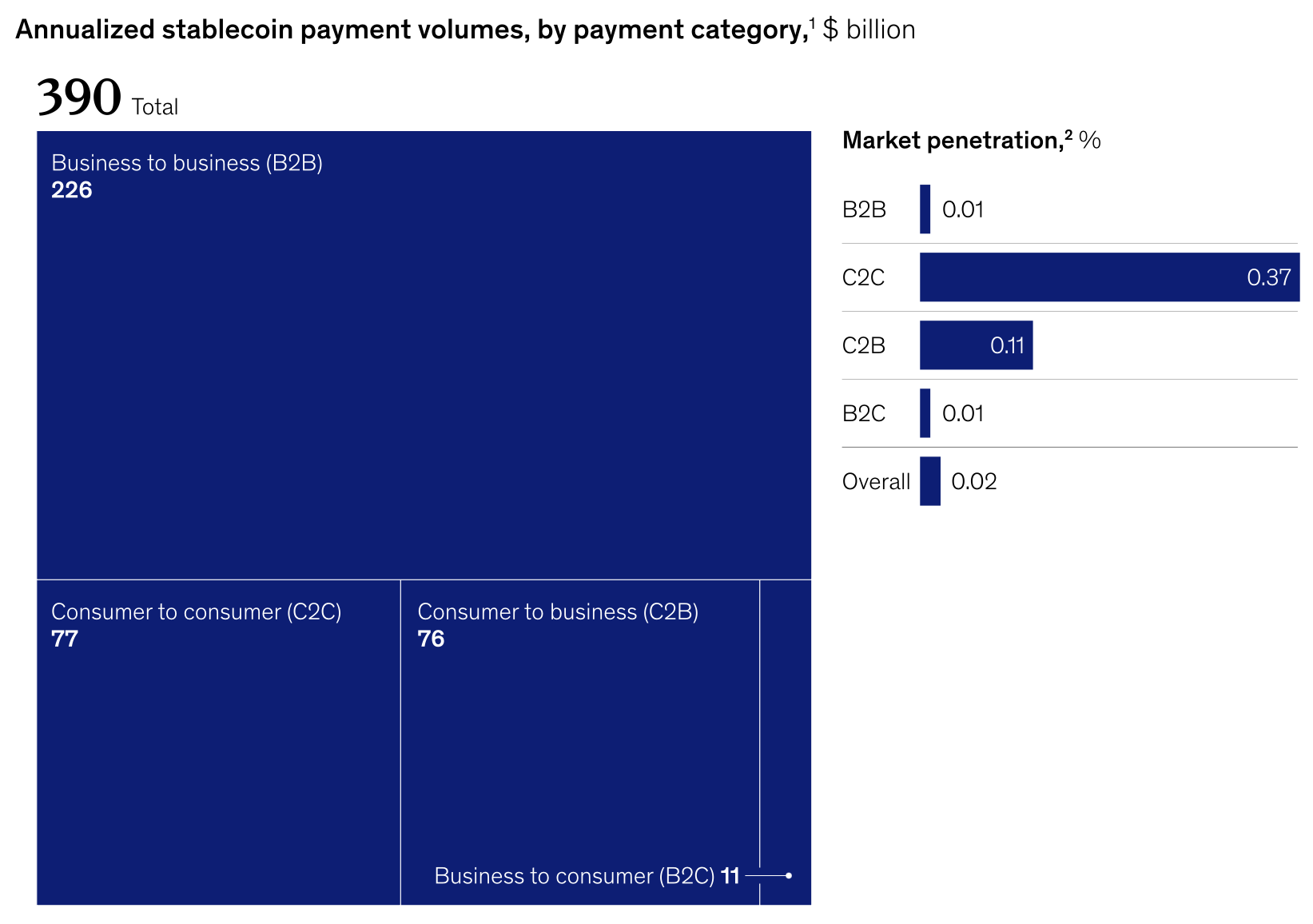
Annualized real-world stablecoin payment volume by use case. Source: McKinsey, Artemis Analytics
Magazine: UK government defers capital gains on certain crypto with ‘no gain, no loss’ approach

XRP ABOUT TO EXPLODE – VANGUARD’S NEXT MOVE REVEALED! – RUSSIA IS READY!

Bedford train crash driver died of ‘traumatic injuries’, inquest hears
China Q2 GDP disappoints as sluggish domestic demand offsets exports boost

No Jackpot Winner as $257 Million Prize Rolls Over to $269 Million Monday Draw

Renter of Home in Anne Heche Crash Denies Settlement With Son

Weekend Open Thread: Staud – Corporette.com
XRP ABOUT TO EXPLODE – VANGUARD’S NEXT MOVE REVEALED! – RUSSIA IS READY!

Why Should I Save Money? | Save, Spend, Share | Financial Literacy For Kids | Piggy Bank | EMoMee

“The XRP Price Bottom Is In” Insane Ripple Price Prediction We Could See A Mega Rebound In Price
-

 Fashion6 days ago
Loro Piana Fall 2026 Enters Houston’s Art Scene
-

 Fashion4 days ago
Weekend Open Thread: Nutriplenish Leave-In Conditioner
-
 Sports5 days ago
2026 Genesis Scottish Open Thursday TV coverage: Round 1
-

 Tech7 days ago
Anthropic brings Claude Cowork to mobile and web as usage data shows most users aren’t coding
-

 Sports5 days ago
Super Eagles star Moses Simon opens up on Liverpool transfer regret
-

 Tech6 days ago
Character.AI enters the microdrama arena with its own productions, but there’s a twist
-

 News Videos7 hours ago
XRP BOMBSHELL… XRP OMBOARDED FOR TRANSACTIONS!!!
-

 Tech21 hours ago
Get Your ESP32 Sunny Side Up With This Solar Dev Board
-

 Tech6 hours ago
Dark Secrets Emerge When Jailbreaking LLMs
-

 News Videos6 days ago
Crypto Just Entered Its Most Important 6-Month Candle (Could Decide Everything!)
-
 Business7 days ago
ASX 200 Slides Over 0.6% as Rare Earths and Lithium Stocks Tumble Amid Global Semiconductor Sell-Off Today
-
 NewsBeat6 days ago
Major update after Huntingdon train attack as man enters plea
-
 Business7 days ago
Will Trent shares rebound after Q1 update triggers 13% crash? Here’s what technical charts indicate
-

 News Videos1 day ago
how to make coin bank box with cardboard #scienceproject #money #diy #shorts
-

 Business7 days ago
SpaceX Shares Slide Nearly 6% Amid Post-IPO Volatility and Starship Test Focus
-

 Sports6 days ago
39-year-old Djokovic wins five-hour thriller to enter Wimbledon semis | Other Sports News
-

 Tech6 days ago
Level Infinite Launches Gangstar Mirage City in India with Pre-Registrations
-
 Tech1 day ago
Cloudflare Precursor Watches Your Mouse and Keyboard To Decide If You Are Human
-

 Tech6 days ago
Entra passkey enrollment vishing targets Microsoft 365 users
-
 Crypto World6 days ago
DeFi Dashboard Zapper to Shut Down After 7 Years
You must be logged in to post a comment Login