
Crypto World
Axelar Disables Secret Network Bridge Routes Amid $4.7 Million Security Breach


A security incident led to the loss of about $4.7 million worth of assets on the Axelar cross-chain interoperability protocol, which has since shut down its bridge functionality with the Secret Network.
Exploit Traced to Secret Network’s ICS-20 Smart Contract
The hacker exploited assets being moved from the Axelar network to the Secret network via the Cosmos IBC (Inter-Blockchain Communication) protocol, according to Axelar. Initial findings indicate that the vulnerability was not in Axelar’s core infrastructure, but instead in the Secret-side ICS-20 smart contract that is managing IBC transfers between the two networks.
For the incident, Axelar’s emergency committee closed down the connections of the Secret and Secret-SNIP bridge to prevent further losses and contain the attack. The protocol also confirmed that it has engaged relevant cryptocurrency exchanges and relevant authorities in its investigation.
The Secret Network is a blockchain that supports privacy and allows data associated with transactions to be encrypted, but not lose the ability to verify on-chain execution of smart contracts. The network has been used to create private cross-chain applications, such as confidential decentralized finance (DeFi) services, privacy-preserving NFT transactions, and anonymous governance mechanisms, among other applications.
Axelar Says Exploit Was Limited to Bridged Assets
According to Axelar, the attack seems to be confined to funds that were transferred to the Secret Network from the Axelar network. There is no evidence so far that any Secret-native assets have been compromised, nor any other IBC connections, nor any additional Axelar integrations, the company said.
The protocol stressed that its wide network was not compromised during the event. The issue is thought to be limited to the Secret-side contract that handles inbound transfers to the Secret ecosystem from Axelar.
Bridge routes in the affected area will continue to be closed until the attack vector has been investigated in detail and the extent of the damage assessed. Once it has finished its investigation, Axelar will be publishing a detailed post-mortem report, the company said.
The attack is part of a number of recent security incidents targeting cryptocurrency infrastructure projects in the past few weeks.
Earlier this month, Humanity Protocol announced its recovery efforts after it suffered an exploit on June 8, which prompted the project to withdraw its original H token from Ethereum, BNB Chain, and Humanity Mainnet. Those affected will be able to receive a replacement token in the form of an “airdrop” based on a new and audited ERC-20 contract deployed on the Ethereum network, the company stated.
Humanity Protocol said the attack occurred due to stolen credentials and noted that there was no breach to the token contracts, bridge infrastructure, or Safe wallet setup.
Binance Research Highlights Growing Security Pressures
Other operational implications have resulted from security incidents. This week, crypto payments platform Pyra announced that it would end its operations after it decided that it could not recover from the losses it suffered due to the Drift exploit.
In this context, Axelar’s attention is now on finding out how the attack was carried out and how to limit the spread of the Secret Network exploit. As of now, the company said, there is no evidence that other parts of the Axelar ecosystem were affected.
The latest hack follows a series of other attacks on DeFi that have been driven by increasing security concerns. Binance Research recently estimated that the amount of funds stolen through DeFi exploits across the sector during April resulted in nearly $13 billion of total value locked (TVL) outflows in the sector.
The on-chain leverage ratio also increased to approximately 38%, which is around the same time since the 2021 downturn, when TVL started to contract more than borrowing.
Market participants will be keenly observing Axelar as investigations proceed to see if the company will provide a final verdict and take any action to enhance the security of cross-chain infrastructure.

Crypto World
Bitcoin Price Tumbles to 2-Week Low as Fed and BoJ Keep Rates Unchanged: Weekly Crypto Recap
It was a very eventful week in terms of economic activity, with most of the focus turned to the Wednesday conclusion of the second FOMC meeting under new Fed Chair Kevin Warsh.
But before we head into the details of the central bank’s decision, let’s explore what transpired prior to that. Last week, the US CPI numbers came out, and inflation data was actually a lot better than many expected. BTC went on a rally after that, peaking at $67,000, where it was rejected but still managed to close the week at around $64,000.
It regained some traction on Monday after the de-escalation news on the Middle East front. The cryptocurrency jumped past $65,000 and touched $65,600 on a couple of occasions. However, the predominantly bearish sentiment was too strong, and the asset dumped below $63,000 a day later.
The bulls managed to intervene and didn’t allow another immediate leg down. Instead, BTC started to regain traction after the United States Federal Reserve kept the rates unchanged. The asset challenged $65,500 once again on Friday morning. However, a familiar end-of-the-week scenario repeated, and the cryptocurrency was rejected even after the Bank of Japan followed the Fed’s example and maintained the rates.
The subsequent leg down has been quite painful, with BTC sliding below $62,500 minutes ago for the first time in over two weeks. Some altcoins have it even worse, with RAIN plummeting by double digits, while ZEC, XLM, and HYPE are down by up to 8%.
Market Data
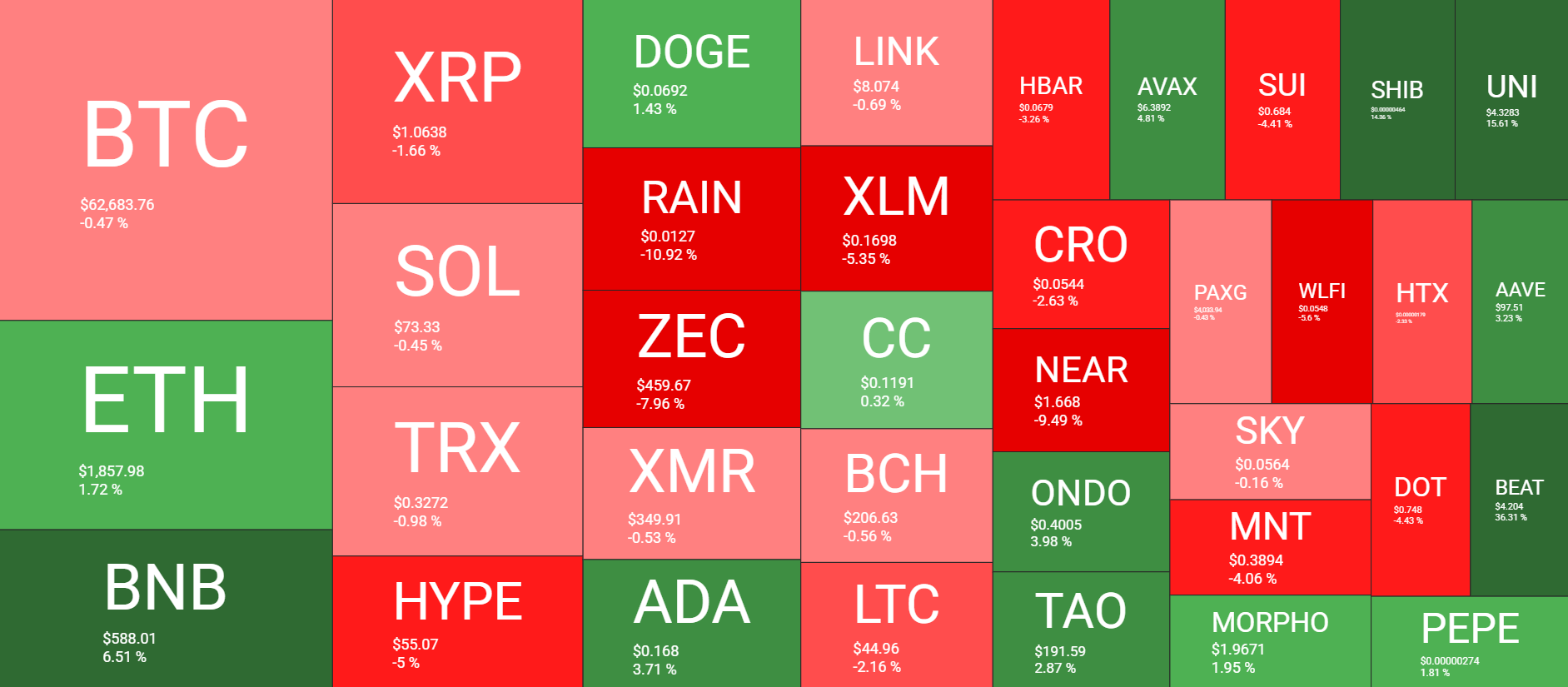
Market Cap: $2.275T | 24H Vol: $60B | BTC Dominance: 55.3%
BTC: $62,700 (-0.5%) | ETH: $1,858 (+1.7%) | XRP: $1.06 (-1.7%)
This Week’s Crypto Headlines You Can’t Miss
New York Sues Kalshi as Legal Pressure on Prediction Markets Intensifies. In a major development from earlier today, New York Governor Kathy Hochul and Attorney General Leticia James filed a lawsuit against Kalshi, arguing that it operates illegal gambling products without the proper license in the state.
A Rocky Year: Ethereum Turns 11 Years as ETH Trades 61% Below the High Set Last August. Ethereum celebrated its 11th birthday on July 30. In this article, we explore the good and bad over the past few years, including some controversial developments around the blockchain and the foundation behind it.
Bitcoin’s Next Bull Run Could Follow US Midterms: Analyst. US Midterm election years are not favorable for bitcoin historically. One analyst claimed that once they are over, BTC’s major rally could finally commence. Another analyst outlined a major price prediction, indicating that the cryptocurrency can peak at somewhere around $400,000 per unit within less than two years.
‘OC’ Actor Ben McKenzie Urges Congress to Block CLARITY Act Over Trump Ties. The CLARITY Act remains one of the most discussed topics within the cryptocurrency community and in Washington. In a surprising development from the past week, OC actor Ben McKenzie argued that the bill should be blocked over its potential aid to Trump and his family.
Circle’s IBM Patent Deal Brings Nearly 1,000 Blockchain Patents. The company behind the second-largest stablecoin said it had expanded its blockchain patent portfolio by purchasing nearly 1,000 such patents from IBM. This includes more than 680 patent families and nearly 1,000 issued worldwide, covering core blockchain tech, banking, financial services, and insurance.
Saylor’s Strategy Keeps Rebuilding Its Cash Pile, Putting Bitcoin Buys on Hold. The world’s largest corporate holder of BTC has continued its BTC purchase pause for a fifth consecutive week. Instead, Strategy keeps growing its USD reserve. Another $525 million injection brought the total USD stash to $3.75 billion, enough to cover 2.1 years of dividend payments.
Charts
This week, we have a chart analysis of Ethereum, Ripple, Cardano, Binance Coin, and Hyperliquid – click here for the complete price analysis.
The post Bitcoin Price Tumbles to 2-Week Low as Fed and BoJ Keep Rates Unchanged: Weekly Crypto Recap appeared first on CryptoPotato.


Circle Internet Group, Inc. (CRCL), the issuer of USDC, the world’s second-largest stablecoin, announced Friday that it secured a limited purpose trust charter from the New York Department of Financial Services (NYDFS).
The trust charter is an official state banking authorization that allows the holder to legally provide fiduciary, custody and asset-management services under the New York Banking Law.
“Earning a New York trust charter has been a longstanding objective for Circle given the regulatory clarity that comes with it,” said Jeremy Allaire, Co-Founder, Chairman, and CEO of Circle.
Circle’s stock price remains flat Friday morning at $64.24 and its stablecoin USDC has a market capitalization exceeding $71.8 billion.
Earlier this month, Circle received approval from the U.S. Office of the Comptroller of the Currency (OCC) to establish a national trust bank.
National trust banks are authorized to provide users with custody and fiduciary services but do not accept consumer deposits or make loans like traditional commercial banks.
The stablecoin issuer said the national bank would “enhance the safety and regulatory oversight of the USDC Reserve, while enabling Circle to offer fiduciary digital asset custody and related services to institutional customers.”
Crypto World
What Jean Grey's Debut in Spider-Man: Brand New Day Means for the Future of the X-Men in the MCU


Warning: Spoilers ahead for Spider-Man: Brand New Day
The Dark Phoenix will rise again. Probably. Eventually.
A new version of Jean Grey made her debut in Spider-Man: Brand New Day. Stranger Things’ Sadie Sink follows in the footsteps of Famke Janssen and Sophie Turner as the redheaded telepath who is arguably the most powerful mutant in the Marvel comics. But the Jean that Peter Parker (Tom Holland) meets is just a lonely teenager who can’t fully control her powers. She presumably won’t learn how until she meets Professor Charles Xavier and the other mutants at his school. Those X-Men are coming to the Marvel Cinematic Universe with a new cast in the iconic roles. It’s just going to take a few more years.
Disney acquired 21st Century Fox way back in 2019, and Marvel fans have been waiting ever since for Magneto, Storm, and Cyclops fighting alongside the Avengers. There have been hints of what is to come: Ms. Marvel carries the X-gene, the fabled marker of a mutant. And the Deadpool & Wolverine movie was the first X-Men movie set inside the MCU. But Marvel Studios head Kevin Feige has long promised something more deliberate, a dedicated series of X-Men movies and a “reset” of the stories that came before.
Jean appears to be the first character in that reset, which is confusing because the old versions of various X-Men characters are still here. Ian McKellen’s Magneto, Patrick Stewart’s Professor X, and James Marsden’s Cyclops all turn up in Avengers: Doomsday later this year. Whether they survive it is another question, and the odds don’t look good. Here’s what Jean’s introduction tells us about how Marvel plans to get from one set of X-Men to the other.

How is Jean Grey introduced in Spider-Man: Brand New Day?
Jean is the misunderstood villain of the latest Spider-Man movie. She uses mind control to break into the Department of Damage Control, the government body originally created to clear the rubble after the fight in the first Avengers movie and since expanded into something closer to SHIELD, charged with safeguarding the public. Its head, Bill Metzger (Tramell Tillman), has a private agenda: he wants to contain superpowered beings and take their abilities. He kidnaps Jean’s sister Sarah, also a telepath, and performs experiments on her. Jean tries to save her, but arrives too late.
The movie draws a parallel between Jean Grey and Peter Parker. Both are isolated. Both see their powers evolve. (We even get hints of the destructive emotions in Jean that could eventually manifest in her alter-ego Dark Phoenix.) Peter talks Jean out of killing Metzger and encourages her to find friends who can embrace her for who she is rather than shame her for being different. At the end of the movie, she boards a bus out of New York. Somewhere ahead of her is the found family at Professor X’s school.
For now, Jean is the only future X-Man we know of in Peter’s timeline. That distinction matters, because the MCU has spent years establishing that variants of the same hero exist across parallel timelines. Bruce Banner and the Ancient One lay out the branching rules in Avengers: Endgame. Loki built an entire series around the TVA, the bureaucracy tasked with policing different timeline branches. And in Deadpool & Wolverine, Deadpool shops across timelines for a Wolverine variant willing to help him save his universe. The Jean Grey played by Janssen, along with Cyclops (Marsden), Magneto (McKellen), and Storm (Halle Berry), live in one of those other timelines.

How do the events of Spider-Man: Brand New Day set up an X-Men film?
In Brand New Day, Peter’s actions may set in motion a major conflict between mutants and the government. Peter begins to develop new abilities thanks to a spike in arachnid hormones. At first, he can’t control his new powers; they make him stronger but also more angry. In an effort to return to “normal,” Peter visits Bruce Banner, a.k.a. The Hulk, who has invented a gamma radiation inhibitor to prevent himself from turning into “the big green guy.” Peter suggests that he could adapt the technology to target specific genes, preserving his “good” powers while suppressing the “bad” ones. Banner warns that judging which evolutionary traits are good or bad is an ethical slippery slope.
Nonetheless, Peter builds both an inhibitor calibrated to target his own evolved powers and a universal one, which he uses to defeat Jean Grey. By the end of the film, the Department of Damage Control has its hands on the universal inhibitor. It’s probably not the last we see of it.
A device that can suppress superhuman abilities will likely play a major role in future X-Men films. Mutants, and Magneto in particular, are frequently in conflict with the government over the attempt to eliminate or “normalize” them. While Professor X advocates for finding a way to live harmoniously beside humans, Magneto frequently takes the stance that humans will inevitably target mutants because of their differences. With the inhibitor, Peter may have accidentally seeded a future conflict between whoever this universe’s Magneto turns out to be and Bill Metzger, should Metzger attempt to use this technology to continue to capture, control, experiment on, and eliminate mutants as he does to Sarah.
Already some early fans are comparing Peter’s invention of this universal inhibitor to J. Robert Oppenheimer in Christopher Nolan’s Oppenheimer: The physicist built the atomic bomb and then came to regret it, spending years advocating against nuclear proliferation. By the end of Brand New Day, Peter has accepted his own evolution and come to realize the government had specifically designed weapons to contain him. Once Peter understands how the universal inhibitor could be weaponized against people with special abilities, he surely will side with the mutants against its use.

How are the Fox X-Men in Avengers: Doomsday if they are from a different timeline?
Trailers and casting announcements have confirmed a substantial Fox contingent in Doomsday: Stewart as Professor X, McKellen as Magneto, Marsden as Cyclops, Rebecca Romijn as Mystique, Alan Cumming as Nightcrawler, Kelsey Grammer as Beast, and Channing Tatum as Gambit, who never appeared in the Fox movies but did make his debut in Deadpool & Wolverine.
It’s unclear which timelines these X-Men hail from. Stewart’s Professor X has already died three different times: vaporized by Jean Grey in X-Men: The Last Stand, stabbed through the chest by X-24 in Logan, and neck-snapped by Wanda Maximoff in Doctor Strange in the Multiverse of Madness. Whatever version shows up in Doomsday, it’s presumably a variant we haven’t met.
The Doomsday trailers suggest that Marvel is employing a specific mechanism that gets all the superheroes in the same room: an incursion, a catastrophic event where the two separate universes collide and destroy one another. In a recent trailer, Professor X seems to witness an incursion. Fans are speculating that various superheroes travel across timelines to join forces and stop both the incursions. In fact, the Fantastic Four have already made that journey: At the end of Thunderbolts*, Yelena (Florence Pugh) spots the Fantastic Four’s ship entering her universe. If the Fantastic Four can reach the Avengers’ timeline, the Avengers can presumably reach the X-Men timeline.

What role will the X-Men play in Avengers: Doomsday and Avengers: Secret Wars?
Feige said at a fan event that Secret Wars will launch “a new age of mutants” in the MCU. That tracks with the comics storyline from which the movie takes its name. In the comics, every parallel timeline is destroyed. A great many heroes and villains die. Many survivors forget their past lives and live on the single remaining planet, Battleworld, ruled by Doctor Doom. That story let Marvel writers clear the board, cut the characters who weren’t working, keep the ones who were, and introduce new ones.
On screen, Secret Wars is a tidy way to justify a new cast and a rebooted storyline. How Jean Grey fits into this plan is unclear. She could survive the incursions and wind up on Battleworld, possibly alongside Peter Parker, who winds up in space in a Brand New Day post-credits. Or perhaps she will become an early recruit to the X-Men team after the events of Secret Wars.

When will there be a new X-Men movie?
A new X-Men movie is in the works, though fans won’t see it until after 2027’s Secret Wars. Thunderbolts* director Jake Schreier is helming with a script by Lee Sung Jin (Beef) and Joanna Calo (The Bear).
At the San Diego Comic-Con in 2026, Feige told fans, “I can’t wait for all of you to see Avengers: Doomsday. We have a movie after that called Avengers: Secret Wars, and then after that the mutants are coming, and the X-Men are coming. That’s been a dream of mine.” He has since said the cast will be young, as the characters are in the comics.
A lot is riding on the Marvel Studios’ execution of the X-Men saga. Fans have expressed frustration at how convoluted the Marvel multiverse has become and how newer additions to the MCU haven’t reached the emotional highs of Iron Man or Captain America. Refocusing on the X-Men could open up new stories and offer a more streamlined Marvel storytelling experience going forward.


Cointelegraph is committed to providing independent, high-quality journalism across the crypto, blockchain, AI, and fintech industries.
All news, reviews, and analyses are produced with full journalistic independence and integrity. For more details on our standards and processes, please read our Editorial Policy.

New York has filed a lawsuit against prediction market platform Kalshi, arguing the company operates an illegal, unlicensed gambling business in the state by offering contracts tied to outcomes such as sports events and elections. The case seeks to halt Kalshi’s alleged activity, recover money described as illegal gains, and impose civil penalties.
New York Attorney General Letitia James said in a statement that “no matter what they call themselves, prediction markets like Kalshi are gambling platforms, plain and simple,” adding that the state is acting to enforce its laws and protect residents. The complaint also follows regulatory action by the New York State Gaming Commission, which previously issued a cease-and-desist order.
Key takeaways
- New York is suing Kalshi to stop what it characterizes as unlicensed gambling conducted through “event contracts” tied to outcomes including elections and sports.
- The lawsuit seeks forfeiture of alleged illegal gains, restitution to users, and civil penalties stated as three times those gains.
- The dispute reflects a wider U.S. jurisdiction fight over whether states can enforce gambling laws against event contracts listed by federally regulated exchanges.
- The CFTC has argued—through emergency court filings in connection with the case—that it holds exclusive authority under the Commodity Exchange Act.
- Regulatory pressure on prediction markets comes as the segment grows, including through blockchain-based products and large-scale event-driven trading activity.
New York’s claims against Kalshi
According to the lawsuit, New York’s core position is that Kalshi’s prediction products amount to gambling under state law because they allow users to wager on outcomes. The state is asking the court for multiple remedies: an order stopping the alleged illegal operation, forfeiture of illegal gains, restitution to affected users, and civil penalties equal to three times those gains.
New York’s filing also follows earlier enforcement steps. The New York State Gaming Commission issued Kalshi a cease-and-desist order in October 2025. Kalshi responded by suing the regulator in federal court.
As described in the lead-up to the new lawsuit, a judge denied Kalshi’s request for a preliminary injunction in July, and an appeals court later rejected Kalshi’s attempt to block enforcement while its appeal continues.
Kalshi disputes New York’s framing. Elisabeth Diana, the company’s head of communications, said the action is “political theater,” arguing that states cannot simply shut down a federally licensed exchange, and warning that such a move would push users “offshore.”
CFTC says federal oversight should control
New York’s case sits within a broader legal contest about regulatory authority over prediction markets. In the days leading up to the lawsuit, the Commodity Futures Trading Commission (CFTC) filed an emergency motion in federal court seeking to block New York’s enforcement efforts.
The CFTC argued that New York’s approach interferes with the agency’s exclusive authority under the Commodity Exchange Act to regulate designated contract markets, including platforms such as Kalshi. Put differently, the federal regulator is asserting that once an exchange is operating within the CFTC’s framework, state gambling laws should not be used to restrict the same kinds of event contracts.
The CFTC has taken similar stances in disputes involving multiple states, positioning the conflict as an issue of federal supremacy and consistent commodities oversight. The regulator’s concern, as reflected in its court filings, is that allowing individual states to prohibit event contracts listed by federally regulated venues would create conflicting rules and “undermine federal commodities regulation.”
This framing matters for participants because it affects where prediction market activity can legally occur and how compliant operators must be. It also has practical implications for platform design and market access: if a state can apply its gambling rules regardless of federal designation, exchanges could face uneven compliance burdens across jurisdictions.
Prediction markets and mainstream momentum
Prediction markets operate by allowing participants to buy and sell contracts tied to future outcomes, with contract prices intended to reflect the market’s estimate of the probability that an event will occur. In recent years, this model has attracted increased attention—especially around high-profile events that draw large audiences.
Kalshi is not the only major player facing regulatory scrutiny. Polymarket, another prominent prediction market, has also encountered challenges abroad, with reporting noting restrictions and investigations tied to gambling and licensing concerns.
Meanwhile, the sector has continued to experiment with blockchain-based infrastructure. Kalshi began expanding into blockchain-based infrastructure in December 2025, launching tokenized prediction markets on Solana and later adding support for multiple blockchain networks. That shift underscores how prediction market operators are adapting product delivery, potentially changing how users access contracts and where trading activity occurs.
On-chain prediction markets have also shown signs of scale around major global events. According to analytics firm Chainalysis, blockchain-based prediction markets processed about $20 billion in trading tied to the 2026 FIFA World Cup, with more than 400,000 wallets participating—an example of the demand that can emerge when widely watched events create an appetite for probability-based trading.
What to watch as the legal fight advances
For market participants, the key question is whether the courts treat event-contract regulation as primarily a matter of federal commodities oversight—or whether states retain meaningful authority to apply their gambling laws to prediction platforms operating within (or near) federally regulated structures. The CFTC’s emergency motion and New York’s pursuit of enforcement remedies suggest the case could be used to clarify that boundary.
Readers should watch next for how federal courts address the CFTC’s arguments about exclusive jurisdiction, and whether any interim rulings change Kalshi’s ability to offer specific event contracts within New York while the broader appeal process plays out.

Ethereum price is trading near $1,900, but the market may be underestimating a major institutional development that could boost its prediction. A consortium of more than 140 organizations, including BlackRock, Visa, Mastercard, Stripe, and BNY, confirmed plans to launch a new Ethereum-based stablecoin.
The project, called Open USD (OUSD), is governed by Open Standard, an independent consortium. Instead of concentrating reserve income with one issuer, it distributes earnings across ecosystem partners. Fundstrat co-founder Tom Lee called the launch another sign of Ethereum’s growing role in global finance. OUSD also lets businesses mint and redeem without fees or volume caps.
The announcement builds on Ethereum’s expanding institutional presence. U.S. spot Ethereum ETFs have attracted about $11.2 billion in cumulative net inflows since launch. BlackRock’s ETHA remains the largest contributor, accounting for roughly $11.4 billion in cumulative inflows. These figures highlight sustained institutional demand beyond short-term market swings.
Rather than standing alone, the OUSD launch strengthens the case for Ethereum as a preferred settlement layer for tokenized dollars. If adoption gains momentum, institutional payment activity could increase on the network. That trend may support long-term demand for ETH while reinforcing its position in the digital asset economy.
Discover: The Best Crypto to Diversify Your Portfolio
Ethereum Price Prediction: Reclaim $2,200 on Institutional Momentum?
Ethereum is trading around $1,916, sitting near a technically sensitive area. Price remains below its 50-day simple moving average, keeping short-term momentum in check. Today’s range spans roughly $1,874 to $1,927, reflecting hesitation rather than strong buying or selling pressure.
Recent technical analysis continues to identify $2,200 to $2,300 as the key resistance zone. That leaves ETH about 15% to 20% below the next major breakout area. Until buyers reclaim that level, rallies may continue facing heavy selling pressure.

The bullish case hinges on the Open USD consortium strengthening Ethereum’s institutional narrative. A move above $2,000 could open the door toward $2,200, with $2,400 to $2,700 becoming the next upside targets. Several market analysts still expect stablecoin growth and tokenized real-world assets to support higher valuations over time.
The base case remains a consolidation between $1,850 and $2,100 as investors digest recent developments. Meanwhile, steady ETF inflows and Ethereum’s staking participation continue supporting long-term fundamentals. However, price may need another catalyst before momentum returns.
The bearish scenario begins with a decisive close below $1,750, which would weaken the current technical structure. A risk-off macro environment or tougher stablecoin regulation could trigger that move. Even so, Ethereum’s Layer 2 ecosystem and rising institutional adoption remain supportive over the long run.
Trade Ethereum on Bybit and Get a Chance to Win Our $1,000 USDT Airdrop
Bitcoin Hyper Targets Early Mover Upside as Ethereum Tests Key Levels
ETH at $1,900 is compelling for believers in the long-term thesis, but at a market cap already in the hundreds of billions, the asymmetric return window is limited compared to where it was 18 months ago. Traders rotating capital into earlier-stage infrastructure plays are increasingly looking at the Bitcoin ecosystem, where the build-out is arguably earlier in its curve.
Bitcoin Hyper ($HYPER) is positioning directly at that intersection. It is the first Bitcoin Layer 2 with Solana Virtual Machine integration, bringing sub-second smart contract execution to Bitcoin’s security layer without sacrificing BTC’s trust model.
The use of SVM is the differentiator: this delivers faster performance than Solana itself while anchoring settlement to Bitcoin. The presale has raised $32.9 million at a current price of $0.0136839, with staking already active at high APY. The project’s Decentralized Canonical Bridge handles native BTC transfers without wrapped token dependencies, a real infrastructure distinction, not a whitepaper feature.
Research Bitcoin Hyper and apply standard due diligence before sizing any position.
Discover: The Best Token Presales
The post Ethereum Price Prediction: Blackrock Backed Stablecoin to Launch on ETH appeared first on Cryptonews.
Crypto World
Bitcoin Price Prediction: $10 Billion of BTC and ETH Option Expiry Hitting the Market Today

The largest single-day options expiry in recent months is clearing today, and the market is already pricing in the friction. Bitcoin price sits at $63,800, hovering just below the $64,000 max pain level as dealers manage delta exposure into settlement in its current bullish prediction. Ethereum trades around $1,890, staying near its own max pain threshold with conviction still absent on both sides.
According to data reported on July 31, 149,000 BTC options expired with a put/call ratio of 0.28, max pain at $64,000, and a notional value of $9.6 billion. Meanwhile, 435,000 ETH options expired with a put/call ratio of 0.63, max pain at $1,850, and a notional value of $830 million. Together, more than $10.4 billion in crypto options were cleared during a single session.
The BTC put/call ratio of 0.28 remains heavily skewed toward calls. That reflects bullish positioning, although many upside bets still expired out of the money. As the expiry passes, attention shifts to whether fresh positioning replaces those contracts or traders remain cautious.
Next comes dealer rehedging and a reset in open interest. That can spark a fresh directional move or leave prices drifting in thin liquidity. Meanwhile, the previous FOMC session offered little clarity, and the macro backdrop still lacks a strong catalyst for crypto.
Catch Bitcoin and Ethereum’s Volatility on Bybit and Get a Chance to Win Our $1,000 USDT Airdrop
Bitcoin Price Prediction: Reclaim $66,000 After Today’s $9.6 Billion Expiry Clears?
Bitcoin trades at $63,800, remaining pinned near the $64,000 max pain level. That is less coincidence than options market mechanics. With a 0.28 put/call ratio, the market leaned heavily toward calls, making $64,000 the level where the greatest number of contracts expired with minimal payouts. Once the settlement clears, that influence fades.
Immediate resistance sits between $65,500 and $66,000. A decisive break could open the way toward $68,000, although stronger volume must confirm the move. Meanwhile, ETF flows have remained soft this week, and US equity volatility has yet to pull fresh capital into crypto. That divergence continues to limit bullish momentum.

The bullish case sees post-expiry dealer hedging unwind, allowing Bitcoin to reclaim $66,000 and challenge $68,000 to $70,000 over the coming sessions. The base case keeps price ranging between $62,000 and $66,000 as traders wait for a fresh catalyst. A daily close below $62,000 would put $60,000 support back into focus.
Ethereum trades around $1,891, leaving the $1,900 level as an important resistance zone. Its max pain level sits at $1,850, placing the price only modestly above that mark after expiry. A sustained move above $2,000 would improve Ethereum’s technical structure and strengthen the near term outlook.
Discover: The Best Token Presales
Bitcoin Hyper Targets Early Mover Upside as Bitcoin Tests Post-Expiry Footing
BTC at $63,800 with an 8-month bear market still unresolved presents a clear asymmetry problem: the upside to $70,000 from here is roughly 9.5%, but the downside to $60,000 is equally accessible and better supported by current macro conditions. Rotation into early-stage Bitcoin infrastructure with a different risk profile is exactly the trade that gains attention in these sideways regimes.
Bitcoin Hyper ($HYPER) is positioned as the first Bitcoin Layer 2 with Solana Virtual Machine (SVM) integration, meaning it targets sub-second finality and low-cost smart contract execution directly within the Bitcoin ecosystem, without sacrificing BTC’s base-layer security.
That’s a technically distinct proposition from existing L2 approaches, as presale has raised $32.9 million at a current price of $0.0136839, with staking available for holders during the raise period. The project includes a Decentralized Canonical Bridge for native BTC transfers and high-speed transaction execution that reportedly outperforms Solana itself on latency benchmarks.
Post-expiry BTC could grind sideways for sessions before resolving, the risk/reward math on early infrastructure plays looks different than chasing spot at current levels.
Research Bitcoin Hyper before the next presale stage closes.
Discover: The Best Crypto to Diversify Your Portfolio
The post Bitcoin Price Prediction: $10 Billion of BTC and ETH Option Expiry Hitting the Market Today appeared first on Cryptonews.


The 2026 FIFA World Cup generated a record $20 billion in prediction market volume, according to blockchain analysis firm Chainalysis.
The figure encompasses activity across nearly 400,000 wallets starting in January 2026 with $5.7 billion in volume generated during the tournament itself, Chainalysis said in a Thursday report.
Markets ranged from the simple question of who would win the international soccer tournament to whether Portugal legend Cristiano Ronaldo would cry when his team was eliminated (he did).
The World Cup, held in June and July, represented by far the biggest prediction market event in terms of volume, shattering the $3.6 billion traded during the 2024 U.S. Presidential Election. Other notable events were Super Bowl 60 in February and the NCAA’s basketball tournament known as March Madness, both of which eclipsed the $1 billion mark.
Prediction markets offer derivatives contracts on the outcome of future events, and settle when the relevant event takes place.
Market leader Polymarket runs on blockchain rails with trades and settlement in stablecoin USDC. As a result, the platforms have become one of the ways in which blockchain technology has gained significant mainstream attention.
Crypto World
Ripple Just Got Full MiCA Authorization in Europe But Fed’s Hawkish Tone Is Keeping XRP Capped at $1.10

In the latest XRP News, XRP price is trading at $1.07, down 0.57% in the last 24 hours, as the asset continues to wrestle with the $1.10 resistance that has capped three consecutive sessions of attempted recovery.
The setup looks deceptively calm on the surface, but the macro and on-chain picture underneath tells a more complicated story. Whether this range resolves with a clean break or a reversal depends on factors that are moving fast right now.
The Federal Reserve held rates steady in the 3.50%–3.75% range, but Fed Chair Kevin Warsh’s hawkish post-meeting tone, insisting the Fed “will deliver the 2% target”, reinforced a risk-off undertone across liquid assets.
Despite that headwind, on-chain data from Santiment shows mid-tier holders (10,000–100,000 XRP) lifting their cumulative share to 11.9% of total supply, up from 11.64% on July 1, while the 100,000–1M XRP cohort climbed to 11.75% over the same window.
Ripple also secured full MiCA Crypto-Asset Service Provider authorization in Europe this week, a regulatory milestone with direct implications for institutional XRP payments flowing across the EU. Perpetual futures open interest sits at 2.27 billion XRP, just below this week’s peak of 2.29 billion.
The combination of a hawkish Fed, a technically capped chart, and a meaningful regulatory unlock creates a binary setup worth examining closely.

Discover: What traders are pricing for the Fed’s next move on Kalshi
XRP News: Can XRP Price Break $1.10 Resistance This Week?
XRP is trading at $1.07, pinned below the Bollinger Band midline near $1.10 and every key exponential moving average.
The 50-day EMA at $1.13 converges with the upper Bollinger Band around $1.14, creating a dense overhead zone that has rejected every intraday push so far. The 100-day EMA at $1.21 and the 200-day EMA at $1.41 confirm the broader structural trend still leans lower. Those levels are not in play unless near-term momentum shifts materially.

Momentum reads soft. Daily RSI hovers near 45, technically neutral but drifting toward weak. MACD is fractionally negative, signaling fading bullish attempts rather than any fresh accumulation pulse. Trading volume and open interest below this week’s high both undermine the idea that a breakout is imminent.
$1.00 remains the primary support level traders are watching. A close below it invalidates the current recovery thesis outright.
MiCA follow-through driving institutional flow, open interest expanding above 2.29 billion, and XRP clearing $1.10 with volume opens a run toward $1.13 to $1.14.
Range-bound consolidation between $1.05 and $1.15 continues while the market waits on ETF flow headlines and any exchange listing catalysts, the more likely near-term path. A daily close below $1.00 signals distribution is winning and the mid-tier accumulation data becomes irrelevant.
Discover: Live odds on the Fed’s next rate decision
The post Ripple Just Got Full MiCA Authorization in Europe But Fed’s Hawkish Tone Is Keeping XRP Capped at $1.10 appeared first on Cryptonews.
The latest earnings week has handed investors a clear shortlist of US stocks to watch in August. Three of the market’s largest companies just reported, and Wall Street split its verdict between reward and punishment.
The divide came down to one test, which AI spender could prove that customers are paying for the build. It left the winners with strong setups and one laggard facing a cautious road into August.
Microsoft (NASDAQ: MSFT)
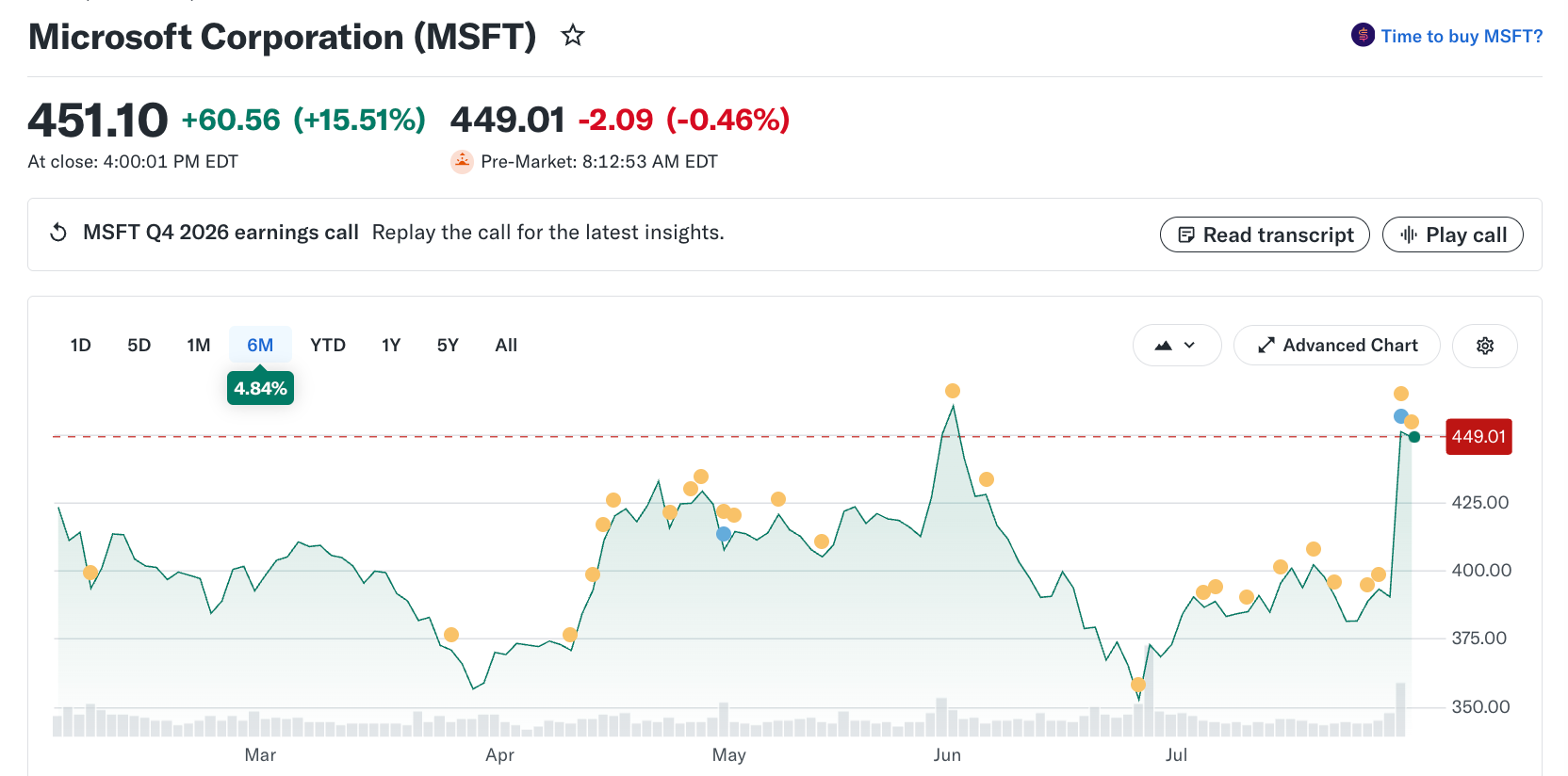
Microsoft soared about 15% to near $451 after its July 29 results, its biggest jump in months. Trading volume, the number of shares changing hands, hit its highest since June 22, which shows strong conviction behind the buying.
Want more insights like this? Sign up for Editor Harsh Notariya’s Daily Newsletter here.
Yet the rally is not fully convincing. That volume still sits below the heavy selling of late June, so buyers have not fully overpowered sellers.

The Chaikin Money Flow (CMF), a gauge of whether institutional money is flowing into or out of a stock, shows the same doubt. It nearly turned negative before earnings, then rose to 0.04 as big investors reacted. It still sits below its July 24 peak, and it must reclaim that level to confirm institutions are truly buying.

The fundamentals explain the jump. Microsoft spent $41 billion on capital expenditure, the cost of building AI data centers, but backed it with a $678 billion book of signed customer contracts. That locked-in demand proves the spending is funded by real orders, which is the bullish case. It also guided Azure cloud growth toward 45%, and faster growth at that scale points to rising future revenue.
Wall Street agrees. The stock holds a Strong Buy rating, with 24 of 25 firms on Buy, signaling broad expectations of more upside.

Only Barclays trimmed its target, a lone caution that matches the soft volume.
Amazon (NASDAQ: AMZN)
Amazon carries the strongest analyst support of the three, making it one of the more bullish US stocks to watch into August. All 28 covering firms rate it Buy, with none on Hold or Sell, and every major desk raised its price target after earnings. That rare unanimity gives Amazon the cleanest bull case of the week.

Options positioning backs that optimism. The put-to-call volume ratio, which compares bearish bets against bullish ones, fell from 0.74 to 0.54 into the print, meaning traders bought far more calls and leaned bullish.

The open interest ratio, the standing option contracts already in place, held steady at 0.66. That shows longer-term money has not fully committed yet, which leaves room for new buyers to lift the stock in August.
The business explains the confidence. Amazon Web Services, its cloud arm, reaccelerated, and the company disclosed a $496 billion backlog of signed customer demand. When Alphabet and Meta raised their AI spending, investors sold both stocks, fearing spending with no proven payoff. Amazon raised spending too, but its backlog proved customers had already agreed to pay, so the stock rose instead.
There is a catch worth knowing. Amazon’s headline $5.75 per share reads like a huge beat, but most of it came from a one-time paper gain on its Anthropic stake, not from the core business. Strip that out, and profit still rose a healthy 43%, so the bull case holds. The real pressure is cash, because heavy AI spending has pushed free cash flow, the money a company keeps after building, into the red over the past year.
Meta Platforms (NASDAQ: META)
Meta is the outlier among the top US stocks to watch. The stock fell about 8% to near $539 and now sits roughly 23% below its mid-July high.

The problem is cash, not sales. Revenue grew 28%, but free cash flow collapsed to $784 million from $8.55 billion a year earlier. Capex nearly swallowed all the cash the business generated, so Meta leaned on about $25 billion of new debt to keep funding its dividend, which unsettles investors.
Unlike Microsoft and Amazon, the other two US stocks to watch, Meta disclosed no backlog of signed demand, so it cannot yet prove the AI build will pay off. Its core apps also earned less, as Family of Apps operating income, the profit from Facebook, Instagram and WhatsApp, slipped to $23.4 billion from $25 billion. The strongest ad engine on earth delivered a weaker bottom line.
The chart warns of more risk. Meta’s CMF trended lower even as the price climbed from early June to mid-July, and a deep correction followed. It still has not cleared the 0.05 line that would confirm buyers are back, so the same bearish drop could repeat.

Analysts stay loyal but nervous. Meta keeps a Strong Buy, yet at least ten firms cut price targets overnight, including Citi to $800 from $850.

That lower ceiling with unchanged ratings signals near-term caution even from believers.
The post 3 US Stocks To Watch In August 2026 After Big Earnings Week appeared first on BeInCrypto.
Bitcoin Price Tumbles to 2-Week Low as Fed and BoJ Keep Rates Unchanged: Weekly Crypto Recap

I Lost Five Close Family Members In Five Years, This Is How I Rediscovered Hope

Trade talk circling as Tigers open series vs. Athletics


-

 Fashion7 days ago
Weekend Open Thread: Brooks Brothers
-
 Sports5 days ago
Commonwealth Games boxing: Jadumani Singh seals dominant 5-0 win over Pakistan’s Sumama Rehman to enter quarter-finals | Commonwealth Games News
-

 Business2 days ago
Why Trees Belong on the Risk Register
-

 Tech5 days ago
Intel is reversing course and bringing hyper-threading back to its server chips
-

 Crypto World6 days ago
Ripple bought a bank in pieces. The $4 billion audit
-

 Politics4 days ago
Luke Littler dismantles Gerwyn Price to retain title in Blackpool
-

 Politics3 days ago
The Part of the Electric Transition Nobody Wants to Discuss
-

 News Videos5 days ago
BITCOIN JUST ENTERED THIS CRITICAL ZONE…
-

 Business2 days ago
Major shareholder moves on Canyon
-

 Crypto World5 days ago
XRP Ledger adds $2.6B as RWA inflows rank second
-

 News Videos1 day ago
Bitcoin Enters the 3rd Stage of the Bear Market
-

 Politics5 days ago
Spain sweeps the board at 2026 World Cup with individual awards
-
 Entertainment3 days ago
‘Stargate’ Creator’s New Sci-Fi Series Returns for Season 3 Tomorrow
-

 Entertainment6 days ago
Sara Gilson Killed By Husband After Viral “Pedophile” TikTok Video
-

 Crypto World3 days ago
Kraken Enables Retail Access to Jersey Mike’s IPO via Tokenized Shares
-

 Tech6 days ago
Anthropic launches Claude Opus 5, a cheaper AI model for coding, agents and enterprise workflows
-

 News Videos3 days ago
Claude: Build Financial Dashboards in Minutes (2026)
-

 Tech4 days ago
New macOS Sequoia & Sonoma security updates for older Macs
-

 Politics22 hours ago
Luke Littler’s dominance sparks GOAT debate
-

 Sports14 hours ago
Seema Kaliramna Wins Discus Throw Bronze, Takes India’s CWG Medals Tally To 17
You must be logged in to post a comment Login