

Crypto World
Banks Can’t Rebuild for AI and Stablecoins


Augustus Bank N.A. has secured conditional approval from the U.S. Office of the Comptroller of the Currency to charter the first clearing bank designed for an AI-enabled, fully reserved stablecoin regime. The move, backed by the GENIUS Act framework, seeks to create a federal structure for payment stablecoins while clarifying how banks and select nonbank entities can issue and integrate dollar-pegged tokens under federal oversight. Augustus disclosed the conditional approval in a PR Newswire release and now aims to launch a Dallas, Texas–based national bank centered on AI-driven compliance and highly automated back-office operations.
Founder Ferdinand Dabitz told Cointelegraph that the institution is “a couple of months” from full approval and launch, though final clearance remains contingent on pre-opening conditions. The claim underscores Augustus’ belief that the current clearing ecosystem—dominated by large, legacy banks—needs a wholesale rebuild rather than a retrofit of existing cores. “The clearing bank bond is truly broken,” Dabitz asserted, arguing there is a path to rethink it as an application and deliver something substantially better.
Augustus’ genesis traces back to Berlin in 2021, where it started as Ivy, a euro-clearing fintech offering a transaction banking platform for non-U.S. institutions, fintechs and crypto firms. The bank already handles euro payments and instant settlement for clients, including Kraken, and now plans to extend that footprint with a full national charter focused on fully reserved stablecoins and AI-powered operations. Dabitz contends that incumbent banks can re-platform some systems, but cannot fundamentally rewire a core designed for humans to operate under AI-driven, tokenized money flows. “I’ve come to the conclusion it’s impossible to re-platform a bank,” he said.
Central to Augustus’ strategy is a three-layer stablecoin model designed to serve as a funding rail, a treasury and liquidity tool, and an interface layer for AI agents interacting directly with money. Dabitz describes the funding rail as the backbone for payments, while the treasury function would target the release of what he estimates as trillions of dollars in idle capital that sit idle due to outdated liquidity management. The third layer envisions AI agents leveraging stablecoins to conduct and monitor transactions in real time, potentially elevating AI from a peripheral capability to a primary user of the bank’s services. In practical terms, Augustus envisions real-time treasury optimization and automated liquidity management with human oversight rather than manual execution at every step.
Key takeaways
- The OCC granted conditional approval for Augustus Bank N.A. to charter a national bank under the GENIUS Act, paving the way for AI-enabled, fully reserved stablecoins and federal oversight of their use.
- Augustus aims to replace large segments of the traditional clearing network, arguing that legacy cores and weekend closures hinder true modernization; the bank contends it can move faster by building AI and stablecoin workflows into its operating model from the ground up.
- The proposed three-layer model positions stablecoins as a payments rail, a treasury/liquidity tool to unlock idle capital, and an interface layer for AI agents to interact with money in real time.
- Industry context shows massive incumbents investing heavily in AI and clearing infrastructure, with JPMorgan citing annual tech spend in the vicinity of $18 billion and Citi reporting significant clearing-related revenue in the first quarter; Augustus argues it can gain speed by starting with an AI-first design rather than retrofitting existing systems.
- Regulatory engagement will be critical as Augustus seeks to balance rapid automation with appropriate checks, balances and risk controls—an area the founder says will feature close collaboration with regulators and established banking leaders.
Rethinking clearing through AI and tokenized money
A founding premise for Augustus is that the traditional clearing network has grown too dependent on human workflows and decades-old core systems. The company argues that the true bottleneck is not the presence of digital assets or AI per se, but the inability of legacy platforms to reconfigure themselves around programmable money and automated compliance. The aim is to embed AI-driven processes into the bank’s day-to-day operations from the outset, rather than layering automation onto an already rigid core.
July’s regulatory pathway for Augustus is framed by the GENIUS Act, which established a federal framework for stablecoins and clarified how banks and certain nonbank entities can issue and integrate dollar-pegged tokens under federal oversight. Augustus’ plan to leverage this framework in a national clearing bank aligns with broader policy conversations about stablecoins, cross-border settlement, and the role of banks as trusted rails for tokenized assets.
In practical terms, Dabitz says the model would enable AI systems to perform tasks such as liquidity management and transaction monitoring on behalf of corporates, with humans supervising the process rather than manually handling every exception. The vision is to compress a set of operational tasks—like transaction monitoring and case handling—from hours to minutes, making compliance and settlement faster and more scalable while preserving safety and oversight. Critics, however, caution about model risk, explainability, and the potential for operational failures as AI takes on a larger share of regulated tasks. Augustus counters that its safety framework will involve rigorous checks and balances and ongoing regulator engagement.
The bank has already demonstrated a practical foothold in European and crypto markets, running euro payments and instant settlement for Kraken. This history, Dabitz says, provides a proving ground for the heavier automation and AI-backed workflows Augustus plans to scale under a national charter. The ambition is not merely to digitize existing processes but to reframe how clearing and settlement work in a world where tokenized money interacts with AI agents and real-time financial data streams.
Industry dynamics: incumbents, regulators, and the path forward
The push to modernize clearing sits against a backdrop of large-scale investments by traditional banks in AI and technology. JPMorgan Chase, for instance, publicly states it invests more than $18 billion annually in technology, including AI initiatives, while Citi reported substantial clearing-related revenue in the first quarter, underscoring the profitability and importance of the clearing business for incumbents. Augustus’ pitch is that its speed-to-market—built around an AI-first design and a fully reserved stablecoin framework—could enable it to outpace incumbents on building new, end-to-end workflows rather than retrofit old ones.
Still, the path to a full operating bank is likely to involve continued regulatory scrutiny, risk management evaluations, and a delicate balance between innovation and safety. Augustus says it will work closely with regulators and banking executives to ensure that “the checks and balances and the harness for the AI to operate in a safe and sound manner” guide its rollout. The broader trajectory of AI-enabled banking will hinge on how effectively new entrants can demonstrate reliability, transparency and resilience alongside the speed and efficiency benefits that automation promises.
The Dallas-based plan reflects a broader trend of US policymakers and financial institutions exploring stablecoins as a settlement mechanism and potential backbone for programmable money within a regulated framework. Augustus’ approach—combining a national charter, a fully reserved model, and AI-driven compliance—could influence how other innovators structure clearance, settlement, and money movement if its approvals proceed as envisioned.
The question readers will watch next is whether pre-opening conditions can be satisfied to deliver a full charter, and how regulators will respond to an institution designed explicitly around AI-powered processes and tokenized money. If Augustus achieves a successful launch, it could mark a meaningful inflection point for the modernization of clearing infrastructure in the digital age.
Readers should monitor forthcoming regulatory milestones and any updates from Augustus on its phased rollout, as well as potential partnerships with corporates and fintechs seeking AI-enabled settlement capabilities under a federally supervised framework.



Key takeaways
- Pi Network extends losses on Friday as a 50-period EMA caps short-term recovery attempts.
- The token could drop below the $0.1600 if the bearish trend persists.
Pi Network (PI) extended losses on Friday, risking a bearish breakout from its short-term consolidation on the 4-hour chart.
The token remains capped by the 50-period Exponential Moving Average (EMA) at $0.1733, limiting recovery despite the recent launch of vibe coding features within the Pi ecosystem.
Vibe coding features aim to boost ecosystem development
The Pi Network has introduced vibe coding tools for developers, enabling the conversion of AI-assisted apps—from platforms like Codex, Claude Code, Replit, Cursor, and Lovable—into Pi Apps.
This integration could reduce app development time and strengthen the ecosystem, which boasts over 60 million engaged users.
Technical outlook: correction pressure persists
The PI/USD 4-hour chart remains bearish and efficient as PI is down by more than 2% in the last 24 hours.
PI is currently under a corrective bias, capped by the 50-period EMA at $0.1733 on the 4-hour chart and the 200-period EMA at $0.1771.
The pair also sits below a nearby downtrend resistance line around $0.1741, reinforcing the upside barrier.
If the bulls regain control, initial resistance would be seen at the 50-period EMA at $0.1733 and the 200-period EMA at $0.1771 cap short-term upside. A nearby downtrend resistance line around $0.1741 adds to the barrier.
The momentum indicators also suggest that the bears are still in control. The Relative Strength Index (RSI) sits at 45, below the midline, signaling persistent selling pressure.
The MACD remains near-flat, suggesting weak, consolidative momentum rather than a decisive rebound.

However, if the bearish trend persists, immediate support would emerge at the S1 Pivot Point at $0.1645.
Pi Network’s short-term outlook remains cautious, and traders should monitor both EMA and trendline levels for signs of a breakout or deeper correction.


The T3 Financial Crime Unit, a joint operation by Tether, TRON, and TRM Labs, has frozen more than $450 million in illicit cryptocurrency since launching in September 2024, with 43.9% more illicit proceeds intercepted in 2025 than the prior year.
The May update reflects expanded cooperation with police forces in the United States, Spain, Germany, the Netherlands, and Bulgaria. The Financial Action Task Force (FATF) has also cited the unit as a leading public-private model for digital asset enforcement.
T3 Expands Reach Across 23 Jurisdictions
The unit operates in 23 jurisdictions, including the United States, Spain, Germany, Brazil, and the United Kingdom. Since its September 2024 debut, it has analyzed millions of transactions across five continents to identify exchange hacks, exploits, DPRK-linked activity, terrorist financing, money laundering, and violent crime cases.
Past T3 actions include a Spanish bust that recovered about $26.4 million tied to a Madrid-based laundering ring.
Response time has been a focus. T3 says it has frozen funds within 24 hours during multiple account takeovers and violent crime emergencies.
The unit also supported Operation Lusocoin, a Brazilian Federal Police investigation that froze more than R$3 billion in crypto, including 4.3 million USDT, Tether’s flagship stablecoin, tied to the criminal network.
Wrench Attacks and North Korean Funds Move Into Focus
Cases this year have spanned controlled substances, terrorist financing, and what T3 calls wrench attacks, a category covering home invasions, kidnappings, and violent extortion against crypto holders.
The unit says it can lock targeted wallets within hours of a verified law enforcement request. BeInCrypto has reported separately that physical attacks targeting digital asset users could climb sharply in 2026.
Recognition came earlier this year, when the FATF named T3, alongside TRM’s Beacon Network, as a leading framework for tackling digital asset crime.
TRM Labs has estimated that illicit crypto flows reached a record $158 billion, an environment in which real-time identification and freezing have become central to enforcement.
“This $450 million milestone is just the beginning of what T3 is capable of, as its impact will only continue to grow in scale and importance.” Paolo Ardoino, Tether CEO, in a statement.
The post Tether, TRON, TRM Labs Freeze $450 Million as T3 Crime Crackdown Widens appeared first on BeInCrypto.


As the Commodity Futures Trading Commission takes on a growing task to police U.S. crypto trading, senior lawmakers are saying it needs bipartisan leadership.

The team behind the controversial project continues to post frequent updates to its substantial user base in terms of the latest developments in its broader ecosystem.
The latest, which went live on Pi Network’s only official account on X, focused on how vibe coders and creators can use the ‘massive user base of over 60 million Engaged Pioneers.’
AI and Human Input
Ever since Pi Network’s Core Team introduced the Pi App Studio last year, they have often outlined the advantages of using AI. However, instead of trying to separate the new technology from human input, they are actively combining them to get the best of both worlds.
In the new post, the team said vibe coders and creators can utilize the aforementioned 60 million user base by “easily bringing their external AI-created apps to Pi’s real distribution network and utility ecosystem through Pi App Studio.”
This means that even those with non-technical products can build apps using platforms such as Codex, Replit, Lovable, Claude Code, Cursor, or other AI-assisted coding tools. Then, they can employ the Pi App Studio to convert the new applications into Pi-native apps.
The post doubles down on the narrative that Pi Network aims to close the gap between creating apps, something in which AI can easily assist, and turning those new products into actually usable and helpful tools.
Ideas Too Good Not to Be Seen
The team further noted that creators can now connect their apps to an existing ecosystem with users, payment capabilities, identity verification, decentralized human infrastructure, and platform-level tools in place, instead of rebuilding infrastructure from scratch.
Consequently, this feature allows users’ ideas to become reality and reach other customers a lot faster. The team said it added this possibility because “your ideas are too good to be seen.” The feature is already activated and users can take advantage from it using the Pi App Studio.
The post Pi Network Drops New Update That ‘Changes the Equation for Creators’: Details appeared first on CryptoPotato.
Popular on-chain investigator ZachXBT updated his 100,000 followers on Telegram minutes ago that the popular decentralized exchange THORChain has likely become a victim of a new crypto hack.
The reported attack appears to be for over $10.5 million, as the platform was exploited on Bitcoin, Ethereum, Binance Smart Chain, and Base.
Although there has been no official confirmation from THORChain’s team as of the time of this point, the project’s native token plummeted immediately after the news spread on X.
RUNE traded above $0.58 before it crashed by double-digits to a two-week low of $0.50, where it found some support.

This is a breaking story with few details at the moment, so make sure to follow for additional information in the following hours.
UPDATE 1: ZachXBT noted shortly after his first report that the actual stolen amount has grown to $10.7 million.
The post RUNE Plunges by 15% as THORChain Falls Victim to New Hack: ZachXBT appeared first on CryptoPotato.
Connex released 1.32 million CONX tokens worth $17.95 million on May 15 in a scheduled cliff unlock.
Summary
- Connex unlocked 1.32 million CONX tokens valued at approximately $17.95 million on May 15, 2026.
- The unlock represents 1.49% of Connex’s released supply, with 822,500 tokens allocated to the ecosystem.
- The remaining 500,000 CONX tokens from the release were directed to the community treasury.
Connex, a Web3 professional networking platform that uses its native token for payments, governance and credential verification, executed the unlock on a preset cliff schedule. According to Tokenomist data, the release equals approximately 1.49% of the project’s adjusted released supply, with 88.60% of maximum supply already in circulation ahead of the event.
The allocation split the 1.32 million CONX into two portions. The ecosystem fund received 822,500 tokens worth approximately $10.94 million, while the community treasury received the remaining 500,000 tokens valued at approximately $6.65 million.
Supply event adds $17.95m in CONX tokens to circulation
Cliff-style unlocks, which release tokens in a single event rather than gradually, can add short-term selling pressure when a large percentage of market cap enters circulation at once.
At current prices the unlock represents roughly 60% of CONX’s market capitalisation of approximately $30.61 million, making it one of the highest unlock-to-market-cap ratios of the week.
The broader crypto market is tracking multiple significant unlock events in May 2026. Crypto.news reported that last week’s period included over $229 million in releases across HYPE, ENA and RED, with Tokenomist data showing that large cliff unlocks draw heightened trader attention around scheduled dates.
Earlier this month, governance turbulence surrounding a separate unlock showed how vesting mechanics can generate community pushback when supply events are not well managed.
The WLFI situation, where $55.57 million was shifted into an unlock contract before a community vote halted the process, highlighted how unlock structure and governance interact.
Connex’s unlock, by contrast, follows a previously disclosed vesting schedule. The token is used to incentivise professional participation and governance across Connex’s LinkedIn-style decentralised network. Hyperliquid’s HYPE token demonstrated earlier this year that markets can absorb large unlock events without sustained price damage when underlying demand remains strong.
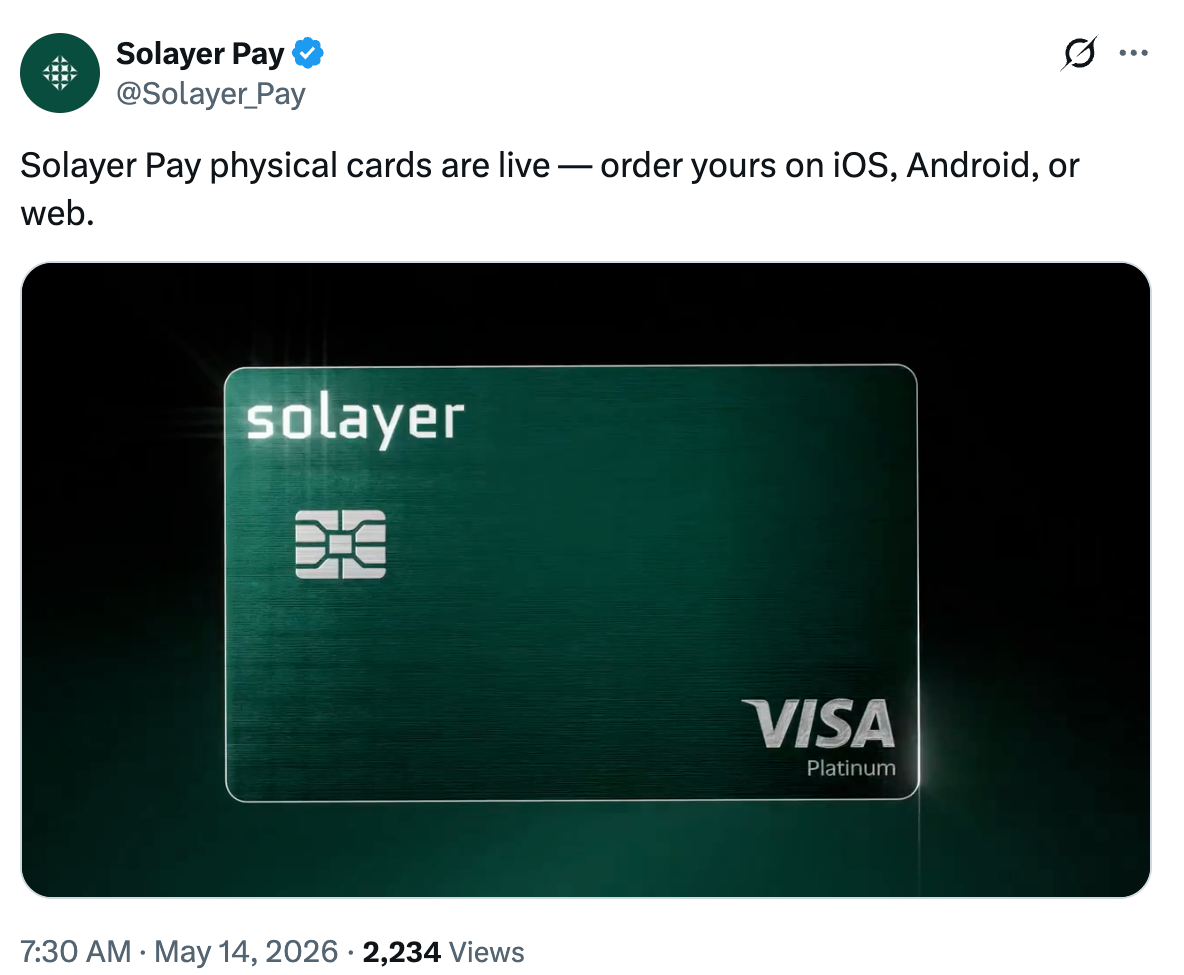
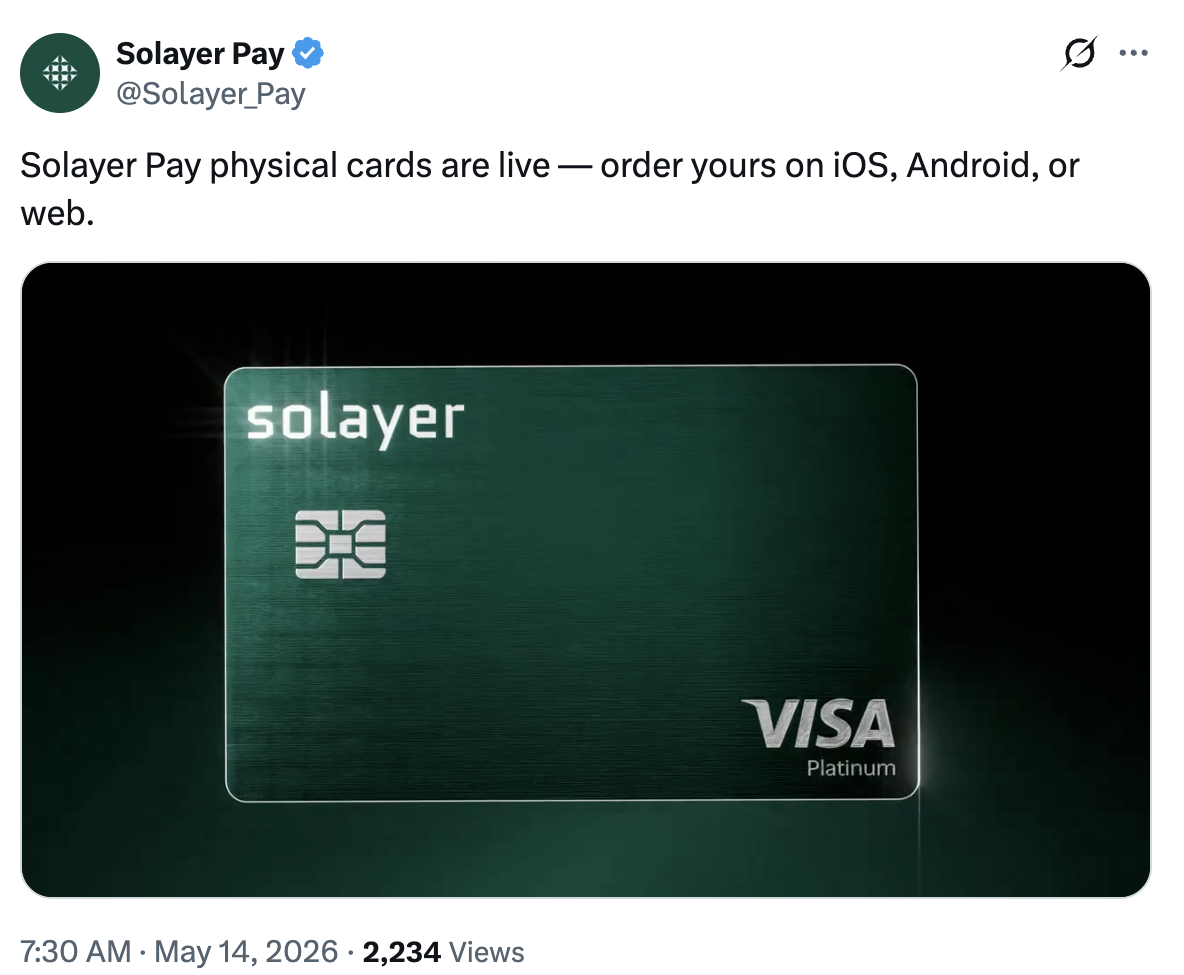
Layer-1 blockchain developer Solayer launched a Visa-compatible payment card that allows users to spend USDC balances through in-store, online and contactless transactions.
The card supports ATM withdrawals in supported regions and can be ordered through the Solayer Pay app, according to the announcement. Existing users can request the card for free, while new users pay a $20 annual activation fee.
Source: Solayer Pay
Solayer Pay launched in April 2025 under the name Emerald Card and initially rolled out to 40,000 users across more than 100 countries, according to the company. Solayer said the new physical card expands the existing Solayer Pay platform, which supports storing, transferring and spending digital assets through Visa-linked payment infrastructure.
The company said the card enables users to spend USDC (USDC) balances globally through Visa payment infrastructure directly from their Solayer Pay accounts.
Solayer develops infiniSVM, a layer-1 network compatible with the Solana Virtual Machine that is designed for high-throughput onchain applications using Solana (SOL) for gas fees.
Related: Dartmouth endowment invests in Solana ETF, holds $14M in crypto exposure
Stablecoin payment cards expand
The launch from Solayer comes as rypto and payments companies have increasingly launched stablecoin-linked payment cards tied to traditional card networks including Visa and Mastercard.
In January, crypto exchange OKX launched a Mastercard-linked payment card for European users through regulated issuer Monavate, allowing verified customers to spend stablecoins, including USDC and Paxos’ Global Dollar (USDG).
The following month, MetaMask expanded its Mastercard-linked crypto payment card across the United States, including New York for the first time, allowing users to spend digital assets directly from self-custodial wallets.
In March, Visa and Stripe-owned Bridge expanded their stablecoin-linked card program to 18 countries and said they planned to roll out the product across more than 100 countries by the end of 2026. The companies also began testing stablecoin settlement through Visa’s pilot program.
The same month, Mastercard agreed to acquire stablecoin infrastructure company BVNK in a deal valued at up to $1.8 billion. BVNK provides infrastructure for businesses to send and receive stablecoin payments across blockchain networks in more than 130 countries.
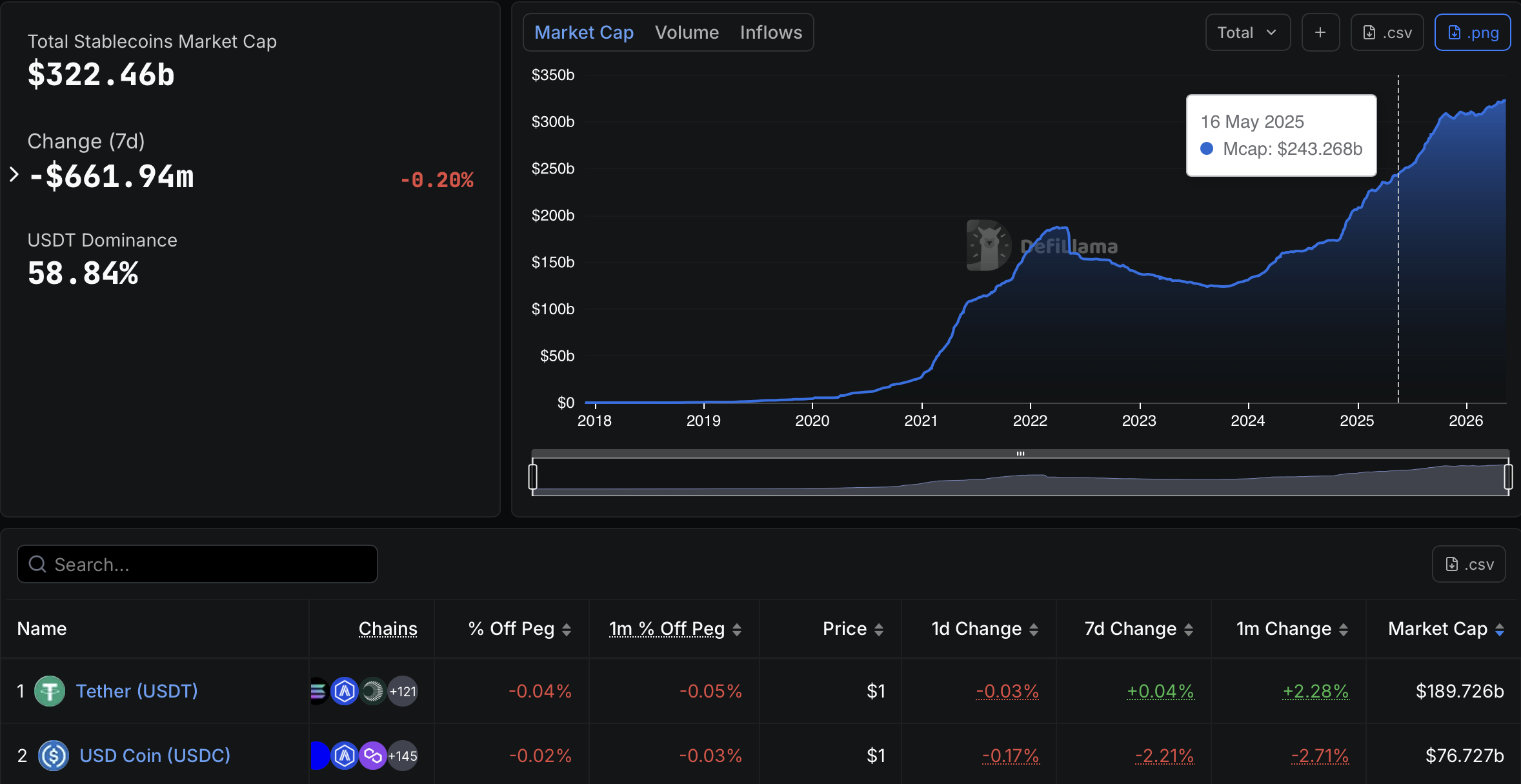
Data from DefiLlama shows the stablecoin market has grown from about $243.3 billion in May 2025 to around $322.5 billion today, an increase of about $79 billion.
Tether remains the dominant stablecoin issuer, with its USDt (USDT) commanding a market capitalization of about $189.7 billion, representing around 58.8% of the total stablecoin market, while Circle’s USDC ranks second with a market capitalization of about $76.7 billion.
Source: DefiLlama
Magazine: eToro founder timed Bitcoin top perfectly due to belief in 4 year cycles

Crypto investigator ZachXBT has accused the team behind LAB of using opaque OTC deals, insider-controlled supply, coordinated market-making activity, and hidden unlock structures to drive the token’s recent rise to a nearly $6 billion fully diluted valuation.
In his latest post on X, ZachXBT claimed LAB represents “everything wrong” with the current centralized exchange token environment, where retail investors allegedly have little visibility into token allocations and insider agreements. The LAB token crashed by over 30% in 24 hours.
LAB Faces Fresh Scrutiny
According to the investigator, LAB was launched in October 2025 by Vova Sadkov and Mark after their previous project, Eesee (ESE), reportedly left many investors dissatisfied once the team moved on. He explained that there is still no clear public breakdown of LAB’s token distribution, as CoinGecko, RootData, and CoinMarketCap all display different circulating supply figures, while LAB’s own documents reportedly provide no detailed allocation data.
ZachXBT said his on-chain analysis indicates insiders likely control more than 95% of the token supply. He also alleged that the LAB team unilaterally changed vesting conditions for Legion public sale participants from a three-month cliff to a nine-month cliff, as he cited an email screenshot shared by a user.
Separate complaints from creators who claimed they were still waiting for marketing payouts months later were also mentioned in the findings. ZachXBT also shared details from a draft private loan contract tied to The Lab Management Ltd., a British Virgin Islands company allegedly connected to Vladimir Sadkov.
The agreement reportedly offered loans with 7.5% monthly interest over six months, with repayment in LAB tokens at market price in the event of default. The wallet connected to the contract was allegedly later used for public LAB buybacks and linked on-chain to another wallet involved in a separate Wildcat loan.
Hidden OTC Deals and Insider Activity
ZachXBT also claimed LAB-related funds were sent to exchange accounts allegedly linked to Sadkov, which had earlier received deposits connected to Eesee. The investigator even went on to allege that several OTC and loan arrangements had been privately offered since January 2026.
According to screenshots and claims shared in the post, some deals included 60% discounted OTC allocations with lockups, guaranteed discount structures recalculated monthly, and influencer-focused allocations with discounts reaching as high as 80%. Some agreements purportedly required influencers to publicly support LAB before their tokens unlocked.
These hidden arrangements created supply risks that retail traders could not track publicly, according to ZachXBT. He also linked one signer associated with LAB multisig wallets to an insider believed to be connected to earlier RIVER token manipulation activity.
As per the findings, insiders deposited 226 million LAB tokens into Bitget-linked addresses between March and April 2026 before roughly 100 million LAB tokens were withdrawn between May 11 and 12 to ten separate wallets. ZachXBT said most LAB spot activity appeared concentrated on Bitget, while Binance and Gate were also used for derivatives and Alpha markets. He called on exchanges including Bitget, Binance, and Gate to freeze alleged insider profits or delist the token altogether.
ZachXBT had raised similar concerns around the SIREN token earlier this year after the asset surged from around $0.40 on March 10 to an all-time high of $3.65 by March 22 before eventually collapsing to $0.53.
The post ZachXBT’s Explosive Claims Send LAB Tumbling Over 30% in One Day appeared first on CryptoPotato.
This Friday, we examine Ethereum, Ripple, Cardano, Binance Coin, and Hyperliquid in greater detail.
Ethereum (ETH)
Ethereum has been hovering just below the $2,400 resistance for over four weeks. With bulls unable to break this level, the price has entered a correction. At the time of this post, ETH is found at around $2,270 and is at a similar price to last week.
Since late April, the momentum on Ethereum has turned bearish on the daily timeframe, and the price appears to be catching up with clear lower highs.
Looking ahead, ETH has formed a large bearish channel with the lower limit at around $2,200. If that level is lost in the near future, then this cryptocurrency is likely to fall to $2,000 next.

Ripple (XRP)
XRP had a good week, closing 6% higher. This comes after the price managed to break out of the blue pennant and rushed towards $1.5. With bulls in control, this cryptocurrency has a real chance to test the key $1.6 resistance next.
As long as the price holds above the pennant, the bias remains bullish. Should the price fall back within the pennant, that would be interpreted as a bearish signal. Right now, the most important support is found at $1.4.
Looking ahead, XRP has been making higher lows and higher highs since April, and the buy volume is increasing. These are bullish signals that will be confirmed once $1.6 becomes support.

Cardano (ADA)
ADA is up 3% this week and has attempted to break the $0.28 resistance. However, sellers returned there to stop the rally, and the price entered into a pullback.
Even if the breakout did not materialize on this first try, it is a major change in price action that finally signals it wants to move higher. Should sellers continue to dominate, ADA could test the $0.25 support.
Looking ahead, this recent rally could suggest Cardano has bottomed around the $0.24 support level. If so, buyers will likely aim to send this cryptocurrency higher, even if it takes them more time. Key resistance levels are found at $0.28 and $0.30.

Binance Coin (BNB)
BNB closed the week 6% higher. This has allowed the price to arrive at the $690 key resistance. At the time of this post, bulls and bears are contesting this level. While momentum favors buyers, it needs higher buying volume to succeed.
Since this cryptocurrency found support at $580, the price has been in a steady uptrend, with daily gains. However, the current resistance may put a stop to this trend.
Looking ahead, Binance Coin needs to break above $690 to end its long consolidation that began in February. The price has been bouncing between $580 and $690 with no clear winners to date.

Hype (HYPE)
HYPE rallied 20% in the past 24h on the news that the USDC sitting on Hyperliquid will use a majority of its native yield to purchase HYPE. This comes after a trilateral agreement among Hyperliquid, Circle, and Coinbase to make USDC the exchange’s native stablecoin.
This development will increase the size of HYPE buybacks, as USDC will provide additional liquidity. In light of that, the price quickly rallied in anticipation of additional buying pressure.
Looking ahead, even if HYPE had a fantastic rally, the price failed to re-enter the blue wedge. For this reason, this could be interpreted as a bearish re-test. Losing the support at $43 would confirm this bias.

The post Crypto Price Analysis May-15: ETH, XRP, ADA, BNB, and HYPE appeared first on CryptoPotato.
Bitwise Asset Management has launched a US-listed investment product tied to Hyperliquid, offering investors spot exposure to the token and staking rewards linked to the decentralized derivatives platform.
The fund, trading under the ticker BHYP on the New York Stock Exchange, is the second US-listed Hyperliquid product to launch this week. Bitwise said the fund plans to stake a significant portion of its HYPE (HYPE) holdings through its in-house staking division.
Hyperliquid is a decentralized trading-focused layer 1 blockchain launched in 2023 that offers perpetual futures, spot trading and lending services. Bitwise said the platform processed about $2.9 trillion in trading volume in 2025 and accounted for roughly 60% of global onchain derivatives open interest as of May 5, citing DefiLlama data.
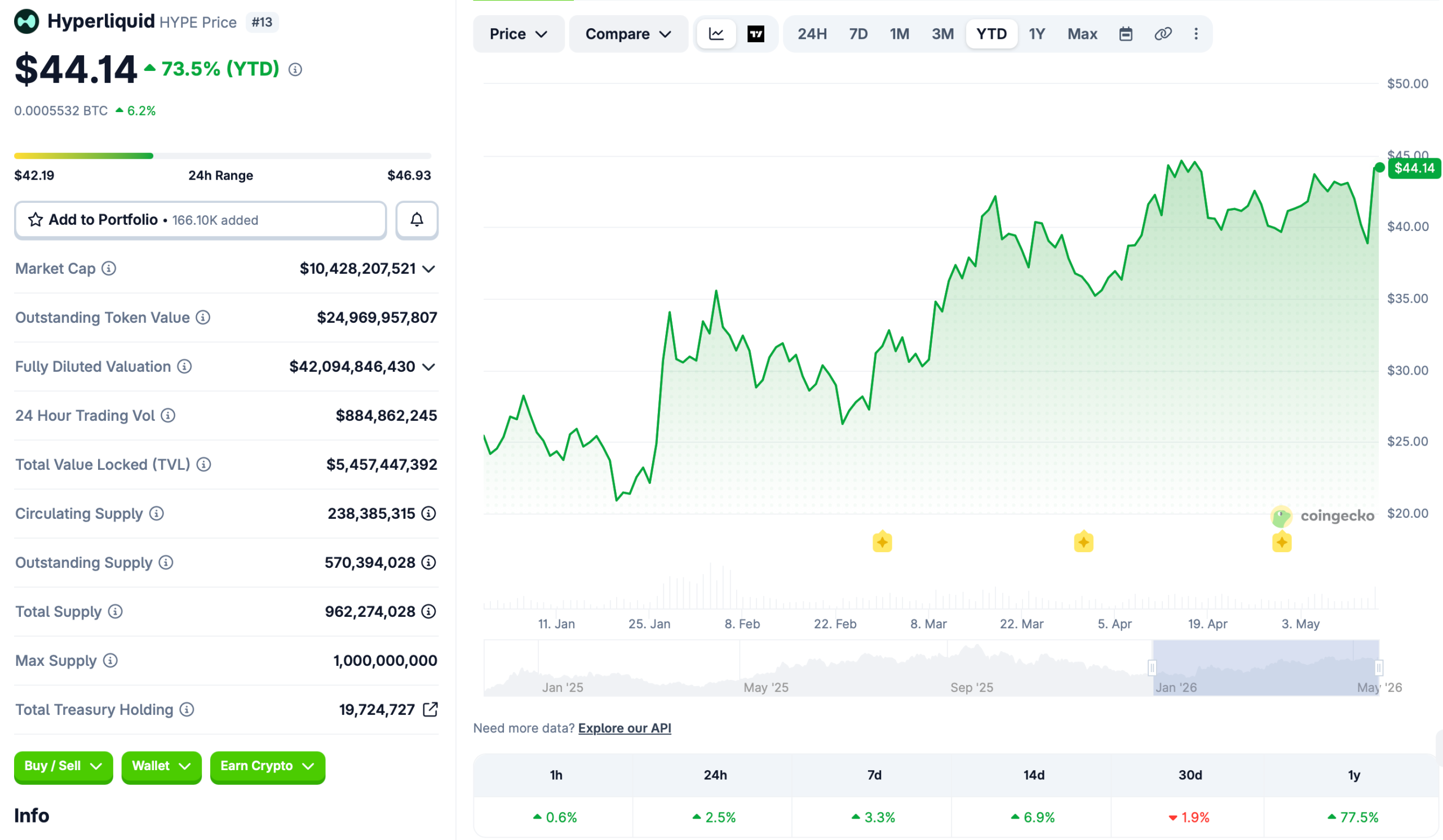
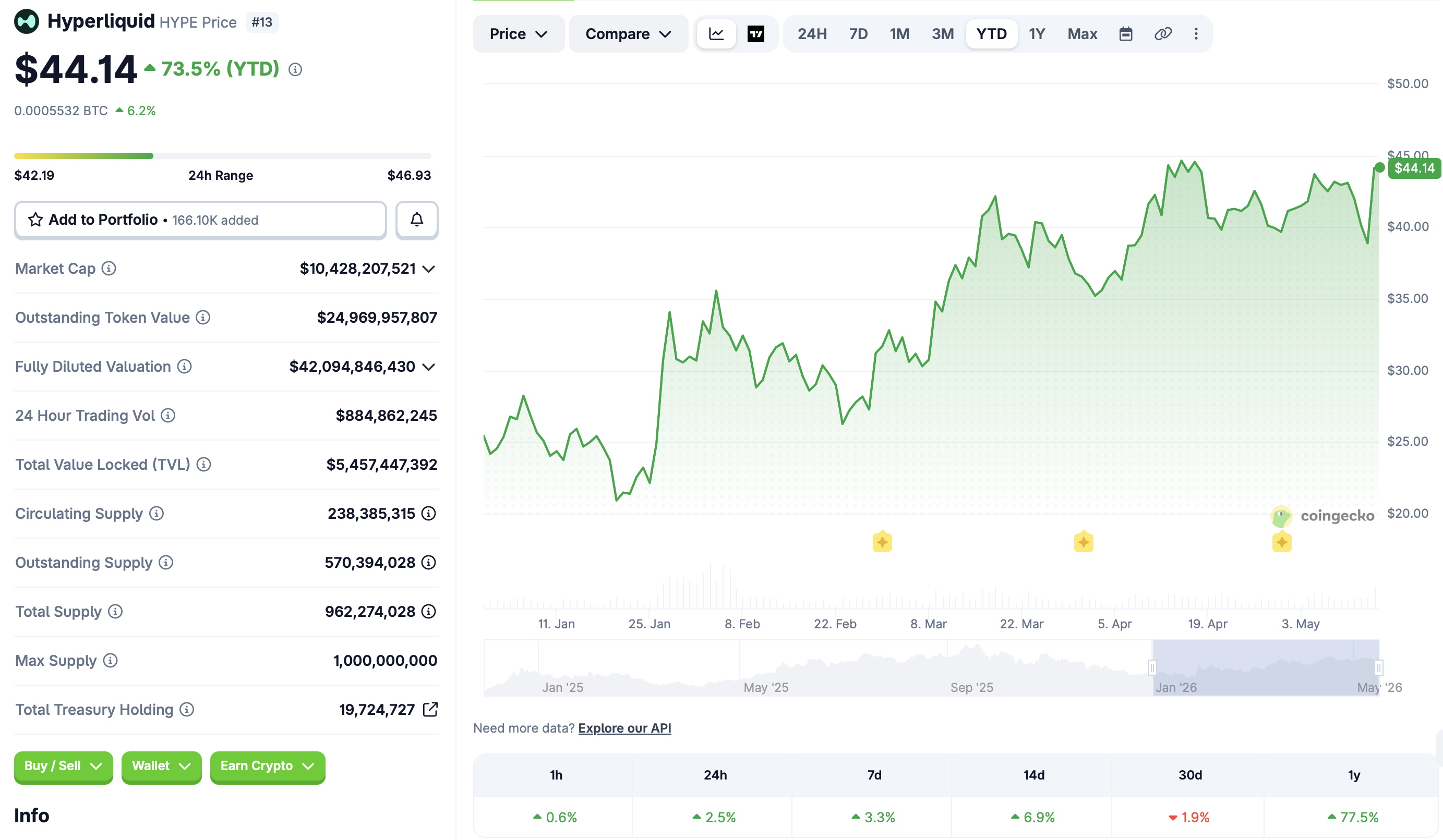
HYPE was trading at around $44 on Friday with a market capitalization of roughly $11.22 billion, making it the 10th-largest cryptocurrency by market value, according to CoinMarketCap data. The token is used for staking, governance and ecosystem participation.
Bitwise, which manages about $11 billion in client assets across crypto investment products including exchange-traded funds, private funds and staking strategies, said the fund will charge a 0.34% sponsor fee, which will be waived for the first month on the fund’s first $500 million in assets.
HYPE token price. Source: CoinGecko
Related: Wells Fargo lifts Ether ETF holdings in Q1 as Bitcoin positions shift
Hyperliquid draws growing institutional interest
The launch comes as institutional interest in Hyperliquid and HYPE-linked investment products expands across crypto asset managers, venture capital firms and trading platforms.
Earlier this week, 21Shares launched its THYP Hyperliquid fund in the US, drawing about $1.2 million in net inflows and $1.8 million in trading volume on its first trading day, according to Bloomberg ETF analyst James Seyffart. Grayscale Investments is also awaiting a decision on its proposed Hyperliquid fund.
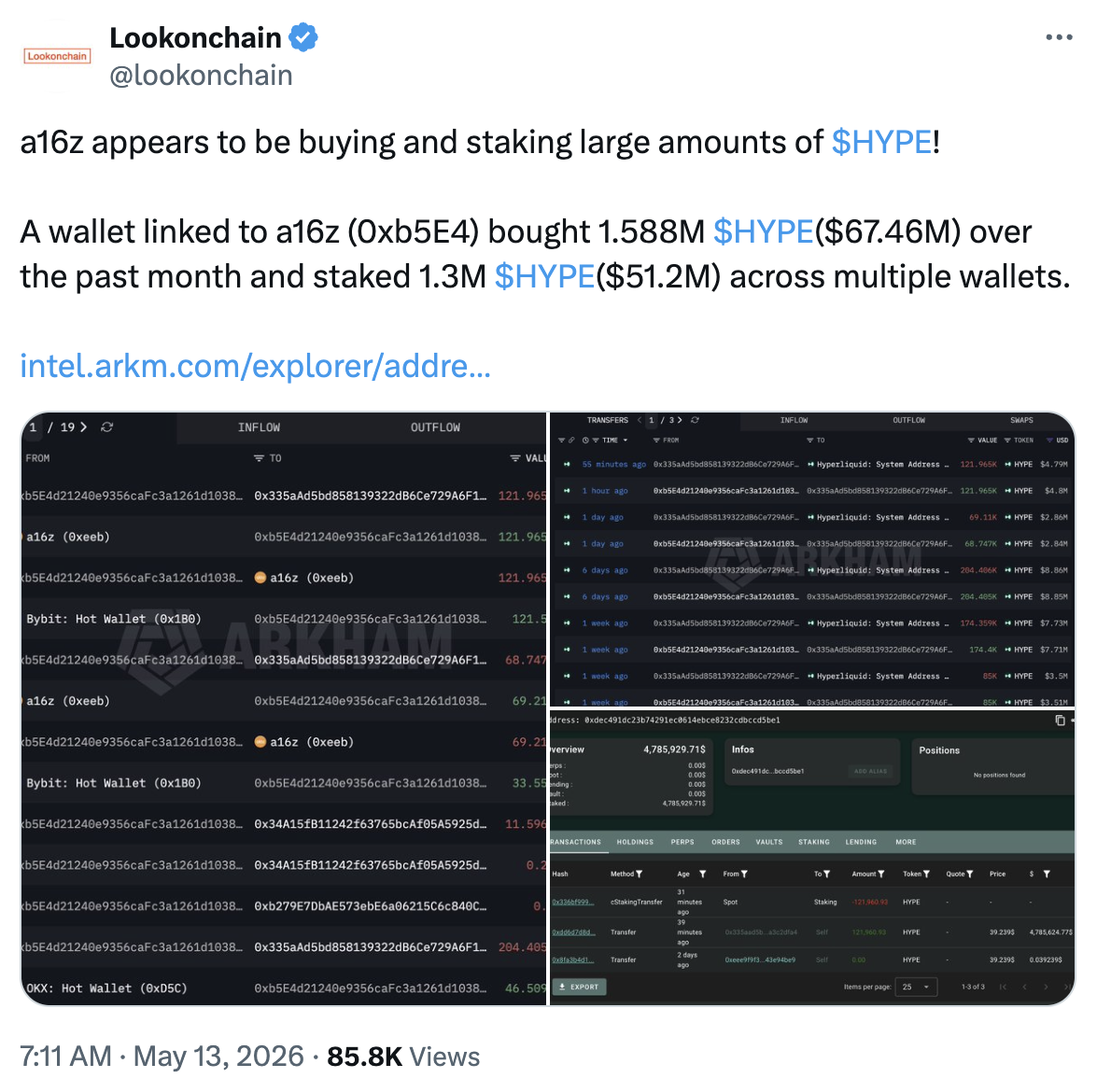
On Wednesday, onchain analytics account Lookonchain said wallets linked to venture capital company Andreessen Horowitz had accumulated about $67 million worth of HYPE over the previous month and staked roughly $51 million worth of the token.
Source: Lookonchain
The following day, Coinbase announced it would become the official treasury deployer for USDC (USDC) on Hyperliquid, where the stablecoin’s supply has grown to around $5 billion since the network launched in 2023, according to DeFiLlama data.
As Hyperliquid gains traction as a decentralized derivatives exchange, centralized crypto companies have also expanded deeper into perpetual futures and offshore derivatives markets through new trading products and international launches.
Earlier this year, Coinbase launched stock perpetual futures for eligible non-US users, while Kraken rolled out tokenized equity perpetual futures tied to assets including Nvidia (NVDA), Apple (AAPL) and Tesla (TSLA) for offshore clients.
Magazine: ETH stalls at $2.4K five times, SOL to rally to $120: Market Moves

Sheinelle Jones Finds Her Wedding Dress After Uche’s Death

Man caught upskirting had 5,000 indecent images and videos
Monster Beverage CFO Thomas Kelly sells $614,670 in company stock

Manchester United reach agreement with Casemiro over contract clause amid transfer speculation

US brings back mandatory military draft registration

Steven Gerrard disagrees with Gary Neville over ‘shock’ Chelsea and Arsenal claim | Football


-

 Fashion4 days ago
Coffee Break: Travel Steam Iron
-

 Politics7 days ago
Politics Home Article | Starmer Enters The Danger Zone
-

 Fashion5 days ago
What to Know Before Buying a Curling Wand or Curling Iron
-

 Politics4 days ago
What to expect when you’re expecting a budget
-

 Tech6 days ago
Auto Enthusiast Carves Functional Two-Stroke Engine from Solid Metal
-
 Business6 days ago
Ignore market noise, India’s long-term story intact, say D-Street bulls Ramesh Damani and Sunil Singhania
-

 Tech5 days ago
GM Agrees To Pay $12.75 Million To Settle California Lawsuit Over Misuse Of Customers’ Driving Data
-

 Fashion4 hours ago
Weekend Open Thread: Theory – Corporette.com
-

 Crypto World6 days ago
CZ says US crypto rivals tried to block Trump pardon
-

 Crypto World6 days ago
PROS explodes 48% as Upbit and Bithumb listings ignite demand
-

 Tech4 days ago
GM agrees to $12.75M California settlement over sale of drivers’ data
-
Crypto World3 days ago
Bitcoin Suisse expands with Digital Asset License and Investment Business Act Registration Approval in Bermuda
-

 Crypto World3 hours ago
E-Estate Announces 1 Year Live: Washington DC Summit as Real Estate Tokenization Enters Its Next Phase
-
 Crypto World7 days ago
Solana UFO Meme Coins Surge After Pentagon Reveals Alien Files
-

 Entertainment7 days ago
Bethenny Frankel Says She Loves ‘Torturing’ Men
-

 Politics3 days ago
Pakistan to enter Chinese capital market as war inflation bites
-
 Crypto World7 days ago
Pi Network Hits 421K Mainnet Nodes Ahead of Protocol 23 Smart Contract Launch
-
 Crypto World1 day ago
Google’s Gemini AI Predicts Incredible Solana Price by the End of 2026
-
Crypto World7 days ago
Crypto Price Analysis May-08: ETH, XRP, ADA, BNB, and HYPE
-
 Entertainment7 days ago
Netflix’s Most Addictive Thriller Is About To Get Even More Unhinged [Exclusive]
You must be logged in to post a comment Login