

Crypto World
BeInCrypto Institutional Research: 10 Firms Powering Autonomous Agentic Payments



Best Autonomous Agentic Payments Platform is a category within the BeInCrypto Institutional 100, an annual research-driven program recognising institutional digital asset excellence across 26 categories and six pillars.
This category sits under Pillar 4: Tokenization & On-Chain Finance. The 10 firms below are listed alphabetically and are not ranked. A shortlist will be named in May 2026, with the winner announced at Proof of Talk in Paris on June 2–3, 2026.
Key Facts
- Long list: 10 firms across stablecoin agent stacks, x402 protocol ecosystems, full-stack agent payment platforms, agent identity standards, settlement layers, agentic onramps, and network-level payment rails
- Initial pool: More than 30 firms screened; 10 advanced to the primary long list
- Order: Listed alphabetically, not ranked
- Scoring: 30% quantitative data · 50% Expert Council · 20% disclosed company data
- Criteria assessed: Agentic transaction volume, agent integration depth, programmability, developer adoption, security and compliance, funding and viability, innovation signal
- Eligibility: Each firm must have a verifiable AI-agentic product, program, fund, standard, or pilot live or announced during the award window
| Firm | HQ | Agentic Platform / Sub-Segment | Reach | Representative Work |
|---|---|---|---|---|
| Ant Digital Technologies | Hangzhou, China | Agent-to-agent economy infrastructure platform | Anvita platform: Anvita TaaS and Anvita Flow Supports x402 payments, Agent Store modules, OpenClaw, and Claude Code |
Anvita launched Mar 31, 2026 at Real Up Cannes USDC integration with Circle in progress; stablecoin licences pending in Hong Kong, Singapore, and Luxembourg |
| Circle Internet Group | New York, USA | Stablecoin issuer Agent Stack on USDC rails | USDC settles 99.8% of x402 agentic payments Live on 11 EVM chains; Agent Marketplace launched with 500+ endpoints |
Circle Agent Stack launched May 11, 2026 Includes CLI, Agent Wallets, Marketplace, Nanopayments, and Circle Skills |
| Coinbase | San Francisco, USA | x402 protocol layer and AgentKit developer ecosystem | About 69,000 active AI agents on x402 167M+ transactions and $50M volume as of Apr 21, 2026 |
x402 V2 launched Dec 2025 under Linux Foundation umbrella Selected protocol layer for Amazon Bedrock AgentCore Payments |
| Crossmint | New York, USA | Full-stack agent payment platform | About $23.6M raised 40,000+ companies and developers; live across 40+ blockchains |
Smart contract wallets across EVM, Solana, and Stellar Virtual Visa and Mastercard cards for agents with spending caps |
| Ethereum Foundation (dAI Team) | Zug, Switzerland | Standards body for AI agent on-chain identity | Dedicated AI initiative launched Sept 15, 2025 Two-track mandate: AI Economy on Ethereum and Decentralized AI Stack |
ERC-8004 finalized at Devconnect Buenos Aires Creates on-chain identity and reputation layer for AI agents |
| Mesh | San Francisco, USA | Settlement layer for agentic commerce | $75M round in Jan 2026 at $1B valuation 400M users via partners across 100+ countries |
Integrates Google AP2 for natural-language agent purchases Visa Intelligent Commerce Connect launch pilot partner |
| MoonPay | Miami, USA | Agentic onramp and card-rail spending product | 30M+ customers across 180 countries NYDFS Trust Charter, BitLicense, and MiCA Netherlands registration |
MoonAgents Card launched May 1, 2026 MoonPay Agents launched Feb 2026 with non-custodial AI wallets |
| Skyfire | San Francisco, USA | Agent identity and payment protocol | $9.5M raised Customers include Anthropic, Cohere, Replicate, and Hugging Face |
KYAPay built for verifiable agent identity and USDC settlement F5 Networks partnership for enterprise agentic commerce |
| Solana Foundation | Zug, Switzerland | Network-level agentic payments rail | $650B stablecoin volume in Feb 2026 15M+ on-chain agent payments cleared to date |
Pay.sh launched May 5, 2026 with Google Cloud Solana Agent Kit provides 60+ pre-built actions |
| TRON DAO | Geneva, Switzerland | Sovereign agentic AI fund and payment rail | 977M transactions in Q1 2026 $86B stablecoin supply and $26B TVL |
AI Fund expanded from $100M to $1B in Mar 2026 B.AI launched on TRON with 8004 identity and x402 standard support |
About This List
The BeInCrypto Institutional 100 — Autonomous Agentic Payments (2026 Long List) identifies firms that enable AI agents to hold assets, access wallets, sign transactions, and settle payments on crypto rails with minimal human intervention.
Coverage spans network-level rails, stablecoin issuer agent platforms, full-stack payment platforms, settlement layers, agent identity protocols, and agentic onramp or card-rail products. Pure AI agent frameworks without a dedicated payment module are out of scope.
Methodology
This category is evaluated under Track B of the BeInCrypto Institutional 100 methodology: 30% quantitative metrics, 50% Expert Council scoring, and 20% disclosed company data.
Assessment spans seven criteria: transaction volume on agentic rails, integration depth across AI frameworks, wallet programmability and policy controls, developer adoption, security and compliance, funding and viability, and innovation during the award window.
The higher Expert Council weighting reflects the early stage of the agentic payments category, where on-chain data exists for some platforms but many launches remain too recent for traditional financial metrics to capture their market importance.
Data was verified using regulatory registers, audited filings, on-chain analytics, x402 Foundation metrics, public company earnings transcripts, partnership announcements, and direct company disclosures.
The post BeInCrypto Institutional Research: 10 Firms Powering Autonomous Agentic Payments appeared first on BeInCrypto.

Vitalik Buterin has outlined Lean Ethereum, a sweeping redesign he calls the network’s third major evolution after the Merge. The upgrades will roll out across three to four years, touching nearly every core part of the protocol.
Buterin shared the plan through a public roadmap he calls the strawmap, an Ethereum Foundation draft. He said almost every major piece will be replaced, calling the effort ambitious yet low-risk.
What Lean Ethereum Changes
Recursive STARKs sit at the center. The cryptographic proof system would verify the chain rather than force every node to re-execute transactions. Buterin wants these proofs enshrined as a core protocol component.
Quantum safety has also jumped up the list. The roadmap swaps quantum-vulnerable cryptography for hash-based schemes built to outlast quantum computers. The shift echoes NIST, the US standards body that finalized its first post-quantum encryption standards in 2024.
The most disruptive change targets how Ethereum stores data. Buterin would keep today’s core protocol architecture largely intact. He would add a restrictive new state type that scales toward 100 TB by 2030.
Rewriting an ERC-20 token or non-fungible token (NFT) into that format could cut fees more than 10x. Complex apps like decentralized exchanges would stay put.
Privacy becomes a first-class goal, not an afterthought, extending Buterin’s broader privacy push. Nearer term, the upcoming Glamsterdam upgrade should raise the gas limit.
Buterin has reason for confidence. The 2022 Merge moved Ethereum to proof of stake and cut its energy use by more than 99%. It shipped with little disruption to users or apps.
“But make no mistake, this IS the third major iteration of Ethereum in the same way that the Merge was the second,” Vitalik Buterin articulated.
Follow us on X to get the latest news as it happens
Not Everyone Buys the Timeline
The schedule drew fast pushback, and not from outsiders. Dankrad Feist praised the vision but called three to four years far too slow. The Ethereum Foundation researcher’s data-scaling work gave danksharding its name.
“Fully proven STF and scaling to Gigagas with finality in seconds gets me excited! But 3-4 years is very slow… I think we should be ambitious and get it done in ~1 year. I think this is realistically possible now with LLMs,” Dankrad Feist suggested.
His faith in AI is not fringe. The strawmap itself assumes human-first development and concedes that AI-accelerated research could compress the timeline.
Others were more cautious. Some urged the Foundation to underpromise, drawing the reply that underpromising only leads to under-delivery.
The stakes are practical. The overhaul arrives weeks after a leaner Ethereum Foundation cut about 20% of its staff, or 54 roles. It has also moved to a tighter, endowment-style budget.
The strawmap remains a draft, not a schedule. Buterin said the coming Hegotá fork is likely the last before the Lean era begins.

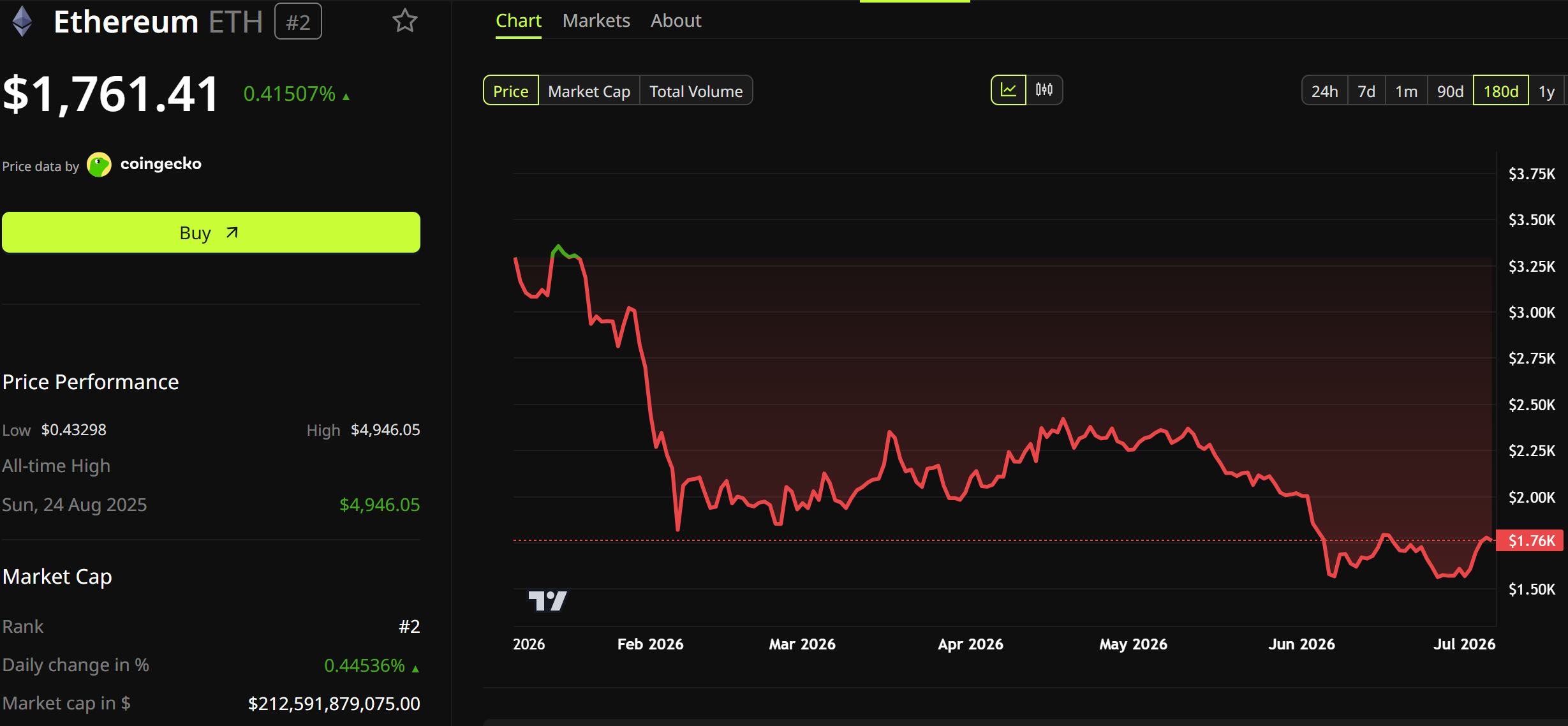
Ether (ETH) has fallen about 41% in 2026 to near $1,760. For now, its market price reflects a market waiting on delivery, not promises.
The post Vitalik’s Lean Ethereum Roadmap Draws Pushback on Its Timeline appeared first on BeInCrypto.
TLDR:
- Ethereum price prediction now centers on the $1,779 resistance level after ETH gained 4.73% and moved back near a critical short-term range.
- ETH reclaimed attention after moving above $1,750, while traders now watch whether the level can hold as support in the coming sessions.
- Whale activity, Binance outflows, and spot ETF interest are improving sentiment, although weak network activity still limits bullish conviction.
- A break above $1,779 could open the way toward $1,850 to $1,900, while a drop below $1,633 may renew downside pressure.
Ethereum price prediction has turned sharply toward the $1,779 resistance zone after ETH rose 4.73% to $1,690.61 in the latest session. The move came as traders watched whether Ethereum could hold above the recently reclaimed $1,750 area. Market analyst Ted says ETH could move toward $1,850 to $1,900 as long as that level holds.
Still, the rebound comes after a weak quarterly stretch. Ethereum has faced falling network activity, mixed ETF demand, and pressure below key moving averages. That makes the next resistance test important for short-term direction.
Ethereum Price Prediction Focuses on the $1,779 Barrier
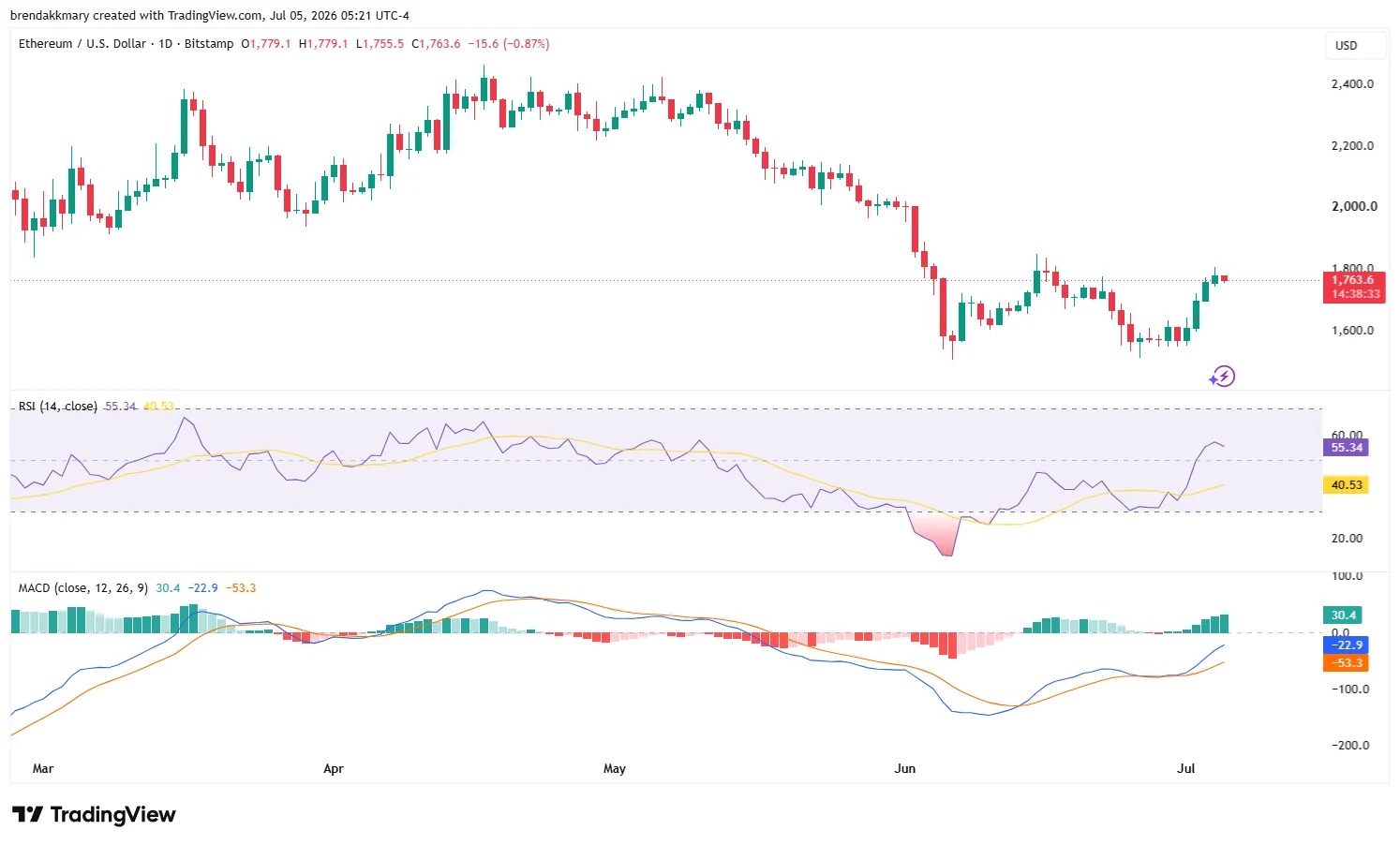
Ethereum price prediction now depends heavily on whether buyers can clear the $1,779 resistance level. That area aligns with the Ichimoku Kijun and sits close to the MA-20 at $1,775 and MA-50 at $1,756. A clean move above that cluster could shift the short-term structure.
The market is also watching the $1,753 zone. This level previously acted as support and now sits near the first major test for bulls. If ETH holds above it, traders may view the recent drop as a failed breakdown.
Meanwhile, the broader setup remains uneven. ETH has traded below several former support levels, including $1,925, $2,175, and $2,375. These zones may now act as resistance if the rebound extends.
Momentum signals are also split. MACD points to stronger buying pressure, while RSI near 55 shows Ethereum has not yet entered a clear bullish zone. CCI and Bull/Bear Power still lean bearish, suggesting sellers have not fully stepped aside.
That is why $1,779 matters. A breakout could invite fresh bids and short covering. Failure near that level may keep ETH trapped between $1,633 and $1,814.
Ethereum Price Prediction Weighed by Whales and ETF Flows
Ethereum price prediction is not only about chart levels. On-chain and institutional signals are also shaping the current setup. Large Ethereum holders added exposure near late June lows. That buying has supported cautious optimism among traders.

At the same time, Binance withdrawals reportedly reached a three-year high. Exchange outflows can reduce available supply, especially when paired with whale accumulation. This often supports bullish narratives when price starts recovering.
However, Ethereum still faces pressure from weak network activity. Active addresses have fallen sharply from early-year highs, raising questions about user demand. Since ETH powers activity across the network, lower usage can weaken the fundamental case.
ETF flows also remain mixed but the renewed spot ETF interest and June outflows showed institutional demand was not yet stable. That divergence keeps the market from forming a clean bullish view.
For now, ETH appears likely to trade inside a consolidation band between $1,633 and $1,814. A breakout above $1,779 would strengthen the case for a move toward $1,850 and $1,900. A loss of $1,633 would shift attention back to $1,500 and deeper support near $1,200.
Institutional sentiment has improved through whale activity, exchange withdrawals, and Ethereum adoption efforts. Yet buyers still need confirmation through price action. The next decisive signal sits near $1,779, where Ethereum must prove the rebound has enough strength to extend.

There seems to be a clear winner in terms of investors’ behavior toward crypto-based exchange-traded funds, and it’s not the two market leaders, BTC and ETH.
The financial vehicles tracking the performance of Ripple’s cross-border token continue to defy the overall market weakness with another week in the green. The HYPE ETFs also marked another positive week, but it was a significant decline from the previous one.
Ripple ETF Streak on Track
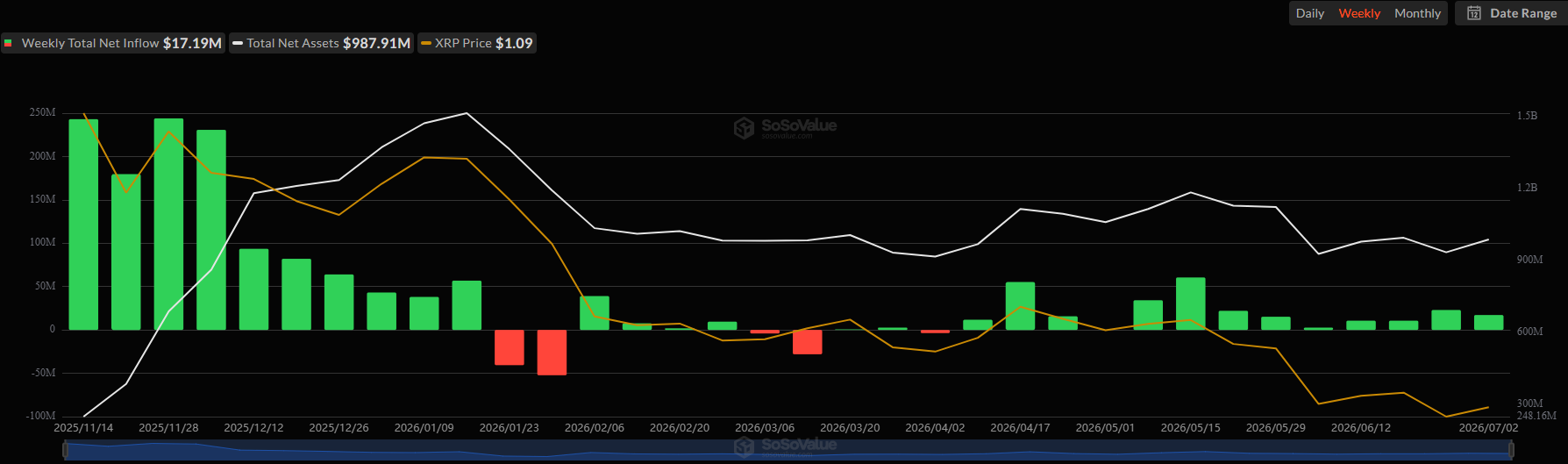
After the impressive end to the previous business week, in which investors poured $15.63 million into the spot XRP ETFs on Friday, hopes for another strong start were high. And the numbers provided by SoSoValue show that reality wasn’t far away, as another $15.34 million entered the ETFs on Monday.
However, the trend changed on Tuesday and Wednesday. Net withdrawals dominated, with investors pulling out $2.83 million and $1.86 million, respectively. This was a rare occasion since the funds have not seen too many red days lately despite the broader ETFs’ trend. The last one was a month ago, on June 3.
Moreover, the last time when there were two consecutive days in the red was nearly three months ago, in early March. However, unlike the events back then, the tides reversed once again, as the funds saw $6.55 million net inflows on Thursday (the last trading day of the week due to the July 4 holiday).
Consequently, the week ended well in the green again, with net inflows of $17.19 million. Thus, the spectacular streak of green-only weeks continues, as the last one (barely) in the red was in late April/early May.
Perhaps driven by the positive developments on the ETF scene, the underlying asset’s price has risen by over 8% in the past week and now sits close to $0.15.
HYPE ETFs Also in the Green
The HYPE ETFs also enjoyed the last full business week of June, seeing a massive net inflow of $111.36 million, which was by far the largest ever. Although the past four-day business week was also in the green, it was a lot more modest, with just $4.32 million entering the funds.
Nevertheless, the cumulative total net inflows sit at an all-time high of almost $300 million, despite the $3.01 million leaving the ETFs on Tuesday.
The post Ripple (XRP) Keeps Dominating ETF Flows, but Cracks Are Starting to Show appeared first on CryptoPotato.
Binance has seen a notable shift in recent activity, with weekly withdrawals jumping sharply—most prominently in Ethereum—as analysts point to a mix of potential accumulation demand and exchange-positioning pressures.
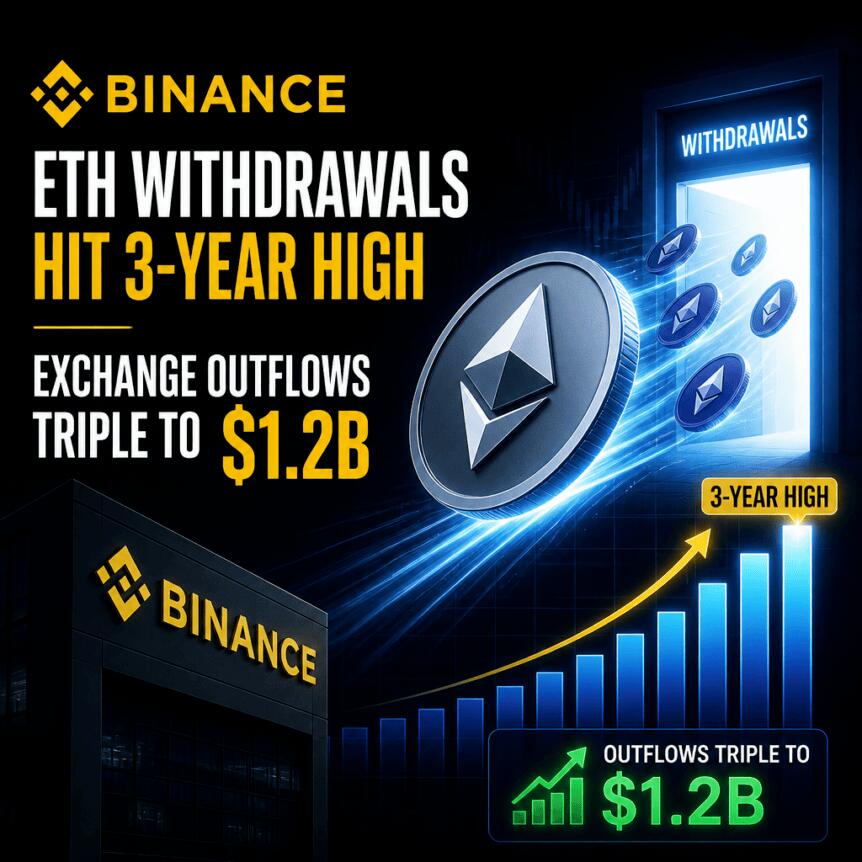
DefiLlama data reviewed by Cointelegraph shows Binance recorded $1.23 billion in net outflows during the week beginning June 29, up 207% from roughly $400 million the previous week. Net outflows for the month totaled about $3.2 billion, underscoring that the latest surge is part of a broader pattern rather than a one-off move.
Key takeaways
- Binance’s weekly net outflows rose to $1.23B for the week starting June 29, a 207% increase versus the week prior.
- Ethereum withdrawals accelerated, with CryptoQuant reporting more than 166,000 withdrawal transactions in a single day—its highest level in over three years.
- Flows coincide with an ETH rebound, with Ether up about 12.5% over the prior seven days to around $1,766 at the time of publication.
- Outflows dominated major CEXs across the board, while inflows were smaller and more fragmented among exchanges like Crypto.com and HashKey.
- CryptoQuant links withdrawal activity to uncertainty around EU MiCA implementation as well as short-term positioning.
Ethereum withdrawals surge alongside a broader outflow trend
While the exchange-wide outflow numbers are significant, the most closely watched element is the Ethereum side. CryptoQuant reported that Binance’s ETH withdrawal transactions reached their highest level in more than three years, logging over 166,000 withdrawals in a single day.
CryptoQuant also noted that this increase represents the sharpest rise in withdrawal transactions recorded on Binance since March 2023. That timing matters to traders because exchange withdrawals can be interpreted as capital leaving centralized order books—often associated with investors moving toward self-custody or decentralized participation, rather than immediate trading.
The broader timing backdrop appears supportive for the ETH narrative. According to CoinGecko, Ether was up roughly 12.5% over the past week, trading around $1,766 at the time of publication. CryptoQuant said the surge in withdrawals aligned with Ether’s modest rebound of around 10% over a two-day period.
Why withdrawals may matter: accumulation signals vs. positioning dynamics
CryptoQuant analysts acknowledged that not all withdrawal-driven activity points to the same intent. Some of the movement could reflect accumulation behavior—buyers converting exposure while pulling funds off exchanges.
In CryptoQuant’s assessment, the withdrawal spike could indicate demand building around the $1,500 area, with investors potentially choosing to take longer-term exposure by moving funds out of Binance. The analysts contrasted that scenario with short-term trading behavior, arguing that patterns like this often align more closely with accumulation than with rapid round-trips on centralized venues.
At the same time, CryptoQuant pointed to other plausible drivers, including regulatory uncertainty linked to the EU’s MiCA (Markets in Crypto-Assets) rulebook. Earlier coverage from Cointelegraph has highlighted ongoing implementation challenges and the complexity of meeting EU compliance deadlines for certain user groups as the regulatory transition progresses.
Other exchanges see net outflows, while inflows stay limited
The move on Binance does not appear isolated. DefiLlama data indicates that several other centralized exchanges also recorded net outflows over the same period.
Bitfinex posted $407.5 million in weekly outflows, followed by Gate with $214.3 million. OKX recorded about $87.1 million in net outflows, while Bybit logged roughly $78.4 million, according to DefiLlama’s figures cited by Cointelegraph.
On the inflow side, the picture was smaller and more distributed. Crypto.com and HashKey Exchange led net gains over the past week, adding around $63 million and $53.3 million, respectively. Additional inflows were recorded at KuCoin ($22.1 million), Gemini ($17.4 million), and Bitvavo ($15.8 million).
For investors, this cross-exchange imbalance can be a useful read: when outflows are concentrated among major venues while inflows are comparatively modest, it may suggest that liquidity is being removed from centralized systems rather than simply rotating between platforms.
Broader crypto market holds steady as ETH and BTC rebound
Ether’s recovery has been paired with firmer sentiment across the broader market. In addition to ETH’s weekly gains, CoinGecko data cited in the report shows Bitcoin up about 4.3% over the same period, trading around $62,925 at the time of publication.
That matters because exchange flow spikes—especially in a single asset like ETH—are often most meaningful when they align with market stabilization or rebounds, as opposed to occurring amid broad sell-offs. Still, the intent behind withdrawals remains the key uncertainty: the same on-chain-like movement away from exchanges can reflect either long-term positioning or short-term preparation ahead of known regulatory and operational changes.
Going forward, traders and long-term holders will likely watch whether Binance’s ETH withdrawal cadence remains elevated beyond this reported peak and whether the outflow trend spreads further or begins to reverse across major CEXs. With MiCA-related uncertainty still in focus, regulators’ practical impact on exchange behavior and user access could also shape the next phase of flows.
Crypto World
Bitcoin Price Prediction: Saylor’s Strategy is a Risk to Bitcoin, According to JP Morgan

JPMorgan has flagged a structural risk most Bitcoin price prediction bulls haven’t priced in: the same entity driving the most aggressive institutional accumulation on record could, under the wrong conditions, become a forced seller.
That tension is now a live market variable. Bitcoin is consolidating near critical technical support while analysts debate whether Saylor’s $150,000 year-end target or JPMorgan’s more measured models better reflect actual market mechanics, and the answer matters for anyone holding BTC into the second half of the year.
JUST IN: — Watcher.Guru (@WatcherGuru) July 2, 2026
 $4.7 trillion JPMorgan warns Michael Saylor's 'Strategy' is creating a new risk for the Bitcoin market. pic.twitter.com/WJZikYwEkw
JPMorgan’s warning centers on the Strategy’s financing structure. By layering convertible notes, preferred equity, and at-the-money offerings to fund Bitcoin purchases, Strategy has introduced a scenario where credit stress or equity dilution pressure could flip the company from net buyer to net seller. That’s a non-trivial tail risk given Strategy’s scale.
Saylor’s public posture remains unchanged: $150,000 by year-end, $1 million within four to eight years, $20 million over two decades, but the bank’s concern isn’t about Saylor’s conviction. It’s about what the market structure looks like if that conviction ever gets tested by margin mechanics.
This divergence between corporate accumulation narrative and institutional risk modeling is exactly the kind of signal that tends to matter at inflection points.
Bitcoin’s next directional move may hinge less on Saylor’s next purchase announcement and more on how the market digests that structural overhang. Macro liquidity conditions add another layer of complexity to an already crowded decision tree.

Discover: The Best Token Presales
Bitcoin Price Prediction: Can Bitcoin Price Reach $150K or Is a Drop to $55K the Real Risk?
$60,000 is the line to watch. That level is being treated as primary support by analysts tracking Bitcoin’s current consolidation phase. A hold keeps the recovery thesis intact. A breach does not.
The immediate reclaim zone sits between $62,000 and $64,000. Clearing that range with conviction puts $65,000 back in play, followed by $70,000, which has functioned as both resistance and magnet across multiple recent trading cycles.
Volume confirmation matters. Consolidation without volume expansion is noise, not signal.
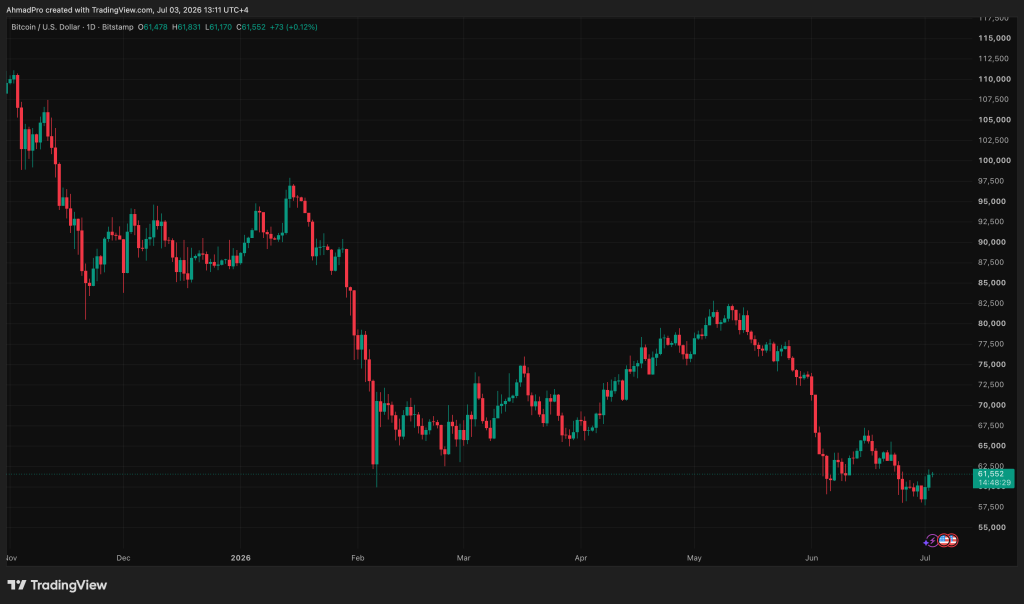
Bitcoin holding $60,000 and reclaiming $64,000 on volume reasserts the Saylor accumulation narrative as the dominant market frame. JPMorgan’s $170,000 short-term target and eventual $266,000 gold-parity estimate became the base case for institutional positioning.
If neither side takes control, a sideways grind between $60,000 and $65,000 continues as the market digests JPMorgan’s risk framing alongside continued Strategy purchases.
Choppy but not broken. A confirmed close below $60,000 opens a slide toward $55,000, where more bearish analyst models begin to look credible, and amplifies concerns about Strategy’s balance sheet resilience.
The setup is cautious consolidation, not a confirmed breakout. Patience over conviction is the disciplined read right now.
Don’t Miss Out on Our $1,000 USDT Airdrop on ByBit
Bitcoin Hyper Could be The Next 1000x in Crypto And Here is Why
Here’s the uncomfortable reality for spot BTC holders watching JPMorgan’s risk warning land: the upside scenarios above assume Bitcoin’s infrastructure can actually scale to support mass institutional and retail use.
At current throughput, it can’t. That gap between Bitcoin’s store-of-value narrative and its transactional limitations is where the next generation of infrastructure plays is being built, and priced at still-early valuations.
Bitcoin Hyper ($HYPER) is positioning directly in that gap. It’s the first Bitcoin Layer 2 integrating the Solana Virtual Machine, bringing sub-second finality and low-cost smart contract execution to the Bitcoin ecosystem without abandoning BTC’s security model.
The architecture includes a Decentralized Canonical Bridge for native BTC transfers and SVM-powered programmability that the team claims outperforms Solana itself on latency benchmarks. (Whether that holds at scale is the question every serious infrastructure investor should be asking before committing.)
The presale has raised $32,921,487.36 at a current price of $0.0136825, with staking active for early participants. As with any early-stage infrastructure presale, execution risk is real and timelines rarely hold.
The post Bitcoin Price Prediction: Saylor’s Strategy is a Risk to Bitcoin, According to JP Morgan appeared first on Cryptonews.
TLDR:
- Bitcoin protocol changes must secure overwhelming network agreement, Michael Saylor said, framing hard consensus as Bitcoin’s core defense layer.
- Saylor said fees price block space, nodes set policy, miners build blocks, and holders allocate capital across the Bitcoin network.
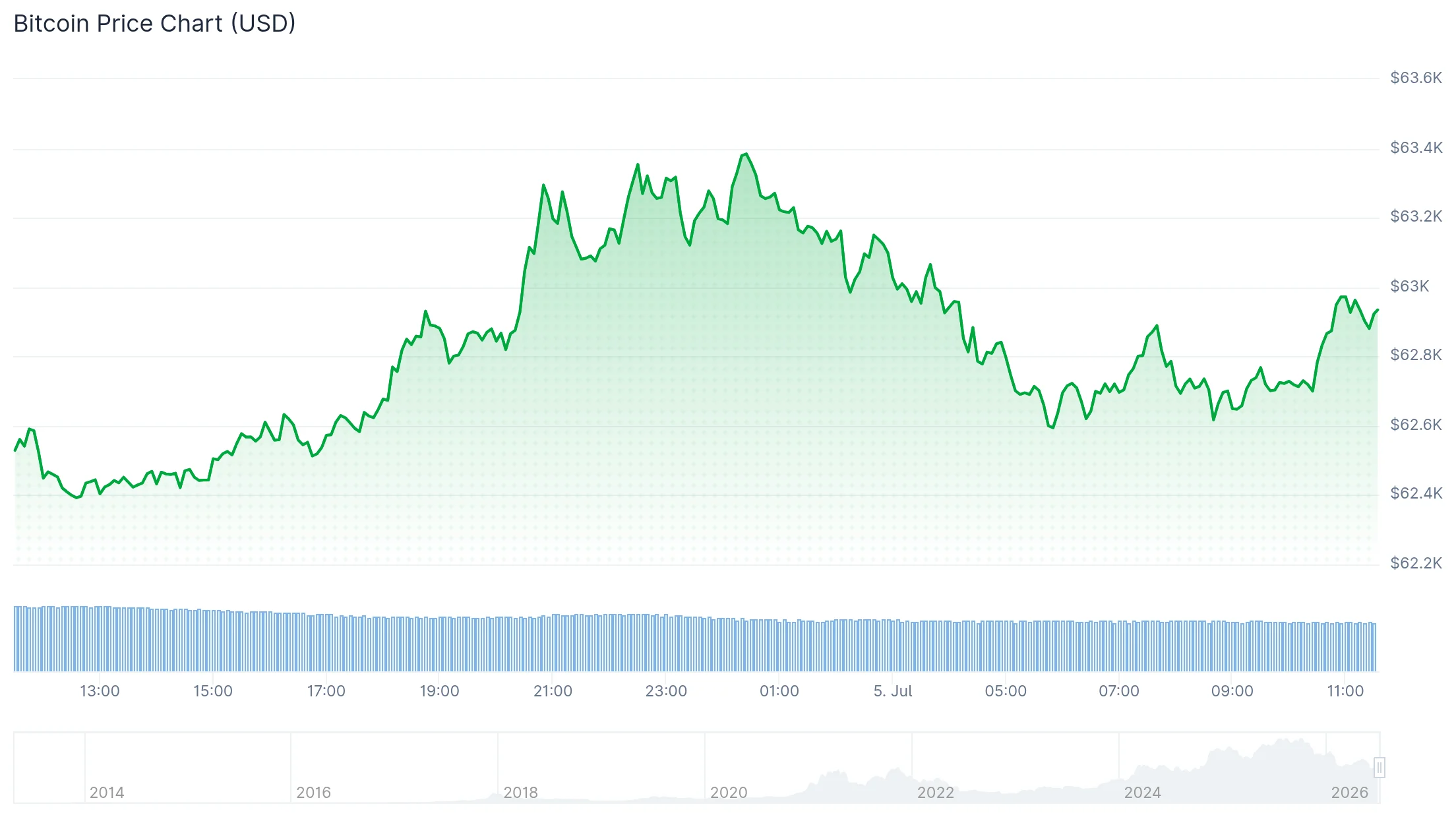
- Bitcoin traded near $63,000 after ETF inflows returned, giving BTC fresh support after a difficult stretch of market outflows.
- Options positioning still points to caution, with traders watching the $66,000 to $68,000 zone as a possible resistance area.
Bitcoin protocol changes need overwhelming alignment before gaining traction, Michael Saylor said in a fresh post on X. The Strategy chairman described hard consensus as Bitcoin’s “immune system,” arguing that weak ideas fail before reaching the protocol layer.
His comments came as BTC traded near $63,000, with the market recovering after renewed spot Bitcoin ETF demand. Current market data showed Bitcoin around $62,956, while U.S.-listed spot Bitcoin ETFs recently added $221.7 million in net inflows.
Bitcoin Protocol Changes Face a High Consensus Bar
Bitcoin protocol changes rarely move through the network without wide agreement. Saylor said transaction fees price block space, nodes set policy, miners build blocks, and holders allocate capital. That structure spreads power across several groups instead of one central authority.
The message focused on Bitcoin consensus rather than short-term price action. Saylor argued that every major change must earn support from participants who protect different parts of the system. In that view, the network rejects risky changes before they damage Bitcoin’s base rules.
This point matters as debates around scaling, fees, custody, and institutional adoption return to the market. Bitcoin protocol changes often attract attention when fees rise or when developers discuss upgrades. Yet Saylor’s view places durability above speed.
The argument also reflects Bitcoin’s long-standing governance model. Developers can propose code, but users and node operators decide what rules they accept. Miners can build blocks, yet they cannot force users to follow unwanted rules.
For holders, the appeal sits in predictability. Bitcoin’s fixed supply, settlement rules, and conservative upgrade culture support its store-of-value narrative. A fast-moving protocol may attract experiments, but Bitcoin relies on slow and broad agreement.
BTC Price Holds Near $63K as Options Cap Upside
Meanwhile, BTC price action added another layer to the story. Bitcoin moved back near $63,000 after ETF inflows ended a 10-day withdrawal streak. The inflow figure gave traders a cleaner demand signal after weeks of pressure.
The macro backdrop also helped risk assets. Weaker U.S. jobs data reduced pressure around rate expectations, while a softer dollar gave Bitcoin room to rebound. Still, derivatives data showed traders were not fully chasing upside.
Options positioning points to a key zone near $66,000 to $68,000. According to Laevitas data, a large July 17 BTC call-condor trade profits most if Bitcoin sits inside that range.
That setup does not guarantee resistance, but it can shape short-term positioning. Traders often watch large options structures as price moves toward expiration. A clean break above $68,000 would weaken that ceiling.
For now, Bitcoin consensus and market structure are moving through separate lanes. Saylor’s comments focus on the protocol’s defense against harmful changes. Traders are watching ETF flows, options hedges, and whether BTC can hold above $62,000.
Binance, the world’s largest crypto exchange by trading volumes, recorded a sharp surge in weekly outflows as Ethereum withdrawal activity climbed to a multi-year high.
According to DefiLlama data viewed by Cointelegraph on Sunday, Binance saw $1.23 billion in net outflows during the week beginning June 29, a 207% increase from roughly $400 million the week prior, while monthly net outflows totaled about $3.2 billion.
Separately, blockchain analytics platform CryptoQuant on Friday reported that Binance’s Ethereum withdrawal transactions hit their highest level in more than three years, with over 166,000 withdrawal transactions in a single day.
While some of the movement may reflect accumulation behavior, CryptoQuant analysts pointed to regulatory uncertainty stemming from the European Union’s Markets in Crypto-Assets (MiCA) regulation and short-term market positioning as possible drivers.
ETH outflows vs price rebound
Binance’s ETH withdrawals marked the sharpest increase in withdrawal transactions recorded on Binance since March 2023, coinciding with Ether posting a modest rebound of around 10% over a two-day period, CryptoQuant said.
“This surge in withdrawals could reflect genuine demand building around the $1,500 level, with investors choosing to take exposure and pull their funds off the exchange, a pattern that typically points toward longer-term accumulation rather than short-term trading,” the analysts said.
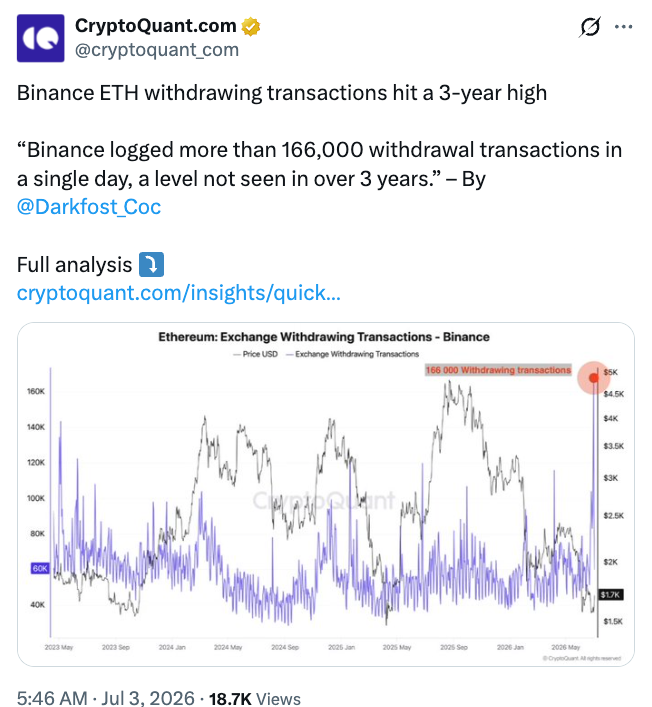
Source: CryptoQuant
Ether prices showed a broader recovery over the past week. According to Coingecko data, ETH rose about 12.5% over the past seven days, trading at $1,766 at the time of publication.
Related: Bitcoin profit and loss ratio falls to 43-month low
Bitcoin, the largest cryptocurrency by market capitalization, also edged up 4.3% over the same period, trading at $62,925 at the time of publication.
Outflows dominate CEXs while inflows remain fragmented
Apart from Binance, several other centralized exchanges (CEXs) also recorded outflows over the past week.
Bitfinex saw $407.5 million in outflows, followed by Gate at $214.3 million. OKX recorded $87.1 million in outflows, while Bybit posted $78.4 million, according to DefiLlama data.
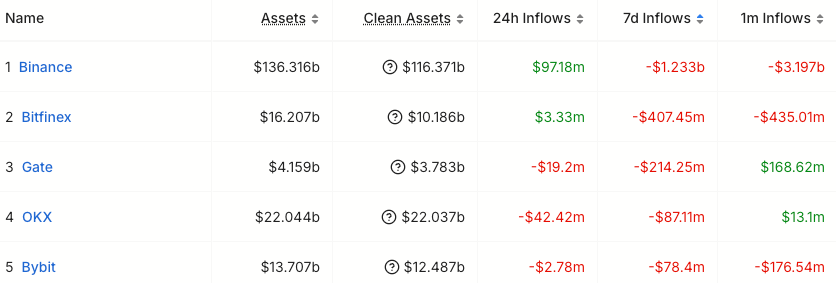
Top five exchanges sorted by weekly net flows. Source: DefiLlama
On the inflow side, Crypto.com and HashKey Exchange led gains over the past week, recording around $63 million and $53.3 million in net inflows, respectively.
Smaller inflows were also seen across KuCoin at $22.1 million, Gemini at $17.4 million, and Bitvavo at $15.8 million over the same period.
Magazine: Bitcoin copying 2022 ‘almost perfectly,’ Ether to $4K in 2026: Market Moves
Bitcoin’s gradual price recovery that began after the early July correction continues, as the asset briefly exceeded $63,000 yesterday and now stands around that level.
Most larger-cap alts remain relatively sluggish on a daily scale, aside from SOL, HYPE, and XLM, which have dropped by up to 4%, and ADA and BCH, which have posted notable gains.
BTC Eyes $63K
June was quite painful for the primary cryptocurrency, as it dropped by over 20%. July began on a similar note, as the asset dipped below $58,000 to chart a new multi-year low. However, the bulls finally intervened at this point and didn’t allow another leg down.
Just the opposite; bitcoin started to recover some ground and quickly reclaimed the $60,000 mark. After a brief dip below that line, the bulls went on the offensive once again, pushing the asset to $62,000 as the net withdrawals from the ETFs eased and investors poured some money in on Thursday.
BTC remained calm at above $61,000 and jumped once again on Saturday and earlier this morning, going to a multi-week peak of $63,400. Although it was stopped there, it now trades close to $63,000, posting a near 5% increase on a weekly scale.
Its market capitalization has risen to $1.260 trillion on CoinGecko, but its dominance over the altcoins remains well below 57%.

LAB Rockets
Ethereum was stopped at $1,800 yesterday and now sits at just over $1,760. BNB’s run couldn’t reclaim $580, and the asset trades below that level now. XRP is under $1.15, while SOL is testing the $80 support after a 2.4% daily decline.
HYPE and XLM have dropped even harder, with a 4% decrease from the former and a 3.4% dip from the latter. In contrast, ADA continues its recovery with another 9% surge to well over $0.19. BCH is up by around 6% and sits at $240.
LAB is by far the top gainer today, having skyrocketed by 80%. The asset, which has seen some intense volatility as of late, now trades at over $16.
The total crypto market cap has increased slightly from yesterday and now sits at $2.230 trillion on CG.

The post Viral Altcoin Skyrockets by 80% Daily, Bitcoin (BTC) Flirts With $63K: Market Watch appeared first on CryptoPotato.

Key Highlights
- Ethereum’s co-founder Vitalik Buterin has announced the “Lean Ethereum” initiative, a comprehensive upgrade plan spanning 2026 through 2029 with changes comparable to the 2022 Merge
- Quantum defense has been significantly elevated as a priority concern, with immediate focus on developing quantum-resistant blob architecture
- Privacy features are transitioning from optional add-ons to fundamental layer-1 protocol components
- Developers are considering implementing a secondary virtual machine—either leanISA or RISC-V—to complement the current EVM
- Skeptics express concern about the Ethereum Foundation’s track record of meeting projected deadlines
Vitalik Buterin, Ethereum’s co-creator, has released an extensive strategic roadmap dubbed “Lean Ethereum” that outlines the network’s evolution through the end of the decade. The comprehensive blueprint addresses fundamental protocol changes across multiple technical layers.
The announcement came via X on Saturday, with Buterin outlining a three-to-four-year implementation timeline. He drew parallels to the transformative September 2022 Merge that transitioned Ethereum from proof-of-work to proof-of-stake consensus.
This strategic vision emerged from collaborative discussions at a Berlin research summit, where core developers and technical researchers convened to reassess the network’s long-term trajectory.
Quantum Threats Drive Accelerated Defense Timeline
A notable recalibration in priorities involves quantum computing resistance. Buterin emphasized that quantum defense “has shifted up a LOT in priority,” characterizing the development of quantum-resistant blob infrastructure as “urgent.”
The strategic blueprint mandates elimination of all quantum-susceptible elements throughout the protocol stack. Engineers have already initiated development on quantum-secure blob architecture.
Additionally, the roadmap introduces recursive STARKs as fundamental layer-1 infrastructure, superseding the existing direct re-execution verification methodology.
Privacy Elevated to Protocol Foundation
Privacy capabilities have been promoted from supplementary features to essential layer-1 objectives. Buterin noted this now encompasses critical areas including mempool architecture and state tree structure.
This represents a fundamental architectural transformation. Historically, privacy functionality within Ethereum existed primarily at the application tier rather than being embedded in the base protocol.
The roadmap also contemplates introducing an alternative virtual machine. Buterin suggested Ethereum might deploy leanISA or RISC-V parallel to the existing EVM, ultimately aiming for a more streamlined and efficient protocol foundation.
Regarding consensus mechanisms, the plan aims to achieve one- to two-round finality by separating the availability chain from finality processes. This approach seeks to enhance security while minimizing latency.
For state management, Buterin indicated Ethereum will maintain its current dynamic state architecture while incorporating additional state categories to boost scalability. Projections suggest that by 2030, Ethereum will manage 2 TB of dynamic state alongside 100 TB of newer state formats. Transitioning applications such as tokens and NFTs to these new state structures could reduce transaction costs by over tenfold.
Implementation Timeline Faces Scrutiny
The proposed timeline has generated skepticism within the community. Researcher Dankrad Feist, while endorsing the strategic direction, argued that the three-to-four-year timeframe is unnecessarily prolonged, proposing that AI-assisted development tools could compress delivery to one year.
Crypto analyst Ignas Fiodorovas similarly supported the roadmap’s objectives but questioned the Ethereum Foundation’s capacity to honor its commitments, citing historical precedents of missed deadlines.
Fiodorovas also identified a critical omission: enhanced tokenomics for Ether itself, which has experienced sustained price depreciation throughout recent market turbulence.
This roadmap follows the Ethereum Foundation’s decision last month to reduce headcount by approximately 20%, part of a broader 40% budget contraction. Several prominent contributors have also exited recently, including protocol developers Tim Beiko and Barnabé Monnot.
TLDR:
- Ripple XRP donation support is tied to America250s Giving 4th campaign, with the company matching eligible gifts in XRP up to $10,000.
- Donors can contribute through cash, stock or crypto, while XRP and RLUSD are listed among the accepted digital assets for the campaign.
- The Call of Duty Endowment says CODE4Vets supports groups that prepare veterans for civilian jobs and raise employer awareness.
- The campaign connects July 4 charitable giving with veteran employment, as the Endowment targets 200,000 job placements by 2030.
The Ripple XRP donation campaign has placed crypto philanthropy in the Independence Day spotlight. Ripple joined America250s Giving 4th effort on July 4 and pledged to match eligible donations in XRP, up to $10,000. The campaign supports the Call of Duty Endowment and its CODE4Vets initiative, which focuses on helping veterans enter civilian careers.
Donors can give cash, stock or crypto, with XRP and RLUSD accepted for eligible contributions. America250 launched Giving 4th in June as a national effort to turn July 4 into a broader day of charitable giving.
Ripple XRP Donation Match Ties July 4 to Veteran Jobs
Ripple announced its Giving 4th participation as the U.S. marked its 250th Independence Day. The move links a civic campaign with a veteran employment fundraiser rather than a direct market update for XRP.
The Ripple XRP donation match applies to contributions made through the Call of Duty Endowment campaign page. Ripple said it would match donations in XRP until the total match reaches $10,000. The campaign page also lists XRP and RLUSD among accepted crypto options.
CODE4Vets is powered by the Call of Duty Endowment. Its stated work centers on funding effective nonprofits that help veterans return to work. It also raises awareness among employers about the skills veterans bring after service.
The Endowment says it has funded more than 165,000 veteran job placements. It has also set a goal of reaching 200,000 placements by 2030. That target gives the fundraiser a measurable employment angle beyond a one-day giving push.
Ripple XRP Donation Adds Crypto Utility to Giving 4th
The Ripple XRP donation pledge also gives XRP and RLUSD another real-world use case through charitable giving. Donors are not limited to crypto, since the campaign also accepts cash and stock. Still, crypto support allows digital asset holders to take part without first converting funds elsewhere.
America250 described Giving 4th as a nationwide initiative designed to support nonprofits around Independence Day. The group said the campaign responds to the summer slowdown many nonprofits face in midyear fundraising.
For Ripple, the campaign arrives as blockchain firms continue pushing digital assets into payments, donations and tokenized finance. The company has already worked with crypto donation platforms and promoted RLUSD for charitable use in past campaigns.
The Ripple XRP donation match remains capped at $10,000, so the final company contribution depends on donor activity. The fundraiser had a stated $10,000 goal, while progress will move through the campaign page as eligible donations come in.

Transfer news LIVE: Arsenal FC deal agreed, Rogers twist; Man Utd want Tchouameni; Chelsea move; Liverpool latest

Somnigroup: How It Plans To Dominate The Mattress Market (NYSE:SGI)

7 Animated Movie Trilogies Where Every Film Is a Masterpiece


-

 Fashion2 days ago
Weekend Open Thread: High Hopes
-

 Politics2 days ago
The House | “Reframing the debate from a binary discussion of winners and losers”: Yuan Yang reviews ‘We Are Not Machines’
-

 Crypto World5 days ago
Strategy authorizes up to $1.25B in Bitcoin sales under new capital plan
-

 News Videos7 days ago
MAJOR BITCOIN & MARKET UPDATE!!!! (MUST WATCH ASAP!!!)
-

 Tech5 days ago
Anonymous researcher drops 0-day ‘exploitarium’ repo
-

 Business5 days ago
Australia treasurer says alleged access of prime minister’s bank data ’incredibly concerning’
-

 News Videos5 days ago
How to Build INSANE Live Financial Dashboards With Claude
-
 NewsBeat6 hours ago
Taylor Swift and Travis Kelce wedding staffer hilariously struggles to keep her cool while checking in megastars
-
 Business6 days ago
The AI boom won’t burst all at once. It will pop in ‘rolling bubbles’: Macquarie
-

 Sports4 days ago
Broncos roster: OL Ben Powers (No. 74) entering final year of contract
-

 NewsBeat4 days ago
Presenter Caroline Flack’s brother Paul Flack dies aged 55
-

 Crypto World3 days ago
Binance stock trading tops $1B in first month after launch
-

 Crypto World3 days ago
Alibaba-affiliate Ant Group enters the humanoid robot market with 12 deals
-
 NewsBeat3 days ago
New exhibition reflects five decades of movement between island of Ireland and GB
-

 Business2 days ago
What a 10 Percent Drop Means for Buyers, Sellers and Renters
-

 Business3 days ago
Meta Platforms Stock Jumps 7% Today as Bloomberg Reports Company Plans to Enter the Cloud Business
-
Crypto World4 days ago
Airdrop Registration Becomes Key Focus For Remittix As RTX Launch Updates Approach
-

 Crypto World2 days ago
Binance Re-Enters Philippines As EU MiCA Rules Restrict Access
-

 Crypto World2 days ago
Standard Chartered Secures MiCA License as ESMA Adds 37 New Crypto Firms
-

 Tech6 days ago
The attack that hijacked Claude Code came through Sentry. Datadog, PagerDuty, and Jira have the same exposure.
You must be logged in to post a comment Login