
Crypto World
Bill Pappas Is one of TIME’s 2026 Executives of the Year: Tech and Data


After overseeing 150-year-old insurance giant MetLife’s multi-year, $3.2 billion modernization initiative, Bill Pappas turned his focus to AI. In two years, the effort has moved the numbers that matter: faster claims adjudication, lower expenses, better customer experience. “AI is not technology-led; it’s CEO-led,” Pappas says. “It’s changing the way we look at efficiency, at individual productivity, and our growth.” He’s just as focused on defense: he also built a team to “use AI to protect against AI,” aware that the same tools unlocking value are dangerous in the hands of threat actors.
Pappas says his biggest lesson in managing a workforce spanning five generations in the AI era came from an unexpected place: climbing Mount Kilimanjaro with his two adult daughters. He had a fixed process in mind; they improvised better than he did. “This whole thing is about learning, unlearning, and relearning,” he says. It’s the mindset he now encourages among his more than 38,000 technology and operations staff.


Depop is known as an online marketplace for secondhand clothes—but for the Gen-Z fashionistas who congregate there, it’s also a community. With more than 56 million registered users and over 68 million items for sale, it’s a big community, to be sure. But user quality is just as important as user quantity, argues chief technology officer Keyur Govande.
Given that dual users tend to be more active and engaged community members, Govande, who joined the company in May 2025 after more than 14 years at Etsy, is focused on building tools that help buyers become sellers and vice versa. “It’s the two-sided nature of our marketplace that makes us really special,” he explains, citing as a prime example the company’s listing flow, which saves time and effort by using AI to automatically generate listing titles and descriptions based on merchandise photos.
To reduce user friction even further going forward, Govande plans to leverage Depop’s new relationship with eBay, which acquired the company in July. “The ways eBay can support us with its deep expertise in things like shipping and payments is something we’re really looking forward to,” he says.


At a moment when emerging technologies are driving both the global economy and the news cycle, business leaders must not only keep up with an industry moving at a breakneck pace—they must look around the corner at what’s next. That’s why TIME is publishing its first-ever Executives of the Year: Tech & Data list, recognizing 50 leaders shaping the future of technology, artificial intelligence, cybersecurity, and digital innovation across industries.
See the full 2026 list here.
Among them are Bartley Richardson, CrowdStrike’s chief AI and autonomous systems officer, who is heading up a new AI research lab dedicated to building autonomous cybersecurity systems, and Reddit chief technology officer (CTO) Amit Puntambekar, who is shepherding AI adoption at one of the internet’s largest repositories of human conversation. At pharmaceutical giant Eli Lilly & Co., Diogo Rau oversaw the effort to build a supercomputer called LillyPod, which models biological processes and screens potential molecules before promising candidates enter wet lab experiments. Meanwhile, at OpenAI, Vijaye Raji, CTO of applications, is in charge of key technical teams—such as data, experimentation, and growth—that help power the ubiquitous ChatGPT, as well as the coding tool Codex.
To create the list, our editors and reporters across the newsroom evaluated the scale of each leader’s responsibilities, the significance of the investments and initiatives they oversee, and their demonstrated impact on how their organization operates, competes, and grows. What came together was a group of executives tasked with modernizing legacy systems and digital infrastructure. Those leaders include Monica Caldas, Liberty Mutual’s global chief information officer, who is rewiring the century-old insurance company for what she calls “the intelligence era,” and Ogi Redzic, who joined Caterpillar Inc. as SVP and chief digital officer in 2018 and has helped the equipment manufacturer rebuild itself around data to address customers’ labor and safety issues.
The list also highlights the creation of new or expanded roles designed to meet the fast-evolving moment. There’s Kathleen Grace, named Lionsgate’s first-ever chief AI officer in February and the first Hollywood studio executive to hold that particular title, as well as Delta’s Amala Duggirala, who joined the airline in January as EVP and chief digital and technology officer—a brand-new role overseeing its recently combined digital and technology organizations, encompassing both the enterprise technology that powers its global operations and the digital tools it creates for customers and employees alike.
Beyond the U.S., tech executives across Asia, Africa, and Europe are driving innovation. At Singapore-based Grab, CTO Suthen Thomas Paradatheth has helped the company transition from a ride-sharing platform to a superapp that processes millions of transactions a day across Southeast Asia. Felix Ike, co-founder and CTO of the Nigerian fintech company Moniepoint, has helped to establish the business as one of Africa’s leading financial platforms. At Paris-based Back Market, a global online marketplace for refurbished electronics, CTO Dawn Baker is applying an environmental mission to the company’s use of computing power. “We have to make sure we’re not using more than we need,” she says. “It’s about using AI smartly and not falling for the hype.”
These leaders and their fellow honorees are the catalysts of some of the most consequential transformations taking place across modern enterprise—translating innovation into meaning.


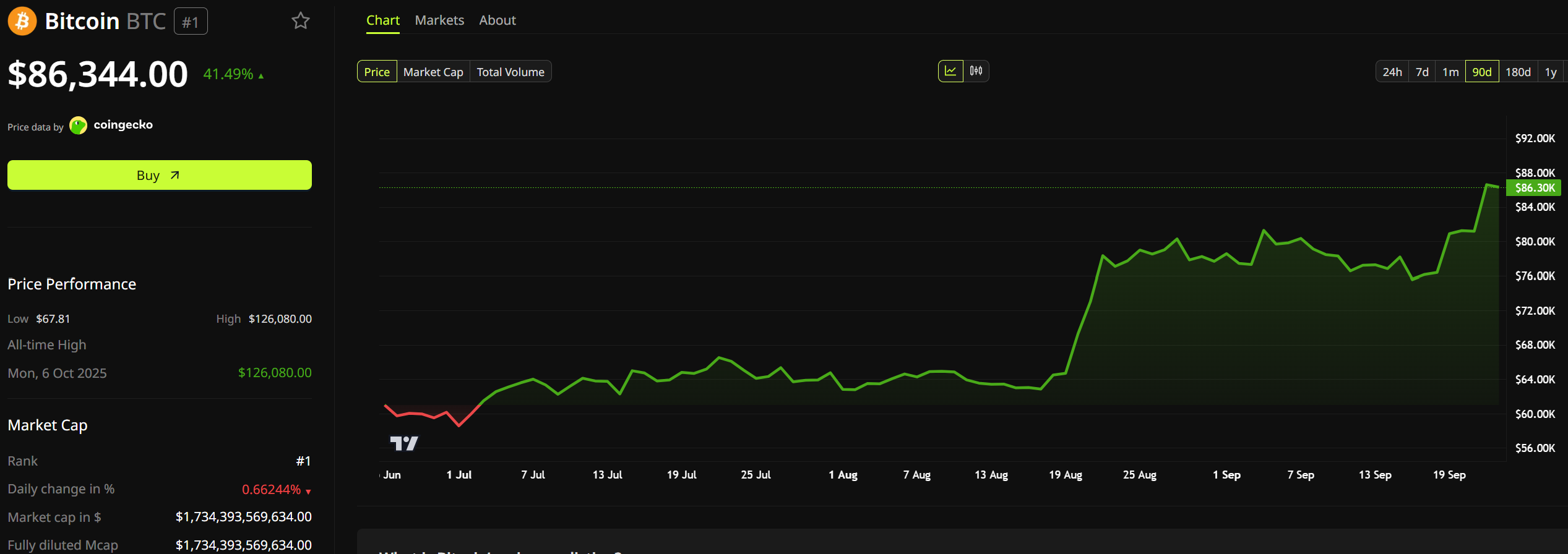
Bitcoin (BTC) traded at $86,423 on Tuesday, up from below $76,000 a week ago. Tom Lee and iTrustCapital’s CEO, Kevin Maloney, say the worst is now behind investors.
Both men made their case after a US interest rate hike and a failed crypto bill, the CLARITY Act. Neither event stopped the pioneer crypto’s rebound.

iTrustCapital CEO Says the Crypto Winter Is Over
Maloney runs iTrustCapital, a platform for crypto and stock investing in retirement accounts. In an interview with Paul Barron, he said the long crypto slump, often called the “crypto winter,” had ended.
His firm was holding about $350 million in idle client cash, Maloney said. He added that “significant portions” were now being invested again.
“Bitcoin doesn’t need Clarity Act,” Maloney said in the interview.
Maloney also named a level to watch. A weekly close above $85,000, he said, would leave Bitcoin in a good position.
Tom Lee Says the Fed Cannot Get More Hawkish
Elsewhere, Fundstrat Capital chief investment officer Tom Lee sees the rate hike as a peak, not the start of a squeeze. He has made that call repeatedly this month.
In his weekly update, Lee pointed to a change in how the government measures inflation, due September 30. He said economists expect it to cut the Personal Consumption Expenditures (PCE) inflation rate, the Fed’s preferred gauge, from 3.4% to near 3%.
“They can’t get any more hawkish than this,” Tom Lee stated.
Lee added that even one more 0.25-point hike would not break the economy or the stock market.
Their Remarks Come After Two Setbacks in One Week
On September 15, the CLARITY Act failed a Senate procedural vote 50-49, short of the 60 needed. The bill would have set out which US regulator oversees digital assets.
A day later, the Federal Reserve raised its benchmark rate by 0.25 percentage points to a 3.75% to 4% range. It was the first increase since 2023. Bitcoin slipped below $76,000 after the vote. It has since recovered.

Fed Projections and ETF Outflows Point the Other Way
Not every signal agrees. Sixteen of 18 Fed officials expect another hike this year, according to the central bank’s projections.
Investors also pulled $450 million from Bitcoin exchange-traded funds (ETFs) on September 15, according to ETF fund flow figures.
Bitcoin sits 0.6% higher on the day, BeInCrypto price data shows. The next test arrives September 30, when the revised inflation figures land.
The post Tom Lee and iTrustCapital CEO Say the Worst Is Over: Can Bitcoin Hold $86,000? appeared first on BeInCrypto.
Crypto World
Democrats ‘chose visceral hatred for’ Donald Trump over crypto Clarity Act, Lummis says
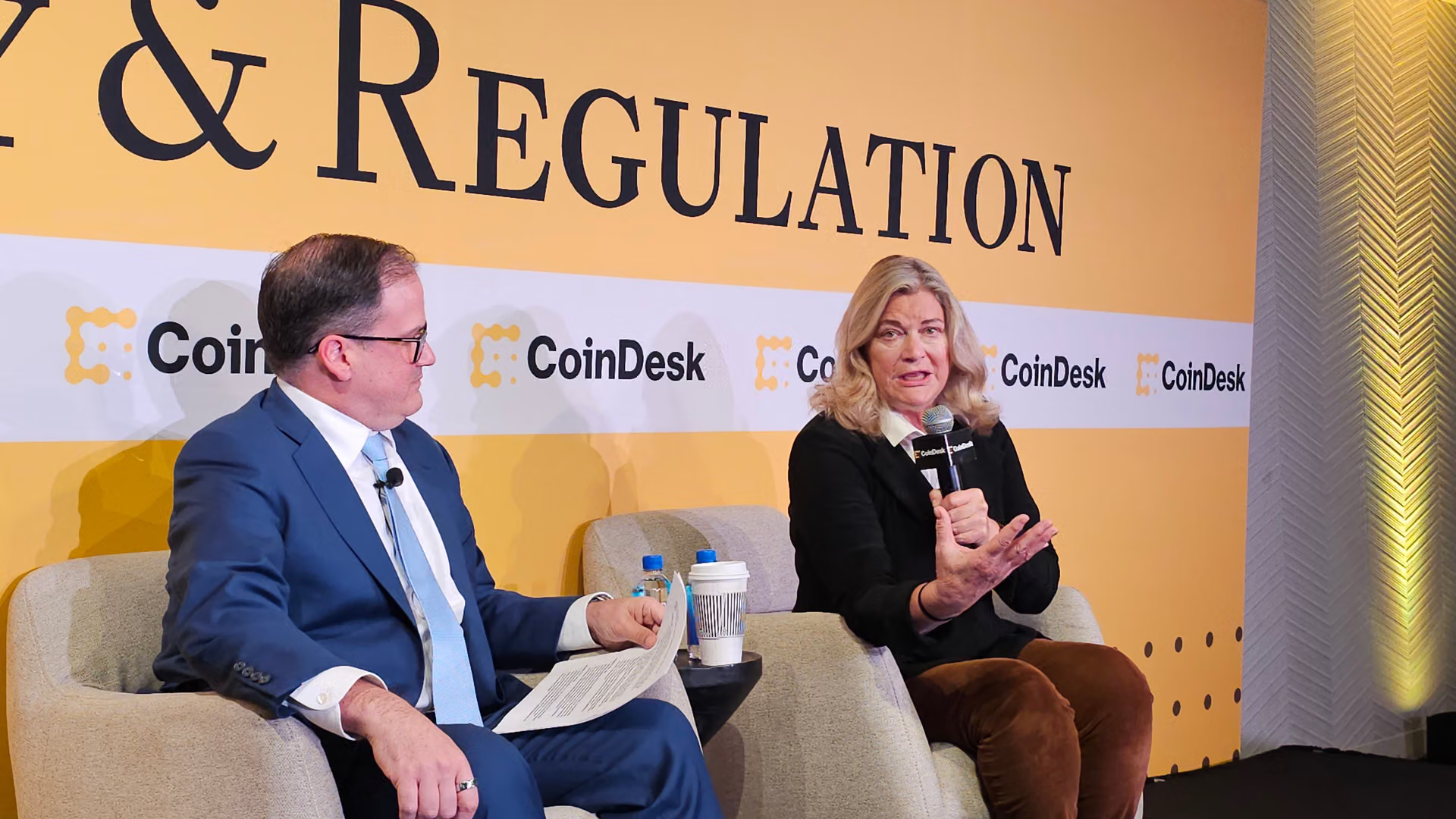
WASHINGTON, D.C. — Senator Cynthia Lummis said she was “dismayed, dumbfounded and saddened” that the Senate couldn’t advance a key procedural vote for crypto market structure legislation last week.
Lummis blamed Democrats for the bill’s failure at an appearance Tuesday at CoinDesk’s Policy & Regulation event, saying that while the bill was the result of negotiations between members of both parties.
“The problem was, as I see it, Democrats hate President [Donald] Trump more than they like good policy, and the way I see it is they chose their visceral hatred for President Trump and denied the opportunity to pass important policy legislation before a midterm,” she said. “They chose that … pin it on the Democrats.”
The bill itself was a bipartisan product which grew from some 300 pages to over 600, she said, after Democrats asked for provisions addressing issues like bankruptcy protections, among other items.




Crypto World
Trump Administration to Cancel Obamacare Coverage for 760,000 Enrollees Over Alleged Fraud

A poll conducted by health policy research group KFF in June found that most voters believe there is at least some fraud in government health programs, and that more than 70% feel it is an extremely or very important issue for candidates to discuss ahead of the midterm elections. For Republican voters, fraud topped all health care issues asked about in the survey, including costs.
But health care costs, which have become increasingly expensive in the U.S. in recent years, weighed more significantly for voters overall, and the poll found that only a minority of those surveyed believed that reducing fraud in government programs would reduce such costs for them personally.
Amid the Trump Administration’s moves to withhold millions in Medicaid payments, 71% also voiced the belief that preserving access to coverage through the insurance program was more important than rooting out fraud. Meanwhile, 65% believed that the Administration’s Medicaid payment deferrals were mostly politically motivated.

Prometheum has detailed how international investors would hold, redeem, and receive legal protection for tokenized US stocks under a proposed distribution arrangement involving HashKey and Velocity Capital.
Summary
- Cede & Co. would remain the registered owner of the underlying shares held at DTC.
- International customers would receive securities entitlements protected under UCC Article 8.
- Investors could convert their tokens into conventional shares or sell their positions for cash.
- The proposed pilot remains subject to final agreements, regulatory clearance and technical integration.
Tokenized US stocks will use existing ownership rules
Prometheum co-CEO Aaron Kaplan told crypto.news that the proposed structure would operate through the indirect holding system established under Article 8 of the Uniform Commercial Code, rather than making each tokenholder the registered shareholder on a company’s official books.
Cede & Co., the nominee used by the Depository Trust Company, would remain the registered owner of the underlying shares. Kaplan said tokenization would not change that arrangement, which is already used for nearly all publicly traded US equities held through brokerage accounts.
Within the planned structure, the participant connected to a registered blockchain wallet would hold the securities entitlement. Acting as a securities intermediary, the participant would then treat its customer as an entitlement holder under Article 8.
“The Token itself does not create or define the customer’s ownership interest,” Kaplan said.
According to Kaplan, the customer’s rights would instead come from the participant’s duties under Article 8, the Securities and Exchange Commission’s Customer Protection Rule and the Securities Investor Protection Act. Each protection would apply independently of the blockchain used to represent the position.
Kaplan’s explanation draws a distinction between appearing as the registered owner and holding a legally protected interest through an intermediary. Under the proposed system, an international customer’s name would not replace Cede & Co. on the issuer’s official shareholder record, but the customer would have an entitlement through the regulated custody chain.
A recent ownership review found that blockchain records alone do not turn stock-linked tokens into legal shares. The legal structure can instead give an investor a direct or beneficial interest in a security, a custodial claim, or only a contract tied to its market price.
The structure differs from synthetic and SPV products
Kaplan said synthetic or special-purpose vehicle structures place investors in a different legal position because an offshore entity may own the conventional shares while a customer holds only a contractual claim against that entity.
In a synthetic product, the token can track the price of a listed stock without giving its holder rights in the underlying company. An SPV-backed product may hold real shares, but the tokenholder’s claim can run against the separate legal entity rather than through the established US securities holding system.
Prometheum, HashKey Digital Asset Group and Velocity Capital intend to use shares custodied at DTC as the assets behind the proposed tokens. The companies described each token as a digital twin of a conventional security rather than a synthetic instrument or an offshore wrapper.
Kaplan said the planned model would preserve the legal protections attached to securities held through SEC-registered broker-dealers. Prometheum Capital is registered with the SEC and belongs to the Financial Industry Regulatory Authority, while Velocity is an SEC-registered, FINRA-member broker-dealer with traditional securities clearing and execution permissions.
The ownership question has also entered current US policy. Under a five-year SEC exemption announced on Sep. 17, qualifying tokenized National Market System stocks must provide the same rights as their conventional counterparts, including applicable voting, dividend, and liquidation rights. Synthetic products offering only price exposure do not qualify under the order.
As previously reported on investor rights, the SEC framework also allows an issuer to object when an unaffiliated party seeks to offer a tokenized version of its shares. The regulator can modify the temporary exemption while it considers permanent rules for onchain securities trading.
Prometheum’s arrangement concerns international distribution rather than an offer to US investors. HashKey would provide access through eligible licensed exchanges in several jurisdictions, subject to local laws, licensing terms and investor eligibility requirements.
Investors could redeem tokens through standard DTC processes
For an investor seeking to leave the blockchain-based position, Kaplan said each token could be converted into a conventional share or sold for cash through the broker-dealer. Both routes would use DTC’s standard securities processes because the corresponding shares would already sit within its custody system.
“Each token is a digital twin of a share already held at DTC, and investors can convert the token position back into a conventional share or sell it for cash through the broker-dealer, using DTC’s standard processes,” Kaplan said.
Dividends, stock splits and other corporate actions would also move through the same DTC channels used by the US securities market, according to Kaplan. His comments did not set out separate procedures for voting or for processing corporate actions when a token trades outside regular US exchange hours.
In the event of a broker-dealer failure, Kaplan said SEC Rule 15c3-3 would require customer securities to remain separate from the firm’s own property. Segregated shares could then be returned to customers rather than becoming part of the failed company’s estate.
SIPA provides another layer of protection within the US broker-dealer system, although the proposed international distribution chain would also involve HashKey exchanges operating under the rules of their respective jurisdictions. The binding memorandum does not itself establish the treatment of customer claims under every participating country’s insolvency law.
Traditional market infrastructure has begun supporting other tokenized investment products. On Sep. 16, Ondo Finance subsidiary Oasis Pro Markets joined DTCC’s Fund/SERV, becoming the first tokenization platform admitted to a network that processes more than 85% of US mutual fund transaction activity.
Oasis Pro, like Prometheum Capital and Velocity, operates through US securities registrations. Its Fund/SERV connection supports transaction processing and distribution, while the legal rights attached to each product still depend on its custody and ownership structure.
HashKey would distribute the securities internationally
Under the MOU, HashKey would act as the international distributor through eligible exchanges within its licensed network. Prometheum Capital and Velocity would provide the custody, trade execution, and clearing services needed to connect the token positions with conventional securities held in the United States.
“Through this collaboration, eligible clients in multiple jurisdictions will have the opportunity to access tokenized U.S. equities supported by SEC-registered clearing infrastructure, subject to applicable laws and regulatory requirements,” HashKey CEO Xiao Feng said.
HashKey has already entered DTCC’s digital-assets work. Earlier in September, the company joined its industry group after DTC completed initial production transactions involving tokenized equities, exchange-traded funds and Treasury products in July.
Velocity CEO Roy Yan said the underlying shares would need to be executed, cleared and held according to the same standards used in regulated US equity markets. Velocity holds memberships with DTC, the National Securities Clearing Corporation and the Options Clearing Corporation.
The proposed product list could include companies in the Russell 1000, which covers the 1,000 largest publicly traded US companies by market value. ETFs tracking major indexes and US Treasury bills, notes and bonds could also qualify.
DTC has said its tokenized assets will carry the same ownership rights, investor protections and entitlements as securities held in conventional form. DTCC scheduled the full launch of its Tokenization Service for October 2026 after conducting limited production transactions in July, and the organization said DTC held more than $114 trillion in assets when it announced the program’s timetable.
Prometheum, HashKey and Velocity are still selecting the securities and jurisdictions for the initial pilot, Kaplan said. A launch requires definitive agreements, regulatory approval, completed technical and operational integration, relevant licenses and the availability of DTCC’s tokenization infrastructure.

The European Central Bank and the EU’s 27 national central banks have asked regulators to replace MiCA’s 30% and 60% bank-deposit floors for stablecoin reserves with maturity-based liquidity requirements.
Summary
- MiCA requires regular stablecoin issuers to hold 30% of reserves in commercial bank deposits.
- The bank-deposit requirement rises to 60% for stablecoins classified as significant.
- European central banks said large redemptions could transmit stress from stablecoins to commercial lenders.
- Tether CEO Paolo Ardoino warned about the same reserve structure in 2024.
The European System of Central Banks said in its response to the European Commission’s MiCA consultation that stablecoin issuers should not have to place a fixed share of their reserves in bank deposits.
Instead, the ESCB recommended setting minimum proportions for reserve assets that mature within one working day and five working days. Such a model would focus on how quickly an issuer can access its reserves during redemptions rather than how much money it keeps at commercial banks.
MiCA currently requires issuers to hold at least 30% of their reserves as bank deposits. For issuers whose tokens receive the “significant” classification, the requirement rises to 60%.
“If reserves are held as bank deposits, stablecoins can alter banks’ funding structures by replacing relatively stable retail deposits with deposits from stablecoin issuers, which tend to be less stable and more sensitive to market conditions,” the central banks said in their response, according to Reuters.
MiCA deposit rule could transmit redemption stress
Under the existing model, a stablecoin issuer may receive money from customers and place the required portion with one or more commercial banks. A rush to redeem tokens could then force the issuer to withdraw a large amount of those deposits within a short period.
The ESCB said such withdrawals could expose commercial lenders to a stablecoin run because deposits from token issuers behave differently from ordinary household deposits. Issuer deposits may leave quickly when crypto markets face stress or token holders seek redemptions.
While drafting MiCA, EU policymakers treated bank deposits as a source of readily available liquidity. An ECB study published in April said a significant stablecoin issuer could meet redemptions equal to as much as 60% of its supply by drawing down deposits without immediately selling sovereign bonds.
The same study also identified a second risk: withdrawals during a stablecoin run could pass financial stress into the banking system. Deposits may protect bond markets from forced sales at first, according to the ECB, while placing the commercial banks holding the money under pressure.
MiCA’s reserve design has already affected which stablecoins European exchanges can support. As crypto.news reported in July, USDT lost access to regulated EU exchange order books after Tether declined to seek authorization under the framework.
Coinbase Europe removed USDT in December 2024, followed by Crypto.com in January 2025. Binance restricted European USDT trading pairs in March 2025, while Kraken moved the token to a sell-only model before ending support.
Tether flagged MiCA reserve risk in 2024
More than two years before the ESCB response, Tether CEO Paolo Ardoino argued that MiCA’s deposit floor could expose stablecoin holders to failures at commercial banks.
In an August 2024 interview with Wired, Ardoino used a hypothetical €10 billion stablecoin to explain his concern. Under the 60% requirement, an issuer would need to place €6 billion with banks, which could then use much of the money for lending.
“Imagine a customer asks to redeem €2 billion [worth of stablecoin], but the bank has only €600 million,” Ardoino said. “Then you are in a situation in which both the bank and stablecoin go bankrupt.”
Ardoino said he did not consider the structure safe and argued that it could create “additional systemic risks in Europe” instead of reducing them. His comments focused on the possibility that an issuer could lose access to uninsured deposits precisely when token holders request large redemptions.
Several months earlier, in April 2024, Ardoino had pointed to the collapse of Silicon Valley Bank as evidence of the risk attached to uninsured deposits. Circle’s USDC temporarily lost its dollar peg in March 2023 after the company disclosed that $3.3 billion of its reserves were held at the failed bank.
“Uninsured cash deposits are not a good idea,” Ardoino wrote. “If a bank goes bankrupt, uninsured cash goes into bankruptcy.”
Calling for issuers to be allowed to keep all reserves in Treasury bills, Ardoino argued that securities would return to their legal owner following a bank failure. Tether has kept much of USDT’s backing in U.S. Treasury securities rather than adopting MiCA’s European bank-deposit model.
The company later said it would reconsider a MiCA application only when the framework became safer for issuers and consumers. European restrictions have continued in the meantime, with OKX Europe opening a one-way conversion route in July for customers moving from USDT into MiCA-authorized USDC.
MiCA review gives regulators a route to amend reserves
The ESCB submitted its recommendation through the European Commission’s review of MiCA, which began with a public consultation on May 20 and accepted responses through Aug. 31.
According to the Commission, the review sought input from token issuers, crypto service providers, financial institutions, technology companies, academics, industry groups and public authorities. Officials are examining whether MiCA remains suitable after changes in digital-asset markets and international regulation.
Feedback will inform a report required under Articles 140 and 142 of MiCA. The Commission could attach a legislative proposal if it decides that the regulation needs amendments, as previously covered in a report on the planned MiCA review in 2027.
Stablecoin reserve rules are not the ECB’s only focus. A separate paper published in September called for the current prohibition on issuer-paid stablecoin interest to cover rewards offered through affiliated exchanges, lending products and staking services. The proposal to expand the yield ban addresses returns paid to users, while the latest ESCB recommendation concerns the assets held against tokens.
U.S. rules allow deposits and Treasury securities
For U.S. token holders, the dispute provides a direct comparison with the reserve system created by the GENIUS Act, which President Donald Trump signed into law in July 2025.
The U.S. framework requires permitted payment stablecoin issuers to maintain reserves of at least one dollar for every dollar of tokens in circulation. Eligible assets include U.S. dollars, funds held at certain regulated or insured depository institutions, short-term Treasury securities, Treasury-backed reverse repurchase agreements and qualifying money market funds.
Unlike MiCA, the U.S. law does not require issuers to keep a fixed 30% or 60% of reserves in commercial bank deposits. The White House described the permitted backing as liquid assets such as dollars and short-term Treasuries, while the law also requires issuers to publish monthly reserve-composition disclosures.
The Office of the Comptroller of the Currency proposed implementation rules in February 2026. Its proposal would require issuers under OCC oversight to show that they can convert each type of reserve asset into cash, including through Treasury sales or repurchase agreements.
The ESCB also addressed stablecoins issued through connected entities inside and outside the EU. It supported the European Systemic Risk Board’s position that interchangeable multi-issuance models are not permitted under current MiCA rules and said any future authorization should require safeguards, including an assessment of whether the other country’s regulatory system is equivalent to the EU framework.

Brits who use eye masks on planes issued warning over infections

Hints and Answer for September 22, 2026 as Puzzle 1921 Stokes the Fiery Competitive Flames

Keyur Govande Is one of TIME’s 2026 Executives of the Year: Tech and Data




-

 Fashion4 days ago
Weekend Open Thread: Talbots – Corporette.com
-

 Tech2 days ago
Researchers escape OpenAI Codex sandbox to run commands on host
-

 Crypto World4 days ago
Circle launches Arc Studio AI agent for building onchain apps
-
 NewsBeat4 days ago
Trump says US has reached an agreement to take permanent control of Greenland’s security
-

 Crypto World2 days ago
Who Needs CLARITY Anyway? ARB Could See 70X Increase: Hodler’s Digest
-

 Crypto World4 days ago
Bitcoin price breaks channel as RSI climbs to 63
-

 Crypto World4 days ago
Trading Bitcoin on Robinhood? Why 2% Spread Has Traders Worried
-

 Crypto World6 days ago
US Charges Robinhood Engineers Over Crypto Listing Trades
-

 Crypto World7 days ago
What Is the Status of the U.S.-Iran Peace Talks? Here's What Both Sides Are Saying
-

 Tech7 days ago
Webb’s IC 348 Mosaic Includes Two-Jupiter Dwarfs, Twin Jets, and a Nursery Still Making Worlds
-

 Crypto World5 days ago
Mortgage and refinance interest rates today, Thursday, September 17, 2026
-

 Crypto World4 days ago
World Money launches in 150+ countries with Stripe
-

 Entertainment7 days ago
Big Brother Update: Melody Explodes at Drew as Illness Sweeps BB28 House
-

 Crypto World4 days ago
Silver prices recover quickly, hitting weekly high today
-

 Business2 days ago
Analog Devices (ADI) Bets $1.35 Billion on Chips that Let Machines Think for Themselves
-

 Tech5 days ago
GPT-6 Astra Reached the Nether in Minecraft, Lost Its Stash to a Creeper, and Farmed Potatoes for Hours
-
 NewsBeat4 days ago
US was ‘on brink of war’ with China over false AI report of nukes moving in Middle East
-

 Crypto World2 days ago
Coinbase, Robinhood, Circle Seen as Tokenized-Stock Winners
-

 Crypto World2 days ago
Bitcoin price holds above $81K as key catalysts line up
-

 Business7 days ago
Federal Reserve expected to hike interest rates 25 basis points at FOMC meeting
You must be logged in to post a comment Login