
Crypto World
Binance co-founders CZ and Yi He adopted Simpsons cartoon aliases ‘Homer’ and ‘Marge’ in company meetings



Yi, who is now the co-CEO of Binance alongside its other chief Richard Teng, still uses the name Marge in meetings and chats.

The CLARITY Act would establish a regulatory framework for digital assets and allocate responsibilities between the Commodity Futures Trading Commission and the Securities and Exchange Commission. Its provisions address registration, oversight, recordkeeping, and custody in specified areas, but they do not prescribe how firms should reconcile activity or modernize legacy operational processes.
Jurisdictional clarity and operational readiness are different problems. H.R. 3633, introduced by Chairman French Hill on May 29, 2025, would establish a comprehensive market-structure framework for digital assets.
Under Section 401, the CFTC would receive exclusive regulatory jurisdiction over digital commodity cash or spot transactions that occur on or with digital commodity exchanges, brokers, and dealers required to register with the agency. The bill also provides for an expedited CFTC registration process for those entities.
The SEC would retain anti-fraud and anti-manipulation authority over transactions involving permitted payment stablecoins and digital commodities that occur on or with an SEC-registered entity.
Section 304 would require SEC registrants that are also registered with the CFTC as digital commodity exchanges, brokers, or dealers to adopt conflict-of-interest policies. It would also require the SEC and CFTC to enter into a memorandum of understanding intended to support non-duplicative oversight and appropriate information sharing.
Discover: The Best Crypto to Diversify Your Portfolio
The Operational Gap CLARITY Act Doesn’t Touch
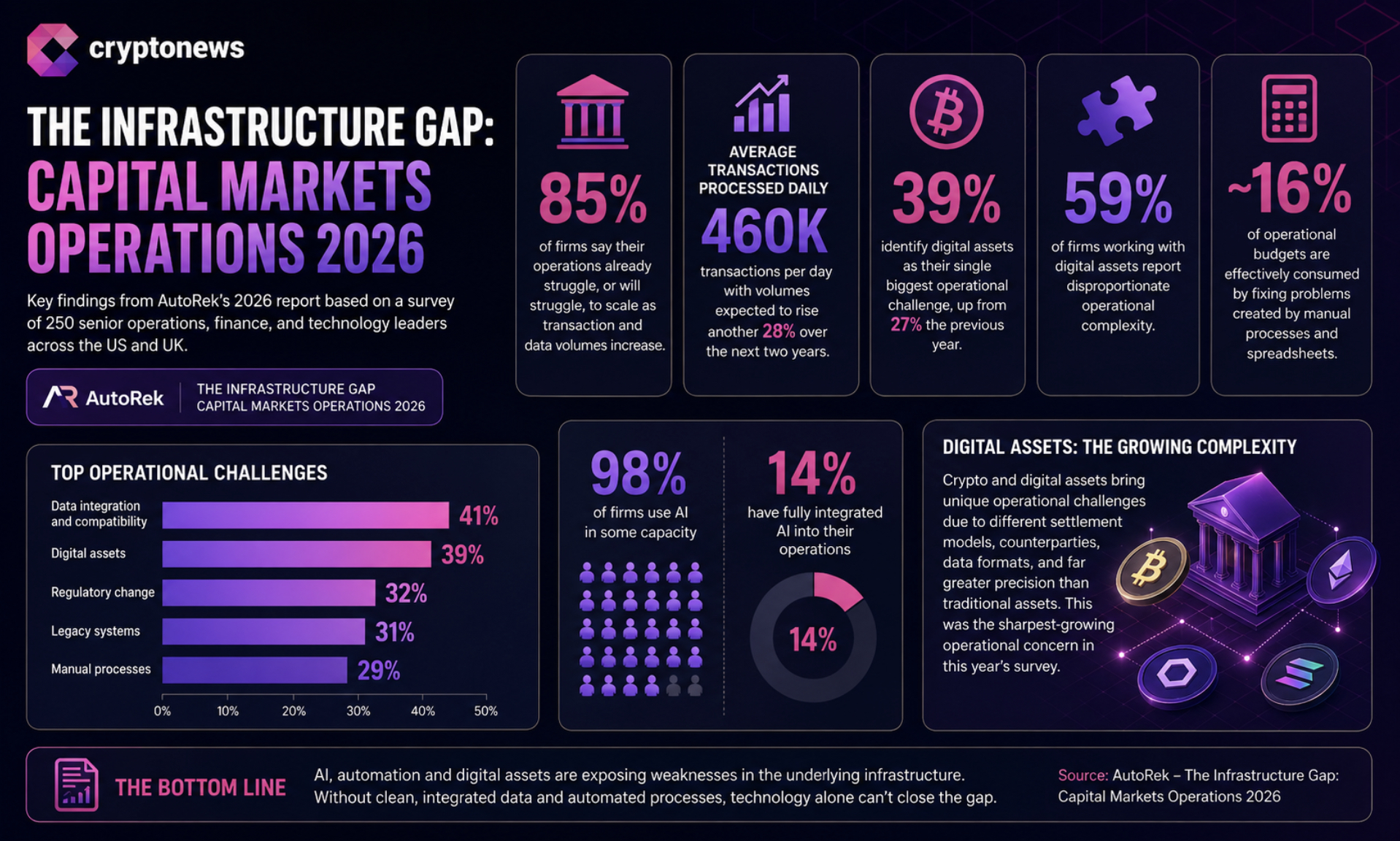
The bill’s regulatory framework does not itself resolve the operational pressures identified in capital markets’ back offices. An AutoRek report on capital markets operations, based on a survey of 250 senior operations, finance, and technology leaders in the United States and the United Kingdom, describes strain from rising volumes, new asset classes, data fragmentation, and shallow AI integration.
Among the report’s findings, 85% of respondents expected scalability strain as activity grows against legacy processes. Of firms working with digital assets, 59% reported disproportionate operational complexity relative to other asset classes.

The report also found that 41% of respondents identified data integration and compatibility as their top operational challenge, while firms reported losing 15.9% of operational budgets to rework driven by manual processes and spreadsheets.
The survey found that 98% of firms use AI somewhere in operations, but only 14% have fully integrated it across operations. Those findings concern operating models rather than the allocation of agency jurisdiction.
A market-structure statute can define regulatory categories and obligations without, on its own, integrating data, replacing manual workflows, or reconciling records across a firm’s systems.
Trade Crypto on Bybit and Get a Chance to Win Our $1,000 USDT Airdrop
Where the Bill Does Touch Infrastructure
The bill does contain provisions relevant to operational infrastructure. Section 305 would allow brokers, dealers, transfer agents, investment advisers, investment companies, and national securities exchanges to use records from a blockchain system for existing recordkeeping requirements, subject to an SEC rulemaking required within 180 days of enactment.
Section 402 would require futures commission merchants to hold customer digital assets with qualified digital asset custodians. The congressional summary also describes requirements concerning recordkeeping and the commingling of customer assets.
Even if the CLARITY Act faces delays, the broader trend is what matters. Crypto regulation in the U.S. appears to be moving from uncertainty toward a more defined framework.
— Squirrel Technologies
(@squirrel_wallet) August 27, 2026

These provisions address specified custody and recordkeeping matters, rather than a general framework for resolving data-integration or manual-process challenges identified by the AutoRek survey.
If enacted, the CLARITY Act would create a statutory framework for digital commodities, registration, and defined areas of SEC and CFTC authority. It would also establish requirements and rulemakings related to recordkeeping, custody, disclosures, and market intermediaries.
It would not, by itself, provide a detailed operating model for the data-integration, rework, and scalability issues reported by capital-markets operations leaders. Regulatory clarity and operational modernization can advance together, but they remain separate tasks under the evidence available here.
Discover: The Best Token Presales
The post CLARITY Act Sets Agency Roles, Leaves Back-Office Work Open appeared first on Cryptonews.


Thirty-nine U.S. state bankers associations have formed BankChain Alliance to develop a bank-owned blockchain network for tokenized deposits, stablecoins, smart payments and automated settlement, with a launch targeted for 2027.
Summary
- BankChain Alliance has brought together 39 state banking associations representing 3,283 banks and $21.8 trillion in assets.
- The planned 2027 network will support tokenized deposits, stablecoins, smart payments and automated settlement.
- BankChain is selecting a technology partner, while individual banks have not yet automatically committed to joining the network.
- Banks nationwide will be invited to become owners, with the network designed and governed by the banking industry.
- The project is developing alongside other bank-led tokenized deposit networks planned by The Clearing House and major US banks.
BankChain Alliance said in its Aug. 25 announcement that the proposed network will be designed, governed and owned by the banking industry, while banks across the United States will be invited to become owners as the group works through its technology selection process.
Still in its development stage, BankChain is not operating a payments network yet. The alliance has completed the first phase of its request for proposals and is evaluating technology providers while planning an infrastructure that can connect with other financial networks.
Kathy Kraninger, chair of BankChain Alliance and president and CEO of the Florida Bankers Association, said the project is intended to give banks of different sizes a role in building the infrastructure they would use.
“This is about banks of all sizes building their own future,” Kraninger said, describing the planned system as an industry-led network that would serve institutions across rural, regional and urban markets.
BankChain Alliance brings 3,283 banks under its association network
The 39 state associations involved in BankChain collectively represent 3,283 banks holding $21.8 trillion in assets, based on Federal Deposit Insurance Corp. call-report data as of March 31, according to the alliance.
Participation, however, currently sits at the association level. BankChain states on its website that individual banks represented by the participating associations have not automatically committed to or joined the planned blockchain network unless separately indicated.
Its member associations cover Alabama, Arkansas, Connecticut, Delaware, Florida, Georgia, Hawaii, Idaho, Indiana, Iowa, Kansas, Maine, Maryland, Massachusetts, Michigan, Minnesota, Mississippi, Missouri, Nebraska, Nevada, New Hampshire, New Jersey, North Carolina, North Dakota, Ohio, Oklahoma, Oregon, Pennsylvania, Rhode Island, South Carolina, South Dakota, Tennessee, Texas, Utah, Vermont, Virginia, Washington, Wisconsin and Wyoming.
Under the proposed structure, banks would be able to use common blockchain infrastructure for services including tokenized deposits, stablecoins, programmable payments and automated settlement. BankChain also plans to make the network interoperable with other systems, although it has not disclosed the underlying blockchain architecture or technical framework.
A tokenized deposit represents commercial bank money on blockchain infrastructure and remains a liability of the issuing bank. The structure differs from stablecoins issued by nonbank companies, which can use separate reserve and redemption arrangements.
BankChain plans to accommodate both tokenized deposits and stablecoins alongside smart payment functions, giving participating institutions several types of blockchain-based payment instruments on the same planned network.
Banks would own the BankChain infrastructure
Ownership forms a central part of BankChain’s proposed structure, although the alliance has not disclosed how much participating banks would be required to invest.
Public materials do not provide figures for committed capital, association contributions, ownership percentages or pricing. American Banker separately reported that BankChain wants to obtain an ownership interest in the technology company ultimately chosen to support the network.
The alliance has already completed the first stage of its request-for-proposals process, Kraninger told the publication.
During that process, regulatory compliance received more weight than any other factor, according to Corey LeBlanc, co-founder and chief technology officer of Locality Bank.
Governance is also being built around participation from state banking organizations. Howard Headlee, president and CEO of the Utah Bankers Association, told American Banker that BankChain is intended to provide member institutions with “equal access to a network they own, where their voice is heard.”
Kraninger chairs a board that also includes executives from state banking groups in Ohio, Nebraska, Texas, North Carolina, Missouri, Utah, New Hampshire and Massachusetts. TekFactor founder Kim Askwith is another member of the board.
Individual banks have yet to be named as owners of the planned network, leaving BankChain to move from association participation toward direct commitments from financial institutions before its targeted 2027 launch.
BankChain joins another bank-led tokenized deposit project
BankChain is entering a U.S. banking sector where major institutions are separately preparing blockchain infrastructure for commercial bank deposits.
Crypto.news previously reported that JPMorgan Chase, Citigroup, Bank of America and Wells Fargo are working through The Clearing House on a shared tokenized deposit network targeted for the first half of 2027.
The Clearing House project is expected to allow corporate customers to transfer tokenized commercial bank money around the clock while connecting blockchain transactions with established banking infrastructure.
Owned by 25 of the largest U.S. financial institutions, The Clearing House already operates payment networks including RTP and CHIPS and says its systems clear and settle more than $2 trillion every day.
Its tokenized deposit project includes support from more than a dozen institutions, including BNY, HSBC, PNC, Santander, TD Bank, Truist and U.S. Bank. Services under consideration include programmable treasury functions, automated payments, liquidity management and cross-border transfers.
No operational launch date beyond the first-half 2027 target has been disclosed, and a technology provider had not been announced when the initiative became public.
BankChain has outlined a different product mix by including stablecoins alongside tokenized deposits, smart payments and automated settlement. Its ownership model is also being organized through state bankers associations and eventual direct participation by banks nationwide.
Wells Fargo, one of the institutions involved with The Clearing House, is also preparing its own tokenized deposit service for corporate and commercial clients.
The bank said in August that an initial rollout planned for this fall would support U.S. dollar-to-British pound transactions for selected customers, with the platform designed to handle transfers and settlements outside conventional banking hours.
Additional clients, currencies and countries are expected to be introduced throughout 2027 as Wells Fargo expands the service.
Banks are moving tokenized payments toward deployment
Blockchain-based bank money is also being tested through infrastructure outside the two U.S. consortium projects.
SWIFT moved its blockchain ledger into initial deployment in July, with 17 global banks preparing to test tokenized deposit payments across the network.
HSBC, Citi, BNP Paribas, UBS, ANZ, DBS and Standard Chartered were among the institutions named in the initial rollout after SWIFT spent nine months developing the system.
The ledger is designed to support international payments during weekends and overnight periods while participating banks retain existing compliance, risk-management and control requirements. Final settlement continues through established banking rails during the initial deployment.
Another structure has been tested by Custodia Bank and Vantage Bank, which have developed a token that can function as a bank deposit within their Hazel network and operate as a stablecoin when transferred outside it.
The banks disclosed the dual-purpose token model in June after testing the Ethereum-based system from March.
Their structure allows participating institutions to retain their customer deposits and control their own wallets while accessing tokenized deposit and payment-stablecoin functions.
Custodia and Vantage have been evaluating the platform with banks ahead of a planned fourth-quarter 2026 rollout, with the system intended for institutions including community banks and credit unions.
BankChain has not named the companies competing to become its technology partner or disclosed when testing with individual banks will begin. Its next steps remain the selection of the network’s technology provider and recruitment of banks as owners before the targeted 2027 launch.
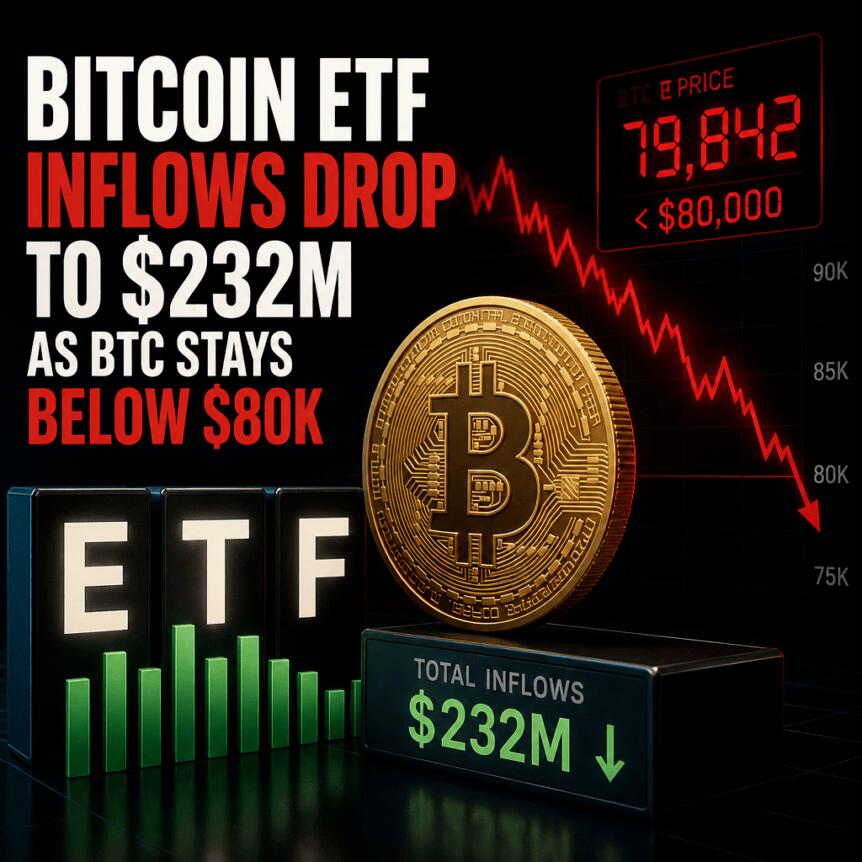
US-listed spot Bitcoin exchange-traded funds (ETFs) continued to pull in fresh capital on Wednesday, recording $232.1 million in net inflows. While that figure was down from the prior day, it still extended the funds’ streak of consecutive positive sessions to eight trading days, according to SoSoValue data.
The latest inflow total represented about a 26% decline versus Tuesday’s $314.4 million and was the smallest daily inflow since Aug. 18. Even with the slowdown, cumulative flows remain strongly positive, with eight-day net inflows totaling roughly $2.8 billion. Year-to-date, net outflows have narrowed to about $2.03 billion, while cumulative net inflows have risen to $54.6 billion and total net assets reached $98.6 billion, according to SoSoValue.
Key takeaways
- US spot Bitcoin ETFs logged $232.1 million in net inflows on Wednesday, extending an eight-day streak.
- Inflows slowed versus Tuesday’s $314.4 million, but cumulative performance remains firmly positive.
- Bitcoin’s price action has been relatively flat after briefly moving above $80,000, while ETF demand continues.
- US spot Ether ETFs also posted a continued run of inflows, while XRP ETFs saw their largest daily inflow since Jan. 5.
Bitcoin ETF inflow streak continues despite softer daily totals
Wednesday’s $232.1 million inflow follows a day when US spot Bitcoin ETFs received $314.4 million, and it marks a visible cooling from the stronger buying pace seen earlier in the streak. SoSoValue data also indicates Wednesday’s total was the smallest since Aug. 18, underscoring that while investor appetite has not disappeared, the intensity of daily purchases is fluctuating.
That matters for market participants because ETF flow patterns often serve as a real-time barometer of institutional and retail allocation behavior. With the eight-session run now in place and cumulative net inflows reaching $54.6 billion, the broader direction remains constructive—even as day-to-day numbers vary.
Price pauses above $80,000 as sentiment edges higher
ETF inflows came as Bitcoin’s momentum appeared to stall. After briefly climbing above $80,000 on Tuesday, Bitcoin traded around $78,759 at the time of publication, down 0.3% over the preceding 24 hours, based on CoinGecko data.
Despite the less exciting price tape, broader sentiment improved. The Crypto Fear & Greed Index rose to 71 from 65 a day earlier, staying in “Greed” territory, according to Alternative.me. For traders, this divergence—steady ETF inflows alongside a pause in near-term price strength—can be a sign that demand may be driven by longer-horizon positioning rather than purely momentum-chasing.
Earlier coverage from Cointelegraph noted the market’s brief push above $80,000 during Tuesday’s session, providing context for the subsequent consolidation.
Ether and XRP ETFs add to a mixed but supportive picture
Beyond Bitcoin, other major US spot crypto ETF products also saw inflows. US spot Ether ETFs recorded an eighth consecutive day of net inflows on Wednesday, bringing in $192.4 million, according to SoSoValue. The continuation across multiple fund categories suggests that the demand driving ETFs may not be limited to a single asset.
Meanwhile, US-listed spot XRP ETFs attracted $28.1 million on Wednesday. SoSoValue data characterizes this as the largest daily inflow since Jan. 5. XRP’s cumulative net inflows now stand at $1.62 billion, providing another datapoint that flow strength is persisting across the broader ETF landscape rather than being concentrated entirely in Bitcoin.
Taken together, the Wednesday results show a market where institutional-style allocation—reflected in ETF inflows—remains active even as Bitcoin’s price action cools after a near-$80,000 move.
What investors should watch next
With Bitcoin ETFs continuing to post positive days, the key question is whether the next sessions bring a re-acceleration in daily inflows or signal a gradual normalization after the early streak. Readers should also monitor whether sentiment indicators like the Fear & Greed Index remain in “Greed” territory as price volatility returns, and whether Ether and XRP flows keep extending their respective runs.


ETF Store President Nate Geraci predicted on Aug. 27 that BlackRock will eventually expand its spot crypto ETF lineup beyond Bitcoin and Ether, citing the growth of competing altcoin products and BlackRock’s broad fund business.
Summary
- BlackRock currently offers spot crypto exposure only to Bitcoin and Ether through its iShares products.
- IBIT held $60.52 billion in net assets on August 26, according to BlackRock’s official data.
- BlackRock’s ETHA and staking-enabled ETHB held approximately $8.26 billion and $833 million, respectively, on Wednesday.
- Nate Geraci predicted BlackRock will eventually offer additional spot crypto ETFs, but provided no evidence.
- SEC searches found no publicly filed BlackRock spot ETF applications covering XRP, Solana, or indexes.
Geraci said it was “wild” that BlackRock had not launched a spot product for another cryptocurrency or a multi-asset crypto index. He interpreted that absence as an implicit judgment that other digital assets lack sufficient investment value.
That interpretation is Geraci’s opinion. BlackRock has not publicly said other cryptocurrencies lack value, nor has it announced plans to launch or permanently reject additional spot crypto ETFs.
BlackRock’s crypto ETFs manage nearly $70 billion
BlackRock currently offers three U.S. spot crypto products through iShares. Its Bitcoin fund, IBIT, held $60.52 billion in net assets as of Aug. 26, according to official fund data.
The non-staking Ethereum fund, ETHA, held approximately $8.26 billion. BlackRock’s newer staking-enabled Ethereum product, ETHB, managed about $832.7 million and reported a 30-day staking reward rate of 1.73%.
Together, the products held roughly $69.6 billion. Their different structures mean they should not be treated as three distinct cryptocurrency exposures: both ETHA and ETHB hold Ether, while ETHB also seeks staking rewards.
BlackRock also launched BITA, a Bitcoin premium-income fund that holds Bitcoin exposure and sells call options. As crypto.news previously reported, BITA uses IBIT and Bitcoin holdings to support an options-based income strategy. It does not expand BlackRock’s underlying spot exposure beyond Bitcoin.
BlackRock has not filed for an altcoin ETF
A review of public SEC records found no BlackRock registration statement for a spot XRP, Solana or other single-altcoin ETF as of Aug. 27. No BlackRock crypto-index ETF filing was located either.
The absence of a filing does not prove BlackRock has rejected those products internally. Asset managers typically keep potential products confidential until registrations, exchange applications or company announcements become public.
Geraci predicted BlackRock would “capitulate at some point” and launch additional spot crypto ETFs.
That statement is a forecast. Geraci did not cite private discussions with BlackRock, regulatory documents or an undisclosed product plan supporting it.
BlackRock’s public digital-assets page currently focuses on Bitcoin and Ether. The company has also expanded into tokenized money-market funds, showing that its blockchain strategy extends beyond crypto ETFs.
Competitors already offer broader crypto exposure
BlackRock’s position contrasts with rival issuers that have moved into XRP, Solana and multi-asset products. Seven U.S. spot XRP ETFs collectively held approximately $1 billion in assets during August.
As crypto.news reported, spot XRP ETFs accumulated about $1.57 billion in cumulative net inflows by Aug. 24. BlackRock was not among their issuers.
Spot Solana products have also established a U.S. market. In related coverage, Solana ETFs crossed $1 billion in combined assets, led by products from Bitwise and Fidelity.
The SEC has also approved broader structures. The approval of T. Rowe Price’s active crypto ETF allowed potential exposure to Bitcoin, Ether, XRP, Solana and other qualifying assets.
Client demand will determine BlackRock’s next move
BlackRock has not announced a deadline or decision process for expanding its lineup. Any new fund would likely require a registration statement, exchange listing documents and SEC review before trading.
The commercial case would depend on client demand, liquidity, custody support, market surveillance and expected fund size. The existence of rival altcoin ETFs demonstrates regulatory feasibility but does not establish that another product would meet BlackRock’s internal thresholds.
For now, Geraci’s prediction remains unconfirmed. A BlackRock SEC filing, Delaware trust registration or official announcement would provide the first verifiable evidence of a strategy change.


A cluster of 12 wallets deposited 36 million USDC into Hyperliquid during the 24 hours ending Aug. 27 and used about $24 million to purchase HYPE, according to on-chain analyst EmberCN.
Summary
- Suspected linked wallets deposited 36 million USDC into Hyperliquid through twelve addresses within one day.
- Twenty-four million USDC reportedly purchased 282,090 HYPE at an average price near $81.50 per token.
- EmberCN estimated the cluster held and staked 4.679 million HYPE worth approximately $381 million overall.
- No public a16z statement, filing or signed wallet proof confirms ownership of the reported addresses.
- Earlier analysts produced different cluster totals, showing attribution methods can materially alter calculated holdings considerably.
The wallets acquired 282,090 HYPE at an estimated average price of $81.50. EmberCN described the cluster as “suspected” of being connected to Andreessen Horowitz, or a16z, but the venture capital firm has not confirmed that attribution.
Public blockchain records can verify individual transfers, purchases and staking transactions. They cannot establish the legal owner of an address without additional evidence linking the wallet to a person or company.
HYPE wallets still hold $12 million in USDC
The cluster had converted approximately two-thirds of its newly deposited USDC into HYPE when EmberCN published the analysis. About $12 million remained available within the reported group of wallets.
The addresses appeared to divide purchases across multiple accounts rather than execute one large market order. Such activity can reduce the visibility and price movement associated with a single transaction, although the wallets’ exact execution strategy was not confirmed.
Three addresses cited by the analyst show Hyperliquid transaction histories that readers can inspect through Hypurrscan: one, two and three.
However, EmberCN did not publish a complete ownership proof covering all 12 addresses. Calculations can also change as wallets trade, transfer, stake or delegate tokens.
Reported HYPE position reaches $381 million
EmberCN estimated that the cluster’s accumulated and staked position had reached 4.679 million HYPE. At the market price used in the post, the holdings were worth approximately $381 million.
The analyst calculated an average acquisition cost near $65.60 and an unrealized profit of about $74.4 million. These remain estimates because the calculation depends on which addresses, deposits and internal transfers are included.
The same entity reportedly bought about $24 million in HYPE during June at an average price of $68.70. The latest purchase was made at a higher average price of $81.50.
HYPE traded near $81.40 on Aug. 27. The available evidence does not establish that the wallet activity caused any specific price movement.
A16z ownership remains unconfirmed
No public a16z portfolio announcement, regulatory filing or signed wallet message identifies the addresses as company-controlled. A16z has also not issued a statement claiming the HYPE purchases or staking position.
The wallets are therefore “suspected” to be associated with a16z, not confirmed institutional holdings.
On-chain analysts typically connect addresses through common funding sources, synchronized transactions, exchange withdrawals and interactions between wallets. These methods can identify coordinated activity but do not always reveal the entity directing it.
Earlier estimates also differed from EmberCN’s latest total. As crypto.news reported, wallets described as a16z-linked were previously estimated to hold 9.18 million HYPE.
Another analysis later claimed that suspected a16z wallets accumulated 6.906 million HYPE during 2026. The differing figures may reflect separate address clusters, transfers, sales or attribution methods.
Remaining USDC could signal further purchases
The clearest item to monitor is the roughly $12 million in USDC that had not been converted when EmberCN published the update. Further HYPE purchases would appear in the wallets’ public transaction records.
Transfers from staking accounts to exchanges or market makers could instead indicate repositioning or possible sales. Staking alone does not prove how long the entity intends to hold the tokens.
Confirmation from a16z, a signed wallet message or independently documented custody records would be needed to establish ownership. Until then, the $381 million position should be described as an analyst-attributed wallet cluster.


Tokenized deposits could make bank funding less stable and raise credit costs for US households and businesses, according to an analysis by two economists at the Federal Reserve Bank of Dallas.
Economists Rosie Levy and Srini Ramaswamy said instant settlement could allow depositors seeking higher yields to switch banks more quickly. They said programmable deposit tokens and agentic artificial intelligence could automate the transfers, shortening the time that deposits remain at individual banks and making them more sensitive to interest rates.
The economists estimated that if deposits became 10% more sensitive to interest rates, banks’ capacity to hold long-term loans and other assets could fall by about $700 billion. In a separate scenario, deposits remaining at banks for 10% less time could reduce that capacity by about $580 billion. Both figures are expressed in 10-year equivalents and do not represent direct reductions in lending.
The calculations are scenarios rather than forecasts and do not represent dollar-for-dollar reductions in bank lending. They come as US banks build shared blockchain networks designed to move tokenized deposits around the clock while keeping customer funds within the regulated banking system.
Banks develop networks for tokenized deposits
On Tuesday, 39 US state banking associations formed the BankChain Alliance to develop a nationwide network supporting tokenized deposits, stablecoins and automated settlement. The Clearing House is developing a separate network backed by JPMorgan Chase, Bank of America, Citi, BNY and Wells Fargo.
Banks have also begun connecting tokenized-deposit systems across institutions. On Aug. 20, Standard Chartered and HSBC completed a live cross-border transaction through Swift’s blockchain ledger, which linked the banks’ separate systems and recorded their resulting obligations before settlement through existing payment infrastructure.
Related: US regulator mulls guidance for tokenized deposit insurance, stablecoins
Levy and Ramaswamy said banks could respond to more volatile deposits by holding larger portfolios of highly liquid assets, including reserves and US Treasurys. They said banks could also rely more heavily on term debt to maintain their lending portfolios, although funding loans through wholesale debt would likely increase credit costs for consumers and businesses.
The authors cited Brazil’s Pix instant-payment system as a potential comparison, while noting that it is not identical to tokenized deposits. A 2025 study found that heavier Pix use increased banks’ holdings of liquid assets and reduced credit intermediation.
Magazine: SEC’s proposed crypto rules probably won’t spark new ICO boom
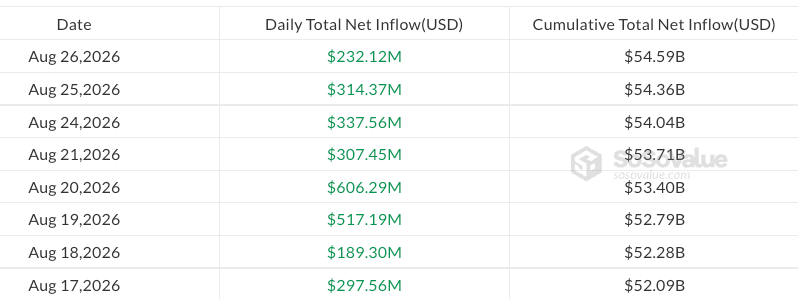
US-listed spot Bitcoin exchange-traded funds (ETFs) drew $232.1 million in net inflows on Wednesday, slowing from the previous day while extending their inflow streak to eight trading days.
The latest inflow was down about 26% from Tuesday’s $314.4 million and marked the smallest daily total since Aug. 18, according to SoSoValue data.
The eight-session streak has attracted about $2.8 billion, cutting year-to-date net outflows to about $2.03 billion. Cumulative net inflows rose to $54.6 billion, while total net assets reached $98.6 billion.
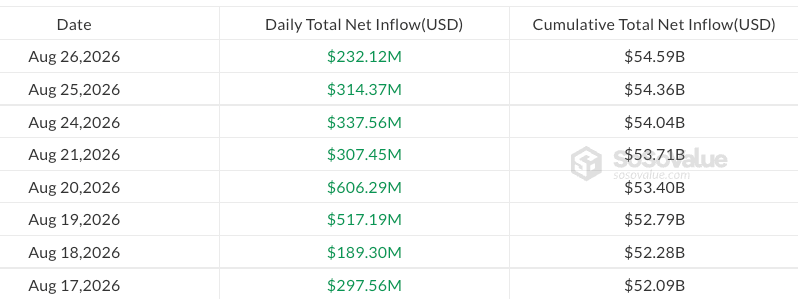
Daily inflows in US spot Bitcoin ETFs since Aug. 17. Source: SoSoValue
The slowdown came as Bitcoin stalled after briefly climbing above $80,000 on Tuesday. Bitcoin traded at about $78,759 at publishing time, down 0.3% over the past 24 hours, according to CoinGecko.
Despite Bitcoin’s stalled price action, crypto market sentiment strengthened on Thursday. The Crypto Fear & Greed Index rose to 71 from 65 a day earlier, remaining in “Greed” territory, according to Alternative.me.
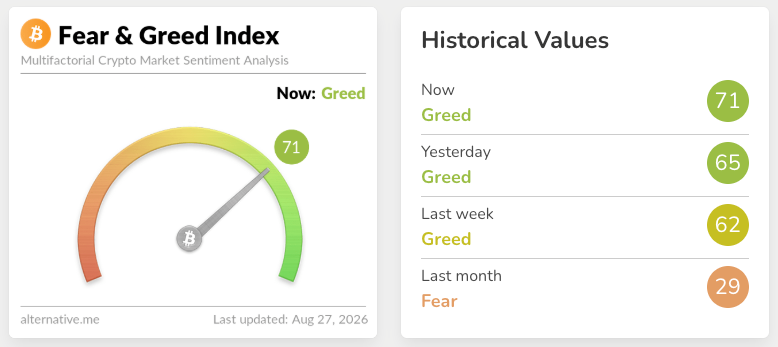
The Crypto Fear & Greed Index. Source: Alternative.me
Among altcoin funds, US spot Ether ETFs also recorded an eighth consecutive day of inflows on Wednesday, attracting $192.4 million.
US-listed spot XRP ETFs attracted $28.1 million on Wednesday, their biggest daily inflow since Jan. 5, according to SoSoValue. Cumulative net inflows reached $1.62 billion.
Related: Supply absorption ‘key question’ as Bitcoin fails to reclaim $80K: Analysis
The SHRINCS proposal would let bitcoin transactions use larger, quantum-resistant approvals while preserving more network capacity than existing post-quantum signature designs.
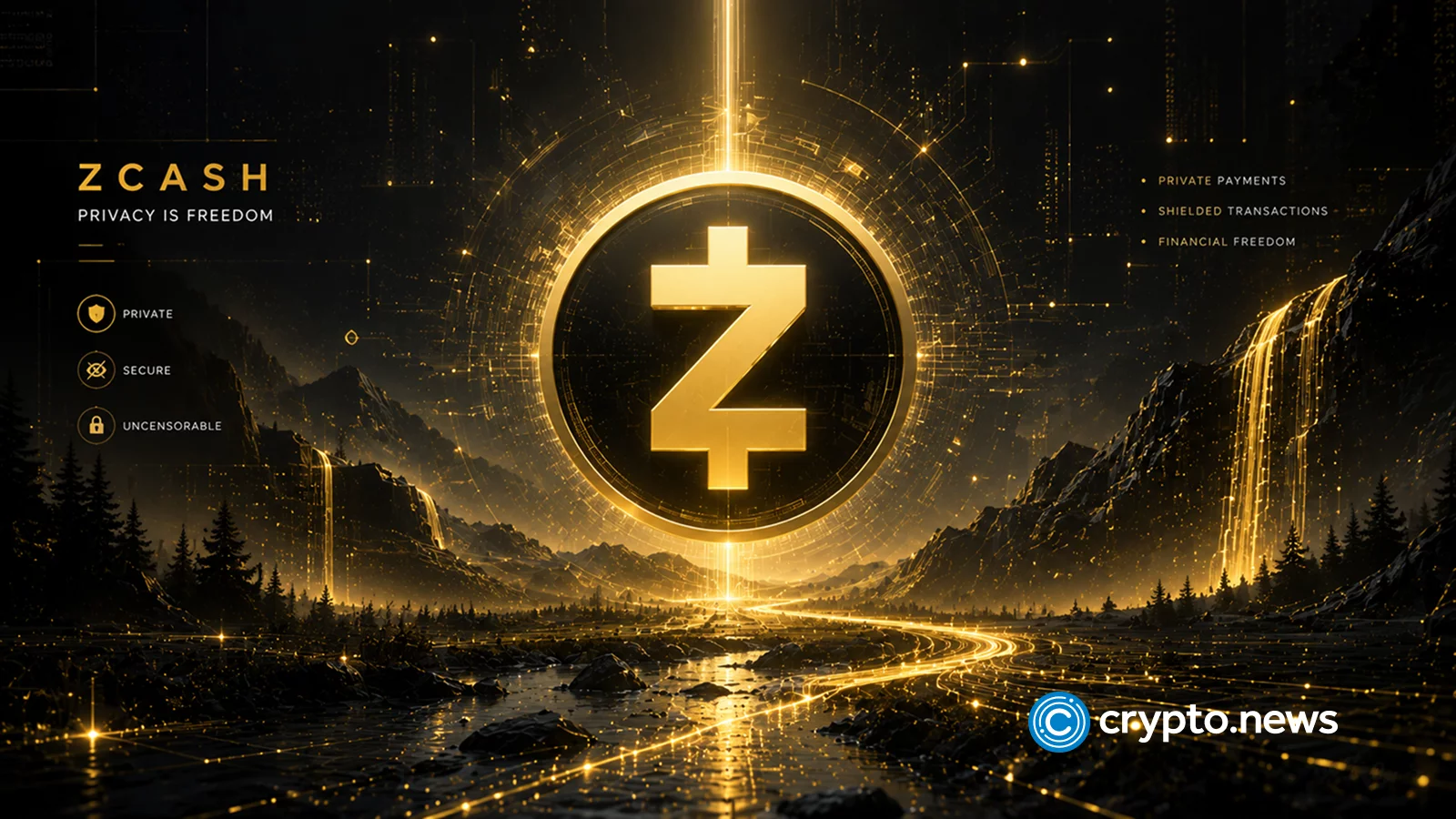
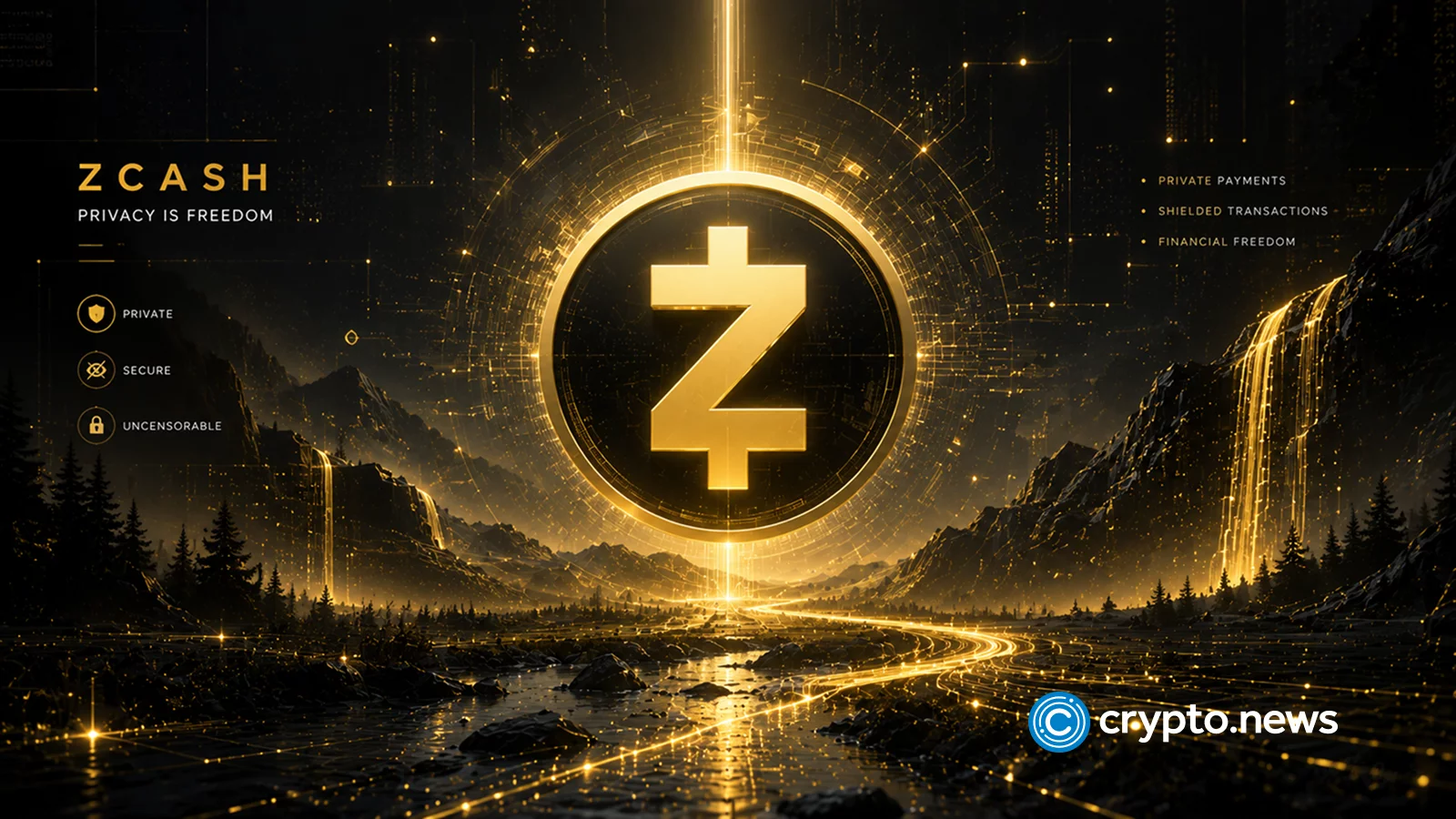
The SEC approved a privacy coin ETF the same month it proposed tighter rules for every other digital asset. That contradiction tells you more about what regulators actually fear than any speech or rulemaking ever could.
Summary
The last time a privacy coin dominated headlines, exchanges were delisting them. Binance dropped Monero in February 2024. OKX followed months later. The message from compliance departments was clear: assets designed to obscure transaction details were incompatible with global anti money laundering frameworks, and no amount of technical nuance would change that.
Eighteen months later, Grayscale rang the opening bell on NYSE Arca for ZCSH, the first exchange traded fund in the United States to offer direct spot exposure to Zcash. The product holds approximately $304 million in ZEC, custodied by Coinbase, and carries a 2.50% management fee with all proceeds directed toward Zcash ecosystem development. It is not a futures wrapper or a synthetic tracker. It is a fund that buys and holds privacy coins on behalf of investors who can now access them through a standard brokerage account.
That inversion from pariah to ETF did not happen by accident, and the mechanics behind it reveal something important about where regulators are actually drawing the line on financial privacy.
How the conversion worked
ZCSH is not a new fund. Grayscale established the Zcash Trust in October 2017, making it one of the oldest single asset crypto vehicles in the United States. For years it traded on OTC markets at persistent discounts to net asset value, sometimes exceeding 40%, because shareholders had no redemption mechanism to arbitrage the gap.
The conversion to an ETF changes that structure entirely. Authorized participants can now create and redeem shares directly against the underlying ZEC, which forces the market price to track net asset value within tight bands. The discount that defined the trust for years collapsed in the weeks before listing as arbitrageurs front ran the conversion.
Coinbase Custody International holds the underlying ZEC in cold storage. The fund’s prospectus specifies that only transparent (unshielded) Zcash addresses are used for custody, meaning the coins sitting inside the ETF are fully auditable on the public blockchain. This is a critical design choice: Grayscale gets to offer exposure to a privacy coin while ensuring the fund itself operates with the transparency that securities regulators require.
Why the SEC let it through
The regulatory path for ZCSH was not straightforward, but it was less contested than most observers expected. Two factors mattered.
First, the SEC completed a formal review of the Grayscale Zcash Trust in January 2026 and took no enforcement action. That review, which began in late 2024, examined whether ZEC qualified as a security under the Howey test. The conclusion was not a formal safe harbor or blessing, but the absence of action created enough regulatory clearance for Grayscale to proceed with the NYSE Arca listing.
Second, Zcash’s architecture differs from Monero’s in a way that regulators find meaningful. Zcash offers opt in privacy: users choose between transparent transactions that are fully visible on the public ledger and shielded transactions that use zero knowledge proofs to encrypt sender, receiver, and amount data. Monero, by contrast, applies privacy by default to every transaction using ring signatures, stealth addresses, and RingCT. There is no transparent mode.
That distinction matters because it allows compliance frameworks to function. An exchange listing ZEC can enforce know your customer rules on deposit and withdrawal addresses because those addresses can be transparent. The same exchange listing Monero cannot verify the origin of funds with the same confidence because the protocol obscures that information by design.
The SEC held a Zcash roundtable in 2025, the kind of structured engagement that Monero has never received. Whether that difference reflects a principled regulatory distinction or simply the politics of which assets have well funded advocacy organizations is an open question, but the outcome is clear: Zcash got an ETF, and Monero remains delisted from Coinbase, Robinhood, and most major Western exchanges.
The shielded adoption curve
The most important number in the Zcash ecosystem is not the ETF’s assets under management. It is the percentage of transactions using shielded pools.
As of July 2026, shielded transactions account for approximately 90% of all Zcash network activity. That figure was under 20% as recently as 2024. The shift happened for two reasons: wallet infrastructure improved, and community norms changed.
Zodl, the most popular Zcash mobile wallet, adopted shielded by default as a design decision in late 2025. Users no longer need to opt in to privacy. They need to opt out. That single UX change flipped the ratio. When the default is private, most users stay private.
The shielded supply pool now holds roughly 4.2 million ZEC, representing about 30% of the circulating supply. That pool has grown steadily even during periods of price decline, suggesting that the users moving coins into shielded addresses are doing so for functional reasons rather than speculative ones.
This creates an interesting tension with the ETF. The fund holds ZEC in transparent addresses for regulatory compliance, but the network those coins run on is increasingly opaque. Roughly 90% of non custodial Zcash activity is now invisible to chain analytics firms. The ETF offers a window into a room where most of the lights are off.
The privacy coin paradox
The timing of ZCSH’s launch is worth examining in context. The SEC proposed Regulation Crypto Assets on August 11, 2026, a framework that would impose new registration and disclosure requirements on virtually every digital asset offering in the United States. Two weeks later, the same agency’s inaction allowed a privacy coin ETF to begin trading.
Those two moves are not contradictory in the way they appear. The SEC’s framework targets issuers and intermediaries, not the assets themselves. A privacy coin is not inherently a security any more than a transparent coin is. What matters under existing securities law is how the asset is offered, sold, and promoted. Grayscale’s trust structure, with its registered prospectus, audited financials, and regulated custodian, satisfies those requirements regardless of what the underlying asset does at the protocol level.
But the optics matter. At least 10 countries, including Japan, South Korea, the UAE, and Australia, have banned or severely restricted privacy coins on exchanges. The European Union’s Markets in Crypto Assets regulation, which took full effect in late 2025, requires exchanges to implement enhanced due diligence for assets with privacy features. Several major European exchanges delisted ZEC preemptively.
The United States just moved in the opposite direction. The world’s largest asset manager by crypto AUM listed a privacy coin on the New York Stock Exchange. That signal will be difficult for other jurisdictions to ignore, and it may force a reexamination of blanket privacy coin bans that were enacted before opt in privacy architectures like Zcash’s were well understood.
What Monero’s absence reveals
The gap between Zcash and Monero’s regulatory trajectories is now the widest it has ever been. ZEC trades on Coinbase, Robinhood, and as of this week, NYSE Arca through an ETF. Monero is available on decentralized exchanges, peer to peer platforms, and a shrinking list of offshore centralized venues.
That divergence is not primarily about technology. Both protocols provide strong transaction privacy. The difference is political and structural. Zcash has the Electric Coin Company and the Zcash Foundation, funded organizations that engage with regulators, publish compliance guidance, and maintain relationships with exchanges. Monero’s development is decentralized and pseudonymous by design, which aligns with its philosophical commitment to privacy but leaves no entity to sit across the table from a regulator.
The market has priced this difference aggressively. ZEC’s market capitalization overtook Monero’s earlier in 2026, a reversal that would have seemed implausible two years ago when Monero was the undisputed leader in the privacy coin category. The ETF listing is likely to widen that gap further, as institutional capital flows to the asset that can be held in a brokerage account rather than the one that requires self custody and offshore exchanges.
Whether that outcome represents a victory for financial privacy or its domestication depends on which version of privacy you value. Zcash offers privacy you can choose. Monero offers privacy you cannot avoid. The market, and the regulators, have made their preference clear.
There is a third possibility that neither camp has fully reckoned with: the ETF itself could become the primary way institutions gain exposure to privacy technology without ever touching a private transaction. If most ZEC demand flows through ZCSH and stays in transparent custody addresses, the network could bifurcate into an institutional layer that is fully visible and a retail layer that is fully shielded, with minimal interaction between the two. That bifurcation would be unprecedented in crypto markets and would raise new questions about what “privacy coin” means when the largest holders operate in the open.
The price mechanics behind the 66% rally
ZEC’s surge from roughly $500 to above $850 in the week surrounding the ZCSH listing was not a simple “buy the news” event. The move had three distinct phases, each driven by different market participants.
The first phase began on August 18 when Grayscale filed its final amended registration statement with the SEC. Traders who had been tracking the regulatory timeline recognized that the filing removed the last procedural obstacle to listing. ZEC climbed from $510 to $640 over three days on spot buying concentrated on Coinbase and Kraken, the two US exchanges with the deepest ZEC order books.
The second phase was the trust discount collapse. The Grayscale Zcash Trust had traded at a discount to NAV for most of its existence, sometimes exceeding 40%. As the conversion date approached, arbitrageurs bought trust shares at the discount and simultaneously shorted ZEC to lock in the spread. When the conversion went live and redemptions became possible, those short positions needed to be covered, creating a squeeze that pushed ZEC from $640 to $780 between August 22 and August 24.
The third phase was the listing day itself. ZCSH began trading on NYSE Arca on August 25 and ZEC touched $855, its highest price since January 2018. Volume on centralized exchanges exceeded $1.2 billion in 24 hours, roughly five times the average daily volume for the preceding month. The move attracted momentum traders and triggered liquidations on leveraged short positions across multiple derivatives venues.
The rally left ZEC with a market capitalization above $14 billion, making it the largest privacy coin by a wide margin and placing it in the top 25 digital assets by market cap. Whether that valuation is sustainable depends on whether the ETF generates sustained inflows or whether the listing was a one time catalyst that front loaded months of demand into a single week.
The post quantum question
One factor that has received less attention than it deserves is Zcash’s roadmap for post quantum cryptography. The zero knowledge proofs currently used by Zcash (Halo 2, based on the PLONK proving system) rely on elliptic curve assumptions that a sufficiently powerful quantum computer could break. The same vulnerability applies to Bitcoin, Ethereum, and every other blockchain using elliptic curve cryptography, but for a privacy coin the stakes are higher: breaking the cryptographic assumptions does not just allow theft of funds but also retroactive deanonymization of every shielded transaction ever recorded.
The Zcash development team has been working on lattice based proving systems that would resist quantum attacks, with a preliminary specification published in Q2 2026. No timeline for deployment has been committed, but the research is further along than comparable efforts on other chains. For institutional investors considering a long duration allocation through ZCSH, the credibility of that post quantum migration path is material to the investment thesis.
The irony is that a quantum threat would affect transparent blockchains far sooner in practice, since those chains expose public keys directly. Zcash’s shielded pool, by hiding public keys behind zero knowledge proofs, actually provides a degree of quantum resistance that transparent chains lack, even before a formal post quantum upgrade.
The AI privacy thesis
Grayscale published a research report on August 20, 2026, titled “Zcash: Financial Privacy in the Age of AI,” arguing that the proliferation of artificial intelligence systems capable of analyzing public blockchain data creates a new demand driver for transaction privacy.
The argument is straightforward: as AI models become better at clustering addresses, identifying users, and inferring spending patterns from transparent blockchains, the privacy guarantees of unshielded transactions degrade. A transaction that was effectively private in 2020 because no one was analyzing it may be fully deanonymized in 2026 by automated systems scraping public chain data at scale.
Zcash’s zero knowledge proofs offer mathematical privacy, not merely practical obscurity. A shielded transaction is not private because no one is looking. It is private because the cryptographic proof reveals nothing about the sender, receiver, or amount, regardless of how much computational power is directed at it.
That distinction becomes more valuable as surveillance capabilities improve, and Grayscale is positioning ZCSH as a hedge against a future where transparent blockchains offer no meaningful financial privacy at all. The thesis is speculative, but the directional logic is sound: demand for privacy tends to increase when the tools for surveillance improve.
The report also highlights a less obvious dynamic: AI agents executing transactions on behalf of users will generate vastly more on chain data than human users ever did. An AI managing a portfolio, paying invoices, or rebalancing yield positions may execute hundreds of transactions per day, each one adding to a public record that can be analyzed, clustered, and attributed. The privacy implications of AI driven financial activity on transparent chains have not been widely discussed, but Grayscale’s framing positions Zcash as infrastructure for a world where most on chain activity is automated and the volume of analyzable data grows by orders of magnitude.
Chainalysis, Elliptic, and other blockchain analytics firms have not publicly commented on how their models perform against Zcash’s shielded pool. The absence of commentary is itself informative: if the shielded transactions were trivially deanonymizable, the analytics firms would say so, as doing so would reassure their exchange and law enforcement clients. The silence suggests the privacy guarantees are holding under real world conditions, which strengthens both the investment thesis and the regulatory tension.
Fee structure and ecosystem funding
The 2.50% annual management fee on ZCSH is notably higher than the fees charged by Bitcoin and Ethereum ETFs, which have compressed below 0.25% through competitive pressure. Grayscale’s Bitcoin ETF (GBTC) charges 1.50% and has lost market share to cheaper alternatives from BlackRock and Fidelity.
ZCSH faces no such competition. It is the only Zcash ETF in the United States, and no competitor has filed to launch one. That monopoly position allows Grayscale to maintain the higher fee, but it also means the fund has committed to directing all management fee revenue toward Zcash ecosystem development and marketing.
At current AUM of roughly $304 million, that fee generates approximately $7.6 million annually for the Zcash ecosystem. For a project whose development funding has historically depended on a block reward allocation that has been contentious within the community, a stable external revenue stream tied to ETF assets is a meaningful structural change.
The question is whether the fee will suppress demand. Institutional allocators building diversified crypto portfolios may balk at paying 2.50% for Zcash exposure when they can access Bitcoin for 0.20%. The counterargument is that ZEC’s uncorrelated privacy narrative and smaller market capitalization offer a different risk return profile that justifies the premium.
What to watch
Disclaimer: This article is for informational purposes only and does not constitute investment advice. Cryptocurrency investments carry significant risk. Always conduct your own research before making investment decisions. Published August 27, 2026.

A recent update from the XRP Ledger Foundation welcomed the TradFi giant, which has a long history with Ripple, to a hackathon taking place just ahead of the major conference, Ripple Swell.
Meanwhile, 21Shares’s XRP ETF has changed how it prices the underlying token amid renewed inflows into all such funds.
Mastercard Joins
The XRP Ledger Foundation said it was “thrilled” to welcome the global technology behemoth in the payments industry as a sponsor of the XRP Ledger Hackathon, scheduled for late October. It’s a 36-hour pre-event to the Ripple Swell 2026 conference, which runs from October 27 to October 29, while the hackathon is open on October 24-25.
“With a decade of proven robustness and architecture, the XRP network is ideally suited for payment use cases. Register, build, and connect with industry leaders like Mastercard. It’s your time to shine,” said the team.
This announcement comes just a few months after Mastercard expanded its relationship with the broader Ripple ecosystem, as well as other crypto giants. As reported in March, the TradFi firm enlisted several industry companies, such as Binance, Gemini, PayPal, Paxos, Circle, and Ripple, in a new partnership program aiming at connecting blockchain with its own vast global payments infrastructure.
In June, Mastercard took it a step further, expanding the blockchain integration with new support assets like Ripple’s own stablecoin, RLUSD, and Circle’s USDC.
ETF Changes to TOXR
An SEC filing showed that 21Shares has switched the pricing of the underlying assets for its XRP ETF (TOXR), moving from the CME Group to the new FTSE XRP Index, effective today.
The other notable change to their financial vehicle means the sponsor will be paid once every three months instead of every week. More importantly, the sponsor will be paid in XRP.
21Shares XRP ETF ($TOXR) just switched how it prices XRP moving from CME to the new FTSE XRP Index starting Aug 27.
They also changed how the sponsor gets paid now once every 3 months instead of every week, and paid in $XRP. https://t.co/I1dHswlJ9t pic.twitter.com/U6oHwAVlzi
— 𝗕𝗮𝗻𝗸XRP (@BankXRP) August 26, 2026
Meanwhile, the spot XRP ETFs have extended their impressive streak of net inflows, attracting $13.82 million on Monday, $24 million on Tuesday, and just over $28 million on Wednesday.
TOXR, however, remains the only XRP ETF in the red, with cumulative net flows of -$20.06 million. In contrast, Bitwise’s XRP ETF remains the largest of the bunch, currently holding $575 million in cumulative net inflows.
The post 2 Major Ripple (XRP) Updates: Mastercard Gets Involved, ETF Changes Announced appeared first on CryptoPotato.

We don’t participate in half of Olympic sports, need to improve: PM Modi | Olympic Games 2024

Star Wars Zero Company reviewed: XCOM-style tactics are a strong fit for Star Wars

Barry Manilow Announces Break From Ongoing Tour To Rest





-

 Fashion6 days ago
Weekend Open Thread: Madewell – Corporette.com
-

 Crypto World1 day ago
SpaceX stock could rise 75% to $240, JPMorgan says
-

 Business5 days ago
Musk’s Tesla, SpaceX Confirm $16.8 Billion ‘Terafab’ Chip Plant as World’s Largest Building in Texas
-

 Crypto World5 days ago
anatomy of crypto’s biggest liquidation event since 2021
-

 Crypto World2 days ago
A $30 Billion AI Fund Implodes, Now the SEC Is Investigating Wall Street’s Role
-

 Politics5 days ago
6 months on, Irish renters crushed by effects of government housing bill
-

 Crypto World1 day ago
Did Trump Just Move SpaceX Stock With One Truth Social Post?
-
 NewsBeat5 days ago
The ‘Lucky Dip Gang’ causing carnage for clicks: After five thugs were killed speeding in the wrong direction on a motorway, GUY ADAMS investigates a sick new trend… and why police aren’t even allowed to pursue them
-

 Business4 days ago
Mystery AI Model ‘Ox Alpha’ Draws Developers With Free Access as Chinese Lab Origins Remain Debated
-

 Business3 days ago
Moderna CEO warns China is pouring state money into mRNA technology
-

 Business7 days ago
Five Below: Kids Discount Retailer Reaps Rich Rewards
-

 Business2 days ago
NVIDIA Stock Drops Nearly 2 Percent to $210 on Seventh Losing Day Ahead of Critical AI Earnings
-
 Crypto World5 days ago
Nvidia Stock Suffers Longest Losing Streak Since 2022: Will Q2 Earnings End It?
-

 Sports4 days ago
Deshaun Watson fires back at Browns fans after being booed: ‘It’s a disrespectful thing’
-

 Business6 days ago
UK firms in critical financial distress rise 9% to 53,756
-
 Crypto World4 days ago
Google Gemini AI Predicts Ethereum Could Become the Trade Retail Misses in 2026
-

 Tech5 days ago
Unitree’s New Superman Robot Claims to Outjump and Outrun Every Human, Usain Bolt Included
-

 Crypto World7 days ago
Optimism-funded team's deciding vote shifts $49 million in OP tokens away from users
-

 Business7 days ago
PayPal and Venmo now accepted for tuition at several universities
-

 Tech6 days ago
Faster chip in a familiar form factor
You must be logged in to post a comment Login