

Crypto World
Binance Coin (BNB) Price Targets $700 as Grayscale and VanEck Submit Fresh ETF Filings

Key Takeaways
- On May 16, Grayscale submitted its second S-1 amendment while VanEck filed its fifth revision for spot BNB ETFs with U.S. regulators.
- James Seyffart from Bloomberg ETF analysis highlighted that BNB encounters “unique regulatory hurdles,” yet the submissions indicate active engagement with SEC commentary.
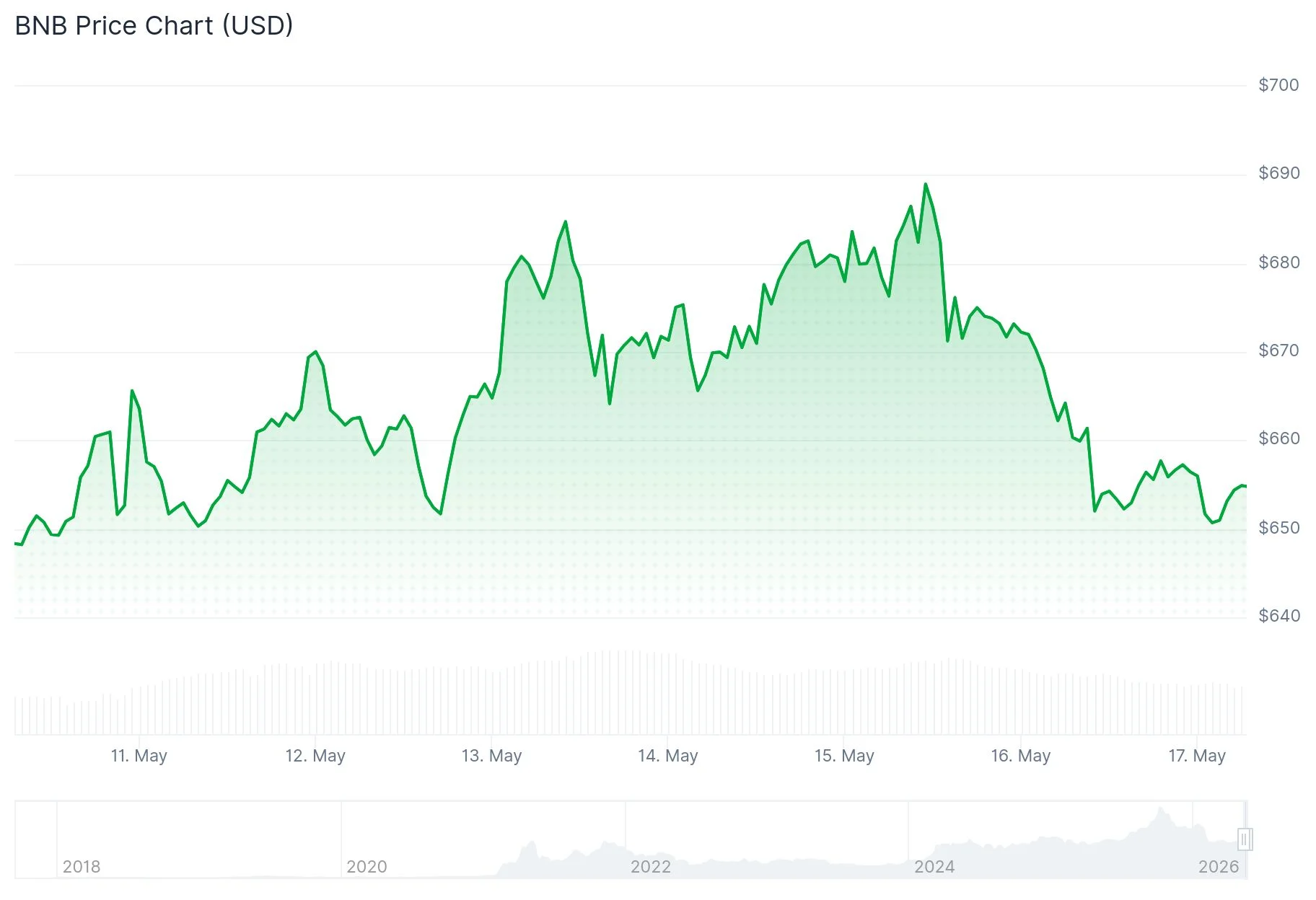
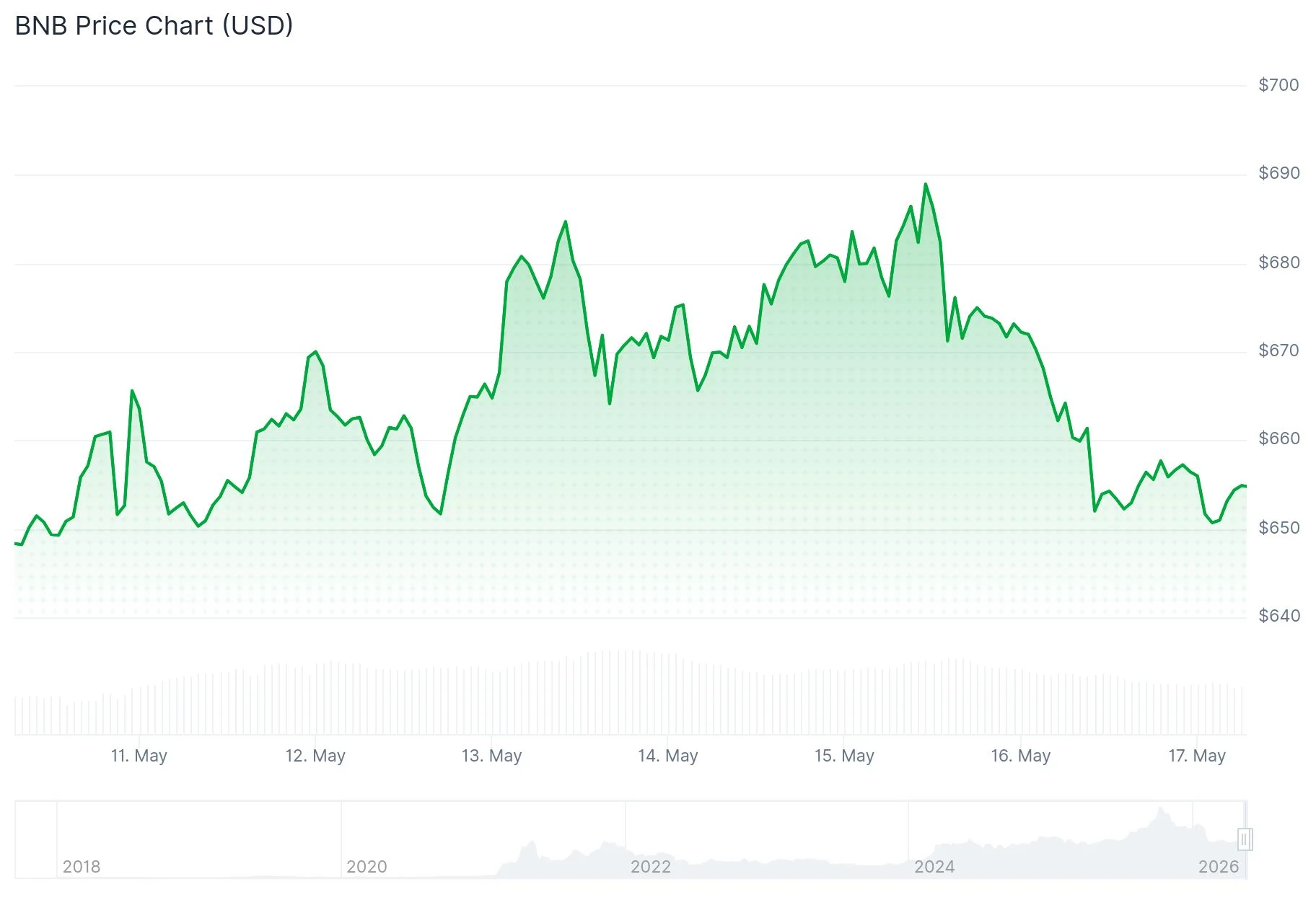
- Binance Coin currently hovers around $687, with market observers tracking the $690 resistance level as a critical catalyst for upward momentum.
- A successful push beyond $690 may unlock pathways toward $750–$780, whereas rejection could trigger pullbacks to support zones between $627–$650.
- Historical analysis from trader CryptoPatel reveals BNB has surged 169,100% since inception, identifying $300–$500 as a significant accumulation corridor.
On May 16, both Grayscale Investments and VanEck submitted revised registration documents for spot Binance Coin exchange-traded funds to the U.S. Securities and Exchange Commission. These simultaneous submissions have reignited market focus on the native token of the Binance ecosystem and its potential trajectory toward becoming a regulated investment vehicle in the United States.
VanEck’s filing represents Amendment No. 5 to its Form S-1 for the proposed VanEck BNB ETF, designed to list on Nasdaq with the ticker symbol VBNB. Meanwhile, Grayscale lodged Amendment No. 2 for its comparable offering, planned to trade under GBNB, likewise on the Nasdaq exchange.
James Seyffart, a Bloomberg analyst specializing in ETF markets, highlighted these filings on social media platform X. His commentary noted that the SEC has maintained a “deliberate in its approach to crypto ETFs” and emphasized that Binance Coin confronts “unique regulatory hurdles.” Seyffart observed that the updated amendments demonstrate Grayscale’s commitment to addressing regulatory concerns, though he cautioned that approval remains uncertain. He speculated that BNB might become the next digital asset to successfully navigate the SEC’s evaluation framework.
These submissions arrive following the landmark 2024 approvals of spot Bitcoin and Ethereum ETFs in U.S. markets. Subsequently, investment products tied to Solana and XRP have also secured listings. A regulated BNB ETF would enable investors to access the token through conventional brokerage platforms without requiring direct custody.
Both investment vehicles from Grayscale and VanEck will not incorporate staking features at inception. Each trust structure plans to maintain direct BNB holdings in compliance with Nasdaq Rule 5711(d) governing Commodity-Based Trust Shares.
Binance Coin Price Approaches Critical Resistance Zone
An additional layer of complexity stems from BNB’s regulatory classification within the United States. The SEC has previously contended in litigation against Binance and its founder Changpeng Zhao that BNB potentially constitutes a security. This legal backdrop introduces distinct evaluation considerations compared to the approval processes for Bitcoin and Ethereum investment products.
Binance Coin is currently changing hands near $687, representing a significant recovery from April lows approximately $580. Technical analysts are monitoring the $690 neckline as the decisive threshold for pattern confirmation. A sustained breach of this resistance would validate a double bottom formation on daily timeframes and establish $700 as the immediate objective.
Should buying pressure drive prices through $690, technical projections point toward $780 as the subsequent measured target. Momentum indicators reinforce the recovery narrative. The asset is trading comfortably above the Supertrend indicator positioned near $627, while the MACD has registered a bullish crossover accompanied by expanding positive histogram readings. Open interest metrics from CoinGlass indicate growing long positioning as BNB tests overhead resistance.
Historical Performance and Network Fundamentals
Cryptocurrency analyst CryptoPatel published a long-duration BNB chart illustrating the token’s remarkable 169,100% appreciation from its initial listing price across an eight-year timespan. The analysis identifies $300–$500 as a robust accumulation range with substantial historical demand and outlines extended targets including $2,112 and $5,000, though achieving these levels would necessitate multi-year bullish expansion.
Activity across BNB Chain infrastructure has accelerated during the recent market recovery phase. Decentralized exchange transaction volumes, stablecoin migration activity, and overall ecosystem engagement metrics have all demonstrated upward trends. Institutional tokenization initiatives deployed on BNB Chain have additionally maintained visibility for the network.
At the time of writing, Binance Coin is trading at approximately $657, maintaining its position as the fourth-largest cryptocurrency by market capitalization. The Securities and Exchange Commission has not published any timeline guidance regarding decisions on either pending ETF application.



TLDR:
- The 30-year Treasury bond surpassed 5%, raising borrowing costs and pressuring stretched equity valuations across U.S. markets.
- The S&P 500 trades at 21.3x forward earnings, well above its 16x long-term average, leaving stocks exposed to a yield-driven selloff.
- First-quarter corporate profits rose nearly 28% year-over-year, with AI infrastructure spending emerging as a key growth driver.
- A prolonged Strait of Hormuz closure could unleash a new inflation regime that equity markets have not yet priced in fully.
Bond yield spike concerns are growing among investors as U.S. stock markets appear unprepared for rising inflation risks.
Despite strong first-quarter earnings and AI-driven productivity gains, geopolitical tensions tied to the Iran conflict are pushing energy prices higher.
The 30-year Treasury bond crossed 5%, while the 10-year benchmark topped 4.5% last week. Analysts warn that equity valuations remain stretched, leaving markets exposed to a potential sharp correction.
Elevated Valuations Meet Rising Treasury Yields
The S&P 500 has climbed more than 17% from its late-March low, posting a year-to-date gain above 8%. However, the index trades at 21.3 times forward earnings estimates, well above its long-term average of 16.
Rising bond yields tend to pressure these valuations by increasing borrowing costs for companies and consumers alike.
Peter Tuz, president of Chase Investment Counsel, captured the mood plainly. “I do think there is a real fear that inflation is kind of embedded in the economy going forward,” he said.
“You don’t see any signs of it going down right now, and that is a real fear, and it will drive the market down if it continues.”
Paul Karger of TwinFocus described a divided outlook among his ultra-high-net-worth clients. “Breakfast, lunch and dinner: the question is always about how to make sense of the fact that this is such a divided outlook,” he said.
He has adopted a “barbell” strategy — holding heavy positions in cash, gold, and commodities while keeping exposure to mega-cap growth stocks.
Jack Ablin at Cresset Capital pointed to the Strait of Hormuz closure as a critical variable. Even a few months of disruption to oil and LNG shipments, he warned, could trigger “a brand new inflation regime for which investors just aren’t prepared.”
Earnings Strength Masks Geopolitical Fault Lines
Corporate earnings have been a key support for equity markets through this period of uncertainty. First-quarter profits are tracking roughly 28% above year-ago levels, the strongest growth since late 2021. AI capital spending on data centers and chip infrastructure has been a major driver of that growth.
Jeremiah Buckley of Janus Henderson noted that the AI spending boom is already showing results. “We’re seeing the impact of the AI spending boom and increase in productivity,” he said, adding that momentum could carry into 2027.
Yet elevated valuations in AI-related sectors are drawing caution from some analysts who see a pullback as possible.
Tim Murray of T. Rowe Price explained why traders remain reluctant to turn bearish. “Traders don’t want to turn bearish if there is a possibility — as many think — that the Strait of Hormuz situation could be cleared up in just a few weeks’ time,” he said. That hesitation is keeping markets supported even as risks build beneath the surface.
John Higgins of Capital Economics warned clients Thursday that equity markets are not pricing in inflation risk the way Treasury markets already are.
Matthew Gertken of BCA added that “the Iran crisis has the potential to reshape the trajectory of the markets” for the rest of the year.
TLDR:
- Monero reached a fresh all-time high near $798 in January 2026, confirming strong privacy sector leadership.
- Zcash uses zk-SNARK cryptography and carries a fixed 21M supply, mirroring Bitcoin’s scarcity model closely.
- XMR enforces mandatory privacy by default, while ZEC’s optional model leaves most transactions fully transparent.
- Zcash recently recorded daily trading volume spikes near $900M, pointing to growing high-beta speculative interest.
The privacy coin sector is seeing renewed debate as analysts compare Monero (XMR) and Zcash (ZEC) head to head. Both assets offer distinct privacy approaches, attracting different investor profiles.
Monero trades around $391.37, while Zcash sits at $519.04 as of this writing. With regulatory scrutiny on the rise, the question of which coin offers a stronger long-term position continues to generate discussion across the crypto community.
Monero Builds Case on Mandatory Privacy and Real-World Use
Monero holds a market cap of roughly $7.5 billion with over $115 million in daily trading volume. The coin recently reached a fresh all-time high near $798 in January 2026, demonstrating strong sector leadership.
Its privacy model relies on ring signatures and stealth addresses, making all transactions private by default. There are no optional transparency settings, which strengthens fungibility across the entire network.
Crypto analyst Dami-Defi shared a breakdown on social media, noting that XMR carries “one of the most loyal holder bases in crypto.”
Real-world usage remains a key strength, particularly in peer-to-peer and darknet payment networks. Monero’s tail emission model also keeps miners consistently incentivized, supporting long-term network security. These factors combine to give XMR a reputation as the “Bitcoin of privacy coins” within the sector.
On the downside, Monero faces serious regulatory headwinds. Multiple centralized exchanges have delisted the asset due to compliance concerns.
Its unlimited supply model also creates hesitation among newer investors unfamiliar with the tail emission structure.
Despite these challenges, the community behind XMR remains ideologically committed and largely resistant to external pressure.
The combination of proven resilience and mandatory privacy architecture makes Monero a high-conviction hold for many privacy-focused investors.
It has survived repeated regulatory attacks without losing its core user base. That track record matters, especially in a sector facing increased government attention globally.
Zcash Attracts Attention With Scarcity Model and Volatility Potential
Zcash uses zk-SNARK technology, which is widely regarded as one of the most advanced cryptographic privacy systems available. Its market cap recently reached around $9.5 billion, with daily volume spiking near $900 million.
The coin still trades far below its all-time high of $5,941, leaving significant recovery room if privacy narratives regain momentum. That gap draws traders looking for high-beta exposure in the privacy sector.
Dami-Defi noted that “whale activity and low liquid float dynamics have created violent upside moves recently” for ZEC. Optional privacy makes Zcash more exchange-friendly and easier for regulators to tolerate.
A fixed supply of 21 million coins also mirrors Bitcoin’s scarcity model, appealing to a different investor demographic. These traits position Zcash as the more institutionally accessible option between the two.
However, optional privacy remains a structural weakness. Most Zcash transactions occur on the transparent chain, not the shielded one.
This weakens overall network anonymity and reduces fungibility compared to Monero. Ecosystem adoption also trails Monero by a considerable margin, limiting its organic usage base.
For traders prioritizing explosive upside and institutional compatibility, Zcash presents a compelling speculative case.
For those focused on proven privacy infrastructure and real-world utility, Monero remains the stronger foundational asset in the privacy coin space.
Intesa Sanpaolo more than doubled its crypto exposure in the first quarter of 2026, according to a report citing Criptovaluta.it data.
Summary
- Intesa Sanpaolo more than doubled crypto exposure to $235 million during the first quarter.
- The bank added Ether and XRP positions while expanding Bitcoin ETF exposure through listed products.
- Intesa nearly exited Solana, cutting its Bitwise Solana Staking ETF stake sharply during Q1.
The Italian banking group’s crypto-linked holdings rose from about $100 million at the end of 2025 to about $235 million by March 31.
The increase came mainly from larger Bitcoin ETF positions. Intesa added to its ARK 21Shares Bitcoin ETF and BlackRock iShares Bitcoin Trust holdings. Crypto.news had earlier reported that the bank disclosed nearly $100 million in Bitcoin ETF exposure at the end of 2025.
Ethereum and XRP enter the mix
The report said Intesa gained Ethereum exposure for the first time through BlackRock’s iShares Staked Ethereum Trust. That move widened the bank’s crypto book beyond Bitcoin and Solana-linked products.
Intesa also added XRP exposure through the Grayscale XRP Trust. The position was valued at about $26 million in the report. The bank has not said whether the holding supports only proprietary trading or also connects to products for professional clients.
Moreover, the bank moved away from Solana during the same quarter. Its Bitwise Solana Staking ETF position reportedly fell from 266,320 shares to only 2,817 shares, marking a near-total exit.
That shift shows a more selective approach to crypto exposure. Intesa increased Bitcoin positions and added Ether and XRP, while almost removing Solana from its disclosed ETF portfolio.
European banks keep moving into crypto
The latest filing builds on Intesa’s earlier Bitcoin activity. In January 2025, Reuters reported that the bank bought 11 BTC worth about €1 million in its first proprietary Bitcoin trade. CEO Carlo Messina called the move “a test” and said, “We won’t become a bitcoin player.”
Intesa’s wider digital asset links also include custody infrastructure. Crypto.news previously noted that the bank had worked with Ripple Custody, formerly Metaco, for tokenized asset custody.
Other European banks are also building crypto services and settlement tools. Crypto.news reported that a 12-bank group led by Qivalis selected Fireblocks to support a MiCA-compliant euro stablecoin planned for the second half of 2026.
Crypto World
A Lawsuit Just Demanded Tether Hand Over $344 Million in Frozen Iranian Funds, Could This Rewrite Stablecoin Law?
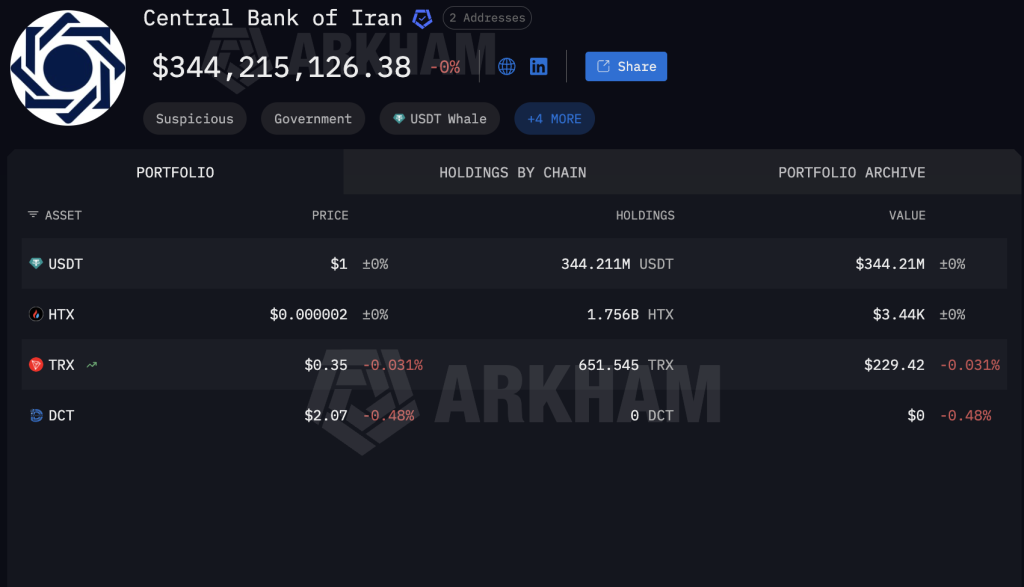
Attorney Charles Gerstein filed a claim in Manhattan federal court Thursday seeking to force Tether to transfer 344,149,759 USDT, roughly $344 million, frozen at two Tron wallet addresses designated by OFAC as belonging to Iran’s Islamic Revolutionary Guard Corps.
The plaintiffs, are asking the Southern District of New York to compel Tether to zero out the blocked wallets and reissue an equivalent amount of USDT to a wallet controlled by their counsel.
The filing is a direct expansion of Gerstein’s earlier litigation targeting frozen funds in the North Korea-linked Arbitrum case and separate claims against Railgun DAO.
Bearish signal for stablecoin issuer confidence. If courts accept this liability theory, Tether’s administrative freeze controls, designed for sanctions compliance, become a litigation target in every jurisdiction where judgment creditors hold unpaid terrorism awards.
Discover: The best crypto to diversify your portfolio with
How the Liability Theory Works Mechanically, and Why Tether Freeze Function Is the Fulcrum
The mechanism here is worth understanding precisely. Unlike bitcoin or ether, USDT includes issuer-level administrative controls: Tether can freeze wallets, blacklist addresses, zero out balances, and reissue tokens to a new destination address.
Gerstein’s filing argues that because Tether already immobilized the funds in response to OFAC’s sanctions designation of the two Tron addresses, the company has demonstrated both the technical capability and the practical willingness to act unilaterally on those holdings.
The chain of events runs as follows. OFAC designated the two Tron wallet addresses as IRGC property. Tether froze the 344,149,759 USDT held there.
The plaintiffs, holders of billions of dollars in unpaid U.S. court judgments tied to Iranian-backed terrorism, now argue that the frozen USDT constitutes blocked property of a state sponsor of terrorism, making it subject to execution under federal law.
The ask is not a seizure of Tether’s own reserves. It is a court order compelling Tether to use controls it has already used, directed at a different destination address.
That distinction matters analytically. Tether has already frozen $4.2 billion in USDT across more than 5,000 wallets linked to criminal activity and assisted the DOJ in seizing over $6 million connected to a Southeast Asian fraud scheme.
The plaintiffs are arguing Tether is not being asked to do something unprecedented, only to redirect an existing freeze toward judgment creditors rather than leaving the funds in limbo.
The legal precedent being constructed here is that administrative control over an asset is functionally equivalent to possession, and that possession creates liability to judgment creditors under the right statutory framework.
Discover: The best pre-launch token sales
The post A Lawsuit Just Demanded Tether Hand Over $344 Million in Frozen Iranian Funds, Could This Rewrite Stablecoin Law? appeared first on Cryptonews.
Crypto World
Hyperliquid HYPE Logs Net Daily Inflation of 3,087 Tokens Even as Spot ETF Hits $12.64M AUM
TLDR:
- HyperCore bought back 23,679.72 HYPE on May 16 but distributed 26,766 HYPE to stakers and validators.
- At current pace, HYPE’s net inflation could add over 1.11 million tokens to circulating supply per year.
- The 21Shares spot HYPE ETF recorded positive net inflows on every single day of its first trading week.
- Closing with $12.64M AUM, the ETF now holds 0.12% of HYPE market cap, a figure rising each day.
Hyperliquid’s HYPE token recorded net inflation on May 16, 2026, even as a new spot ETF drew steady investor interest throughout its debut week.
Buyback Activity Falls Short of Staking Rewards
On May 16, 2026, HyperCore repurchased 23,679.72 HYPE tokens at an average price of roughly $41.62. However, the protocol distributed 26,766 HYPE to stakers and 24 validators on the same day. The difference left a net addition of 3,087 HYPE to the circulating supply.
According to data shared by Hyperliquid Hub on X, this pace points to a daily net inflation of 3,087 HYPE. Extrapolated further, that translates to approximately 92,610 HYPE monthly and around 1.11 million HYPE annually. For context, Solana’s staking mechanism inflates its supply by roughly 25.19 million SOL per year.
The buyback mechanism is directly tied to price movement. When HYPE trades higher, fewer tokens can be repurchased with the same protocol revenue.
Conversely, lower prices allow the system to buy back and burn more tokens. This creates a natural counterbalance across different market conditions.
Long-term, the protocol’s growth depends on wider HIP-3 adoption. More trading activity generates more revenue, which in turn funds larger buybacks. That cycle is central to Hyperliquid’s supply management strategy going forward.
21Shares HYPE ETF Closes First Week With Consistent Inflows
Away from the inflation data, the newly launched 21Shares spot HYPE ETF wrapped up its first week on a positive note. BSCNews reported on X that the product recorded net inflows every single day since its launch earlier this week. By May 15, it had pulled in a net inflow of $3.1 million for the day alone.
The ETF closed the week with a total AUM of approximately $12.64 million. It now holds around 0.12% of HYPE’s total market cap, and that share continues to grow steadily. These numbers reflect early but consistent demand from investors seeking regulated exposure to HYPE.
The inflow-only streak during the debut week is a notable data point for a newly listed crypto product. Many ETFs experience mixed flows in their first days as the market discovers pricing and liquidity. That did not happen here, which points to pre-existing demand among institutional and retail investors alike.
The product’s AUM growth, while still early, adds another layer of buying pressure on HYPE at a time when the protocol is working through its inflation mechanics.
Both developments together offer a fuller picture of where HYPE stands heading into the latter half of May 2026.


VanEck and Grayscale filed new amendments for their proposed spot BNB exchange-traded funds, adding fresh attention to the race for the next U.S. altcoin ETF.
Summary
- VanEck and Grayscale filed new BNB ETF amendments as altcoin ETF competition moves faster.
- Both BNB ETF proposals plan direct token exposure but keep staking out at launch.
- Canary’s TRX filing takes a different route by placing staking inside the fund structure.
The filings came as asset managers continue to test how far the SEC may move beyond Bitcoin and Ethereum products.
VanEck filed Amendment No. 5 for the VanEck BNB ETF on May 15. The fund is expected to list on Nasdaq under the ticker VBNB, subject to approval. Its filing says the trust would hold BNB directly and trade under Nasdaq’s commodity-based trust share rules.
Grayscale keeps BNB plan alive
Grayscale also filed an updated registration statement for its own BNB ETF plan. The Grayscale BNB ETF was formed as a Delaware statutory trust on Jan. 8, 2026, and its stated purpose is to hold BNB tied to the BNB Smart Chain.
The filing says the trust would seek to reflect the value of BNB held by the fund, less expenses and liabilities. It also includes conditional language around staking, but that does not mean staking will be active at launch. That part remains tied to regulatory and operational conditions.
In addition, the BNB filings show caution around staking. Both proposals focus on direct BNB exposure, while keeping staking outside the main launch plan. That approach reflects ongoing questions around how staking rewards fit inside regulated U.S. ETF products.
Canary Capital is taking a different path with its Canary Staked TRX ETF. Its May 15 amendment describes a fund that would hold TRX and include staking as a secondary investment objective. The filing names the product as Canary Staked TRX ETF and lists it as Amendment No. 1 to Form S-1.
Altcoin ETF queue keeps expanding
The filings come as the wider altcoin ETF queue grows. Crypto.news recently reported that Grayscale added TRX, HYPE, TON, ENA, and other assets to its Q2 2026 list of digital assets under review for future products. The same report said Grayscale had also filed for a spot HYPE ETF.
Another crypto.news report said analysts expect altcoin momentum to depend partly on ETF approvals, with several proposed products still under SEC review. The report said proposals tied to SOL, XRP, HBAR, LTC, and TRX remain part of the broader review cycle.
Crypto World
Intesa Sanpaolo’s Crypto Portfolio Hits $235M as Italy’s Biggest Bank Goes Deeper Into Digital Assets
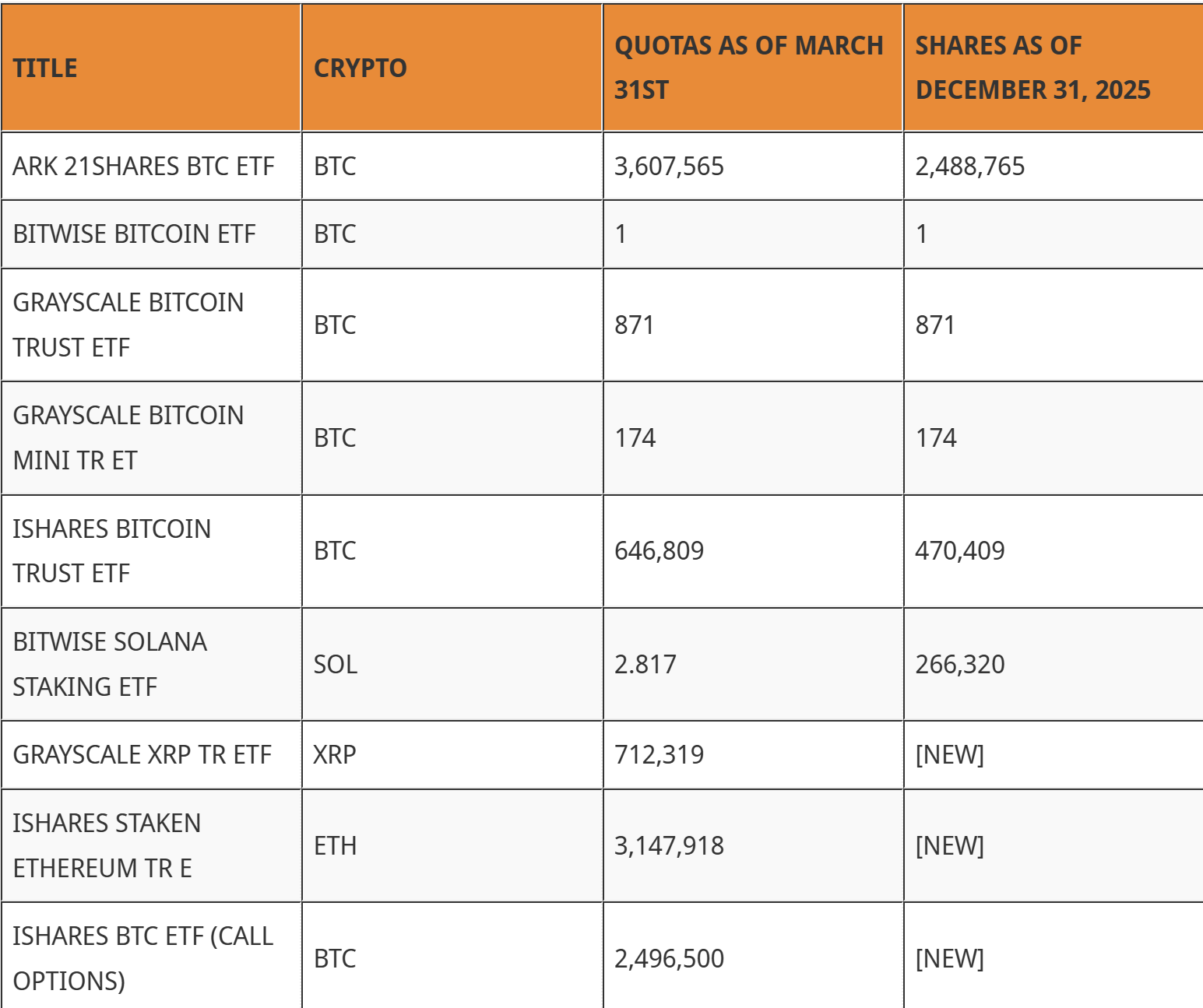
Intesa Sanpaolo, Italy’s largest bank, more than doubled its crypto exposure in the first quarter of 2026, with holdings climbing from approximately $100 million at the end of 2025 to around $235 million as of March 31.
The growth was driven by expanded Bitcoin positions, with the bank adding to positions in both the ARK 21Shares BTC ETF and BlackRock’s iShares Bitcoin Trust ETF. It also entered Ethereum for the first time through BlackRock’s iShares Staked Ethereum Trust, and picked up a fresh stake in Ripple’s XRP via the Grayscale XRP Trust ETF, worth approximately $26 million, according to a report by local crypto outlet Criptovaluta.it.
Intesa also opened a new position in iShares Bitcoin Trust call options, its first derivatives play in the space. The bank previously confirmed to Criptovaluta.it that its crypto positions are held for proprietary trading purposes, though it has not disclosed whether any of the assets are also used to hedge products offered to professional clients, the report said.
Source: Criptovaluta.it
On the other hand, the bank reduced its Solana holdings, which had featured prominently in the prior quarter. Its position in the Bitwise Solana Staking ETF slashed from 266,320 shares to just 2,817, a near-total exit.
Related: Banking Circle Joins Europe’s Stablecoin Settlement Race
Intesa adds BitGo, dumps Bitmine
On the equities side, the bank made several adjustments to its crypto stock holdings. It added 165,600 shares of BitGo for the first time, while dumping the Bitmine position. The bank also closed out its put options on Strategy and trimmed its stake in Cantor Equity Partners II, the vehicle through which tokenization firm Securitize is set to list. Coinbase shares also increased from 1,500 to 10,357.
The moves come as Intesa deepens its ties to the digital asset sector. Last month, Ripple announced it would offer its custody services to the Italian banking group.
Intesa shares closed at 5.74 euros on Friday, down 1.56% on the day and off 3.14% year-to-date, according to Yahoo! Finance.
Related: Europe Bitcoin Treasury Model Won’t Mirror Strategy: PBW 2026
European banks expand crypto offerings
More European banks are moving into crypto, with Spain’s BBVA, France’s BPCE and Belgium’s KBC among those already live with retail trading services. BBVA became the first major Spanish bank to offer 24/7 Bitcoin and Ether trading through its mobile app, while BPCE launched in-app crypto trading via regulated subsidiary Hexarq, targeting 12 million customers by 2026.
At the infrastructure level, a consortium of 12 major European banks, including BNP Paribas, ING, UniCredit and Deutsche Bank, formed Qivalis to issue a MiCA-compliant euro-backed stablecoin, targeting a launch in the second half of 2026.
Magazine: Guide to the top and emerging global crypto hubs — Mid-2026
Crypto World
SUI Price Holds at $1.06 as Chart Base and Whale Accumulation Signal a Potential Reversal
TLDR:
- SUI is trading at $1.0651, sitting 17.6% below its 200-day moving average resistance level of $1.2873.
- RSI has recovered from extreme oversold levels to a neutral 51, leaving room for price to move in either direction.
- MACD has not crossed bullish yet, but the narrowing gap between lines signals building momentum below the surface.
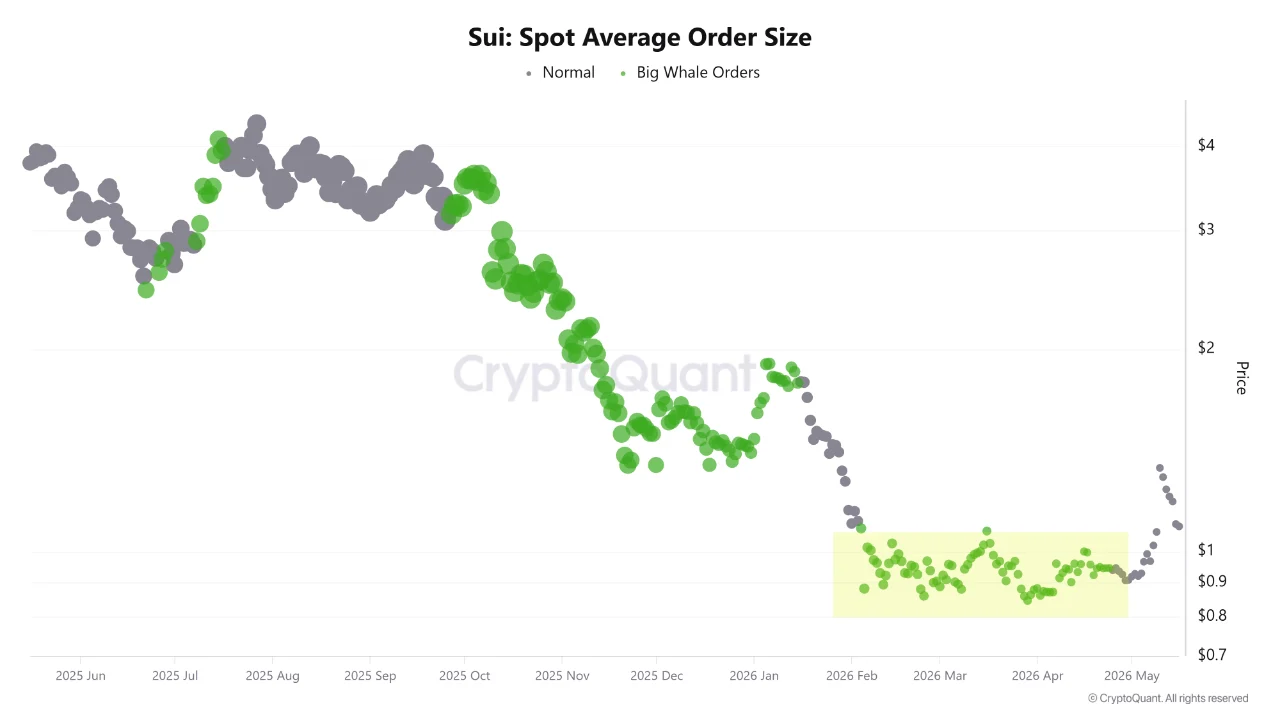
- CryptoQuant data shows large orders clustering at $0.90–$1.00, pointing to whale accumulation ahead of a potential rebound.
SUI is trading at $1.0651, sitting 17.6% below its 200-day moving average of $1.2873. The token dropped from $4.00 to $0.50 over four months before stabilizing.
Technical analysts are now watching closely as momentum indicators show early signs of recovery. Meanwhile, on-chain data from CryptoQuant points to large-order accumulation near key support zones. The chart structure tells a more layered story than the price decline alone suggests.
Technical Indicators Point to a Market in Transition
SUI printed a capitulation bottom near $0.50 in late 2025. Volume spiked sharply at those lows, which typically marks seller exhaustion rather than continued distribution. That kind of price action usually separates a dying asset from one completing a base.
Since that bottom, the Relative Strength Index has climbed from extreme oversold territory back to 51. That reading is neutral — not extended to the upside, and not under further selling pressure. It gives the chart room to move in either direction.
Analyst account @2xnmore noted that the MACD has not crossed bullish yet, but the gap between the MACD line and the signal line is narrowing.
The momentum engine is building without having triggered a confirmed buy signal. That is an important distinction.
The 200-day moving average at $1.2873 remains the key structural line. A high-volume daily close above that level would shift the chart from bearish to neutral.
A MACD crossover on top of that would then move the structure from neutral to bullish. Neither has happened yet.
Whale Order Data Suggests Accumulation at the $0.90–$1.00 Zone
On-chain researcher Rei Researcher referenced CryptoQuant’s Spot Average Order Size data to track large-player behavior.
The data shows large-volume orders clustering around the $0.80–$1.00 range during market lulls, without pushing price lower. That pattern has preceded rebounds before.
Source: Cryptoquant
The $0.90–$1.00 zone appears to function as a solid support band. When large orders repeatedly fill at that level without breaking it, it suggests institutional positioning rather than exit. That behavior contrasts with panic-driven retail selling at cycle lows.
If SUI corrects back toward that range and large-order activity increases, analysts consider it a bullish signal for the next move higher. The re-fill pattern at that level is what traders are now watching for on future dips.
The broader picture is that SUI remains in a technical rebuild phase. Price is below the 200-day MA, but the base structure and whale footprint both suggest the selling pressure has already been absorbed at lower levels.

While macro pain and Iran war uncertainty drag Bitcoin below $79K, fixed-income market outflows could trigger a medium-term Bitcoin rebound.
TLDR:
- Justin Sun controls roughly 60 billion TRX tokens, representing 63% of the total supply in circulation.
- HTX acquisition allows Sun to channel user deposits into JustLend, using TRX as near-unlimited collateral.
- The Tron Inc. Nasdaq reverse merger lets Sun swap on-chain tokens for U.S. dollars without crashing markets.
- Sun’s WLFI investment created an off-exchange token swap that converts TRX exposure into tradable assets.
Justin Sun’s financial maneuvers have drawn scrutiny after a detailed analysis revealed how the Tron founder may be converting illiquid TRX holdings into hard assets.
Crypto analyst Punk2898 outlined several methods Sun allegedly uses to manage his vast token reserves. Sun reportedly controls around 60 billion TRX tokens, valued at over $20 billion, but faces major liquidity challenges due to the sheer size of his position in the market.
The Mechanisms Behind Sun’s Liquidity Strategy
Sun’s approach to managing TRX appears to draw lessons from the FTX collapse. According to Punk2898, FTX once held a large TRX position and could not aggressively sell it.
Instead, FTX continuously bought back TRX on secondary markets to support the price. It then used third-party platforms to collateralize the tokens and borrow stablecoins, creating a steady flow of liquid capital.
Sun’s acquisition of Huobi, now rebranded as HTX, appears to serve a similar function. Users deposit USDT into HTX expecting high-interest returns.
Those funds are reportedly channeled into Aave or JustLend to capture yield spreads. HTX then pockets the interest differential, while JustLend collateral remains largely in TRX — a token Sun controls in virtually unlimited supply.
The USDD stablecoin adds another layer to this structure. USDD is backed by 10.9 billion TRX and approximately 19.6 million USDT, supporting around 745 million USDD in circulation.
Sun uses TRX as collateral to mint USDD, which then attracts real dollar deposits through high annualized yields. This effectively turns his own tokens into a mechanism for pulling in external liquidity.
Sun’s investment in World Liberty Financial and the TRUMP memecoin also fits into this pattern. He reportedly invested over $40 million in WLFI, which then bought TRX in return.
Sun can liquidate his WLFI holdings freely, while WLFI holds TRX. The analyst described it as an off-exchange swap that heavily favors Sun’s position.
The Nasdaq Reverse Merger and Long-Term Conversion Plans
The most direct conversion method came in July 2025 through a Nasdaq reverse merger involving Tron Inc. The deal essentially exchanged on-chain TRX tokens for a U.S. stock ticker.
U.S. stocks were issued to raise dollars, which were then used to buy TRX from Sun directly through over-the-counter trades.
Those TRX tokens then entered the Nasdaq company’s treasury, while the dollars went to Sun. The analyst compared this to Michael Saylor’s Bitcoin treasury strategy but with a key difference—Saylor buys existing Bitcoin, while Sun effectively creates TRX. The structure allows Sun to convert crypto holdings into Wall Street assets without crashing the open market.
Punk2898 noted that Sun’s core task, for years to come, remains converting his 60 billion illiquid TRX into Bitcoin and Ethereum.
Every strategy described feeds into that single objective. Each move builds infrastructure that slowly shifts value from TRX into harder, more widely accepted assets.

Southwest Gas Holdings, Inc. (SWX) Presents at 2026 American Gas Association Financial Forum – Slideshow
Bond Yield Spike Puts Equity Markets at Risk, Investors Caution

Bruce Willis Goes Full John Wick in This Explosive 33-Year-Old Streaming Hit

Manchester United reach agreement with Casemiro over contract clause amid transfer speculation

US brings back mandatory military draft registration

Steven Gerrard disagrees with Gary Neville over ‘shock’ Chelsea and Arsenal claim | Football


-

 Crypto World1 day ago
BloFin War of Whales 2026 Grand Prix opens registration for $5M trading championship
-

 Fashion2 days ago
Weekend Open Thread: Theory – Corporette.com
-

 Crypto World2 days ago
E-Estate Announces 1 Year Live: Washington DC Summit as Real Estate Tokenization Enters Its Next Phase
-

 Fashion6 days ago
Coffee Break: Travel Steam Iron
-

 Fashion6 days ago
What to Know Before Buying a Curling Wand or Curling Iron
-

 Politics6 days ago
What to expect when you’re expecting a budget
-

 Tech2 days ago
Tech Moves: Microsoft AI leader jumps to OpenAI; former AI2 exec joins Meta; and more
-

 Tech6 days ago
GM Agrees To Pay $12.75 Million To Settle California Lawsuit Over Misuse Of Customers’ Driving Data
-
Crypto World4 days ago
Bitcoin Suisse expands with Digital Asset License and Investment Business Act Registration Approval in Bermuda
-

 Tech5 days ago
GM agrees to $12.75M California settlement over sale of drivers’ data
-

 Politics4 days ago
Pakistan to enter Chinese capital market as war inflation bites
-

 Crypto World4 days ago
Bitcoin Suisse expands with Digital Asset License and Investment Business Act Registration Approval in Bermuda
-

 Crypto World3 days ago
Google’s Gemini AI Predicts Incredible Solana Price by the End of 2026
-
 Business2 days ago
H&R Real Estate Investment Trust (HR.UN:CA) Q1 2026 Earnings Call Transcript
-

 Tech1 day ago
Google reimburses Register sources who were victims of API fraud
-
 Entertainment6 days ago
Prime Video’s Forgotten but Brilliant 2-Part Horror Anthology Is a Perfect Binge
-
 Entertainment6 days ago
‘Rivals’ Season 2 Is Bigger, Better, and Raunchier Than Ever
-
 Tech6 days ago
University of Michigan’s $20M early OpenAI investment now worth $2B as Musk trial documents reveal endowment bet
-

 Tech6 days ago
Over-Engineered Cardboard PC Case Houses a Full Computer Without Compromising Style or Performance
-

 Fashion4 days ago
The Best-Kept Makeup Secret for a More Defined Face
You must be logged in to post a comment Login