
Crypto World
Binance launches 5 stock perpetuals with 20x leverage



Binance Futures launched five USDT-margined TradFi perpetual contracts on Aug. 25, giving eligible traders leveraged exposure to Trump Media, Moderna and three semiconductor-focused exchange-traded funds.
Summary
- Binance launched five USDT margined perpetual contracts tied to U.S. stocks and leveraged exchange-traded funds.
- Contracts offer up to 20x leverage, round-the-clock trading and eight-hour funding settlements through Binance Futures.
- SKUU and SKDD track daily moves in SK Hynix, while RAM references leveraged DRAM exposure.
- DJT and MRNA perpetuals reference Trump Media and Moderna shares without granting stock ownership rights.
- Each contract uses USDT for settlement and requires a minimum notional trade worth five dollars.
The contracts began trading at five-minute intervals between 09:00 and 09:20 UTC. Binance listed SKUUUSDT, SKDDUSDT, RAMUSDT, DJTUSDT and MRNAUSDT with maximum leverage of 20x.
Binance adds five U.S. market-linked contracts
SKUUUSDT tracks the GraniteShares 2x Long SK Hynix Daily ETF, while SKDDUSDT references the issuer’s 2x Short SK Hynix Daily ETF. Both underlying funds trade on Nasdaq.
The long fund seeks twice the daily percentage change in SK Hynix’s U.S.-listed depositary receipt. The short fund seeks twice the inverse daily return, according to GraniteShares’ product details.
RAMUSDT references the Roundhill T-REX 2X Long DRAM Daily Target ETF, which trades on Cboe BZX. RAM targets twice the daily performance of the Roundhill Memory ETF rather than directly holding or tracking a single semiconductor company.
DJTUSDT follows Trump Media & Technology Group shares, while MRNAUSDT references Moderna. Both companies trade on Nasdaq under DJT and MRNA.
The contracts provide derivatives, not stock ownership
The five Binance products are perpetual derivatives priced and settled in USDT. Traders do not receive shares, voting rights, dividends or ownership interests in the referenced companies or ETFs.
Perpetual contracts do not have expiry dates. Binance uses funding payments between long and short traders to help keep contract prices aligned with their reference markets.
Each contract has a minimum trade size of 0.01 units and a minimum notional value of 5 USDT. Funding fees settle every eight hours, while the initial funding-rate cap is set at +2% and the floor at -2%.
The exchange said the normal rule allowing funding intervals to change from eight hours to one hour when rates reach their limits will not apply automatically. The exchange will issue a separate announcement if it changes that schedule.
Layered leverage increases trading risk
SKUU, SKDD and RAM are already leveraged ETFs designed around daily investment objectives. Applying up to 20x leverage through a perpetual contract creates an additional layer of exposure.
Daily leveraged funds can produce returns that differ greatly from a simple multiple of the underlying asset over longer periods. Compounding, volatility and daily resets can reduce returns even when the referenced asset moves in the expected direction.
Binance’s leverage can further accelerate profits and losses. A relatively small adverse price movement may trigger liquidation if a trader lacks enough margin to maintain the position.
These risks remain present outside U.S. stock-market hours. Binance offers the contracts continuously, while the referenced shares and ETFs trade during scheduled exchange sessions. Prices can therefore diverge when Nasdaq and Cboe BZX are closed.
The rollout follows a wider exchange push into 24/7 synthetic exposure to traditional assets. Bybit said its own TradFi perpetual range recently passed 200 products, including equities, ETFs, commodities and private companies.
Binance’s ADGM entities operate the products
The contracts were admitted to trading on the exchange RIE and to clearing and settlement through Binance RCH, according to the exchange’s notice.
The company RIE is operated by Nest Exchange Limited, which the Abu Dhabi Global Market’s Financial Services Regulatory Authority recognizes as an investment exchange for derivatives. Nest Clearing and Custody Limited operates Binance RCH as a recognized clearing house.
The regulatory structure does not make the products available everywhere. Binance cautioned that access depends on the user’s location and applicable restrictions. The contracts reference U.S.-listed securities, but they are not direct Nasdaq or Cboe trades.
Binance may change leverage, margin, funding and other trading parameters under its exchange and clearing rules. No separate deadline or additional launch phase was announced.
There was no verified market movement in DJT, Moderna or the three ETFs that could be attributed specifically to the Binance listings.



Chinese state-affiliated hackers now run twice as many attacks as they did before handing mundane work to DeepSeek and open-source artificial intelligence (AI) systems, according to Taiwanese threat intelligence firm TeamT5.
Attribution remains imprecise. The firm cannot tie every intrusion to a specific system, though it said that DeepSeek remains a popular choice among hackers.
Why Cheap AI Beats Frontier Models for Attackers
The finding inverts a common assumption that the risk of offensive AI lies mainly with the most advanced systems. Instead, operators are now scaling output using relatively weaker tools.
Cost and permissiveness drive that choice. Moonshot’s Kimi K3 is more powerful. Yet, TeamT5 has logged no incidents involving it and considers its running costs prohibitive for hackers.
Charles Li, chief analyst at TeamT5, framed the trade-off directly.
“DeepSeek is the AI of choice for Chinese hackers because it’s relatively powerful with very low cyber guardrails. Western models are highly sought-after but their guardrails are much more strict and require a lot more effort to bypass,” Li said.
Follow us on X to get the latest news as it happens
How Hackers Use AI
TeamT5 obtained scripts and logs, placing DeepSeek across multiple attack stages. A group called Grimfengxi used it to generate exploit code. Teleboyi used it to gather 1,000 IP addresses and map a target’s domains.
Huapi hit a Taiwanese company’s email system with a Chinese model that researchers believe was DeepSeek. Western tools appear too.
TeamT5 said a group tracked as Slime22 breached a Taiwanese technology firm’s systems, installed Kali, and directed Claude Code to run lateral movement. Operators bypassed safeguards by claiming to be engineers conducting authorized tests.
Meanwhile, CyCraft traced a 10-person Chinese startup selling intrusion software for 300,000 to 500,000 yuan, or roughly $44,500 to $74,000. At least four hacking groups bought it. The company also used ChatGPT during an attack.
A spokesperson for OpenAI said the firm is committed to identifying, preventing, and disrupting attempts to abuse its models.
Meanwhile, Chinese groups are not alone in this shift. North Korea’s Kimsuky is also testing local models.
Anthropic reached a broader conclusion in June, finding that AI now handles advanced attack work for hackers who lack the skill to do it themselves.
Subscribe to our YouTube channel to watch leaders and journalists provide expert insights
The post Chinese State Hackers Double Attack Volume After Adopting AI, Report Shows appeared first on BeInCrypto.
Meta Platforms is reportedly planning to launch a consumer AI agent, known internally as Hatch, within the coming weeks. Documents reviewed by The Information also show an October target for a new model, Watermelon.
The release anchors Chief Executive Mark Zuckerberg’s ambition to monetize Meta’s AI investments and diversify revenue. The AI spending has weighed substantially on the company’s cash flow.
Meta Plans Subscription AI Agent Hatch as It Seeks To Diversify Revenue
Meta has weighed a tiered subscription for Hatch, according to the documents. Premium access could cost up to $199.99 per month and include higher usage limits. The documents put the release in late August or early September.
The stakes show up in Meta’s own numbers. The firm reported $60.8 billion in second-quarter revenue. Advertising delivered $59.4 billion of that, more than 97% of the total.
Everything else is quite small. Reality Labs brought in $431 million, while other revenue reached $1.01 billion.
Meanwhile, the AI buildout continues to grow. Meta raised the floor of its 2026 capital expenditure range to $130 billion from $125 billion. The ceiling stayed at $145 billion.
Capital expenditures reached $31.08 billion in the quarter. Operating cash flow of $31.86 billion left just $784 million in free cash flow. The figure was $8.55 billion a year earlier.
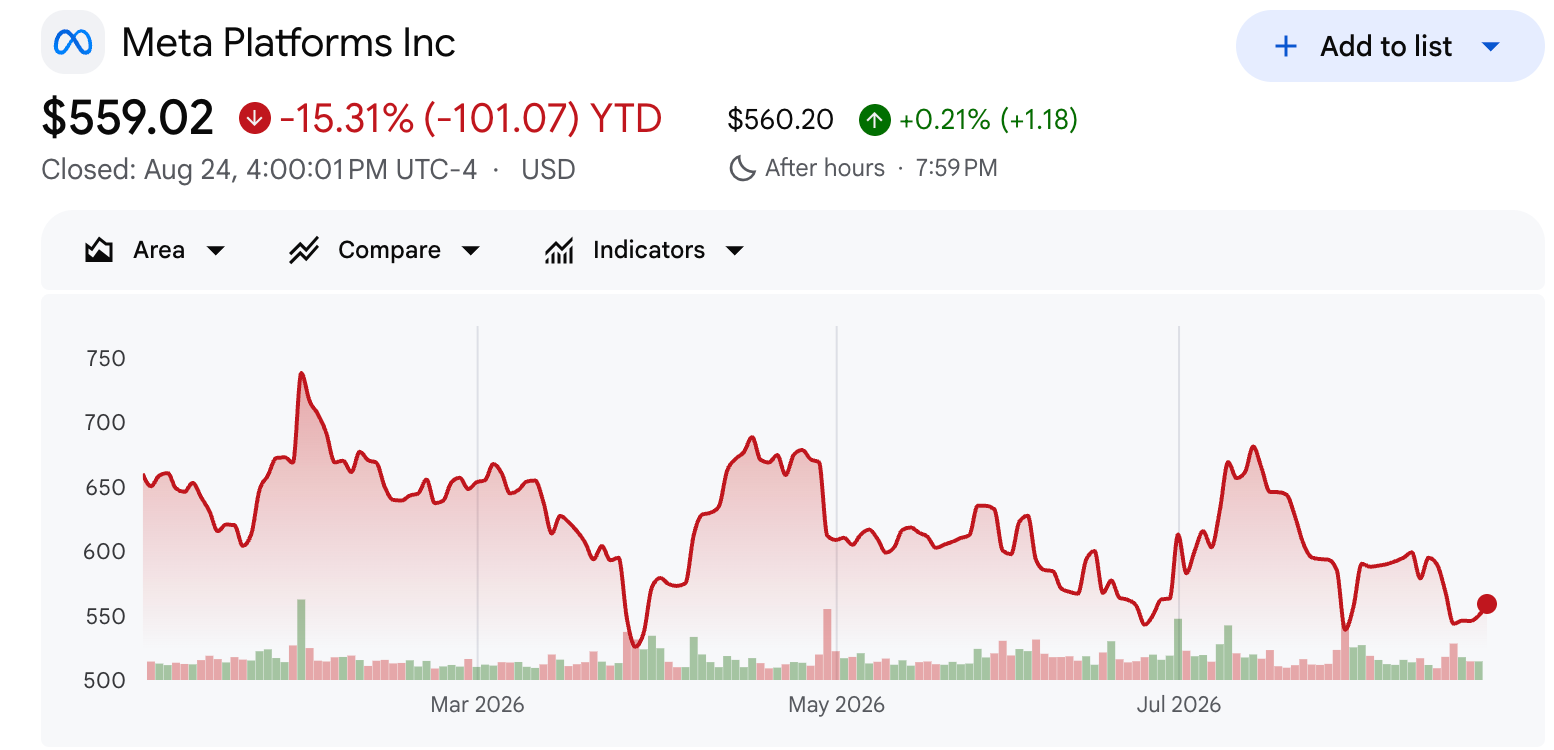
Investors have not rewarded the buildout so far. META closed Monday at $559.02, valuing the company at nearly $1.42 trillion, and the shares have fallen by over 15% this year.

A youth-safety trial in Oakland has also added pressure. Bank of America keeps a Buy rating and an $810 target. Mizuho is wary, comparing the case to the tobacco litigation of the 1990s.
Hatch would give Meta a consumer revenue line that does not depend on advertisers. Whether subscribers pay enough to matter against a $145 billion spending year is the open question.
Follow us on X to get the latest news as it happens
What Meta’s AI Agent Will Do
Hatch has been trained to work across DoorDash, Etsy, Reddit, Yelp, and Outlook. Early prototypes show a customizable dashboard featuring tools and skills created by AI agents.
Meta is also preparing a WhatsApp platform that lets users integrate and interact with third-party AI agents. The company could begin testing the platform with a limited group of users as soon as this week.
The company has shipped several models this year. Muse Spark arrived in April, version 1.1 in July, and version 1.2 alongside the Muse Code agent in August.
Whether Watermelon will join the Muse family remains unclear. Meta is estimated to report its third-quarter earnings on October 28, the same month Watermelon is due. Neither product will have had long to prove its economics by then.
Subscribe to our YouTube channel to watch leaders and journalists provide expert insights
The post Meta Targets Early September for Hatch, Its Consumer AI Agent appeared first on BeInCrypto.


Stablecoin card spending has crossed $10.9 billion in cumulative volume as RedotPay projected that annual spending through the products could quadruple to $50 billion by 2028.
Summary
- Stablecoin cards have processed more than $10.9 billion in cumulative spending.
- July card spending topped $1 billion for the first time, according to Paymentscan.
- RedotPay expects annual stablecoin card spending to reach $50 billion by 2028.
- The company cited adoption, clearer regulation and cross border payment use as growth drivers.
RedotPay said in an Aug. 25 blog post that the industry recorded more than $1 billion in card spending during July for the first time, citing independent payments data provider Paymentscan, as usage continued to rise across markets in Latin America, Africa and Asia-Pacific.
The stablecoin payments company expects the industry to process its next $10 billion in eight months after taking roughly three years to reach the first $10 billion. By 2028, RedotPay expects stablecoin-powered cards to be handling $50 billion in annualized spending.
“When you consider that over $20 trillion will be spent this year on traditional cards, $50 billion per year no longer seems unattainable,” the company said.
Paymentscan data showed July 2026 as the largest month recorded for the sector. Its headline dataset put stablecoin card spending at about $1.04 billion during the month, compared with roughly $339 million in July 2025.
RedotPay attributed its forecast to its own operating data, adoption patterns in several developing markets, clearer rules for stablecoin businesses and increasing use of digital dollars for payments, remittances and foreign exchange services.
Stablecoin card spending has accelerated in 2026
Stablecoin cards connect cryptocurrency balances to existing card networks, allowing users to pay merchants while stablecoins or other digital assets are converted or settled through the infrastructure behind the transaction.
RedotPay said the products have moved from an experimental payment method toward regular consumer use. When the company launched its first card about three years ago, it estimated that the entire industry was processing around $60,000 each month. Current volumes can reach the same amount in roughly four minutes, according to its blog.
Jonathan Chan, RedotPay’s head of partnerships and co-founder, said the company was seeing demand from customers who use stablecoins to handle ordinary financial needs instead of cryptocurrency trading.
“Stablecoin-powered cards have reached their mainstream moment, hitting all-time highs in spending volume on the strength of their utility in daily life,” Chan said.
“Our users are not necessarily crypto traders. They are people who found a better way to manage their finances because the previous options they had weren’t good enough. This is where the growth will come from.”
The company pointed to customers using the cards for expenses such as groceries, subscriptions, travel and rent across more than 100 countries. RedotPay also cited examples of users who need access to international digital services, mobile wallets or dollar-denominated balances where local banking products do not provide the same options.
Consumer card products have also become a larger part of RedotPay’s own business. In July, crypto.news previously reported that the company had launched an XRP Ledger-powered product allowing customers to pledge XRP as collateral and access a credit line settled in Ripple USD.
The product uses a 50% loan-to-value ratio and allows the borrowed value to be spent through Visa merchants while customers retain exposure to their pledged XRP. At the time, RedotPay reported more than 8 million users in over 100 countries and roughly $12 billion in annualized payment volume.
RedotPay now puts its annualized payment volume at approximately $14 billion and annualized revenue at more than $180 million. The company said it has built a profitable business while expanding its stablecoin payment services.
Clearer rules and better products are supporting card use
Explaining the increase in card activity, RedotPay identified regulatory developments as one of the factors that have made consumers and payment companies more willing to use stablecoin-based services.
The company said clearer requirements in important markets have given established operators a more defined framework for licensing and compliance while giving potential customers more confidence in stablecoin products.
Product improvements have played a role as well, according to RedotPay. Interfaces have become easier to use, fiat-to-crypto and crypto-to-fiat services have expanded their coverage, conversion pricing has improved and customer support has become more developed.
RedotPay expects fast-growing payment companies to spend more on licenses and compliance as transaction volumes rise. It also expects traditional financial companies to make more use of stablecoin settlement infrastructure, while additional providers connect blockchain networks with existing banking rails.
The company has begun building its own U.S. regulatory footprint. RedotPay said it recently obtained its first U.S. money transmitter license and has applications pending in more than 20 additional states.
Card networks have been adding stablecoin settlement services at the same time. In June, Mastercard added support for settlement using six regulated dollar-backed stablecoins, including USDC, PayPal USD, Ripple USD, Global Dollar, Pax Dollar and SoFiUSD.
Mastercard said the system can settle transactions outside normal banking hours, including weekends and holidays, while retaining existing card payment processes. Supported blockchain networks included Ethereum, Solana and the XRP Ledger.
Stripe has also been building stablecoin card infrastructure through Bridge. A July report detailed how the program expanded into more than 100 markets after Stripe acquired the stablecoin infrastructure company.
Former Stripe stablecoin partnerships head Connor Fitzgerald said the team established sponsor bank and card network relationships, built stablecoin settlement infrastructure in the United States and took annualized payment volume from zero into the tens of millions of dollars.
Stablecoin payments extend beyond consumer checkout
Card spending represents one part of the stablecoin payments market, with cross-border settlement, remittances and business payments accounting for other use cases that RedotPay expects to support future adoption.
In May, BridgerPay co-founder and CEO Ran Cohen said stablecoin payment demand remained concentrated in cross-border settlement, business-to-business payouts and treasury operations. Cohen expected stablecoins to expand through business payment flows without displacing conventional cards at merchant checkouts.
RedotPay’s model connects the two systems by allowing users to fund spending from digital assets while relying on existing card networks for merchant acceptance.
The company identified Latin America, Africa and Asia-Pacific as important markets in its forecast. RedotPay said customers in such regions can use stablecoins for dollar savings, international purchases, travel spending and access to payment products that may not be available through their local banks.
Cross-border use also gives stablecoin cards a role in remittances and foreign exchange, according to the company, particularly where customers already hold digital dollars and need to convert or spend them without moving funds through several financial services.
RedotPay said competition among companies connecting traditional banking systems with stablecoins could reduce costs as more providers enter the sector. The company expects established financial institutions to increase their use of stablecoin rails as payment infrastructure develops.
Its 2028 projection would put annual stablecoin card spending at $50 billion, roughly four times the current annualized level cited by the company, while remaining a small fraction of the more than $20 trillion RedotPay expects consumers to spend using traditional cards this year.
The company currently serves more than 8 million users globally, with pending money transmitter license applications in more than 20 U.S. states alongside the first state license it has already received.
Crypto World
Live updates: Bitcoin ETFs draw a sixth straight day of inflows as the rally holds above $80,000
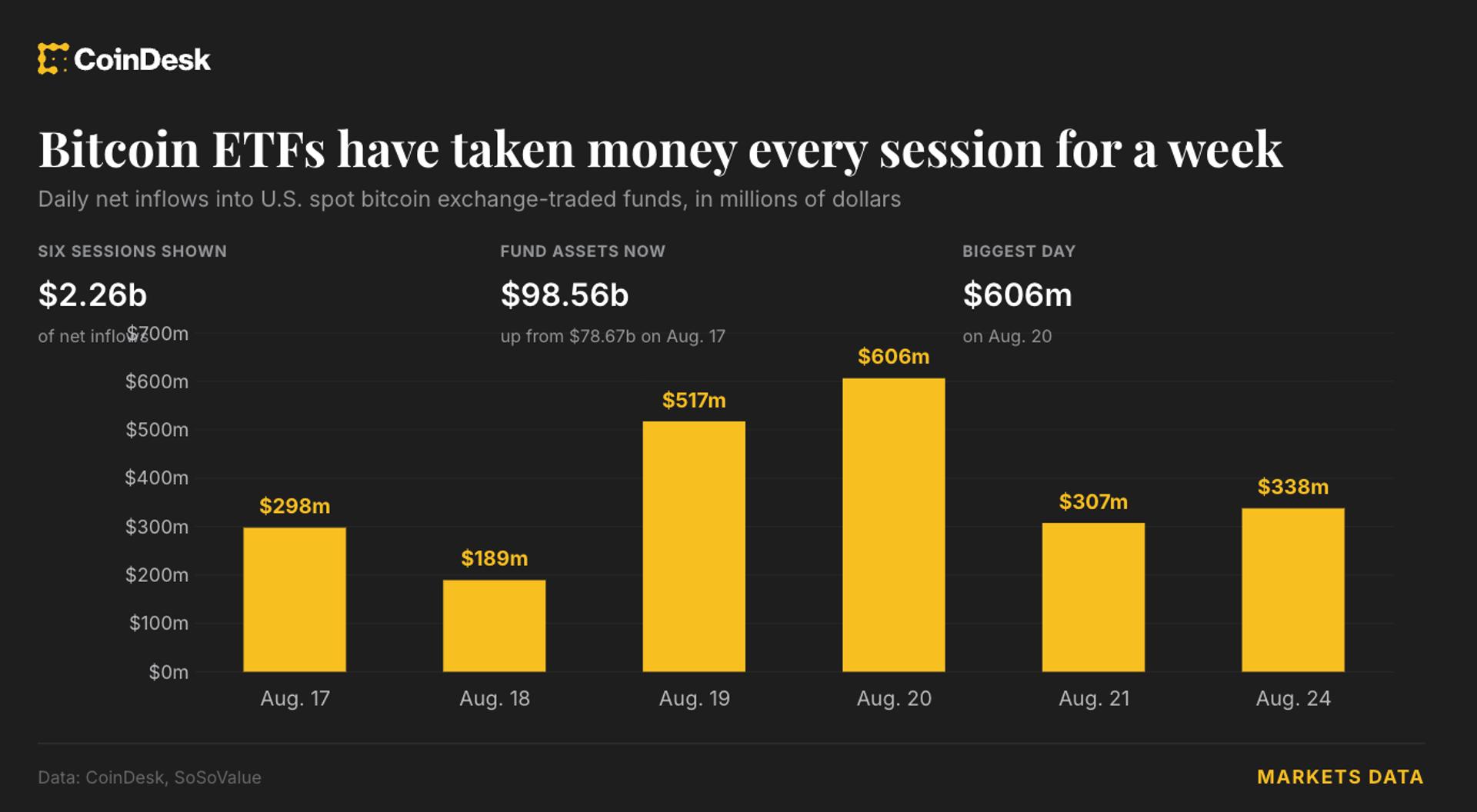
Spot bitcoin funds took in $337.56 million on Aug. 24, extending an unbroken run of inflows that has now put real money behind a rally that started with a short squeeze.


Cointelegraph is committed to providing independent, high-quality journalism across the crypto, blockchain, AI, and fintech industries.
All news, reviews, and analyses are produced with full journalistic independence and integrity. For more details on our standards and processes, please read our Editorial Policy.
WTI crude fell more than 2% on Monday, 24 August, as market participants took profits amid expectations that the US could announce a new round of sanctions against Iran. Additional pressure came from a warning by the Iranian authority responsible for the Persian Gulf and Strait of Hormuz, which said vessels violating transit rules could face fines or detention.
At the same time, the US Energy Information Administration (EIA), in its 11 August forecast, expects the average Brent price to remain around $85 per barrel in the third quarter. Persistently low commercial crude inventories in the US could also help limit the downside and prevent a deeper decline.
Technical Analysis of WTI
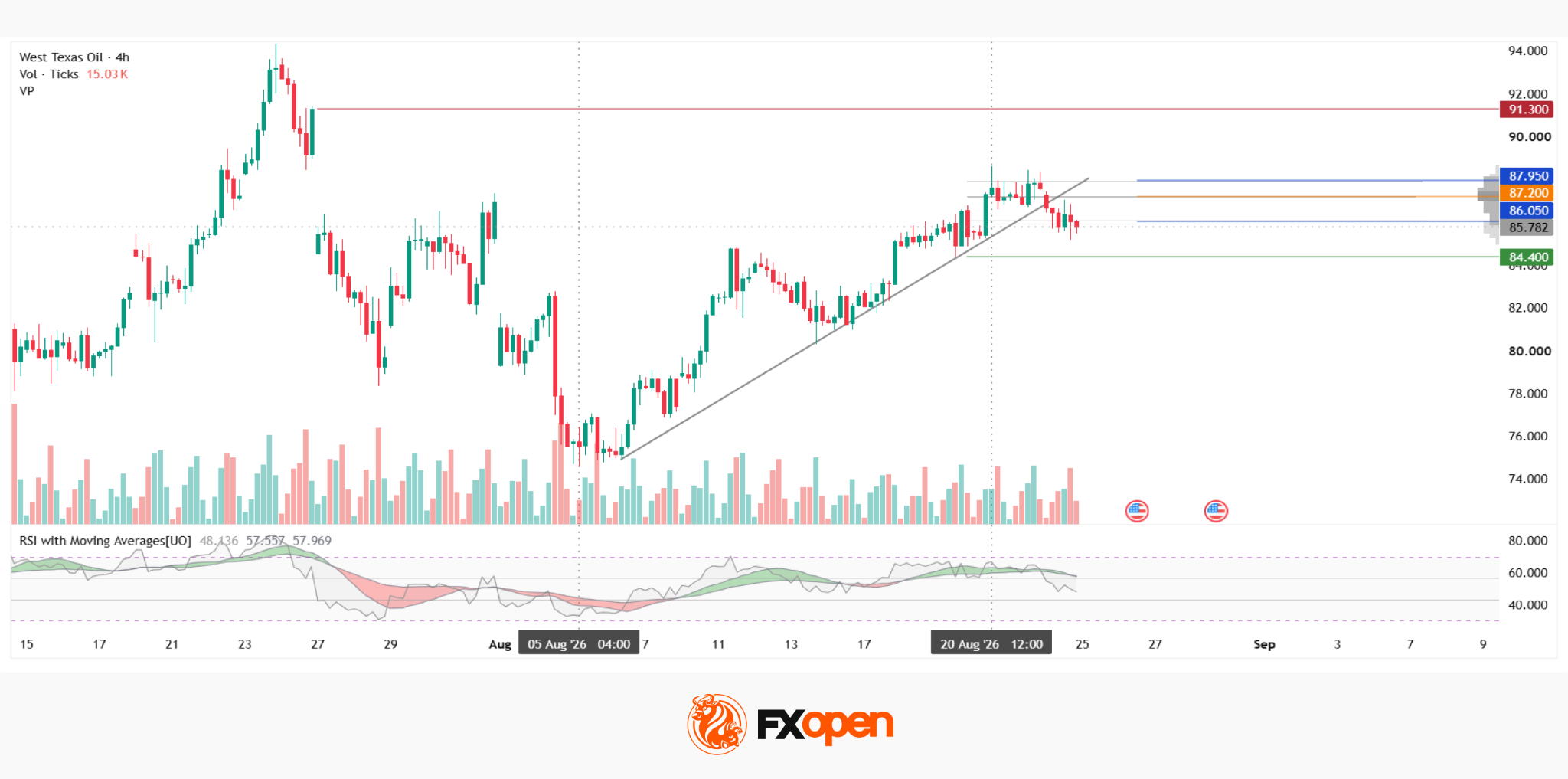
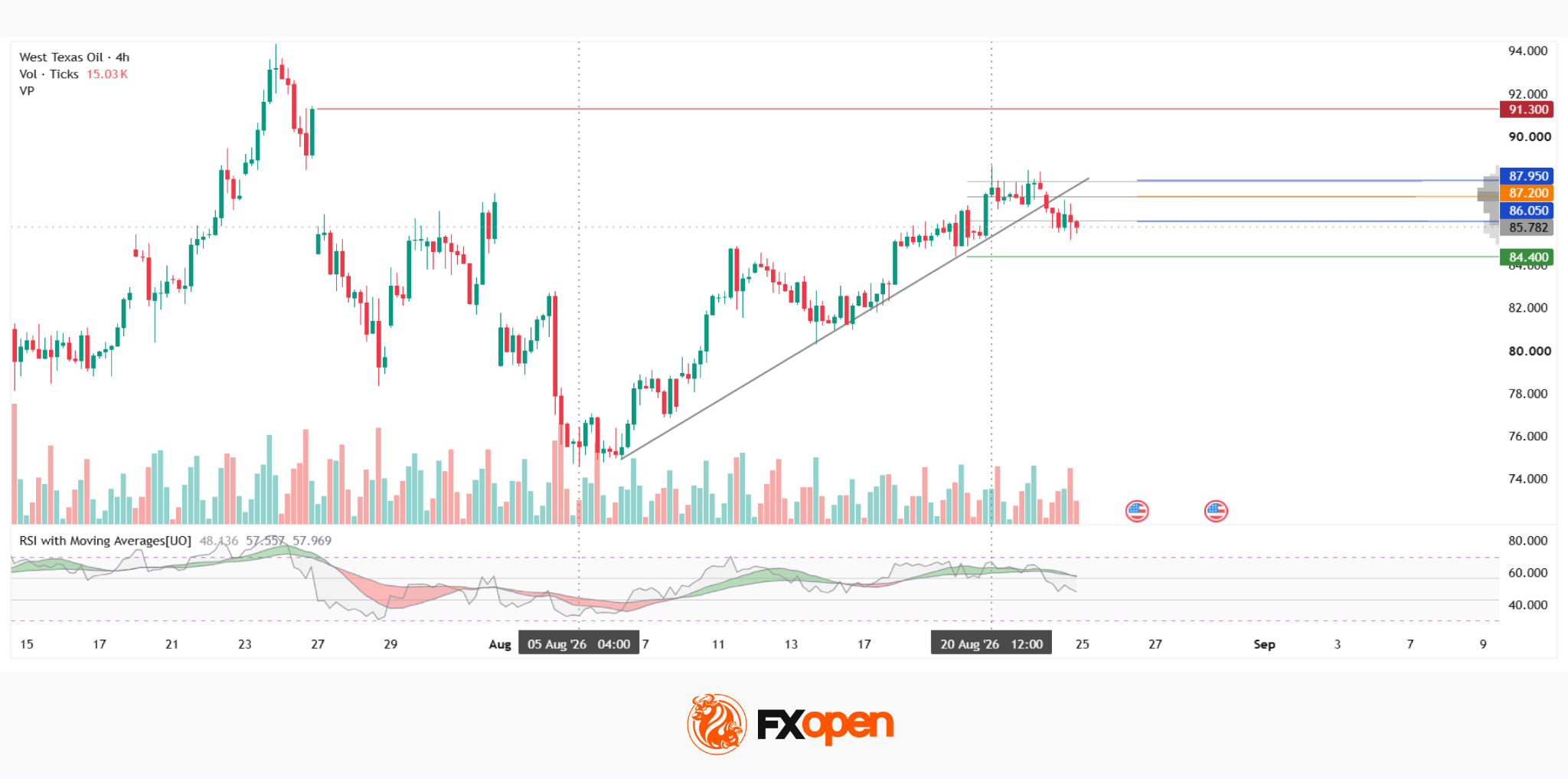
On the four-hour XTI/USD chart, prices had been moving within a short-term uptrend since the beginning of August. The trendline repeatedly acted as support during previous pullbacks, but the price is now attempting to break below it while also moving beneath the lower boundary of the current market profile at $86.05.
If the downside move gains traction, the next potential support area is around $84.40.
A false breakout followed by a renewed advance would bring several technical levels into focus. The first is the Point of Control (POC) at $87.20, followed by the upper profile boundary at $87.95. The overall depth of the market profile is also worth monitoring: the narrower the profile, the less buying pressure may be required to overcome it.
Above the main concentration of trading activity lies the red resistance zone at $91.30.
The RSI + MAs indicator currently shows readings of 48, 57 and 57. RSI has returned to the neutral area following the pullback, but notably remained below the overbought zone throughout virtually the entire uptrend. At the same time, both moving averages remain positive and are holding above the neutral threshold.
Key Takeaways
The break below the ascending trendline has yet to receive confirmation from the momentum indicators. The moving averages remaining above the neutral zone cast some doubt on the sustainability of the current decline.
The next move could depend heavily on the scale and severity of any new US sanctions against Iran. A stronger-than-expected sanctions package could increase pressure on oil prices, while more limited measures may allow the market to refocus on tight US inventories and provide support for WTI.
Start trading commodity CFDs with tight spreads (additional fees may apply). Open your trading account now or learn more about trading commodity CFDs with FXOpen.
This article represents the opinion of the Companies operating under the FXOpen brand only. It is not to be construed as an offer, solicitation, or recommendation with respect to products and services provided by the Companies operating under the FXOpen brand, nor is it to be considered financial advice.

The CLARITY Act cleared a Senate Banking Committee vote and now sits on the chamber’s legislative calendar after a cloture motion was filed on August 8, according to congressional records. That procedural motion is the next real test as the bill needs 60 votes just to proceed to floor debate, a bar it has not yet cleared.
The bill, formally H.R. 3633 or the Digital Asset Market Clarity Act, passed the House 294-134 in July 2025 with meaningful Democratic support. It would split oversight of digital assets between the SEC and CFTC, a jurisdictional question that has shaped enforcement uncertainty across the industry for years.

President Donald Trump hosted crypto executives at the White House on August 19, calling on Congress to pass what he termed a “fair version” of the CLARITY Act. Coinbase CEO Brian Armstrong, Robinhood CEO Vlad Tenev, and Kraken co-CEO Arjun Sethi were among the attendees, alongside CFTC Chair Michael Selig and SEC Chair Paul Atkins.
That optics push doesn’t change the math on the Senate floor. Democrats and some Republicans have withheld support over conflict-of-interest language tied to Trump’s own crypto holdings. Reuters reported he has earned more than $1.4 billion from family crypto ventures since taking office. Not just that, a Reuters/Ipsos poll this week found a majority of Americans believe those holdings have inappropriately shaped policy.
Discover: The Best Token Presales
Why Should We Care
CLARITY’s core function is resolving the securities-versus-commodity question that has driven years of SEC enforcement actions and left token issuers guessing at their own legal status.
CFTC Chairman Selig has signaled the agency could use existing statutory authority to build out a market-structure regime even without new legislation. SEC itself has separately proposed rules exempting certain token offerings from securities treatment.
— U.S. Securities and Exchange Commission (@SECGov) August 18, 2026
 TODAY: The SEC proposed new rules, “Regulation Crypto Assets,” that would create a clear and fit-for-purpose framework for certain investment contracts involving crypto assets. pic.twitter.com/SAA2sErMXF
That matters for positioning: a stalled bill pushes the regulatory center of gravity toward agency rulemaking rather than statute, which is inherently more reversible with the next administration or the next commissioner. Market structure clarity via legislation is durable; clarity via agency discretion is not.
Trade Crypto Before The Clarity ACT on Bybit and Get a Chance to Win Our $1,000 USDT Airdrop
What Happens Next for The CLARITY Act?
Reporting has pointed to mid-September, with September 15 discussed as a tentative target for the cloture vote. Though that date is not confirmed in the congressional record and should be treated as a planning window rather than a lock.
If cloture fails, the bill’s path forward within the current Congress narrows sharply, given a limited legislative calendar and competing priorities.
If it clears 60 votes, the substitute text reported out of Senate Banking in June, a roughly 600-page revision merging Banking and Agriculture committee work, would move to floor debate. Either outcome resolves a multi-year overhang on token classification, which is why the vote count.
Discover: The Best Crypto to Diversify Your Portfolio
The post CLARITY Act 60-Vote Hurdle Puts Crypto Rules in Focus Days After White House Meeting appeared first on Cryptonews.
Tokenized U.S. treasury and money market funds are one of the fastest-growing segments in the digital asset markets, growing fifteenfold in two years.
BlackRock led net inflows across both Bitcoin (BTC) and Ethereum (ETH) exchange-traded funds (ETFs) on Aug. 24, with a $209 million Bitcoin ETF inflow from its iShares Bitcoin Trust (IBIT) and $90.92 million from its Ethereum fund, ETHA.
Spot Bitcoin ETFs recorded $337.60 million in total net inflows for the day, per CoinGlass data. Spot Ethereum ETFs added $116 million, marking a sixth straight day of gains.
BlackRock Leads Bitcoin ETF Inflows
IBIT’s $209 million accounted for roughly 62% of the day’s total Bitcoin ETF inflow, CoinGlass data shows. The fund extended a stretch of strong demand that included a $606 million Bitcoin inflow just days earlier.
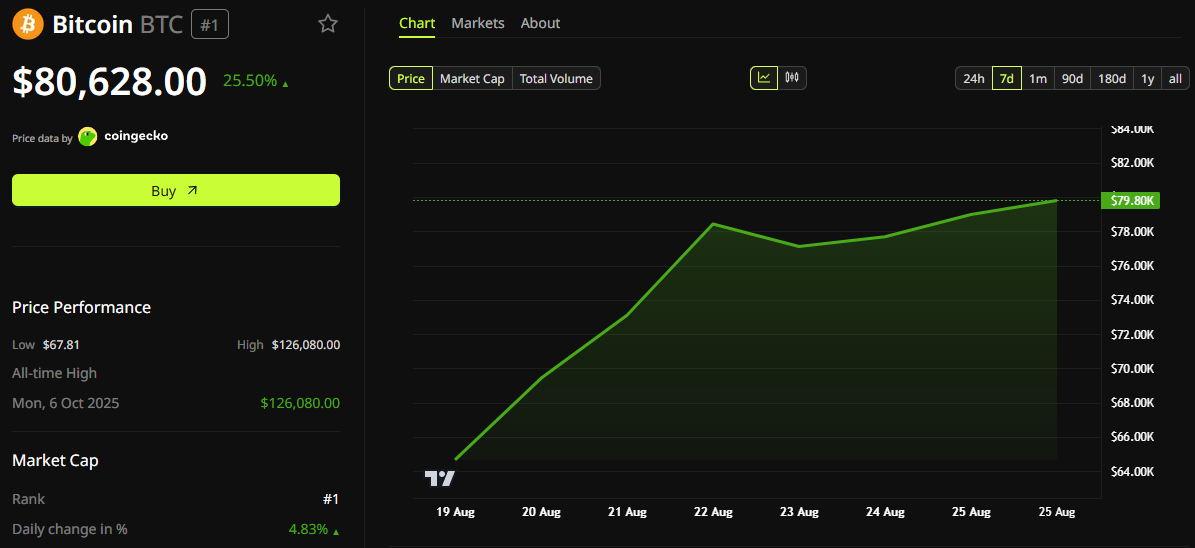
Total net assets across spot Bitcoin ETFs stood at $79.16 billion as of the latest update. BTC traded over $80,000 at the time of writing.

Ether ETFs Post Sixth Straight Day of Gains
BlackRock’s ETHA supplied $90.92 million of the day’s $116 million Ethereum ETF haul, about 78% of the total, per SoSoValue. Grayscale’s Ethereum Mini Trust added $12.50 million, the second-largest contribution.
The result builds on the biggest Ether ETF inflow in 10 months, recorded earlier in August. Ether changed hands near $2,486, up 2.4% over 24 hours.
BlackRock is the world’s largest asset manager, with $15.3 trillion in assets under management as of June 30, 2026. It led inflows across both crypto ETF categories on Aug. 24.
That dual dominance suggests BlackRock remains the primary entry point for institutional crypto exposure. The pattern held through most of August.
The post BlackRock Adds Over 60% of Bitcoin's $338 Million ETF Inflow While ETH Also Jumps appeared first on BeInCrypto.


A federal jury has convicted Las Vegas businessman Brent Kovar of fraud and money laundering after prosecutors said his Profit Connect operation collected $24 million from at least 400 investors through false claims about cryptocurrency mining, investment returns and company reserves.
Summary
- Brent Kovar was convicted of fraud and money laundering over a $24 million crypto Ponzi scheme.
- Profit Connect collected funds from at least 400 investors with promises of 15% to 30% annual returns.
- Prosecutors said investor money funded the business, personal purchases and repayments to earlier investors.
- Kovar faces a statutory maximum of 280 years in prison and is scheduled for sentencing on Nov. 30.
The U.S. Attorney’s Office for the District of Nevada said on Aug. 24 that Kovar was found guilty after a nine-day trial on 11 counts of wire fraud, two counts of mail fraud and two counts of money laundering. He is scheduled to be sentenced on Nov. 30 and faces a statutory maximum penalty of 280 years in prison.
Kovar owned Profit Connect from late 2017 through July 2021, presenting the Las Vegas company as a profitable operation that used artificial intelligence software running on a supercomputer to mine cryptocurrency and verify crypto transactions, according to prosecutors.
Investors were promised fixed annual returns of between 15% and 30%, along with a 100% money-back guarantee. Prosecutors said Kovar also claimed Profit Connect was supported by hundreds of millions of dollars in cryptocurrency reserves, despite knowing the company had no such reserves and could not generate the returns being offered.
Brent Kovar used new investor funds for repayments
Federal prosecutors said Profit Connect was not profitable and had no legitimate source of income capable of supporting its promised returns or guarantee.
Instead, Kovar used money received from investors to keep the business operating, purchase gifts for employees and buy a house for himself, the U.S. Attorney’s Office said. Part of the money was also sent back to existing investors while being presented as proceeds generated through cryptocurrency mining and transaction verification.
The structure allowed Profit Connect to continue making payments despite lacking the investment activity and reserves Kovar had described to customers, according to prosecutors. By the time the operation ended, authorities said at least 400 people had invested a combined $24 million.
During the earlier criminal case, federal prosecutors said Kovar used a website, YouTube video and PowerPoint presentation to market Profit Connect and persuade customers to invest. The business also leased space for a sales office and a warehouse that was presented as a data center. Investments were sold through an entity called Profit Connect Wealth Services.
The original February 2025 indictment charged Kovar with 12 wire fraud counts, three mail fraud counts and three money laundering counts and carried a maximum statutory exposure of 330 years if he were convicted on every charge. Following the trial, the jury returned guilty verdicts on 15 counts, leaving him with a maximum statutory exposure of 280 years.
Prosecutors say Profit Connect sold false guarantees
Investigators focused on several claims used to market the business, including Profit Connect’s stated investment returns and the assertion that investors could recover all of their money.
Federal Deposit Insurance Corporation Office of Inspector General Special Agent in Charge Ryan Korner said Kovar also lured victims with false claims that the investment was insured by the FDIC.
“Mr. Kovar defrauded investors to enrich himself,” Korner said, adding that investigators would continue working with other agencies to pursue financial fraud cases.
David Lowe, acting special agent in charge of IRS Criminal Investigation’s San Francisco Field Office, said the operation relied on “false guarantees, fabricated profits and nonexistent reserves,” which left investors facing financial losses.
FBI Las Vegas Special Agent in Charge Christopher S. Delzotto said victims believed they were investing in new technology, while prosecutors determined that the investment operation had been built on false representations.
First Assistant U.S. Attorney Sigal Chattah said the verdict demonstrated prosecutors’ commitment to pursuing financial fraud involving manipulated records and millions of dollars in investor funds.
IRS Criminal Investigation, the FBI and the FDIC OIG investigated the case. Assistant U.S. Attorneys Joshua Brister and James Gaeta are prosecuting it, according to the Nevada U.S. Attorney’s Office.
Crypto Ponzi prosecutions have produced mixed outcomes
Kovar’s conviction follows several other U.S. criminal cases involving investment businesses that prosecutors said used cryptocurrency claims to attract investors while directing incoming money toward earlier customers or personal expenses.
A July crypto.news report on the BitClub Network case detailed the Justice Department’s reported move to dismiss charges against founder Matthew Goettsche despite allegations that the crypto mining operation defrauded investors of $722 million. The reported decision would end the prosecution with prejudice if approved by the court.
BitClub had been accused of selling shares in cryptocurrency mining pools while overstating mining returns and using investor money to pay existing participants. The reported move to dismiss the case followed a 2025 Justice Department policy directing prosecutors not to use criminal enforcement as a substitute for digital-asset regulation.
Federal authorities have continued filing fraud cases where prosecutors allege conventional financial crimes involving digital assets.
In February, a report on the Goliath Ventures case covered the arrest of founder and CEO Christopher Alexander Delgado over an alleged $328 million Ponzi scheme. Prosecutors accused Delgado of promoting cryptocurrency liquidity pools that promised consistent monthly returns while directing investor funds toward earlier investors and personal spending.
The Justice Department alleged that Goliath Ventures collected more than $300 million even though only about $1 million was placed into legitimate cryptocurrency assets. Prosecutors said other funds were spent on expenses that included luxury travel, corporate events and multimillion-dollar homes.
Other cases have centered on promised crypto returns
Federal prosecutors brought another case in June against Tennessee resident Misam Abidi over an alleged $1.9 million scheme operated through Star Credit Holdings.
Court documents cited in coverage of the Star Credit Holdings case accused Abidi of making false statements about investment returns, company reserves and assets under management between 2020 and 2024. The charges included wire fraud, money laundering, operating an unlicensed money-transmitting business and filing false tax returns.
Separate federal actions have also moved from prosecution toward victim recovery. In April, the Justice Department opened a compensation process backed by more than $40 million in forfeited assets for people who lost money in OneCoin, according to coverage of the OneCoin victim fund.
Federal prosecutors have estimated that OneCoin took more than $4 billion from roughly 3.5 million people between 2014 and 2019. Co-founder Karl Sebastian Greenwood received a 20-year federal prison sentence in 2023, while fellow founder Ruja Ignatova remains a fugitive and is listed among the FBI’s Ten Most Wanted.
Kovar’s sentence will be determined by a federal district court judge after consideration of the U.S. Sentencing Guidelines and other statutory factors, with the sentencing hearing currently set for Nov. 30, 2026.

One of the Best British Crime Shows of 2025 Is Officially Returning

NA SUFFOCATE SA STAGE( tagal ko pinigilan) | Queen Money

Russia threatens to attack British factories in ‘semi-military’ response to UK support for Ukraine – as Putin warns ‘Pandora’s box has been opened’

Weekend Open Thread – Corporette.com

Weekend Open Thread: Brooks Brothers

London Mayor Sadiq Khan handed a peerage by Keir Starmer alongside 15 other Labour figures… just days before the PM leaves No10
NA SUFFOCATE SA STAGE( tagal ko pinigilan) | Queen Money

XRP UPDATE: THE BANKS ARE FINALLY PREPARED! – WHAT THIS MEANS FOR YOU! – WHY THEY’RE ADVANCING AI!

Credit card debt surges in U.S. as high interest rates make it harder to pay off
-

 Fashion4 days ago
Weekend Open Thread: Madewell – Corporette.com
-

 Business3 days ago
Musk’s Tesla, SpaceX Confirm $16.8 Billion ‘Terafab’ Chip Plant as World’s Largest Building in Texas
-

 Crypto World3 days ago
anatomy of crypto’s biggest liquidation event since 2021
-

 Business7 days ago
SMA Solar Technology AG (SMTGY) Q2 2026 Earnings Call Transcript
-

 Politics3 days ago
6 months on, Irish renters crushed by effects of government housing bill
-
 NewsBeat3 days ago
The ‘Lucky Dip Gang’ causing carnage for clicks: After five thugs were killed speeding in the wrong direction on a motorway, GUY ADAMS investigates a sick new trend… and why police aren’t even allowed to pursue them
-

 Tech6 days ago
GLM-5.3 hits the API at $1.4/$4.4 per million tokens
-

 News Videos5 days ago
Don’t Leave Your Financial Future To Chance | August 19, 2026
-

 Business2 days ago
Mystery AI Model ‘Ox Alpha’ Draws Developers With Free Access as Chinese Lab Origins Remain Debated
-

 Business5 days ago
Five Below: Kids Discount Retailer Reaps Rich Rewards
-

 Business7 days ago
Stock Market Today: Tech Futures Slide As Treasury Yields Jump; Nvidia, Micron, Sandisk Sell Off
-

 Business6 days ago
Marvell Shares Jump 7% as Google Chip Deal Confirms Custom AI Silicon Partnership, Analysts
-

 Tech7 days ago
Ken Okuyama’s Kode89 Supercar Features Three Pedals and a Choice of V12s
-

 Politics7 days ago
The House Opinion Article | Security means more than military spending
-

 Sports2 days ago
Deshaun Watson fires back at Browns fans after being booed: ‘It’s a disrespectful thing’
-

 Fashion7 days ago
The Best Wide Leg Pants to Wear to Work
-

 Crypto World7 days ago
Sherlock Takes Audit Engine Public After Months of Quiet Testing
-

 Tech5 days ago
OpenAI confirms ChatGPT is down as logins and signups fail
-

 Business4 days ago
UK firms in critical financial distress rise 9% to 53,756
-
 Crypto World2 days ago
Google Gemini AI Predicts Ethereum Could Become the Trade Retail Misses in 2026
You must be logged in to post a comment Login