
Crypto World
Binance Locked Out of Europe on July 1: What Happened



The world’s largest crypto exchange will suspend services for European Union users from July 1 after failing to secure a license under Europe’s new crypto rules. The headlines say Binance is leaving Europe. The reality is more precise, and more revealing: it was locked out, and the reason was not its paperwork but its past.
Summary
- From July 1, 2026, Binance will suspend most services for European Union residents, halting new orders, deposits, sign-ups, and staking products, after failing to obtain a license under the EU’s MiCA regulation by the June 30 deadline.
- This is a suspension, not a permanent exit: user funds remain safe and withdrawable, and Binance says it intends to secure an EU license and return in the coming months.
- Binance bet on Greece as its entry point, but on June 24, it withdrew its application one week after reports that the Greek regulator was preparing to reject it.
- The rejection reportedly turned on Binance’s past, not its paperwork, in particular its history of penalties and whether co-founder Changpeng Zhao could pass MiCA’s “fit and proper” test for owners and managers.
- The episode shows MiCA has teeth: of more than 3,000 crypto firms in Europe, only around 210 secured authorization, with rivals like Coinbase, Kraken, and OKX passing, while the largest exchange in the world was shut out.
On June 24, an email from Binance landed in the inboxes of millions of European users, and within hours, it had set off a wave of alarm across the continent’s crypto community. The message was blunt: starting July 1, the world’s largest cryptocurrency exchange would suspend much of its service for anyone residing in the European Union. The headlines that followed were predictably dramatic, declaring that Binance was shutting down in Europe, abandoning the region, or being expelled from the bloc.
The reality is both narrower and more revealing than any of those framings. Binance is not collapsing, it is not seizing anyone’s money, and it is not, in its own telling, permanently leaving Europe. What actually happened is that Binance failed to obtain the license it needed under the European Union’s new crypto regulation before a hard deadline, and as a result, it is being locked out of the EU market until it can secure that license somewhere else.
The distinction matters because the panic-inducing version of the story obscures both what users should actually do and the far more interesting question of why the largest exchange on earth could not get a license that its smaller rivals managed to obtain.
This piece lays out what actually happened, what changes and what does not, and what the episode reveals about the new rules now governing crypto in Europe.
The story is worth understanding precisely because it is a milestone, the moment when Europe’s comprehensive crypto framework showed that it would apply to everyone, including the biggest player in the industry, with no exceptions for size or market share. It is also a story with a specific and somewhat surprising cause, one that has less to do with Binance’s compliance systems or its application paperwork and more to do with the legal history of the company and its founder.
To make sense of it, this piece works through the precise facts of the suspension, the practical reality for users whose first instinct was to panic, the MiCA regulation and the deadline that forced the situation, the Greek gateway that collapsed, the deeper reason the application failed, Binance’s own account of events, the rivals who succeeded where it did not, the path Binance is now pursuing, and what the whole affair means for the future of crypto in Europe. The aim throughout is accuracy over drama, because the drama, while real, has obscured what is genuinely going on.
What actually happened
Strip away the alarmist framing, and the sequence of events is clear. Binance needed a license to operate legally in the European Union under a regulation called MiCA, the bloc’s new crypto framework, and the deadline to have that license was the end of June. Binance had pursued the license through Greece, filing its application there in January, but the process stalled, and in mid-June, reports emerged that the Greek regulator was preparing to reject the application.
Facing a likely formal rejection, Binance made a strategic choice on June 24: rather than wait to be formally refused, it withdrew its Greek application altogether, framing the move as a prudent decision to pursue authorization in another EU member state instead. Because withdrawing the application meant Binance would not hold a MiCA license by the June 30 deadline, it was obligated to stop offering regulated services to EU residents from July 1, and so it emailed its European users to tell them exactly that.
The crucial point that the dramatic headlines missed is what this suspension is and is not. It is a halt to Binance’s ability to offer new regulated services to EU residents, triggered by the absence of a license. It is not a shutdown of the company, a seizure of user assets, or, in Binance’s framing, a permanent departure from Europe.
Binance has stated clearly that it intends to remain in the European market, that it will seek a license through another member state, and that it expects to secure authorization in the coming months.
So the accurate description of what happened is this: Binance, unable to get the license it needed in time and facing a probable rejection in Greece, withdrew its application and is now suspending EU services until it can obtain a license elsewhere, while assuring users their funds are safe.
That is a serious setback and a significant moment for the industry, but it is a regulatory lockout with a stated path back, not the collapse or expulsion the headlines suggested.
What changes on July 1, and what does not
For the millions of European users who received that email, the most urgent question is intensely practical: what happens to their accounts and their money? Here, the gap between the panic and the reality is widest, and it is worth being precise, because the distinction between what stops and what continues determines what users should actually do.
What stops on July 1 is the set of active, regulated services that require a license. Binance will halt new spot trading orders for EU residents, stop accepting new deposits, end new sign-ups and onboarding, and suspend its yield-generating products such as staking and the various Earn offerings.
In effect, the ability to put new money in and to actively trade or earn on the platform as an EU resident comes to an end, because those are precisely the regulated activities MiCA requires a license to provide.
What does not change is just as important. User funds remain safe and accessible, and withdrawals stay active, which means no one’s assets are being seized, frozen, or automatically lost.
The orderly wind-down that EU rules require an exiting platform to provide is designed to guarantee exactly this: that users retain access to their assets and can move them elsewhere. Binance has said it is not instructing customers to remove their funds by a specific date and that user assets remain secure. To allow an orderly exit, it keeps certain features available in a limited form, such as a conversion function that can be used to sell positions so users can wind down in an orderly way.
The practical guidance that follows from this is the opposite of panic: EU users have time, their money is accessible, and the sensible course is to withdraw funds to another licensed platform or a self-custody wallet in an unhurried way, while being especially alert to scammers who exploit exactly this kind of confusion.
Binance has also said it will contact affected users directly with steps specific to their account and country, and that it will never call them by phone or ask for passwords or security codes, a warning worth heeding because moments of regulatory upheaval are prime opportunities for fraud.
The headline made it sound like an emergency. The reality is a wind-down with the safety nets that the regulation requires.
MiCA, and the deadline that forced this
To understand why any of this happened, you have to understand the regulation at the center of it, because the Binance situation is a direct consequence of a deliberate European policy choice.
MiCA, which stands for Markets in Crypto-Assets, is the European Union’s comprehensive framework for regulating crypto, designed to replace the patchwork of differing national rules that previously governed the industry across the bloc’s member states.
Before MiCA, a crypto company could operate in Europe by registering under the individual rules of various countries, and global operators often moved through the gaps and gray areas between those national regimes. MiCA ends that fragmented era by creating a single, unified system: to offer crypto services anywhere in the EU, a company must obtain authorization as a Crypto-Asset Service Provider, known as a CASP, from the regulator of one member state, after which a passport mechanism lets it operate across the entire bloc on the strength of that single license.
The deadline that forced the Binance situation is the end of a transition period built into the regulation. MiCA came into full effect at the end of 2024, but it included a grandfathering window that let firms operating under the old national registrations continue while they pursued a CASP license. That transition period closes on July 1, 2026, which is the hard enforcement date.
From that day forward, any firm offering crypto services in the EU without a CASP license is in breach of European law, and the prior national registrations that companies once relied on, in countries such as Spain, France, Italy, and Poland, carry no legal weight under the new framework. This is why the deadline was absolute for Binance: its old national registrations became void, and without a CASP license by June 30, it had no legal basis to serve EU customers.
The regulation makes no distinction between large exchanges and small ones; it distinguishes only between the licensed and the unlicensed. Binance, for all its size, fell on the wrong side of that line, and MiCA’s design left no room for a grace period or a special arrangement. The deadline was the deadline, and Binance did not meet it.
The Greek gateway that collapsed
Binance’s path to a license ran through Greece, and the choice was strategic rather than accidental. Because a single CASP license passport across the entire EU, a company can pick which member state to apply through, and the calculation involves speed, the competitiveness of the local process, and the regulator’s posture.
Binance filed its application with the Greek markets regulator in January, setting up a local holding entity to anchor its European operations there. The logic, by several accounts, was that Greece had granted few or no MiCA licenses at that point, which in principle might offer a faster and less crowded path than applying in a country like Germany or the Netherlands, which had already processed dozens of applications and built up queues.
Binance also cited the country’s local talent and other practical considerations, and it pursued the Greek approval for what it described as a lengthy engagement with regulators.
The plan collapsed. Although Binance filed in Greece, the application did not get reviewed in isolation, because under MiCA’s structure, the assessment was tracked alongside regulators in other member states, with authorities in Ireland and Latvia reportedly involved in the review, and oversight at the level of the EU’s central markets authority.
According to multiple press reconstructions, that joint review raised concerns about Binance’s legal history and its complex corporate structure, and in mid-June, reports indicated that the Greek regulator was poised to reject the application.
People familiar with the process described Binance making significant offers to win approval, including commitments to hire staff, open an office in Greece, and bring substantial investment into the country, the kind of inducements that signal how badly the company wanted the license and how much trouble it sensed.
None of it was enough. Faced with a likely formal rejection, Binance withdrew the application on June 24, pulling its bid before it could be officially refused. The Greek gateway, chosen for its supposed speed and openness, had become the place where Binance’s European ambitions stalled, and the reasons for the stall point to something deeper than any single country’s process.
The real reason: the fit and proper problem
Here is the heart of the matter, the part that the headlines about Europe and deadlines miss entirely: the rejection reportedly turned on Binance’s past, not its paperwork. MiCA, like most serious financial regulations, applies a standard known as the fit and proper test to the people who own and run a regulated firm, assessing whether an applicant’s management and significant shareholders are suitable to operate a licensed financial business.
This is where Binance ran into trouble, because the test put the spotlight on its co-founder and roughly 90% owner, Changpeng Zhao, and on the company’s documented history of legal problems.
According to people familiar with the review, the concerns that sank the Greek application centered on Binance’s anti-money-laundering controls and on whether Zhao could satisfy the fit and proper standard, given his record.
That record is substantial and a matter of public fact. In 2023, Binance pleaded guilty in the United States to anti-money-laundering and sanctions violations and paid penalties exceeding $4 billion, among the largest corporate penalties in American history.
Zhao himself stepped down as chief executive, pleaded guilty to a criminal charge, served a prison sentence of several months, and was later pardoned by the United States president in late 2025, though he retains his roughly 90% stake in the exchange.
Beyond the American case, Binance faces elevated pressure elsewhere in Europe: French authorities opened a judicial investigation into whether the company assisted money laundering, including possible links to drug trafficking and tax fraud, allegations Binance denies, and the exchange has been banned in the United Kingdom since 2021.
Stacked together, this history is exactly the kind of baggage that a fit and proper assessment is designed to scrutinize, and it gave regulators concrete grounds for concern about authorizing the firm and its dominant owner.
The significance of this cannot be overstated: Binance was not locked out because it filed a sloppy application or lacked the technical capacity to comply. By the available accounts, it was locked out because regulators looked at its past and the standing of the man who controls it and concluded they could not, in good conscience, hand it a license to operate across the EU. The obstacle was history, not paperwork.
Binance’s side of the story
Fairness requires giving Binance’s account, because the company disputes important parts of this narrative, and its perspective deserves a clear hearing.
Binance’s central contention is that its application was sound and that it never received a formal rejection. The company has stated that its understanding was that the Greek regulator completed its review and considered the application compliant with MiCA requirements, and that the application was also reviewed at the level of the EU’s central markets authority.
In Binance’s framing, it did not fail a clear test so much as run out of time within an ambiguous process: it received no formal decision before the deadline, and so it made what it called the prudent choice to withdraw the Greek application and pursue authorization in another member state rather than wait passively to be refused.
The company emphasizes that it engaged constructively with regulators for roughly eighteen months and believes it meets MiCA’s requirements, casting the outcome as a procedural and timing failure instead of a substantive rejection on the merits.
Binance has also worked hard to reassure users and to project continuity. It has stressed repeatedly that user funds remain safe and secure, that it is not instructing customers to rush their withdrawals, and that its ambition to operate in Europe under a clear and harmonized framework is unchanged. It has framed the entire episode as a setback on the path to a license instead of a defeat, expressing confidence that it will secure authorization in another EU member state in the coming months.
At the same time, the company’s handling of the situation has drawn criticism even from sympathetic observers, who argue that the weeks of ambiguity before the announcement, followed by an email that triggered panic, reflected poorly on a firm seeking to present itself as a mature, compliant financial institution.
Several commentators noted that a straightforward early acknowledgment of the Greek difficulty and a clear timeline could have spared users much of the confusion, and that in regulated finance, where transparency maps directly to trust, the murkiness of the process was itself a reputational cost.
Binance’s version, then, is of a compliant applicant caught in a slow and unclear process, choosing prudence over a formal refusal, while its critics see a company whose past caught up with it and whose communication compounded the damage.
The winners: who passed MiCA
Nothing illustrates the significance of Binance’s failure more sharply than the list of companies that succeeded, because the contrast turns the story from one exchange’s misfortune into a statement about the new shape of European crypto.
While Binance was being locked out, a number of its largest rivals secured the MiCA authorization it could not obtain. Major exchanges, including Coinbase, Kraken, OKX, and Crypto.com, all cleared the process and now hold licenses to operate across the bloc, giving them a significant competitive advantage heading into the second half of the year.
These are not minor players; they are among the most prominent exchanges in the world, and their success shows that the MiCA hurdle, while high, was clearable by serious firms willing and able to meet its standards. The fact that the largest exchange of all could not join them is what makes the moment so striking.
The broader numbers underline how selective the new regime is, and how much of an achievement a license represents. Of more than 3000 crypto firms operating across Europe, only around 210 secured full CASP authorization across roughly two dozen member states, a clearance rate in the single digits. Measured against the smaller universe of firms that had held national registrations before MiCA, the conversion rate was still well under a fifth.
In other words, the overwhelming majority of crypto firms that operated in Europe under the old patchwork did not make it through MiCA’s gate and were left to exit the market or scale back. This is the regime working as intended, filtering out firms unable or unwilling to meet a unified standard, and the licensed survivors now enjoy a meaningful moat.
Unsurprisingly, regulated rivals have moved quickly to capture the business Binance is vacating, with competitors publicly promoting their authorized status and their readiness to serve the users now looking for a licensed home. The competitive map of European crypto is being redrawn, and the redrawing favors those who got their license, with Binance, for now, on the outside looking in.
What comes next: the France gambit
Binance’s lockout is, by the company’s account, temporary, and the path it is pursuing back into the market is worth understanding, because it raises questions of its own.
Having withdrawn from Greece, Binance has signaled that it will seek a MiCA license through another member state, and according to reports citing people familiar with its plans, the chosen venue is France. This is a notable choice given that French authorities have an open judicial investigation into the company, which would seem to complicate an application there, and it suggests Binance believes it can satisfy the French regulator despite the scrutiny it faces in the country.
The more immediate problem is timing. Even if Binance applies promptly in France, any approval is likely to come after the July 1 deadline, which means there will be a gap, potentially of months, during which Binance remains locked out of the EU and unable to serve its European users with regulated services. The company’s confidence that it will secure a license in the coming months may prove justified, but the interim is real, and during it, the business migrates elsewhere.
The France gambit also surfaces a deeper tension within MiCA that the Binance affair has exposed. If Greece, working alongside regulators in Ireland and Latvia, found Binance unsuitable for a license, and France subsequently grants one, the episode would reveal inconsistencies in how different member states interpret and apply the same supposedly unified requirements.
That kind of divergence is precisely the regulatory arbitrage that MiCA was designed to eliminate, the practice of shopping for the most permissive regulator, and a high-profile instance of it involving the largest exchange in the world would raise uncomfortable questions about whether the framework is as harmonized as advertised.
Conversely, if France also declines, Binance’s path back into Europe narrows considerably, and the lockout could extend well beyond the coming months, the company has promised.
So the next chapter hinges on France: a relatively quick approval would vindicate Binance’s confidence while testing MiCA’s consistency, a slow process would prolong the lockout, and a refusal would turn a temporary suspension into something that looks more like a lasting exclusion. The one certainty is that the gap between July 1 and whatever comes next is a period in which Binance is genuinely shut out, and the European crypto market continues without it.
What it means: the end of crypto’s gray zone
Step back from the specifics, and the Binance affair marks a genuine turning point, the moment when Europe showed that its crypto regulation has real teeth and applies without exception.
For years, the crypto industry operated in a gray zone in Europe, with global exchanges moving through the gaps between national rules and the largest players seemingly too big and too important to be meaningfully constrained. MiCA was built to end that gray zone, to replace ambiguity with a single clear standard, and to subject every operator to the same requirements.
The fact that the framework’s first major casualty is the largest exchange in the world is the clearest possible proof that the regime means what it says. No firm, however dominant, is exempt from the fit and proper standard, the anti-money-laundering requirements, or the licensing process, and a company that cannot meet them is locked out regardless of its size.
That message will reverberate through the industry far beyond Binance, because if the biggest player can be shut out, everyone else is on notice that compliance is now the price of access to the European market.
The implications are double-edged, and an honest accounting acknowledges both sides. On one hand, the regime delivers what it promised: consumer protection, a level playing field of uniform rules, and the removal of operators unwilling or unable to meet serious standards, which many would call a healthier and safer market.
On the other hand, locking out the largest exchange carries real costs and risks. Liquidity and trading volume migrate, some of it to the licensed rivals who will consolidate the market, but some of it potentially to workarounds, as users turn to virtual private networks and offshore accounts to keep accessing Binance, which is exactly the kind of regulatory shadow activity that MiCA was meant to prevent.
The bloc may lose some of the investment, jobs, and tax revenue that a major exchange brings, a concern Binance itself has raised. And the France question hangs over everything, with the prospect that inconsistent application across member states could undercut the very harmonization MiCA was built to achieve.
What is not in doubt is that the era of crypto’s European gray zone is over. From July 1, the rule is simple and absolute: hold a license or do not operate, and even Binance is not big enough to be an exception.
That is what actually happened, and it matters far more than the headlines about an exchange leaving Europe, because the real story is that Europe decided who gets to stay, and for now, on its own terms, it said no to the biggest name in crypto.
Frequently Asked Questions
Is Binance actually leaving Europe?
Not permanently, despite headlines suggesting otherwise. Binance is suspending most regulated services for EU residents from July 1 because it failed to obtain the required MiCA license by the June 30 deadline. The company has stated clearly that it intends to remain in the European market, that it will seek a license through another member state, and that it expects to secure authorization in the coming months. So the accurate description is a regulatory lockout with a stated path back, not a permanent departure. Binance is being shut out until it can get a license elsewhere, not abandoning Europe by choice.
What happens to my funds on Binance if I am in the EU?
Your funds remain safe and accessible, and withdrawals stay active. Nothing is being seized, frozen, or automatically lost. What stops on July 1 is new activity: new spot trading orders, new deposits, new sign-ups, and yield products like staking and Earn. The orderly wind-down that EU rules require is designed to guarantee continued access to your assets, and Binance has said it is not instructing users to remove funds by a specific date. The sensible approach is to withdraw to another licensed platform or a self-custody wallet without panic, and to be alert to scammers, since Binance says it will never call you by phone or ask for passwords.
Why did Binance fail to get a MiCA license?
By the available accounts, the rejection turned on Binance’s past, not its paperwork. MiCA applies a “fit and proper” test to a firm’s owners and managers, and the concerns reportedly centered on Binance’s anti-money-laundering controls and on whether co-founder and roughly 90% owner Changpeng Zhao could satisfy that standard. Binance’s history includes a 2023 guilty plea in the United States to anti-money-laundering and sanctions violations with penalties over $4 billion, Zhao’s own criminal plea and prison sentence, an open French investigation, and a UK ban since 2021. Regulators looked at that record and the standing of its controlling owner and had grounds for concern.
What is MiCA and why does it matter?
MiCA, the Markets in Crypto-Assets regulation, is the European Union’s comprehensive framework for crypto, replacing the old patchwork of differing national rules with a single unified system. To offer crypto services anywhere in the EU, a firm must obtain authorization as a Crypto-Asset Service Provider from one member state’s regulator, after which a passport lets it operate across the bloc. MiCA came into full effect at the end of 2024 with a transition period that closes July 1, 2026, the hard enforcement date. After that, operating without a license breaches EU law, and prior national registrations carry no weight. It matters because it sets a single, serious standard for the entire European market.
Which exchanges did get a MiCA license?
Several of Binance’s largest rivals secured authorization, including Coinbase, Kraken, OKX, and Crypto.com, all of which can now operate across the bloc and hold a meaningful competitive advantage. The broader picture shows how selective the regime is: of more than three thousand crypto firms operating in Europe, only around two hundred ten obtained full authorization across roughly two dozen member states, a clearance rate in the single digits. The overwhelming majority did not make it through and must exit or scale back. That the largest exchange of all was locked out while these rivals passed is what makes the moment so significant for the industry.
Can Binance come back to the EU?
Yes, that is its stated plan, though the timing and outcome are uncertain. Having withdrawn from Greece, Binance intends to seek a license through another member state, reportedly France, and expects to secure authorization in the coming months. But any approval is likely to come after July 1, leaving a gap during which Binance remains locked out. France route also raises questions, both because French authorities have an open investigation into the company and because, if France grants what Greece would have refused, it would expose inconsistencies in how member states apply MiCA. A quick approval would bring Binance back; a refusal would turn the suspension into something more lasting.
This article provides information about a fast-moving regulatory situation, not legal or financial advice. Details of Binance’s licensing, the positions of regulators, and the timeline reflect reporting available as of June 26, 2026, and can change quickly as the situation develops. EU users with questions about their accounts should rely on official communications from verified sources and be alert to scams. Verify current developments through primary sources

South Korean crypto exchange Upbit announced on July 31 that it would list Conflux’s CFX token against the Korean won, Bitcoin and Tether. Trading is scheduled to begin at 16:00 Korea Standard Time.
Summary
- Three CFX pairs will open on Upbit against KRW, Bitcoin and Tether at 16:00 KST.
- 8.5% CFX gain preceded trading, while 24-hour volume nearly doubled to $13 million before launch.
- Only Conflux eSpace deposits qualify, with unsupported networks potentially causing lengthy asset-return procedures for users.
The official Upbit notice was published at 14:00 KST. Deposits and withdrawals were expected to open within 90 minutes through Conflux eSpace. However, Upbit said the trading launch “may be delayed” if the exchange cannot secure enough liquidity.
Upbit CFX listing opens three spot markets
The addition gives CFX direct access to Upbit’s KRW market alongside its BTC and USDT markets. The Korean won pair is particularly relevant because it lets local users trade CFX without first converting their funds into another crypto asset.
Upbit displayed CFX at 58.25 won, 0.00000062 BTC and 0.04044 USDT at 13:30 KST, shortly before publishing the notice. The exchange used CoinMarketCap data to establish the reference prices and its opening-order restrictions.
Upbit will block buy orders for about five minutes after trading begins. During the same period, sell orders priced more than 10% below the previous closing price will also be restricted. Only limit orders will be available for the first two hours.
CFX rose before scheduled Upbit trading
CFX traded near $0.0452 before the scheduled Upbit opening, representing an increase of about 8.5% over 24 hours. Its daily trading volume reached approximately $13 million, up about 93%, while its market capitalization stood near $236 million.
The token moved between approximately $0.0403 and $0.0455 during the period. However, trading had not yet started on Upbit when those figures were recorded. The price increase therefore cannot be attributed entirely to completed orders on the Korean exchange.
Past Upbit listings have produced mixed market reactions. As crypto.news reported, the exchange added Derive across the same three markets in July. In related coverage, nine other tokens received new BTC and USDT pairs in June. Some listings raised early volume, but initial price gains did not always continue.
Conflux eSpace is the only supported network
Upbit will support CFX deposits and withdrawals only through Conflux eSpace. Users who send tokens through Core Space or another unsupported network may need to complete a lengthy recovery process.
Conflux operates two execution environments. Core Space is the network’s native environment, while eSpace is fully compatible with the Ethereum Virtual Machine. Ethereum smart contracts, wallets and development tools can therefore operate on eSpace with limited changes.
The blockchain combines proof-of-work and proof-of-stake. Miners produce and arrange blocks through its Tree-Graph structure, while proof-of-stake validators provide finality. CFX pays transaction fees and supports staking, governance and storage collateral.
Moreso, CFX previously rallied after the Conflux 3.0 announcement. That upgrade focused on higher throughput, payment infrastructure and real-world asset applications.
Opening controls will shape the first trading hours
The next confirmed event is the planned start of trading at 16:00 KST on July 31. Upbit may change that time if deposits do not provide enough liquidity. Users must also comply with South Korea’s travel-rule requirements and use verified personal wallet addresses.
The first five minutes will show the initial balance between Korean demand and available CFX supply. The two-hour limit-order period is designed to reduce disorderly execution while the new order books develop.
Beyond the opening session, traders will watch whether higher volume continues after the listing-driven attention fades. The listing expands access to CFX, but it does not guarantee lasting demand, deeper liquidity or further price gains.
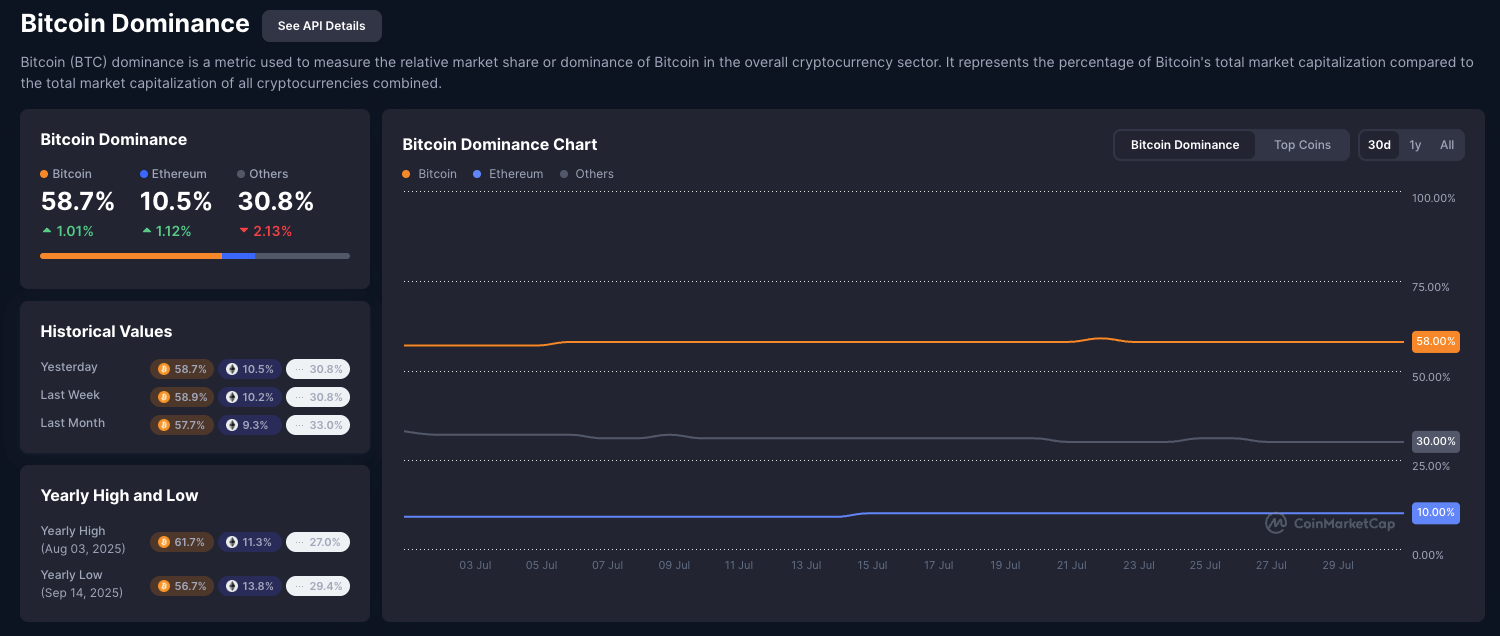
The ETH/BTC ratio briefly topped 0.030 this week, its highest level in three months. However, Bitcoin (BTC) dominance climbed at the same time instead of falling.
That combination points to capital concentrating in the market’s two biggest assets, not spreading into the wider altcoin field.
Two Winners, Not a Broad Rally
Bitcoin’s dominance sits near 58.7%, and it gained ground over the past day, but in general, it has been relatively steady. At the same time, Ethereum’s (ETH) share climbed to 10.5%. The category tracking everything else, thousands of smaller tokens outside the top two, has been on a slide and dropped to 30.8%.

The Rest of the Market Keeps Shrinking
This squeeze isn’t new. Altcoin sell pressure outside Bitcoin and Ethereum ran for 15 straight months through mid-June. BitMine chairman Tom Lee still calls the ETH/BTC move a bullish signal for crypto overall:
“We view the rising ETH/BTC ratio, despite the falling odds of passage of the Clarity Act in 2026, as a sign crypto prices are strengthening.” — Lee
That read centers on ETH specifically. It says little about the median token, and the Ethereum whale accumulation driving the rally has focused on ETH, not smaller altcoins.
Not Just a Bounce
The ETH/BTC ratio sits at 0.02963, up 10.52% over the past month; however, the pair is still down 4.85% over six months and 12.60% year to date. This indicates how low Ethereum was relative to Bitcoin and how far it has to climb.

Institutional buying backs the move up. BitMine and Arthur Hayes have kept adding ETH through a month when spot ETH ETFs pulled in fresh inflows while Bitcoin funds saw redemptions. Treasuries and funds don’t typically chase a single green candle. Their buying suggests they expect the move to last.
Whether the ratio holds here or slides back toward its lows will show whether this is a genuine reversal or just a bounce inside Bitcoin’s grip on the market.
The post ETH/BTC Ratio Hits 3-Month High: But Don’t Count on Altcoin Season Yet appeared first on BeInCrypto.
On 30 July, Amazon.com reported its financial results for the second quarter of 2026, significantly exceeding market expectations. Revenue rose 20% year-on-year to $200.6 billion, compared with the consensus forecast of around $196.5 billion. The main growth driver was the AWS cloud business, where sales increased by 37% — the fastest growth rate in 18 quarters — while the segment’s operating profit surged to $16.6 billion. Total operating profit climbed 43% to $27.5 billion. Net income reached $62.6 billion, or $5.75 per share, although a substantial portion came from a $53.4 billion non-operating gain related to the revaluation of Amazon’s stake in Anthropic. Advertising revenue also increased by 26% year-on-year.
Amazon Technical Analysis
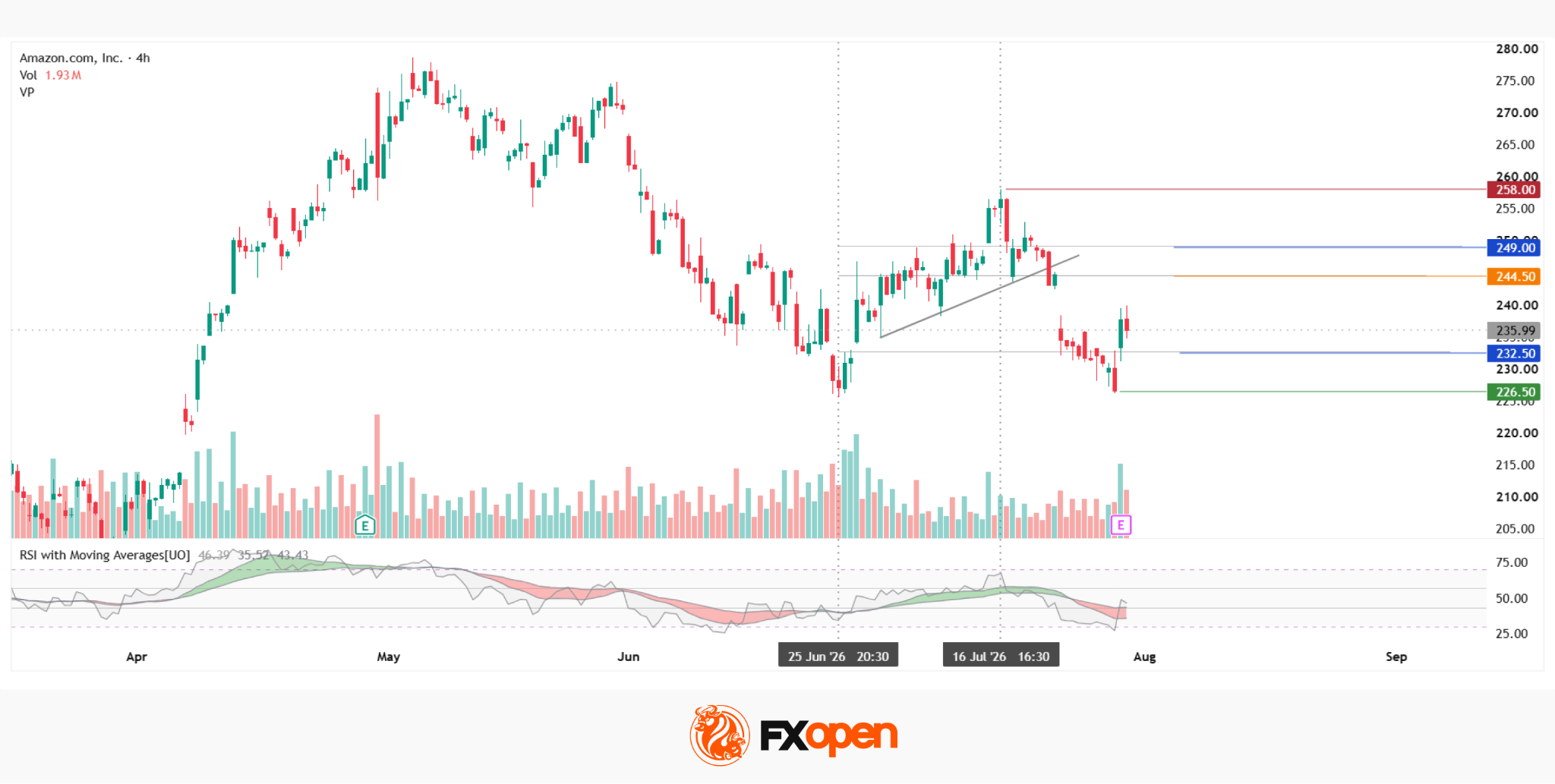
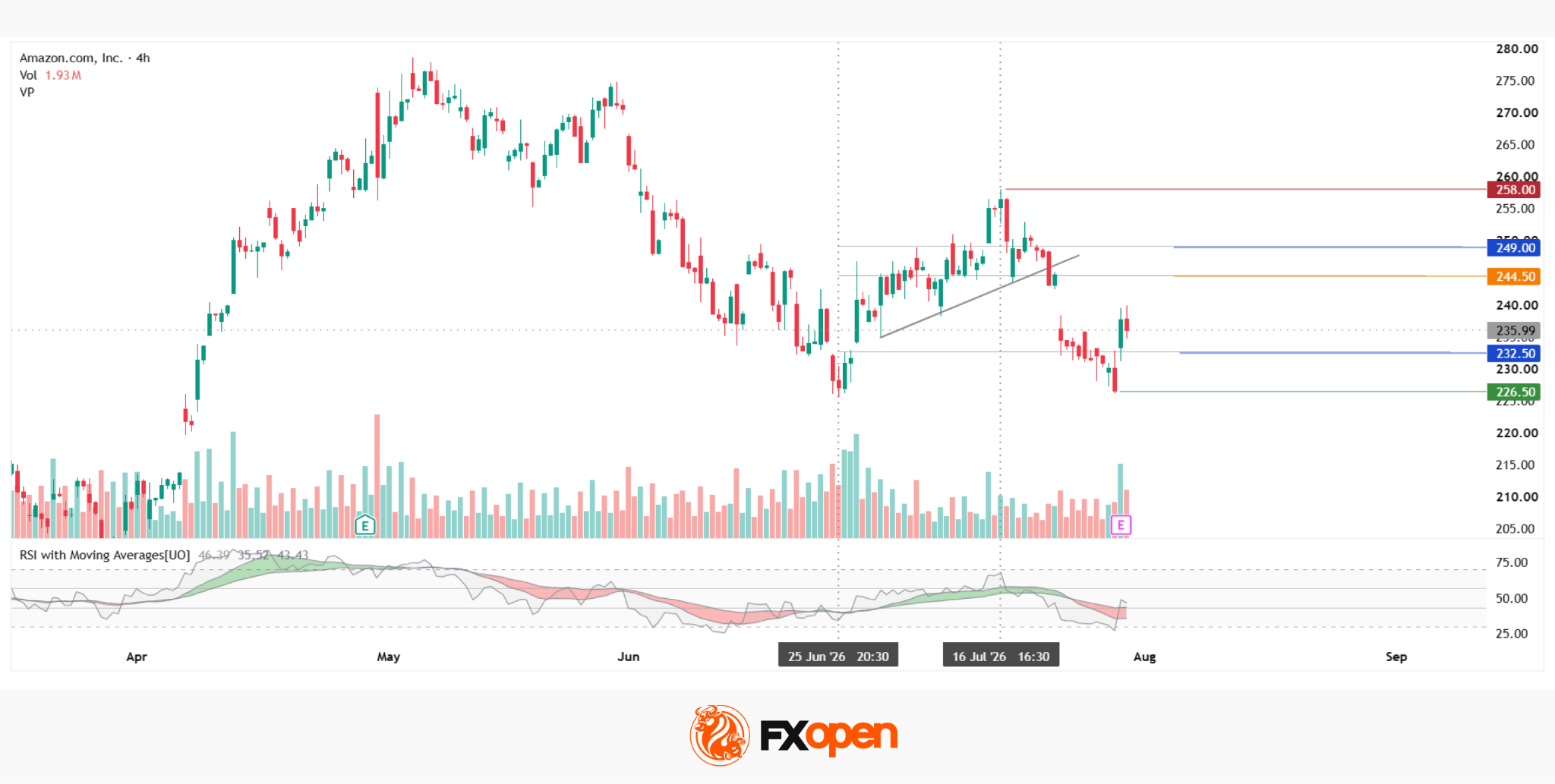
On the four-hour AMZN chart, a downtrend developed after the stock peaked near $278 in May. The decline towards $226 at the end of June was followed by a corrective recovery along an ascending trendline connecting higher lows until mid-July, when the price approached resistance around $258, where the red resistance level is currently located. A break below this trendline signalled that the correction had run out of momentum, after which the price returned to the current market profile range, settling between the POC zone at $244.5 and the lower profile boundary at $232.5. Below this area lies the green support level at $226.5.
Should the current rebound continue and the price break above the POC zone, it is likely to face two further obstacles: the upper profile boundary at $249 and the red resistance level at $258. It is also worth noting that the RSI + MAs indicator currently shows readings of 46, 36 and 43. The indicator suggests that the slower moving average has yet to move below the parity zone, while the RSI has already recovered from oversold territory.
Summary
Strong earnings provide a fundamental catalyst for a continuation of the current rebound, although the RSI + MAs oscillator has yet to generate a clear signal. In the coming days, further guidance from management on AI infrastructure capital expenditure, along with the market’s reaction to earnings reports from other technology giants, could determine the stock’s next move.
Buy and sell stocks of the world’s biggest publicly-listed companies with CFDs on FXOpen’s trading platform. Open your FXOpen account now or learn more about trading share CFDs with FXOpen.
This article represents the opinion of the Companies operating under the FXOpen brand only. It is not to be construed as an offer, solicitation, or recommendation with respect to products and services provided by the Companies operating under the FXOpen brand, nor is it to be considered financial advice.


Quantum Solutions sold 1,000 ETH for $1.903 million on July 30 through its consolidated subsidiary, GPT Pals Studio Limited.
Summary
- 1,000 ETH sale raised $1.903 million as Quantum Solutions redirected funds toward AI data centers.
- 4,375 ETH authorization permits another 2,471 tokens to be potentially sold through October 30, 2026.
- 4,764.80 ETH remain, while 3,050 tokens stay pledged as collateral to a Singapore-based financial lender.
The Tokyo-listed company plans to redirect the proceeds toward its AI Infrastructure Data Center business. The sale reduced the group’s Ethereum balance to 4,764.80 ETH and is expected to produce a loss of about ¥17 million in the second quarter of the fiscal year ending February 2027.
The company also raised the maximum amount authorized for sale from 1,875 ETH to 4,375 ETH. After two disposals totaling 1,904 ETH, Quantum may sell another 2,471 ETH before October 30. Any further transactions will depend on funding needs, market conditions and progress in its AIDC plans.
Quantum Solutions expands its ETH sale authority
The revised ceiling adds 2,500 ETH to the earlier authorization adopted on June 4. Quantum said the change gives it more flexibility to fund data-center usage agreements, GPU equipment, launch preparations and related operating costs. The filing states that the increase “does not constitute a decision to immediately sell” the entire authorized amount.
Quantum’s first sale occurred on June 16, when GPT Pals sold 904 ETH at $1,777.07 each for about $1.606 million. That transaction left the group with 5,764.80 ETH and generated an expected ¥18 million loss based on its revalued carrying price.
The latest sale creates a ¥17 million loss
GPT Pals received a net $1,903 per ETH in the July transaction. Quantum had marked the assets at $2,003.97 each on May 31, leaving a $100.97 difference per token. The company therefore expects a $100,970 realized loss, equal to roughly ¥17 million at its stated exchange rate.
That accounting loss is not measured against the original historical purchase price. Quantum uses fair-value accounting and records valuation changes at each quarter-end. When it sells ETH, it compares the sale price with the latest carrying value under its moving-average method.
Most remaining ETH is tied to loan collateral
Of the 4,764.80 ETH left after the sale, 3,050 ETH remains pledged to a Singapore-based financial services company as collateral for an earlier borrowing. Only 1,714.80 ETH sits in GPT Pals’ crypto trading account, according to the filing.
The remaining authorization exceeds that unpledged balance by 756.20 ETH. This means Quantum would likely need to release or replace some collateral, acquire more ETH or use another arrangement before selling the full additional 2,471 ETH. The company has not said that it will take any of those steps.
Quantum’s top Japanese treasury ranking is disputed
The two sales have cut Quantum’s ETH holdings by about 28.6% from the 6,668.80 ETH reported before the June disposal. As previously reported, Quantum became one of the leading listed Ethereum treasury companies after rapidly adding ETH in late 2025.
Its current Japanese ranking is less clear. BitcoinTreasuries.net lists Def Consulting with 4,976 ETH as of June 30, which would place Quantum behind it. However, CoinGecko currently lists Def Consulting at 4,571 ETH. The conflicting tracker figures mean the claim that Quantum remains Japan’s largest listed Ethereum holder cannot be treated as settled without a newer company disclosure.
moreover, FG Nexus also reduced its Ethereum treasury in June as losses widened. Meanwhile, larger holders including BitMine and SharpLink continued accumulating, showing that corporate Ethereum strategies have moved in different directions during the market downturn.
Quantum said it will disclose any further sales requiring public notice. The next formal checkpoint is its second-quarter results, scheduled around October 10 on the company’s investor calendar. Investors will then see the recognized sale losses, updated ETH holdings and any further AIDC spending before the authorization expires on October 30.


The 2026 FIFA World Cup generated $20 billion in blockchain prediction-market volume from January through the tournament’s end, Chainalysis reported on July 30.
Summary
- $20 billion in prediction-market volume accumulated from January through the World Cup’s five-week tournament period.
- 400,000 wallets generated $5.7 billion during the tournament, representing 63% of prediction-market activity by volume.
- $24 million in FIFA Collect trades supported ticket access for more than 100,000 fans worldwide.
The analytics firm said more than 400,000 wallets participated, while $5.7 billion was traded during the five-week event.The report also tracked $24 million in stablecoin-powered trading through FIFA Collect, the football body’s official digital collectibles platform. The data show how betting, collectibles and ticket access converged on public blockchain infrastructure during the tournament.
World Cup prediction markets dominated onchain activity
World Cup-related markets accounted for about 63% of all prediction-market volume during the competition. Daily activity began near $50 million in January, exceeded $100 million during busy pre-tournament periods and moved toward $250 million after matches began on June 11.
Volume topped $300 million on the final, when Spain defeated Argentina, Chainalysis said. The $20 billion total covers trading from January, including qualifying and pre-tournament markets. It should not be read as betting conducted only during the tournament.
The figures fit a broader expansion in event contracts. Binance Research separately reported that monthly prediction-market notional volume rose 86% from January to $51.6 billion in June. It said Kalshi and Polymarket represented 92% of June’s total, although its market-wide measurement differs from Chainalysis’ World Cup-specific dataset.
U.S. and China led globally attributed volume
Chainalysis attributed the most activity to the U.S. and China, followed by Canada, Thailand and the United Kingdom. Participation came from every continent except Antarctica.
However, the firm cautioned that its proprietary geolocation method “may carry uncertainty” when VPNs, mixers or privacy tools obscure wallet locations. The rankings therefore represent Chainalysis’ attribution, not verified residence data for every participant.
However, World Cup demand pushed daily prediction-market volume sharply higher during June. In addition, Kalshi gained tournament exposure through ADI Predictstreet, FIFA’s official prediction-market partner.
Chainalysis identified about 3,700 participating wallets with traceable illicit interaction histories, representing less than 1% of the total. It reported at least $5.4 million flowing from Huobi or HTX into wallets that later used World Cup markets. Scam-linked wallets accounted for about $2 million, while stolen-fund exposure exceeded $800,000.
The U.K. designated Huobi Global on May 26 under its Russia sanctions regime and clarified that HTX falls within those restrictions through ownership. The European Union later added HTX to a transaction-ban list, with the measure scheduled to apply from August 23.
These findings measure earlier wallet interactions and fund flows. They do not prove that each flagged wallet committed an offense through its World Cup trades.
FIFA Collect connected digital assets with tickets
FIFA Collect let users trade digital collectibles and obtain rights connected to match tickets. FIFA says more than 100,000 fans gained stadium access through its Right-to-Ticket products. Chainalysis traced $24 million in payments to a key FIFA Collect smart-contract wallet from May 2025 through the tournament.
The firm estimated that FIFA received at least $6 million from secondary transactions after applying the platform’s 5% share. It found negligible direct illicit exposure among FIFA Collect users, which “may be a result of FIFA’s robust KYC practices,” according to Chainalysis. That explanation is an assessment, not a controlled test.
As crypto.news reported, FIFA moved its collectibles platform to a purpose-built, Avalanche-based blockchain in 2025. The next test is whether ticket-linked collectibles and prediction-market users remain active after the World Cup. Regulators and platforms will also face pressure to strengthen sanctions screening, market surveillance and settlement controls as event-contract volumes expand.


Crypto markets barely registered one of the sharpest equity rallies of the year on Friday, with bitcoin holding near $64,300 while South Korean stocks staged a record rebound from the selloff that dominated the past two weeks.
The majors were close to unchanged. Ether traded at $1,907, XRP at $1.08, solana at $74 and dogecoin at $0.07, with roughly $27 billion changing hands in bitcoin and $7 billion in ether. BNB was the exception, up 3% on the day to $590 and the only major holding a meaningful weekly gain. Bitcoin spiked to $65,300 in early Asian hours before giving it back within an hour.
The weekly picture stays soft. Hyperliquid’s HYPE is down 5% over seven sessions, solana and XRP are each off 3%, and bitcoin has lost 2%. Ether and dogecoin are up 1%.
Equities went the other way, hard. The Kospi surged as much as 17%, rebounding from a three-day rout that had taken the index more than 40% below its June peak. Samsung and SK Hynix both jumped more than 23%, and Taiwan Semiconductor rose 10%, making chipmakers the biggest contributors to a broad Asian advance.
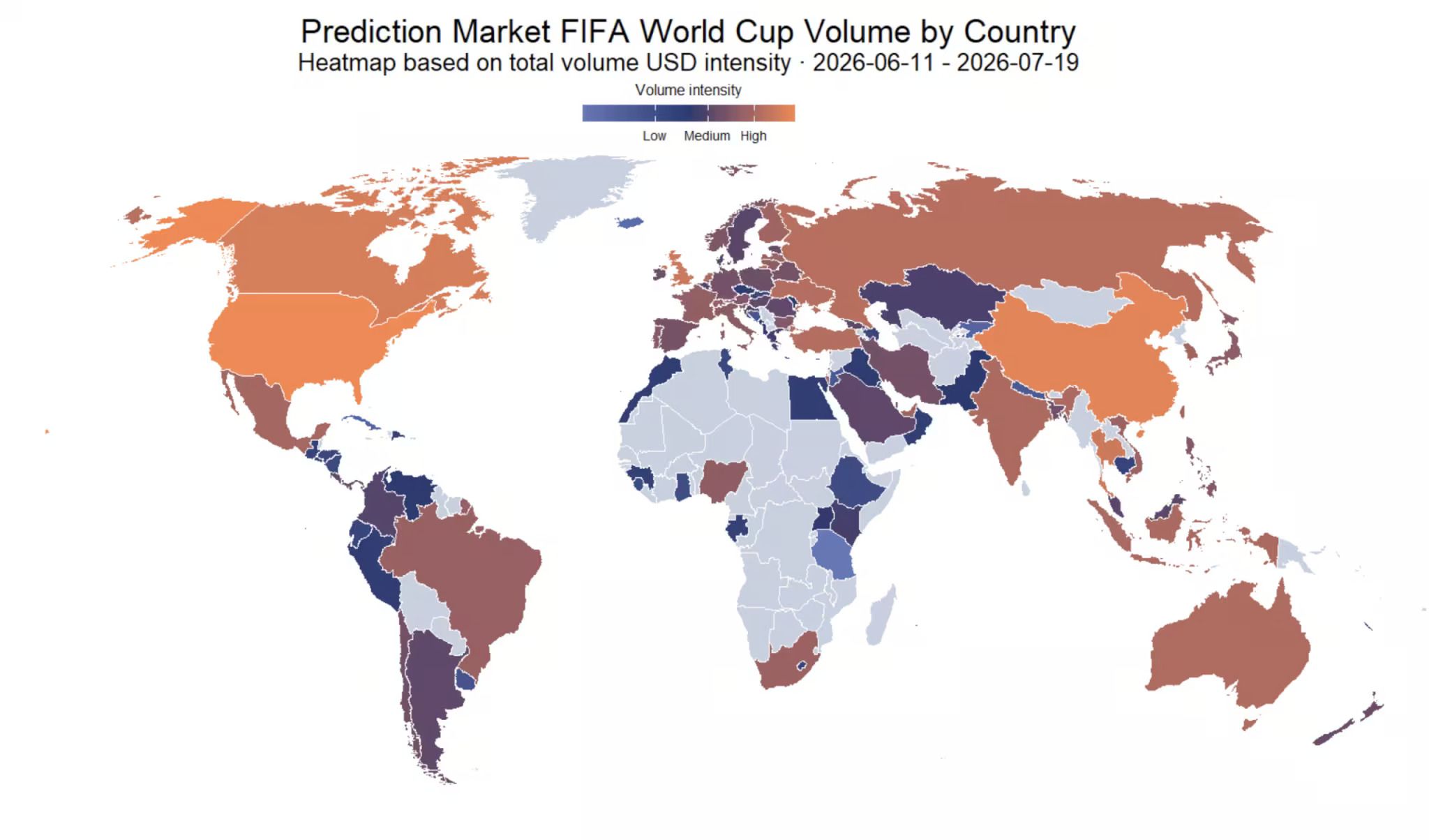
The 2026 FIFA World Cup generated $20 billion in prediction market volume, with the US and China contributing the largest country-level flows, according to new Chainalysis research published Thursday.
More than 400,000 wallets placed on-chain bets on the tournament. World Cup markets accounted for roughly 63% of all prediction market activity during the event.
World Cup Betting Volumes Peaked at the Final
Chainalysis tracked World Cup betting from January 2026. Markets were already producing nearly $50 million in daily volume months before kickoff. Daily activity jumped to around $250 million once the tournament opened on June 11.
The final, in which Spain defeated Argentina, drove over $300 million in wagers. Novelty markets also attracted heavy flows. A single market asked whether Cristiano Ronaldo would cry after his last campaign, generating $49 million.
Bettors fared unusually well. Chainalysis found 55% of participants ended the tournament in profit, and 79% of those winners were experienced prediction market users.
The report mapped tournament betting flows by country between June 11 and July 19. The heatmap shows that the US and China generated the highest attributable volumes worldwide.
Canada, Thailand, and the UK also ranked among the top contributors. Australia, Brazil, Russia, and India also saw heavy activity, while much of Africa showed little or no attributable volume.

Follow us on X to get the latest news as it happens
Sanctioned Exchange Funds Reached Betting Wallets
Not all the money was “clean.” Chainalysis identified roughly 3,700 wallets, under 1% of bettors, with illicit transaction histories.
The largest single source was Huobi/HTX, which sent at least $5.4 million into World Cup betting wallets. The UK sanctioned the exchange in May over alleged Russian sanctions evasion, and the EU followed in July. Scam-linked wallets added around $2 million.
Meanwhile, FIFA’s own on-chain experiment stayed largely clean. Chainalysis identified a key FIFA Collect wallet on Avalanche that received $24 million from NFT collectors between May 2025 and the tournament’s end.
The firm said that strict identity checks may explain the negligible level of illicit exposure. On-chain flows indicate FIFA collected at least $6 million from secondary sales.
Subscribe to our YouTube channel to watch leaders and journalists provide expert insights
The post US and China Led $20 Billion World Cup Prediction Market Boom, Chainalysis Says appeared first on BeInCrypto.
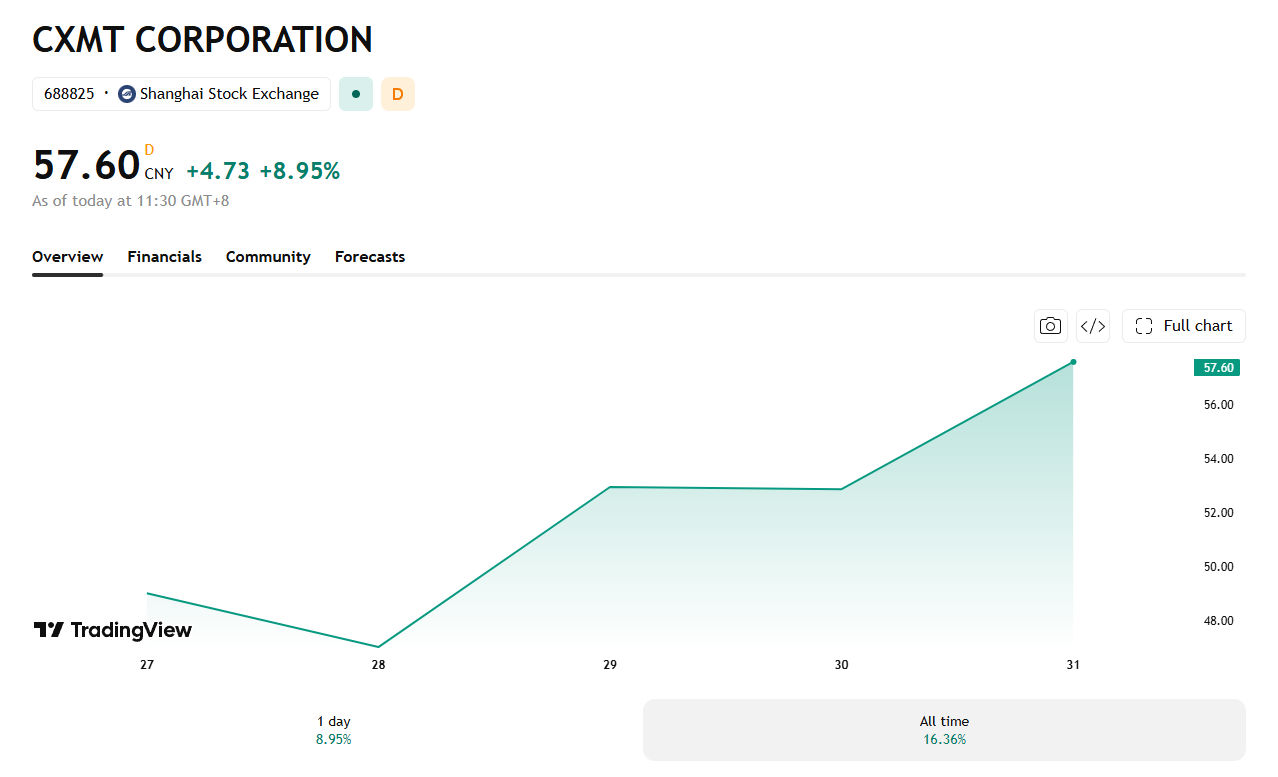
CXMT Corp (688825) jumped 8.95% on Friday to close at 57.60 yuan (about $8.51), extending its rally through a fifth trading day on the Shanghai Stock Exchange.
The Chinese memory chipmaker has grown continuously in the few days since its record initial public offering (IPO) last week, pushing its market capitalization to roughly 3.54 trillion yuan, or about $523 billion.
Why CXMT Keeps Climbing
CXMT, short for ChangXin Memory Technologies, listed on Shanghai’s STAR Market on July 27. Shares surged as much as 466% on opening day. The move briefly pushed CXMT past Industrial and Commercial Bank of China to become mainland China’s most valuable listed company.

The IPO raised 57.92 billion yuan, or about $8.6 billion. CXMT plans to use the funds to expand production and close the technology gap with foreign rivals.
Two forces are driving investor demand. Beijing wants chip self-sufficiency as Washington restricts China’s access to advanced semiconductor equipment.
At the same time, a global shortage of dynamic random-access memory (DRAM), the chips that let devices and AI models store and process data, has manufacturers redirecting supply toward AI data centers.
What CXMT Actually Makes
CXMT was founded in 2016 and is based in Hefei. The company holds roughly 7.7% of the global DRAM market, making it the world’s fourth-largest producer. Samsung Electronics, SK Hynix, and Micron Technology control the other 90% between them.
CXMT mainly builds mainstream memory chips for phones, laptops, and servers. It still trails rivals in High Bandwidth Memory (HBM), the advanced chip type that feeds AI data centers directly. Counterpoint Research director MS Hwang said CXMT aims to start supplying HBM within China by 2027.
Dell, HP, and Apple have reportedly started testing CXMT’s chips as they look to diversify away from Korean and American suppliers. Price is the main draw. But the deal carries risk.
The Pentagon has added CXMT to a list of firms it links to the Chinese military, a designation the company denies. Apple is separately lobbying Washington for clearance to use Chinese-made memory.
CXMT’s rise lands amid what industry watchers call “RAMageddon,” a consumer device memory squeeze that has already boosted Apple’s smartphone pricing power and rattled chip stocks from Seoul to Wall Street.
Analysts remain split on how much relief CXMT can deliver. That means any pricing benefit for everyday devices probably won’t arrive soon, even as the AI chip race keeps accelerating.
The post CXMT Stock Jumps Another 9%: What the Chipmaker Means for the AI Race appeared first on BeInCrypto.
U.S. Senate Minority Leader Chuck Schumer introduced the Anti-Corruption Bureau Creation Act on July 30, proposing a federal agency with authority to investigate and pursue executive-branch corruption.
Summary
- Seven Senate-confirmed members would lead the proposed bureau, with subpoena, enforcement and reporting powers nationwide.
- Trump’s certified disclosure entries totaled over $1.4 billion across crypto-related ventures during calendar year 2025.
- Four Democratic senators sponsor the bill; its launch materials named no Republican cosponsor on Friday.
Senators Andy Kim, Alex Padilla and Jeff Merkley joined Schumer as original cosponsors.The bill cites President Donald Trump’s 2025 financial disclosure and says he received at least $2 billion from investments and business interests, including more than $1.4 billion connected to crypto ventures. The proposal does not itself establish that any disclosed income resulted from illegal conduct.
The crypto figure represents an aggregation of entries in the disclosure, rather than a single total calculated by the Office of Government Ethics. The filing reports income and transaction amounts, not the net profit that would appear on a tax return.
Anti-Corruption Bureau would combine three watchdogs
Schumer’s proposal would place the Federal Election Commission, Office of Government Ethics and Office of Special Counsel inside one independent bureau. A seven-member board confirmed by the Senate would oversee investigations, subpoenas, enforcement actions and public reporting.
The legislation would also allow state attorneys general and private plaintiffs to seek recovery of funds allegedly obtained through corruption. Its official summary describes disgorgement, treble damages and awards for successful plaintiffs. It also proposes a self-financing Freedom From Influence Fund.
A three-judge division of the U.S. Court of Appeals for the D.C. Circuit could appoint temporary board members when vacancies threaten the bureau’s operation. The provision is intended to prevent a president or Senate from disabling the agency by leaving seats vacant.
Trump’s crypto income came from several ventures
Trump’s certified disclosure lists $635.1 million in royalties from Celebration Coins. It also records hundreds of millions of dollars from World Liberty Financial token sales, equity transactions and crypto wallets, plus $196.9 million tied to a stablecoin-related holding company. Together, the listed crypto-related entries exceed $1.4 billion.
Those figures describe disclosed revenue and proceeds, not necessarily Trump’s personal after-tax earnings. As previously reported, the filing showed that crypto generated more income than Trump’s resorts and other property businesses during 2025.
The bill separately states that Trump’s family held more than $1 billion in a crypto fund connected to foreign governments. It references a reported United Arab Emirates-backed investment in World Liberty Financial. These are legislative findings and allegations, not a court judgment that corruption occurred.
White House rejects conflict-of-interest claims
White House Principal Deputy Press Secretary Anna Kelly said Trump’s investments were held in fully discretionary accounts managed by independent third-party financial institutions. She maintained there were “no conflicts of interest.” Trump has also said he does not manage his personal finances while serving as president.
Schumer described the existing federal oversight system as a “broken patchwork” and argued that its agencies were not designed to address current executive-branch conduct. The White House disputes the premise that Trump’s business income creates an unlawful conflict.
The bill faces a difficult path through Congress
The publicly released full bill text still displayed a placeholder instead of a Senate bill number on July 31. The launch announcement listed four Democratic sponsors and no Republican cosponsor. The measure must clear both chambers before reaching Trump, who could veto it.
The proposal also enters a wider debate over the Digital Asset Market Clarity Act. Senator Cynthia Lummis released updated Senate text on July 22 after the bill passed the Banking Committee by a 15–9 vote. Senator Elizabeth Warren argued that its current ethics provisions would not adequately restrict presidential crypto interests, while supporters continued to seek a bipartisan agreement.
Crypto.news reported that the CLARITY Act still faced disputes over ethics and banking provisions as supporters pressed for a vote. The Senate is scheduled to reconvene on Aug. 3, but no timetable has been announced for Schumer’s anti-corruption bill. Its next steps could include formal numbering, committee referral and hearings before any floor consideration.

Wintermute says the next phase of altcoin momentum may look different from past cycles: fewer tokens could attract sustained inflows as institutional desks concentrate their activity into a narrower basket of assets. In a first-half 2026 OTC flow report, the market maker found that institutional counterparties accounted for the vast majority of spot trading activity on its desk—an outcome that, if mirrored across the broader market, would likely make “altseason” less broad and more selective.
The shift also appears to include a timing mismatch. Wintermute reports that institutional participation tends to fade quickly after a token’s price and volume spike, while retail activity typically stays elevated for longer—suggesting any future rallies could be more short-lived and restricted to the tokens institutions already favor.
Key takeaways
- Wintermute’s first-half 2026 OTC data shows institutional counterparties generated 72% of spot flow across all tokens on its desk—the highest share recorded—up from 61% in H2 2025 and 59% in H1 2025.
- Liquidity and attention are concentrating in the “short list” of assets institutions choose, while activity in the market’s smaller “long tail” weakens.
- The number of unique tokens traded by institutional counterparties rose only 24% from H1 2024 to H1 2026, versus 76% growth for retail clients.
- Institutional activity after a price-and-volume surge typically cools within about one day, while retail activity remains elevated for around three days.
Institutional desks are pulling OTC liquidity toward a smaller set of tokens
Wintermute’s OTC flow report points to a structural change in how capital is deployed across the altcoin market. According to Wintermute, institutional counterparties drove 72% of spot flow across all tokens handled on its OTC desk in the first half of 2026—its highest recorded level. That compares with 61% in the second half of 2025 and 59% in the first half of the previous year.
While institutional participation has been rising, Wintermute’s interpretation matters for traders and investors: when the majority of activity is concentrated among a smaller group of counterparties and assets, rallies can become narrower. The firm said liquidity is increasingly clustering in tokens institutions favor, while the broader “long tail” of smaller tokens sees less consistent engagement.
That concentration effect is reinforced by the growth rates in token participation. Wintermute found that from H1 2024 to H1 2026, the number of unique tokens traded by institutional counterparties increased by 24%, whereas retail clients increased their number of unique traded tokens by 76% over the same span. In practical terms, the data suggests that retail participants explore a wider range of assets, while institutional flow remains comparatively disciplined.
Faster institutional pullbacks after spikes could reshape altcoin rally dynamics
Another detail in Wintermute’s report relates to how quickly activity cools after a token experiences a surge. The firm found that institutional activity following spikes in a token’s price and volume faded after roughly one day. Retail behavior differed: Wintermute says retail activity typically stays elevated for about three days after similar surges.
If these patterns extend beyond Wintermute’s OTC venue, they can influence how traders structure exposure during altcoin moves. Short-lived institutional participation can mean that order flow—and therefore liquidity—does not remain supportive for as long as it may have in earlier cycles when broader rotation into many assets sustained momentum.
For market participants, the implication is straightforward: rallies may require faster decision-making and more asset-selective positioning, because the “institutional bid” may not persist the way it once did across a wide swath of tokens.
Other data points suggest “altseason” rotation is narrowing across venues
Wintermute’s proprietary OTC findings add to a growing set of signals that capital is clustering around fewer altcoins. On June 20, CryptoQuant CEO Ki Young Ju said the “traditional rotation of Bitcoin profits” into smaller assets had “basically disappeared.” CryptoQuant data referenced by Young Ju suggested that trading volume in Bitcoin-denominated altcoin pairs was near its weakest level since 2021.
Meanwhile, CryptoQuant’s CEO also pointed to market cap concentration. The 10 largest non-stablecoin altcoins accounted for about 80.5% of the non-Bitcoin, non-stablecoin market’s capitalization—another indicator that the market’s center of gravity is increasingly tilted toward the biggest names in the category.
Exchange-level data has also suggested a similar pattern. In July 2025, Kaiko reported that the ten largest altcoins made up 63% of altcoin trading volume, up from roughly 50% several months earlier as activity in smaller tokens weakened. Together with Wintermute’s OTC numbers, the message across different datasets is consistent: liquidity and trading interest are drifting toward the same smaller group of assets.
Market debate: broad rallies vs. selective sector moves
The question now facing investors is whether this concentration will permanently reduce the breadth of future altcoin runs—or simply change their shape. DWF Labs managing partner Andrei Grachev has argued that broad altcoin rallies are giving way to more selective sector activity. In March 2025, Grachev said too many tokens were competing for limited capital, while institutional investors remained focused on Bitcoin, Ether, and tokenized real-world assets.
This framing aligns with the mechanics Wintermute describes: if institutions are more concentrated, and their participation fades quickly after price and volume spikes, “rotation” may become less of a market-wide wave and more of a series of targeted moves. In such an environment, tokens outside the institutional comfort zone may struggle to attract sustained liquidity, even if retail interest remains visible for a brief period.
It also highlights a potential tension between retail and institutional behavior. Retail participation appears to spread across more tokens and remain elevated longer after bursts. But if institutional desks dominate overall spot flow on major venues and OTC desks, retail-led excitement may not be enough to maintain broad-based momentum without follow-through from larger pools of capital.
For readers, the key watch items are whether institutional concentration continues to increase beyond H1 2026, and whether the “one-day” institutional fade and “three-day” retail persistence become stable patterns across more tokens and more trading conditions. If they do, the definition of “altseason” may shift from a widespread rotation into many names to a narrower, faster-moving set of trades that reflect where liquidity is actually concentrated.
Upbit adds CFX as Conflux gains Korean market access

‘I am sad, I couldn’t be selected’: 17-year-old aspiring woman cricketer dies by suicide | Cricket News

Bearable Bull Unmasked: The XRP Domino Theory, XRP price & the Reverse Carry Trade


-

 Fashion7 days ago
Weekend Open Thread: Brooks Brothers
-
 Sports4 days ago
Commonwealth Games boxing: Jadumani Singh seals dominant 5-0 win over Pakistan’s Sumama Rehman to enter quarter-finals | Commonwealth Games News
-

 Business1 day ago
Why Trees Belong on the Risk Register
-

 Tech4 days ago
Intel is reversing course and bringing hyper-threading back to its server chips
-

 Crypto World5 days ago
Ripple bought a bank in pieces. The $4 billion audit
-

 Politics4 days ago
Luke Littler dismantles Gerwyn Price to retain title in Blackpool
-
 Entertainment7 days ago
A New Post-Apocalyptic Gundam Anime Series Blasts Into SDCC
-

 Politics3 days ago
The Part of the Electric Transition Nobody Wants to Discuss
-

 News Videos4 days ago
BITCOIN JUST ENTERED THIS CRITICAL ZONE…
-

 Business2 days ago
Major shareholder moves on Canyon
-

 Crypto World5 days ago
XRP Ledger adds $2.6B as RWA inflows rank second
-

 News Videos18 hours ago
Bitcoin Enters the 3rd Stage of the Bear Market
-

 Politics5 days ago
Spain sweeps the board at 2026 World Cup with individual awards
-
 Entertainment2 days ago
‘Stargate’ Creator’s New Sci-Fi Series Returns for Season 3 Tomorrow
-

 Entertainment5 days ago
Sara Gilson Killed By Husband After Viral “Pedophile” TikTok Video
-

 Crypto World2 days ago
Kraken Enables Retail Access to Jersey Mike’s IPO via Tokenized Shares
-

 Tech6 days ago
Anthropic launches Claude Opus 5, a cheaper AI model for coding, agents and enterprise workflows
-

 News Videos2 days ago
Claude: Build Financial Dashboards in Minutes (2026)
-

 Politics14 hours ago
Luke Littler’s dominance sparks GOAT debate
-

 Tech3 days ago
New macOS Sequoia & Sonoma security updates for older Macs
You must be logged in to post a comment Login