

Crypto World
Binance Looks Beyond Greece for EU MiCA Authorization

[Update 14:47 UTC, June 24: Updates with comments from Binance beginning in first paragraph.]
Crypto exchange Binance is withdrawing its MiCA application with Greece’s Hellenic Capital Market Commission (HCMC) and intends to pursue authorization in another member state just days before the deadline for EU licensing.
“When we are ready to announce that Member State, we will do so publicly,” the company said in a statement on Wednesday.
Earlier, Gillian Lynch, Binance’s head of Europe and the United Kingdom, told Reuters that the exchange is “not leaving Europe” and would pursue authorization in another EU jurisdiction if its application in Greece does not move forward.
Lynch said Binance contacted other regulators but submitted a formal application only in Greece. The exchange reportedly held talks with Ireland, Latvia and Greece but encountered resistance over its past money-laundering penalties, international structure and what officials viewed as a risk-taking culture.
The move comes days before the Markets in Crypto-Assets Regulation (MiCA) transitional period ends on July 1, a key deadline for crypto firms seeking to operate across the EU. The European Securities and Markets Authority (ESMA) said on Tuesday that crypto service providers that remain unauthorized by the deadline must take “immediate” steps to wind down their EU activities.
On June 16, Binance pushed back against an earlier Reuters report that EU regulators were preparing to reject its MiCA application, saying Greece’s Hellenic Capital Market Commission had reviewed the application and considered it compliant, subject to further review by ESMA. The exchange said at the time that it expected the process to advance toward authorization.
EU customers could see changes
In its statement, Binance said it plans to take the necessary steps before July 1 to remain “compliant with applicable requirements.”
“This means some users may be impacted, and we will communicate directly with affected users to provide clear information on next steps,” the representative said. “All user funds remain safe and secure. Our priority is to minimize disruption, provide clarity to users, and continue building a trusted and compliant digital asset ecosystem globally.”
The representative did not provide additional details.
MiCA deadline puts Binance’s European reach at risk
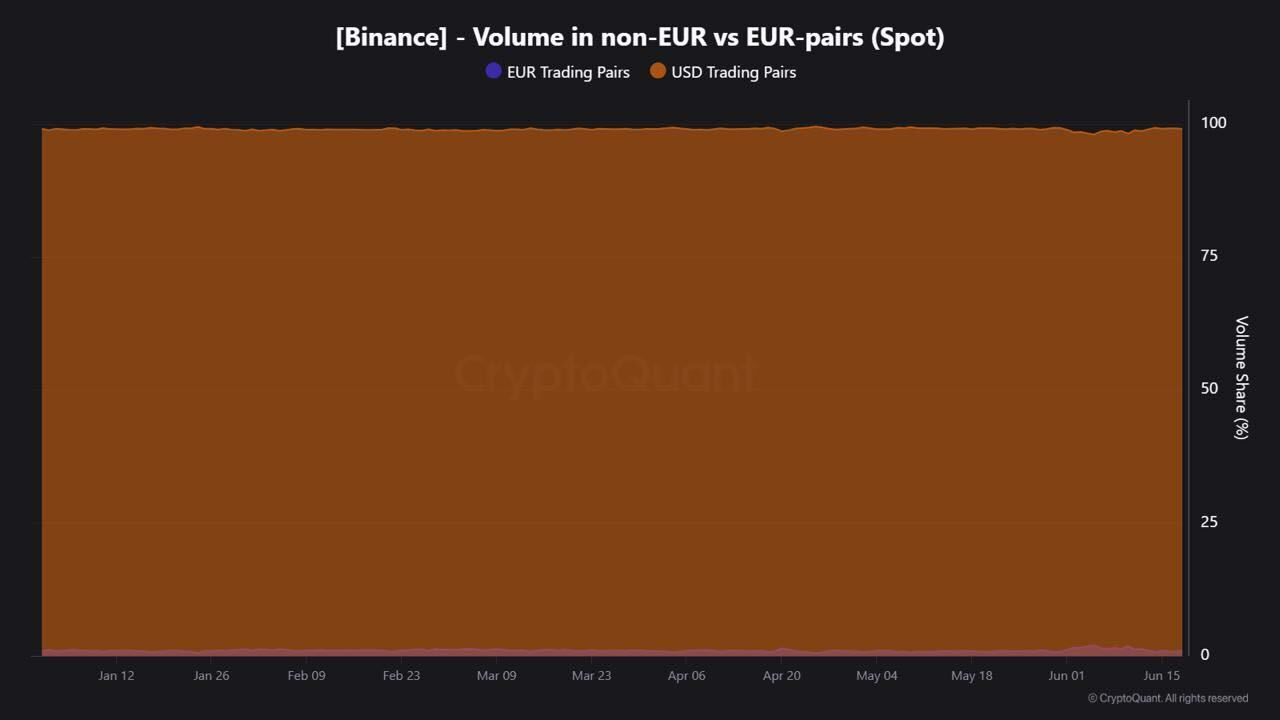
On Monday, CryptoQuant analyst Maartunn told Cointelegraph that euro-denominated pairs account for about 1% of Binance’s global spot trading volume, suggesting that a European licensing setback may have a limited effect on the business.
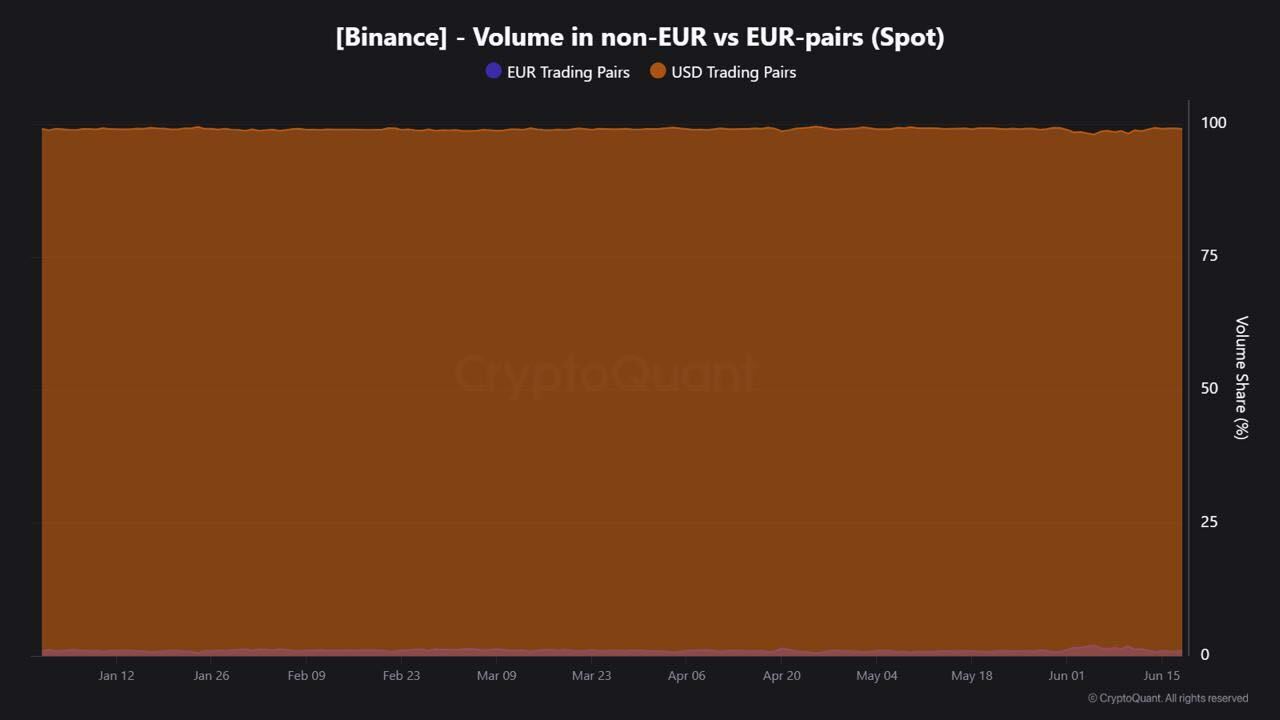
Source: CryptoQuant
However, Binance remains a significant trading venue for European users, handling between about $100 million and $250 million in daily euro-pair volume in 2026, with occasional spikes of about $600 million.
Binance held an estimated 18.5% share of euro-denominated spot trading during the year, placing it second behind Kraken’s 43.3% share, according to CryptoQuant’s data.
Exchanges emerge as MiCA compliance gatekeepers
Binance’s licensing difficulties could also affect token issuers, as authorized exchanges increasingly prepare and notify MiCA white papers for assets they list.
In a LinkedIn post, Ryan King, creator of the EU Crypto Register, said at least 380 of 867 white-paper entries he tracked were notified by third parties rather than token issuers. He said Kraken, LCX, OKX and Bitstamp accounted for 271 notifications, or about 31% of the total.
Related: Binance’s Yi He warns of alleged impersonation scam, CoinUp denies ties
King told Cointelegraph that the model was “symbiotic” because exchanges employ MiCA-trained compliance teams, maintain regulator relationships and retain large law firms. He added that exchanges increasingly request white papers during onboarding and may offer to prepare them, even for tokens covered by transitional arrangements.
“They also use standard templates,” King told Cointelegraph, recalling that one exchange told a token project to “fill it in and we’ll handle the rest.”
Magazine: Japanese pension fund tips 1% in crypto, G7 urges action on NK hackers: Asia Express



The Commodity Futures Trading Commission filed suit against Kentucky on Tuesday, bringing the total number of states facing federal litigation over prediction-market jurisdiction to nine. The CFTC's complaint seeks declaratory and injunctive relief to block Kentucky from enforcing state gaming… Read the full story at The Defiant


Coinbase opened its Luxembourg office on June 24, naming the country its European Union hub under the Markets in Crypto-Assets (MiCA) framework. Binance, by contrast, just withdrew its license bid in Greece.
The contrast shows how regulatory track records increasingly decide who keeps EU access before the deadline on July 1. Early movers gain a 27-state passport, while latecomers risk losing the bloc.
Coinbase Locks In Its Luxembourg Base
Coinbase won its MiCA license from Luxembourg’s Commission de Surveillance du Secteur Financier in June 2025. That came more than a year before the deadline.
The company already held national licenses in six EU countries, including Germany and France. It has also traded publicly on Nasdaq since 2021, giving regulators years of audited disclosures.
The single license covers more than 450 million people across the EU. Coinbase Luxembourg S.A. now sits on ESMA’s register, joining the firms approved under MiCA across the bloc.
Chief Policy Officer Faryar Shirzad opened the office alongside Luxembourg Finance Minister Gilles Roth.
“Luxembourg has established itself as the EU’s leading hub for institutional crypto and tokenization,” he said in a post.
Follow us on X to get the latest news as it happens
Binance Faces a MiCA Reckoning
Binance took the opposite path this week. The exchange confirmed its Greek license bid had collapsed, leaving it absent from ESMA’s register.
Regulators have long weighed Binance’s record. In 2023, it pleaded guilty in the United States to money-laundering and sanctions violations.
Binance paid more than $4.3 billion, one of the largest corporate penalties in US history. Founder Changpeng Zhao pleaded guilty and resigned as chief executive.
It now plans to seek approval in another EU member state. Binance says it meets MiCA standards and points to roughly 1,500 compliance staff.
“Binance is not leaving Europe,” Gillian Lynch, Binance’s head of Europe and UK, told Reuters.
What Comes Next
With days left before the deadline, more than 230 firms have cleared MiCA and can keep serving EU users. Coinbase and rivals including Kraken sit on ESMA’s list.
Binance does not. Its return now hinges on convincing another regulator that its compliance matches its size.
The post Coinbase Opens Luxembourg MiCA Hub as Binance Races EU Deadline appeared first on BeInCrypto.
Crypto World
Binance Withdraws Greece MiCA Application, Targets New EU Jurisdiction Before July Deadline


Binance has withdrawn its MiCA license application in Greece and confirmed it will seek authorization in a different EU member state, with seven days before the bloc's regulatory wind-down deadline takes effect. The exchange confirmed the withdrawal Wednesday in a post on X, saying the target… Read the full story at The Defiant
A wallet attributed to venture firm Andreessen Horowitz (a16z) withdrew 25,560 ETH, worth about $42.62M, from Binance on Tuesday, per onchain intelligence tracker Lookonchain. The move has drawn attention as a potential accumulation play amid a sustained ETH drawdown. Lookonchain identified the… Read the full story at The Defiant
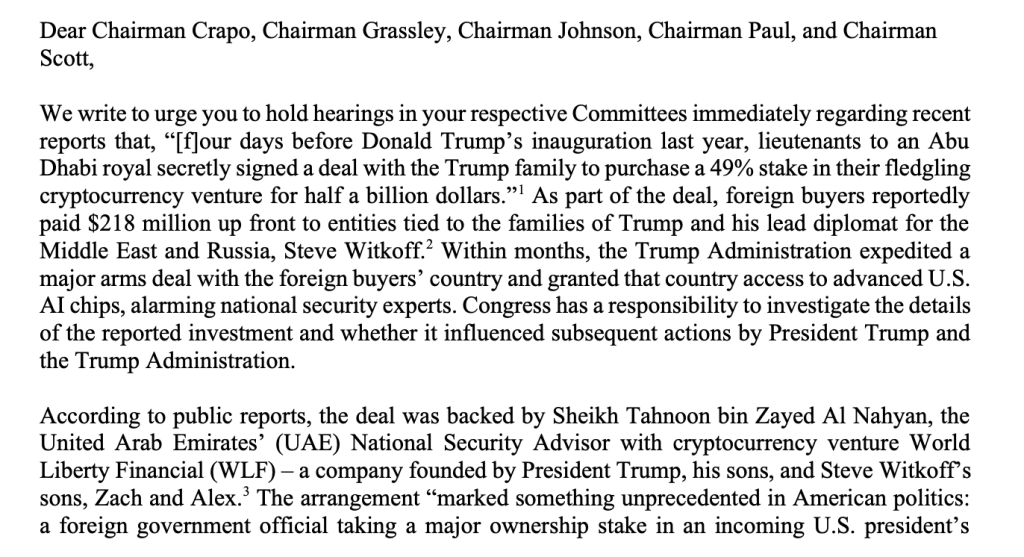
Five Senate Democrats, Elizabeth Warren, Richard Blumenthal, Gary Peters, Dick Durbin, and Ron Wyden, formally demanded hearings on June 23 into the $500 million UAE investment in Donald Trump crypto venture, World Liberty Financial, calling the deal unprecedented in American political history and demanding sworn testimony from White House officials on what they knew and when.
The letter landed four days after the senators’ earlier CFIUS inquiry went unanswered, and it sharpens the conflict-of-interest argument by tying a cascade of favorable UAE policy decisions directly to the investment timeline.
The demand is a narrative event. Whether it produces testimony, subpoenas, or anything resembling accountability depends entirely on Republican committee chairs who have shown no appetite to pursue the question – and on whether Democrats have the procedural leverage to force the issue. That leverage, it turns out, runs directly through the stablecoin and crypto market-structure bills Republicans are counting on.
Discover: The Best Token Presales
What the Senate Letter Actually Covers, and What It Can’t Force
The deal at the center of this inquiry closed four days before Trump’s inauguration. Lieutenants to Sheikh Tahnoon bin Zayed Al Nahyan, the UAE’s National Security Advisor, purchased a 49% stake in World Liberty Financial for $500 million, with $218 million paid upfront to entities tied to the Trump family and Steve Witkoff, Trump’s lead diplomat for the Middle East.
Two executives from G42 – the Abu Dhabi AI firm chaired by Sheikh Tahnoon, joined World Liberty Financial’s five-member board, giving the Emirati side effective veto power over key decisions.
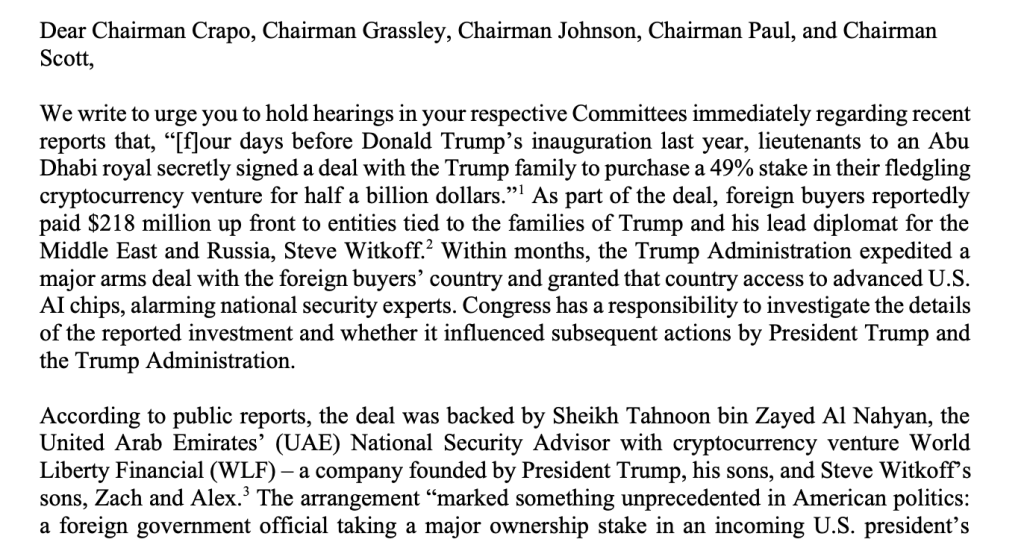
The senators’ letter identifies three subsequent policy decisions that benefited the UAE: a $1.4 billion arms sale approved in May 2025 despite congressional objections over weapons reaching armed groups in Sudan; Treasury’s creation of a ‘Known Investor Pilot’ program to fast-track UAE investment approvals through CFIUS; and the Department of Commerce rescinding Biden-era chip export restrictions, authorizing G42 to receive 35,000 Nvidia Blackwell chips worth over a billion dollars.
U.S. intelligence officials had previously flagged G42 for providing U.S. technology that enhanced China’s missile capabilities, a detail that makes the chip authorization the most politically combustible element of this sequence.
This is not the first escalation. A February 13 letter from Warren and Senator Andy Kim had already asked Treasury Secretary Scott Bessent to determine whether a formal CFIUS review of the UAE’s stake was required, with a March 5 deadline for written answers. That deadline passed without a public response. The June 23 letter represents the shift from requesting a review to demanding public, sworn testimony, a procedural escalation, though still not a subpoena.
World Liberty Financial’s spokesperson David Wachsman has stated that neither Trump nor Witkoff was involved in the investment transaction and that both have had no connection to World Liberty Financial since taking office. Democrats say that framing does not resolve the underlying conflict of interest, particularly given that a Trump-affiliated entity retains a claim to 75% of token revenues, approximately $400 million earned to date.
Discover: The Best Token Presales
The Legislative Hostage: USD1, Stablecoin Bills, and the 60-Vote Problem
The sharper pressure point is legislative. Republicans need at least seven Democratic Senate votes to clear the 60-vote threshold on both pending crypto regulation bills, the CLARITY Act on market structure, and the stablecoin legislation moving through the Banking Committee.
Senate Democrats have already signaled that stronger ethics and foreign-influence safeguards are conditions of their support, and the window to move these bills before the August recess is narrowing fast.
The conflict-of-interest dimension is especially acute for the stablecoin bill because World Liberty Financial is actively marketing USD1, its dollar-backed stablecoin backed by short-term U.S. Treasuries and cash equivalents, while the regulatory framework that would govern that product is being negotiated in the same Congress.
I couldn't cover all of Trump's corruption – I'd break the floor speech record if I tried that. — Chris Murphy
But this is why Trump isn't fixing America's problems: he's too busy rigging the rules for himself.
Once corruption becomes normal, it becomes permanent. We can't let that happen. pic.twitter.com/KGavDtgI59
 (@ChrisMurphyCT) June 23, 2026
A prior investment by MGX, another UAE state-backed vehicle, boosted the Trump family stablecoin market capitalization by nearly $2 billion overnight. Warren and Waters sent a separate letter to SEC Acting Chair Mark Uyeda demanding preservation of all records related to WLF and the Trump family, citing the revenue structure as an unprecedented conflict for any administration overseeing crypto regulation.
Senator Chris Murphy put it plainly on the Senate floor: the UAE investment ‘steered millions of dollars to Trump and his envoy Steve Witkoff right before the Trump White House greenlit an unprecedented deal to sell advanced AI chips to the UAE.’ That framing, foreign government money in, favorable U.S. policy decisions out, is the core argument Democrats are taking into any hearing they can force. Representative Ro Khanna has gone further, referring the Delaware LLC used in the transaction to the U.S. Attorney in Delaware and calling the arrangement a potential constitutional violation.
The Trump administration and Republicans have not publicly criticized the World Liberty Financial deal, and the Trump crypto agenda broadly remains a White House priority, as seen in recent executive actions on crypto security policy. That political alignment means committee chairs have no incentive to schedule hearings voluntarily. Senate Democrats can slow or withhold votes on crypto legislation, but they cannot unilaterally convene a hearing or issue a subpoena from the minority.
The execution events that would actually matter here, a formal CFIUS review opened, a subpoena issued, a floor vote withheld, have not happened. What has happened is a sustained escalation of documented, on-the-record demands that build a paper trail, raise the political cost of inaction, and hand Democrats a concrete procedural threat: no ethics safeguards, no votes for the crypto bills Republicans need.
Don’t Miss Out on Our $1,000 USDT Airdrop on ByBit
The post Is The Senate Finally Pulling the Plug on Trump Crypto Activities? appeared first on Cryptonews.

Nearly seven out of every 10 tokens launched on the Solana-based meme coin launchpad, Pump.fun, since January 2024, stopped trading on the same day they were created, according to a new analysis by CoinGecko.
The study examined more than 18.67 million tokens launched on the platform, excluding only those that never recorded any trading activity. It found that almost 69% of tokens, or around 12.8 million, saw their final trade on the day they launched and did not remain active beyond a single calendar day. Overall, only 850,000 tokens, or 4.55% of all launches, survived for more than 90 days.
Meme Coin Graveyard
In its latest report, CoinGecko said the high failure rate reflects how easy it is to create tokens on Pump.fun. The platform’s low barriers to entry allow creators to launch large numbers of tokens and quickly move on to new projects if early interest does not materialize.
Another 2.18 million tokens survived just one day after launch before activity ended. These projects carried over into the next calendar day but failed to sustain attention. CoinGecko said this pattern is consistent with tokens that briefly gained visibility through trending feeds or influencer mentions before interest quickly faded. Together, about 15 million tokens stopped trading either on the day they launched or the following day, which means more than 80% of all tokens analyzed failed within two days.
There has also been a steady decline in token survival beyond the first few days. Around 770,249 tokens, or more than 4%, remained active for two to three days, while 642,614 tokens, or 3.4%, survived between four and seven days. Another 460,697 tokens, representing 2.5%, continued trading for eight to 14 days.
Dogecoin, Shiba Inu, and PEPE Slide
The broader meme coin market has been struggling for months after losing the strong momentum seen during the previous cycle. Several recovery attempts this year have failed to gain traction, which has left many popular tokens well below their earlier highs. The recent market turmoil has added further pressure.
The OG meme coin, Dogecoin (DOGE), for instance, has lost almost 25% over the past month. Shiba Inu (SHIB) was also down by nearly 20% during the same period. Meanwhile, Pepe (PEPE) shed over 27%.
The post Nearly 70% of Pump.fun Tokens Die on Launch Day: CoinGecko appeared first on CryptoPotato.
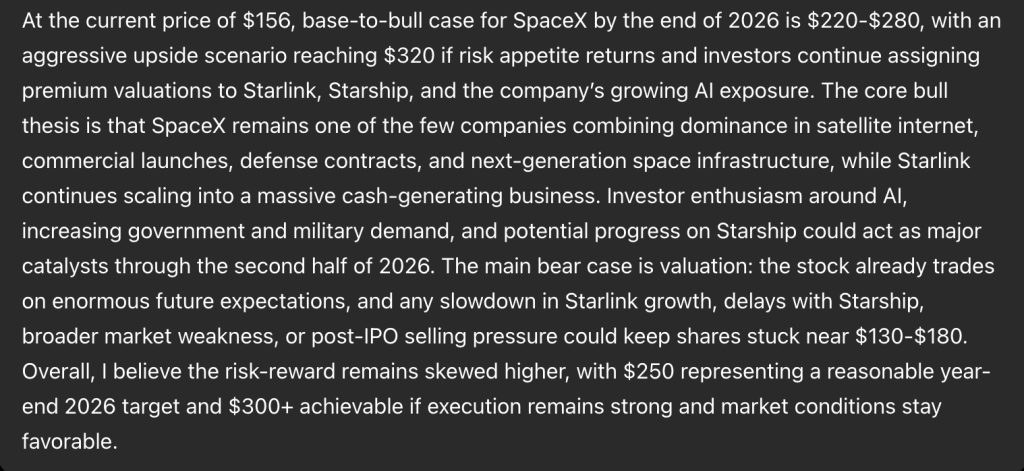
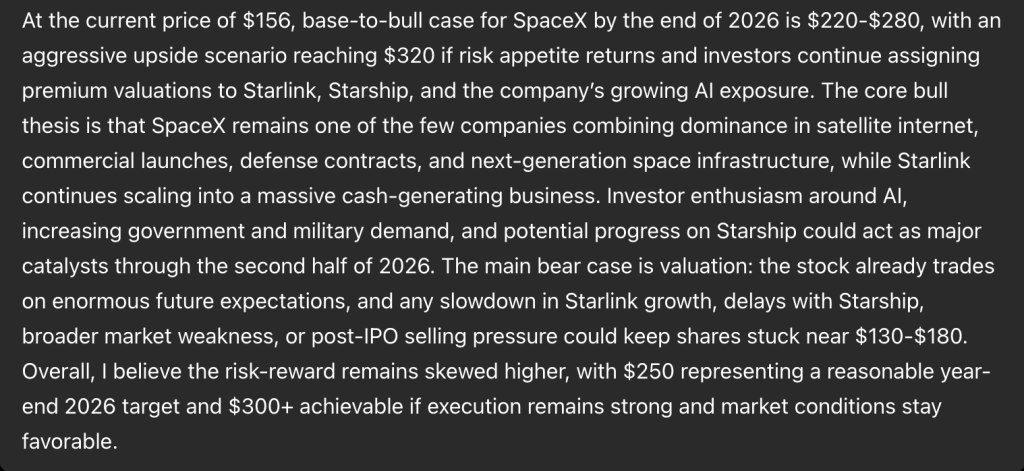
ChatGPT AI just made a prediction on SpaceX stock price that treats the recent pullback as an opportunity rather than a warning. The model sees $220 to $280 by the end of 2026, with an aggressive case stretching to $320.
The bull case treats SpaceX as a rare combination of businesses trading under one ticker. At $156 today, the model frames this as a base-to-bull setup rather than a stretch target.
SpaceX sits at the intersection of satellite internet dominance, commercial launch supremacy, major defense contracts, and next-generation space infrastructure, while Starlink continues to scale into an increasingly massive, cash-generating business on its own. Investor enthusiasm around artificial intelligence adds another layer, especially given the company’s growing exposure through its merged AI operations.
Rising government and military demand could act as a steady tailwind through the back half of 2026, and any real progress on Starship would give bulls a fresh headline to rally around.
If risk appetite returns broadly and investors keep assigning premium valuations to this combination of businesses, the model sees $250 as a reasonable year-end target, with $300 or higher achievable if execution stays strong and conditions stay favorable.
The bear case comes down to one word: valuation. The stock already prices in enormous future expectations, leaving little room for disappointment.
Any slowdown in Starlink subscriber growth, delays with Starship, broader market weakness, or simple post IPO selling pressure as lockups expire could keep shares stuck in the $130 to $180 range for a while instead of breaking higher.
SpaceX Price Prediction: SPCX Stock Tests Gravity After Its Record-Setting Launch
The intraday chart shows SpaceX trading at $156.06 after a turbulent first two weeks as a public company. Shares spiked from their IPO base into the low $220s before rolling over hard, then chopped through a series of lower highs on the way back down toward $150.
That kind of explosive debut, followed by a sharp pullback, is common for mega-cap IPOs once early momentum buyers take profits and lockup dynamics start to weigh on sentiment.
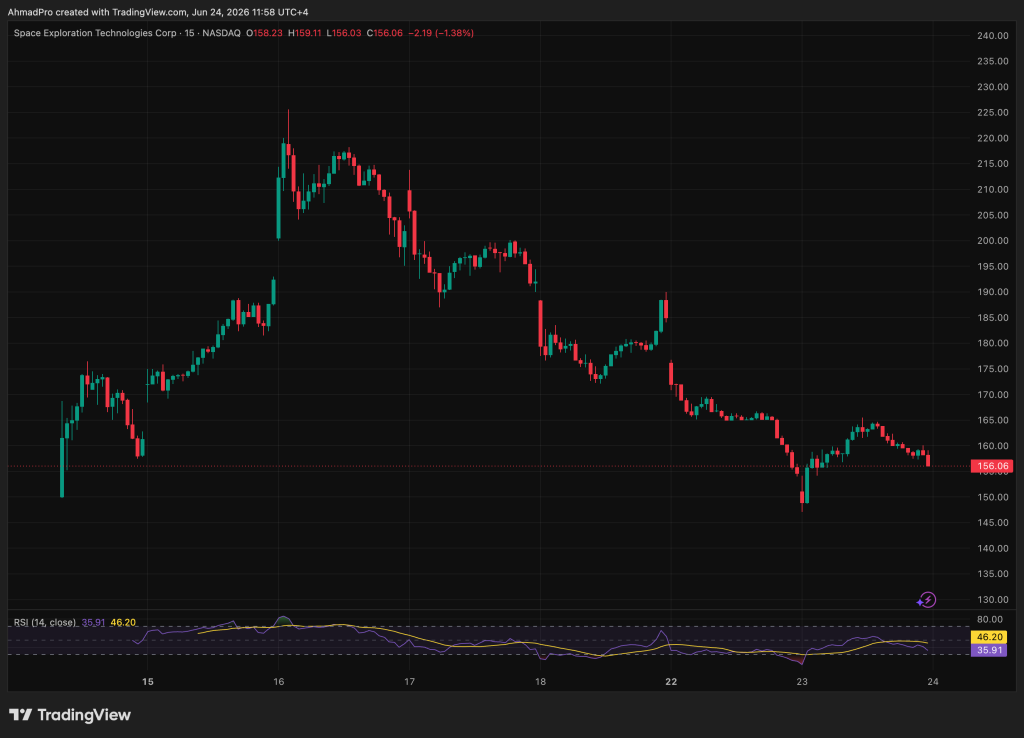
Price recently found support near $150, bounced toward $190, then faded again into the current $156 level, which puts it right in the middle of that post IPO trading range.
Immediate resistance sits near $165, then a tougher ceiling around $190 where the last bounce attempt stalled out. Support holds at $150, the same zone defended during the sharpest part of the recent selloff.
RSI is reading 35.91 against a signal line of 46.20, putting momentum well below its own average and firmly in weak territory for this short trading history. That wide negative gap signals sellers are still very much in control right now.
Overall momentum looks shaky rather than stabilizing at this point. Given how fresh this listing is, SpaceX will likely need to hold $150 and reclaim $190 before the $250 target starts looking like anything more than a longer-term bet on the story rather than the chart.
Don’t Miss Out on Our $1,000 USDT Airdrop on ByBit
LiquidChain Is Catching the Attention of SpaceX holders: ChatGPT AI Predicts It’s the Next 100x
The rotation is already happening. Most people will only see it in hindsight.
Large-cap crypto is not failing. It is capped. Bitcoin, Ethereum, and XRP have been pressing against the same resistance bands for weeks. The macro tailwinds keep getting delayed.
The institutional inflows keep getting pushed to next quarter. Holding assets where the upside depends on catalysts you cannot control is not a strategy. It is waiting.
A capital that has navigated enough cycles does not wait at resistance. It moves before the destination becomes obvious.
Early-stage infrastructure plays operate on different math entirely. A small enough market cap means a modest rotation produces dramatic price movement. The asymmetry exists because the market has not priced in what is being built yet. That gap between current valuation and what the project is actually worth is where the returns come from.
Multi-chain fragmentation costs DeFi real money every single day. Bitcoin, Ethereum, and Solana run completely isolated liquidity systems with no native way to connect them. Every user moving value between ecosystems absorbs that cost directly in fees, slippage, and failed transactions.
LiquidChain collapses all 3 networks into a single execution layer. One deployment. Full ecosystem access. No cross-chain tax on every interaction.
The market has not found this yet. That is the entire point.
The presale is at $0.01454 with just over $820,000 raised. Ground floor is not a marketing phrase here. It is a description of where this actually sits in its lifecycle.
Execution is unproven. Adoption is unknown. Those risks are real and worth naming directly. Established assets offer a smoother ride toward a ceiling that is already visible. This offers an earlier seat at a table that has not been set yet.
Explore the LiquidChain Presale
The post Sam Altman ChatGPT AI Predicts SpaceX Stock Price By End of 2026 appeared first on Cryptonews.
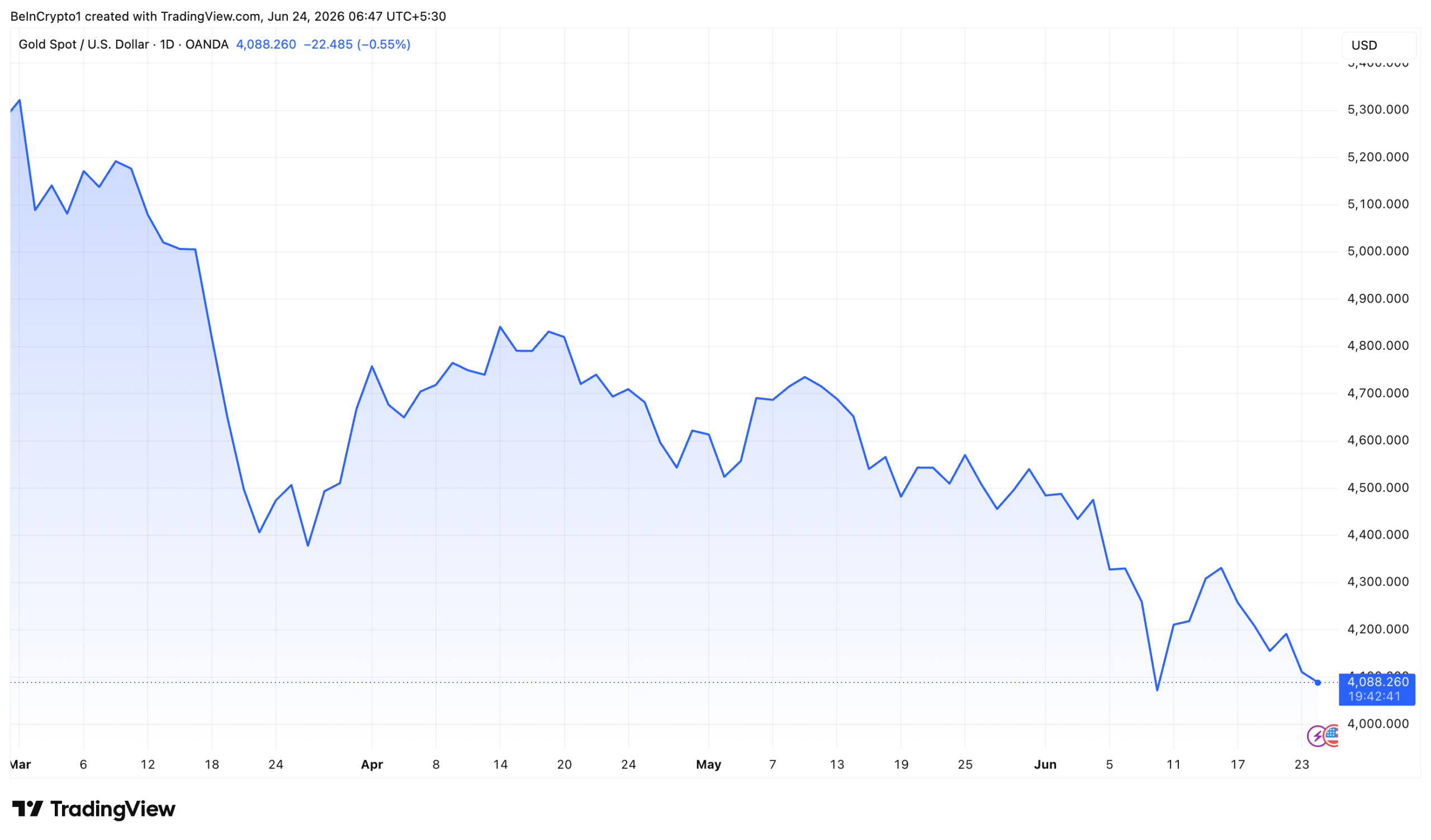
Deutsche Bank warned that gold could fall to about $3,800 an ounce if the Federal Reserve delivers three to four rate hikes, a scenario that would deepen the metal’s slide.
The downside case sits alongside fresh forecast cuts. Deutsche Bank follows Goldman Sachs, which cut its year-end target to $4,900 an ounce from $5,400.
Gold Faces Deeper Drop on Fed Hikes
In a note published on Tuesday, the bank noted that “hawks are driving out bulls” in the gold market. The bank now forecasts gold at $4,300 per ounce in the third quarter, more than 22% below its previous estimate and $4,800 in the fourth quarter. Even that year-end target marks a roughly 17% cut from its earlier forecast.
Analyst Michael Hsueh said the revised fourth-quarter outlook assumes the Federal Reserve keeps interest rates unchanged. A run of hikes would change that math.
Three to four rate hikes could push gold prices about 7% below current levels. The warning comes as expectations for US monetary policy continue to shift.
Notably, Bank of America recently suggested that the Federal Reserve could implement as many as three rate hikes in 2026.
Deutsche Bank added that the repricing of Fed expectations, coupled with resilient US economic data, has weighed on bullion prices.
Higher rates lift real yields, which weigh on gold because the metal pays no interest. Shifting rate expectations have already driven the recent selloff.
Follow us on X to get the latest news as it happens
Banks Temper Bullish Gold Calls
Gold has slumped more than 21% since early March. A January surge to record highs reversed after the US-Iran conflict lifted energy prices and stoked rate-hike bets.
Spot gold has now dropped below $4,100. It traded near $4,088 on Wednesday, down nearly 1% on the day.

Federal Reserve Chair Kevin Warsh left interest rates unchanged at his first FOMC meeting. Yet, nine of the 18 policymakers expect at least one rate increase in 2026.
The shift in tone reinforces downside risks for gold, keeping the possibility of a drop toward $3,800 firmly on the table.
Subscribe to our YouTube channel to watch leaders and journalists provide expert insights
The post Deutsche Bank Flags $3,800 Gold Risk as Fed Turns Hawkish appeared first on BeInCrypto.
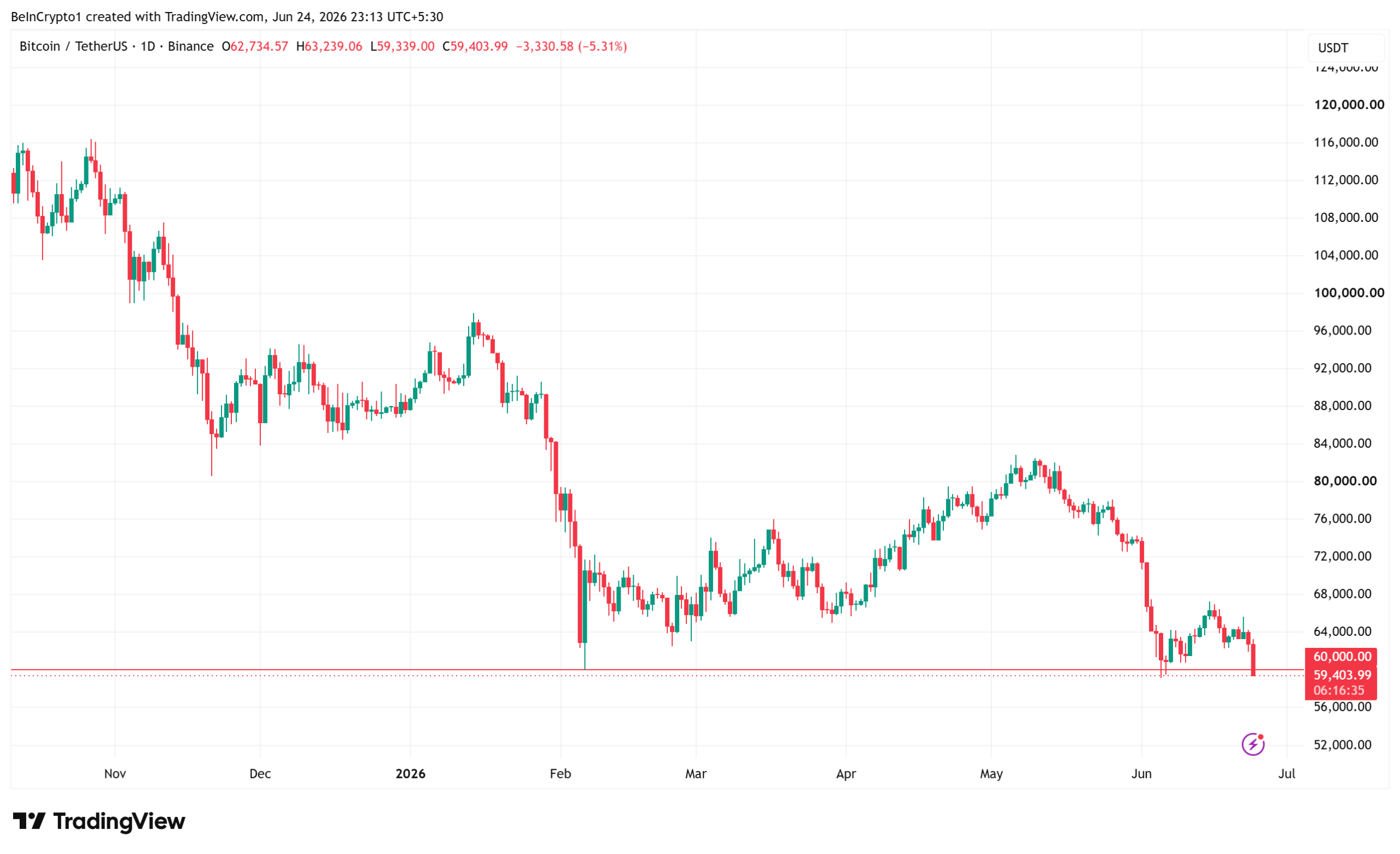
Bitcoin (BTC) fell below $60,000 again on Wednesday, this time with a steeper decline than the two previous instances in early June.
However, despite the breach, 21Shares still says the four-year cycle has not broken. The crypto asset manager had forecast that institutional demand would end Bitcoin’s halving-driven pattern in 2026.

Its mid-year report now says the opposite.
Why the Four-Year Cycle Still Holds
Bitcoin recorded an intra-day low of $59,102 as of this writing, down nearly 5% over 24 hours. The token has fallen more than 50% from its $126,080 record set in October 2025. It marks the third time the pioneer crypto falls below $60,000 this month.
Bitcoin has peaked 12 to 18 months after each past halving, then fallen hard. The April 2024 halving fed the run to October’s record, and the current slump tracks the same path.

In its latest State of Crypto report, 21Shares said the decline still mirrors past post-halving corrections. The firm had entered the year expecting Bitcoin’s four-year cycle to finally break.
“Heading into 2026, we believed that Bitcoin’s four-year cycle could be finished. Six months in, we have to be honest: price action still looks familiar,” read an excerpt in the report.
Follow us on X to get the latest news as it happens
The drawdown still looks mild next to the past two cycles. Glassnode data show Bitcoin fell about 84% after its 2017 peak and 77% after the 2021 peak.
Even while trading below $60,000, Bitcoin holds above the roughly $54,000 cost basis the report flags. That suggests sellers have not fully capitulated.
Institutional Money Cushions the Drop
21Shares built its original call on heavy exchange-traded fund (ETF) inflows and growing institutional adoption. It expected those forces to soften the boom-and-bust rhythm tied to Bitcoin’s halving.
Ownership has indeed grown more institutional, which the firm says makes capital stickier through downturns. Through late May, it counted about $3 billion in net ETF outflows.
The bleed has since deepened into a record outflow streak in June. Even so, net ETF inflows since the 2024 launch still total roughly $53 billion, SoSoValue data shows.

21Shares still expects that institutional base to support a recovery toward $100,000 by year-end, not a breakout to new highs.
Not Every Analyst Sees a Soft Landing
Other voices see more pain ahead. BitMEX co-founder Arthur Hayes expects a $40,000 bottom within six months, well below the cost basis 21Shares watches.
Hayes points to a hawkish Federal Reserve, where traders now put December rate-hike odds near 37% on CME FedWatch. He stays long while hedging with options, a stance that captures the current unease.
Thursday’s inflation reading and the Fed’s next moves may decide which view holds. A softer print could ease pressure, while another hot number may invite a deeper test of support.
The post 21Shares Concedes 4-Year Cycle Intact as Bitcoin Falls Below $60,000 Again appeared first on BeInCrypto.

Key Takeaways
- ASML shares tumbled 7.82% to close at $1,778.46, significantly lagging broader market indices
- Allegations surfaced regarding possible violations of U.S. export control regulations related to Chinese sales
- Proposed bipartisan legislation threatens to halt all deep-ultraviolet lithography (DUV) equipment exports to China
- Chinese market represents approximately 20% of ASML’s anticipated 2026 revenues
- Despite volatility, Wells Fargo upgraded price target to $2,200 with consensus rating at Moderate Buy
Shares of ASML (ASML) experienced a sharp decline on Tuesday, closing at $1,778.46—a 7.82% drop that significantly outpaced the broader market’s losses. While the S&P 500 shed 1.44% and the Nasdaq fell 2.22% during the same trading session, ASML’s pullback was notably steeper.
The semiconductor equipment manufacturer’s slide followed reports that U.S. officials have raised concerns about possible export control violations involving the company’s business with China. Compounding investor anxiety, a bipartisan legislative proposal now threatens to completely prohibit deep-ultraviolet (DUV) lithography equipment shipments to the Chinese market.
The stakes are substantial: China is projected to contribute approximately 20% of ASML’s total revenue stream in 2026, making this exposure a critical focal point for market participants.
ASML issued a formal denial of the allegations, clarifying that no extreme ultraviolet (EUV) systems were shipped to China in breach of existing controls. While this statement may mitigate some reputational risk, regulatory scrutiny appears likely to intensify.
Beyond the immediate allegations, market participants are increasingly concerned about potential restrictions on software updates, spare parts, and maintenance services for equipment already deployed in China. This ongoing service revenue has represented a significant, albeit understated, contributor to ASML’s financial performance.
Competitive dynamics add another layer of complexity. Nikon has been expanding its presence in mature-node immersion lithography systems, while Chinese domestic manufacturers continue advancing their indigenous capabilities—developments that could exert downward pressure on both pricing and profit margins in ASML’s lower-tier product segments.
Upcoming Earnings Release
Despite Tuesday’s selloff, ASML’s fundamental performance metrics remain robust. The company is scheduled to report quarterly results on July 15, 2026. Wall Street analysts project earnings per share of $7.98, representing a substantial 75.38% year-over-year increase.
Second-quarter revenue estimates stand at $10.28 billion, reflecting 17.83% growth compared to the prior-year period. Full-year consensus forecasts call for EPS of $36.69 and revenues of $45.35 billion—representing increases of 31.27% and 22.67%, respectively.
In the most recent quarter, ASML delivered EPS of $8.28 on $10.15 billion in revenue, achieving a return on equity of 48.69% and maintaining a net profit margin of 27.65%.
The stock currently trades at a forward price-to-earnings multiple of 52.58, above the industry average of 47.43. Its price-to-earnings-growth (PEG) ratio of 1.55 also exceeds the sector norm of 1.48.
Wall Street Maintains Cautious Optimism
Despite the recent volatility, analyst sentiment remains generally supportive. Wells Fargo elevated its price objective from $1,750 to $2,200 while maintaining an overweight rating. Bank of America similarly increased its target price and retained a Buy recommendation.
Morgan Stanley and Barclays have both reaffirmed overweight ratings in recent research updates.
The Street consensus stands at Moderate Buy, comprising four Strong Buy ratings, 20 Buy recommendations, five Hold ratings, and three Sell calls. The average price target of $1,772.62 closely aligns with Tuesday’s closing price.
However, not all institutional investors are holding steady. Riverbridge Partners LLC reduced its ASML position by 40.3% during the first quarter, divesting 1,201 shares. Following this reduction, the firm maintained 1,781 shares valued at approximately $2.35 million.
From a technical perspective, ASML’s 50-day moving average sits at $1,610.59, while the 200-day moving average stands at $1,411.79, suggesting the stock retains a cushion before testing long-term support levels. The 52-week trading range spans from $683.48 to $1,959.04.
ASML currently carries a Zacks Rank of #3 (Hold), with earnings per share estimates revised downward by 1.11% over the past month.


Tartan Army gutted after Brazil loss but defiant fans declare ‘party must go on’

JPMorgan turns cautious on IT, sees growth headwinds ahead

CFTC Sues Kentucky, Making It the Ninth State in Prediction-Market Jurisdiction Fight


-

 Fashion5 days ago
Weekend Open Thread: Miami – Corporette.com
-

 Entertainment4 days ago
Renter of Home in Anne Heche Crash Denies Settlement With Son
-

 Tech3 days ago
Microsoft accidentally kills epic Outlook email threads
-
 Sports1 day ago
Two goals and an assist by sheer aura: Cristiano Ronaldo just entered the World Cup chat
-

 Business4 days ago
Soccer-U.S. defends Iran World Cup travel restrictions, says discussions ongoing
-
Crypto World21 hours ago
Bitcoin (BTC) Dips Below $62K, Ethereum (ETH) Plunges 6% Daily: Market Watch
-

 Politics6 days ago
BBC Reporter Discusses Cross Party Criticism Of Trumps Iran Deal
-

 Politics5 days ago
Andy Burnham and the meaning of Makerfield
-

 Crypto World18 hours ago
Securitize Wraps Roubini's SEC-Registered ETF as Dubai VARA Digital Security
-
Business24 hours ago
Entergy settles forward sale agreements, raises $672 million in cash proceeds
-
 Business5 days ago
Wall Street Week Ahead: Investors see Micron earnings as pulse check of AI rally momentum
-

 NewsBeat5 days ago
Keir Starmer Allies Question His Chances For No 10
-

 Tech6 days ago
AWS enters the context layer race with a graph that learns from agents, not manual curation
-
 Crypto World5 days ago
Can Charles Hoskinson Really Rescue Cardano?
-

 Crypto World5 days ago
HIVE shares jump as $220M AI deal speeds Bitcoin mining pivot
-

 Crypto World5 days ago
Jake Chervinsky accuses CME of protecting derivatives monopoly
-
 Tech3 days ago
Signal’s Meredith Whittaker says AI chatbots ‘are not your friends’ and calls Copilot agents a backdoor
-

 Entertainment5 days ago
Jose Alvarado Wants Taylor Swift at More Knicks Games
-

 Tech2 days ago
Nearly 7,000 fake Amazon domains registered ahead of Prime Day 2026, researchers warn
-

 Business6 days ago
Brexit cost 6% of UK economy, Bank of England company data suggests
You must be logged in to post a comment Login