
Crypto World
Binance New Listing Calendar Heats Up as Strategy Holds 766,970 BTC and One Presale Fills Fast

Strategy now holds 766,970 BTC worth over $54 billion after buying roughly 45,000 BTC in the past 30 days, proving the largest corporate holder is not slowing down even with BTC above $71,000.
The binance new listing calendar is where the next round of returns gets decided, and the presale filling fastest right now is the one with a confirmed spot on that calendar.
Pepeto is approaching its listing date with more than $8.87 million raised and the cofounder who built the original Pepe coin, and wallets are rushing to lock in the presale entry before stages close.
Strategy bought roughly 45,000 BTC over the past month, pushing its total to 766,970 BTC per CoinDesk. The company launched its STRC offering to fund more purchases, and the position now tops $54 billion.
BTC cleared $72,700 after the ceasefire rally that wiped $600 million in shorts per Bloomberg, and the next confirmed binance new listing is where presale holders turn floor entries into returns that BTC at current prices cannot match.
How BNB, SOL, and the Next Binance New Listing Compare for Returns
Pepeto: What Happens When a Working Exchange Hits the Binance New Listing Calendar
Most tokens land on Binance with a whitepaper and a promise. Pepeto lands with a finished exchange that already runs live trades, and that difference is why the binance new listing for this token is getting more attention than any other presale this cycle.
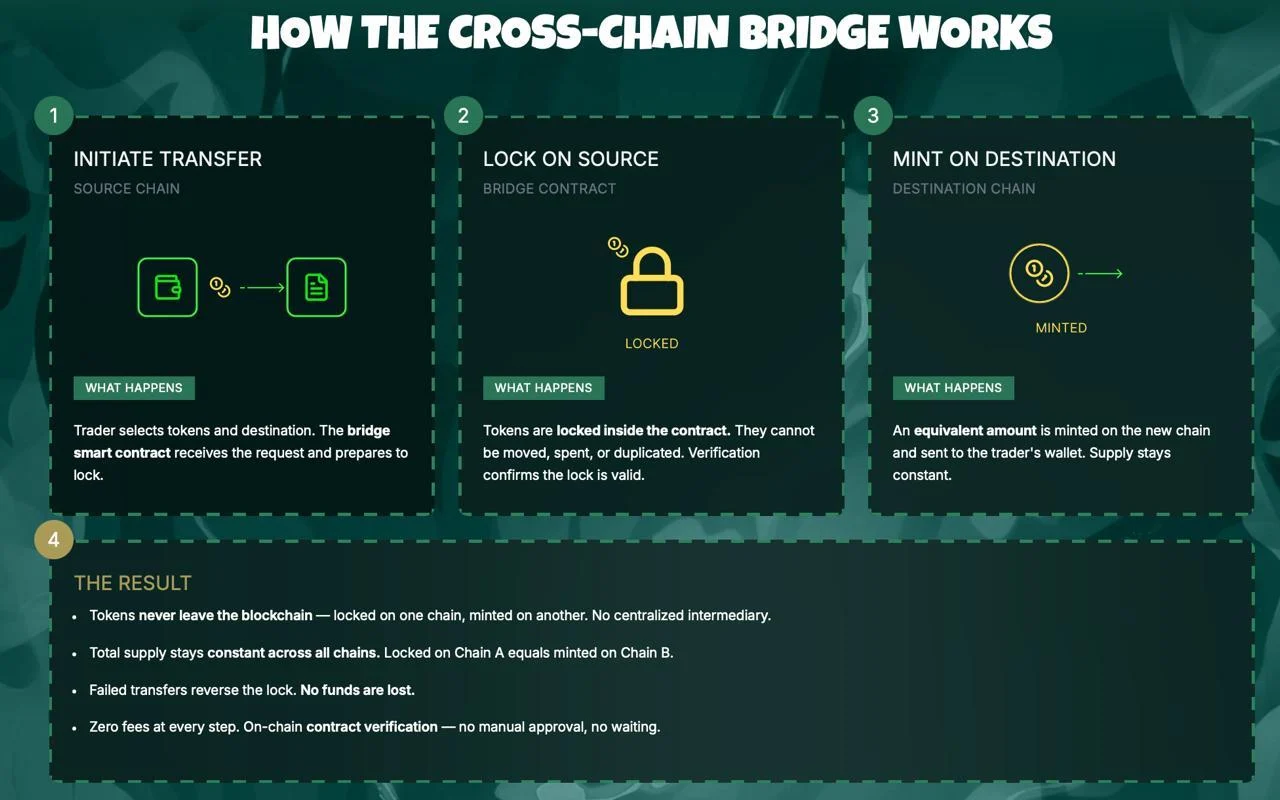
Zero fee swaps keep positions whole. The bridge moves tokens across chains without charging a cent. The contract scanner catches rug pulls before a dollar goes in. All three tools are live, not coming soon, live.
The presale hit $8.87 million during extreme fear while the rest of the market froze, and the Pepe cofounder who took 420 trillion tokens to $11 billion with nothing behind it is building a real exchange this time. Every contract cleared a SolidProof audit, 186% APY staking grows every position, and analysts model 100x to 300x starting at the $0.0000001863 entry.
The presale fills faster each round because the wallets inside know what listing day does, it replaces this price permanently and the return belongs only to the wallets that got in while the number still existed. The binance new listing date is the clock, and every hour closer is one hour less before the entry is gone.
BNB: Exchange Token Holds $605 but Upside Stays Measured
BNB holds near $605 with quarterly token burns and Binance volume keeping demand steady per CoinMarketCap.
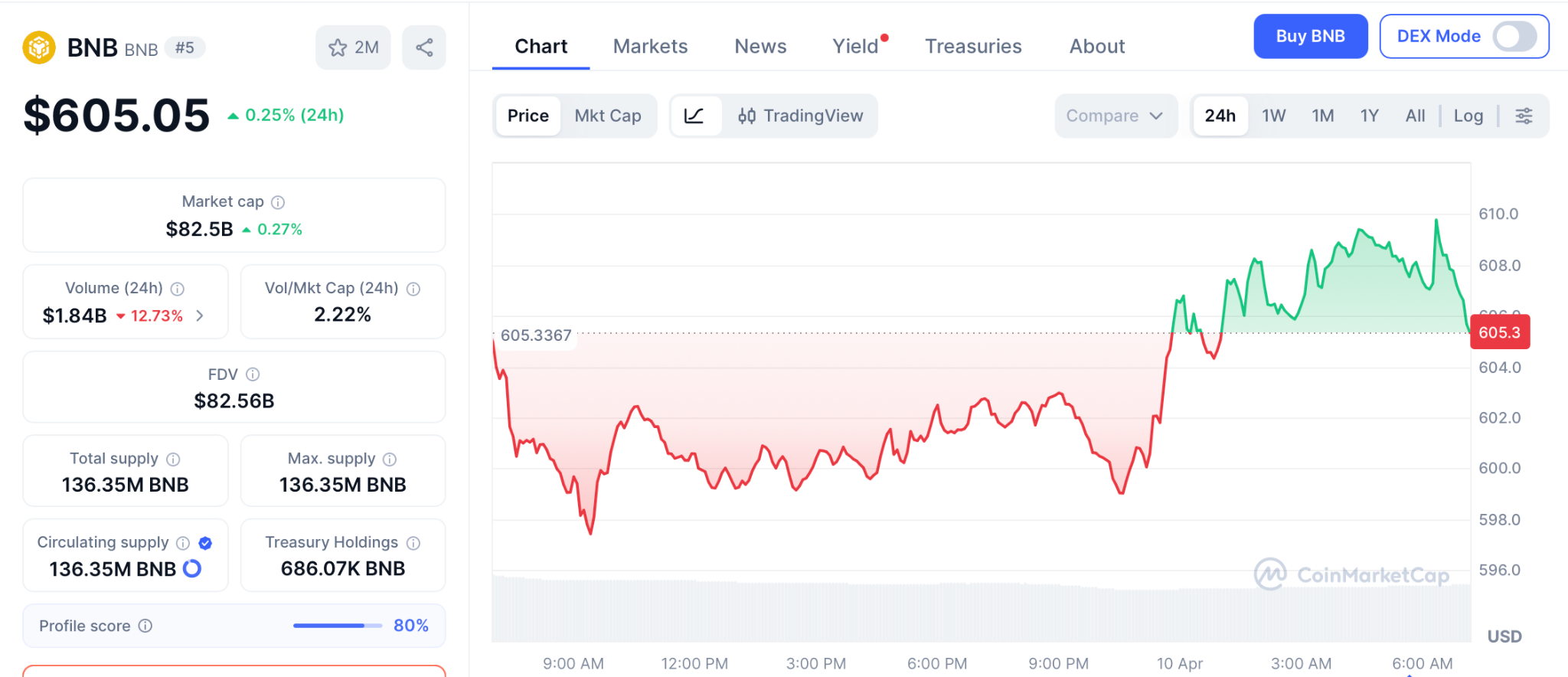
New listings on Binance historically lift BNB as traders move capital onto the platform, and the upcoming Pepeto listing adds another event to the calendar.
BNB offers stability, but from $605 the path to $900 is roughly 50%, far from the kind of return a presale floor delivers when the binance new listing opens the gap between entry and market price.
Solana: SOL Sits at $84 With Strong Fundamentals but Limited Ceiling
SOL trades near $84 after commodity classification cleared regulatory clouds per CoinGecko. Nine ETF filings and the Alpenglow upgrade add long term weight, and institutional ownership of SOL products sits at 48.8%, the highest of any crypto fund.
CME Group also plans SUI and AVAX futures for May, showing derivatives markets are expanding beyond BTC and ETH. SOL is strong, but from $84 even a move to $300 delivers 3.5x over months while presale entries hold the spread between presale and listing where the widest returns get built.
Conclusion
Strategy’s 766,970 BTC proves long term confidence in digital assets, but the wallets watching the binance new listing calendar are looking past large caps toward presale entries with real weight. Pepeto has the live exchange, the capital, and the confirmed listing to back it.
The last stage sold out ahead of schedule, and this one fills while these words load. The presale price stops existing the moment the binance new listing date arrives, and the returns belong only to the wallets that got in while the door was still open.
Click To Visit Pepeto Website To Enter The Presale

FAQs
What is the most expected binance new listing in 2026?
Pepeto leads with $8.87 million raised, a live exchange with zero fee trading, and a confirmed listing date. The Pepe cofounder and SolidProof audit give it the strongest profile this cycle.
Can a binance new listing deliver bigger returns than holding BNB or SOL?
BNB at $605 offers 50% to $900 and SOL at $84 targets 3.5x to $300. Presale entries at floor price carry the listing gap where the widest returns in every cycle get built.
Disclaimer: This is a Press Release provided by a third party who is responsible for the content. Please conduct your own research before taking any action based on the content.


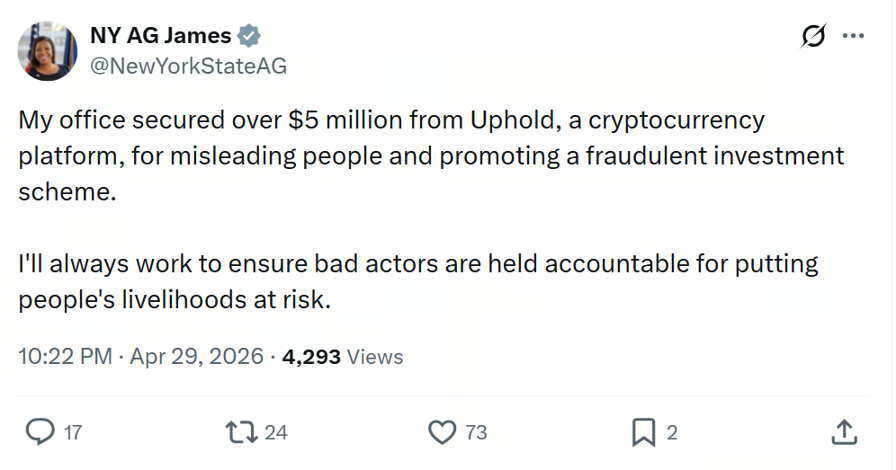
New York Attorney General Letitia James has secured more than $5 million from cryptocurrency platform Uphold over its role in promoting a fraudulent investment product.
The settlement centers around Uphold’s promotion of CredEarn, a product offered by Cred, LLC and its CEO Daniel Schatt. Between January 2019 and October 2020, the platform marketed CredEarn to users on its platform and mobile app as a safe, reliable savings product with attractive annual interest payments.
However, Uphold didn’t tell customers that Cred was generating those returns by making microloans to low-income video game players in China, who are typically borrowers with no credit histories and no access to traditional financial institutions, the Attorney General’s office said in an announcement.

Source: NY AG James
Uphold also told customers that Cred carried “comprehensive insurance,” a claim the Attorney General’s office found to be false. No such insurance protecting retail investors from digital asset losses existed in the industry at the time. On top of the misleading promotion, Uphold was operating without the required broker or commodity broker-dealer registration.
Related: Canada Proposes Crypto ATM Ban to Tackle Scams, Money Laundering
Cred collapse hits Uphold users
Cred began racking up losses from its risky lending practices in March 2020 and filed for bankruptcy eight months later, leaving thousands of Uphold customers around the world holding the bag, according to the announcement.
Under the settlement, Uphold will pay $5 million directly to affected customers, more than five times the fees it collected from the arrangement. Any funds Uphold recovers from Cred’s ongoing bankruptcy proceedings, where it is owed $545,189, will also be passed on to harmed investors. Affected users will be notified by email when the funds hit their accounts.
“Investors should be able to trust the industry advice they receive,” James said, “and my office will always work to ensure bad actors are held accountable for endangering their customers’ financial security.”
Related: US Gov’t Sues Four States, RWAs Cross $30 billion
New York’s legal run-up with CFTC
Last month, New York sued Coinbase and Gemini, claiming their prediction market offerings violated state gambling laws.
The CFTC fired back by suing New York in federal court, arguing that federal law gives it sole authority over prediction markets and asking for a permanent injunction to block the state’s enforcement actions.
Magazine: AI-driven hacks could kill DeFi — unless projects act now

The US crypto sector is unlikely to lose momentum even if the CLARITY Act, the proposed framework intended to bring sharper regulatory guidance to digital assets, stalls in Congress. That is the view of Chris Perkins, chief executive of 250 Digital Asset Management, who told Cointelegraph’s Chain Reaction podcast that the industry should not hinge on a single bill. Perkins argued that the two key US regulators are already laying down workable frameworks that could outlive any one legislative effort.
Perkins pointed to ongoing work by the U.S. Securities and Exchange Commission (SEC) and the Commodity Futures Trading Commission (CFTC), particularly the agencies’ joint interpretation issued in March on how federal securities laws apply to crypto assets. He framed this as a crucial step toward real policy certainty, predictability, and a formal taxonomy for digital assets, rather than a political ideal.
Key takeaways
- Regulatory progress in the US is continuing independently of CLARITY Act passage, with ongoing policy work from the SEC and CFTC shaping the landscape.
- Token classification as securities has evolved from a “death sentence” to a pathway for structured compliance, thanks to deliberate policy creation and precedent.
- Passing the CLARITY Act could embed regulatory clarity for a long horizon, making it harder for future administrations to unwind the framework.
- The latest stablecoin yield provisions have intensified hopes that the CLARITY Act could move forward soon, signaling potential legislative momentum.
Regulatory momentum persists beyond a single bill
On the Chain Reaction podcast, Perkins emphasized that the two regulators are actively building a more coherent framework for digital assets. The March joint interpretation—reported as a synchronized stance by the SEC and CFTC—offers a concrete roadmap for compliance and enforcement that can endure beyond shifts in political leadership. Perkins called this development a meaningful advance, arguing that it provides certainty, stability, and a usable taxonomy for market participants.
“They’re creating policy and precedent every single day, and they are giving us the one thing we’ve needed for a very long time: certainty, stability, and ultimately a taxonomy,” Perkins said. He noted that the political climate around crypto regulation has shifted since earlier eras when token classifications as securities could trigger aggressive enforcement and delistings, leaving little room for compliant pathways in the United States.
Perkins did not frame CLARITY Act passage as the sole determinant of the industry’s fate. Rather, he suggested that even if the bill does not advance, the momentum created by regulators and the evolving framework would keep the market on a more navigable course. In his view, the direction of travel matters just as much as the destination, and that direction appears to be toward greater regulatory legitimacy.
CLARITY Act: a potential anchor for policy
Industry sentiment has grown more positive about CLARITY Act prospects in light of other regulatory developments. The article notes that the timing around the bill could be linked to broader regulatory negotiations, including the freshly published stablecoin yield provisions that have been the subject of bipartisan discussion in Congress.
Coinbase chief legal officer Faryar Shirzad weighed in on the moment, posting after Senators Thom Tillis and Angela Alsobrooks released a final text intended to resolve the stablecoin yield dispute between the banking and crypto sectors. Shirzad urged lawmakers to “get CLARITY done,” signaling industry enthusiasm for a clear and durable framework that could govern a broad swath of digital assets, not just stablecoins.
The bill’s potential to constrain future administrations from easily unwinding regulatory policy is a recurring theme among supporters. Perkins argued that once a law is enacted, unwinding it becomes more arduous, which he sees as a stabilizing factor for the industry. The saying that “it takes an act of Congress to do something” resonates with the view that legislative clarity could be a shield against abrupt reversals in policy direction.
Regulators’ emphasis on clear classifications and accountable oversight also aligns with broader market needs. Investors, traders, and builders want predictable rules around custody, exchanges, disclosure, and anti-fraud measures. If CLARITY Act advances, proponents contend, the US could offer a more stable environment for capital formation and innovation, reducing the risk of abrupt regulatory shifts that have previously unsettled the market.
What readers should watch next
The conversation around CLARITY Act remains closely tied to ongoing negotiations over stablecoins and the broader regulatory posture toward digital assets. Several senators have publicly weighed in on timing and necessity. Senator Bernie Moreno has signaled that he expects the CLARITY Act to be resolved by the end of May. On April 11, Senator Cynthia Lummis warned that “it’s now or never” for getting a resolution. These remarks underscore the continued political interest in providing a definitive, workable framework for crypto markets in the near term.
Analysts and industry participants will be watching several cross-cutting factors: the pace of the SEC-CFTC collaboration on enforcement and rulemaking; the specifics of any final CLARITY Act language and how it clarifies asset categorization, registration requirements, and compliance infrastructure; and the potential alignment of stablecoin governance with traditional financial regulatory regimes. The market will also be attentive to how regulators respond to new technologies and business models that emerge as crypto markets mature, such as on-chain finance tools, tokenized assets, and decentralized platforms that intersect with conventional banking rails.
In the longer run, Perkins and others argue that the most consequential outcomes may be less about any single bill and more about the durability of the policy framework that emerges. If the current policy trajectory yields a robust taxonomy and enforceable rules, the industry could benefit from stronger institutional participation, clearer pathways to listing and trading tokens, and more predictable interactions with banks and other financial partners. If not, the steady march of regulatory development—driven by the SEC, CFTC, and other federal agencies—could still deliver the clarity that the market has sought for years.
As the debate continues, readers should monitor updates on regulatory interpretations, the progress of the CLARITY Act, and the evolving stance of lawmakers on stablecoins, as these elements will collectively shape the operating environment for crypto companies, investors, and users across the United States.


Iran’s largest crypto exchange, Nobitex, is facing fresh scrutiny after Reuters reported that two brothers from Iran’s influential Kharrazi family founded the platform under an alternative surname.
Summary
- Reuters said Nobitex was founded by brothers from a powerful political family under another surname.
- Nobitex denied state links while investigators cited transactions tied to sanctioned Iranian entities and users.
- Crypto withdrawals from Nobitex rose sharply after Tehran strikes, though analysts differed on the cause.
The report comes as blockchain data shows rising crypto movements from Iran during conflict-related stress. Nobitex has denied government links and said it does not assist state bodies.
Ali and Mohammad Kharrazi founded Nobitex in 2018 using the surname Aghamir. The report said the brothers are part of a powerful Iranian family with deep political and clerical ties.
Nobitex has grown into Iran’s largest crypto exchange. Reuters reported that the platform claims 11 million users and handles an estimated 70% of Iran’s crypto transactions.
Exchange denies state connection
Reuters said blockchain records and interviews pointed to transactions linked to sanctioned Iranian entities, including the central bank and the Islamic Revolutionary Guard Corps. The report said Nobitex has become part of a parallel financial system used outside normal banking channels.
Nobitex rejected the claims of direct state links. The company told Reuters it is a “private and independent business” and said it had no relationship or contract with the IRGC, Iran’s central bank, or other government bodies.
Moreover, the report adds to long-running concerns about crypto use in sanctioned economies. Reuters cited blockchain analysis and investigators who said Nobitex has helped move funds beyond Western financial controls.
Crystal Intelligence executive Nick Smart told Reuters that Nobitex creates a difficult compliance issue because normal Iranian users and state-linked activity may share the same platform. He said it is “hard to separate the regime from the people.”
Outflows rose after Tehran strikes
The scrutiny also follows a sharp rise in Iranian crypto withdrawals after U.S. and Israeli airstrikes on Tehran. Crypto.news reported that Nobitex withdrawals jumped more than 700% within minutes of the strikes.
Elliptic data showed users withdrew more than $500,000 shortly after the first strikes. The figure later reached nearly $3 million between February 28 and March 1.
Crypto.news also cited Elliptic as saying Nobitex lets users convert rials into crypto and withdraw funds to outside wallets. That process can help users move money abroad when banking routes remain limited.
TRM Labs gave a more cautious view. It said the activity may have reflected lower transaction volume caused by internet blackouts, not only capital flight. Iran’s internet connectivity fell about 99% after the strikes began.

Key Takeaways
- A prominent crypto executive believes the digital asset sector will remain resilient regardless of whether the CLARITY Act becomes law
- Current regulatory agencies are already establishing frameworks that provide necessary guidance for cryptocurrency companies
- A bipartisan agreement on stablecoin yield restrictions emerged from Senators Tillis and Alsobrooks, resolving the legislation’s primary roadblock
- The compromise prohibits yield structures resembling traditional bank deposits while permitting rewards linked to genuine user engagement
- Major industry players including Coinbase, Circle, and the Blockchain Association endorsed the framework and called for swift committee action
Legislative momentum for the CLARITY Act accelerated following a breakthrough agreement on one of its most contentious provisions — the treatment of stablecoin yield payments. Yet despite this progress, a leading cryptocurrency executive maintains the sector’s prospects remain strong with or without congressional action.
During an appearance on Cointelegraph’s Chain Reaction podcast Friday, Chris Perkins, who leads 250 Digital Asset Management as CEO, expressed confidence in the industry’s current regulatory environment, regardless of new federal legislation.
Perkins highlighted the work being done by the Securities and Exchange Commission under Chair Paul Atkins and the Commodity Futures Trading Commission led by Chair Michael Selig. According to him, both agencies are actively developing policies and establishing crucial precedents.
“These regulators are delivering exactly what we’ve desperately needed — predictability, consistency, and most importantly, clear classification standards,” Perkins explained.
He emphasized a fundamental transformation in how securities classification impacts cryptocurrency ventures. During Gary Gensler’s tenure as SEC Chair, receiving a security designation typically triggered enforcement actions, exchange delistings, and regulatory dead ends. The landscape has fundamentally shifted.
“Previously, securities classification spelled disaster for projects. Today, it actually provides a viable regulatory pathway,” Perkins observed.
Perkins acknowledged that formal legislation would offer greater permanence against future policy reversals. “Congressional action creates durable frameworks — reversing statutory law proves exponentially more difficult,” he noted.
Breakthrough on Stablecoin Rewards
Friday brought the release of compromise language from Senators Thom Tillis and Angela Alsobrooks addressing stablecoin yield provisions, which represented the bill’s last significant hurdle.
The revised framework prohibits cryptocurrency platforms from distributing interest or yield on stablecoin holdings that functionally replicate traditional bank deposit products. Conversely, it permits reward structures connected to authentic platform engagement and transaction activity.
Companies will need to transition their incentive programs away from passive holding strategies toward models that reward active platform participation.
Blockchain Association CEO Summer Mersinger characterized the agreement as meaningful progress. She cautioned that continued regulatory uncertainty drives innovation and investment away from American shores.
Dante Disparte, Circle’s Chief Strategy Officer, offered unqualified support for the compromise, citing USDC’s expanding role in payment systems and capital markets infrastructure.
Coinbase faced particularly high stakes in the outcome. CEO Brian Armstrong responded to the released text with “Mark it up” on social media. Paul Grewal, the company’s Chief Legal Officer, confirmed the language safeguards reward programs connected to legitimate platform usage.
Lingering Industry Questions
While the Crypto Council for Innovation expressed support for the legislation, the organization identified potential concerns. CEO Ji Hun Kim noted the current language extends beyond last year’s GENIUS Act, which restricted only issuer-paid rewards. The updated provisions apply more broadly across digital asset market participants.
Despite reservations, Kim advocated for advancing the bill. “Our fundamental objective remains ensuring American leadership in cryptocurrency innovation,” he stated on X.
Senator Bernie Moreno projected the CLARITY Act would secure passage before May concludes. Senator Cynthia Lummis declared in April: “This represents our window of opportunity.”
The Senate Banking Committee had previously delayed markup proceedings scheduled for January.
Key Takeaways
- Recent Bitcoin ETF activity brought approximately $1.9 billion in fresh capital inflows
- Ethereum spot ETFs recorded around $101 million in net inflows on the first day of May, while Bitcoin ETFs attracted $630 million
- Solana remains under observation due to ecosystem expansion, transaction efficiency, and potential ETF approval prospects
- XRP continues attracting attention for its cross-border payment use case and responsiveness to regulatory developments
- Dogecoin delivered its most impressive monthly performance in nine months, surpassing both Bitcoin and XRP returns
As May unfolds, cryptocurrency market participants are focusing their attention on a select group of digital assets with compelling narratives. While Bitcoin maintains its position as the dominant cryptocurrency, Ethereum, Solana, XRP, and Dogecoin are capturing interest for distinct strategic reasons. Exchange-traded fund activity, regulatory developments, and renewed retail participation are influencing which tokens appear on investor radars this month. This analysis doesn’t suggest guaranteed price appreciation across all five assets—rather, it examines the specific factors making each worthy of close monitoring.
Bitcoin
Bitcoin possesses the most robust institutional adoption narrative entering May. The aggregate cryptocurrency market capitalization has climbed to approximately $2.6 trillion, with Bitcoin trading in the upper-$70,000 territory.
United States spot Bitcoin ETF capital flows have strengthened considerably, with data indicating roughly $1.9 billion in recent institutional demand. May 1st alone witnessed approximately $630 million in net capital flowing into Bitcoin spot ETFs.
Exchange-traded fund movements have emerged as a critical barometer for Bitcoin demand because they reflect participation from established, regulated financial institutions. The primary consideration is that Bitcoin has already mounted a substantial recovery from previous lows, meaning any deceleration in institutional flows could create headwinds near technical resistance zones.
Ethereum
Ethereum is capturing market attention as demand momentum builds, despite trailing Bitcoin in recent price appreciation.
Ethereum spot ETFs registered approximately $101 million in net inflows on the first trading day of May. Ethereum continues serving as the foundational infrastructure for decentralized finance protocols, stablecoin issuance, asset tokenization, and blockchain applications.
This comprehensive utility profile provides broader investment appeal compared to most major cryptocurrency assets. Some market participants are awaiting more decisive price momentum before increasing their allocation.
Solana
Solana ranks among May’s most closely monitored alternative cryptocurrencies. This prominent Layer-1 blockchain platform has gained recognition for transaction throughput, active retail trading, and new project launches.
Market observers are tracking network enhancements and the potential introduction of a regulated Solana spot ETF product. CoinDCX highlighted that Solana interest correlates with anticipated protocol improvements and the possibility of institutional capital access through approved exchange-traded funds.
While Solana confronts competition from Ethereum scaling solutions and alternative high-performance blockchains, its technical capabilities and engaged user community maintain its prominence on altcoin watchlists.
XRP
XRP maintains close scrutiny from retail market participants, particularly during periods of U.S. cryptocurrency regulatory activity. The asset features a well-defined cross-border payments thesis and benefits from an established, vocal community.
Recent market commentary has included XRP in discussions surrounding ETF developments and cryptocurrency sector rotation. The Motley Fool referenced that Ethereum, Solana, and XRP exchange-traded funds all experienced inflows during a recent timeframe, while emphasizing that brief periods of positive flows don’t necessarily establish durable trends.
XRP demonstrates pronounced sensitivity to regulatory announcements. Should policy developments disappoint or retail enthusiasm wane, price momentum can reverse rapidly.
Dogecoin
Dogecoin recorded its strongest monthly performance in nine months, delivering returns that exceeded both Bitcoin and XRP during that timeframe. This resurgence has returned the token to retail investor watchlists throughout social platforms and trading applications.
Unlike the other cryptocurrencies discussed here, Dogecoin lacks comparable fundamental value propositions. Price movement is predominantly influenced by market sentiment, social media trends, and general risk appetite among traders.
During periods when market participants demonstrate increased willingness toward speculative positioning, meme-oriented cryptocurrencies like Dogecoin frequently experience accelerated price action.
Final Thoughts
These five cryptocurrencies each present distinct narratives driving investor consideration throughout May 2026. Bitcoin commands attention through institutional capital flows. Ethereum dominates decentralized finance and Web3 infrastructure development. Solana represents a high-growth Layer-1 alternative. XRP connects to payment solutions and regulatory outcomes. Dogecoin reflects retail market sentiment and meme cryptocurrency dynamics.
According to the latest available data, Bitcoin ETF inflows constitute the strongest verifiable demand indicator currently visible in the market, with alternative cryptocurrency interest strengthening alongside improving overall crypto market sentiment in May.


New York Attorney General Letitia James has secured more than $5 million from crypto platform Uphold.
Summary
- Uphold will pay over $5 million directly to customers affected by the failed CredEarn product.
- New York said CredEarn users were not told about risky lending behind advertised returns clearly.
- The settlement adds to New York’s wider enforcement push against crypto products and market operators.
The settlement relates to Uphold’s promotion of CredEarn, a crypto savings product tied to Cred, LLC.
The New York Attorney General’s office said Uphold promoted CredEarn between January 2019 and October 2020. The product was marketed to users through Uphold’s platform and mobile app as a reliable crypto savings product with interest payments.
The settlement said CredEarn came from Cred, LLC and its CEO Daniel Schatt. New York said the product misled investors because customers did not receive a clear view of the risks behind the advertised returns.
New York says key risks were not disclosed
The Attorney General’s office said Uphold did not tell customers that Cred used funds to make risky loans to borrowers in China. Those borrowers included low-income video game players with no credit histories and limited access to banks.
New York also said Uphold told users that Cred had “comprehensive insurance.” The office found that claim false, saying no such insurance protected retail investors from digital asset losses at the time.
Additionally, Cred began facing losses from its lending activity in March 2020. It filed for bankruptcy later that year, leaving thousands of Uphold customers with losses after they had placed digital assets into CredEarn.
Under the settlement, Uphold will pay more than $5 million directly to affected customers. The amount is more than five times the fees Uphold collected from the arrangement. Any money Uphold recovers from Cred’s bankruptcy case will also go to harmed investors.
Uphold registration issue adds pressure
The Attorney General’s office also said Uphold operated without required broker or commodity broker-dealer registration. The settlement document states that digital assets are commodities under New York’s Martin Act and that Uphold failed to register while offering crypto and promoting CredEarn.
James said, “Investors should be able to trust the industry advice they receive.” Uphold has disputed parts of the state’s framing. Its CEO Simon McLoughlin said he was “deeply disappointed” and called the Attorney General’s statement “profoundly inaccurate.”
New York keeps pressure on crypto firms
The Uphold settlement comes as New York continues its wider crypto enforcement push. Last month, the state sued Coinbase and Gemini over prediction market offerings, alleging that the products violated state gambling laws.
The CFTC later sued New York in federal court, arguing that federal law gives it authority over prediction markets. The separate dispute shows how state and federal regulators are still contesting control over parts of the crypto market.
Quick Summary
- Large Ethereum holders acquired 140,000 ETH valued at $322 million over a 96-hour period, while prices remained relatively stable around $2,300.
- Legislative progress on the CLARITY Act in the US Senate follows a breakthrough compromise on stablecoin yield provisions, with markup scheduled for May 11.
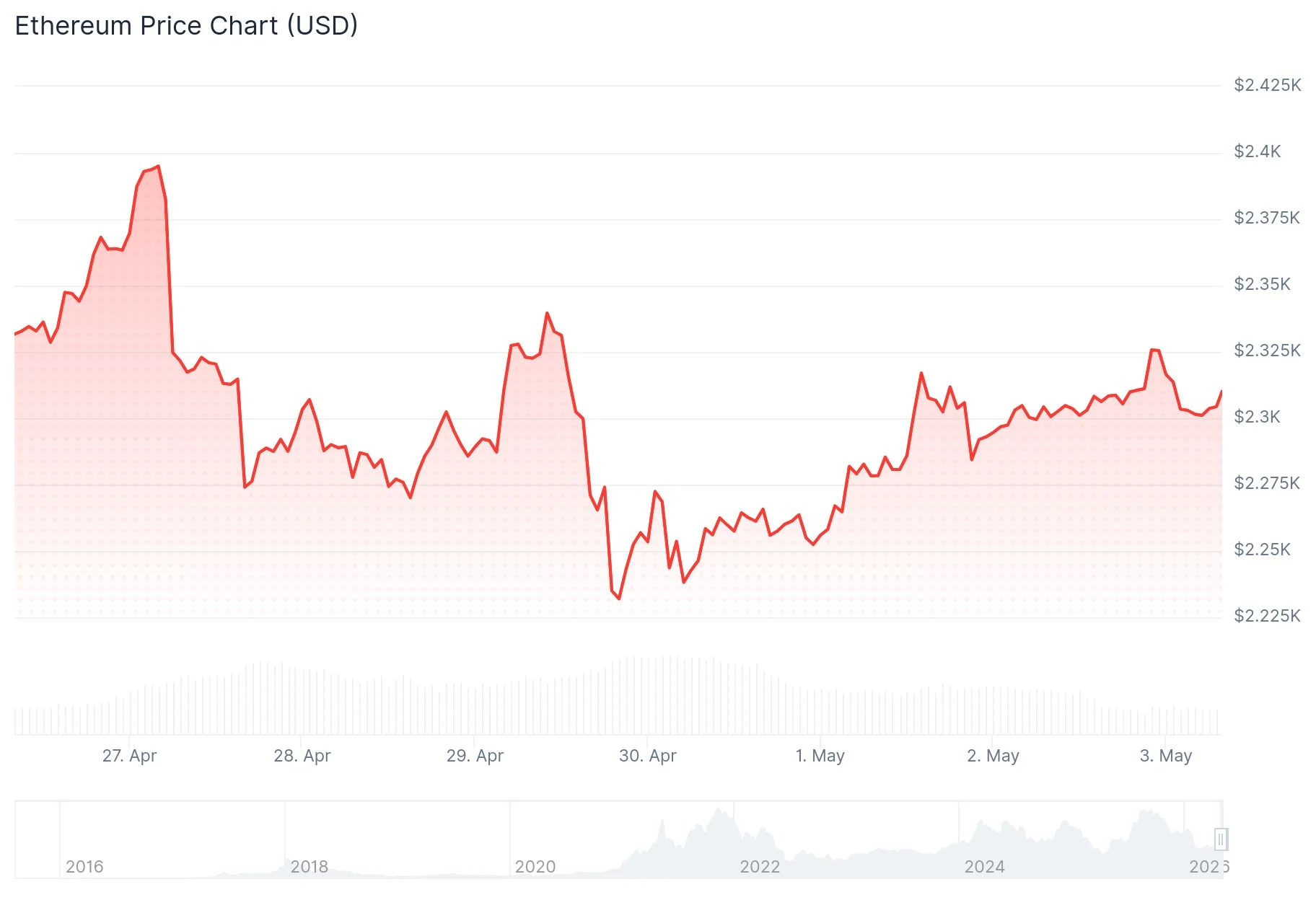
- Over the last month, ETH has climbed approximately 12%, currently changing hands near $2,305.
- The next significant resistance sits at $2,400 — breaking through could pave the way toward $2,600, followed by $2,800.
- Support at $2,200 is crucial; losing this level could push ETH back toward the $1,900 territory.
Ethereum (ETH) maintains its position around $2,305 while major holders discreetly increase their positions and significant US cryptocurrency legislation advances toward a critical vote.
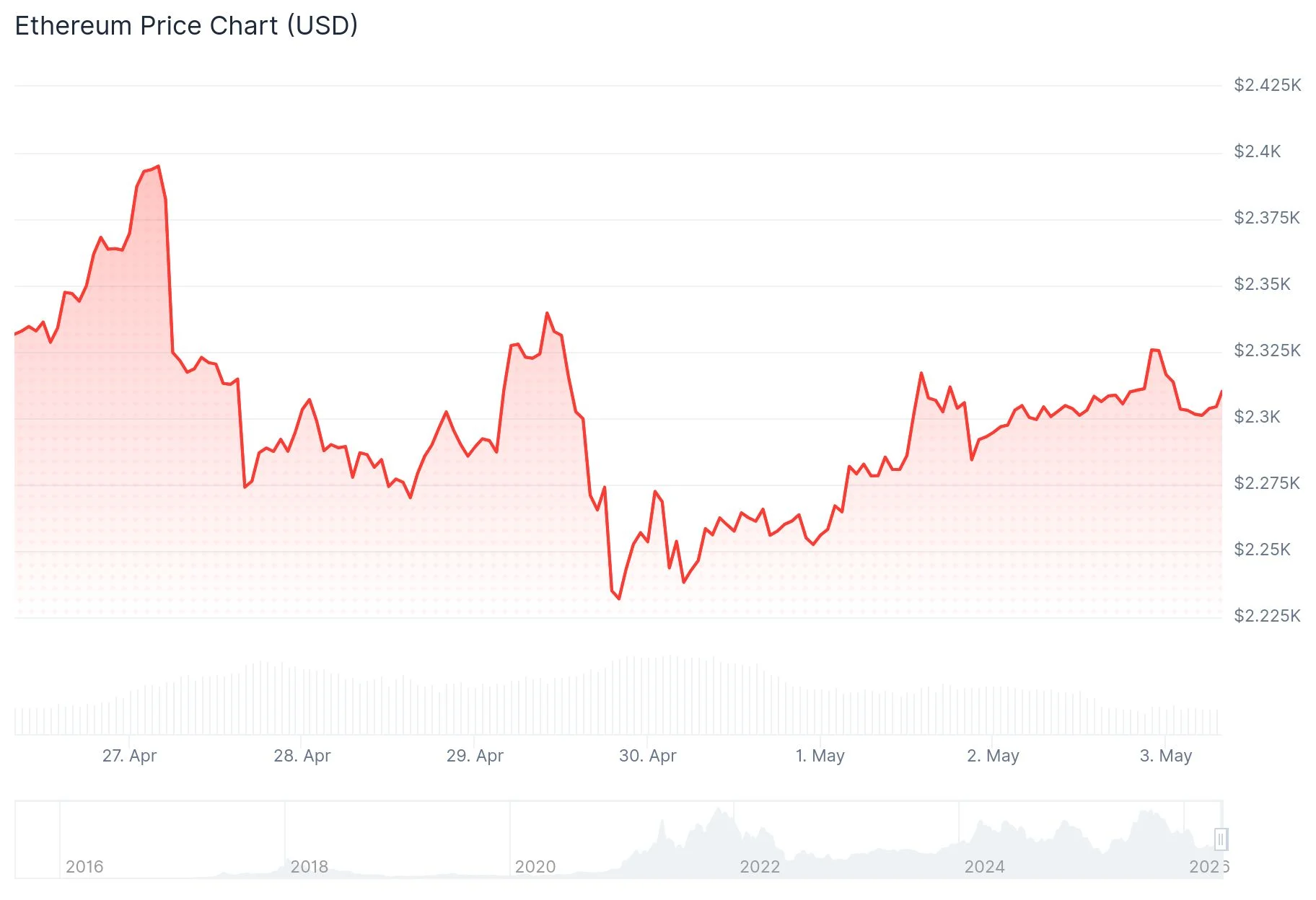
Data published by Ali Charts reveals that substantial ETH investors acquired more than 140,000 ETH during a 96-hour window spanning May 1 through May 3. This represents approximately $322 million in purchasing power. Total whale holdings increased from roughly 13.78 million ETH to nearly 13.98 million ETH. The accumulation pattern suggests deliberate, sustained buying rather than isolated large transactions.
Yet despite this significant whale activity, ETH’s price movement has remained relatively flat. The cryptocurrency registered a modest 0.1% gain in the last 24 hours while experiencing a roughly 1% decline over the past seven days. Current daily trading volume stands at $6.8 billion.
Stablecoin Legislation Makes Headway in Senate
The more significant catalyst for ETH market sentiment could be emerging from Washington. The CLARITY Act — proposed legislation establishing a regulatory framework for stablecoins — faced delays in the US Senate stemming from disagreements about whether stablecoin holders should earn yield. Traditional banking institutions opposed such provisions. Coinbase mounted a defense against yield restrictions.
Senator Tillis facilitated a compromise arrangement. Paul Grewal, Coinbase’s Chief Legal Officer, stated the impasse was unnecessary from the start but expressed satisfaction with the outcome. Galaxy’s crypto analyst Alex Thorn, who previously estimated just 50% odds for CLARITY’s passage this year, has revised his outlook upward. He now anticipates a Senate markup session on May 11.
Critical Support and Resistance Zones
Market analyst Daan Crypto Trades observed on X that Ethereum is presently encountering resistance at the weekly 200 moving average — a natural area for consolidation. He identified $2.1K as an important level across higher timeframes, suggesting a breakthrough above $2,400–$2,500 might trigger a move toward $2,800.
ETH has been establishing progressively higher lows since establishing support in the $1,800–$2,000 zone during the earlier part of the year. A descending wedge formation is taking shape on the chart, which technical analysts often interpret as a potentially bullish reversal indicator.
The $2,200 level represents the critical support floor that traders are monitoring closely. A decisive drop beneath this threshold could reintroduce $1,900 as a target. Looking upward, $2,400 represents the initial resistance barrier to overcome. Successfully clearing this level could establish pathways toward $2,600 and subsequently $2,800.
The latest blockchain data confirms that whale addresses continue expanding their ETH positions, with aggregate holdings reaching nearly 13.98 million ETH as of May 3.
Key Takeaways
- Investing in hyped-up cryptocurrencies without proper due diligence typically results in financial setbacks once excitement wanes
- Concentrating your entire investment in a single digital asset amplifies exposure in an inherently unstable marketplace
- Overlooking Bitcoin’s market movements can leave altcoin holders unprepared when downward trends emerge
- Meme-based tokens present substantial dangers and shouldn’t form part of a sustainable investment approach
- Selling during routine market corrections and relying on speculative forecasts represent frequent and expensive missteps
The cryptocurrency landscape operates at breakneck speed. Valuations can surge or plummet within mere hours, fresh tokens debut constantly, and digital platforms overflow with guidance that doesn’t always merit attention. For newcomers stepping into this space in 2026, sidestepping fundamental errors proves more valuable than pursuing speculative wins.
Below are seven critical missteps that cryptocurrency novices should consciously avoid.
1. Investing in Cryptocurrencies Simply Because They’re Viral
Whenever a digital asset gains explosive traction across TikTok, Reddit, or X, inexperienced traders frequently rush to participate. However, once the majority notices the trend, initial investors are often already exiting their positions. The essential questions to consider: What purpose does this project serve? Is this price movement driven by substantive developments or merely speculation?
2. Allocating Your Entire Capital to a Single Asset
Concentrated exposure presents genuine danger in cryptocurrency markets. When one token experiences a 30% to 40% decline, an undiversified portfolio can suffer devastating losses. Bitcoin and Ethereum are typically regarded as more stable options, whereas lesser-known altcoins introduce heightened volatility. Diversification remains crucial, regardless of portfolio size.
3. Disregarding Bitcoin’s Market Influence
Numerous newcomers concentrate exclusively on their chosen cryptocurrency. This represents a critical oversight. Bitcoin continues to dictate overall market psychology. During significant Bitcoin downturns, the vast majority of alternative coins experience parallel declines. Monitoring Bitcoin’s trajectory, institutional demand through ETFs, and critical support levels provides valuable insight into broader market direction.
4. Pursuing Meme Tokens Without Understanding the Dangers
Meme-driven cryptocurrencies can experience rapid appreciation, making them magnets for inexperienced investors. Equally, they can collapse with startling speed. Most lack genuine utility and depend almost exclusively on viral social media momentum. Numerous projects are engineered to enrich early participants before inevitable price deterioration. While potentially entertaining, they represent unsuitable foundations for lasting wealth building.
5. Compromising on Security Measures
Storing digital assets on questionable platforms or interacting with suspicious links continues as a leading cause of cryptocurrency theft in 2026. Implement two-factor authentication, utilize reputable wallet solutions, and create robust passwords. Your seed phrase should never be disclosed to anyone. Legitimate exchanges and wallet providers will never request this information.
6. Making Impulsive Sales During Routine Market Swings
Cryptocurrency markets can experience 10% to 20% corrections without altering fundamental prospects. Unprepared investors lacking strategic frameworks frequently liquidate positions at the least opportune moments. Before committing capital, establish clear rationales for your investment, determine your intended holding period, and identify conditions that would alter your thesis. Strategic planning minimizes emotion-driven choices during volatile periods.
7. Accepting Every Online Forecast as Gospel
The crypto sphere overflows with ambitious price projections. Many exist purely to generate engagement or expand follower counts rather than provide meaningful analysis. These predictions frequently omit critical considerations including token supply dynamics, regulatory developments, and market liquidity. Approach forecasts as subjective viewpoints rather than certainties. Instead, concentrate on measurable factors: real-world adoption rates, development team activity, exchange partnerships, and prevailing market conditions.
Closing Perspective
Successful crypto participation doesn’t require capturing every upward movement. Success stems from avoiding the errors that inflict the greatest financial harm. Thorough research, robust security practices, portfolio diversification, and patient execution outweigh trend-chasing behavior. Markets compensate disciplined approaches while penalizing impulsive decisions made without proper planning. For newcomers navigating 2026’s crypto environment, maintaining simplicity and consistency often delivers the most reliable results.
TLDR
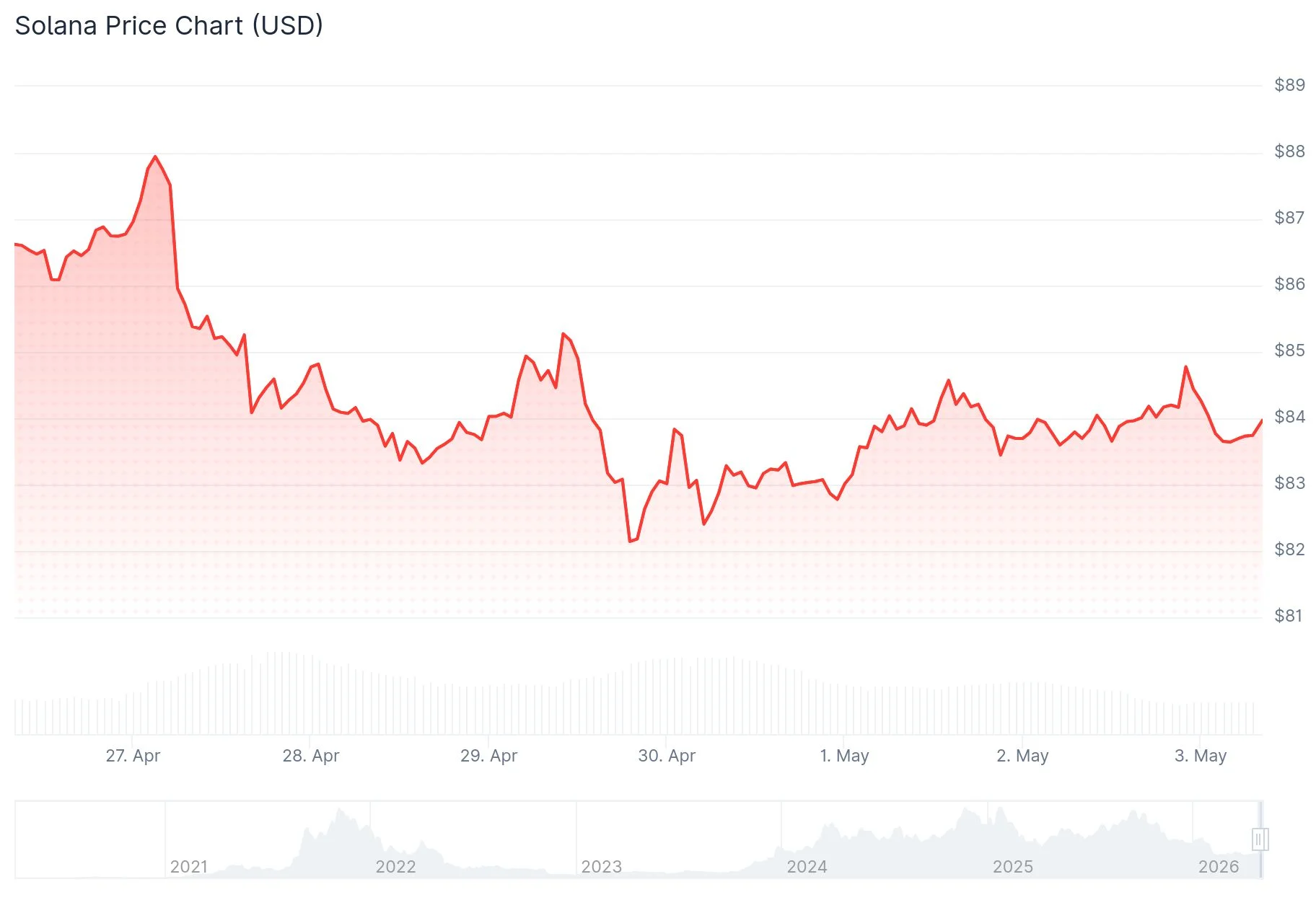
- SOL currently hovers between $80–$85, a price area that previously ignited significant rallies across market cycles.
- Liquidation data reveals concentrated short positions clustered between $84 and $87.
- Bulls must reclaim $106.24 to confirm renewed upward momentum in the market.
- Crypto analyst Patel highlights SOL’s return to the accumulation zone that preceded a 2,200% price increase.
- An extended triangle consolidation pattern suggests a potential breakout ranging from $250–$300 if current support levels hold.
Solana currently finds itself trading within the $80 to $85 range as of this writing, a price territory that has historically marked significant turning points across multiple market cycles. Following a steep decline exceeding 70% from its 2025 peak values, SOL has returned to this familiar zone.
This price region holds substantial historical significance for SOL. During the 2021 bull market, the asset surged from single-digit dollar values to surpass $250. Following the 2022 market downturn that pushed prices near $10, SOL gradually recovered and eventually climbed to fresh highs approaching $290 in the subsequent cycle.
Prominent market analyst Crypto Patel drew attention to this historical parallel in a recent social media post. Patel stated: “$SOL is back at the same buy zone that pumped it 2,200% last cycle. Will it hit $1000 in alt season?” This observation underscores a recurring pattern where this particular price range has consistently functioned as a foundation for substantial upward movements.
Critical Price Levels Under Observation
Liquidation heatmap data provided by CoinAnk reveals accumulating short positions concentrated within the $84 to $87 range. After touching approximately $81, price action has bounced back toward this upper concentration area. These heatmaps identify zones where leveraged traders face potential forced liquidations should price action reach specific thresholds.
Market analyst Don has identified $106.24 as the crucial resistance level that SOL must overcome. Breaking above this threshold would signal a validated shift toward bullish price action. Beyond $106, the next significant target emerges at $260.17, though this remains considerably distant from current levels. Should buyers lose control of present support, the analysis suggests a possible retest of $80 or potentially lower levels.
Triangle Consolidation Builds Tension
Technical analyst Javon Marks presented chart analysis revealing SOL confined within an expansive triangle formation. This pattern demonstrates progressively lower peaks and higher troughs developing over an extended timeframe, a structure that typically precedes significant directional price movement.
Solana presently trades near the bottom boundary of this triangle formation, approximately within the $75 to $85 range. Should buyers successfully maintain this support zone, potential breakout objectives emerge between $250 and $300. Conversely, a breakdown beneath the mid-$60 area would invalidate this technical structure and bring the $45 region into consideration.
As of current market conditions, SOL maintains its position within the $80 to $90 support corridor, with $106.24 standing as the next decisive level bulls must overcome to establish upward control.


A newly disclosed Linux security flaw has drawn attention from U.S. cyber officials after researchers warned that attackers could use a small Python script to gain root access on affected systems.
Summary
- CISA added Copy Fail to its exploited bugs list after reports of active Linux abuse.
- Researchers said attackers need prior code access before using the flaw to gain root rights.
- Crypto exchanges and nodes may review Linux exposure because many critical systems run affected distributions.
The flaw, known as Copy Fail and tracked as CVE-2026-31431, affects many Linux distributions released since 2017. CISA has added the bug to its Known Exploited Vulnerabilities catalog, citing active exploitation risk.
Copy Fail is a local privilege escalation bug in the Linux kernel. It does not give remote access by itself. An attacker must already have code execution on the system before using the flaw to gain root rights.
Security researchers said the flaw affects major Linux distributions, including Ubuntu, Red Hat, SUSE, and Amazon Linux. Microsoft also warned that the bug could affect cloud workloads and Kubernetes environments.
Researchers warn about simple exploit path
Theori and Xint Code linked the issue to the Linux kernel’s crypto subsystem. Researchers said the bug allows an attacker to corrupt the in-memory page cache of readable files, including privileged binaries.
Researcher Miguel Angel Duran described the exploit as unusually simple, saying, “10 lines of Python” may be enough to gain root access on affected systems. Another researcher called the flaw “insane,” reflecting concern over how small the exploit can be.
Moreover, CISA added CVE-2026-31431 to its Known Exploited Vulnerabilities catalog on May 1. The agency said the Linux kernel contains an incorrect resource transfer flaw that can allow privilege escalation.
The KEV listing means federal civilian agencies must follow CISA’s remediation timeline. Private companies also often use the catalog to rank patching work, especially when public exploit code exists.
Crypto firms may review Linux exposure
Linux powers many crypto exchanges, blockchain nodes, validators, custodians, and cloud-based trading systems. That makes patching important for firms that run critical infrastructure on affected distributions.
The flaw does not directly target crypto wallets or blockchains. However, it could create risk if an attacker first gains access to a Linux server and then uses Copy Fail to obtain root control.
Theori CEO Brian Pak said the team reported the vulnerability privately to the Linux kernel security team on March 23. Patches reached the mainline kernel on April 1, while the CVE was assigned on April 22.
Security firms have urged users to apply patched kernels where available. Sophos said public proof-of-concept exploit code exists and organizations should prioritize fixes for multi-tenant Linux hosts and container platforms.

Welsh woman finds way to lose 11 stone after being humiliated as ‘everybody stared at me’
NY Forces Uphold to Pay $5M Over Fraudulent Crypto Product

Celebrity Traitors Season 2 Cast: The Full Line-Up Has Been Unveiled

Manchester United reach agreement with Casemiro over contract clause amid transfer speculation

US brings back mandatory military draft registration

Steven Gerrard disagrees with Gary Neville over ‘shock’ Chelsea and Arsenal claim | Football
![J MONEY - NA NHA NOME [VIDEO OFICIAL]](https://wordupnews.com/wp-content/uploads/2026/05/1777799968_maxresdefault-80x80.jpg)


-

 Tech6 days ago
Register Renaming | Hackaday
-

 Politics5 days ago
Drax board avoid their own AGM, accused of greenwashing & environmental racism
-

 Tech6 days ago
Why Blue Badges Disappeared From Toyota Hybrids
-

 Tech6 days ago
Images of Samsung’s rumored smart glasses have leaked
-
 Sports7 days ago
IPL 2026: Ruturaj Gaikwad registers slowest fifty of the season, enters all-time unwanted list | Cricket News
-
 Tech2 days ago
Trump’s 25% EU auto tariff breaches Turnberry Agreement that also covers semiconductors and digital trade
-

 Fashion4 days ago
Kylie Jenner’s KHY Enters a New Era with ‘Born in LA’
-

 Business4 days ago
Most Commercial Energy Audits Miss the Real Losses
-

 Crypto World5 days ago
CFTC’s AI will review U.S. crypto registration applications, chairman tells CoinDesk
-

 Business6 days ago
(VIDEO) Charlize Theron Climbs Times Square Billboard to Promote New Netflix Thriller ‘Apex’
-

 Business4 days ago
Barclay Brothers Avoid Bankruptcy: HSBC Drops High Court Petitions After IVA Deal
-
 Sports2 days ago
Paul Scholes issues Marcus Rashford reality check as agreement emerges over Man United star
-
 Entertainment6 days ago
Alicia Keys Calls Out Music Industry ‘Boys Club’
-
 Business4 days ago
Tesla Officially Registers Elon Musk’s Stock: What Investors Need to Know
-

 Tech5 days ago
Get Ready for More Brain-Scanning Consumer Gadgets
-

 Tech7 days ago
Dyson Vacuums And The Curse Of Cooked Capacitors
-
Crypto World5 days ago
Robinhood Phishing Scam Exploits Gmail Dot Feature to Bypass Security
-

 Crypto World7 days ago
Only 3% of traders drive Polymarket’s accuracy, not the crowd, study finds
-

 Entertainment6 days ago
Sister Wives: Janelle Posts New Scary Warning
-

 Crypto World5 days ago
Gmail Dot Trick Underpins Robinhood Phishing, Sending Real-Looking Emails
You must be logged in to post a comment Login