

Crypto World
Binance Retail Investor Bitcoin Inflows Drop By 73%, What’s Next for BTC?

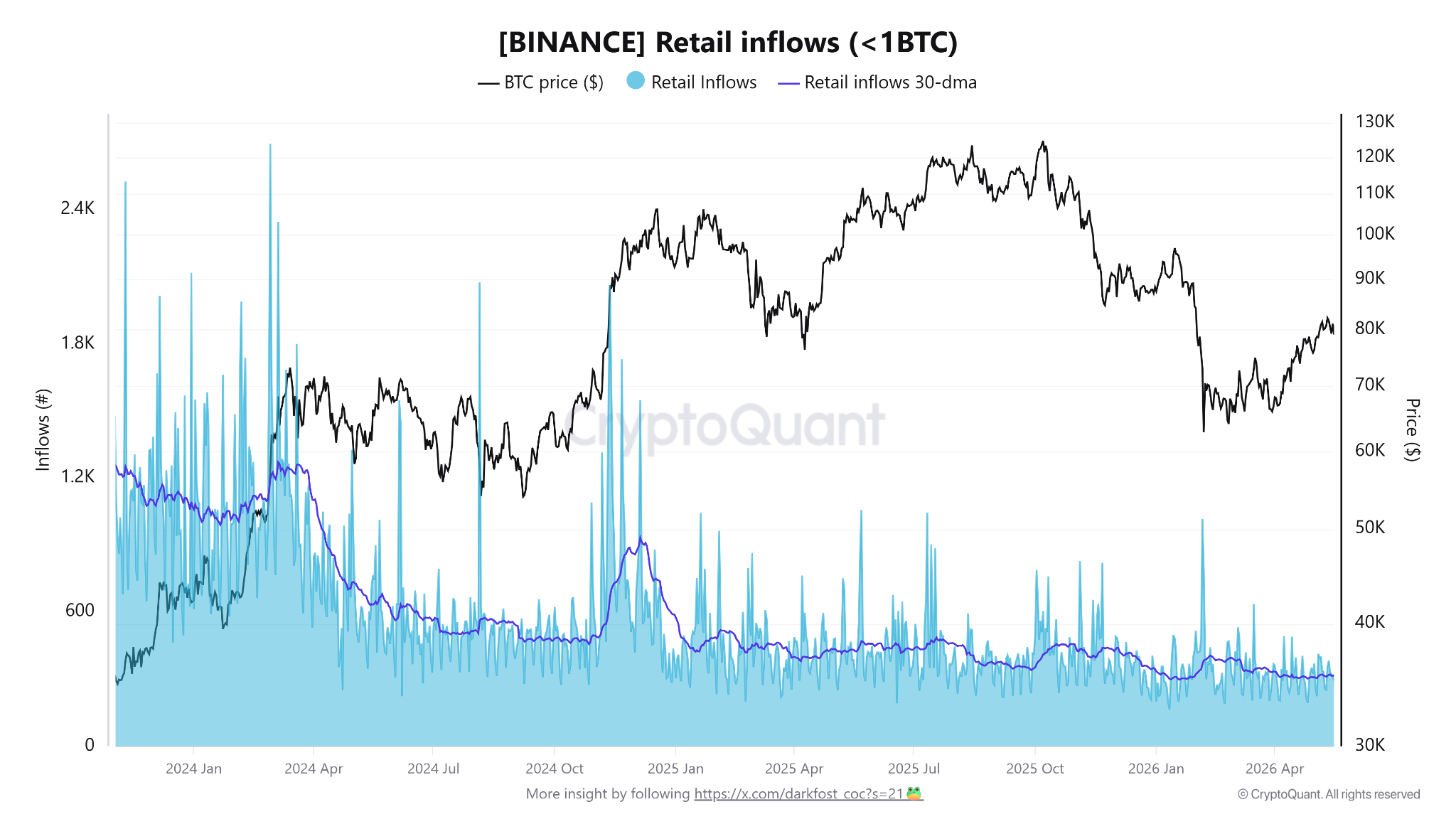
Bitcoin (BTC) retail investor activity on Binance has fallen to its lowest level in history. Retail BTC inflows on Binance now average near 314 BTC per month in 2026, down sharply from the 1,200 BTC range recorded in March 2024.
Bitcoin’s recovery in May also slowed as spot inflows on Binance weakened, with the 30-day net demand growth falling 73% over the past three weeks.
Bitcoin retail traders step back
CryptoQuant analyst Darkfost said retail Bitcoin inflows to Binance remained near its historic lows. The metric tracks BTC deposits from wallets holding less than 1 BTC, a common signal for retail investor activity.
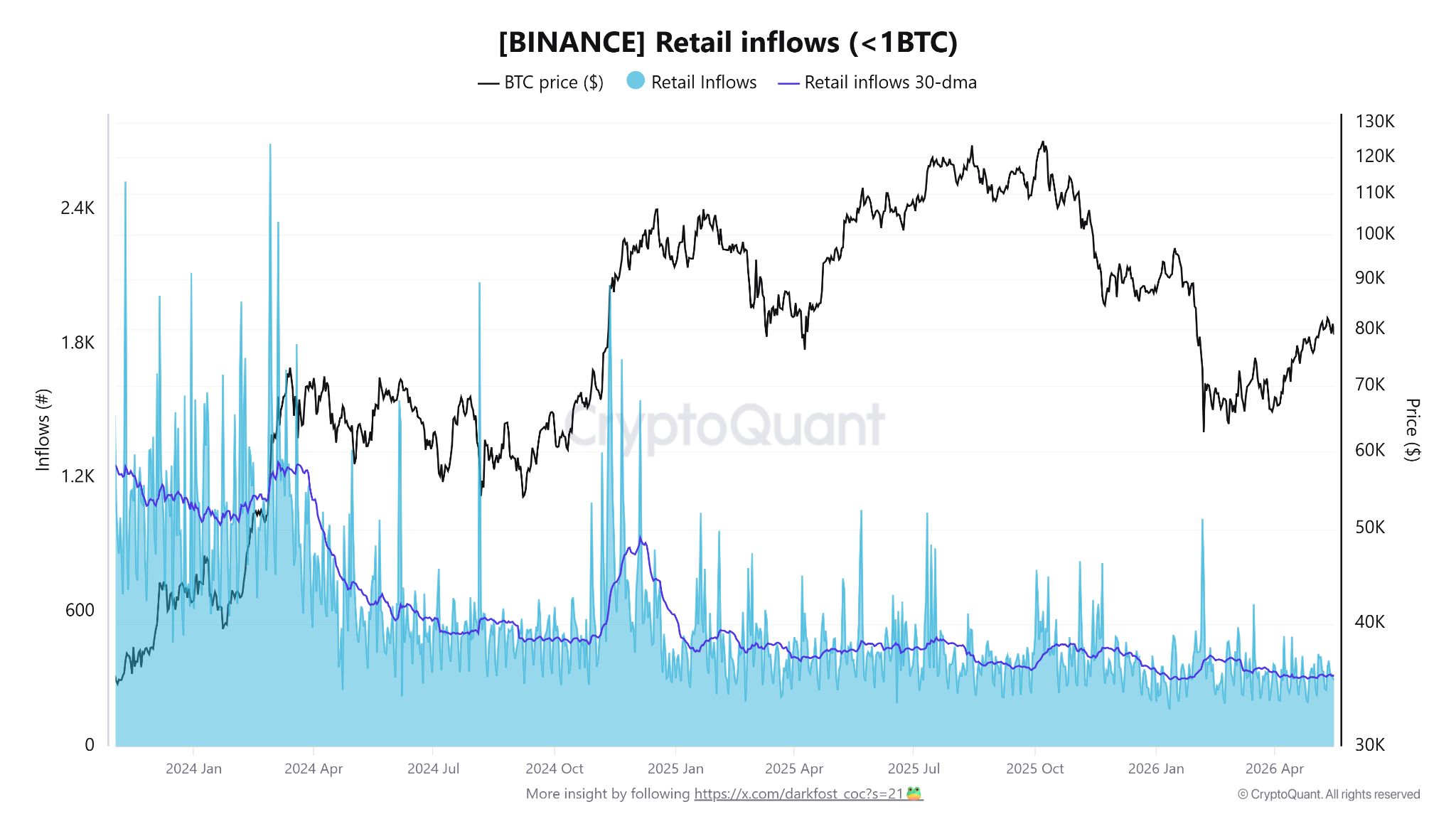
Bitcoin retail inflows (less than 1 BTC) on Binance. Source: CryptoQuant
Monthly retail BTC inflows on Binance now average just 314 BTC. The figure stood near 1,800 BTC during the 2022 bear market and around 1,200 BTC during Bitcoin’s March 2024 local top near $75,000. Earlier cycles showed far heavier retail participation, with inflows peaking near 5,400 BTC in 2018 and 2,600 BTC in 2021.
Darkfost said part of the shift likely stemmed from investors moving toward spot Bitcoin exchange-traded funds (ETFs) rather than directly holding BTC on exchanges.
CryptoQuant data also showed a cooldown in retail demand growth. The 30-day change in retail investor demand dropped to 3.12% from 7.39% last week. That earlier reading marked the strongest retail demand expansion since August 2025, when Bitcoin traded near $115,000. The decline points to weaker spot participation after a brief pickup in buying activity.
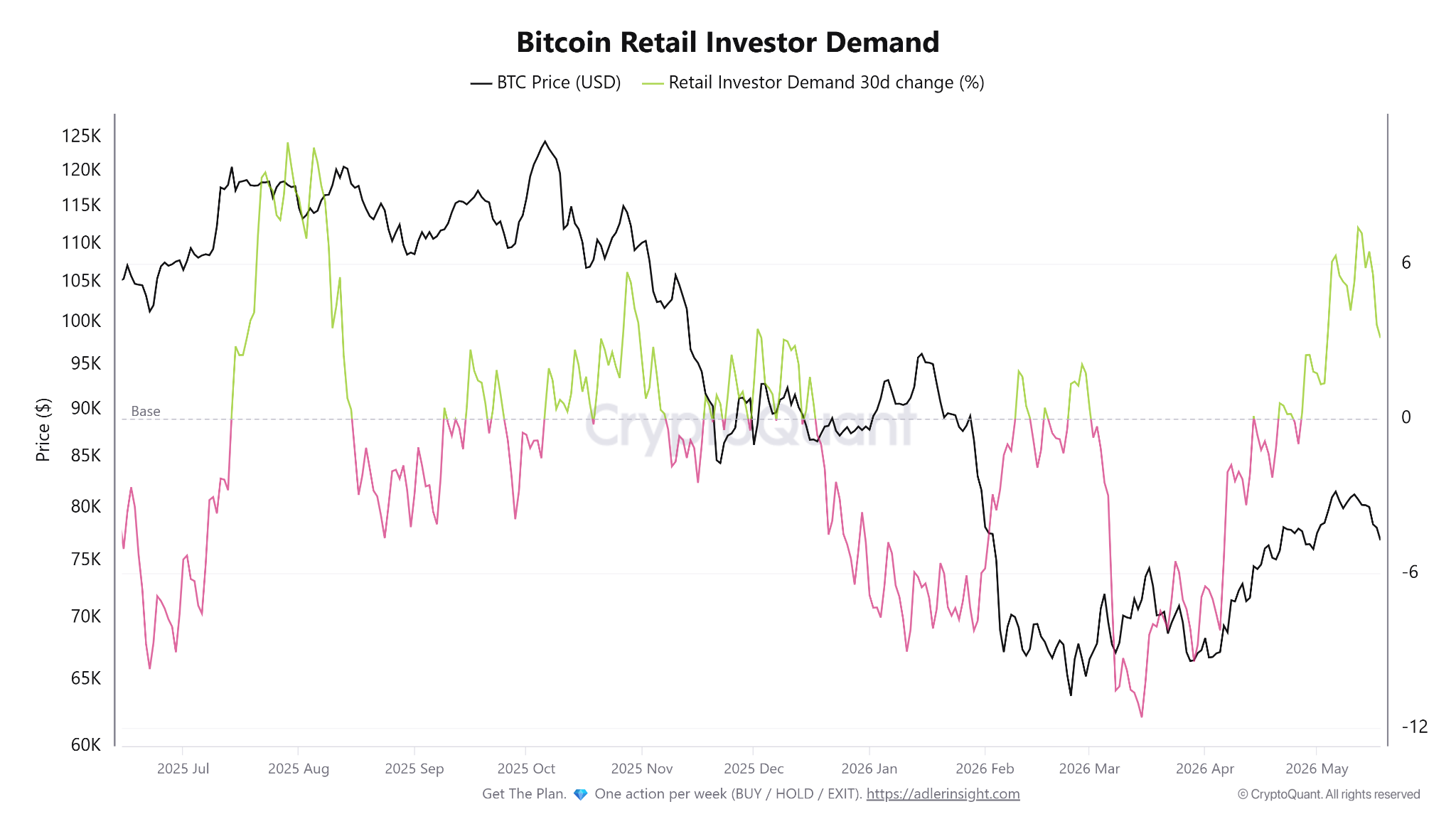
Bitcoin retail investor demand. Source: CryptoQuant
Related: Bitcoin price hits $76K, lowest since April after $1B ETF net outflow
BTC spot demand lags behind futures positioning
Crypto analyst Amr Taha said Binance recorded two large spikes in Bitcoin taker sell volume during the recent decline. The first reached roughly $1.5 billion on May 15. Another climbed above $1.1 billion as Bitcoin fell below $77,000.
Market analyst Crazzyblockk said one important signal still missing from Bitcoin’s recovery is a balanced spot demand. The previous rallies in October 2024, November 2024, and May 2025 showed that spot and futures demand rose together. Spot demand ranged between +97,000 BTC and +190,000 BTC during those price rallies, while the futures demand expanded alongside it.
The latest recovery showed a different pattern. BTC futures demand remained positive at +193,000 BTC over 30 days, while spot demand remained negative at -28,000 BTC and stayed below zero for 65 consecutive days. The total 30-day demand growth also fell from 232,000 BTC in early May to 62,000 BTC by May 16, recording a 73% decline.
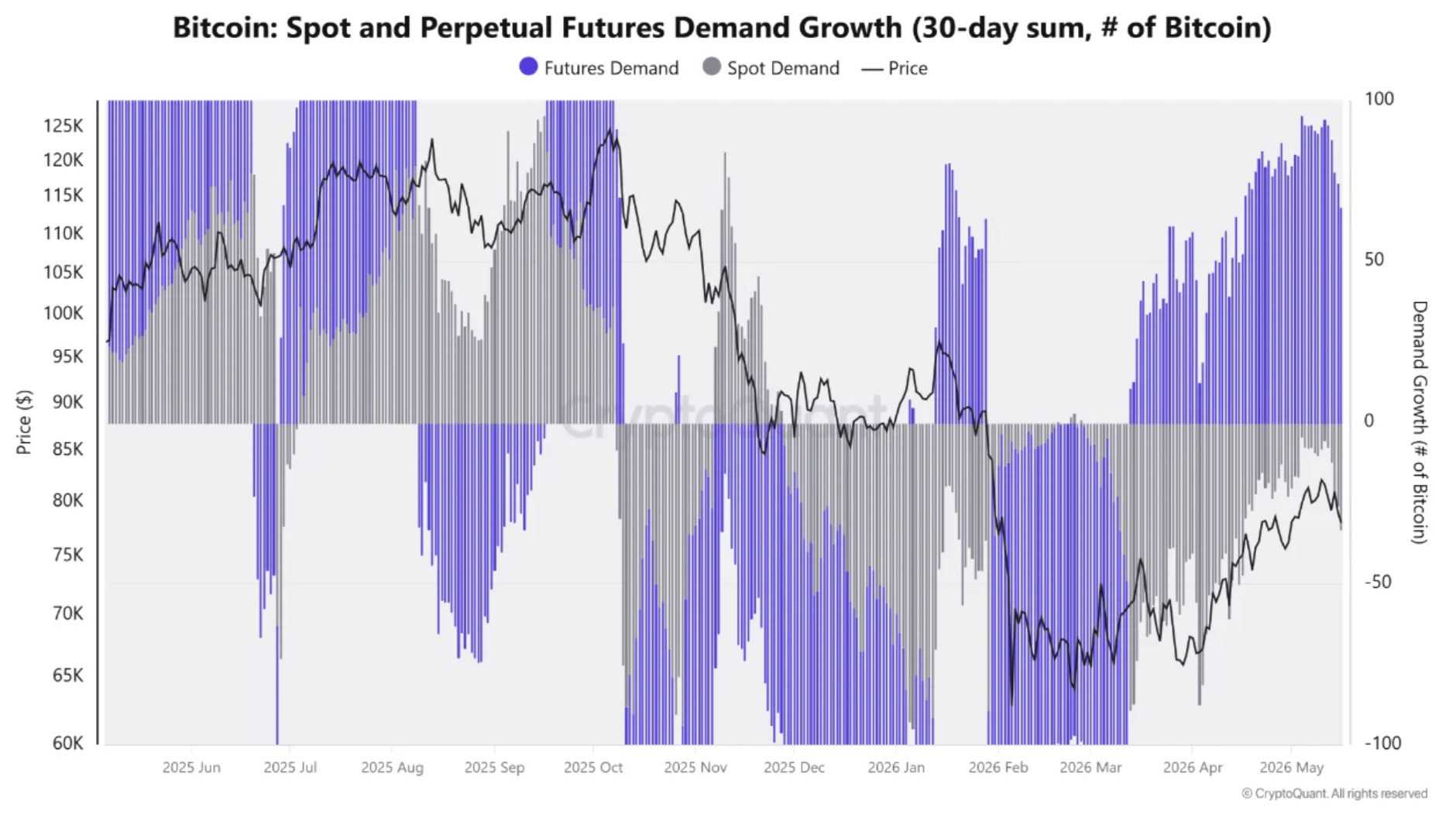
Bitcoin spot and futures demand growth (30-day sum). Source: CryptoQuant
Crazzyblockk also pointed to a sharp shift in Binance’s futures dominance last month. Binance previously controlled 40%-44% of global USDT-margined futures volume from October 2024 to March 2026.
In May 2026, Binance’s share dropped to 21.1% while OKX climbed to 26.3%, marking the first reversal in exchange leadership during the cycle.
Related: Price predictions 5/18: SPX, DXY, BTC, ETH, XRP, BNB, SOL, DOGE, HYPE, ADA

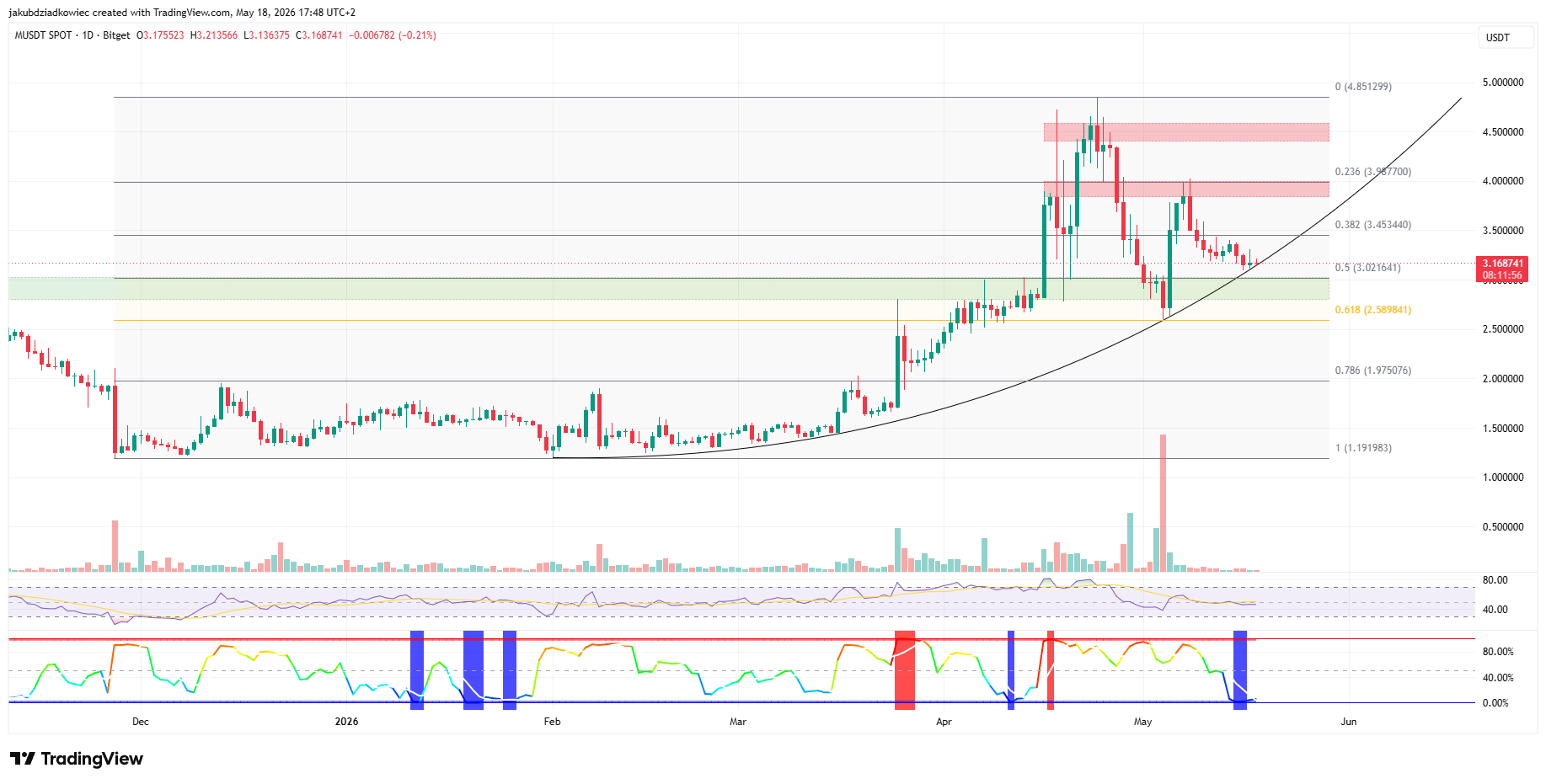
MemeCore (M), 币安人生 (BinanceLife), and Gigachad (GIGA) sit at decisive technical levels heading into the third week of May. Daily charts show each token compressing or consolidating after weeks of volatile price action.
Each setup tells a different story. One token coils above a key Fibonacci floor, another nears a triangle breakout, and the third holds gains after a sharp weekly rally.
MemeCore Compresses Above $3.02 Fibonacci Support
MemeCore (M) trades near $3.16 after a 2.16% decline over the past seven days. The token sits just above the 0.5 Fibonacci retracement at $3.02 on the daily chart.
The Relative Strength Index (RSI) prints at roughly 50, indicating neutral momentum. Meanwhile, volatility, as measured by the BBWP indicator, has collapsed to extreme lows, suggesting an accumulation phase.
Price has also bounced off an ascending exponential curve that has held every dip since February 1. A previous BeInCrypto rebound report tracked the same Fibonacci structure during the prior leg up.

Two horizontal supply zones remain in play above. The first sits near $4.00, with a heavier band stretching to $4.50.
A deeper correction would shift attention to the 0.618 Fibonacci retracement at $2.59. That level would serve as the first bearish target if the exponential curve cracks.
BinanceLife Coils Inside a Triangle Targeting $0.68
币安人生 (BinanceLife) trades at $0.43 after a 5.54% advance over the past week. In contrast with MemeCore, BinanceLife has been trending higher since the March 29 low.
The token printed an all-time high at $0.5595 in April. After pulling back to the 0.382 Fibonacci retracement at $0.36, the price resumed posting higher highs and higher lows.
Daily candles now coil within a horizontal triangle close to resolution. The earlier 3,000% surge reported by BeInCrypto set the stage for the current consolidation.

A break above $0.46 resistance would open a measured move toward $0.68 as the first bullish target. Strong support sits at the previous January 14 swing high near $0.26, which coincides with the 0.618 Fibonacci level.
The RSI hovers near 61, leaning neutral to bullish. Volatility remains compressed, reinforcing the case for a directional move once the triangle resolves. Broader BNB meme coin flows could determine the direction.
Gigachad Consolidates Below $0.0047 After Weekly Rally
Gigachad (GIGA) trades at $0.00435 after a sharp 13.91% weekly gain. However, the token has slipped 5.08% over the past 24 hours and now sits just below resistance at $0.0047.
A clean break above $0.0047 could open the path toward $0.0057, with a second resistance near $0.0072. Therefore, the next move from this consolidation will likely set the short-term tone.
The setup echoes earlier meme coin sector-watchlist coverage that tracked similar pauses after fast rallies. If the rally stalls, the first support area sits near $0.0035, marked by the November 17 and December 2025 lows.

A deeper flush would expose $0.0024, which capped price during the February to May accumulation range. The RSI prints near 70, holding firmly in bullish territory.
Volatility has cooled from recent extremes, suggesting a phase of reactivation rather than exhaustion. The next directional move will likely follow either a $0.0047 breakout or a retest of the $0.0035 floor.
The post Top 3 Meme Coins to Watch in the Third Week of May 2026 appeared first on BeInCrypto.
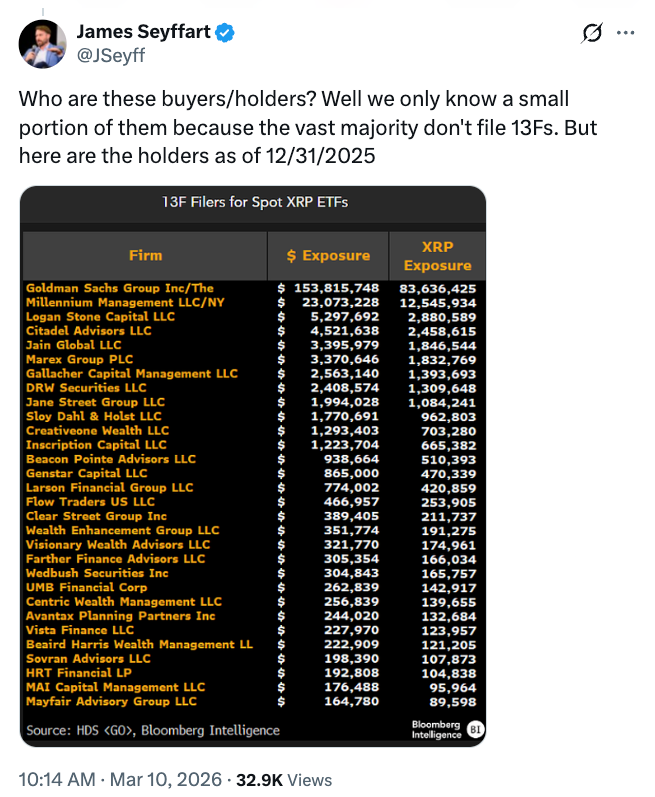
US investment bank Goldman Sachs sharply reduced its exposure to cryptocurrency exchange-traded funds (ETFs) in the first quarter of 2026.
No XRP-linked ETFs appeared in Goldman Sachs’ Q1 Form 13F filing with the US Securities and Exchange Commission.
In its Q42025 13F filing, Goldman Sachs reported holding nearly $154 million worth of XRP-related ETFs from Bitwise, Franklin Templeton, Grayscale and 21Shares.
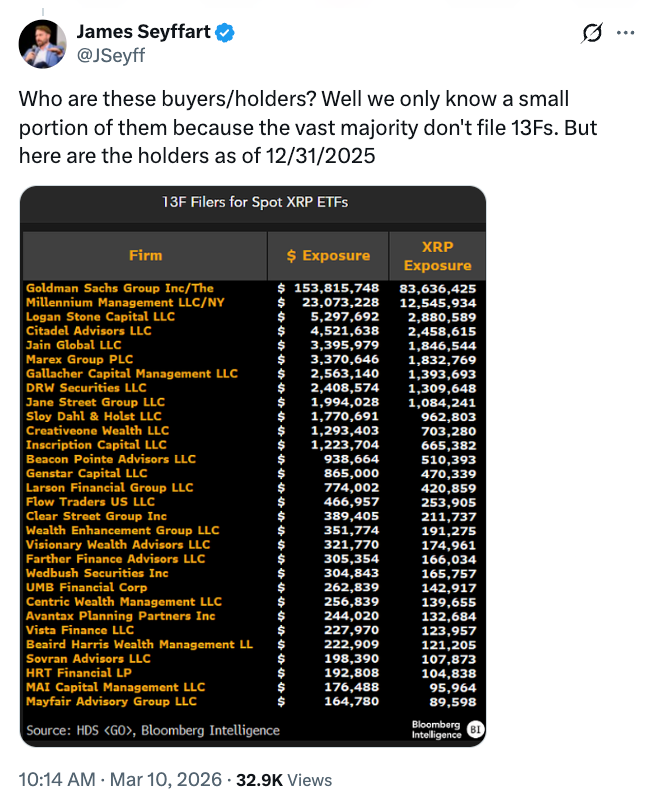
Goldman Sachs was the largest institutional holder of XRP-related ETFs as of Dec. 31, 2025. Source: James Seyffart
Quarterly 13F filings are closely watched by crypto investors because they provide a rare look into how major institutional asset managers are allocating capital across digital-asset investment products. The bank pulled back from XRP products, even as broader institutional interest in digital-asset ETFs remains intact.
Early pullback from new crypto ETFs
Goldman Sachs no longer reported any holdings in Solana-linked ETFs either.
The bank previously disclosed positions in Solana-linked ETFs, including the Grayscale Solana Trust ETF (GSOL), the Bitwise Solana Staking ETF (BSOL) and the Fidelity Solana Fund (FSOL).
Both XRP- and Solana-linked ETFs launched in late 2025, when issuers began rolling out a new wave of crypto funds beyond Bitcoin (BTC) and Ether (ETH).
Solana ETFs began trading in late October 2025, with additional funds rolling out in November. The first spot XRP ETFs hit the market in mid-November as issuers raced to bring new altcoin products to investors.
Goldman Sachs trims Bitcoin ETF exposure, but still holds more than $700 million
While no longer reporting ETF exposure to XRP and Solana, Goldman Sachs continued to hold significant positions in Bitcoin and Ether ETFs, along with equity tied to crypto companies.
The bank held about $690 million in BlackRock’s iShares Bitcoin Trust ETF (IBIT) and another $25 million in the Fidelity Wise Origin Bitcoin Fund (FBTC), even after reducing both positions by roughly 10% during the quarter.
Goldman Sachs also cut its position in the iShares Ethereum Trust (ETHA) by about 70%, leaving it with roughly 7.2 million shares valued at around $114 million.
Related: JPMorgan piles into BlackRock’s Bitcoin ETF in Q1 2026
In crypto equities, Goldman Sachs increased its exposure to several names, led by a 249% jump in Circle Internet Group (CRCL) and a 205% rise in Galaxy Digital (GLXY), while also adding to positions in Coinbase Global (COIN), Robinhood Markets (HOOD) and PayPal Holdings (PYPL) during the quarter.
At the same time, it reduced stakes in major mining and infrastructure names, including BitMine Immersion Technologies (BMNR), Bit Digital (BTBT) and Riot Platforms (RIOT). It reduced positions in Strategy (MSTR) and IREN (IREN).
Magazine: XRP ‘probably going to $12,’ Bitcoin ETFs add $1B: Market Moves
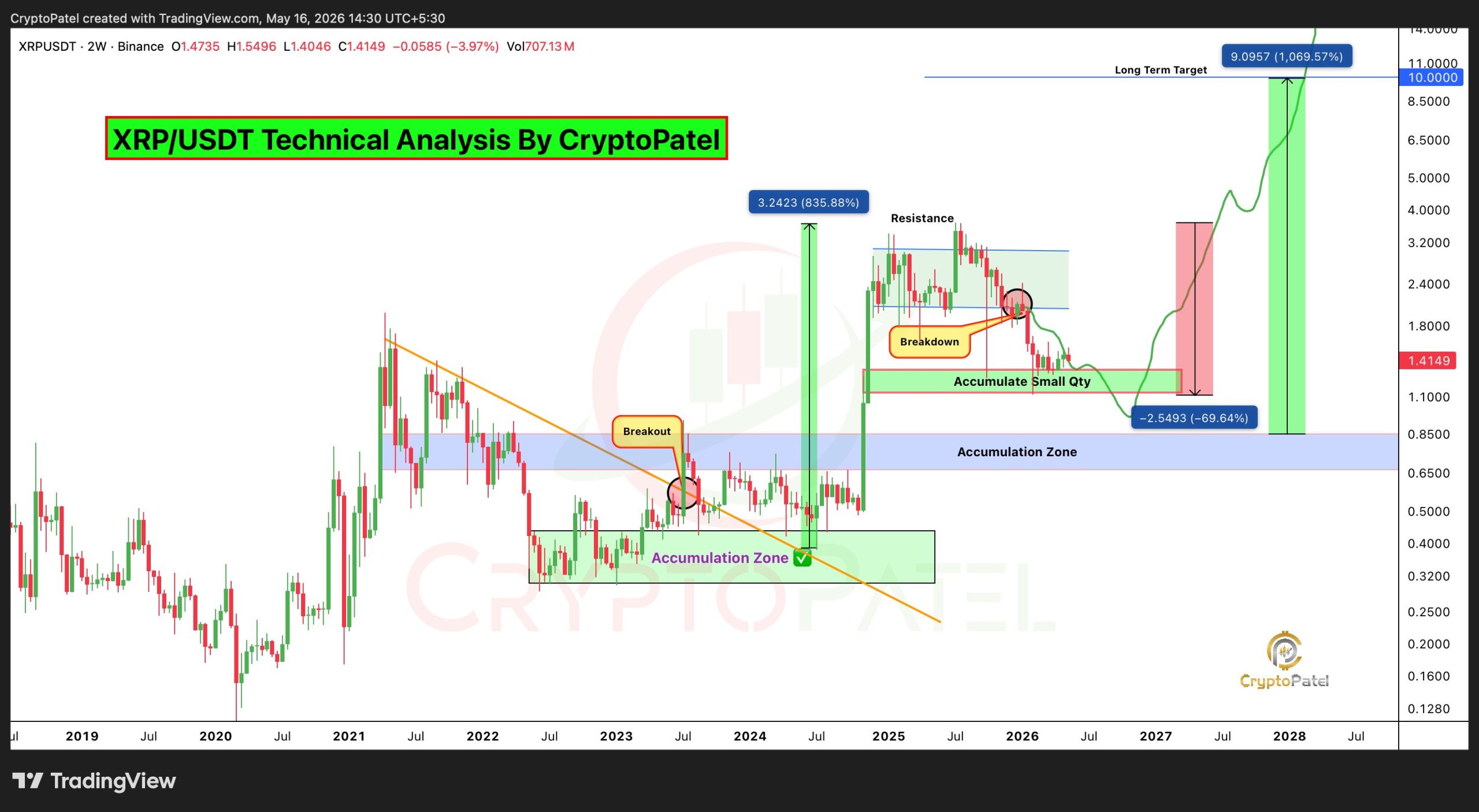
XRP (XRP) may go on a 10x–15x rally from its “quiet accumulation” zone, according to analyst Crypto Patel, who says the muted price action resembles the calm before its major breakout in late 2024.
Key takeaways:
- XRP’s lack of retail hype may lead to a rally toward $5, $10 and $15 targets.
- XRP’s current $1.00–$0.70 demand zone is similar to its 2022–2024 base, which preceded an 835% rally.
Lack of retail hype hints at XRP boom toward $15
In his Sunday post, Patel highlighted the $1.00–$0.70 range as a potential long-term accumulation zone, arguing that XRP’s muted sentiment and lack of retail hype could precede a larger upside move.
His chart showed XRP pulling back after failing to break the $3.20–$3.50 resistance area, with price now drifting toward a green demand zone that he views as a potential “massive opportunity.”
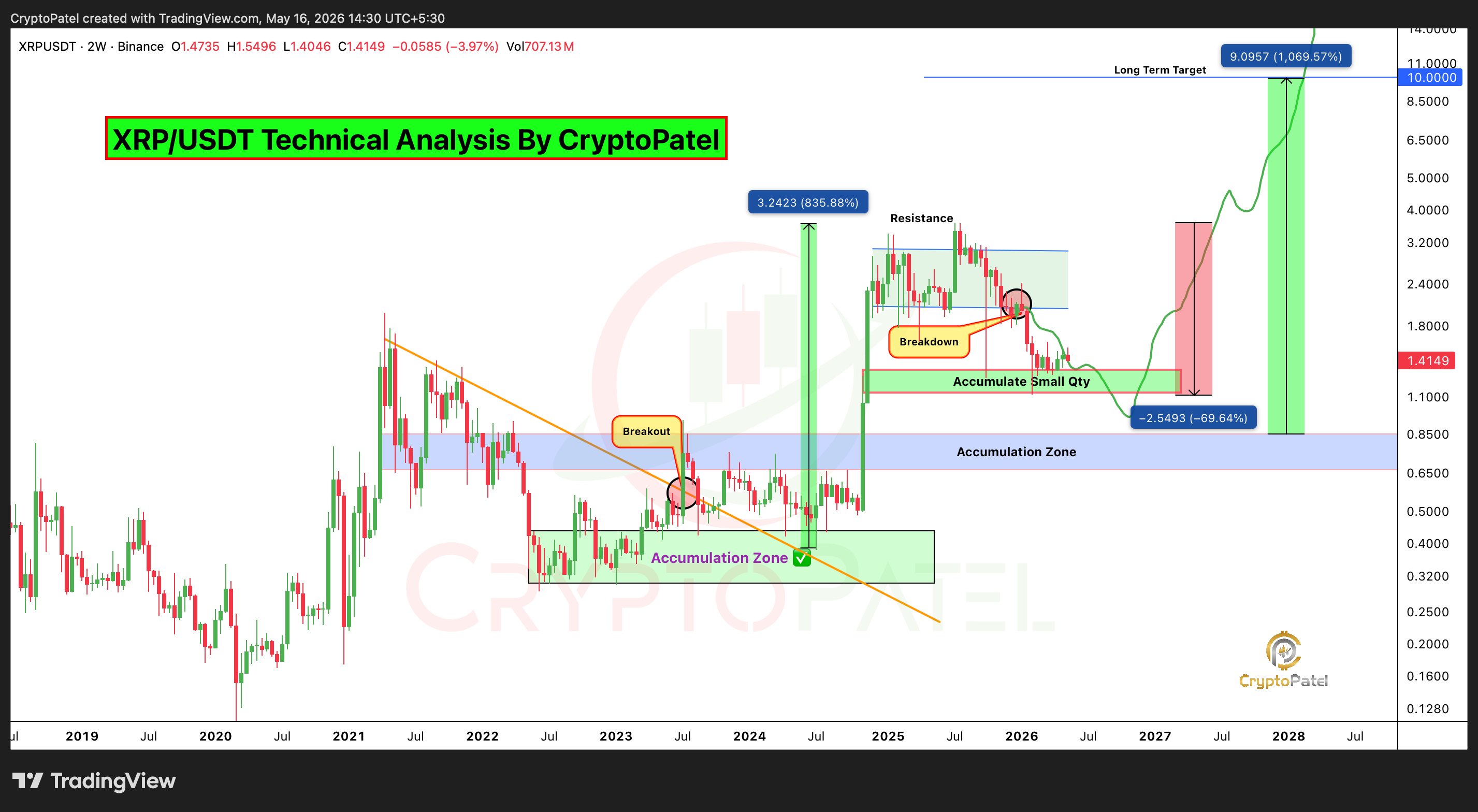
XRP/USD two-week chart. TradingView/Crypto Patel
The analyst projected upside targets at $5, $10, and $15, implying roughly 10x–15x potential from the lower end of the accumulation range if XRP repeats its 2022–2024 cycle-style expansion.
That comparison is central to Patel’s bullish case.
In the previous cycle, XRP spent months building a base around the $0.32–$0.40 area before breaking above a multi-year descending trend line near $0.55–$0.60 in November 2024.
The breakout also cleared the broader $0.65–$0.85 resistance band, marked in blue on the chart, followed by an 835% rally toward $0.40 over the next two months.
CLARITY Act may push XRP into a multi-year bull market
The late 2024 rally had a clear fundamental trigger.
Donald Trump’s re-election as US president in November 2024 boosted risk appetite across crypto markets, as traders viewed his incoming administration as far more supportive of digital assets than the previous administration.
In 2026, a similar potential catalyst is emerging with the CLARITY Act, which has advanced in the Senate.
The bill aims to create a clearer US market-structure framework for crypto by defining when digital assets fall under securities or commodities rules.
Related: Italy’s largest bank more than doubles crypto holdings to $235M in Q1: Report
Jason Yanowitz, co-host of the Empire podcast at Blockworks, named XRP as one of the altcoins that may enter a multi-year bull market if the CLARITY Act becomes law.
Analyst Michaël van de Poppe said he’ll stay “fully allocated toward altcoins” for his personal crypto portfolio.
XRP network metrics see the highest one-day growth since March
On-chain data from Santiment adds another layer to XRP’s bullish setup, showing that the recent recovery coincided with a sharp rebound in network activity.
On Saturday, the XRP Ledger recorded its strongest 24-hour activity levels since March, with 48,453 active addresses, the highest since March 30, and 3,317 new addresses, the highest since March 19.
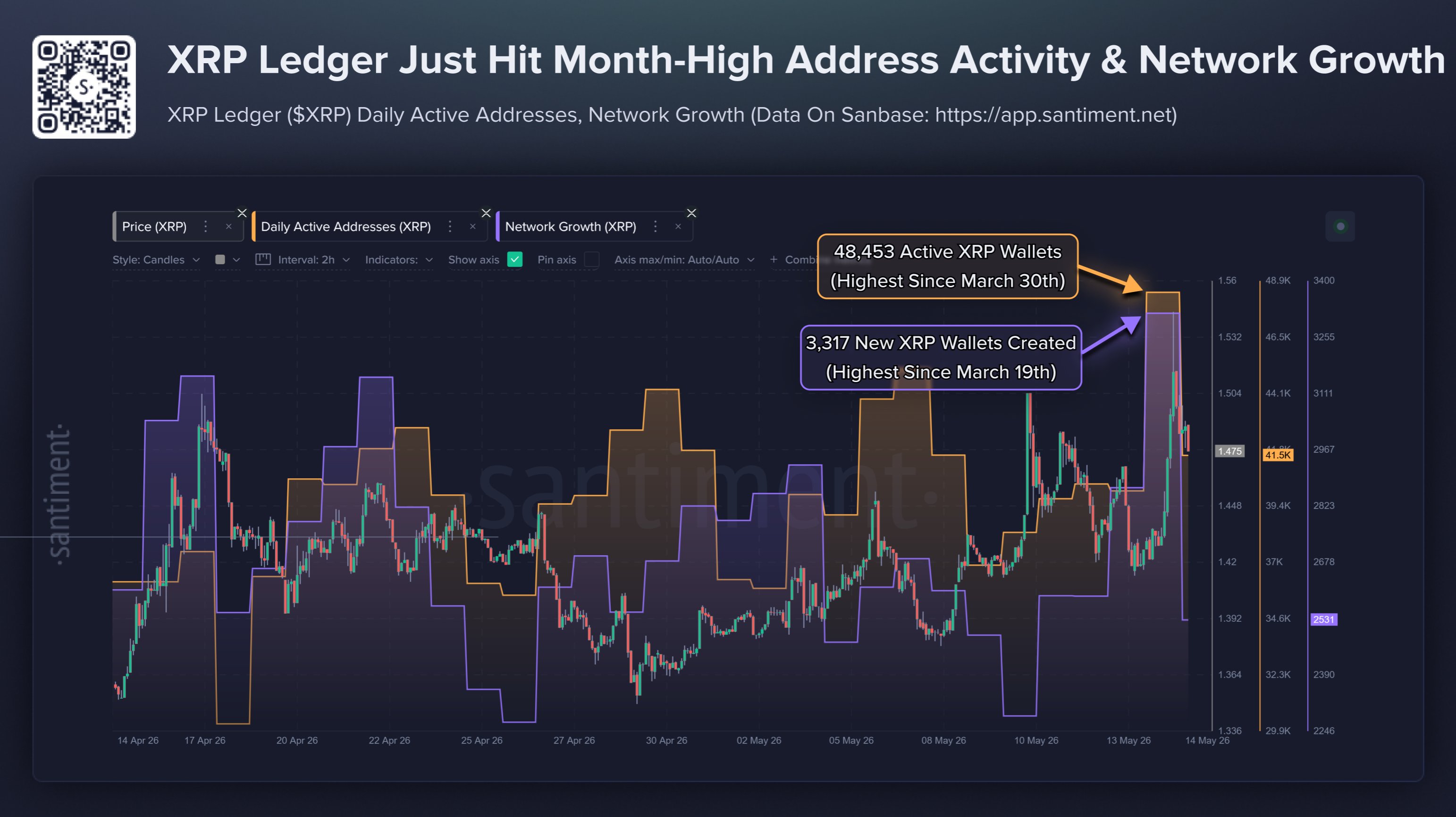
XRP Ledger daily active addresses and network growth. Source: Santiment
“Higher adoption helps justify higher prices,” Santiment wrote, noting that the activity spike could support XRP’s “mid- and long-term price growth” if it proves sustainable.
Earlier this week, the XRP network also witnessed a rise in the number of whale wallets, with Santiment noting that they were accumulating the token at record levels.
XRP chart triangle setup risks drop toward $1
XRP’s short-term chart shows a symmetrical triangle forming after months of lower highs and higher lows.
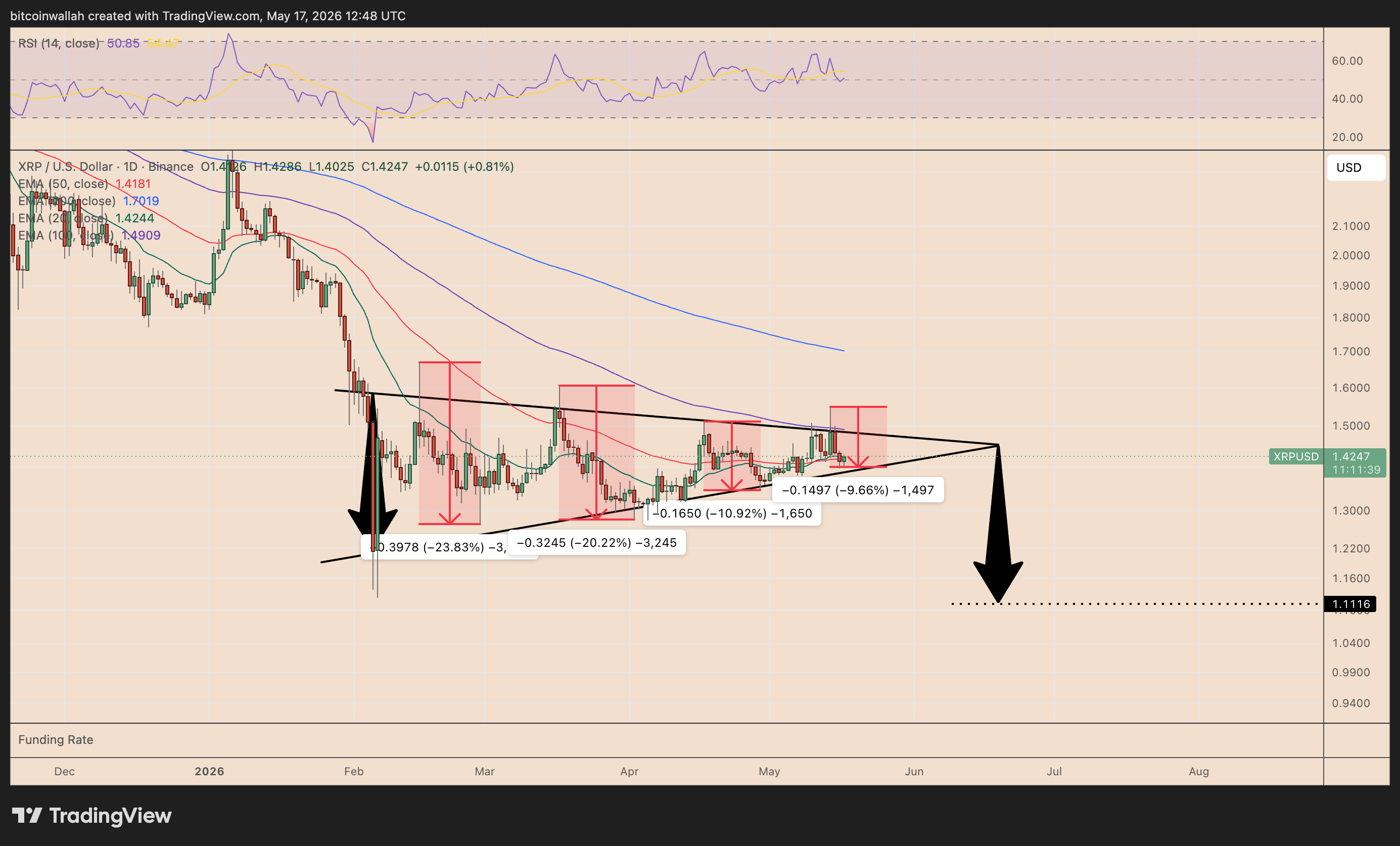
XRP/USD daily chart. Source: TradingView
The latest rejection near the upper trend line suggests bulls still lack enough momentum to confirm a breakout.
If XRP breaks below the triangle’s lower trend line, the setup could flip bearish and open the door to a measured move toward the $1.00–$1.10 support area, down approximately 20% from the current prices.
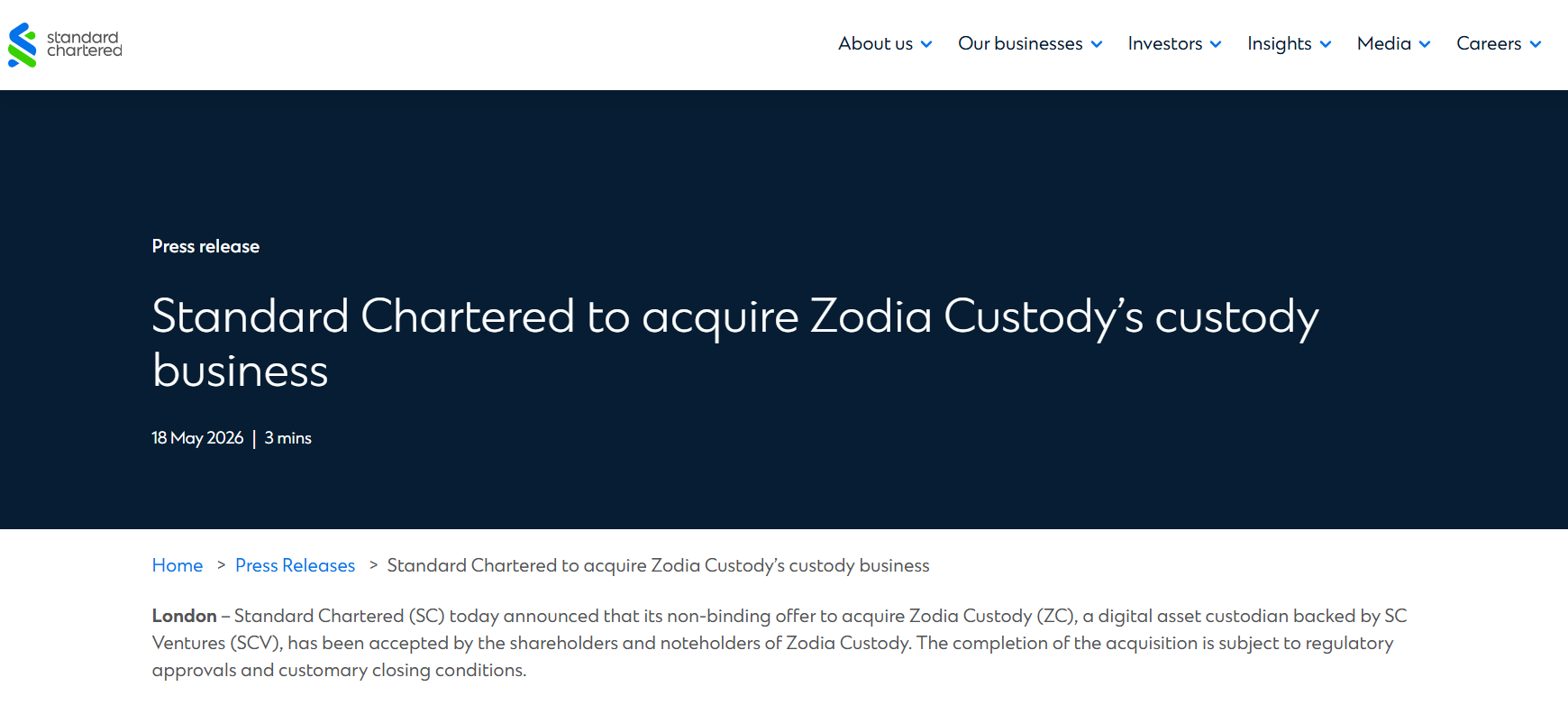
Standard Chartered has announced that its offer to acquire the business of Zodia Custody has been accepted by shareholders.
The deal, announced Monday, will consolidate Standard Chartered’s digital asset custody operations while separating a standalone infrastructure platform for institutional clients.
Zodia Solutions will be established as an independent entity under SC Ventures, backed by several banking investors, including existing Zodia Custody shareholders, and will provide “bank-grade infrastructure” to financial institutions, including Standard Chartered, as they expand digital asset services.
Zodia Custody was originally launched in 2020 by Standard Chartered and Northern Trust as a regulated crypto custody platform for institutional investors.
The bank said the transaction will “drive value by unlocking revenue and cost synergies” while enabling a more comprehensive offering to digital asset custody clients globally.
Related: Standard Chartered takes stake in crypto market maker GSR
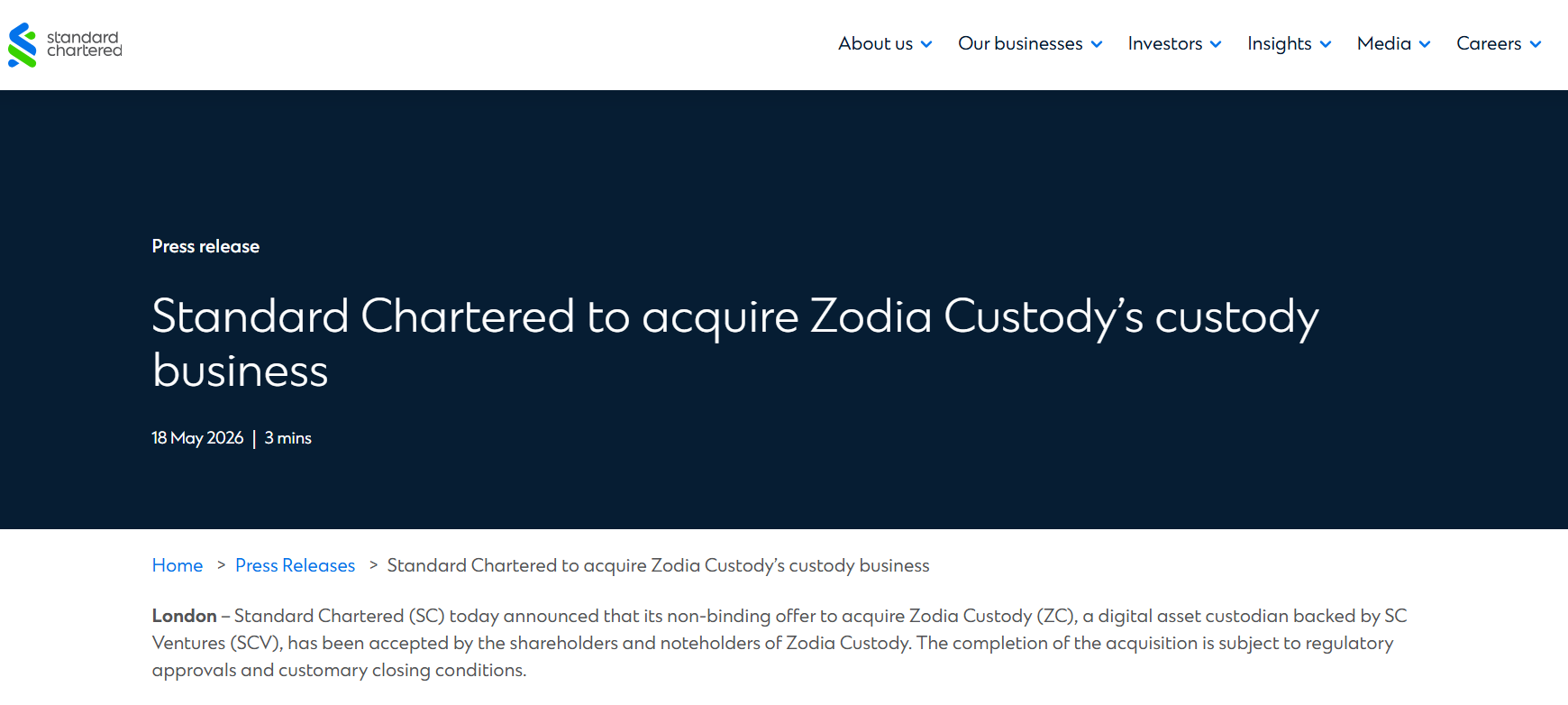
Standard Chartered to acquire Zodia Custody’s custody business. Source: Standard Chartered
Margaret Harwood-Jones, global head of financing and securities services at Standard Chartered, said in the release that the deal would accelerate the growth of Standard Chartered’s global digital asset custody portfolio.
The companies said they do not expect the transaction to disrupt existing custody clients, who will continue to receive services as usual.
A Standard Chartered spokesperson declined to comment further.
Broader bank push into digital asset custody
In April, Bloomberg reported that Standard Chartered was considering bringing parts of Zodia Custody in-house by merging the custody business into an existing division, while leaving Zodia to operate as a software-as-a-service platform.
The announcement formalizes that strategy amid a broader push by major banks to secure trust bank charters and other regulatory structures to custody crypto directly for clients.
BNY Mellon, for example, launched its Digital Asset Custody platform in the US as far back as 2022, enabling selected clients to hold and transfer Bitcoin (BTC) and Ether (ETH) alongside traditional assets on a single platform.
In February 2026, Morgan Stanley applied for a US de novo national trust bank charter. The charter would allow it to custody certain digital assets for clients within a bank-regulated framework.
Magazine: Singapore isn’t a ‘crypto hub’ — it’s something better: StraitsX CEO


Mark Cuban has proposed a federal tax on artificial intelligence (AI) tokens at less than 50 cents per million. He said the levy would push large model operators toward efficiency while raising billions in annual revenue.
The Dallas Mavericks owner said his idea mirrors the regulatory path crypto once resisted. Critics including libertarian-leaning founders and AI builders have pushed back sharply.
Cuban Echoes the Crypto Regulation Arc
Cuban said early crypto supporters treated any rule as unacceptable. They later gravitated toward PACs and structured advocacy once growth demanded legal clarity. He tied that arc to the AI debate.
“This is exactly what EVERYONE said about crypto. Any regulation is bad. I got crucified on here for saying that the industry needed regulation to expand it to normies,” wrote Cuban.
The software billionaire investor framed the proposal as a sales-tax-style charge on commercial providers.
Open-source models and local inference would sit outside its scope. Crypto firms have walked a similar path, with lobbying quadrupling in recent years.
Revenue and Energy Drive the Argument
Cuban estimated the levy could yield about $10 billion a year at the start. He said the figure could expand sharply as inference demand grows. Revenue could fund federal debt reduction or programs responding to AI disruptions.
Energy concerns sit at the center of his case. Data centers running large language models already draw heavily on US grids. Cuban said the tax would push providers toward efficiency gains that exceed their tax outlay.
Critics Call It Government Overreach
Anduril founder Palmer Luckey said the measure would tax American firms while pushing customers toward foreign models. He warned of new infrastructure for federal tracking of AI usage.
The proposal will not advance without congressional appetite, which currently looks thin.
Whether AI providers eventually lobby for clearer rules, as crypto firms did, may shape the next phase of the debate.
The post Shark Tank Billionaire Mark Cuban Proposes Federal AI Token Tax appeared first on BeInCrypto.
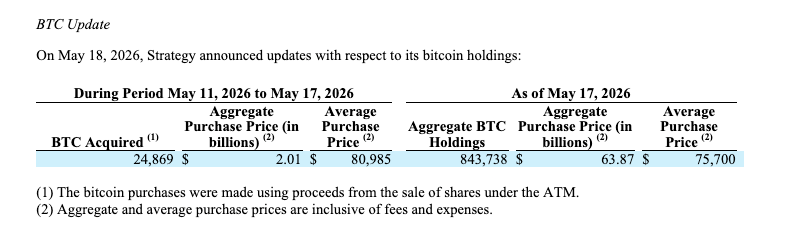
Michael Saylor’s Strategy, the world’s largest public Bitcoin holder, made another massive BTC acquisition last week as the crypto asset hovered around $80,000.
Strategy acquired 24,869 Bitcoin (BTC) for $2.01 billion between May 11 and 17, according Monday’s 8-K filing with the US Securities and Exchange Commission.
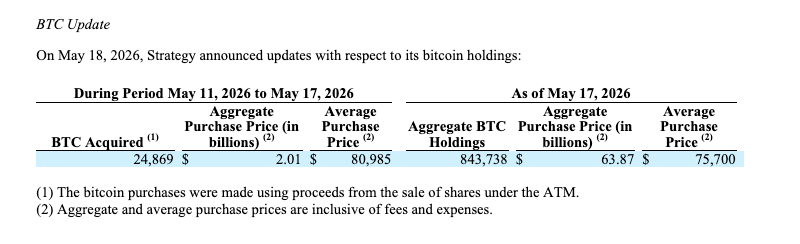
Source: SEC
The purchases were made at an average price of $80,985 per BTC, raising Strategy’s cost basis to $75,700.
The company now holds 843,738 BTC, acquired for about $63.87 billion. At the time of publication, the holdings were valued at roughly $65.3 billion, according to CoinGecko.
STRC sales account for 97% of the entire purchase
Strategy funded nearly all of its latest Bitcoin purchase through sales of its STRC perpetual preferred stock, which accounted for about 97% of total proceeds.
According to the SEC filing, Strategy raised roughly $1.95 billion from the sale of about 19.5 million STRC shares.
In comparison, Strategy’s Class A common stock (MSTR) contributed a smaller share of funding, generating about $83.7 million in net proceeds from the sale of 430,344 shares.
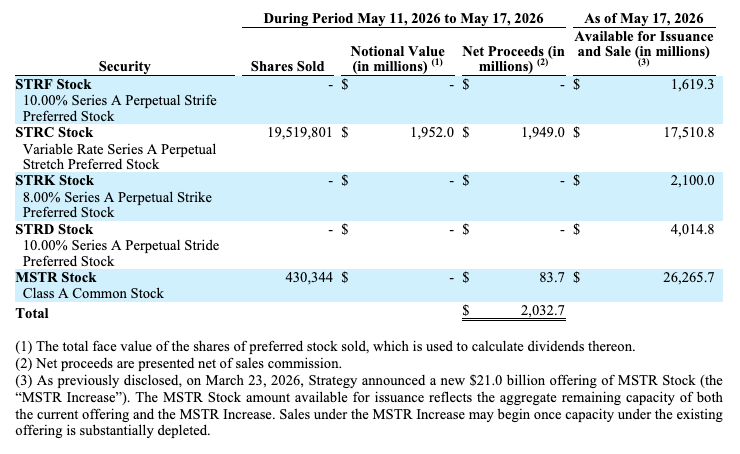
Source: SEC
The outcome was broadly in line with expectations from STRC Live, which reported heavy STRC activity during the week, including a record trading day of 15.1 million shares, with estimated purchases of around 15,466 BTC.
The structure mirrors previous large bitcoin buys this year, including a 34,164 BTC purchase, Strategy’s third-largest on record, which was also largely financed through preferred securities rather than common equity.
Related: Strategy resumes Bitcoin acquisitions with $43M BTC buy
Strategy co-founder Saylor previously signaled that the company would add to its Bitcoin holdings by posting a chart showing Strategy’s purchase history with 109 Bitcoin acquisition events since 2020.
Its 843,738 BTC now far outpaces BlackRock, the world’s largest asset manager, which holds around 817,000 BTC on behalf of its clients.
The purchases came a week after Saylor raised the possibility of selling Bitcoin during Strategy’s recent earnings call, framing it as a way to better protect the asset’s long-term value.
He said that sticking too rigidly to a “never sell” Bitcoin approach could, over time, work against the very asset the company is built to accumulate and hold.
Magazine: Bitcoin ETFs bleed $1B, Aave’s $71M ETH unfreeze bid delayed: Hodler’s Digest, May 10 – 16
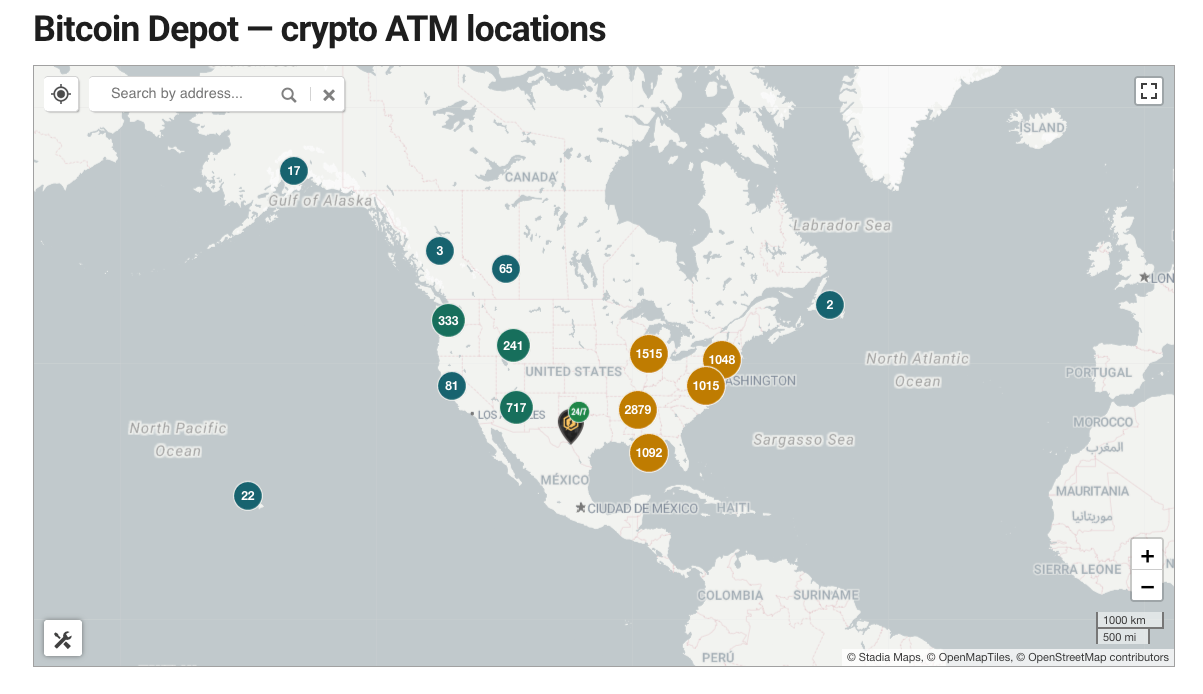
Bitcoin Depot, one of the largest Bitcoin ATM operators in the US, filed for Chapter 11 bankruptcy protection as the company moved to wind down operations and sell its assets.
In a Monday announcement, Atlanta-based Bitcoin Depot said it started voluntary Chapter 11 proceedings in the US Bankruptcy Court for the Southern District of Texas, citing mounting regulatory pressure and financial strain.
CEO Alex Holmes said the company strengthened anti-fraud protections in recent years, including stricter identity checks and lower transaction limits, but argued that growing compliance demands and enforcement actions made the business model “unsustainable.”
The filing marks one of the biggest collapses in the crypto ATM sector to date and highlights the increasing pressure facing companies that provide cash-to-crypto services in the US.
Thousands of Bitcoin ATMs taken offline
Bitcoin Depot said its network of Bitcoin ATMs has already been taken offline as part of the court-supervised restructuring process. The company operated more than 9,000 kiosk locations globally as of August 2025 and held one of the largest market shares in North America.
The company said the bankruptcy process is intended to support an “orderly wind-down” while allowing management to pursue a sale of its assets.
Bitcoin Depot’s first-day bankruptcy hearing is scheduled for Tuesday at 7:00 pm UTC, according to court information published on Kroll’s restructuring portal. The company appointed law firm Vinson & Elkins as legal adviser, while Portage Point Partners will oversee restructuring efforts.
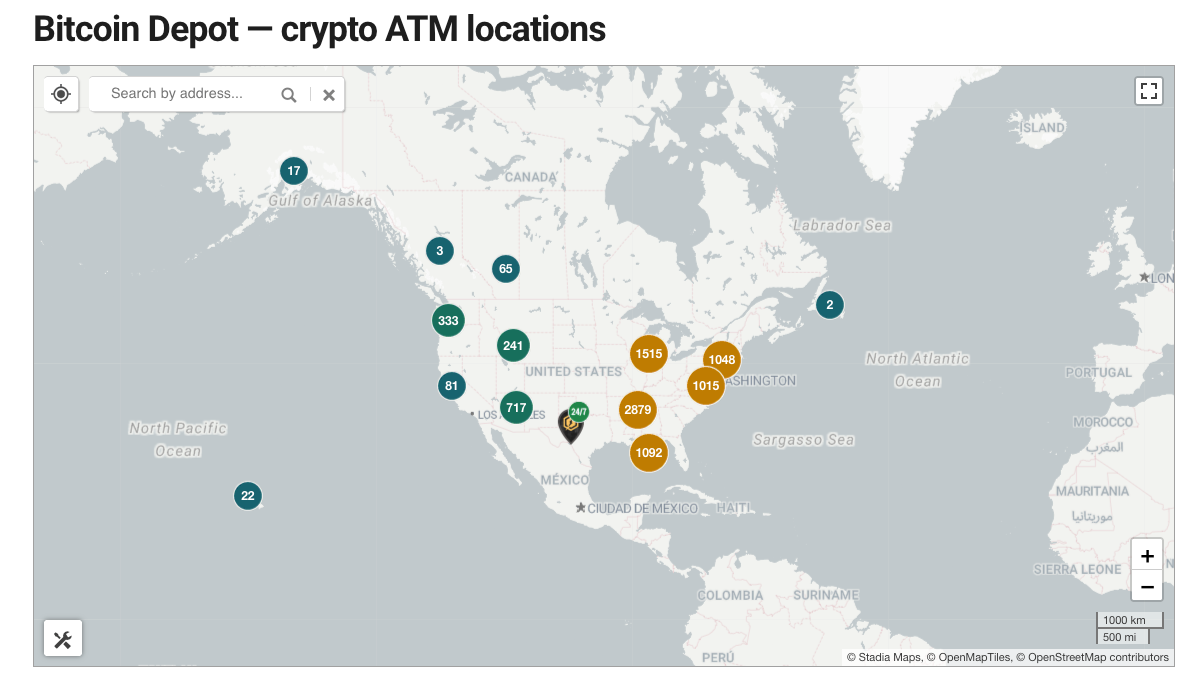
Bitcoin Depot’s crypto ATM locations. Source: CoinATMRadar
Bitcoin Depot’s Canadian entities are also included in the restructuring process, with separate proceedings expected to begin in Canada. The company added that its remaining non-US entities will shut down under local laws.
Regulatory pressure weighs on the crypto ATM industry
Crypto ATMs have become a popular on- and off-ramp, allowing users to buy Bitcoin with cash or withdraw cash by selling it.
However, regulators in several US states and Canada have been scrutinizing the sector, citing complaints tied to scams and fraud.
Operators in the sector have also faced lawsuits, while multiple jurisdictions have proposed blanket bans on crypto ATMs.
Bleak outlook for crypto ATM operators
Bitcoin Depot’s collapse may signal broader trouble ahead for the crypto ATM sector in the US as regulators tighten oversight of cash-to-crypto services.
“Bitcoin Depot’s bankruptcy is likely a preview of what the broader crypto ATM industry will face in the US over the next several years,” Roshan Dharia, CEO of Echo Base and a restructuring adviser, told Cointelegraph.
Dharia said the traditional crypto ATM business model relied on high transaction fees and relatively limited regulatory scrutiny to offset steep operating costs tied to compliance, cash handling, fraud remediation and revenue-sharing agreements with retail partners.
Related: Canada proposes crypto ATM ban over scams and money laundering
“That equation is breaking down as states increasingly impose consumer protection standards that compress fees, expand operator liability for scam-related activity, and raise expectations around transaction monitoring and reimbursement,” he said, adding:
“The result is that many crypto ATM operators may no longer be able to generate sufficient margin to support a nationwide network at scale.”
Bitcoin Depot shares plunged more than 70% in premarket trading following the bankruptcy announcement, according to TradingView data. Since debuting on the Nasdaq under the ticker “BTM” in July 2023, the company’s stock has fallen roughly 95% to about $2.93.
Magazine: How crypto laws changed in 2025 — and how they’ll change in 2026


Disclosure: This article does not represent investment advice. The content and materials featured on this page are for educational purposes only.
Lotment Capital expands multi-asset strategy access, including crypto investment tools for users.
Summary
- Lotment Capital offers diverse asset access including crypto, helping investors build flexible data-driven portfolios!!
- The platform combines analytics and trading tools, enabling users to manage strategies and respond to market changes!!!
- Lotment Capital provides diversified instruments including crypto to support structured data-driven investment decisions
Lotment Capital is committed to supporting users every step of the way, offering a wide range of tools and solutions that help them focus on decision-making and the implementation of their ideas. The company has created a system that combines a diverse range of assets, a functional platform, and the professional support of its team. This empowers clients to optimise their time and make data-driven decisions.
Diversity of investment areas
One of Lotment Capital advantages is access to a wide range of financial instruments. The company offers customers the opportunity to work with assets across various categories, including cryptocurrencies, paving the way for the creation of flexible and promising portfolios. This diversity allows investors to evaluate the strengths of each segment, combining tools with different characteristics and growth potential.
Working with multiple areas allows clients to develop a strategy that aligns with their personal goals and trading style. Some choose assets with stable dynamics, others prefer more innovative instruments or combine both approaches. Lotment Capital creates an environment where every investor can find a suitable option and effectively exploit its opportunities.
Furthermore, access to cryptocurrencies opens up additional opportunities, as this segment continues to grow rapidly. The ability to include digital assets in a portfolio makes working with the company particularly attractive for those seeking to make a profit on current market trends and unique conditions.
Advanced platform capabilities
A functional platform is the foundation of a successful investor, and Lotment Capital places special emphasis on this area. The company provides clients with access to a wide range of tools that help them analyse the market, manage trades, and build strategies based on current information.
The platform includes analytical solutions that allow the customer to track asset dynamics, identify patterns, and find new entry points. Thanks to its user-friendly interface, investors can quickly navigate data and make decisions based on objective information.
Additional trade management tools help clients effectively control customers’ positions. The ability to flexibly adjust parameters and quickly respond to market makes working more convenient and productive. The Lotment Capital platform is designed to ensure that every user can work in a comfortable environment and utilise all available features to their full potential.
Professional team support
Another key advantage of Lotment Capital is the ability to receive assistance from a team of experienced specialists. Clients can contact the company’s professionals for advice on specific situations or to create a comprehensive strategy tailored to their goals.
This support is especially valuable for those seeking to develop and improve their skills. Specialists help analyse the market, identify promising areas, and make decisions based on objective data. This allows clients to feel confident and move forward with a clear understanding of their steps.
Furthermore, the ability to receive individualised recommendations makes working with Lotment Capital more personalised. Each investor receives attention and support that helps them achieve their goals and maximise the market’s potential.
In summary
By combining a wide selection of assets, a functional platform, and professional support, Lotment Capital creates an atmosphere in which clients can confidently grow and achieve impressive results on an ongoing basis. The company strives to provide users with all the necessary tools and opportunities to help every investor realise their potential and build a successful strategy. This approach allows them to enjoy a comfortable trading environment.
The company’s format of interaction creates a solid foundation for long-term cooperation. This makes it a partner for those striving for success and looking to confidently move forward in the world of investing.
Disclosure: This content is provided by a third party. Neither crypto.news nor the author of this article endorses any product mentioned on this page. Users should conduct their own research before taking any action related to the company.

Key Highlights
- Zerohash obtains Electronic Money Institution authorization following MiCAR certification.
- Company becomes pioneering MiCAR-licensed entity to achieve complete Dutch EMI credentials.
- EMI authorization expands Zerohash’s capabilities for European stablecoin operations.
- Move reinforces company’s regulated digital asset payment infrastructure across EU.
- Dutch EMI credentials enhance Zerohash’s competitive stance in crypto services sector.
Zerohash Europe has obtained Electronic Money Institution authorization from De Nederlandsche Bank, establishing itself as the pioneering MiCAR-certified digital asset firm to achieve complete EMI credentials. This regulatory milestone provides the organization with expanded legal authority for cryptocurrency services and electronic payment operations. The approval solidifies Zerohash’s standing within Europe’s regulated blockchain asset ecosystem.
Electronic Money Authorization Broadens European Operations
The EMI authorization enables Zerohash to conduct conventional electronic payment activities throughout the European Economic Area. The organization can now facilitate payment transactions, stablecoin applications, and digital asset services under enhanced regulatory frameworks. This development establishes a transparent pathway for financial institutions, technology companies, trading platforms, and service providers requiring compliant operational infrastructure.
Zerohash obtained its MiCAR authorization in October 2025 from the Dutch Authority for the Financial Markets. MiCAR provides crypto-asset service operators with authorization to function throughout EU member states. Nevertheless, stablecoin-related transactions demand additional regulatory supervision under electronic money regulations.
The European Banking Authority implemented this regulatory distinction through official guidance issued in 2025 and subsequent clarifications published in 2026. The authority determined that certain electronic money token transactions fall within existing electronic payment regulatory frameworks. Consequently, the EMI authorization provides Zerohash with supplementary regulatory authority in areas where MiCAR certification alone might not encompass all service offerings.
Stablecoin Regulatory Framework Drives Strategic Expansion
The EMI authorization carries significant importance as European authorities continue developing comprehensive regulatory frameworks for stablecoins. Organizations processing stablecoin-enabled financial transactions require explicit authorization to integrate cryptocurrency infrastructure with conventional payment networks. Zerohash now possesses the capability to address this market need through combined MiCAR and EMI credentials.
The organization indicated that the dual authorization structure supports financial institutions, brokerage firms, payment processors, and enterprise platforms. It enables business partners to integrate cryptocurrency and stablecoin capabilities without developing comprehensive infrastructure internally. This operational approach aligns with Europe’s increasing demand for regulatory-compliant digital asset solutions.
Zerohash has strengthened its European operations from its Amsterdam headquarters in recent periods. The company currently provides services to Interactive Brokers Europe throughout the region. Furthermore, the EMI authorization strengthens the company’s market position as stablecoin utilization expands across payment systems, trading venues, and financial service platforms.
Capital Raising and Banking Charter Initiatives Provide Additional Perspective
Zerohash commenced operations in 2017 and currently maintains a workforce of approximately 200 employees globally. The organization operates facilities in New York, Chicago, North Carolina, and Amsterdam. The company successfully completed a $104 million Series D-2 financing round at a $1 billion corporate valuation.
The organization has additionally submitted an application to the U.S. Office of the Comptroller of the Currency seeking a national trust banking charter. This initiative demonstrates its strategic plan to expand regulated activities beyond European markets. The newly obtained EMI authorization adds strategic momentum to its worldwide regulatory compliance approach.
Industry reports also connect Zerohash to ongoing capital raising discussions following unsuccessful acquisition negotiations with Mastercard. The company reportedly seeks to raise $250 million at a $1.5 billion valuation. As a result, the EMI authorization reinforces its competitive market position as digital asset infrastructure providers compete for regulated enterprise clientele.



NYDIG says a rare bipartisan window to pass a comprehensive US crypto market‑structure bill could slam shut if Congress fails to move it before the August recess.
Summary
- NYDIG says the current bipartisan window for a comprehensive US crypto market-structure bill could close if Congress fails to move the legislation before the August recess.
- The bill would clarify digital asset classifications, split jurisdiction between the SEC and CFTC, and set unified operating standards for exchanges and crypto businesses.
- NYDIG warns prolonged uncertainty is already pushing capital and talent toward clearer regimes in the UAE, Singapore and the EU, and fears the US could slide back into regulatory stalemate.
Digital asset investment firm NYDIG has warned that the leading US crypto market-structure bill may effectively “fail” if it does not make substantial progress in Congress before lawmakers leave Washington for the August recess, according to FinanceFeeds. The firm argues that the fragile bipartisan consensus around a broad crypto regulatory framework amounts to a “brief window” that could slam shut once Congress returns to a calendar dominated by midterm elections, budget fights and partisan priorities.
August or bust for US market-structure reform
NYDIG’s assessment is blunt: if the bill does not advance “in the coming months,” the probability of passage “may significantly decrease” as legislative attention fragments and the political cost of tackling crypto grows. In that scenario, the US risks replaying the past several years of gridlock, with high-profile enforcement actions filling the vacuum left by the absence of a clear statutory market-structure regime.
At stake is one of the most ambitious attempts yet to build a comprehensive federal framework for digital assets in the US. The draft bill is designed to clarify how tokens are classified, draw a bright line between securities overseen by the SEC and commodities under the CFTC, and create unified operational standards for exchanges, brokers and other crypto businesses.
Core issues: SEC–CFTC lines, stablecoins and DeFi
According to the FinanceFeeds report, the proposed market-structure legislation would, for the first time, codify which digital assets fall under securities law and which are treated as commodities, addressing a long-running turf war between the SEC and CFTC. It would also establish common rules for trading venues and service providers, aiming to replace today’s patchwork of guidance, enforcement actions and state-by-state licensing with a single, more predictable regime.
But NYDIG notes that key issues remain unresolved, including stablecoin oversight, how to regulate DeFi protocols, the contours of consumer protection and how to handle conflicts of political interest. Those disagreements have slowed negotiations and raised doubts about whether lawmakers can lock in compromises before the August deadline.
The firm’s warning comes as global competition intensifies. NYDIG points out that extended US uncertainty is already driving capital, talent and innovation toward jurisdictions with clearer rules, citing the UAE, Singapore and the EU’s MiCA framework as examples of regions that are actively benefiting from America’s drift.
If Congress misses this legislative window, industry participants fear the US could again default to rulemaking by enforcement, with no durable settlement on market structure for years. That would leave exchanges, issuers and developers operating under legal ambiguity just as other financial centers lock in their own digital-asset regimes and pitch themselves as safer homes for long-term investment.

one girl said bloom app #genzfinance #finance #investing

Racist abuse against Cleveland Police officers on the rise

Berkshire Sold Stocks in First Quarter. 6 Takeaways and a Buffett Mystery.

Manchester United reach agreement with Casemiro over contract clause amid transfer speculation

US brings back mandatory military draft registration

Steven Gerrard disagrees with Gary Neville over ‘shock’ Chelsea and Arsenal claim | Football


-

 Crypto World3 days ago
BloFin War of Whales 2026 Grand Prix opens registration for $5M trading championship
-

 Fashion3 days ago
Weekend Open Thread: Theory – Corporette.com
-

 Crypto World3 days ago
E-Estate Announces 1 Year Live: Washington DC Summit as Real Estate Tokenization Enters Its Next Phase
-

 Tech4 days ago
Tech Moves: Microsoft AI leader jumps to OpenAI; former AI2 exec joins Meta; and more
-
Crypto World6 days ago
Bitcoin Suisse expands with Digital Asset License and Investment Business Act Registration Approval in Bermuda
-

 Politics6 days ago
Pakistan to enter Chinese capital market as war inflation bites
-

 Crypto World6 days ago
Bitcoin Suisse expands with Digital Asset License and Investment Business Act Registration Approval in Bermuda
-
 Crypto World5 days ago
Google’s Gemini AI Predicts Incredible Solana Price by the End of 2026
-

 Business3 days ago
H&R Real Estate Investment Trust (HR.UN:CA) Q1 2026 Earnings Call Transcript
-

 Tech3 days ago
Google reimburses Register sources who were victims of API fraud
-

 Sports3 days ago
Napoleonic enters 2026 Doomben 10,000 field via Abounding withdrawal
-

 NewsBeat6 days ago
Comment on Keir Starmer surviving the day as Prime Minister like a turd that wont flush
-

 Fashion6 days ago
The Best-Kept Makeup Secret for a More Defined Face
-
 Entertainment4 days ago
Zara Larsson Has Blunt Response To Chris Brown Diss
-

 Politics7 days ago
The Trial of Majid Freeman, Verdict
-

 Politics6 days ago
Palestine’s flag becoming a regular sight at European football stadiums
-
 Tech6 days ago
Why AI is making typography a boardroom conversation
-
 Crypto World5 days ago
Two AI Tokens Lead May Rally, But Risks Are Rising
-

 Crypto World6 days ago
Senate Approves Kevin Warsh to Federal Reserve Board Seat
-

 Politics6 days ago
The 81 MPs (so far) who have demanded tick-like Starmer out
You must be logged in to post a comment Login