
Crypto World
Binance uses MiCA workaround to keep some EU customers: report



Binance has continued serving and onboarding some European Union customers more than two months after missing the bloc’s MiCA licensing deadline, using regulatory provisions and offshore routing while it seeks authorization elsewhere.
Summary
- Binance continues serving some EU customers despite missing the July 1 MiCA licensing deadline and withdrawing its Greek application in June.
- The exchange has relied on reverse solicitation to onboard customers who approach it independently, while some EU trading has been routed through an Abu Dhabi entity.
- ESMA has sought confirmation that Binance is properly winding down its EU operations as the exchange works toward securing MiCA authorization elsewhere.
- Binance still controlled more than 45% of global spot trading volume in late August, while its euro trading share remained largely unchanged from before the MiCA deadline.
According to a Bloomberg report, the world’s largest crypto exchange has remained active in parts of the 27-member bloc despite withdrawing its Greek Markets in Crypto-Assets application in June and entering July without the authorization required for EU-wide operations.
People familiar with the matter said Binance has relied partly on MiCA’s “reverse solicitation” provision, which permits certain services when customers approach an unlicensed crypto company on their own initiative instead of being targeted through marketing. Binance has interpreted the provision as allowing it to onboard new customers who independently seek out the platform, the people said.
Trading for some EU-based customers has meanwhile been routed through a Binance entity in Abu Dhabi, where the business operates under a different regulatory framework, according to the report.
The arrangements have allowed Binance to maintain part of its European business while pursuing MiCA authorization. Binance said in a statement that it follows regulations in jurisdictions where it operates and remains committed to doing business in the EU on a “long-term, compliant basis.”
“We are actively working toward becoming MiCA-authorised and view this as an important step in providing users with a consistent, regulated, and trusted service across the European market,” the exchange said.
Binance has kept some EU customers after the MiCA deadline
Binance’s continued presence follows months of uncertainty over what would happen to its European operations after the July 1 licensing cutoff.
Crypto.news previously reported that Binance was still opening EU accounts in August, more than seven weeks after the deadline. Tests across Austria, France, Germany, Spain and Belgium found that some new users could complete registration and identity verification, while crypto deposits remained available on active accounts.
One account created on Aug. 19 using a European identity document and residential address was verified and subsequently funded with cryptocurrency. Binance remained absent from the European Securities and Markets Authority’s register of authorized crypto providers.
MiCA requires crypto asset service providers to secure authorization from a regulator in one EU member state. Once approved, a license can be used to provide covered services across participating markets in the bloc.
ESMA had instructed unauthorized providers before the deadline to stop onboarding new EU customers and limit remaining services to steps required for customers to exit. By July 1, those companies were expected to have implemented their wind-down plans.
For Binance, the change affected customers differently depending on where they lived. In France, Spain, Italy, Poland, Sweden and Lithuania, where Binance previously maintained local entities, customers received multiple emails asking them to leave the exchange, Bloomberg reported.
Most affected accounts were restricted to withdrawals instead of active trading, although some customers were subsequently allowed to return under Binance’s interpretation of reverse solicitation.
Binance had told customers that assets would remain accessible when MiCA service changes began on July 1. CEO Richard Teng said affected users would retain access to previously communicated options, including withdrawals.
Greek MiCA application ended before a regulatory decision
Binance had sought to obtain its MiCA authorization through Greece, which would have given the exchange access to customers across the EU through the regulation’s passporting system.
Its prospects deteriorated in June as scrutiny of the application increased. The Hellenic Capital Market Commission was expected to consider Binance’s application at a board meeting on June 17, according to Bloomberg, but the company withdrew the filing on June 16. The regulator said no decision was therefore made.
Before the withdrawal, Binance maintained that it had received no formal indication that its application would be rejected. The exchange said it believed it had met the relevant MiCA requirements.
Concerns over the Greek application had surfaced earlier in June when the licensing process moved toward rejection, putting Binance’s ability to continue serving EU customers after the transition period at risk.
European Central Bank President Christine Lagarde personally intervened behind the scenes to prevent the application from being approved, Bloomberg reported, citing people familiar with the matter. The ECB declined to comment.
Reports of Lagarde’s involvement had emerged while Binance’s Greek licensing bid stalled ahead of the deadline. Binance maintained at the time that its application met MiCA requirements and warned that delays to authorization could affect competition and liquidity.
As the Greek process ran into trouble, Binance said it would pursue another EU route if the application did not advance. The exchange has yet to publicly confirm which member state could handle its next application.
ESMA has sought details on Binance’s EU wind-down
European regulators have continued examining how the exchange is handling customers without a MiCA license.
ESMA recently contacted Binance seeking confirmation that the company was appropriately winding down its EU business, Bloomberg reported, citing people familiar with the communication. The authority declined to discuss an individual company and said national regulators are responsible for imposing sanctions over non-compliance.
Binance’s interpretation of reverse solicitation has become particularly relevant because the exemption depends on a customer initiating contact without being solicited by the provider.
Nina-Luisa Siedler, a lecturer at the Berlin University of Applied Sciences who advises companies on MiCA compliance, told Bloomberg that failing to receive a license does not automatically require Binance to close every account belonging to European customers.
“The fact that they did not obtain the license does not necessarily mean that they need to close all accounts they have for European customers,” Siedler said.
Restrictions have nevertheless remained in place in individual markets. Binance users in France lost access to trading after the July 1 deadline, including spot and margin trading, while withdrawals remained available.
The exchange’s app availability has varied across the bloc. In late July, the Binance app disappeared from Google Play in some EU countries, including reports from users in Spain and Latvia, while it remained available in Poland. Binance attributed the changes to updates in Google Play policies affecting crypto applications in certain markets.
Binance trading activity has held up despite MiCA restrictions
The regulatory setback has not substantially changed Binance’s position as the largest crypto exchange globally.
Kaiko data cited by Bloomberg showed Binance accounted for more than 45% of global spot crypto trading volume in late August. Its share of euro-denominated trading stood between 3% and 4%, a measure that does not capture every transaction involving European customers.
The euro trading share was not meaningfully different from levels recorded before the July 1 deadline, according to the report.
Binance has remained among the most downloaded crypto trading applications through Apple’s App Store in the EU, with its position showing little change over recent months.
Licensed competitors have entered the post-transition market under a different regulatory status. Coinbase and other approved providers can use MiCA passporting rights to offer covered services across EU member states, while Binance continues looking for another licensing route.
The exchange’s European difficulties follow its $4.3 billion settlement with U.S. authorities in 2023 over anti-money laundering, sanctions and unlicensed money transmission violations. Co-founder Changpeng Zhao separately pleaded guilty to failing to maintain an effective anti-money laundering program, served a prison sentence and was pardoned by U.S. President Donald Trump last year.
Binance has since increased its compliance spending and cooperation with authorities. In June, the exchange said its annual compliance spending reached $300 million and reported handling more than 313,000 law enforcement requests globally.
Its next MiCA application remains unresolved. Binance had been preparing to seek authorization from an EU member state other than Greece, according to Bloomberg, but the jurisdiction where it may file has not been confirmed.



South Korea’s Financial Services Commission (SFC) introduced a three-phase roadmap to develop infrastructure for tokenized securities issuance, for assets including stocks, bonds and funds.
Starting Feb. 4, 2027, tokenized securities will be legally recognized as digitized forms of securities after an update to the Act on Electronic Registration of Stocks and Bonds is scheduled to take effect, the FSC revealed in a Friday press release.
The first phase will offer tokenized securities legal recognition, including for institutional money market funds, bonds, unlisted stocks and fractional investment securities. Phase two would expand tokenization to all publicly offered securities, while phase three aims for onchain payments linked to stablecoins.
The roadmap is part of a planned implementation of the amended Capital Markets Act and Electronic Securities Act, the country’s first tokenized securities framework, scheduled to take full effect on Feb. 4.
Next, the FSC plans to propose revisions to relevant subordinate regulations by the end of September and decide the timeline for the second and third phase of the roadmap. Before the roadmap’s initiation, the FSC said it will work with the Korea Securities Depository (KSD) to develop the relevant tokenization infrastructure.
South Korean regulators have been moving closer to a regulatory framework for tokenized assets. In May, the FSC said it would release detailed tokenized securities rules to bring them under the country’s capital markets framework in 2027.
In April, South Korea’s Ministry of Economy and Finance announced a pilot project that will use tokenized deposits to execute government operational spending, with a full rollout set for the fourth quarter of 2026.
Related: South Korea to bring digital assets under new state asset management system
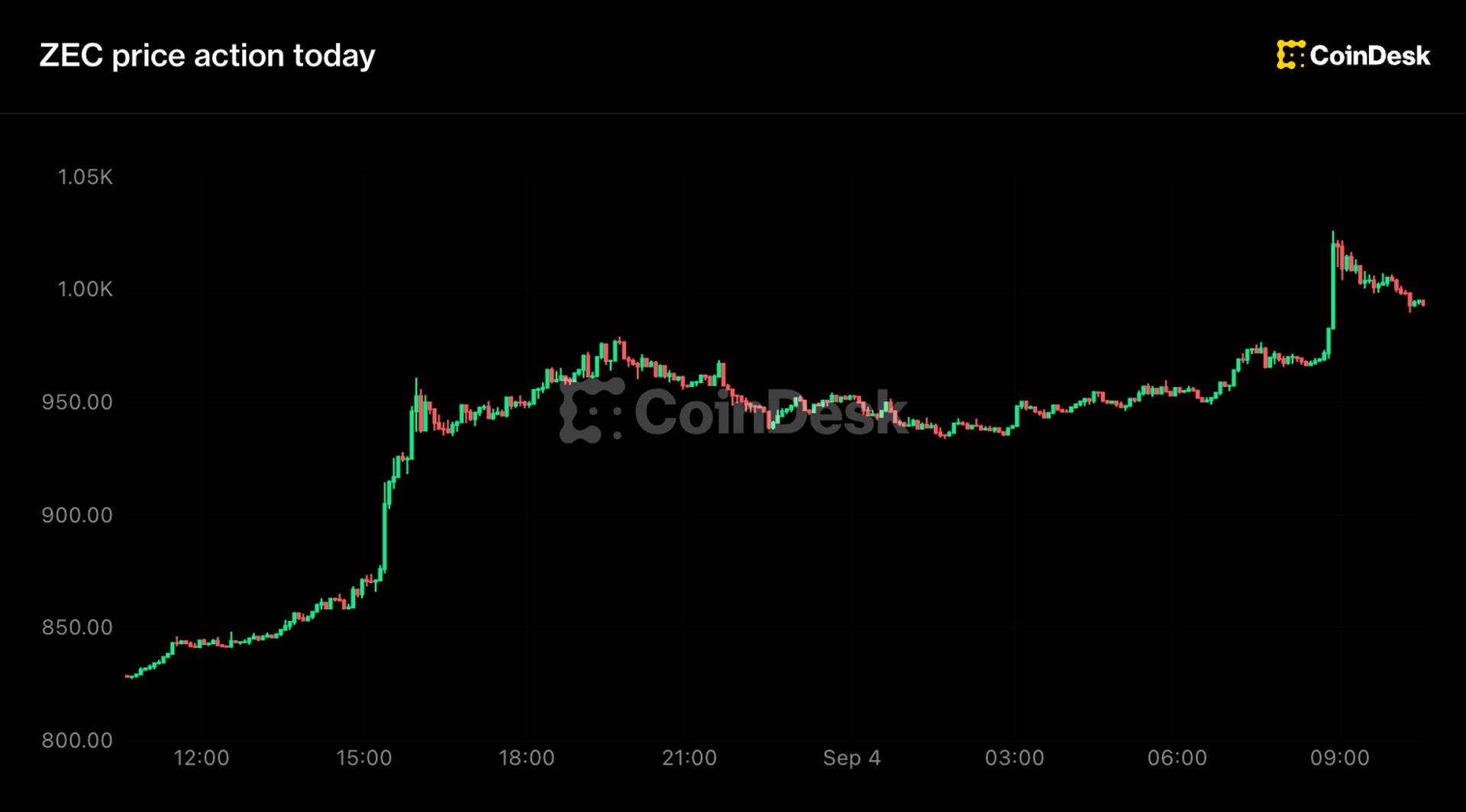
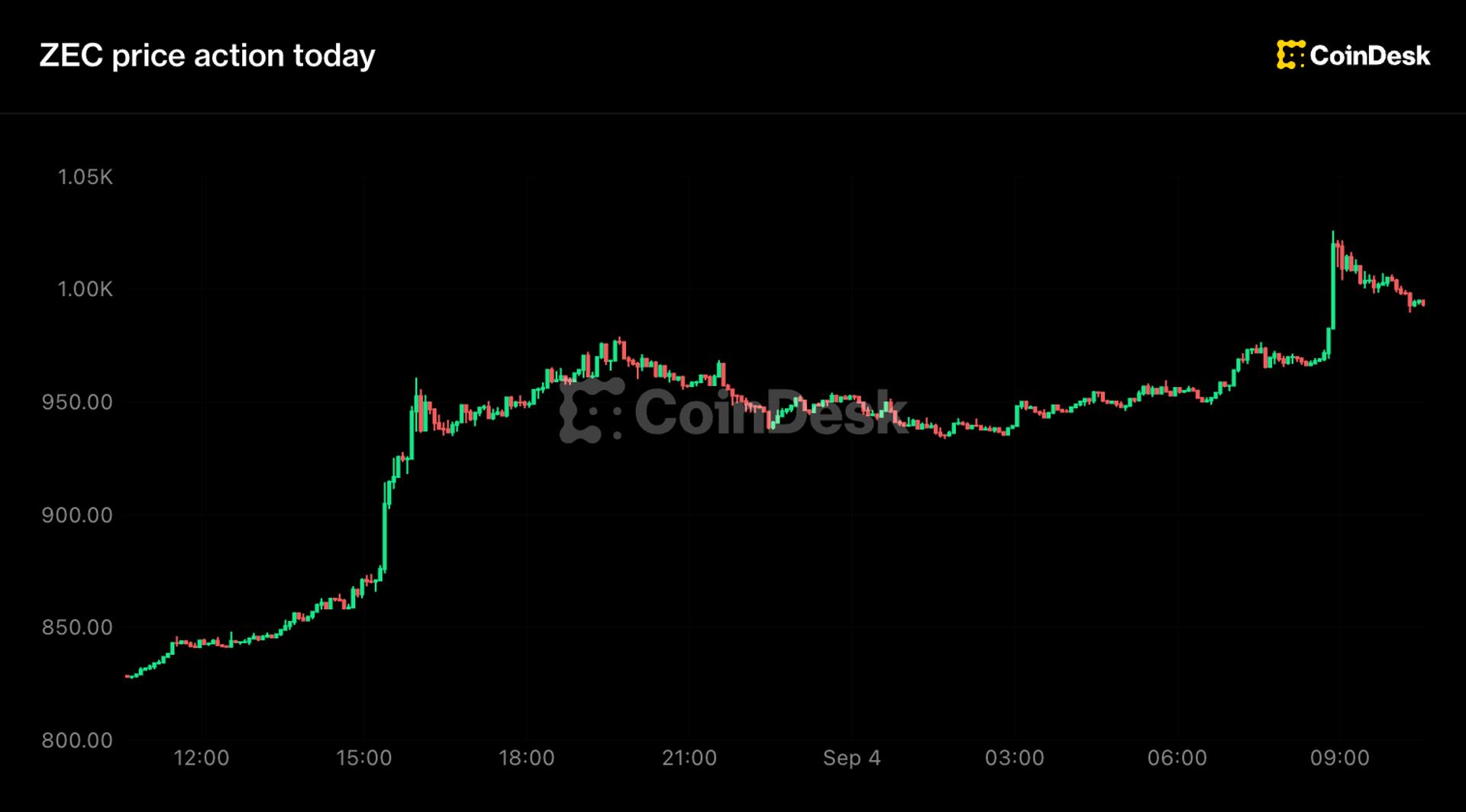
ZEC briefly traded above $1,020 as a sharp rally forced traders betting against the token out of leveraged positions.
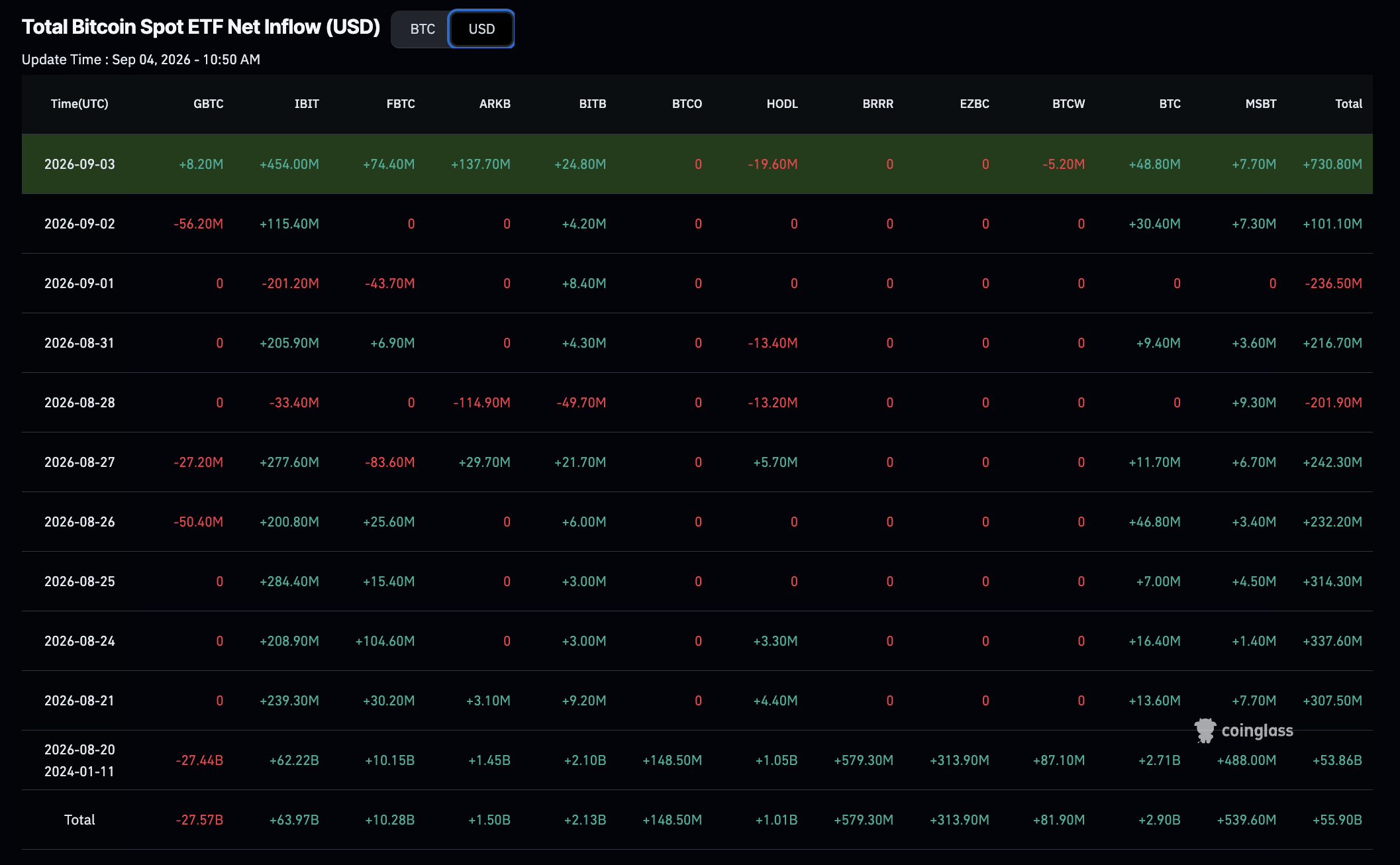
U.S. spot Bitcoin ETF recorded $730.8 million in net inflows on September 3. BlackRock’s IBIT led the session with $454 million in net inflows. That was well over half of the total.
The result offers a fund-by-fund view of where net creations and redemptions were recorded for the day. The daily flow figures can be revised as late fund reports are received, so totals should be read as tracker data for the reported trading session.

Discover: The Best Crypto to Diversify Your Portfolio
IBIT Bitcoin ETF Dominance Leaves the Rally Concentrated
IBIT’s $454.0 million inflow was substantially larger than that of the other funds reporting positive flows on September 3. ARK 21Shares’ ARKB recorded $137.7 million, while Fidelity’s FBTC recorded $74.4 million. Together, those three funds accounted for the bulk of the day’s reported positive flows.
Several additional products also recorded inflows. Grayscale’s Bitcoin Mini Trust, listed as BTC in the tracker, added $48.8 million. Bitwise’s BITB added $24.8 million, Grayscale’s GBTC added $8.2 million, and Morgan Stanley’s MSBT added $7.7 million.

The daily breakdown was not positive across every product. VanEck’s HODL recorded a $19.6 million net outflow, while WisdomTree’s BTCW recorded a $5.2 million net outflow. Franklin’s EZBC, Invesco Galaxy’s BTCO, and CoinShares’ BRRR each showed zero flow in the tracker for the date.
The concentration in IBIT is an important context for the $730.8 million headline figure. A large complex-wide total can include different outcomes among individual funds, and the September 3 data show that the largest contribution came from one product.
Earn $50 and Enter $300K Prize Draw on EdgeX
What Would Confirm the Trend
One day’s flow data provides a snapshot rather than a complete pattern. The tracker shows that daily totals can vary materially from one session to the next, including both inflow and outflow days in its historical table. It also explains that a daily figure represents net creations or redemptions across the funds.
For readers assessing the September 3 total, the useful distinctions are the overall net flow, the distribution of flows among issuers, and the possibility of later revisions. The table below separates the reported fund-level results from the complex-wide total.
Coinfuty describes its tracker as covering daily creations and redemptions, total net assets, Bitcoin held in trust, and premium or discount to net asset value. It says figures are updated once per U.S. trading day and that a dash can indicate that a fund has not yet reported rather than a zero value.
Discover: The Best Token Presales
The post Bitcoin ETF News: BlackRock IBIT Captures 62% of Inflows appeared first on Cryptonews.


South Korea has laid out a three-stage plan to bring stocks, bonds and funds onto tokenized infrastructure, with the final phase set to connect securities settlement to stablecoin-based onchain payments.
Summary
- South Korea will begin expanding tokenized securities in February 2027, starting with selected funds, bonds, unlisted stocks and fractional investment products.
- The second phase will open tokenization to all publicly offered securities, while the final stage will introduce onchain payment infrastructure linked to stablecoins.
- Existing licensed financial firms will be allowed to handle tokenized securities under their current licenses, while qualifying issuers can manage their own securities accounts.
- Retail subscriptions will be capped at the lower of 30 million won or 5% of an issuance, with annual net purchases on OTC exchanges limited to 100 million won.
The Financial Services Commission said Friday that the roadmap will begin when amendments to the Electronic Registration Act take effect on Feb. 4, 2027, expanding tokenization beyond fractional investment products and creating a legal route for conventional securities to be issued and managed through distributed ledgers.
FSC Vice Chairman Kwon Dae-young unveiled the policy at the third meeting of a public-private consultative group attended by the Financial Supervisory Service, financial institutions, industry groups and private-sector experts.
Authorities plan to build the system in stages, starting with a limited group of securities and institutional products before opening tokenization to publicly offered securities and eventually connecting the market to stablecoin settlement.
“Authorities will seek to lay foundations to facilitate the tokenized issuance and circulation of more traditional types of securities, including stocks, bonds, and funds,” Kwon said, describing a longer-term plan to upgrade capital market infrastructure for digital connectivity.
South Korea tokenization plan starts in February 2027
During the first phase, privately pooled money market funds and bonds reserved for institutional investors will become eligible for tokenization. Unlisted stocks issued through trust structures and publicly offered fractional investment securities will fall within the initial framework as well.
The rollout builds on amendments passed by South Korea’s National Assembly in January that recognize distributed ledgers as securities registries while keeping tokenized instruments within the country’s existing securities laws. Crypto.news previously reported that the tokenized securities rules were scheduled to take effect in February 2027 as regulators worked on standards covering issuance, trading and settlement.
Technical infrastructure is being prepared alongside the legal framework. Samsung SDS won a contract earlier this year to develop a token securities platform for the Korea Securities Depository, with completion expected around the time the amended laws take effect.
The system is expected to connect the KSD’s existing electronic securities account infrastructure with blockchain records, covering issuance, circulation checks, rights management and monitoring.
South Korea’s second phase would open tokenization to all publicly offered securities. Regulators have not fixed a start date because implementation will depend on results from the first stage and the pace at which financial companies adopt the required technology.
Stablecoins form the final settlement layer
The third phase would introduce onchain payment infrastructure linked to stablecoins, bringing the cash side of securities transactions onto digital rails.
Its timing remains dependent on pending stablecoin legislation as well as the results of the earlier tokenization stages. South Korean lawmakers have been working separately on a Digital Asset Framework Act expected to cover stablecoin issuance and other parts of the digital asset market.
In August, the FSC said it would accelerate consultations on the legislation as lawmakers sought to complete the framework during the fall session. Stablecoin rules have remained one of the main unresolved parts of South Korea’s digital asset regulatory program.
Tokenized settlement is already being tested outside the planned securities framework. A separate South Korean program has expanded deposit-token trials to nine banks, while the Bank of Korea has studied the use of tokenized bank deposits as settlement money for tokenized bonds and shares.
Private financial institutions are running their own trials ahead of the 2027 legal rollout. Shinhan Asset Management recently signed an agreement to test a tokenized fund denominated in Korean won using Solana, covering investor verification, issuance, distribution and onchain liquidity in a proof of concept.
Retail limits will apply to tokenized securities
The FSC’s roadmap sets investment limits and operating requirements as regulators prepare to bring more securities onto distributed ledgers.
For non-monetary trust beneficiary certificates, the maximum individual subscription would be the lower of 30 million won, roughly $22,000, or 5% of the total issuance volume. Regulators want publicly offered allocations to include a portion reserved for retail investors, with a minimum amount distributed equally.
Retail investors using over-the-counter exchanges will face an annual net purchase ceiling of 100 million won, or roughly $74,000, on each OTC platform.
Existing financial investment companies will not need a separate authorization solely because they handle tokenized securities. Firms already licensed for the relevant financial activity can operate within their existing permitted business areas, although intermediaries handling tokenized securities on OTC markets will need prior consultation with the Financial Supervisory Service.
Authorities plan to introduce another OTC licensing category for debt securities alongside existing categories covering unlisted stocks and non-monetary trust beneficiary certificates. The FSC expects debt-security transactions to become more common as tokenization develops.
Issuers will have another route through the new “issuer account management entity” structure. Companies approved under the system can manage securities accounts themselves instead of relying exclusively on financial institutions.
Applicants must maintain at least 4 billion won, or close to $3 million, in equity capital. Staffing requirements include personnel responsible for account management and internal controls, along with two employees assigned to computer and IT systems. Issuers must meet specified cybersecurity and technology standards.
The Korea Securities Depository has prepared screening criteria for distributed ledgers used by securities firms. Tests will cover core issuance and circulation functions as well as contingency procedures for system failures and other disruptions.
Asian markets are testing blockchain settlement
South Korea’s plan is developing alongside blockchain settlement projects elsewhere in Asia.
Japan is studying a system that could eventually process publicly traded stocks and Japanese government bonds on blockchain infrastructure around the clock. The Financial Services Agency, Ministry of Finance, Bank of Japan and financial institutions are expected to participate, with an initial development plan targeted for early 2027 and possible operations during the 2030s.
Japanese institutions have already begun testing parts of that model. Four Mitsubishi UFJ Financial Group companies launched a proof of concept in August to test JGB repo settlement on Canton Network, examining automated processing and 24-hour settlement. Tokenized deposits or stablecoins are being considered for the payment side of those transactions.
Asia accounted for 30% of global stablecoin trading activity in 2025 and recorded the highest regional growth rate in crypto activity, according to an OECD report cited in the source material.
South Korea itself had 11.3 million verified crypto users, according to FSC data, giving regulators a sizable domestic digital asset market as the securities framework moves toward implementation.
The FSC plans to publish proposed revisions to subordinate regulations under the Financial Investment Services and Capital Markets Act and Electronic Registration Act by the end of September. Securities companies and the Korea Securities Depository will work on the required infrastructure before the first phase begins in February 2027.

The hardware wallet manufacturer revealed in a new update from September 4 that another 67,000 customers in the United States had their personal information exposed in the breach at its shipping provider, ShipMonk.
These clients placed orders between November 2019 and August 2021, meaning some of the compromised records were almost seven years old.
CryptoPotato reported last month that Trezor had initially said the ShipMonk breach affected approximately 13,689 customers. The timing was quite peculiar as it came amid the Coldcard saga, and investors’ confidence was already shaken.
12,742 of the entire amount had their names, emails, phone numbers, and shipping addresses exposed, while another 1,947 had more limited information compromised.
The latest discovery, though, shed some more worrisome light on the incident, as much older customer information remained in ShipMonk’s systems. Trezor said it had repeatedly requested – and received, written assurances from the logistics provider confirming that the data had been deleted in accordance with its contract and data policy.
“We are very disappointed that, despite receiving this confirmation, the data was not deleted in their systems,” reads the update on X.
Adding the newly identified 67,000 customers brings the known number of affected users to more than 80,000. The hardware wallet provider noted that all newly affected customers have been contacted directly by email and explained that users who have not received a notification are not believed to be impacted.
Trezor’s team emphasized that its own systems were not compromised and that its wallets remain secure. Private keys and wallet backups were not exposed in the ShipMonk incident.
However, the danger comes from criminals possessing detailed information identifying people are hardware wallet customers. The company warned affected users to be particularly cautious of fake emails, fraudulent phone calls, and physical letters.
The update also highlighted potential physical security risks, which have become a considerably more serious issue lately.
The post Trezor Breach Is Much Bigger Than Initially Thought: Another 67,000 Customers Exposed appeared first on CryptoPotato.
The wild nature of the cryptocurrency markets has returned for some major altcoins, such as the privacy coin leader, Zcash (ZEC). The token skyrocketed to a new multi-year peak of just over $1,000 earlier today.
The move caught many traders, including Garrett Jin, unprepared. Data from Lookonchain outlined his massive loss due to a short squeeze.
The analysts provided a screenshot from a wallet linked to Jin, showing that he had entered a massive short for 32,760 ZEC (currently worth over $33 million) at prices well below the current level of $444.
Given the asset’s substantial rally in the past several days, Jin had to add to his short position over time before ultimately realizing a loss of over $18.5 million.
As $ZEC broke above $1,000, Garrett Jin (@GarrettBullish) has lost over $18.5M on his 32,760 $ZEC ($33.11M) short.https://t.co/bLk5NAoS2r pic.twitter.com/YiAA6oySEo
— Lookonchain (@lookonchain) September 4, 2026
The privacy coin is among the top performers in the past 24 hours. Its daily gains stand at over 21% as of now, as its price jumped to $1,020 for the first time in eight years. Moreover, ZEC’s value has doubled since the market broke out on August 19, when it traded at around $500.
Data from CoinGlass indicated that the total value of wrecked ZEC positions is up to $36 million, meaning Jin’s wipeout accounted for half of it.
The post Garrett Jin’s ZEC Short Bleeds Over $18M as Zcash Explodes Past $1,000 appeared first on CryptoPotato.

Another thing we can combat individually is the urge to check our messages every time we have a spare minute. Pulling out our phones is often a convenient way to avoid negative emotions or awkward encounters. Yet all this task switching leaves us distracted and depleted, and I can’t realistically handle any of the issues in the emails I read in the 30 seconds it takes to walk from my yoga class to my car.
It stands to reason that our brains would be less foggy if we used those small slices of our lives to take a deep breath, notice our surroundings, and have short, pleasant interactions with the people around us. When we returned to our desks, we’d think more clearly, work more efficiently, and send better responses.
This Labor Day, there’s a way for workers to be healthier, happier, more productive, and solve a lot of our public policy problems, too. We need to stop working when we’re not working.
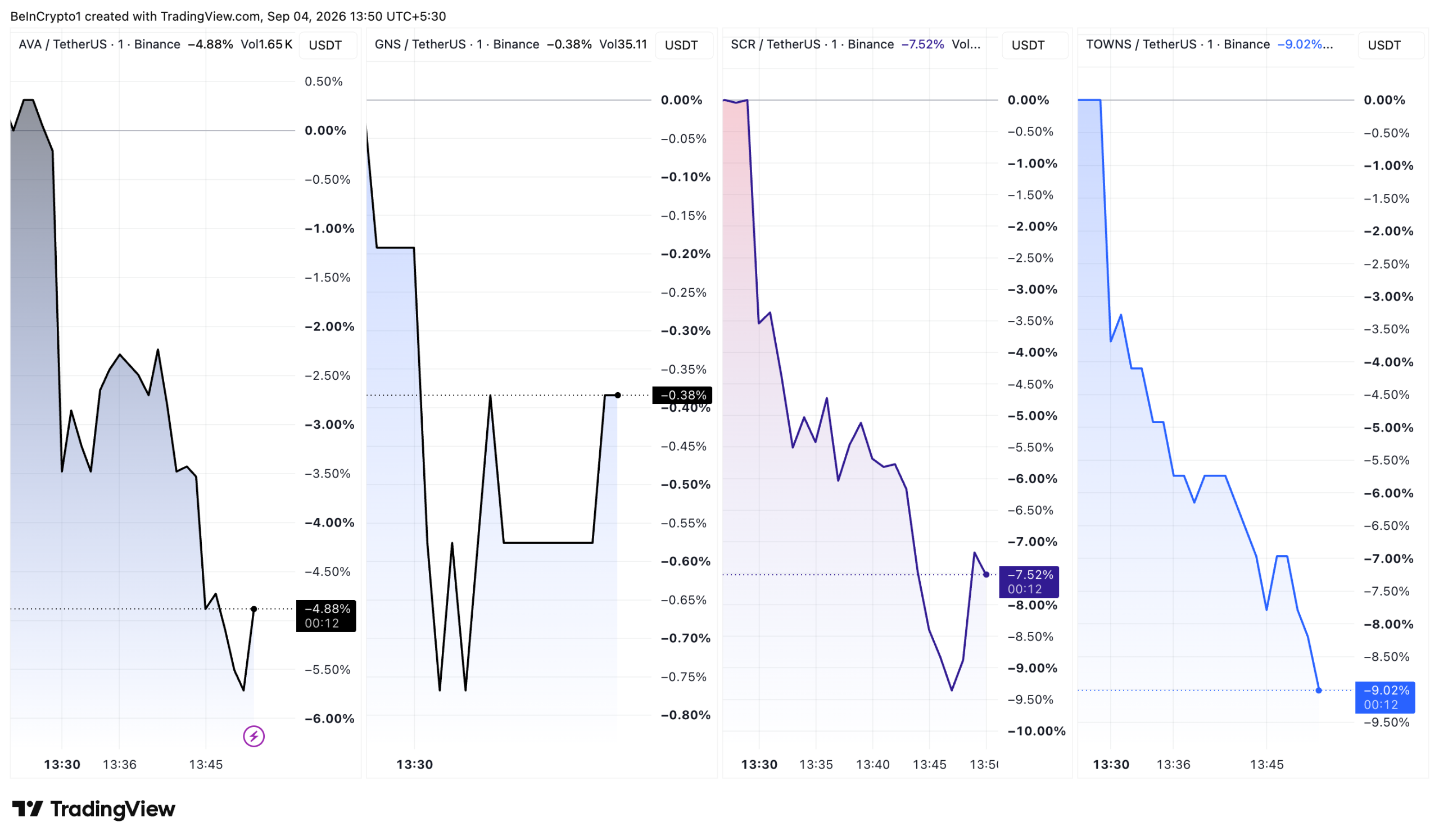
Binance applied its Monitoring Tag to AVA (AVA), Gains Network (GNS), Scroll (SCR), and Towns Protocol (TOWNS) on September 4. The label places all four tokens under closer review.
Traders reacted quickly. All four tokens dropped following the announcement.
What Does the Binance Monitoring Tag Mean?
Binance uses the tag to flag assets that are more volatile and riskier than the rest of its listings. Tagged tokens face repeat reviews and can lose their listing entirely.
“Keep in mind that tokens with the Monitoring Tag are at risk of no longer meeting our listing criteria and being delisted from the platform,” the team said.
Binance weighs team commitment, development activity, trading volume, liquidity, network stability, and tokenomics changes during each review.
The recent record gives the label weight. Binance delisted Across Protocol (ACX), Hashflow (HFT), PIVX, Vulcan Forged PYR (PYR), Vanar (VANRY), and Viction (VIC) last month, and all had been tagged earlier.
The pattern repeated weeks later. Binance removed ICON (ICX), Secret (SCRT), and Storj (STORJ) from spot trading on September 3. All three had received the tag first, ICX as recently as August 11.
Follow us on X to get the latest news as it happens
Scroll and Towns Protocol Lead the Selloff
The market priced that history in almost immediately. TOWNS slid 9.02% in the minutes after the announcement. SCR traded near $0.0214 after the notice, down 7.5%, with about $1.6 million in trading volume on Binance.

AVA dropped 4.88%. GNS managed to recover some of its losses and was down 0.38% at press time. Binance said other services tied to the four tokens remain unaffected.
The tag does not commit Binance to a delisting. However, the last few removal rounds drew from the tagged list, raising risks.
Subscribe to our YouTube channel to watch leaders and journalists provide expert insights
The post Binance Adds Monitoring Tag to 4 Tokens, Signaling Delisting Risk appeared first on BeInCrypto.
Crypto World
IMF confirms El Salvador’s bitcoin growth was funded by private donations, not public money


The IMF confirmed that all bitcoin added to official holdings since June 2025 was sourced from private donations, with no public funds used for accumulation.


U.S. spot Bitcoin ETFs have recorded $730.9 million in net inflows in their strongest single trading session since mid-January, led by more than $450 million entering BlackRock’s iShares Bitcoin Trust.
Summary
- U.S. spot Bitcoin ETFs recorded $731 million in net inflows on Sept. 3, their strongest single trading day since January.
- BlackRock’s IBIT led the session with $454 million, followed by $138 million for ARKB and roughly $74 million for Fidelity’s FBTC.
- Combined Bitcoin ETF net assets reached $103.34 billion, equal to just over 6% of Bitcoin’s market capitalization.
- The inflows followed a $236 million withdrawal on Sept. 1, when IBIT alone recorded roughly $201 million in redemptions.
According to SoSoValue data for Sept. 3, the group posted its largest daily inflow since Jan. 14, when the funds attracted $843.6 million, pushing cumulative net inflows since their January 2024 launch to $55.44 billion.
Bitcoin ETF inflows reach $731 million
BlackRock’s IBIT accounted for $454 million of Thursday’s inflows, representing more than 60% of the total. The latest allocation brought the fund’s cumulative net inflows to $63.94 billion.
ARK Invest and 21Shares’ ARKB ranked second with $138 million, while Fidelity’s FBTC received roughly $74 million. Grayscale’s two Bitcoin products drew a combined $57 million during the session.
VanEck’s HODL and WisdomTree’s BTCW were the only products to record withdrawals. HODL lost close to $20 million, while approximately $5 million left BTCW.
The inflows arrived as Bitcoin rebounded sharply, with the U.S.-listed funds gaining between 5.7% and 5.9% during Thursday’s trading session. Their combined net assets climbed to $103.34 billion, equivalent to 6.32% of Bitcoin’s market capitalization.
Thursday’s result was more than three times the size of any single daily inflow recorded during an 11-session run of positive flows in late August.
The latest buying followed an active August for the products. U.S. Bitcoin ETFs collected $1.92 billion during the five trading sessions ending Aug. 21, when Bitcoin and Ether ETFs together attracted $2.61 billion in their strongest combined week since October 2025.
Bitcoin funds accounted for roughly 73% of those flows, while spot Ether ETFs received $697.47 million during the same five-day period.
BlackRock’s IBIT remains the main source of ETF demand
IBIT has repeatedly accounted for a large share of the money entering U.S. spot Bitcoin ETFs during recent periods of buying.
Crypto.news previously reported that the funds attracted $853.5 million over five days from Aug. 3 through Aug. 7. BlackRock’s fund brought in an estimated $693 million during the run, equivalent to roughly 81% of the group’s total inflows.
The pattern continued later in August. QCP Capital said Bitcoin’s advance from approximately $63,500 to above $80,000 was supported by spot buying while futures positioning declined. During part of the rally, spot Bitcoin ETFs drew $2.8 billion across eight consecutive sessions.
Futures open interest fell from 646,000 BTC to 588,000 BTC as Bitcoin advanced, according to QCP, separating the price move from rallies driven primarily by an increase in leveraged positions.
IBIT has remained the largest U.S. spot Bitcoin ETF by assets through the changes in daily flows. BlackRock had reported $60.52 billion in net assets for the fund as of Aug. 26, before Bitcoin’s latest advance and Thursday’s increase in ETF asset values.
Institutional filings have shown large positions in the fund as well. Jane Street reported more than $1 billion in U.S. spot Bitcoin ETF shares as of June 30, including approximately $828 million in IBIT. The quarterly filing represented positions at the end of June and did not disclose the trading firm’s current exposure.
ETF flows have remained volatile between large buying sessions
Large inflows have not produced a continuous run of buying across every trading day.
The U.S. products recorded $201.9 million in net outflows on Aug. 28, ending nine consecutive sessions of inflows. ARK 21Shares’ ARKB led the withdrawals with $114.9 million, while IBIT lost $33.4 million.
Despite the final negative session, the funds still attracted a combined $924.5 million during the Aug. 24 to Aug. 28 trading week.
Flows reversed again as September began. Investors withdrew $236 million from the funds on Sept. 1, with IBIT accounting for roughly $201 million of the redemptions.
SoSoValue data showed the group returned to net buying the following session, taking in approximately $101 million on Sept. 2. IBIT received roughly $115 million, offsetting withdrawals elsewhere in the group before Thursday’s much larger allocation.
The $454 million that entered IBIT on Sept. 3 therefore came two sessions after the fund recorded a $201 million withdrawal, putting BlackRock’s product on both sides of the largest daily moves during the opening days of September.
The recent swings follow a period when Bitcoin ETF demand had already recovered from sustained withdrawals earlier in the year. The products entered July after eight consecutive negative weeks, including $527 million in withdrawals during the four trading days ending July 2.
A $221.7 million inflow on July 2 ended a 10-day daily withdrawal run, while BlackRock returned to larger allocations days later. IBIT received $209.4 million on July 7 as total daily inflows across the U.S. Bitcoin ETFs reached $265.7 million.
By July 30, another $233.1 million entered the products, with BlackRock taking $183.4 million. The fund accounted for 78.7% of that session’s inflows.
Thursday’s $730.9 million allocation has now exceeded each of those daily totals, while the combined net asset value of the U.S. spot Bitcoin ETF market has moved above $103 billion.

Daphne – Money (Official Video)

Bolton Council apologises as bins left unemptied in recent weeks

Billionaire wealth reaches $15.1 trillion in 2025: Altrata report





-

 Fashion7 days ago
Weekend Open Thread: Maeve – Corporette.com
-

 Crypto World1 day ago
CLARITY Act could advance within weeks, Atkins says
-

 Business6 days ago
Onto Innovation Stock: AI’s Next Bottleneck Is Yield (NYSE:ONTO)
-

 Crypto World2 days ago
Elon Musk Says Grok 4.7 Lands in 10 Days and Will Beat Every Model
-

 Crypto World6 days ago
Bitcoin price tests $82K resistance as Brandt stays long
-
 Tech6 days ago
Hugging Face built a $4.5 billion empire on free AI models. Now Nvidia is buying it for $12.9 billion
-

 Business7 days ago
iPhone 18 Pro Pre-Orders Could Shift to Saturday as Apple Reportedly Avoids September 11 Anniversary
-

 Sports6 hours ago
Devon Dampier throws for 3 TDs as No. 21 Utah demolishes Idaho
-
Crypto World5 hours ago
XRP Trading Activity Hits Highest Level Since February as Price Jumps 8%
-
 Entertainment7 days ago
‘Adults’ Creators Break Down Season 2’s Most Shocking Moments and Tease a Potential Season 3
-

 Tech6 days ago
PaperCut releases second emergency patch for exploited flaws
-

 News Videos5 days ago
Charlie Munger on Robinhood: No one should believe that Robinhood’s trades are free
-

 Crypto World1 day ago
Kalshi seeks CFTC approval for WTI perpetual
-

 Tech5 days ago
As the influencer economy drives retail sales, Seattle startup raises $22M to play matchmaker
-
 Crypto World2 days ago
Bitcoin slips below $77.5K as macro pressure offsets ETF inflows
-

 Tech5 days ago
Tamagotchi Ring Takes the 30-Year Digital Pet and Places it on Your Finger
-
 Business2 days ago
Oil Price Today (September 2): Crude oil nears $97 as war tensions escalate. Will it hit $100 again?
-
 Entertainment4 days ago
Taylor Swift Reportedly ‘Frustrated’ With Travis Kelce After ‘Short’ Honeymoon
-

 Business7 days ago
Apple Confirms September 9 iPhone Launch Event as Tim Cook Prepares to Hand CEO Reins to John Ternus
-

 News Videos5 days ago
News kii Crypto ugu danbeeyey & Suuqa oo dhaqaaqey
You must be logged in to post a comment Login