
Crypto World
Guardant Health Stock Dives After Losing A Patent Dispute; Judge Orders Royalties


Guardant Health (GH) stock tumbled Monday after losing a patent battle against privately held TwinStrand Biosciences and the University of Washington. The judge ordered Guardant to pay more than $245.2 million in damages, accrued royalty and interest. Guardant will also have to pay a 6% royalty on sales of key products, including its Guardant360 and Shield tests. These tests use…
Copyright ©2026 Investor’s Business Daily, LLC. All rights reserved. 87990cbe856818d5eddac44c7b1cdeb8


The Crypto Council for Innovation (CCI) and Blockchain Association (BA) filed a lawsuit against Illinois officials regarding the state’s 0.2% tax on cryptocurrency, expected to be enforced starting in January 2027.
In a lawsuit filed Friday in the Circuit Court of the Seventh Judicial Circuit for Sangamon County, lawyers for the two crypto advocacy groups challenged Illinois’ digital asset tax on the grounds it violated the US Constitution, the state’s constitution, federal and state due process laws and the federal Internet Tax Freedom Act. Illinois Governor JB Pritzker signed the measure into law as a “privilege tax” in June as part of the state’s fiscal year 2027 budget, requiring crypto users to be taxed as applied to transaction volume rather than income.
On the due process claim, CCI and BA argued that the tax was “unconstitutionally vague” by placing the burden on residents and brokers “under the threat of serious civil and criminal penalties” to determine what and how such assets were taxed. Notably, the crypto organizations’ arguments under the US Constitution were based on alleged violations of the Commerce Clause covering interstate commerce, claiming that the state tax “creat[ed] the specter of duplicative taxation.”
“States have an important role to play in fostering innovation, but that authority has constitutional limits,” said Summer Mersinger, CEO of the Blockchain Association and a former commissioner at the US Commodity Futures Trading Commission. “Illinois cannot impose a novel tax regime that discriminates against digital commerce, creates uncertainty for consumers and businesses, and threatens to fragment a rapidly growing national market.”

Source: Blockchain Association
The CCI and BA lawsuit followed a similar one filed by the Digital Chamber in July in which that organization argued that the Illinois tax “discriminates against people who transact in digital assets.“ The suits represented the influence of digital asset groups in opposition to laws passed by US state officials during an election year when crypto policy, laws and regulation could influence voters.
Related: Nigeria sets crypto tax collection rules for digital asset platforms
Illinois also targeting prediction markets
Opposition to the crypto tax came amid prediction market platform Kalshi’s lawsuit against Illinois officials over a law that went into effect on July 1. According to the company, the legislation “expressly bans sports event contracts” in violation of federal law by requiring state licensing.
Separately, Pritzker signed an executive order banning state employees from betting on the platforms in April in an effort to ”prevent insider trading amid the rapid growth of online prediction markets and event-based gambling contracts.”
Magazine: Crypto industry ties were a liability in Illinois primary


Two U.S. crypto trade groups have sued three Illinois officials to stop a 0.2% digital asset tax from taking effect on Jan. 1, 2027.
Summary
- The Blockchain Association and Crypto Council for Innovation want the court to block the tax before its 2027 start.
- The complaint alleges violations of the U.S. Constitution, the Illinois Constitution, and the federal Internet Tax Freedom Act.
- Brokers could face registration, collection, reporting, and recordkeeping duties backed by civil and criminal penalties.
- The Digital Chamber filed a separate lawsuit against the same tax in July.
Illinois crypto tax faces six legal claims
The 39-page complaint, filed by the Blockchain Association and Crypto Council for Innovation in Sangamon County Circuit Court, seeks declaratory and injunctive relief against the Digital Asset Tax Act.
Filed against Illinois Department of Revenue Director David Harris, Attorney General Kwame Raoul, and Sangamon County State’s Attorney John Milhiser, the case challenges the officials responsible for implementing, collecting, and enforcing the tax.
According to the filing, Illinois would impose the levy on the full value of a customer’s digital assets whenever a covered broker exchanges, transfers, or stores them. The groups said a customer could owe the tax even without selling an asset, transferring ownership, or earning a profit.
The complaint sets out six counts under federal and state law. CCI and the Blockchain Association allege that the measure violates the federal Internet Tax Freedom Act, the Commerce Clause, and due process protections under the U.S. Constitution.
At the state level, the groups claim the tax violates Illinois’ Uniformity Clause, unlawfully delegates tax policy to an administrative agency, and fails to meet a state constitutional rule requiring bills to be read by title on three separate days in each legislative chamber.
Calling the measure “unconstitutionally vague,” the plaintiffs said brokers and Illinois customers cannot determine with enough certainty which activities fall under the law or who must collect and remit the tax. The groups argued that the uncertainty carries serious consequences because statutory violations could expose a broker to a Class 3 felony.
The filing also claims that some association members are already spending money on outside legal and tax advice and changing their systems to calculate, collect, and record the levy. According to the plaintiffs, withholding court review would leave affected firms with a choice between limiting service to Illinois customers and risking criminal liability.
Groups say interstate transactions could be taxed twice
Under its Commerce Clause claim, the complaint argues that Illinois has not fairly limited the tax to economic activity within the state. The law allows officials to treat a transaction as occurring in Illinois by relying on details such as a customer’s address, account records, or IP address.
The groups said another state could use its own location test for the same transaction, raising the possibility that two jurisdictions would tax one transfer. A customer with an Illinois address who completes an online transaction while visiting another state could therefore create competing tax claims if both states adopted similar rules, according to the filing.
Illinois also lacks a credit for comparable tax paid to another state, the complaint said. On that basis, the plaintiffs allege that the measure could place interstate digital asset activity at a disadvantage compared with transactions conducted entirely within one state.
Summer Mersinger, CEO of the Blockchain Association and a former Commodity Futures Trading Commission member, said states can support new industries but must remain within constitutional limits.
“Illinois cannot impose a novel tax regime that discriminates against digital commerce, creates uncertainty for consumers and businesses, and threatens to fragment a rapidly growing national market.”
The Internet Tax Freedom Act claim focuses on the tax treatment of online commerce. According to the complaint, the federal law prevents states from imposing discriminatory taxes on electronic transactions when equivalent offline activity receives more favorable treatment.
Illinois does not impose the same levy on the exchange, transfer, or storage of cash, stocks, bonds, or precious metals, the plaintiffs said. The filing gives the example of an Illinois resident who can store gold in a safe deposit box without paying the new tax but would face the 0.2% charge when using a service to hold Bitcoin.
Brokers and Illinois customers could both owe duties
As crypto.news reported in June, Governor JB Pritzker signed the tax into law as part of Illinois’ $55.9 billion fiscal 2027 budget. State budget documents estimated that the levy could generate about $60 million annually.
The law places a 0.2% “privilege tax” on the value of digital assets tied to covered business activity received by an Illinois customer. Covered services include exchanging, transferring, and storing digital assets through a broker.
According to tax advisory firm BDO USA, certain out-of-state brokers can fall under the law when they receive at least $100,000 from Illinois customers during a 12-month period. Location tests can draw on billing details, customer records, mailing addresses, and IP information.
Covered brokers must register with the Illinois Department of Revenue, collect the tax from customers as a separate charge, keep transaction records, and submit monthly filings. When a broker does not collect the levy, the statute directs the customer to assess the amount and pay the department by the 20th day of the following month.
The latest complaint says different sections of the law create uncertainty over which firms must follow each requirement. While one part places collection duties on brokers with an Illinois place of business, another appears to require the broker completing a sale to collect the levy without applying the same revenue threshold, according to the plaintiffs.
CCI and the Blockchain Association also challenged how lawmakers passed the measure. Their filing said Senate Bill 3019 began in January as a two-page proposal concerning loans for agricultural property before lawmakers replaced its contents on the final day of the legislative session.
Two amendments expanded the legislation into a 1,624-page package covering subjects ranging from vehicle weight rules to sports wagering. The complaint said the digital asset provisions took up fewer than 20 pages and contained no legislative findings explaining the tax.
According to the groups, House and Senate committees gave the public about an hour or less of notice before hearings, while both chambers passed the rewritten bill within 24 hours. Pritzker signed it on June 16 as Public Act 104-468.
A second lawsuit targets the same 0.2% levy
The case is the second industry challenge filed against the Illinois tax. In July, the Digital Chamber filed its own lawsuit in the same state court, arguing that Illinois had taxed digital asset services differently from economically similar transactions involving traditional assets.
The Digital Chamber asked the court to declare the law void and unenforceable. Its complaint also alleged violations of federal and state constitutional protections and challenged the state’s decision to base tax treatment on the technology used to record or move an asset.
Public objections began before the budget became law. The Crypto Council for Innovation asked Pritzker to remove the digital asset provisions through a line-item veto, while the Digital Chamber and Illinois Blockchain Association said lawmakers gave affected businesses no meaningful notice.
Strategy co-founder Michael Saylor later called the law a “Big Mistake.” Miles Jennings, general counsel and head of policy at a16z Crypto, said in June that no comparable state financial transaction tax applied to stocks, bonds, or derivatives.
Illinois has also faced a separate court fight over prediction markets. Kalshi challenged a state law that treats sports event contracts as wagers and requires operators to obtain state licenses.
In its federal complaint, Kalshi argued that the Commodity Exchange Act gives the CFTC exclusive authority over contracts listed by federally regulated markets. The company said complying with the Illinois licensing system would create additional expenses, while blocking state residents could require new geofencing systems.
Pritzker had earlier signed Executive Order 2026-04 restricting state employee trading on prediction platforms when nonpublic information obtained through official duties could be used to make a profit or avoid a loss.

Ethereum (ETH) could reach $20,000 in the next few years, according to Credible Crypto.
The premise for his thesis lies in ETH’s trading range of five years, weak relative performance vis-à-vis Bitcoin (BTC), as well as a potential rotation into higher-risk assets.
Analyst Sees ETH Breaking 5-Year Range
As explained by the analyst in Sunday’s episode of the No Bs Crypto podcast, ETH has been trading in a range of around $1,500 to $5,000 for about five years now, the token having touched both ends several times in the process, forming what he considers a large higher timeframe range.
Additionally, while Bitcoin is trading above the 2021 high, Ethereum is lagging behind, and according to Credible Crypto, the ETH/BTC ratio has reached such levels that it can allow ETH to catch up with BTC.
His basic target is $10,000. He argued that doubling Ethereum’s previous range high near $5,000 would produce that level, while a larger range expansion could push ETH toward $8,000 and $9,000 even before we consider other factors.
The $20,000 target will rely heavily on Bitcoin’s price. If the BTC price stands at about $80,000, where it is currently close to, with ETH/BTC recovering back to its earlier high of 0.156, then Credible says Ethereum will hit above $12,000.
“Now, if we take a more optimistic scenario with Bitcoin at $100K, that gives us over $15,000 Ethereum,” Credible told his host Kyren. “And if we take the most realistic scenario, in my opinion, the Bitcoin highs at $126K will be broken and we’ll actually trade above those levels. Now we’re pushing $20K Ethereum and above.”
The crypto trader also pointed to ETH’s higher risk compared to Bitcoin, with that, in his view, creating room for the former to deliver a larger return during a bull cycle. But his technical case rests on Ethereum defending a higher-timeframe low near $1,388.
He believes a break below that level would invalidate the bullish structure. However, he considers a move below $1,500 increasingly unlikely and estimates there’s maybe a 90% chance that ETH does not return below $1,900.
Altcoins Could Follow Ethereum Higher
The latest market data gives the bullish case some context, as CoinGecko data shows ETH above $2,400 at the time of writing, up 3.5% in 24 hours and about 30% in seven days. In addition, it has gained more than 32% over 30 days but is still about 50% below its all-time high.
ETH’s recent double-digit one-day pump has also attracted historical comparison, with market watcher Jamie Coutts noting that several similar upticks in the past helped push up ETH prices as much as 60% higher within 180 days.
Other altcoins have also started moving faster, and that segment added $215 billion between August 19 and 22, pushing its total market cap above $1 trillion, with the share of Binance-listed altcoins trading above their 200-day moving average also rising from 15% to 56%.
According to Credible Crypto, some assets with stronger fundamentals could outperform ETH if the cycle continues, potentially delivering even bigger returns if Ethereum goes up tenfold from $2,000 to $20,000, as he predicts.
“I’ve talked about end-of-cycle targets for those altcoins, and those targets are 30, 40, 50x higher than where they trade today,” he said. “There’s no doubt in my mind that those levels will be met.”
The post Bitcoin’s Next Rally Could Send Ethereum Toward $20K: Analyst appeared first on CryptoPotato.

After the market’s sudden revival, spotting a popular altcoin still stuck in the red on a weekly scale has become increasingly difficult. Fortunately for ADA’s investors and supporters, the asset is not among them, posting a solid 28% gain during the period.
We asked three of the most widely used AI-powered chatbots to gauge whether the rally could extend in the following months and whether a move toward $1 is possible before the end of 2026. Here are the answers.
Yes, But…
As of this writing, ADA trades at around $0.22, but ChatGPT noted that the asset has previously surpassed the $1 milestone, so a potential rise before New Year’s Eve wouldn’t be unprecedented. However, OpenAI’s platform warned that such an increase would require an exceptional market-wide rally, sustained growth in Cardano’s users, DeFi activity, and overall ecosystem development.
“The immediate challenge is proving this move is more than a relief rally. ADA would first need to recover and hold above progressively tougher areas around $0.30, $0.50, and its 52-week highs begore $1 becomes a credible target,” ChatGPT added.
Perplexity shared a similar thesis, stating that a rise to $1 is theoretically possible but would depend on “an exceptional confluence of catalysts and a very strong altcoin/bull market.”
It paid special attention to the $0.22-$0.24 range, claiming a decisive break and close above could open the door to a more substantial move north. Most importantly, Perplexity argued that ADA’s potential success would depend on Bitcoin’s strength.
“If BTC pushed to new highs and liquidity rotates aggressively into large-cap alts, ADA can outperform,” it said.
The primary cryptocurrency has been on a tear lately, with its valuation nearing $80,000 after a 25% weekly surge. It remains to be seen whether the rally will continue in the following days and whether it will indeed benefit altcoins like Cardano’s native token.
In addition, Perplexity outlined the potential launch of a spot ADA ETF as another major catalyst that could positively impact the price. Nonetheless, Grayscale recently pulled its filing for such a product, casting doubt on whether a financial vehicle of this type will see the light of day this year.
Not in 2026?
Google’s Gemini was more pessimistic, predicting that an ascent of ADA to $1 is more likely next year than in the remaining months of 2026. It claimed that most of the capital remains concentrated in top-tier cryptocurrencies like BTC and ETH and expects greater interest in other assets next year, when an altseason becomes more plausible.
“Crypto capital moves like a waterfall: money enters at the top in Bitcoin, and only after Bitcoin tops out and stabilizes do investors move profits down into riskier altcoins like Cardano. Because this multi-step profit rotation takes significant time to build, 2027 provides a much more realistic timeline for that capital to cascade into coins like ADA,” the chatbot concluded.
The post Cardano (ADA) Jumps Past $0.20: 3 AIs Debate Whether a Rally to $1 Is Possible in 2026 appeared first on CryptoPotato.
AI chip leader Nvidia (NVDA) is bucking up its capabilities in artificial intelligence software with a major licensing deal with AI startup Poolside and a possible investment in AI service provider Perplexity. Nvidia stock fell Monday. Late last week, news broke that Nvidia had signed a $6 billion licensing deal with Poolside to build a powerful open-weight AI model to…
Copyright ©2026 Investor’s Business Daily, LLC. All rights reserved. 87990cbe856818d5eddac44c7b1cdeb8


Money entering crypto ETFs over their first two years meant institutions were arriving, and institutions arriving meant more demand for crypto. However, mid-2026 has made that relationship considerably more complicated.
Digital asset investment products went through eight consecutive weeks of withdrawals totalling a record $8 billion before inflows returned in July and early August. By August 7, the same products had recorded five consecutive positive weeks, including around $1.05 billion during the first week of August.
U.S. spot Bitcoin ETFs show the reversal particularly well. They attracted roughly $865 million between August 3 and August 7, followed by a combined net withdrawal of about $198 million from August 10 through August 12.
ETFs remain a major source of crypto demand. Their behaviour increasingly resembles other large investment vehicles, however: investors buy when risk looks attractive and redeem when it does not.
BeInCrypto asked executives from Wirex, Zoomex and Phemex what recent flows reveal about investor demand, how ETFs have affected crypto trading, and whether another generation of altcoin funds can reproduce Bitcoin’s success.
Selective Crypto Demand
ETF withdrawals are certainly a measure of changing investor behaviour, although ETF flows should not be treated as a census of institutional activity. Funds are available to many types of investors, and institutions can gain crypto exposure through several other instruments.
Even so, the change since late 2025 is substantial. The enthusiasm surrounding ETF access has encountered a prolonged crypto downturn and a more difficult macroeconomic environment.
Yves Renno, Head of Trading at Wirex, sees retrenchment rather than abandonment.
“Appetite is cooling, not necessarily fleeing. Although impressive, the ETF outflows are a healthy correction against a significant accumulation since 2024. This looks like the market shaking out weak investors before a steadier, more durable phase of allocation.”
Recent flows lend some support to this interpretation. Bitcoin ETF demand turned positive again in July, with approximately $403 million of monthly net inflows, while Ethereum products attracted around $359 million.
The recovery also shows why individual weeks can give a misleading picture. Strong buying returned in early August before another series of withdrawals appeared only days later. Institutional participation can remain substantial while allocations become much more price-sensitive.
This ETF market is different from the one investors watched during the early spot Bitcoin ETF boom. Access itself has largely been solved. Investors now need a reason to increase exposure.
More Liquidity, More Price Pressure
ETFs have connected crypto more closely with brokerage accounts, asset managers, advisers and portfolio allocation models. At the same time, large creations and redemptions can produce meaningful buying or selling pressure in the underlying market.
Renno believes both effects now coexist.
“Clearly both. There are moments where retail and institutional flows pull in opposite directions, especially around reversals, and this tension is exactly the bread and butter of the market makers and arbitrageurs who keep the market’s depth intact.”
Research increasingly supports the idea of ETF flows having measurable price effects.
An April 2026 study examining the five largest U.S. spot Bitcoin ETFs found a $100 million net ETF inflow was associated with approximately 53 basis points of same-day Bitcoin returns. ETF flows explained around 21% of daily return variation across the sample, while the research also found feedback in both directions: flows affected prices and price movements subsequently influenced flows.
A separate 2026 study examining all U.S. spot Bitcoin ETFs also found greater price effects when large fund flows encountered fragmented liquidity across crypto exchanges.
ETF demand therefore adds capital and liquidity while also creating another route through which changes in investor risk appetite reach Bitcoin.
ETF Buyers Need More Than Access
Fernando Lillo Aranda, CMO at Zoomex, argues renewed demand depends heavily on investors becoming comfortable with risk again.
“We are currently in a bear market, where investors are naturally more risk-averse and capital preservation takes priority over chasing returns. In this environment, even high-quality products such as crypto ETFs struggle to attract sustained inflows.”
He continued, “historically, ETF demand has accelerated when investors regain confidence a new growth cycle is beginning. That confidence is typically supported by improving macroeconomic conditions, greater regulatory clarity, stronger institutional participation and renewed momentum across digital assets.”
The past several weeks show how quickly this can affect flows.
Bitcoin’s early-August recovery can be linked partly to changing interest-rate expectations, softer U.S. economic data and reduced expectations of further monetary tightening. The same period produced more than $1 billion of weekly digital asset product inflows.
Lillo Aranda expects the eventual recovery in ETF demand to come from several developments occurring together rather than one announcement.
“ETFs continue to play an important role by providing regulated and familiar access to the crypto market, particularly for traditional investors. The infrastructure is already in place; what is missing is the appetite for risk.
He continued, “ultimately, ETF adoption is unlikely to be driven by a single catalyst. It will be the combination of improving market conditions, growing institutional confidence and a return of positive sentiment.”
Altcoin ETFs Face Diminishing Returns
The next test comes from the growing number of crypto assets available through exchange-traded products.
The SEC approved generic listing standards for commodity-based trust shares in September 2025, making it easier for qualifying crypto products to reach U.S. exchanges. The same decision accompanied approval of Grayscale’s multi-asset Digital Large Cap Fund.
Greater availability raises a separate problem: each additional ETF competes for investor capital.
Federico Variola, CEO of Phemex, believes Bitcoin’s experience will prove difficult to repeat further down the crypto market.
“The capital entering BTC through ETFs has not rotated into other tokens. Obviously, it is not as easy to move capital between regulated investment products as it is within the native crypto market. We have seen this even with Ethereum, which received its own ETF approval but has continued to lag far behind Bitcoin.”
He continued, “this tells us ETF buyers are very different from crypto-native investors. Altcoin ETFs may therefore not benefit in the same way Bitcoin did, both because of the investor profile and because of the different value proposition.”
Current fund flows illustrate the difference in magnitude.
U.S. Bitcoin ETFs have accumulated roughly $52 billion of net inflows since launch. Solana ETFs have attracted about $1.13 billion. The products have very different trading histories, making a straight comparison imperfect, but the figures already demonstrate how uneven ETF demand can be between assets.
Variola expects this effect to become stronger as funds reach more speculative assets.
“My view is the marginal benefit a token receives from an ETF decreases as we move further down the risk curve. Investors who want to speculate on altcoins can already do so relatively easily without an ETF. Bitcoin, on the other hand, is viewed as belonging to a different category in terms of its risk profile.”
This reverses the ETF thesis. Scarcity helped make a U.S. spot Bitcoin ETF important. A market containing ETFs for numerous crypto assets makes approval itself far less distinctive.
Altcoin ETFs can still attract new buyers who require regulated brokerage access, and specialised funds may develop substantial investor bases. Yet every new listing also asks investors to make another allocation decision.
Final Thoughts
Crypto ETFs have entered a more mature phase of their development. Their importance remains considerable, but their existence provides no guarantee of persistent buying.
Mid-2026 has offered the clearest evidence yet. ETF investors can accumulate crypto aggressively, disappear for weeks, return during improving market conditions and sell again when risk deteriorates.
The bull-market aura surrounding ETFs has faded. What remains is a large, liquid and increasingly price-sensitive pool of capital capable of pushing crypto markets in either direction.
The post Crypto ETFs Lose Their Bull-Market Halo as Outflows Test Demand appeared first on BeInCrypto.
Tom Lee’s Bitmine Immersion Technologies continued its accumulation of Ether last week, adding to its holdings as the cryptocurrency staged a sharp breakout following a prolonged downturn.
The company disclosed Monday that it purchased 32,447 Ether (ETH) last week, bringing its total holdings to 5,847,611 ETH, or roughly 4.8% of Ethereum’s circulating supply. Bitmine has acquired ETH every week since launching its Ethereum treasury strategy on June 30, 2025, extending its buying streak to roughly 14 months.
The company’s NYSE-traded shares were up about 8.7% to open the week, poised to extend their almost 28% gains over the past six months.
Bitmine is now 97% of the way toward its stated goal of owning 5% of the ETH supply. It has also staked 5.07 million ETH, representing about 87% of its holdings, and reported combined crypto, cash, securities and other investments of $14.9 billion.
The latest purchase coincided with a sharp rally across Ether and the broader cryptocurrency market. ETH has outperformed Bitcoin since last Wednesday, when the US Treasury announced plans to double its monthly purchases of certain longer-dated US Treasurys to $4 billion from $2 billion beginning next month.
Ether has gained more than 32% since the announcement, breaking above $2,500 for the first time since January, according to CoinMarketCap data.
Related: Crypto Biz: Treasury’s ‘Not-QE’ playbook sends Bitcoin higher
Ether price rebound cuts Bitmine’s paper losses
Bitmine’s aggressive Ether purchases during the market downturn left the company sitting on steep unrealized losses as ETH prices continued to fall. However, the cryptocurrency’s recent recovery has significantly narrowed that shortfall.
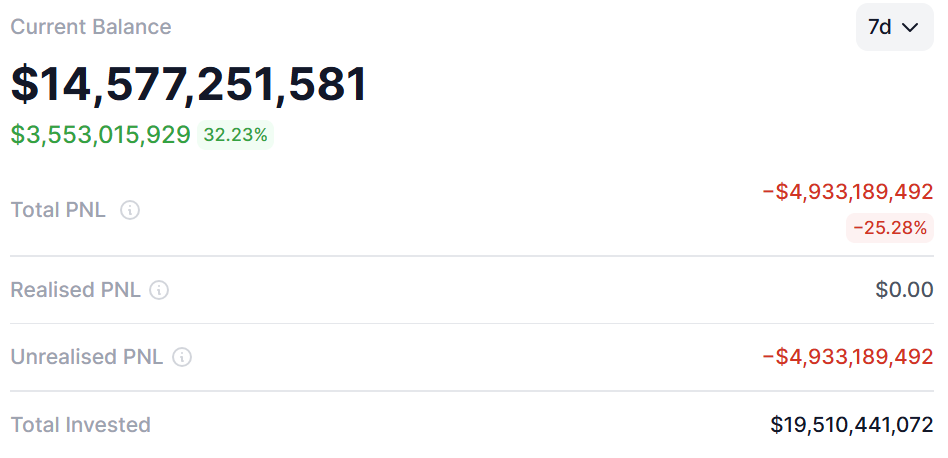
Bitmine has invested more than $19.5 billion in its Ether treasury, with its paper losses falling to below $5 billion from more than $8.4 billion roughly a week ago, according to DropsTab data.
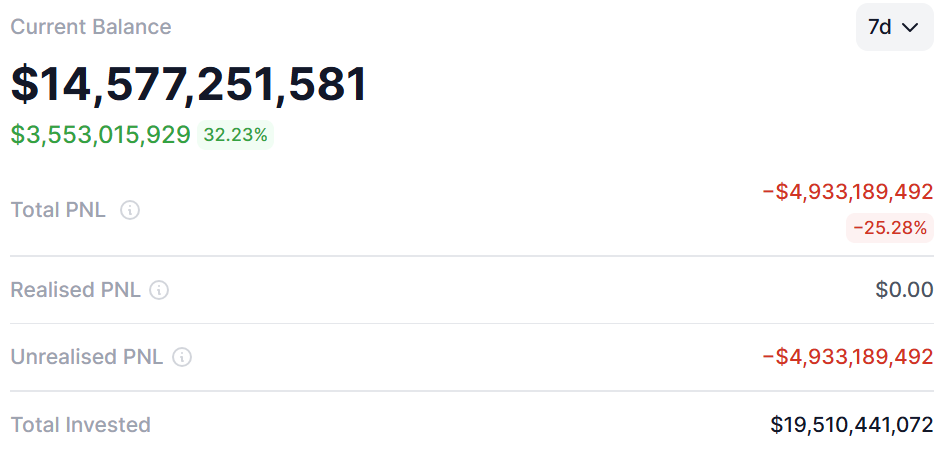
Bitmine’s unrealized losses on its ETH holdings have narrowed amid the market recovery. Source: DropsTab
The sharp swings highlight the challenges of managing digital asset treasuries, whose valuations can fluctuate significantly with changing market conditions.
Related: Ethereum Foundation warns some tools may break with Glamsterdam upgrade
Bitmine Immersion Technologies, an NYSE-listed company run by Tom Lee, disclosed that it continued building its Ether treasury last week—adding 32,447 ETH as the token rebounded sharply after an extended decline. The purchase lifts Bitmine’s total Ether holdings to 5,847,611 ETH, according to the company’s Monday update.
The latest buying pace keeps Bitmine on a nearly continuous accumulation schedule tied to its stated Ethereum treasury strategy, launched on June 30, 2025. With the firm now staking most of its position, the disclosure also offers a snapshot of how large spot treasuries can swing in value when the market turns.
Key takeaways
- Bitmine bought 32,447 ETH last week, bringing total holdings to 5,847,611 ETH—about 4.8% of Ethereum’s circulating supply.
- The company says it has acquired ETH every week since June 30, 2025, extending its buying streak to roughly 14 months.
- Bitmine is about 97% of the way toward its goal of owning 5% of the ETH supply.
- Of its Ether holdings, 5.07 million ETH is staked—around 87% of what Bitmine owns.
- Earlier losses tied to ETH’s drawdown have narrowed, with DropsTab data showing unrealized paper losses falling below $5 billion from more than $8.4 billion about a week earlier.
Bitmine keeps stacking Ether as the rebound gathers pace
Bitmine’s Monday disclosure confirms that last week’s ETH purchase was not isolated—it continued a weekly accumulation pattern that began when the company launched its Ethereum treasury strategy on June 30, 2025. With Ether prices stabilizing and then rallying, the firm’s latest tranche arrives at a time when its portfolio valuation is improving relative to the prior downturn.
According to the report, Bitmine now holds 5,847,611 ETH, which equates to roughly 4.8% of Ethereum’s circulating supply. The company also reiterated that it is nearing its target: it is reported to be 97% toward owning 5% of the ETH supply.
Bitmine’s NYSE-traded shares opened the week up about 8.7%, following a stretch that has already put gains at nearly 28% over the past six months. While share moves are not solely determined by crypto prices, the timing underscores how investors can respond to disclosures about on-chain treasury activity during volatile market phases.
How staking and treasury size shape the risk profile
The company’s Ether position is not only large—it is also largely staked. Bitmine reported staking 5.07 million ETH, representing about 87% of its holdings. Staking doesn’t eliminate price risk, but it changes how a treasury can pursue yield while remaining exposed to Ethereum’s market value.
Bitmine also provided a broader balance sheet snapshot, reporting combined crypto, cash, securities, and other investments of $14.9 billion. For readers tracking treasury strategies, this matters because valuation gaps in crypto holdings can be cushioned or amplified by how much capital the company holds outside of digital assets and by whether those assets are liquid versus locked or staked.
In practice, a treasury that keeps buying through downturns can end up with substantial unrealized losses during bearish periods. When markets rebound—especially sharply—those losses can narrow quickly, improving net asset value on paper even if the underlying strategy and risk exposures have not changed.
Why Ether’s rally mattered to Bitmine’s paper losses
Bitmine’s accumulation during the downturn left it facing steep unrealized losses when ETH prices fell. The recent recovery, however, has materially reduced that gap. DropsTab data cited in the disclosure indicates Bitmine has invested more than $19.5 billion in its Ether treasury, while unrealized losses have come down to below $5 billion from more than $8.4 billion roughly a week earlier.
The reported swing highlights a key operational challenge for crypto treasuries: digital asset valuations can change rapidly, sometimes in both directions, forcing investors to think in terms of marked-to-market exposure rather than only realized gains or losses. For companies building long-term crypto reserves, that volatility becomes part of the investment story—even when the buying cadence remains steady.
Bitmine’s latest purchase also aligns with a broader market move. Ether outperformed Bitcoin starting last Wednesday, when the US Treasury announced plans to double its monthly purchases of certain longer-dated US Treasurys to $4 billion from $2 billion beginning next month, as reported by Cointelegraph’s markets coverage.
CoinMarketCap data referenced in the disclosure shows Ether gained more than 32% since that announcement, breaking above $2,500 for the first time since January. For a treasury operator like Bitmine, that type of price action can quickly shift the narrative from “drawdown management” to “valuation recovery,” even if the company continues to execute the same acquisition strategy.
Treasury accumulation in context: what investors should watch next
Bitmine is approaching its 5% ETH supply target while maintaining a heavy staking allocation. That combination—sustained spot accumulation plus high staking participation—can influence how markets interpret the company’s longer-term commitment to Ethereum.
Still, several questions remain important for investors monitoring this strategy. How consistently Bitmine will be able to purchase ETH week after week if market volatility returns is one. Another is how much of its Ether is held in a form that can be deployed versus locked in staking. Finally, broader macro developments—such as how US Treasury policy and liquidity conditions continue to affect risk assets—could determine whether the current ETH rebound sustains or fades.
For now, the immediate watch item is whether Bitmine’s ongoing weekly purchases continue at the same pace as its unrealized loss position improves, and whether Ethereum’s momentum holds beyond the post-announcement rally.

Disclosure: This article does not represent investment advice. The content and materials featured on this page are for educational purposes only.
WBT trades around $72.70 after hitting a new high, as its four-year milestone coincides with broader developments in blockchain infrastructure and digital assets.
Summary
- WBT hits a new all-time high above $72, extending gains as exchange tokens gain utility across trading and blockchain ecosystems.
- Whitechain is transitioning to an Ethereum Layer 2 using the OP Stack, with WBT remaining its native gas token.
- WBT’s full supply is now unlocked while WhiteBIT’s active burn program targets a long-term reduction toward 200 million tokens.

WBT is trading around $72.7 after reaching a new all-time high, extending its gains beyond the previous $64.11 record set in December 2025. The move comes as the four-year-old token reaches another stage in its development, while the wider crypto industry continues shifting toward more established infrastructure and institutional participation.
Utility is becoming more important for exchange tokens
The role of an exchange token has changed considerably from the early days of crypto.
WhiteBIT offers users trading-related benefits, including reduced fees, while holdings can also affect referral rewards and eligibility for certain Launchpad activities. Staking and reward programs provide additional ways for users to interact with the asset.
The token also has a blockchain function. WBT is used as the native gas asset on Whitechain, connecting it directly to transactions taking place outside the exchange environment.
That broader utility is relevant as crypto platforms increasingly serve users who expect more than a place to buy and sell assets. Trading, blockchain infrastructure, token launches and rewards are increasingly being combined within connected ecosystems.
WBT is one example of that model.
Whitechain is taking a different route to scalability
The infrastructure side of the story is developing at the same time.
Whitechain is transitioning from its original standalone Layer 1 into an Ethereum Layer 2 built with the OP Stack. The network’s Sepolia testnet is already operational, while mainnet development is targeting later in 2026.
The move places Whitechain within a much larger ecosystem. Ethereum Layer 2 networks have become an established way to handle blockchain activity while settling transactions back to Ethereum.
Whitechain’s architecture remains EVM-compatible, which means developers can continue using familiar Ethereum development tools. WBT remains the native gas token after the transition.
The development is particularly relevant to WBT because it gives the token a role in network activity that does not depend solely on exchange trading.
A new phase for token supply
WBT has appreciated 28.3% over the past 12 months and was among the global top 10 cryptocurrencies by market capitalization in figures released around its fourth anniversary.
The price move is noteworthy, but it is taking place alongside several structural changes that are affecting how exchange-linked digital assets are used.
WBT’s tokenomics have also reached a transition point.
The token’s full supply has been unlocked as of 2026. Meanwhile, its burn mechanism remains active. WhiteBIT says the buyback program uses an amount corresponding to 33% of trading-fee income and 5% of income from other exchange activities, with the stated aim of reducing total supply toward 200 million WBT.
This is different from the supply dynamics during WBT’s earlier years, when scheduled unlocks were still taking place.
The combination of completed unlocks and continuing burns gives traders another variable to consider when looking at the token’s longer-term supply profile.
It also means the recent all-time high is arriving after a significant change in the mechanics governing how much WBT is circulating.
More markets are opening up
The token’s wider market presence has changed alongside its utility. WBT was listed on Kraken in March 2026 with WBT/USD and WBT/EUR markets, giving the asset additional access outside its original exchange environment.
That matters for liquidity and visibility, particularly for an exchange-linked token whose early use was closely associated with a single platform.
WBT’s fourth anniversary provides another reference point. Four years after launch, the token is trading above its previous record, has gained 28.3% over the last year and has developed uses spanning exchange services and blockchain infrastructure.
The new high does not establish where the token goes next. What it does show is that WBT is entering a different stage of its lifecycle, one in which market performance is being watched alongside token utility, supply changes and the development of the network that uses it.
Disclosure: This content is provided by a third party. Neither crypto.news nor the author of this article endorses any product mentioned on this page. Users should conduct their own research before taking any action related to the company.

Treasury yields fell and the price of gold continued its recent rally Monday after Treasury Secretary Scott Bessent essentially warned investors not to bet against his ability to tame the government bond market. Following last week’s news that the Treasury will at least double its buybacks of long-term bonds, Bessent and his lieutenants signaled their readiness to deploy the nearly…
Copyright ©2026 Investor’s Business Daily, LLC. All rights reserved. 87990cbe856818d5eddac44c7b1cdeb8

Horrified tourist finds note on her restaurant receipt saying ‘burn the eggs and spit on them’ after she asked for them not to be runny

Slide Insurance: Can Florida Be Attractive Here?

Crypto Organizations Oppose Illinois Digital Asset Tax in Court





-

 Fashion3 days ago
Weekend Open Thread: Madewell – Corporette.com
-

 Business6 days ago
SMA Solar Technology AG (SMTGY) Q2 2026 Earnings Call Transcript
-

 Crypto World3 days ago
anatomy of crypto’s biggest liquidation event since 2021
-

 Business2 days ago
Musk’s Tesla, SpaceX Confirm $16.8 Billion ‘Terafab’ Chip Plant as World’s Largest Building in Texas
-

 Tech7 days ago
Qwen3.8-27B runs frontier-class coding agents and reasoning locally, no cloud API required
-

 Crypto World7 days ago
OCC Greenlights Trump Family Crypto Firm for Trust Charter
-

 Politics2 days ago
6 months on, Irish renters crushed by effects of government housing bill
-
 NewsBeat2 days ago
The ‘Lucky Dip Gang’ causing carnage for clicks: After five thugs were killed speeding in the wrong direction on a motorway, GUY ADAMS investigates a sick new trend… and why police aren’t even allowed to pursue them
-

 Crypto World7 days ago
NAVI Prime launches institutional lending framework on Sui
-

 Tech5 days ago
GLM-5.3 hits the API at $1.4/$4.4 per million tokens
-

 News Videos4 days ago
Don’t Leave Your Financial Future To Chance | August 19, 2026
-
 Crypto World7 days ago
Dow’s 3-Year Winning Run Isn’t a Crash Signal, Still 49% Odds of Double-Digit Gains
-
Tech7 days ago
5 Of The Most Reliable Car Brands To Consider If You’re Buying A Used SUV
-

 Tech6 days ago
Keychron K8 Ultra 8K review: a great value keyboard with comfort issues
-

 Business6 days ago
Stock Market Today: Tech Futures Slide As Treasury Yields Jump; Nvidia, Micron, Sandisk Sell Off
-
 Tech7 days ago
Nvidia discloses $21B stake in SpaceX
-

 Business5 days ago
Marvell Shares Jump 7% as Google Chip Deal Confirms Custom AI Silicon Partnership, Analysts
-
 NewsBeat7 days ago
Trump explodes at CNN reporter after question about young blonde aide who wrote him besotted letters
-
Business7 days ago
Fabrinet (FN) Q4 2026 Earnings Call Transcript
-

 Business4 days ago
Five Below: Kids Discount Retailer Reaps Rich Rewards
You must be logged in to post a comment Login