
Crypto World
Bitcoin (BTC), Nasdaq futures decline as Trump won’t rule out more Iran strikes

At the United Nations General Assembly, Iran proposed an agreement to reopen the Strait of Hormuz, a major oil chokepoint disrupted by the war, for a seven-day period and pause fighting, followed by broader negotiations on issues.
Trump, however, rejected the proposal, saying that Iran is looking for a deal because it was under heavy pressure. Trump also stressed on Truth Social that Iran “cannot have a nuclear weapon.”
This lingering geopolitical uncertainty has stoked inflation fears since the war began in early March, lifting Treasury yields. The 10-year yield has risen by 127 basis points to 5.20%, the highest since 2007, amid inflation fears, Fed rate-hike bets and debt concerns.
Bitcoin fell early this year, but has bounced back strongly in the third quarter, shrugging off these uncertainties. Prices are up 42% in three months, outperforming every major asset, including Nasdaq and gold.
Analysts are now watching incoming data for cues about the next move in the cryptocurrency.
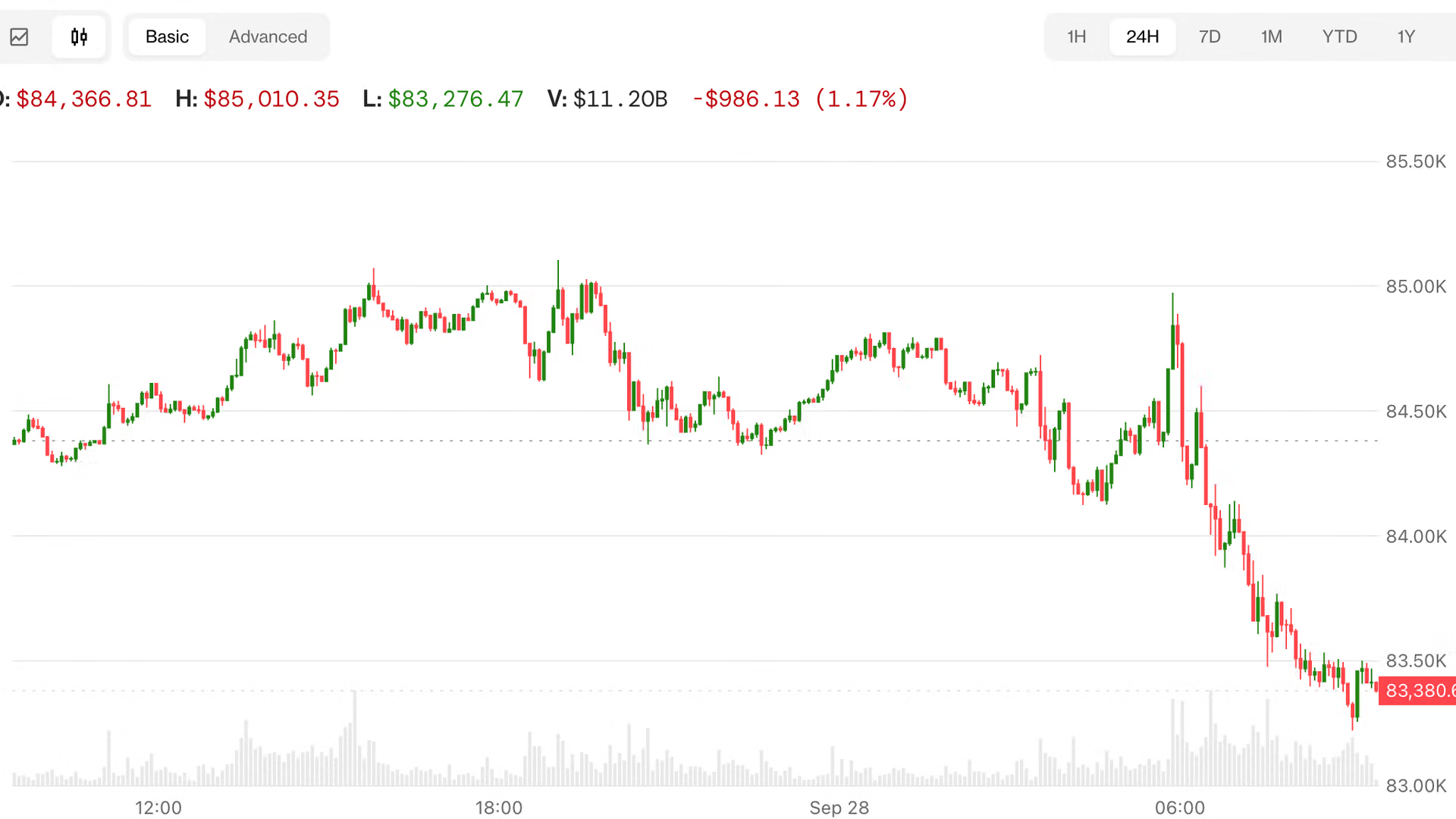
“For investors, the 83,800-84,000 zone is an important near-term support. The 85,000-85,800 area is the immediate resistance zone. It would be prudent to avoid chasing the rally at current levels,” Vikram Subburaj, CEO of India-based Giottus exchange, said in an email.

Ethereum (ETH) co-founder Vitalik Buterin expects next year’s Hegota upgrade to be the network’s last conventional fork. He said the work after it would involve advanced cryptography and quantum-safe designs.
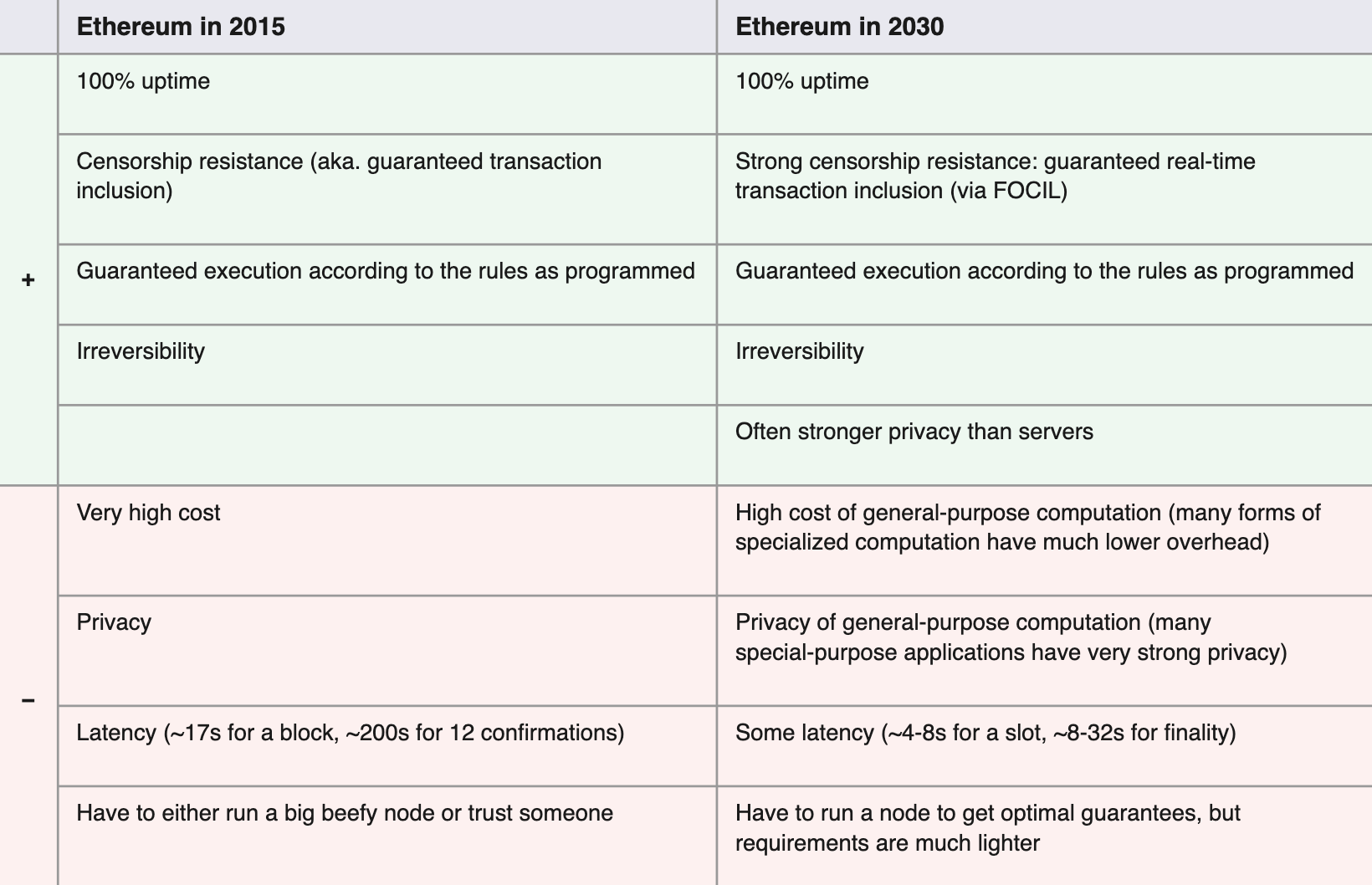
Buterin set out the view in a September 27 essay on his personal blog. In it, he compared Ethereum in 2015, 2025, and 2030 with the original Bitcoin (BTC) whitepaper.
The Fork a 2015 Developer Would Still Recognize
Buterin pointed to the Strawmap, a draft long-term Ethereum roadmap, when placing Hegota in the schedule.
“If you look at the Strawmap, Hegota – the fork planned for next year – is likely to be Ethereum’s last ‘normal’ fork, with features and technology that would be recognizable to someone in 2015,” he said.
According to Buterin, everything after Hegota involves recursive STARKs, a type of cryptographic proof. That later work also covers automated formal verification, highly optimized consensus, and quantum safety.
Recursive STARKs and quantum-resistant cryptography were also central to the Lean Ethereum plan he outlined earlier this year.
However, Hegota itself remains in early planning. Ethereum.org’s Hegota page lists two scheduled changes: Fork-Choice Enforced Inclusion Lists (FOCIL) and frame transactions.
FOCIL lets a committee of validators propose transaction lists that block builders must honor. Frame transactions, meanwhile, let each account run its own verification logic and choose quantum-resistant signatures.
Follow us on X to get the latest news as it happens
Buterin’s 2030 Blueprint for Verification, Speed, and Privacy
Beyond the fork schedule, Buterin’s essay makes a broader argument about Ethereum’s identity. He wrote that after its Lean upgrades, Ethereum would carry the blockchain label largely for historical reasons.
To make that case, he argued that nearly every core property of a blockchain has changed or soon will. Verification is one example. Under the 2010 model, nodes downloaded and re-executed every block.

By 2030, he expects nodes to verify a cryptographic proof and use Peer Data Availability Sampling (PeerDAS) instead.
Users would feel those changes through speed. His targets include slots of roughly 4 to 8 seconds and finality within about 8 to 32 seconds. By comparison, Ethereum in 2015 needed about 200 seconds to reach 12 confirmations.
Buterin also argued that decentralization, once purely a cost paid for safety, could help performance in a few limited cases. A decentralized network, he noted, can store data and run computation in parallel.
Building this design still involves open problems, he acknowledged. Zero-knowledge proofs remain hard to make efficient and safe, although artificial intelligence (AI) tools already help optimize them. Managing access to very large amounts of state would likely be the harder challenge, he added.
Before that work begins, Ethereum still has two upgrades to ship. Hegota is expected to follow Glamsterdam, whose Sepolia testnet fork is scheduled for October 6. Ethereum.org lists Glamsterdam’s mainnet launch for Q4 2026 with no confirmed date.
Subscribe to our YouTube channel to watch leaders and journalists provide expert insights
The post Vitalik Buterin Says Next Year's Hegota Will Be Ethereum's Last ‘Normal' Fork appeared first on BeInCrypto.
South Korea’s Financial Services Commission said it is considering a market-making system for digital assets, after a stablecoin linked to the value of the Japanese yen traded for as much as four times its peg on a major South Korean crypto exchange earlier this month.
Crypto exchange Upbit opened trading of JPYC, a yen-backed stablecoin, on Sept. 17, with the market opening at 12 Korean won per JPYC before reaching a high of 37.6 Korean won just an hour later, more than four times its market value. The spike was attributed to limited liquidity on Upbit.
“We will also review the need to introduce systems such as market-making activities to increase the efficiency and stability of the digital asset landscape,” Yoo Young-joon, director of digital finance policy at the FSC, said at a conference in Seoul on Monday, Digital Asset reported. “There were also criticisms that user losses occurred from the price surge after the JPYC listing, so demands for discipline in this area are expanding.”
South Korea’s Virtual Asset User Protection Act currently does not contain an exemption for market-making from its market manipulation provisions, preventing market makers from providing liquidity in crypto markets. The latest comments from Yoo suggest the FSC could be reconsidering this decision.
South Korean academics have debated the market-maker carve-out before. In a 2024 peer-reviewed paper from Seoul Law Review, KB Securities researcher Lee Min Jung said regulators at the time did not allow crypto market making as it could amount to market manipulation. While Lee argued that introducing market makers would be premature due to manipulation concerns, she said regulators could consider a carve-out once the market becomes more stable.
Researchers had called for a formal market-making framework long before the recent JPYC episode. A paper by Yoonyoung Choi from the Korbit Research Center argued that the domestic crypto market has been experiencing “serious liquidity problems” due to the absence of a formal market maker system, leading to price discrepancies and high volatility. The paper cited the Kimchi premium as an example of inefficiency in South Korea’s crypto market.
Related: South Korea drops Travel Rule threshold for crypto transfers
The potential introduction of a market-making system comes as South Korea works to establish a broader regulatory framework for its crypto industry.
The FSC said in July that it planned to introduce a consolidated Digital Asset Basic Act covering stablecoins and the broader crypto market, including rules for digital asset businesses, exchanges, disclosures and internal controls.
However, lawmakers have yet to settle several key aspects of the legislation, including rules governing won-denominated stablecoin issuers.
Magazine: THORChain under fire over Bitget, ETH evolves beyond blockchain: Hodler’s Digest
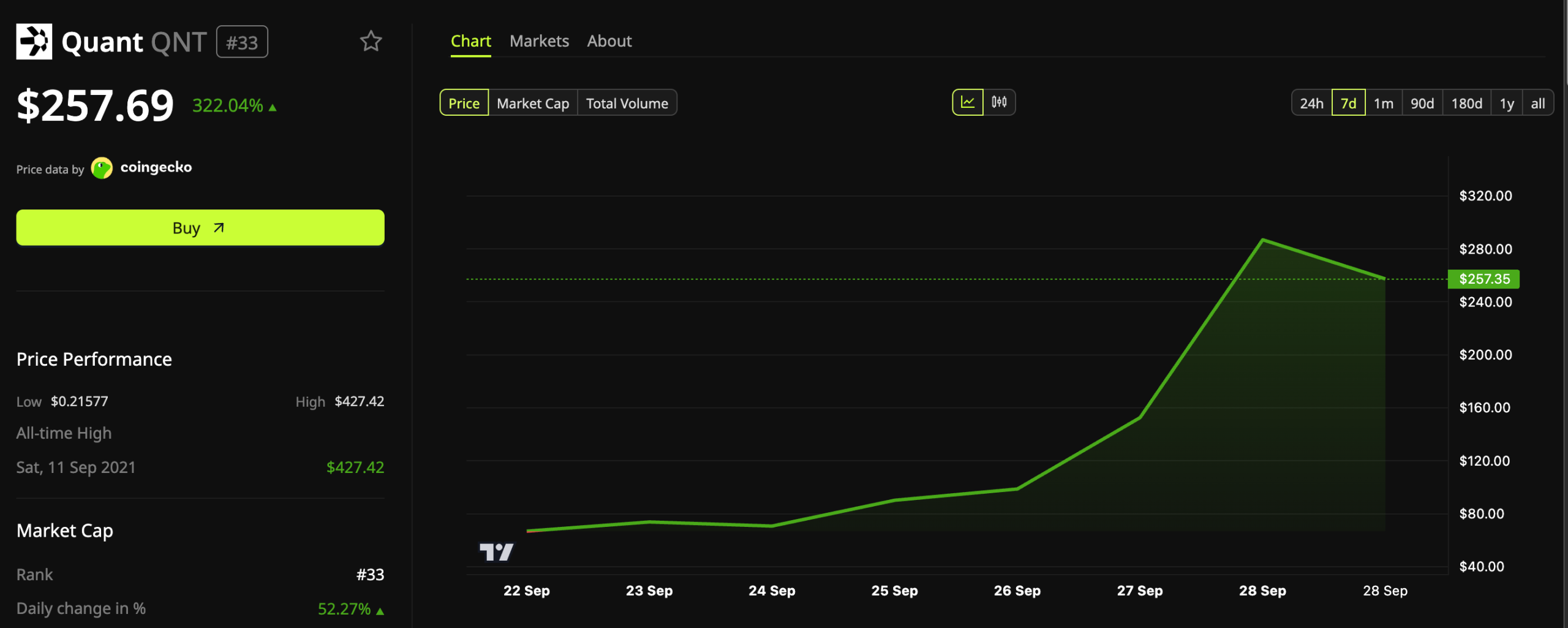
Quant (QNT) has climbed 322% over the past week to $ 257.69. It also gained 52% in 24 hours, ranking among the top daily gainers.
The gains followed a pair of announcements on September 24. Both tied Quant’s software to bank-led tokenized deposit networks in the US and UK.
Follow us on X to get the latest news as it happens

The Clearing House Brings Quant Into US Bank Plumbing
The Clearing House, owned by 25 of the largest US banks, selected Quant to power its On-Chain Money Initiative. It unveiled the initiative in June with backing from Bank of America, Citi, JPMorgan, and Wells Fargo.
This is a planned shared network for clearing and settling tokenized deposits between financial institutions around the clock. Tokenized deposits are digital versions of bank deposits that keep the same protections and oversight as ordinary deposits.
Quant will provide the network’s interoperability, orchestration, and transaction-management layer. Its technology will also link the network to existing fiat rails, including RTP and CHIPS.
The Clearing House expects the network to open to participating institutions in the first half of 2027. Its existing networks already settle over $2 trillion a day.
Quant founder and CEO Gilbert Verdian framed the deal in global terms.
“Tokenized deposits are now the de facto way banks move money on-chain, and The Clearing House sits at the heart of the U.S. banking system, meaning this partnership sets a standard for the rest of the world to follow,” Verdian said.
London Added a Second Headline the Same Day
UK Finance announced the same day what it called the first live customer transactions using tokenized sterling deposits. The pilots ran on a shared platform that Quant developed for the Great British Tokenised Deposit (GBTD) initiative.
The initiative includes Barclays, HSBC UK, Lloyds Banking Group, Monzo, Nationwide, NatWest, and Santander. The first transactions covered two remortgage completions and a marketplace purchase. In each, funds were locked and released automatically once conditions were met.
Meanwhile, analyst Ted Pillows also pointed to earlier partnerships on X. These include Quant’s March integration with Murex’s MX.3 platform. He also noted the European Central Bank (ECB) had picked Quant to help test the digital euro.
Quant’s 2025 announcement shows it was one of almost 70 ECB pioneer partners. Pillows added that QNT has broken out of a five-year downtrend. He said it could double from about $187, its price when he posted.
“If momentum continues, QNT could pull another 2x from its current level,” the analyst said.
That would put the altcoin near $373, still about 13% below its $427.42 all-time high from September 2021.
Subscribe to our YouTube channel to watch leaders and journalists provide expert insights
The post Why Is Quant (QNT) Up 322%? JPMorgan, Citi and Barclays Have the Answer appeared first on BeInCrypto.
Binance Wallet has added USDT gas-fee payments on four blockchain networks as of Sept. 25, allowing users to transact without first holding each chain’s native gas token.
Summary
- Binance Wallet now lets users pay blockchain gas fees with USDT across four supported networks.
- BNB Smart Chain, Ethereum, Solana and TRON support the new USDT gas payment option today.
- Users can alternatively fund gas from Binance Exchange balances holding supported assets across eligible networks.
- Binance says network fees still go to blockchain validators, not directly to the company itself.
- TRON users can receive zero gas fees through December 22 under a separate promotional program.
According to Binance’s updated support documentation Binance Wallet gas-fee guide, the option currently works on BNB Smart Chain, Ethereum, Solana and TRON. Users with USDT in Binance Wallet can select the stablecoin to cover the network fee when completing supported transactions.
Previously, users generally needed BNB for transactions on BNB Smart Chain, ETH on Ethereum, SOL on Solana and TRX on TRON. A wallet without the required native token could leave the user unable to complete an on-chain transaction even when it held the asset being transferred.
Binance said its wallet calculates the network fee based on current blockchain conditions. The company said more networks will gain support later, though it has not provided a rollout timetable.
Binance Wallet uses USDT for gas on four networks
The USDT option changes how Binance Wallet users can fund transaction costs, but it does not remove the underlying blockchain fee. Validators or other network participants still receive the network charge required to process the transaction.
Binance states in its support guide that “none of the network fee goes to Binance.” The company distinguishes blockchain gas from service fees that Binance Wallet may charge for certain products, including swaps.
Network charges remain dynamic. Binance says congestion can push fees higher on Ethereum Virtual Machine networks and Solana as users compete for transaction processing. Lower activity can reduce the amount required.
TRON operates differently through its resource model, which uses bandwidth and energy. Users can obtain resources through mechanisms such as staking TRX or renting energy. When available resources cannot cover a transaction, TRX may be burned to pay the remaining cost, according to Binance’s explanation.
For Binance Wallet users, USDT now serves as another payment method for those costs on supported chains. Binance has not said the networks themselves have changed their native fee mechanisms.
Exchange balances provide another way to cover gas
Users without enough USDT in Binance Wallet can use supported balances held in their Binance Exchange accounts on the same four networks.
The official Binance support page lists BNB, USDT, USDC, ETH and SOL among assets that can be used through eligible Spot, Funding or Earn balances. Users select the Exchange Account option when choosing how the network fee will be paid.
Binance lists several other routes when neither wallet USDT nor an eligible exchange balance is available. Users can transfer the required gas token from Binance Exchange, receive it from another wallet or buy supported assets using a bank card.
A separate option lets eligible users draw BNB from their Spot or Funding Account for gas on BNB Smart Chain, Ethereum and opBNB. Binance says users need more than 0.01 BNB in the relevant account before selecting that payment method.
The company continues to warn users to select the correct blockchain when moving assets between Binance and another wallet. Its withdrawal guide says choosing an incompatible network can result in assets becoming unrecoverable.
TRON users get a separate zero-gas offer
The rollout follows a separate Binance Wallet promotion for transfers on TRON.
Starting Sept. 23, eligible users can receive zero gas fees when sending USDT and other TRC-20 tokens through Binance Wallet. The campaign runs through Dec. 22, 2026, according to a Binance Wallet announcement.
Binance said the offer is supported by TRON DAO and remains subject to available campaign spots. After the promotional period, the company said qualifying transfers will receive a discounted fee of 1 USDT per transaction.
To use the promotion, users start a transfer through Binance Wallet, select the token and destination, then choose the network-fee payer when signing the transaction. USDT can be selected as the payment method before confirmation.
The TRON promotion and the four-network USDT feature cover related transaction costs under different terms. The support documentation presents USDT as a payment option for gas on BNB Smart Chain, Ethereum, Solana and TRON, while the TRON campaign temporarily reduces eligible TRC-20 transfer charges to zero.
Binance Wallet has been reducing transaction friction
Binance has made several changes to its self-custody wallet since renaming Binance Web3 Wallet in December 2024.
As crypto.news previously reported, the rebranded Binance Wallet introduced a unified wallet interface and changes to asset management and its airdrop section. Binance said at the time that upgrades would arrive in several stages.
Network fees remained separate from trading fees in later wallet promotions. In February 2025, Binance waived trading charges on eligible wallet swaps, while users still had to pay blockchain gas fees, as crypto.news reported.
Binance Wallet has since expanded the number of services available through the self-custody product. In April 2026, the wallet introduced perpetual futures trading through its app and web interface, with an Alpha Points campaign tied to trading volume, according to related crypto.news coverage.
By May, Binance Wallet had integrated Event Rush on BNB Chain, where verified users could trade tokens linked to event outcomes using USDT. The service operates through a third-party decentralized application and is restricted in some regions, as crypto.news reported.
Binance’s current documentation identifies Binance Wallet as a self-custody product provided by Binance Barbados Limited. The company states that the wallet services are not supervised by the Financial Services Regulatory Authority or another regulatory authority.
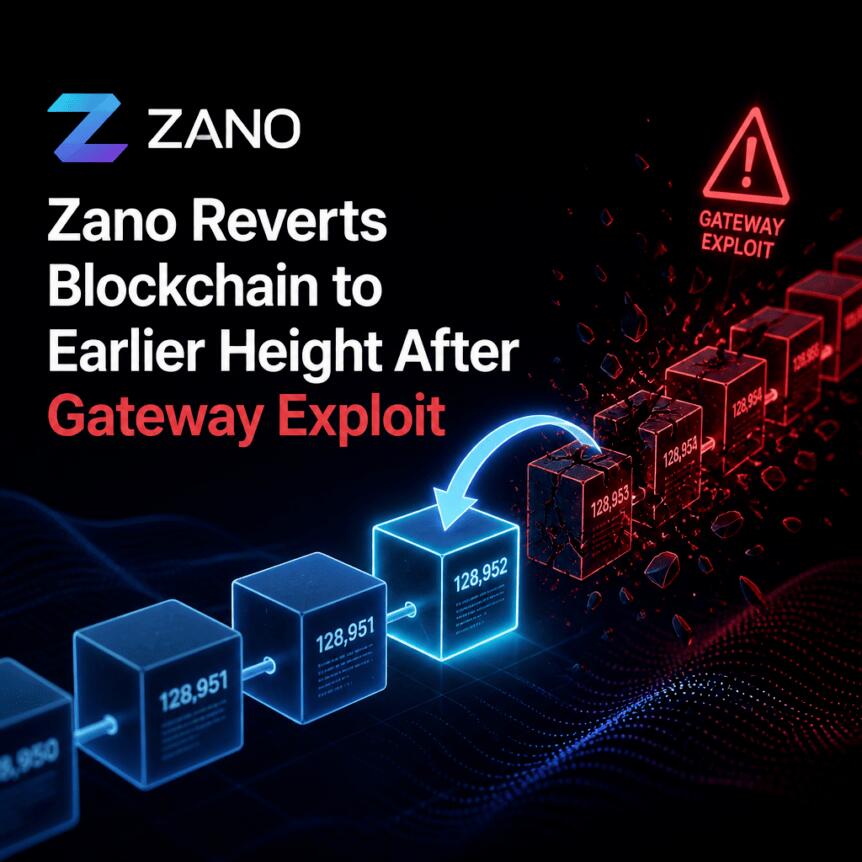
Zano’s core team has restarted the Zano blockchain to undo roughly a month of activity after it identified a vulnerability tied to “Gateway Addresses” that allowed unauthorized ZANO and Freedom Dollar (fUSD) tokens to enter circulation. The restart reverts the chain to block 3,833,000—immediately before Hard Fork 6 introduced the affected feature.
According to the project’s leadership, the recovery will only take full effect once participating nodes, miners, stakers, exchanges, and other services adopt the updated software. The team says transactions and token activity that occurred during the compromised period will no longer appear on the recovered chain. However, it also warns that the rollback cannot reverse payments that were already settled on other blockchains.
Key takeaways
- Zano restarted the chain at block 3,833,000, rolling back about a month of history linked to an exploit affecting Gateway Addresses.
- The reset targets activity after the Hard Fork 6 feature deployment, meaning compromised transactions won’t show on the restored chain.
- Participating nodes, miners, stakers, exchanges, and other infrastructure providers must upgrade to complete the recovery.
- Zano says it will publish a reimbursement and claims process to address losses, though cross-chain settlements cannot be undone.
Rollback mechanics: what changed and what can’t be reversed
The project says the vulnerability’s impact is limited to the period after Hard Fork 6, when Gateway Addresses were introduced. By restarting the network from block 3,833,000, Zano invalidates both legitimate transactions included after that block and any unauthorized ZANO and fUSD that the exploit minted or introduced.
That matters for users and service operators because it effectively resets the on-chain record for that interval. Anyone who relied on transactions during the rolled-back window—whether for balances, accounting, or automated workflows—will need to reprocess those events against the restored chain state.
At the same time, the team draws a clear boundary around what is feasible. While the rollback can change what is recognized on Zano itself, it cannot undo transactions already finalized elsewhere. For users who moved value through cross-chain transfers or other external systems, the project’s update implies that losses tied to already-settled external payments may not be recoverable via the chain restart alone.
What are “Gateway Addresses,” and why they became a target
Zano says it has not published a full post-mortem yet, but it confirmed the exploit originated with Gateway Addresses. The feature was created to make integrations easier for bridges, exchanges, and payment services by allowing them to manage funds through a single account-style balance model.
Before Gateway Addresses, Zano wallets tracked funds as separate transaction outputs (UTXOs), rather than as one consolidated account balance. That difference influences how exchanges and payment processors work: services had to scan the blockchain to identify incoming payments, track which outputs corresponded to customer deposits, and select appropriate outputs when users requested withdrawals.
By contrast, an account-style abstraction can streamline integration logic—especially for services that want a unified view of balances. The Zano team’s decision to revert the network “immediately before Hard Fork 6,” however, suggests the abstraction layer introduced new attack surface that was not sufficiently contained.
Zano’s public explorer shows the rollback taking place on Sunday, reflecting the chain reset and the shift back to the pre–Hard Fork 6 state. The project did not provide additional technical details in the excerpted information, but the explicit identification of Gateway Addresses helps narrow the likely root cause to the feature rather than to core transaction privacy itself.
Token supply, trust, and the case for restarting
The Zano leadership framed the restart as a tradeoff between immediate disruption and long-term credibility. Quinten van Welzen, head of marketing and growth, argued that “doing nothing” would have meant unauthorized ZANO and fUSD remaining in circulation indefinitely—diluting holders and undermining the idea of a fixed supply.
Van Welzen also suggested that allowing the compromised supply to stand would signal to future attackers that they could retain value after an exploit. In that view, the most damaging outcome would not just be the technical breach, but the precedent it sets for adversaries.
Restarting from an earlier block, he said, comes with real costs: it eliminates about a month of blockchain history and requires the community to rebuild trust. Still, the team’s position is that restoring the intended supply and restarting from a clean state offers a path back that justifies the disruption.
Why exchanges and validators are central to the fix
Zano’s recovery depends on adoption. The team said participating nodes, miners, stakers, exchanges, and other services must adopt the update so the network stabilizes on the recovered chain state. This requirement is especially important for institutional and high-throughput operators, where delayed upgrades can lead to inconsistent balances, duplicate processing, or mismatched transaction histories.
For traders and users, the implication is straightforward: infrastructure readiness will determine how quickly services converge on the restored ledger. For exchanges in particular, the rollback also affects deposit and withdrawal accounting—so operators may need to re-sync transaction histories and ensure customer records match the post-recovery state.
In parallel, Zano says it is working to account for losses. The team indicated that it will publish a reimbursement and claims process, which should become a key reference for affected parties once the details are released. Until then, the only fully reliable takeaway for users is that transactions from the compromised period are expected to disappear from the restored chain, while any already-settled activity outside Zano may not be reversible through the rollback.
Going forward, readers should watch for the promised reimbursement/claims instructions and any technical follow-up that clarifies exactly how Gateway Addresses were exploited, because those details will likely determine how integrators adjust their systems and how quickly confidence can be rebuilt after the Hard Fork 6 rollback.
BlackRock’s Rick Rieder is cutting stocks. He says high-grade bonds paying 7% to 8% now beat the 10% to 12% he expects from equities.
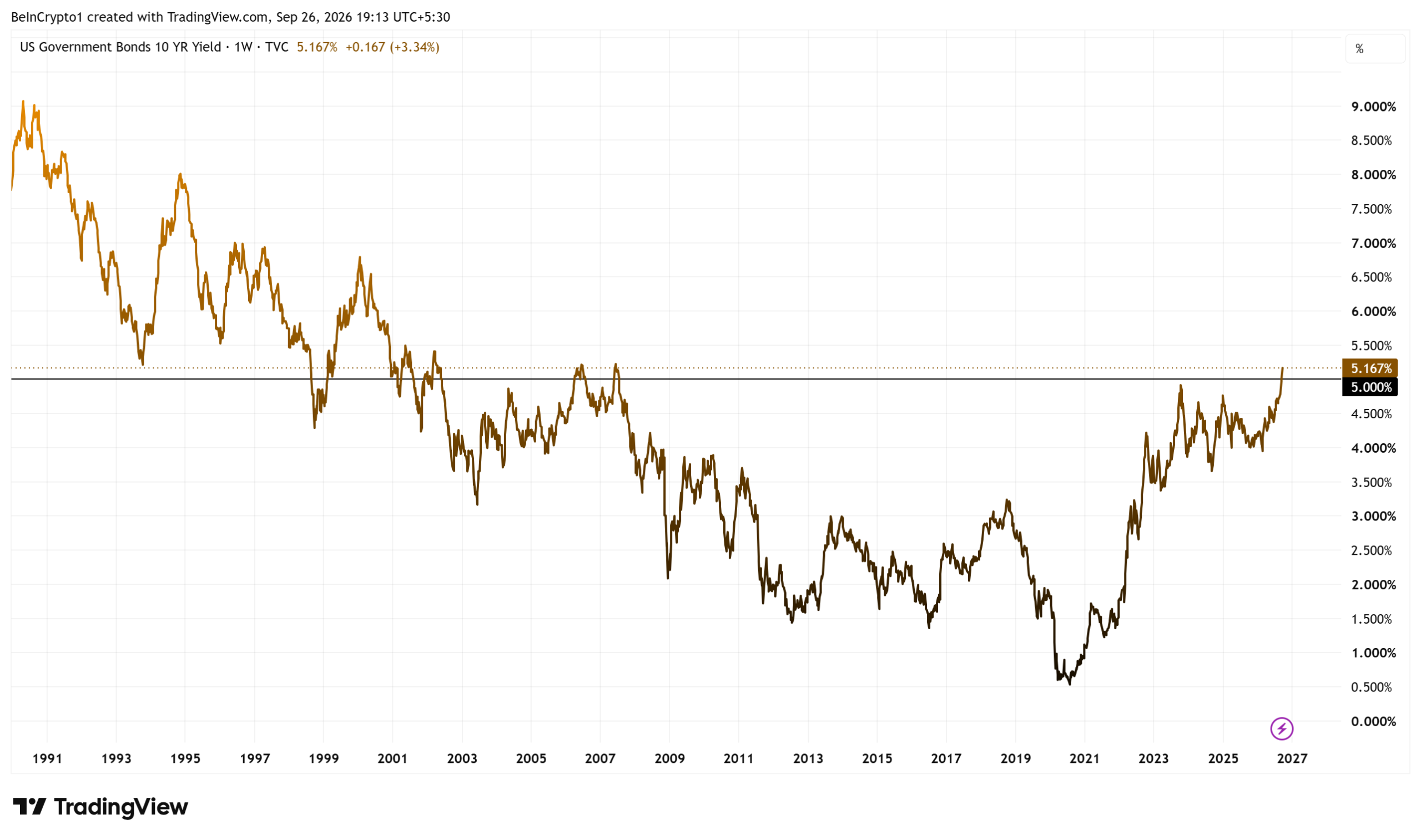
Rieder is chief investment officer of global fixed income at BlackRock and oversees about $2.4 trillion. He spoke on Yahoo Finance’s Sozzi Unleashed about the 10-year Treasury yield above 5%.
Why the US Treasury Yield Matters
The 10-year yield is the interest rate the US government pays to borrow for a decade. It shapes mortgage rates, company loans, and stock prices.
This month it rose above 5% for the first time since 2007. TradingView data shows it at 5.167% on Sept. 26, with the 30-year yield at 5.49%.

The Federal Reserve raised its benchmark rate to 3.75%–4% on September 16, its first hike in more than three years. Rieder called the moment “not a crisis, but an eye-opener.”
Rieder graded stocks a B-minus, lower than he had for a long time. He still likes chipmakers and memory storage, where he sees order backlogs. However, higher inflation-adjusted rates and slowing AI growth weigh on the rest of the market.
An income fund he runs yields 7.2% with an A-minus credit rating. It also holds bonds that mature or reset within three years, which limits losses if rates continue to rise. He has also sold some mortgage bonds, which lose value when rates climb.
Yields are already pushing mortgage rates to 7.45%. Rieder said the housing market is “frozen.”
What Another Fed Rate Hike Would Cost
Rieder argued the Fed should not be raising rates. Still, he expects one more hike. He warned it would inflate US debt costs.
“For every 100 basis points of move, it’s somewhere between 130 and 150 billion dollar cost to the US government,” he said in the interview.
One hundred basis points equals one percentage point.
Not everyone reads high yields as bad for stocks. Fundstrat’s Tom Lee argues rising yields favor strong companies.
Rieder added that when the 10-year starts at 5%, the next year’s bond return has averaged about 9.5%. Even so, he advised against rushing into it now. He pointed to strong growth, a war, and heavy new government borrowing.
He is now watching jobs reports for signs that US growth is slowing. BlackRock’s real-time tracking puts growth at 6.5% to 7%.
The post BlackRock CIO Dumps Stocks for High-Grade Bonds. Here’s Why appeared first on BeInCrypto.
China’s industrial profits grew 4.2% in August from a year earlier, official data showed Monday. Cumulative profit growth for the year has now slowed for a fourth straight month.
That cumulative pace peaked at 24.7% through April and has eased to 15.7% through August. Meanwhile, an AI-driven profit boom is lifting rival economies far faster.
The AI Boom China Missed
South Korea’s audited companies posted a record operating margin of 16.9% in the second quarter. That is up nearly 12 percentage points from a year earlier.
Manufacturing margins alone leaped almost fivefold, to 24.0%, driven by chipmakers riding the artificial intelligence memory wave.
Japan told a similar story. Corporate profits jumped 24.6% year-on-year in the second quarter, beating estimates comfortably.
Across the Pacific, US manufacturers saw after-tax profits climb to $370.1 billion in the second quarter. That is up from $225.8 billion a year earlier.
By contrast, China’s 4.2% barely registers as growth.
Europe Is the Exception
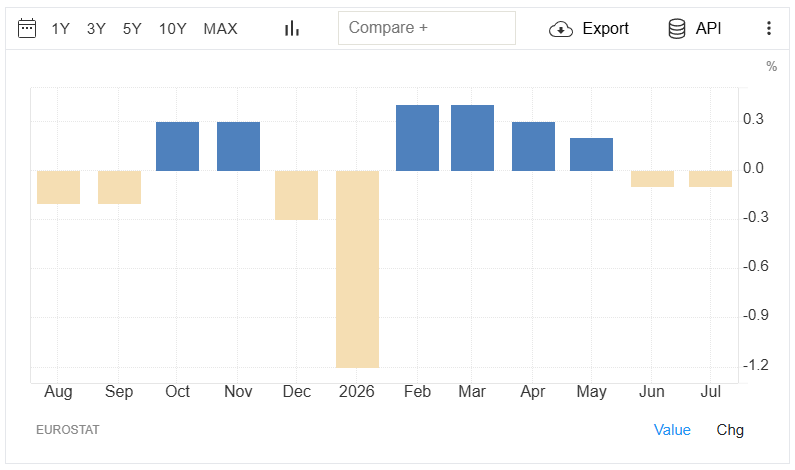
However, one major economy is struggling harder than Beijing. Eurozone industrial production fell 1.2% year-on-year in January and was flat by July.

The Eurozone’s manufacturing gauge hit a 44-month high in February, led by a German rebound. Germany’s own index returned to expansion for the first time in more than three years.
China’s factories are slowing down. Europe’s are barely moving at all.
What It Means
The split exposes a widening fault line in the global economy. AI hardware is minting profits in Seoul, Tokyo and Washington.
Beijing sits stuck in the middle. Brussels sits further behind.
The post China's Industrial Profits Slow to 4.2% Showing The AI Boom Left It Behind appeared first on BeInCrypto.
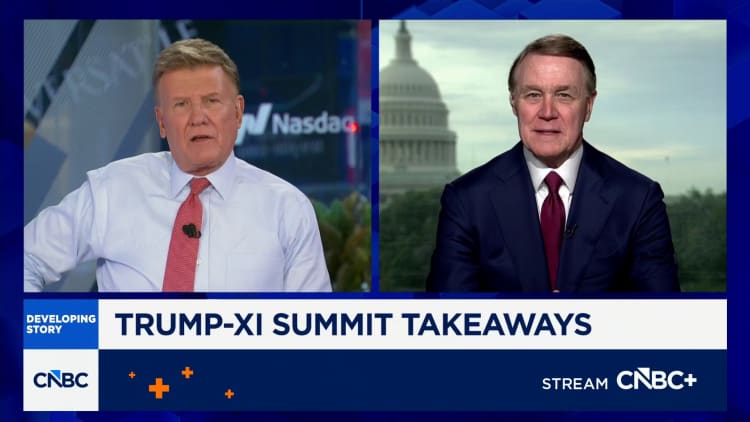
U.S. President Donald Trump welcomes Chinese President Xi Jinping to speak during a state dinner in the East Room of the White House on September 24, 2026 in Washington, DC.
Kevin Dietsch | Getty Images News | Getty Images
BEIJING — In a summit dominated by spectacle, the U.S. and China have essentially agreed to keep talking.
President Donald Trump hosted Chinese President Xi Jinping in Washington, D.C., last Wednesday to Friday in Xi’s second state visit since 2015. Trump personally greeted Xi at the airport in a very rare gesture, and more than 100 people, mostly from U.S. government and businesses, attended a state dinner for Xi.
But there were few breakthroughs, including a far shorter-than-expected two-month trade truce extension.
“I’m concerned that this kind of diplomacy and this fragile detente is really unsustainable — if it doesn’t result in more tangible outcomes or in addressing in some way the strategic challenges that are clearly manifest across the entire relationship, from the strategic relationship to economics,” Daniel Kritenbrink, partner at consultancy The Asia Group, said Monday on CNBC’s “Squawk Box Asia.”
Statements from both countries following the summit agreed on only a handful of points.
Peter Alexander, Shanghai-based managing director of Z-ben Advisors, said he was surprised the two sides issued separate statements rather than a joint one.
It means “the two sides are truly locked in a battle seeking to determine where escalation dominance in the relationship resides,” Alexander said in a note Monday. He had expected Xi would not likely travel to the U.S. unless a joint statement had been agreed to in advance.

Here are major areas where the U.S. and China sent similar messages, according to their readouts released over the weekend:
First, Trump and Xi both intend to attend the APEC meeting in Shenzhen in November, and the G20 summit in Miami in December.
Second, the two countries agreed to hold an AI dialogue in the next two months, and establish a communication channel for AI incidents. But while the U.S. used the term “Super Intelligence,” China still referred to the technology as AI in its readout.
Third, both readouts pointed to how the U.S. and China were allies during World War II and “fought side by side to win the war.”
During the summit, the two presidents each referenced that cooperation in relation to Japan.
When welcoming Xi to the White House, Trump referenced the Flying Tigers, a group of American pilots that fought the Japanese in Myanmar and China in the early 1940s.
Xi’s dinner toast to Trump was more specific: “Over 80 years ago, the Chinese and American people stood shoulder to shoulder in a fight against Japanese militarist aggressors.”
Analysts from both the U.S. and China pointed out the historical reference also signaled broader efforts between the two countries to cooperate.
But a Chinese social media account called “Chairman Rabbit,” long seen as having insight into Beijing’s thinking, directly linked the World War II comments to Japan.
“If we were to say who the biggest loser was of this China-U.S. Summit in Washington, D.C., it would be the Sanae Takaichi government,” the account wrote in an article Saturday. That’s according to a CNBC translation of the Chinese.
Nearly a year ago, Takaichi drew Beijing’s ire by indicating an attempt to seize Taiwan by force could prompt Japan’s Self-Defense Forces to intervene. Beijing considers the independent, self-ruled island part of its territory. During the latest meeting with Trump, Xi urged the U.S. to oppose “Taiwan independence.”
Fourth, the U.S. and Chinese presidents signaled some alignment on limiting Iran’s nuclear weapon capabilities, and agreed “no country or institution can be allowed to impose tolls on international waterways.”
Fifth, both countries formalized Board of Trade and Board of Investment plans, and agreed to reduce tariffs on $30 billion worth of goods from the other.
China’s Commerce Ministry said Monday that this figure would include Chinese coal imports from the U.S., and noted plans for purchases in 2027 and 2028, without specifying an amount. The U.S. readout said each year would see Chinese imports of at least 10 million metric tons of coal.
The two countries also said they would establish a working group to discuss agricultural trade, with China’s Commerce Ministry specifying sector talks would start before the end of 2026.
Businesses will now watch the timeliness of implementation.
“Despite the red-carpet treatment and effusiveness of both Trump and Xi, the two sides’ fact sheets suggest how wary each is of the other,” said Scott Kennedy, senior advisor and trustee chair in Chinese business and economics at the U.S.-based think tank Center for Strategic and International Studies.
“The deliverables on trade, rare earths, refined oil, investment, and AI are all quite limited and tentative,” he said. “Although Taiwan was discussed, it did not find its way in either side’s official readout, suggesting no progress.”
China’s Commerce Ministry statement Monday also referenced plans to increase flights between the two countries, and open the financial sector to businesses from all countries, but did not elaborate.
On Sunday, Zoo Atlanta announced two giant pandas arrived from China, just days after Xi said Beijing was sending the bears.


The law also restricts crypto companies from offering certain memecoins tied to public officials to California residents and takes effect for tokens issued from Jan. 1, 2027.
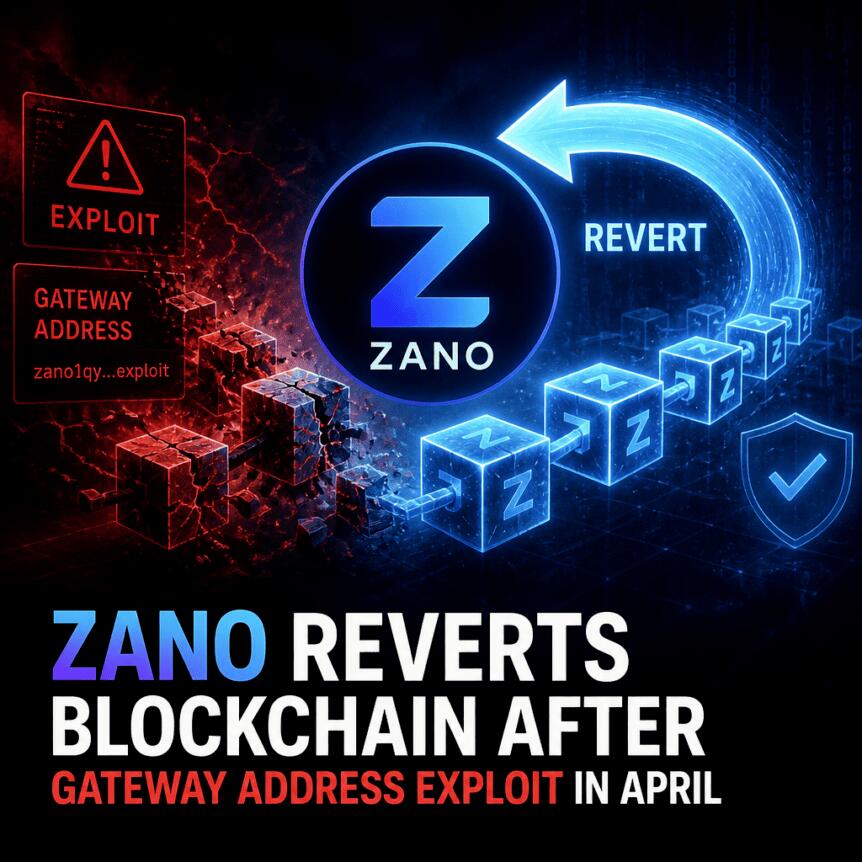
Zano has rolled back roughly a month of blockchain history after it identified a vulnerability tied to “Gateway Addresses” that, according to the project’s core team, enabled unauthorized ZANO and Freedom Dollar (fUSD) to enter circulation.
In an update shared Sunday, Zano said the network was restarted at block 3,833,000—immediately before Hard Fork 6, which introduced the affected functionality. The recovery now depends on ecosystem participants, including nodes, miners, stakers, exchanges, and other services, upgrading to the revised software.
Key takeaways
- Zano restarted the chain at block 3,833,000, rolling back about a month of activity tied to an exploit linked to Gateway Addresses.
- The rollback removes both legitimate transactions from that window and the unauthorized ZANO and fUSD that entered circulation.
- Payments already completed on other blockchains cannot be undone, limiting how far the recovery can reverse real-world settlement.
- Zano says it will handle remediation for affected parties through a reimbursement and claims process, though details have not yet been published.
- The fix requires coordinated adoption by infrastructure operators and service providers, including exchanges and other third parties that integrate with Zano.
Hard Fork 6 and the Gateway Address vulnerability
Zano has not published a full post-mortem as of publication, but it has confirmed that the problem originated with Gateway Addresses—a feature designed to simplify how external platforms such as bridges, exchanges, and payment services integrate with the Zano network.
According to the project’s explanation, Gateway Addresses enable these services to manage funds using a single “account-style” balance rather than handling payments as scattered transaction outputs.
Before Gateway Addresses existed, Zano wallets operated using separate transaction outputs (UTXOs). For exchanges and similar services, that meant incoming funds required blockchain scanning to identify which outputs belonged to a platform, followed by selecting specific outputs for withdrawals.
The introduced feature changed that workflow by offering a different way to account for funds—one that, in Zano’s view, became the pathway for the vulnerability that allowed unauthorized tokens to be minted or otherwise introduced into circulation.
What the rollback does—and what it cannot fix
Zano’s rollback invalidates the on-chain record of the affected period. The project states that transactions processed during that time will no longer appear on the restored chain. It also says the unauthorized ZANO and fUSD created or introduced through the exploit will be removed from the recovered ledger.
However, Zano cautioned that the rollback cannot reverse payments already settled on other blockchains. That distinction matters for users and service operators: if cross-chain transfers or off-chain settlements were completed before the restart, those transfers may not be recoverable even if the originating chain history is rewritten.
Zano also indicated that it is working to account for losses and will publish a reimbursement and claims process. The project did not provide the mechanics of how losses will be calculated or what documentation will be required within the material available at the time of writing.
Why Zano chose to restart the network
Zano’s head of marketing and growth, Quinten van Welzen, framed the decision as a trade-off between restoring the integrity of the currency supply and accepting a painful loss of history.
In statements shared alongside the rollback announcement, van Welzen argued that “doing nothing” would have allowed unauthorized ZANO and fUSD to remain in circulation without limits—effectively diluting holders and breaking what he described as the basic promise a currency makes: a fixed supply. He also suggested that allowing the attacker to retain value would set a dangerous precedent.
He acknowledged that restarting the chain from before Hard Fork 6 carries costs, including the disappearance of about a month of transaction history. At the same time, van Welzen said the rollback restores the supply that users expected and leaves a path for rebuilding trust.
Gateway Addresses and the risks of integration features
Zano’s broader context helps explain why the exploit mattered. The project launched in May 2019 as a layer-1 blockchain focused on private payments. Standard private transactions are designed to conceal senders, receivers, transferred amounts, and asset types.
Beyond its native token (ZANO), Zano allows users to deploy and mint custom digital assets. Freedom Dollar (fUSD) is one such token operating on the Zano blockchain. The vulnerability therefore wasn’t confined to a single token: unauthorized issuance affected both ZANO and an issued asset tied to the same underlying system.
Gateway Addresses were created to make integrations easier—especially for services that need to handle deposits and withdrawals without scanning UTXOs manually. But Zano’s response underscores a central theme in blockchain security: features that simplify custody and balances for third parties can also concentrate risk if they introduce new assumptions or pathways an attacker can abuse.
In that light, the coordination requirements for the restart carry practical weight. Zano said the recovery requires participating nodes, miners, stakers, exchanges, and other services to adopt the update. Without broad adoption, the network could split between versions, complicating settlement and increasing operational risk for trading venues and custodial providers.
For users, the rollback also highlights a limitation that extends beyond Zano itself: even if the originating chain is corrected, downstream effects—especially those involving cross-chain transfers or already-completed settlement—may remain permanent.
Looking ahead, attention should focus on the reimbursement and claims process Zano said it will publish, as well as how quickly exchanges and infrastructure operators finalize adoption of the restart. The project’s next security communications—whether it eventually releases a deeper technical post-mortem—will also be important for assessing whether Gateway Addresses will be reworked to prevent similar failures.

Vitalik Buterin Says Next Year's Hegota Will Be Ethereum's Last ‘Normal' Fork

Police block Orange Order from controversial parade route

How much is in your savings account?





-

 Fashion3 days ago
Weekend Open Thread: J.McLaughlin – Corporette.com
-

 Crypto World5 days ago
Goldman Sachs and Deutsche Bank Agree: The S&P 500 Rally Isn't Over
-

 Fashion4 days ago
8 iPhone Accessories That Add Personality
-

 Entertainment5 days ago
These 17 Fall Amazon Dresses Seriously Look Like Anthropologie
-

 Tech5 days ago
Reolink’s solar 4K security camera falls to its lowest price in months
-

 Tech7 hours ago
OpenAI is preparing “o,” an always-on ChatGPT assistant that could handle email
-

 Crypto World5 days ago
This Bearish Netflix Stock Trade Can Cash In On Video Streaming Giant’s Woes
-

 Crypto World6 days ago
Trump-Xi Polymarket Odds for Handshake Hit 50%
-

 Tech7 days ago
Google’s $899 Googlebook is a bet that you’ll buy a new laptop for Gemini
-

 Crypto World4 days ago
Crude Oil Prices Pressured by Diplomatic Hopes in the Middle East
-
 Business5 days ago
Oil Price Today (September 23): Crude oil below $100 on hopes of US-Iran talks. What did Trump say?
-
 Crypto World4 days ago
Bitcoin price tests $83,600 Supertrend support after $87K rejection
-

 Crypto World4 days ago
Bitcoin Threatens Sub-$84,000 Breakdown as Long Liquidations Spike
-

 Crypto World5 days ago
BitGo says Bitcoin absorbed Fed hike, CLARITY failure
-
 Crypto World6 days ago
Meta Jumps 11% As Muse Shines and Investors Show an Appetite for Advancing AI
-

 Crypto World5 days ago
Did Jim Cramer Just Give GameStop Stock the Kiss of Death When He Said the Turnaround Is Working?
-

 Crypto World7 days ago
Bitcoin price holds above $81K as key catalysts line up
-
 Crypto World6 days ago
Trump, Xi Meet on S&P 500's Best Day Since Early August: Will Markets Stay Bullish?
-
 Tech4 days ago
UiPath’s Dines says AI needs a manual and launches Cartographer to write it
-
 Tech7 days ago
Amazon blocks Meta’s Muse AI assistant in new standoff over agentic shopping
You must be logged in to post a comment Login