

Crypto World
Bitcoin: Corrective Channel Broken as Traders Turn More Active

Bitcoin has come under the influence of several factors simultaneously. The wave of selling at the beginning of June was linked to Strategy’s first disclosed Bitcoin sale in several years, a prolonged series of outflows from spot ETFs, and a large transfer of funds from a Mt. Gox wallet to a new address. The run of outflows from US spot Bitcoin ETFs became one of the longest and largest since these products were launched in January 2024.
Bloomberg Intelligence analyst James Seyffart noted that around $9 billion has exited Bitcoin ETFs since their peak, although most long-term fund investors have chosen to maintain their positions.
Technical picture
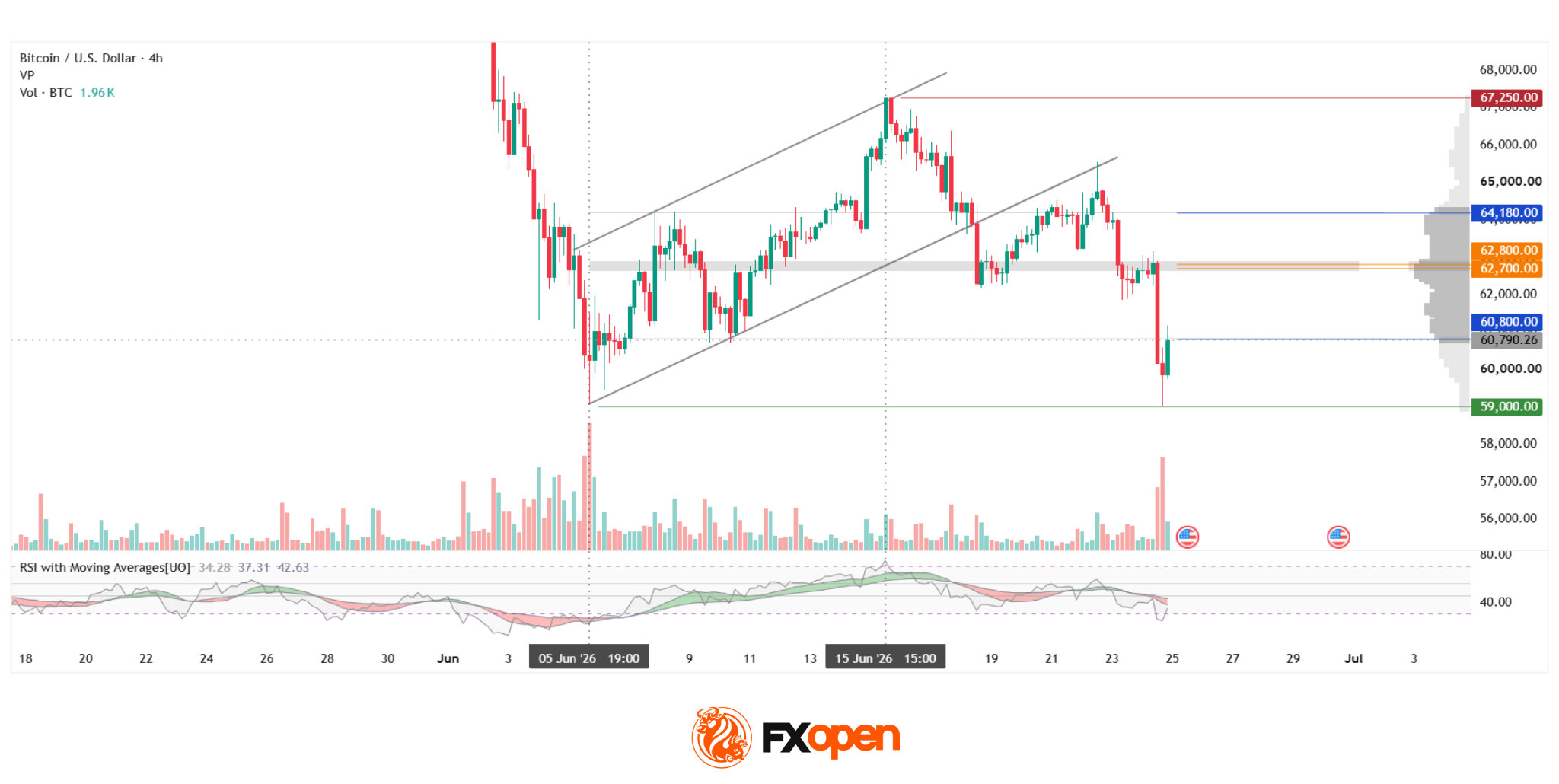
On the H4 chart of BTC/USD, an ascending corrective channel formed after an impulsive decline towards the $59,000 area. Price subsequently advanced to the upper boundary of the channel at $67,250, but failed to hold those levels. The channel was then broken to the downside, with quotations moving towards a test of the lower boundary of the current profile at $60,800.
The Point of Control (POC) is concentrated in the $62,700–$62,800 area and could attract market attention if price rebounds from the lower boundary.
The upper boundary of the profile is located near $64,180 and could act as resistance if the POC zone is breached. The RSI + MAs indicator stands at 34, 37 and 42 respectively. The oscillator remains below the neutral zone but has recovered from oversold territory, while the moving averages remain bearish and continue to point lower.
At the same time, vertical volume surged sharply during the decline on 24 June, which may have been interpreted by market participants as a sign that the local downtrend was nearing completion.
Summary
The unusually high volume recorded on 24 June, combined with the current RSI position, does not provide strong confirmation that the latest local impulse will continue, although the moving averages remain pointed lower for now.
Further price action may be influenced by upcoming US inflation data, as well as flows into Bitcoin ETFs, which experienced record outflows during June.
FXOpen offers the world’s most popular cryptocurrency CFDs*, including Bitcoin and Ethereum. Floating spreads, 1:2 leverage — at your service (additional fees may apply). Open your trading account now or learn more about crypto CFD trading with FXOpen.
*Important: At FXOpen UK, Cryptocurrency trading via CFDs is only available to our Professional clients. They are not available for trading by Retail clients. To find out more information about how this may affect you, please get in touch with our team.
This article represents the opinion of the Companies operating under the FXOpen brand only. It is not to be construed as an offer, solicitation, or recommendation with respect to products and services provided by the Companies operating under the FXOpen brand, nor is it to be considered financial advice.

American Bitcoin Corp has approved a 1-for-15 reverse stock split after shareholders backed the proposal at the company’s 2026 annual meeting.
Summary
- American Bitcoin has approved a 1-for-15 reverse stock split following shareholder approval at its 2026 annual meeting.
- The Trump-backed Bitcoin mining company also elected Asher Genoot to its board and approved KPMG as its independent auditor.
- ABTC shares extended losses on Thursday despite the corporate action, while the company continues to hold more than 7,500 BTC.
According to a filing with the U.S. Securities and Exchange Commission, shareholders of American Bitcoin Corp voted on several corporate matters during the annual meeting, after which the company’s board authorized a one-for-15 reverse stock split. The company said the change will take effect as soon as practicable.
The SEC filing states that the reverse split will reduce the number of outstanding shares while leaving the total number of authorized shares unchanged. Reverse stock splits are commonly used by listed companies to increase their per-share trading price without changing the overall value of shareholders’ holdings.
American Bitcoin has expanded its Bitcoin treasury
Alongside the reverse split, shareholders elected Asher Genoot as a Class I director for a three-year term that will expire in 2029, according to the SEC filing. Investors also approved the reappointment of KPMG LLP as American Bitcoin’s independent registered public accounting firm.
American Bitcoin, the Bitcoin mining and treasury company backed by Eric Trump and Donald Trump Jr., has accumulated more than 7,500 Bitcoin since its launch. The company currently ranks 16th among publicly traded corporate Bitcoin holders based on available treasury data, while Eric Trump continues to play a prominent role in the business.
The corporate update arrives one day after crypto.news reported that Democratic senators urged Senate Republican leaders to hold hearings into a reported $500 million investment in World Liberty Financial by an Abu Dhabi-backed entity.
According to the lawmakers’ letter, they want Trump administration officials to testify under oath about whether the investment affected later policy decisions involving the United Arab Emirates.
As previously reported by crypto.news, the senators cited a Wall Street Journal report stating that Aryam Investment 1, an Abu Dhabi-based company backed by Sheikh Tahnoon bin Zayed Al Nahyan, acquired a 49% stake in World Liberty Financial under an agreement signed in January 2025. The lawmakers also pointed to subsequent approvals for major arms sales and access to advanced AI chips for the UAE as developments warranting congressional scrutiny.
ABTC stocks remains under pressure despite the corporate action
American Bitcoin’s filing also disclosed that several directors received Class A common shares after restricted stock units vested on the annual meeting date. Justin Mateen received 254,778 shares, Richard Busch was issued 254,778 shares, and Michael Broukhim received 270,701 shares through one-for-one conversions of vested RSUs.
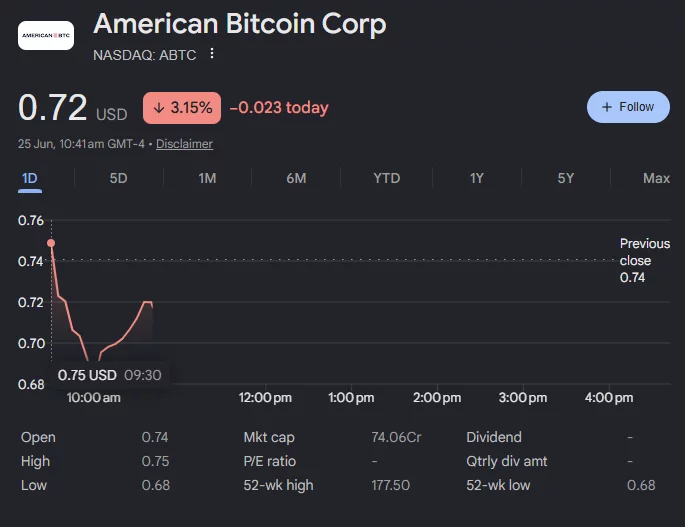
ABTC shares closed Wednesday’s session down 4.17% at $0.74 after trading between an intraday high of $0.78 and a low of $0.73. The stock has fallen roughly 17% over the past week and remains down about 60% year-to-date, according to Google Finance data.
Early Thursday trading extended the weakness, with ABTC falling another 3.15% to around $0.72 after touching an intraday high of $0.75 and a low of $0.68. Meanwhile, Bitcoin traded around $59,360, down 2.6% over the past 24 hours after slipping below the $60,000 mark, as investors continued to digest the latest U.S. Personal Consumption Expenditures inflation data.
Stablecoin issuer Circle and Japan’s largest investment bank Nomura have reportedly partnered to enable instant foreign exchange settlement for Japanese companies as early as 2027.
The service would enable companies to convert yen into dollar-denominated stablecoins for cross-border transactions and instant settlement, reducing delays caused by banking hours and time zone differences, Nikkei reported on Thursday.
The partnership would bring one of the world’s largest dollar stablecoins into Japan’s corporate foreign exchange market, expanding the use of stablecoins for business-to-business cross-border settlement.
Circle is the issuer of the world’s second-largest stablecoin, USDC (USDC), which has a market capitalization of $73.8 billion, CoinMarketCap data shows.
Cointelegraph has reached out to Circle and Nomura but had not received a response by press time.
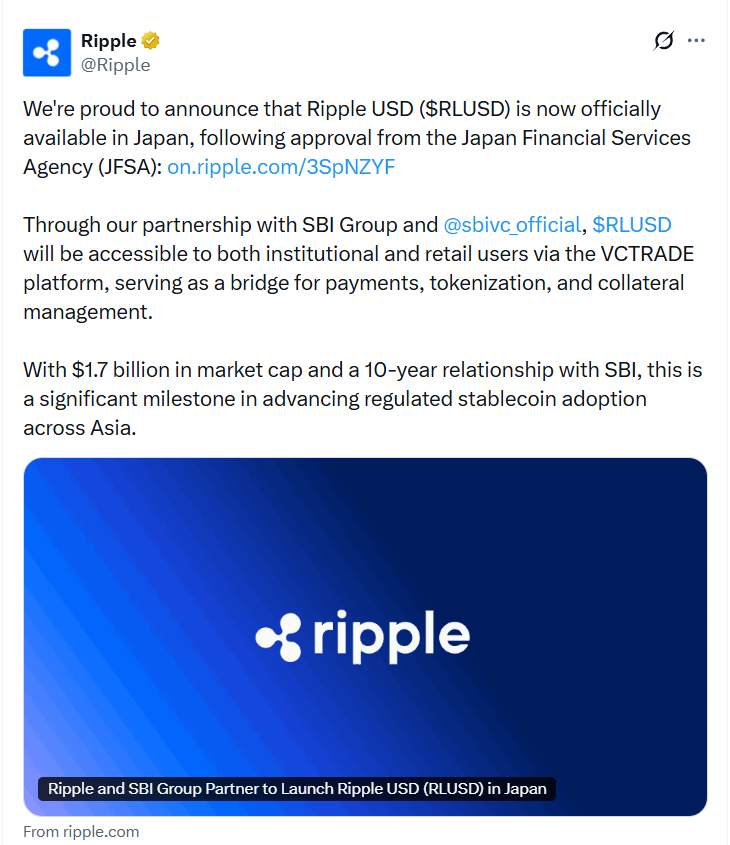
Stablecoin initiatives in Japan have been accelerating as financial institutions explore regulated blockchain-based settlement. On Wednesday, SBI Holdings and Startale Group announced JPYSC, a trust bank-backed yen stablecoin designed for institutional and cross-border settlement, while Ripple USD (RLUSD), the world’s 10th-largest dollar stablecoin by market capitalization, officially launched in Japan.
Source: Ripple
Related: SBI eyes Bitbank deal as Japan’s crypto exchange market consolidates
Japan moves closer to crypto ETFs, lower tax on digital assets
Japan has been one of the first major economies to establish a legal framework for stablecoins, allowing banks, trust companies and licensed money transfer providers to issue regulated tokens under the Payment Services Act.
The Payment Services Act also currently governs cryptocurrencies in Japan, but regulators have been moving to shift digital assets under the Financial Instruments and Exchange Act, which would bring them closer to the regulatory treatment of traditional financial products.
Earlier in June, Japan’s Lower House passed a bill that would bring crypto assets under the country’s financial instruments framework, potentially opening a path to exchange-traded funds, lower tax treatment, tighter exchange oversight, disclosure requirements and insider trading restrictions.
The proposed changes would also lower the capital gains tax on crypto assets from the current 55% to a 20% flat rate.
Magazine: Vietnam preps crypto pilot, HK pushes tokenization: Asia Express
Crypto World
‘It Seems Like BTC is Going to Zero?’ Prominent Voices Explain Why Dave Portnoy Is Wrong

The leading cryptocurrency has been in a clear decline lately, with the downturn intensifying over the past 24 hours as the price briefly tumbled below $60,000 for the second time this month.
As expected, the latest pullback has prompted a wave of doomsday predictions, with some claiming that bitcoin is “going to zero.” The popular American businessman and media personality, Dave Portnoy, floated the idea, but numerous industry participants dismissed the grim scenario.
‘The Bitcoin Journey is a Hero’s Journey’
The founder and CEO of Barstool Sports created a heated debate on X with his post. Several hours ago, he urged “all the bitcoin and crypto people who say it’s going to a million and how it’s the future” to convince him that the digital asset is not a scam and not headed toward rock bottom at $0.
“Cause it seems like it’s going to zero,” he added.
What followed was a massive wave of support toward BTC and its fundamentals, along with accusations that Portnoy simply speaks of things he doesn’t understand. One of the prominent people presenting strong arguments in favor of the cryptocurrency was Jack Mallers. The founder and CEO of Strike reminded that over the past 13 years, BTC has been the subject of such forecasts numerous times, especially after catastrophic events like Mt. Gox’s crisis and FTX’s meltdown.
Yet somehow, BTC is still around with a market capitalization of over $1 trillion, Mallers noted. He said the asset has been “the best thing I could have poured my life into over the last 13+ years.” Mallers then moved on to give Portnoy important advice:
“The Bitcoin journey is a hero’s journey. You kill your ego. You surrender the idea that you’re the all-knower of the future, the main character, and important enough to matter to this thing. Bitcoin doesn’t care what you think, and it doesn’t need your permission. You either have the balls to build conviction in it, or you don’t.”
Last but not least, Mallers challenged Portnoy to sell his BTC if he believes in the government and its ability “to not print away” people’s purchasing power.
Altcoin Daily also joined the discussion. The X user described BTC as “a global gold 2.0” that people can “actually own, send globally, and hold without a bank, CEO, or government changing the rules.”
“You know value and price are not the same thing. The internet crashed, too. It still changed the world,” they added.
Historically, BTC cycle bottoms have coincided with peak pessimism, when numerous people declared the asset dead or insisted that “it’s going to zero.” Some of the commentators on Portnoy’s post outlined that parallel, arguing that the market floor might be near.
Shift Focus From BTC
Portnoy has long stirred controversy with his Bitcoin takes, initially calling the asset a “Ponzi scheme.” He then softened his tone and withdrew his scam claims.
He also has experience in the meme coin sector, launching tokens such as GREED, GREED2, and JAILSTOOL, which experienced massive price volatility and severe crashes. Several X users reminded him of those efforts, predicting that BTC will recover sooner or later, but the dubious coins he once shilled are unlikely to rise from the dead.
The post ‘It Seems Like BTC is Going to Zero?’ Prominent Voices Explain Why Dave Portnoy Is Wrong appeared first on CryptoPotato.
It’s another painful day in the cryptocurrency markets, especially for the altcoins. Ethereum, which traded at roughly $1,800 just over a week ago, tumbled toward $1,500, but it’s yet to break its negative June record, at least for now.
In contrast, Ripple’s XRP has been at the forefront of the latest declines. The token plunged to just over $1.00 minutes ago, which became its lowest price tag since late 2024.
Analysts, even those who have been predominantly bullish on XRP’s future price trajectory, have warned that the asset could unravel if it decisively loses the psychologically important $1.00 level.
CasiTrades, for example, warned that the token could drop to a low of $0.87 before it rebounds. Ali Martinez was even more bearish, outlining targets of below $0.70 and all the way down to $0.15 in a very extreme scenario.
Many other altcoins have posted similar losses in the past hour alone. SOL is down by over 3.5%, ZEC has plunged by 4%, while ADA is close to breaking below $0.14 after a 3.7% drop.
Naturally, the liquidations have skyrocketed given this enhanced volatility, especially since BTC broke below $59,000 and plummeted to $58,000.
Expectedly, BTC is responsible for the lion’s share. Over $320 million worth of longs have been wiped out in the past hour alone. ETH follows suit with nearly $140 million, while XRP is third with just over $40 million – all from longs.
In total, the liquidations are up to $630 million in the past hour, and $600 million is from longs. The total value for the past day is $1.5 billion, with $1.22 billion from longs.

The post Over $600M Liquidated in 1 Hour as XRP, ETH Mimic BTC’s Massive Price Crash appeared first on CryptoPotato.


MiCA is the European Union’s first comprehensive rulebook for crypto, and on July 1, 2026, its transition period ends for good. This guide explains what MiCA does, why USDT got delisted while USDC did not, and what the hard deadline means for exchanges and users.
Summary
- MiCA becomes fully enforceable across the European Union on July 1, 2026, after which crypto firms without a MiCA license can no longer legally serve EU users.
- The regulation introduced a single framework for crypto across all EU member states, with strict rules for stablecoins, exchanges, and other crypto service providers.
- MiCA compliance kept USDC listed on regulated European exchanges, while USDT was delisted after its issuer chose not to seek authorization.
MiCA, short for Markets in Crypto-Assets, is the European Union’s first comprehensive law governing crypto-assets and the companies that deal in them, creating one common rulebook across all twenty-seven member states in place of the patchwork of national approaches that came before. Formally known as Regulation (EU) 2023/1114, it entered into force in mid-2023 and has rolled out in phases ever since, and it now sits at a decisive moment: on July 1, 2026, the transition period that let existing crypto firms keep operating under old national rules expires for good, and Europe’s market supervisor has been blunt that there will be no extensions.
After that date, any company offering crypto services to European Union clients without a proper MiCA license is simply breaking the law. This guide explains what MiCA is, the categories it creates, why some stablecoins survived in Europe while others were delisted, what a crypto company must do to comply, and what the hard 2026 deadline means for exchanges and ordinary users alike.
The significance of MiCA is hard to overstate, because the European Union is one of the largest economic blocs on earth and MiCA is the most ambitious attempt yet to bring crypto fully inside a traditional financial-regulation framework. Before MiCA, a crypto exchange or token issuer operating in Europe faced a confusing mix of national rules, with one regime in Germany, another in France, another in Malta, and gaps everywhere in between.
MiCA replaces that fragmentation with a single, harmonized system: get authorized once, and you can passport your services across the entire bloc. The trade-off is that the bar to get authorized is high, the obligations are heavy, and the deadline to clear them is now days away rather than years off. The result is a market being reshaped in real time, with a small number of licensed winners, a large number of firms facing exit, and a stablecoin landscape that already looks very different inside Europe than outside it.
What MiCA actually regulates
MiCA divides the crypto world into categories and applies different rules to each, so the first step in understanding it is learning what those categories are. At the top level, MiCA governs two kinds of actors: the issuers of crypto-assets and the providers of crypto-asset services. For issuers, MiCA sorts tokens into three buckets.
The first is electronic money tokens, or EMTs, which are stablecoins pegged to a single official currency, such as a euro-pegged or dollar-pegged coin. The second is asset-referenced tokens, or ARTs, which are stablecoins backed by a basket of things, multiple currencies, commodities, or other assets, rather than a single currency. The third is a catch-all category of other crypto-assets, which covers utility tokens, governance tokens, and unbacked cryptocurrencies like Bitcoin and Ether, the assets most exchanges handle every day.
Each bucket carries different obligations. The two stablecoin categories face the strictest treatment, because regulators view stablecoins as the part of crypto most capable of threatening the wider financial system, a concern sharpened by the 2022 collapse of the TerraUSD algorithmic stablecoin that wiped out tens of billions of dollars. EMT and ART issuers must hold proper reserves, grant holders redemption rights, and meet governance and disclosure standards.
The other crypto-assets face lighter rules, mainly requirements to publish an honest whitepaper before offering a token to the public and to avoid market abuse. Notably, MiCA largely excludes non-fungible tokens, unless they are issued in a large fungible series that makes them function more like ordinary tokens, and it excludes assets already covered by existing financial law, such as securities. The category a token falls into determines almost everything about how MiCA treats it, which is why getting the classification right is the starting point for any issuer.
The stablecoin rules and why USDT got delisted
The most visible effect of MiCA so far has been on stablecoins, and the clearest way to understand the rules is through what happened to the two largest dollar stablecoins. Under MiCA, a stablecoin can only be offered by European Union-regulated platforms if its issuer is authorized, which for a single-currency stablecoin means holding an e-money or credit institution license and meeting MiCA’s reserve, redemption, and governance requirements.
The reserve rules are strict: an EMT must back its tokens fully, holding one hundred percent of reserves in safe, segregated accounts, while an ART must keep at least a substantial portion segregated at regulated credit institutions. MiCA also bars stablecoin issuers from paying interest or yield to holders, a deliberate choice to stop stablecoins from competing with bank deposits and drawing money out of the banking system.
This is where the two giants diverged. Circle, the issuer of USDC, pursued authorization through a European subsidiary and obtained MiCA approval for USDC and its euro stablecoin EURC, making them compliant and freely offered across European Union exchanges. Tether, the issuer of USDT, the largest stablecoin in the world, did not apply for MiCA authorization and confirmed its token was not compliant. The consequence was swift: major European Union-regulated exchanges, including the regional arms of the largest global platforms, delisted USDT and other non-compliant stablecoins for their European users.
The nuance worth understanding is that USDT is not banned from existence in Europe; users can still hold it in self-custody and trade it on decentralized exchanges. What changed is that a MiCA-licensed exchange can no longer offer it, which fragments liquidity and pushes European users toward compliant alternatives like USDC. Every stablecoin authorized under MiCA so far has been an EMT, a single-currency token, and USDC’s compliance versus USDT’s non-compliance has become the textbook illustration of the rules in action.
CASPs: the rules for exchanges and service providers
Beyond token issuers, MiCA’s other major target is the companies that provide crypto services, which the regulation calls crypto-asset service providers, or CASPs. This category is broad: it covers exchanges, brokers, custodians, wallet providers that hold customer assets, trading platforms, and firms that advise on or place crypto-assets.
If your business touches customer crypto in almost any commercial way, you likely need a CASP authorization to keep serving European Union clients. The obligations that come with that authorization are extensive and closely mirror those imposed on traditional financial firms, which is the entire point: MiCA aims to make crypto service providers behave like regulated financial institutions rather than lightly governed startups.
A CASP must meet requirements covering customer identity verification and anti-money-laundering controls, the safekeeping and segregation of customer assets, governance and capital standards, market-conduct rules that prohibit insider trading and market manipulation, and clear disclosure of risks to customers. Authorized CASPs also become subject to the European Union’s operational-resilience framework, which mandates cybersecurity and incident-reporting standards, and to the crypto travel rule, which requires them to pass along sender and recipient information on transfers, the same obligation that has applied to bank wires for decades.
The reward for shouldering all of this is passporting: once a firm is authorized in any one member state, it can offer its services across all twenty-seven without seeking separate licenses in each, turning a fragmented continent into a single market. The burden is that running these programs at scale, across a global customer base, is expensive and demanding, which is exactly why so many firms are struggling to clear the bar before the deadline.
The July 2026 deadline and the great narrowing
Everything about MiCA now points toward a single date, and understanding the phased rollout explains why that date matters so much. MiCA did not arrive all at once. The stablecoin rules for EMTs and ARTs took effect in mid-2024. The full CASP authorization regime took effect at the end of 2024, the point from which firms needed a MiCA license to operate.
But MiCA included a grandfathering provision, a transition period that let firms already operating legally under their national rules continue doing so while they applied for full MiCA authorization. Member states set their own transition windows within the limits MiCA allowed, ranging from short windows ending in 2025 to the full eighteen-month period ending on July 1, 2026. That final date is the bloc-wide cutoff, the moment the transition ends everywhere at once.
What makes the deadline dramatic is how few firms have actually cleared the bar. As the cutoff approached in 2026, roughly a couple of hundred firms held some form of full MiCA authorization across the entire union, but the number cleared to run an actual crypto trading platform was strikingly small, in the low double digits, with a number of member states having issued zero trading-platform licenses at all. Industry executives openly warned that a large majority of exchanges currently operating may fail to secure a license and be forced to exit the European market, and reports emerged of major global exchanges facing rejection in specific countries.
Europe’s market supervisor reinforced the message with no room for ambiguity: no member state may extend the transition beyond July 1, 2026, and after that date, operating without authorization is a breach of European Union law, not a paperwork gap. The picture, then, is of a great narrowing, a market being compressed from a crowded field into a small set of licensed survivors, with the rest required to wind down their European operations or leave.
A worked example: what a token and an exchange each face
To make the rules concrete, it helps to walk through how MiCA treats two typical cases, a stablecoin issuer and an exchange, because the abstract categories become much clearer in motion. Imagine a company issuing a euro-pegged stablecoin and wanting European users to hold and trade it on regulated platforms.
Under MiCA, that token is an electronic money token, so the issuer must hold an e-money or credit institution license, back every token fully with reserves held in safe, segregated accounts, grant holders the right to redeem their tokens for the underlying currency on demand, publish a compliant whitepaper, and accept that it cannot pay holders any interest or yield. If the company does all of this and secures authorization, its stablecoin can be offered across the bloc; if it does not, regulated exchanges must refuse to list it, exactly the fork in the road that separated the compliant dollar stablecoin from the non-compliant one. The token’s fate under MiCA is decided entirely by whether its issuer accepts this package of obligations.
Now imagine an exchange that wants to keep serving European customers. Its path runs through CASP authorization. It must apply to a national regulator in some member state, prove it meets MiCA’s standards for governance, capital, and the safekeeping and segregation of customer assets, stand up the identity-verification and anti-money-laundering machinery that turns it into an obliged entity under European law, implement the travel rule so it passes sender and recipient information on transfers, meet the operational-resilience and cybersecurity requirements, and submit to ongoing supervision and market-conduct rules. If the regulator grants authorization, the exchange can passport that single license across all twenty-seven member states and operate bloc-wide.
If it cannot meet the bar or applies too late, it must stop serving European Union clients once the transition ends, winding down in an orderly way. The two journeys share a logic: MiCA offers a single, valuable prize, legal access to the entire European market, in exchange for accepting obligations modeled on those that govern banks and regulated financial firms.
What this worked example reveals is the deeper character of MiCA. It is not a light-touch registration that lets crypto firms keep operating much as before with a new label. It is a serious authorization regime that demands real reserves, real controls, real segregation of customer money, and real accountability, and it forces every issuer and service provider to decide whether the prize of European market access is worth the cost of meeting those demands.
For well-resourced firms with a long-term commitment to Europe, the answer is often yes, and they have built the compliance machinery to clear the bar. For many smaller or offshore operators, the cost is too high or the timeline too short, which is why the market is narrowing toward a smaller set of licensed survivors. The categories and rules described earlier are not bureaucratic abstractions; they are the concrete hurdles that decide, token by token and firm by firm, who gets to operate in Europe after the transition closes.
What MiCA leaves unsettled
For all its ambition, MiCA leaves important questions open, and the gaps are as revealing as the rules. The largest unsettled area is decentralized finance. MiCA is built around identifiable issuers and service providers, the companies it can authorize and supervise, but a genuinely decentralized protocol has no company at its center, no firm to hold a license or answer to a regulator. MiCA states that fully decentralized arrangements, those provided without any intermediary, fall outside its scope, which sounds clean until you ask what “fully decentralized” actually means.
The market supervisor has not yet defined the term precisely, and most real protocols sit somewhere in the middle, with a governance token, a development team, a foundation, or a front-end operator that a regulator might decide counts as an intermediary. The result is genuine uncertainty about which DeFi protocols MiCA captures and which it does not, a gap that will be filled by future guidance and enforcement instead of the text itself.
Other tensions are surfacing as the rules meet reality. MiCA places caps on how widely very large stablecoins denominated in non-European currencies, such as dollar stablecoins, can be used as a means of payment within the bloc, a provision aimed at protecting European monetary sovereignty but one that complicates life for a market where most trading is dollar-denominated.
There are overlaps with other European financial laws, such as payment services rules, that can double the compliance burden for some stablecoin activities and have prompted worries about the competitiveness of euro stablecoins. And politically, the dossier has grown charged, with some member states floating the idea of a mechanism to switch off foreign stablecoins seen as a systemic threat.
None of these unsettled questions undermines MiCA’s core achievement of creating a single framework, but they are reminders that a law this sweeping cannot anticipate everything, and that MiCA will keep evolving through guidance, enforcement, and amendment for years after the headline deadline passes.
MiCA in the global picture
MiCA does not exist in isolation, and seeing it alongside parallel efforts elsewhere reveals where global crypto regulation is heading. The same years that produced MiCA also produced the United States’ first comprehensive federal stablecoin law, the United Kingdom’s move toward its own crypto regime under its financial regulator, and Hong Kong’s stablecoin ordinance, among others.
These frameworks differ in detail, but they converge on a striking number of core principles: stablecoin issuers should hold full, high-quality reserves; they should be licensed and supervised; holders should have clear redemption rights; service providers should enforce identity checks and anti-money-laundering controls; and the whole apparatus should be brought inside the regulatory perimeter that governs traditional finance. MiCA, having arrived early and comprehensively, has functioned as something of a reference point that later frameworks echo and respond to.
This convergence matters for anyone trying to understand the trajectory of the industry. The era in which crypto operated in a regulatory vacuum, where an exchange could serve a global audience with minimal oversight, is closing, and MiCA is one of the clearest markers of that shift. The picture that emerges is of a maturing market in which access increasingly depends on compliance, in which the same stablecoin can be freely available in one jurisdiction and delisted in another based purely on its issuer’s regulatory posture, and in which the cost of operating legally has risen sharply.
For Europe specifically, MiCA’s promise is a safer, more transparent market with clear rules and a public register of authorized firms and tokens that anyone can consult. Its cost is a heavier compliance burden, a narrower field of providers, and reduced access to some popular global assets. Whether that trade favors consumers or stifles innovation is the live debate, but the direction is set: in Europe, crypto is now a regulated activity, and after July 1, 2026, that is true without exception.
What it means for everyday users
For an ordinary person using crypto in Europe, MiCA changes the landscape in concrete ways worth understanding before the deadline instead of after. The most immediate effect is on which platforms and tokens you can use. If you rely on an exchange that has not secured a MiCA license, that platform may be forced to stop serving European Union clients after July 1, 2026, which in practice can mean frozen new deposits, halted trading features, and eventually a forced withdrawal of your funds, sometimes during a period of low liquidity and high fees. The protective move is to check, today instead of on July 2, whether the platforms you use have secured or are clearly on track to secure authorization, and to favor those that have. An unauthorized service operating after the deadline offers reduced legal protection and potential restrictions on access to your own assets.
The second effect is on stablecoins. If you hold a non-compliant stablecoin on a European Union-regulated exchange, you may find it delisted, with trading pairs removed and liquidity drying up, which is why many European users have shifted toward MiCA-authorized options. You can still self-custody whatever you like, but the convenient on-ramps and trading pairs increasingly favor compliant tokens. The broader takeaway is that MiCA, for all its complexity, ultimately aims to make the European crypto market safer and more transparent for users by ensuring the exchanges they trust meet real standards and the stablecoins they hold are genuinely backed. The cost of that safety is fewer choices and more friction, and a transition period that, for some platforms and tokens, ends abruptly.
The practical wisdom is simple: understand which of your platforms and assets are compliant, make any moves before the deadline instead of during the disruption, and treat MiCA authorization as a meaningful signal that a service has accepted real regulatory accountability.
Frequently Asked Questions
What does MiCA stand for and what is it?
MiCA stands for Markets in Crypto-Assets. It is the European Union’s first comprehensive law for crypto-assets and the companies that deal in them, formally Regulation (EU) 2023/1114. It replaces the previous patchwork of national rules with one harmonized framework across all twenty-seven member states, covering token issuers and service providers like exchanges, custodians, and wallet providers. Its goals are to protect consumers, prevent market abuse, ensure stablecoins are properly backed, and bring crypto inside the same kind of regulatory perimeter that governs traditional finance, while letting authorized firms operate bloc-wide.
Why was USDT delisted in Europe but not USDC?
Under MiCA, a stablecoin can only be offered by European Union-regulated platforms if its issuer is authorized and meets MiCA’s reserve, redemption, and governance rules. Circle pursued authorization through a European subsidiary and obtained MiCA approval for USDC and its euro stablecoin EURC, so they remain available. Tether did not apply for MiCA authorization and confirmed USDT was non-compliant, so European Union-regulated exchanges delisted it. USDT is not banned outright; it can still be self-custodied and traded on decentralized exchanges, but licensed European platforms can no longer offer it.
What happens on July 1, 2026?
That is when MiCA’s transition period ends across the entire European Union. The transition, or grandfathering, let firms already operating under national rules keep going while they applied for full MiCA authorization. After July 1, 2026, any company providing crypto services to European Union clients without a proper MiCA license is breaking European Union law. The market supervisor has stated there will be no extensions. Because relatively few firms have secured licenses, especially to run trading platforms, many exchanges may be forced to exit the European market or wind down their services there.
What is a CASP under MiCA?
A CASP is a crypto-asset service provider, MiCA’s term for companies that offer crypto services such as exchanges, brokers, custodians, wallet providers holding customer assets, and trading platforms. To serve European Union clients, a CASP needs MiCA authorization, which comes with obligations modeled on traditional finance: identity checks and anti-money-laundering controls, segregation and safekeeping of customer assets, governance and capital standards, market-conduct rules against manipulation and insider trading, operational-resilience requirements, and the crypto travel rule. Once authorized in one member state, a CASP can passport its services across all twenty-seven.
Does MiCA regulate DeFi and NFTs?
Only partly, and with significant uncertainty. MiCA largely excludes non-fungible tokens unless they are issued in a large fungible series that makes them behave like ordinary tokens. For decentralized finance, MiCA says fully decentralized arrangements provided without any intermediary fall outside its scope, but it has not precisely defined “fully decentralized.” Since most protocols have a governance token, a development team, a foundation, or a front-end operator, regulators may decide some of them have an intermediary that MiCA captures. So the treatment of many DeFi protocols remains unsettled and will be clarified through future guidance and enforcement.
How does MiCA affect ordinary crypto users in Europe?
Mainly through which platforms and tokens you can use. If an exchange you use has not secured a MiCA license, it may have to stop serving European Union clients after July 1, 2026, which can mean halted deposits and trading and eventually forced withdrawals. Non-compliant stablecoins may be delisted from regulated exchanges, with liquidity shifting to compliant ones like USDC. The protective steps are to check whether your platforms are authorized, move before the deadline instead of during any disruption, and treat MiCA authorization as a signal that a service has accepted real regulatory accountability. You can still self-custody assets freely.
This article is educational information, not legal or financial advice. MiCA implementation, license counts, stablecoin compliance status, and deadlines can change, and details reflect reporting available as of June 25, 2026. Confirm current requirements and the status of specific platforms and tokens through official sources such as the European Securities and Markets Authority register before relying on anything described here.


- GoMining mines first Stratum V2 Bitcoin block with DMND pool.
- Stratum V2 enables miners to choose block transactions directly.
- New system shifts power from pools to miners in Bitcoin mining.
GoMining has mined the first known Bitcoin block produced using the Stratum V2 protocol with the DMND Bitcoin mining pool.
The process demonstrates miner-controlled block creation in a live mining environment.
The block was created using Stratum V2’s Job Declaration functionality through the DMND pool.
The approach allowed GoMining to construct and declare its own block template rather than relying on a mining pool to select transactions.
Pool-controlled transaction selection has been the dominant model in Bitcoin mining for years.
The milestone marks an early real-world implementation of Stratum V2’s miner-driven architecture and highlights a shift toward giving miners greater authority over how blocks are constructed while remaining part of pooled mining operations.
Miner-controlled block construction demonstrated in production
The block included transactions linked to GoMining’s GoBTC Pay, an open-source Bitcoin instant payments protocol developed by the company.
By incorporating GoBTC Pay transactions into the block template it created, GoMining demonstrated a practical use case for Stratum V2’s Job Declaration feature and showed how miners can directly influence the contents of blocks they help produce.
“This block demonstrates that miners can now participate in pooled mining while retaining control over block construction,” said Mark Zalan, CEO at GoMining. “For years, mining pools have largely determined which transactions are included in Bitcoin blocks. By creating our own block template and including GoBTC Pay transactions, we’re demonstrating one of the practical capabilities that Stratum V2 makes possible.”
The successful mining of the block provides an example of how miners may be able to gain more autonomy while continuing to benefit from the shared resources and economics of mining pools.
Stratum V2 aims to expand miner participation and flexibility
Stratum V2 is an open-source mining protocol developed with contributions from multiple participants across the Bitcoin industry.
In addition to improvements in security and efficiency, the protocol enables miners to create their own block templates while still participating in pooled mining.
The latest development demonstrates that miner-controlled block construction can operate in a production environment, potentially supporting broader adoption of Stratum V2 across the mining ecosystem.
The deployment also illustrates how the protocol may allow miners to integrate their own applications and services directly into the block creation process.
“A miner just mined the first Stratum V2 block to power their own product end to end. GoMining declared the template and included their GoBTC Pay payments with no pool in the way. We built DMND for exactly this.” said Alejandro De La Torre, CEO & Co-founder at DMND.
The milestone comes as the bitcoin mining industry continues to explore technologies that improve efficiency, security and decentralization.
By demonstrating that miners can build and declare their own block templates while remaining part of a mining pool, GoMining and DMND have provided an early example of how Stratum V2’s architecture could reshape block creation and transaction selection within the broader Bitcoin mining ecosystem.

Binance has informed European Union users that access to several services will be tightened after the exchange failed to obtain Markets in Crypto-Assets (MiCA) authorization from an EU member state before a July 1 deadline. The change, according to notices circulated by users, centers on stopping onboarding for new EU customers and reducing service availability for EU-based accounts as of July 1.
Importantly, Binance’s messages also emphasize that users will be able to withdraw their digital assets after the deadline. The notices frame the transition as an “orderly process” designed to minimize disruption, while the exchange proceeds with its MiCA rollout in Europe.
Key takeaways
- Binance says it will halt onboarding new EU users and limit certain services for EU accounts effective July 1 after missing MiCA authorization timing.
- Users are told they can still withdraw “all digital assets” after the deadline, subject to applicable regulatory requirements.
- The company reportedly advises EU customers to move funds to self-custody or other crypto asset service providers (CASPs) before access is restricted.
- Questions remain among users about how staking and existing yield-related positions will be handled during the restricted-services phase.
- Industry participants are split on expected user disruption, with some arguing effects are mainly limited to marketing and new customer acquisition.
What Binance is changing for EU users
Multiple public Binance notices shared on social media indicate that access restrictions will begin after the July 1 cutoff. Users reported that the exchange will stop bringing in new EU customers and limit “certain services” for EU-based accounts starting July 1.
While services are expected to narrow, the exchange’s communications are clear that withdrawals remain available. The notices reportedly state that “all digital assets are still available for withdrawal,” aligning with regulatory requirements.
Binance’s step appears tied to how MiCA licensing is being implemented across EU member states. The situation is described as one of the early, high-profile transitions under the EU’s MiCA framework, coming after Binance announced it withdrew its MiCA license application in Greece earlier this week.
Cointelegraph attempted to obtain comment from Binance on its plans but did not receive a response prior to publication.
Why Binance recommends self-custody or switching CASPs
In circulating notices, Binance told users they may consider moving assets to self-custodial wallets or transferring funds to other crypto asset service providers. The exchange characterized the transition as intended to be an “orderly process,” with services reduced to position management and withdrawals after the deadline.
The practical message for EU customers is straightforward: if they want to keep using Binance for broader features, they may need to act before July 1, because some functionality for EU accounts is expected to be scaled back. Binance’s guidance also suggests that the exchange expects limited usability after the cutoff, even if balances remain withdrawable.
Competitors and other MiCA-licensed platforms appear to be positioning themselves for the transition. Media and user reports referenced CASPs such as Revolut and OKX actively recruiting new users in EU member states ahead of the deadline.
Staking, trading, and the unanswered operational details
Beyond onboarding restrictions, users have focused on what happens to active services—particularly staking. In public replies, some Binance users asked what will occur to staked crypto assets after the deadline, reflecting uncertainty over whether yield-generating arrangements will be impacted by the forthcoming changes.
A Binance representative responded that user balances “remain available and safe as always,” but did not offer specific details on staking rewards or the treatment of active positions during the restricted-services period.
That gap matters for EU customers because MiCA compliance is not only about marketing and customer acquisition; it also affects how services are offered and structured. If staking rewards are treated differently, or if certain yield-related operations must pause, traders and long-term holders could experience operational friction even if withdrawals remain possible.
For active traders, the immediate concern is access to trading and position management. Another user said their main use of Binance is as a trading gateway and would switch exchanges if needed, arguing that disruption would likely be most significant for active traders and users with larger balances on the platform.
How the wider industry views the impact
The expected effect of Binance’s EU transition has not been universally interpreted. Some industry figures argue that the real-world impact on existing users may be limited compared with the amount of public attention the deadline has received.
Dominik Tomczyk, CEO of SIA AlphaRoute (operating as Kanga Exchange EU), told Cointelegraph that unlicensed platforms may still continue serving existing users under the legal concept of “reverse solicitation.” From a user perspective, he suggested that “nothing will change,” except for constraints on marketing and user acquisition within the EU.
Sławomir Zawadzki, co-CEO of Kanga Exchange, similarly suggested existing users are unlikely to face major disruptions. He also implied that much of the concern is being overstated and that competitive positioning may be influencing how the narrative is playing out online.
Other EU-based Binance users described a more pragmatic approach—monitoring for enforcement actions rather than assuming immediate harm. One user told Cointelegraph they were not overly concerned about the July 1 deadline, pointing to Binance’s liquidity and proof-of-reserves reporting, and saying they would keep using Binance until they saw evidence of a potential enforcement action.
These differing perspectives highlight a key asymmetry: notices about restrictions can create urgency, but the extent to which existing account functionality is reduced may vary depending on how MiCA rules are applied in practice and how Binance structures permitted activities after the cutoff.
Scale and what to watch after July 1
Binance’s EU footprint is large enough that the outcome will be watched closely by both users and other exchanges. According to Reuters, Binance’s global client base counts at least 300 million customers, and the app was downloaded more than 4 million times in the EU last year.
Even with withdrawal access preserved, EU users will likely pay attention to what “position management” covers once the restrictions start, as well as whether staking-related operations and trading features are curtailed in a way that forces customers to adapt their workflows.
Going forward, the critical signals to watch will be any clarification from Binance on staking and active positions, how quickly EU users migrate to other CASPs, and whether regulators or service providers interpret MiCA in a way that limits service continuity for already-established customers.

In the latest Cardano news, Cardano (ADA) price is trading at approximately $0.1480, down 1% in the last 24 hours, and sitting roughly 95% below its September 2021 all-time high of $3.09. That’s not a typo.
The Leios Musashi Dojotestnet went live on June 23, a genuine scaling milestone, and the chain barely blinked. Daily transactions held near 25,000, in line with a three-month average, with active staking addresses hitting a 120-day low of around 5,000 on June 21 against a prior norm of 7,000–8,000.
The one transaction spike worth flagging came June 4–5, when daily volume jumped above 60,000, but that aligned directly with a sharp sell-off, pointing to liquidation activity rather than fresh adoption.
Charles Hoskinson’s public comments about potential “ecosystem failures” and a temporary project pause compounded the negative sentiment, helping push ADA below $0.20 for the first time since 2020.

Governance friction, including backlash over a Discord migration proposal and calls for leadership changes, has added another layer of uncertainty that pure technical analysis can’t price away.
The broader altcoin market context makes the setup even more precarious: BTC has softened, macro headwinds persist, and capital rotation out of mid-cap alts has been aggressive. Whether ADA’s current tight range resolves as capitulation or continuation is the question every ADA holder is sitting with right now.
Cardano News: Can ADA Price Recover From $0.14 Support or Is a Fresh Low Ahead?
ADA’s technical picture is compressed. Price is consolidating between $0.148 support and $0.172 resistance, a tight band after a steep breakdown from the $0.20 to $0.25 range.
Market cap sits near $5.58 billion against a circulating supply of roughly 37.24 billion ADA. Even modest buying pressure can move ADA price right now, but sustained volume is absent.
If $0.14 holds, exchange outflows sustain accumulation pressure, and a macro risk-on shift lifts altcoins broadly, ADA retests $0.172 and potentially $0.20 on momentum.
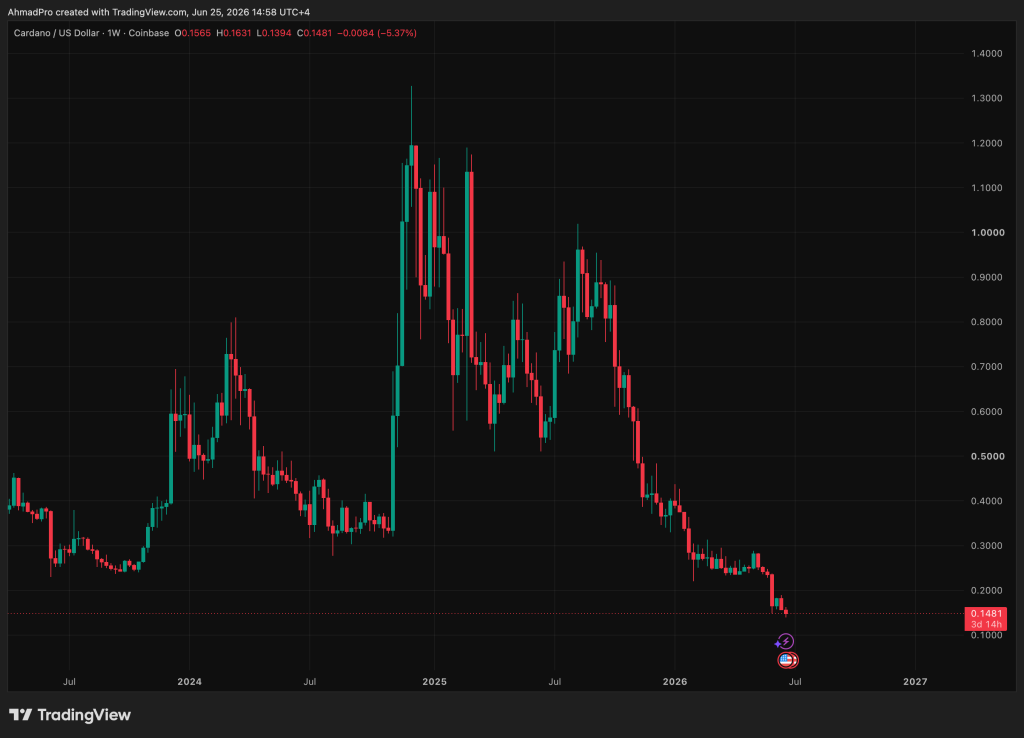
If neither side takes control, price grinds sideways through the summer in this corridor, with the 2026 mainnet target for Leios providing a longer-term catalyst that keeps capitulation buyers engaged but limits near-term upside.
A breakdown through $0.148 on volume opens a much weaker technical picture, with the next meaningful reference sitting well below current levels and a structural break from multi-year support shifting the chart narrative decisively negative.
The real tension is the divergence between exchange outflows and on-chain engagement. Buyers appear present at current levels. They are just not building anything on the network yet. That gap needs to close before any recovery gains real credibility.
Watch $0.148 closely. It is doing a lot of structural work right now.
Maxi Doge Dosen’t Promise You Anything: But It Could 1000X
ADA’s risk-reward at current levels is a genuine debate. Even in the bull case, recovering from $0.15 to prior cycle highs requires the kind of capital inflow that broad altcoin markets haven’t delivered in months.
That calculus is pushing a segment of active traders toward earlier-stage positions where entry price asymmetry is still intact, before a project reaches the liquidity constraints of a $5 billion market cap.
Maxi Doge ($MAXI) is one presale drawing that is drawing attention. Built on Ethereum (ERC-20), it positions itself around a meme-first trading culture, 1000x leverage mentality, gym-bro viral marketing, holder-only trading competitions with leaderboard rewards, and a Maxi Fund treasury allocated to liquidity and partnerships (the tagline is “never skip leg-day, never skip a pump,” which is either ridiculous or perfectly calibrated for its target audience, probably both).
The project has raised $4,811,876.93 at a current presale price of $0.0002825, with dynamic staking APY available for participants. For context on how meme coin dynamics play out post-launch, the Dogecoin cycle offers a reference point this category continues to benchmark against.
Presales carry real risk, liquidity post-launch is never guaranteed, and meme token markets are unforgiving if momentum stalls. DYOR before committing capital.
The post ADA Just Launched a Major Scaling Testnet And the Network Barely Noticed at $0.148 appeared first on Cryptonews.

Japan’s SBI Holdings has moved to fully take control of the Bitbank cryptocurrency exchange in a deal valued at 46.7 billion yen (about $289 million), building a larger, more consolidated crypto trading platform under one regulated umbrella. The agreement follows an initial announcement made in May, which positioned the combination as a potential scale-up into the country’s largest crypto exchange.
On Thursday, SBI said its wholly owned subsidiary, SBICAH, will acquire Bitbank shares from Bitbank CEO Noriyuki Hirosue and other shareholders, then participate in a third-party share allotment. After that, Bitbank will buy back shares currently held by MIXI and Ceres, leaving SBI with 100% indirect ownership. SBI expects the transaction to close around October, subject to regulatory approval.
Key takeaways
- SBI will pay 46.7 billion yen to gain full indirect control of Bitbank, aiming to accelerate its position in Japan’s regulated exchange market.
- The restructuring plan includes a third-party share allotment and a Bitbank share buyback from MIXI and Ceres, with SBI ending at 100% indirect ownership.
- SBI forecasts the combined group will manage about 1.1 trillion yen in assets under custody and reach roughly 2.92 million crypto accounts, based on end-April figures.
- Bitbank’s trading has been relatively muted for months, with CoinGecko data showing daily volume typically below $50 million over much of the past four months.
- SBI says the enlarged exchange footprint could add another distribution channel for stablecoins, tokenized assets, and onchain financial products.
Why SBI’s Bitbank control matters to Japan’s crypto market
For investors and market participants, the main significance of the Bitbank deal is not only consolidation, but also capacity—SBI is trying to connect an exchange-led customer base with a broader digital-asset product lineup. SBI’s stated goal is to expand its regulated crypto exchange operations and customer reach, which it argues could support distribution of stablecoins, tokenized assets, and other onchain financial services.
In effect, the acquisition is designed to strengthen SBI’s role across multiple layers of Japan’s crypto ecosystem: trading infrastructure, custody and account management, and settlement or product distribution. That matters in a market where regulatory clarity and institutional participation are key constraints—and where distribution channels can be as important as underlying technology.
How the transaction will be structured
SBI’s announcement outlines a multi-step process. First, SBICAH will acquire Bitbank shares from Hirosue and other existing shareholders. It will then subscribe to shares issued through a third-party share allotment. After those steps, Bitbank is expected to repurchase the shares held by MIXI and Ceres.
The result, SBI says, is that the group will hold 100% indirect ownership once the buyback completes. SBI expects the overall deal to close around October, but only after it receives regulatory clearance—an important reminder that Japan’s exchange and stablecoin frameworks rely on approvals and compliance review.
Scale effects: custody and accounts, plus the trading backdrop
Alongside the ownership changes, SBI provided combined operating figures for the enlarged group. According to SBI, combining Bitbank with SBI VC Trade would bring the group to about 1.1 trillion yen in assets under custody and roughly 2.92 million crypto accounts, using data from the end of April.
SBI also claims that this combined business would rank first among Japanese crypto exchanges by assets under custody and among the largest by account numbers. While the exact competitive landscape can shift with market activity and reporting periods, the direction of travel is clear: SBI is targeting scale metrics that are closely watched by institutions, compliance teams, and potential partners.
Trading liquidity is another piece of the picture. CoinGecko data cited by SBI indicates Bitbank’s daily trading volume has generally stayed below $50 million for most of the last four months. The exchange’s activity is heavily concentrated in key fiat pairs—BTC/JPY accounts for 39.5% of volume, with XRP/JPY and ETH/JPY each at 19.7%.
That concentration underscores why integration could matter: combining Bitbank with SBI VC Trade may help SBI manage customer routing, product access, and onchain distribution more efficiently—especially if volumes are expected to respond to broader cross-platform adoption.
SBI’s broader push: stablecoins and tokenized financial markets
The Bitbank acquisition fits into a wider strategy by SBI to extend from trading into digital-asset settlement and tokenized finance. SBI frames the move as additional infrastructure for its evolving product suite.
Earlier this year, SBI and Startale Group unveiled Strium, a layer-1 blockchain intended to support around-the-clock trading and settlement for tokenized equities and real-world assets. In parallel, SBI has been expanding stablecoin-related capabilities in Japan.
Most recently, SBI said that on Wednesday, SBI and Startale launched JPYSC, a yen-pegged stablecoin. SBI stated that the token is issued by SBI Shinsei Trust Bank and distributed by SBI VC Trade. Initially, JPYSC circulation is limited to transfers within SBI VC Trade accounts, with public blockchain circulation planned after resolving outstanding legal and tax conditions.
On the same day, Ripple and SBI Group also launched Ripple USD (RLUSD) in Japan via SBI VC Trade. SBI said RLUSD became available to both institutional and retail customers after receiving approval under Japan’s regulatory framework for foreign-issued stablecoins.
Taken together, these developments highlight why exchange ownership is strategically valuable. If distribution for stablecoins and tokenized instruments depends on access points that regulated exchanges can provide, acquiring a bigger platform and integrating accounts can directly influence adoption timelines—at least from the perspective of product rollout and customer onboarding.
Investors should watch two things next: whether SBI clears the remaining regulatory steps to complete the Bitbank acquisition around October, and how the combined operations evolve in practice—particularly whether SBI can translate scale in accounts and custody into stronger liquidity and smoother distribution for JPYSC, RLUSD, and future tokenized offerings.
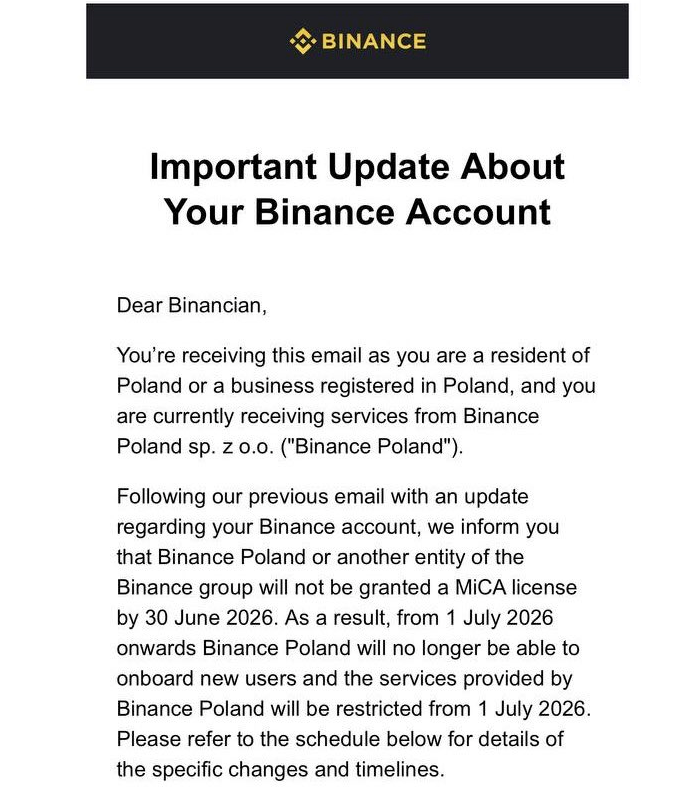
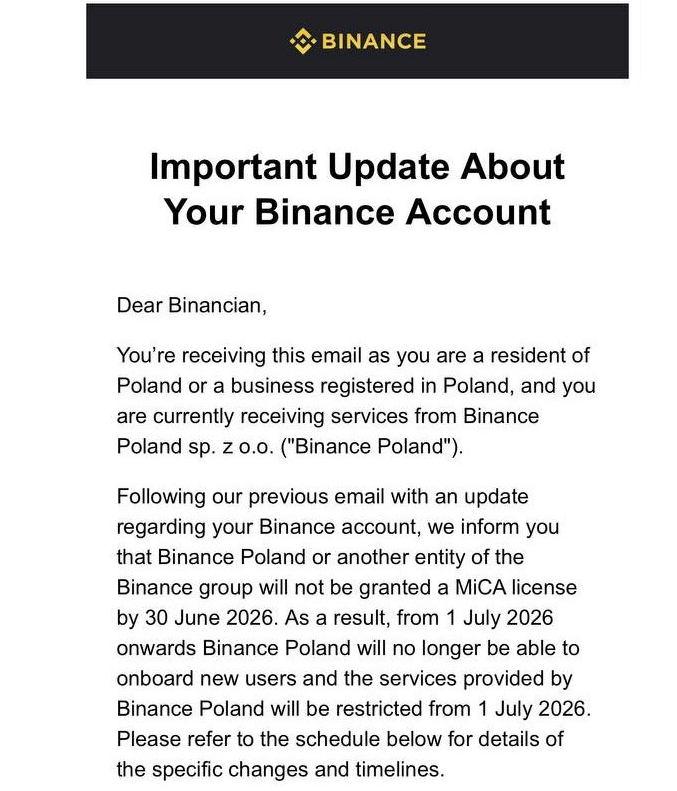
Binance has notified European Union users that access to key services will be restricted after the exchange failed to secure Markets in Crypto-Assets (MiCA) authorization from a member state before a July 1 deadline.
Those restrictions include halting the onboarding of new EU users and limiting certain services for EU-based accounts effective July 1, according to exchange notices shared by users on social media.
The notices said users will still be able to withdraw their assets after that date, stating that “all digital assets are still available for withdrawal,” in line with applicable regulatory requirements.
The move marks one of the first major transitions under the EU’s MiCA framework after Binance announced it withdrew its MiCA license application in Greece on Wednesday.
Cointelegraph approached Binance for comment on its plans but did not receive a response prior to the time of publication.
Binance advises moving funds to self-custodial wallets or other exchanges
In circulating notices, Binance told users they may move assets to self-custody wallets or transfer funds to other crypto asset service providers (CASPs).
The exchange operator said the transition is intended to be an “orderly process” aimed at minimizing disruption to users, with services reduced to position management and withdrawals after the deadline.
Source: IT_Tech_PL
Multiple MiCA-licensed CASPs including Revolut and OKX have been actively recruiting new users in EU member states ahead of next week’s deadline.
Users seek clarity on staking and trading
Some Binance users have raised concerns over how specific services will be handled once EU service restrictions take effect after the MiCA transition ends.
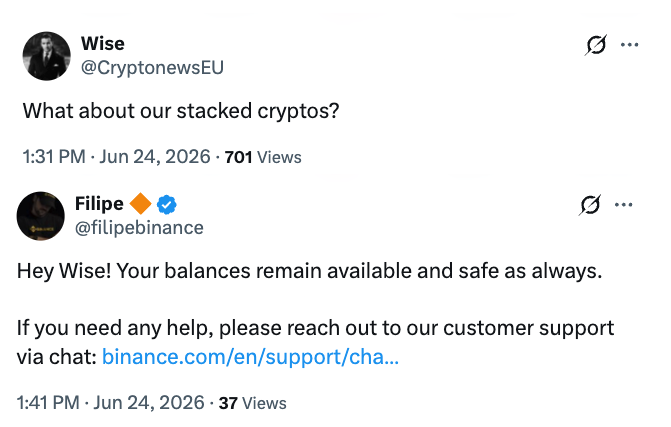
In public replies on social media, users asked what will happen to staked crypto assets on Binance after the deadline, reflecting uncertainty around whether yield-generating positions will be affected by the upcoming service changes.
Source: Filipebinance
In response, a Binance representative said user balances “remain available and safe as always,” but did not provide specific details on how staking rewards or active positions will be treated under the restricted-services phase.
Community divides over Binance user impact
Views across the crypto industry differ on how significant the upcoming MiCA transition will be for existing Binance users in the European Union.
Dominik Tomczyk, CEO of SIA AlphaRoute, operating as Kanga Exchange EU, told Cointelegraph that non-licensed platforms may still continue serving existing users under the legal concept of “reverse solicitation.” He said that, from a user perspective, “nothing will change,” apart from restrictions on marketing and user acquisition within the EU.
Sławomir Zawadzki, co-CEO of Kanga Exchange, said existing users are unlikely to see major disruptions. He also suggested that much of the concern around MiCA-related changes is being overstated, adding that competitive positioning may be shaping parts of the public narrative.
Mixed response from users
One Binance EU user told Cointelegraph they were not overly concerned about the MiCA deadline, pointing to Binance’s liquidity and proof-of-reserves reporting. “I’ll honestly continue using Binance until I see evidence of a potential enforcement action,” the person said.
Another user said the impact on Binance EU users would depend on how heavily they rely on the platform. They noted that their primary use of the platform is as a trading gateway and would switch to another exchange if needed, while suggesting the biggest disruption would likely affect active traders and users with large balances on the platform.
Related: EUR trading accounts for 1% of Binance spot volume, CryptoQuant says
According to media reports, Binance’s global client base counts at least 300 million customers, while the app was downloaded more than 4 million times in the EU last year.
Magazine: How crypto laws changed in 2025 — and how they’ll change in 2026

Trump-backed American Bitcoin approves 1-for-15 reverse stock split

All-Ireland SFC Quarter-Final – Stats

Netris raises $15M Series A from a16z to help AI neoclouds go live faster


-

 Fashion6 days ago
Weekend Open Thread: Miami – Corporette.com
-

 Entertainment5 days ago
Renter of Home in Anne Heche Crash Denies Settlement With Son
-
 Sports2 days ago
Two goals and an assist by sheer aura: Cristiano Ronaldo just entered the World Cup chat
-

 Tech3 days ago
Microsoft accidentally kills epic Outlook email threads
-

 Business5 days ago
Soccer-U.S. defends Iran World Cup travel restrictions, says discussions ongoing
-

 Politics5 days ago
Andy Burnham and the meaning of Makerfield
-
Crypto World1 day ago
Bitcoin (BTC) Dips Below $62K, Ethereum (ETH) Plunges 6% Daily: Market Watch
-

 Politics7 days ago
BBC Reporter Discusses Cross Party Criticism Of Trumps Iran Deal
-

 Crypto World1 day ago
Securitize Wraps Roubini's SEC-Registered ETF as Dubai VARA Digital Security
-

 NewsBeat6 days ago
Keir Starmer Allies Question His Chances For No 10
-
Business2 days ago
Entergy settles forward sale agreements, raises $672 million in cash proceeds
-
 Business5 days ago
Wall Street Week Ahead: Investors see Micron earnings as pulse check of AI rally momentum
-
Crypto World5 days ago
Can Charles Hoskinson Really Rescue Cardano?
-

 Crypto World6 days ago
HIVE shares jump as $220M AI deal speeds Bitcoin mining pivot
-

 Crypto World5 days ago
Jake Chervinsky accuses CME of protecting derivatives monopoly
-

 Entertainment6 days ago
Jose Alvarado Wants Taylor Swift at More Knicks Games
-
 Tech4 days ago
Signal’s Meredith Whittaker says AI chatbots ‘are not your friends’ and calls Copilot agents a backdoor
-

 Tech3 days ago
Nearly 7,000 fake Amazon domains registered ahead of Prime Day 2026, researchers warn
-

 Sports2 hours ago
India vs Bangladesh LIVE Score, Women’s T20 World Cup: Bangladesh Opt To Bat; India Enter ‘Do-Or-Die’ Stage As Semi-Final Race Heats Up
-

 Sports7 days ago
FIFA World Cup 2026: Canada beat 9-men Qatar 6-0 to register first ever win | FIFA World Cup 2026
You must be logged in to post a comment Login