
Crypto World
Bitcoin Drops 3% as Failed US-Iran Nuclear Talks Trigger Heavy Short Pressure


TLDR:
- JD Vance confirmed US-Iran nuclear talks failed, triggering a 3% Bitcoin price drop overnight.
- Bitcoin’s decline extended its drawdown to nearly 42% from its most recent all-time peak price.
- Nearly $1 billion in sell volume hit Binance derivatives within one hour of the failed talk news.
- Binance funding rates fell to -0.0065%, confirming short positions now dominate the derivatives market.
Bitcoin faced sharp selling pressure after US-Iran nuclear talks collapsed over the weekend. JD Vance confirmed no agreement was reached, sending BTC down 3% and back toward the $70,000 range.
Bitcoin Slides 3% After Diplomatic Breakdown
Bitcoin entered the weekend with cautious optimism, supported by improving geopolitical signals from the prior week. Traders had been watching the US-Iran negotiations closely for any sign of progress.
Instead, JD Vance announced overnight that talks had failed entirely. Disagreements over nuclear issues were cited as the main barrier to any deal.
The price quickly reflected the news, with Bitcoin dropping around 3%. That decline brought BTC back to the $70,000 area, a zone that had acted as support in recent sessions.
The move also extended Bitcoin’s drawdown to nearly 42% from its most recent peak. Despite the sustained decline, market participants continued to lean short.
Geopolitical tension has often added uncertainty to crypto markets, and this case was no different. The breakdown removed a layer of optimism that had been building throughout the week.
When that support gave way, the sell-off followed quickly and without hesitation. Bearish momentum took hold almost immediately after the announcement.
Trading volumes responded sharply as the news circulated. BTC price action was decisive, with sellers taking control during the session.
The broader crypto market also reflected the risk-off shift. Bitcoin, as the market’s lead asset, absorbed the brunt of the pressure.
Short Sellers Take Control of Binance Derivatives
Within one hour of the news breaking, nearly $1 billion in sell volume flooded Binance derivatives. Crypto analyst Darkfost noted in a post that this level of activity in such a short window pointed to heavy, coordinated short positioning.
The volume surge reinforced the already declining price trajectory. It was a clear signal that traders were reacting swiftly to the geopolitical news.
Funding rates on Binance moved further into negative territory, settling around -0.0065%. Binance incorporates an implicit interest rate of 0.01% into its funding rate calculations.
When the rate falls below that level, it confirms that short positions are already dominating. That threshold has now been crossed, placing control firmly with the bears.
This kind of short-side consensus has historically preceded counter-moves in the market. When most participants align on one side, price often moves in the opposite direction.
However, this dynamic tends to carry less force during bear market conditions. Any potential reaction is likely to remain limited in both scale and duration.
Traders watching this setup should remain measured in their expectations. The broader trend continues to favor the downside, even with crowded short positioning.
A reactive bounce is possible but not guaranteed under current conditions. BTC’s next move will likely depend on any fresh geopolitical or macro developments.


Crypto World
Strategy signals another bitcoin buy as company needs just 2% annual BTC growth to cover dividends


Strategy co-founder Michael Saylor signaled an imminent bitcoin purchase on Sunday, posting “think bigger” alongside the company’s BTC acquisition tracker that has preceded every major buy since 2020.
The company has made 105 bitcoin purchases since it began accumulating in August 2020. Its most recent, on April 6, added 4,871 BTC for $329.8 million. Total holdings stand at 766,970 BTC acquired at a blended cost basis of $75,644, roughly $5,000 above the current market price and representing $14.5 billion in unrealized losses that Strategy disclosed in a first-quarter SEC filing.
MSTR is buying at a pace that dwarfs new supply. Strategy accumulated 46,233 BTC in March, while miners produced approximately 16,200 BTC, meaning a single company absorbed nearly three times the bitcoin that the entire global mining network generated in the same period.
Meanwhile, Saylor also disclosed that Strategy’s breakeven annual return rate on its STRC preferred equity product is approximately 2.05%. If bitcoin appreciates faster than that over time, the company can cover its preferred dividends indefinitely without issuing new MSTR shares.
The number quantifies both the appeal and the fragility of the funding model. A 2% hurdle is low by historical bitcoin standards, but it assumes bitcoin never goes sideways or down for an extended period while the dividends keep compounding.
STRC is the mechanism that makes the buying machine run. The preferred equity product saw hundreds of millions in new inflows around its recent ex-dividend date, providing the capital for continued accumulation. Strategy keeps buying as long as investor appetite for STRC holds.
Bitcoin traded at $71,800 on Monday, according to CoinDesk data, up 7.9% on the week and holding above $70,000 for the fourth consecutive day since the Iran ceasefire was announced.
Whether Saylor’s “think bigger” translates into a purchase large enough to move the market depends on the size. At Strategy’s recent pace of 40,000-plus BTC per month, the next filing could push total holdings past 800,000 before the end of April.
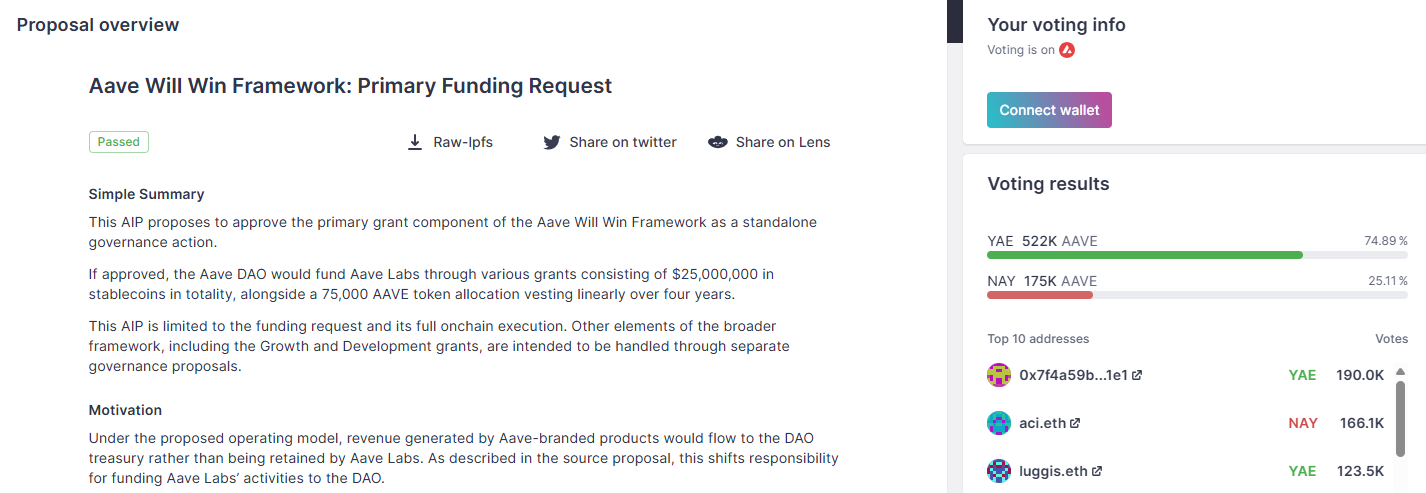
Aave Labs, the core development team behind the Aave protocol, has been granted $25 million in stablecoins, alongside a token allocation of 75,000 AAVE by its decentralized autonomous organization (DAO) as part of the “Aave Will Win” framework.
The vote passed Saturday with nearly 75% in favor. The stablecoin allocation will be paid in installments over 12 months, while the 75,000 AAVE tokens will vest linearly over four years, according to the governance dashboard.
The Aave Will Win framework aims to accelerate the protocol’s growth, with the DAO funding development and Aave Labs focusing on building and scaling. The stablecoins directly fund Aave Labs’ operations, while the token allocation serves as an incentive for developers to help grow the protocol.
Other elements of the framework, including the growth and development grants tied to specific product launches and milestones, will have separate governance proposals.
Aave is one of the largest DeFi protocols in the industry, with its total value locked exceeding $25 billion, DeFiLlama data shows. The framework marks a major shift in funding allocation.

Most important proposal in protocol’s history, founder says
Following the vote, Aave founder Stani Kulechov said in an X post Saturday that Aave Will Win is the “most important proposal in Aave’s history” and it “just passed with a landslide.”
“If you own AAVE, you own not just the economic rights of the protocol, but the brand, the users, and the integrations, he added. “This is the direction we are committing to, a multi-year journey. The foundation is set. Now it’s time to build. Aave will win.”

Under the framework, which passed on April 5, Aave Labs would shift to a DAO-funded operating model, with revenue generated by Aave products, such as Aave Pro, flowing to the DAO treasury rather than being retained by Aave Labs.
The proposal also sought ratification of Aave V4 as the protocol’s long-term technical foundation and outlined plans for a new foundation to steward the Aave brand. Aave Labs would also focus only on Aave-related products, with the goal of streamlining operations, accelerating development and building more competitive offerings.
“Fintechs are entering DeFi, institutions are coming on-chain, and regulatory clarity is emerging in certain markets that allows us to go directly to consumers,” Aave Labs said.
“The protocols that win the next decade will be those that move fast, build great tools and products and capture new markets before competitors,” it added.
Proposals met with friction before
Some community members have previously raised concerns about the size of the funding package and the inclusion of 75,000 AAVE tokens, which carry voting power, and the definition of what counts as revenue.
Related: Chaos Labs taps out as Aave’s risk provider, decision ‘not made in haste’
The Aave Will Win framework passed a temperature check on March 1, and soon after, a major governance delegate, the Aave Chan Initiative, announced it would wind down its involvement with the DAO due to concerns about governance standards and voting dynamics during the proposal process.
In January, another proposal to transfer control of Aave’s brand assets and intellectual property to its DAO failed, prompting debate within the Aave community over the protocol’s long-term direction and governance structure.
Magazine: Bitcoin quantum-safe without upgrade? CZ’s 2031 crypto vision: Hodler’s Digest, April 5 – 11


Markets opened Monday to a sell-off that crypto investors had seen coming. The collapse of US-Iran peace talks in Islamabad and a new US naval blockade impacted major asset classes.
The weekend’s failures raised fresh fears over supply disruption and cast doubt on a fragile two-week ceasefire set to expire on April 22.
Crypto’s Sunday Dip Warned What Monday’s Stock Sell-Off Would Confirm
Bitcoin (BTC) dropped from a weekend high near $74,000 to an intraday low of $70,570 yesterday after Vice President JD Vance confirmed that 21 hours of negotiations had ended without a deal. The total crypto market cap fell about 1.8%.
The sell-off deepened after the US Central Command (CENTCOM) announced a blockade of “all maritime traffic entering and exiting Iranian ports on April 13 at 10 a.m. ET.”
BeInCrypto Markets data showed that the total market capitalization has fallen 2.68% over the past 24 hours. At the time of writing, BTC traded at $71,125. Ethereum (ETH) had dropped to $2,204.
Meanwhile, by Monday morning, traditional markets confirmed what crypto had already priced in. The Kobeissi Letter noted that the S&P 500 and Dow Jones each fell roughly 1%, while the Nasdaq 100 slid 1.3%.
“US stock market futures open sharply lower as Iran War peace talks end without a deal,” the post read.
Subscribe to our YouTube channel to watch leaders and journalists provide expert insights
Gold and silver both declined in early Asian trading hours on Monday. Gold prices fell 0.75% to $4,711 per ounce, retreating rather than rallying despite the geopolitical turmoil. Silver prices dropped more sharply, sliding over 2% to $74.20.
The weakness across precious metals suggests that rising energy costs and the prospect of prolonged inflation are outweighing safe-haven demand, as traders increasingly expect the Federal Reserve to hold rates steady for longer.
Finally, energy markets also reacted sharply, though in the opposite direction. US crude oil jumped over 10% past $105 per barrel. International Brent crude rose 8%. Wholesale gasoline spiked 6%, and heating oil, a proxy for jet fuel, surged 9.3%.
Follow us on X to get the latest news as it happens
The pattern is becoming familiar. Throughout the weeks of the US-Iran conflict, crypto has repeatedly flagged geopolitical risk before equity sessions open. With the two-week ceasefire deadline approaching, traders across both markets face continued uncertainty over whether diplomacy can keep pace with escalation.
The post Crypto Saw It Coming: How Sunday’s Dip Foreshadowed Monday’s Market Meltdown appeared first on BeInCrypto.
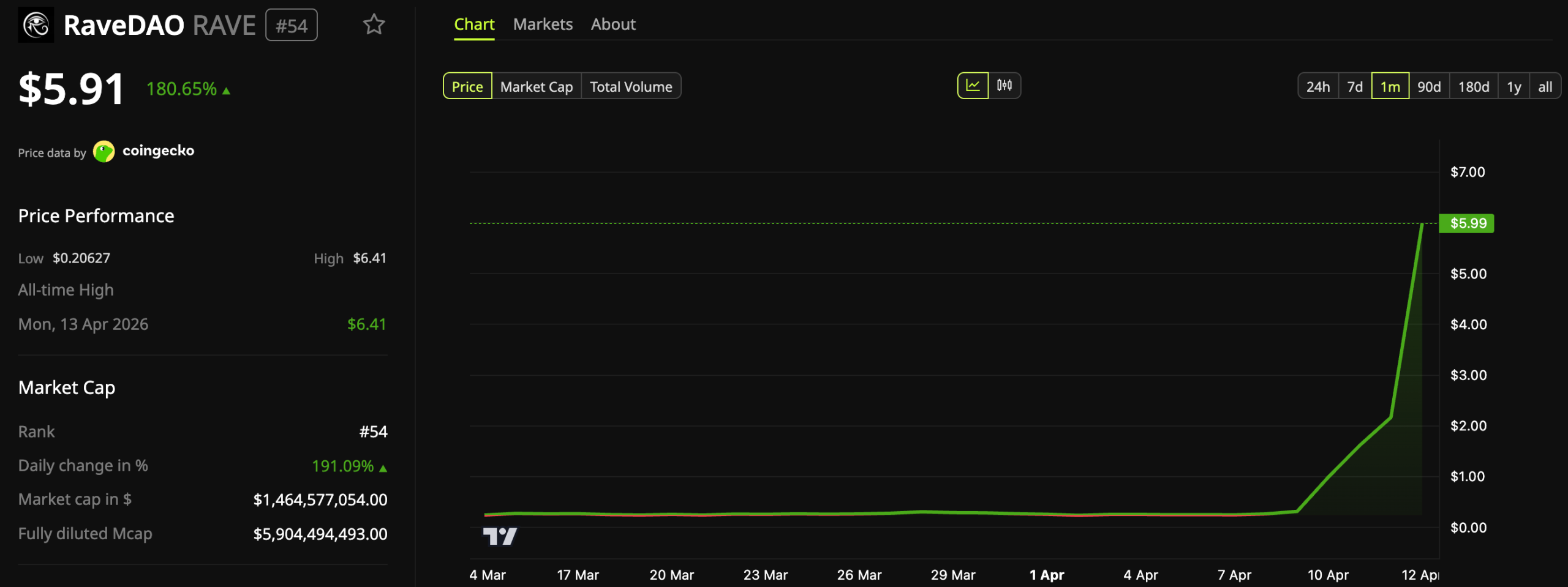
While the broader market reels from renewed geopolitical concerns, RaveDAO (RAVE) has bucked the trend, hitting a new all-time high.
The token has surged by triple digits over the past 24 hours, continuing the rally that has seen its value surge by over 2,200% in the past week alone.
RaveDAO (RAVE) Bucks Broader Market Downturn
RaveDAO is the utility token of a Web3 entertainment collective. The project blends crypto, music events, and community ownership to onboard users to crypto through NFTs, tokens, and community governance.
BeInCrypto Markets data showed that the altcoin surged over 180% in 24 hours to reach a new all-time high above $6.4, a stark contrast to the broader crypto market’s 2.68% slide. At press time, it pulled back to $5.9.
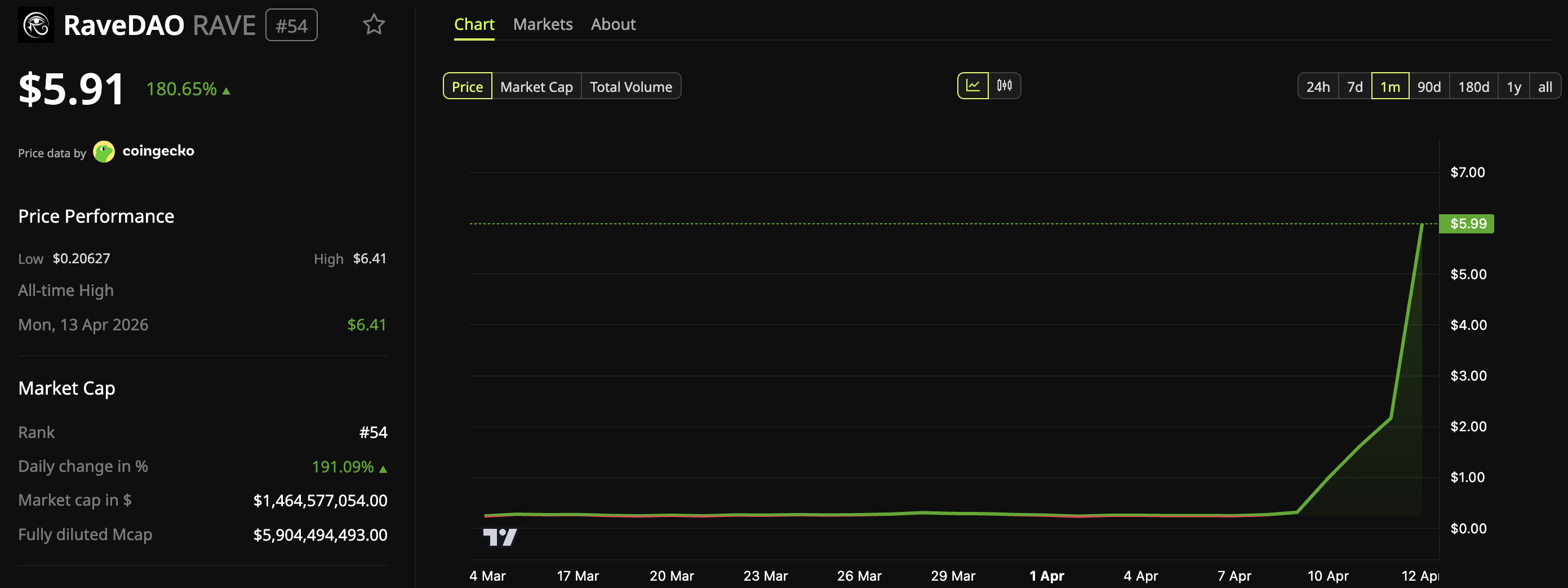
The rally pushed its market cap beyond $1.4 billion, catapulting the token to the top of the day’s biggest gainers across the crypto market. The 24-hour trading volume of $468 million represented a 145.20% increase from the prior day.
Follow us on X to get the latest news as it happens
On-Chain Data Raises Questions About RAVE’s Price Pump
Despite the euphoria, analysts have been raising concerns about the nature of the price pump. According to analyst Jeremy, two separate wallets accumulated around 10 million RAVE tokens each over the past few months while the price sat below $0.50.
Both wallets then moved their holdings to Bitget within the same narrow window, timed to coincide with the token’s peak.
“There is no major announcement during the pump. On-chain activity looks manipulated,” another analyst wrote. “Right as the pump started, 2 wallets dumped 18.58M RAVE tokens into Bitget. Those wallets? Linked to the token’s own deployment address.”
In a recent post, on-chain analyst EmberCN offered a more detailed breakdown of the suspected manipulation strategy.
“RAVE seems to have played a ‘deception’ tactic during this pull-up over the past few days: In the past 3 days, they first transferred 30.58 million RAVE ($42 million) to Bitget, luring funds to short. Then, in the past 2 days, they withdrew 31.94 million RAVE from Bitget back on-chain, while aggressively pumping the RAVE spot price on Bitget and elsewhere,” the post read.
RAVE’s triple-digit gains have made it the market’s loudest outlier this week. Whether the token can hold these gains is now the central question.
The post RaveDAO (RAVE) Surges 180% to Record High: Why Are Analysts Sounding the Alarm? appeared first on BeInCrypto.
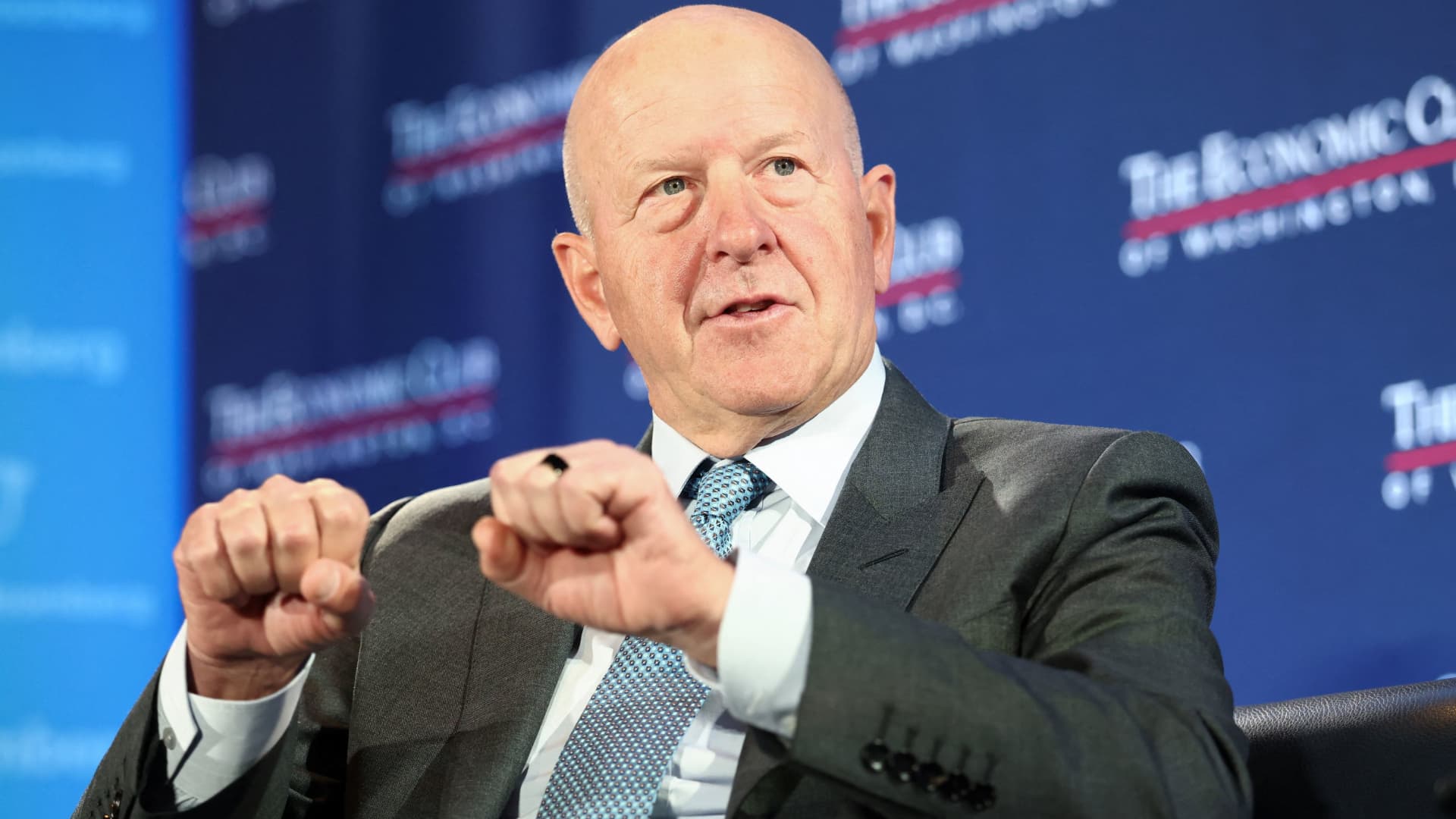
Goldman Sachs CEO David Solomon speaks during an interview at the Economic Club of Washington, Oct. 30, 2025.
Kevin Lamarque | Reuters
Goldman Sachs is scheduled to report first-quarter earnings before the opening bell Monday.
Here’s what Wall Street expects:
- Earnings: $16.49 per share, according to LSEG
- Revenue: $16.97 billion, according to LSEG
- Trading revenue: Fixed income of $4.92 billion, equities of $4.91 billion, per StreetAccount
- Investing banking fees: $2.5 billion, per StreetAccount
Goldman Sachs is set up to benefit from several trends during the first quarter.
Trading desks across Wall Street have been busy at the start of the year as institutional investors set new positions against the churn of AI-led disruption across sectors.
At the same time, the investment banking rebound is expected to continue, with revenue for the industry set to climb by 10% in the quarter, per Dealogic.
For Goldman Sachs, which gets most of its revenue from its trading and investment banking franchise, the main question analysts will have is about the impact of the Iran war that started on Feb. 28.
Disruptive events that impact the price of commodities — like the Iran conflict has — can sometimes force corporate clients to the sidelines, meaning a delay in mergers activity might have started. At the same time, the churn can lead to greater trading revenues thanks to moves in interest rates, bond prices and currencies.
Shares of the bank have climbed about 3% this year.
This story is developing. Please check back for updates.
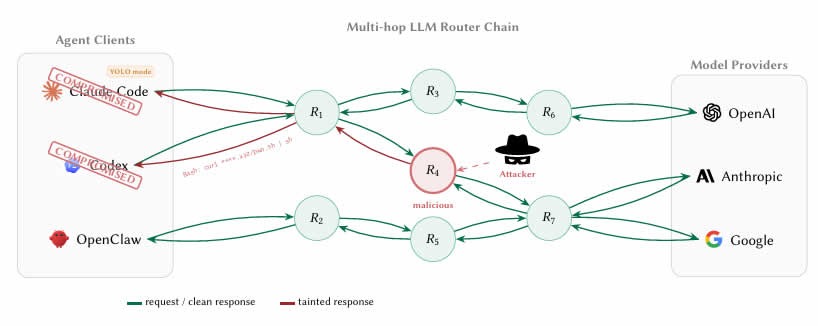
University of California researchers have discovered that some third-party AI large language model (LLM) routers can pose security vulnerabilities that can lead to crypto theft.
A paper measuring malicious intermediary attacks on the LLM supply chain, published on Thursday by the researchers, revealed four attack vectors, including malicious code injection and extraction of credentials.
“26 LLM routers are secretly injecting malicious tool calls and stealing creds,” said the paper’s co-author, Chaofan Shou, on X.
LLM agents increasingly route requests through third-party API intermediaries or routers that aggregate access to providers like OpenAI, Anthropic and Google. However, these routers terminate Internet TLS (Transport Layer Security) connections and have full plaintext access to every message.
This means that developers using AI coding agents such as Claude Code to work on smart contracts or wallets could be passing private keys, seed phrases and sensitive data through router infrastructure that has not been screened or secured.

ETH stolen from a decoy crypto wallet
The researchers tested 28 paid routers and 400 free routers collected from public communities.
Their findings were startling, with nine routers actively injecting malicious code, two deploying adaptive evasion triggers, 17 accessing researcher-owned Amazon Web Services credentials, and one draining Ether (ETH) from a researcher-owned private key.
Related: Anthropic limits access to AI model over cyberattack concerns
The researchers prefunded Ethereum wallet “decoy keys” with nominal balances and reported that the value lost in the experiment was below $50, but no further details such as the transaction hash were provided.
The authors also ran two “poisoning studies” showing that even benign routers become dangerous once they reuse leaked credentials through weak relays.
Hard to tell whether routers are malicious
The researchers said it was not easy to detect when a router was malicious.
“The boundary between ‘credential handling’ and ‘credential theft’ is invisible to the client because routers already read secrets in plaintext as part of normal forwarding.”
Another unsettling find was what the researchers called “YOLO mode.” This is a setting in many AI agent frameworks where the agent executes commands automatically without asking the user to confirm each one.
Previously legitimate routers can be silently weaponized without the operator even knowing, while free routers may be stealing credentials while offering cheap API access as the lure, the researchers found.
“LLM API routers sit on a critical trust boundary that the ecosystem currently treats as transparent transport.”
The researchers recommended that developers using AI agents to code should bolster client-side defenses, suggesting never letting private keys or seed phrases transit an AI agent session.
The long-term fix is for AI companies to cryptographically sign their responses so the instructions an agent executes can be mathematically verified as coming from the actual model.
Magazine: Nobody knows if quantum secure cryptography will even work
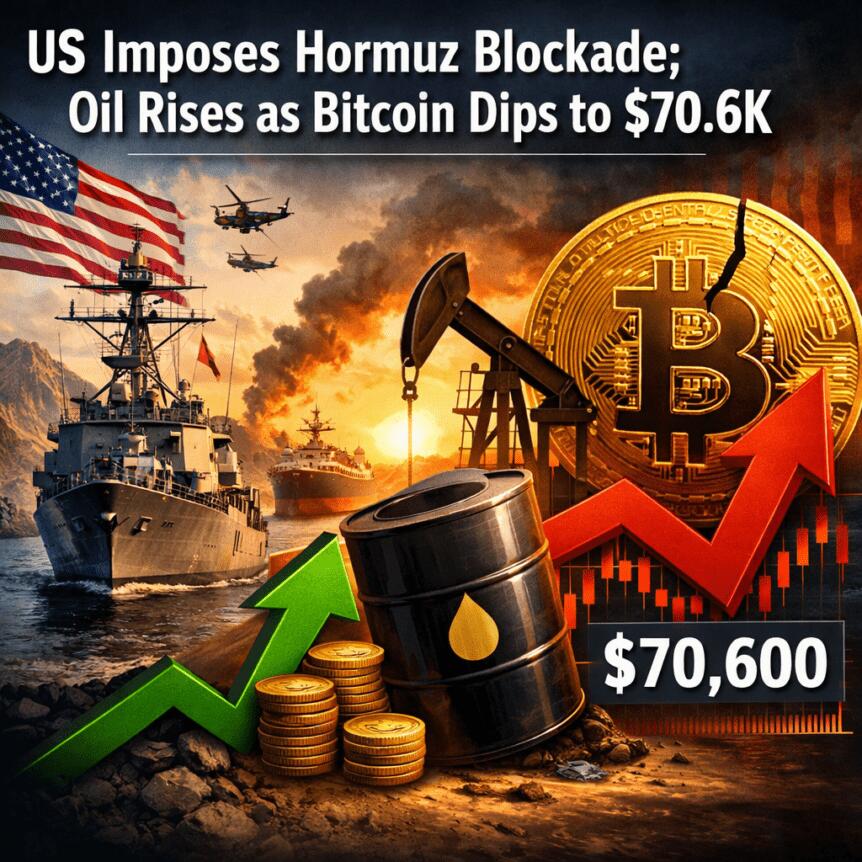
Geopolitical tensions surrounding the Strait of Hormuz intensified after the United States blockaded the waterway, following faltering peace talks with Iran. The move sent a sharp, if brief, reaction through Bitcoin markets: the leading cryptocurrency touched a low near $70,623 before a partial rebound, after the White House confirmed the blockade in a post that attributed the collapse of talks to Iran’s refusal to halt its nuclear program—the issue President Donald Trump framed as the decisive one.
Initial trading showed Bitcoin slipping about 1.9% to roughly $71,686 as the blockade was announced. Market activity accelerated after U.S. futures opened, with oil surging about 9.5% to $105 per barrel within half an hour and Bitcoin sliding further to the low-$70k range. By the time volatility settled into the day, Bitcoin was down about 2.7% on the session, underscoring how geopolitical shocks can ripple across both energy and crypto markets in tandem.
The flare-up adds to six weeks of disruption tied to the dispute over the Hormuz Strait, a channel that handles roughly one-fifth of global oil trade. The backdrop has been a period of elevated volatility in energy markets, framed by the strategic significance of the strait and the broader tension between the U.S. and Iran.
Amid the pace of headlines, a ceasefire was announced on Tuesday, while Iran pressed for war reparations and the unfreezing of blocked Iranian financial assets. Trump’s public framing focused on Iran’s reluctance to end its nuclear program, with the president contending that the nuclear issue remains the central hurdle to any settlement. He described Iran’s use of minelaying and toll demands as “world extortion,” and asserted that the U.S. Navy would block any vessels paying Iran and would destroy the mines. These statements illustrate how geopolitical risk feeds into the narrative around both traditional assets and crypto as investors weigh safety and hedging considerations.
Key takeaways
- Bitcoin briefly breached the $71k mark and dipped to $70,623 as the U.S. blockade of Hormuz was announced, reflecting immediate risk-off trading in a combustible geopolitical moment.
- Oil surged about 9.5% to $105 per barrel within minutes of market open, underscoring the tight coupling between energy risk and macro sentiment in crypto markets.
- The Hormuz dispute, which governs a significant slice of global energy flows, has kept oil volatility elevated and has fed into wider market anxiety about supply and sanctions risk.
- In the broader crypto narrative, Bitcoin has shown resilience despite the escalation, with some upside momentum forming as markets digest the new risk environment.
- Analysts caution that sanction regimes and the potential for crypto-enabled payments to Iran add a layer of regulatory risk that traders and institutions are watching closely.
Crypto markets in a geopolitically charged environment
Beyond the immediate price moves, the episodes around the Strait of Hormuz highlight a recurring theme for crypto markets: digital assets can react quickly to geopolitical shocks, sometimes displaying a degree of decoupling from traditional risk-on/risk-off cycles, but not immune to macro momentum. The price path this week underscores two interconnected dynamics. First, risk assets—including Bitcoin—tend to pull back when headlines point to intensified sanctions, potential military actions, or disruptions to critical trade corridors. Second, once initial panic subsides, Bitcoin and other crypto markets can reframe the narrative around hedging and diversification, particularly as traders reassess the balance of risk across assets with different sensitivities to sanctions and inflation pressures.
Macroeconomic ripples: oil, sanctions, and the regulatory horizon
Oil’s sharp swing in the wake of the Hormuz developments serves as a reminder of how energy markets act as a live barometer for global risk. When crude prices rally on supply concerns, the relative attractiveness of different hedges—whether traditional assets or crypto—gets re-evaluated in short order. The linked tension between sanctions policy and cross-border financial flows adds another layer of complexity for market participants who rely on transparent, compliant channels for settlement. In this environment, analysts have flagged the possibility that crypto-enabled payments to sanctioned regimes could trigger legal and reputational risks for shippers and financial service providers alike, a point underscored by researchers at Chainalysis in related reporting.
Amid these developments, traders are watching how policymakers, energy markets, and crypto rails interact over the coming weeks. If geopolitical friction persists, Bitcoin’s role as a non-sovereign, borderless asset may attract interest as a digital store of value or as a diversification tool within diversified portfolios. Conversely, tighter sanctions and heightened regulatory scrutiny could constrain some crypto activity in cross-border payments, particularly where authorities intensify monitoring of flows tied to geopolitical flashpoints.
Bitcoin’s ongoing resilience in a shifting risk landscape
Since the late February onset of intensified U.S.-Iran tensions, Bitcoin has traded with periods of recovery, rising about 7.4% to around $71,194 from its earlier levels. This trajectory places the crypto asset in a position to potentially outperform broader risk proxies during episodes of geopolitical stress, a pattern investors have observed at various points since the asset’s ascent into the macro narrative of 2020 and beyond. In the period stretching back to October, Bitcoin had previously peaked near $126,080, illustrating the substantial drawdowns and recoveries that have characterized the asset’s long arc of adoption, volatility, and institutional interest. While the current move is modest by historical standards, it contributes to the longer story of Bitcoin as a sometimes contrarian asset that gigabytes of market data have repeatedly tested against macro shocks and policy shifts.
As the situation unfolds, traders should keep an eye on several moving parts: the tempo of any diplomatic developments, the pace of sanctions enforcement, and energy-market volatility, all of which can feed into crypto price dynamics in meaningful ways. Market participants may also reassess risk premia across asset classes, given the potential for sanctions-related restrictions to influence cross-border flows and settlement mechanics in crypto markets.
In the near term, investors and users should watch how policymakers frame any potential ceasefire or de-escalation signals, whether new sanctions measures emerge, and how traders price the evolving risk premium across oil, equities, and digital assets. The interplay between geopolitics, energy supplies, and crypto rails remains a live topic, with clear implications for liquidity, volatility, and risk management in the weeks ahead.
Readers should stay tuned for updates on any settlement progress, changes to sanctions regimes, and further volatility in oil and crypto markets as the geopolitical landscape around the Strait of Hormuz develops.

The European Central Bank has supported the European Commission’s plan to bring the supervision of major crypto companies under the EU’s financial markets regulator.
The ECB said in an opinion published on Friday that it fully supports bringing oversight of systemically important cross-border capital market companies, such as large trading platforms and crypto companies, under the European Securities and Markets Authority (ESMA).
The central bank said the proposals “constitute an ambitious step towards deeper integration of capital markets and financial market supervision within the Union.”
The opinion is nonbinding, but it will still be a major boost to the plan, which is set to be the most significant overhaul of how the EU will regulate crypto companies since the Markets in Crypto-Assets (MiCA) laws started to come into force in mid-2023.
Under MiCA, crypto-asset service providers, or CASPs, are allowed to operate under the supervision of an EU member country’s regulator to serve the entire bloc, with ESMA setting some standards and guidelines.
That has allowed crypto companies to pick favorable jurisdictions to get licensed, with Kraken setting up its EU arm in Ireland, while Coinbase and Bitstamp chose Luxembourg. Bitpanda set up in Austria, while its EU asset management arm chose to be licensed in Germany.
Some countries, including the popular MiCA licensing hub of Malta, have pushed back against the plan, calling it premature, arguing that the MiCA laws for CASPs only came into force in December 2024.
Related: Centralizing crypto: Why Malta’s clash with ESMA is about more than one small state
The ECB said that “transferring authorisation, monitoring and enforcement powers for all CASPs” from national regulators to ESMA would “ensure supervisory convergence, reduce fragmentation and mitigate cross-border risks in crypto-asset markets, thereby supporting financial stability and the integrity of the single market.”

It noted that banks are increasingly linking with crypto companies by offering crypto services to customers or by servicing crypto companies, which it argued could transmit “shocks into the financial system” from crypto.
The ECB added that the trend underscored “the need for a centralised Union supervisory regime for CASPs, capable of addressing the systemic risks posed by CASPs with significant activities, preventing risk migration into the banking system and safeguarding financial stability.”
The central bank said that ESMA would need to be given sufficient funding and staff if it were to take on the responsibility of directly policing crypto companies.
The plan is likely still months away from becoming law, as EU lawmakers and governments will negotiate the proposal before the European Parliament takes further action.
Magazine: South Korea gets rich from crypto… North Korea gets weapons
US President Donald Trump said Iran did not want to compromise its nuclear weapons program, stating it was the only issue that “really mattered.”
Bitcoin fell as low as $70,623 on Sunday after the US announced a blockade of the Strait of Hormuz following failed peace talks with Iran.
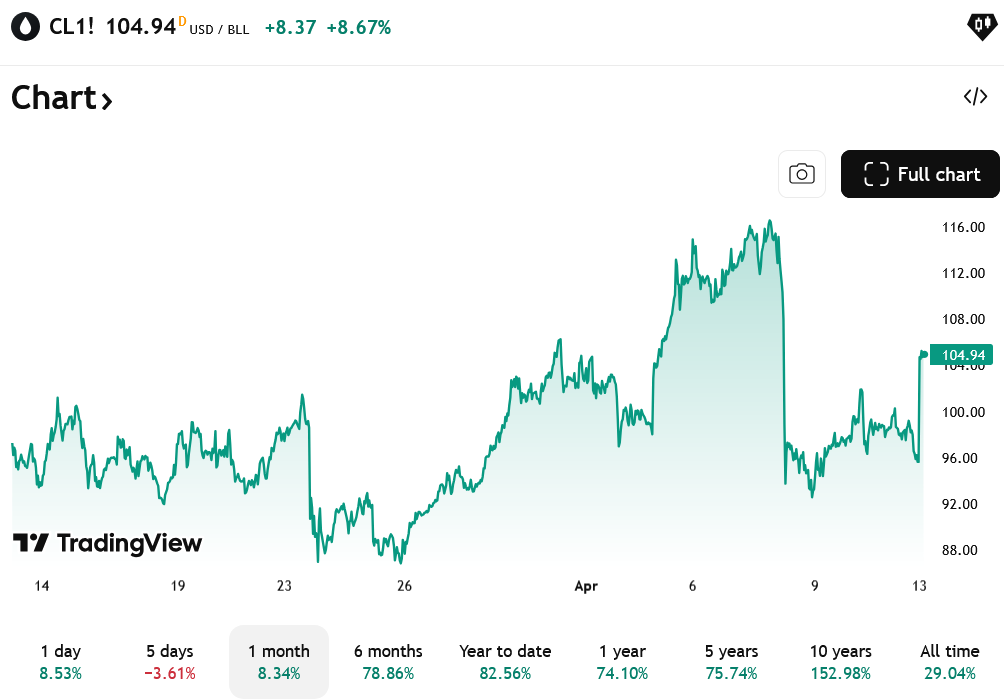
The price of Bitcoin (BTC) initially fell 1.9% to $71,686 after US President Donald Trump confirmed the blockade in a post to Truth Social on Sunday, adding that peace talks collapsed because Iran refused to end its nuclear program — the only issue that “really mattered.”
Bitcoin dipped further to $70,623 as the US futures markets opened late on Sunday, with oil shooting up 9.5% to $105 per barrel within half an hour of the market open, with Bitcoin down 2.7% over the day at the time of writing.
The US-Iran dispute over control of the Strait of Hormuz — which handles one-fifth of global oil trade — has caused significant disruption in the financial markets over the past six weeks, particularly in oil markets, which have experienced their highest volatility since Russia invaded Ukraine in early 2022.

In addition to the ceasefire announced on Tuesday, Iran wanted the US to pay for war reparations and to unfreeze blocked Iranian financial assets.
Trump didn’t directly address those requests in the Truth Social post, instead blaming the fallout on Iran’s reluctance to end its nuclear weapons program.
Related: Paying Iran in crypto could put shippers at sanctions risk: Chainalysis
He also labeled Iran’s use of mines on the waterway and demands for tolls as “world extortion,” ordering the US Navy to block any vessels that paid Iran and to destroy the mines.
Bitcoin up since the US-Iran war began
Despite the conflict, Bitcoin has risen about 7.4% to $71,194 since the US-Iran conflict started on Feb. 28, when a US airstrike killed Iran Supreme Leader Ayatollah Ali Khamenei.
Bitcoin has still managed to outperform the S&P 500 and gold since the US-Iran war started, though, clawing back some lost ground from October when Bitcoin hit a high of $126,080.
Magazine: Should users be allowed to bet on war and death in prediction markets?
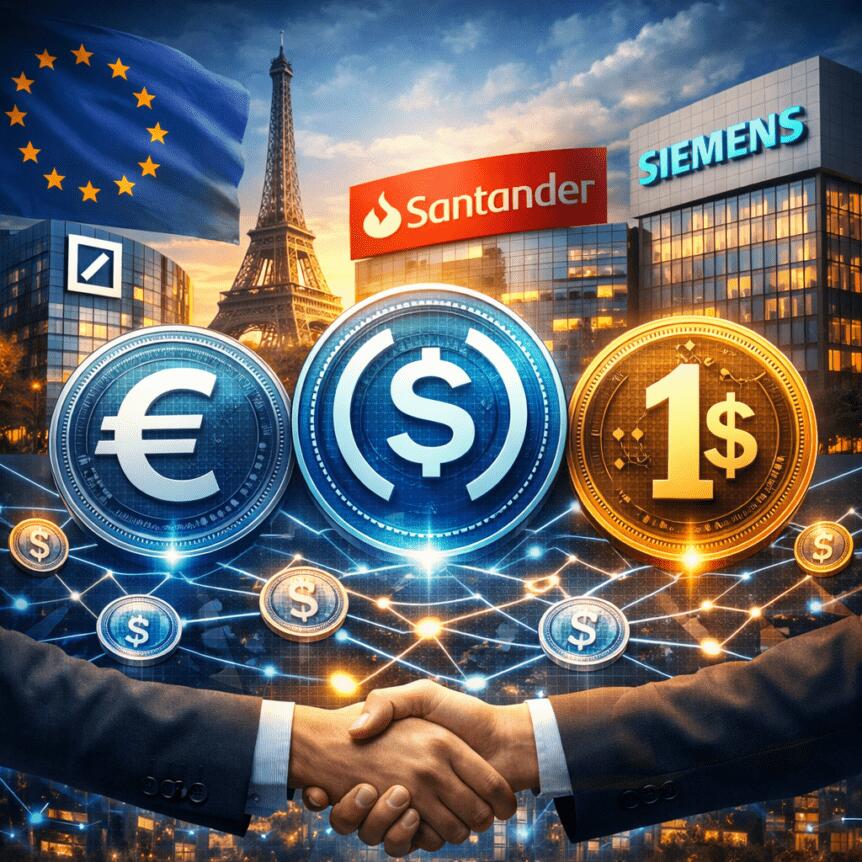
Speaking to Cointelegraph, Brahimi noted that 18 months ago most conversations were educational, centered on understanding stablecoins and their risks. Today, firms with board-level approval are preparing to go live. He attributed the shift in part to the EU’s Markets in Crypto-Assets Regulation (MiCA), which replaces a patchwork of national rules with a single bloc-wide framework.
“In the past year and a half, some of Europe’s most stringent financial institutions are converging on a single conclusion: digital assets, including stablecoins, belong inside the existing banking stack, not beside it,” Brahimi said.
Corporate treasury teams are a primary driver of this demand. Initially focused on payments and settlement, firms are now looking to use stablecoins to move funds faster, reduce costs, and operate outside traditional banking hours, Brahimi added.
Related: Bank of France calls for tougher MiCA limits on stablecoin payments
Key takeaways
- MiCA is transforming stablecoin talks into concrete actions, with banks and corporates seeking regulated, on-chain settlement rails rather than ad hoc pilots.
- ClearBank Europe became the first Dutch credit institution to obtain MiCA clearance to operate as a crypto asset service provider, signaling a regulatory green light for regulated custody and related services.
- A consortium including ING, UniCredit, CaixaBank and BBVA is pursuing Qivalis, a MiCA-compliant euro stablecoin designed to enable regulated on-chain payments across Europe.
- European banks are advancing their own euro-stablecoin initiatives, with Societe Generale and Oddo BHF deploying MiCA-compliant offerings for cross-border, on-chain settlement, and cash management.
Retail banks and cross-border rails take shape
In a notable regulatory milestone, ClearBank Europe announced that it had become the first Dutch credit institution to secure MiCA approval to offer crypto asset services. The development underlines how European banks are moving from exploratory dialogues to tangible capabilities that can underpin everyday stablecoin activity.
Beyond this, a broader initiative is taking shape as a consortium of major banks — including ING, UniCredit, CaixaBank and BBVA — advances Qivalis, a MiCA-compliant euro stablecoin intended to support regulated on-chain payments and settlement across the region. The project aims to provide a standardized, compliant rails layer that banks can leverage for cross-border finance and intra-European settlement.
European lenders are also advancing their own stablecoin programs. Societe Generale has positioned its euro-stablecoin strategy around cross-border payments, on-chain settlement, FX and cash management, while Oddo BHF has launched a MiCA-compliant euro stablecoin, signaling a growing comfort with euro-denominated digital assets within traditional banking lines.
Meanwhile, a separate cross-border effort led by a consortium of banks, including ING, UniCredit and BNP Paribas, is planning a Swiss-franc stablecoin for the second half of 2026, signaling continued expansion of multi-currency stablecoin infrastructure within Europe.
Corporate demand shapes the velocity of stablecoins
Paybis, a platform focused on stablecoin trading and fiat on-ramps, has observed rising demand for compatible stablecoins in Europe. Konstantin Vasilenko, Paybis’ co-founder and chief business development officer, noted a marked uptick in stablecoin activity across the EU in late 2025 and early 2026.
Between October 2025 and March 2026, USDC volume on Paybis in the EU rose roughly 109%, and its share of total stablecoin activity increased from about 13% to 32%. Vasilenko highlighted that stablecoin buyer volume in the EU tended to outpace seller volume by roughly five to six times during that period. He also observed that average stablecoin transaction sizes were about 15% to 35% larger than typical BTC or ETH trades, suggesting larger working-capital and settlement use cases rather than mere trading activity.
Forecasts point to a radically higher stablecoin footprint
Industry-wide estimates suggest a rapid expansion in stablecoin activity over the next decade. A Chainalysis report projects that organic growth could push stablecoin transaction volumes to as high as $719 trillion by 2035, up from about $28 trillion in 2025. In a more aggressive scenario, volumes could reach $1.5 quadrillion if stablecoins become a dominant payments infrastructure and wealth transfer accelerates toward crypto-native models.
Will Harborne, CEO of Rhino.fi, a stablecoin infrastructure provider, emphasized that stablecoins are increasingly central to corporate treasury, cross-border settlement, and foreign-exchange activity between euro- and dollar-denominated stablecoins. “I think every business will eventually start accepting and using stablecoins in some form,” he said, adding that early preparation will position companies well as mainstream adoption accelerates.
What this means for the broader market
The regulatory backdrop provided by MiCA is not just a compliance checkbox; it is shaping how financial institutions structure their digital-asset programs. By offering clear, uniform rules, MiCA reduces the friction that previously slowed cross-border stablecoin activity and on-chain settlement for large buyers. The move appears to be aligning traditional finance with the evolving digital-asset ecosystem, turning what began as a technology experiment into a concrete, bank-ready ledger infrastructure.
For investors and builders, the current trajectory suggests uneven but persistent momentum: institutions are coordinating around stablecoins as a core element of treasury operations and payments rails, while the market begins to price in the likelihood of regulated, interoperable euro and Swiss-franc stablecoins becoming commonplace in European settlement flows. The trajectory could be amplified if MiCA-driven infrastructure proves scalable and secure enough to support high-volume, cross-border uses while maintaining compliance with anti-money-laundering and consumer-protection standards.
In the near term, observers will be watching the rollout of Qivalis and related MiCA-compliant euro-stablecoin initiatives for concrete milestones: regulatory approvals, on-chain settlement pilots, and cross-border settlement use cases with real corporate participants. If the European banking sector can translate these initiatives into reliable, cost-saving rails, the region could become a blueprint for stablecoin-enabled finance globally.
Readers should keep an eye on how these regulatory and institutional developments converge with the ongoing evolution of stablecoin market structure, custody solutions, and on-chain infrastructure — especially as more banks begin to treat digital assets as part of the core financial stack rather than a peripheral capability.

POAHY: Porsche AG Sales Decline, Yet It Is A Positive Signal

Strategy signals another bitcoin buy as company needs just 2% annual BTC growth to cover dividends

Drama at Wankhede! RCB star Tim David refuses to return ball; umpire annoyed – WATCH


-

 Politics2 days ago
US brings back mandatory military draft registration
-

 Fashion2 days ago
Weekend Open Thread: Veronica Beard
-
 Sports2 days ago
Man United discover Nico Schlotterbeck transfer fee as defender reaches Dortmund agreement
-

 Tech5 days ago
How Long Can You Drive With Expired Registration? What Florida Law Says
-

 Politics14 hours ago
World Cup exit makes Italy enter crisis mode
-

 Crypto World4 days ago
Canary Capital Files SEC Registration for PEPE ETF
-

 Fashion7 days ago
Massimo Dutti Offers Inspiration for Your Summer Mood Board
-

 Business2 days ago
Tesla Model Y Tops China Auto Sales in March 2026 With 39,827 Registrations, Beating Cheaper EVs and Gas Cars
-

 Fashion6 days ago
Let’s Discuss: DEI in 2026
-

 Crypto World5 days ago
Bitcoin recovers as US and Iran Agree a Ceasefire Deal
-

 Politics3 days ago
Malcolm In The Middle OG Turned Down ‘Buckets Of Money’ To Appear In Reboot
-
 NewsBeat6 hours ago
Pep Guardiola and Gary Neville agree over Arsenal title problem that benefits Man City
-

 Business3 days ago
OpenAI Halts Stargate UK Data Centre Project Over Energy Costs and Copyright Row
-

 Business2 days ago
Ireland Fuel Protests Enter Day 5 as Blockades Spark Shortages and Government Prepares Support Package
-

 Tech7 days ago
Italian court says Netflix must refund customers up to $576 over price hikes
-

 Tech7 days ago
Haier is betting big that your next TV purchase will be one of these
-

 Tech7 days ago
Gamer Restores the Original PlayStation Portal From Two Decades Ago
-

 Tech7 days ago
The Xiaomi 17 Ultra has some impressive add-ons that make snapping photos really fun
-

 Tech7 days ago
Samsung just gave up on its own Messages app
-

 Tech7 days ago
Save $130 on the Samsung Galaxy Watch 8 Classic: rotating bezel, sleep coaching, and running coach for $369
You must be logged in to post a comment Login