

Crypto World
US Imposes Hormuz Blockade; Oil Rises as Bitcoin Dips to $70.6K

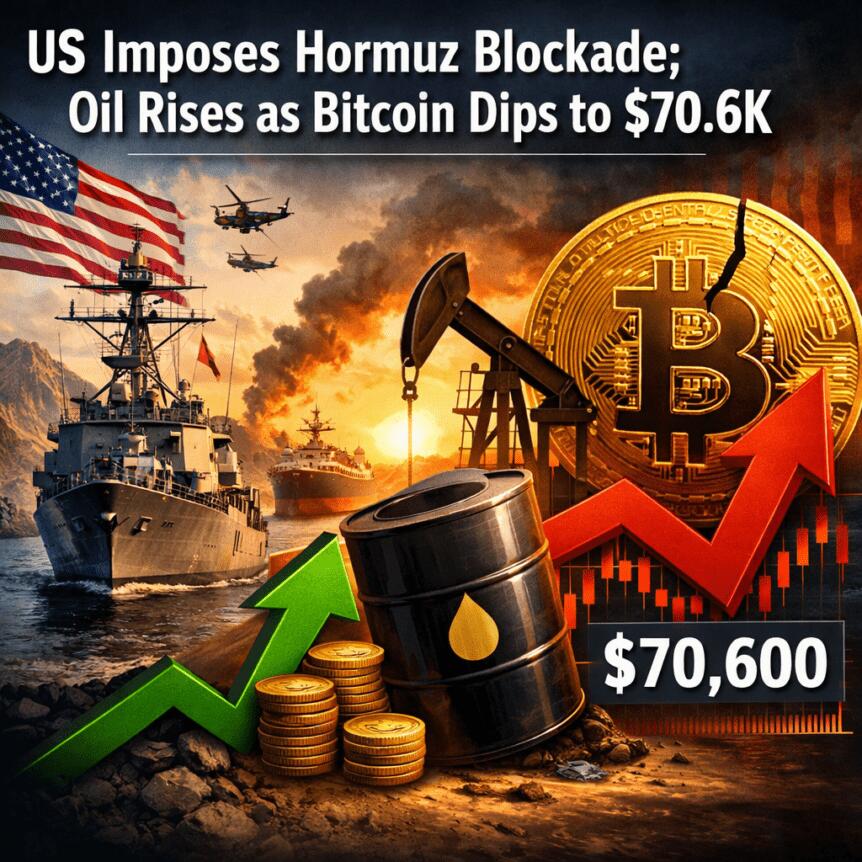
Geopolitical tensions surrounding the Strait of Hormuz intensified after the United States blockaded the waterway, following faltering peace talks with Iran. The move sent a sharp, if brief, reaction through Bitcoin markets: the leading cryptocurrency touched a low near $70,623 before a partial rebound, after the White House confirmed the blockade in a post that attributed the collapse of talks to Iran’s refusal to halt its nuclear program—the issue President Donald Trump framed as the decisive one.
Initial trading showed Bitcoin slipping about 1.9% to roughly $71,686 as the blockade was announced. Market activity accelerated after U.S. futures opened, with oil surging about 9.5% to $105 per barrel within half an hour and Bitcoin sliding further to the low-$70k range. By the time volatility settled into the day, Bitcoin was down about 2.7% on the session, underscoring how geopolitical shocks can ripple across both energy and crypto markets in tandem.
The flare-up adds to six weeks of disruption tied to the dispute over the Hormuz Strait, a channel that handles roughly one-fifth of global oil trade. The backdrop has been a period of elevated volatility in energy markets, framed by the strategic significance of the strait and the broader tension between the U.S. and Iran.
Amid the pace of headlines, a ceasefire was announced on Tuesday, while Iran pressed for war reparations and the unfreezing of blocked Iranian financial assets. Trump’s public framing focused on Iran’s reluctance to end its nuclear program, with the president contending that the nuclear issue remains the central hurdle to any settlement. He described Iran’s use of minelaying and toll demands as “world extortion,” and asserted that the U.S. Navy would block any vessels paying Iran and would destroy the mines. These statements illustrate how geopolitical risk feeds into the narrative around both traditional assets and crypto as investors weigh safety and hedging considerations.
Key takeaways
- Bitcoin briefly breached the $71k mark and dipped to $70,623 as the U.S. blockade of Hormuz was announced, reflecting immediate risk-off trading in a combustible geopolitical moment.
- Oil surged about 9.5% to $105 per barrel within minutes of market open, underscoring the tight coupling between energy risk and macro sentiment in crypto markets.
- The Hormuz dispute, which governs a significant slice of global energy flows, has kept oil volatility elevated and has fed into wider market anxiety about supply and sanctions risk.
- In the broader crypto narrative, Bitcoin has shown resilience despite the escalation, with some upside momentum forming as markets digest the new risk environment.
- Analysts caution that sanction regimes and the potential for crypto-enabled payments to Iran add a layer of regulatory risk that traders and institutions are watching closely.
Crypto markets in a geopolitically charged environment
Beyond the immediate price moves, the episodes around the Strait of Hormuz highlight a recurring theme for crypto markets: digital assets can react quickly to geopolitical shocks, sometimes displaying a degree of decoupling from traditional risk-on/risk-off cycles, but not immune to macro momentum. The price path this week underscores two interconnected dynamics. First, risk assets—including Bitcoin—tend to pull back when headlines point to intensified sanctions, potential military actions, or disruptions to critical trade corridors. Second, once initial panic subsides, Bitcoin and other crypto markets can reframe the narrative around hedging and diversification, particularly as traders reassess the balance of risk across assets with different sensitivities to sanctions and inflation pressures.
Macroeconomic ripples: oil, sanctions, and the regulatory horizon
Oil’s sharp swing in the wake of the Hormuz developments serves as a reminder of how energy markets act as a live barometer for global risk. When crude prices rally on supply concerns, the relative attractiveness of different hedges—whether traditional assets or crypto—gets re-evaluated in short order. The linked tension between sanctions policy and cross-border financial flows adds another layer of complexity for market participants who rely on transparent, compliant channels for settlement. In this environment, analysts have flagged the possibility that crypto-enabled payments to sanctioned regimes could trigger legal and reputational risks for shippers and financial service providers alike, a point underscored by researchers at Chainalysis in related reporting.
Amid these developments, traders are watching how policymakers, energy markets, and crypto rails interact over the coming weeks. If geopolitical friction persists, Bitcoin’s role as a non-sovereign, borderless asset may attract interest as a digital store of value or as a diversification tool within diversified portfolios. Conversely, tighter sanctions and heightened regulatory scrutiny could constrain some crypto activity in cross-border payments, particularly where authorities intensify monitoring of flows tied to geopolitical flashpoints.
Bitcoin’s ongoing resilience in a shifting risk landscape
Since the late February onset of intensified U.S.-Iran tensions, Bitcoin has traded with periods of recovery, rising about 7.4% to around $71,194 from its earlier levels. This trajectory places the crypto asset in a position to potentially outperform broader risk proxies during episodes of geopolitical stress, a pattern investors have observed at various points since the asset’s ascent into the macro narrative of 2020 and beyond. In the period stretching back to October, Bitcoin had previously peaked near $126,080, illustrating the substantial drawdowns and recoveries that have characterized the asset’s long arc of adoption, volatility, and institutional interest. While the current move is modest by historical standards, it contributes to the longer story of Bitcoin as a sometimes contrarian asset that gigabytes of market data have repeatedly tested against macro shocks and policy shifts.
As the situation unfolds, traders should keep an eye on several moving parts: the tempo of any diplomatic developments, the pace of sanctions enforcement, and energy-market volatility, all of which can feed into crypto price dynamics in meaningful ways. Market participants may also reassess risk premia across asset classes, given the potential for sanctions-related restrictions to influence cross-border flows and settlement mechanics in crypto markets.
In the near term, investors and users should watch how policymakers frame any potential ceasefire or de-escalation signals, whether new sanctions measures emerge, and how traders price the evolving risk premium across oil, equities, and digital assets. The interplay between geopolitics, energy supplies, and crypto rails remains a live topic, with clear implications for liquidity, volatility, and risk management in the weeks ahead.
Readers should stay tuned for updates on any settlement progress, changes to sanctions regimes, and further volatility in oil and crypto markets as the geopolitical landscape around the Strait of Hormuz develops.



Chris Larsen’s XRP wallets have resumed on-chain activity ahead of Tuesday’s Texas primary runoff.
Summary
- Ripple co-founder Chris Larsen’s associated XRP wallets have shown renewed activity, coming ahead of Tuesday’s Texas Democratic primary runoff election.
- Larsen is estimated to hold approximately 2.58 billion XRP across eight wallets tracked on XRPScan, making his holdings one of the largest known individual XRP positions.
- XRP was trading near $1.35 at time of writing, with today’s activity following $109 million in Larsen-linked wallet transfers to exchanges recorded in January 2025.
Ripple co-founder Chris Larsen’s associated wallets have resumed on-chain activity, according to blockchain data, ahead of Tuesday’s Texas Democratic primary runoff. The reactivation draws immediate attention given Larsen’s history of significant XRP transfers at notable market and political junctures.
Larsen serves as executive chairman of Ripple Labs. His estimated 2.58 billion XRP holdings across eight wallets tracked on XRPScan represent one of the largest known individual positions in any single cryptocurrency, worth approximately $3.5 billion at current prices near $1.35.
🚨 @Ripple co-founder Chris Larsen’s $XRP wallets are active again.
On-chain trackers spotted fresh wallet #movements after months of inactivity, reviving speculation across the $XRP community. 👀
📊 @cryptoquant_com data estimates Larsen is sitting on over $764M in unrealized… pic.twitter.com/kyKupOSdzZ
— CoinGape (@CoinGapeMedia) May 25, 2026
Why Larsen’s wallet activity draws attention from the XRP community
In January 2025, wallets that had been idle for six to seven years reactivated and sent more than $109 million in XRP to exchanges including Coinbase, Bitstamp, and Bybit. In July 2025, on-chain researcher ZachXBT reported an additional $140 million in XRP transfers from Larsen-linked addresses coinciding with XRP trading near an all-time high above $3.40.
“Since July 17, 2025, an address linked to Ripple co-founder Chris Larsen transferred out 50M XRP ($175M) to four addresses. ~$140M ended up at exchanges/services,” ZachXBT wrote on X in July 2025. Larsen had not commented publicly on today’s activity at time of writing.
Whether the current movement precedes exchange transfers or represents internal wallet management is not confirmed from on-chain data available at time of publication. Crypto.news has covered Ripple CEO Brad Garlinghouse’s legislative activity in 2026 as the Clarity Act moves through Congress.
Crypto.news has also reported on why the Clarity Act’s progress is particularly consequential for XRP, context that gives any Larsen wallet movement added political timing significance ahead of Tuesday’s runoff.

TLDR
- XRP whale transactions worth over $1 million dropped by 57% in nine days.
- The XRP price declined from $1.54 on May 14 to around $1.35.
- The token recorded five consecutive intraday losses for the first time in two months.
- Large transactions fell from 157 trades to just 67 during the period.
- Analyst Ali Martinez linked the drop in whale activity to weakening market participation.
XRP whale activity has dropped sharply over the past nine days as large transactions declined across the network. Data shows trades worth at least $1 million fell by 57% while the XRP price also weakened. The slowdown points to reduced participation from large holders during a period of falling prices.
XRP Whale Activity Drops as Price Records 5 Straight Losses
XRP fell to $1.35 after declining from $1.54 recorded on May 14. The token posted five consecutive intraday losses between May 15 and May 19. The decline marked the first time in over two months that XRP recorded such a streak. The price dropped about 8% during this five-day period. Market analyst Ali Martinez highlighted a drop in large transactions during the same timeframe.
According to the data, whale transactions fell from 157 trades to just 67. These trades each represented transfers worth at least $1 million. This equals a 57% decline in large transaction activity within nine days. The reduction aligned closely with XRP’s downward price movement.
Martinez stated that large investors reduced participation as prices weakened. He added that this drop reflected lower confidence among major holders. The slowdown in trading activity occurred while XRP traded below $1.40. Selling pressure remained steady throughout the period.
Compression Phase Forms as Whales Quietly Accumulate XRP
Martinez described the current market state as a compression phase. He said whales appear to be waiting as the price stabilizes within a tighter range. He noted that such conditions often reduce short-term volatility. They also help establish clear support and resistance levels. Despite fewer large trades, some wallets continued accumulating XRP. Data shows selective buying among mid-sized holders during the dip.
Wallets holding between 1 million and 10 million XRP increased their balance. Holdings rose from 3.72 billion XRP to 3.79 billion XRP. This group added about 70 million XRP over the observed period. Smaller whale wallets also increased their holdings slightly.
Addresses holding between 100,000 and 1 million XRP added around 20 million XRP. Their total rose from 6.31 billion XRP to 6.33 billion XRP. Martinez said the accumulation remains limited in impact on price movement. The broader market still reflects reduced activity from larger participants.
He also pointed to a tightening Bollinger Band on the three-day chart. He said it marks the lowest volatility level seen in over a year. Martinez identified $1.50 and $1.29 as key levels to monitor. He called this range a “no-trade zone” in his analysis.
He stated that a close above $1.50 could push XRP toward $1.80. A move below $1.29 could weaken the outlook and test $1.00 support. At the time of writing, XRP continues trading near $1.35 while whale activity remains subdued.

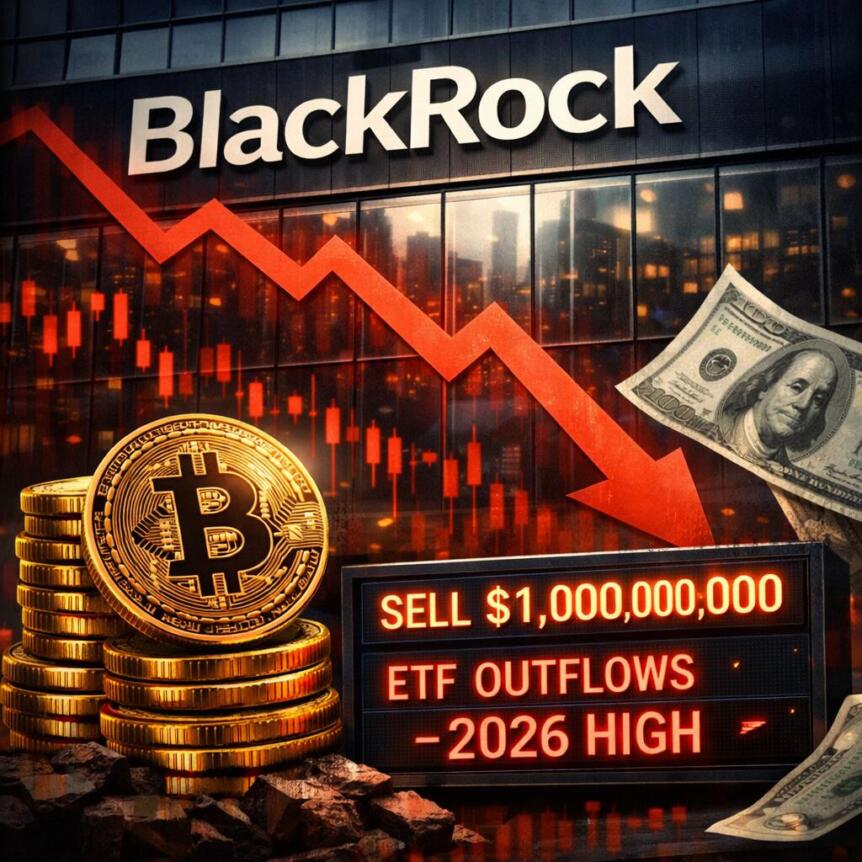
BlackRock recorded its largest Bitcoin ETF outflow of 2026 after steady withdrawals throughout the past week. The asset manager sold more than $1 billion worth of Bitcoin, while the broader ETF market also posted heavy losses. Meanwhile, Bitcoin remained under pressure despite a modest recovery near the start of the week.
BlackRock Leads Weekly Bitcoin ETF Outflows
BlackRock reported continuous Bitcoin sales during every trading day last week. Consequently, the total value of those sales reached approximately $1.01 billion by week’s end. The figure marked the firm’s largest weekly Bitcoin ETF outflow since November 2025.
Data from crypto analytics platform Arkham showed BlackRock accounted for most of the sector’s withdrawals. Moreover, the broader Bitcoin ETF market experienced significant selling activity across multiple funds. Market participants reduced exposure as volatility increased across digital assets.
Bitcoin faced persistent downward pressure during the same period. As a result, ETF demand weakened despite BlackRock maintaining its leading market position. The latest withdrawals reflected a notable shift from stronger inflows seen earlier this year.
The outflow trend emerged as cryptocurrency prices struggled to sustain momentum. Furthermore, several major digital assets traded in negative territory throughout much of the week. The market environment contributed to reduced demand for spot Bitcoin ETFs.
Institutional activity played a major role in the week’s market performance. Consequently, large-scale fund withdrawals added pressure to Bitcoin and related investment products. The combined ETF outflow reached approximately $1.26 billion during the reporting period.
BlackRock represented the largest share of those withdrawals. Moreover, the fund manager continued to dominate overall Bitcoin ETF holdings despite recent selling activity. The latest figures highlighted the scale of the market’s recent shift.
Bitcoin Holds Above Key Levels Despite Selling Pressure
Bitcoin traded at $77,443 at the time of reporting. However, the cryptocurrency remained well below levels seen during stronger periods earlier this month. The price still managed a modest gain of 0.45% from recent lows.
The asset began the month with positive momentum across major exchanges. However, sentiment weakened as volatility returned to the broader cryptocurrency market. Selling pressure increased as prices struggled to maintain upward movement.
Several market indicators pointed to growing uncertainty across digital assets. Consequently, traders adjusted positions while risk appetite declined. Bitcoin faced resistance as buyers attempted to stabilize recent losses.
The recent ETF withdrawals added another challenge for the market. Moreover, reduced institutional demand coincided with weaker price performance across major cryptocurrencies. The combination created additional pressure on Bitcoin’s short-term outlook.
Market forecasts remained divided regarding Bitcoin’s next move. Some analysts expected consolidation near current levels, while others projected further declines. Meanwhile, resistance levels continued to limit stronger recovery attempts.
Bitcoin maintained support above key price zones despite the recent weakness. However, continued selling activity could influence future market direction. The cryptocurrency remained sensitive to both institutional flows and broader market sentiment.
Market Context Highlights Changing Institutional Activity
Spot Bitcoin ETFs played a significant role in Bitcoin’s performance throughout the past year. Consequently, inflows and outflows often influenced short-term market sentiment and trading activity. Large fund movements frequently attracted attention across financial markets.
BlackRock emerged as the dominant participant in the Bitcoin ETF sector after its launch. Moreover, the firm’s products consistently attracted substantial capital compared with competitors. That position made recent withdrawals particularly notable.
The latest outflows followed months of stronger institutional participation. However, changing market conditions encouraged a more defensive approach among large market participants. As a result, Bitcoin ETFs experienced one of their weakest weeks of 2026.
The broader cryptocurrency market continues to navigate heightened volatility. Meanwhile, Bitcoin remains the primary benchmark for digital asset performance. Future ETF flow data will likely remain an important factor for market direction.
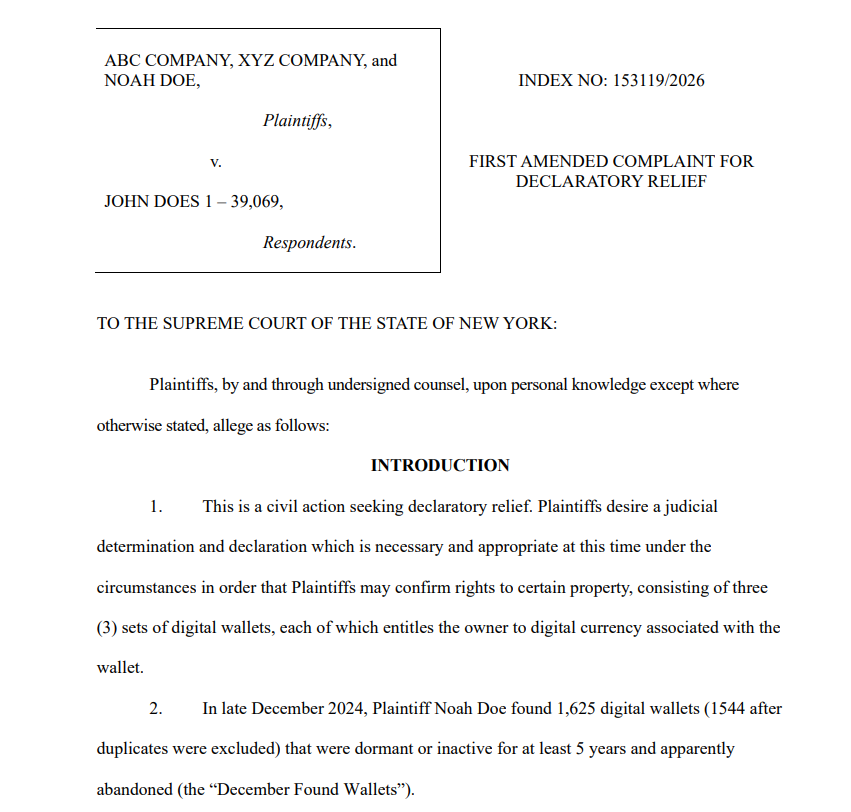
A New York lawsuit filed by Noah Doe and two Wyoming-based LLCs, ABC Company and XYZ Company, seeks a court order declaring ownership of 39,069 dormant Bitcoin addresses, raising important questions about the legal treatment of inactive Bitcoin under property laws.
Filed on May 1, the suit claims that the coins tied to the listed addresses represent legally abandoned property they found and reported to the New York Police Department and claimed under New York lost-property law.
The plaintiffs claim that the dormant Bitcoin wallets were legally “abandoned” property that they found, including wallets belonging to early Bitcoin miners and addresses attributed to Bitcoin creator Satoshi Nakamoto, among other lost coins and unidentified entities. They claim that these constitute seizable property, akin to traditional bank accounts.
The lawsuit raises important questions about the legal treatment of long-dormant Bitcoin wallets, including Satoshi-era tokens that have been inactive for over a decade. While the legal basis of the lawsuit is questionable, it is unclear how the plaintiff could recover the lost Bitcoin without possessing the private keys to access the wallets.
However, even if the court ruled in favor of the plaintiff, it would only be a symbolic move that is not technically enforceable, as the Bitcoin network has no mechanism to “reassign funds without a private key,” Noveleader, lead research analyst at investment research firm Castle Labs, told Cointelegraph, adding:
“The one narrow exception would be if any of these coins are moved to a regulated custodian or exchange, at which point a court could compel that intermediary to act.”
The research analyst argued that a significant portion of these coins may belong to deceased holders, those who lost their keys or simply to long-term holders who haven’t transacted, meaning that none of these instances constitute legal abandonment.
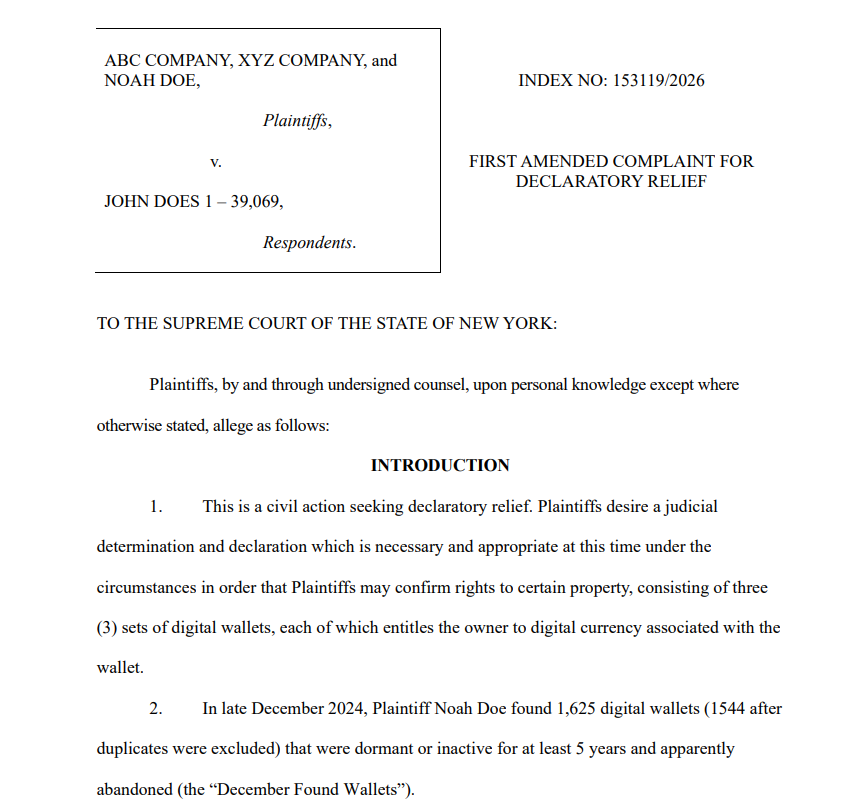
ABC Company, XYZ Company, Noah Doe, lawsuit against John Does holding 39,069 BTC. Source: ilawconotices.com
Lawsuit seeks ownership of Satoshi’s tokens, Mt. Gox hacker’s BTC stash
The 901-page lawsuit lists 39,069 total Bitcoin wallet addresses, including wallet address “12c6D” associated with Satoshi Nakamoto and address “1Feex” linked to the Mt. Gox exchange hacker.
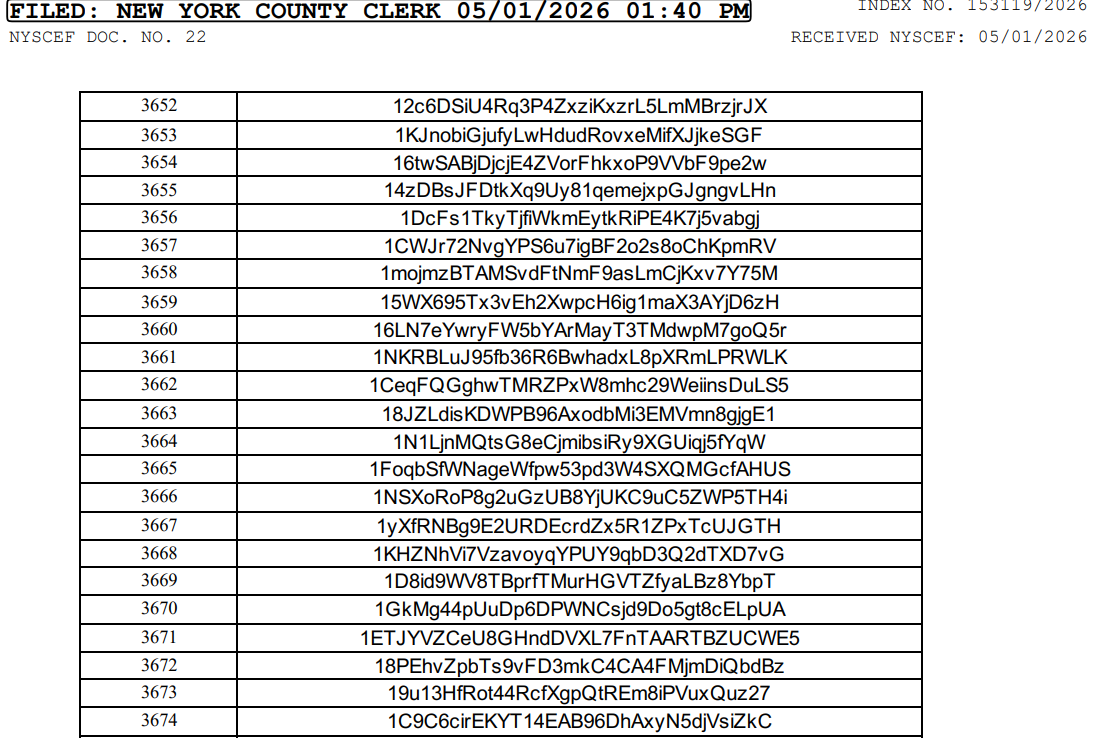
ABC Company, XYZ Company, Noah Doe, lawsuit against John Does holding 39,069 BTC, Bitcoin wallets. Source: ilawconotices.com
The listed addresses hold an estimated 3.7 million BTC, valued at about $285 billion, according to Sani, the founder of Bitcoin onchain analytics platform Timechain Index.
The founder also noted that most of the old Satoshi-era tokens are currently sitting in Pay-to-Public-Key (P2PK) output formats, while the plaintiffs only sent legal notices to the corresponding hashed public key under Pay-to-Public-Key-Hash (P2PKH) formats, which often hold no value.
This could undermine the claim that proper notice of abandonment was given to the holder, since plaintiffs sent the legal notices to the empty P2PKH addresses, while the actual BTC balance sits in unnotified P2PK scripts.
Castle Labs’ lead research analyst agreed, adding that the messaging attempt was “structurally defective” because it was sent to the address formats no longer used by the targeted wallets. Sending a small transaction via the OP_RETURN function would be “similarly ineffective” as it only works with active recipients monitoring their wallets.
Related: Bitcoin miner MARA spent $4.3M on CEO security in 2025 as crypto attacks rise
The over 39,000 wallets named in the lawsuit hold Bitcoin that are considered dormant, or lost, meaning that they haven’t been circulating onchain for multiple years.
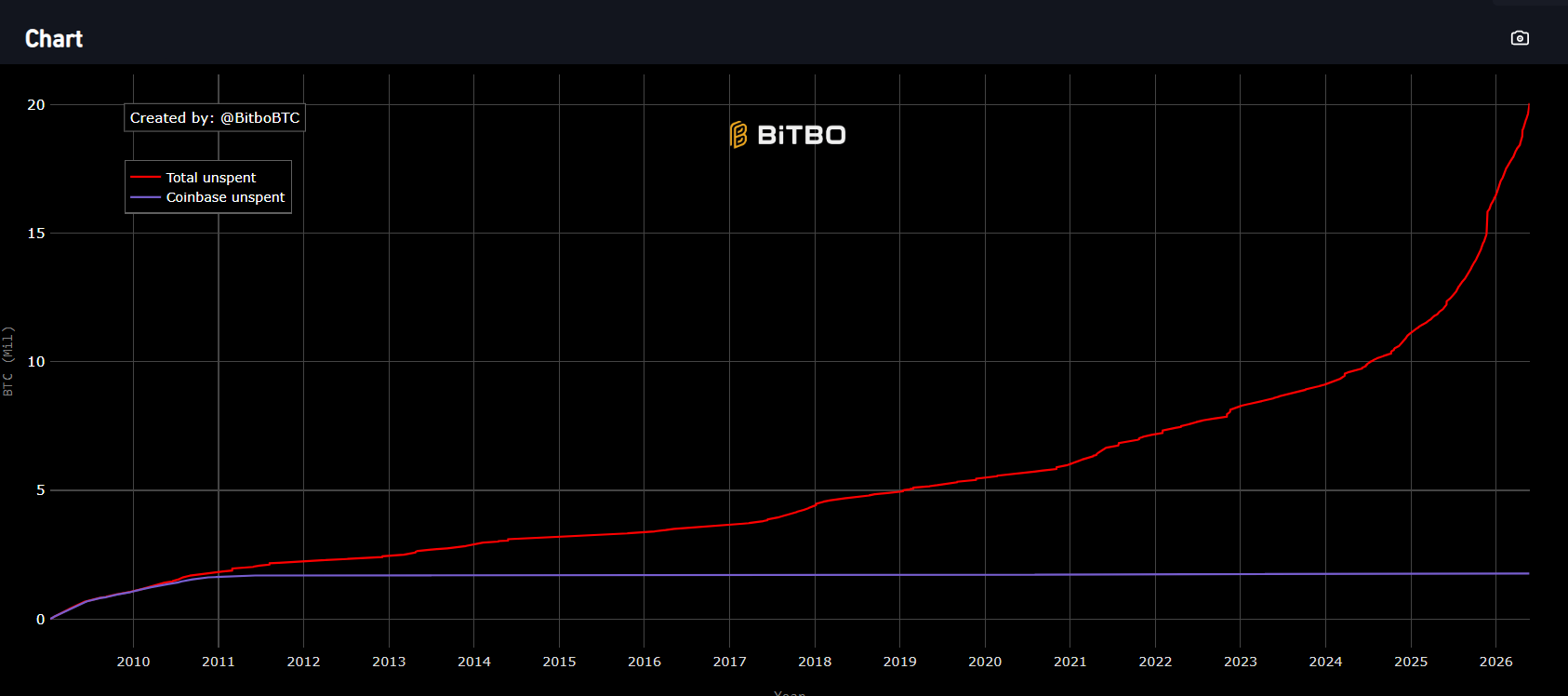
The supply of Bitcoin dormant for the past five and 10 years. Source: Bitbo
There are currently 3.5 million Bitcoin, worth about $271 billion, that have been dormant for the past 10 years and another 6.6 million coins, worth around $577 billion, that have been dormant for over five years, Bitbo data shows.
Magazine: The legal battle over who can claim DeFi’s stolen millions
Kevin Warsh was sworn in as the 17th Chair of the Federal Reserve on May 22. With this, he effectively replaced Jerome Powell after a narrow Senate vote and inherited sticky inflation, a $6.7 trillion balance sheet, and an increasingly Fed-sensitive crypto market.
His record as a former Fed governor, Bush-era policy adviser, and Wall Street financier points to a more hawkish, less interventionist Fed. Markets are pricing the shift in real time, and crypto traders are watching closely.
1. Hawkish on Inflation With a Smaller Balance Sheet in Mind
Warsh has long argued the post-2008 Fed grew too large and too active. He resigned in 2011 over additional quantitative easing and has spent the years since calling for scarcer reserves, a leaner balance sheet, and tighter discipline on inflation.
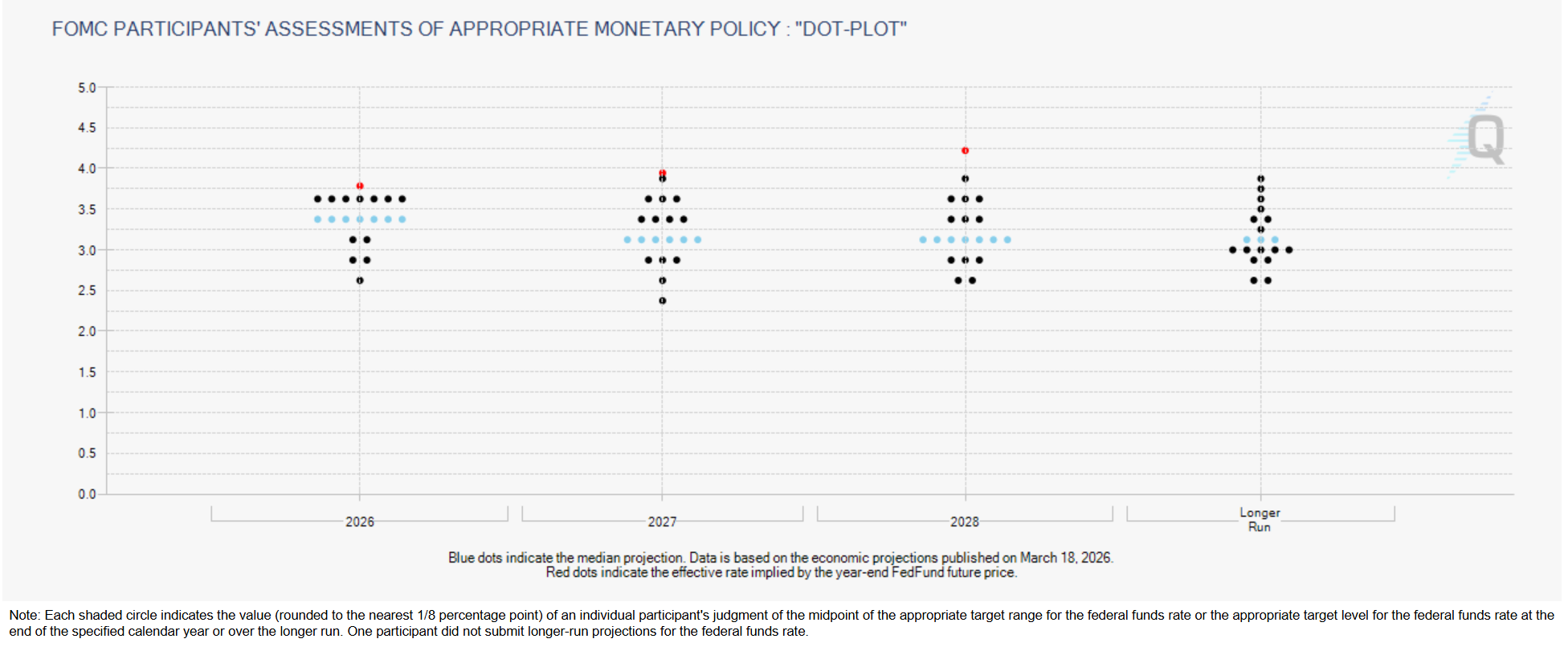
That framework now meets the moment. The federal funds target sits at 3.50 to 3.75%, headline inflation climbed to 3.3% in March on an Iran-driven oil shock, and the March dot plot pencils in just one cut for 2026.

At his Senate confirmation hearing, Warsh framed the central bank’s delayed inflation response as structural rather than a one-off mistake.
“Once you let inflation take hold in the economy, it is more expensive and harder to bring it down, and so the fatal policy error going back four or five years is still a legacy that we are dealing with… we need a regime change in the conduct of policy.”
Traders read that as a signal for faster quantitative tightening (QT) over near-term rate cuts.
Follow us on X to get the latest news as it happens
2. A Friendlier Take on Bitcoin Than His Predecessor
Warsh enters the role with the most openly pro-crypto record of any sitting Fed Chair. Trump’s Fed Chair pick has called Bitcoin a “sustainable store of value,” ruled out a retail central bank digital currency, and described crypto as already part of the United States financial system.
His crypto financial disclosure lists over $100 million in digital asset exposure, spanning Layer 1 networks, Decentralized Finance (DeFi) protocols, and Bitcoin (BTC) payment infrastructure.
The combination produces a paradox for traders. A hawk on rates is bearish for risk in the short term. However a Chair who views Bitcoin as a credible reserve asset reframes the longer-run case during every liquidity squeeze.
BTC has retreated from its January peak as the dot plot hardened, with traders caught between hawkish Fed policy and friendlier crypto signals from the top.

3. A Regime Change in How the Fed Talks to Markets
Warsh has telegraphed sweeping changes to how the Fed speaks to investors. He wants to:
- Scrap the post-meeting press conference cadence
- Retire forward guidance as a tool, and
- Adopt what he calls a “different, new inflation framework.”
Subscribe to our YouTube channel to watch leaders and journalists provide expert insights
The implication is a more opaque Fed. Investors who built positions around dot plots and well-trailed pivots will face a Chair who prefers silence and discretion over telegraphed signals.
That style may raise near-term volatility, yet in Warsh’s framing it restores credibility lost during the transitory inflation period.
His pledge during the Powell-to-Warsh handoff was to behave as no one’s “sock puppet,” a direct response to Trump’s pressure for rate cuts.
The first real test arrives at the next FOMC meeting, Warsh’s first as Chair.
Kevin Warsh being able to deliver regime change or careful continuity will set the tone for rates, the dollar, and crypto through the rest of 2026.
The post 3 Things to Know About Kevin Warsh, the New Fed Chair appeared first on BeInCrypto.
In the upcoming 2026 midterm elections, Americans will elect 35 of 100 Senate seats and all of the 435 voting seats of the House of Representatives.
The cratering popularity of President Donald Trump’s administration, which polls show is the result of everything from the economy to the War in Iran and his handling of immigration, has put Democrats in an historic lead.
The generic congressional ballot test, i.e., a poll that asks which party the respondent plans to support, recently showed that the Democrats had the largest mid-term lead of any party in the last 20 years.
But the Democrats have to contend not only with gerrymandering and a $1.8 billion slush fund for Trump’s political allies, but also the millions of dollars the crypto lobby is pouring into the elections.
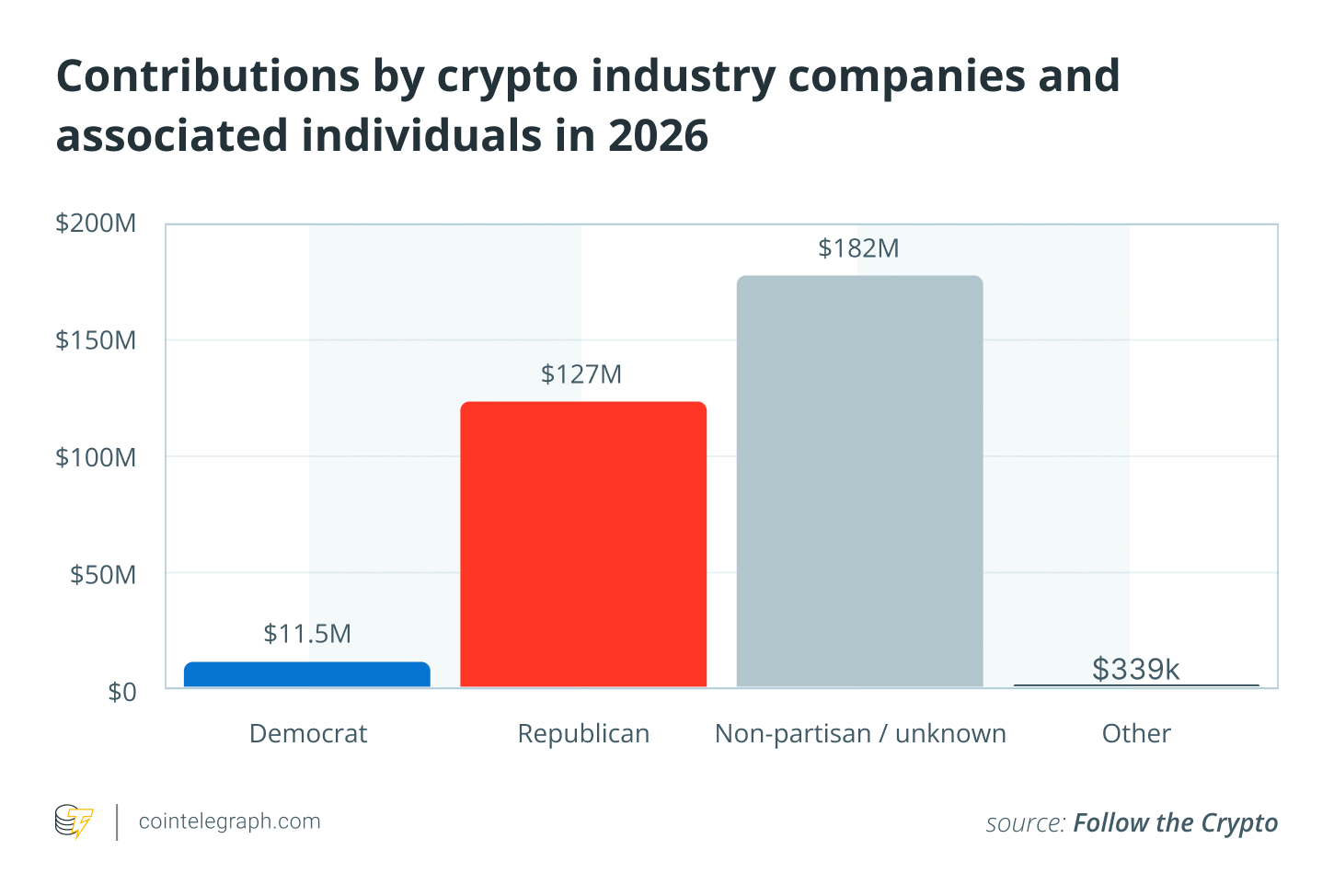
According to Follow the Crypto, an accountability project tracking political donations from the crypto industry, political action committees and crypto execs combined have donated over $500 million to influence the 2026 elections.
Crypto’s partisan divide becomes even clearer
According to Follow the Crypto, crypto-associated Political Action Committees (PAC) spending on the 2026 elections has already exceeded $245 million. Super PACs, which cannot donate to political campaigns directly but can spend an unlimited amount of money, have spent $49 million this cycle.
Super PACs are showing an increasingly partisan preference, contributing $23.4 million to support Republicans. It’s more than double the $11.3 million it spent to support Democrats.
The difference is even more stark when considering contributions from companies and associated individuals, e.g., CEOs and other executives. Here, companies and associations have spent more than 11 times on Republicans than on Democrats.
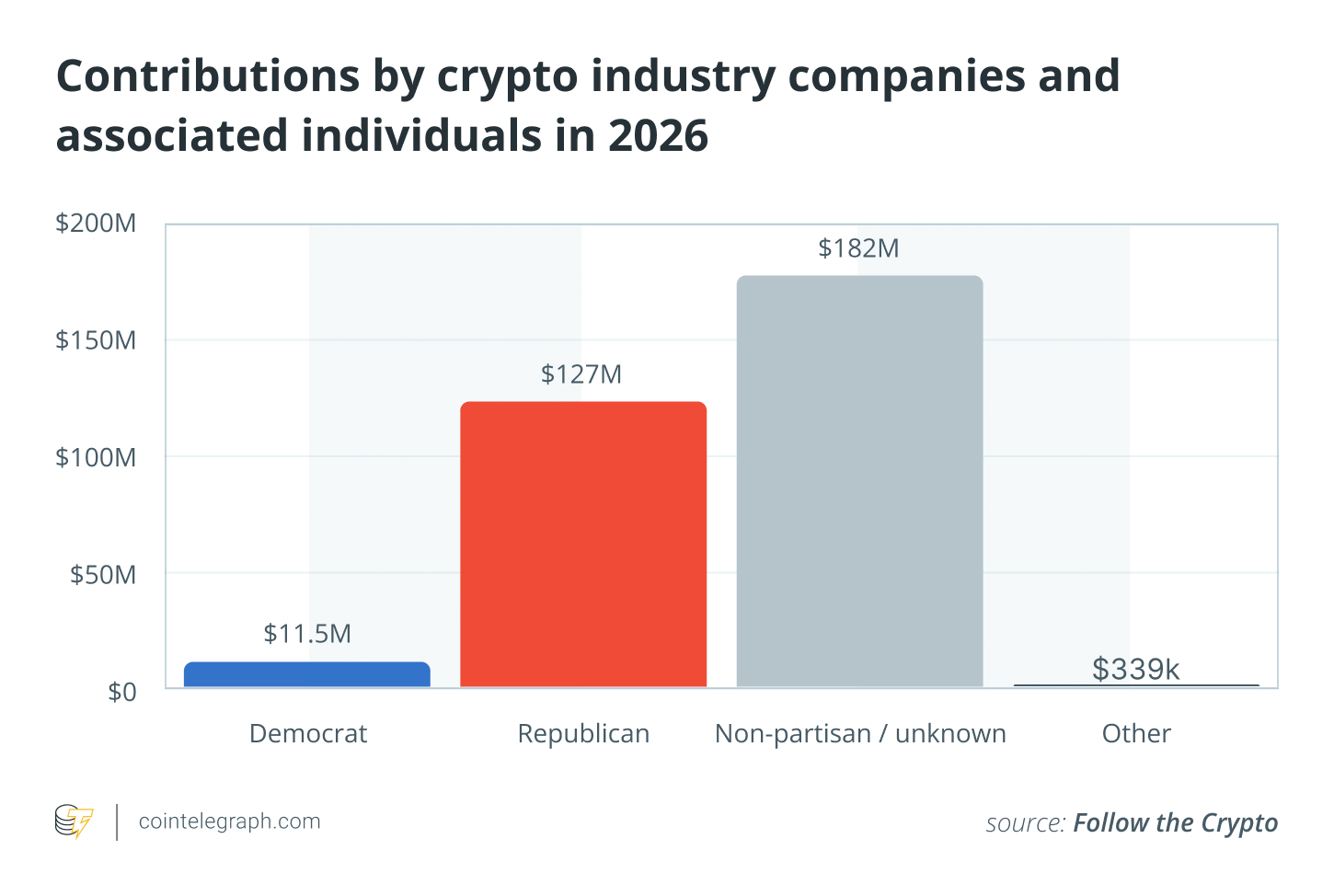
Part of this vast divide in spending could be explained by not necessarily a partisan bias toward Republicans, but the fact that Republican attitudes toward the finance industry tend to value deregulation and relaxed oversight. Democrats are not opposed to crypto on the level of party platform, but tend to be more skeptical.
But PACs have also spent a considerable sum opposing Democrats as well. Indeed, they’ve spent nearly $2 million more opposing Democrats than they have supporting them.
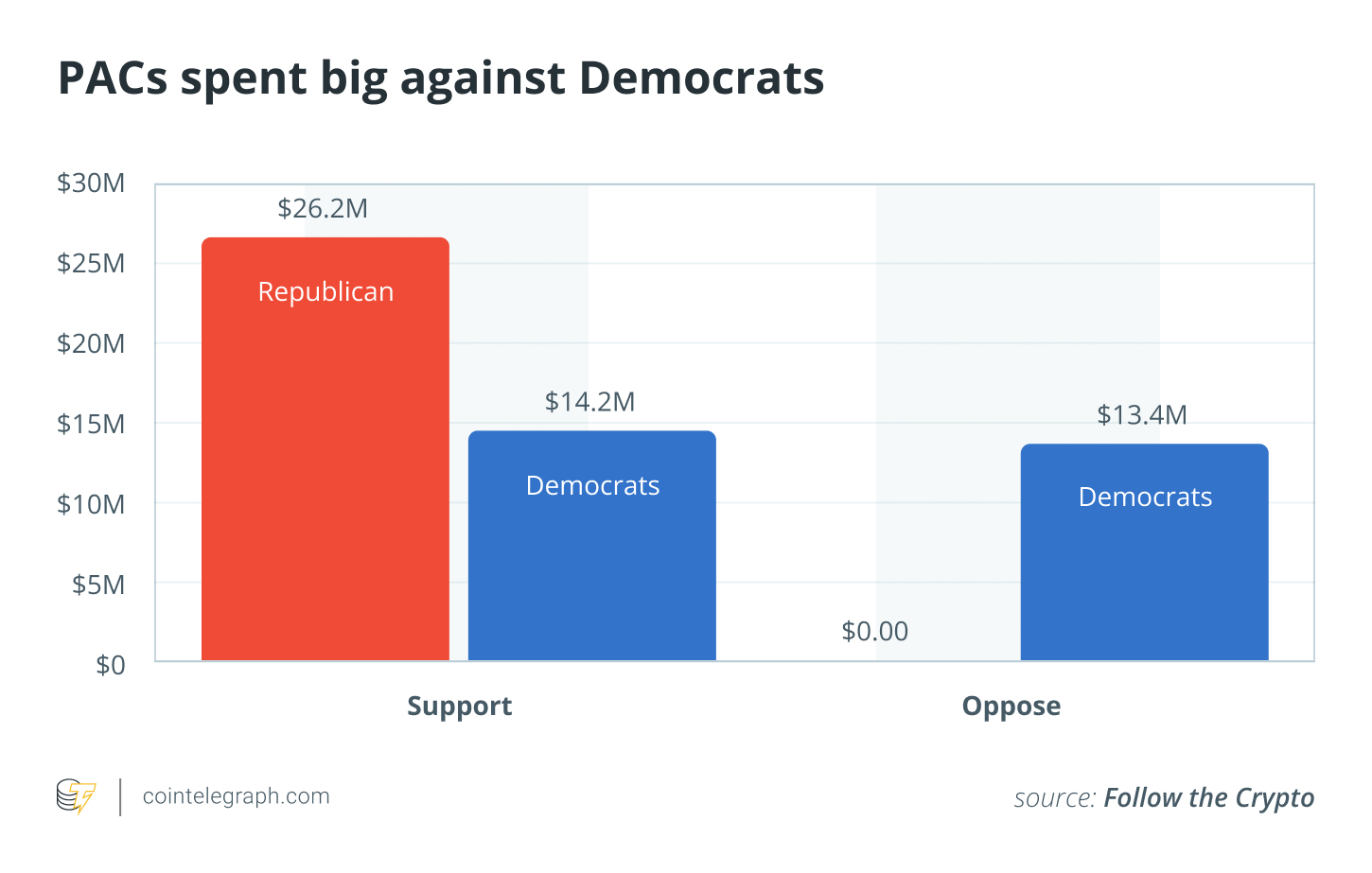
Crypto PACs spent more against Democrats than for them. Source: Follow the Crypto
Furthermore, in three out of the four special elections for the House where crypto PACs backed the winner, the victor was a Republican:
- Randy Fine (Florida 6th), $1.67 million
- Jimmy Patronis (Florida 1st), $558,000
- Clayton Fuller (Georgia 14th), $755,000
Crypto spends big in primaries, with mixed results
So far, most of the expenditures have been in primary elections, where the party decides among themselves which candidate will represent them in the general elections in November. Here, the crypto lobby can ensure that they have at least one crypto-friendly candidate on the ballot.
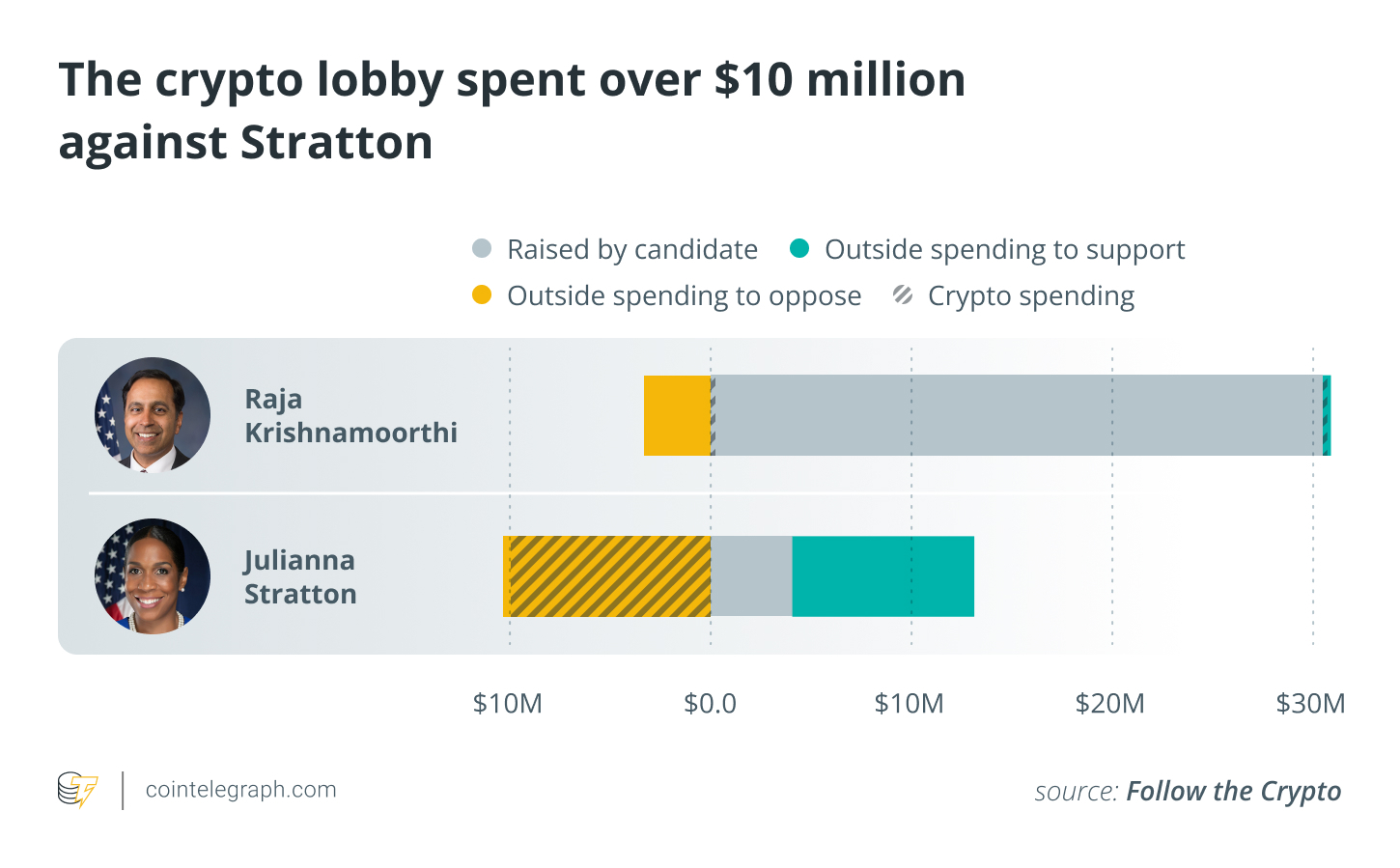
Three recent examples of profligate spending in primaries stand out. First is the Illinois senate primary that took place in March. Illinois Lieutenant Governor Juliana Stratton faced off against Representative Raja Krishnamoorthi.
Related: Crypto industry ties were a liability in Illinois primary
Kirashnamoorthi received only a nominal donation from crypto donors, but crypto PACs spent over $10 million on materials against Stratton. The spending against nearly totalled more than the total financial support for Stratton. In this case, it didn’t work. In fact, Stratton used the crypto money as a point against her opponent, and won by over seven percent of the vote.
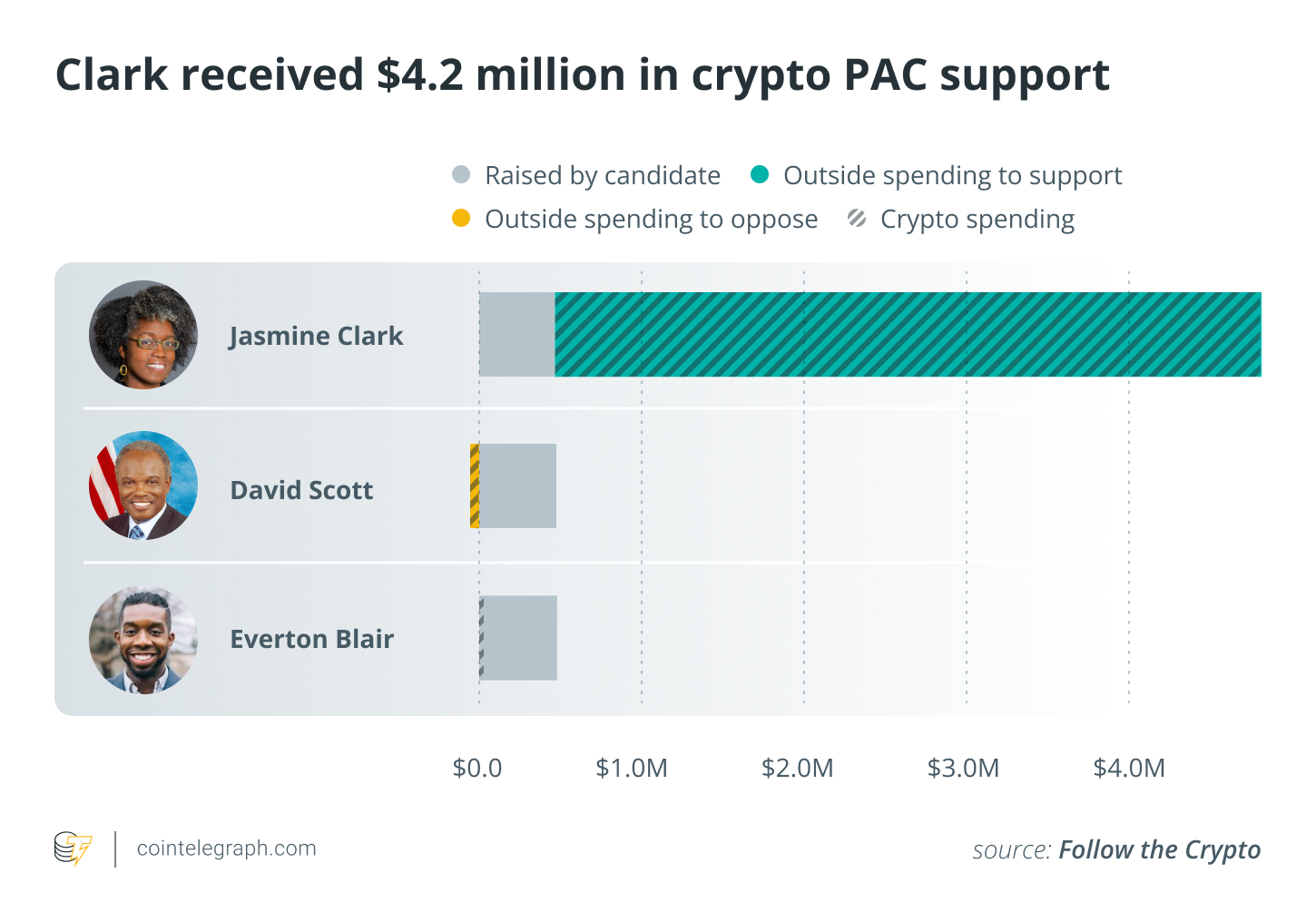
Earlier this week, Georgia State Representative Jasmine Clark won the primary for Georgia’s 13th Federal Congressional District. Clark received 56% of the vote over her opponents Heavenly Kimes and Everton Blair, who received 21.5% and 11.6%, respectively.
Clark received massive support from the crypto lobby. According to Follow the Crypto, outside spending from PACs accounted for $4.2 million in contributions — over nine times the amount of money her campaign raised itself.
Elections analyst Matt Klein said that “one of Clark’s opponents showed me data suggesting that the millions of dollars in crypto [money] for her was a huge turn-off for Dem voters.”
Despite this, Clark still won. According to Klein, this is because the other campaigns lacked the finances to inform the electorate. “The problem: Voters had no way of knowing it was crypto money! To advertise that message, guess what you need…”
In Alabama, Senator Tommy Tuberville is leaving office, leaving an empty seat. The leading candidates to replace him, Steve Marshall, Jared Hudson and Barry Moore, faced off in a primary earlier this week.
Moore, who is favored by Trump, received $7.8 million in donations from the crypto lobby — almost four times the total raised by his opponent.
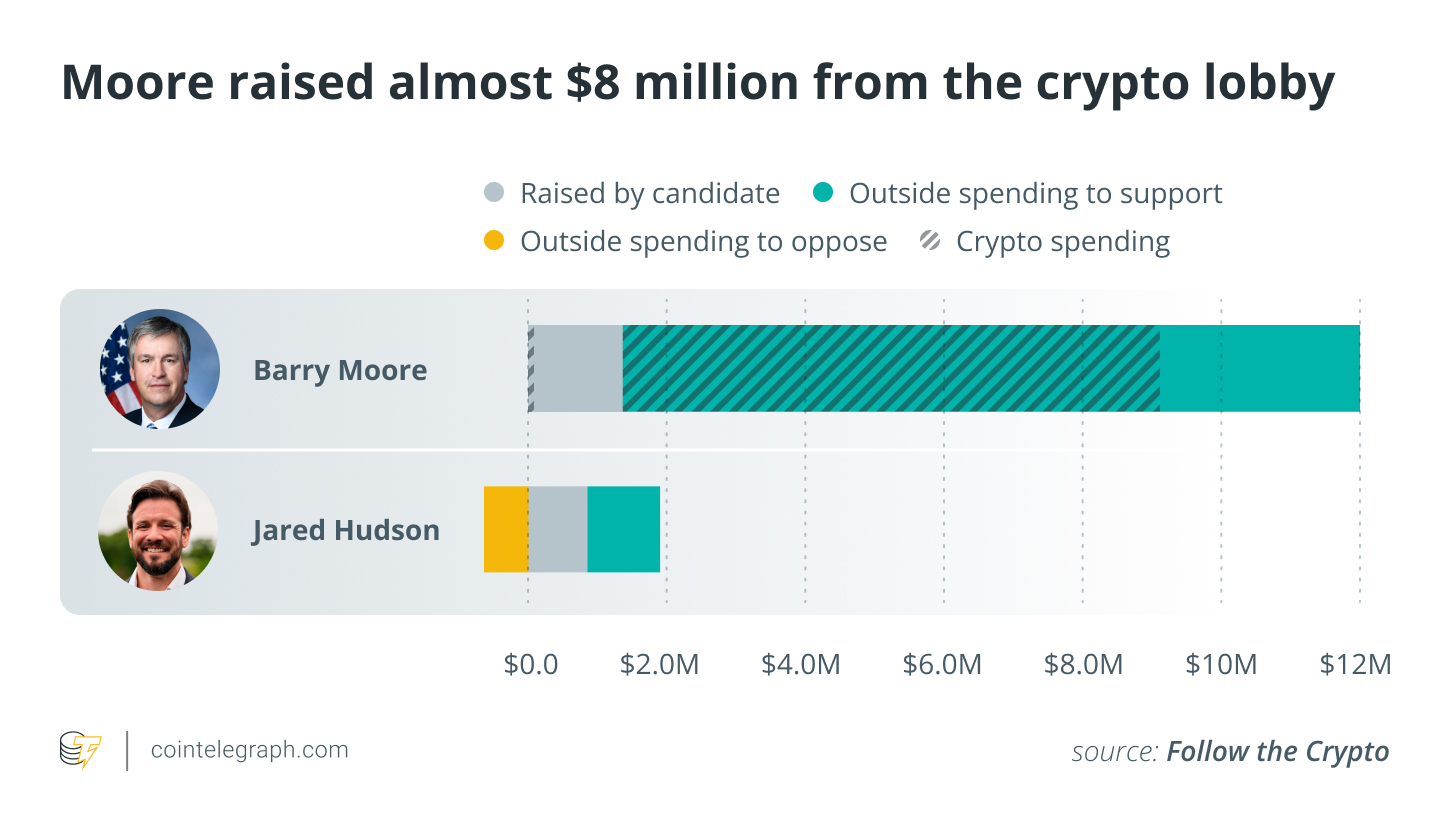
While Moore finished first in the primary results on Tuesday, he did not get the majority needed to secure the election. Now, he and Hudson are headed to a runoff.
Crypto sweep or careful messaging?
The crypto industry is already on track to break its previous record for spending in the 2024 presidential elections. But as shown above, it remains to be seen how effective crypto is as an actual organizing issue.
As reported in industry media, Fairshake, the largest crypto PAC, claimed a sweep in six primaries in which it spent money, claiming that a “powerful bipartisan mandate is being heard.”
But all the GOP candidates to which it donated were also endorsed by President Trump, a particularly powerful edge in red, Republican-dominated states like Alabama. Messaging in those campaigns reportedly concentrated on those associations, rather than the candidates’ positions on crypto.
Moore’s site draws particular attention to his association with Trump, which he doubles down on in his issues page. There is no mention of crypto and blockchain in his economic agenda, save for mention in support statements from other legislators.
Clark also received sizable donations, but was previously in a very tight race against her opponent Representative David Scott, before he passed away. As noted above, the fact that she received large donations from the crypto industry was not well known.
Any mention of crypto is notably absent from campaign sites or advertisements. Clark’s site makes no mention of digital assets in her agenda. Nor does she note crypto-associate organizations among her endorsements.
Crypto is increasingly becoming a political issue. Money can certainly make a difference in American elections, but even candidates don’t seem sold on it as a campaign issue.
Magazine: 5 tech predictions the mainstream media got horribly wrong
Crypto World
Ethereum Foundation's Kohaku Initiative Launches SDK for Wallet-Level Privacy Integration


The Ethereum Foundation's Kohaku Initiative announced the release of its SDK for integrating privacy protocols into Ethereum wallets without intermediaries. The team achieved a major milestone with v0.0.1-alpha.21 of the kohaku-eth/railgun integration, which now features operational 4337 mempool… Read the full story at The Defiant
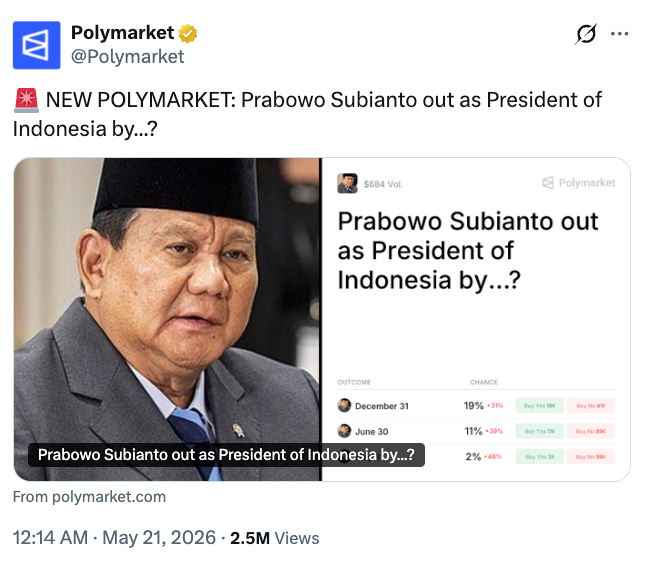
Indonesia blocked access to Polymarket after the prediction market platform hosted wagers on whether President Prabowo Subianto would leave office before the end of his term.
Indonesia’s Ministry of Communication and Digital Affairs (Komdigi) announced the block on Friday, describing Polymarket as an “online gambling site disguised as a prediction market.”
“The government will not allow any form of online gambling in Indonesia,” ministry official Alexander Sabar said, adding: “Activities like Polymarket involve betting and speculation on uncertain outcomes, thus violating Indonesian law.”
The move adds Indonesia to a growing list of jurisdictions treating prediction markets as gambling products, not merely forecasting tools, as platforms such as Polymarket and Kalshi face mounting legal scrutiny worldwide.
Political bets trigger scrutiny
The government action came days after Polymarket opened a wager tied to Prabowo’s presidency, allowing users to bet on whether the Indonesian leader would leave office early.
One of the markets, which appeared on Polymarket on May 21, lets users bet on whether Prabowo would leave office before several future dates, including May 31, June 30 and Dec. 31, 2026, even though his five-year presidential term is set to run until October 2029.
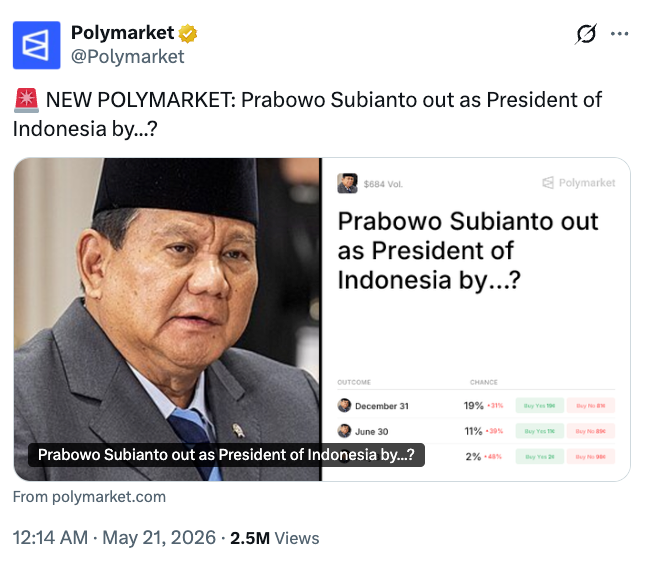
Source: Polymarket
The market recorded more than $46,000 in trading volume, with traders pricing a 1% chance of him leaving by May 31, 2% by June 30 and 18% by the end of 2026.
The ministry’s statement did not specifically reference the presidential exit prediction market, instead broadly characterizing Polymarket as a gambling platform operating in violation of Indonesian law.

Source: Indonesia’s Ministry of Communication and Digital Affairs (Kemkomdigi)
“As a measure to protect the public, especially the younger generation and users of the national digital space, the Ministry of Communication and Digital has blocked access to the Polymarket platform and similar services that are suspected of facilitating online gambling practices,” it said.
Prediction markets face global pressure
The Indonesian ban adds to growing regulatory pressure on prediction market platforms across multiple jurisdictions.
Supporters say prediction markets function as tools for crowd-sourced forecasting and sentiment tracking, while critics argue they can resemble online gambling and raise concerns around market manipulation as well as insider trading.
Related: CFTC officials who questioned prediction markets were suspended: NYT
India was among the latest countries to restrict access to Polymarket, extending a list of jurisdictions where the platform is blocked to more than 30. Despite the restrictions, Polymarket has recently signaled interest in pursuing regulatory approval in select markets, including Japan.
Magazine: Polymarket seeks Japan entry, Harvard dumps entire ETH position: Hodler’s Digest, May 17 – 23
TLDR
- YZi Labs has launched YZi Talent as a recruitment platform for its portfolio companies across Web3 AI and biotechnology sectors.
- The platform aggregates open roles into a single hub for candidates seeking opportunities in frontier technologies.
- Initial listings include senior engineering and leadership roles at predict.fun and AgriDynamics Robotics.
- YZi Talent supports hiring for both technical and business positions within YZi Labs backed startups.
- The platform complements YZi Labs internal hiring efforts by providing shared access to talent across its ecosystem.
YZi Labs has introduced YZi Talent, a recruitment platform for its portfolio companies. The platform aggregates job openings across Web3, artificial intelligence, and biotechnology sectors. YZi Labs said the initiative creates a unified entry point for candidates seeking roles in these fields.
The firm announced the launch in an official post on X. It described YZi Talent as a platform “integrating open positions” across its portfolio. The first listings include senior roles at predict.fun and AgriDynamics Robotics. These positions cover engineering and business leadership functions.
YZi Labs Builds Unified Hiring Platform for Portfolio Companies
YZi Talent centralizes hiring for companies backed by the firm. It allows candidates to explore roles across multiple sectors through one platform. The initial roles include Backend Chief Engineer and Frontend Staff Engineer positions at predict.fun. The platform also lists a Founding Business Leader role at AgriDynamics Robotics.
Predict.fun operates as a prediction market focused on improving liquidity using DeFi tools. AgriDynamics Robotics develops AI-driven systems for agricultural automation. YZi Labs highlighted both companies in its EASY Residency Season 2 portfolio. The initiative supports startups across Web3, AI, and biotech sectors.
Third-party job listings show the type of candidates YZi Talent targets. A Web3 Researcher role requires deep analysis of blockchain technologies and market trends. The same role also involves identifying developers and entrepreneurs for investment or collaboration. This combines technical research with investment-focused responsibilities.
YZi Labs also shared hiring updates through LinkedIn. The firm is recruiting Investment Directors, associates, and portfolio management leads. These roles focus on supporting founders building products in Web3, AI, and biotech. The firm also seeks recruiters and go-to-market specialists.
Platform Supports Growth Across AI, Web3 and Biotech Sectors
YZi Talent complements internal hiring efforts within YZi Labs. It provides a shared channel for portfolio companies to attract talent.
The firm positions itself as an investor across three technology sectors. It expanded beyond its origins as Binance Labs over the past 18 months. YZi Labs appointed Jane He to lead biotechnology investments in 2025. The firm also increased its focus on decentralized science and data-sharing projects.
By December 2025, YZi Labs had invested in 17 projects across its core sectors. These include ventures like AgriDynamics, predict.fun, Trellis Robotics, and Ethena Labs. Partners at the firm have discussed combining AI, blockchain, and biotech in public forums. They highlighted use cases such as tokenized health data and AI-driven trading systems.
In a conference talk, Jane He said users could share health data securely using blockchain. She added that participants could earn tokens for contributing to AI model training. YZi Labs continues to expand its ecosystem beyond funding. The launch of YZi Talent marks its latest effort to support portfolio growth through recruitment.


Zcash privacy claims faced a direct challenge after Arkham Intelligence linked 53% of ZEC transactions to identified entities.
Summary
- Arkham Intelligence labeled over 53% of all Zcash transactions and linked $420 billion in ZEC volume to identifiable individuals and institutions.
- The tracking covers 48% of all transaction inputs and outputs and 37% of total ZEC balances, approximately $2.5 billion, per Arkham’s published research.
- Zcash founder Zooko Wilcox clarified that fully shielded-to-shielded transactions remain cryptographically protected and that Arkham cannot access the shielded pool.
Blockchain analytics firm Arkham Intelligence published research revealing it had labeled more than 53% of all Zcash transactions, attributing approximately $420 billion in ZEC volume to identifiable individuals and institutions. The research, published in December 2025, triggered immediate debate about the true extent of Zcash’s opt-in privacy model.
Arkham’s tracking covers 48% of all transaction inputs and outputs and links 37% of total ZEC balances, approximately $2.5 billion, to named entities. The firm did not crack Zcash’s cryptography. It combined entity clustering, exchange data, known government seizures, and transparent address analysis to attribute activity to real-world actors.
Why Arkham can track most Zcash activity but not all of it
The critical distinction is between transparent and shielded transactions. Zcash’s privacy is opt-in. Users choose between T-addresses, which are fully visible on the public ledger, and Z-addresses, which use zero-knowledge proofs to shield sender, recipient, and amount.
“[Arkham] didn’t actually deanonymize any ZEC that was held at rest in the shielded pool,” Zcash founder Zooko Wilcox said in response to the announcement. Tracking such transactions would be “impossible because the information just isn’t there,” he added.
As of December 2025, fewer than a quarter of all ZEC in circulation sat in the shielded pool. The majority of activity passes through transparent addresses, particularly on centralised exchanges which almost exclusively use T-addresses. Crypto.news has tracked the capital dynamics driving ZEC’s recent 73% monthly gain as the quantum and privacy narrative drives fresh interest.
Why the Arkham disclosure matters as ZEC rallies and NU7 approaches
The controversy resurfaced in May 2026 as ZEC rallied sharply on quantum computing concerns and the approaching NU7 network upgrade. The Orchard shielded pool provides stronger privacy guarantees than the older Sapling pool, but still holds a minority of ZEC activity.
Until shielded pool usage expands significantly, Arkham-style behavioural analysis of transparent activity will remain possible for the majority of network transactions.
Crypto.news has covered the quantum threat timeline, including research showing Bitcoin’s elliptic curve cryptography requires approximately 2,330 logical qubits to break. Privacy protocols with zero-knowledge proof infrastructure are increasingly discussed as potential safe harbors as those timelines accelerate.
Crypto.news has also noted Citi’s analysis that a quantum attack on major financial institutions could put $2 to $3.3 trillion of GDP at risk, context that makes Zcash’s NU7 privacy improvements directly relevant to institutional risk managers watching the space.
Earnings call transcript: Fisher & Paykel Healthcare posts strong H2 2026 results

Chris Larsen XRP wallets go active near midterms

BITCOIN: They’re Setting a Nasty TRAP! (red alert) – BTC Price Prediction Today

US brings back mandatory military draft registration

Steven Gerrard disagrees with Gary Neville over ‘shock’ Chelsea and Arsenal claim | Football

Register Renaming | Hackaday
BITCOIN: They’re Setting a Nasty TRAP! (red alert) – BTC Price Prediction Today

Clarity Act Wins Senate Committee Vote, Crypto Wrench Attacks Surge | Bloomberg Crypto 5/19/2026

THIS IS WHERE BITCOIN EITHER PROVES ME WRONG… OR MAKES MILLIONS
-

 Crypto World4 days ago
Blockchain.com files with SEC for U.S. IPO
-

 Fashion3 days ago
Holiday Weekend Open Thread – Corporette.com
-

 Business3 days ago
Dell Technologies DELL Stock Surges 15% on AI Server Momentum and Analyst Upgrades in 2026
-

 Crypto World4 days ago
Bitcoin Accumulation Weakens as BTC Realized Losses Hit $600M
-

 Crypto World3 days ago
Space X IPO Is ‘Bad News’ for Tech Stocks: But What About Bitcoin?
-

 Politics3 days ago
Makerfield: a tale of two social-media histories
-

 Crypto World3 days ago
Robinhood crypto COO Tanya Denisova exits
-
 Crypto World4 days ago
MicroStrategy’s Saylor Says Miners No Longer Set Bitcoin Price, Another Force Has Taken Over
-

 Business1 day ago
NYT Strands Answers May 24 2026 Revealed for Puzzle No. 812 Theme Summer Essentials
-

 Crypto World3 days ago
AI infrastructure race heats up as IREN pitches full-stack strategy, WhiteFiber lands $160M deal
-
 Tech3 days ago
A 0.12% parameter add-on gives AI agents the working memory RAG can’t
-

 Tech4 days ago
WhatsApp ads could make Irish debut after discussions with DPC
-

 Tech4 days ago
You Can Now Add ChatGPT To PowerPoint
-

 Business4 days ago
Trump Invests $1M-$5M in Kura Sushi USA Chain With 27 California Locations
-

 Sports4 days ago
2026 CJ Cup Byron Nelson leaderboard: Brooks Koepka finds putting stroke in Round 1
-
 NewsBeat4 days ago
Charity run by Reform leader Malcolm Offord accused of ‘law breaking’ over Scottish registration
-

 Crypto World5 days ago
Exa Labs raises $250 million in funding led by a16z
-
Business4 days ago
Goldman Sachs reinstates Ageas stock coverage with neutral rating
-
 Crypto World4 days ago
Trump Media’s Bitcoin Stash Shrinks Again as 2,650 BTC Lands on Crypto.com
-
 Business3 days ago
Marine engineering firm Avantis eyeing expansion on equity boost
You must be logged in to post a comment Login