
Crypto World
Bitcoin ETF Inflows Stall After 9-Day Run as BTC Drops Under $78K

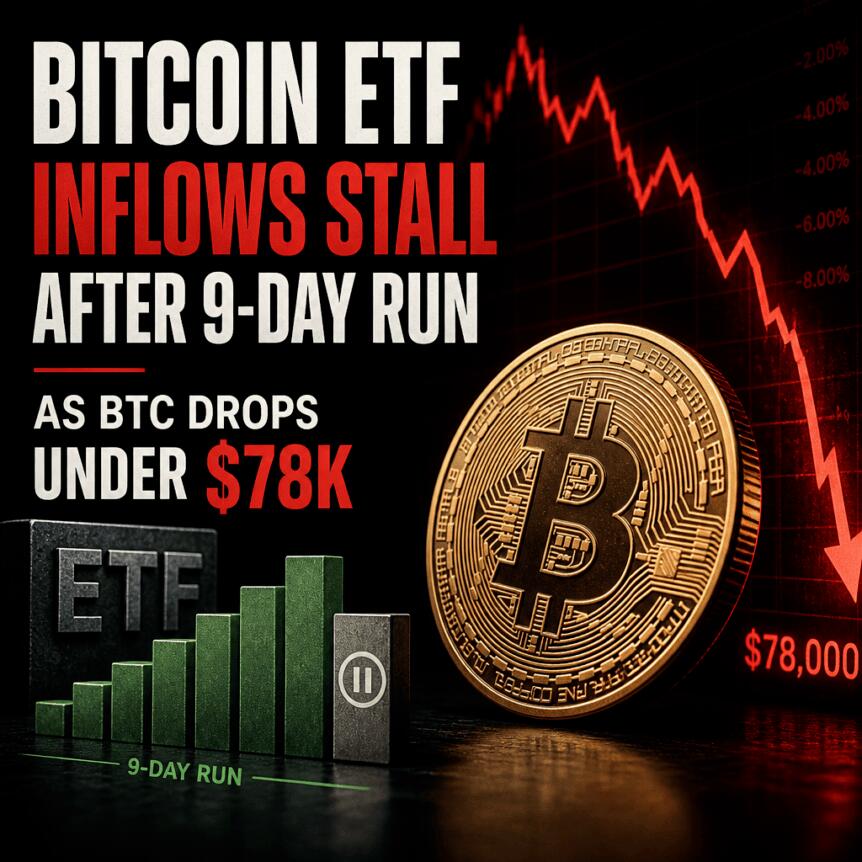
US-listed spot Bitcoin exchange-traded funds (ETFs) snapped a nine-day streak of net inflows as Bitcoin slipped back below the $78,000 level. The pause in demand comes amid an otherwise strong August for the category, with total inflows over the month still positive into the final days of the period.
SoSoValue data shows US spot Bitcoin ETFs logged $201.8 million in net outflows on Friday, ending a run that had brought more than $3 billion in net inflows over nine consecutive trading sessions. August net flows remained positive at $3.3 billion with one US trading day left, while total net assets slipped to $97.6 billion after reaching above $100 billion on Thursday.
Key takeaways
- Friday marked a shift to $201.8 million of net outflows for US spot Bitcoin ETFs, ending a nine-day inflow streak.
- SoSoValue reported that the pullback followed more than $3 billion in net inflows over the prior nine sessions.
- Ether and XRP spot ETF categories continued to add assets on Friday, receiving net inflows of $102.2 million and $26.2 million, respectively.
- Solana ETFs sustained positive momentum and reached major milestones in cumulative flows, according to Bloomberg ETF analyst Eric Balchunas.
- ARK 21Shares led the day’s Bitcoin outflows, while most other funds were either negative or only mildly positive.
Bitcoin ETF outflows resume after a strong run
Bitcoin-related ETF demand eased on Friday even as the broader picture for August remained constructive. The shift is best understood as a “cooling” rather than a full reversal: the category’s net inflow streak ended, but the aggregate month-to-date figure still stands in positive territory.
According to Farside Investors, ARK 21Shares’ spot Bitcoin ETF (ARKB) recorded the largest withdrawals of the day, with $114.9 million in net outflows. Bitwise’s Bitcoin ETF (BITB) followed with $49.7 million in net outflows. BlackRock’s iShares Bitcoin Trust ETF (IBIT)—the largest US spot Bitcoin ETF by assets—also saw outflows, totaling $33.4 million on Friday.
Among the lineup, Morgan Stanley’s Bitcoin Trust (MSBT) was the exception, adding $9.3 million in net inflows. That means while the day’s overall flow picture turned negative, capital was not uniformly leaving every product—some funds still attracted incremental demand.
Altcoin ETF demand holds: Ether and XRP keep flowing
What stands out in Friday’s broader ETF flow data is the divergence between Bitcoin and parts of the altcoin complex. Ether and XRP ETFs continued to receive net inflows despite the reversal in Bitcoin.
SoSoValue reported that US spot Ether ETFs added $102.2 million in net inflows on Friday. Ether funds had last recorded net outflows on Aug. 11, highlighting that Friday’s gains appear to extend a recovery or at least a stable demand pattern.
For XRP, SoSoValue data showed $26.2 million in net inflows on Friday. The XRP funds last saw net outflows on Aug. 5, suggesting that this category has also been able to hold up through periods when Bitcoin ETF flows have weakened.
This separation matters for investors because it suggests that not all “risk-on” or “risk-off” behavior is being expressed through Bitcoin ETFs alone. If inflows into Ether and XRP persist while Bitcoin ETFs experience intermittent pullbacks, it can indicate more selective positioning across major digital asset categories rather than a blanket rotation away from crypto.
Solana ETFs hit new milestones amid sustained momentum
Solana ETFs also remained resilient. Bloomberg ETF analyst Eric Balchunas said Friday that the Solana ETF category has accumulated $1.7 billion in cumulative flows without a sustained stretch of outflows. He described the broader backdrop as a difficult first half for crypto, referring to it as a “nightmare downturn,” but still characterized the Solana ETF performance as “impressive.”
Balchunas also noted that Bitwise’s Solana ETF became the first in the category to cross the $1 billion mark, underscoring how the product lineup is beginning to show clearer scale differences. While the report did not specify the exact date of the milestone within the message, it ties the achievement to the ongoing flow momentum across the category.
Taken together, the Solana and multi-asset flow pattern suggests that investors may be distributing exposure across several single-asset ETF themes rather than concentrating only on Bitcoin—at least during this particular stretch of market activity.
What to watch next
Friday’s data shows how quickly Bitcoin ETF inflows can turn when price action softens, even if broader monthly totals remain positive. Traders and long-term ETF investors will likely focus on whether outflows persist over the next sessions or if the category quickly re-establishes net inflow momentum, while also keeping an eye on whether Ether, XRP, and Solana funds continue to attract assets alongside—or independently of—Bitcoin.



President Donald Trump has announced an oil agreement that would give the United States a 55% effective output share in a new venture controlling 65 billion barrels of Venezuelan reserves.
Summary
- The planned venture covers 17 Venezuelan oil fields with an estimated 65 billion barrels.
- A U.S. official said the United States would receive equity and rights to buy crude at cost.
- Venezuela expects the projects to attract $100 billion in investment and generate $209 billion in taxes.
- Damaged infrastructure, political uncertainty, and unresolved legal questions could delay any production increase.
According to Trump’s Truth Social announcement, Secretary of State Marco Rubio and Defense Secretary Pete Hegseth negotiated the agreement with Venezuela’s interim President Delcy Rodríguez and private businesses.
Trump called the arrangement “the biggest oil deal in world history” and said it would give the United States majority control over more than 65 billion barrels of proven reserves at no cost to American taxpayers.
Rodríguez’s government said the planned venture would develop 17 strategic fields. A field list reviewed by Reuters placed the assets in the Orinoco Belt and the Lake Maracaibo region, two central parts of Venezuela’s oil industry.
Neither government has released the complete agreement, named the private operator, or explained how the United States would exercise control over reserves that remain subject to Venezuelan law.
Venezuela oil deal includes equity and at-cost crude
The Associated Press, citing an unnamed U.S. official familiar with the terms, reported that the United States and a private operator would form a new company in Venezuela. Rodríguez has granted the company development rights lasting 100 years, according to the official.
Under the proposed structure, the United States would receive 55% of the venture’s effective output. The arrangement includes an equity interest as well as the right to purchase crude at cost, but the official did not disclose the government’s exact ownership percentage.
Axios separately described the structure as a public-private partnership rather than a cash acquisition by Washington.
“It’s not a purchase. They’re giving us equity,” a U.S. government source told Axios.
The Pentagon’s Office of Strategic Capital would oversee the arrangement, according to the report. The office finances projects tied to U.S. national security, although the administration has not published documents explaining its authority or financial role in the Venezuelan venture.
Questions also emerged inside the administration immediately after Trump’s announcement. Axios reported that officials initially disagreed over whether the agreement had been completed before Rodríguez issued a statement supporting it.
“It’s going to happen. It’s just a question of when,” another U.S. source told the publication.
Venezuelan officials are preparing to sign exploration and production agreements with several companies next week, Reuters reported. U.S. firms are expected to receive priority, while a lease and auction model has also been discussed.
If formed on the stated terms, the company would control the second-largest proven oil reserve base held by a corporate entity, behind Saudi Aramco, the U.S. official told the Associated Press.
The agreement targets investment and US oil costs
Rubio said the projects could bring almost $100 billion in private investment to Venezuela, create thousands of jobs, and support the rebuilding of its oil industry.
“This deal is a huge win for both the American and Venezuelan people,” Rubio wrote on X.
Rodríguez projected that the venture would produce $209 billion in tax revenue for Venezuela. In a government statement, she said the investment would support the recovery of the country’s energy infrastructure and raise production from the 17 fields.
For the United States, crude purchased through the venture would be used to replenish the Strategic Petroleum Reserve and meet military needs, the U.S. official told the Associated Press.
Reserve stocks fell below 300 million barrels in early August, more than 100 million barrels below their level at the start of 2026, according to AP. Average U.S. gasoline prices stood near $4.09 per gallon on Friday, compared with $3.21 a year earlier, based on AAA data cited by the news agency.
Trump has faced pressure to lower fuel costs ahead of the November midterm elections. Rubio said stable supplies of lower-cost Venezuelan crude could reduce gasoline prices, although neither government has provided an output schedule.
Venezuela holds about 303 billion barrels of proven crude reserves, equal to roughly 17% of the world’s total, according to the U.S. Energy Information Administration. Despite its underground resources, the country currently produces about 1.25 million barrels per day after years of sanctions, underinvestment, and poor maintenance.
Much of Venezuela’s oil is heavy crude that requires specialized equipment and refining capacity. Pipelines, electrical systems, export terminals and upgraders would require billions of dollars in repairs before the 17 fields could add substantial supply, according to energy specialists cited by Reuters and AP.
ExxonMobil CEO Darren Woods called Venezuela “un-investable” during a White House meeting with oil executives after Nicolás Maduro’s removal in January. AP reported that executives showed interest in the country’s reserves but remained concerned about damaged assets and the history of government expropriation.
Lower oil prices could affect Bitcoin through inflation
An increase in Venezuelan output could affect crypto markets if it produces a sustained decline in oil and fuel costs, though no source has established that the agreement will deliver such an effect soon.
Energy costs feed into U.S. inflation through gasoline, transport, and production expenses. Lower inflation can give the Federal Reserve more room to reduce interest rates, while persistent price pressure can keep borrowing costs high and restrict liquidity available for Bitcoin and other risk assets.
As previously covered by crypto.news, a lasting fall in crude prices can lower direct fuel costs and reduce expenses across supply chains. The report noted that a one-day oil decline has little effect on inflation unless lower prices remain in place long enough to enter official data.
July’s latest PCE reading showed that the headline index rose 0.2% for the month and 3.7% from a year earlier, according to the U.S. Bureau of Economic Analysis. Core PCE also increased 0.2% monthly and remained at 3.3% annually, above the Federal Reserve’s 2% target.
Bitcoin has already shown sensitivity to energy prices and U.S. rate expectations during the Iran conflict. A July report found that rising oil pressure accompanied Bitcoin’s fall below $64,000 as disruptions around the Strait of Hormuz added to inflation concerns.
Venezuelan production, however, cannot replace impaired Gulf supply immediately. The Associated Press reported that oil flows through the Strait of Hormuz remain well below levels recorded before the six-month U.S.-Iran conflict, while the waterway previously carried about 20% of global petroleum supply.
Legal and political risks remain unresolved
David Goldwyn, president of Goldwyn Global Strategies, told Reuters that the agreement’s legal basis remains unclear under Venezuela’s constitution and hydrocarbons law.
Goldwyn said there was “no precedent for having the U.S. government enter into a lease to operate oil fields.” He also questioned whether the structure could overcome an unreliable power grid, weak export capacity and government discretion over energy projects.
Venezuela nationalized its oil industry in the 1970s and later forced foreign producers into ventures led by the state oil company PDVSA. Under former President Hugo Chávez, the government expropriated projects operated by U.S. companies, including ExxonMobil and ConocoPhillips.
Rodríguez opened parts of the industry to private ownership after becoming interim president, reversing rules that had kept the state at the center of oil production. Venezuelan opposition figures have challenged her authority and argued that a long concession involving national reserves would violate the constitution.
Her government took power after U.S. forces captured Maduro in January and transferred him to the United States to face federal narcoterrorism and drug-trafficking charges. Maduro remains in U.S. custody and has pleaded not guilty.

XRP price trades around the $1.40 to $1.45 range, down from the recent $1.70 peak as the token digests one of its sharpest weekly swings of the year, despite its prediction still leaning bullish. The rally has faded, leaving traders with a much simpler question: Does $1.40 hold, or does this unwind further?
The move traces back to a broken falling wedge pattern and a wave of legislative optimism. President Trump pushed Congress on the CLARITY Act during a White House crypto meeting featuring Ripple’s Brad Garlinghouse. The Senate then moved toward a scheduled cloture vote.
— RippleXity (@RippleXity) August 19, 2026
 JUST IN: #Ripple CEO Brad Garlinghouse is now LIVE from the White House alongside President Trump.
Leveraged shorts were caught wrong-footed, triggering a squeeze that turned the rally into a danger zone once buyers failed to defend the $1.50 to $1.55 area.
Crypto markets remain caught between regulatory optimism and traders carrying increasingly heavy leverage. That tug of war makes the next XRP move particularly important. If buyers can reclaim $1.50, the recent rally could have another act. If $1.40 breaks instead, sellers could start asking how far this correction can really go.
Discover: The Best Crypto to Diversify Your Portfolio
XRP Price Prediction: Can Ripple Token Hold $1.40 and Retest $1.63?
XRP is trading around the $1.40 range, with the pullback from the recent peak shaving 15% off the local top. The seven-day gain remains positive despite the recent red candles. This means that XRP is still a rally cooling rather than a trend that has completely broken. Volume has also thinned since the squeeze, a familiar sign of mean reversion after an overheated move.
The bull case starts with XRP holding the $1.40 to $1.45 area and reclaiming $1.50 to $1.55. A move through $1.63 could then provide the acceleration needed for another run toward $1.85 and potentially $2.

The base case is less exciting, with XRP consolidating between roughly $1.23 and $1.50 while excess leverage gets flushed from the market.
The bear case becomes more serious if XRP loses $1.23. That would expose the $1.12 support zone, while a deeper breakdown could eventually send the token back toward the $1.00 area.
For now, the key battle remains around $1.40. Hold it, and the bulls still have something to work with. Lose it, and this cooling rally could turn into something much colder.
Trade XRP on Bybit and Get a Chance to Win Our $1,000 USDT Airdrop
LiquidChain Targets Early Mover Upside as XRP Tests Key Levels
XRP holders who bought the wedge breakout are sitting on decent gains, but let’s be honest, a move from $1.42 to $2 is a 41% return on an asset with a market cap already in the tens of billions.
The upside is real, but it’s not the asymmetric setup early-stage buyers look for. This is where capital increasingly rotates toward presale-stage infrastructure plays with room to actually multiply.
LiquidChain is making “which chain?
” a thing of the past.
⟁https://t.co/vqvBcdSQYC pic.twitter.com/ip83gw1P0u
— LiquidChain (@getliquidchain) August 23, 2026
LiquidChain ($LIQUID) is a Layer 3 infrastructure project fusing Bitcoin, Ethereum, and Solana liquidity into a single execution environment. It is solving the fragmentation problem that forces developers to rebuild for every chain.
LIQUID is currently priced at $0.01494, with $950K raised so far. The deploy-once architecture and verifiable settlement layer are its standout features, letting builders access three major ecosystems without duplicating work.
Those tracking the ETF inflow trend covered in this whale activity breakdown may find the diversification argument familiar.
Research LiquidChain before the presale window ends.
Discover: The Best Token Presales
The post XRP Price Prediction: Momentum and $1.40 Floor to Hold appeared first on Cryptonews.
A Solana-based token promoted by a Trump-linked coin brand collapsed within hours of its launch, raising questions over who was behind it and its unusual trading activity.
Real Trump Coins, a brand US President Donald Trump publicly promoted in 2024, touted the “Trump Digital GOLD” token on X before deleting related posts on Saturday, according to blockchain analytics platform Lookonchain.
The Real Trump Coins website continued promoting GOLD as of publication, advertising a 4% trading fee and pledging to use 99% of trading fees to buy back the token in an effort to make it a top-10 crypto asset by market capitalization.
The launch has left crypto observers questioning GOLD’s legitimacy, with some suggesting the Real Trump Coins website and its Trump-followed X account may have been compromised.
GOLD token wallets sell amid 82% supply concentration
The token surfaced early Saturday when the Real Trump Coins X account, which Trump’s official account follows, announced the GOLD launch and directed users to RealTrumpCoins.com to buy the token.
Lookonchain flagged the launch shortly afterward, noting that the developer held 600 million GOLD while 15 newly created wallets spent $18,657 to acquire another 224.5 million tokens. “The team currently controls 82.45% of the total supply,” Lookonchain said, advising users to be cautious.
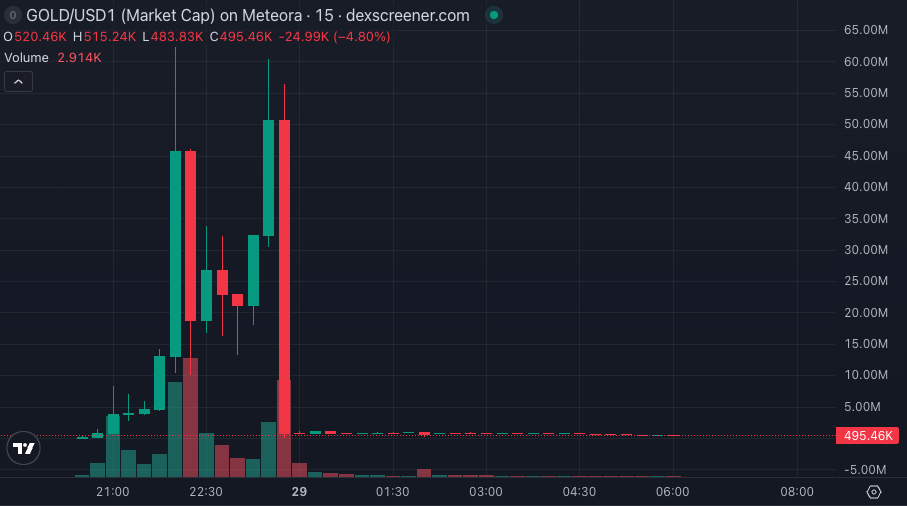
Lookonchain later reported that the 15 wallets, which it linked to the team, sold all 224.5 million GOLD for 3,178 Solana (SOL), worth about $330,000. GOLD subsequently lost nearly all of its value, with its market capitalization falling from about $50 million to $500,000 at the time of publication, according to DEX Screener.
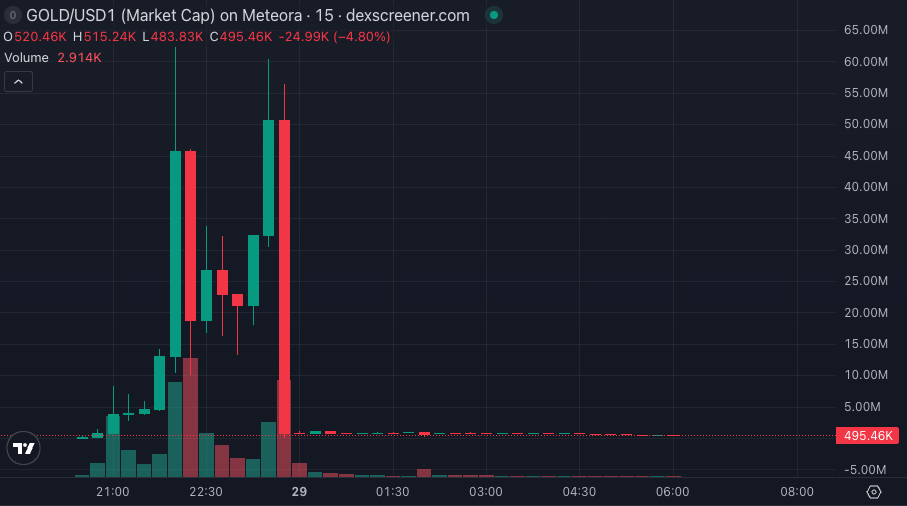
Source: DEX Screener
“GOLD just rugged!” Lookonchain said, estimating that the wallets made a $312,000 profit, or roughly 17 times their initial investment.
What is Real Trump Coins?
Trump publicly promoted RealTrumpCoins.com in September 2024 when announcing his silver medallions, describing the website as the exclusive place to buy them. The site says the products are not manufactured, distributed or sold by the Trump Organization.
The sudden GOLD promotion and subsequent deletion of related X posts fueled speculation that the brand’s X accounts and website had been compromised. Several crypto outlets have since described GOLD as an apparent scam or rug pull, while unverified reports have linked the suspected compromise to Iranian hackers.
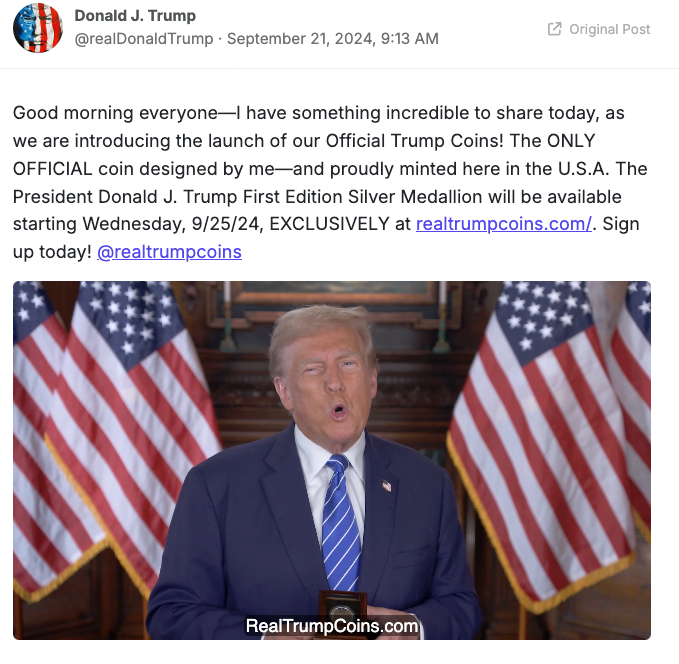
US President Donald Trump promoted the Real Trump Coins brand in September 2024. Source: Truth Social
The GOLD episode adds to scrutiny of Trump-linked crypto ventures as the president pushes Congress to advance legislation that would reshape US oversight of the industry.
Related: Trump cost investors $4.7B through crypto ‘schemes’: Public Citizen
Trump urged lawmakers on Aug. 19 to pass a “fair version” of the CLARITY Act, proposed legislation that would establish a regulatory framework for crypto assets and clarify whether tokens fall under securities or commodities rules.
Trump and his family have backed or launched several crypto ventures, including the Official Trump (TRUMP) memecoin and World Liberty Financial. The ventures have drawn conflict-of-interest concerns as his administration shapes crypto policy, while the White House has denied any impropriety.
Magazine: Who is legally liable when an AI agent goes rogue?
Two U.S. fund filings dated Aug. 27 and Aug. 28 have listed three XRP-linked ETFs, adding fresh evidence of the token’s growing presence across regulated investment products.
Summary
- ProShares’ filing lists its unlevered XRP ETF and the 2x leveraged Ultra XRP ETF.
- Morningstar Funds Trust’s amendment includes a live fund combining S&P 500 stocks with XRP exposure.
- Seven U.S. spot XRP ETFs had attracted $1.57 billion in cumulative inflows by Aug. 24.
- XRP traders face an escrow unlock on Sept. 1 and a Senate procedural vote on Sept. 15.
Two filings submitted to the U.S. Securities and Exchange Commission identify two ProShares products and one Cyber Hornet strategy fund, although neither document represents a new SEC approval.
A Rule 24f-2 notice submitted by ProShares Trust on Aug. 27 names the ProShares XRP ETF under series number S000091571. It also lists the ProShares Ultra XRP ETF, registered as series S000091573 and traded under the ticker UXRP.
Filed under the Investment Company Act, Rule 24f-2 notices concern securities sold by investment companies and the related registration fees. Their appearance in the filing system should not be read as approval of a new product or a ruling on XRP’s regulatory status.
Morningstar Funds Trust filed a separate post-effective amendment on Aug. 28 under Securities Act file number 333-216479. Post-effective amendment No. 15 includes the Cyber Hornet S&P 500 and XRP 75/25 Strategy ETF, which began trading on Jan. 30, 2026.
ProShares XRP ETFs offer two different exposure levels
ProShares placed its two XRP-linked series alongside other crypto funds in the Aug. 27 notice, including its Ultra Solana product and CoinDesk 20 Crypto ETF.
UXRP has traded since July 2025 and seeks twice the daily return of the Bloomberg XRP Index. Rather than holding XRP directly, the fund uses financial contracts, including futures and swaps, to create leveraged exposure.
The fund charges an expense ratio of 1.67%. Market snapshots around Aug. 28 placed its assets under management between $40 million and $55 million, while its net asset value stood near $15.83 after XRP recorded a sharp daily decline.
Daily leverage makes UXRP materially different from an ordinary spot ETF. ProShares states in its fund materials that the product pursues its target for a single trading day, meaning returns over longer periods can depart from twice XRP’s cumulative performance.
Compounding becomes more pronounced when prices swing repeatedly in both directions. As a result, the fund is designed primarily for investors who monitor their positions frequently and understand the risks tied to derivatives and daily resets.
The unlevered ProShares XRP ETF listed under series number S000091571 presents a different case. Although the series appears in the trust filing, several fund-tracking services still label the product as pending rather than available for trading. A series registration alone does not establish that shares have launched or can be purchased through U.S. brokerage accounts.
Cyber Hornet combines S&P 500 stocks with XRP
Morningstar Funds Trust’s amendment provides another form of regulated XRP exposure through the Cyber Hornet S&P 500 and XRP 75/25 Strategy ETF.
Traded under the ticker XXX, the fund seeks to follow an index that assigns about 75% of its exposure to the S&P 500 and about 25% to XRP. The allocation gives investors access to large U.S. companies and the crypto asset through one exchange-listed product.
The fund’s equity holdings include Nvidia, Apple, Microsoft and Amazon, according to its portfolio information. Its XRP-related allocation was approximately 25.7%, while the vehicle reported a net asset value of about $22.08 as of Aug. 27.
Assets under management remained close to $550,000, making the fund small compared with established equity or crypto ETFs. Its size also means it is not a major source of XRP demand, even though its structure shows how U.S. fund managers are placing digital assets inside mixed portfolios.
Exchange notices show that trading began on Jan. 30 alongside Cyber Hornet funds pairing the S&P 500 with Ethereum and Solana. The XRP product uses the S&P 500 and S&P XRP 75/25 Blend Index as its benchmark and rebalances its allocations periodically.
For American investors, the listings provide several routes to XRP exposure without requiring them to manage a crypto wallet. Products now range from spot funds to futures-based vehicles, leveraged ETFs, and funds that combine crypto with U.S. equities. Each structure carries different costs, tax considerations, and risks, and an exchange listing does not remove the possibility of losing principal.
US spot XRP ETFs have drawn $1.57 billion
Demand for the filings sits against a much larger market for spot products. As crypto.news previously reported, seven U.S. spot XRP ETFs had accumulated about $1.57 billion in net inflows by Aug. 24.
Bitwise’s fund led the group with approximately $542 million in cumulative inflows, followed by Canary Capital with about $468 million and Franklin Templeton with $434 million. Trading volume across the seven products reached a record $125 million on Aug. 20.
Goldman Sachs also disclosed $86.5 million of exposure spread across five spot XRP ETFs in its second-quarter regulatory filing. The bank had reported no XRP ETF holdings at the end of the first quarter, according to the report.
Earlier institutional demand was already visible in June, when Bitwise XRP products in the United States and Europe surpassed $200 million in year-to-date inflows. Bitwise chief executive Hunter Horsley disclosed the figure on June 22.
Spot funds hold or obtain exposure to the underlying asset without seeking a multiple of its daily return. UXRP instead uses derivatives to target 200% of the Bloomberg XRP Index’s daily movement, while the Cyber Hornet fund combines XRP exposure with an equity allocation.
XRP leverage raises the risk of sharp liquidations
The addition of fund structures has occurred while leverage has increased in the derivatives market. Binance’s XRP leverage ratio recently reached 0.213, its highest level in seven months, after the token rallied 44%.
XRP futures open interest climbed to roughly $3.4 billion as long positions became crowded. Such positioning can magnify declines because exchanges automatically close leveraged trades when collateral falls below required levels.
A recent XRP market report found that the token had gained about 50% in one week before facing renewed volatility. Spot ETF inflows reached approximately $1.55 billion during the period, while the funds held an estimated 1.5% of XRP’s supply.
XRP traded between about $1.38 and $1.46 heading into the weekend after falling close to $1 earlier in August. The recovery left the token well below its January 2026 cycle high, despite continued ETF inflows.
September brings two XRP market catalysts
Ripple is scheduled to release 1 billion XRP from escrow on Sept. 1 under its programmed monthly process. An escrow release does not mean the entire amount will immediately enter circulation because Ripple has historically returned unused tokens to new escrow contracts.
U.S. lawmakers face another XRP-related event two weeks later. The Senate has scheduled a cloture vote on the Digital Asset Market Clarity Act for Sept. 15, when 60 votes will be required to advance the bill for consideration.
The vote will decide whether the Senate proceeds with debate; it will not determine final passage. Senate leaders would still need to address amendments and hold additional votes if the cloture motion succeeds.
The House passed the CLARITY Act in July 2025, while the Senate Banking Committee advanced its version by a 15-9 vote in May 2026. The proposal would divide oversight of digital assets between the SEC and the Commodity Futures Trading Commission based on how each asset is classified.
Standard Chartered has estimated that clearer U.S. market rules could support another $4 billion to $8 billion of inflows into XRP investment products. The projection depends on legislation providing sufficient certainty for financial institutions and does not represent committed capital.


SpaceX bought Cursor on August 14, and two weeks later, OpenAI is moving to cut the AI coding tool off from its models. Access ends on November 12.
Cursor is one of the most widely used coding assistants among software developers. A $60 billion all-stock deal put it inside Elon Musk’s empire. OpenAI decided that was reason enough to leave.
Why OpenAI Walked Away
OpenAI never said Cursor did anything wrong. Rather, it used a change-of-control clause, meaning a contract term letting one side exit after the other is sold.
The reason it gave is trust, saying that it cannot be sure SpaceX will follow its rules. Specifically, they pointed to two events.
- X (Twitter), the platform Musk bought in 2022 and later folded into SpaceX, broke an earlier OpenAI contract.
- In a California courtroom on April 30, a lawyer asked Musk whether xAI had distilled OpenAI models to train Grok.
Distilling means prompting a rival model over and over to copy what it knows. Musk first said every AI company does it. Pressed again, he conceded that xAI partly had.
He was testifying in his own lawsuit against OpenAI, and a jury dismissed Musk’s case three weeks later for being filed too late.
OpenAI added one more condition. Astra, its next flagship model, will never ship through Cursor.
Cursor Says the Hit Is Small
Michael Truell, a Cursor co-founder now working for SpaceX, put the damage at roughly 5% of user traffic. Talks with OpenAI are still open.
“Cursor was one of the very first users of OpenAI, we’ve worked closely with their team for years, and we’ve trusted their platform to be neutral infrastructure for our business,” Truell expressed.
Elon Musk is likely not to negotiate. In his initial response, he said he “couldn’t care less” and called Altman and OpenAI president Greg Brockman untrustworthy.
Anthropic went the other way. Co-founder Tom Brown said it will add compute so Claude runs better inside Cursor.
“Cursor has been a trusted partner of Anthropic since Sonnet 3.5. We’ll continue to increase compute to support Claude models in Cursor and are excited for what comes next with them at SpaceX,” Brown shared in an early Saturday post.
OpenAI is not defending revenue worth 5% of one customer. It is refusing to sell to Musk at all. Developers have until November 12 to pick a new supplier, and Cursor already routes to SpaceXAI’s Grok models, Claude and Gemini.
The post Sam Altman and Musk’s War Costs Cursor AI After $60B Deal appeared first on BeInCrypto.


The Bank of Russia is building a surveillance apparatus for digital assets at the same time the Russian state relies on those assets to circumvent Western financial restrictions. The contradiction reveals how governments actually think about crypto.
Summary
- The Bank of Russia added 2,600 crypto wallets to a monitoring system used by banks and law enforcement after more than 1 billion rubles flowed into the addresses during the first half of 2026.
- More than 74% of pyramid schemes identified by the regulator used cryptocurrencies to attract funds, down from 84% in 2025 but still the dominant payment channel for financial fraud in Russia.
- Russia simultaneously uses cryptocurrency for international trade settlement to circumvent Western sanctions, with the government legalizing crypto for cross border payments in late 2024 and expanding the framework through 2025 and 2026.
- China, India, and Russia are all building domestic blockchain surveillance infrastructure while encouraging or tolerating cross border crypto settlement, creating a bifurcated system where crypto is monitored internally and weaponized externally.
- The number of entities flagged for illegal financial activity fell 31% from the first half of 2025, but illegal lending doubled over the same period, with some lenders offering loans denominated in USDT at specified exchange rates.
The Bank of Russia published its first half 2026 enforcement data this week, and the headline number, 2,600 crypto wallets flagged for suspected illegal activity, tells one story. The context around that number tells a completely different one.
What the blacklist actually does
The 2,600 wallets were added to an information system that Russian banks and law enforcement agencies use for digital compliance, client risk assessments, and financial investigations. The system does not freeze wallets on chain. It cannot. What it does is flag associated bank accounts, payment processors, and fiat on ramps within the Russian financial system.
When a wallet appears on the list, any Russian bank processing a transaction linked to that address receives an alert. The bank can then apply restrictive measures, which during the first half of 2026 resulted in actions against more than 500 payment details used for illegal financial activity.
The regulator also sends flagged data to law enforcement and the Federal Antimonopoly Service. That led to more than 330 administrative cases during the period. Authorities restricted access to over 11,800 online resources belonging to suspected illegal market participants and pyramid schemes.
The infrastructure is substantial. This is not a token gesture. The Bank of Russia has built a working crypto surveillance system that connects wallet addresses to bank accounts, social media pages, Telegram channels, and website registrations. The 2,600 wallets are the latest additions to a database that has grown steadily since 2024.
The pyramid scheme pattern
The numbers reveal a clear pattern. In 2024, the Bank of Russia identified more than 3,490 entities with characteristics of pyramid schemes. In 2025, more than 4,600 crypto wallets were flagged as receiving payments from pyramid organizers. In the first half of 2026, the wallet count dropped to 2,600 and the entity count to 2,891, a 31% decline.
The decline could reflect either successful enforcement or a shift in methods. The Bank of Russia’s data suggests the latter. Pyramid schemes have not disappeared. They have moved deeper into crypto native infrastructure.
More than 74% of identified pyramid schemes used crypto to attract funds in the first half of 2026, down from 84% in 2025. The remaining schemes used foreign payment services or cash. Organizers operated through more than 940 websites, 120 Telegram channels, and over 2,500 social media pages.
The schemes themselves have evolved. In 2024, the central bank warned that scammers were using meme coins and tap to earn games to attract victims. In 2026, the dominant formats are pseudo investment projects offering exposure to crypto, income from mining operations, or investments in data centers supposedly supplying computing capacity to miners. Some promoted digital tokens said to track gold prices.
The sanctions evasion parallel
This is the section a competitor could not have written, because it requires holding two contradictory Russian state positions in view at the same time.
In late 2024, Russia legalized cryptocurrency for cross border payments. The law allows Russian companies to settle international trade using digital assets, bypassing the SWIFT messaging system and the Western banking infrastructure that implements sanctions. Through 2025 and 2026, the framework expanded, with Russian officials publicly describing crypto as a tool for maintaining trade flows with China, India, Turkey, and the UAE.
At the same time, the Bank of Russia is building an increasingly sophisticated domestic surveillance apparatus for the same technology. The 2,600 wallet blacklist is part of a system that monitors, tracks, and restricts crypto activity within Russia’s borders.
The contradiction is not accidental. It reflects a deliberate policy architecture: crypto is a weapon when pointed outward and a threat when pointed inward. The Russian state wants its exporters to use crypto to sell oil and gas to sanctioned buyers. It does not want its citizens to use crypto to run pyramid schemes, evade taxes, or move capital abroad without state oversight.
This dual use framework is not unique to Russia.
The global surveillance pattern
China banned crypto trading domestically in 2021 but has not prevented Chinese companies from participating in cross border crypto settlement through Hong Kong, which legalized crypto exchanges in 2023. The Chinese government’s blockchain based service network, BSN, operates infrastructure that could support tokenized trade settlement while domestic crypto activity remains illegal.
India imposed a 30% tax on crypto gains and a 1% tax deducted at source on all crypto transactions in 2022, effectively creating a tracking system that gives the government visibility into every domestic crypto trade. At the same time, India participates in Project mBridge, a cross border central bank digital currency initiative that includes China, Thailand, and the UAE, designed to settle international trade without relying on the U.S. dollar.
The pattern is consistent across all three countries. Build surveillance infrastructure domestically. Permit or encourage crypto based settlement internationally. The technology is the same. The regulatory treatment depends entirely on the direction of the money flow.
The USDT lending market
The Bank of Russia’s report revealed an unexpected detail: illegal lenders are now offering loans denominated in Tether’s USDT stablecoin. The number of identified illegal lenders doubled from the first half of 2025, reaching 999 compared with 467 a year earlier.
These services offer borrowers loans in USDT or rubles converted at a specified exchange rate. The borrower receives stablecoins or their ruble equivalent, and repayment terms reference the USDT exchange rate.
The growth in crypto lending outside the regulated system reflects the same dynamic driving the wallet blacklist. Russians want access to dollar denominated financial products. Western sanctions have cut off access to U.S. bank accounts and dollar transfers. USDT provides a synthetic dollar exposure that the formal banking system cannot offer.
The Bank of Russia linked part of the illegal lending increase to tighter requirements for legal lenders, which limited access to borrowing for customers with high debt burdens. By restricting formal credit, the regulator inadvertently expanded demand for crypto denominated alternatives.
The Clarity Act and GENIUS Act context
The U.S. regulatory response to crypto sits at the other end of the spectrum from Russia’s approach, and the comparison is instructive.
The Clarity Act lost its legislative window in August 2026. The GENIUS Act missed its statutory deadline by four months. American regulators are still debating which agency has jurisdiction over crypto, while Russia has already built and deployed a working surveillance system.
The difference is not about capability. The U.S. has more sophisticated financial surveillance infrastructure than Russia. FinCEN, OFAC, and the IRS all monitor crypto transactions. The difference is about coherence. Russia has decided what it wants crypto to do, a tool for sanctions evasion abroad and a monitored asset class at home, and has built infrastructure accordingly. The U.S. has not reached consensus on what crypto is, let alone what it should do, and the regulatory gaps reflect that indecision.
What the 2,600 number means for Western enforcement
Western sanctions enforcement agencies should be reading the Bank of Russia’s report carefully, though not for the reasons the Bank of Russia intended.
The 2,600 wallet blacklist demonstrates that Russia has developed the technical capacity to trace crypto flows, link wallet addresses to real world identities, and connect on chain activity to bank accounts. That same capacity, if applied to outbound flows, would allow the Russian state to monitor and facilitate sanctions evasion with full visibility into the transaction chain.
OFAC has sanctioned hundreds of crypto wallets linked to Russian entities since 2022. But the Bank of Russia’s report suggests that Russia’s own monitoring infrastructure may be more comprehensive than what Western agencies have built. Russia is not just tracking wallets; it is tracking the social media pages, Telegram channels, and websites associated with each flagged entity.
The implication is that Russia’s crypto surveillance is not primarily defensive. It is an intelligence asset that gives the state visibility into both domestic fraud and international capital flows, allowing it to suppress the former and facilitate the latter.
What would prove this analysis wrong
Two developments would undermine the dual use thesis.
First, if Russia restricts crypto for cross border settlement, reversing the 2024 legalization, it would indicate that domestic surveillance concerns have overridden the sanctions evasion utility. Any legislative moves to curtail the cross border framework would signal a shift.
Second, if Western enforcement demonstrates the ability to trace and block Russian crypto based sanctions evasion at scale, the utility of the external channel diminishes. Chainalysis and Elliptic provide tracing capabilities to OFAC, but the question is whether those capabilities can match the volume and sophistication of state facilitated evasion.
What to watch
Bank of Russia second half 2026 report. The trajectory matters more than any single number. If wallet blacklistings accelerate while the entity count continues declining, it means enforcement is shifting from entity level to wallet level surveillance, a more granular and technically sophisticated approach.
Russian cross border settlement volume. Public data is scarce, but estimates from Chainalysis and the Russian central bank’s own disclosures provide directional signals. An increase in reported crypto settlement volumes would confirm that the dual use framework is expanding.
OFAC sanctions on Russian crypto wallets. The frequency and specificity of OFAC designations targeting Russian crypto wallets indicate how much visibility Western agencies have into the flows the Bank of Russia is simultaneously monitoring and facilitating.
China and India surveillance actions. Similar wallet blacklisting or monitoring announcements from the People’s Bank of China or the Reserve Bank of India would confirm that the domestic surveillance plus external settlement pattern is becoming a standard framework among major non Western economies.
USDT lending growth in Russia. If the illegal lending count continues doubling, it would signal that crypto has become the primary channel for credit access outside the formal banking system, making the surveillance task exponentially harder.
What did the Bank of Russia do with the 2,600 wallets?
The Bank of Russia added 2,600 crypto wallet addresses to a monitoring system used by Russian banks and law enforcement for compliance checks and financial investigations. The system flags associated bank accounts and payment processors, enabling banks to restrict transactions linked to those addresses.
Why is Russia blacklisting crypto wallets while using crypto for sanctions evasion?
Russia treats crypto differently depending on the direction of capital flow. Domestic crypto activity is monitored and restricted to prevent fraud, tax evasion, and capital flight. Cross border crypto settlement is facilitated to maintain international trade flows despite Western sanctions.
How many pyramid schemes in Russia use crypto?
More than 74% of pyramid schemes identified by the Bank of Russia in the first half of 2026 used cryptocurrencies to attract funds. The figure was 84% in 2025 and 77% in 2024.
What is USDT lending in Russia?
Illegal lenders in Russia are offering loans denominated in Tether’s USDT stablecoin, providing borrowers with synthetic dollar exposure that the formal banking system cannot offer due to sanctions. The number of identified illegal lenders doubled from the first half of 2025.
Are other countries doing the same thing?
China, India, and Russia all follow a similar pattern: building domestic blockchain surveillance while participating in cross border crypto or digital currency settlement frameworks. Each monitors internal flows while permitting or facilitating external ones.
How does this affect Western sanctions enforcement?
Russia’s crypto surveillance infrastructure demonstrates technical capacity to trace and monitor crypto flows. That same capacity, applied to outbound flows, allows the state to facilitate sanctions evasion with full visibility. Western enforcement agencies face a counterparty that understands the technology at an operational level.
Can the blacklisted wallets still be used?
The blacklist does not freeze wallets on chain. Blockchain transactions are permissionless and cannot be blocked by the Bank of Russia. The restrictions apply only within the Russian banking system, where associated accounts and payment processors can be flagged or blocked.
Is this a sign that crypto regulation is getting stricter globally?
This is educational analysis, not investment advice. Russia’s approach reflects a broader global trend toward domestic crypto surveillance, but each country’s framework is shaped by its specific policy goals. The direction is toward more monitoring, not less, regardless of jurisdiction.
Disclosure: This content is provided by a third party. Neither crypto.news nor the author of this article endorses any product mentioned on this page. Users should conduct their own research before taking any action related to the company.
A research paper published this week quantifies what happens when bank deposits move at blockchain speed. The number is large enough to reshape how banks fund the economy, and the crypto industry is building the pipes without acknowledging the consequences.
Summary
- A research paper published on August 25 found that tokenized deposits could reduce U.S. bank lending capacity by $580 billion if the technology reaches widespread adoption, roughly 5% of total bank lending.
- The mechanism is straightforward: banks lend against stable deposits, and if deposits can move on chain in minutes instead of days, the deposit base becomes less stable, forcing banks to hold more liquid reserves and lend less.
- LayerZero and Keeta launched tokenized bank deposits across Ethereum, Solana, Base, and Keeta in July 2026, covering nine fiat currencies and making the theoretical risk operationally real.
- The Bank of England endorsed tokenized deposits as belonging in UK payments infrastructure, and South Korea began trialing them for government spending, indicating that adoption pressure is coming from regulators, not just startups.
- The $580 billion figure assumes a moderate adoption scenario. The paper’s high adoption model projects a reduction of $1.2 trillion in lending capacity, a number that would force structural changes to how U.S. banks fund mortgages, small business loans, and commercial real estate.
The crypto industry has spent two years building infrastructure to put bank deposits on chain. The banking industry has spent two years worrying about what happens when it works. A new research paper puts a number on the worry, and the number is large enough that both sides should be paying closer attention.
How bank lending actually works
This section requires explaining something that most crypto coverage skips entirely: the mechanics of fractional reserve banking and why deposit stability is the load bearing wall of the entire system.
When a customer deposits $1,000 at a bank, the bank does not keep $1,000 in a vault. It keeps a fraction, typically 3% to 10% depending on the bank’s risk profile and regulatory requirements, and lends the rest. That $900 or $970 goes to a mortgage borrower, a small business, or a commercial real estate developer. The borrower spends it, and the recipient deposits it at another bank, which lends most of that out again. This is the money multiplier, and it is the engine that converts $22 trillion in U.S. bank deposits into $12 trillion in bank lending.
The system works because deposits are sticky. A customer who deposits money on Monday does not withdraw it on Tuesday. The bank can rely on a statistical floor, the amount that will remain regardless of individual withdrawals, and lend against that floor with reasonable confidence.
Regulatory frameworks formalize this assumption. Basel III assigns stability scores to different deposit types. Retail deposits from individuals receive the highest stability weighting because individuals rarely move their entire balance in a single day. Corporate deposits receive lower scores because businesses manage cash more actively. Interbank deposits receive the lowest scores because banks move money constantly.
The Liquidity Coverage Ratio, a core Basel III metric, requires banks to hold enough high quality liquid assets to cover 30 days of net cash outflows under stress. The calculation assumes that retail deposits experience outflows of 3% to 10% over 30 days. Corporate deposits face outflow assumptions of 20% to 40%. These percentages determine how much of each deposit type a bank can lend out.
Tokenized deposits threaten to reclassify every deposit into the highest outflow category, because the technology makes any deposit as mobile as an interbank transfer.
What the paper found
The research paper, published on August 25, modeled three scenarios for tokenized deposit adoption in the U.S. banking system.
In the low adoption scenario, covering 5% to 10% of total deposits, the impact on lending capacity is modest: roughly $120 billion, absorbed through minor adjustments to reserve ratios and overnight funding markets. Banks would barely notice, and the adjustment would be indistinguishable from normal quarter to quarter fluctuations in deposit levels.
In the moderate scenario, covering 15% to 25% of deposits, lending capacity falls by $580 billion. This is the headline number, and it represents a meaningful contraction. To put it in context, $580 billion is roughly the total outstanding balance of U.S. auto loans, or about one third of all outstanding commercial and industrial loans. A contraction of that magnitude would not cause a crisis, but it would tighten credit availability for borrowers at the margin, precisely the small businesses and first time homebuyers who are most rate sensitive.
In the high adoption scenario, covering 35% to 50% of deposits, the reduction reaches $1.2 trillion. At that level, banks would need to fundamentally restructure their funding models, shifting from deposit funded lending to wholesale funding markets, securitization, or Federal Home Loan Bank advances. Each of these alternatives is more expensive than deposits, which means the cost of borrowing rises for everyone. The paper estimates that average mortgage rates could increase by 15 to 30 basis points under the high adoption scenario, and small business loan rates could rise by 25 to 50 basis points.
The speed problem
The critical variable is not how much deposits move, but how fast they move. Traditional bank transfers through ACH take one to three business days. Wire transfers settle within hours but cost $25 to $50 and are typically reserved for large transactions. Neither mechanism threatens deposit stability because the friction creates natural resistance to movement.
Even FedNow, the Federal Reserve’s instant payment system launched in 2023, processes transfers in seconds but imposes transaction limits and operates within the existing banking framework. A FedNow transfer moves money from one bank account to another, but both accounts remain within the banking system. The deposit leaves one bank and arrives at another, preserving the aggregate deposit base.
Tokenized deposits are different. A transfer on Ethereum’s base layer settles in roughly 12 seconds. On Solana, it takes under a second. On a Layer 2 like Base, settlement is near instantaneous for the user, with finality following within minutes. More importantly, the deposit can leave the banking system entirely, moving into DeFi protocols, smart contract escrow, or cross chain bridges where no bank holds the underlying balance.
The paper models the impact of settlement speed directly. At one day settlement, the effect on deposit stability is negligible. At one hour settlement, it becomes measurable. At near instant settlement, which is what blockchain infrastructure provides, the deposit stability models that underpin Basel III capital requirements break down entirely, because the statistical assumptions about how long deposits remain were calibrated for a world where moving money takes days, not seconds.
This is not a theoretical concern. The tokenized deposit infrastructure is already live. LayerZero and Keeta deployed tokenized bank deposits across four chains in July 2026. USBC, Uphold, and Vast Bank launched the first retail tokenized U.S. dollar deposits in late 2025. The pipes exist. The question is how much volume they carry and how quickly that volume grows.
Who is building this and why
The builders fall into three categories, each with different motivations and different risk profiles.
Fintech infrastructure companies like LayerZero and Keeta are building the plumbing. Their business model is transaction fees and protocol revenue. More deposit movement means more revenue. They have no incentive to consider the systemic effects on bank lending because those effects are externalities, costs borne by borrowers and the broader economy while the revenue flows to the infrastructure provider.
LayerZero’s deployment covers nine fiat currencies across four blockchains. Keeta’s architecture allows any bank to issue tokenized deposits on its platform, abstracting the blockchain layer so that depositors interact with a familiar banking interface while their funds exist as on chain tokens. The cross chain interoperability means a deposit tokenized on Ethereum can move to Solana in minutes, a level of fungibility that traditional banking infrastructure cannot match.
Banks themselves are experimenting cautiously. JPMorgan’s Kinexys platform processes tokenized deposit transfers between institutional counterparties. MUFG, SMBC, and Mizuho in Japan are piloting tokenized government bonds settled through tokenized central bank reserves. The Bank of Japan’s sandbox uses tokenized central bank reserves as the settlement asset, which is as close to a central bank digital currency as Japan has come without officially launching one. These pilots are controlled environments with known counterparties and limited scale, but the technology they validate is the same technology that, at scale, could destabilize their own deposit bases.
Regulators are the wild card. The Bank of England explicitly endorsed tokenized deposits as part of UK payments infrastructure. Sarah Breeden, the Bank’s deputy governor for financial stability, said tokenized deposits belong in the UK’s future payments architecture alongside stablecoins and a potential digital pound. South Korea is trialing tokenized deposits for government operational spending. The GENIUS Act’s stablecoin framework implicitly endorses the underlying technology by creating a regulated category for digital dollars that compete with bank deposits for the same customer balances.
Regulators are simultaneously promoting the technology and responsible for managing the systemic risk it creates. The contradiction is not lost on central bankers, but the competitive pressure from China’s digital yuan pilots and the private sector’s first mover advantage leaves regulators feeling that the alternative to managed adoption is unmanaged adoption, which is worse.
The stablecoin connection
Tokenized deposits and stablecoins are often discussed as competitors, but the systemic risk analysis reveals them as complements that amplify the same underlying pressure on bank balance sheets.
Stablecoins like USDC and USDT are backed by Treasury bills, commercial paper, and bank deposits. When a user buys $1,000 of USDC, Circle deposits that $1,000 at a partner bank. The bank lends against it. The deposit is still in the banking system; it has just been intermediated through a stablecoin issuer. Circle’s reserve management acts as a buffer, because Circle does not withdraw its deposits based on individual user redemptions. It manages aggregate flows, smoothing the volatility.
Tokenized deposits cut out the intermediary. When a user holds a tokenized deposit, they hold a direct claim on the bank. There is no stablecoin issuer sitting between the depositor and the bank. That directness is marketed as an advantage, eliminating counterparty risk from the stablecoin issuer, but it also means the depositor can withdraw at blockchain speed without Circle or Tether serving as a shock absorber.
The Revolut stablecoin launch in Europe illustrates the competitive dynamics. Revolut has 50 million users who can now hold euros in a stablecoin form. If those users shift from bank deposits to Revolut’s stablecoin or to tokenized deposits, the net effect on European bank lending capacity follows the same pattern the research paper describes for the U.S.
The combined effect of stablecoins and tokenized deposits is larger than either alone. Stablecoins pull deposits out of the banking system and into reserve managed pools. Tokenized deposits keep deposits in the banking system but make them volatile. Both reduce the stable deposit base that banks use to justify long term lending.
The section a competitor could not write
Every existing analysis of tokenized deposits focuses on either the technology (how they work) or the opportunity (how much faster payments become). This piece examines the second order effect that neither the crypto industry nor the banking industry wants to discuss openly.
The crypto industry does not want to discuss it because acknowledging that tokenized deposits reduce lending capacity undermines the narrative that blockchain technology is purely additive. If putting deposits on chain means fewer mortgages, fewer small business loans, and higher borrowing costs, the political and regulatory response will be hostile. The industry has spent years arguing that crypto creates new financial access. The research paper suggests it could restrict existing access by destabilizing the lending infrastructure that funds the real economy.
The banking industry does not want to discuss it because acknowledging the risk validates the technology’s power. If tokenized deposits are not a threat to deposit stability, there is no reason to oppose them. If they are a threat, it means the technology works exactly as described, moving money faster and more efficiently than legacy rails. That admission attracts more investment, more builders, and faster adoption, accelerating the very dynamic banks fear.
The research paper breaks this silence by quantifying the cost. $580 billion in reduced lending capacity is not an existential threat to the U.S. banking system, but it is large enough to change behavior. Banks would need to raise deposit rates to retain customers, increase wholesale funding at higher cost, or reduce lending to lower risk categories. All three responses have consequences for borrowers who depend on affordable credit.
What the Fed would do
The Federal Reserve has not publicly addressed the research paper’s findings, but the institutional response is predictable based on how the Fed handled previous deposit stability threats, including the money market fund reforms of 2010 and 2014 and the SVB deposit flight crisis of 2023.
If tokenized deposit adoption reaches the moderate scenario, the Fed would likely adjust Liquidity Coverage Ratio requirements to classify tokenized deposits as less stable than traditional deposits, assigning them outflow rates of 40% to 60% instead of the 3% to 10% applied to standard retail deposits. This would increase the amount of high quality liquid assets banks must hold against tokenized deposit balances, effectively pricing in the faster withdrawal risk and reducing the lending capacity impact by forcing banks to hold more reserves from day one.
The Fed could also impose holding period requirements or withdrawal speed limits on tokenized deposits, similar to the gates and fees that money market funds implemented after the 2008 financial crisis and strengthened after the March 2020 liquidity stress. These measures would reduce the systemic risk but would also eliminate the speed advantage that makes tokenized deposits attractive in the first place, potentially killing adoption.
A more creative response would involve the Fed launching its own tokenized settlement system through FedNow or a future central bank digital currency, allowing deposits to move quickly within a system the Fed controls and monitors in real time. This would preserve the speed benefit while keeping the systemic risk management within the central bank’s perimeter.
What would prove this analysis wrong
Three developments would invalidate the $580 billion projection.
First, if tokenized deposits adopt voluntary speed limits, settling in hours instead of seconds, the deposit stability impact drops sharply. Some implementations already include programmable settlement delays that can be configured by the issuing bank. If these become standard, the paper’s extreme speed scenarios do not materialize, and the impact reverts to the low adoption model even at higher volume.
Second, if banks create new lending products specifically designed for volatile deposit bases, the lending capacity reduction could be offset. Variable rate loans that reprice in real time, for example, would match asset duration to the shorter deposit duration, preserving lending volume at the cost of transferring interest rate risk to borrowers. Overnight repo style lending, already common in institutional markets, could expand to consumer credit.
Third, if adoption stalls below 10% of total deposits, the low scenario applies and the impact is within the range that existing capital buffers can absorb without behavioral changes. Adoption is not guaranteed to reach the moderate scenario, and the friction of opening tokenized deposit accounts may limit uptake to technologically sophisticated users who represent a small fraction of total deposits.
What to watch
LayerZero and Keeta transaction volume. These platforms provide the clearest real time signal of how fast tokenized deposit adoption is growing. Monthly volume crossing $10 billion would put the system in the low adoption scenario. $100 billion would approach moderate.
Fed commentary on deposit stability. Any mention of tokenized deposits in Federal Reserve speeches, meeting minutes, or Financial Stability Reports would signal that the $580 billion scenario has entered the regulatory conversation. Watch the November 2026 Financial Stability Report specifically.
Basel Committee updates. The Basel Committee on Banking Supervision reviews capital requirements for digital assets periodically. A reclassification of tokenized deposits in the liquidity coverage ratio framework would be the first regulatory acknowledgment of the speed risk at the global standard setting level.
Bank deposit rate movements. If major U.S. banks begin raising deposit rates in markets where tokenized deposit alternatives are available, it would confirm that deposit competition is already affecting bank behavior, even before adoption reaches the paper’s moderate scenario.
Central bank digital currency timelines. A Fed CBDC or expanded FedNow tokenized settlement system would provide a government controlled alternative to private tokenized deposits, potentially capping adoption of private solutions at a level below the paper’s risk thresholds.
What are tokenized deposits?
Tokenized deposits are bank deposits represented as digital tokens on a blockchain. They give the depositor a direct claim on the issuing bank, the same as a traditional deposit, but allow transfers at blockchain speed instead of through traditional banking rails like ACH or wire transfers.
How could tokenized deposits reduce bank lending?
Banks lend against stable deposits, relying on statistical models that assume most depositors will not withdraw their money on any given day. If deposits can move in seconds instead of days, the deposit base becomes less predictable. Banks must hold more liquid reserves to cover faster potential withdrawals, leaving less capital available for loans.
How much lending could be affected?
A research paper published August 25, 2026, projects that moderate adoption of tokenized deposits could reduce U.S. bank lending capacity by $580 billion, roughly the total outstanding balance of U.S. auto loans. High adoption could reduce it by $1.2 trillion.
Are tokenized deposits the same as stablecoins?
No. Stablecoins are issued by non bank entities like Circle or Tether and backed by reserves including Treasury bills and bank deposits. Tokenized deposits are issued by banks and represent a direct deposit claim. Stablecoins add an intermediary between the depositor and the bank. Tokenized deposits remove it, giving the depositor direct access to withdraw at blockchain speed.
Which banks are experimenting with tokenized deposits?
JPMorgan runs Kinexys for institutional tokenized transfers. In Japan, MUFG, SMBC, and Mizuho are piloting tokenized government bonds settled through tokenized central bank reserves. Vast Bank in the U.S. launched the first retail tokenized dollar deposits in late 2025. LayerZero and Keeta deployed multi chain infrastructure covering nine fiat currencies in July 2026.
Would the Federal Reserve intervene?
The Fed has not publicly addressed the research. Based on precedent from money market fund reforms and the SVB crisis response, the Fed would likely adjust liquidity requirements, impose settlement speed limits, or launch its own tokenized settlement system if adoption reaches levels that threaten deposit stability.
How fast can tokenized deposits move?
On Ethereum, settlement takes roughly 12 seconds. On Solana, under one second. On Layer 2 networks like Base, near instantly from the user’s perspective. This speed, compared to one to three business days for ACH transfers, is what makes tokenized deposits both attractive as a product and risky as a systemic factor.
Should I be concerned about tokenized deposits?
This is educational analysis, not investment advice. Tokenized deposits offer faster payments and broader access to banking services. The systemic risk to bank lending is real but depends on adoption rates that remain uncertain. The technology is in early deployment, and regulatory responses will shape outcomes significantly over the next two to three years.
Disclosure: This content is provided by a third party. Neither crypto.news nor the author of this article endorses any product mentioned on this page. Users should conduct their own research before taking any action related to the company.


Eight years after the ICO boom, the regulator is offering a path that the market already abandoned. The capital it is trying to regulate now flows through channels the proposal does not touch.
Summary
- The SEC proposed a framework allowing crypto projects to raise up to $75 million annually through public token sales without full securities registration, using an expanded version of existing Regulation A+ exemptions.
- The proposal arrives roughly eight years after the 2017 to 2018 ICO wave that prompted it, during which projects raised over $20 billion through unregistered token sales before the SEC began systematic enforcement.
- In 2026, capital formation in crypto has shifted almost entirely to mechanisms the proposal does not cover: meme coin launchpads, airdrops, points programs, liquid token listings, and venture rounds with simple agreements for future tokens.
- Pump.fun posted its second highest revenue day in history during the same week the SEC published the proposal, generating more capital formation in 24 hours than most ICOs raised in their entire campaigns.
- The framework requires audited financials, ongoing reporting, and a two year pathway to full registration, requirements that would disqualify the vast majority of projects currently raising capital in the crypto market.
The SEC spent nearly a decade deciding how to let crypto projects raise money legally. By the time it published the answer, the industry had moved on without it. The proposal is technically sound, institutionally rational, and almost certainly irrelevant to the market it claims to serve.
What the proposal actually says
The framework extends Regulation A+, an existing exemption that lets small companies raise up to $75 million per year from the public with lighter disclosure requirements than a full S-1 registration. The SEC’s crypto specific version adds provisions for token specific risks, smart contract audits, and wallet custody disclosures.
Projects using the framework would file a Form 1-A offering circular with the SEC, provide audited financial statements, and submit to ongoing reporting requirements including semiannual updates and current event disclosures. After two years of compliant reporting, the project would transition to full registration under the Securities Exchange Act.
The $75 million ceiling is per issuer per year. Secondary trading would be permitted on registered alternative trading systems, though no major crypto exchange currently operates as one. The proposal explicitly excludes tokens that function solely as payment mechanisms or governance tokens with no expectation of profit, categories that encompass a significant portion of the tokens actually being traded.
The filing process itself is not trivial. Form 1-A requires detailed disclosure of the project’s business plan, the team’s background, use of proceeds, risk factors, and the specific rights the token confers. The SEC reviews each filing before qualification, a process that typically takes three to six months for traditional Reg A+ offerings. For a crypto project operating in a market where narratives shift weekly and opportunities close in days, a six month review period is effectively a death sentence.
Why the timing matters
The ICO boom peaked in January 2018, when projects were raising hundreds of millions through white papers and Ethereum smart contracts. EOS raised $4.1 billion. Telegram raised $1.7 billion. Filecoin raised $257 million in thirty minutes. The total exceeded $20 billion across 2017 and 2018, with virtually none of it passing through a regulatory framework.
The SEC responded with enforcement, not rulemaking. Between 2018 and 2025, the agency brought over 100 enforcement actions against token issuers, settlements that collectively extracted billions in penalties. EOS paid $24 million. Telegram returned $1.2 billion and paid an $18.5 million penalty. Block.one, Kik, LBRY, Ripple, and dozens of smaller projects went through multi year legal battles that established through litigation what the SEC could have established through clear rules at the outset.
The enforcement first approach created a regulatory desert. Projects that wanted to raise capital legally had no clear path. Projects that raised capital illegally faced enforcement risk years after the sale, when the money was already spent and the team had often dissolved. Neither outcome served investors.
The Clarity Act lost its legislative window in August 2026, with Polymarket odds on passage collapsing from 82% to 16%. The GENIUS Act missed its statutory deadline by four months. In the absence of legislation, the SEC is now writing the rules that Congress could not pass.
That sequence matters because it reveals the proposal’s actual function. This is not a growth initiative designed to encourage crypto capital formation. It is a regulatory land grab, an attempt to establish SEC jurisdiction over token issuance before another agency or legislative framework takes the territory.
How capital actually forms in crypto now
This is the section a competitor could not have written, because it requires mapping the full landscape of how projects raise money in 2026 and comparing it against what the SEC’s framework would cover.
Meme coin launchpads. Pump.fun on Solana generated its second highest revenue day in history during the same week the SEC published its proposal. The platform lets anyone create and launch a token in minutes, with capital flowing through bonding curves that price tokens algorithmically. No white paper, no team disclosure, no audited financials. The new Solana meme token $fone reached a $35 million market capitalization on its debut day. None of this activity would fit within the SEC’s framework because meme tokens explicitly disclaim any profit expectation tied to the efforts of the issuer.
The scale of launchpad activity dwarfs anything Reg A+ has produced. Pump.fun and competing platforms processed tens of thousands of token launches per month through 2025 and 2026. Four.Meme on BNB Chain briefly flipped Pump.fun in daily revenue, demonstrating that the model replicates across chains. The total capital flowing through these platforms on a monthly basis exceeds what Regulation A+ has facilitated in its entire eleven year history across all asset classes.
Airdrops and points programs. Projects like Hyperliquid, which hit an all time high above $86 this week, distributed tokens through activity based airdrops that reward users for trading on the platform. The user receives tokens for past behavior, not in exchange for capital. The SEC’s framework governs sales, not distributions, leaving the fastest growing capital formation mechanism untouched.
The airdrop model has become the dominant go to market strategy for new protocols. Blur, Eigen, Ethena, Jupiter, and dozens of other projects used points programs that converted to token distributions. The total value distributed through airdrops in 2025 alone exceeded $10 billion, more than the annual Reg A+ ceiling of $75 million by a factor of 130.
Venture rounds with SAFTs. Serious infrastructure projects still raise through Simple Agreements for Future Tokens, private placement instruments sold to accredited investors under Regulation D. These rounds are already legal, already common, and do not need a new public offering framework. The $75 million Reg A+ path offers nothing that a $50 million Reg D round does not, except more paperwork, more SEC oversight, and a longer timeline.
Venture funding in crypto totaled approximately $13.7 billion in 2025 and is on pace for a similar number in 2026, according to Galaxy Research. Virtually all of it flows through Reg D exemptions or offshore structures. The projects that need capital have already found it. The SEC’s proposal offers a slower, more expensive alternative to channels that work perfectly well.
Liquid token listings. Many projects skip fundraising entirely and launch tokens directly on decentralized exchanges, establishing price discovery through liquidity pools on Uniswap, Raydium, or Orca. The listing is permissionless. The capital comes from traders, not investors, and the distinction matters legally even if it does not matter economically.
The compliance arithmetic
The proposal requires audited financial statements. For a crypto startup, an audit from a firm willing to opine on a token project costs between $150,000 and $500,000 annually. The major accounting firms, Deloitte, PwC, EY, and KPMG, have been selective about crypto audit engagements, leaving most projects reliant on smaller firms with limited blockchain expertise.
The Form 1-A filing itself requires legal counsel familiar with both securities law and token mechanics. Specialized crypto securities attorneys charge $500 to $1,200 per hour. A complete Reg A+ filing, including the offering circular, legal opinion, and SEC review process, costs between $200,000 and $500,000 in legal fees alone.
Add ongoing reporting requirements, including semiannual updates, current event disclosures, and eventually full Exchange Act reporting after two years, and a project using this framework would spend roughly $400,000 to $1,000,000 annually on compliance before writing a line of code.
For a project raising $75 million, those costs represent 0.5% to 1.3% of the raise, which is manageable. But the projects raising $75 million are already doing it through Reg D private placements that cost a fraction as much and impose fewer ongoing obligations. The projects that would benefit most from a public offering path, early stage teams with limited capital who want to sell tokens to retail investors, are precisely the ones that cannot afford the compliance burden.
The two year pathway to full registration creates an additional deterrent. A project that files under Reg A+ in 2027 would face full Exchange Act reporting requirements by 2029, including quarterly filings, annual reports, proxy statements, and insider trading restrictions. In an industry where the average project lifespan is measured in months and the median token loses 80% of its value within a year of launch, committing to four years of SEC oversight is a bet that few founders would take voluntarily.
Who actually benefits
The proposal serves three constituencies, none of which are the crypto native projects it appears to target.
First, traditional financial institutions that want to issue tokenized securities. Banks, asset managers, and broker dealers already have compliance infrastructure, audit relationships, and legal teams. For them, a Reg A+ token offering is a minor extension of existing operations. JPMorgan’s Kinexys platform, Goldman Sachs’ tokenized money market fund, and Franklin Templeton’s on chain treasury fund could all issue tokens under this framework without materially changing their cost structure. The proposal essentially codifies what they were already planning to do.
Second, the SEC itself. By establishing a regulatory pathway that requires filing, disclosure, and eventual full registration, the agency creates jurisdiction over a category of assets that courts have inconsistently classified. Every project that files under this framework validates the SEC’s authority over tokens, regardless of whether the framework generates meaningful adoption. Institutional turf in Washington is measured by the number of entities under your jurisdiction, and this proposal expands the SEC’s count.
Third, compliance service providers. Law firms, audit firms, and registered transfer agents would gain a new revenue stream from token issuers navigating the framework. The Revolut stablecoin launch and similar institutional entries into crypto have already expanded demand for crypto compliance services. The Reg A+ framework would extend that demand further, creating a recurring revenue base for firms that specialize in SEC filings.
The precedent problem
Regulation A+ has existed since 2015 under the JOBS Act Title IV. In its traditional form, it has been used by roughly 800 companies, raising a collective $8 billion over eleven years. The vast majority of those offerings were for small companies in real estate, cannabis, and consumer products. Very few raised the full $75 million, with the median raise closer to $5 million to $15 million.
By comparison, crypto projects raised $7.5 billion through token sales in 2024 alone, according to CoinGecko data, almost none of it through SEC regulated channels. The entire eleven year output of Reg A+ across all industries barely exceeds what crypto raised in a single year through unregulated mechanisms.
The adoption rate tells the story. Even in traditional capital markets, Reg A+ is a niche product used by companies that are too small for an IPO and too retail focused for pure Reg D. IPOs, Reg D private placements, direct listings, and SPACs handle the overwhelming majority of capital formation. There is no reason to expect crypto’s adoption rate to exceed the traditional market’s, and several reasons to expect it to be lower, including the availability of permissionless alternatives that do not exist in traditional finance.
The $TRUMP token comparison
The $TRUMP meme coin raised more capital through trading activity in its first week than most Reg A+ offerings raise in their entire campaign. It did so without an offering circular, without audited financials, and without any interaction with the SEC’s filing system.
The comparison is not entirely fair. The $TRUMP token and the thousands of meme coins launched daily on platforms like Pump.fun are overwhelmingly speculative, short lived, and carry no pretense of building anything. But that is precisely the point. The SEC’s proposal addresses a category of activity, legitimate projects seeking to raise capital from the public with proper disclosure, that has already been abandoned by the market in favor of mechanisms that operate entirely outside the regulatory perimeter.
The market has voted, and it voted for speed over safety, permissionlessness over process, and memes over fundamentals. Whether that is good for investors is debatable. Whether the SEC’s proposal changes it is not.
What would prove this analysis wrong
Two scenarios would make the SEC’s proposal relevant.
First, if a major crypto project, one with a recognized brand and significant user base, files under the framework and raises a full $75 million, it would validate the pathway as a real alternative to Reg D and offshore token sales. The first successful filing would create precedent and potentially attract followers who see regulatory clarity as a competitive advantage in serving institutional capital.
Second, if the SEC begins enforcing against airdrops, points programs, and launchpad mechanisms, projects currently using those channels would need a legal alternative. The Reg A+ framework would become relevant not because it is attractive, but because everything else is blocked. The SEC has shown willingness to expand its enforcement scope in the past, and a future where meme coin launchpads face enforcement risk is not implausible.
A third possibility is that foreign regulators adopt similar frameworks that require reciprocal compliance for U.S. market access. If the EU, UK, or Singapore require Reg A+ equivalent disclosures for tokens sold to their citizens, projects targeting global audiences would face compliance pressure from multiple jurisdictions simultaneously.
What to watch
Filing activity in the first 90 days. The comment period runs through November 2026. If no project files a Form 1-A within three months of the final rule, the framework is effectively dead on arrival. Watch for announcements from tokenized securities platforms or institutional issuers as the likely first movers.
SEC enforcement against airdrops and launchpads. Any enforcement action against a major airdrop campaign or meme coin launchpad would immediately change the calculus for projects choosing between regulated and unregulated capital formation. The proposal becomes important only if the alternatives become dangerous.
Congressional response. If the Clarity Act or a similar bill revives in the next session, it could preempt the SEC’s framework entirely. Legislative activity in the first quarter of 2027 will determine whether the Reg A+ pathway has a future or becomes another abandoned regulatory experiment.
Institutional adoption of tokenized securities. Banks and asset managers issuing tokenized bonds, funds, or equity under this framework would generate volume even if crypto native projects ignore it. Watch for filings from Goldman Sachs, JPMorgan, or BlackRock affiliates as the bellwether for institutional interest.
Pump.fun and launchpad revenue trends. If launchpad revenue declines due to market conditions or regulatory pressure, the pool of capital seeking a home grows, and regulated pathways become more attractive by default. Conversely, if launchpad volume keeps growing, the SEC’s framework becomes increasingly irrelevant.
What is the SEC’s new crypto token sale proposal?
The SEC proposed allowing crypto projects to raise up to $75 million annually through public token sales using an expanded Regulation A+ exemption. Projects would file disclosure documents, provide audited financials, and transition to full SEC registration after two years of compliant reporting.
How much can crypto projects raise under this framework?
The ceiling is $75 million per issuer per year. Secondary trading would be permitted on registered alternative trading systems. The filing and review process typically takes three to six months.
Why is the SEC proposing this now?
Congress failed to pass comprehensive crypto legislation. The Clarity Act lost its window and the GENIUS Act missed its deadline. The SEC is writing rules through its existing regulatory authority because the legislative path is blocked, establishing jurisdiction before another agency takes the territory.
How does this compare to how crypto projects actually raise money?
Most crypto capital formation in 2026 happens through meme coin launchpads, airdrops, points programs, and venture rounds using SAFTs under Regulation D. None of these mechanisms would be covered by the SEC’s proposal. Airdrops alone distributed more than $10 billion in 2025.
What does the proposal cost to comply with?
Audited financials, legal review, Form 1-A filing, and ongoing reporting cost an estimated $400,000 to $1,000,000 annually. Projects raising $75 million can absorb this. Early stage teams raising smaller amounts face compliance costs that consume a disproportionate share of their raise.
Will meme coin launchpads be affected?
Not directly. Meme tokens typically disclaim any profit expectation tied to the issuer’s efforts, placing them outside the securities framework. The proposal governs sales of tokens with investment characteristics, not speculative trading tokens launched on permissionless platforms.
Who would actually use this framework?
Traditional financial institutions issuing tokenized securities are the most likely adopters. Banks, asset managers, and broker dealers already have the compliance infrastructure, audit relationships, and legal teams to absorb the requirements. Crypto native projects have cheaper, faster, and less restrictive alternatives available.
Is this good or bad for the crypto market?
This is educational analysis, not investment advice. The framework provides a legal pathway that did not previously exist, which is structurally positive for projects that want regulatory certainty. Whether it generates meaningful adoption depends on enforcement activity against unregulated alternatives and the willingness of established institutions to issue tokens through SEC channels.
Disclosure: This content is provided by a third party. Neither crypto.news nor the author of this article endorses any product mentioned on this page. Users should conduct their own research before taking any action related to the company.

Iran could resume attacks on U.S. bases, radar systems, and other facilities that support maritime surveillance and command-and-control systems that help protect and coordinate shipping through the Strait. More dangerous still, it could attempt to strike U.S. naval vessels directly. Iran is believed to possess anti-ship missiles that, at least on paper, can threaten American warships operating in and around the Persian Gulf. The harder problem is locating and tracking moving targets with sufficient precision, why is why better intelligence, including potentially from partners such as Russia or China, could become an important variable.
So far, Tehran has generally had strong reasons to avoid inflicting large numbers of American casualties, which could trigger a much larger U.S. campaign against Iran’s military and civilian infrastructure. But that restraint depends on Iranian leaders continuing to believe that avoiding such a confrontation leaves them better off. If they conclude instead that prolonged blockade and economic pressure are steadily worsening their position, the threshold for taking that risk could fall. Tehran has already warned that major U.S. attacks on Iranian energy or civilian infrastructure would be met with strikes against comparable infrastructure across the region, potentially widening the confrontation well beyond Hormuz.

The issue extends well beyond parents and children. Similar patterns appear in marriages and among siblings, friendships, and other close bonds. Therapists have become too quick to support ending difficult relationships instead of helping people develop the skills to repair them.
In reality, walking away from another person often solves one problem while creating others. Increasingly, my practice sees clients who have ended relationships that took a lifetime to build. The immediate conflict may be gone, but so is the connection. Many become lonelier and less equipped to navigate conflict, disappointment, and repair elsewhere.
Tragically, many who end contact with loved ones also become more distressed in the long run, since close relationships are a foundation of mental health. Maintaining social connection is a form of “fitness” that requires ongoing cultivation. Even when strained or difficult, human bonds provide belonging, support, identity, and resilience. That may matter more now than ever, as many meaningful in-person social interactions are dwindling in the face of digital alternatives.

Jimmysstar primed for Memsie Stakes return in 2026

Soundcore Liberty 5 Pro Review: Master of Phone Calls

Defendants sentenced recently at York Magistrates Court





-

 Crypto World3 days ago
SpaceX stock could rise 75% to $240, JPMorgan says
-

 Crypto World1 day ago
Bitcoin’s 22% rally now needs real demand to outlast Treasury liquidity boost
-

 Business7 days ago
Musk’s Tesla, SpaceX Confirm $16.8 Billion ‘Terafab’ Chip Plant as World’s Largest Building in Texas
-

 Fashion18 hours ago
Weekend Open Thread: Maeve – Corporette.com
-

 Crypto World4 days ago
A $30 Billion AI Fund Implodes, Now the SEC Is Investigating Wall Street’s Role
-

 Crypto World3 days ago
Warsh Jackson Hole keynote puts financial innovation first
-

 Business1 day ago
Salesforce Stock Soars 19% as Blowout Earnings and Agentforce AI Growth Silence Software Skeptics
-

 Politics7 days ago
6 months on, Irish renters crushed by effects of government housing bill
-

 Crypto World3 days ago
Did Trump Just Move SpaceX Stock With One Truth Social Post?
-

 Business6 days ago
Mystery AI Model ‘Ox Alpha’ Draws Developers With Free Access as Chinese Lab Origins Remain Debated
-

 Business3 days ago
Walmart takes aim at younger shoppers with new fashion brand
-
 NewsBeat3 days ago
Lindsay Clancy jury braces for closing arguments as judge tells court: ‘You’ve heard all the evidence’ – Live updates
-

 Business5 days ago
Moderna CEO warns China is pouring state money into mRNA technology
-

 Business5 days ago
NVIDIA Stock Drops Nearly 2 Percent to $210 on Seventh Losing Day Ahead of Critical AI Earnings
-

 Crypto World2 days ago
Elon Musk Grok Bot Promise: We Will Make You Whole if AI Loses Your Money
-

 Crypto World2 days ago
NVIDIA revenue hits $96.2B as AI demand doubles
-

 Business19 hours ago
iPhone 18 Pro Pre-Orders Could Shift to Saturday as Apple Reportedly Avoids September 11 Anniversary
-
 Crypto World5 days ago
$92 Billion Nvidia Earnings Could Make or Break the AI Trade
-

 Business3 days ago
Thailand’s Eastern Economic Corridor Capital City (EECiti): Key Developments and Investment Opportunities
-

 Business6 days ago
Where Will Kevin Durant Play in 2027? Rockets Hold Player Option Key to His Future With Houston via Deal
You must be logged in to post a comment Login