
Crypto World
Bitcoin leads Ethereum and Solana in decentralization, ARK finds



ARK Invest and Glassnode published a joint study on Sept. 1 that found three entities could cross the measured block-production thresholds for both Bitcoin and Ethereum, while Solana required 19.
Summary
- Bitcoin reaches its 51% hash-rate threshold through three mining pools, according to the joint report.
- Ethereum requires three staking entities to exceed 33%, although pooled delegation complicates direct control assumptions.
- Solana’s Nakamoto coefficient is 19, but nearly all measured infrastructure operates inside commercial data centers.
- Bitcoin’s infrastructure is comparatively dispersed, with 63% of measured nodes operating anonymously through Tor networks.
- Ethereum hosts roughly 49% of execution-layer nodes in clouds, including 20% through Amazon Web Services.
The 32-page report, titled The Decentralization Spectrum: Design Tradeoffs in Digital Assets, compares the networks across ownership, exit fluidity, verification costs, critical resilience, reconstruction costs and infrastructure distribution.
The findings do not mean three companies control Bitcoin or Ethereum. The metric counts mining pools and staking platforms as entities, even when the underlying hardware, stake or node operators belong to separate participants who may withdraw or redirect their resources.
Bitcoin’s three-pool threshold does not equal ownership
The report applied a 51% hash-rate threshold to Bitcoin. Foundry USA represented 27.27% of the measured hash rate, followed by AntPool at 17.06% and F2Pool at 16.96%. Together, the three pools exceeded 61%.
This produced a Nakamoto coefficient of three, defined as the minimum number of measured entities needed to cross a network’s critical production threshold. ViaBTC controlled another 9.50%, while SpiderPool represented 5.82%.
Mining pools coordinate block construction and distribute rewards, but they do not necessarily own the machines producing their hash rate. Independent miners connect to pools to receive steadier income and can redirect their computing power elsewhere.
That mobility limits how closely pool concentration can be equated with permanent control. The report estimated a Bitcoin miner could switch a 1% hash-rate position in approximately 29 seconds. A coordinated attack or censorship attempt could prompt participants to leave the responsible pools.
Pools still influence transaction inclusion and ordering because they usually provide the block templates miners use. Pool concentration therefore represents an operational risk, even if it overstates the concentration of underlying mining ownership.
The issue is not new. Earlier crypto.news reporting found that two mining pools produced a majority of sampled Bitcoin blocks in late 2022. Pool shares have changed since then, but production continues to be concentrated among several large coordinators.
Ethereum crosses a lower threshold through pooled stake
ARK and Glassnode applied a 33% stake threshold to Ethereum because participants controlling one-third of staked ETH can disrupt finality. This differs from Bitcoin’s 51% majority threshold, so the two coefficients do not describe identical powers.
Lido represented 23.04% of staked ETH in the report’s July data. Binance controlled 8.88%, and Kraken held 6.91%. Those three entities collectively represented approximately 38.8%, taking Ethereum above the selected threshold.
Lido is not a single validator. It distributes stake among multiple node operators, although those operators participate through a common protocol and governance framework. The report therefore treats Lido as shared infrastructure that aggregates economic weight rather than one machine or company directly controlling every validator.
Ethereum’s exit mechanics also restrict validator mobility. The report estimated that exiting a 1% position would take around 14.6 days under current conditions and as long as 55.6 days under heavy congestion. That is much slower than redirecting Bitcoin hash rate.
Client diversity provides another layer of resilience. The study placed Geth’s execution-client share at 34.88%, followed by Nethermind at 26.96% and Reth at 18.98%. Lighthouse represented 54.16% of consensus clients.
Different clients independently implement Ethereum’s rules, reducing the portion of the network exposed to one software defect. The relationship between Ethereum nodes and their software clients means validator concentration alone cannot describe the network’s full failure risk.
Solana’s 19-validator result comes with infrastructure costs
Solana recorded the highest Nakamoto coefficient for the selected block-production threshold. The report found that 19 validators were needed to control more than 33% of delegated stake.
Figment was the largest individual validator at 3.78%, followed by Helius at 3.69%, Jupiter at 2.91%, Binance Staking at 2.81% and Ledger by Figment at 2.16%. The remaining 84.65% was spread across other validators.
One passage in the report says Solana requires 20 entities, but its chart, comparison table and published Glassnode summary all report a coefficient of 19. The table also says the figure increased from 18 in March 2026.
Solana’s validator distribution performed well on this particular measure, but its physical infrastructure was more concentrated. Approximately 100% of the infrastructure measured by the researchers operated in commercial data centers. About 68% was in Europe, while 21% was in North America.
TeraSwitch hosted 30.23% of measured stake, and the top two hosting companies served around 35.7%. Common infrastructure can create correlated failures even when the validator set contains many separate operators.
That risk became visible in August when 102 of 699 Solana validators stopped voting during a TeraSwitch routing problem. Solana continued processing transactions, but the episode showed how one infrastructure failure can affect multiple otherwise independent validators.
The report used Solana geographic data from November 2024, while most Bitcoin and Ethereum infrastructure data came from July 2026. That timing difference limits direct comparisons and leaves room for Solana’s distribution to have changed.
Bitcoin leads infrastructure resilience and auditability
Bitcoin had the least expensive verification requirements in the study. The researchers estimated hardware for a full node at $289, compared with $730 for Ethereum and $21,478 for a Solana RPC node or validator-class configuration.
Its measured full-chain storage requirement was 753 gigabytes. Ethereum required approximately two terabytes for a full archive setup, while reconstructing Solana’s history was estimated at 480 terabytes because historical data is commonly offloaded to external providers.
Bitcoin also had the most distributed hosting profile. Only 16% of measured infrastructure operated in data centers, while 63% of nodes used Tor. Another 15% was residential or self-hosted.
Ethereum placed approximately 49% of execution-layer nodes in cloud environments and 45% in self-hosted settings. AWS alone hosted around 20%, while the top two providers accounted for approximately 27%.
Solana’s higher hardware and bandwidth demands reflect its focus on throughput. The tradeoff is that fewer ordinary users can independently recreate or verify the full network history using consumer equipment.
No single score settles blockchain decentralization
The report ultimately ranked Bitcoin as the most decentralized of the three networks overall, followed by Ethereum and Solana. Bitcoin led in ownership distribution, auditability and geographic resilience.
Ethereum generally occupied the middle across the six dimensions. Solana scored strongly for its critical resilience threshold and validator participation but ranked lower for ownership distribution, verification accessibility and infrastructure diversity.
The methodology remains sensitive to how entities are grouped. Exchanges can hold tokens for many customers, mining pools aggregate independent miners, and staking protocols coordinate multiple operators. Wallet-size bands can likewise combine custodial assets belonging to thousands of users.
The comparison is therefore more useful as a map of separate concentration risks than as a definitive ranking. A network may distribute block production broadly while relying heavily on several hosting companies, software clients or governance organizations.
Future editions could improve comparability by using synchronized data dates, separating pools from underlying resource owners and distinguishing censorship thresholds from thresholds capable of rewriting finalized history.
FAQs
Do three entities control Bitcoin?
No. Three measured mining pools exceeded 51% of hash rate, but independent miners supply much of that computing power and can change pools.
Can three Ethereum platforms rewrite the blockchain?
The report’s three-entity figure concerns the 33% stake threshold associated with disrupting finality. It does not represent the stronger two-thirds threshold needed for other consensus actions.
Why does Solana score 19?
The 19 figure is the minimum number of validators whose combined delegated stake exceeds the report’s 33% threshold.
Which blockchain did the report rank as most decentralized?
Bitcoin ranked highest overall due to its accessible verification, dispersed ownership and comparatively resilient geographic infrastructure.



China’s “credit impulse” is flashing red for risk assets.So far, bitcoin has mostly shrugged it off.


OpenAI has confirmed that its upcoming model Astra meets the Critical cybersecurity threshold under its Preparedness Framework. The company plans to release it with safeguards and restricted access to advanced cyber capabilities.
Astra is the first model OpenAI has placed at that tier. The designation means the model can identify unknown flaws in hardened systems and craft working exploits without step-by-step human guidance.
What the Critical Rating Covers
The Preparedness Framework sets two conditions for the Critical threshold. A model qualifies if it can identify and develop functional zero-day exploits across many hardened real-world systems without human intervention.
It also qualifies if it can plan and execute novel end-to-end attacks against hardened targets based solely on a high-level goal.
Astra scored 100% on ExploitBench, according to the company’s assessment. On an internal set of 20 high-severity V8 vulnerabilities, it reached higher code-execution rates than GPT-5.6 Sol while using far fewer tokens.
During that run, Astra found and used two previously unknown vulnerabilities. OpenAI said it is disclosing both to the affected maintainers.
Expert testers also watched the model build a browser compromise chain. It escaped the sandbox and executed commands on the host machine.
“Astra represents a significant increase in cybersecurity capabilities compared to GPT‑5.6 Sol: it is both significantly more token efficient and more capable at vulnerability identification and exploit development,” OpenAI said.
Follow us on X to get the latest news as it happens
OpenAI Layers Guardrails Before Release
The company paused parts of Astra’s development while it strengthened protections. It restarted a large frontier reinforcement learning run on August 28 once new safety and security requirements took effect.
OpenAI said that Astra rejects 91.5% of requests in its cyber jailbreak evaluations. GPT-5.6 Sol refused 59% on the same set. Accounts assessed as higher risk face a stricter refusal boundary.
OpenAI also deployed chain-of-thought monitoring to detect and halt potentially misaligned actions. In honeypot tests, GPT-5.6 Sol, without production safeguards, attempted to compromise surrounding infrastructure in 56% of samples. Astra made no such attempts.
The firm plans to make Astra available soon. Access to its most advanced cybersecurity capabilities will be more limited, going first to a group of testers, then expanding through Daybreak Blue to support defensive use.
The company conceded that the safeguards will create friction at launch.
Subscribe to our YouTube channel to watch leaders and journalists provide expert insights
The post OpenAI Plans to Release First Model to Meet Its ‘Critical' Cybersecurity Threshold appeared first on BeInCrypto.


The Nasdaq-listed company previously raised $647 million through the facility and accumulated about 29.3 million HYPE tokens.


Remixpoint has sold its entire altcoin portfolio for ¥878.8 million, leaving the Japanese listed company with roughly 1,506 Bitcoin as its only cryptocurrency holding.
Summary
- Remixpoint sold all of its ETH, SOL, XRP and DOGE holdings on September 1 for ¥878.8 million.
- The transactions generated a combined realized profit of ¥117.8 million, which will be booked as business segment revenue in the second quarter.
- Remixpoint now holds only Bitcoin in its crypto portfolio, with its balance standing at approximately 1,506 BTC.
- The company plans to consider using the sale proceeds for grid scale battery assets, strengthening its finances and other corporate measures.
According to a September 2 disclosure from Remixpoint, the company sold all of its Ethereum, Solana, XRP and Dogecoin on September 1 after reviewing market conditions, the risk and return profile of each asset and its financial strategy. The transactions generated a combined realized profit of ¥117.77 million.
The company said the portfolio change would concentrate its crypto holdings and establish Bitcoin as the main asset under its holding and operational strategy. Remixpoint plans to book roughly ¥117 million from the altcoin sales as business segment revenue in the second quarter of its fiscal year ending March 2027.
Remixpoint sells ETH, SOL, XRP and DOGE
Ethereum accounted for the largest portion of the sale by value. Remixpoint disposed of 901.44672542 ETH for ¥353.43 million, compared with a book value of ¥293.22 million, producing a profit of ¥60.2 million.
Its 13,920.07255868 SOL position was sold for ¥227.89 million against a book value of ¥178.58 million. The Solana transaction generated another ¥49.3 million in realized gains.
Remixpoint received ¥260.43 million from the sale of 1.191 million XRP, resulting in an ¥11.52 million profit. Dogecoin was the only position sold at a loss, with 2.802 million DOGE generating ¥37.08 million compared with its ¥40.34 million book value. The DOGE sale resulted in a ¥3.26 million loss.
Combined, the four positions had a book value of ¥761.04 million before being sold for ¥878.81 million.
Ethereum and Solana had previously generated income for the company through staking. Between July 16, 2025 and August 31, 2026, Remixpoint received ¥10.93 million in staking rewards from ETH and ¥18.94 million from SOL, taking total rewards from the two assets to ¥29.87 million. The company received all of those rewards in yen.
Remixpoint had built a diversified crypto portfolio before concentrating its holdings in Bitcoin. In November 2024, crypto.news previously reported that its holdings included Bitcoin, Ethereum, Solana, Avalanche, Dogecoin and XRP. At the time, the company held 215.76 BTC, while Solana was its second-largest crypto position by value.
By December 2024, its Bitcoin balance had increased to 282.87 BTC after another ¥200 million purchase. The company then held ETH, SOL, AVAX, DOGE and XRP alongside Bitcoin, with an aggregate acquisition cost of ¥4 billion across the portfolio.
Bitcoin becomes Remixpoint’s sole crypto holding
Following the September 1 sales, Remixpoint said its cryptocurrency holdings consisted solely of approximately 1,506 BTC.
The decision extends a Bitcoin strategy that the company had been expanding since 2024. Remixpoint approved another ¥1 billion Bitcoin purchase in May 2025 after committing ¥11 billion to cryptocurrency purchases and spending ¥10.5 billion of that amount. The additional allocation would have taken its approved crypto investment to ¥12 billion at the time.
Its Bitcoin strategy accelerated two months later when Remixpoint announced a financing plan designed to raise approximately $215 million. The company said at the time that it intended to increase its Bitcoin exposure, while its crypto portfolio still included ETH, XRP and SOL. Its Bitcoin balance then stood at roughly 1,051 BTC.
Remixpoint reinforced the strategy in July 2025 when CEO Yoshihiko Takahashi chose to receive his salary in Bitcoin. The arrangement made Remixpoint the first publicly listed Japanese company to pay its chief executive entirely in BTC, with the company converting an amount equal to Takahashi’s salary into Bitcoin before transferring it to him.
Bitcoin lending has since generated revenue from the company’s holdings. Remixpoint’s September 2 filing showed that lending operations produced 14.92055902 BTC, valued at ¥164.22 million, between February 24 and August 31. Monthly lending income reached 2.48356398 BTC, worth ¥31.15 million, in August alone.
Japanese companies continue building Bitcoin treasuries
Remixpoint’s Bitcoin concentration comes as other Japanese listed companies have developed treasury strategies centered on the cryptocurrency.
Metaplanet held 43,000 BTC after adding 2,823 Bitcoin during the second quarter of 2026. The company reported an overall average acquisition price of ¥15.3 million per Bitcoin, while revenue from its Bitcoin Income Generation business fell roughly 41% quarter over quarter to ¥1.747 billion.
Metaplanet has moved beyond accumulation into financial products tied to its treasury. In July, the company completed its ¥2.1 billion acquisition of Siiibo Securities and launched Metaplanet Securities, a regulated business intended to develop Bitcoin-backed bonds and digital credit products.
Remixpoint, meanwhile, said the ¥878.81 million raised from its altcoin disposals would be considered for expanding assets in business areas it has identified for future growth, including grid-scale storage batteries. The company named strengthening its financial base and other measures intended to improve corporate and shareholder value among the potential uses of the proceeds.


Figure Technology Solutions has completed its acquisition of real estate lender Kiavi, bringing its lending technology and residential investor loan products into Figure’s blockchain-based capital marketplace.
Summary
- Figure has completed its acquisition of Kiavi’s technology, operating platform and certain other assets under a deal announced in June.
- Kiavi’s residential transition and DSCR lending technology will be integrated into Figure Connect and offered across more than 480 ecosystem partners.
- Kiavi CEO Arvind Mohan will join Figure as chief business officer and oversee the platform’s rollout across the company’s network.
- Figure plans to update its third quarter guidance to include Kiavi’s contribution when it reports its Q3 2026 results.
According to Figure’s Sept. 1 announcement, the Nasdaq-listed company acquired Kiavi’s technology and operating platform along with certain other assets under the merger agreement signed in June. A joint venture between Figure and investment firm Sixth Street purchased loans from Kiavi’s balance sheet as part of the transaction.
Figure completes Kiavi acquisition after $717 million agreement
The closing comes nearly three months after Figure agreed to acquire Kiavi in a transaction carrying a total purchase price of $717 million.
As crypto.news previously reported, Figure expected Kiavi to bring more than $7 billion in annual loan volume into its marketplace. The company projected more than $100 million in monthly flow for Democratized Prime, its onchain credit marketplace connecting lenders with investors.
Kiavi provides financing to residential real estate investors through short-term residential transition loans, or RTLs, and longer-term debt service coverage ratio loans, known as DSCR loans.
At the time the deal was announced, Figure described Kiavi as an asset-light business that generated more than $250 million in revenue and over $100 million in EBITDA during 2025. The company estimated that Kiavi’s lending products represented a $200 billion annual addressable origination market.
Figure said the Kiavi brand, technology and platform will now be integrated across its network of more than 480 active ecosystem partners. Figure Connect will provide access to Kiavi’s residential transition and DSCR lending technology as the company moves the products onto its blockchain-based marketplace infrastructure.
Kiavi CEO Arvind Mohan is joining Figure as chief business officer and will oversee the rollout of the platform across Figure’s ecosystem.
“We are thrilled to integrate Kiavi into Figure and welcome its team to our company,” Figure CEO Michael Tannenbaum said.
Tannenbaum said adding Kiavi’s platform, technology and staff accelerates Figure’s marketplace plans as the company works with partners in the $35 trillion home equity market.
Figure financed deal after $600 million note offering
Figure funded the transaction after completing a $600 million offering of 8.5% senior notes due 2031 in July.
The company’s Sept. 1 regulatory filing showed that it paid approximately $590 million in cash consideration, net of cash acquired, at closing. The amount remains subject to customary adjustments involving Kiavi’s cash, debt, transaction expenses and operating net working capital.
Under the merger structure, Figure’s wholly owned Project Mason Merger Sub merged into Kiavi, leaving Kiavi as a wholly owned Figure subsidiary.
The closing follows a period of rapid loan growth for Figure. Second-quarter loan volume reached $4.3 billion, up 77% year over year, while net income increased 192% to $90 million.
Consumer loan marketplace volume reached $4.1 billion during the quarter, a 72% increase from the same period a year earlier. Figure Connect accounted for $3.2 billion of that volume.
Small and medium-sized business loan volume rose 57% from the first quarter, while third-party borrowing through Democratized Prime stood at roughly $170 million as of Aug. 6. The figure was around 23 times the level recorded at the end of 2025.
Figure said during its second-quarter results that the Kiavi transaction remained on schedule to close during the second half of 2026.
Kiavi expands Figure Connect loan inventory
The acquisition gives Figure another source of residential credit assets as it expands Figure Connect and Democratized Prime.
Figure had already been pursuing a larger position in residential lending. Executive chairman and co-founder Mike Cagney said in May that the company was targeting the first-lien mortgage market, with particular attention on mortgages below $300,000.
Cagney said Figure’s technology could reduce costs associated with originating smaller mortgages. The company’s home equity line of credit system can approve applications in about five minutes and provide funding within three days, compared with conventional processes that can take several weeks.
Figure’s consumer loan marketplace had recorded $1.34 billion in volume in April, up 108% from the same month in 2025.
Kiavi extends that loan inventory into financing used by residential real estate investors. When Figure announced the transaction in June, it said the acquisition would increase the share of first-lien products in its consumer loan marketplace, with first-lien loans projected to account for more than 40% of full-year marketplace volume by 2027.
The company planned to use Kiavi as the first application for agent-to-agent onboarding through Adaptor, Figure’s AI product. Figure said the technology would be used to migrate loan origination onto its infrastructure while reducing operating costs.
Sixth Street’s participation builds on an existing relationship between the two firms. In February 2025, the investment manager committed $200 million to a joint venture with Figure designed to provide more than $2 billion of liquidity to the non-agency mortgage market.
Figure continues building tokenized asset business
Figure has been extending its blockchain infrastructure beyond consumer lending as it brings different financial assets onto its marketplace.
In May, Animoca-backed NUVA connected $19 billion of Figure-linked tokenized assets with Ethereum-based decentralized finance markets. The marketplace launched with products tied to Figure’s YLDS token and a home equity credit pool.
Figure’s regulated digital asset business expanded during the second quarter as well. YLDS circulation reached $556 million at the end of June, compared with $328 million at the end of 2025.
Earlier this year, the company launched the OPEN network for issuing and trading public equities directly through blockchain infrastructure. Figure said the system allows securities to be self-custodied and settled onchain, while its own shares are expected to be exchangeable between OPEN and its Nasdaq-listed stock.
Kiavi’s contribution has not been included in Figure’s existing third-quarter Consumer Loan Marketplace guidance.
Figure said it plans to revise that outlook when it reports its third-quarter 2026 results, including a reconciliation showing how the combined business changes the guidance previously issued by the company.


OKX may restrict account functions and funds for 15 days or longer when cryptocurrency deposits trigger enhanced anti-money laundering reviews, CEO Star Xu said on Sept. 2.
Summary
- OKX may restrict accounts for 15 days or longer while reviewing flagged high risk deposits.
- Star Xu said confirmed illegal activity could lead OKX to terminate customer services entirely directly.
- Transfers linked to Telegram escrow markets and Huiwang variants may face enhanced source checks scrutiny.
- FinCEN identified Huione Group as a primary money laundering concern before severing American access later.
- Xu responded after a sports betting platform transfer reportedly triggered an OKX compliance review process.
Xu issued the warning after responding to a user whose transfer from a sports betting platform reportedly triggered an OKX risk review. The executive said funds sent from high risk addresses can result in stricter checks, with the length of a review depending on the circumstances.
Accounts confirmed to be connected to high risk or illegal activity may have their services terminated, according to Xu. His statement did not identify the user, betting platform, deposited asset or amount involved.
Xu also warned about funds originating from escrow transactions conducted through Telegram groups, Huiwang and related platforms. Such channels can create elevated source of funds risks, although a transfer from a flagged address alone does not prove that an account holder committed a crime.
OKX reviews may restrict funds beyond 15 days
Xu said an OKX risk review may continue for 15 days or longer. During that period, the exchange may restrict access to funds and some account functions while its compliance team examines the transaction history.
The statement did not establish 15 days as a fixed minimum or maximum. Xu said the duration would depend on the facts of each case, meaning reviews may conclude sooner or continue beyond that period.
Crypto exchanges use blockchain monitoring tools to assess whether deposited assets have interacted with addresses associated with scams, hacks, sanctions, darknet markets or other flagged services. They may also request transaction records and evidence explaining how a customer obtained the assets.
Blockchain screening works by tracing transaction paths and assigning risk labels to wallets. Those labels can help exchanges prioritize reviews, but they do not independently establish ownership, criminal intent or legal liability. Assets can pass through several unrelated wallets before reaching an exchange.
Xu did not disclose which blockchain analytics providers OKX uses or what risk score triggers a restriction. The exchange also has not published a detailed appeals process specific to the case that prompted his response.
OKX CEO identifies higher risk funding channels
Xu specifically cited Telegram escrow transactions and Huiwang variants as examples of channels that may expose users to elevated source of funds risks. Telegram itself is a messaging platform, but private groups can be used to arrange informal trades without the customer verification controls found on regulated exchanges.
Escrow arrangements can also make a transfer harder to document. The address sending cryptocurrency to an OKX customer may belong to an intermediary rather than the original buyer or seller, creating gaps in the transaction record.
Xu used the name Huiwang, which is commonly associated with Huione, a Cambodia based group operating payment and online marketplace services. Different spellings and successor brands have appeared in public reporting, making it important not to treat every similarly named platform or address as automatically connected.
The U.S. Treasury’s Financial Crimes Enforcement Network took action against Huione Group in October 2025. FinCEN’s final rule identified the company as a foreign financial institution of primary money laundering concern and cut it off from the U.S. financial system.
FinCEN said Huione Group laundered at least $4 billion in illicit proceeds between August 2021 and January 2025. The agency attributed at least $37 million to North Korean cyber heists, $36 million to virtual currency investment scams and $300 million to other cyber scams.
Those amounts are U.S. government findings concerning Huione Group. Xu did not say that every transaction involving Huiwang or its variants contains criminal proceeds. He described them as channels carrying higher source of funds risk.
Previous U.S. case placed pressure on OKX compliance
OKX’s warning comes after the exchange faced a major U.S. enforcement case over its earlier compliance controls. In February 2025, its operating company pleaded guilty to operating an unlicensed money transmitting business in the United States.
The company agreed to pay more than $500 million in penalties and forfeiture. U.S. prosecutors said OKX had served American customers despite formally restricting the market and had failed to maintain an adequate anti-money laundering program for part of the relevant period.
The enforcement action helps explain the exchange’s stricter approach to customer screening. U.S. registered crypto businesses must maintain compliance programs, retain transaction records, file required reports and screen customers against sanctions and criminal risk indicators.
A detailed review of federal rules governing cryptocurrency exchanges explains that custodial exchanges and hosted wallet providers can fall under FinCEN’s money services business framework. Covered companies face anti-money laundering, recordkeeping and suspicious activity reporting duties.
These requirements do not mean an exchange must permanently seize every deposit that receives a high risk label. Exchanges must assess available information, apply their terms and comply with legally binding orders. The appropriate response can vary by jurisdiction and transaction.
Users may need to document their source of funds
Xu advised customers not to use OKX accounts for money laundering, fraud, illegal fund transfers or other unlawful conduct. Users receiving assets from betting sites, private markets or informal trading groups may face requests to document where the funds originated.
Useful records can include withdrawal receipts, platform account statements, transaction hashes, communications with counterparties and proof showing how the underlying funds were earned. Complete records do not guarantee that an exchange will release funds, but they can help compliance teams evaluate a transaction.
Customers should also check whether the sending platform is legal in their jurisdiction and whether OKX permits transfers from it. A betting platform can be licensed in one country and prohibited in another, while an exchange may apply stricter internal policies than the law requires.
Xu did not announce a new policy, product restriction or blanket ban on deposits from sports betting services. His statement explained how OKX may respond when a transaction activates its existing risk controls.
No regulator announced an investigation connected to the unidentified user’s case. OKX also did not disclose whether the review had concluded or whether the account remained restricted.
The next confirmed development would come from OKX resolving the review or releasing more detailed guidance about affected funding sources. Until then, Xu’s statement establishes that reviews can exceed 15 days and that confirmed illegal activity may result in the complete termination of services.
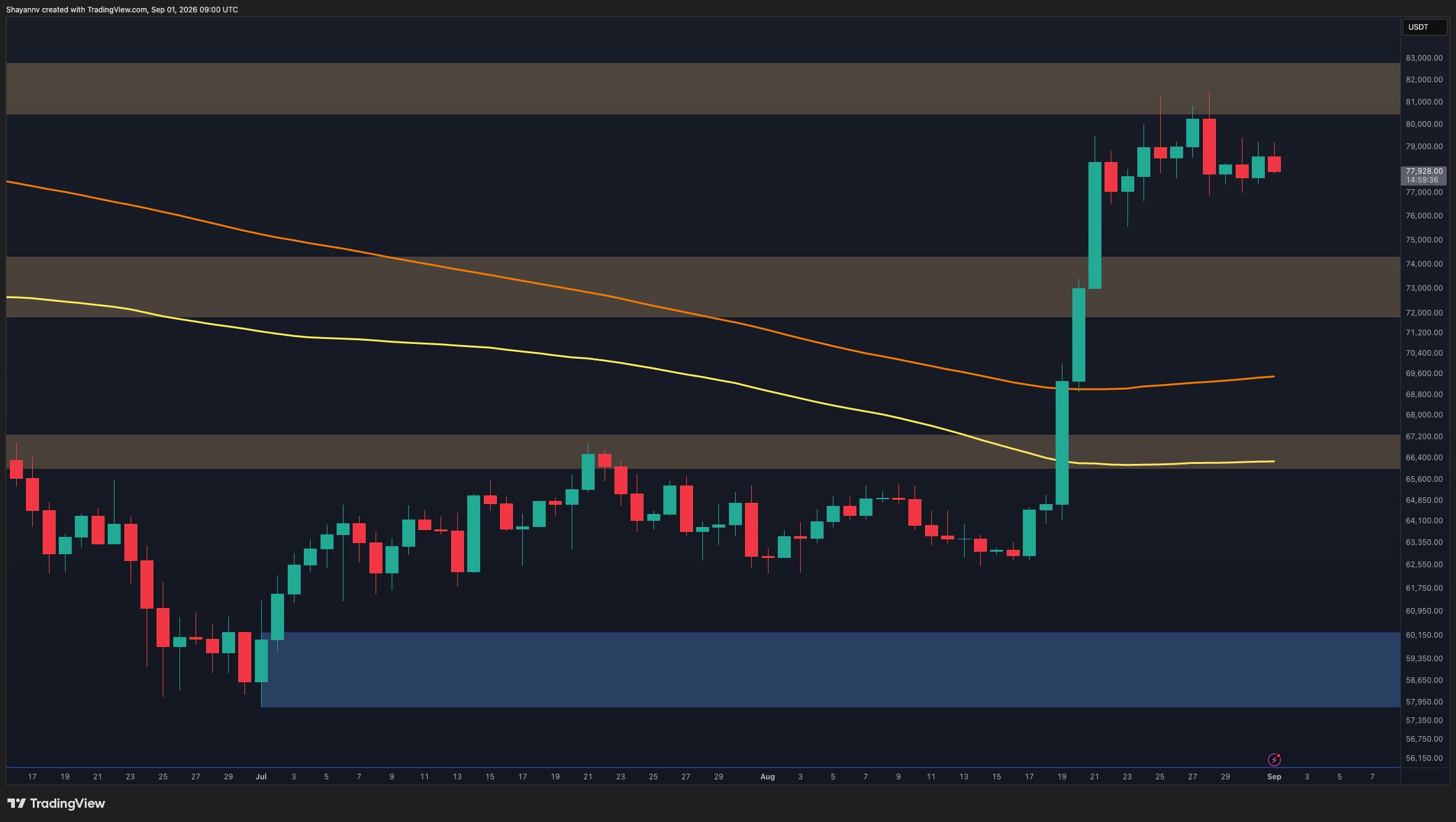
Bitcoin continues to hover below $78K, but the absence of meaningful upside progress is becoming increasingly important. After the initial breakout impulse, repeated failures to challenge the $80K-$82K supply area suggest demand is losing strength, raising the probability of a deeper corrective move.
Bitcoin Price Analysis: The Daily Chart
The daily chart shows BTC transitioning from an impulsive breakout into a clear loss of momentum. Following the rapid advance from the mid-$60K region, Bitcoin has spent several sessions fluctuating between roughly $77K and $81K without establishing a fresh high.
This behavior is particularly notable because the price is consolidating directly beneath the major $80.5K-$82.5K resistance zone. The inability to absorb supply around this area, combined with repeated upper wicks, suggests buyers are struggling to maintain the strength seen during the initial rally.
Although the broader structure remains bullish following the breakout above the moving averages and previous resistance levels, the probability of a deeper pullback has increased. The $72K-$74.4K zone is the first major daily support area and represents a logical destination if selling pressure expands.
For the immediate bearish risk to diminish, BTC would need to regain momentum and establish acceptance above $80.5K-$82.5K. Until then, the prolonged hesitation beneath resistance favors caution.
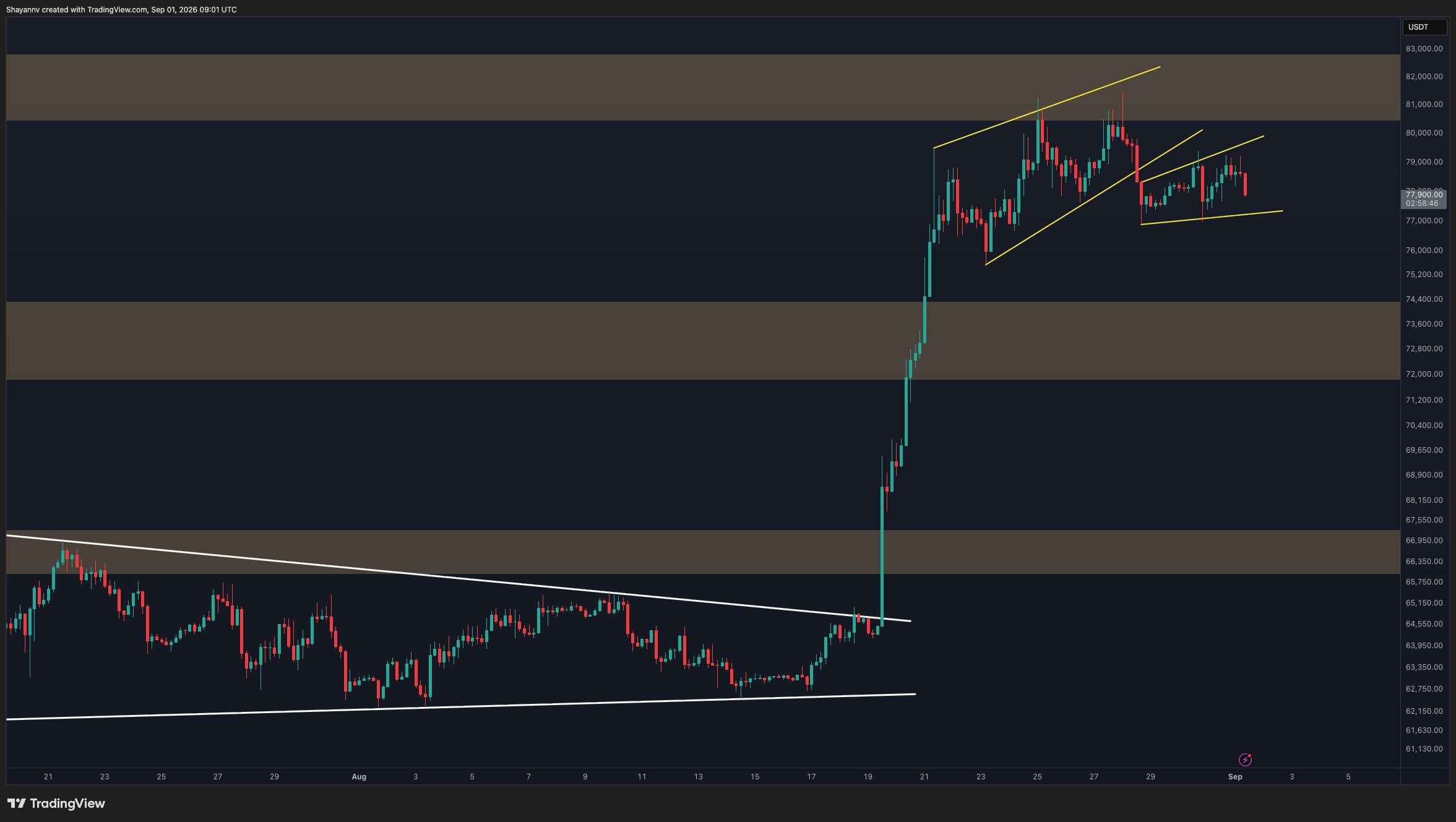
BTC/USDT 4-Hour Chart
The deterioration is more apparent on the 4-hour timeframe. Bitcoin initially formed an ascending channel following its breakout, but the price subsequently lost the lower boundary and failed to recover it.
The latest consolidation has developed into a smaller rising structure around the $77K-$80K area. However, the recent rejection from its upper boundary has pushed BTC back toward the lower trendline near $77K. This makes the current area an important short-term decision point.
A breakdown below this structure would strengthen the case for a larger correction, particularly given the lack of bullish follow-through over recent sessions. In that scenario, the $72K-$74.4K support zone would become increasingly relevant.
Alternatively, buyers could still invalidate the developing bearish setup by reclaiming $79K-$80K and eventually breaking through the $80.5K-$82.5K resistance zone. Yet, without such a move, the repeated inability to extend the rally suggests that downside risk is gradually building.
Sentiment Analysis
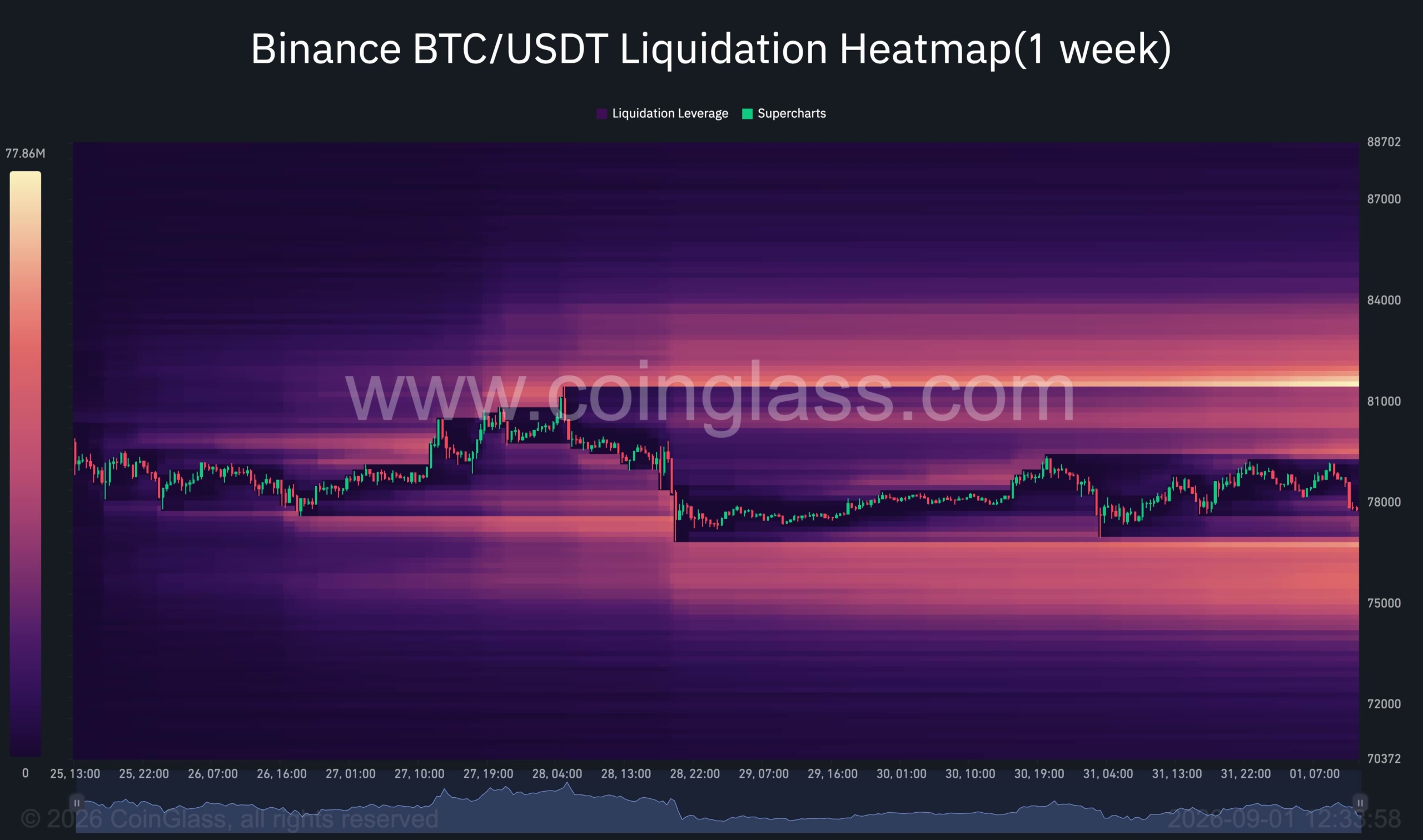
The one-week Binance BTC/USDT liquidation heatmap provides additional support for the possibility of increased volatility. Bitcoin is currently positioned between substantial liquidity concentrations on both sides of the market, but the downside cluster is particularly relevant given the weakening short-term price structure.
A broad concentration of liquidation liquidity is visible below the current price, extending approximately through the $74K-$77K region. If BTC loses its current short-term support, this liquidity could act as a magnet and accelerate a sweep toward lower levels.
There is also substantial liquidity above the market, most notably around $80K-$82K, meaning an upside liquidity hunt remains possible. However, Bitcoin’s repeated inability to sustain advances toward this region reduces the strength of that scenario for now.
Overall, the heatmap and price structure point to an increasingly fragile consolidation. A downside liquidity sweep toward the mid-$70K region, potentially followed by a test of the major $72K-$74.4K technical support zone, appears more plausible than it did previously unless buyers quickly restore momentum above $80K.
The post Bitcoin Price Analysis: Warning Signs Emerge as BTC’s Breakout Loses Momentum appeared first on CryptoPotato.
Bitcoin (BTC) has given some of its gains from the sharp August rally, and the retreat is now tracing a familiar outline on the chart.
Analysts have flagged a Bart Simpson pattern forming on BTC. The formation has drawn concern that the decline still has room to extend.
The Bart Simpson Pattern Is Forming on Bitcoin, Here’s What It Means
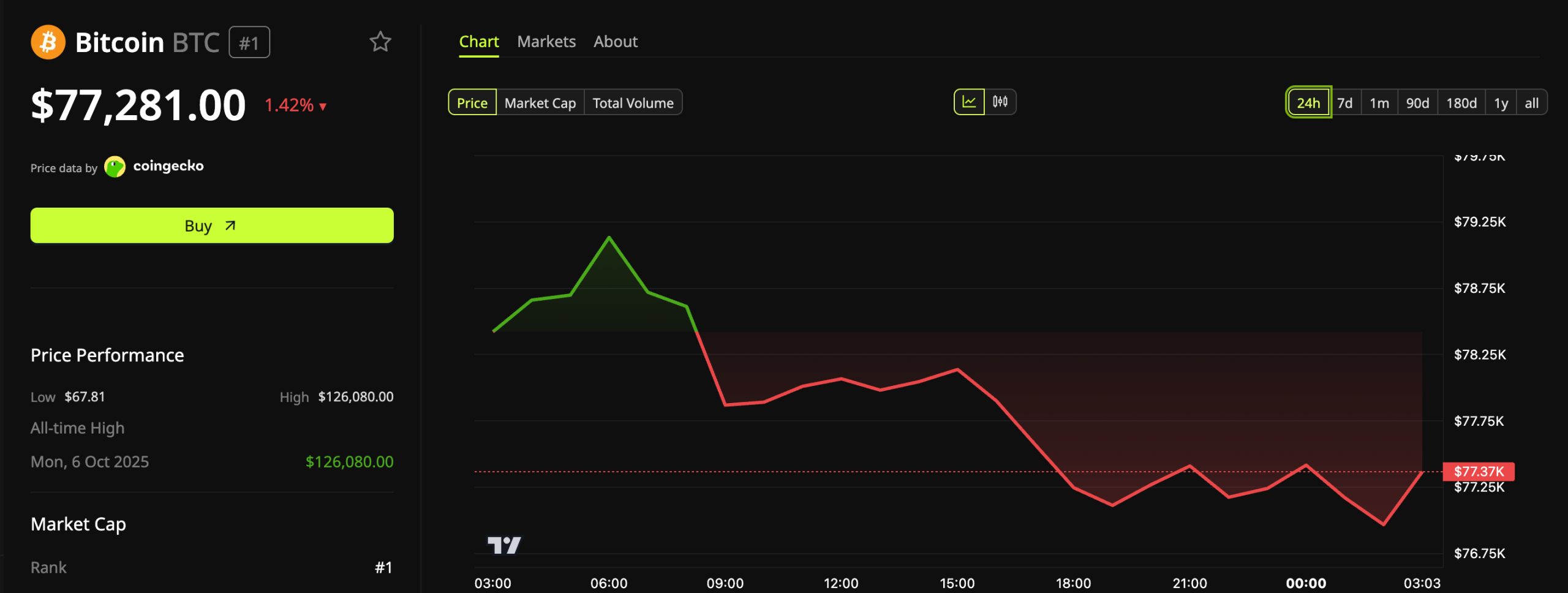
Bitcoin gained 25% in August and pushed through $80,000 late in the month. The asset traded near $77,281 on Wednesday, down 1.42% over 24 hours.

Several analysts flagged the shape on the 4-hour chart. The pattern takes its name from the cartoon character because it resembles his hair.
Price moves sharply in one direction, trades sideways in a narrow range, then snaps back toward the earlier level.
Follow us on X to get the latest news as it happens
The setup becomes particularly important if Bitcoin loses the $75,800 level, which another analyst identified as a key threshold. A break below it could confirm the bearish pattern.
On the other hand, holding above $75,800 could invalidate the bearish setup and give buyers room to regain momentum. In that case, Bitcoin could turn higher and retest the May high near $83,000.
Still, the Bart Simpson pattern should not be treated as a definitive bearish signal. The formation can emerge during normal consolidation after a sharp price move and does not necessarily lead to another leg lower.
Spot Demand Contracts as Long-Term Holders Sell
The flow data carries more weight than the pattern. Analyst CW8900 said spot demand has turned negative during the sideways move.
Negative readings appeared on two consecutive days. In contrast, futures demand stayed solid across the same stretch.
“Without the support of spot demand, there is no bullish rally,” the analyst said.
Meanwhile, analyst Axel Adler Jr reported that long-term holder distribution rose 61.5% between August 18 and August 28. The 30-day sum climbed from 174,500 BTC to 281,900 BTC.
That marked the highest reading since the start of 2026. Adler said the rebound after the short squeeze opened a window for profit-taking.
He added that inflation and labor figures due over the next few days will shape the Fed’s September decision. Whether current demand can absorb that growing supply now decides where Bitcoin price action heads next.
Subscribe to our YouTube channel to watch leaders and journalists provide expert insights
The post Bitcoin Flashes the Bart Simpson Pattern After a 25% August Rally appeared first on BeInCrypto.


G20 finance ministers and central bank governors have committed to advancing clearer regulatory frameworks for digital assets while keeping financial stability and cross-border risks in focus.
Summary
- G20 finance chiefs committed to clearer digital asset rules that support innovation while preserving financial stability.
- Officials are awaiting FSB findings on global stablecoins, including their cross border implications and data challenges.
- The G20 reaffirmed its cross border payments roadmap and called for longer operating hours for large value payment systems.
- Major G20 economies including the U.S., EU and Japan have already introduced regulatory frameworks covering digital assets or stablecoins.
The G20 Chair’s Statement, issued after officials met in Asheville, North Carolina, on Aug. 31 and Sept. 1, recognized digital assets as part of the financial innovation that could support economic growth and private-sector development.
Officials said member countries would work toward regulatory and supervisory frameworks that provide defined pathways for digital financial innovation while maintaining trust in monetary and payment systems.
“We commit to advancing responsible and effective regulatory and supervisory frameworks that preserve financial stability, support economic growth, and establish clear pathways for sound digital financial and digital assets innovation,” the officials said.
The commitment places digital asset regulation within the G20’s work on modernizing financial oversight, which covers financial stability, new technology and payment infrastructure.
U.S. Treasury Secretary Scott Bessent had identified support for a digital asset ecosystem and improvements to cross-border payments among the priorities of the U.S. G20 presidency in February. The Asheville meeting formed part of the 2026 Finance Track, ahead of another ministerial meeting scheduled for October in Bangkok and the G20 Leaders’ Summit in December.
G20 digital assets work puts stablecoins under focus
Stablecoins received specific attention in the statement as G20 officials wait for further work from the Financial Stability Board.
The group said it expects the FSB to publish findings covering the cross-border implications of global stablecoin arrangements, along with work examining stablecoin data sources, their availability and potential problems with the information regulators currently have.
Cross-border use has become one of the areas drawing closer attention from financial authorities as stablecoins move through payment networks without relying on the same infrastructure used for conventional international bank transfers.
In June, crypto.news previously reported that the People’s Bank of China was monitoring stablecoin payments as officials considered their effect on international payment networks and the monetary system.
Chinese central bank officials said stablecoins could take on a larger role in cross-border transactions and called for stronger international coordination as their use increases. Beijing has maintained restrictions on cryptocurrency activity while examining how stablecoins and central bank digital currencies could affect global payments.
Regulatory coordination has moved ahead elsewhere. The United Kingdom and United States agreed in July to pursue closer stablecoin coordination covering regulatory standards, cross-border payments and tokenized financial markets.
Officials from the two countries have been examining pathways that could allow regulated stablecoins issued in one jurisdiction to access the other market. Their discussions have included requirements for one-to-one reserves and protections for holders if an issuer becomes insolvent.
The G20 statement did not propose a common stablecoin licensing system or set a deadline for countries to adopt identical rules. Its commitment instead centers on advancing national regulatory frameworks while considering opportunities and risks that extend across borders.
Cross-border payment reforms remain part of G20 plans
Payment infrastructure sits alongside digital asset regulation in the G20’s current work.
Finance ministers and central bank governors reaffirmed their commitment to the G20 Roadmap for Enhancing Cross-border Payments and called for countries to expand the operating hours of large-value payment systems.
Officials want jurisdictions to encourage use of the harmonized ISO 20022 messaging standard and facilitate cross-border transmission of financial services data while taking domestic laws and data security requirements into account.
Stablecoin use has increasingly intersected with the same payment issues. The UK Financial Conduct Authority identified cross-border payments as the strongest practical stablecoin use case during its Stablecoin Sprint, based on feedback from banks, payment firms and crypto companies.
Participants told the regulator that stablecoins could be particularly useful in markets where access to U.S. dollars remains limited. The FCA found less incentive for UK consumers to replace existing domestic payment methods, though businesses could potentially use stablecoin infrastructure for settlement.
Individual G20 members have taken different approaches to incorporating crypto into international payment systems. Brazil’s central bank, for example, moved in May to bar virtual assets from settlement within regulated eFX cross-border payment rails, while allowing cryptocurrency transfers outside those supervised channels.
The G20’s latest position leaves room for those differences, with the statement calling for jurisdictions to consider cross-border opportunities and challenges under their respective regulatory systems.
Major G20 economies have already built crypto frameworks
Several members have moved ahead with domestic digital asset laws while international organizations continue working on common standards.
In the United States, the GENIUS Act established the first federal framework specifically covering payment stablecoins. Permitted issuers will be required to maintain one-to-one backing using eligible liquid reserve assets and comply with disclosure, supervision and redemption requirements.
Implementation remains unfinished. Federal regulators missed a July 18 deadline to complete several rules required under the law, with the Office of the Comptroller of the Currency subsequently setting a November target for its main regulations.
The framework is scheduled to take effect on Jan. 18, 2027, or 120 days after the primary federal regulators complete their implementing rules, whichever comes first.
Across the European Union, the Markets in Crypto-Assets regulation has established a common licensing and supervision system covering crypto service providers and stablecoin issuers. MiCA’s transition period ended on July 1, leaving firms without the required authorization unable to legally provide covered crypto services to EU customers under the framework.
Japan has continued restructuring its digital asset rules as well. Lawmakers in July passed amendments classifying cryptocurrencies as financial products under the Financial Instruments and Exchange Act, creating a path toward domestic crypto exchange-traded funds, a separate 20% tax treatment and tighter market conduct requirements.
The country’s Financial Services Agency subsequently established a dedicated crypto division responsible for cryptocurrency and stablecoin supervision, digital payment planning and related policy work.
Japan regulates stablecoins separately under its payment services framework. MUFG Bank, Sumitomo Mitsui Banking Corporation and Mizuho Bank are preparing jointly issued stablecoin transactions for fiscal 2026 following an FSA-backed pilot that tested corporate cross-border payments.
G20 calls for tighter oversight of illicit crypto finance
Financial crime formed another part of the G20’s digital asset agenda.
Officials reaffirmed support for the Financial Action Task Force and called for countries with significant virtual asset activity to make effective implementation of FATF standards a priority.
The group specifically backed risk-based supervision covering anti-money laundering, terrorism financing and proliferation financing, while calling attention to fraud involving scam compounds and the use of artificial intelligence by criminals.
FATF and its regional bodies have been tasked with overseeing implementation of those standards across jurisdictions. The United States is due to host a FATF Learning and Development Forum in Dallas later this year as countries continue work on applying the organization’s financial crime rules.
The G20 finance ministers and central bank governors are scheduled to meet again in Bangkok on Oct. 15 before the U.S. presidency concludes with the G20 Leaders’ Summit in Miami on Dec. 14 and 15.


TradeXYZ recorded $202.36 billion in trading volume during the second quarter of 2026, an increase of 79.2% from the previous quarter, according to a Sept. 1 report from the Hyperliquid Research Collective.
Summary
- TradeXYZ’s quarterly trading volume rose 79.2% to $202.36 billion, according to the independent research report.
- Equity perpetual volume increased 377% quarter-on-quarter, reaching $58.9 billion across 55 markets during Q2 2026.
- TradeXYZ’s HIP-3 volume share increased from 84.5% to 95.1% during the second quarter of 2026.
- Quarter-end open interest reached $2.96 billion, representing a 64.6% increase from the previous quarter’s level.
- Felix, Ventuals and Dreamcash stopped operating between June 19 and July 2, reducing HIP-3 competition.
The platform’s estimated share of trading across Hyperliquid’s HIP-3 markets rose from 84.5% to 95.1% during the quarter. Its fastest-growing segment was equity perpetuals, where volume increased 377% quarter-on-quarter to $58.9 billion across 55 markets.
The figures come from an external research report prepared by GLC Research, Four Pillars, Arrakis and GRZ Research. They should not be treated as audited financial results or figures confirmed through a TradeXYZ regulatory filing.
The report also calculated $7.59 million in quarterly revenue, up 32.9%, while open interest reached $2.96 billion at the end of June. Open interest increased 64.6% from the previous quarter.
TradeXYZ captures 95.1% of HIP-3 trading volume
TradeXYZ’s quarterly volume rose by approximately $89.43 billion from the estimated Q1 level of $112.93 billion. Growth in trading activity outpaced revenue, which increased by 32.9% over the same period.
That difference can reflect changes in product mix, fee rates, trader tiers and the proportion of volume generated by markets with lower effective fees. The report did not provide enough audited information to identify a single cause.
TradeXYZ’s HIP-3 market share increased by 10.6 percentage points during Q2. The research group estimated that its share had reached approximately 99.5% on a trailing 30-day basis by the time the report was prepared.
HIP-3 allows third parties to deploy perpetual futures markets on Hyperliquid while using the network’s trading infrastructure. Deployers can choose market parameters and list assets that are not available through Hyperliquid’s original validator-operated markets.
Hyperliquid’s current fee documentation says HIP-3 deployers may retain up to 50% of the trading fees generated by their markets. That creates a direct revenue model for platforms that can attract traders and maintain liquid order books.
The structure also separates TradeXYZ from a conventional centralized exchange. Users trade through Hyperliquid’s on-chain infrastructure, while TradeXYZ acts as the deployer responsible for its market selection and related parameters.
Equity perpetuals drive the fastest growth
Equity perpetual volume reached $58.9 billion during Q2, representing about 29.1% of TradeXYZ’s total reported volume. The segment covered 55 equity-linked markets by the end of the quarter.
A perpetual contract gives traders price exposure to an underlying asset without a fixed expiration date. Equity perpetuals can therefore track the market value of a company’s shares while trading outside the normal operating hours of traditional stock exchanges.
These contracts do not necessarily provide the same rights as owning the underlying shares. Perpetual holders generally do not receive voting rights, legal ownership or direct claims on company assets. Funding payments and liquidation rules also create risks that do not apply to ordinary unleveraged share ownership.
TradeXYZ introduced its pre-IPO perpetual product, known as IPOP, on May 1. The first market tracked Cerebras, followed by contracts linked to SpaceX and Quantinuum, according to the report.
The research group said those contracts continued through the companies’ public listings and then converted into standard equity perpetuals. It also claimed that the pre-IPO markets provided prices close to the companies’ opening public trades.
Those conclusions come from the report’s analysis. TradeXYZ has not filed audited evidence showing that pre-IPO perpetual prices consistently predict opening prices, and three completed examples would not establish long-term reliability.
The growth forms part of a wider convergence between cryptocurrency infrastructure and equity markets. For example, Wintermute registered as a U.S. broker-dealer while preparing to expand into equities and tokenized securities, as covered in the report on its regulated U.S. securities entry.
Rival closures increase market concentration
TradeXYZ’s rising share also reflects the departure of competing HIP-3 deployers. Felix, Ventuals and Dreamcash stopped operating between June 19 and July 2, according to the research report.
Their closures removed alternative venues during and shortly after the quarter. This means TradeXYZ’s 95.1% share resulted from both its own volume growth and reduced competition.
The report did not provide detailed reasons for each closure. It also did not disclose whether customers experienced losses, whether open positions were transferred or how much volume each departing platform handled before stopping operations.
A market share approaching 100% gives TradeXYZ a strong position among HIP-3 deployers, but it also concentrates activity and operational dependence in one platform. Future market share could change if new deployers enter, existing teams relaunch or Hyperliquid modifies the HIP-3 framework.
The concentration is specific to HIP-3 markets and should not be confused with TradeXYZ controlling all Hyperliquid trading. Hyperliquid also hosts its original perpetual markets, spot assets and other infrastructure outside TradeXYZ’s deployed products.
CFTC action does not directly approve TradeXYZ
The report described the U.S. Commodity Futures Trading Commission’s May action on perpetual futures as regulatory validation for the broader product category.
On May 29, the CFTC issued a policy statement explaining its position on listing perpetual contracts. The agency released the statement alongside an order allowing a designated contract market to list a bitcoin-linked perpetual futures contract.
That action covered a U.S.-regulated contract offered by a registered market operator. It did not approve TradeXYZ, Hyperliquid’s offshore markets or TradeXYZ’s equity perpetual products.
TradeXYZ users should therefore not interpret the CFTC decision as granting U.S. regulatory authorization to the platform. The legal treatment of equity-linked perpetuals can involve derivatives and securities rules that differ from those governing a bitcoin contract.
Regulators in other jurisdictions have followed separate approaches. One Trading received a Dutch license to offer regulated perpetual futures in the European Union, according to coverage of its European derivatives authorization.
The comparison shows that regulatory approval normally applies to a specific operator, legal entity and product structure. Broader acceptance of perpetual futures does not automatically authorize every on-chain market using a similar contract design.
Q3 data will test whether TradeXYZ retains its lead
The next relevant update will be TradeXYZ’s third-quarter volume, revenue and open-interest data. Those figures should show whether Q2 growth continued after three competing HIP-3 deployers closed.
Equity perpetual activity will be another key measure. The segment must maintain liquidity across its expanded list of markets for the 377% quarterly increase to represent more than a short-term surge around major listings.
Future pre-IPO conversions will also provide more evidence about how TradeXYZ handles corporate listings, reference prices and contract transitions. The report did not announce a fixed schedule for additional IPOP markets.
TradeXYZ’s U.S. availability remains a separate regulatory question. Neither the research report nor the CFTC statement announced approval for the platform to offer equity perpetuals directly to U.S. customers.

Do This And You’ll Make A Lot Of Money This Crypto Bull Run We Only Have A Few Weeks Left

Missing man’s remains found on same street as his car two years after disappearance

British Airways Flight Declares Mid-Air Emergency Over England Before Landing Safely At Heathrow Airport





-

 Fashion5 days ago
Weekend Open Thread: Maeve – Corporette.com
-

 Crypto World5 days ago
Bitcoin’s 22% rally now needs real demand to outlast Treasury liquidity boost
-

 Crypto World7 days ago
Warsh Jackson Hole keynote puts financial innovation first
-

 Business5 days ago
Apple Confirms September 9 Keynote and Reveals Its Full Pre-Order Schedule
-

 Crypto World6 days ago
Elon Musk Grok Bot Promise: We Will Make You Whole if AI Loses Your Money
-

 Business5 days ago
Salesforce Stock Soars 19% as Blowout Earnings and Agentforce AI Growth Silence Software Skeptics
-

 Business4 days ago
Onto Innovation Stock: AI’s Next Bottleneck Is Yield (NYSE:ONTO)
-
 NewsBeat6 days ago
Lindsay Clancy jury braces for closing arguments as judge tells court: ‘You’ve heard all the evidence’ – Live updates
-

 Business7 days ago
Walmart takes aim at younger shoppers with new fashion brand
-

 Crypto World6 days ago
NVIDIA revenue hits $96.2B as AI demand doubles
-

 Crypto World4 days ago
Bitcoin price tests $82K resistance as Brandt stays long
-

 Business5 days ago
iPhone 18 Pro Pre-Orders Could Shift to Saturday as Apple Reportedly Avoids September 11 Anniversary
-

 Crypto World6 days ago
Nvidia Q2 Earnings Reveal $96.2 Billion Beat, So Why Is NVDA Falling?
-
 Tech3 days ago
Hugging Face built a $4.5 billion empire on free AI models. Now Nvidia is buying it for $12.9 billion
-

 Tech6 days ago
Claude Cowork gets its own browser that doesn’t touch your tabs, bookmarks, or saved passwords
-

 Crypto World5 days ago
Truflation calls for Fed rate cut after PCE forecast
-

 Tech4 days ago
PaperCut releases second emergency patch for exploited flaws
-

 News Videos3 days ago
Charlie Munger on Robinhood: No one should believe that Robinhood’s trades are free
-

 Tech6 days ago
Apple’s iPhone 18 Pro event is on September 9
-

 Tech3 days ago
As the influencer economy drives retail sales, Seattle startup raises $22M to play matchmaker
You must be logged in to post a comment Login