

Crypto World
Bitcoin Liquidity Magnets Determine BTC’s Directional Price Moves

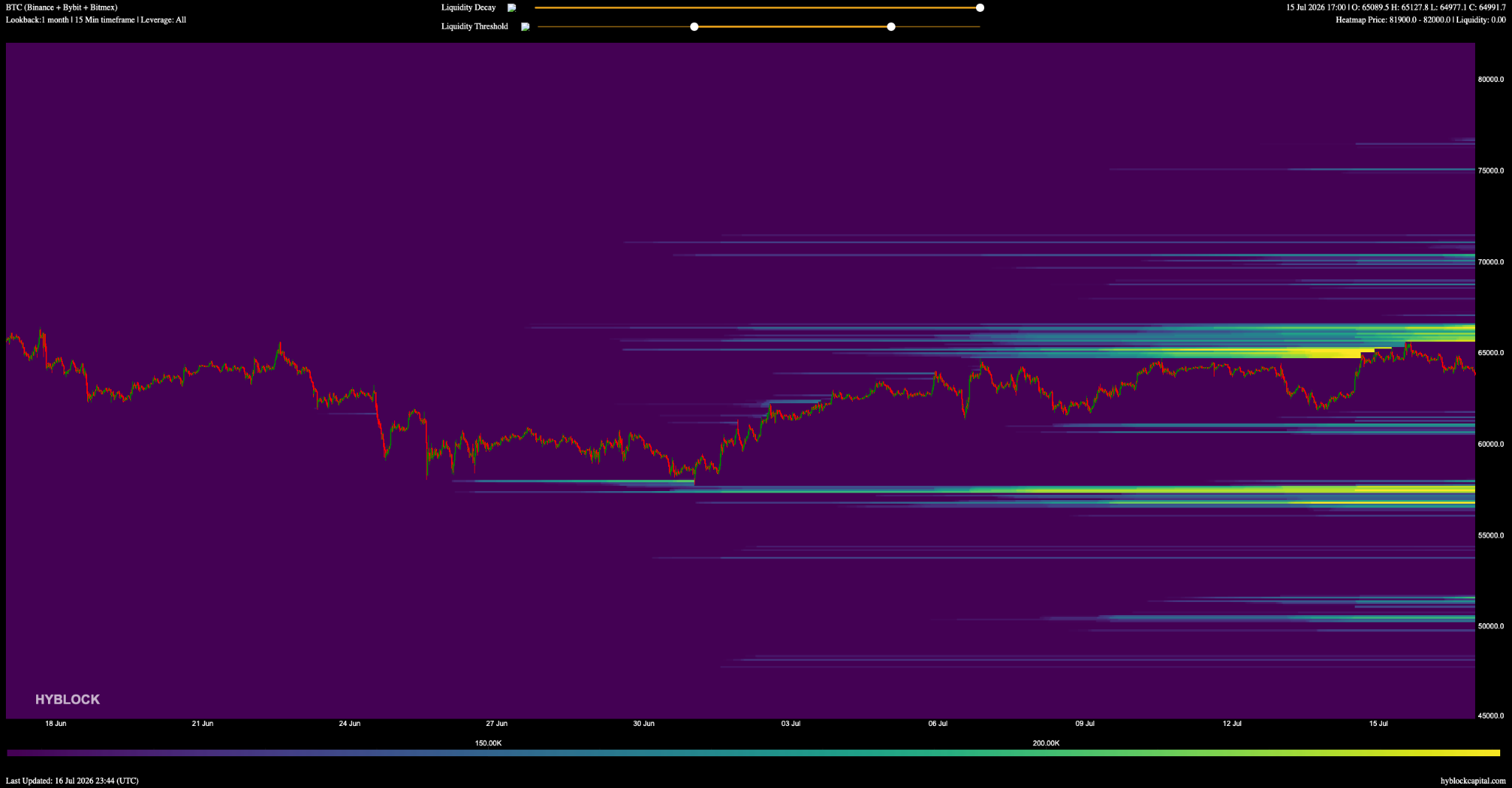
Increased activity across Bitcoin’s (BTC) futures markets is playing the dominant role in its short-term price action, which keeps tracing back to where leveraged positions are stacked. Prices tend to gravitate toward where liquidity is most concentrated, and as Bitcoin battles to hold above $64,000, reviewing current liquidation scenarios may provide insight into BTC’s next move.
Liquidation heatmap data shows a cluster of short positions concentrated between $65,500 and $66,000, roughly 3% away from current market pricing. A push through $65,600 may put that shelf in play and could accelerate a larger rally toward $67,000.
Below market pricing, support is layered in the $63,500 to $63,750 range, with the closest cluster 1% away, and larger liquidity pools are found at $63,000-$63,250 (about 1.5% down) and $62,500-$62,750 (about 2.3% down).
Combined, long-side liquidity across the tracked window outweighs short-side liquidity by nearly two to one, potentially signaling that the bulk of a leverage built up over the past month hasn’t fully closed out.
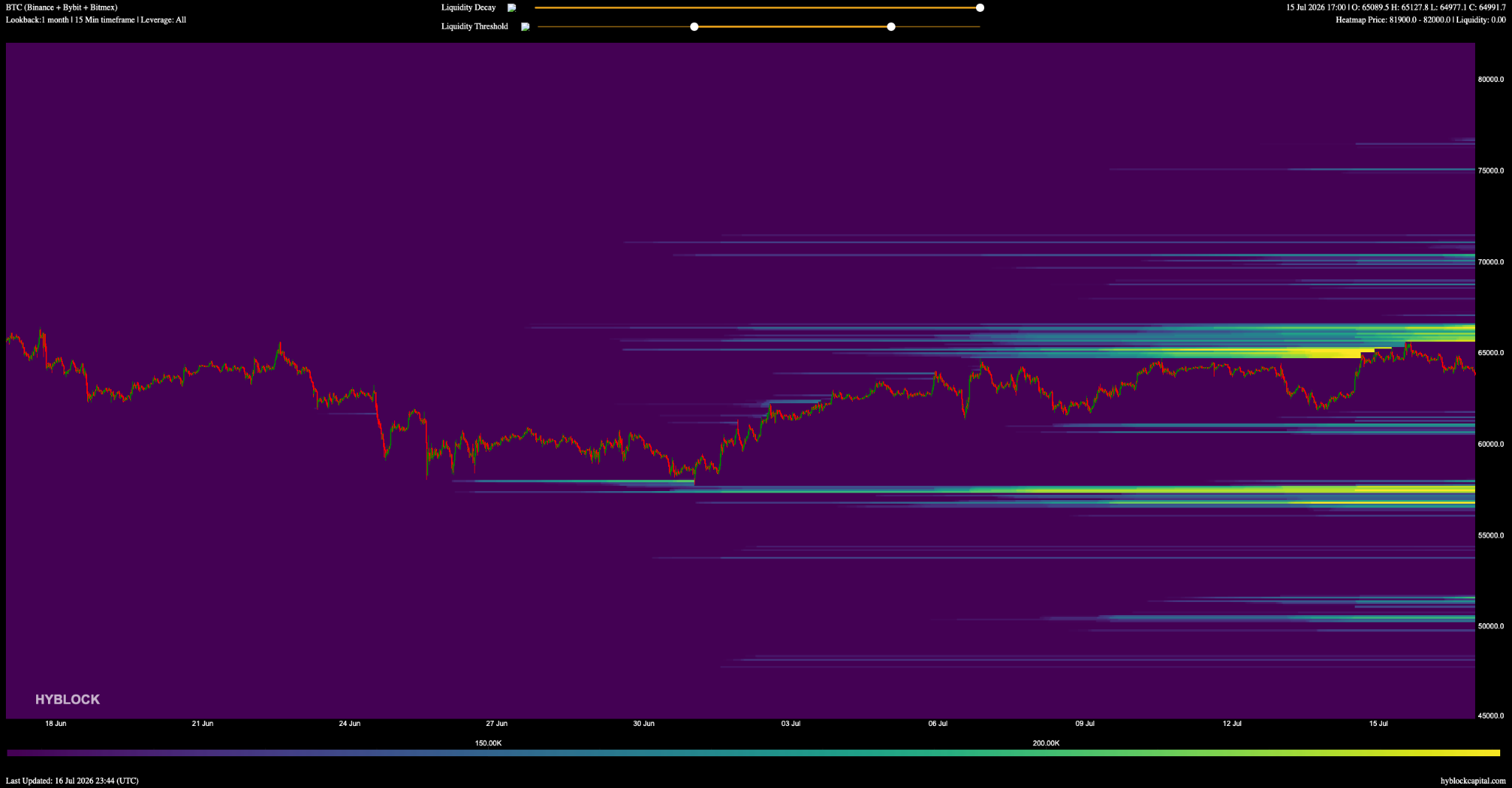
BTC liquidation heatmap, 1-month lookback. Source: Hyblock
In the most bearish scenario, a wide liquidation band near $55,000 (which has built up over the full month lookback) is visible and stands out more than almost anything else on the chart. This magnet could exert its pull on price if support in the $62,500 to $63,750 were to give way.
The last few weeks of price action suggest that Bitcoin may remain rangebound between $60,000 and $67,000, and BTC’s aggregate open interest and funding rate back this view.
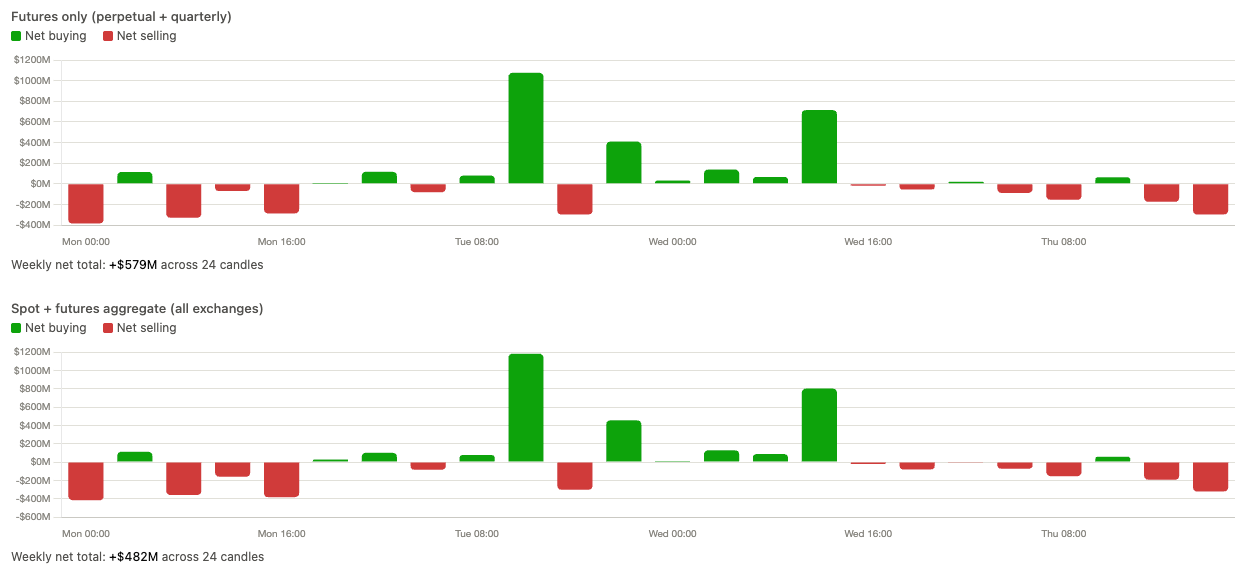
BTC spot and cumulative volume flows. Source: Hyblock
While OI has come down more than 3% from Tuesday’s peak, BTC price has barely moved, and as funding cooled toward neutral, spot and futures flows have favored the buy side over the past week.

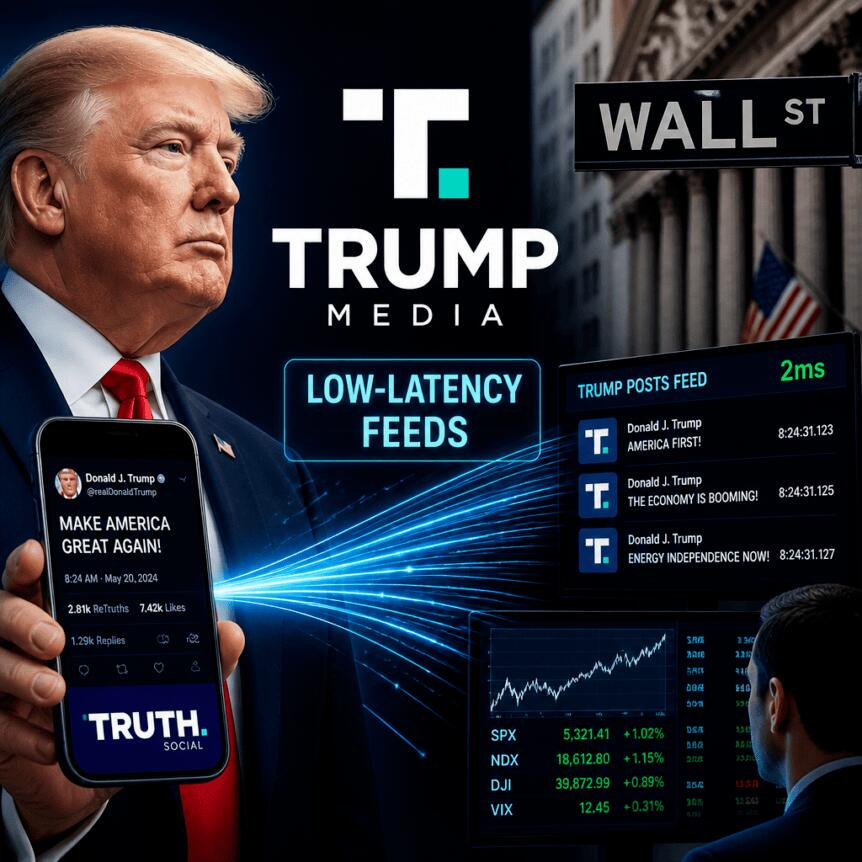
Trump Media & Technology Group (TMTG), the company behind the Truth Social platform, says it is preparing to launch a paid API that will let institutional Wall Street users pull posts from selected high-impact Truth Social accounts in real time.
In a filing with the U.S. Securities and Exchange Commission, TMTG states the “Truth API” is expected to be available to institutional customers starting Aug. 1, 2026. The service is designed for low-latency, machine-readable access—useful for high-frequency and algorithmic trading firms that want faster integration than manual browsing or slower data collection methods.
Key takeaways
- Trump Media is launching a paid Truth Social API aimed at institutional customers and market data workflows.
- Availability is targeted for Aug. 1, 2026, with a focus on real-time, licensed content from influential accounts.
- The API is intended for algorithmic and high-frequency trading that prioritizes low latency and machine readability.
- TMTG says scraping prior approaches violate its terms and that the company wants to increase friction for non-direct data collection.
- Truth Social posts have previously been cited as market-moving, including posts connected to U.S.–Iran developments.
A licensed, real-time feed for institutions
According to TMTG’s SEC filing, the Truth API is positioned as a direct, licensed channel for retrieving posts from Truth Social’s most “market-moving” accounts. The company is explicitly pitching the product to professional trading and market data users that need data in a format that systems can ingest quickly.
The filing emphasizes that the API is meant to deliver a real-time feed, tailored for scenarios where timing matters—especially for automated strategies. That framing matters to investors and market participants because it acknowledges a practical reality: social-media headlines and posts can influence how quickly traders react, and the gap between posting and data availability can affect execution.
Low latency and “friction” for scraping
In comments tied to the rollout, TMTG’s interim CEO Kevin McGurn said that Truth API provides a direct licensed stream of the platform’s “most market-moving Truths,” while also supporting the company’s goal of monetizing proprietary assets through recurring revenue.
The company also drew a line around how data should be obtained. In the filing, McGurn says companies have previously attempted to scrape Truth Social data, which he characterizes as a violation of the platform’s terms of service. He adds that Truth API is expected to “create a lot of friction” for those who do not come to the company directly.
For market participants, this shift is significant. Scraping-based approaches typically come with reliability and compliance risks—such as sudden changes in access patterns, blocking, or disputes over licensing. A formal API, by contrast, signals a more structured data pipeline that may be easier to incorporate into regulated or vendor-driven workflows.
Which accounts are in scope
TMTG’s announcement highlights that the API is intended to deliver posts from influential accounts, including Donald Trump (as President and as the operator of the Truth Social account named in the filing). The SEC documentation also references other major figures on the platform, including Donald Trump Jr, Eric Trump, and FBI Director Kash Patel.
Separately, the company points to prior instances where posts from Trump’s Truth Social account were associated with market attention. The article notes examples tied to the ongoing conflict between Iran and the U.S.—a reminder that Truth Social content is being watched not only as political commentary, but as a potential driver of market narratives.
Even with the API’s focus on “market-moving” accounts, investors should consider a key uncertainty: the SEC filing and the accompanying description do not spell out—within the provided text—exactly how “market-moving” is determined, how frequently the account set could change, or what latency benchmarks will be provided to customers.
Why an API matters for trading workflows
Social-media data has long been used in trading, but the quality of that data pipeline—particularly speed, structure, and licensing—often determines whether it can be reliably used for automation. By targeting low-latency delivery to institutional users, TMTG is effectively positioning Truth Social as a more integration-ready source of information for quantitative systems.
Just as importantly, the company’s approach frames the business model: rather than relying on incidental discovery or indirect data access, TMTG is attempting to convert platform influence into a recurring, licensed data service. The “high-margin, recurring revenue stream” language in McGurn’s statement suggests the API is intended to become a durable line of monetization, not a one-off product experiment.
As Aug. 1, 2026 approaches, market observers will likely watch for more operational details—especially how the API will handle access controls, content eligibility, and real-time performance expectations for institutional customers. Those specifics will determine whether Truth API becomes a practical component of algorithmic strategies or remains largely a compliance-first licensing alternative.
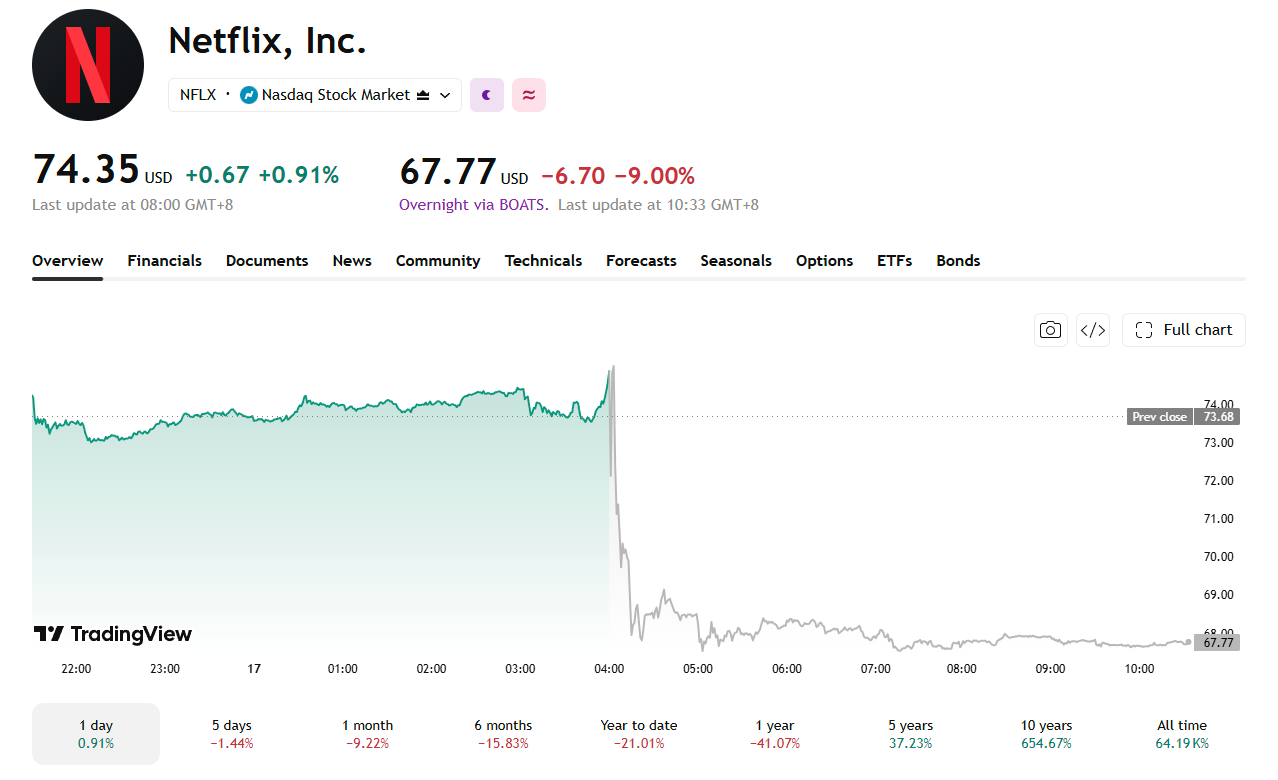
Netflix (NFLX) forecast third-quarter revenue of $12.86 billion, short of Wall Street’s $13 billion estimate. Shares sank nearly 9% in after-hours trading Thursday, July 16.
The guidance overshadowed second-quarter results that beat earnings estimates but fell just short on revenue. Investors are weighing slowing subscriber growth against a maturing streaming business heading into the back half of 2026.
Shares Slide Toward a Two-Year Low
Netflix shares closed Thursday’s regular session at $74.35, up 0.91%. The stock then fell 8.98% to $67.78 in after-hours trading once the guidance landed, per TradingView data.

The stock is down more than 21% year-to-date has fallen 41% over the past twelve months. It sits far from its all time high of around $133 set in June 2025.
The drop lands during a stretch of bank earnings season that has already tested investor patience. Fed Chair testimony on rates added to the volatility this week. The Nasdaq and S&P 500 have swung on similar earnings-driven volatility this cycle.
Analysts See a Maturing Growth Story
PP Foresight analyst Paolo Pescatore described the outlook as “a naturally maturing growth profile.” He said this does not signal deterioration in the business, but added that Netflix now has less room for error given persistently high expectations.
Netflix also said it would cut its viewing-hours report to once a year, starting in January 2027. The company wants to keep the focus on revenue and operating profit.
The company reiterated plans to roughly double annual advertising revenue to $3 billion. Engagement also grew 2% in the first half of 2026.
Netflix reports third-quarter results on October 20. Investors will watch whether the advertising and live-events push can offset slowing subscriber gains.
The post Netflix Stock Sinks After Third-Quarter Revenue Guidance Misses Estimates appeared first on BeInCrypto.


Trump Media, the company that operates the Truth Social network, said Thursday it was launching a new paid-for API that gives Wall Street firms “the fastest” access to posts from the most influential Truth Social accounts, including US President Donald Trump.
The API is targeted to be available to institutional customers from Aug. 1, 2026, and is aimed at high-frequency and algorithmic trading firms that require a low-latency, machine-readable feed, said the company on Thursday.
“Markets already move on Truth Social posts,” said Kevin McGurn, interim CEO of TMTG in a statement. “Truth API delivers a direct, licensed, real-time feed of the platform’s most market-moving Truths while advancing our strategy to monetize proprietary assets through a high-margin, recurring revenue stream.”
Posts from Trump’s Truth Social account have moved markets, with the most recent examples being his posts relating to the ongoing conflict between Iran and the US. Other major accounts on Truth Social include Donald Trump Jr, Eric Trump and FBI Director Kash Patel.
“Companies have previously tried to scrape data from Truth Social, which is in violation of its terms of service,” McGurn said, according to CNN.
“We’re going to create a lot of friction for those folks that aren’t coming to us directly,” he added.
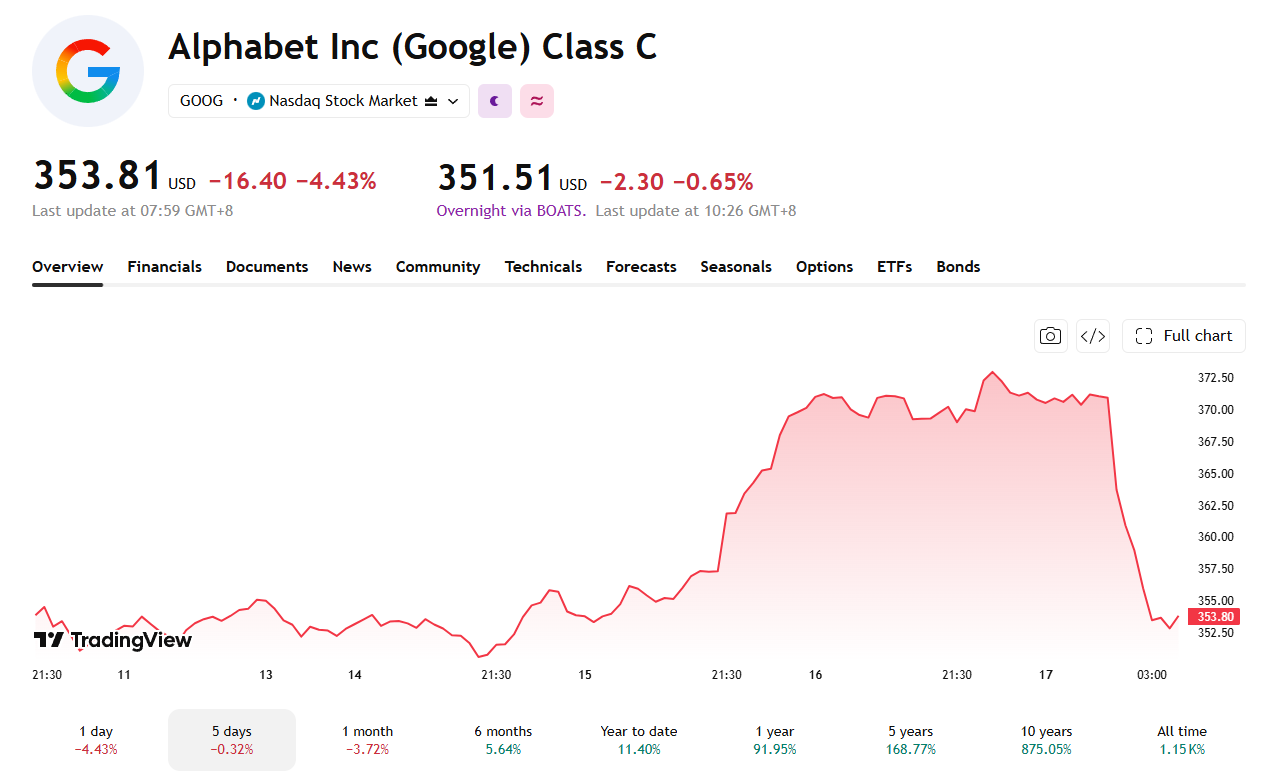
Alphabet stock fell over 4% after the European Union ordered Google to open Search and Android data to rivals. The order adds to concerns over a delayed Gemini 3.5 Pro launch.
The pullback erased most of a rally sparked days earlier by Warren Buffett’s public endorsement of the stock. Shares changed hands near $353 on Thursday, down from above push toward $370 days earlier, per TradingView data.
Gemini Delay Meets a Costly AI Buildout
Alphabet is reportedly facing delays in launching Gemini 3.5 Pro, its next flagship AI model. CEO Sundar Pichai had signaled a June release. Engineers are said to still be working on coding performance and now, some researchers reportedly worry rival models now outperform Gemini on enterprise benchmarks.

The delay lands as Alphabet guides to $180 billion to $190 billion in capital spending this year alone. That buildout already forced the company into reversing its buyback strategy. It also drove an $80 billion equity raise that Berkshire helped anchor.
Wall Street expects Alphabet to post second-quarter earnings per share near $2.86, up nearly 24% year over year when it announces on July 22. Google Cloud grew 63% last quarter to nearly $20 billion. That figure is what investors will watch most closely for evidence AI spending is converting into revenue, after Alphabet’s stronger earnings reaction than rivals last quarter.
Regulators Add to the Pressure
The European Commission ordered Google on Thursday, July 16 to open 11 Android features to rival AI assistants. It also ordered Google to share anonymized Search data with competitors, including OpenAI, under the Digital Markets Act. The Android changes take effect with the next major Android version in July 2027. Search data sharing begins in January 2027.
Google objected to the order in a statement.
“Europeans’ private searches would be exposed to unfamiliar companies, without adequate anonymization of the data and without user knowledge or consent. This would weaken citizens’ privacy, risk business trade secrets, and endanger national security,” he said in a statement.
Separately, The EU could issue Google a fine next week in a related Digital Markets Act investigation. That would mark a second, distinct regulatory action within days. US antitrust litigation over Google’s search dominance is also drawing fresh institutional attention.
Buffett’s Vote of Confidence
Against this backdrop, Buffett’s endorsement stands out. Speaking with CNBC’s Becky Quick, the Berkshire Hathaway chairman confirmed he built the position. Successor Greg Abel did not initiate the trade, he said.
Berkshire’s stake now tops $31 billion, ranking behind only Apple and American Express among its holdings. Buffett tempered the praise, though. He said Alphabet is not among his four or five favorite Berkshire-owned businesses.
He also flagged the same capital intensity worrying the broader market. Buffett called the AI spending race “real money.” His comments in his CNBC interview echoed the same caution about chasing near-term results over real returns.
The post Alphabet Stock Slips on Gemini Delay and EU Order Despite Buffett Bet appeared first on BeInCrypto.


Trump Media & Technology Group has launched a paid data feed called Truth API. It gives banks and trading firms faster access to Donald Trump’s market-moving Truth Social posts.
The service goes live August 1 and already has signed customers, the company said.
Why Speed On Trump’s Posts Matters
Trump’s Truth Social posts have repeatedly jolted global markets. Recent examples include his “Liberation Day” tariff announcements and trade threats against China.
On April 9, 2025, Trump said he would pause many new tariffs for 90 days. US stocks turned sharply higher within minutes of the post.
Truth API will cover the 10 most influential Truth Social accounts and archive posts back to 2022. The platform’s most-followed users include Trump himself, his sons Donald Trump Jr. and Eric Trump, and allies like Dan Bongino and Sean Hannity.
TMTG’s interim CEO, Kevin McGurn, said the feed targets firms with the most to lose from delayed information.
“We’re going to create a lot of friction for those folks that aren’t coming to us directly.”
— Kevin McGurn, Reuters
Conflict Of Interest Questions
The Donald J. Trump Revocable Trust holds roughly 41% of TMTG stock. Trump’s children oversee that trust, which manages his investments. The presidents close ties to the company, and his immense influence, puts him in a position of power to move markets with his social account.
Senator Ron Wyden, the top Democrat on the Senate Finance Committee, criticized the launch. He has also previously criticized the ‘Trump Family Greed‘ in relation to crypto profit disclosures. Wyden said of the new API that it would enrich the Trump family and “make Wall Street traders rich.”
Despite the criticism, and the apprent conflict of interest, Dynamis law firm partner Robert Frenchman said tiering access does not break federal securities law. However, he noted the practice still creates uneven odds for smaller traders.
“It certainly does not seem fair, but yes, a tech platform can tier its distribution of information without violating federal securities laws,” Frenchman said.
TMTG has accused unnamed firms of scraping Truth Social data for months. It calls that a breach of its terms of service. The company has previously batted down other Truth Social monetization rumors, including talk of a meme coin.
The launch adds to a pattern of Trump-linked market moves drawing scrutiny over who profits from information timing. Regulators have not said whether tiered access to a president’s posts raises new disclosure concerns.
The post Trump’s Truth Social Posts Will Hit Wall Street First, Giving a Financial Edge appeared first on BeInCrypto.
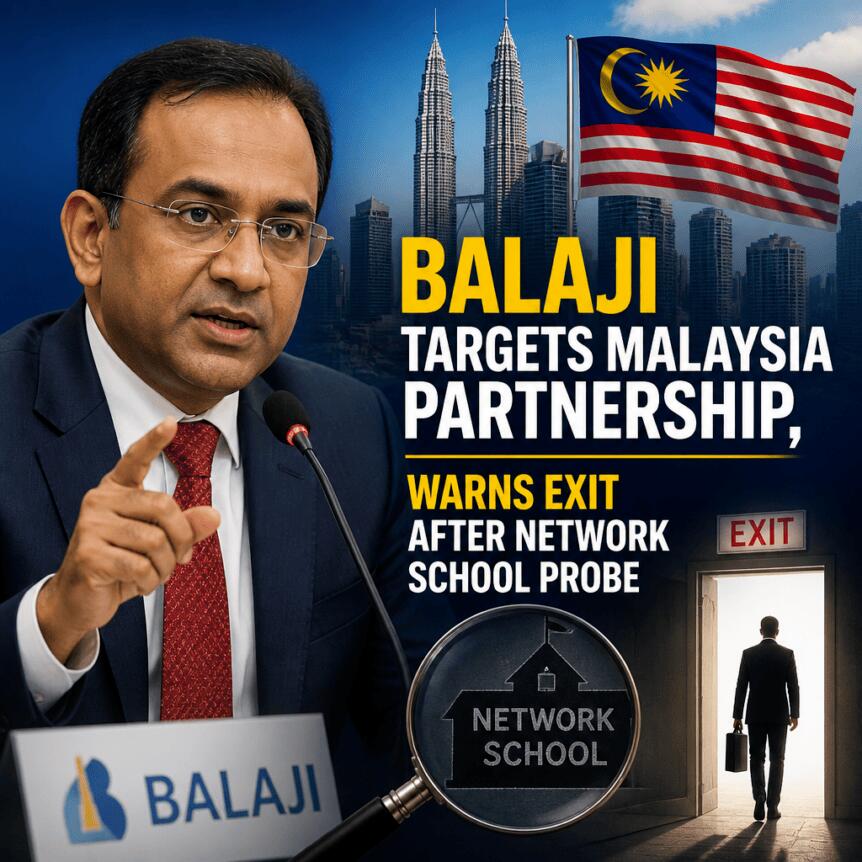
Network School founder Balaji Srinivasan says he is seeking a memorandum of understanding with Malaysia after Malaysian authorities probed his Forest City tech community over allegations that it may have hosted Israeli citizens using second passports. Malaysia’s Home Affairs Ministry said it is investigating the start-up community in Johor following claims that Israelis were present in violation of immigration rules.
The situation underscores a challenge for crypto-adjacent “digital utopia” projects: even when communities aim to build their own institutions and economies, they still rely on conventional nation-states for legal certainty. Srinivasan has linked the next phase of his Malaysia expansion plans to getting that assurance.
Key takeaways
- Malaysia’s Home Affairs Ministry is investigating Network School in Johor after allegations of Israeli nationals using second passports.
- Authorities’ initial checks reportedly found that 266 foreign residents held valid documents.
- Srinivasan is asking Malaysia for written assurances—possibly a memorandum of understanding or changes tied to a special economic zone.
- He says further investment in Malaysia, including a $122 million expansion plan, is on hold pending “sufficient assurance” that issues won’t repeat.
Malaysia investigation follows immigration-related claims
Malaysia’s Home Affairs Ministry said Tuesday that it is investigating Network School’s operations in Johor after claims surfaced alleging that the community included Israelis who may have breached immigration laws. In an early review, the ministry said it found no immediate documentary irregularities—reportedly confirming that 266 foreigners under the initiative had valid documents.
According to the ministry’s statement, the probe is tied to specific allegations rather than a blanket rejection of the project. Still, the inquiry puts Network School’s continued ability to attract and house foreign participants under closer scrutiny.
Srinivasan pushes for written legal certainty
Srinivasan said the reason for pursuing an agreement with Malaysia is to provide Network School with “legal certainty” that would allow it to continue investing and operating in the country. Without such a document, he suggested, the community could redirect its capital elsewhere.
In a video addressed to Malaysian Prime Minister Anwar Ibrahim, Srinivasan said he wants more than general statements welcoming tech; he wants personal, written confirmation that Network School will be considered welcome. He also indicated he is open to different legal mechanisms, including a memorandum of understanding or modifications tied to a special economic zone provision.
While Srinivasan did not lay out specific terms publicly, his messaging focused on predictability: investors and community operators need clarity about the legal status of participants, not just broad political signals.
He also said he is pausing any further investment in Malaysia, including a planned $122 million expansion, until he receives “sufficient assurance” that the immigration issues raised during this episode do not recur.
How the allegations surfaced
Claims that Network School was harboring Israeli citizens were traced back to an Instagram post from “Malaysian Protest 4 Palestine,” an activist group that accused the school of becoming a “gathering place for Israeli entrepreneurs.” In its course of action, the post helped spur immigration scrutiny that then moved to the Malaysian Home Affairs Ministry.
Malaysian policy on entry for Israeli passport holders is central to the dispute. The article notes that Israeli passport holders are forbidden from entering Malaysia, a Muslim-majority country, without written permission from the Malaysian Ministry of Home Affairs—reflecting Malaysia’s lack of diplomatic relations with Israel and its stated position of not recognizing Israel.
Importantly, while the investigation is ongoing, the ministry’s initial checks reportedly did not find immediate evidence—at least at the documentation level—that foreign residents lacked valid paperwork. That creates a key uncertainty going forward: authorities may still need to determine whether the allegations relate to residency status, identity verification, the use of alternate travel documents, or other aspects not covered by “valid documents” alone.
Why this matters for crypto-linked community models
Beyond the specifics of one tech community, the episode reflects a recurring tension for crypto-leaning projects that describe themselves as building new social and economic systems. Such initiatives often emphasize borderless or community-driven norms, but they still require host governments to provide stable, enforceable rules—especially when the project involves foreign nationals and long-term operations.
For investors and participants, the difference between informal tolerance and formal assurance can determine where capital goes next. Srinivasan’s decision to pause a large expansion plan suggests Network School is treating immigration uncertainty as a material risk to its business continuity, not a temporary public-relations issue.
If Malaysia provides the kind of written clarity Srinivasan is requesting, the project could regain confidence for future fundraising and staffing. If not, the story hints at a broader pattern: even when “build-first” communities develop successfully, compliance and policy certainty may become the bottleneck.
Readers should watch for what Malaysia’s Home Affairs Ministry concludes in the investigation, and whether any formal agreement—such as a memorandum of understanding or changes tied to existing special economic zone rules—emerges that addresses the specific compliance concerns raised in this case.


Network School founder Balaji Srinivasan is seeking a memorandum of understanding with Malaysia after authorities probed his Forest City tech community over allegations it was hosting Israeli citizens using second passports.
Malaysia’s Home Affairs Ministry said Tuesday it was investigating Srinivasan’s start-up community in Johor following claims it included Israelis in violation of immigration laws. Initial checks found all 266 foreigners held valid documents.
Srinivasan said the agreement would give Network School legal certainty to continue investing in Malaysia. Without it, he said, the community could take its capital to countries that are more welcoming.
“I’d like to have a document which says not just abstractly that tech is welcome … but rather that we’re personally welcome,” Srinivasan said in a video directed at Malaysian Prime Minister Anwar Ibrahim on Thursday.
The episode highlights a tension faced by many crypto utopias, which aspire to build digital-native communities with their own institutions and economies, but still depend on conventional states for legal certainty.
Balaji, the former chief technology officer of Coinbase, launched his Network School in August 2024 in Johor’s Forest City, which is located about an hour from Singapore. It is marketed as a physical community of tech builders, creators and founders.
Srinivasan did not give the specifics of what a deal with Malaysia could include, but suggested it could be a memorandum of understanding or a modification of a special economic zone provision.
Related: Balaji calls for more ‘crypto tools’ for refugees amid Middle East tensions
“If not, then we will readily go somewhere else because I don’t want to be where we’re not welcome,” he said.
Srinivasan also announced that he is putting any further investment in Malaysia, including a $122 million plan to expand its community, on hold until it gets “sufficient assurance” that such issues don’t recur.
Instagram post led to immigration probe
Claims that the Network School was harboring Israeli citizens have been traced back to a social media post on Friday from activist group “Malaysian Protest 4 Palestine,” which accused the school of becoming a “gathering place for Israeli entrepreneurs.”
Israeli passport holders are forbidden from entering Malaysia, a Muslim-majority country, without written permission from the Malaysian Ministry of Home Affairs, as Malaysia does not recognize Israel and does not have any diplomatic relations with the country.
Magazine: Gambling on random Pokémon cards: Onchain gagcha hits record high as crypto sinks


South Korea has raised interest rates for the first time since January 2023, shifting monetary policy toward tighter conditions in one of the world’s most active retail crypto markets.
Summary
- South Korea raised rates to 2.75%, marking its first monetary policy increase since January 2023.
- Tighter borrowing conditions could cool speculative crypto demand as local trading activity has already weakened.
- Strong growth, persistent inflation and won weakness may keep additional Bank of Korea hikes possible.
The Bank of Korea raised its benchmark rate by 25 basis points from 2.50% to 2.75% on July 16. All seven members of the Monetary Policy Board supported the decision. The central bank also said further increases may be needed depending on inflation, growth and financial stability conditions.
Bank of Korea shifts toward tighter monetary policy
The rate increase was widely expected. A Reuters poll found that 36 of 37 economists expected the central bank to raise its policy rate to 2.75%.
The Bank of Korea cited stronger exports and investment, persistent inflation and risks to financial stability. June consumer inflation reached 3.2%, while the central bank expects economic growth to exceed its previous 2.6% forecast by a wide margin.
Governor Hyun Song Shin said developments in growth, inflation and financial stability all supported a rate increase. The bank also said monetary policy may need to remain on a tightening path, with future decisions depending on economic data.
Higher interest rates generally raise borrowing costs and can reduce demand for speculative assets. For crypto markets, the direct effect may depend on whether tighter local financial conditions reduce the amount of won available for trading.
South Korea remains a major retail crypto market
South Korea continues to play an important role in global cryptocurrency trading. Local exchanges such as Upbit and Bithumb regularly generate large volumes in won-denominated markets, especially for altcoins.
As previously reported by crypto.news, XRP briefly became the most traded asset on Upbit in May, recording about $110.9 million in daily volume compared with $88.6 million for Bitcoin and $67 million for Ethereum. That trading pattern showed the continued influence of Korean retail traders on individual crypto markets.
Recent listings also show that crypto exchanges continue to target Korean traders. As reported by crypto.news, Upbit added Derive’s DRV token to its KRW, BTC and USDT markets on July 14, while Bithumb also introduced a won trading pair.
Crypto demand had already weakened before the rate hike
The rate increase comes after local crypto activity had already fallen from earlier peaks. However, cryptocurrency holdings among South Korean investors dropped from about $83.3 billion in January 2025 to $41.4 billion by February 2026.
Daily trading volume across five major domestic exchanges also declined from about $11.6 billion in December 2024 to roughly $3 billion in February. Won deposits held at exchanges fell from 10.7 trillion won to 7.8 trillion won, pointing to weaker cash demand for crypto trading.
Higher rates could add another restraint on speculative activity if households choose deposits, bonds or other yield-bearing assets over cryptocurrencies. However, crypto prices also depend heavily on global monetary policy, institutional flows and broader market conditions.
Further rate hikes could keep liquidity under pressure
The Bank of Korea has left the door open to additional tightening. Reuters reported that many economists expect at least one more increase this year, potentially taking the benchmark rate to 3.00%.
For South Korea’s crypto market, the policy shift comes as local retail participation has already cooled from previous highs. Further increases could keep domestic liquidity tighter, while stronger global institutional demand may become more important in supporting broader crypto risk appetite.


Cantor and Securitize have formed a partnership to bring blockchain infrastructure directly into initial public offerings and follow-on stock sales, creating a pathway for companies to raise capital and issue securities onchain.
Summary
- Cantor and Securitize will combine capital markets expertise with regulated infrastructure for blockchain-based public offerings.
- The partnership targets IPOs and follow-on offerings while keeping issuers within existing capital market frameworks.
- Securitize previously tokenized its own NYSE shares, providing an early model for issuer-sponsored digital securities.
Under the agreement announced on July 15, Cantor will provide its equity capital markets and trading capabilities. Securitize will handle the infrastructure used to issue, distribute and service the tokenized securities. Its SEC-registered broker-dealer affiliate, Securitize Markets, will also participate in the offering and settlement process.
Partnership takes tokenization into primary markets
The collaboration differs from many existing tokenized stock products because it brings blockchain technology into the original issuance process. Companies could conduct IPOs or later share offerings using onchain infrastructure while remaining within the established framework for regulated public offerings.
The companies said the approach could modernize ownership records, distribution and settlement. Carlos Domingo, co-founder and CEO of Securitize, said “public companies shouldn’t have to choose” between traditional capital markets and blockchain infrastructure. The partnership does not yet name a company planning to use the new model or provide a date for its first offering.
Securitize builds on its own tokenized public shares
The agreement follows Securitize’s own move into public markets. The company listed on the New York Stock Exchange under the SECZ ticker on July 2 and simultaneously issued tokenized versions of its common shares on Solana and Avalanche.
Those blockchain-based shares represent the same SECZ common stock rather than a separate share class or synthetic product. Securitize had entered public markets through a business combination with Cantor Equity Partners II, a deal expected to deliver about $400 million in gross proceeds before expenses.
Wall Street expands its tokenization efforts
The Cantor partnership arrives as large financial institutions move more traditional securities onto blockchain networks. As reported by crypto.news, DTCC recently launched a tokenization initiative involving BlackRock, JPMorgan, Goldman Sachs, Vanguard and other major financial firms.
The New York Stock Exchange has also taken steps toward blockchain-based securities. As previously reported, the exchange proposed allowing eligible tokenized shares to trade alongside traditional securities while retaining the same rights, ticker and other ownership features. Securitize has separately worked with the NYSE on its planned tokenized securities platform.
Issuer-sponsored model keeps the actual security onchain
The Cantor-Securitize model centers on issuer-sponsored tokenization. Under the structure described by the companies, the blockchain token would represent the actual security rather than a wrapper, special-purpose vehicle or synthetic exposure linked to a stock.
Cantor Co-CEO and Global Head of Equities Pascal Bandelier said “tokenization is becoming part of mainstream capital markets.” The partnership now aims to apply that technology directly to capital raising rather than limiting it to funds or secondary-market trading.
Securitize has already expanded across institutional tokenization, including work with major asset managers and more than 650 funds, according to earlier crypto.news coverage. The new Cantor partnership extends that strategy into IPOs and follow-on offerings, although the companies have not yet announced the first issuer that will use the platform.
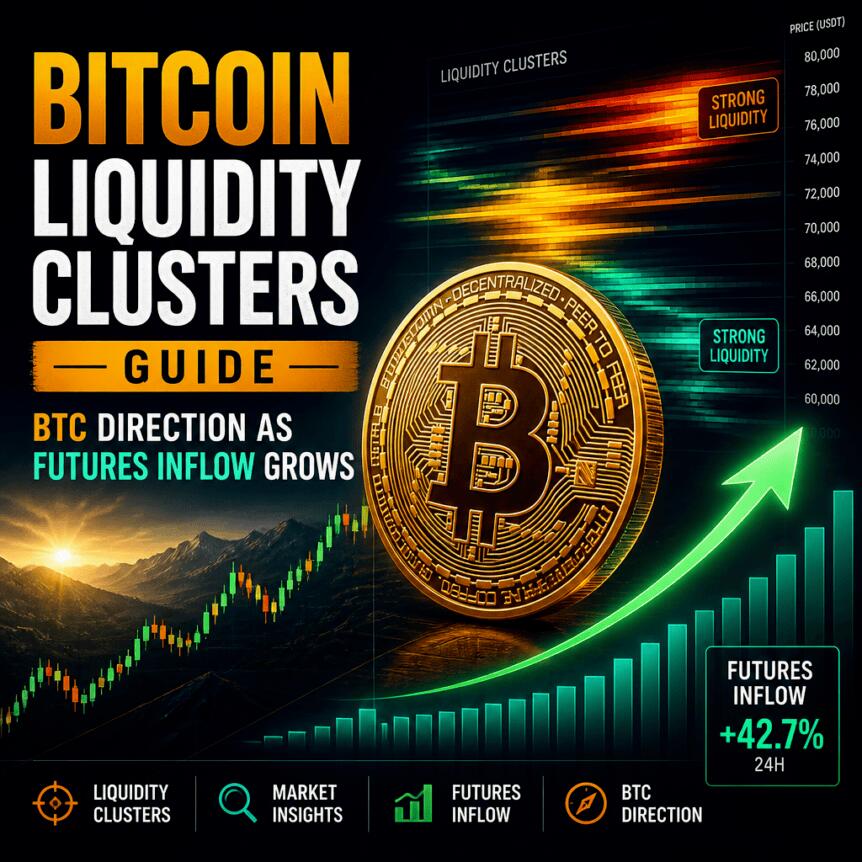
Bitcoin’s near-term direction appears increasingly tied to where leverage is concentrated in the futures market, according to liquidation heatmap readings. As BTC tests the area around the low-$60,000s—holding above $64,000 at the time of writing—price action is gravitating toward liquidity “magnets” where traders have the most to lose if the market moves.
Hyblock’s liquidation heatmap points to a key cluster of short positions between $65,500 and $66,000, positioned about 3% away from current pricing. If BTC pushes through roughly $65,600, that pocket of liquidity could be triggered, potentially helping fuel a move toward the next notable ceiling around $67,000.
Key takeaways
- A dense short-position cluster sits between $65,500 and $66,000, roughly 3% above current price, making $65,600 a potential inflection point.
- Support is layered below with a notable long-side liquidity band around $63,500 to $63,750, about 1% under current pricing.
- Deeper liquidity pools are visible at $63,000 to $63,250 and $62,500 to $62,750, which may matter if the market slips lower.
- Across the tracked window, long-side liquidity outweighs short-side liquidity by nearly 2-to-1, hinting that leverage built over the past month may not be fully unwound.
- A bearish outlier liquidation band near $55,000 stands out, suggesting that a breakdown—especially below $62,500 to $63,750—could accelerate downside.
Where liquidation clusters could pull price
Liquidation heatmaps illustrate how concentrated leverage is at specific price levels. When markets move toward those levels, forced position closings can compound the move, creating short-term momentum in either direction.
In this case, the most prominent overhead liquidity comes from shorts stacked between $65,500 and $66,000. This area sits close enough to current trading to plausibly act as a near-term target if BTC continues to grind higher. Hyblock’s data suggests that a push beyond $65,600 could put the cluster “in play,” increasing the odds of a faster run toward $67,000.
On the downside, Hyblock shows multiple long-side support zones. The closest concentration lies between $63,500 and $63,750, roughly 1% below current pricing. Additional liquidity pockets appear at $63,000 to $63,250 (about 1.5% lower) and $62,500 to $62,750 (about 2.3% lower). Together, these levels form a tiered map of where liquidations could either cushion dips—or, if breached, remove support quickly.
Importantly, the balance of liquidity is not symmetrical. Hyblock’s tracked window shows long-side liquidity outweighing short-side liquidity by nearly two to one. While that does not guarantee upside, it implies that—based on where leverage appears to sit—the market may be more prone to short-term upward pressure if BTC reaches the upper liquidity shelves first.
Rangebound trade structure backed by open interest and funding
The liquidation picture is only part of the story. The article notes that recent price behavior has leaned toward a $60,000 to $67,000 range, and that derivatives positioning metrics broadly align with a market that is not fully trending.
Two signals in particular are cited: aggregate open interest (OI) and the funding rate. Open interest had been elevated earlier, but it has since eased. Specifically, the data referenced shows OI has come down by more than 3% from a Tuesday peak, yet BTC’s price has barely moved in the same span.
At the same time, funding is described as having cooled toward neutral. Funding neutrality often corresponds with reduced directional conviction in perpetual markets; it can also mean traders are less aggressively paying for long or short exposure at that moment, even if liquidation levels remain influential.
The piece further states that spot and futures flows have been skewed toward the buy side over the past week, with spot activity and cumulative volume flows—also sourced from Hyblock—supporting the idea that dip-buying has not fully disappeared.
The $55,000 liquidation band: a risk scenario to monitor
Beyond the near-term clusters around $65,500–$66,000 and the layered support below $63,500, Hyblock’s month-long liquidation heatmap highlights a much larger bearish outlier.
A wide liquidation band near $55,000 is described as standing out more than almost anything else on the chart when using a full month lookback. The logic is straightforward: if price action weakens enough to break through key supports—particularly the $62,500 to $63,750 zone—then the market could become exposed to lower-price leverage unwinds that have been building over longer horizons.
In other words, while the most “actionable” levels may currently be close to the prevailing price, the existence of a substantial liquidity magnet farther down adds asymmetry to the downside risk. It suggests that a deeper move would not just be a continuation of the existing range—it would likely involve a regime shift where forced selling dynamics become more pronounced.
What traders should watch next
For the next decision point, focus on whether BTC can move cleanly toward $65,600 and test the short-heavy shelf between $65,500 and $66,000; doing so would be consistent with the liquidation-driven upside path toward $67,000. If instead BTC loses the nearest support bands around $63,500–$63,750 and then $62,500–$63,750, the heatmap implies that downside could accelerate toward deeper liquidity pockets, including the prominent band near $55,000.

Andy Burnham to pledge to be ‘unashamedly Labour’ when he becomes party leader

Is OpenAI Signaling That Robots Are Next?

Good Opening Day for Ireland at Euro U18 Championships


-

 Fashion6 days ago
Weekend Open Thread: Nutriplenish Leave-In Conditioner
-
 NewsBeat12 hours ago
London Mayor Sadiq Khan handed a peerage by Keir Starmer alongside 15 other Labour figures… just days before the PM leaves No10
-

 Crypto World1 day ago
CFTC blocks Kalshi from unwinding Michigan trades after court order
-

 Sports7 days ago
Super Eagles star Moses Simon opens up on Liverpool transfer regret
-

 Business1 day ago
Nvidia Stock Slips After Big Tuesday Rally as Huang Confirms Vera Rubin Chip Is Now in Production Today
-

 Politics2 days ago
Young campaigners urge incoming PM to act on outdoor junk food ads
-

 News Videos2 days ago
XRP BOMBSHELL… XRP OMBOARDED FOR TRANSACTIONS!!!
-

 Tech3 days ago
Get Your ESP32 Sunny Side Up With This Solar Dev Board
-
 Entertainment1 day ago
Disney’s Most Ambitious Failed Star Wars Attraction Is Coming to SDCC
-

 Tech2 days ago
Dark Secrets Emerge When Jailbreaking LLMs
-

 Crypto World7 hours ago
Injective Submits SEC Transfer-Agent Registration to Onchain Ownership Records
-
 Sports1 day ago
New Cornerback Enters Vikings Trade Rumor Mill
-

 News Videos4 days ago
how to make coin bank box with cardboard #scienceproject #money #diy #shorts
-
 Tech3 days ago
Cloudflare Precursor Watches Your Mouse and Keyboard To Decide If You Are Human
-

 Business2 hours ago
Banco Bilbao Vizcaya Argentaria, S.A. (BBVA) Discusses Global Macro Environment and Economic Outlook for Core Markets Transcript
-
Crypto World3 days ago
Ripple, Coinbase, Circle Join Linux x402 Foundation to Help Shape AI Payments
-
 Entertainment1 day ago
Vicki Gunvalson Defends Discussing Heather Dubrow’s Money
-
Business3 hours ago
Nephros, Inc. (NEPH) Discusses Evolving Water Safety Strategies and Expansion Beyond Filtration Transcript
-

 Crypto World5 hours ago
Claude Fable 5 Slips to Second in AI Coding Leaderboard
-

 Business2 days ago
ACCC warns AI could lift insurance costs in risk-prone areas
You must be logged in to post a comment Login