
Crypto World
Bitcoin may gain if AI bubble bursts, Hayes says

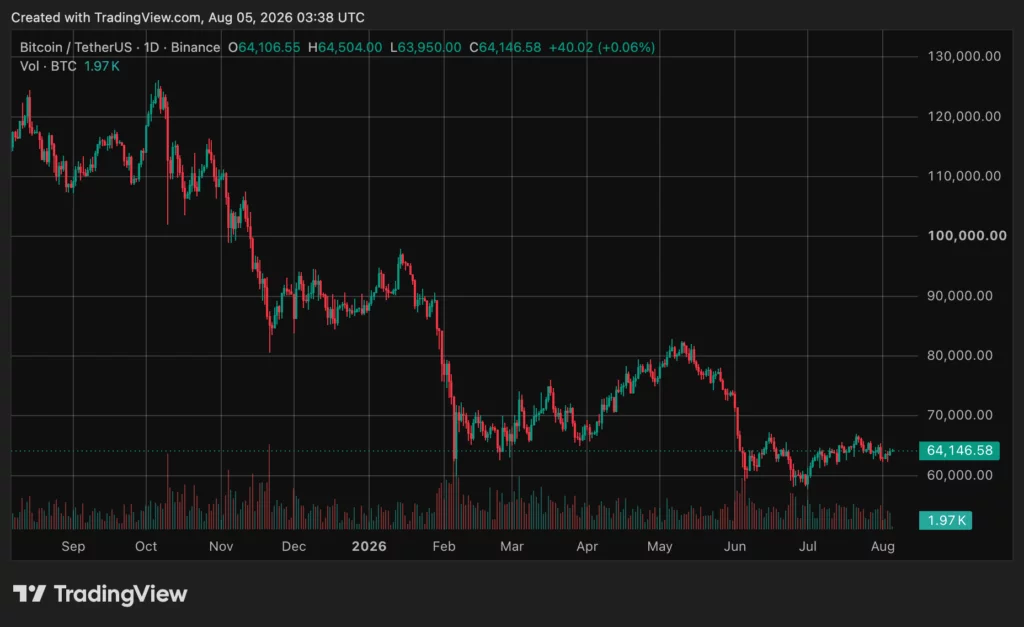
BitMEX cofounder Arthur Hayes published a new essay, “Situationship,” on Aug. 4, 2026, arguing that the artificial intelligence (AI) infrastructure boom could end as a credit crisis rather than a dot com style equity collapse.
Summary
- Hayes argues AI infrastructure resembles leveraged real estate, making a future downturn a credit crisis.
- U.S. hyperscalers continue raising capital spending as cloud demand and artificial intelligence workloads expand rapidly.
- Alphabet raised 2026 capital expenditure guidance to $195 billion to $205 billion amid demand growth.
- Federal Reserve officials held rates at 3.5% to 3.75%, while announcing no AI rescue program.
- Bitcoin traded near $64,337, but Hayes’s essay provided no verified immediate market catalyst for traders.
Hayes framed data centers as leveraged real estate containing computing equipment that can lose economic value as newer chips become more efficient.
Hayes said an eventual slowdown in data center construction could expose weak borrowers and financiers, prompting government intervention and broader monetary easing. He believes the resulting liquidity could support a renewed Bitcoin bull market. However, the scenario remains his personal forecast, not a confirmed crisis or an official policy outlook.
Bitcoin traded around $64,150 early on Aug. 5. No evidence reviewed for this report linked the immediate price move to Hayes’s essay. Hayes also acknowledged that he cannot identify the borrower that might trigger a crisis or determine Bitcoin’s precise bottom.
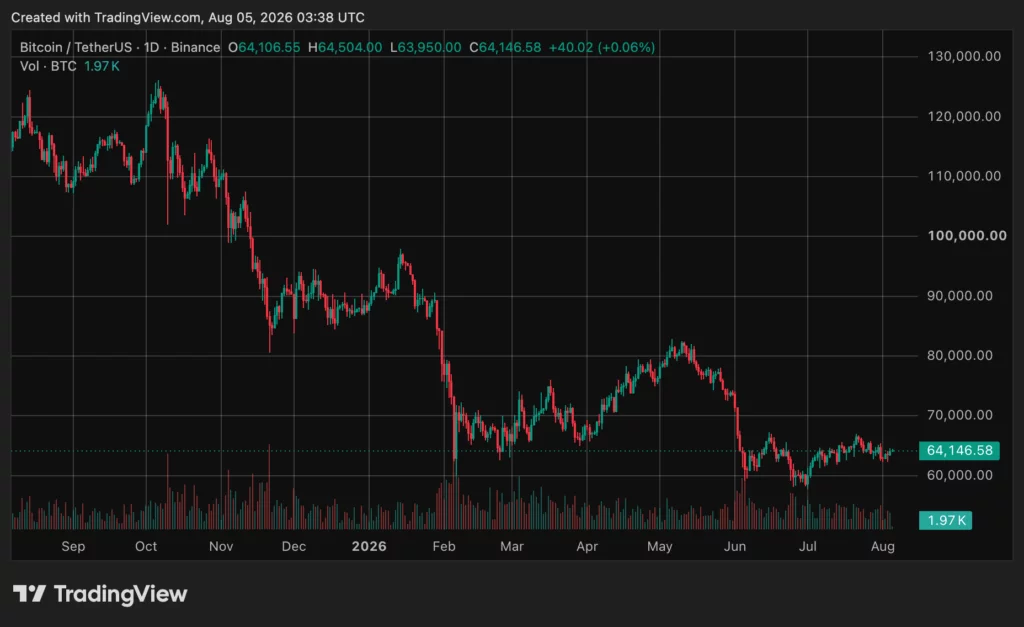
Arthur Hayes says AI spending is a real estate credit trade
Hayes’s central argument is that investors are treating AI capital expenditure as if every dollar supports a high margin technology business. He views much of the spending differently. Data center land, buildings, power connections and cooling systems resemble property development, while processors can become less valuable when newer equipment delivers more computing power at a lower cost.
This distinction leads to his comparison with the global financial crisis. Hayes described the AI boom as a “credit story like 2008 and not an earnings story like 2000.” In his scenario, banks, insurers, private credit funds and infrastructure investors continue financing construction after profitable demand begins slowing.
Losses would then emerge when weaker projects cannot generate enough cash to meet debt, lease or interest obligations. Financial stress could spread to lenders and investors holding AI infrastructure exposure, even if leading technology companies remain profitable.
Hayes expects announced AI capital spending growth to begin slowing during the second half of 2027 and become clearer in 2028. He also expects markets to eventually reward companies that reduce construction plans. Those dates are forecasts. No company filing reviewed for this report confirms that an industrywide contraction has begun.
His Bitcoin case follows from the expected policy response. Hayes argues that U.S. authorities would protect strategically important AI companies and their lenders because computing capacity has become part of the country’s economic competition with China.
He discussed a possible Bitcoin trading range between $60,000 and $70,000, with downside near $50,000, before an eventual rise toward $1 million. Those levels are not guaranteed targets and depend on monetary policy, credit creation and investor demand developing as Hayes expects.
The essay extends an earlier argument. As crypto.news previously reported, Hayes warned that major technology listings, including possible OpenAI, Anthropic and SpaceX offerings, could absorb liquidity that might otherwise enter crypto markets.
In related coverage, crypto.news examined the expanding bond and credit exposure behind AI infrastructure. That analysis noted that financial risks could spread beyond technology shares if data center construction relies more heavily on debt and private financing.
Official filings show AI spending is still accelerating
The latest company results do not show an AI capital spending collapse. Alphabet reported $44.9 billion of capital expenditure during the second quarter. About 60% of its technical infrastructure investment went toward servers, while 40% went toward data centers and networking equipment.
Alphabet raised its 2026 capital spending guidance to between $195 billion and $205 billion, up from its previous range of $180 billion to $190 billion. The company attributed the increase to faster capacity delivery required to meet demand.
Google Cloud revenue rose 82% from the previous year to $24.8 billion. Cloud operating income reached $8.8 billion, while backlog increased to $514 billion. Alphabet said it expects capital expenditure to increase again in 2027.
Microsoft also reported continued expansion. Its quarterly capital expenditure reached $41 billion, with roughly two thirds directed to CPUs and GPUs. Microsoft Cloud revenue increased 27% to $59.3 billion, while commercial remaining performance obligations reached $678 billion.
The company said it expects capital expenditure to grow during fiscal 2027. Microsoft also expects more than $50 billion of spending in its next quarter, although part of that figure reflects a change in how some data center leases will be classified.
Amazon reported a similar mix of rising investment and stronger cloud income. AWS revenue increased 37% to $42.2 billion in the second quarter, its fastest growth in 18 quarters. AWS operating income reached $16.6 billion.
However, Amazon’s trailing twelve month free cash flow moved to an outflow of $7.6 billion. The company attributed the change mainly to a $66.1 billion increase in property and equipment purchases, largely connected to AI investment.
These results cut both ways for Hayes’s thesis. Strong cloud growth and large customer backlogs weaken the argument that demand is already failing. At the same time, lower free cash flow, rising depreciation and growing contractual obligations show how the buildout can pressure finances even while revenue expands.
Heavy spending alone does not create a credit crisis. Such a crisis would require weaker cash generation, refinancing problems, defaults or impaired infrastructure assets across several companies and lenders.
U.S. financing exposure is growing, but 2008 is unproven
Regulatory filings support Hayes’s narrower claim that AI infrastructure increasingly involves leases, guarantees, joint ventures and outside capital.
Alphabet disclosed $85.2 billion of future payments for leases, mainly connected to data centers, that had not started as of June 30. These leases are scheduled to begin between 2026 and 2031, with contract terms reaching as long as 26 years.
Alphabet also reported $811 billion of purchase commitments and other contractual obligations. Most relate to technical infrastructure, inventory, energy agreements and other long term contracts. The company had $98.2 billion of long term debt and issued more than $51 billion of fixed rate notes during the first half of 2026.
Microsoft disclosed $62.9 billion of finance lease liabilities as of March 31. It also reported another $196.6 billion of leases, mainly for data centers, that had not yet commenced.
Meta reported approximately $182.88 billion of uncommenced lease obligations and $237.67 billion of noncancelable contractual commitments as of March 31. The company entered another $24 billion of infrastructure contracts during April.
Private financing is also becoming more visible in U.S. data center projects. Meta and BlackRock announced a venture for a one gigawatt campus in El Paso, Texas. Meta described the project as representing more than $10 billion of investment.
An earlier Meta venture with Blue Owl Capital covered an estimated $27 billion data center campus in Louisiana. Blue Owl funds received an 80% interest, while Meta retained 20%. Part of the outside funding came through debt sold privately to PIMCO and other bond investors.
Meta agreed to lease the Louisiana facilities and provided a capped residual value guarantee under certain conditions. Such arrangements show how data center exposure can be distributed among technology companies, insfrastructure funds, landlords and debt investors.
They do not prove that a 2008 style chain of insolvencies has started. Alphabet, Microsoft, Amazon and Meta remain profitable businesses with large operating cash flows and growing customer commitments. The reviewed filings did not report widespread defaults on AI infrastructure debt or an official government rescue program.
The 2008 comparison therefore remains a stress scenario rather than a present diagnosis. Mortgage losses became systemic because weak lending, securitization, leverage and opaque counterparty exposure spread through major financial institutions.
An AI infrastructure downturn could follow a different route involving unused capacity, falling rental values, obsolete equipment, tenant concentration and long power commitments. Whether those risks become systemic will depend on utilization, refinancing conditions and where losses ultimately settle.
Bitcoin’s outcome depends on policy, liquidity and timing
The Federal Reserve held its federal funds target range at 3.5% to 3.75% on July 29. The decision passed by a 9 to 3 vote. The central bank did not announce an AI rescue facility, emergency lending program or new asset purchase plan.
The Fed has conducted reserve management purchases of Treasury bills to maintain ample banking system reserves. Its July monetary policy report said Treasury bill purchases since early January totaled nearly $250 billion, including about $160 billion of reserve management purchases.
Those operations are not officially described as quantitative easing or an AI bailout. The Fed says they are intended to maintain an adequate level of reserves and support control over short term interest rates.
Hayes interprets balance sheet growth and stable policy rates as supportive for bank credit and future market liquidity. That interpretation remains open to debate because reserve management can expand the Fed’s assets without representing the broad crisis response assumed in his forecast.
Bitcoin could benefit if a future downturn produces rate cuts, emergency lending or larger asset purchases. However, the first stage of a credit shock could hurt Bitcoin as investors sell liquid assets, meet margin calls and reduce leverage.
As crypto.news reported in its examination of Bitcoin’s changing market cycle, Federal Reserve policy and global liquidity now compete with the halving cycle as major drivers of crypto prices.
The next evidence will come from company guidance and credit markets rather than from Hayes’s essay. Investors can watch 2027 spending plans, cloud backlog conversion, data center occupancy, lease commitments, private credit spreads and any defaults tied to AI infrastructure.
The Fed’s next scheduled meeting will take place on Sept. 15 and Sept. 16. Unless company demand weakens or financing stress begins appearing, Hayes’s argument remains a forward looking Bitcoin thesis built around a credit crisis that has not occurred.
FAQs
Is the AI bubble already bursting?
The latest filings do not show an industrywide contraction. Alphabet raised its spending guidance, Microsoft expects continued capital expenditure growth and AWS reported accelerating revenue. Financial pressure is visible in free cash flow and contractual commitments, but those conditions do not constitute a credit bust.
Why does Hayes compare AI with 2008 instead of 2000?
Hayes believes the main vulnerability lies in debt, leases and infrastructure financing rather than technology companies earning little or no revenue. The comparison depends on credit losses spreading through financial intermediaries, which has not been established.
Would an AI crash automatically raise Bitcoin’s price?
No. Bitcoin could decline during an initial liquidation period. A later recovery would depend on the scale, speed and form of monetary support, along with continuing demand for Bitcoin. Central bank easing would not guarantee any particular price.
What would weaken Hayes’s thesis?
Sustained cloud revenue, strong data center utilization, profitable AI services and stable credit performance would weaken the argument. The thesis would also lose force if companies fund construction without creating stressed borrowers or concentrated lender losses.





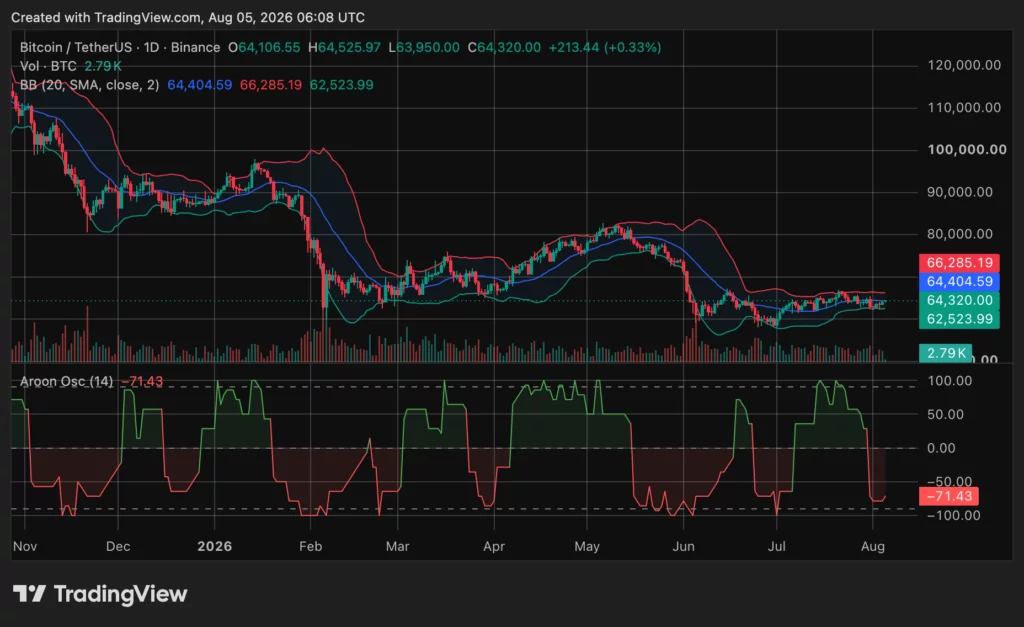
Bitcoin traded near $64,270 on Aug. 5, gaining less than 1% as record equity markets and falling oil prices failed to produce a broad crypto rally.
Summary
- Bitcoin price held above $64,000 while record global equities and cheaper oil failed to spark momentum.
- Brent fell near $78.50 as traders awaited a possible U.S., Iran, and Oman shipping agreement.
- Bitcoin must close above $64,300 on four hour charts to confirm analyst Ali Martinez’s breakout.
- Bollinger Bands place immediate resistance near $66,285 and range support around $62,524 for Bitcoin traders.
- U.S. spot Bitcoin ETFs drew $19.6 million Tuesday, but recent outflows still weighed on demand.
The largest cryptocurrency remained roughly flat over seven days and about 49% below its October 2025 record above $126,000.
Ether and XRP weakened, while BNB and Hyperliquid’s HYPE outperformed among major tokens. The restrained response contrasted with global stocks, where the S&P 500 and Dow closed at records and Asian technology shares rose sharply on strong AI related earnings.
Bitcoin price sits out the latest risk rally
Reuters reported that Japan’s Nikkei gained 3.5%, South Korea’s benchmark rose 4.3%, and an MSCI Asia Pacific gauge excluding Japan advanced 2.3%. Brent crude fell toward $78.85, while the U.S. 10 year Treasury yield eased to about 4.603% as traders reduced expectations for another near term Federal Reserve rate increase.
Those conditions would normally offer support to BTC. Cheaper oil can reduce inflation pressure, while lower bond yields can make non interest bearing assets more attractive. Yet BTC has shown only a limited response across several sessions, suggesting crypto specific demand remains too weak to confirm a wider risk rally.
U.S. spot Bitcoin exchange traded funds recorded $19.6 million of net inflows on Aug. 4, according to Farside Investors. The positive session offered some support, but it followed a period of heavier withdrawals, including about $265 million reported on Aug. 1.
Corporate supply has also returned to the market. Strategy’s official Bitcoin ledger shows the company sold 1,638 BTC for about $105 million, leaving it with 842,138 BTC. The sale was small relative to its holdings, but it removed a source of price insensitive accumulation that had supported earlier rallies.
A Hormuz agreement remains possible, not confirmed
Axios reported that the U.S., Iran, and Oman were approaching a temporary arrangement to reopen the Strait of Hormuz, with an announcement targeted for Wednesday. The proposal would create a 60 day shipping arrangement that could be extended. President Donald Trump later said a deal could arrive Wednesday or Thursday.
No signed agreement had been announced at the time of reporting. Trump described the discussions as “very good,” while Iran and the U.S. still differed on key details. The market therefore remains exposed to another breakdown after an earlier arrangement collapsed and attacks on shipping resumed.
Oil has already priced in part of the expected easing in tensions. The largest crypto has recovered by more than $2,000 from its recent low near $62,200, but the move remains modest compared with the response in equities and crude. A confirmed agreement may reduce a major inflation and geopolitical risk, although it would not guarantee fresh crypto demand.
The crypto rose toward $66,800 after an earlier Hormuz reopening announcement in June.Renewed conflict could expose support below $64,000. The contrast makes the next confirmed diplomatic update a useful test of whether Bitcoin still reacts strongly to the oil and rates channel.
Bitcoin needs $64,300 to confirm a breakout
The supplied four hour setup places $64,300 at the upper boundary of a descending channel. Analyst Ali Martinez said a close above that level “could confirm the breakout” and open a possible move toward $65,500 or $66,500. Those levels are conditional targets, not confirmed outcomes.
The daily chart gives a more cautious reading. The crypto trades near the Bollinger Bands middle line around $64,404. The upper band sits near $66,285, while the lower band is around $62,524. This structure shows consolidation rather than a completed directional move.
The Aroon Oscillator stands at negative 71.43, showing recent lows remain more dominant than recent highs. Holding $62,500 to $63,000 would preserve the range, while a daily move above $66,000 to $66,300 would provide stronger evidence that buyers have regained control.
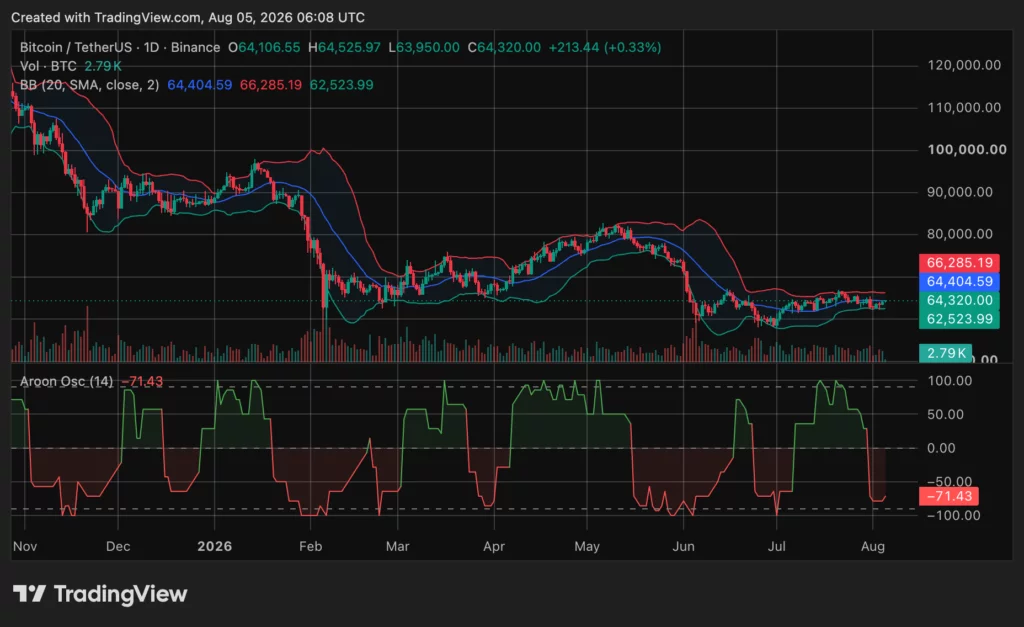
Meanwhile, the next market test is whether a confirmed Hormuz agreement can push the crypto above $64,300 and then through the upper Bollinger Band. Failure to rally after a verified deal would strengthen the view that capital is favoring AI shares, bonds, and gold rather than crypto.
Traders will also watch ETF flows, the $62,500 lower range, and whether Strategy reports further sales. Until volume expands and BTC closes above resistance, the rebound from $62,200 remains a recovery inside a broader downtrend rather than a confirmed trend reversal.
FAQs
Why is Bitcoin lagging behind global stocks?
Bitcoin lacks strong crypto-specific demand despite favorable macro conditions. Record stock prices, falling oil and lower bond yields have not produced enough buying pressure to confirm a breakout. Recent ETF inflows have also remained modest compared with earlier withdrawals.
What is the key Bitcoin price level to watch?
The immediate level is $64,300, which marks the upper boundary of the descending channel on the four-hour chart. A confirmed close above it could support a move toward $65,500 and $66,500, although those targets remain conditional.
Could a Strait of Hormuz agreement lift Bitcoin?
A confirmed agreement could reduce geopolitical and inflation risks by improving shipping conditions and lowering oil prices. However, it would not guarantee a Bitcoin rally. A weak response could indicate that investors currently prefer equities and other assets.
What are Bitcoin’s main support and resistance levels?
Immediate support sits between $62,500 and $63,000. A break below that range could expose the recent $62,200 low. Resistance appears at $64,300, followed by the upper Bollinger Band near $66,285.
What would confirm a stronger Bitcoin recovery?
Bitcoin would need stronger trading volume, sustained ETF inflows and closes above $64,300 and $66,300. Until then, the move from $62,200 remains a rebound within a broader downtrend rather than a confirmed reversal.

Ted is a more awkward fit as a father figure to the Lady Greyhounds because, well, the new gender dynamic could read as less paternal than paternalistic. Make him a voice of reason, and he might be perceived as mansplaining; have him defer too much to his players, and he becomes the cringey, try-hard male feminist he sometimes resembled in previous seasons. The show’s solution is to keep him largely on the sidelines, leaving female characters like Alice and, in one clumsily inserted storyline, erstwhile AFC Richmond therapist Sharon (Sarah Niles) to dispense wisdom on such female-coded issues as intra-team cliques. This puts the players at arm’s length as well. There’s a mom, a couple, a goalie who refuses to wear gloves, but no Roy or Jamie emerges.
Female characters were never the mostly male Ted Lasso creative team’s strength. Despite charming performances from Waddingham and Temple, Rebecca and Keeley’s business plot never lives up to its potential because these colleagues continue to interact like giggly teenagers at a slumber party. Although there are plenty of women writing and directing in Season 4, Alice—the highlight of the series’ second act so far—is the only substantial character who doesn’t feel filtered through the male gaze.


BitMEX co-founder Arthur Hayes said the debt-fueled artificial intelligence infrastructure boom could end in a 2008-style credit crisis and predicted the resulting government liquidity response could drive Bitcoin (BTC) to $1 million or higher.
In a Tuesday blog post, Hayes said investors have mistakenly treated spending on data centers and power infrastructure as high-growth technology investment rather than leveraged real estate. He said he expects lenders to finance excessive construction before a slowdown in AI capital expenditure exposes weaker borrowers.
The thesis connects the trillion-dollar expansion of AI infrastructure to a potential new source of crypto-market liquidity. However, Hayes’ predicted crisis, government bailout and subsequent BTC rally remain speculative.
Hayes described the AI boom as a “credit story like 2008 and not an earnings story like 2000.” He said BTC could remain between $60,000 and $70,000, with possible downside to $50,000, before the credit cycle and resulting liquidity response drive a recovery. Hayes also forecast that Ether (ETH) would reach $5,000 by year-end and said Maelstrom intends to build a significant position while selling out-of-the-money ETH put options.
Hayes’ latest outlook builds on his earlier views on AI’s competing effects on crypto liquidity. On May 13, he said US-China competition in AI would encourage bank lending and fiat creation, benefiting Bitcoin. On June 4, Hayes sold HYPE and NEAR after warning that major AI listings could divert capital from crypto.
Big Tech locks in $1 trillion of future leases
The scale of commitments underpinning the AI boom is already visible. On Tuesday, Reuters reported that Microsoft, Meta, Oracle, Amazon and Alphabet have committed about $1.09 trillion to leases that have not yet commenced, primarily for data centers.
The commitments are nearly four times the roughly $285 billion in lease liabilities already recognized by the companies. However, Reuters noted that the $1.09 trillion cannot simply be treated as debt because it represents undiscounted payments spread across several years.
Related: Iran war, AI spending could push Bitcoin back to $126K this year: Hayes
Still, the financial strain is uneven. Oracle’s debt was about 4.3 times its earnings before interest, taxes, depreciation and amortization, while Alphabet, Amazon, Microsoft and Meta had ratios below one, according to a separate Reuters analysis.
S&P Global analyst Andrew Chang said Oracle’s data-center leases, which run for 15 to 19 years, pose a key risk because its customer contracts last no more than five years.
Magazine: Why Meta is choosing partners over power in its 2026 stablecoin push

Cardano’s ecosystem recorded several important developments between July 30 and August 5th. These range from a new cross-chain connection to changes in the way governance representation works.
Meanwhile, ADA briefly approached $0.20 after gaining over 20% over the past week. Here are some of the most important Cardano news and an update on ADA’s price action from the past few days.
Cardano Connects With Injective Through IBC
Cardano and Injective established their very first connection through the Inter-Blockchain Communication protocol on the testnet.
In an official announcement, Injective said the integration is designed to eventually allow ADA to enter its ecosystem while INJ itself becomes fully available on Cardano.
The testnet deployment creates a direct cross-chain rail and is intended to represent another step toward improving the compatibility of Cardano with other networks outside its existing ecosystem.
JUST IN
: Cardano is now officially connected to Injective, the first blockchain to have a live onchain rail to Cardano via testnet.$ADA is coming to Injective. $INJ is coming to @Cardano. Both will be available across the two ecosystems. pic.twitter.com/ECnexrfx8c
— Injective
(@injective) August 3, 2026
Development Shifts Toward the Dijkstra Era
Following the completion of the van Rossem upgrade, Cardano developers turned their attention to the upcoming Dijkstra development era. According to the latest update, planned work includes Nested Transactions and Linear Leios, with both targeted for mainnet implementation by the end of this year.
Recall that van Rossem previously introduced improvements, including Plutus performance, ledger consistency, and improved node security.
New Governance Tools Move On-Chain
In another important piece of news, Cardanoo has moved the election of its Constitutional Committee onto the blockchain, making the voting process easier to verify and more transparent. The committee is responsible for checking whether major governance decisions follow the Cardano constitution.
Meanwhile, the ecosystem has also opened a new portal where community members can test how future changes to that constitution may be proposed. Additionally, ADA holders, as well as their representatives, can now vote on a separate proposal to adjust some of the network’s technical settings.
Together, these updates give the community a more direct role in the way Cardano is managed and developed.
EMURGO Steps Down from Intersect’s Board
EMURGO announced its immediate resignation from the Intersect board. The organization plans to deregister its delegated representatives.
The decision followed serious community criticism surrounding governance participation and the delegation experience within Yoroi Wallet.
EMURGO acknowledged that both positions carried significant responsibilities and said the changes are intended to address these specific concerns.
The departure has once again renewed discussions about accountability among Cardano’s major ecosystem organizations.
ADA Price Update: One-Month High and Renewed Bullish Expectations
ADA climbed from around $0.15 in late July to a one-month high of approximately $0.195 on August 4th. The move, at the time, represented a weekly gain of roughly 26%, although the cryptocurrency has since pulled back as traders look to book some profits.
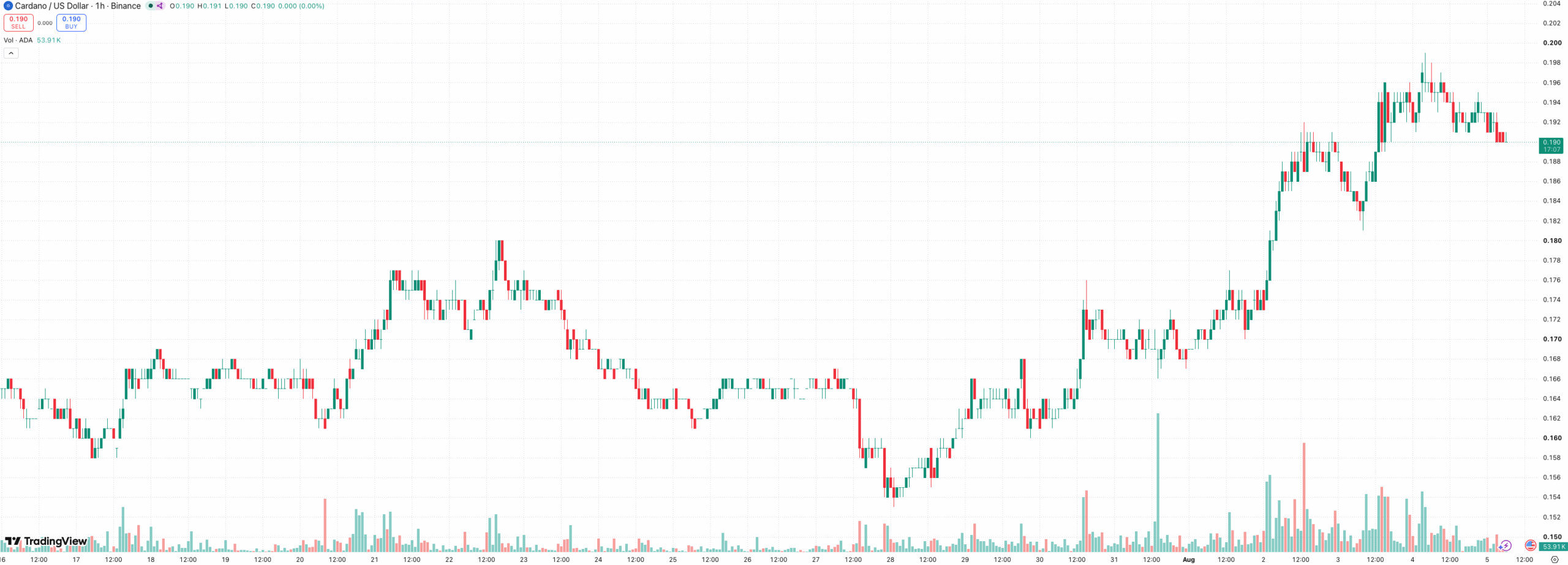
The rally started during the weekend, when ADA jumped by 9% and outperformed a lot of the large-cap altcoins.
One possible reason for the move was the increased buying from large investors. Whales accumulated more than 240 million ADA within five days, helping it soar by roughly 22% during that same period.
ADA is now testing a very important resistance area between $0.19 and $0.20. Some analysts believe that a successful break above it could open the way toward $0.28-40.30.
However, it’s also important for the cryptocurrency to remain above $0.17 to protect its improving short-term structure – from a strict technical perspective.
The post Important Cardano News and ADA Price Update: August 5th appeared first on CryptoPotato.
Arthur Hayes says Bitcoin’s climb to $1 million depends on the AI industry’s credit problems, not its earnings. In a new essay titled “Situationship,” the BitMEX co-founder makes his case.
He argues that AI data center spending resembles 2008-style debt speculation rather than 2000-style dot-com overvaluation. He expects central banks to print enough money to eventually rescue over-leveraged AI lenders. That flood of liquidity, he says, is what carries Bitcoin toward seven figures.
Why Hayes Separates AI From the Dot-Com Bubble
Hayes argues investors mistake data centers for pure technology. In his view, they are really real estate developments packed with fast-depreciating chips.
He made a related case in May. Back then, he called AI spending history’s largest fiat credit bubble and set an initial Bitcoin price target near $126,000.
“AI CAPEX is just another boring real estate play”
— Arthur Hayes,
In his view, hyperscalers increasingly fund data centers with borrowed money, not free cash flow. That shifts default risk onto banks and bondholders.
He compares this to the 2006-2008 mortgage cycle. Lending kept flowing even after home price growth stalled. It only broke once construction spending actually contracted.
The Bailout Mechanism Behind the $1 Million Call
Hayes expects AI capital spending growth to decelerate in 2027. That slowdown, he says, will expose the weakest data center loans. He argues the Fed and Treasury will respond the way they did in 2008 and 2020. That means emergency lending facilities, and possibly direct equity purchases, to prevent a systemic default.
His forecast follows a familiar pattern from the Fed. Chair Kevin Warsh held interest rates steady at his second meeting in late July. Three FOMC members dissented, favoring a hike. Markets now price high odds of a rate hike later this year.
Hayes reads that hold as evidence authorities will keep credit flowing. He sees continued bank lending to AI projects as further confirmation officials won’t let weak borrowers fail.
This isn’t Hayes’s first seven-figure Bitcoin call. He made a similar $1 million prediction last year based on an expected Fed shift toward yield curve control.
This time, he ties the call to AI credit stress instead. He also reiterated a $5,000 Ethereum target for the end of 2026. Hayes points to Ethereum’s emerging role as a settlement layer for tokenized real-world assets.
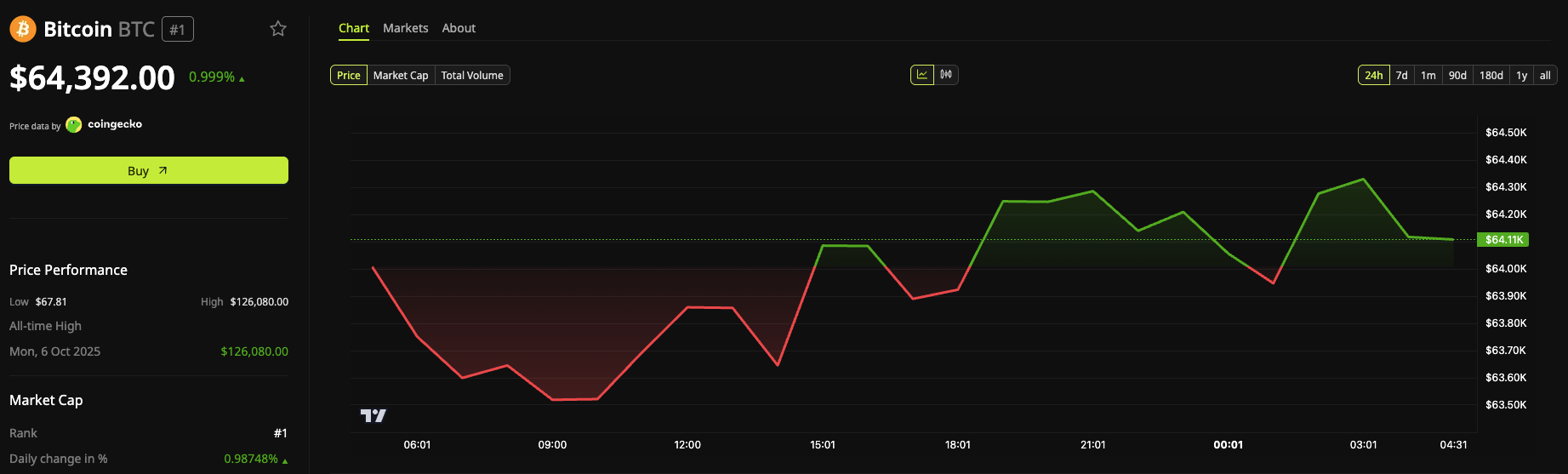
Bitcoin traded near $64,300 at the time of writing, up roughly 1% over 24 hours, per BeInCrypto data.

Hayes has also called for a Bitcoin bottom near $40,000 before any run toward his higher targets. That framework leaves room for further downside first. Whether the AI credit cycle actually unwinds on his 2027 timeline remains the open question. Investors will likely watch hyperscaler earnings and bank loan books for early signs over the coming quarters.
The post Arthur Hayes Says Bitcoin’s Going to $1 Million After an AI Credit Bust appeared first on BeInCrypto.
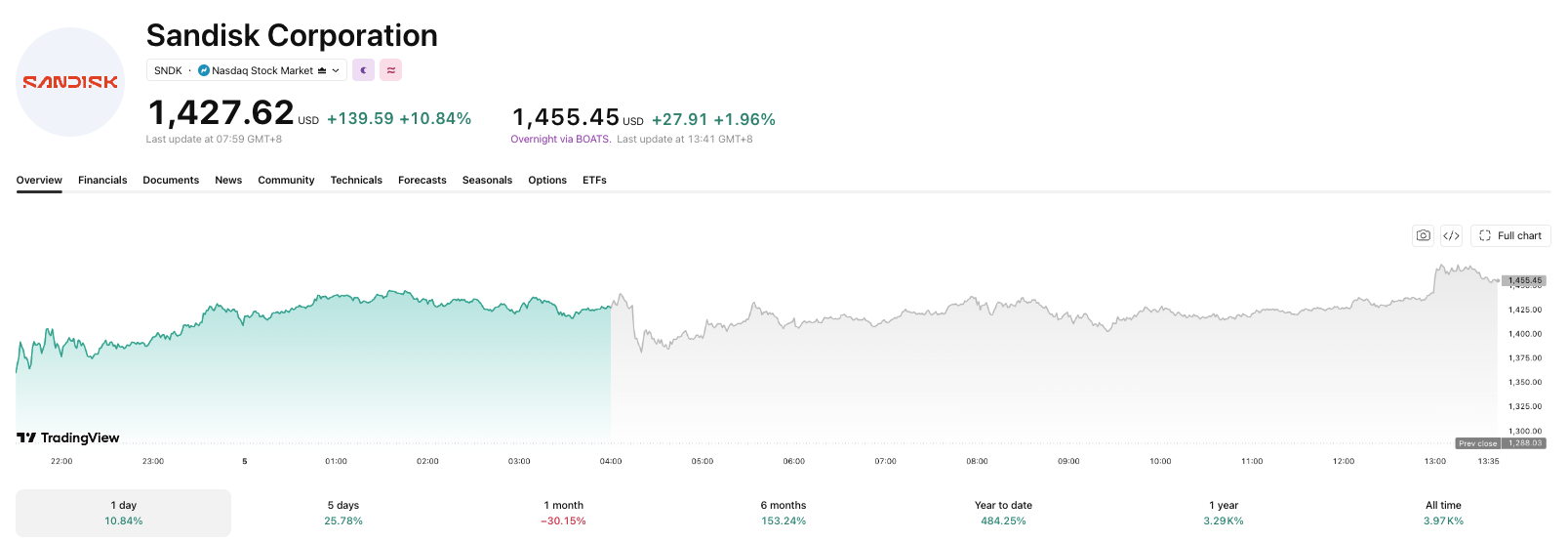
SanDisk stock jumped 10.84% on Tuesday following a new AI memory milestone with SK Hynix. The companies advanced their ongoing collaboration by releasing the first industry specification for High Bandwidth Flash (HBF) technology.
SanDisk also presents a keynote on AI memory today at the Future of Memory and Storage (FMS) Conference, just hours before its earnings call. Google and Tenstorrent joined the HBF consortium during the standardization process, adding credibility to the new standard.
A New Memory Tier for AI Chips
The Open Compute Project (OCP), an industry group that builds open hardware standards, published the HBF specification this week. The standard gives chip designers a shared framework for using HBF in AI accelerators.
It fills a gap left by High Bandwidth Memory (HBM), which is fast but capacity-constrained. In contrast, solid-state drives hold more data at slower speeds.
The specification supports NAND stacking up to 512GB per die stack. It also defines three performance tiers, with read speeds reaching 3.0 terabytes per second.
SanDisk and SK Hynix started the HBF consortium in February. Google and Tenstorrent joined as members during the specification’s development. SanDisk Chief Technology Officer Alper Ilkbahar called the release a major step for the technology.
“an important milestone for the HBF ecosystem”
Alper Ilkbahar, SanDisk’s chief technology officer, said in a statement.
Earnings Loom as Memory Stocks Rebound
SanDisk reports fiscal fourth-quarter results after markets close today. Wall Street expects earnings near $33 per share on revenue around $8.3 billion, up sharply from $0.29 a year earlier. However, SanDisk shares pulled back in premarket trading Wednesday, as some investors turned cautious ahead of tonight’s results.

SanDisk shares fell roughly 47% last month during a broader memory sector selloff. Meanwhile, SK Hynix shares have swung just as sharply since their Nasdaq debut in July.
The rebound reflects a tighter link between Korean and US markets, as AI infrastructure spending increasingly moves both in tandem.
Today’s earnings will show whether the AI memory story behind Tuesday’s rally holds up under closer scrutiny.
The post SanDisk Stock Jumps 10% on New AI Memory Milestone With SK Hynix Ahead of Earnings appeared first on BeInCrypto.
A wallet identified by onchain analytics platform Lookonchain as being associated with Strategy transferred 1,030 Bitcoin worth about $66.14 million on Aug. 5.
Summary
- A suspected Strategy wallet moved 1,030 Bitcoin, but no official sale has been confirmed yet.
- Strategy officially sold 1,638 Bitcoin last week, raising $104.73 million for preferred dividends and repurchases.
- Strategy reported 842,138 Bitcoin holdings, acquired for $63.51 billion at an average $75,419 per coin.
- MARA transferred 6,000 Bitcoin to Two Prime, where it already maintains managed institutional investment arrangements.
- MARA previously allocated 2,000 Bitcoin to Two Prime’s institutional yield strategies under a managed account.
The movement came two days after Strategy officially disclosed another Bitcoin sale, increasing scrutiny of the company’s changing treasury policy. Lookonchain’s post described the addresses as wallets linked to Strategy.
However, Strategy has not confirmed that the latest transfer represented a sale. Its most recent Securities and Exchange Commission filing reported holdings of 842,138 BTC as of Aug. 2. No later filing had reduced that figure when this report was prepared.
Strategy transfer is not yet a confirmed Bitcoin sale
Lookonchain asked, “Is Michael Saylor’s Strategy dumping BTC again?” The wording reflects uncertainty. Wallet attribution can indicate that an address is likely connected to an organization, but an onchain transfer alone does not establish its purpose or legal ownership.
Bitcoin can move between custodians, internal wallets, trading accounts and settlement addresses without being sold. Confirmation would require a company disclosure, an identified exchange deposit followed by trading activity, or other evidence showing that ownership changed.
Strategy’s public Bitcoin ledger still lists 842,138 BTC following the company’s Aug. 3 update. The ledger records transactions reported by Strategy rather than every transfer attributed to the company by external analytics firms.
The latest movement occurred after the Aug. 2 reporting cutoff in Strategy’s filing. It could therefore appear in a later update if it represents a sale under the company’s Bitcoin monetization program.
Strategy officially sold 1,638 BTC for $104.73 million
Strategy confirmed that it sold 1,638 BTC between July 27 and Aug. 2. The company received $104.73 million after fees, equal to an average sale price of $63,957 per Bitcoin. The official figure is higher than the roughly $102.4 million cited in some early reports.
Strategy used $52.4 million of the proceeds to fund preferred stock dividends. It directed the remaining $52.3 million toward repurchases of its STRC preferred shares. The company separately bought back 912,143 STRC shares for $81.2 million during the period.
Its remaining 842,138 BTC had an aggregate purchase price of $63.51 billion and an average cost of $75,419 per coin. The company also reported a $4 billion U.S. dollar reserve, including unsettled proceeds from common stock sales.
The transaction was permitted under Strategy’s Bitcoin monetization framework, which its board approved in June. The framework allows Bitcoin sales to support the cash reserve, pay dividends or interest, and finance approved security repurchases. It does not require Strategy to sell any specific amount.
As crypto.news reported, the Aug. 3 disposal followed earlier sales that marked a departure from Strategy’s previous focus on continuous accumulation. Its ledger shows four reported 2026 sales totaling 5,258 BTC.
MARA’s Two Prime transfer may involve asset management
Separately, Lookonchain reported that MARA transferred 6,000 BTC, worth approximately $384.6 million at the time, to addresses identified as belonging to Two Prime. The analytics firm cautioned that the movement “doesn’t necessarily mean a sale” and could relate to asset management.
MARA has an established financial relationship with Two Prime. In July 2025, the miner led a $20 million investment in the firm and expanded its managed Bitcoin allocation from 500 BTC to 2,000 BTC. Two Prime manages institutional trading, lending and Bitcoin yield strategies.
An SEC filing showed that MARA transferred 2,000 BTC into a separately managed account during 2025. The account held 1,903 BTC by Sept. 30 after recording a net trading loss of roughly 97 BTC.
The new 6,000 BTC transfer could expand the arrangement, move assets between custody accounts or support another financial transaction. Those possibilities remain unconfirmed. MARA’s 2025 annual report says it may buy or sell Bitcoin depending on market conditions and capital allocation priorities.
In related coverage, crypto.news reported that MARA increased its holdings to 36,303 BTC in June after selling 15,133 BTC during March to support a $1 billion convertible debt repurchase.
Official filings will determine whether more Bitcoin was sold
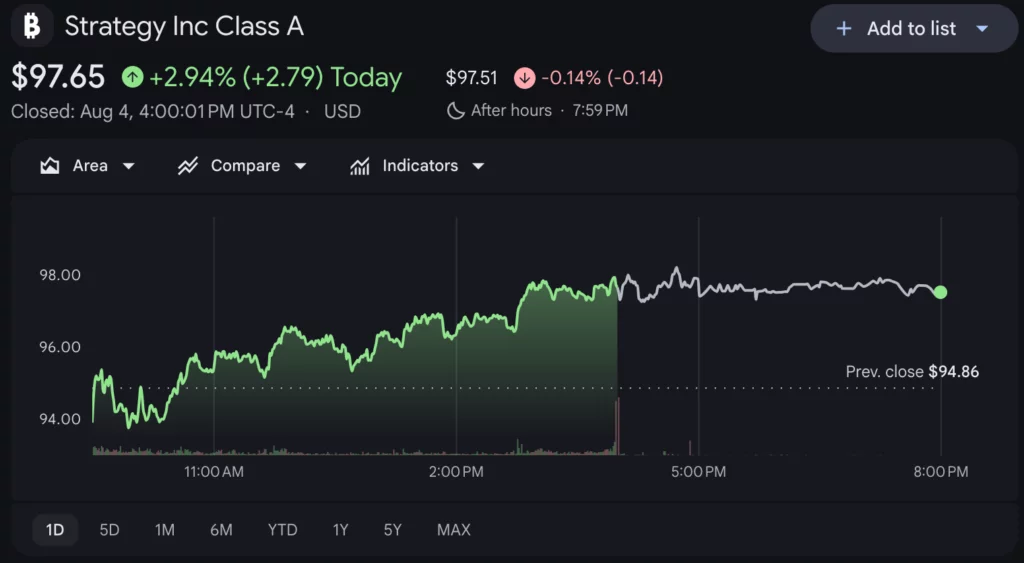
Bitcoin traded near $64,387 at the time of reporting, up about 0.95%. Strategy shares rose approximately 2.9% to $97.65 during the latest U.S. session, while MARA shares were nearly unchanged at $11.75. The market data showed no immediate broad selloff tied to the reported transfers.
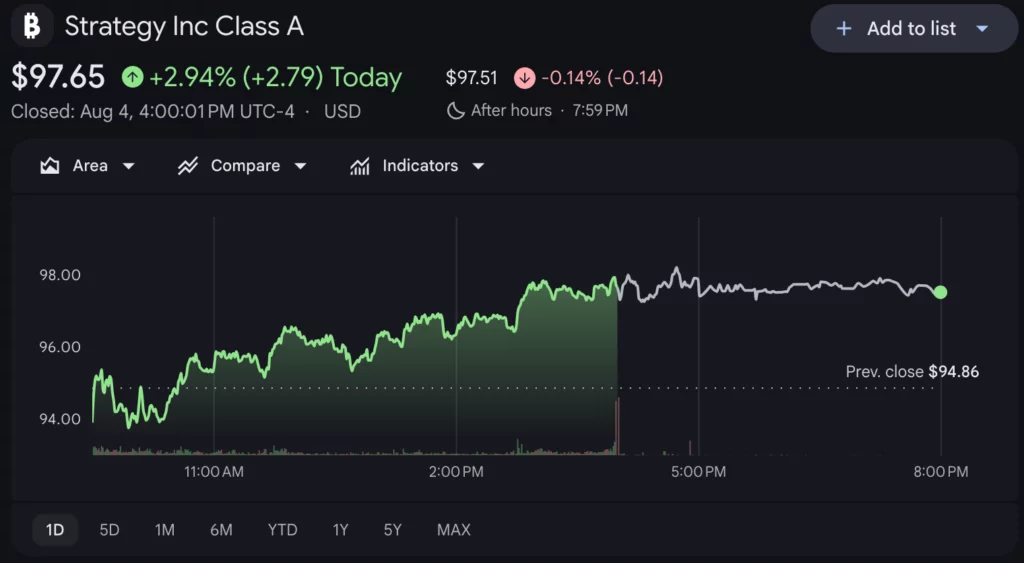
Strategy says it will disclose material Bitcoin monetization through its customary Form 8-K filings and its public dashboard. Its next update should show whether the 1,030 BTC movement changed the company’s reported holdings.
MARA investors will similarly need an SEC filing or company statement to determine whether its 6,000 BTC remains under company ownership. Until those disclosures arrive, both movements should be treated as transfers rather than confirmed sales.


Cloudflare began the first stage of its programmable wallet rollout on Aug. 4, allowing customers to claim unique wallet handles for future stablecoin payments by artificial intelligence agents.
Summary
- Cloudflare users can claim wallet handles now, while stablecoin funding and payment functions remain forthcoming.
- Account Wallets will hold funds, while Virtual Wallets let authorized agents make controlled purchases online.
- Owners can cap allowances, approve merchants, limit transaction sizes, and require human overrides when needed.
- x402 processed 75.41 million transactions and $24.24 million in volume during the last thirty days.
- Cloudflare has not disclosed supported stablecoins, networks, custody partners, fees, or full launch timing yet.
The official Cloudflare announcement said users can reserve a handle tied to their Cloudflare account through cloudflare.pay. However, the company said the ability to fund wallets and use them to purchase APIs, data and online content will arrive “soon.” It did not provide a launch date.
The distinction means Cloudflare has opened the identity layer of the product rather than a fully functioning payment service. Customers cannot yet assume that the stablecoin storage, withdrawal or automated spending features described by the company are broadly available.
Cloudflare Wallets begin with handles, not payments
Cloudflare plans to offer two wallet types. Account Wallets will be controlled by individual or organizational customers. Users will be able to add funds, withdraw balances and delegate spending authority to wallets operated by their AI agents.
Virtual Wallets will operate through API keys. An agent will use the wallet to purchase services within permissions established by the Account Wallet owner. Cloudflare listed APIs, Model Context Protocol tools, data, AI inference and online content as potential purchases.
The company is also building a human readable identity system around the wallets. A business could assign an agent an address such as research.example.cloudflare.pay, allowing merchants to associate the software with a particular organization. Declaring that identity will remain optional. Merchants will decide whether to serve unidentified agents or give priority to known ones.
Cloudflare compared the system with the way the Domain Name System links readable website names to less readable internet addresses. The wallet handle will be connected to an agent’s cryptographic key rather than replace the underlying verification process.
Spending controls aim to limit autonomous agent risks
Cloudflare said Account Wallet owners will be able to set allowances, approved merchant lists and maximum transaction sizes. These controls are intended to let agents test low cost services without requesting human approval for every purchase.
A company could, for example, give each employee’s agent a weekly budget for AI inference. When a wallet reaches its limit, the agent could request a manual override from an authorized administrator. Unexpectedly fast spending could also trigger a review before the owner increases the budget or adds more funds.
Cloudflare presented these limits as protection against overspending. However, it has not published technical documentation explaining how lost API keys, compromised agents, disputed payments or unauthorized purchases will be handled.
The company has previously worked with Visa and Mastercard on systems that help merchants distinguish approved shopping agents from malicious bots. Visa’s Trusted Agent Protocol and Mastercard’s Agent Pay use Cloudflare’s Web Bot Auth system to verify cryptographic signatures and confirm whether an agent intends to browse or complete a payment.
x402 connects agent wallets with paid online resources
The wallets form the buyer side of Cloudflare’s planned agent commerce system. Its Monetization Gateway will provide the seller side by allowing website owners and developers to charge for pages, datasets, APIs and MCP tools.
As crypto.news previously reported, Cloudflare opened the Monetization Gateway waitlist in July. Customers will be able to set fixed or variable prices and require payment before Cloudflare passes a request to their server.
Payments will use x402, an open protocol that attaches payment instructions to standard HTTP requests. When an agent requests a paid resource, the server returns an HTTP 402 “Payment Required” response containing the price and settlement instructions. The agent pays and resubmits the request with payment proof.
Coinbase introduced x402 in 2025 and later formed the x402 Foundation with Cloudflare. The foundation aims to maintain the system as a neutral standard rather than a protocol controlled by one company or blockchain.
The x402 website reported 75.41 million transactions, $24.24 million in volume, 94,060 buyers and 22,000 sellers over the latest 30 day period at the time of reporting. Those figures are live protocol metrics and may change as new activity is recorded.
In related coverage, crypto.news reported that Amazon Bedrock AgentCore integrated x402 payments, allowing agents to purchase services using USDC. That rollout shows Cloudflare is entering a growing market that already includes cloud providers, payment companies and blockchain developers.
Full wallet access depends on compliance and funding support
Cloudflare said it will initially offer conventional funding and withdrawal methods in supported locations. Eligible customers will also be able to fund their wallets directly with stablecoins. The company has not identified the first countries or regions included in that rollout.
It also has not disclosed which stablecoins or blockchains the wallets will support. The announcement did not name a custodian, banking partner, onramp provider or entity responsible for identity and compliance checks. Pricing, transaction fees and withdrawal limits also remain unknown.
These details will determine how widely companies can deploy the product. Wallet services involving stablecoin custody and fiat conversion can face different regulatory requirements across U.S. states and international markets.
The next verified update should clarify when Cloudflare customers can fund Account Wallets, create Virtual Wallets and complete live x402 purchases. Until then, users can claim wallet handles, but the core stablecoin payment features remain a planned service rather than a completed general release.

BH Live kickstarts Southampton investment programme

Future Of Bitcoin

One of Elon Musk’s discarded SpaceX rockets crashes into the MOON at 5,400mph – producing a blast equivalent to 15,000 sticks of dynamite and carving out a brand new crater


-

 Business6 days ago
Why Trees Belong on the Risk Register
-

 Fashion5 days ago
Weekend Open Thread: Wit & Wisdom
-

 Politics4 days ago
Meta enters AI-training agreement with far-right ‘propaganda rag’ Newsmax
-

 Politics7 days ago
Reform UK betrays West Mids residents by running from party pledges
-

 Crypto World4 days ago
MicroStrategy Post-Earnings CLARITY Act Push Could Add New Catalyst for Its Stock
-

 Politics3 days ago
Zack Polanski: an incitement to murder Nigel Farage?
-

 Crypto World4 days ago
XRP Ledger v3.3.0 brings five institutional features
-

 News Videos6 days ago
Bitcoin Enters the 3rd Stage of the Bear Market
-

 Politics6 days ago
Luke Littler’s dominance sparks GOAT debate
-

 Sports5 days ago
Seema Kaliramna Wins Discus Throw Bronze, Takes India’s CWG Medals Tally To 17
-

 Crypto World4 days ago
New York sues Kalshi over prediction market gambling
-

 Crypto World3 days ago
Crypto PAC spending tops $2M in Michigan House race
-

 Tech7 days ago
Gemini can now summarize the messiest comment threads in Google Docs
-

 Business5 days ago
Trump Announces Hamas Disarmament Agreement as Iran Strikes Kuwait Air Base and US Attacks Pause Overnight
-

 Tech3 days ago
ESET tracks rise in malicious AI skills and adaptable malware
-

 Business2 days ago
DTCR: Deleveraging And A Hedge Fund Collapse Point To A Possible AI Bottom
-

 Tech5 days ago
Building A Reproduction PlayStation Motherboard
-

 Tech5 days ago
Gemini Spark can now use Chrome logins and saved passwords to run errands on your behalf
-

 NewsBeat6 days ago
Four people die trying to cross Channel in small boats
-

 Sports7 days ago
Sakshi, Arundhati Enter Boxing Semi-Finals. India Assured Of 18 Medals At CWG 2026
You must be logged in to post a comment Login