
Crypto World
Black Girl (1966)






Cointelegraph is committed to providing independent, high-quality journalism across the crypto, blockchain, AI, and fintech industries.
All news, reviews, and analyses are produced with full journalistic independence and integrity. For more details on our standards and processes, please read our Editorial Policy.


Robinhood has filed to raise up to $200 million for its second publicly listed venture fund, offering retail investors access to seed-stage startups while introducing performance fees that were absent from its first fund.
Summary
- Robinhood has filed to raise up to $200 million for its second public venture fund focused on seed stage startups.
- The new fund introduces a 2% management fee and a 20% performance fee, unlike Robinhood’s first venture fund.
- RVII will invest mainly in companies linked to Y Combinator and is expected to begin trading on the NYSE on Aug. 13.
- The launch extends Robinhood’s effort to expand beyond crypto trading and public markets into private company investing.
According to regulatory filings reviewed by multiple publications, Robinhood Ventures Fund II (RVII) plans to offer 7.6 million shares at $25 each, while Robinhood will separately sell another 400,000 shares. The fund is expected to begin trading on the New York Stock Exchange under the ticker RVII on Aug. 13, subject to regulatory approval.
Goldman Sachs is serving as the lead bookrunner for the RVII offering, while Citigroup, JPMorgan, UBS and Wells Fargo are acting as joint bookrunners. According to the filing, the subscription window is scheduled to close on Aug. 12, one day before the fund is expected to begin trading on the NYSE.
Robinhood moves from late-stage startups to early funding
Unlike Robinhood Ventures Fund I, which concentrated on later-stage private companies such as Databricks, Stripe, OpenAI and SpaceX, the new vehicle has been structured around much earlier investments.
Regulatory documents show RVII will launch with holdings in about 80 private companies and will primarily invest in seed-stage businesses linked to startup accelerator Y Combinator, including current participants, former participants and companies founded by YC alumni.
Robinhood Ventures head Sarah Pinto said the new fund is intended to let retail investors participate in a company’s growth before it reaches the public markets instead of waiting for an initial public offering.
The filing also notes that Robinhood has permission to reference the Y Combinator name, although the accelerator does not sponsor, endorse or accept responsibility for the fund or its investment performance.
Y Combinator has backed more than 5,000 startups since 2005, with those companies collectively reaching a reported valuation of more than $1.3 trillion and producing over 100 unicorns, according to information cited in the filing.
Robinhood venture fund introduces new fee structure
The second fund also changes how investors will be charged.
While Robinhood Ventures Fund I did not impose a performance fee, RVII will charge a 2% annual management fee alongside a 20% incentive fee on realized gains. Regulatory disclosures cited by The Defiant estimate the fund’s annual expense ratio at roughly 4.18%.
The prospectus further describes the investment as speculative, warning of substantial risk of loss. It also states that shareholders will not have redemption rights, meaning investors cannot redeem shares directly with the fund before liquidation.
Robinhood’s first venture fund raised about $658.4 million after launching in March. Although the portfolio focused on more mature private companies that the company’s finance executives previously described as carrying lower risk than early-stage ventures, the fund still dropped roughly 16% on its first trading day before later recovering about 30%.
Rich Aberman, portfolio manager for RVII and a former Y Combinator founder and visiting partner, said the firm’s long-term objective is to make retail investors a regular presence on seed and Series A capitalization tables.
Expansion continues beyond crypto trading
The latest fundraising effort comes as Robinhood continues adding new investment products alongside its traditional brokerage and cryptocurrency businesses.
As crypto.news previously reported, the company recently secured registration with the UK’s Financial Conduct Authority, allowing its UK subsidiary to offer crypto services under the country’s existing anti-money laundering framework before a new crypto authorization regime begins rolling out.
Robinhood said the approval positions the company to launch cryptocurrency services in the UK after previously confirming plans to expand into the market during its second-quarter earnings report.
The company has also continued building products outside spot crypto trading. During the second quarter, Robinhood launched Robinhood Chain, expanded Stock Tokens to more than 120 countries, introduced Robinhood Earn and completed its acquisition of WonderFi, even as crypto transaction revenue declined to $100 million from the previous year.
Financial results released last week showed total net revenue increased 32% year over year to $1.31 billion, supported by growth across options, equities and event contracts. Robinhood reported that event contracts generated $156 million in revenue during the quarter, making them its fastest-growing transaction business.
Prediction markets remain another area of growth
At the same time, Robinhood has continued expanding the infrastructure behind its prediction markets business.
Back in July, The Wall Street Journal reported that Robinhood had discussed adding Crypto.com’s event contracts to its prediction markets hub. Neither company confirmed that an agreement had been reached, and the report said the discussions could still end without a finalized deal.
Robinhood has said it intends to work with multiple exchanges instead of relying on a single supplier. Its platform already distributes contracts through Kalshi, ForecastEx and Rothera, the exchange it operates through a joint venture with Susquehanna International Group.
Earlier this year, Bernstein raised its Robinhood price target and projected the company’s prediction-market revenue could reach approximately $1.7 billion by 2028. The research firm also estimated about $586 million in revenue from the business during 2026, supported by increased trading activity and expanding exchange partnerships.

Bitcoin activity has surged sharply over the past week, with 712,000 addresses active in the past seven days, according to Santiment’s findings. That marks a three-month high.
Whale activity also hit a five-month high. 61,800 transactions worth more than $100,000 were recorded during the period.
Coldcard Fallout Drives Network Activity
Santiment flagged the recent security incident involving Coldcard hardware wallet as the obvious catalyst behind the rise in activity. Reports linked the late-July attacks to weak keys generated by affected devices. Santiment estimates losses at above 2,055 BTC, or about $130 million. It said affected users rushed to move funds, consolidate wallets and reduce their exposure.
Meanwhile, Galaxy Research identified that the tokens were stolen from 7,300 addresses across three confirmed waves of attacks. It also found 14 smaller security incidents. The firm also said the exploits linked to an issue affecting seeds generated on Coinkite’s Coldcard Mk3, Mk4, Mk5 and Coldcard Q firmware versions.
Coinkite later released emergency firmware updates for all affected models and confirmed destroying the remaining vulnerable inventory. The issue became public on July 30. The incidents appeared to involve automated, programmatic sweeps, with possible assistance from large language models.
Galaxy Research said it suspects the losses could be higher if a potential fourth wave of attacks is confirmed. The firm, however, did not receive specific confirmation from victims.
Santiment also warned that Bitcoin volatility could remain elevated over the next few weeks. Fear could push retail investors to sell. At the same time, continued whale accumulation and “security-driven” movement of coins could reduce liquid supply over the coming months if stronger holders continue absorbing the panic.
Cash-Out Hurdles
The stolen Bitcoin may not be easy to turn into cash, Trace Finance co-founder and CTO Leone Parise told CryptoPotato. On the monetization prospects of the stolen funds, Parise said,
“Not at anything close to face value. These are the most heavily surveilled UTXOs in BTC’s history: dormant for years, then moved in a burst, which is exactly the kind of signature that makes clustering trivial. Bitcoin can’t be frozen, but every regulated on-ramp can refuse these coins.
That leaves mixers, cross-chain bridges, OTC desks in weak jurisdictions, and peer-to-peer channels, all of which cost real money and introduce counterparty risk. They’ll extract a fraction, over years, with heavy leakage. $100M on-chain is not $100M in the bank.”
The post Bitcoin (BTC) Whales Are Moving Big as Coldcard Chaos Sends Shockwave appeared first on CryptoPotato.


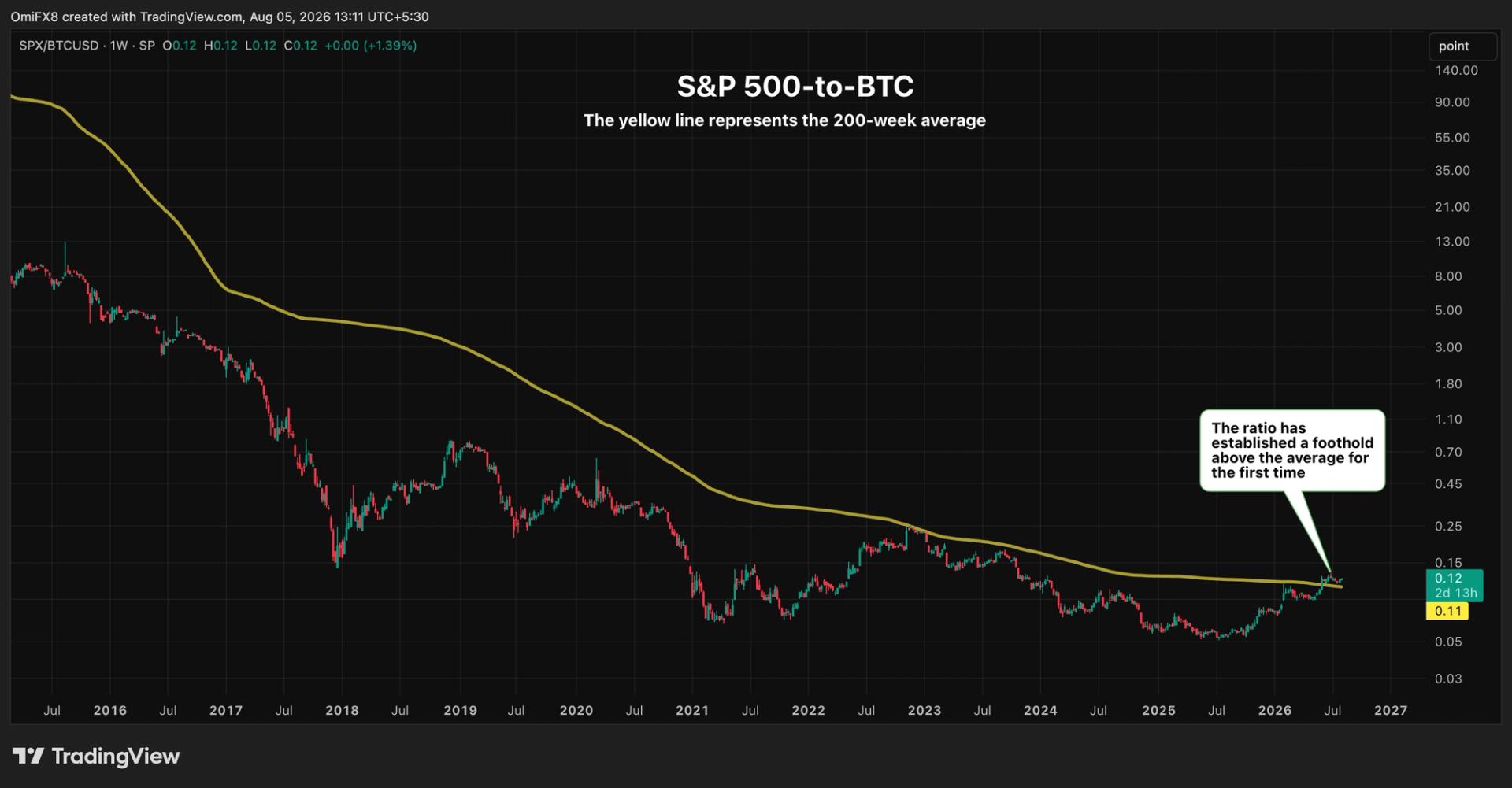
For years, bitcoin trounced stocks and most other assets, and supporters pointed to that outperformance as proof it was the best store of value around. Now, one chart suggests that edge may be fading.
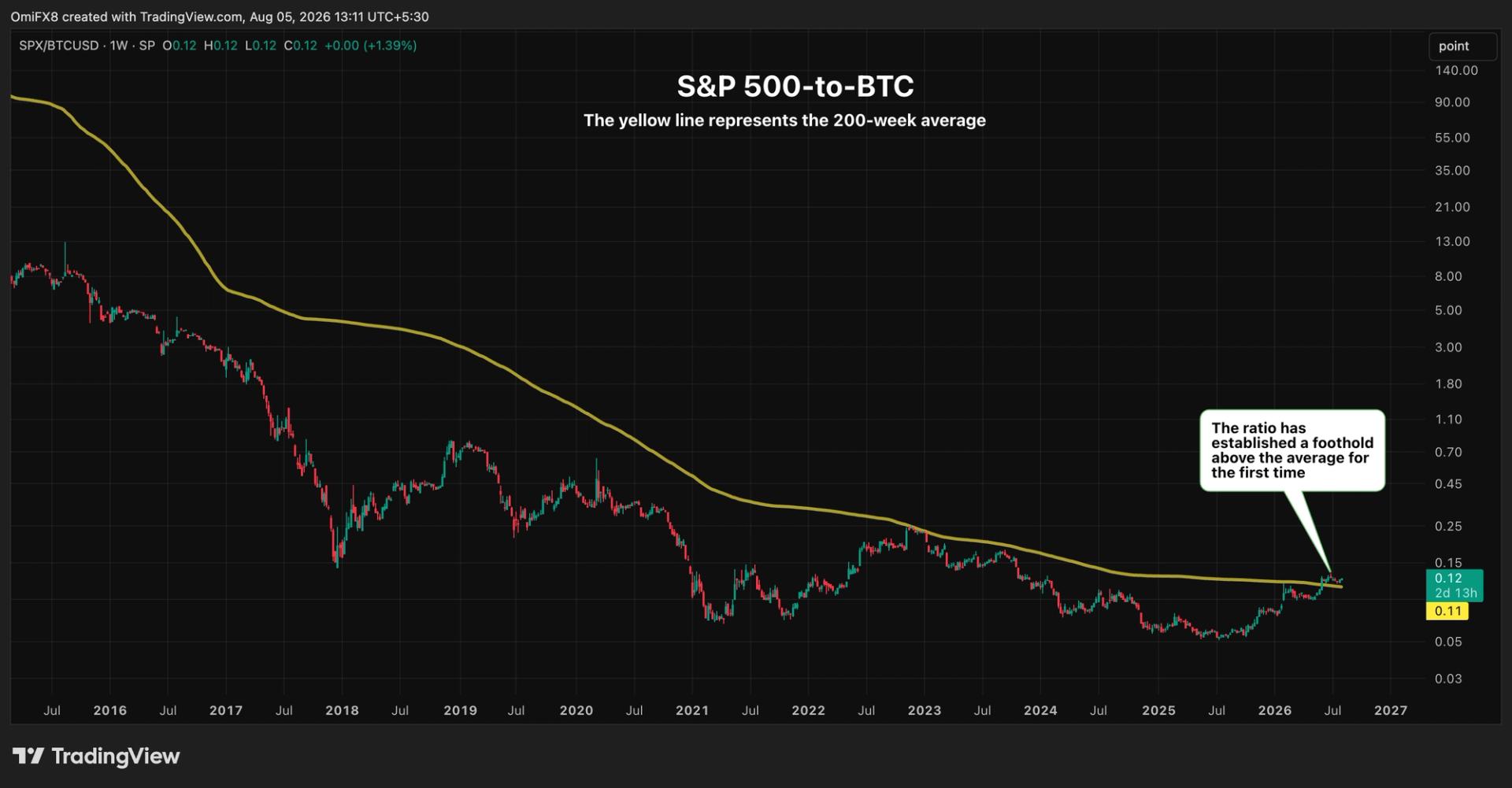
That chart is the S&P 500-to-bitcoin ratio. It measures how much bitcoin it takes to buy the index. Today it takes roughly 0.12 BTC, versus more than 300 BTC in 2012. The ratio moved largely lower in a steep downtrend since BTC’s inception in 2010, with the 200-week simple moving average, a barometer of long-term trend, acting like a ceiling holding a ball underwater. There were brief instances of stocks outperforming BTC, lifting the ratio, but never beyond that average.
Until now.
In recent weeks, the ratio hasn’t just topped the 200-week average, it’s established a firm foothold above it, clearly visible on the far right of the chart above. It’s not isolated to the S&P, either. The Nasdaq/BTC ratio is showing the same first-ever crossover above the 200-week average.

What is the single most important action you think the public, or a specific company or government, needs to take in the next year to advance the climate agenda?
The single most important action we need in the next year is for utilities, governments, and companies—especially hyperscalers—to recognize and invest in households as energy infrastructure. We are living through the convergence of three forces: unprecedented load growth, a worsening affordability crisis, and the urgency of climate action. Household upgrades are the fastest way to add capacity to the grid, lower costs for families, and reduce emissions. Our latest analysis shows upgrading households to efficient electric devices could offset all projected data center demand growth over the next five years.
Treating households as energy infrastructure is not just a climate strategy, it is the pathway to reconciling affordability, reliability, and decarbonization while renewing the bonds of community. Once we lean into that work, the solutions—policy interventions, demand aggregation, and durable private investment—will come rushing through.
What’s one sustainability effort you personally will try to adopt in the next year?
This year I want my family to lean less on our gas car, which has basically become our “peaker plant” whenever kids’ activities pile up; tennis, flag football, soccer, two different school dropoffs—parents know this drill. We already have an EV, our daily driver, but the gas car sneaks into the mix more than I’d like. Maybe this will be the year that we fully retire that peaker plant and become a full EV household. At the same time our family has really taken to composting with the Mill Food Recycler. It really taught me how fast a new habit can stick. It’s become so normal in our house that “just mill it” is now a verb. The persuasion campaign for my own parents to follow suit is underway.
What is a climate solution that isn’t getting the attention or funding it deserves?
A climate solution that doesn’t get nearly enough attention is insurance. As climate impacts intensify, the models we use to insure risk are breaking down, leaving households, small businesses, and entire communities exposed. In many parts of the country, families are already losing access to affordable homeowners’ insurance because of wildfire, flood, or storm risk. Without viable insurance, communities can’t build resilience, families can’t protect their assets, and entire local economies are destabilized.

Arthur Hayes, the former co-founder of BitMEX, is warning that today’s surge in AI infrastructure spending could sow the seeds of a renewed credit crunch—one he believes may ultimately send Bitcoin to highly elevated levels.
In a Tuesday blog post, Hayes argued that the boom is being treated by investors as a high-growth technology earnings story, when he views it more like leveraged real estate. He expects lenders to fund aggressive data-center and power buildouts, only for a slowdown in AI-related capital expenditure to reveal weaker borrowers. From there, Hayes suggested, a government liquidity response could reintroduce significant risk assets into the broader market, with Bitcoin potentially rallying far beyond current ranges.
Key takeaways
- Hayes frames AI infrastructure expansion as a “credit story” rather than an “earnings story,” drawing a parallel to the 2008-style credit cycle.
- He expects banks to finance data-center construction and believes the exposure will become clearer when AI spending growth cools.
- Hayes said Bitcoin could churn in a range of $60,000 to $70,000, with downside risk to $50,000 before any credit-driven recovery.
- He forecast Ether could reach $5,000 by year-end and said his firm Maelstrom plans to accumulate while selling out-of-the-money ETH puts.
- Recent reporting highlights the scale of future AI data-center lease commitments, underscoring the leverage embedded in the buildout.
Hayes’ “AI is real estate” credit-cycle warning
Hayes’ latest argument centers on how the AI buildout is financed. In his view, spending on data centers and power infrastructure is not the same as investing in product-driven technology growth. Instead, he characterizes it as a leveraged commitment that resembles property finance—where cash flows depend on demand staying strong and credit remaining available.
That distinction matters because credit cycles can turn quickly when expectations are met too early or when capital expenditure slows. Hayes’ thesis is that lenders will continue extending funding while projects are still ramping, but problems may surface after AI capital expenditures weaken and borrowers face difficulty servicing obligations. In that scenario, he expects liquidity measures from policymakers to follow—potentially injecting fresh capital into financial markets.
From 2008 comparisons to Bitcoin’s speculative path
Hayes directly compared the dynamic to 2008, calling the AI boom a “credit story like 2008 and not an earnings story like 2000.” He stressed that the key driver for crypto, in his framing, would not be fundamental “earnings” growth from the AI sector itself, but rather the liquidity response that could follow a credit deterioration.
In the meantime, he outlined a near-term technical-style range for Bitcoin. Hayes said BTC could remain between $60,000 and $70,000, with potential downside to $50,000, before any recovery tied to the credit cycle and government liquidity response. He also floated the prospect that, if the cycle plays out as he expects, Bitcoin could eventually be driven to $1 million or higher.
It’s important to note that Hayes’ scenario is inherently speculative. The argument depends on a specific chain: overbuilding in AI infrastructure → weaker borrowers → a credit crisis → policy liquidity support → renewed inflows into risk assets like Bitcoin. While the general linkage between credit conditions and market liquidity is a recurring theme in macro finance, the timing and magnitude Hayes suggests remain uncertain.
What changes, and how Hayes positions within the market
Hayes’ outlook includes both a macro forecast and an options-and-positioning angle. He predicted Ether (ETH) would reach $5,000 by year-end and said Maelstrom intends to build a “significant position” while simultaneously selling out-of-the-money ETH put options. The structure signals a willingness to hold exposure while collecting premium that could cushion downside—though the payoff depends on where ETH trades relative to the strike prices and volatility conditions.
His thinking also builds on earlier public comments about how AI competition and capital allocation could affect crypto liquidity. On May 13, Hayes said US-China competition in AI would encourage bank lending and fiat creation—an environment he argued could benefit Bitcoin. On June 4, he previously said he sold HYPE and NEAR after warning that major AI-related listings could divert capital away from crypto.
Taken together, the throughline is that Hayes sees crypto’s near-to-medium term direction as sensitive to macro and liquidity flows, not just to crypto-native fundamentals. Where AI spending is framed as a credit lever, the opportunity for crypto comes from the knock-on effect: whether the broader system expands liquidity—or contracts it under stress.
Why leverage in AI infrastructure is getting attention
Hayes’ caution about financing risk comes as reporting has begun to quantify the scale of commitments behind the AI buildout. According to Reuters, Microsoft, Meta, Oracle, Amazon, and Alphabet have committed about $1.09 trillion to leases that have not yet commenced, largely for data centers. Reuters noted that this figure cannot be treated as a straightforward debt total because it reflects undiscounted payments spread across multiple years.
Still, Reuters highlighted that the commitments are nearly four times the roughly $285 billion in lease liabilities already recognized by the same companies. The gap matters because off-balance-sheet commitments can become a stress point if operating assumptions weaken, especially if the buildout timing and actual demand for capacity diverge.
Reuters also pointed to uneven strain across firms. A separate Reuters analysis cited that Oracle’s debt was about 4.3 times its earnings before interest, taxes, depreciation, and amortization, while Alphabet, Amazon, Microsoft, and Meta had ratios below one. Reuters further quoted S&P Global analyst Andrew Chang, who said Oracle’s data-center leases run for 15 to 19 years, while customer contracts last no more than five years—creating a mismatch that could increase risk if customers do not renew or expand on the expected schedule.
For crypto investors tracking Hayes’ thesis, the relevance is straightforward: if the AI infrastructure ramp becomes a drag on credit and financing markets, it could translate into broader liquidity constraints. Conversely, if policymakers respond aggressively to maintain stability, that same liquidity could later flow back into speculative assets—where Bitcoin has historically captured attention during risk-on phases.
Going forward, market participants will likely watch whether AI infrastructure spending and financing conditions begin to show signs of strain, and whether policy-makers move to support credit markets if they do; Hayes’ case hinges on that transition from construction optimism to a liquidity-driven response. Until there is clear evidence of a slowdown in capital expenditure or credit stress in the real economy, his BTC range and $1 million-plus scenario remain a high-volatility narrative rather than a confirmed forecast.
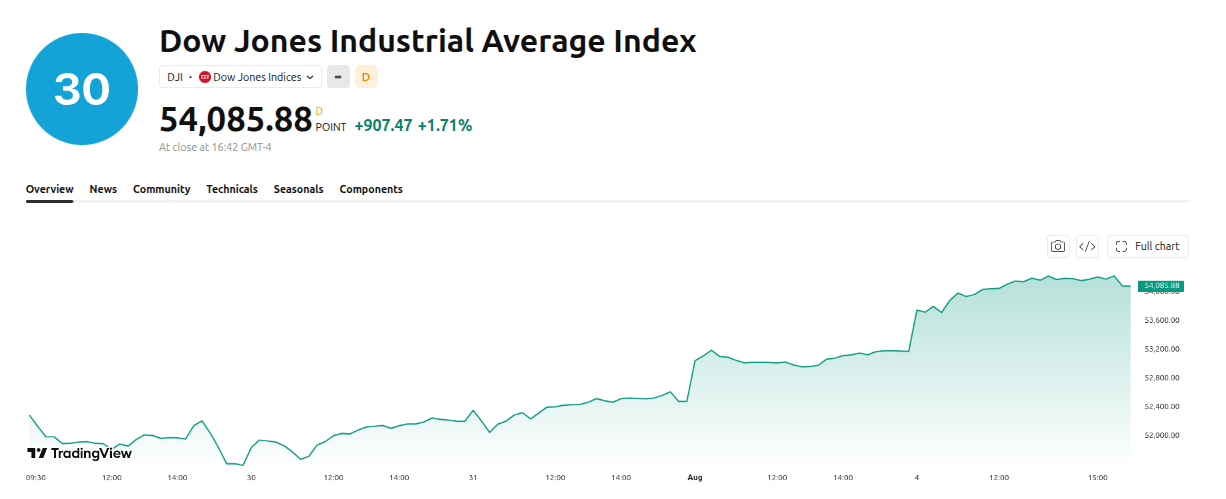
The Dow Jones and S&P 500 both closed at record highs on Tuesday, driven by optimism over progress toward fully reopening the Strait of Hormuz.
Crude fell roughly 5% amid diplomatic signals, easing inflationary pressure that had capped equities for months.
The Diplomatic Signals Behind Wall Street’s Record Session
The Strait of Hormuz is a narrow waterway handling a substantial portion of global seaborne oil and liquefied natural gas shipments. Its status has shaped market sentiment since February.
The numbers reflected a broad risk appetite. The Dow Jones rose 1.71%, or 907 points, to 54,085.88, while the S&P 500 advanced 1.79% to 7,736.52.
Follow us on X to get the latest news as it happens.

That marked the S&P’s first closing record since early July. The technology-heavy Nasdaq Composite outperformed both, gaining 2.59% to finish at 26,584.99.
Both major indexes traded even higher during the session. The intraday moves underscored how quickly sentiment shifted in response to Middle East headlines. Secretary of State Marco Rubio provided the initial catalyst. He confirmed the strait remains open, with ships and oil continuing to transit the waterway.
Negotiations appear to be advancing. Rubio described talks involving Iran, Oman, and US participation aimed at ensuring safer and increased vessel traffic in the short term.
Treasury Secretary Scott Bessent added further momentum. He told CNBC that a deal to fully reopen commercial transit could be reached today or tomorrow.
Diplomatic context explains the urgency. President Donald Trump recently suspended what he described as a major potential strike on Iran to allow negotiations to proceed.
Why Analysts Still Urge Caution
Energy markets responded immediately. Crude prices fell roughly 5%, pulling Treasury yields lower and supporting equities across sectors. Semiconductor and artificial intelligence stocks led the advance. The Philadelphia Semiconductor Index surged more than 6% during the session.
Corporate results reinforced the move. Upbeat earnings from Caterpillar and Palantir helped alleviate lingering concerns about demand. The stakes explain why traders reacted so forcefully. Prolonged disruption earlier this year fueled volatility, raised energy costs, and pressured growth forecasts.
A durable agreement would remove a significant geopolitical risk premium. That prospect alone justified Tuesday’s repricing across multiple asset classes.
Caution remains warranted, however. Rubio acknowledged that no final deal exists yet, despite the progress he described. Tehran has issued mixed signals about the formal status of talks. Previous memorandums of understanding have collapsed under similar circumstances.
Any breakdown could reverse the moves quickly. Oil would likely spike again, pressuring equities and reviving the inflation concerns that briefly faded. The week ahead brings additional tests. Investors will digest further earnings reports and economic data alongside developments in the Gulf.
Attention stays fixed on one question. Whether diplomatic optimism translates into concrete shipping gains will determine if these records hold.
For now, the waterway’s status has unlocked Wall Street’s latest advance. The durability of that rally depends on negotiations still unfolding.
Subscribe to our YouTube channel to watch leaders and journalists provide expert insights.
The post Wall Street Closes at Records as the Strait of Hormuz Holds the Key: What’s Next? appeared first on BeInCrypto.


Cloudflare introduced programmable Wallets for AI agents and said payment features using stablecoins will launch in a future update.



Ozlo Sleepbuds 2 Mask Snoring Before Someone Has to Reach for a Pillow

Elon Musk’s SpaceX Is Coming For Your Bitcoin. Here’s the Mechanism.

How to watch Arsenal FC vs Real Betis: TV channel and live stream for pre-season friendly today


-

 Business6 days ago
Why Trees Belong on the Risk Register
-

 Fashion5 days ago
Weekend Open Thread: Wit & Wisdom
-

 Politics4 days ago
Meta enters AI-training agreement with far-right ‘propaganda rag’ Newsmax
-

 Politics7 days ago
Reform UK betrays West Mids residents by running from party pledges
-

 Crypto World4 days ago
MicroStrategy Post-Earnings CLARITY Act Push Could Add New Catalyst for Its Stock
-

 Politics3 days ago
Zack Polanski: an incitement to murder Nigel Farage?
-

 Crypto World4 days ago
XRP Ledger v3.3.0 brings five institutional features
-

 News Videos6 days ago
Bitcoin Enters the 3rd Stage of the Bear Market
-

 Politics6 days ago
Luke Littler’s dominance sparks GOAT debate
-

 Sports5 days ago
Seema Kaliramna Wins Discus Throw Bronze, Takes India’s CWG Medals Tally To 17
-

 Crypto World4 days ago
New York sues Kalshi over prediction market gambling
-

 Crypto World3 days ago
Crypto PAC spending tops $2M in Michigan House race
-

 Tech7 days ago
Gemini can now summarize the messiest comment threads in Google Docs
-

 Business5 days ago
Trump Announces Hamas Disarmament Agreement as Iran Strikes Kuwait Air Base and US Attacks Pause Overnight
-

 Tech3 days ago
ESET tracks rise in malicious AI skills and adaptable malware
-

 Business2 days ago
DTCR: Deleveraging And A Hedge Fund Collapse Point To A Possible AI Bottom
-

 Tech5 days ago
Gemini Spark can now use Chrome logins and saved passwords to run errands on your behalf
-
 Tech5 days ago
Building A Reproduction PlayStation Motherboard
-

 NewsBeat6 days ago
Four people die trying to cross Channel in small boats
-

 Sports7 days ago
Sakshi, Arundhati Enter Boxing Semi-Finals. India Assured Of 18 Medals At CWG 2026
You must be logged in to post a comment Login