

Crypto World
Bitcoin miners rise as Nvidia posts big earnings beat and strong outlook

Nvidia (NVDA) posted another blockbuster quarter on Wednesday, as demand for artificial intelligence infrastructure pushed revenue, profit and cash flow to record levels.
The chipmaker reported first-quarter revenue of $81.62 billion, up 85% from $44.06 billion a year earlier and above Wall Street estimates of $78.9 billion, according to FactSet data. Adjusted earnings came in at $1.87 per share, beating analyst expectations of $1.76 per share. The company also gave stronger-than-expected guidance for the current quarter, forecasting revenue of roughly $91 billion.
Meanwhile, the company also moved to return more cash to shareholders. Nvidia’s board authorized an additional $80 billion in stock buybacks and raised the quarterly dividend to 25 cents per share from 1 cent previously.
However, despite the beats, positive outlook and shareholder returns, the stock was down about 1.5% at the time of publication. Investors were likely looking beyond the quarter and into the potential challenges in growth opportunities for Nvidia as competition for AI chips continued to grow.
Bitcoin miners with exposure to AI and high-performance computing infrastructure traded modestly higher following Nvidia’s earnings report. Shares of Core Scientific (CORZ) and Cipher Mining (CIFR) each rose slightly in after-hours trading as investors continued to view some miners as potential beneficiaries of growing demand for data centers, power capacity and AI computing infrastructure. IREN (IREN), which rose initially, is down about a percent.
“The buildout of AI factories — the largest infrastructure expansion in human history — is accelerating at extraordinary speed,” CEO Jensen Huang said in a statement. “Agentic AI has arrived, doing productive work, generating real value and scaling rapidly across companies and industries,” he added.
Data center growth
Specifically for bitcoin miners moving towards the data center business, there was some positive news in the chipmaker’s earnings.
Nvidia’s Data Center business continued to drive growth as cloud providers, enterprises and governments expanded spending on AI infrastructure powered by the company’s chips.
Hyperscalers generated more than half of Nvidia’s $75 billion in Data Center revenue during the quarter, reaching roughly $38 billion and rising 12% from the previous quarter, CFO Colette Kress said on the company’s earnings call.
The remaining $37 billion came from a segment Nvidia now calls ACIE, which includes AI cloud providers, industrial customers and enterprise markets. Kress said AI cloud revenue more than tripled from a year earlier, as Nvidia helped rapidly expand AI computing capacity across more than 80 data centers with capacities of more than 10 megawatts.
Kress added that spending on AI infrastructure continues to accelerate, and demand for Nvidia’s computing systems remains strong. She also said Nvidia expects to generate $20 billion in CPU revenue this year.
Nvidia said its outlook does not assume any Data Center compute revenue from China, where U.S. export restrictions have limited sales of advanced AI chips.
Investors have closely watched Nvidia’s earnings for signs that spending on AI infrastructure remains strong despite growing questions about how quickly companies will turn those investments into profits.
So far, Nvidia’s results suggest demand continues to outpace expectations, which might be positive for data center providers.

Bitcoin has now declined for five consecutive trading days between May 15 and May 19, marking its second longest losing streak of the year and trying to put in its first daily green candle in six days.
The latest pullback has seen bitcoin slide from above $80,000 to roughly $76,000 in light of broader market weakness.
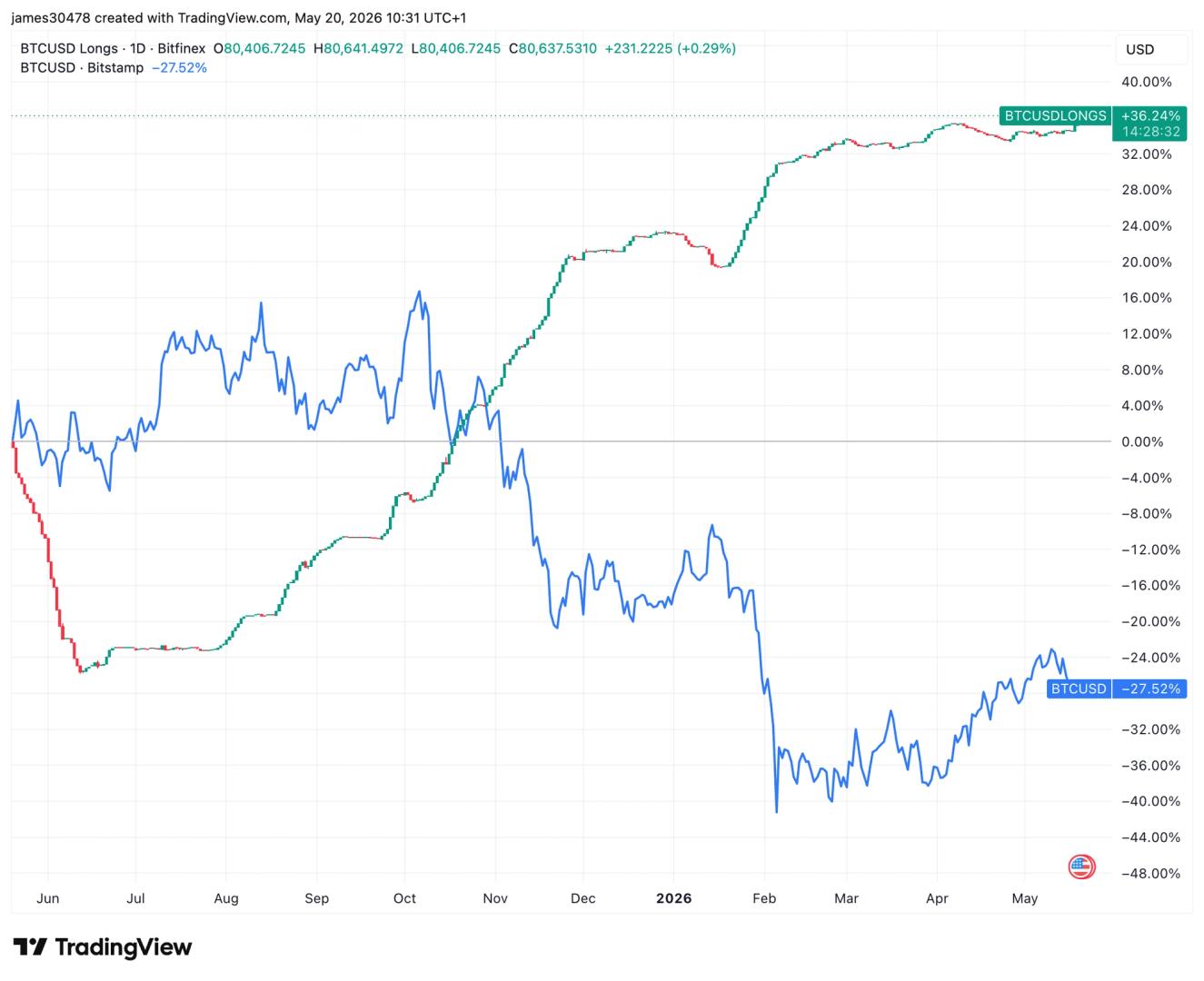
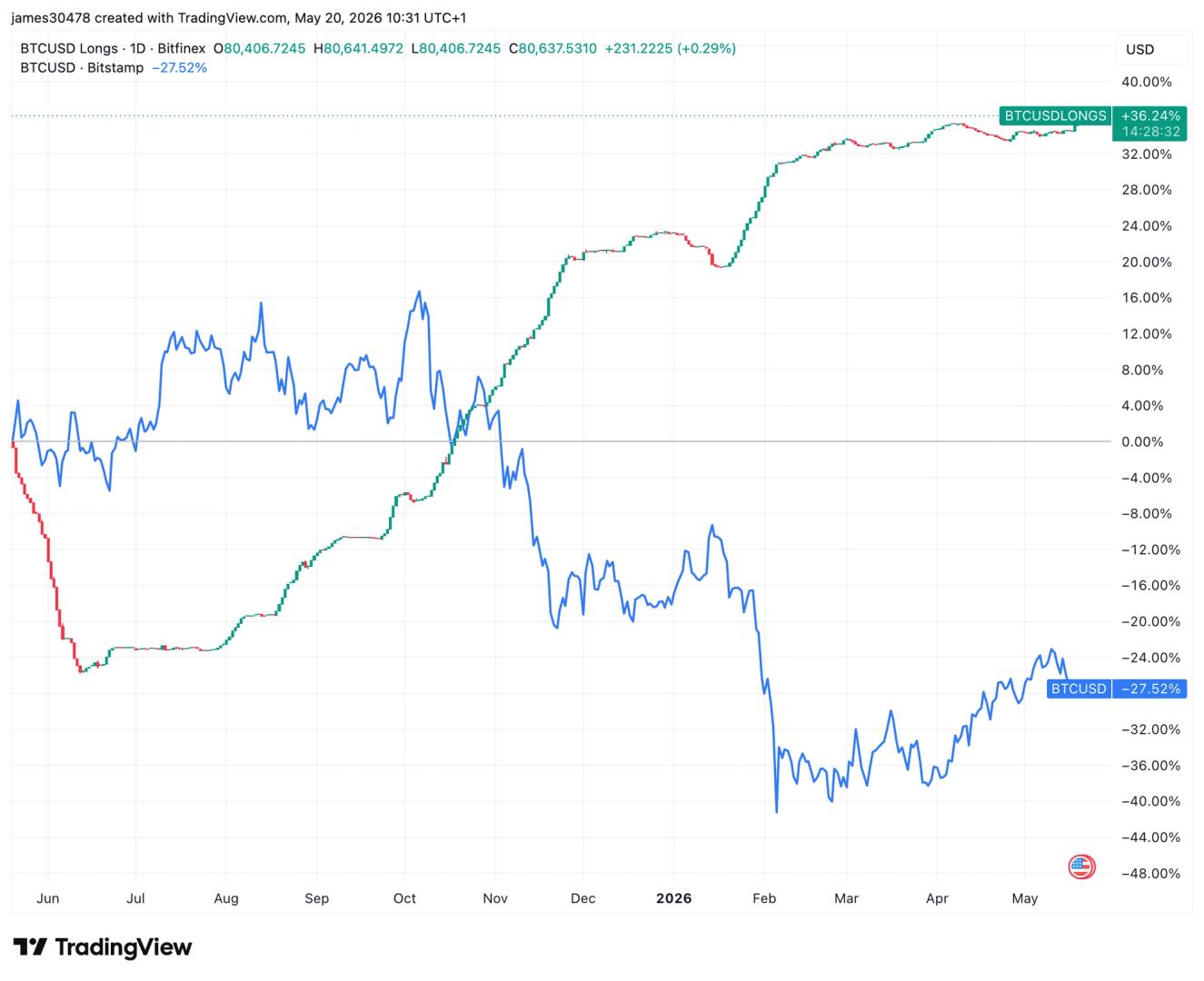
During the downturn, leveraged traders on Bitfinex continue to add exposure. Data from the TradingView shows bitcoin margin longs, positions opened using borrowed funds, have risen to 80,636 BTC, up roughly 1.5% over the past several days and now sitting at their highest level in two and a half years. The last time longs were this elevated was in December 2023, when bitcoin traded near $43,000.
According to TradingView data, Bitfinex margin longs have climbed around 10% since the start of the year, even as bitcoin itself has fallen 13%. The divergence underscores continued accumulation from large traders despite BTC remaining nearly 35% below its October all-time high of $126,000.
Historically, the so-called “Bitfinex whale” has often acted as a contrarian signal. Over the past five years, large leveraged long positions on the exchange have frequently expanded during periods of market weakness and capitulation, while being reduced closer to local market tops and trend reversals.
Bitcoin is now approaching a key technical zone. The asset is currently testing both the True Market Mean, an onchain valuation metric representing the market’s aggregate cost basis, and the short-term holder realized price, which tracks the average acquisition price of recent buyers over the past 155 days, near $78,000, just above the current spot price. Above that, the 200-day moving average sits just over $81,000, representing another major resistance level for bulls to reclaim.
Crypto World
BTC price tops $77,000. Analysts weigh in on whether the bounce has legs.: Crypto Daily
This is an excerpt from CoinDesk newsletter ‘Daybook.’ Sign up here, if you haven’t already.
Bitcoin has bounced to over $77,000, triggering a broader market recovery that has lifted both the CoinDesk 20 (CD20) and CoinDesk 80 (CD80) indexes by more than 1% since midnight UTC. Some coins, such as privacy-focused Dash and XDC Network’s XDC token, have gained 10% over the past 24 hours.
Some analysts continue to maintain a cautious stance, saying the market is caught between positive regulatory tailwinds and macro headwinds.
“Short-term action is pressured by [ETF] outflows and macro caution, while long-term positioning is supported by regulation, institutional access and reserve-asset narratives,” Naeem Aslam, a former hedge fund trader and the chief investment officer at Zaye Capital Markets, told CoinDesk in an email.
Aslam hailed President Donald Trump’s directive to the government and the Federal Reserve to review payment-system access for fintech and crypto firms as supportive of digital assets.
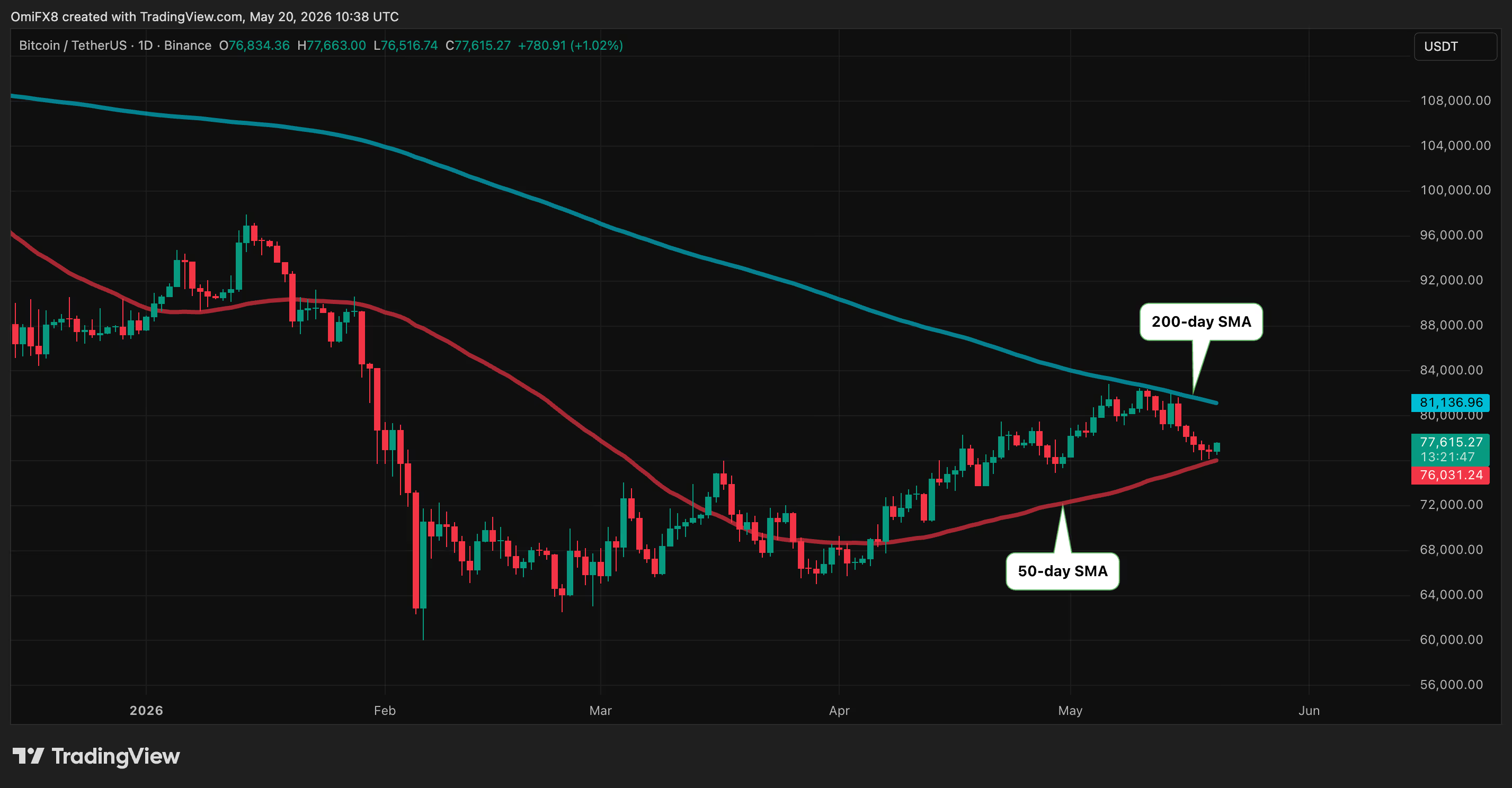
Alex Kuptsikevich, the chief market analyst at FxPro, said bitcoin’s latest bounce from the 50-day simple moving average is setting the stage for a decisive move in the next couple of days.
“Bitcoin, as of the end of last month, found support on dips to the $76K region,” Kuptsikevich said in an email. “Over the last couple of days, this support has been reinforced by the 50-day MA, as has the market. On the other hand, resistance at the 200-day MA continues to decline, bringing the bulls’ and bears’ red lines closer together and marking the moment when the market will choose its trend for the coming months.”
A market update from the financial technology and digital asset platform 1Konto placed the onus for sustained recovery on ETF inflows.
“ETF flows have become one of the cleanest transmission channels between traditional portfolios and Bitcoin spot demand. If those flows turn negative at the same time the long end sells off, Bitcoin trades more like macro collateral than a standalone scarcity asset,” the firm said in its daily market update.
We think Bitcoin can still stabilize before broader risk assets, but the next durable move higher likely needs either a calmer Treasury market or clear evidence that ETF demand is rebuilding,” the firm said in its daily market update,” it added.
In traditional markets, futures tied to the Nasdaq 100 index rose 0.8%, and oil dropped as the Senate moved to curb Trump’s ability to wage war against Iran. Investors are also looking to Nvidia’s earnings later Wednesday. Stay alert.
Read more: For analysis of today’s activity in altcoins and derivatives, see Crypto Markets Today . For a comprehensive list of events this week, see CoinDesk’s “Crypto Week Ahead.”
What’s trending
Today’s signal

Bitcoin’s five-day losing streak has run out of steam with prices nearly testing the 50-day simple moving average (SMA) late Tuesday.
Since then, BTC has bounced back above $77,000. The setup is pretty simple: Prices are stuck between the 50-day SMA support and the 200-day SMA resistance.
The two averages are converging, with the 200-day SMA declining and the 50-day measure rising, narrowing the range and building pressure for a decisive move in either direction in the days ahead.
A break below the 50-day SMA near $76,000 would likely signal that the bounce has failed and open the door to a retest of the February lows near $73,000. On the other hand, a sustained close above the 200-day SMA near $82,500 would be a meaningful technical development, potentially drawing in sidelined buyers and shifting the broader trend from bearish to neutral at minimum.
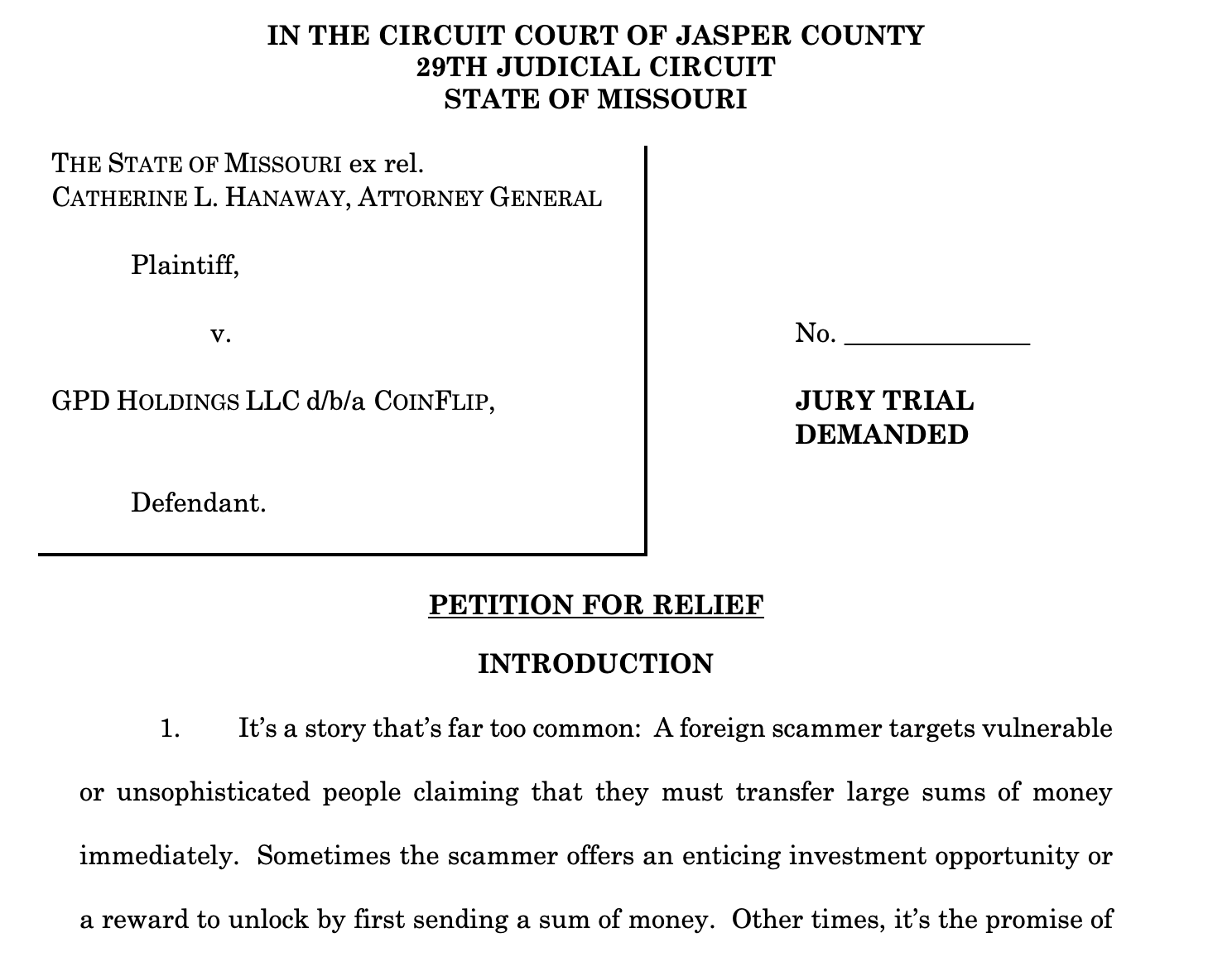
Missouri is suing the company behind cryptocurrency ATM operator CoinFlip for “knowingly facilitating fraudulent transactions and profiting from them,” in the latest move by a US state authority targeting digital currency kiosks and ATMs.
In a Wednesday notice, the office of Missouri Attorney General Catherine Hanaway said the lawsuit against GPD Holdings, doing business as CoinFlip, was in response to incidents of fraud, including against the state’s “seniors and veterans.” The state began a probe in December into several crypto ATM companies, including Bitcoin Depot, which recently filed for bankruptcy.
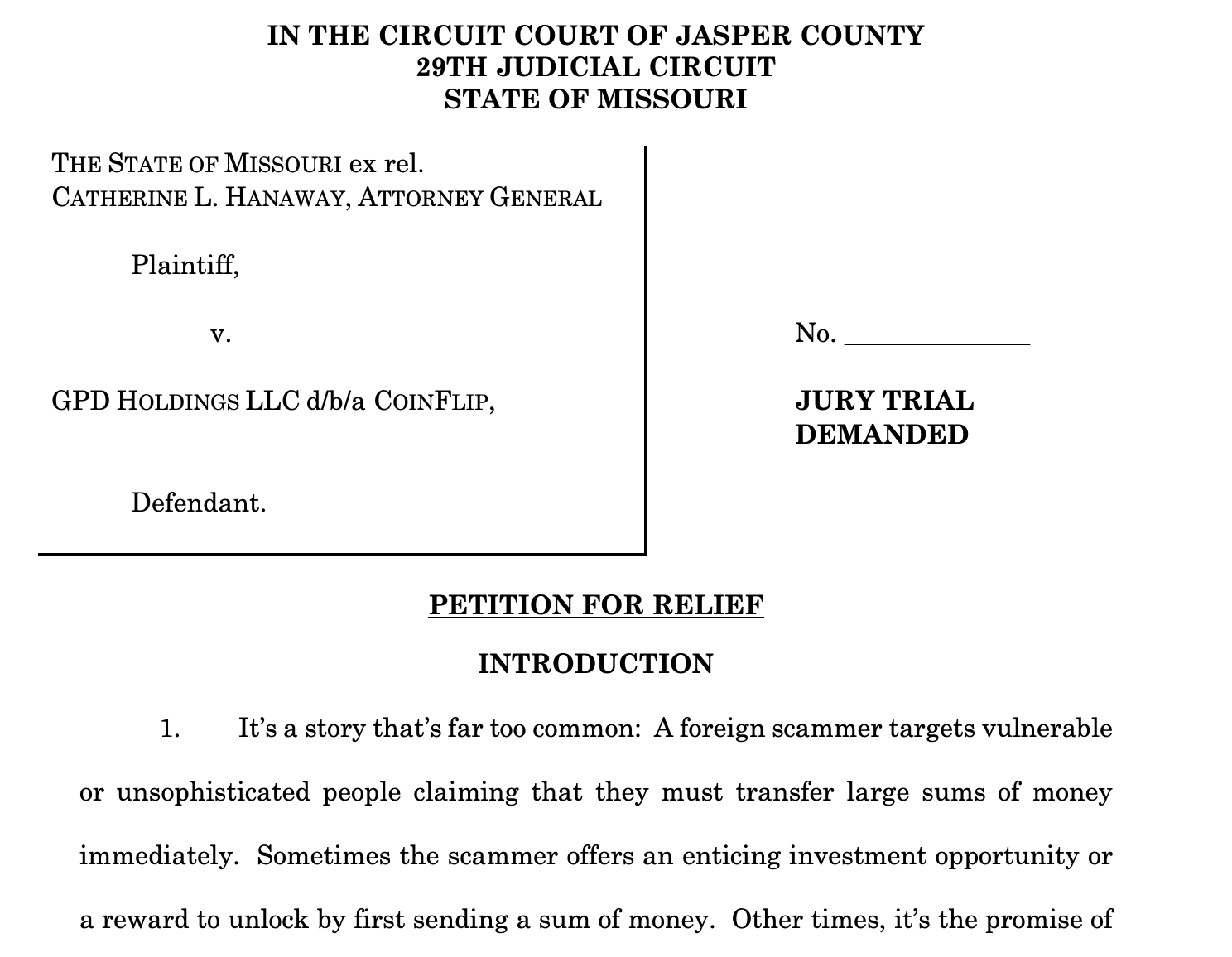
Missouri lawsuit against CoinFlip. Source: Missouri AG
“The Attorney General’s Office is asking the Court to declare that CoinFlip’s practices violate the Missouri Merchandising Practices Act; to enjoin CoinFlip from operating in Missouri; to impose civil penalties of $1,000 per violation over the past five years (up to $1,826,000); and to award restitution to consumers,” said the AG’s office.
According to CoinFlip’s website, the company operates 136 crypto kiosks in Missouri, and 4,229 in the US.
In recent months, ATM operators like Bitcoin Depot, CoinFlip and others have been repeatedly targeted by US state authorities and municipalities which have passed laws and ordinances restricting or outright banning the technology.
Related: Minnesota to weigh ban on crypto kiosks after scam reports

Warning about fraud from May 2025. Source: CoinFlip
Cointelegraph reached out to CoinFlip for comment on the lawsuit but did not receive an immediate response.
Bitcoin Depot warned of lawsuits and regulations before filing for bankruptcy
In a May 12 filing with the US Securities and Exchange Commission, crypto ATM operator Bitcoin Depot said “substantial doubt exists about the Company’s ability to continue as a going concern.” The concerns over paying more than $20 in legal judgments in the fourth quarter of 2025 and “ongoing litigation matters” came just a few days before Bitcoin Depot filed for voluntary Chapter 11 proceedings in Texas.
Bitcoin Depot was one of the largest crypto ATM operators in North America, responsible for more than 9,000 kiosks globally.
Magazine: 5 tech predictions the mainstream media got horribly wrong
Crypto World
NVIDIA Q1 FY2027 Revenue Hits Record $81.6 Billion as AI Infrastructure Demand Accelerates

TLDR:
- NVIDIA Q1 FY2027 revenue reached a record $81.6 billion, rising 85% year-over-year and 20% sequentially.
- Data Center revenue surged 92% annually to $75.2 billion, with networking revenue climbing 199% year-over-year.
- NVIDIA raised its quarterly dividend from $0.01 to $0.25 per share and approved an $80 billion buyback program.
- Q2 FY2027 revenue guidance stands at $91 billion, excluding all Data Center compute revenue sourced from China.
NVIDIA reported record first-quarter fiscal 2027 revenue of $81.6 billion, marking an 85% year-over-year increase. Data Center revenue reached $75.2 billion, up 92% annually.
The company also guided Q2 revenue to $91 billion. Non-GAAP diluted EPS climbed 140% to $1.87. Operating cash flow hit $50.3 billion, while free cash flow totaled $48.6 billion during the quarter.
Record Revenue Driven by AI Infrastructure Demand
NVIDIA’s Q1 FY2027 results reflect growing demand for AI computing infrastructure worldwide. Revenue rose 20% sequentially from $68.1 billion in Q4 FY2026. The company’s GAAP gross margin stood at 74.9%, up 14.4 percentage points year-over-year.
Data Center compute revenue alone reached $60.4 billion, rising 77% from a year ago. Networking revenue within the segment hit $14.8 billion, up 199% annually. These numbers show strong adoption of NVIDIA’s Blackwell GPU platform across hyperscale clients.
Jensen Huang, NVIDIA’s founder and CEO, described the moment as a turning point for global infrastructure. He stated that “the buildout of AI factories — the largest infrastructure expansion in human history — is accelerating at extraordinary speed.” Huang further noted that agentic AI is now doing productive work and generating real value across industries.
NVIDIA returned approximately $20 billion to shareholders through buybacks and dividends during Q1. The Board also approved an additional $80 billion share repurchase authorization on May 18, 2026, with no expiration date.
Huang added that NVIDIA is “uniquely positioned at the center of this transformation” as the only platform running across every major cloud.
Dividend Increase and Shareholder Returns Signal Confidence
NVIDIA raised its quarterly cash dividend from $0.01 per share to $0.25 per share. The dividend will be paid on June 26, 2026, to shareholders of record as of June 4, 2026. This marks a notable shift in NVIDIA’s capital return strategy.
As of Q1’s close, the company had $38.5 billion remaining under its prior share repurchase authorization. The new $80 billion addition further strengthens NVIDIA’s buyback capacity. Together, these moves reflect management’s confidence in sustained earnings growth.
GAAP net income for the quarter came in at $58.3 billion, up 211% year-over-year. Non-GAAP net income reached $45.5 billion, rising 139% from the same period last year. Both figures point to strong profitability alongside revenue growth.
GAAP diluted EPS of $2.39 compares to $0.76 in Q1 FY2026, a 214% increase. Non-GAAP diluted EPS of $1.87 reflects a 140% annual gain.
Huang noted that NVIDIA’s platform “runs in every cloud, powers every frontier and open source model, and scales everywhere AI is produced.”
Q2 Outlook and Structural Reporting Changes
NVIDIA guided Q2 FY2027 revenue at approximately $91 billion, plus or minus 2%. The company stated that this outlook excludes any Data Center compute revenue from China. GAAP and non-GAAP gross margins are expected to remain near 74.9% and 75.0%, respectively.
Operating expenses for Q2 are projected at around $8.5 billion on a GAAP basis and $8.3 billion non-GAAP. For the full fiscal year 2027, NVIDIA expects tax rates of 16% to 18%, excluding discrete items. These projections reflect continued investment in research and operations.
NVIDIA also announced a new reporting framework splitting its business into Data Center and Edge Computing platforms. Within Data Center, it will now report Hyperscale and ACIE sub-markets separately. Edge Computing will cover PCs, game consoles, robotics, and automotive devices.
Edge Computing revenue for Q1 reached $6.4 billion, up 29% year-over-year and 10% sequentially. New partnerships with Hyundai, Kia, BYD, and Uber support growth in autonomous driving. Expanded collaborations with Google Cloud and Marvell also continue to broaden NVIDIA’s ecosystem reach.



The U.K.’s ambitions to become a dominant global digital asset hub is running into a wall of political inertia and regulatory gridlock, Jonny Fry, a blockchain and global banking researcher, founder of Digital Bites and CEO at TeamBlockchain Ltd., told CoinDesk.
Despite outward assurances of progress from the Financial Conduct Authority (FCA), industry insiders suggest that nagging bureaucratic barriers and legislative friction behind closed doors are severely delaying the implementation of a unified crypto framework. The slow progress is creating rising concern that Britain is conceding critical economic ground to regimes in Washington and Brussels.
Fry said the U.K. should worry over other more critical issues. “The real risk is not that firms physically leave Britain,” he said. “The risk is that the next generation of digital asset infrastructure is built somewhere else.”
The concern on the floor of the Digital Money Summit 2026 in London reflects a deep-seated institutional divide. While the private sector demands swift execution to unlock massive market efficiencies, a web of divided remits between HM Treasury, the Bank of England and the FCA has severely fractured the payment and investment perimeters.
“We have a situation at the moment whereby the Treasury is looking to set the law, and then we’re having the FCA looking to have publicly-issued stablecoins and a Bank of England-issued digital pound,” Fry noted.
He warned that this fragmented approach creates deep operational uncertainty, complicating how the jurisdiction handles the “singleness of money” across tokenized deposits and digital assets.
This administrative friction has pushed several high-profile digital asset firms to abandon the U.K. entirely, choosing to relocate to jurisdictions with immediate regulatory clarity. Fry cited the crypto derivatives exchange Deribit as a prime example.
“Had we had the regulatory clarity that staking your crypto was not a collective investment scheme, maybe Deribit would have relocated here in the U.K.,” Fry said, estimating that the missed opportunity cost the U.K. government hundreds of millions in tax revenues following Coinbase’s acquisition of the platform.
Andrew MacKenzie, CEO of sterling stablecoin developer Agant, told CoinDesk in February he believed that regulations were moving in the right direction, but were moving too slowly to support its global digital asset hub ambitions.
The Bank of England’s cautious, slow approach to crypto is heavily frustrating the private sector, a Financial Times article stated last week, It added that while businesses are pushing for fast integration, the central bank’s tight restrictions on stablecoins have created a massive regulatory bottleneck.
The FCA, caught between Downing Street’s political priorities and the Bank of England’s watchfulness on monetary stability, has preferred to emphasize its controlled testing environments rather than publicly vent its operational frustrations.
Matthew Long, Director of Payments and Digital Assets at the FCA, took a more positive approach to the pace at which regulations are being adopted, presenting the timeline as a calculated, modular rollout designed to build a bulletproof regime.
“So I think we’ve delivered a comprehensive regime that’s open for business right now. We’re encouraging firms to apply,” he told CoinDesk. “We’ve got our pre-application support service available, so what I’m saying to firms is it’s open for business.”
However, if U.K. regulators do not move with genuine market agility, liquidity will inevitably default to where capital is most fluid, Fry warned. Without a competitive digital pound alternative, private operators will simply settle transactions using dominant U.S. dollar-backed stablecoins.
“We’ll end up seeing dollarisation,” Fry warned.
U.K. regulations are set to come into effect in October 2027.


Bitcoin quantum exposure covers 1.92 million BTC, or 9.6% of total supply, Glassnode warned in a new report.
Summary
- Glassnode classified 1.92 million BTC as structurally exposed to a quantum breakthrough because their output types reveal public keys by design.
- Satoshi Nakamoto’s coins represent about 1.1 million BTC of the structural risk, with another 620,000 BTC in other early Satoshi-era outputs.
- A broader 4.12 million BTC, or 20.6% of supply, is operationally exposed due to address reuse and key management practices at exchanges.
Blockchain analytics firm Glassnode published a full analysis on May 20 classifying 1.92 million BTC, or 9.6% of total supply, as structurally exposed to a future quantum computing breakthrough.
The structural category covers outputs whose design reveals the public key regardless of address management. The three types at risk are Satoshi-era Pay-to-Public-Key outputs, legacy multisig structures and Pay-to-Taproot outputs.
Glassnode breaks down Bitcoin’s quantum exposure by address type
Glassnode classified 4.12 million BTC, or 20.6% of supply, as operationally exposed due to address reuse and poor key management. This is more than twice the structurally unsafe supply.
Exchange-held Bitcoin accounts for a disproportionate share. About 1.66 million BTC on exchanges, 8.3% of total supply, falls into the exposed category. Binance shows 85% exposed balances while Coinbase’s labeled balances sit at just 5% exposed.
What the structural versus operational split means for holders
Glassnode said the exposure could be reduced through better address standards and user behavior. BIP-360 proposes a quantum-resistant Pay-to-Merkle-Root output type offering a voluntary migration path for affected holders.
Crypto.news has covered the full quantum threat timeline, including the estimated 2,330 logical qubits needed to break Bitcoin’s elliptic curve cryptography.
What exchanges and custodians should do now
Glassnode advised exchanges and custodians to reduce key reuse, improve address hygiene and plan migration to quantum-proof formats before any breakthrough occurs. The firm stressed the risk is structural but not yet active.
Citi’s analysis, as crypto.news reported, found a quantum attack on major financial institutions could put $2 to $3.3 trillion of GDP at risk. The Bitcoin price page tracks how markets are pricing these long-term security concerns alongside current price action.
TLDR:
- Uniswap’s temp check vote targets BNB Chain, Polygon, and Celo, expanding the fee-and-burn to 13 chains.
- Every swap generates a protocol fee that bridges to Ethereum and permanently burns UNI at a dead address.
- CryptoQuant data shows rising UNI net outflows on Binance, pointing to smart money accumulation near lows.
- The governance vote closes May 21st with 18.1M UNI cast, 100% in favor, and the 10M quorum already cleared.
Uniswap is moving to extend its fee-and-burn mechanism to BNB Chain, Polygon, and Celo. A temp check vote is currently underway, drawing strong community support.
Meanwhile, on-chain data from CryptoQuant shows rising net outflows on Binance as UNI trades near its lower price range. Together, these developments are drawing fresh attention to the token’s near-term outlook.
Governance Vote Targets 13-Chain Fee-and-Burn Rollout
The proposal, shared via Snapshot.eth on behalf of Uniswap’s governance, aims to bring the fee-and-burn system to three additional networks. If passed, the rollout would cover 13 chains in total.
Every swap on these networks generates a protocol fee, which bridges back to Ethereum and permanently burns UNI at a dead address.
The system has been live since December across Ethereum and nine other networks. BNB Chain and Polygon would connect through Wormhole’s Native Token Transfer setup.
Celo was approved in an earlier vote but failed due to a configuration error. This proposal corrects that path and re-runs the execution.
Forum member Abel189 described the move as “a coherent next step” given Uniswap’s “increasingly multi-chain reality.”
He supports incremental, chain-by-chain expansion but flagged growing cross-chain messaging complexity as a key watch item going forward.
L2BEAT’s governance team, including members Kaereste and Manugotsuka, voted in favor after their research team verified the implementation, contracts, and expected governance payloads.
They noted the unchanged fee structure and continuity with the previously approved framework as reasons for their support.
On-Chain Outflow Data Points to Accumulation Activity
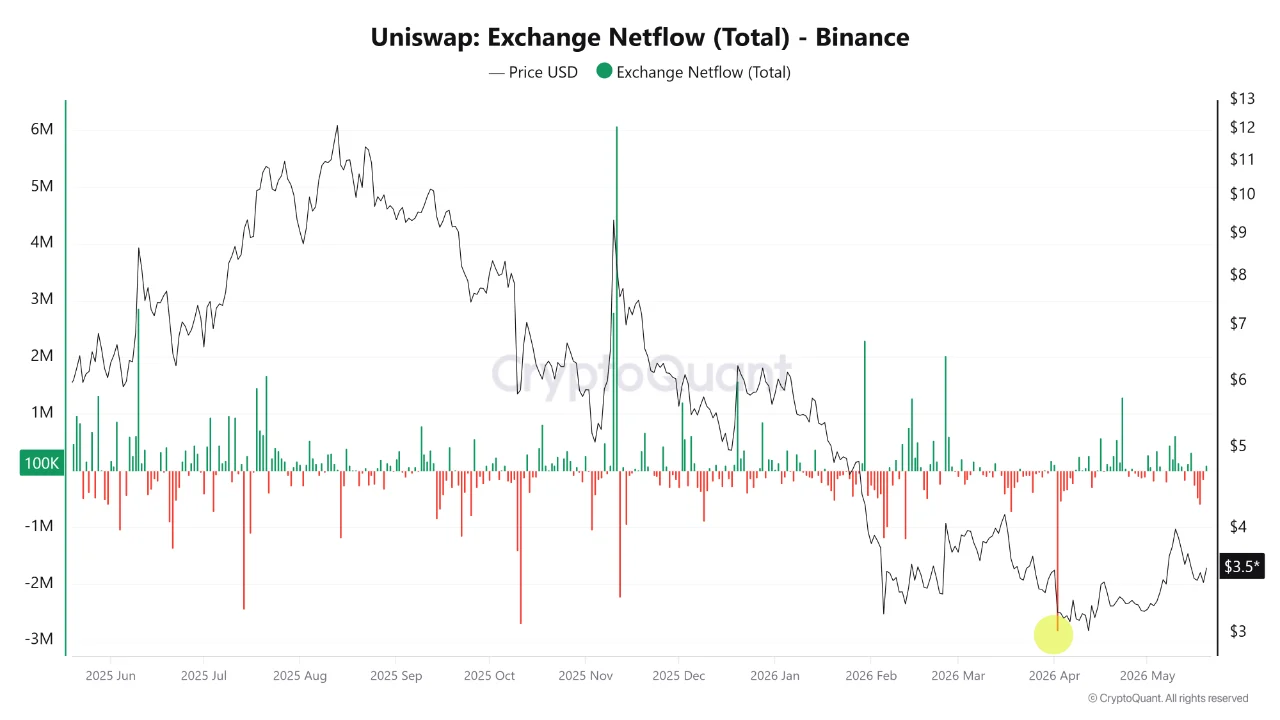
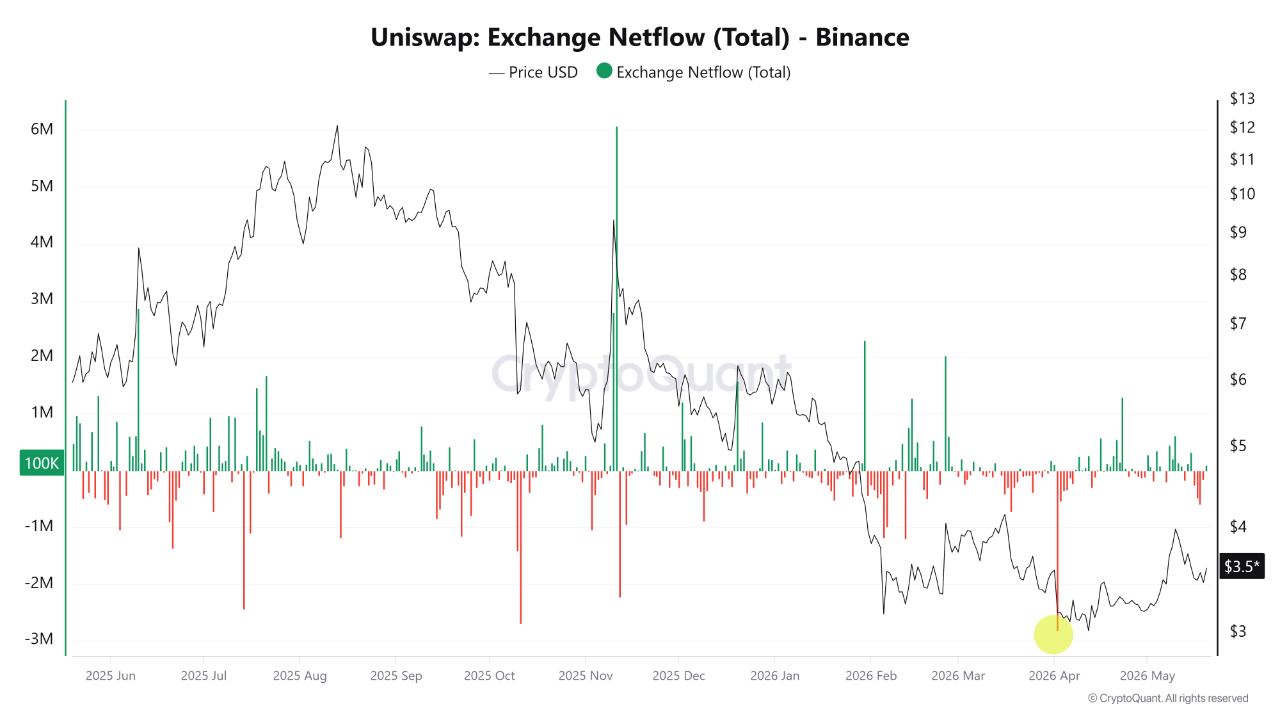
On the market side, CryptoQuant data on the Uniswap Exchange Netflow chart for Binance is showing notable movement.
As UNI’s price corrected deeply, netflow bars grew denser with large net outflows becoming more frequent. This pattern tends to reflect behavior from longer-term holders and smart money participants.
These outflows typically mean UNI is being withdrawn from Binance and moved to personal wallets for holding. That reduces the available supply on the exchange and lowers direct selling pressure over time. Analyst Rei Researcher noted this trend as a potential setup for an accumulation zone near the bottom.
Source: Cryptoquant
Currently, UNI is seeing a mild price recovery. If the outflow trend continues and exchange supply tightens further, buying demand could push the price higher.
The combination of reduced sell-side pressure and growing protocol utility through the burn mechanism adds a structural layer to that potential move.
The governance vote closes on May 21st at 5:30 PM UTC. As of the latest update, 258 wallets have cast 18.1 million UNI votes, with 100% in favor and the 10 million quorum already cleared.

Sam Altman, chief executive officer of OpenAI Inc., during a media tour of the Stargate AI data center in Abilene, Texas, US, on Tuesday, Sept. 23, 2025.
Kyle Grillot | Bloomberg | Getty Images
Reports that OpenAI is set to confidentially file for an IPO as soon as Friday changed prediction market traders’ outlook on which private AI giant will debut on the public markets first.
Traders on Kalshi now see OpenAI as the favorite to go public before Anthropic, giving it an 83% chance of getting the big payday first.
“Getting to public markets first is very important, given this arms race going on,” said Dan Ives, Wedbush Securities’ global head of technology research. “It sets a valuation, you’re the first one to meet with investors on the road, and there’s an advantage.”
Before the initial report on the IPO timeline by the Wall Street Journal which CNBC later confirmed, traders gave OpenAI just over a 32% chance of beating its chief private rival to the public markets.
Chances Anthropic would beat OpenAI to an IPO collapsed on Polymarket to 20% from 69%.
While the birth of OpenAI’s ChatGPT launched the AI bull market in November 2022, the company has lost some of its shine with investors.
Worries about the company’s spending, reports on missed revenue and growth targets and leadership turnover weighed on investors’ outlooks. There have even been internal disagreements on the timeline to go public, according to the Journal, with CEO Sam Altman pushing for a faster debut than CFO Sarah Friar.
At the same time, Anthropic’s enterprise business has led it to experience massive growth in recent months, and reportedly is in talks with investors for a new funding round that would value the company at $900 billion, greater than that of OpenAI’s latest valuation.
Investors became enchanted with Anthropic’s Claude models, which have been constantly updated with new versions. Those updates were followed so closely by investors that they consistently moved the stock market in the beginning of the year, as worries about how new tools from Claude models would disrupt existing businesses mounted.
It was in late March when reports about an extremely powerful new model, Claude Mythos, circulated that Anthropic took a consistent lead over OpenAI on Kalshi of who would have a public debut first. Bloomberg reported around the same time that the company was looking to IPO as soon as October.
But with an IPO on the way — sooner than prediction market traders thought — and a court win against Elon Musk this week, it could be the moment for a turnaround, according to Ives.
“It started with the lawsuit,” he said. “And now filing the IPO, that’s a great one-two punch to start to put water on the negative fire that’s been on them.”
Disclosure: CNBC and Kalshi have a commercial relationship that includes a CNBC minority investment.
The biggest question facing bitcoin investors is whether the market bottom was set in early February, when the largest cryptocurrency briefly fell toward $60,000.
While no indicator can assess that with certainty, a number of onchain and derivatives metrics suggest the worst of the current correction may be in the past, especially as bitcoin is now trading back above $77,000.
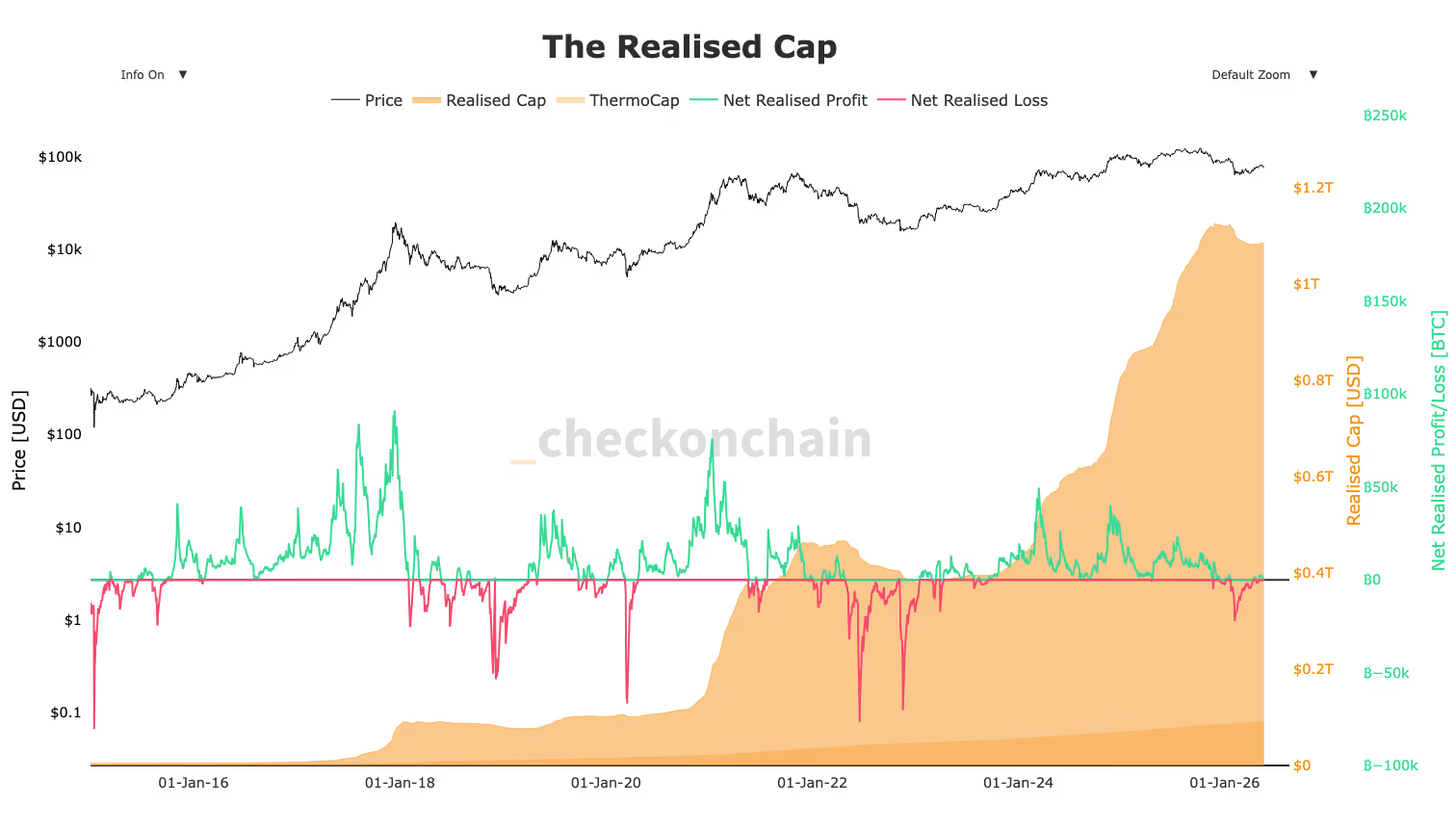
The first metric is Realized Cap, which measures the total value of bitcoin based on the price each coin last moved onchain. It differs from market capitalization, which is based on the current market price, and reflects the aggregate cost basis of investors. It is often used to track capital entering or leaving the network.
Realized cap peaked near $1.12 trillion before falling to roughly $1.08 trillion as bitcoin declined more than 50% from its October record high. That’s a significant wealth destruction, one of the largest on record. However, the metric has now begun stabilizing and forming a base, similar to the pattern seen during lows of the 2022 bear market.

The second metric is the RHODL Ratio, which compares wealth held by longer-term holders (six months to two years) with newer market participants (one day to three months). The ratio is now above 5, its third-highest reading on record.
The only higher readings occurred during the 2015 and 2022 cycle bottoms. This suggests long-term holders continue to dominate supply. Since February, long-term holder supply has increased by over 400,000 BTC.
Finally, perpetual futures funding rates, the payments exchanged between long and short traders to keep futures prices aligned with spot markets, remained negative for one of the longest periods on record between February and May.
Historically, sustained negative funding reflects extreme bearish sentiment and overcrowded short positioning, conditions that often form market bottoms as selling pressure becomes exhausted.
Similar setups occurred during the Silicon Valley Bank crisis in March 2023, the yen carry unwind in August 2024, and the tariff-driven selloff in April 2025, all of which ultimately marked major bitcoin lows.


Regent University School of Law announced that Hester M. Peirce, a two-term commissioner of the U.S. Securities and Exchange Commission and a longtime figure in crypto policy, will join the faculty as an associate professor beginning in November. The appointment comes as the SEC’s leadership landscape remains unsettled and as federal regulators weigh how to realign oversight for digital assets within a changing legislative and enforcement environment.
Regent’s notice situates Peirce within the law school’s expanding emphasis on federal litigation, securities regulation and digital assets. Her SEC tenure officially ended in June 2025, but commissioners may continue serving for up to about 18 months after terms expire if replacements are not named, according to the agency’s rules. Peirce first joined the SEC in January 2018, after confirmation following her nomination by President Donald Trump in December 2017. She was later confirmed for a second term in 2020. Earlier in her career, Peirce was nominated by President Barack Obama to fill a Republican seat on the commission in 2015, but the nomination did not advance in the Senate at that time.
Regent communications indicate that Peirce’s teaching focus will include federal litigation, securities regulation and digital assets, signaling a constructive bridge between regulatory practice and academic inquiry. The move underscores a broader trend of regulators transitioning into academic roles to shape future professionals’ understanding of policy and compliance in the crypto space.
Key takeaways
- Hester M. Peirce will join Regent University School of Law as an associate professor, with teaching to begin in November, according to Regent’s notice.
- The SEC term for Peirce expired in June 2025; commissioners may serve for approximately 18 months after term expiration if not replaced, a policy that can affect regulatory continuity during leadership transitions.
- Peirce’s departure contributes to a constrained leadership slate at the SEC, where Caroline Crenshaw’s seat remains vacant following her January departure; the commission would be left with two Republican members (Mark Uyeda and Chair Paul Atkins) once Peirce exits, given the current membership configuration.
- Across the two primary crypto regulators—the SEC and the CFTC—staffing gaps persist. The CFTC, led by Chair Michael S. Selig, currently has a single commissioner, highlighting ongoing debates over who should supervise digital-asset markets.
- Legislative momentum around a digital asset market structure, including the CLARITY Act, could reallocate certain powers from the SEC to the CFTC, shaping the trajectory of enforcement and market oversight.
- Nomination dynamics under the current administration remain pivotal for restoring full regulatory capacity and for signaling the administration’s regulatory posture toward crypto firms, banks, and investors.
Academic transition amid regulatory vacancies
Peirce’s move to Regent comes at a moment when the crypto policy debate in Washington is characterized by competing priorities: enforcement clarity, investor protection, market integrity, and technological innovation. As a two-term commissioner who led the SEC’s crypto task force and earned the informal moniker “Crypto Mom” for her approach to digital-asset issues, Peirce has been at the center of policy debates about whether tokens constitute securities, how to apply existing securities laws to novel financial instruments, and how to balance innovation with investor safeguards. Regent’s programmatic emphasis on federal litigation and securities regulation, augmented by a focus on digital assets, suggests an intent to embed practical regulatory perspectives within the law school’s curriculum. For institutions and compliance teams, the appointment signals heightened attention to regulatory theory and real-world enforcement considerations as new graduates enter finance and technology sectors.
From a compliance perspective, Peirce’s academic appointment could influence conversations about how future financial institutions assess compliance risk, structure internal control frameworks, and engage with policymakers. It also highlights the importance of jurisprudence and standardized regulatory interpretation as markets evolve. The move is not a mere personnel change; it reflects a bridge between policy formation and legal education that can inform how market participants interpret regulatory expectations, draft internal policies, and prepare for evolving enforcement priorities.
Vacancies in the SEC and CFTC: implications for enforcement and governance
The staffing picture at the SEC remains incomplete. The departure of a sitting commissioner creates a narrower political and regulatory footprint at a moment when crypto policy is under active consideration in Congress and in the courts. Crenshaw’s earlier exit in January left the agency with a reduced complement of commissioners; according to the agency’s own disclosures, vacancies may extend for months while nominations work through the Senate. As Peirce winds down her term, the SEC would be left with only two Republican commissioners, alongside a Democratic minority, a configuration that can influence the Commission’s voting dynamics on nuanced policy questions and enforcement actions.
Similarly, the Commodity Futures Trading Commission faces parallel staffing challenges. Michael S. Selig remains the chair and, at present, the agency’s leadership operates with a limited number of members. This convergence of vacancies at the SEC and CFTC has immediate practical implications for regulatory tempo, rulemaking, and cooperative efforts on cross-cutting issues such as digital-asset market structure and investor protection.
Industry observers have noted that regulatory leadership matters not only for immediate enforcement actions but also for the long-term signaling of the United States’ approach to crypto markets. With the nomination process potentially slow in the current political climate, market participants and institutional clients must plan for a period of governance uncertainty, during which policy direction—particularly on crypto asset classification, registration, and reporting requirements—may lack a clear, unified voice from Washington.
Regulatory reorganization and the path to a unified market framework
A central policy topic in this period is the ongoing discussion around the digital asset market structure. The CLARITY Act, and related legislative efforts in Congress, are viewed by many as attempts to delineate and consolidate authority over crypto markets. Proponents argue that a clearer allocation of powers between the SEC and CFTC would reduce regulatory fragmentation and bring more predictable oversight for market participants—especially those operating cross-border and those seeking to coordinate banking services with stablecoins and digital-asset settlements.
Under this framework, the balance of oversight could shift toward the CFTC for certain market-structure matters, including the governance of crypto spot and derivatives markets. At the same time, the SEC’s role in registration, disclosure, and investor protection remains significant, particularly for projects that might be construed as securities offerings. The evolving dynamics underscore the importance for market participants to monitor both rulemaking activity and legislative developments, as well as any potential realignment of enforcement priorities.
Notably, the current administration has signaled a willingness to recalibrate interd- agency coordination. In practice, that could mean more explicit cooperation between the SEC and CFTC on compliance expectations for exchanges, wallets, and asset issuers, along with streamlined processes for cross-border firms seeking to operate in the United States. Observers should also watch how this alignment interacts with broader regulatory regimes, including anti-money-laundering (AML) and know-your-customer (KYC) requirements and licensing regimes that influence institutional onboarding and banking relationships for crypto firms.
In coverage beyond the agency level, industry analyses have highlighted that these regulatory tensions—and the potential reallocation of authority—carry practical implications for risk management, legal budgeting, and internal control design within financial institutions, exchanges and liquidity providers. The interplay between evolving law, enforcement discretion, and business models will shape how firms allocate resources to regulatory compliance programs, internal audits, and ongoing policy engagement with regulators and lawmakers. Cointelegraph has documented how the regulatory posture has shifted under the current administration, contributing to an atmosphere of recalibration across U.S. crypto oversight.
Closing perspective: what to watch next
As Regent welcomes Peirce and as vacancies persist at the SEC and CFTC, the next several months will be critical for determining the pace and direction of U.S. crypto regulation. The interplay between academic engagement, regulatory staffing, and legislative advance will influence not only enforcement priorities but also how market participants structure compliance programs, partner with banks, and evolve governance practices in line with evolving legal standards. Key watch points include nominee progress in the Senate, any shifts in enforcement posture tied to leadership changes, and the continued articulation of a coherent market-structure framework that clarifies regulatory responsibilities across securities and futures regimes.

Steelers QB Aaron Rodgers says 2026 will be final season

How Anker’s Soundcore Q20i Headphones Deliver Silence, Sound, and Stamina for Forty Dollars

Nico Leonard on Money #finance #watch #wealth


-

 Crypto World5 days ago
BloFin War of Whales 2026 Grand Prix opens registration for $5M trading championship
-

 Fashion5 days ago
Weekend Open Thread: Theory – Corporette.com
-

 Crypto World5 days ago
E-Estate Announces 1 Year Live: Washington DC Summit as Real Estate Tokenization Enters Its Next Phase
-

 Tech6 days ago
Tech Moves: Microsoft AI leader jumps to OpenAI; former AI2 exec joins Meta; and more
-

 Tech5 days ago
Google reimburses Register sources who were victims of API fraud
-
 Crypto World6 days ago
Google’s Gemini AI Predicts Incredible Solana Price by the End of 2026
-

 Business5 days ago
H&R Real Estate Investment Trust (HR.UN:CA) Q1 2026 Earnings Call Transcript
-
 Entertainment6 days ago
Zara Larsson Has Blunt Response To Chris Brown Diss
-

 Sports5 days ago
Napoleonic enters 2026 Doomben 10,000 field via Abounding withdrawal
-

 Crypto World5 days ago
BeInCrypto 100 Institutional Awards Nomination: KAST for Best Digital Assets Neobank and Best Digital Assets Fintech
-

 Fashion4 days ago
On the Scene at Gucci’s Cruise Show in New York City: Mariah Carey, Kim Kardashian, Lindsay Lohan, Iman, and More!
-
 Crypto World5 days ago
Bitcoin Battles US Bond Nerves With BTC Price Dip Toward New May Lows
-
 Crypto World5 days ago
Wall Street’s Boldest Gold Prediction Has Russians Rushing to Buy
-

 Crypto World5 days ago
ICE and CME urge US regulators to curb Hyperliquid energy trading
-

 Fashion5 days ago
Trending Western Style Vests Perfect for Summer
-

 Politics6 days ago
DWP PIP Timms review continues to be an absolute farce
-

 Entertainment5 days ago
David Letterman Returns to Late Show, Blasts Cancellation
-
Crypto World6 days ago
Lido Finance Selects Chainlink CCIP as the Official Cross-Chain Infrastructure for wstETH Security
-

 Crypto World5 days ago
IREN closes $3 billion convertible notes deal amid AI infrastructure expansion
-

 Fashion4 days ago
Amazon Sundays: Memorial Day Hosting
You must be logged in to post a comment Login