

Crypto World
Bitcoin Overbought Signal Points to a Potential Top Near $78K


Bitcoin is hovering at a crucial crossroads after a rapid ascent that brought the price into the low $80,000s. A spike in the daily RSI to overbought levels suggests momentum may be cooling in the short term, even as some market participants remain optimistic about a further upside run.
The rally, which climbed from a macro low near $60,000 to about $82,800 this week, has pushed key momentum indicators into territory that historically precedes pullbacks. Traders are parsing whether the current strength can be sustained or if a near-term correction is due as price tests nearby resistance around the 200-day moving average.
Key takeaways
- Bitcoin’s daily RSI advancing to the 70s amid an ~36% rebound from the macro low signals an overbought condition that has historically preceded meaningful corrections.
- A break below the $78,000 support could open downside toward the mid $70,000s, while a hold above this level keeps the potential for another push higher intact.
- Market dynamics point to an overheated MVRV and short-term holder Bollinger Band signal, with similar configurations last seen in November 2024 before a notable drop.
RSI heat and the near-term risk
On the daily chart, Bitcoin’s RSI rose to 70 as BTC tagged roughly $82,800, up from a March low near $39. The move brought BTC to the vicinity of the 200-day exponential moving average, a level analysts watch closely for how it may act as resistance.
As trader Jelle observed on X, the moment BTC touches the 200-day EMA in conjunction with overbought RSI “makes sense to find resistance here.”
“It makes sense to find resistance here.”
Commentary from observers underscores the potential for a short-term pullback if buyers don’t sustain momentum. Crypto Tice called the current signal “rare,” noting it has appeared only a handful of times over the past year and has historically led to pullbacks in the near term. He added:
“Overbought conditions on the daily don’t resolve sideways. They resolve with a flush.”
The discussion isn’t just about a single indicator. The market’s readers also weigh the Bitcoin price against longer-term context, including the current risk environment and macro drivers. Rekt Fencer highlighted the pattern’s history by pointing to prior occurrences where the same setup foreshadowed sharp declines, noting that “the last 2 times this happened, it dumped” by substantial margins.
Beyond RSI, the market is watching the balance between risk and reward in real-time indicators. The short-term holder (STH) MVRV metric recently entered an “overheated” zone, a signal that traders and analysts are using to gauge whether BTC is overvalued relative to on-chain profitability. FrankAFetter summarized the sentiment by noting that BTC last broke above the overheated threshold on STH Bollinger Bands in November 2024, a moment that preceded a retracement.
“Bitcoin breaks above the overheated level on the short-term holder Bollinger Bands for the first time since November 2024.”
Support, resistance, and what could unfold
For now, the chart is defining an important battleground around $78,000. Traders broadly agree that this level has become a meaningful anchor for BTC/USD. At the same time, the 200-day EMA sits higher up near $83,000, acting as a ceiling that could cap further upside in the near term.
Analyst Jelle weighed in again, noting that the $78,000 area represents the “first main area of interest” and urging that turning this into support could pave the way for another attempt at higher levels.
“Turn that into support and we can have another go at the MAs.”
Meanwhile, others see the potential for a decisive test around the same area. Tradermayne argued that holding the $78,000–$80,000 zone on lower timeframes would give bulls a clear bias for higher prices, whereas a break could tilt the risk balance toward downside bearest moves.
“Holding the support at $78,000–$80,000 on low time frames would give bulls a very easy bias level.”
Market liquidity, often a hidden driver of crypto price action, is also a focal point. Master of Crypto highlighted liquidity clusters around the current range. If buyers defend the $78k zone, the next leg could target the $82k–$83k area where substantial resting liquidity sits. But a breakdown could accelerate a move toward the mid-$70k zone.
“If buyers defend this area, the next move could be toward $82K–$83K where a lot of liquidity is sitting. But if this support breaks, Bitcoin could quickly drop to $75K–$76K.”
Market depth maps reinforce the risk-reward calculus. A Bitcoin liquidity heatmap shows that a drop below $78,000 could unleash more than $3.1 billion worth of leveraged long liquidations across major exchanges, potentially amplifying a short-term downturn.
What this means for traders and investors
The current configuration — rising price with an overbought RSI, a technically important support around $78,000, and overheated on-chain metrics — paints a nuanced picture. The near-term path likely hinges on whether BTC can defend the key support and how it reacts around $83,000 resistance. If the market sustains above $78,000 and bulls regain momentum, a move toward the $82,000–$83,000 band becomes plausible. Conversely, a break below $78,000 could open the door to a sharper correction, potentially testing the mid-$70,000s and inviting larger-liquidation scenarios on leveraged positions.
Investors should also monitor on-chain indicators that have historically provided warning signals in similar setups. The combination of MVRV readings and the Bollinger Band context for short-term holders has shown a tendency to precede corrective moves, especially when paired with a sustained price push into the 200-day EMA’s vicinity.
As always, external catalysts—ranging from macro data releases to shifts in risk sentiment—can alter the trajectory quickly. The current setup, however, emphasizes cautious positioning near key levels rather than a confident, one-way bet.
Readers should watch how BTC behaves around the $78,000 support and whether the price can sustain above or break below that level, which will largely shape the next leg of its journey toward the $82,000–$83,000 zone or a potential retreat into the mid-$70,000s.

Crypto World
Binance aims for 3 billion users by 2030 amid a market it says is going through hard times


The crypto market is struggling, competitors are either passing through hard times or pivoting to other areas, while Binance is building with eyes on increasing its active user base ten-fold to 3 billion by 2030, Catherine Chen, the head of VIP and Institutional told CoinDesk in an interview.
“It is true, the market is going through a hard time,” Chen said. “There is still some regulatory development, we are seeing some of our competitors either struggling or perhaps shifting their focus.”
Coinbase, for example, recently reduced its workforce by 14% or nearly 700 staffers, citing negative market conditions as well as AI challenges, part of a wave of crypto employee layoffs this year.
As BTC faces resistance to reclaim the psychological six-figure mark over $100,000, a level it has not seen since mid-November, the broader market seeks sustainable growth drivers beyond retail speculation. The total crypto market capitalization was hovering around the $2.7 trillion mark, down by nearly 40% from its all-time-high of $4.38 trillion before the October Flash Crash, from which bitcoin has not recovered.
Chen said Binance’s position remains robust despite the market downturn, noting the exchange currently serves more than 310 million active users. She emphasized these are “actual active individual users,” verified through stringent KYC and corporate KYB protocols, not just “registered” accounts, she clarified. Binance is considered the largest crypto exchange in the world, dominating in the market in trading volume and registered users. Coingecko ranks Binance second with daily trading volume averaging roughly $7 billion.
Bridging the $2 billion institution spending gap
Chen speaks of a digital asset market that is growing so significantly and with such enormous potential, that only collaboration between traditional finance (TradFi) and native cryptocurrency will see both sides emerge winners in the future.
Binance is going after the massive spending disparity between traditional and digital asset desks, Chen said. She noted that TradFi spends north of $2 billion annually on advanced Order Management Systems (OMS). In crypto, infrastructure spend is less than a tenth of that, sitting at around $185 million.
Binance’s newOMS tool kit is designed to bridge this exact gap, partnering with industry mainstays like Coin Metrics, Talos and 3Commas to provide institutional-grade flow analytics, Chen said.
“Financial institutions are increasingly merging with crypto exchanges and blockchain infrastructure providers,” said Chen. “They don’t want to be building all that infrastructure themselves.”
Pledging Wall Street assets on crypto rails
This convergence has moved past theoretical trading and into the core plumbing of institutional custody. So, while the market watches retail trends, Chen noted, Binance has rolled out an institutional “triparty” banking framework designed to alleviate the ultimate TradFi pain point that is counterparty risk.
Institutional clients do not want to custody crypto directly nor do they want to leave their capital on an exchange, Chen added. Instead, they want to custody fiat or fiat-equivalents with their existing banking partners.
To solve this problem, Binance has silently integrated with sovereign-grade asset management, Chen stated, adding that the crypto exchange now accepts tokenized money market funds from institutional giants BlackRock and Franklin Templeton as eligible triparty ecosystems.
Instead of manually rolling Treasury futures and incurring heavy administrative fees, institutional traders can now pledge real-time, yield-bearing tokenized shares to back their trading operations.
“Whether it is equities, treasury, or debt, this is the way forward,” Chen notes, pointing to a 12-to-18-month horizon where real-world asset (RWA) tokenization matures rapidly. “People have finally figured out that you don’t magically change the fundamental characteristics or price of an asset by tokenizing it. It is fundamentally an improved form to ensure better accessibility.”
Binance also recently rolled out its Crypto-as-a-Service (CaaS) platform designed exclusively for financial institutions seeking to get involved in the digital asset sector in September of last year, Chen recalled. Since then, she added, over 15 major financial institutions have sought their services.
“Whenever the market is bad, it is always the best time for us to build,” Chen says. “We are building and positioning ourselves to 10x our user base when people aren’t noticing—and then, hopefully, we are already there.”


Hyperliquid (HYPE), a decentralized trading platform that began as a crypto perpetual futures exchange less than three years ago, is increasingly being viewed by Wall Street analysts as a broader financial infrastructure play that could challenge parts of traditional exchanges and derivatives markets.
In a new report, Grayscale described Hyperliquid as a fast-growing blockchain-based platform that generated roughly $800 million in revenue in 2025 while capturing meaningful market share in crypto perpetual futures, one of the largest segments of digital asset trading.
“Hyperliquid is not directly comparable to another project in either crypto or traditional finance,” Grayscale wrote. “If it continues to execute well … we think Hyperliquid could become a financial services juggernaut.”
Perpetual futures, or “perps,” are derivatives contracts that allow traders to speculate on asset prices without expiration dates. The market has become a cornerstone of crypto trading, averaging roughly $200 billion in daily volume this year, according to Grayscale.
Historically, the market has been dominated by centralized exchanges such as Binance and Bybit. Hyperliquid, however, earlier this year emerged as one of the first decentralized exchanges to compete at scale while offering self-custody and onchain transparency.
The platform processed roughly $2.9 trillion in perpetual futures volume in 2025 and now holds about $7 billion in open interest, according to the report.
Grayscale argued Hyperliquid’s ambitions now extend far beyond crypto trading.
The platform has expanded into tokenized equities, commodities and prediction-style markets through its HIP-3 and HIP-4 systems, allowing developers to launch new markets directly on the network. Grayscale said those products are increasingly functioning as round-the-clock trading venues for assets traditionally confined to Wall Street hours.
FalconX reached a similar conclusion in a separate report last week, saying Hyperliquid is beginning to compete with firms such as CME Group and prediction market operators including Kalshi and Polymarket.
“Hyperliquid is seeing traction as demand for its HIP-3 markets expands to include pre-IPO markets,” FalconX strategist Martin Gaspar wrote.
Both reports pointed to regulation as a critical factor for Hyperliquid’s future growth.
Hyperliquid currently blocks U.S. users because perpetual futures markets operate in a regulatory gray area under American law. But Grayscale said evolving guidance from regulators and growing interest from firms such as Coinbase (COIN), Robinhood (HOOD) and Kraken suggest regulated perpetual-style products could eventually enter the U.S. market.
Even so, risks remain. Grayscale noted that Hyperliquid’s token, HYPE, remains highly volatile and warned that the platform’s long-term growth depends heavily on future regulatory changes.
Still, both firms suggested Hyperliquid has moved beyond being viewed as just another crypto exchange.
Instead, analysts increasingly see it as an early attempt to build a 24/7 global financial market on blockchain rails.

TLDR:
- U.S. spot Bitcoin ETFs posted a tenth consecutive day of net withdrawals on May 29.
- Ethereum ETFs extended their outflow streak to fourteen sessions, reflecting weaker demand.
- Retail traders increased Bitcoin purchases as prices remained under pressure near support.
- Large investors reduced accumulation activity, keeping market momentum constrained.
Institutional sentiment in the digital asset sector remains under scrutiny as capital continues flowing out of major crypto investment products.
At the same time, exchange-level trading activity reveals that retail participants are actively accumulating during market weakness.
Bitcoin ETF Outflows Signal a Shift in Market Participation
On May 29, U.S. spot funds recorded net withdrawals of $125 million. The latest session marked ten consecutive trading days of capital exiting these investment vehicles, reflecting a notable cooling in institutional appetite.
The current trend stands in contrast to the powerful accumulation phase that fueled much of Bitcoin’s historic rally.
Throughout 2024 and the first half of 2025, strong fund inflows helped support a sustained advance, while assets under management climbed alongside price performance.
Recent fund-flow data now paints a different picture. Monthly withdrawals have become increasingly visible, and total ETF assets have started retreating from previous highs.
A reported monthly net outflow of roughly $2.43 billion suggests large investors remain focused on reducing exposure rather than building new positions.
Ethereum-linked products have followed a similar path. Spot Ethereum ETFs recorded $17.91 million in net outflows, extending a fourteen-day withdrawal streak.
The continued selling pressure indicates institutional demand across the broader digital asset market remains subdued.
Charts circulating across crypto-focused social media platforms illustrate this transition clearly. The data shows declining fund holdings occurring alongside weaker price action, reinforcing the market’s current defensive tone.
Retail Accumulation Grows as Smart Money Remains Defensive
While institutional capital continues moving to the sidelines, order-book and liquidity data suggest another group of investors is becoming increasingly active. Material Indicators’ latest market charts point to steady buying from smaller participants despite recent volatility.
The liquidity heatmap reveals substantial sell walls positioned between $75,000 and $80,000. These areas have repeatedly capped recovery attempts, preventing Bitcoin from establishing stronger upward momentum. Meanwhile, support remains concentrated around the $72,000 to $73,000 range.
The cumulative volume delta data offers additional insight. Traders executing transactions between $100 and $10,000 have significantly increased their buying activity.
This behavior suggests retail investors are treating recent declines as an accumulation opportunity rather than a warning sign.
In contrast, larger market participants continue showing restraint. Trading groups handling positions between $100,000 and $10 million have either slowed purchases or distributed holdings into weakness.
A noticeable reduction in activity appeared around May 28 as prices approached the lower end of the current range.
This divergence reflects an ongoing transfer of ownership within the market. Smaller investors are absorbing available supply, while institutional players remain cautious.
Until larger buyers begin accumulating alongside retail demand, price action may continue to fluctuate within a relatively narrow trading band.


More than 1,400 liquidity pools tied to old DxSale contracts on BNB Chain were drained in a $7.3 million exploit flagged by blockchain security firms on May 29.
The attack adds to a growing list of DeFi breaches this month, as security experts warn that aging smart contracts and weak access controls are leaving protocols exposed.
What Happened
According to on-chain security account PeckShieldAlert, a user named “Tahax” first identified the exploit. Per their report, attackers targeted at least 1,400 old DxSale liquidity pool contracts on BNB Chain, draining about $7.3 million worth of crypto from them, which they then routed through AnySwap in an attempt to obscure their trail.
PeckShield added that an address identified as “0xC457…FA69” had transferred 2,958 BNB from the hack, worth $1.87 million, into two main wallets, which then moved the funds through several deposit addresses on Binance.
DxSale is a launchpad platform that lets crypto projects create tokens and liquidity pools without building their own infrastructure. It was pretty big about five years ago, with many of the projects launching tokens on BNB Chain locking their LPs with the protocol.
According to Tahax, the locker was still holding LPs from projects that had not been touched for years, with founders and holders believing it was safe. However, nearly nine months ago, the DxSale deployer transferred ownership of the locker to a new wallet with no public announcement or migration notice. The on-chain degen claims that the locker contract was unverified and it probably contained a backdoor, which the attacker took advantage of.
Two days ago, 0xC457…FA69, a brand new wallet funded from Bybit and possibly routed through AnySwap, reportedly took ownership of the locker and, within hours started draining the LPs.
DxSale itself was yet to make a statement regarding the exploit.
DeFi Security Concerns Keep Growing
The DxSale hack hasn’t happened in isolation, with the crypto sector losing at least $650 million in April from similar incidents. May has also had its fair share of attacks, including one last week, where a person stole more than $11 million from the Verus bridge after exploiting a flaw in how it verified payment amounts. According to security researchers, the attacker submitted a tiny transaction that passed verification checks while still unlocking large withdrawals from the bridge’s reserves.
Earlier in the month, liquidity provider TrustedVolumes was also hit for about $5.9 million after a hacker abused weaknesses in its custom settlement system, with analysts pointing out that the exploit worked because the protocol checked authorization against one address while pulling funds from another.
THORChain was also a victim, with on-chain sleuth ZachXBT saying it may have lost more than $10 million, which sent its RUNE token plummeting 15% within minutes.
This steady stream of exploits has elicited a reaction, with OpenZeppelin co-founder Manuel Aráoz declaring “all of DeFi unsafe,” arguing that AI-assisted attackers are finding vulnerabilities faster than security teams can patch them.
The post Over 1,400 Liquidity Providers Hit in $7.3 Million DxSale Exploit appeared first on CryptoPotato.
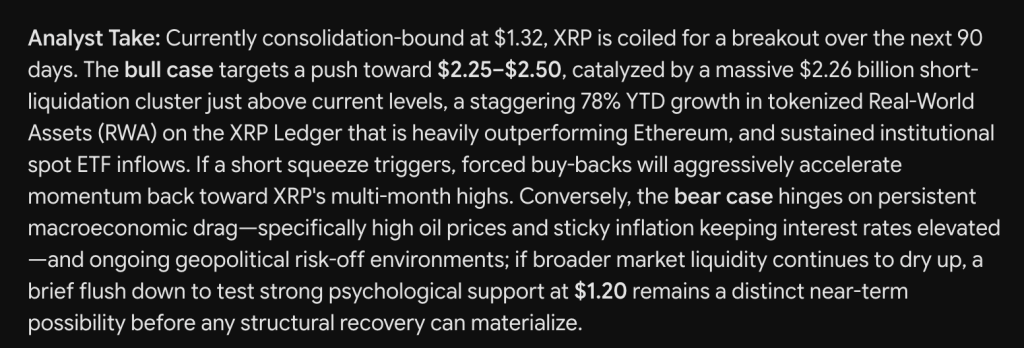
Google Gemini AI is calling XRP coiled for a breakout over the next 90 days, targeting $2.25 to $2.50 from a current price of $1.32, and the specific mechanism behind the bull case is more technical than most predictions in this series.
The $2.26 billion short liquidation cluster sitting just above current levels is the loaded gun in this setup. That is not a narrative catalyst or a roadmap promise; that is real leveraged money that gets forcibly bought back the moment the price pushes through the trigger zone.
If XRP breaks above the cluster level with enough volume to start the cascade, forced buybacks accelerate momentum in a way that fundamentals alone never could.
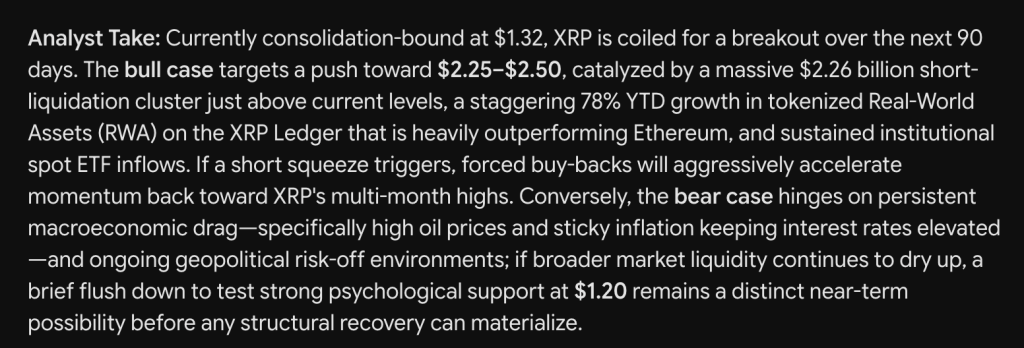
Gemini essentially points to a market structure catalyst that feeds on itself once it is activated.
Layered on top of that is a data point that most XRP coverage has been sleeping on. Tokenized Real-World Asset volume on the XRP Ledger is up 78% year to date, and it is outperforming Ethereum on that specific metric.
That matters because RWA has been one of the dominant institutional narratives of this cycle, and XRP is quietly winning the race on the infrastructure that processes it.
Add sustained spot ETF inflows that continue to build the institutional demand base, and Gemini sees the setup as one where the short squeeze provides the ignition and the fundamental story provides the fuel.

The bear case is macro rather than XRP-specific. High oil prices and sticky inflation keeping interest rates elevated longer than the market expects would drain liquidity from risk assets broadly, and XRP would not be immune.
Geopolitical risk-off environments have consistently hurt the altcoin market regardless of individual asset fundamentals, and if that environment persists, Gemini flags a flush toward $1.20 as a real near-term possibility before any structural recovery takes hold.
XRP Price Prediction: XRP Went From $0.50 to $3.70 in 8 Weeks, the Weekly Chart Explains Why $1.32 Feels Like a Contradiction
XRP price is closing the current week at $1.319 and this weekly chart going back to 2024 captures one of the most violent repricing events in recent crypto history.
The move from $0.50 in late 2024 to $3.70 at the January 2025 peak was nearly vertical, a straight-up 7x in under 2 months that was driven almost entirely by the SEC lawsuit resolution and the institutional access narrative that followed it.
What happened after that peak is the story the chart is still telling now. Every recovery attempt from the January high made a lower high, and every pullback made a lower low.
The structure from January 2025 through today is a clean descending channel that has been methodically grinding XRP from $3.70 all the way back to $1.20, which was last month’s low.
The $1.20 level is significant because it is not just round-number psychology, it is the pre-election breakout zone from November 2024 where the entire institutional narrative first got priced in.
Losing that level on a weekly close would mean the market is pricing out the entire post-SEC settlement premium.
The current price at $1.32 is sitting in the lower portion of a consolidation range between $1.20 and $1.60 that has formed over the past 3 months.
That range is narrowing, and compressing ranges on the weekly timeframe tend to resolve with directional conviction when they finally break. Gemini’s short squeeze thesis is essentially a bet on the range breaking upward rather than downward.
Google Gemini AI Predicts that Liquidchain Could Be The Next Big Thing
There is a moment in every cycle where the money stops chasing what everyone already owns.
Large caps do not stop working all at once. They slow down gradually. Returns compress. The same resistance levels hold for weeks. The narrative stays intact but the price stops responding to it. Bitcoin is there right now. So is Ethereum. So is XRP, which has been perpetually one catalyst away from its next move for longer than most traders want to admit.
When that happens, capital does not sit still. It finds the next thing. It always does.
The next thing never looks ready when the rotation starts. Early presale. Small raise. Unproven team. A problem the entire industry acknowledges and complains about, and has never actually fixed. That combination is exactly what gets ignored until it can no longer be ignored.
Cross-chain liquidity is that problem. Bitcoin, Ethereum, and Solana are three dominant ecosystems with three completely isolated liquidity systems. There is no native way to connect them. Every user and developer who needs to operate across all three pays for that limitation directly, in fees, in slippage, in failed transactions, and in time. The fragmentation cannot be patched. It is hardwired into how these networks were originally built.
LiquidChain is building the layer that makes the entire problem irrelevant. One execution environment connecting all 3 ecosystems simultaneously. Deploy once, reach everywhere, with no cross-chain tax extracted from every interaction.
The presale is at $0.01454. Just over $700,000 raised.
The market has not looked at this yet. That changes eventually.
The risk profile is what you would expect at this stage. Nothing is proven. Adoption, liquidity, and execution are all still unknowns. That is not a disclaimer. That is the nature of the bet.
The projects that return 10x or 100x are not the ones that looked safe at entry. They are the ones who solved a real problem before the rest of the market understood it.
LiquidChain is still in that window.
The post Google’s Gemini AI Predicts Incredible XRP Price by The Next 90 Days of 2026 appeared first on Cryptonews.
Crypto World
AI Agents Are Leaking Alpha: Here is How Crypto Infrastructure Is Closing the Privacy Gap
TLDR:
- Centralized AI inference logs and retains prompts, creating structural data leaks with real dollar value attached.
- McKinsey’s 2025 report shows data security jumped 10pp YoY, becoming the top enterprise AI scaling blocker.
- Crypto projects like NEAR, Phala, and Nillion use TEEs and MPC to run encrypted AI inference at near-normal speed.
- Gartner projects 75% of untrusted infrastructure processing will require TEEs by 2029, opening a major market window.
Privacy infrastructure is fast becoming a critical requirement for enterprise AI adoption. As artificial intelligence systems move beyond simple tasks into managing capital, executing trades, and running autonomous agents, the question of who controls sensitive data has gained real economic weight.
Several blockchain-based projects are now positioning themselves as neutral, verifiable alternatives to centralized cloud inference.
Centralized AI Creates Structural Data Exposure Risks
The problem with centralized inference is straightforward: every prompt sent to a third-party server gets logged and potentially retained.
That arrangement worked when AI was summarizing documents or answering general questions. It becomes a liability when AI systems touch trading strategies, private keys, or proprietary deal flow.
Real incidents have already exposed this vulnerability. Samsung engineers accidentally leaked source code through ChatGPT.
DeepSeek was caught routing Korean user prompts directly to ByteDance servers in Beijing. These are not theoretical risks — they are documented failures with measurable consequences.
As crypto analyst Kaff noted on X, “An agent’s system prompt is its alpha. If it’s readable, it’s extractable. MEV, but for intelligence.”
That framing captures the shift well. Agentic AI systems carry embedded strategic information, making prompt confidentiality a security matter, not just a privacy preference.
Enterprise data backs this concern. McKinsey’s State of AI 2025 report showed data security jumped 10 percentage points year-over-year as the top scaling blocker for enterprise AI.
Separately, 80% of organizations have already encountered risky AI-agent behavior, including unauthorized data access.
Crypto Projects Build Verifiable Privacy Stacks for AI Workloads
Big tech is responding with its own solutions. NVIDIA’s confidential GPU mode on Blackwell is approaching normal performance levels. Apple has Private Cloud Compute in production.
Meta is building private processing for WhatsApp. Google Cloud and AWS both offer confidential compute products. However, all of these solutions remain tied to single cloud providers.
Crypto projects offer something different: open coordination, censorship resistance, and neutral infrastructure. Venice ($VVV) reports over 2 million users, 50,000 daily active users, and 15,000 inference requests per hour, with local encrypted memory and end-to-end encryption for Pro users.
NEAR is running AI Cloud on TEE-secured environments where even GPU operators and cloud hosts cannot access user data.
Nillion ($NIL) combines MPC, homomorphic encryption, and TEEs, reporting over 643 million documents stored and 1.4 million inference calls.
Phala Network ($PHA) processes over 1 billion LLM tokens daily through Intel TDX and NVIDIA H100/H200 GPU TEEs at roughly 95–99% of standard performance.
Gartner projects that over 75% of processing on untrusted infrastructure will require trusted execution environments by 2029.
That timeline gives privacy-focused crypto infrastructure a concrete market window to capture enterprise AI workloads at scale.
Ripple Labs is reportedly leading an effort to raise at least $1 billion for a new public-market vehicle that would accumulate XRP, per Bloomberg, testing whether the digital asset treasury trade still works beyond bitcoin.
The raise would be done through a special purpose acquisition company, the report citied to people familiar with the matter. The funds would sit inside a new XRP-focused digital asset treasury, and Ripple is expected to contribute some of its own XRP to the vehicle.
Terms are still under discussion and could change. Ripple did not immediately respond to CoinDesk’s requests for comment or confirmation.
If completed, the deal would be the largest known XRP treasury vehicle to date. XRP is the world’s fifth-largest token, with a market value of about $138 billion. It has gained 13% this year, compared with a 16% rise in bitcoin.
Digital asset treasury companies became one of crypto’s biggest stock-market trades in 2025, as listed firms used SPACs, reverse mergers and equity issuance to buy tokens. The model worked while crypto prices rose and investors paid premiums for balance-sheet exposure.
That trade has weakened, however. Shares of major token accumulators, including Strategy and Metaplanet, have fallen sharply in recent months as crypto prices turned choppy and investors started questioning how many public companies can run the same accumulation play at once.
Ripple’s plan would test whether XRP has enough institutional demand to support a similar structure.
XRP has not drawn the same treasury-company interest as bitcoin. One of the larger examples came in May, when VivoPower announced a $121 million raise to pivot toward XRP investing.
Ripple has its own reasons to back a larger vehicle. The company held 4.74 billion XRP in wallets as of July 31, worth about $11 billion at current prices, according to its website. Another 35.9 billion XRP were locked in on-ledger escrow accounts scheduled for monthly release.
A public XRP treasury company could create a new buyer for the token while giving Ripple another way to place part of its holdings with investors.
Crypto World
Spot Bitcoin ETFs See Record 10-Day Outflow Streak, Analyst Calls It ‘Contrarian Indicator’
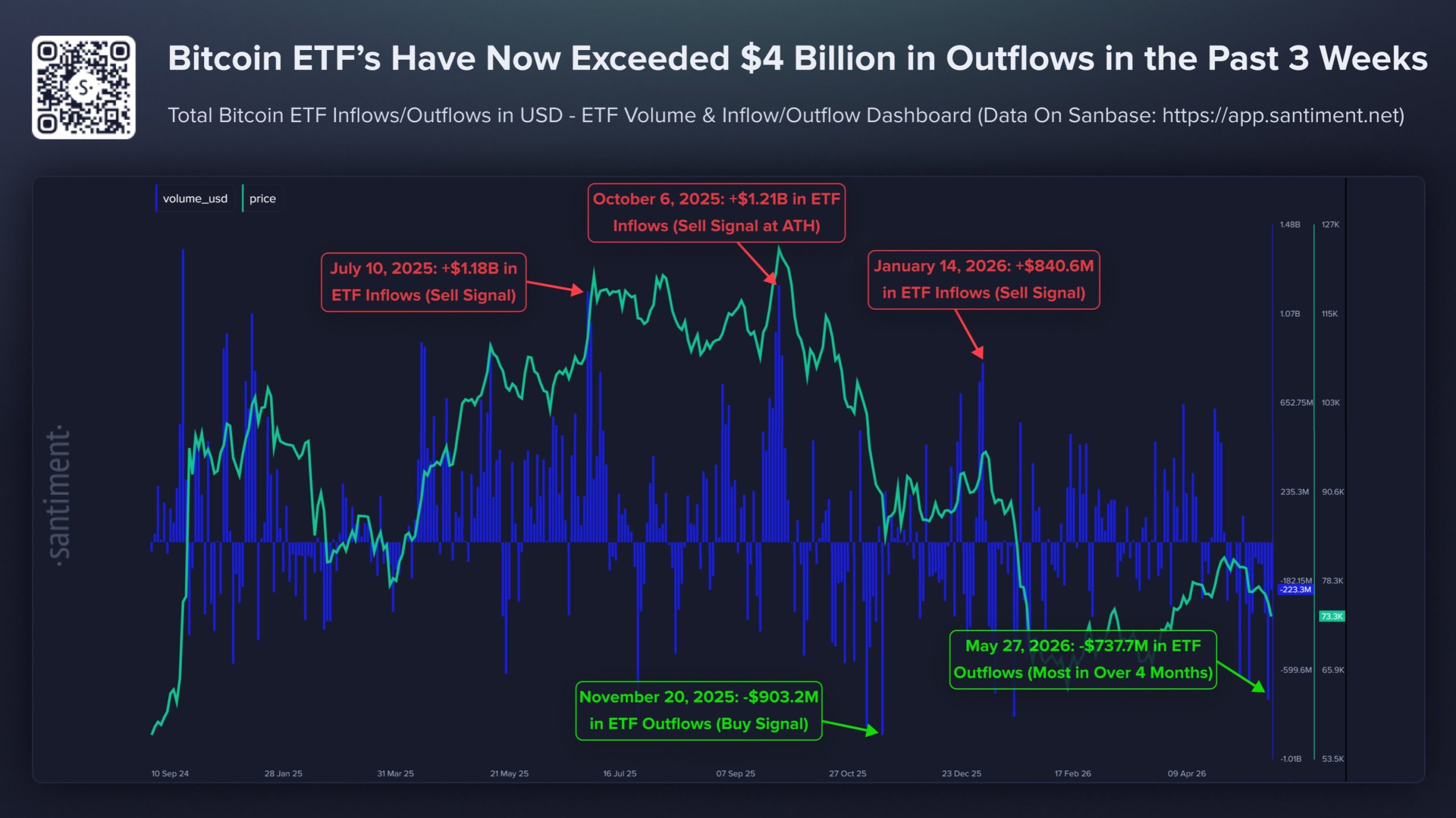
Spot Bitcoin exchange-traded funds (ETFs) have logged outflows for ten consecutive trading days, with total net redemptions exceeding $2.97 billion since May 15, a streak that one analyst says may signal a market bottom is near.
According to data from SoSoValue, daily outflows ranged from $70 million to $733 million across the period, with the steepest single-day exodus recorded on Wednesday at $733.43 million. Total net assets held across spot Bitcoin (BTC) ETFs have dropped from $104.29 billion on May 15 to $94.17 billion as of Friday, a decline of roughly $10 billion in two weeks.
The current streak broke the previous record of eight consecutive outflow sessions, which was recorded in early last year and saw $3.2 billion in withdrawals, on Thursday, before extending to 10 days on Friday.
Spot Bitcoin ETFs have become a major gauge of institutional demand since their US launch. Large inflows have historically signaled growing optimism and increased demand, while heavy outflows reflect fear and de-risking.
Related: Bitcoin ETFs Turn Negative as IBIT Posts Near-Record Losses
Bitcoin ETF outflows signal ‘peak fear’
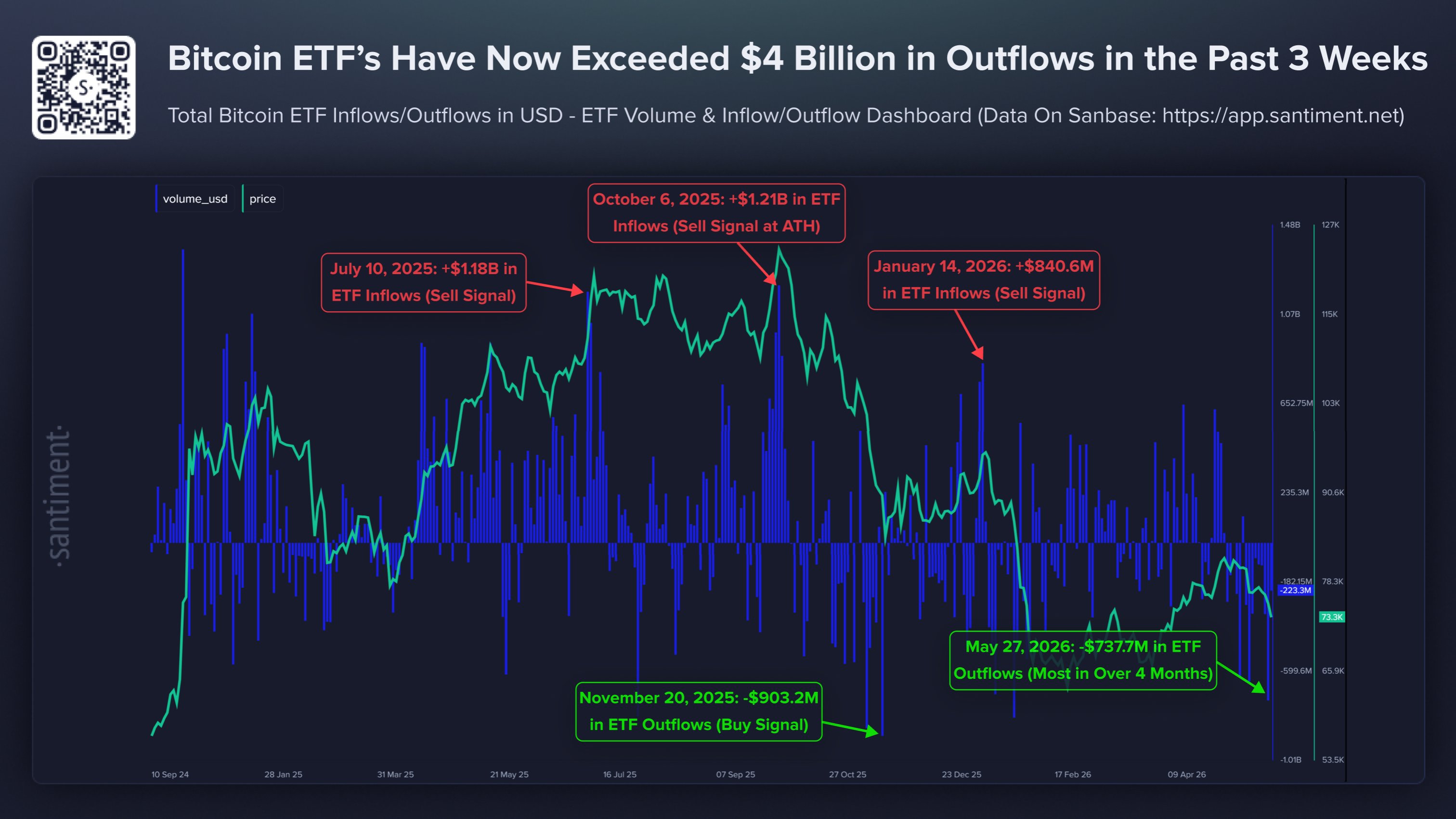
Crypto analytics firm Santiment Intelligence said the sustained outflows may suggest the market bottom is nearing an end. “History has shown that extreme ETF outflows typically work well as a contrarian indicator, since prices move opposite to trader expectations,” Santiment wrote on X.
In a Friday post on X, the platform argued that when large amounts of money leave Bitcoin ETFs over a short period, it reflects ‘peak fear, frustration, or risk aversion’ among investors.
Source: Santiment Intelligence
The firm pointed to the nearly $904 million single-day outflow recorded in November 2025, which occurred close to a major market low before prices recovered. “Consider the massive level of money moving out as a sign that we are getting closer to the local bottom some patient investors have been waiting for,” it added.
Related: Bitcoin ETFs on Brink of Net Outflow Territory For 2026
Spot Ether ETFs see 14-day outflow streak
Spot Ether (ETH) ETFs have also been caught in the broader selloff, logging outflows across 14 consecutive trading sessions from May 11 to Friday. Daily redemptions ranged from $5.65 million to $130.62 million, with the steepest single-day exit recorded on May 12 at $130.62 million. Total net assets fell from $13.85 billion on May 11 to $11.27 billion on May 29, a decline of roughly $2.6 billion over the period.
Meanwhile, spot Hyperliquid (HYPE) ETFs bucked the trend, logging inflows every single session since launching on May 12. Cumulative net inflows crossed $100 million by May 28, with total net assets climbing from $1.87 million at launch to $122.20 million in just over two weeks.
Magazine: Guide to the top and emerging global crypto hubs — Mid-2026


Brian Armstrong fired back at Jamie Dimon on Friday with a meme, after the JPMorgan CEO attacked him on live TV.
Summary
- Jamie Dimon appeared on Fox Business on May 29, calling Armstrong “full of sh!t” and vowing that banks will fight the Clarity Act’s stablecoin provisions.
- Armstrong responded on X with a hockey-themed meme depicting himself and Dimon facing off, while Galaxy CEO Mike Novogratz publicly backed Armstrong.
- Dimon’s core objection is that the Clarity Act lets crypto firms effectively pay interest on stablecoin deposits without bank-level oversight.
Coinbase CEO Brian Armstrong posted a hockey-themed rivalry meme on X on Friday, hours after JPMorgan Chase CEO Jamie Dimon appeared on Fox Business’s Mornings with Maria and called Armstrong “full of sh!t” over his lobbying push for the Digital Asset Market Clarity Act.
The exchange escalated a months-long public feud between Wall Street’s largest bank chief and crypto’s most prominent exchange CEO, now centred on a single sticking point: whether crypto platforms should be allowed to pay yield on stablecoin balances without submitting to bank-style regulation.
What Dimon said and what it means
Appearing on Fox Business on May 29, Dimon said: “It allows cryptocurrency firms to effectively pay interest on deposits, stablecoins or something like that, without the protection that they should have. The banks will not accept it that way.” He warned the system would “eventually blow up” if passed as written, and accused Armstrong of spending hundreds of millions of dollars in Washington to push the bill. “No one is going to bow down to this guy,” Dimon said.
Galaxy Digital CEO Mike Novogratz joined the response on X, writing: “Since when do banks get to decide on legislation?” Novogratz argued that lawmakers, not financial institutions, should determine the framework for digital assets.
The friction between Dimon and Armstrong is not new. At the World Economic Forum in Davos in January 2026, Dimon reportedly told Armstrong directly “you are full of sh!t” in a private meeting that also included former UK Prime Minister Tony Blair. Bank of America CEO Brian Moynihan also reportedly told Armstrong at Davos: “If you want to be a bank, just be a bank.” Coinbase pulled its support for the Clarity Act in January after a Senate draft included provisions that would have effectively banned yield on stablecoin balances, a withdrawal that forced Senate Banking Committee Chair Tim Scott to cancel a scheduled vote.
By May, a compromise had emerged allowing activity-based rewards while banning passive yield. As crypto.news reported, Armstrong backed the updated bill ahead of the Senate Banking Committee’s May 14 markup, which advanced the legislation 15 to 9. Despite that progress, Dimon’s Friday comments signalled that JPMorgan and allied banks intend to push back on the floor vote.
For Coinbase, the stakes are direct. Coinbase reported $1.35 billion in stablecoin revenue in 2025, making the yield provisions a revenue variable as much as a policy preference. Galaxy Research head Alex Thorn currently gives the Clarity Act 70% odds of passing before August recess, while Polymarket traders price it at 61%. Dimon’s public opposition, backed by the weight of America’s largest bank, adds institutional friction at precisely the moment the bill’s floor timeline is most compressed.

The rapidly evolving Bitcoin treasury space finds itself at a crossroads, split between funds with deployable capital strategies and a wave of promotional narratives. In a candid interview at BitcoinVegas, Sean Bill, co-founder of the Bitcoin treasury vehicle BSTR alongside Adam Back, warned that many peers may be overpromising and underdelivering on practical deployment of Bitcoin.
“A lot of them don’t have the right capital structure to actually deploy Bitcoin,” Bill told Cointelegraph in a YouTube interview published this week. “They’re really planning on having Bitcoin do all the talking for them. I do think that you have a lot of carnival barkers in this space.”
Bill argued that the value proposition for a treasury-focused firm hinges on more than simply holding Bitcoin. While cheap and easy leverage can prop up value, a company without a credible mechanism to deploy capital risks losing investor interest to simpler products—such as Bitcoin exchange-traded products—when price makes the narrative harder to justify after the initial hype fades.
The ongoing debate surrounding Bitcoin treasuries has become one of the cycle’s most-discussed narratives. While corporate holdings have driven demand and visibility for Bitcoin, they also raise questions about systemic risk and market integrity as the sector matures.
In a June 3, 2025 note to investors, Geoff Kendrick, head of digital assets at Standard Chartered Bank, warned that a sharp drop in Bitcoin’s price could trigger sizable liquidations within treasury-linked strategies. He also noted that regulatory developments and broader market maturation may erode the premium that has historically accompanied Bitcoin proxy stocks. The takeaway for market participants is clear: a shift from speculative hype to disciplined capital deployment could redefine how these vehicles are valued in the years ahead.
Bitcoin treasury data underscores the sector’s scale and concentration. According to BitcoinTreasuries, 198 public companies collectively hold about 1.25 million BTC. Among them, Michael Saylor’s Strategy is listed as the largest public corporate holder, with a treasury of 843,738 BTC.
Recent coverage has highlighted the fragility of some listed vehicles. Cointelegraph reported that Nakamoto (NAKA) stock, a prominent Bitcoin treasury-listed company, slid roughly 67% year-to-date and more than 99% from its May 2025 peak of around $34 per share. The stock traded near $0.16 in April before a reverse stock split, a move that drew attention from investors and market observers. Nasdaq had warned of possible delisting after trading below $1 for 30 consecutive days, according to an SEC filing.
These dynamics illuminate the tension between narrative-driven momentum and the realities of capital markets. As more capital programs come online, the sector’s ability to deploy capital prudently—and to withstand downside risk—will increasingly determine which players survive the next cycle.
For readers tracking this space, the broader question remains: will the Bitcoin treasury model evolve into a disciplined, capital-allocating ecosystem that stands on its own merits, or will it rely on continued price momentum and promotional narratives to attract capital?
Key takeaways
- The Bitcoin treasury sector is bifurcating between firms with credible capital deployment strategies and those leaning on promotional narratives without robust capital structures.
- Without real deployment options, some companies risk losing investor interest to straightforward Bitcoin products like ETFs, especially in softer macro conditions.
- Analysts warn that a sharp price decline could trigger forced liquidations in treasury strategies, while regulatory and market maturation may erode premium pricing for Bitcoin proxy stocks.
- BitcoinTreasuries tallies show 198 public companies holding about 1.25 million BTC; the largest holder is described as Michael Saylor’s Strategy with 843,738 BTC.
- Illustrative cases like Nakamoto (NAKA) illustrate liquidity and delisting risks in this niche, underscoring the need for robust corporate governance and sustainable capital plans.
A split in the Bitcoin treasury landscape
Sean Bill’s critique centers on the structural viability of treasury programs. He contends that a credible firm must demonstrate an actionable plan to deploy Bitcoin into productive use—whether through yield-generating mechanisms, strategic hedging, or disciplined capitalization—rather than relying on Bitcoin’s price appreciation alone to justify value. In his view, “carnival barkers” may generate short-term buzz but fail to deliver durable value for long-term investors.
The industry’s narrative is closely tied to Bitcoin’s own price journey and the broader appetite for crypto exposure via listed vehicles. As Treasury strategies proliferate, the question becomes whether the market will reward tangible capital deployment and governance rigor or reward spectacle and marketing hype. This debate matters for investors seeking diversification within crypto and for builders crafting transparent, risk-aware treasury programs.
Regulatory and market maturation: what changes the calculus?
Market observers point to the Standard Chartered assessment as a reminder that the space cannot remain purely narrative-driven. A potential price shock could trigger liquidity events that ripple through treasury portfolios, particularly when leverage and margin facilities are employed. At the same time, regulatory clarity and market maturation could compress the premium that investors have historically paid for Bitcoin proxy exposure, pushing capital toward products and protocols that demonstrate resilience beyond hype.
The evolving regulatory backdrop is thus as important as Bitcoin’s price action for treasury strategies. As this segment matures, investors will demand greater transparency on reserve management, risk controls, and the ability to deploy capital productively under varied market conditions.
Scale, concentration, and the Nakamoto case
The BitcoinTreasuries dataset paints a picture of scale and concentration. With nearly 1.25 million BTC across 198 public companies, the sector remains dominated by a few large holders. The largest, described in industry data as Michael Saylor’s Strategy, holds 843,738 BTC, underscoring how a small number of large treasury positions can shape market perception and capital flows.
The Nakamoto case provides a cautionary counterpoint. The stock’s steep decline and the delisting risk highlighted the fragility that can accompany publicly traded Bitcoin treasury vehicles. The intersection of stock market mechanics and crypto exposure remains a delicate space where governance, liquidity, and valuation interact in complex ways.
As readers monitor these developments, it’s worth noting that the broader Crypto markets are watching not only Bitcoin’s price but also how treasury programs adapt to regulatory expectations and evolving investor protections. For now, the sector’s fate hinges on disciplined capital deployment, clear governance, and a credible path to real value creation beyond mere price narratives.
Further coverage on related dynamics, including market reactions to the latest regulatory signals and new treasury deployments, will help investors gauge which players are likely to endure as the space consolidates.
Sources and data references include BitcoinTreasuries’ ongoing public-company BTC holdings ledger and market notes discussing the Nakamoto stock situation, including the SEC filing and Nasdaq delisting considerations. For context on BTC treasury metrics, see BitcoinTreasuries data.

Mariah Carey Teases ‘The Rarities 2’ and Holiday Return as Catalog Interest Surges in 2026

Binance aims for 3 billion users by 2030 amid a market it says is going through hard times

Naomi Osaka reaches Roland Garros fourth round for First Time


-

 Business6 days ago
NYT Strands Answers May 24 2026 Revealed for Puzzle No. 812 Theme Summer Essentials
-

 NewsBeat3 days ago
Israel says it has killed new Hamas military leader in Gaza City airstrikes
-

 Politics5 days ago
Bridgerton Season 5: Cast, Release Date And Everything We Know So Far
-

 Business4 days ago
Selena Gomez Reportedly Upset Over Benny Blanco’s Comments on Her ‘Terrible’ Diet
-
Crypto World4 days ago
Micron Crosses $1 Trillion Market Cap as AI Demand Reshapes Memory Sector
-

 Tech5 days ago
Microsoft’s quiet Claude Code retreat and the real cost of enterprise AI
-

 Business5 days ago
BTS Sells Out Four Las Vegas Shows at Allegiant Stadium for ARIRANG World Tour
-
 Tech4 days ago
China assigns ID codes to 28,000+ humanoid robots
-

 News Videos3 days ago
XRP *JUST* SUCCEEDED!!!! CLARITY ACT EXPOSED!!! (SHE EXPOSED IT)
-

 Tech1 day ago
Waymo dominates autonomous vehicle registrations as Tesla trails behind
-
Tech3 days ago
The Samsung pay deal is the moment Korean unions changed register
-

 Tech5 days ago
Westone Audio and Etymotic Acquired by Fidelity Collective in Major IEM Market Move
-

 Tech4 days ago
Millions of AI agents imperiled by critical vulnerability in open source package
-
Crypto World6 days ago
Brian Armstrong Outlines Crypto Vision for the Future Financial System
-
 Entertainment5 days ago
‘Breaking Bad’ Star’s Easy-to-Binge 6-Part Crime Series Spin-Off Is Finally Heading to Free Streaming
-
Crypto World3 days ago
SpaceX’s $2 Trillion IPO: Why Tech Giants Nvidia (NVDA), Apple (AAPL), and Microsoft (MSFT) May Face Pressure
-
 Crypto World5 days ago
Nvidia (NVDA) CEO Calls on Super Micro to Strengthen Export Controls Amid Smuggling Probe
-

 Tech3 days ago
NASA taps Blue Origin to deliver lunar rovers for Moon Base initiative
-
 NewsBeat5 days ago
Hottest May day ever as London hits 34.8C in 2C leap from previous records
-
 Crypto World20 hours ago
Snowflake (SNOW) Stock Rallies on Strong Q1 Results and AI Product Growth
You must be logged in to post a comment Login