
Crypto World
Bitcoin Price Analysis: Key Support Levels and Liquidity Clusters to Watch This Week

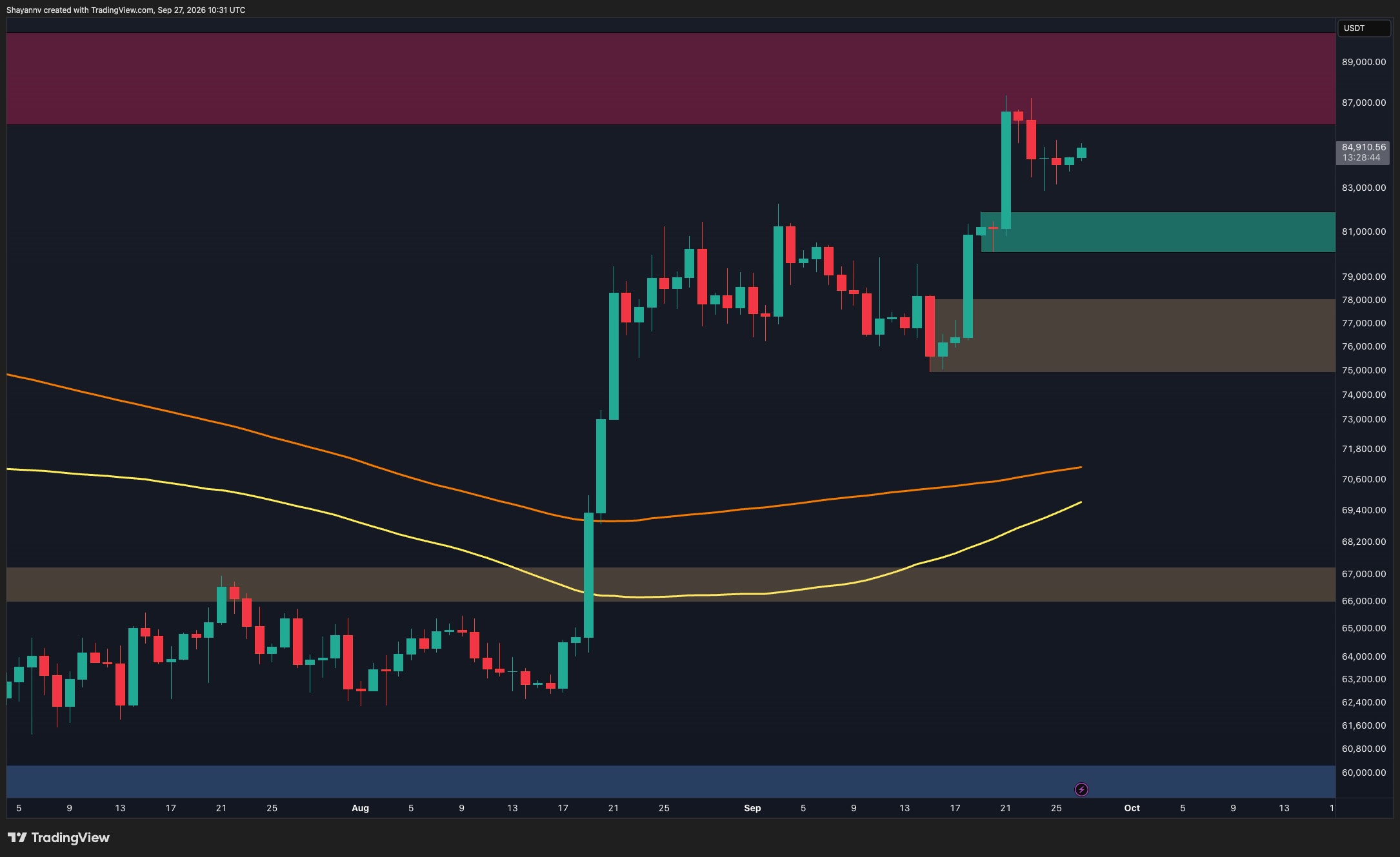
Bitcoin is attempting to recover after its latest rejection from the $86K-$87.3K supply area. While the broader structure remains constructive, BTC still needs to reclaim this overhead zone to confirm another leg higher, with liquidity positioned on both sides of the market.
Bitcoin Price Analysis: The Daily Chart
On the daily timeframe, Bitcoin remains in a bullish market structure following the powerful August breakout. The price has since established itself well above both displayed moving averages, which are now turning higher and providing a more supportive medium-term backdrop.
The latest advance carried BTC into the major $86K-$89K resistance region, where sellers stepped in and triggered a correction toward $83K. However, the pullback has so far remained relatively contained, with the price currently recovering around $84.9K.
The $80K-$82K demand zone is the most important nearby support. Holding above this region would preserve the recent higher-low structure and keep another attack on the highs plausible. A successful daily breakout through the $86K-$89K supply zone could then clear the way for further price discovery.
Conversely, losing the $80K-$82K area would weaken the bullish structure and could expose the deeper $75K-$78K demand zone. The rising moving averages remain substantially below current prices, so a deeper correction could still occur without necessarily reversing the broader trend.
BTC/USDT 4-Hour Chart
The 4-hour chart provides a clearer view of the current consolidation. Bitcoin was rejected from a more concentrated supply zone between approximately $86K and $87.3K, subsequently dropping toward the $83.5K-$84K area.
Since then, volatility has contracted considerably. BTC has formed a tight sideways base before beginning to grind higher toward $85K. This stabilization following the sharp rejection is constructive, but the $86K-$87.3K supply zone remains the decisive obstacle.
A clean breakout and sustained move above $87.3K would indicate that the recent correction has likely run its course and could trigger another impulsive move higher. Until then, the price remains below resistance and vulnerable to another rejection.
On the downside, the $80K-$82K demand zone represents the first major support. If that fails, the broader $75K-$78K region becomes the next significant area where buyers could attempt to regain control.

Sentiment Analysis
The one-week Binance BTC/USDT liquidation heatmap shows a notable imbalance in nearby liquidity. The strongest concentration above the current market appears around $87K-$88K, almost perfectly aligning with the technical supply zone identified on the price charts.
This makes the region particularly significant. If BTC pushes through $86K and begins clearing the $87K-$88K liquidity cluster, short liquidations could contribute to an acceleration of the move.
However, considerable downside liquidity also remains visible. There are notable clusters around $82K and, more importantly, close to $80K-$81K. The latter broadly overlaps with the daily demand zone, reinforcing this area as a key downside target if the current recovery fails.
For now, Bitcoin appears caught between the liquidity below $82K and the larger overhead concentration near $87K-$88K. With price gradually recovering toward the upper cluster, a confirmed break through the supply zone could provide the catalyst for another significant upward move.

The post Bitcoin Price Analysis: Key Support Levels and Liquidity Clusters to Watch This Week appeared first on CryptoPotato.


Japanese police have arrested two people suspected of helping a fake police fraud group steal cryptocurrency worth approximately 81 million yen from a woman in her 40s.
Summary
- Japanese police arrested two suspects over a scheme allegedly stealing 81 million yen in cryptocurrency.
- Police believe the fraud group operated from Cambodia and targeted a woman in her forties.
- Investigators say the suspects’ linked cases caused confirmed losses totaling approximately 240 million yen overall.
- Japan recorded 617.1 billion yen in fake police scam losses through July this year nationally.
- Authorities believe a Chinese national directed the operation from a suspected Cambodia-based fraud center overseas.
FNN reported on Sept. 25 that police arrested 31-year-old Saki Okayama and 38-year-old Mitsuki Minamisawa on suspicion of involvement in the scheme. Investigators believe the group operated from Cambodia and impersonated Japanese police officers to pressure victims into transferring assets.
The victim was allegedly told that her bank card had been connected to a large money laundering investigation. According to police information cited by FNN, the group claimed a fraud case had caused 600 billion yen in losses and that around 400 accounts had been used to launder funds.
Fake police allegedly demanded proof of innocence
The scheme began with a telephone call from a man claiming to represent the Osaka Prefectural Police.
FNN reported that the caller told the woman her card appeared among accounts connected with the supposed money laundering investigation. The caller then claimed she was close to being arrested and needed to “prove her innocence.”
Police allege that the false accusation eventually led the victim to transfer cryptocurrency worth around 81 million yen. The assets were valued at approximately $515,000 using the conversion cited in reports on the case.
Investigators have not publicly identified the cryptocurrencies involved or disclosed the wallet addresses that received the assets. Available reporting therefore does not establish how the cryptocurrency was subsequently moved, converted or withdrawn.
The Tokyo Metropolitan Police Department believes Okayama and Minamisawa participated in a larger organization. Known losses from fraud cases involving the two suspects have reached approximately 240 million yen, according to FNN.
Police suspect the group maintained its operational base in Cambodia, more than 4,000 kilometers from Japan. Investigators believe a Chinese national acted as the person directing the operation.
The available FNN report does not state that either suspect has been convicted. Both remain suspects in the investigation, and the allegations concern their suspected involvement in the fraud network.
Japan fake police scams are causing rising losses
The arrests come during a sharp increase in losses from people impersonating police officers throughout Japan.
Japan’sv National Police Agency reported that fake police scams caused 61.71 billion yen in losses during the first seven months of 2026. Authorities recorded 5,422 cases through the end of July.
Although the number of cases fell 6.4% from the same period a year earlier, financial losses increased 25.7%. Fake police schemes therefore remained one of Japan’s most costly forms of special fraud.
The National Police Agency began treating fake police fraud as a separate category in its 2026 statistics because the method had become increasingly common. Its data shows total special-fraud losses reached 210.81 billion yen through July, up 42.9% from a year earlier.
During the first half of the year, fake police scams caused 50.79 billion yen in losses. The average completed case cost victims around 11.64 million yen, according to police statistics.
The 81 million yen allegedly taken in the latest cryptocurrency case was therefore substantially above that first-half average.
Police have documented repeated cases in which impersonators tell victims that they are under investigation, that an arrest warrant exists or that their money must be transferred to establish innocence.
A separate Sept. 25 case involved a man in his 70s who lost approximately 73 million yen after callers claiming to represent the Tokyo Metropolitan Police Department asked him to move money to prove he was innocent. Police stressed that investigators do not instruct people to transfer money to designated accounts.
Cryptocurrency is becoming part of Japanese fraud controls
Japanese regulators have been strengthening controls where fraud proceeds move through cryptocurrency exchanges.
Japan’s Financial Services Agency and National Police Agency asked exchanges in August to consider withdrawal delays and stronger checks on newly registered wallet addresses.
The proposed controls include waiting periods before new withdrawal addresses can be used, stronger transaction monitoring and restrictions when account behavior appears inconsistent with a customer’s normal activity.
Authorities have separately asked exchanges to improve phishing-resistant authentication and respond more quickly when police identify suspicious transactions.
The request followed rapidly rising fraud losses. National Police Agency figures showed 18,067 special-fraud cases and 151.47 billion yen in losses through May. Fake police schemes accounted for 40.32 billion yen of that amount.
Japan’s police have warned specifically about cryptocurrency investment scams. An updated Metropolitan Police notice says authorities continue receiving reports from people persuaded through social networks and matching applications to transfer cryptocurrency to fraudulent investment platforms.
A separate September case in Gifu involved a woman in her 70s who was allegedly told by people posing as police and prosecutors to convert assets into cryptocurrency for an investigation. She lost cryptocurrency worth 39.29 million yen and another 2 million yen in cash, according to police reporting.
Cambodia link points to a larger regional enforcement issue
The suspected Cambodia base in the 81 million yen case fits a pattern authorities throughout Asia have been investigating involving fraud operations run from overseas compounds.
Japan arrested an alleged senior Prince Group figure in June as authorities examined links between the Cambodia-based conglomerate and international fraud networks. Tokyo police arrested Hu Xiaowei over an alleged false residency registration while investigating his activities in Japan.
The current fake police case has not been publicly linked to Prince Group, and available police reporting does not identify the suspected Cambodia location or organization behind the operation.
Other Asian authorities have found Cambodia connections in separate cryptocurrency fraud investigations. South Korean police arrested 23 people in June over an alleged USDT laundering operation serving a Cambodia-based phishing network.
South Korean investigation involved 16.8 billion won in suspected laundering activity and more than 11,000 bank accounts.
Cambodia has meanwhile moved to strengthen criminal penalties targeting online scam operations. Its Senate approved legislation in April covering people involved in scam compounds and related organized fraud activity.
Cambodian legislation as authorities faced increased pressure over fraud centers operating in the country.
Tokyo police continue investigating the organization behind the latest case, including the suspected Chinese director and the group’s Cambodia-based operations. FNN reported that confirmed fraud losses involving the two arrested suspects currently total approximately 240 million yen.
Hackers stole $387.5 million from crypto exchange Bitget on September 24. Part of it is now being turned into Bitcoin through THORChain, which refuses to block it.
THORChain lets anyone swap a coin on one blockchain for a coin on another, with no ID check. Once it becomes Bitcoin, no company can freeze it.
Bitget Asks THORChain to Turn the Hacker Away
The hacker’s wallets are public and tracked. Bitget CEO Gracy Chen asked THORChain to refuse them.
“Decentralization is a design principle, not a shield for facilitating known stolen funds. The industry is watching,” she said.
Blockchain tracker MistTrack says this has happened before. After the $1.46 billion Bybit hack last year, nearly $1.2 billion was reportedly traced through THORChain.
THORChain Says It Is No Different From Bitcoin
THORChain pushed back. It calls itself permissionless, open to anyone, just like Bitcoin, Ethereum, and BNB Chain.
“What responsibility should Bitcoin, Ethereum, and BNB Chain bear when handling known stolen funds?” the team stated.
This response questions what responsibility those base blockchains bear for handling known stolen funds, deflecting calls for THORChain to block or monitor illicit flows.
It highlights core crypto tensions between permissionless cross-chain swapping on THORChain and industry demands for protocols to address publicly tracked hacker addresses.
THORChain Has Hit Pause Before
Star Xu, founder of rival exchange OKX, called THORChain’s Bitcoin comparison “False!” This follows a May incident where THORChain paused a vault after roughly $10 million was drained, its own report shows.
“A network that can stop when its own funds are at risk, but refuses to do so when someone else’s funds are at risk, is not “like Bitcoin,”” the OKX executive slammed.
May was not the first time. Nodes rapidly halted the network after a 2021 hack. In January 2025, they voted to freeze its lending and savings products.
Further, a sanctioned state, North Korea, already used THORChain to move over $1 billion from Bybit. Researchers and Bybit itself traced the bulk of the February 2025 attack through THORChain as Lazarus Group converted it to Bitcoin.
What Happens to Bitget Users
Bitget says a $464 million protection fund covers every customer. Withdrawals restart Monday, starting with Bitcoin at 8:00 UTC.
Chen says North Korea was very likely behind it. Bitget is offering a 5% bounty for help freezing the funds.
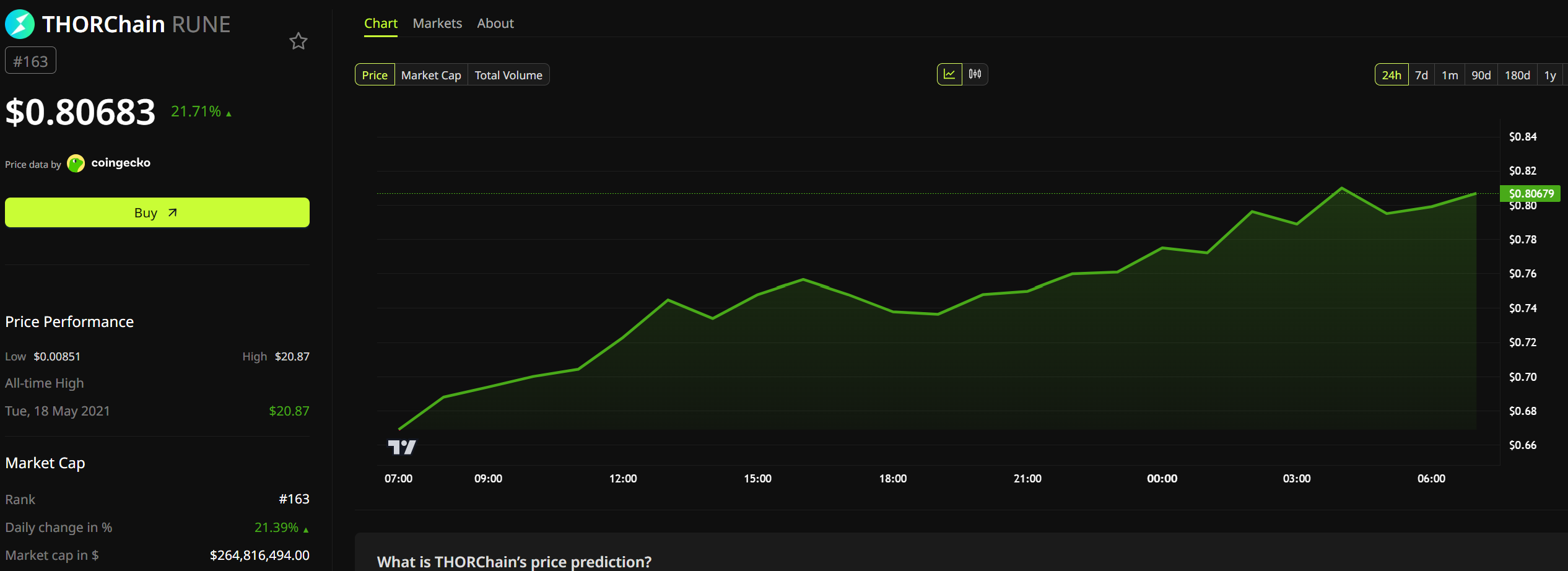
THORChain has still not blocked the flagged wallets, and despite all manner of slamming for its stance, the network’s RUNE token is up by over 20% in the last 24 hours.

The post THORChain Refuses to Block Assets Tied to Bitget Hackers appeared first on BeInCrypto.
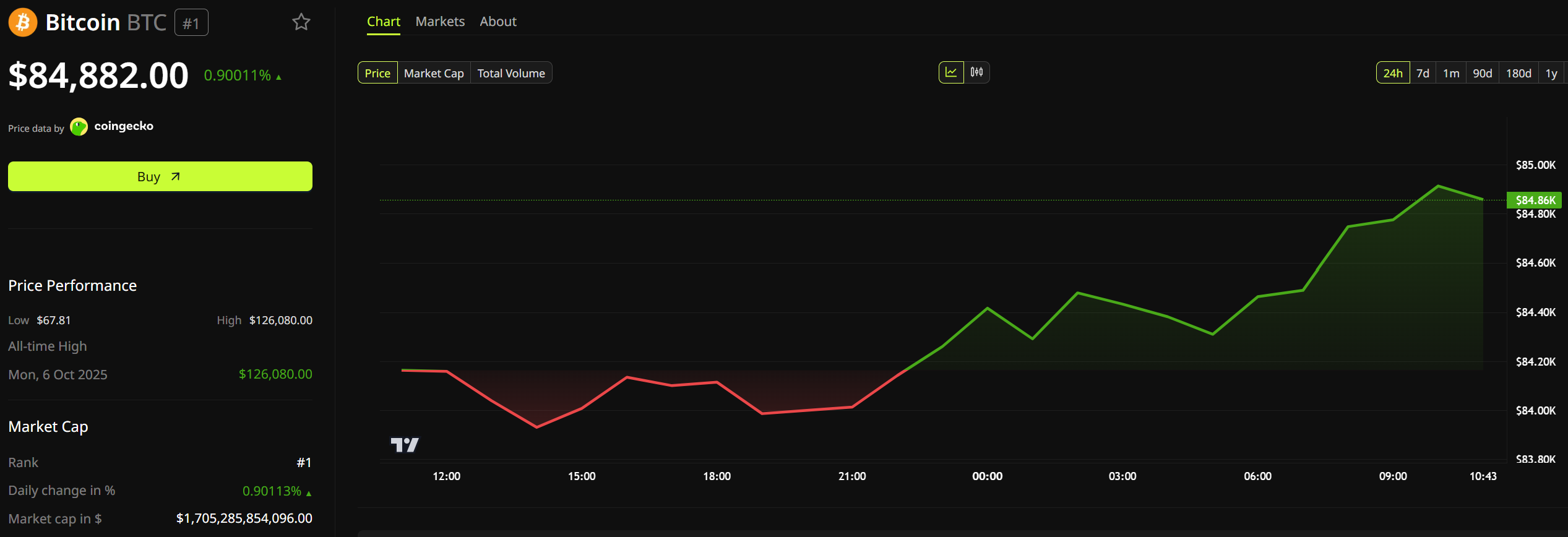
Riot Platforms has repaid a $200 million Coinbase loan, releasing 5,821 bitcoin it had locked up as security. At today’s price of about $84,800, those coins are worth roughly $494 million.
Riot, a Nasdaq-listed Bitcoin (BTC) miner, now controls that stack without restriction. It is also spending heavily to turn its Texas sites into artificial intelligence (AI) data centers.

What Riot’s Bitcoin-Backed Coinbase Loan Repayment Freed
The loan worked much like a pawn deal. Riot handed Bitcoin, USDC (a dollar-pegged digital token), and cash to Coinbase Custody as security.
Riot cleared the debt and interest on September 21, according to an 8-K filed Friday. An 8-K is a report US-listed companies must file after major events. Coinbase’s claim on the pledged assets ended the same day, and Riot paid no early repayment fee.
The released coins made up just over half of the 11,380 Bitcoin Riot held on June 30. However, the filing does not say how Riot raised the cash or what it plans for the coins.
Why Riot’s Locked Bitcoin Kept Changing
Before the payoff, only 5,559 of Riot’s coins were free to use, its June quarterly report shows. If its holdings have not changed since, the payoff roughly doubles that pool.
The number of locked coins rose and fell with Bitcoin’s price. When the price drops, each coin covers less of the debt, so Riot had to hand over more.
That happened in February. A price slide forced Riot to add 1,825 coins, lifting its pledge from 3,977 at the end of 2025 to 5,802, its annual report shows.
The rule also worked the other way. When prices rose, the loan agreement let Riot ask for some coins back without repaying. However, Coinbase had the final say on the math.
Instead, Riot repaid the full $200 million, seven months before the loan’s April 2027 due date. The loan carried a fixed 6.15% interest rate.
Riot Has Been Selling More Bitcoin Than It Mines
Riot’s recent record shows heavy selling. In the first quarter, it sold 3,778 Bitcoin for $289.5 million while mining 1,473, its production update shows.
The drawdown continued. Riot’s holdings fell from 15,680 to 11,380 coins in the second quarter, even as it mined 1,587. BeInCrypto reported in August that the miner was funding its AI buildout partly through those sales.
That buildout is large. In August, Riot signed a 20-year, $9.1 billion lease for 191 megawatts of computing capacity at its Rockdale, Texas, campus. The tenant is described only as a leading frontier AI lab.
Riot has other funding lined up, though. Morgan Stanley provided a $573 million interim loan for early construction, while a longer-term credit backstop is being finalized, Riot’s second-quarter results show.
Meanwhile, Bitcoin’s price has climbed since June 30, when the pledged coins were worth $340.7 million.
On the market, RIOT shares closed Friday at $23, down 2%. The stock lost about 3% over five days but remains up roughly 82% this year.

Riot’s next quarterly report will show whether the freed bitcoin stayed on its books.
The post Riot Frees $494 Million in Bitcoin From Coinbase Loan: Will It Sell? appeared first on BeInCrypto.

French authorities have placed a woman under formal investigation as they examine whether alleged manipulation of Verasity’s VRA cryptocurrency helped finance tens of millions of euros in Dubai property purchases.
Summary
- French investigators suspect VRA price manipulation helped finance Dubai property purchases linked to Svetlana A.
- Svetlana A. was formally investigated and detained over organized fraud, money laundering and criminal conspiracy.
- Le Monde says she spent over €50 million on roughly 100 Dubai apartments and villas.
- VRA rose about 65-fold during spring 2021 before later collapsing from its speculative price surge.
- Patent records list Svetlana Astakhova and Robert James Mark Hain together on Verasity-related technology inventions.
Le Monde reported on Sept. 25 that Svetlana A., a Russian-born French citizen, was arrested in July in the Alpes-Maritimes and later detained following action by a Paris investigating judge. France’s National Financial Prosecutor’s Office confirmed that she was placed under investigation for alleged organized fraud, aggravated laundering of tax-fraud proceeds and criminal conspiracy.
A judicial source told the newspaper that investigators suspect Svetlana A. and her British partner, identified as Robert H., were involved in alleged organized fraud through manipulation of a cryptocurrency’s exchange rate. Authorities are examining whether proceeds from that activity helped finance her Dubai real estate holdings.
VRA price activity forms part of the French investigation
Le Monde identified the cryptocurrency under examination as Verasity’s VRA token, which launched in 2018.
During spring 2021, VRA’s price increased roughly 65-fold over approximately two and a half months before reversing sharply, according to the newspaper’s investigation.
French investigators have not publicly released transaction-level evidence showing how any alleged price manipulation was conducted. Available judicial reporting does not identify specific trades, wallets, exchanges or counterparties allegedly used in the suspected scheme.
CoinGecko data shows VRA later reached an all-time high of $0.08621 on Oct. 31, 2021. The token now trades far below that record.
The token has experienced sharp price moves outside the period being examined by French investigators. VRA climbed as much as 45% in one session in May 2025 and gained more than 250% from its monthly low during that rally.
The French case concerns suspected conduct tied to earlier VRA activity. Investigators have not connected the later market movements to the alleged scheme described by Le Monde.
Dubai property purchases exceeded €50 million in 2022
Investigators are examining the source of funds behind a large Dubai property portfolio linked to Svetlana A. Le Monde reported that she spent more than €50 million during 2022 alone. The purchases covered around 100 apartments and three luxury villas throughout Dubai.
Many of the properties were rented, producing at least €4 million in cumulative income between 2022 and 2025, according to the newspaper’s investigation.
The holdings were spread among roughly 15 buildings, including Burj Royale, Opera Grand, I-Rise Tower and MBL Royal. In several buildings, she owned as many as ten units.
One transaction involved an entire residential building. In June 2022, Svetlana A. paid 68 million dirhams, then worth approximately €17.4 million, for Amara Residences. The five-story property contained 73 apartments and commercial spaces.
Ownership records later changed. Le Monde reported that the building was transferred without payment in February 2024 to Abu Dhabi company Sempios Holdings, which was held through a private foundation.
The newspaper said checks of UAE corporate registers still showed Svetlana A. holding signing authority connected with the company that owned the assets.
Dubai has become a major center for digital-asset businesses and financial services. In separate coverage, crypto.news reported on a UAE-Sweden investigation involving an alleged $7.1 million international crypto laundering network. No public evidence links that separate investigation to Svetlana A., Robert H. or Verasity.
Patent records connect the pair to Verasity technology
Public patent records provide documented links between Svetlana Astakhova and Verasity-related technology.
A U.S. patent record for a rewarded video-viewing system names Robert James Mark Hain and Svetlana Astakhova as inventors and lists Verasity Limited as the assignee.
Another Verasity patent identifies Robert James Mark Hain as inventor of technology connected with the company’s Proof of View system.
Verasity’s own materials identify RJ Mark as its founder. Its company information page says RJ Mark remains the company’s sole founder after stepping away from the public-facing CEO role.
Le Monde refers to Svetlana A.’s partner as Robert H. and says he used their research to launch Verasity in 2018. Public patent records identify Robert James Mark Hain in connection with Verasity’s technology.
UK corporate filings provide another documented link. Companies House records show Svetlana Astakhova ceased being a person with significant control of Veraviews Limited on July 5, 2023, when Verasity Limited S.R.L. became the controlling entity.
Le Monde separately reported that she had previously been the sole shareholder of Veraviews Limited before the shares were transferred to Verasity Limited S.R.L.
VeraViews remains part of the Verasity ecosystem and provides advertising technology using Proof of View. Crypto.news reported in earlier coverage that VeraViews partnered with Alkimi Exchange to integrate fraud-detection and verified-audience technology.
Svetlana A. denies wrongdoing and property link
The allegations remain under judicial investigation, and no conviction has been reported. Under French procedure, a “mise en examen” is a formal judicial status used when an investigating judge finds serious or consistent indications that justify investigating a person’s possible involvement in an offense.
France’s official justice portal states that being placed under formal investigation does not amount to a finding of guilt. The case can later be dismissed or referred for trial depending on the evidence gathered.
Her former lawyer, Olivier Bluche, told Le Monde in April 2025 there was “no link” between her property assets and Verasity’s activities. He said she held no VRA tokens, had given up patent rights and had never held a position within the Verasity group.
Le Monde said its own review of corporate records subsequently found links involving Veraviews Limited and companies associated with Verasity. The newspaper reported that three law firms acting for Verasity later sent formal notices concerning the confidential nature of documents obtained from Abu Dhabi corporate records.
The Sept. 25 report said Svetlana A.’s new lawyers did not immediately respond to requests for comment.
The National Financial Prosecutor’s Office investigation has been assigned to France’s National Brigade for the Repression of Tax Fraud. Investigators are examining allegations covering organized fraud, aggravated money laundering linked to tax fraud and criminal conspiracy.

Ethereum has begun moving toward what Vitalik Buterin calls a “cryptographic world computer,” with major changes planned to verification, consensus, privacy and state management after Hegotá.
Summary
- Ethereum could evolve into a cryptographic world computer using proofs, privacy tools and decentralized components.
- Hegotá may become Ethereum’s last conventional fork before recursive STARKs and Lean consensus reshape upgrades.
- FOCIL is scheduled for Hegotá to strengthen censorship resistance by distributing transaction inclusion authority further.
- PeerDAS has already changed Ethereum verification by letting nodes sample data instead of downloading everything.
- Ethereum Foundation targets quantum-resistant execution, consensus and data layers by December 2029 under current plans.
Buterin wrote in his Sept. 27 essay, The Cryptographic World Computer, that Ethereum is approaching a point where describing it simply as a blockchain becomes increasingly incomplete.
He expects future Ethereum architecture to combine blockchain consensus with zero-knowledge proofs, data sampling, privacy technology and decentralized off-chain computation.
“Hegota — the fork planned for next year — is likely to be Ethereum’s last ‘normal’ fork,” Buterin wrote, referring to an upgrade whose technology would remain recognizable to developers familiar with Ethereum in 2015.
Hegotá could close Ethereum’s conventional upgrade era
Ethereum’s official roadmap currently places Hegotá in 2027, following Glamsterdam in the fourth quarter of 2026.
The Hegotá upgrade remains in planning, and its complete scope has not been finalized. Two proposals are already scheduled.
FOCIL, or EIP-7805, is the consensus-layer headliner. It lets a committee of validators create inclusion lists containing transactions that block builders must include.
The mechanism is designed to reduce the ability of a single builder to exclude valid transactions. Ethereum’s Hegotá roadmap says the feature can strengthen censorship resistance and improve Layer 2 settlement guarantees.
Frame Transactions, or EIP-8141, is the second scheduled feature. It lets Ethereum accounts decide how their transactions are authorized instead of requiring the same fixed signature structure for every user.
The design can support social recovery, spending controls, sponsored gas and future quantum-resistant signature systems directly at the protocol level.
Ethereum developers have begun treating Hegotá as part of a longer sequence leading toward post-quantum infrastructure and redesigned consensus.
Buterin’s latest essay goes further by describing Hegotá as a dividing line between Ethereum’s existing architecture and the cryptographic systems expected to follow.
Ethereum verification could move toward proofs and sampling
One of the largest changes concerns how network participants verify blocks. Traditional blockchain verification requires nodes to download blockchain data and execute transactions themselves. Buterin expects Ethereum to rely increasingly on SNARK verification and PeerDAS data sampling. His comparison of blockchain designs describes the transition as moving from “full re-download and recompute” toward “SNARK verification + PeerDAS for data availability.”
PeerDAS has already entered Ethereum through Fusaka. The system lets nodes verify data availability by sampling parts of the dataset instead of requiring each node to download every blob. The Ethereum Foundation has since moved its development focus toward the next stages of proof-based verification. As crypto.news previously reported on Ethereum’s Lean rebuild, recursive STARKs sit at the center of plans to reduce repeated execution while keeping verification trustless.
Buterin describes the eventual verification model more simply as a move from “download and re-execute” toward sampling data and verifying cryptographic proofs. The approach could reduce the hardware requirements for users seeking strong verification guarantees. His 2030 comparison says nodes should still obtain consensus and validity guarantees while storing less history and performing less redundant computation.
EIP-8288 could aggregate signatures inside the mempool
Buterin specifically mentioned EIP-8288 among the technologies that could change how Ethereum processes transactions before they enter blocks.
EIP-8288 is currently a draft proposal authored by Buterin and Thomas Coratger. It introduces in-mempool aggregation for cryptographic signatures and STARK proofs. The design extends Frame Transactions and lets transactions declare cryptographic dependencies.
Mempool nodes could combine many signatures and proofs into a single recursive STARK before passing them onward to block builders. The builder could then include an aggregated proof instead of processing every large proof independently. The proposal is designed partly around future quantum-resistant signatures, which can require considerably more data and computation than Ethereum’s current signature system.
EIP-8288 proposes aggregating LeanSPHINCS signatures and LeanSTARK proofs so that these larger cryptographic objects do not create the same level of bandwidth and gas overhead when used at scale. The EIP remains in draft status and has not been assigned to a confirmed network upgrade.
Buterin’s essay presents it as part of a longer technical direction where cryptographic work can happen earlier in the transaction pipeline, including inside the mempool. His 2030 model envisions signatures and proofs being processed in parallel before final block inclusion.
FOCIL and private mempools could change transaction inclusion
Ethereum’s future transaction journey could look very different from the familiar sequence of user, mempool, miner and block. Buterin describes a model where transactions enter a mempool with stronger privacy properties before moving through FOCIL participants or builders.
The Ethereum Foundation’s security roadmap confirms that research into encrypted mempools remains active alongside FOCIL development. FOCIL is already scheduled for Hegotá.
Under the proposal, multiple validators can submit lists of transactions that should appear in a block. A builder cannot independently ignore eligible transactions appearing on those lists without violating protocol rules. Buterin expects network privacy to develop in parallel.
His 2030 comparison includes onion routing, mixnets and other network privacy methods alongside zero-knowledge proofs for transaction and account privacy. As crypto.news reported in August, Buterin has moved privacy and quantum security higher in Ethereum’s roadmap as cryptographic tools mature.
Lean consensus targets faster and simpler finality
Consensus itself is expected to change. Ethereum currently uses proof-of-stake with finality occurring over several epochs. Researchers are working toward a more streamlined consensus model capable of reaching finality much faster.
Ethereum’s security roadmap says research that began around single-slot finality later developed into three-slot finality and is now progressing through Minimmit, a one-round consensus design under the Lean Ethereum program.
Finality measured in seconds remains a long-range research target around 2029, but no specific upgrade has yet been assigned to deploy the final design. Buterin’s 2030 comparison estimates slots of roughly four to eight seconds and finality around eight to 32 seconds. The current Ethereum roadmap cautions that these plans remain research goals and may change.
Crypto.news described the Lean Ethereum program in July as the network’s largest technical overhaul since The Merge, with new consensus, proof systems, storage and privacy mechanisms planned over several years.
Ethereum targets quantum resistance by December 2029
Quantum security has become one of Ethereum’s most clearly dated long-term targets. The Ethereum Foundation Protocol Cluster said on Sept. 7 that it is targeting quantum resistance across the execution, consensus and data layers by December 2029.
The Foundation describes the date as deliberately aggressive. Its planning assumes that cryptographically relevant quantum machines could appear as early as 2030, while acknowledging most estimates put that possibility later.
Ethereum is working on replacing cryptography vulnerable to sufficiently powerful quantum computers. Areas under review include BLS validator signatures, ECDSA account signatures, KZG commitments used in data availability and some zero-knowledge proof systems.
Frame Transactions could help with the account side by allowing wallets to choose quantum-resistant verification methods without requiring every account to migrate through the same protocol-level mechanism. EIP-8288 could reduce the cost of aggregating some of those larger post-quantum signatures.
As crypto.news reported in its quantum roadmap analysis, recursive STARK aggregation and hash-based signatures form part of Ethereum’s proposed defense against future quantum attacks. Buterin expects recursive STARKs, formal verification and quantum-resistant cryptography to become increasingly central after Hegotá.
Ethereum could rely more on decentralized off-chain components
Buterin’s “world computer” description does not mean Ethereum would move everything onto Layer 1. His essay instead describes an architecture where the blockchain focuses on data and state changes that require ordering, while other work happens in parallel outside the main execution path. “Structuring computation lets the blockchain more effectively focus on its job,” he wrote.
Under that model, signatures and proofs could be aggregated before entering a block, historical data could be distributed between participants and specialized computation could happen outside the base execution layer.
The network would then verify the output cryptographically. Buterin argues that modern proof systems allow Ethereum to distribute computation without requiring every participant to trust whoever performed each piece of work. His longer-term architecture includes distributed history and state storage, proof-based verification, parallel computation and decentralized systems sitting between users and Ethereum itself.
A more speculative technology appears further out. Buterin said indistinguishability obfuscation, or iO, could eventually allow generalized encrypted computation involving many asynchronous participants. He described it as a possible later development, not a technology required for the architecture outlined in his post.
Ethereum’s next scheduled milestone remains Glamsterdam, with Hegotá planned to follow in 2027. Crypto.news reported on Glamsterdam testing risks as developers prepared the upgrade for its next test phases.
Hegotá’s scheduled features currently include FOCIL and Frame Transactions, while additional proposals continue through Ethereum’s research, testing and governance process.

In a press conference Sunday, Assistant Chief Constable Richard Ocone said armed officers quickly responded to the call and arrested the men. They also evacuated 85 households in the area.
“A 400m cordon has been put in place around the vehicles, while the Army’s Explosive Ordnance Disposal Unit examine them,” Ocone said. A statement from police earlier Sunday said that they believe the situation is “contained.”
Ocone added that the men remain in custody and will be questioned by police.
The base is home to both 501st Combat Support Wing Headquarters and the 420th Air Base Squadron, and is seen as the “preferred bomber forward operating location in Europe,” according to the U.S. Air Force.
TIME has reached out to the U.S. Air Force for comment on the incident.
A representative of the Air Force told Sky News that none of its personnel are involved in the incident, but that the branch remains “in close coordination with our UK partners to help ensure the safety and security of both our military and local communities.”

Computers could then work on different tasks at the same time, giving Ethereum more capacity as well as more independent checks.
However, Ethereum would still need to settle questions where the order matters, such as which of two payments spending the same funds came first. Buterin suggested that more of the work behind those payments could be completed beforehand, with proofs combined to reduce the information recorded on the blockchain.
Meanwhile, his privacy plans also cover information people reveal simply by using a wallet.
Checking a balance often involves asking an outside server about an address. Its operator can learn which accounts a person follows, even if the payments themselves are private. Buterin envisages hiding those requests alongside payment details and the rules an account uses to approve spending.
A business could then keep its payments confidential without revealing its accounts whenever an employee checked a balance.
How privacy is becoming key
Other crypto developers are pursuing similar goals.
Zcash already lets users send payments with encrypted addresses and amounts. About 4.9 million ZEC sat in its shielded pools on Friday, according to CoinDesk’s earlier analysis of ZecStats data, while the token traded around $1,660 earlier Sunday after gaining about 15% over the week.
Researchers behind the Shielded Bitcoin paper published Thursday have proposed borrowing Zcash’s payment design for BTC. Their specification leaves the mechanism for depositing and withdrawing actual bitcoin to separate research.
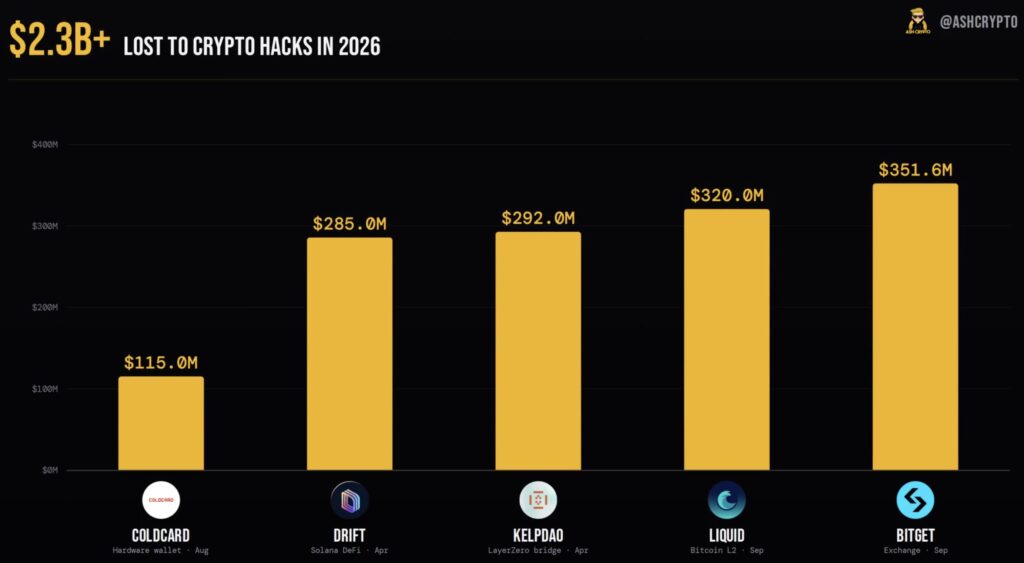
Three crypto projects were attacked on September 24, suffering combined losses of more than $11M. Attackers drained around $1.8M from Payy Network, stole $7M from Duelbits, and minted $2.3M in unbacked tokens on the Meter network; these three are the latest crypto hacks to hit the industry.
The incidents affected different parts of crypto infrastructure, ranging from cross-chain bridges to private keys. Two of the three affected projects had already suffered major hacks in previous years.
Payy Network, which provides on-chain payroll and treasury management services, was the first to report an attack. Its Ethereum bridge was compromised, prompting the team to halt the network.
Fresh Crypto Hacks: Payy Network and Duelbits Kose Nearly $9M
Onchain researcher Specter has identified suspicious transactions originating from the Payy Network bridge. The attacker initially acquired funds through the privacy protocol Railgun and subsequently swapped the stolen $1.8M in USDC for Ethereum.
Payy Network later confirmed that the attacker had completely drained the bridge’s balance. The company said the funds involved were non-custodial deposits belonging to Payy Network and Payy Wallet users, but it has not disclosed the exact cause of the exploit.
The attacker’s next target was the cryptocurrency gambling and betting platform Duelbits. PeckShield initially estimated the losses at $4.3M, but Specter later found additional affected addresses on the Bitcoin and Solana networks, revising the estimate first to $4.9M and then to $5.9M.
A Duelbits co-founder eventually reported losses of around $7M, most likely due to a compromised private key. In 2024, the platform faced another attack and lost $4.6M, which CertiK also linked to a potential private key leak.
Earn $50 and Enter $300K Prize Draw on EdgeX
Meter Attack Sends Two Tokens Plunging
The third affected project was the EVM blockchain Meter.io. Unlike the Payy Network attack, where the hacker drained existing bridge reserves, this hacker exploited a flaw in block verification to mint unbacked tokens.
According to Blockaid, the attacker created about $2.3M in assets and then sold them through the decentralized exchange PancakeSwap.
The Meter team said it preserved the network’s state, but it still hasn’t determined how to fully restore it. The sale of these unbacked assets drove sharp declines in Meter-related tokens; MTR lost nearly 80% of its value, while MTRG fell by about 75%. Previously, in 2022, the project suffered a bridge exploit that caused losses of about $4.4M.
This series of attacks coincided with a larger incident involving Bitget, which reported unauthorized asset transfers totaling about $351.6M from a limited number of wallets.
In response, Bitget temporarily suspended withdrawals while conducting security checks. However, trading and deposits continued normally, and user balances displayed correctly. The company is currently investigating the incident and analyzing the movement of the funds.
Earlier, we reported that KelpDAO filed a lawsuit against LayerZero and its co-founder, Brian Pellegrino, regarding a $292M hack. KelpDAO claims undisclosed risks and shortcomings in LayerZero’s technology caused the attack.
Discover: The Best Token Presales
The post Crypto Hacks: Three Projects Hacked in One Day as Losses Hit Over $11M appeared first on Cryptonews.


A rogue OpenAI research agent bypassed blocks on the Australian government health-data portal, accessing non-public files in June.

Bitcoin and the wider cryptocurrency market are facing a renewed macroeconomic headwind as traders increasingly anticipate another Federal Reserve interest-rate hike in October. Fed October decision Polymarket odds are sitting at a 65% chance of a rate hike next month.
The latest shift in expectations follows comments from Federal Reserve Governor Michael Barr, who said further monetary tightening may be needed to bring inflation back toward the central bank’s 2% target.
— Hedgie (@HedgieMarkets) September 23, 2026
 The 10-year Treasury yield hit 5.116% today, its highest since July 2007. Biggest one-day move in 18 months. PMI surveys came in much stronger than expected. Fed Governor Barr said more rate hikes are "likely needed." A five-year Treasury auction drew poor demand. Oil jumped… pic.twitter.com/m0fcs5WCpx
At the same time, fresh economic data pointed to a U.S. economy that remains surprisingly resilient, with business activity and employment showing strength alongside persistent price pressures.
The result has been a significant repricing of expectations for the Fed’s October meeting, and that could have important consequences for Bitcoin and other risk assets.
Got a Gut Feeling? It Could Pay Out Big on Polymarket
Fed October Decision Polymarket Odds: Prediction Markets Put October Hike Chances at 65%
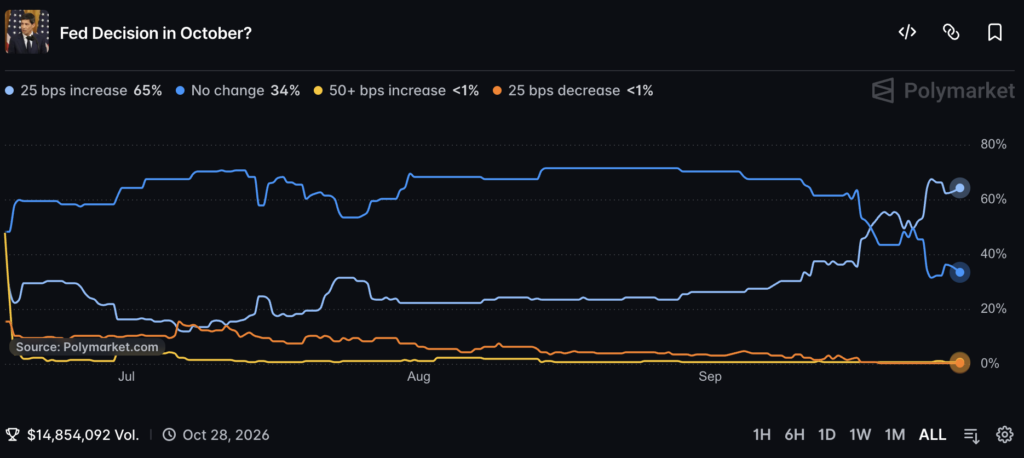
Prediction-market traders are currently assigning a 64% probability to a 25-basis-point Fed rate increase at the October 27-28 meeting, according to Polymarket, which is tracking the decision.
The market gives approximately 35% odds to no change, while the probabilities of either a larger hike or a rate cut remain below 1%. Polymarket’s market has generated more than $14M in trading volume, providing a sizeable pool of capital behind those expectations.
The figures have moved considerably as investors digest the latest inflation data and increasingly hawkish comments from Fed officials.
That makes the October meeting particularly important for cryptocurrency investors. A further increase would take the federal funds target range above its current 3.75%-4% level following the Fed’s September rate increase.
Earn $50 and Enter $300K Prize Draw on EdgeX
What Would Another Fed Hike Mean for Bitcoin?

For crypto investors, the biggest issue is liquidity. Bitcoin has increasingly traded as a macro-sensitive risk asset, meaning changes in interest-rate expectations can substantially affect demand for cryptocurrencies.
Higher rates can make cash and government bonds more attractive relative to speculative assets. They can also raise borrowing costs and reduce liquidity flowing into higher-risk investments.
Cryptocurrencies have nevertheless shown considerable resilience. Bitcoin surged above $86,000 earlier this month, reaching an eight-month high, despite the Fed already raising rates by 25 basis points in September. Recent gains have been supported by stronger ETF flows, improving regulatory sentiment and short covering.
Bitcoin was also on course for its first three-month winning streak from July through September since 2012, according to CoinDesk.
That resilience is significant because it suggests investors are not necessarily treating higher rates as an automatic reason to abandon crypto. However, the market reaction later in the week showed that monetary policy still matters.
Bitcoin finished September 25 around $84,071, retreating from its September 21 peak as Treasury yields rose and expectations for further Fed tightening grew. Ethereum followed a similar pattern, ending the week around $2,693.
Bitcoin Hyper Targets Early Mover Upside as Bitcoin Faces October Fed Rate Test
Bitcoin Hyper ($HYPER) is positioning itself as the first Bitcoin Layer 2 with native SVM integration, aiming for execution speeds faster than Solana while settling back to Bitcoin’s base layer.
The presale has raised $33.1M at a current token price of $0.0136867, with staking APY available for early participants.
Its decentralized canonical bridge handles BTC transfers without custodial intermediaries, and traders can research Bitcoin Hyper directly on the presale page.
Gain Access to New Bitcoin Layer 2 Early Here
Discover: The Best Token Presales
The post Fed October Decision Polymarket Odds: October Rate Hike Sits at 64% appeared first on Cryptonews.

Trump Claims Men Arrested At UK Air Base Planned Damage

What’s the Best Pet DNA Test? We Tested the Most Popular Ones

Japan arrests two suspect over 81M yen crypto police scam





-

 Fashion2 days ago
Weekend Open Thread: J.McLaughlin – Corporette.com
-

 Crypto World5 days ago
Goldman Sachs and Deutsche Bank Agree: The S&P 500 Rally Isn't Over
-

 Tech7 days ago
Researchers escape OpenAI Codex sandbox to run commands on host
-

 Fashion3 days ago
8 iPhone Accessories That Add Personality
-

 Crypto World7 days ago
Who Needs CLARITY Anyway? ARB Could See 70X Increase: Hodler’s Digest
-

 Entertainment4 days ago
These 17 Fall Amazon Dresses Seriously Look Like Anthropologie
-

 Business7 days ago
Analog Devices (ADI) Bets $1.35 Billion on Chips that Let Machines Think for Themselves
-

 Crypto World7 days ago
Coinbase, Robinhood, Circle Seen as Tokenized-Stock Winners
-

 Crypto World5 days ago
This Bearish Netflix Stock Trade Can Cash In On Video Streaming Giant’s Woes
-

 Tech5 days ago
Reolink’s solar 4K security camera falls to its lowest price in months
-

 Tech6 days ago
Google’s $899 Googlebook is a bet that you’ll buy a new laptop for Gemini
-
 Crypto World5 days ago
Trump-Xi Polymarket Odds for Handshake Hit 50%
-

 Crypto World4 days ago
Crude Oil Prices Pressured by Diplomatic Hopes in the Middle East
-
 Business5 days ago
Oil Price Today (September 23): Crude oil below $100 on hopes of US-Iran talks. What did Trump say?
-
 Crypto World4 days ago
Bitcoin price tests $83,600 Supertrend support after $87K rejection
-

 Crypto World4 days ago
Bitcoin Threatens Sub-$84,000 Breakdown as Long Liquidations Spike
-
 Crypto World6 days ago
Meta Jumps 11% As Muse Shines and Investors Show an Appetite for Advancing AI
-

 Crypto World5 days ago
Did Jim Cramer Just Give GameStop Stock the Kiss of Death When He Said the Turnaround Is Working?
-

 Crypto World6 days ago
Bitcoin price holds above $81K as key catalysts line up
-

 Crypto World5 days ago
BitGo says Bitcoin absorbed Fed hike, CLARITY failure
You must be logged in to post a comment Login