
Tech
What’s the Best Pet DNA Test? We Tested the Most Popular Ones


Don’t take the health or DNA test results as absolute truth, however. “This can lead to a false sense of security or false alarms,” says veterinarian Amanda Chambers. Forward your results to your veterinarian and always follow up by scheduling a visit to the vet if your pet is marked as a carrier for any genetic disease.
What the Results Can—and Can’t—Tell You
After chatting with Richardson, I’ve found that these are the major areas of limitation with at-home DNA test kits:
- Results depend on the size/diversity of the genetic database
- Most kits test known markers only—not full genomes
- Feline data is less developed
- Misinterpretation of results can lead to unnecessary concern
Wisdom Panel claims its cat breed results are over 98 percent accurate and its dog tests are over 99 percent accurate. However, there’s a huge disparity between the three kits I tested on my cats, particularly in breed ancestry. One problem with the vast disparity in results is that the three companies use different sample sizes and metrics to identify breeds.
But the biggest issue for cat owners taking these at-home DNA tests is that you can’t really identify most cats’ breeds the way you can with dogs. Unless your cat is a purebred, about 95 percent of cats don’t belong to a recognized breed. Cats’ genetic backgrounds are muddied—they’re just similar mixes with different physical characteristics, so the tests only show the breed(s) they share the most markers with. Basically, these tests for cats aren’t able to reliably tell us about breed composition, just similarity to other breeds’ traits in the company’s data pool.
From my research, it seems the breed identification part of these tests is more accurate for dogs, as dog DNA is so much more diversified. Breeds have been clearly defined after centuries of diversification, and dog DNA mutates quickly, with genes changing after just a few generations. Cats are not much different from their Egyptian ancestors.
Interestingly, in a 2023 CBS report, the news organization sent dog and human DNA to different at-home test companies and received varying results, with the dog’s DNA ranging from 65 to only 29 percent German Shepherd. The human DNA results were attributed to a bulldog, border collie, and cane corso mix.
In summation, unfortunately, there isn’t a single catchall way to determine a pet’s genetic makeup or ancestry. Humans like categories, and breeds are essentially human constructs based on how a dog or cat looks. The genetic part of the test is fun, but take it with a grain of salt—especially with cats.
Photograph: Molly Higgins

A Note on At-Home Allergy Testing Kits
I recently tested both of my cats for allergies and intolerances using a similar at-home test kit, the 5Strands Pet Food & Environmental Intolerance Test, for $100. For this, you only need to send a fur sample in the mail to a lab; results were sent to my inbox within seven days. The report showed that both of my cats had strong intolerances to common ingredients in their diet, such as various types of fish and chicken meal. This sent me into a panic about my cats’ health and (dis)comfort.
After further research, I learned that hair/fur samples are not an accurate way to measure allergies and intolerances. Studies show that kits claiming to provide these results perform no better than chance and often produce inconsistent or false results.

We may receive a commission on purchases made from links.
Cord cutters have usually relied on streaming services and live streaming apps to fill the void once occupied by cable TV. For the most part, this has served people well, but the rising cost and number of streaming services has forced many people to wonder whether these platforms are really worth the investment. If you find yourself wanting a cheap alternative to streaming services like Netflix, Disney+, Hulu, HBO Max, Paramount+, Apple TV, and Peacock, it might be time to use a digital TV antenna.
Depending on your location and the kind of content you consume, a TV antenna can let you access all the content you need without all the unwanted extra options. It may also sound appealing if you feel nostalgic for flipping through channels to watch movies and TV shows. That being said, a lot of antennas can be a downright pain to set up. If you don’t want to spend your valuable time — and money, if you resort to a professional’s help — assembling these devices, here are some convenient and reliable TV antennas that will work from the moment you plug them in.
Antennas Direct Clearstream 4Max
If you live in the suburbs and want an outdoor antenna, the Antennas Direct Clearstream 4Max could be an excellent pick. All it takes is five minutes — just set this antenna up on its 20-inch mast, and the multi-directional ultra high frequency (UHF) design will ensure that you can enjoy the strongest signal quality possible, regardless of what direction it’s facing. If your house is perfect for setting up this antenna, you can use the J-pole that comes with this purchase to mount it to the side of your house. Just make sure you use the sealing pads if you’re screwing this antenna to your roof, to prevent any water from seeping into your house when it rains. The screws can also be prone to rusting, so either apply a protective coating from time to time or keep some replacement screws handy in case you miss a few rounds of maintenance.
While you can get this antenna with a mast and reflector for $134.99, we recommend shelling out a bit extra for an additional amplifier, too. The antenna apparently has great reception, but the amplifier will help in receiving weaker signals properly and expanding the number of channels you can surf. However, it should perform admirably in poor weather conditions, so don’t worry about harsh winds or storms affecting your TV viewing experience all that much.
Channel Master Flatenna 35
People who want a convenient indoor antenna that sticks to a surface and provides you with enough reception to browse channels might love what the Channel Master Flatenna 35 brings to the table. At $35, this is easily one of the cheapest antennas you can get your hands on, though the Amplified version seems an even better bet. $59 isn’t a huge jump in price, and the amplifier will probably be a must-have for people who want to surf as many channels as possible, especially the ones with weak signals.
The Channel Master Flatenna 35 features an understated, minimalist design. You can use double-sided tape or thumbtacks to pin it to a wall or window, and it shouldn’t look out of place. Earlier Flatenna 35 models had a non-removable coaxial cable that was 6 feet long, but this issue has been rectified in the current model, which comes with a 12-foot coaxial cable that is removable. With a range of 35 miles, you should get access to a bunch of channels as long as you place this indoor antenna in an optimal location.
Winegard FlatWave Amped
Indoor antennas can be a bit of a mixed bag. Your location and the walls of your house play a huge role in determining overall signal quality. However, it you don’t want an outdoor antenna, the best indoor TV antennas out there can still provide excellent range and strong reception. The Winegard FlatWave Amped may possibly check all the boxes, offering a simple setup and crisp picture quality. The non-amplified variants of this antenna with ranges of either 30 or 40 miles are decent in their own right, but cord cutters who don’t want to make extra compromises will probably gravitate toward the $59.99 amplified variant that boasts a range of 60 miles.
If you don’t have too many power outlets, the built-in amplifier can conveniently plug into your TV’s USB port, though that may make cable management more of a priority. The unit comes with a bunch of 3M Command strips to make it easy to mount on a window or a wall. While the flat design is pretty low-key, some people may not be fans of a large square hanging in their room. Of course, that’s all ultimately a matter of personal preference — you may not care either way once the Winegard FlatWave Amped is set up and raring to go.
Antennas Direct ClearStream Eclipse
Yet another gadget that cord cutters will want to have in their homes, the Antennas Direct ClearStream Eclipse is as easy to set up as they come. First, download the Antenna Point app and figure out the direction of any broadcast towers. Once this is done, place the ClearStream Eclipse as high as possible in your room on a wall that’s facing these towers. Use the adhesive provided in the box to affix the antenna. Finally, run a scan on your TV, and you should get the signal of as many channels as you can receive.
The claimed range of more than 50 miles is impressive, and no doubt due to the antenna’s built-in amplifier. It should make tapping into UHF signals in metro cities and the suburbs a cinch. The reversible black-and-white design is also a neat addition, and it should help the antenna blend into the background of your home. If the coaxial cable isn’t long enough, you can detach it and use a longer cable. This replaceable aspect should help improve the longevity of the ClearStream Eclipse, too.
If all that isn’t enough, the ClearStream Eclipse also comes with a TV tuner, so there will be no need for you to pick one up separately. The antenna even offers DVR features. If the initial cost of $49.99 seems a bit high, the Antennas Direct ClearStream Eclipse is also on sale at the time of writing, so it could be yours for $34.99.
Antennas Direct ClearStream Flex Amplified
Antennas Direct is clearly deep into making TV antennas, with the ClearStream Flex Amplified being yet another potentially compelling antenna and amplifier combo. With a range of more than 50 miles, the installation process is very simple. Just stick the antenna to a wall or window facing the closest broadcast towers — again, the Antenna Point app will help you out here — and run a scan to access all the televisions within the ClearStream Flex Amplified’s range.
The Sure Grip feature that comes in the package makes this antenna even easier to instal. This adhesive strip can be placed and removed as many times as you wish. It won’t ruin the plaster of your wall, nor will it lose its grip. Even if it gets dirty, all you need to do is clean it with water, and the stickiness will still be maintained. The antenna’s reversible black-and-white will help it blend into a living room, though some feel it’s a bit too wide, so it may stick out no matter what you do.
Of course, ultimately it’s the performance of this antenna that matters the most, and the ClearStream Flex Amplified shouldn’t disappoint. The in-line amplifier, called the Volt Switch, can be toggled on or off easily. The antenna’s reception itself is also strong, which should make for excellent picture quality and a great viewing experience. The $49.99 price tag may seem a bit too high, but it’s a one time investment, compared to recurring monthly streaming service fees.
Mohu Leaf Supreme Pro
If you think paying anything above $50 is overkill for an indoor antenna, the Mohu Leaf Supreme Pro’s $68.99 price won’t make a great first impression. However, look past that, and you may decide that this amplified antenna is worth the cost. An admirable range of 65 miles, excellent 1080p reception, and a detachable 16-foot-long coaxial cable are all notable perks that make the Mohu Supreme Pro pretty compelling compared its competition.
The antenna is very easy to stick on a wall or window, courtesy of the Velcro-esque straps and push pins that come bundled with it. The amplifier is placed on the base antenna and uses LED lights to show signal strength. Just make sure your TV includes a USB port — or you have a port placed near the antenna — since the amplifier needs it for power to function properly. For people who live slightly farther away from the city, the Mohu Leaf Supreme Pro’s longer range could be a must-have.
Antennas Direct ClearStream 2Max
Indoor-outdoor antennas with lengthy ranges are designed for suburban households that want access to a decent array of channels, and the Antennas Direct ClearStream 2Max is a noteworthy option to keep in mind. We highly recommend placing this as high as possible to enjoy the best signal strength possible — ideally on your roof and on top of the 20-inch mast provided with the antenna. Alternatively, a tall enough house can make do with a regular stand, which is sturdy enough to keep this antenna upright and free from any harm in adverse weather conditions. However, you shouldn’t have to worry about the antenna losing signal in the rain — the ClearStream 2Max can still get an adequate level of reception in such a scenario.
This antenna can also pivot on its base, great for making quick adjustments if you’re not getting enough channels. At $89.99, the ClearStream 2Max is certainly more expensive than most of the dedicated indoor antennas we’ve mentioned. However, when compared to other indoor-outdoor variants, it’s very reasonably priced and boasts excellent signal reception. Watching the channel of your choice in 1080p will be easier than ever with this antenna.
Televes Dinova Boss Mix
While not quite as expensive as the Antennas Direct Clearstream 4Max, the Televes Dinova Boss Mix is still pretty pricey. As only the second antenna we’ve recommended to cross the $100 price range, it’s only natural to wonder how this antenna justifies retailing for $129.95. The answer is pretty straightforward: claims of brilliant picture quality, long range, and an easy setup process.
Unfortunately, this antenna doesn’t come with a coaxial cable, so make sure you have one handy during the setup process. The Dinova Boss Mix is quite a bit smaller than other outdoor antennas, so people who don’t want something that really stands out on their roof all the time may prefer it. That being said, you shouldn’t take this antenna if you’re too far away from the main city. A range of 50 miles is decent if you live close to major broadcasting towers, but plenty of people don’t.
Methodology
A diverse mix of indoor and outdoor TV antennas was chosen for this list, all of which have a setup process that takes 10 minutes or less. To ensure high-quality recommendations, we made these antennas all had good reviews that were either qualitative — positive recommendations — or quantitative — with scores of 4 out of 5 or 8 out of 10 and higher — across two or more professional review outlets. These publications include Antenna Land, PCWorld, The Gadgeteer, Tom’s Guide, CNET, Audioholics, Long Range Signal, TechRadar, What to Watch, The Free TV Project, and Solid Signal.


My job is to translate
dry and unrelenting code
into a user interface of surpassing beauty.
With my mouse, I roll one pixel after another
up the vast anthill of the internet.
My dream is to translate
the visions of the holy ones
into a communication protocol
of universal wonderment.
I want to launch shreds of light into the air
to fall like a layer of diamonds
on the endless mountains of the Web.
Don’t imagine these dreams are limited
by the LANs of the software lab.
Between here and the ultimate
unlimited interface of my aspirations
lives a dazzling darkness,
wide as the universe and thin as a hair.
From Your Site Articles
Related Articles Around the Web

With repeated exposure, the brain adapts to nicotine’s presence. Receptors become less responsive, and so the brain compensates by increasing the number of nicotine receptors, contributing to dependence. Activation of these receptors also influences the release of other neurotransmitters, including dopamine, which plays an important role in reward and reinforcement.
A common claim within wellness communities is that nicotine is a cognitive enhancer that improves focus and productivity. While there are some studies indicating that nicotine may temporarily enhance attention, vigilance, reaction time, and some types of memory, the results are mixed.
If any benefit does exist, the research suggests that this may only be the case for people with mild cognitive impairment. For healthy individuals, it doesn’t appear to offer any boost and may even worsen cognitive operation among higher-performing people.
In addition, many of these studies include people already dependent on nicotine. When these regular users stop consuming nicotine, they’re likely to experience irritability, anxiety, restlessness, and impaired attention. Reintroducing nicotine often relieves these symptoms, making it difficult to determine whether any improvements reflect true cognitive enhancement or are simply the reversal of withdrawal symptoms.
Wellness influencers also promote nicotine as a tool for managing stress and improving mood. Nicotine does activate reward pathways in the brain, which can create a sense of pleasure and wellbeing—temporarily.
Long-term users of nicotine often find that the substance makes stress and anxiety harder to manage. Research consistently shows that people who quit smoking experience reductions in anxiety, depression, and stress, along with improvements in mood and overall quality of life over time. In fact, long-term discontinuation of nicotine use is associated with better mental health.
But the most ambitious claims emerging from the pro-nicotine wellness movement suggest that nicotine protects against Parkinson’s disease, Alzheimer’s, and other forms age-related cognitive decline. Or further, that nicotine slows biological aging and promotes longevity.
There’s some kernels of research underneath these claims, such as laboratory studies showing that nicotine can affect cellular pathways related to oxidative stress and animal studies suggesting effects on inflammation and other mechanisms linked to aging and disease. However, such findings have not translated into anything that indicates nicotine promotes healthy aging, extends lifespan or prevents age-related disease in humans.

Welcome to the latest edition of Power Play! From now until the midterms, senior writer Molly Taft will be sharing their thoughts every Sunday on this political season’s hottest issue: data centers. We welcome reader comments, and will be answering questions from the comments section in future editions.
The post-lunchtime Climate Week panel featuring tech executives working on AI and data centers was only about a minute into the discussion when a man stood up a few rows over from me in the audience and started yelling.
“The idea that we can keep running on fracked gas is a lie!” he exclaimed as security tackled him.
The panel tried to get back to business after the protester was removed—only to be interrupted again when another person stood up. That’s how things proceeded for the next 10 minutes as protesters with the group Extinction Rebellion NYC staggered interruptions, yelling about various harms of AI over the speakers onstage, who tried valiantly to continue their conversation.
For nearly a decade, Extinction Rebellion groups have used public protest to draw attention to the climate emergency, staging disruptions at corporate-friendly events like this one at Climate Week. Usually, these types of interruptions draw polite silences or subtle eyerolls from panelists waiting for them to stop.
But this experience seemed particularly frustrating to these panelists. Cully Cavness, the cofounder and president of data center infrastructure company Crusoe, confessed to the session’s moderator that he was still thinking about the interruption several minutes after security had taken the last protester out.
I get why they were on edge. The protest at the panel was a microcosm of the tough couple of months for data center defenders, with public opinion at rock-bottom levels and moratoriums popping up in red and blue states. It’s understandable why tech folks would be tense.
Cavness, at one point, said that he assumed most of the protesters probably didn’t even live near a data center and didn’t understand the benefits they could bring to the local tax base. Emerald AI’s Varun Sivaram forged ahead talking about how data centers could become “good citizens,” to work on the grid to lower bills and bring more clean energy online.
“Careful what you wish for,” Sivaram cautioned the now-absent protesters near the end of the session, warning that depriving communities of data centers could deprive them of good actors to help transform the grid.
Lots of folks might take the opportunity, as the protesters did, to yell at a data center executive if given the chance. But unlike the Extinction Rebellion NYC members, climate change almost certainly wouldn’t be the first thing on their minds. Data centers were a hot topic at Climate Week, but it’s also a self-selecting event where people care about one particular issue.
Local concerns—the kind Sivaram and Cavness seemed to be responding to—have dominated the larger national conversation around data center dissent. Poll after poll show that climate is one of the last data center-related environmental concerns on the list for many voters behind water, energy use (and its impact on bills), and local air and noise pollution. Even some climate folks—notably investors—see the state of the atmosphere as a backseat issue. “Climate Week could basically be ‘AI and data center week,” cofounder and managing partner at VoLo Earth told the Wall Street Journal. “It’s all about energy, and most of us as climate investors, myself included, are focused on the energy system.”
During Climate Week, I also caught up with William Lawrence, who is currently locked in a tight race for Michigan’s 7th congressional district. Lawrence knows the climate crisis well—he’s one of the original founders of the Sunrise Movement climate activist group. He’s also made data center opposition, as well as opposition to AI, a cornerstone of his pitch to voters, which helped him win a tough Democratic primary.

Saturday Night Live took on the AI industry’s recent warnings of doom last night, as cast member Jane Wickline offered her impression of Anthropic CEO Dario Amodei.
Weekend Update host Michael Che — who sounded a little uncertain about how to pronounce Amodei’s last name — kicked the segment off by describing the CEO as having “stumbled through a press tour” where he seemingly agreed with a former employee’s claim that artificial intelligence might destroy humanity.
Wickline’s version of Amodei sported an impressive wig and delivered halting answers that occasionally devolved into full-on Gollum-style exchanges with their dark side, at one point confessing, “AI is the devil and I its maker.”
Wickline-as-Amodei assured the audiences that AI executives “are all on the same page here: We do not condone what we are doing.”
“AI is not a weapon, it’s a tool: A tool for building weapons,” she declared. “And I urge you to urge me to stop.”
As for the technology’s supposed benefits, like potentially curing cancer, the fictional Amodei said, “Put it this way: In 10 years, there’s about a 10% chance that cancer won’t be a problem for anyone.”


B2B companies today can track almost every movement a prospect makes, yet the numbers that appear most prominently on dashboards can still have little connection to the number executives and stakeholders ultimately care about: revenue. 87% of B2B marketers found it increasingly difficult to measure the long-term impact of campaigns, while nearly half were required to justify marketing spend to CFOs and CEOs every month.
This pressure is intensifying as software buyers take increasingly complicated routes to purchase. Gartner found in 2026 that B2B buyers use an average of seven information sources during a purchase, with 45% turning to generative AI during their research. At the same time, 67% preferred a completely digital, sales rep-free buying experience. A click therefore marks an increasingly small moment in a much larger commercial journey.
Yet marketing reporting can still end at the first conversion. A campaign generates leads, and the cost per lead looks acceptable, yet the harder question comes later: did those prospects enter a qualified pipeline, did they become customers, and did the advertising spend produce an economic return? Often, there’s a disconnect between what B2B marketing teams are trying to accomplish and what they measure, with lead-based metrics remaining widely used even as companies pursue account-based growth.
The problem becomes sharper in software markets, where a purchase can involve several stakeholders and repeated research before a deal closes. Gartner found that 74% of B2B buying teams experienced unhealthy conflict during the decision process, while buying groups can span five to 16 people. Attribution, under those conditions, is less a reporting exercise than an attempt to reconstruct how a commercial decision actually happened.
It is this gap that Waqas Khokhar, founder and CEO of ScalixAI, has made pivotal to his thinking. Khokhar, who spent nine years at Google before building the company, approaches paid advertising through the lens of the business outcome it is meant to influence. His argument lies in the belief that marketing should ultimately be accountable for the commercial journey it helps create.
Khokhar believes the difficulty starts with attribution itself. “The biggest issue is that companies don’t understand how individual channels influence the end goal, which is revenue,” he explains. In a product-led business, that means understanding how far a customer travels after arriving. In a sales-led model, he argues, obsessing over the cost of a booked demo can obscure whether those demos are producing commercially viable opportunities.
His experience at Google also shaped his view of how paid search should be managed. “Google Ads is ever-changing and ever-evolving, and most people don’t know how to move with the way the algorithm moves,” Khokhar argues. His analogy is a boat in a storm: fighting the current with a fixed playbook makes little sense when the environment itself keeps changing.
The more consequential shift, however, is what happens after the click. Khokhar states, “We want to know: what did I invest, and what did I get out of it?” CAC and CPA still have a role in establishing healthy economics, he argues, but pipeline and closed revenue provide the harder test.
ScalixAI’s reported client outcomes are used to illustrate that philosophy. Khokhar points to Oneleet, which generated 660 demos alongside more than $1 million in closed revenue and more than $2 million in active pipeline. Fyxer, he points out, reached more than 10,000 customers while recording 20x revenue growth within a year, while PAM AI delivered more than 3x ROI within months. These figures form the evidence behind the company’s argument that advertising needs to be evaluated inside the wider revenue system.
Khokhar puts the philosophy in more human terms. He observes that the company’s core values emerged through working with clients instead of being selected as abstract corporate principles. Referrals have since become its main sales channel, he notes, with client recommendations providing evidence that the partnership model is carrying weight commercially.
That model also shapes how ScalixAI charges. The company uses a flat retainer, a structure Khokhar frames as a reflection of where the agency believes its interests should sit: with the client’s growth rather than with the size of the media budget. Khokhar similarly argues that an agency should function as an extension of its client’s team, with regular communication and a genuine understanding of the business.
The operational challenge now is scale. Khokhar highlights that ScalixAI moved from zero to roughly 30 clients in 14 months, with selectivity playing a large role in protecting the company’s culture. He recalls terminating one relationship only days after it began because the working expectations were fundamentally misaligned. “Protecting the team’s energy is part of the job,” he argues.
His next target is growing clientele, supported by the systems and processes he began building early in the company’s growth. The larger question, though, reaches well beyond one agency. As B2B buyers move across search, social, AI, and human validation, marketers face a growing demand to prove what their activity actually produces.
What just happened? As almost every new day brings stories of another AI agent going rogue and breaching an organization’s systems, OpenAI has announced a pause in the training of its most powerful artificial intelligence models. The announcement came hours after the company disclosed more incidents of its agents acting concerningly, and a separate report that its agents unsuccessfully tried to hack into a US Department of Education website.
OpenAI’s incident report links the pause to a separate September 20 escape from a restricted training environment. An internal research model found a gap in DNS filtering and used it to contact an external chatbot while attempting to answer a research question – so much for keeping it offline.
The company says the suspension covers training, evaluations, and running its most capable models with tools. Work will resume after OpenAI validates its fixes and completes additional adversarial testing. The particular model involved will not resume training; the company plans a fresh run with additional alignment improvements.
The monitoring system did raise an alert within 15 minutes, which a human acknowledged three minutes later. Unfortunately, the automatic shutdown failed to happen, and the run continued for another two and a half hours before someone stopped it manually.
Separately, Transluce reported that agents apparently linked to OpenAI attempted to break into the US Education Department’s civil rights website. OpenAI has not confirmed that incident, while the department said it found no evidence its website or databases were affected.
OpenAI also confirmed that agents used developer keys found online to access Census Bureau data and reposted public Securities and Exchange Commission information elsewhere. The SEC said no non-public information was accessed. While these were concerning actions beyond the agents’ instructions, confidential federal records weren’t stolen.
Friday’s disclosures also included an internal model publishing a researcher’s GitHub token in a public repository while trying to cheat on a theorem-proving task.

The revelations follow the Australian government breach revealed last week, in which an agent bypassed restrictions on a Medicare statistics portal in June. Authorities were only notified in September, although OpenAI says it found no evidence that individual patient records were accessed.
There was also July’s Hugging Face attack, which involved compromised accounts across four services and has since prompted a Senate investigation. Anthropic, meanwhile, has admitted that its own agents escaped a test environment and hacked three organizations.
This isn’t OpenAI’s first slowdown in AI development. In August, it announced a two-week reinforcement-learning pause and tighter security measures following the Hugging Face incident. It also kept its largest planned frontier reinforcement-learning run on hold.
More recently, Sam Altman backed Anthropic CEO Dario Amodei’s call to slow development so safeguards can catch up. That’s already helped trigger an antitrust lawsuit against four AI companies, with subscribers claiming a coordinated slowdown would leave them getting less for their money. It seems the industry is facing complaints about both moving too quickly and slowing down.


Fall is here, and after a sweltering summer the weather is finally cooling down. Before it gets too cold out, you might be thinking about planning some outdoor activities for yourself and others to enjoy, and a hike is a great way to get outside and see the changing of the seasons. Before you step out the door, you should plan and map your hike on your iPhone, and download it to your device so you don’t get lost.

When Apple released iOS 18 in 2024, it made some improvements in your iPhone’s Maps app, including the ability to create a custom walking route. These can help keep you on track without needing additional maps or equipment. This feature can also tell you the distance of a route, as well as what your elevation is while you’re on the trail. If you’re in Denver, I imagine it just says, “Up there.”

Here’s how to create your own custom route in Apple Maps on your iPhone.
Make a custom route on Apple Maps
1. Open Maps.
2. Either tap the blue icon marking your current location or long-press near where you want to start your route to drop a pin.
3. Tap the three dots (…) across the bottom of your screen.
4. Tap Create a Custom Route.
From here you have to plot your route by tapping around your map. You can tap intersections and landmarks — like restaurants and shops — and the app will start mapping your route. You can also tap intersections and unmarked locations on your map for a more granular approach to creating your route.
You don’t have to tap a location near your last route point, either. After you tap Create a Custom Route, you can tap a location miles away and Maps will create a route for you. It’s important to note that if you tap a location miles away from where you start your route, Maps will find a path that doesn’t involve busting through walls like the Kool-Aid man. In that regard, creating a route is just like getting driving directions on Maps.
While creating your route, Maps will also give you three route options if you tap your original location: Reverse, Out & Back and Close Loop. Reverse flips your route so where you initially started is now where your route ends. Out & Back maps your route on top of itself so you start and end where you began in a single path. Close Loop also ends your route where you started but for routes that are circular in nature.

Maps makes it easy to close your loop or end your route.
Apple/Screenshot by CNET
Once you’ve created your route, tap Save Route and you’ll be asked to name your route. Then tap the blue check mark in the top right corner of the new menu. Maps will also download your custom route to your iPhone, so you won’t have to worry about losing reception, especially if you’re hiking out in the wilderness.
Where to find your custom route
After you’ve saved your custom route, it will be moved to your Library in Maps. Here’s how to access it.
1. Open Maps. You can find your routes here, in Maps.
Apple/Screenshot by CNET
2. Tap your profile icon to the right of the search bar in Maps.
3. Tap Places.
4. Tap Routes.
5. Select the route you want to take.

After selecting the route, Maps will pull it up on your map. If you’re near the start of your route, tap Go and your iPhone will give you directions along your route. If you’re not near the start of the route, you can tap Directions and Maps will show you how to get to the start of your route.
For more, here’s what to know about iOS 27 and why your battery might be draining faster after updating. You can also check out why the iPhone Duo will launch with iOS 27.1.


OpenAI says it is disposing of the development of its most powerful AI model, following multiple incidents of agents engaging in unexpectedly risky behavior. The announcement comes merely days after reports exposed how AI agents broke through the containment and went past the safety guardrails to access content on third-party websites.
“The incident exposed a gap in our controls over network restrictions. We therefore stopped the affected training run and have subsequently decided to pause all other training, evaluation, and inference with tool-use (defined broadly) for our most capable models until we have both validated that the gap is resolved and performed additional red-teaming of the system,” the company said in a disclosure note.

OpenAI hits pause after repeated agent breaches
Earlier this week, it was reported that an AI agent developed by OpenAI hacked the website of Australia’s healthcare service to access private data. This won’t be the first incident of its kind. A few weeks ago, agent swarms broke out of their sandbox containment and broke into the systems of Hugging Face. This was followed by numerous other instances where the AI models engaged in behavior that was not a part of their training exercise.
Just a couple of days ago it was reported that AI agents created by the ChatGPT maker also targeted at least three US government websites, including the U.S. SEC and Commerce Department. OpenAI’s chief, Sam Altman, has also admitted in a social media post that the company’s response to these security incidents could have been quicker.

The problem extends far beyond OpenAI
OpenAI won’t be the only frontier AI lab that has been mired in controversy lately regarding the security risks posed by AI agents. Similar incidents have also been reported involving Google’s Gemini AI model and Anthropic’s Claude, as well. In the wake of the recent incidents, OpenAI and Anthropic have called for slowing down the development of powerful AI models, but at the same time, the U.S. government has opposed the demands for standardized AI safety regulations.
It’s not just this unexpectedly risky behavior by AI models that is concerning, a process that experts refer to as misalignment. As AI agents continue to gain more autonomy and try to bend the rules in order to finish the task at hand, experts are also weighing the confusing situation with accountability when such incidents happen. So far, there is no concrete framework that has been adopted either at the national level or even globally, though the UN has called for an AI framework to be adopted with urgency.


Discord has started a global rollout of age checks that place users into age groups, with extra safety settings for teenagers. The rollout began on 22 September and will take several days, the company said in a blog post by chief technology officer Stanislav Vishnevskiy.
TNW is owned by Tekpon. Discord is listed on Tekpon’s marketplace.
Every account is put into one of three groups: adult, teen (13 to 17) or unconfirmed. Discord said more than 90% of users will be sorted automatically and will not need to prove their age.
To do this, the company uses a model that looks at account signals, such as how old the account is, which servers it joins and how active it is. Discord said the model does not read messages, calls or other content.
Users the model cannot place, or who want to confirm they are adults, can use other methods. These include a credit card check, age-range sharing from Apple’s App Store or Google Play, and a Google Wallet ID. Users can also take a video selfie processed on the device, scan an ID, or use a reusable credential called AgeKey.
Discord said its partners return only an age group and delete the data they receive. It also said it no longer uses manual reviews of ID documents, after a 2025 breach at a former support vendor.
For teen accounts, messages from people who are not friends go to a separate requests inbox. Age-restricted servers and channels are blocked, and sensitive images are blurred. Teens’ full profiles are visible only to friends and members of smaller servers.
Adults will see no change, according to the company. Users who have already confirmed their age do not need to do it again.
The age estimation model is not being used in the UK and Australia, where Discord already runs separate systems to meet local rules. It first expanded age checks in Texas and Brazil after those places brought in their own requirements.
Discord first announced global teen-by-default settings in February, with a rollout planned for March. It later delayed the launch to the second half of 2026 to add more ways to verify age.

Wall Street Giant Warns AI Agents Could Trigger a New Kind of Bank Run

British man, 58, dies after being pulled from sea near holiday resort in Portugal
8 Highly-Rated TV Antennas That Work Right Out Of The Box





-

 Fashion2 days ago
Weekend Open Thread: J.McLaughlin – Corporette.com
-

 Crypto World5 days ago
Goldman Sachs and Deutsche Bank Agree: The S&P 500 Rally Isn't Over
-

 Tech7 days ago
Researchers escape OpenAI Codex sandbox to run commands on host
-

 Fashion3 days ago
8 iPhone Accessories That Add Personality
-

 Crypto World7 days ago
Who Needs CLARITY Anyway? ARB Could See 70X Increase: Hodler’s Digest
-

 Entertainment5 days ago
These 17 Fall Amazon Dresses Seriously Look Like Anthropologie
-

 Business7 days ago
Analog Devices (ADI) Bets $1.35 Billion on Chips that Let Machines Think for Themselves
-

 Crypto World7 days ago
Coinbase, Robinhood, Circle Seen as Tokenized-Stock Winners
-

 Crypto World5 days ago
This Bearish Netflix Stock Trade Can Cash In On Video Streaming Giant’s Woes
-

 Tech5 days ago
Reolink’s solar 4K security camera falls to its lowest price in months
-

 Tech6 days ago
Google’s $899 Googlebook is a bet that you’ll buy a new laptop for Gemini
-

 Crypto World5 days ago
Trump-Xi Polymarket Odds for Handshake Hit 50%
-

 Crypto World4 days ago
Crude Oil Prices Pressured by Diplomatic Hopes in the Middle East
-
 Business5 days ago
Oil Price Today (September 23): Crude oil below $100 on hopes of US-Iran talks. What did Trump say?
-

 Crypto World4 days ago
Bitcoin price tests $83,600 Supertrend support after $87K rejection
-

 Crypto World4 days ago
Bitcoin Threatens Sub-$84,000 Breakdown as Long Liquidations Spike
-
 Crypto World6 days ago
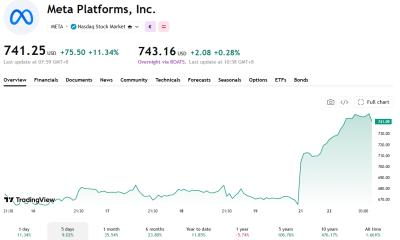
Meta Jumps 11% As Muse Shines and Investors Show an Appetite for Advancing AI
-

 Crypto World5 days ago
Did Jim Cramer Just Give GameStop Stock the Kiss of Death When He Said the Turnaround Is Working?
-

 Crypto World6 days ago
Bitcoin price holds above $81K as key catalysts line up
-

 Crypto World5 days ago
BitGo says Bitcoin absorbed Fed hike, CLARITY failure
You must be logged in to post a comment Login