

Crypto World
Bitcoin Price Prediction: Sentiment Points Bearish Bear Market Pattern, But It’s Not a Bad Thing

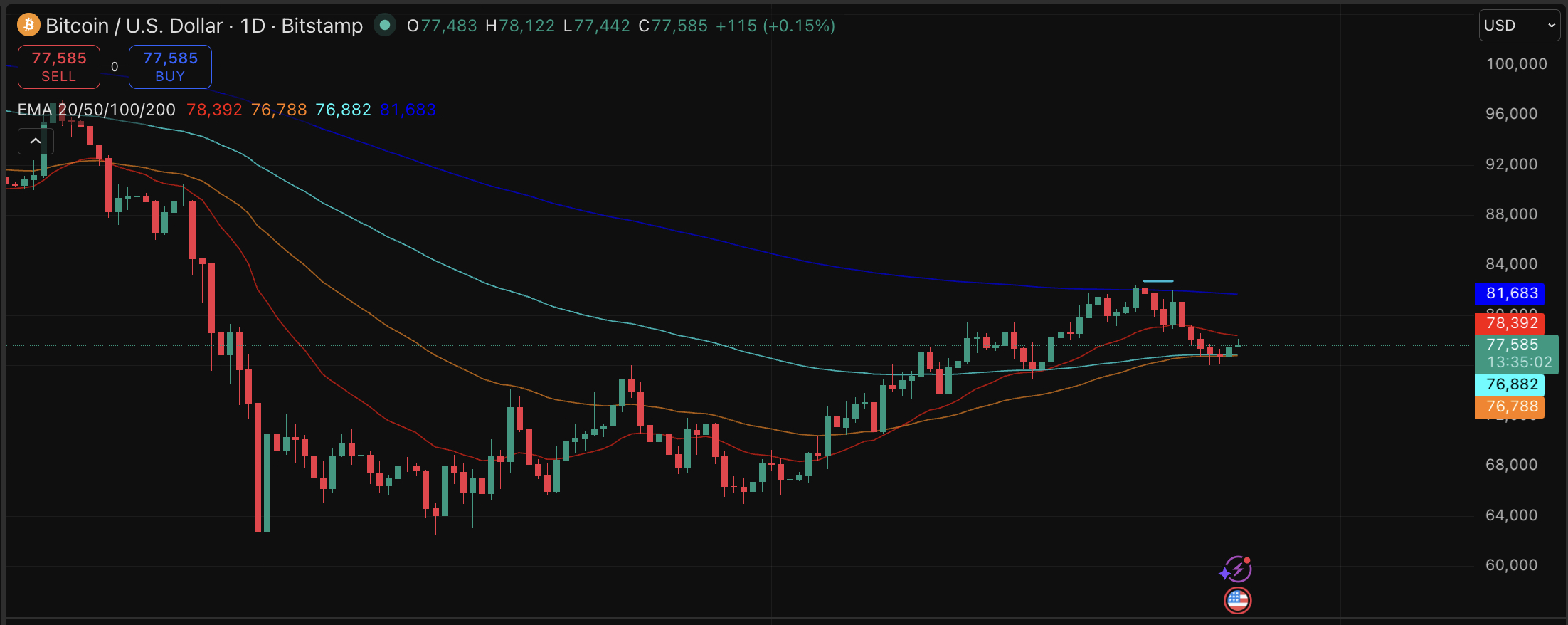
Bitcoin price prediction is bearish, according to CryptoQuant’s head of research. According to the reading, the current condition is a mirror comparison to March 2022. BTC sentiment indicators are flashing bearish even as short-term projection points at a modest upside.
Bitcoin’s rally hit resistance at the 200-day moving average around the $82,000 level before pulling back to as low as $76,000. According to CryptoQuant’s Julio Moreno, the same pattern is uncomfortably matched by March 2022, when BTC surged 43% from its lows, kissed the 200-day MA, and resumed its downtrend.
This time, BTC rose by 37% from its April 2025 lows before facing the same ceiling. Spot demand is contracting, speculative futures demand dried up above $82K, and U.S. spot ETFs flipped to net sellers, offloading around 4,000 BTC after buying as much as 64,000 BTC over a prior 30-day window.
The macro structure has not healed. It has just been bandaged, and the bearish technical overlay deserves a closer look.
Discover: The best crypto to diversify your portfolio with
Bitcoin Price Prediction: $82,400 Resistance Battling $73K Retest
Bitcoin is trading in a $76,000–$78,000 consolidation band with near-term projections pointing to $78,000. The chart leans slightly more optimistic, targeting $79,000 with a potential spike toward $82,000, though its indicator tally reads 10 sells vs. 7 buys.
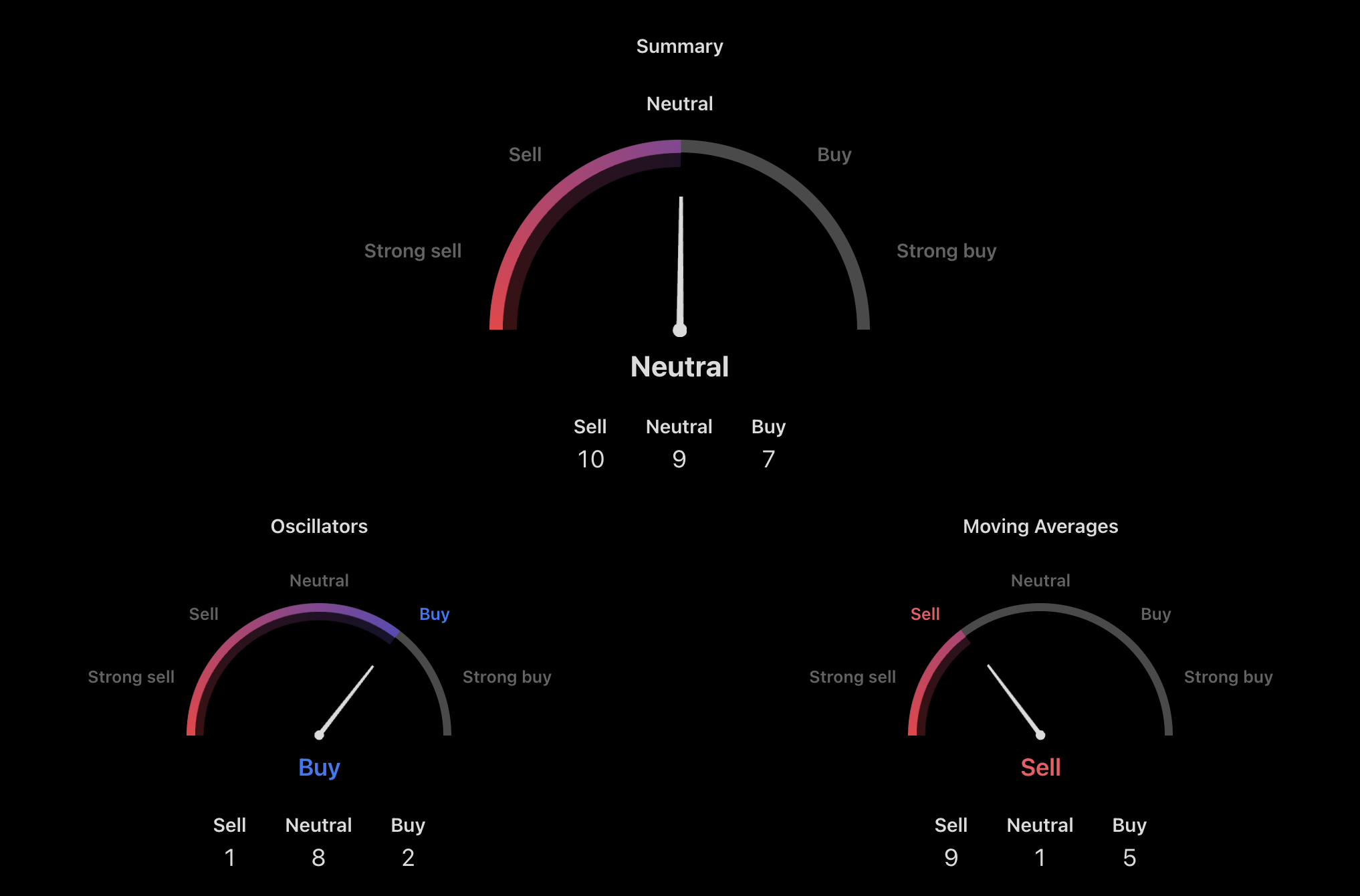
Support sits at $76,000 with resistance stacks above $79,000, and ultimately the decisive 200-day MA zone at $82,000. According to Cryptoquant, a failure to reclaim the 200-day MA is “the strongest technical confirmation that the bear market remains structurally intact.”
The weight of evidence tilts toward the base-to-bear scenario. Structurally, the chart is not broken, but it is not healthy either.
Discover: The best pre-launch token sales
Bitcoin Hyper Targets Early Mover Upside as Bitcoin Battles Support
Bearish BTC consolidation has a reliable side effect: capital rotates. Not out of crypto entirely, but into earlier-stage, higher-asymmetry positions where the upside math still works. That dynamic is exactly the environment Bitcoin Hyper ($HYPER) is launching into, and the timing is deliberate.
Bitcoin Hyper is positioned as the first-ever Bitcoin Layer 2 with Solana Virtual Machine (SVM) integration, delivering sub-second finality and low-cost smart contract execution on top of Bitcoin’s security layer.
The pitch targets Bitcoin’s three core limitations, such as slow transactions, high fees, and zero programmability, in a single infrastructure play. The presale has already raised more than $32 million at a current token price of $0.0136, with 36% APY staking rewards live, supporting a Decentralized Canonical Bridge enabling native BTC transfers.
ETF outflows and macro pressure squeezing BTC spot demand may, counterintuitively, accelerate that rotation into presale-stage infrastructure projects.
The post Bitcoin Price Prediction: Sentiment Points Bearish Bear Market Pattern, But It’s Not a Bad Thing appeared first on Cryptonews.


Bitcoin’s slide toward a key on-chain support level has sparked debate after market analyst Shanaka Anslem Perera argued that the behavior usually seen at major market bottoms is still missing.
According to him, BTC came within 9% of the price level that has historically ended bear markets, but investors didn’t sell in the numbers usually associated with capitulation.
Bitcoin Nears Realized Price, But Selling Pressure Looks Different
The metric in question is Bitcoin’s realized price, which is currently around $53,600, and represents the average cost basis across every BTC in circulation.
In a June 11 post on X, Perera stated that in 2018 and 2022, the OG cryptocurrency fell to that level and bounced. Those rebounds, according to him, weren’t coincidences but were because of what happens after Bitcoin comes close to its realized price. Holders often break, selling at a loss in large enough numbers that the supply gets flushed, weak hands leave, and the market finds solid ground again.
But that flush hasn’t happened this time around. In the 2022 capitulation, Perera says holders sold 1.2 million BTC at a loss, but in last week’s drop, the number was only 187,000 units.
Essentially, Bitcoin approached the same price floor without the same behavior, which, per the analyst, is precisely what made that moment ambiguous rather than confirming.
“Bitcoin reached the bottom’s address without the bottom’s behavior,” he wrote. “The flush that clears weak hands and ends bear markets has not happened.”
In his opinion, the dip was driven by disappearing demand rather than panic selling. He pointed to a drop of 652,000 BTC in demand last week, which he described as the worst decline since January 2022, and also noted that spot Bitcoin ETF flows had been hugely negative.
Bitcoin’s cause has not been helped by escalating geopolitical tensions after Iran once again closed the Strait of Hormuz following US strikes on its military infrastructure, sending the price of crude oil jumping by more than 2.5%.
Furthermore, the US Consumer Price Index came in at a higher-than-expected 4.2%, effectively ruling out Fed rate cuts and raising the possibility of hikes under the new Federal Reserve Chair, which added to concerns about reduced market liquidity.
Long-Term Holders Still Steady Despite Market Pressure
One other thing that Perera pointed out in his assessment was that the lack of selling can also be interpreted as a bullish signal.
“The realized price has marked four of the last four major bottoms, and long-term holders are sitting still rather than selling. That is the bull case,” he explained.
That view echoes comments from another market observer, Sykodelic, who noted that long-term holders collectively control a record 16.5 million BTC despite many positions sitting below the prices they were bought for.
Other firms have reached similar conclusions while stopping short of calling a bottom. For instance, Grayscale has said that Bitcoin currently looks undervalued, even though it warned that the conditions right now are not as extreme as past bear market lows.
The post Bitcoin Nears Realized Price But Capitulation Signals Are Missing: Analyst appeared first on CryptoPotato.
Crypto World
Silver Price is Down Nearly 50% from Record High, and This Trendline is the Last Defense
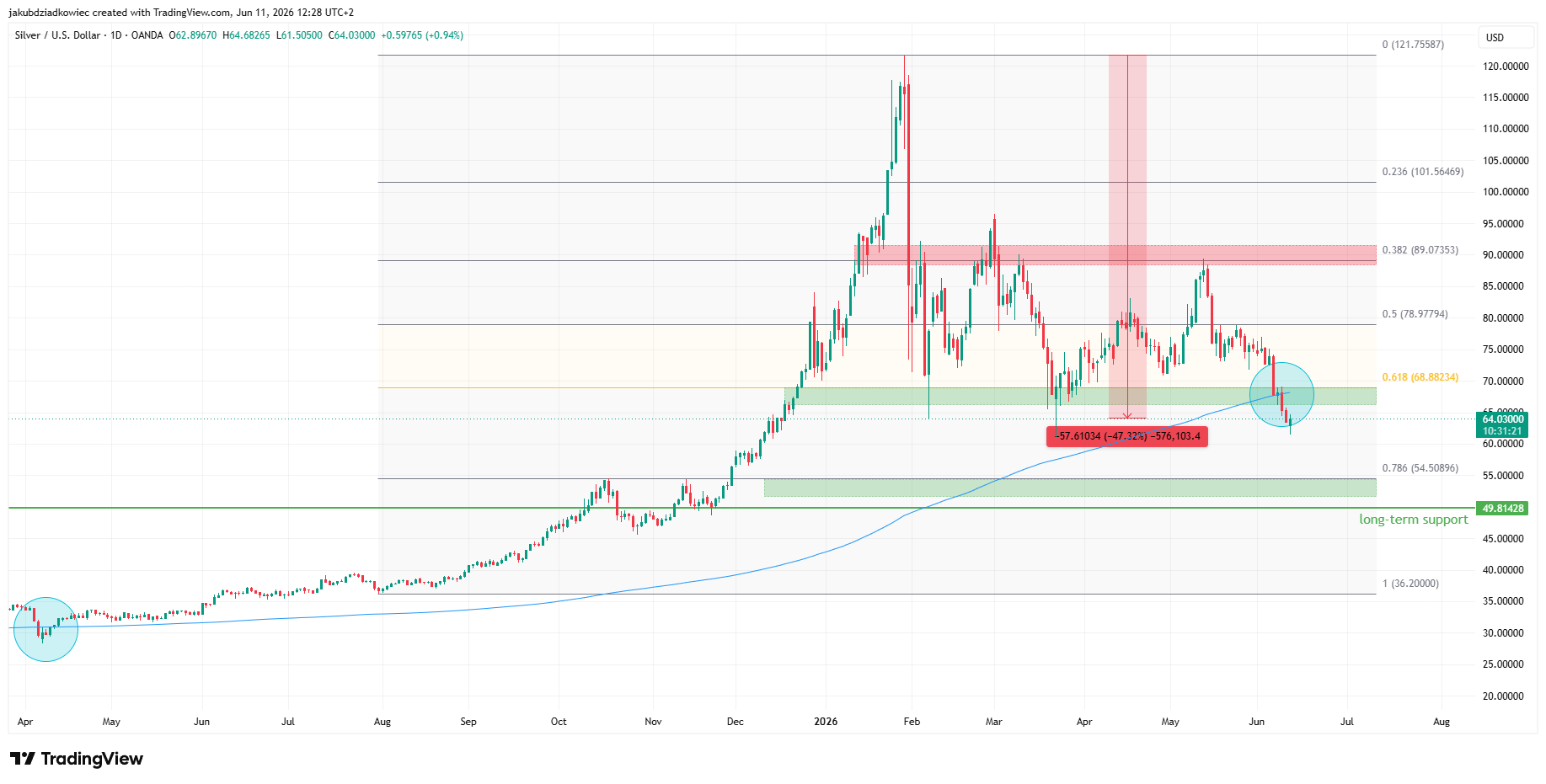
Silver (XAG) closed below its 200-day moving average on June 9 for the first time since April 2025. Silver price now trades near $64 after falling about 47% from its January all-time high (ATH) of $121.75.
The breakdown removes a trend support that held through the entire bull cycle. However, a four-year trendline in the daily Relative Strength Index (RSI) is approaching its fifth test.
Silver Loses the 200-Day Moving Average for the First Time Since April 2025
Silver closed below the 200-day moving average on June 9 and extended the decline a day later. The price printed a low at $61.50 on June 11 before a modest bounce to around $64.
The previous close below this average came on April 4, 2025. Back then, silver spent only three days under the line before reclaiming it. The current breakdown looks different because it follows a 47% drawdown rather than a brief pause in an uptrend.

Sellers also took out the support near $69, which aligned with the 0.618 Fibonacci retracement of the rally from $36.20 to $121.75. An earlier BeInCrypto analysis had already flagged the risk of a slide to $63.
The next major support sits near $54.50, at the 0.786 Fibonacci level. Below that, the $50 area marks strong long-term support and the previous record high. Meanwhile, the 0.382 Fibonacci level near $89 remains the key resistance.
A 4-Year RSI Trendline Faces Its Fifth Test
The bearish price structure has one important counterweight. The daily RSI has been trading above an ascending trendline since May 2022.
The line has already produced four bounces (blue circles) in May 2022, March 2023, October 2023, and April 2025. Notably, the April 2025 touch coincided with silver’s quick recovery above the 200-day moving average.

The indicator now reads near 30 and approaches the trendline for the fifth time. A bounce here could reset momentum and fuel a counter-trend rally. In contrast, a clean break would end the four-year pattern and confirm that bearish momentum dominates.
The signal carries extra weight because a May prediction from BeInCrypto already warned of further losses once key supports failed.
Silver Price Prediction as Precious Metals Sentiment Turns Capitulatory
The drawdown extends across precious metals. Trader BullTheoryio estimated the combined damage in a post on X.
“BREAKING: Over $12.95 trillion has been wiped out from gold and silver in just 132 days. Gold has crashed -26.50% from its January peak… Silver is down -47.69%, wiping out $3.2 TRILLION.”
According to the same post, the selloff happened while the Iran conflict stayed active, oil traded near $90, and inflation remained elevated. These are conditions that have historically favored metals, which makes the decline more striking.
Mockery from Bitcoin circles adds a final signal of sentiment. On-chain analyst Checkmatey ridiculed the crash with a satirical post about Jane Street using a quantum computer to mine asteroids and inflate the supply of metal to infinity.
Such open derision of an asset class often clusters near capitulation phases, though it offers no timing guarantee.
If the RSI trendline holds, the silver price could attempt a recovery to the broken $69 area. A reclaim of that zone would open the way to the 0.5 Fibonacci level near $79. Only a move above the $89 resistance would invalidate the broader bearish structure, a scenario explored in a recent outlook on physical market tightness.
If the trendline breaks, the path opens to $54.50, then to $50. Silver’s fate now rests on a single momentum line that has not failed in four years.
The post Silver Price is Down Nearly 50% from Record High, and This Trendline is the Last Defense appeared first on BeInCrypto.
LG Electronics is building a blockchain network for placing and selling ads, the company told Fortune on June 11. The South Korean device maker worked with Arbitrum to develop its own layer-2 chain for the platform.
The project emerged from LG’s dedicated blockchain research lab, which piloted the system with an unnamed Japanese ad agency. A commercial rollout is under evaluation for later this year.
Why LG Electronics Built a Blockchain for Advertising
The platform gives advertisers and publishers a shared database of ad inventory, according to Fortune. It also records how audiences interact with each placement.
That common ledger could replace the manual reconciliation that still settles many digital ad deals.
The prize is substantial. Dentsu forecasts digital ad spend at $740 billion in 2026. That is about 73% of a global media market set to top $1 trillion for the first time.
Samuel Byungsun Park leads LG Electronics’ blockchain research department. He said LG is evaluating whether the approach delivers meaningful value to advertisers, publishers, and audiences.
Historically, LG has tested Web3 in waves. The company previously unveiled its digital asset wallet Wallypto and filed an NFT trading TV patent, both tied to its consumer device business.
Follow us on X to get the latest news as it happens
Corporate Chains Shift From Renting to Owning
LG joins a growing list of firms building their own ledgers rather than renting block space.
Stripe incubated Tempo, a payments chain that raised $500 million. Meanwhile, Robinhood is working with Arbitrum on its own tokenized-equity chain, and Circle is developing the Arc network.
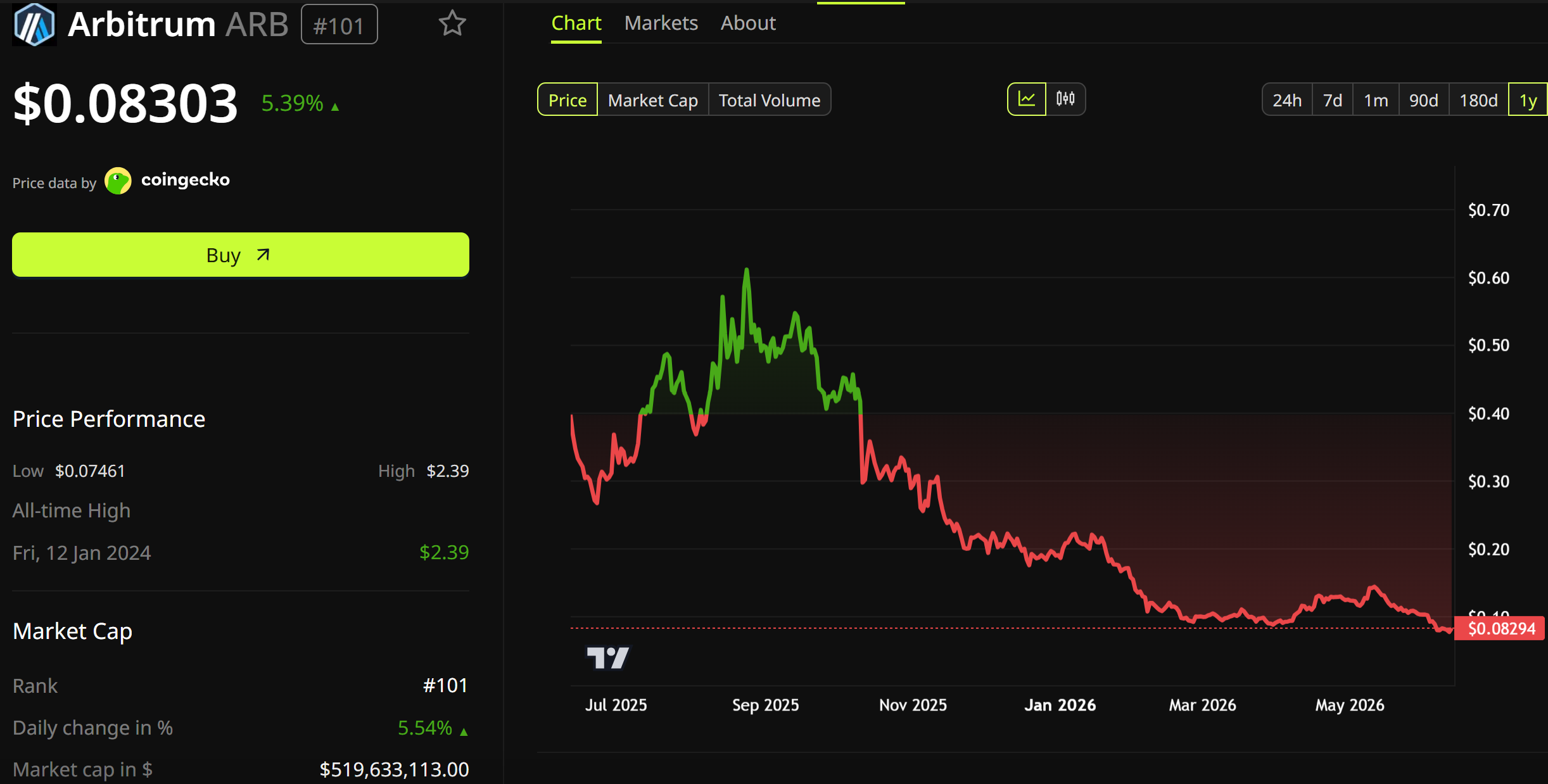
However, Arbitrum’s enterprise wins have not lifted its token. Arbitrum (ARB) traded near $0.083 on Thursday, up 5% in 24 hours yet down 80% over the past year.

Arbitrum cofounder Steven Goldfeder argued the model can automate ad sales without manual intervention. Still, he warned that owning a chain does not fit every company.
“I am very opinionated when someone asks me, ‘Should I launch a blockchain?’ For many people, the answer is yes, but probably for most people, the answer is no,” Goldfeder said in comments to Fortune.
LG committing depends on what the pilot proved about cost and speed. The decision on a full market launch should land later this year.
The post LG Wants to Put the $700 Billion Ad Industry On-Chain With Arbitrum appeared first on BeInCrypto.

A bipartisan proposal in the U.S. House aims to consolidate criminal investigations into cryptocurrency theft, scams, and other digital asset-related crimes under a Department of Justice-led task force. The legislation envisions the DOJ as the principal federal coordinator, uniting the FBI, Homeland Security Investigations, and Treasury’s Financial Crimes Enforcement Network (FinCEN) to streamline evidence collection, blockchain forensics, asset tracing, and victim support across federal, state, and local law enforcement. According to Cointelegraph, the measure would also enable training and technical assistance for state and local agencies, with the task force coordinating international law enforcement collaboration on cross-border investigations and delivering annual threat assessments to Congress.
The proposal explicitly states that it would not authorize new regulation of cryptocurrency markets, would not expand the authority of federal agencies, and would not create new criminal offenses. Rather, its focus is on interagency coordination within the enforcement framework already responsible for financial crimes. The bill names Republican Representative Lance Gooden and Democratic Representative Josh Gottheimer as its sponsors. The text and accompanying materials have been referenced in reporting, including a link to the draft bill hosted by Gooden’s office.
The initiative also comes amid rising crypto-related losses and an expanding role for technology in investigations. The FBI’s 2025 Internet Crime Report highlighted that Americans reported more than $11 billion in crypto-related losses last year. In parallel, the crypto-analytic community is increasingly leveraging artificial intelligence to support casework.
The task force would engage with international counterparts on cross-border cases and would produce annual reports outlining emerging threats, enforcement challenges, and potential policy recommendations for Congress. The bill’s architects frame the measure as a coordination enhancement rather than a regulatory expansion, aimed at closing gaps in investigative workflows and ensuring consistency in evidence handling across jurisdictions.
The broader policy conversation surrounding this proposal sits alongside a growing emphasis on advanced analytics in crypto investigations. Industry players have rolled out AI-enabled tools designed to trace fund flows, audit transaction graphs, and support investigative decision-making. For example, TRM Labs recently introduced an AI-driven investigative assistant designed to aid crypto compliance and investigations, while Chainalysis announced a later rollout of similar AI-enabled agents for investigations and compliance. These developments reflect a trend toward more scalable forensics as criminals increasingly automate cross-chain activity. Regulatory and financial institutions will be watching closely how such tools intersect with AML/KYC regimes and cross-border enforcement norms.
Crypto-asset exploits continue to drive losses, underscoring the practical significance of enhanced investigative capacity. DeFiLlama data cited a monthly loss total of roughly $630 million in April, marking one of the largest monthly totals in recent months and reinforcing the argument for stronger, more coordinated enforcement and forensics capabilities. Related reporting indicates a broader push toward integrated law enforcement tools and international cooperation in tackling crypto crime.
Key takeaways
- A bipartisan bill would establish a Department of Justice–led task force to coordinate cryptocurrency crime investigations across federal, state, and local agencies, with a focus on best practices and evidence standardization.
- The initiative emphasizes cross-agency collaboration, blockchain forensics, asset tracing, victim support, and training, including international cooperation on cross-border cases.
- Importantly, the bill explicitly prevents new market regulation, expansion of federal authority, or creation of new criminal offenses; the aim is enhanced coordination within existing enforcement powers.
- AI-enabled analytics and blockchain-investigation tools are increasingly central to crypto crime workflows, shaping how investigators trace flows and identify illicit networks.
Legislative framework and enforcement architecture
According to Cointelegraph, the proposal would position the DOJ as the central federal coordinator for cryptocurrency-crime investigations, consolidating activities among the FBI, Homeland Security Investigations, and FinCEN’s enforcement arm. The task force would develop and disseminate best practices for evidence collection, blockchain forensics, asset tracing, and victim support, while providing training and technical assistance to state and local law enforcement agencies. The legislation envisions annual reporting to Congress on emerging threats and enforcement challenges, and it calls for collaboration with international law-enforcement partners to advance cross-border investigations. The sponsors emphasize that the measure is a coordination mechanism rather than a vehicle to regulate markets or expand federal power.
For compliance and oversight teams, the architecture signals a potential shift toward standardized investigation workflows and shared standards for digital-asset evidence. As authorities align practices across jurisdictions, exchanges, custodians, and banks could face more uniform expectations for information sharing and cooperation in criminal investigations.
Technology and investigative capabilities
The bill arrives at a moment when private-sector blockchain intelligence firms are integrating AI into investigative workstreams. In early 2025, TRM Labs announced an AI-assisted investigative assistant designed to trace flows, audit transaction graphs, and propose next steps from natural-language prompts, reflecting a broader industry trend toward scalable forensics. Chainalysis subsequently indicated that its own AI-enabled agents would roll out to support investigations and compliance functions, underscoring a parallel shift toward automated, data-driven intelligence in crypto-crime response. The integration of AI tools—while increasing efficiency—also raises considerations for accuracy, bias, and governance within enforcement workflows.
These tools are increasingly central to how investigators identify illicit activity, parse complex transaction networks, and reconstruct schemes that span multiple chains and jurisdictions. As enforcement bodies scale with these capabilities, firms operating in the crypto ecosystem should anticipate evolving expectations around data transparency, reporting, and collaboration with law enforcement under applicable AML/KYC regimes and cross-border frameworks.
Regulatory policy and market implications
The proposed framework represents a structural approach to enforcement coordination rather than a new regulatory regime. By clarifying roles and standardizing practices across agencies, the bill could influence how exchanges, banks, and institutional investors approach risk management and regulatory compliance. In the broader policy landscape, the development complements ongoing regulatory oversight at the federal level while existing frameworks for monitoring and supervising crypto markets remain distinct from the substance of this enforcement-oriented initiative. Observers will be attentive to how annual congressional reporting shapes understanding of threats and informs any future policy considerations.
Overall, the measure highlights a continued convergence between legislative intent and technological tools in the fight against crypto crime. As cross-border investigations intensify and illicit actors increasingly leverage automation, coordinated, well-governed enforcement mechanisms will be critical to maintaining resiliency in the digital-asset ecosystem.
Closing perspective: If advanced oversight and interagency coordination proceed, the sector should monitor the pace of funding, the scope of interagency collaboration, and the cadence of annual threat assessments—factors that will shape enforcement posture and compliance expectations in the months ahead.


Coinbase this afternoon launched two onchain USDC lending vaults built on Morpho and curated by Steakhouse Financial, giving users their first choice of risk profile when lending from the exchange: a conservative Prime tier backed by blue-chip crypto collateral, and a Higher Yield tier drawing on… Read the full story at The Defiant


LG Electronics is building a blockchain-based advertising network on its own Arbitrum-derived Layer 2, according to an exclusive report by Fortune published Thursday. The company describes the project as a pilot with no commercial launch date set. The South Korean electronics giant, known for TVs… Read the full story at The Defiant
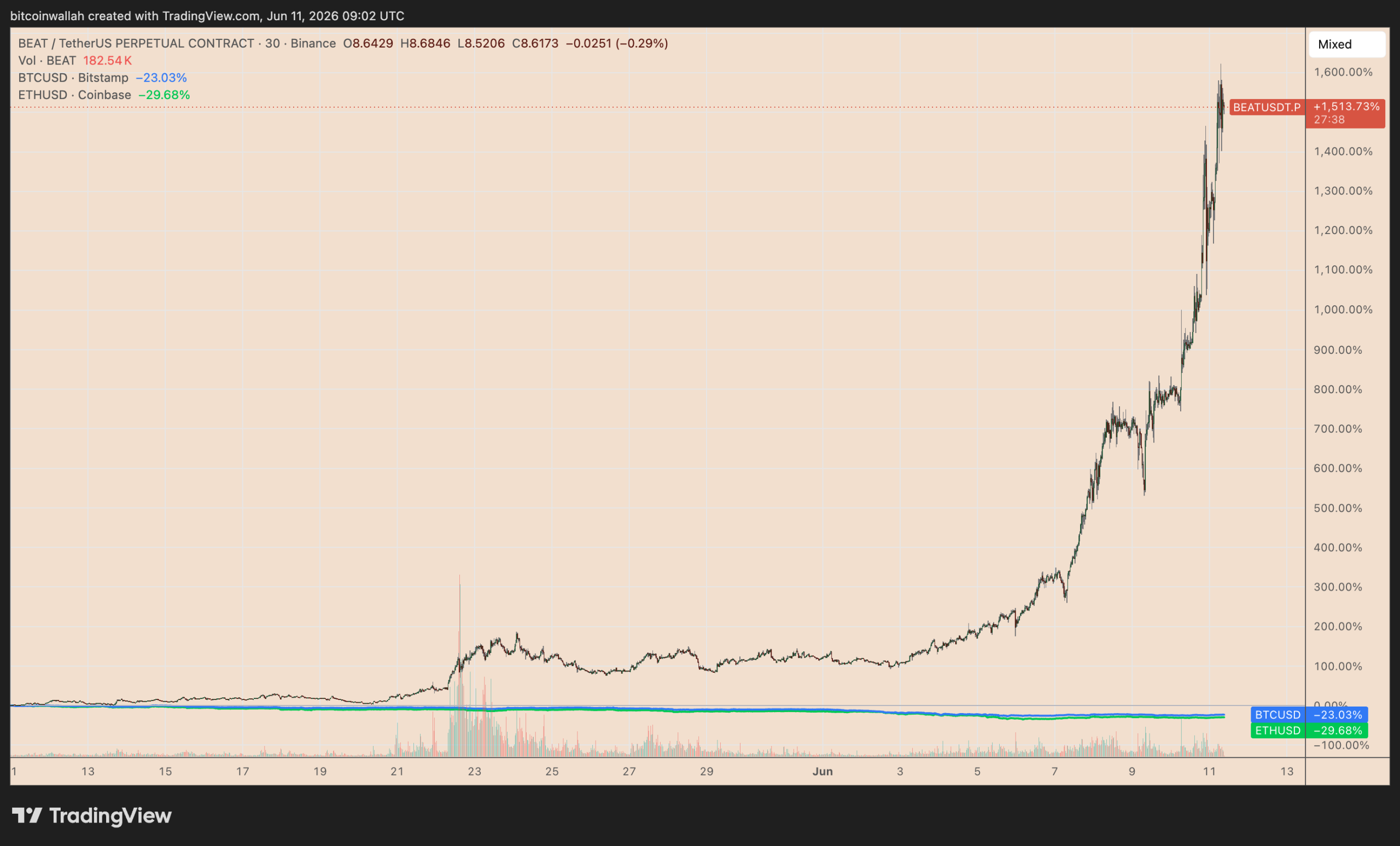
BEAT, the native token of AI music platform Audiera, has exploded higher over the past month, surging more than 1,500% to a record high of $9.20 even as Bitcoin (BTC) and Ether (ETH) fell roughly 25% and 30%, respectively, in the same period.
BEAT/USD vs. BTC/USD and ETH/USD 1-month price performance. Source: TradingView
Key takeaways:
- Strong platform revenues mixed with excessive short liquidations send BEAT’s price higher.
- The AI token is now at its most overbought stage, which may prompt a 35% dip in the coming days.
Why is Audiera’s BEAT price up so much?
BEAT’s sharp outperformance has turned it into one of crypto’s hottest AI-linked trades, driven by a mix of platform revenue claims, token burns, and short liquidations.
Audiera revenue and token burns strengthen BEAT bull case
BEAT’s rally has gained momentum from Audiera’s revenue-and-burn model, which has given traders a stronger value-capture story to chase.
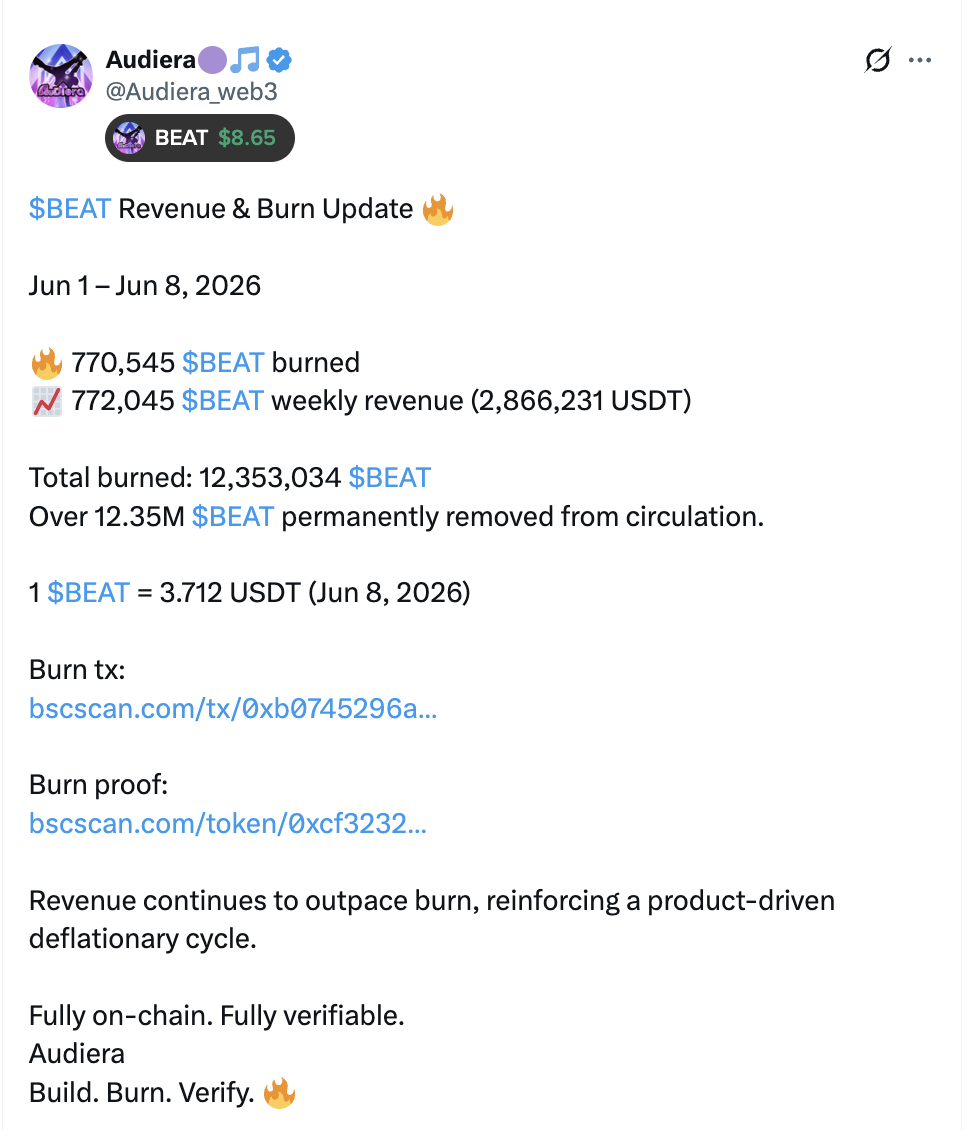
The project reported 772,045 BEAT in weekly revenue between June 1 and June 8, worth about $2.87 million at its stated price of $3.712. During the same period, Audiera said it burned 770,545 BEAT, taking the total burned supply to 12.35 million BEAT.
Source: X
Burns reduce BEAT’s available or future supply against its fixed 1 billion-token cap, strengthening the scarcity narrative when demand is rising.
This resembles Hyperliquid’s HYPE token economics, which have seen 120% price gains so far in 2026.
Related: Hyperliquid bear turns bullish after losing over $46M shorting HYPE
However, Hyperliquid has already shown strong product-market fit in perpetual trading, while Audiera’s model remains newer and less tested. That leaves BEAT vulnerable to sharp profit-taking if revenue slows, burn activity weakens, or speculative demand cools.
Short squeeze helps fuel BEAT rally
BEAT’s rally has received a strong boost from derivatives liquidations, particularly from traders betting against higher prices.
Since May, BEAT has seen $28.72 million in short liquidations, compared with $13.74 million in long liquidations. That means bearish traders lost more than twice as much as bullish traders during the rally.
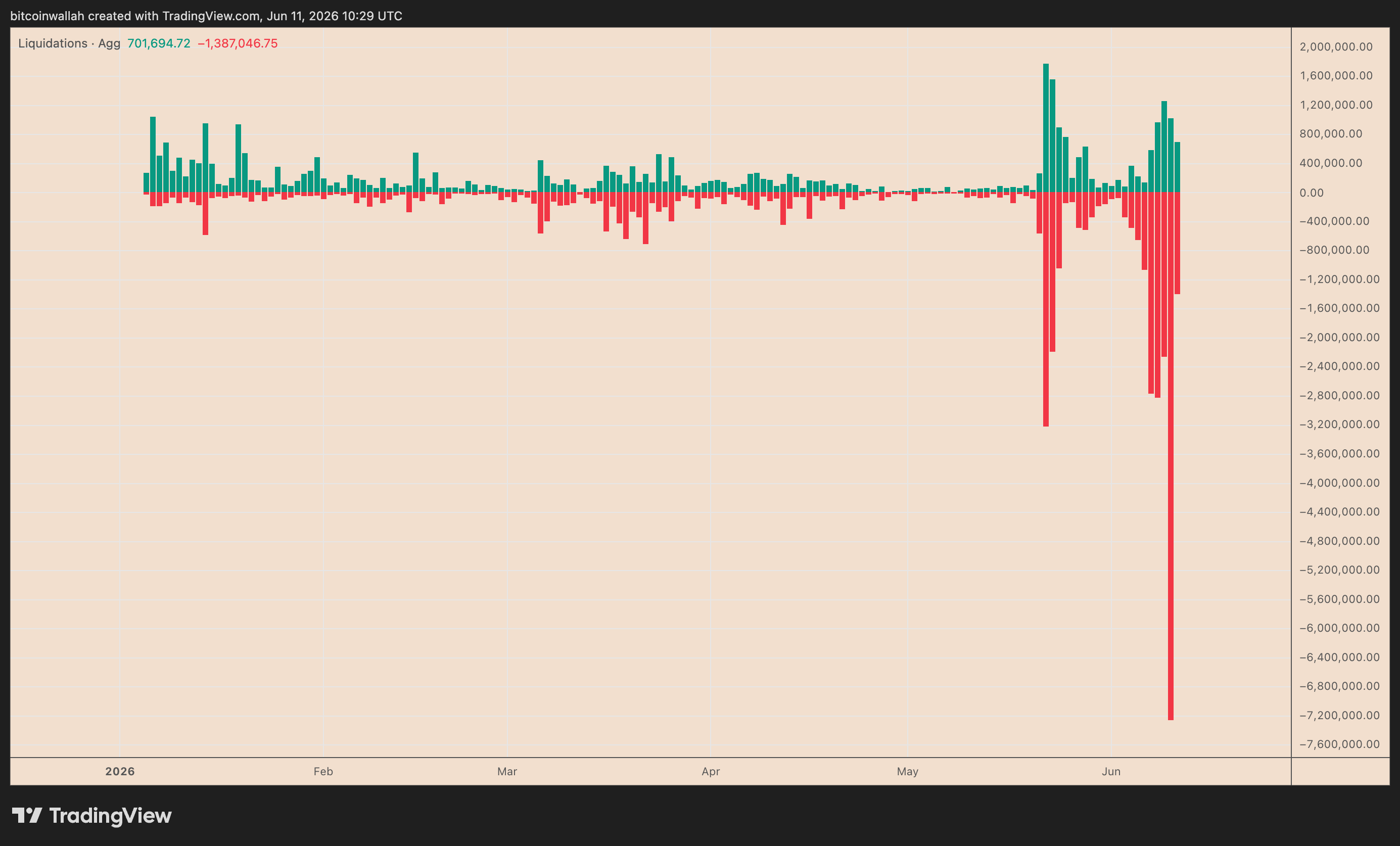
BEAT’s daily aggregated liquidation bar chart. Source: TradingView
This imbalance points to a classic short squeeze. As the BEAT price kept rising, traders holding short positions were forced to close their bets. Since closing a short position requires buying back the token, those liquidations added more upward pressure to the price.
That helped turn BEAT’s rally from a strong uptrend into a vertical move.
However, it also means part of the surge came from forced buying rather than steady spot demand. Once short-liquidation pressure fades, BEAT may need fresh buyers to keep the rally going.
BEAT price may decline 35% in June
BEAT’s price explosion over the past month has made its relative strength index (RSI), which gauges momentum, the most overbought on record.
As of Thursday, BEAT’s daily RSI reading was 96.87, way above its overbought threshold of 70. In other words, the Audiera token’s rally remains vulnerable to a sharp pullback if buyers lose momentum or early investors start booking profits.
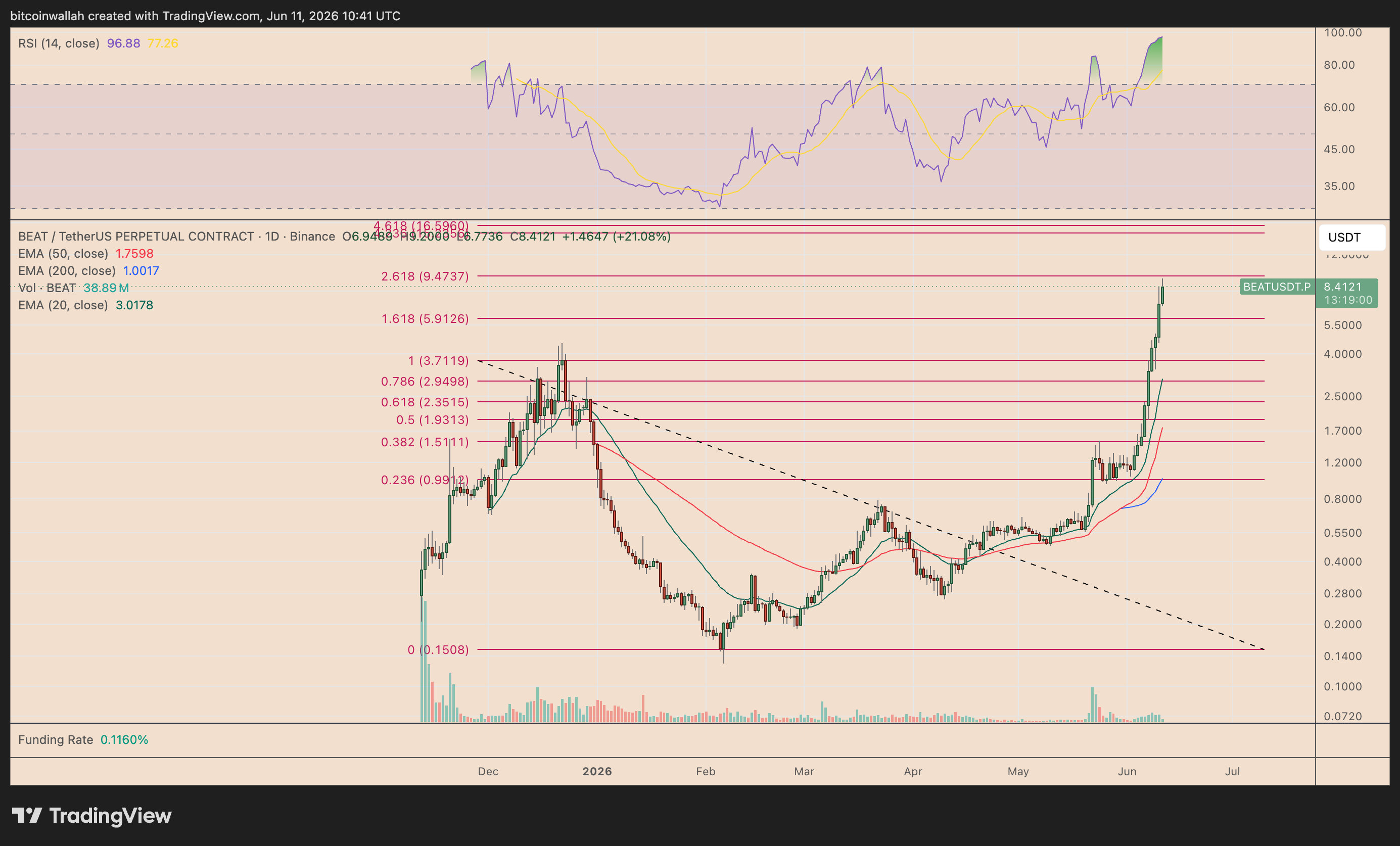
BEAT/USDT daily price chart. Source: TradingView
A decisive pullback from the $9.47 resistance level, which aligns with the 1.618 Fibonacci retracement line, increases the odds of BEAT falling toward the 1.0 Fib line at around $3.71, down roughly 35% from the current price, in June.
Conversely, a clear breakout above the $9.47 resistance level raises BEAT’s potential to rise toward its 4.236 Fib line above the $15 mark in the coming weeks.
The 2026 FIFA World Cup could mark a breakout moment for prediction markets, with Coinbase emerging as one of the biggest winners, according to a new research report from Bernstein.
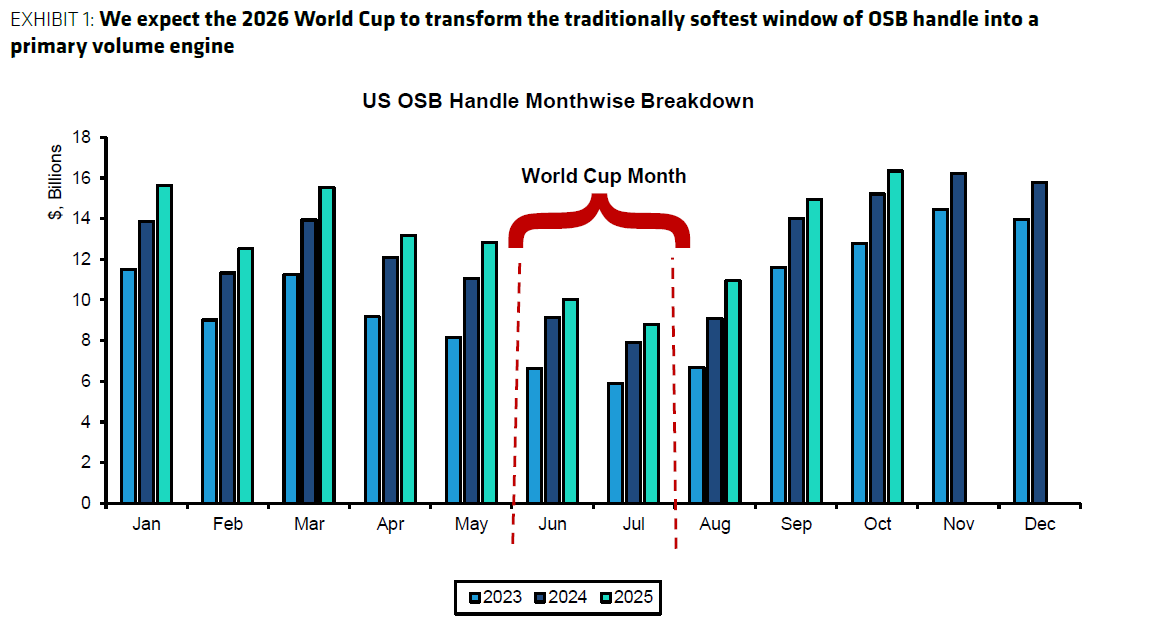
Published Thursday, the Bernstein analysts estimate the expanded tournament will generate more than $3 billion in incremental sports betting handle and $5 billion to $10 billion in additional consumer prediction market volume, as 104 matches transform what is typically the slowest period for online sports betting.
FIFA expects the month-long tournament to attract roughly 6 billion viewers worldwide, up from an estimated 5 billion during the 2022 World Cup in Qatar. Matches are scheduled to start today.
Bernstein said Coinbase has established itself as a major player in the sector, surpassing $100 million in annualized prediction market revenue in March, just months after launching the product.
As Cointelegraph reported, the crypto exchange rolled out prediction markets nationwide through a partnership with Kalshi, allowing users in all 50 US states to trade event contracts tied to sports, politics, culture and other real-world outcomes.
Robinhood is also expected to benefit from the tournament. Bernstein noted that the brokerage is using the event to launch Rothera, its own US Commodity Futures Trading Commission (CFTC)-licensed exchange and clearinghouse for prediction markets.
“[W]e expect prediction markets to be the biggest driver of incremental revenue for Robinhood,” the analysts wrote, forecasting roughly $586 million in prediction market revenue for 2026.
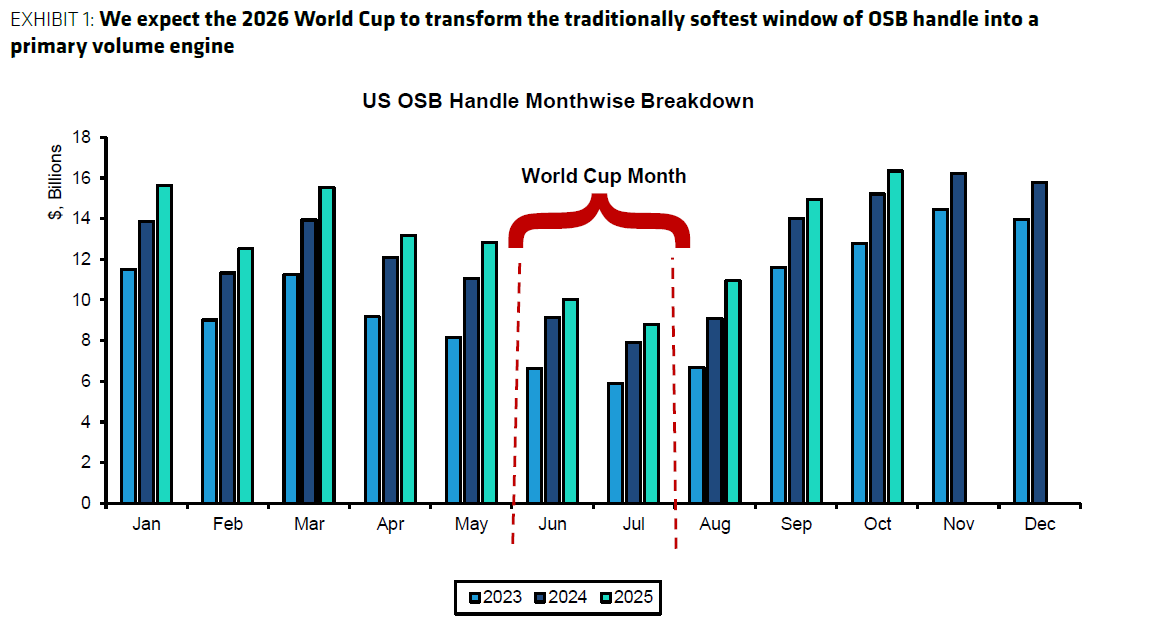
Bernstein expects the FIFA World Cup to transform the slowest months for online sports betting into a major driver of betting and prediction market volumes. Source: Bernstein
Related: Coinbase fends off Nevada’s emergency bid to halt prediction markets
Sports emerge as prediction markets’ biggest growth driver
Prediction markets have become one of crypto’s fastest-growing use cases, expanding even as the broader digital asset market has cooled.
An April report by Bitget Wallet and Polymarket found that monthly prediction market trading volume reached nearly $26 billion, with retail traders accounting for more than 80% of users.
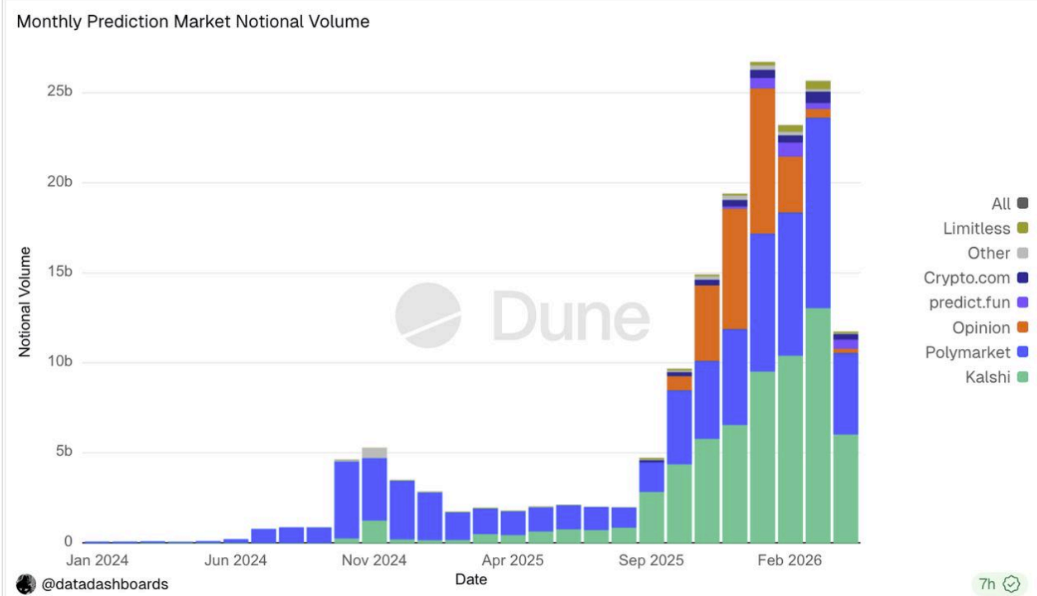
Prediction market volumes have grown considerably since late 2025. Source: Bitget Wallet
The report also pointed to a structural shift in user behavior. Rather than attracting activity around one-off events such as elections, prediction markets are increasingly retaining users across recurring categories, with sports emerging as the largest segment.
In March alone, sports betting accounted for more than 39% of prediction market volumes, according to Bitget Wallet and Polygon.
The CFTC on Wednesday issued draft rules for prediction markets signaling that sports event contracts are generally not contrary to the public interest even though federal law classifies them as “gaming.”
Related: Kalshi, Polymarket eye $20B valuations in potential fundraising: WSJ
Key takeaways:
- Surging oil prices and rising producer inflation have pushed traders to price in a stricter US Fed monetary policy.
- Massive spot Bitcoin ETF outflows in June show the cryptocurrency is currently failing to act as a stock market hedge.
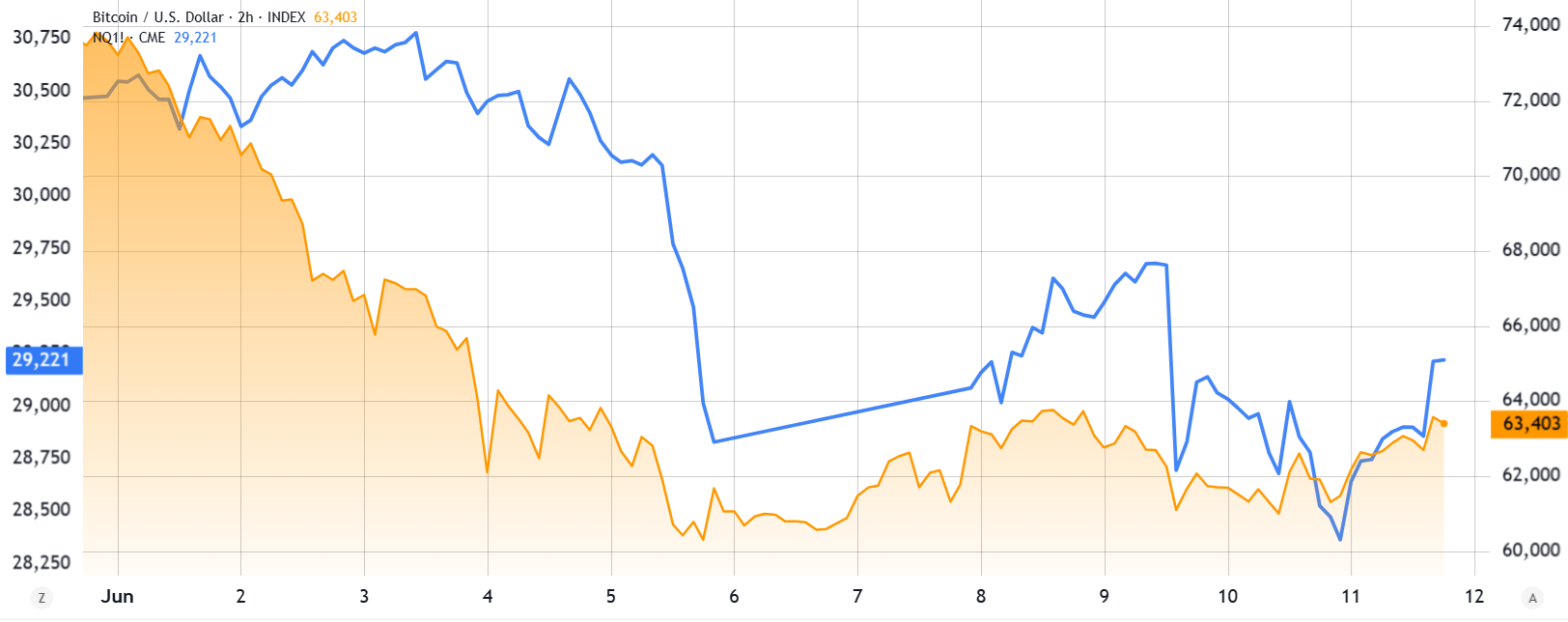
The Nasdaq 100 Index dropped 7.5% in the seven days leading up to June 10, wiping out $2.7 trillion in market value. The fallout represents more than twice the entire Bitcoin (BTC) market capitalization and has put traders on alert, especially as inflation data feels the heat from high oil prices. Traders now fear that Bitcoin support near $60,000 stands at risk.
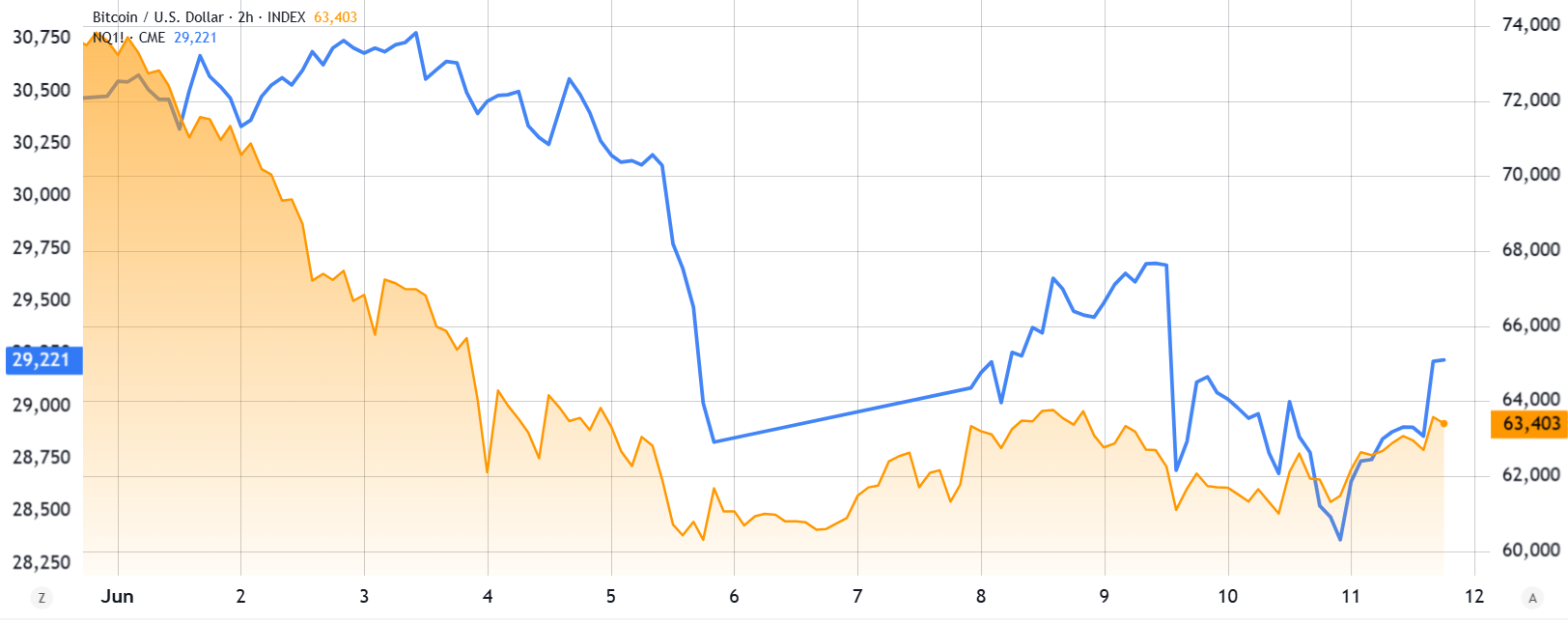
Nasdaq 100 futures (left) vs. Bitcoin/USD (right). Source: TradingView
The ongoing war in Iran has driven Brent crude oil prices above $90, prompting investors to fear an economic slowdown and to price in a tighter monetary policy for longer than previously anticipated. Regardless of job market conditions, money available for consumption tends to decline.
The US Labor Department reported Thursday that its producer price index jumped 6.5% from May 2025, the highest level since 2022. Traders now anticipate 40% odds of an interest rate increase by the US Fed by September, up from 5% one month prior, according to the CME FedWatch Tool.
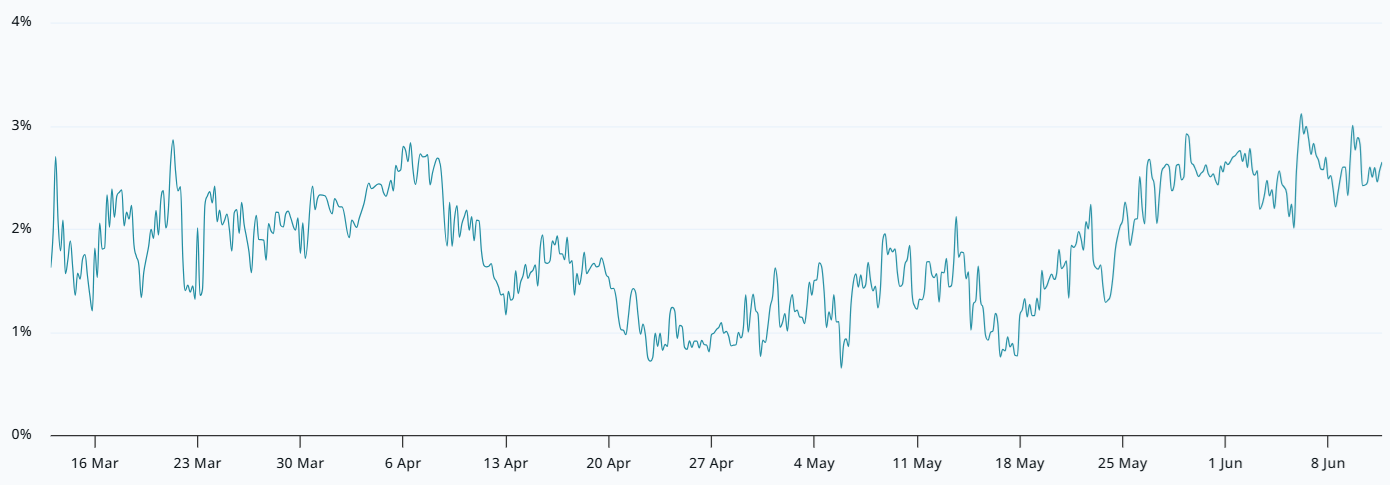
Bitcoin 2-month futures annualized basis rate. Source: Laevitas
Bitcoin futures contracts traded below the 4% neutral premium relative to regular spot markets on Thursday, indicating low demand for bullish leverage. Meanwhile, the upcoming $75 billion SpaceX (SPCX US) IPO was oversubscribed by more than 2x, signaling investors are not yet ready to abandon hope of further tech sector growth.
AI infrastructure companies are in desperate need of cash to fuel their build-outs, which partially explains the negative market reaction. Google (GOOG US) announced plans to raise $80 billion, while Oracle (ORCL US) and Super Micro Computer (SMCI US) followed suit with $40 billion and $7 billion, respectively. The Friday debut of SpaceX shares will likely set the tone for upcoming IPOs.
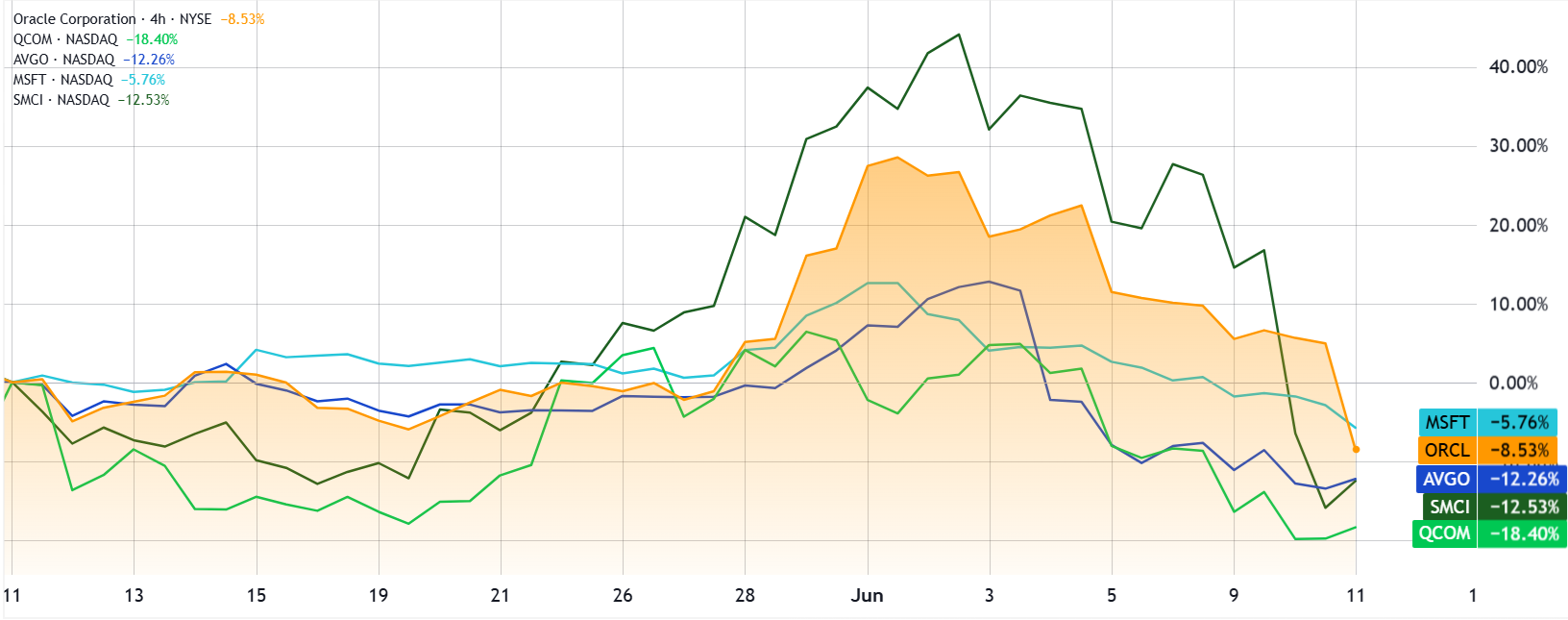
Selected AI sector stock performances. Source: TradingView & Cointelegraph
It seems premature to deem the AI sector a bubble after SpaceX marked the largest IPO in history at a $1.77 trillion valuation. Moreover, the US stock market reacted positively after US President Donald Trump called off planned strikes on Iran, citing renewed negotiations to reopen the Strait of Hormuz.
Strategy accumulation pause amid spot Bitcoin ETF outflows
Bitcoin’s decline coincided with Strategy’s (MSTR US) decision to temporarily halt its Bitcoin accumulation to reduce convertible debt. As a result, Strategy’s cash position declined to seven months of dividend coverage, while its preferred variable Stretch (STRC US) shares distanced themselves from the $100 level that would allow further equity issuance.
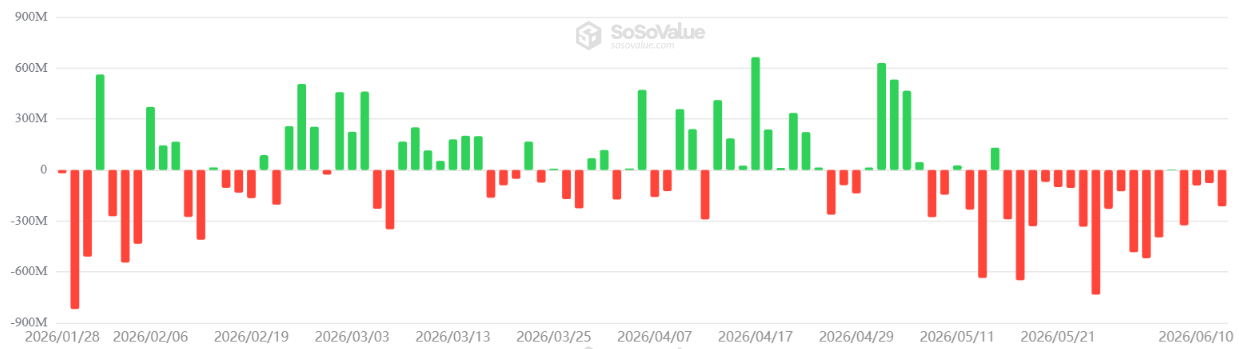
US-listed Bitcoin spot ETFs daily net flows, USD. Source: SoSoValue
The $1.9 billion in outflows from spot Bitcoin exchange-traded funds (ETFs) in June reinforced bearish sentiment, as the indicator serves as a proxy for institutional demand. Presently, Bitcoin can hardly be considered a hedge against an eventual stock market sell-off; the odds of a further correction below $60,000 should not be ruled out.
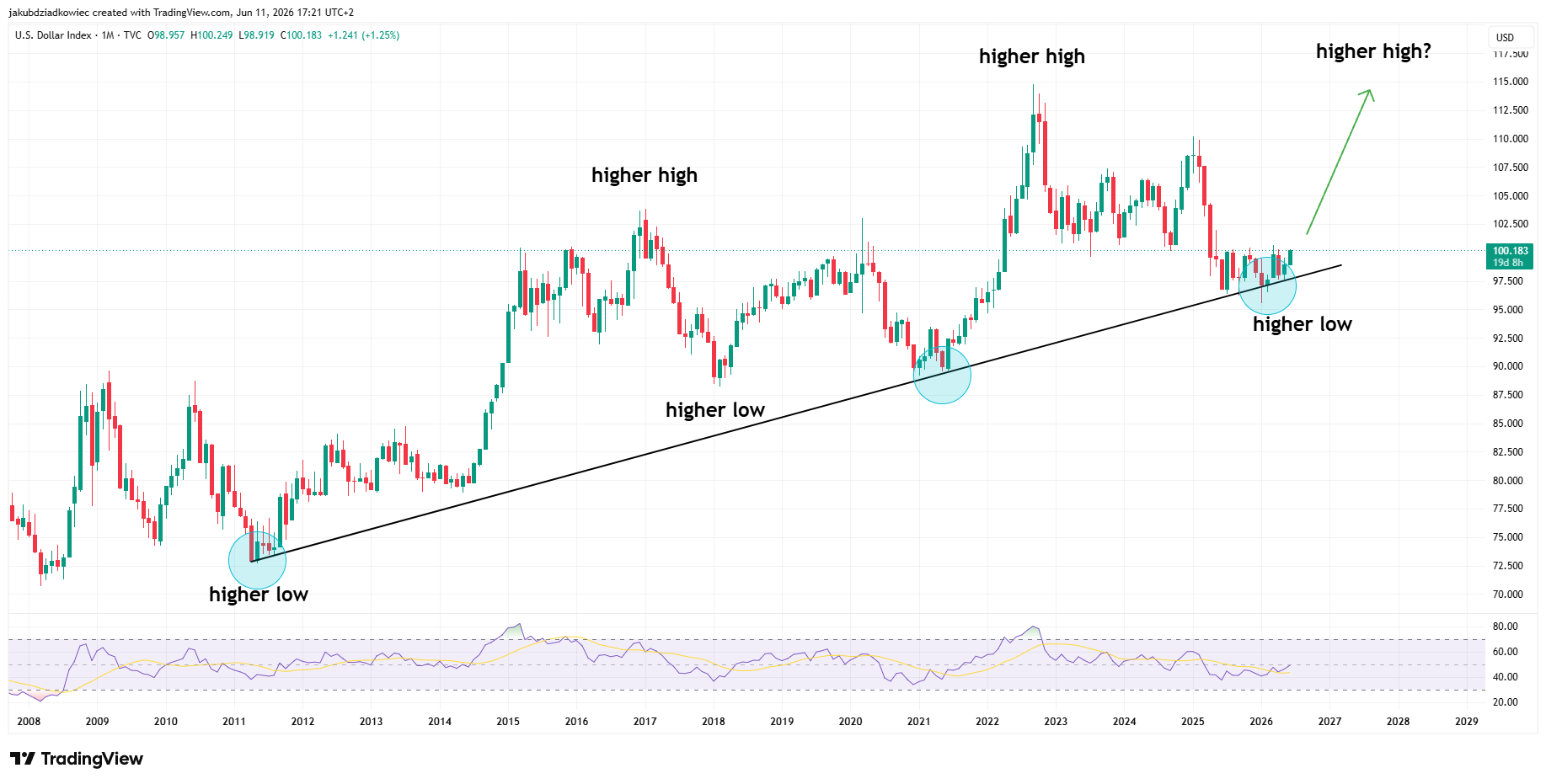
The US Dollar Index (DXY) trades near 100.2 after retesting an ascending trendline that has supported it since May 2011. A resistance zone at 100.5 still caps the recovery.
BeInCrypto examined the monthly, weekly, and daily charts to map the next likely move. The Federal Reserve (Fed) meeting on June 16-17 could decide the direction.
US Dollar Index Defends a Trendline That Has Held Since 2011
The monthly chart shows an ascending trendline that has defined the dollar’s long-term direction since May 2011. The line was almost retested in June 2014 and confirmed again in June 2021.
In February 2026, the index returned to this line once more. So far, the level has held.
The broader structure also remains constructive. DXY has printed a series of higher lows and higher highs over the past 15 years, including the 2022 peak near 115.

If the trendline holds, the current retest may become the next higher low. A repeat of previous cycles could then push the index above 115.
Dollar strength matters for crypto investors because of Bitcoin’s (BTC) long-running inverse correlation with DXY. However, the monthly relative strength index (RSI) remains neutral and signals no clear momentum.
Weekly Chart Still Treats the Recovery as a Correction
The weekly timeframe complicates the bullish picture. DXY climbed in a parabolic run from December 2020 until September 2022, peaking at 114.80. The breakdown from that parabola started a long distribution period and a downtrend.
Within that downtrend, the index printed a swing high near 110.18 in early 2025. The decline that followed bottomed at 95.55.

From this perspective, the ongoing recovery looks like a correction rather than a new uptrend. The key area sits near 99.5 to 100, where former support has turned into resistance.
A weekly close above this zone would validate the bullish breakout scenario. A rejection, in contrast, would likely resume the slide back to 95.55. Meanwhile, the weekly RSI reads 57, which indicates neutral momentum.
DXY Price Prediction Hinges on the 100.5 Resistance Zone
The daily chart provides the most detailed view of the battle. A support area near 97.5 has been retested twice, forming a double bottom or W pattern.
The measured target of this formation sits at 101.07, nearly 1% above the current price. However, the pattern remains unconfirmed. Resistance at 100.4 to 100.5 still caps the index, and DXY was rejected from this zone twice in March.
A second structure adds a bearish angle. Recent price action has formed an ascending wedge, a pattern that typically resolves downward. Its target lies near 98.5, roughly 1.7% below current levels. That target coincides with the 0.618 Fibonacci retracement at 98.547.

The daily RSI stands at 67 and approaches the overbought threshold of 70. Because the wedge’s upper band overlaps the resistance zone, a rejection on the first attempt looks likely.
Analysts have recently called DXY the most accurate macro indicator for Bitcoin’s direction, so crypto traders should watch these levels closely.
The Fed’s June 16-17 meeting is the nearest catalyst, with markets still pricing a possible rate hike in December. A daily close above 100.5 would open the path to 101.07 and revive the long-term rebound thesis, while a wedge breakdown would expose 98.5 first.
The post Is the US Dollar Index (DXY) Headed Higher After a 15-Year Trendline Retest? appeared first on BeInCrypto.

More than 50 Iranian military bases damaged in US strikes since start of war, satellite images show

New Zealand manufacturing slips into contraction amid weak demand, higher costs
Bitcoin Nears Realized Price But Capitulation Signals Are Missing: Analyst



-

 Fashion6 days ago
Weekend Open Thread: Evereve – Corporette.com
-
 Crypto World6 days ago
Jensen Huang Approves Samsung, SK Hynix, and Micron for NVIDIA (NVDA) HBM4 Memory Supply
-

 Crypto World4 days ago
Anatomy of the June crypto crash: Fed, Iran, Saylor
-
 Entertainment5 days ago
The Best Mystery Series of All Time Is Surging on Streaming 30 Years After It Ended
-

 NewsBeat4 days ago
Alexander Zverev wins the French Open to finally earn a 1st Grand Slam title
-

 Tech6 days ago
Suspicious Polyfill login prompts pop up on Toshiba, Muji websites
-
 Crypto World5 days ago
Senator Cynthia Lummis Calls CLARITY Act the Most Consequential Financial Legislation of This Generation
-

 Tech7 days ago
Microsoft launches MXC, an OS-level sandbox for AI agents, with OpenAI and Nvidia already on board
-

 Tech5 days ago
Microsoft unveils seven homegrown AI models in new bid for ‘long term self-sufficiency’
-

 Business7 days ago
(VIDEO) Justin Bieber Delivers Surprise Happy Birthday Serenade to Diners at Los Angeles Mexican Restaurant
-
 NewsBeat4 days ago
Alexander Zverev conquers demons and outlasts Flavio Cobolli to win French Open for first major title
-
 Business5 days ago
The Pain Points Taking a Fragile Tech Rally Down a Notch
-

 Business4 days ago
High Stakes for Wembanyama as New York Pushes for 3-0 Lead
-
 Crypto World4 days ago
Eli Lilly (LLY) Stock Surges 4% Following Breakthrough Sleep Apnea Trial Results
-

 Tech6 days ago
Von der Leyen’s AI envoy pick draws conflict-of-interest fire
-

 Tech6 days ago
Meta steals a tactic from Tesla and builds data centers in tents
-
Crypto World7 days ago
LBank Surpasses 25 Million Users Worldwide as AFA Partnership Continues to Drive Global Growth
-

 Tech6 days ago
Hackers now exploit SolarWinds Serv-U flaw to crash servers
-

 Crypto World4 days ago
Trump’s AI Ownership Plan Could Benefit Anthropic at OpenAI’s Expense
-
 Sports2 days ago
Bangladesh beat Australia after 20 years in ODIs, register only their second win over six-time world champions | Cricket News
You must be logged in to post a comment Login