
Crypto World
Bitcoin price tops $77K after BOJ lifts rates to 1.25%

Bitcoin has climbed above $77,400 on Sept. 18 after the Bank of Japan raised its benchmark interest rate by 25 basis points to 1.25%, its highest level in roughly 31 years, while the yen weakened following the decision.
Summary
- Bitcoin traded above $77,400 after the Bank of Japan raised rates to 1.25% on Friday.
- BOJ approved the 25-basis-point increase by seven votes to two, its second hike since June.
- CoinGecko showed Bitcoin near $77,409, up 1.4%, with $77,624 marking the daily high during trading.
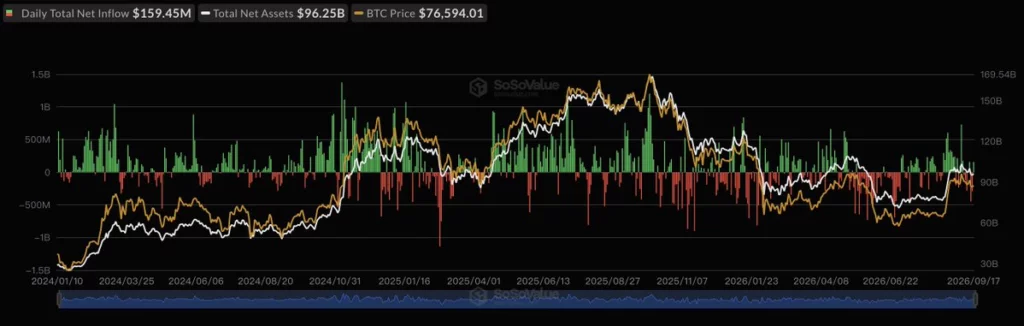
- U.S. spot Bitcoin ETFs drew $159.5 million on September 17, led by BlackRock’s IBIT fund.
- RSI remained neutral-bullish while bearish MACD crossover showed short-term momentum had weakened after Bitcoin’s rebound.
The Bank of Japan said the Policy Board approved the increase from 1.0% by a 7–2 vote as officials responded to inflation risks and continued progress toward the central bank’s 2% price stability target. Reuters reported that policymakers retained guidance indicating rates could rise further if economic activity and prices develop in line with the BOJ’s projections.
Bitcoin price holds above $77K after BOJ decision
At the time of checking, CoinGecko showed Bitcoin at $77,409.41, up 1.4% over 24 hours. The cryptocurrency had traded between $75,971.64 and $77,623.53 during the period, placing the current price close to the upper end of its daily range.
The move followed an overnight decline toward $76,200. BTC recovered to roughly $77,400 after the BOJ decision, while BTC/JPY on Tokyo-based bitFlyer rose around 0.5% to 12.06 million yen.
Foreign-exchange trading moved in the opposite direction. USD/JPY rose from around 156.20 before the rate announcement to approximately 156.70 afterward, showing that the yen weakened despite the higher Japanese policy rate.
Reuters said investors focused partly on the two dissenting BOJ members and the lack of stronger language pointing toward rapid additional tightening. The yen therefore failed to strengthen after a rate decision that had already been widely expected.
Bitcoin’s rise should not be attributed solely to the BOJ meeting. BTC had already started recovering from the $76,000 area before the announcement, while U.S. ETF flows, Federal Reserve policy, Treasury yields, oil prices and geopolitical conditions were moving at the same time.
As recent Bitcoin central-bank coverage previously reported, analysts had identified the BOJ meeting as a potential source of volatility because tighter Japanese monetary policy can increase the cost of yen-funded positions.
BOJ raises rates as inflation risks stay elevated
Friday’s increase took the BOJ policy rate from 1.0% to 1.25%, extending a tightening cycle that has moved Japan further from the ultra-low borrowing costs maintained for much of the previous three decades.
The increase was the BOJ’s second rate hike in roughly three months after policymakers raised the benchmark to 1% in June.
Two Policy Board members opposed Friday’s increase. Reuters reported that the dissenters argued economic conditions did not yet justify another increase, while the majority pointed to inflation risks connected with import prices, energy costs and domestic price-setting behavior.
Japan’s central bank said the economy had continued recovering moderately, although some sectors remained weak. Officials maintained that underlying consumer inflation was gradually moving toward 2%.
Higher oil costs remain one source of pressure because Japan imports much of its energy. A weaker yen can raise those costs further by making dollar-priced commodities more expensive in local currency terms.
The BOJ said it would continue raising its policy rate and adjust monetary accommodation if its economic and inflation outlook is realized. The statement does not commit the bank to a date or size for the next increase.
As earlier BOJ crypto coverage reported after the June increase, higher Japanese rates have drawn attention from digital-asset traders because yen borrowing has historically financed leveraged positions across global markets.
Yen carry trade remains a crypto risk factor
For years, very low Japanese borrowing costs encouraged investors to borrow yen and deploy capital into currencies or assets offering higher returns.
Higher BOJ rates increase the funding cost of those strategies. A rapid rise in the yen can create an additional problem because traders who borrowed the currency must repay liabilities at a stronger exchange rate.
The latest decision did not produce that pattern immediately. The yen weakened and Bitcoin rose after the announcement, meaning Friday’s first reaction did not resemble a disorderly carry-trade unwind.
The interest-rate gap with the U.S. remains sizable. The Federal Reserve raised its target range to 3.75%–4.00% earlier this week, compared with Japan’s new 1.25% policy rate. The difference remains approximately 2.5 to 2.75 percentage points. The Fed’s own rate data confirms the latest U.S. range.
The August 2024 market selloff remains a common reference point because equities and crypto dropped sharply as yen-funded trades came under pressure. Past market behavior does not establish that the same response will occur after subsequent BOJ decisions.
Meanwhile, U.S. monetary policy remains another factor for Bitcoin. Reuters reported that Goldman Sachs and BofA Global Research expect the Federal Reserve to raise rates again in October. Most major brokerages expect another increase later in 2026, commonly in December.
Morgan Stanley does not currently share the October call cited in some reports. Reuters said Morgan Stanley and Macquarie expect a December increase followed by another rate hike in March 2027.
Bitcoin ETFs return to $159.5M net inflows
Institutional flows provided another data point for Bitcoin before the BOJ announcement.
U.S. spot Bitcoin ETFs recorded $159.5 million in net inflows on Sept. 17, reversing two consecutive trading sessions of withdrawals, according to SoSoValue data.
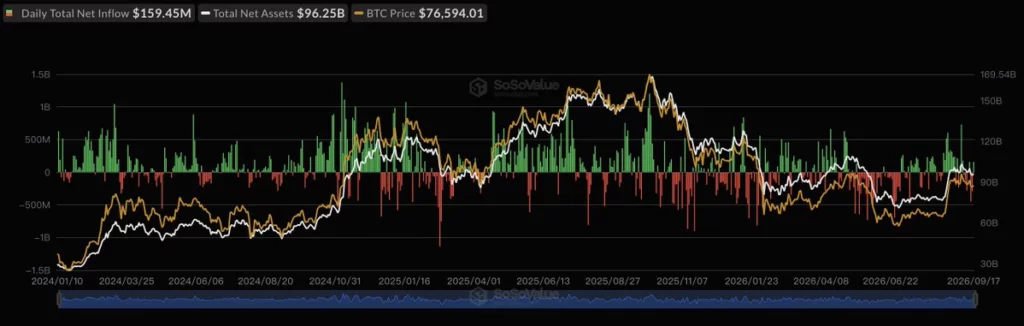
BlackRock’s iShares Bitcoin Trust recorded $183.7 million of net inflows. Fidelity’s FBTC posted $16.6 million in outflows, while VanEck’s HODL lost $7.6 million. The remaining products recorded no meaningful net movement in the reported figures.
The result means IBIT was the only fund with positive net flows in the Sept. 17 dataset, but saying it received $159 million would be incorrect. BlackRock attracted more than the group’s net total because withdrawals from Fidelity and VanEck reduced the combined result.
The inflow followed withdrawals of roughly $450.4 million on Sept. 15 and $295.9 million on Sept. 16, according to the same Farside-based data.
BlackRock’s product remains the largest U.S. spot Bitcoin ETF by holdings. Bitbo data placed U.S. spot ETF holdings collectively at approximately 1.259 million BTC as of Sept. 17, with IBIT holding roughly 784,526 BTC.
In earlier U.S. Bitcoin ETF coverage, the funds recorded a much larger $730.9 million daily inflow on Sept. 3, showing that daily institutional flows have remained volatile through September.
RSI and MACD show momentum cooling below $77,600
The supplied Bitcoin chart shows price recovering from approximately $76,200–$76,400 into the $77,400–$77,600 area before moving into a narrower consolidation.
The 14-period RSI stands at 56.89, below its moving average of 60.55. A reading above 50 keeps the indicator on the positive side of neutral, while remaining below the 70 level commonly associated with overbought conditions.
With the RSI below its moving average, the chart indicates that momentum has eased compared with the earlier stage of the rebound.
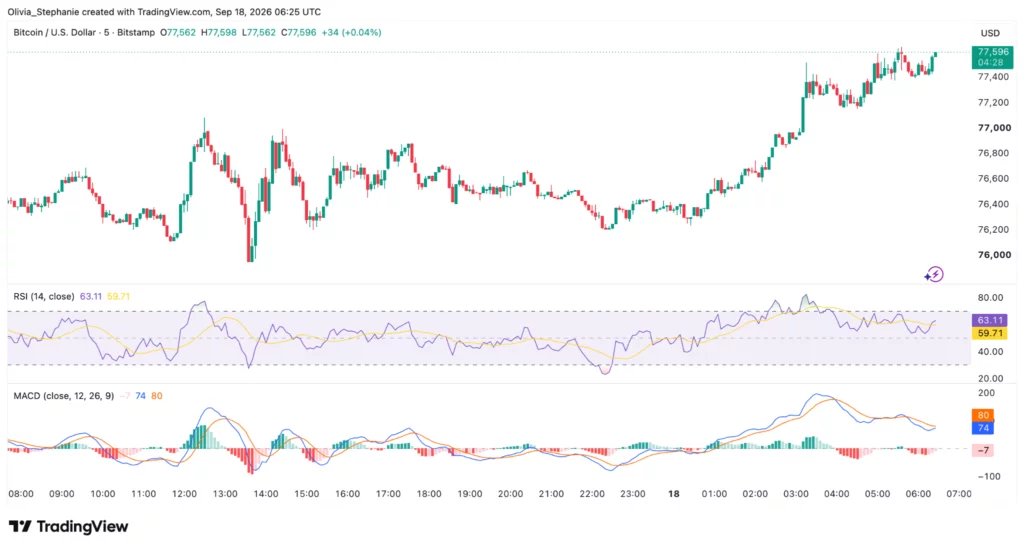
The MACD gives a more cautious reading. Its line is close to 73, below the signal line near 91, while the histogram is approximately -19. The bearish crossover shows that short-term momentum has weakened even as Bitcoin holds above $77,000.
Current CoinGecko data places the 24-hour high at $77,623.53, closely matching the $77,600 area where the supplied chart shows recent candles encountering resistance.
Below the market, the latest CoinGecko range places the daily low near $75,972. Earlier Bitcoin technical coverage identified the $75,000–$76,000 region as an area where buyers had recently returned.
The BOJ’s next policy moves remain conditional on inflation and economic data. For Bitcoin, the immediate market now combines the Japanese rate increase, a still-large U.S.-Japan policy-rate gap, recovering ETF inflows and technical resistance around the upper $77,000 to $78,000 region.
Disclosure: This article does not represent investment advice. The content and materials featured on this page are for educational purposes only.

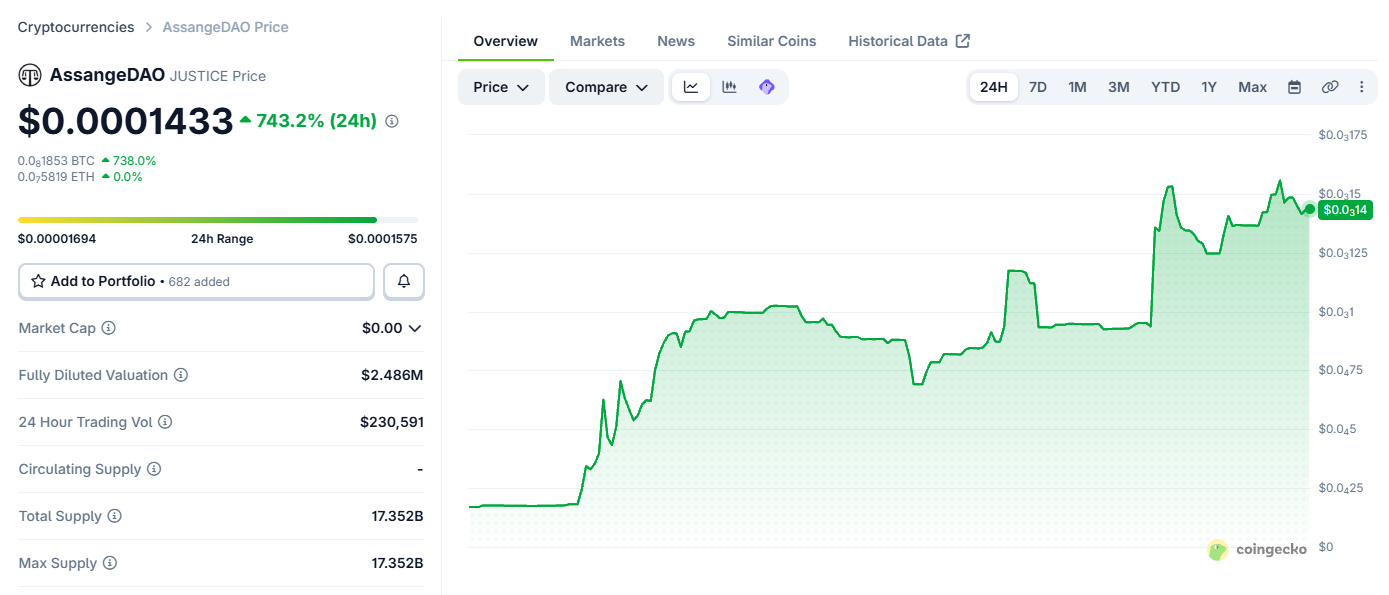
WikiLeaks founder Julian Assange returned to X with a two-word post saying he is back. AssangeDAO (JUSTICE), the Ethereum token minted to fund his defense, then spiked 743% in 24 hours.
Most coverage called the gap a two-year absence. Assange corrected that himself, saying his last personal post came in 2018.
AssangeDAO Token Spikes on a Two-Word Post
His defense campaign ran the account as @DefendAssange in the meantime. The silence therefore lasted eight years, not two. Assange has kept a low profile in Sydney since a 2024 plea deal freed him.

The volume jump tells the story better than the price. JUSTICE averaged under $800 in daily turnover over the past month. That figure reached roughly $231,000 during the surge. Liquidity stays thin in absolute terms, though.
Most of the trading ran through a single Uniswap pool, and the fully diluted valuation sits near $2.5 million. The AssangeDAO token also trades about 95% below its February 2022 record.
Traders have chased attention spikes like this before. A viral meme coin rally in August lifted one token 10,000%. BASECAT climbed more than 2,000% in a single day. Both moves faded quickly.
AssangeDAO launched in February 2022 to fund Assange’s legal defense. Supporters pooled 16,593 ETH, worth about $53 million then. They bought an NFT from the artist Pak. The Wau Holland Foundation later spent the proceeds on legal costs.
Bitcoin Kept WikiLeaks Alive After the Banking Blockade
Visa, Mastercard and PayPal cut WikiLeaks off in December 2010. The site therefore started accepting Bitcoin in June 2011. That move became an early test of censorship-resistant money.
Satoshi Nakamoto opposed it at the time.
“It would have been nice to get this attention in any other context. WikiLeaks has kicked the hornet’s nest, and the swarm is headed towards us,” Satoshi Nakamoto, bitcointalk post.
Assange later credited those donations with keeping WikiLeaks funded. He claimed returns close to 50,000%. In 2024, an anonymous donor sent 8 BTC to clear his roughly $500,000 charter-flight debt.
That pattern has since repeated elsewhere. Crypto donations reached Venezuela within days of its June earthquakes.
JUSTICE therefore appears to trade on that history rather than on any fresh project development.
The post WikiLeaks Founder Says “I'm Back.” A Token Most People Forgot Existed Jumps 743% appeared first on BeInCrypto.
Crypto World
Major Ripple (XRP) Opportunity, Shiba Inu (SHIB) Updates, and More: Bits Recap September 18
Ripple’s cross-border token has posted a slight decline over the past week and now trades well below its all-time high set in the summer of 2025. Still, one analyst sees the current level as a perfect buying opportunity.
Shiba Inu unveiled a “useful” update related to Shibarium, while Ethereum (ETH) might be gearing up for a rally toward $3,000.
XRP’s Potential
As of this writing, the token is worth around $1.33 (per CoinGecko), representing a 56% collapse on a yearly scale. X user Cryptollica, however, noted that the downtrend has pushed XRP’s two-week RSI to around 33.5.
This is the lowest point in the asset’s history and is usually viewed as a bullish factor. After all, it indicates that XRP has neared oversold territory and could be on the verge of a solid recovery. Cryptollica explained:
“That is the part the market is misreading. Sentiment has been destroyed, momentum has been washed out to a historical extreme, and the asset is being treated as if the story is already over. But this is exactly where asymmetry becomes interesting. Market has already delivered the pain while the long term structire is still active.”
Other market observers anticipating a short-term resurgence include STEPH IS CRYPTO and Crypto Bitlord. The former spotted a “cup and handle” pattern on XRP’s price chart and predicted a potential pump to $2.50, while the latter said they are 99% sure a push toward $2 is coming next.
The Shibarium Update
Earlier this week, the team behind Shiba Inu implemented “a small but useful” update for the layer-2 scaling solution, Shibarium. It refreshed its RPC listing in the Ethereum-lists/chains registry, and Chainlist now has updated connection details.
The update, however, didn’t trigger a price rebound for SHIB, and the community noted that Shibarium continues to struggle with weak usage. A year ago, the protocol fell victim to an exploit, after which daily transactions on the network have plunged to thousands and occasionally even hundreds. Prior to the attack, the figure stood in the millions.

ETH’s Path to $3K
The second-largest cryptocurrency experienced significant volatility over the past several days due to the CLARITY Act’s failure and the Fed’s decision to increase interest rates. Eventually, it settled around $2,500, a modest 1% gain for the week.
Renowned analyst Ali Martinez recently said ETH remains contained within its 4-hour channel. He said the price has reached the structure’s lower boundary and that he’s now closely watching for a potential rebound toward the mid-range and the upper boundary near $2,570.
According to him, this is a key level, and a strong 4-hour close above (backed by volume) could confirm a breakout and open the door to a jump toward $2,700 and even $3,000.
Other analysts, like X user BLADE, were even more optimistic. They noted a double-bottom formation on ETH’s price chart and argued the asset is on the verge of “the biggest move of the cycle,” projecting an explosion beyond $10,000 sometime next year.
The post Major Ripple (XRP) Opportunity, Shiba Inu (SHIB) Updates, and More: Bits Recap September 18 appeared first on CryptoPotato.
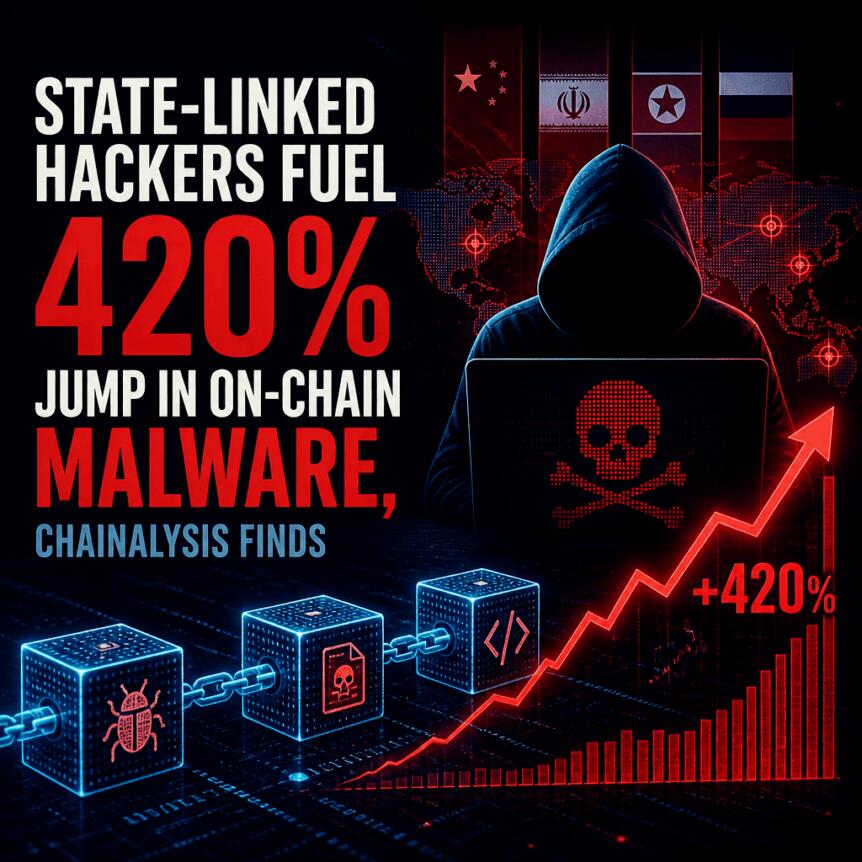
State-linked cybercriminals are increasingly using public blockchains as “dead drops” for malware instructions and infrastructure details, according to a new Chainalysis report. The firm estimates that state-aligned actors accounted for roughly two-thirds of new dead drop activity each quarter, while the frequency of these writes rose 420% over the past 12 months.
Chainalysis also reports that operators tied to North Korea and Iran are among the groups adopting the tactic, including activity it linked across multiple networks—Tron, Aptos, and BNB Smart Chain (BSC)—to a North Korea-associated actor tracked by Google Threat Intelligence.
Key takeaways
- Chainalysis says state-linked threat actors drive about two-thirds of quarterly blockchain dead drop activity.
- Blockchain “dead drop” writes climbed 420% year over year, indicating faster growth in on-chain malware infrastructure.
- North Korea-linked groups have used multi-chain routing, with Tron acting as a first route and Aptos as a fallback to a BSC transaction containing encrypted instructions.
- Chainalysis attributes a 440% rise in malicious writes since July 2025 in part to the availability of high-capacity open-source AI models capable of generating malicious code with limited safeguards.
- Iran-linked operators are also suspected of using the Bitcoin blockchain to publish encoded command-and-control routing data that infected devices can poll for updates.
Dead drops across public chains: why it’s hard to shut down
Chainalysis defines the “dead drop” tactic as embedding malware guidance—such as pointers to infrastructure, server addresses, or configuration data—inside transactions on public blockchains. The report highlights a central advantage for attackers: even if domains, servers, or code repositories are taken offline, the stored information can remain publicly accessible on-chain.
The analytics firm warns that this durability makes campaigns more resilient over time and increases the operational burden on defenders. Instead of merely disrupting a single server or endpoint, response efforts may need to account for information that is permanently replicated across decentralized ledgers.
Chainalysis also points to a broader pattern: state actors are not only using blockchains, but increasingly scaling how often they do so and broadening the networks involved.
North Korea-linked activity routed through Tron, Aptos, and BSC
One of the report’s most specific findings ties previously unattributed blockchain activity spanning Tron, Aptos, and BNB Smart Chain to UNC5342, a North Korea-linked group tracked by Google Threat Intelligence.
Chainalysis describes how encoded pointers embedded in Tron and Aptos transactions would direct infected devices toward the same BSC transaction. In this setup, Tron served as the first routing path, while Aptos provided a fallback option if the primary route failed.
The shared BSC transaction, Chainalysis says, contained encrypted server addresses and configuration data. That data, once decrypted by compromised devices, connected them to off-chain infrastructure used for remote access and data theft.
For investors and builders, the takeaway is less about any single chain and more about how malware operators are treating blockchain networks as flexible, multi-route messaging systems—one that can help keep campaigns functioning even when certain routes or infrastructure components change.
Chainalysis also notes that public blockchains have previously been used in similar ways by North Korean hackers. In 2025, for instance, coverage from Cointelegraph described a technique called EtherHiding, where malicious crypto-stealing code was placed in smart contracts.
AI’s role: more malicious writes, but attribution remains uncertain
Chainalysis further reports a 440% increase in malicious blockchain writes since July 2025, framing the change as coinciding with when “high-capacity open-source Chinese artificial intelligence models became capable of producing malicious code with limited safeguards,” according to the firm’s findings.
Eric Jardine, cybercrimes research lead at Chainalysis, told Cointelegraph that the team observed a “clear point-in-time association” between the period and the surge in malicious on-chain activity. However, he cautioned that the firm could not prove that the actors publishing the malicious transactions and contracts had directly used these AI models to boost their output.
This distinction matters for what readers should infer from the data. The increase suggests that the environment for writing and deploying malicious code may have become easier to scale, but Chainalysis’ evidence does not establish a direct line from a specific model to specific actors. Defenders may still adjust their priorities—especially around how quickly adversaries can publish new payloads—without assuming the attribution is solved.
Iran-linked operations use Bitcoin as an update channel
Beyond non-Bitcoin networks, Chainalysis also identifies threat actors it suspects are linked to Iran’s Ministry of Intelligence. In its assessment, those actors wrote encoded command-and-control routing data to the Bitcoin blockchain.
Chainalysis says its judgment is based on a combination of factors—such as the malware family, the decoding method used, timing patterns, and associated server infrastructure—rather than relying on blockchain activity alone.
The report describes a mechanism where attacker-controlled wallets sent small payments to a well-known Bitcoin address historically tied to Satoshi Nakamoto. Chainalysis states that the address has no connection to the attackers and functions as a permanent public location that infected devices can check for updated instructions.
According to Chainalysis, the attackers can refresh their server infrastructure by publishing a new Bitcoin transaction with updated data. Once malware pulls the new directions, the operation can shift off-chain for follow-on activities that may include remote access, credential theft, and the delivery of additional malware.
By using Bitcoin as a reliable public registry for routing updates, the approach again underscores the same theme: attackers can avoid some traditional single-point failures (like takedowns) by embedding “where to go next” information into data that remains widely available.
Chainalysis’ findings suggest defenders should treat blockchain dead drops as an evolving, potentially scalable part of cyber operations—especially as on-chain writes rise across multiple networks. The key uncertainty readers should watch next is whether future reporting will narrow the gap between association and direct attribution—particularly around AI-assisted scaling—and how quickly defenders and platforms adapt to this more resilient style of malware infrastructure.


A German Army Enigma message from July 1941 has finally given up its contents. Carter Leffen broke it this week using OpenAI’s GPT-6 Astra, and the archive that had logged the intercept as unsolved now records a solution.
The recovered text is almost mundane. Reaching it took roughly 10 hours of model time, one borrowed phrase, and 14.8 million key checks.
Inside the GPT-6 Astra Enigma Break
The intercept carries the indicator MVUEH and dates to July 10, 1941. It came from German Army traffic during the invasion of the Soviet Union. The run recovered the full machine setup, including rotor order II-V-III and 10 plugboard pairs.
A crib made the attack practical. Leffen took the repeated place name Rosenow from a related message that was already solved, which cut the search space to a workable size. GPT-6 Astra then searched archives, built an Enigma simulator, wrote the cryptanalysis code, and tested competing keys in parallel.
“Please specify the route of march. I am in Rosenow, Rosenow. Immediate reply by radio,” Carter Leffen, site
Two independent implementations reproduced the plaintext. Frode Weierud’s CryptoCellar archive has since logged the GPT-6 Astra Enigma break and credited Leffen by name.
Where the Human Still Did the Work
The cipher itself is not the story. Allied codebreakers beat Enigma in the 1940s, and any modern machine can clear a three-rotor key space once a crib narrows it.
Nor was the break autonomous. Leffen set the goal, supplied the crib, and pushed the investigation forward, while the agents handled evidence, search, and review. The model carried out the execution rather than the judgment.
That division of labor keeps surfacing. Anthropic said in July that its model found weaknesses in encryption systems that researchers had not documented.
However, none of this touches modern cryptography. Enigma is a 1930s rotor machine, and the math protecting Bitcoin wallets sits in a far harder class. The quantum threat to Bitcoin remains a live question there.
Leffen offered his own measure of the effort. He said the website explaining the GPT-6 Astra Enigma solution took 99 times more work than the codebreaking itself.
The post OpenAI's GPT-6 Astra Cracked a Nazi Enigma Message in 10 Hours: Is Bitcoin Next? appeared first on BeInCrypto.


Stablecoin payments firm dtcpay announced today the formal completion of its $25 million Series A funding round, securing a strategic investment from Japan’s financial giant, the SBI Group.
The capital raise, initially anchored earlier this year by Vertex Ventures Southeast Asia & India, concluded with SBI entering the fold through SBI Ventures Asset and the SBI-NTU-Kyobo Digital Innovation Fund. Existing backers Genedant Capital and Kwee Liong Tek also maintained their positions.
Dtcpay provides essential crypto infrastructure. It handles asset conversion and custody, and offers a Visa-linked card that lets holders spend stablecoins just like ordinary cash. The firm holds a Major Payment Institution license from the Monetary Authority of Singapore, alongside regulatory footprints in Europe, Hong Kong, Australia, and North America.
SBI’s involvement in the funding round indicates a strategic move to secure fully regulated pipelines connecting Japanese capital with Southeast Asian commercial channels. Stablecoins provide a high-speed alternative to slow traditional correspondent banking, provided the intermediary meets rigorous regulatory standards.
“We did not raise this round to sustain what we have built,” Alice Liu, founder and CEO of dtcpay, said in the statement. “We raised it to fundamentally change how money moves across borders.”


Hong Kong has set plans to bring 24/7 central bank digital currency settlement to its tokenized deposit market by around the end of 2026, while preparing real value CBDC transactions for after hours derivatives trading and tests involving more than HK$1.3 trillion in Exchange Fund Bills.
Summary
- Hong Kong plans to introduce 24/7 wholesale CBDC settlement for tokenized deposits under EnsembleTX by the end of 2026.
- HKEX and the HKMA are preparing real value wholesale CBDC transactions for after hours derivatives trading.
- HKMA plans tests involving more than HK$1.3 trillion in Exchange Fund Bills as Hong Kong expands its tokenization program.
- Regulated stablecoins are being explored for tokenized money market fund settlement under Hong Kong’s digital asset framework.
According to Hong Kong’s 2026 Policy Address, the Hong Kong Monetary Authority plans to implement CBDC settlement and round the clock operations under EnsembleTX, the pilot phase of Project Ensemble, while continuing to explore new uses for tokenized deposits.
The plan would give banks access to tokenized central bank money for settlement beyond the operating hours of conventional payment infrastructure. EnsembleTX has been running real value transactions involving digital assets and tokenized deposits during 2026, with the HKMA progressively upgrading the pilot environment to support 24/7 settlement in tokenized central bank money.
Hong Kong began the live transaction phase after earlier Project Ensemble work examined how tokenized commercial bank deposits could be used alongside tokenized assets. Interbank settlement initially remained dependent on conventional payment infrastructure, leaving a gap between the continuous operation of distributed ledger systems and the hours during which central bank money could move between banks.
Hong Kong CBDC plan moves toward 24/7 settlement
The year end target moves EnsembleTX closer to providing both the tokenized commercial bank money used by participating institutions and a central bank settlement asset for transactions between them.
As crypto.news previously reported, Hong Kong’s latest policy program includes plans to support regulated stablecoin trading on licensed virtual asset platforms and use regulated stablecoins to settle tokenized money market funds. The Securities and Futures Commission is expected to refine rules for tokenized investment products, including gold and other suitable real world assets.
CBDC settlement under EnsembleTX serves a separate part of the tokenized financial system. Tokenized deposits represent commercial bank money, while the wholesale CBDC provides central bank money that can be used for settlement between participating financial institutions.
The HKMA said in its 2025 annual report that EnsembleTX would operate throughout 2026 and that its pilot environment would be progressively enhanced to support settlement in tokenized central bank money on a 24/7 basis.
Earlier e-HKD trials provided the groundwork. The HKMA completed the second phase of its digital currency pilot in 2025 after 11 projects tested e-HKD and tokenized deposits across financial use cases. The pilot findings indicated that both forms of digital money could support programmable transactions, after which the authority prioritized wholesale financial applications.
Wholesale CBDC will enter after hours derivatives settlement
A second use of wholesale e-HKD is being prepared with Hong Kong Exchanges and Clearing for derivatives trading outside normal banking hours.
HKEX and the HKMA are working to introduce a wholesale CBDC payment solution for after hours derivatives trading, with real value transactions targeted for 2026, according to the Policy Address.
The two institutions had already started an after hours CBDC pilot in June. The trial examines whether clearing participants can use e-HKD to transfer advance margin outside regular banking hours.
Under the existing process described when the pilot was announced, clearing participants seeking to have advance margin recognized for an after hours trading session have to submit deposit requests to HKFE Clearing Corporation by 3 p.m. The pilot allows participating firms to test real value transactions voluntarily, while any larger rollout remains subject to regulatory approval and market readiness.
HKEX Chief Operating Officer Vanessa Lau said at the time that the project was intended to provide a “more flexible and timely payment option” outside regular business hours. HKMA Deputy Chief Executive Howard Lee described the project as a test of wholesale CBDC in a live market environment.
HKMA will test more than HK$1.3 trillion in Exchange Fund Bills
Hong Kong’s tokenization plans extend beyond payments. The HKMA is preparing tests involving more than HK$1.3 trillion worth of Exchange Fund Bills before the end of 2026.
The Policy Address said the tests will examine the operation of tokenized Exchange Fund Bills and how banks can use the instruments around the clock for asset and liability management. The HK$1.3 trillion figure refers to the value of Exchange Fund Bills that could be used more efficiently through tokenization, rather than a statement that the entire amount will be tokenized in a single issuance.
That distinction clarifies an ambiguity in earlier information describing the initiative as an HK$1.3 trillion tokenization test. The Policy Address describes tests on the operation of tokenization involving a pool of more than HK$1.3 trillion worth of Exchange Fund Bills.
Hong Kong has already moved government and institutional debt onto digital infrastructure. The HKMA formed a tokenized bond expert group in June involving JPMorgan, HSBC, Standard Chartered, UBS, Ant Digital, HashKey Group and other institutions. At that point, Hong Kong had issued more than HK$6.8 billion in tokenized government bonds across several offerings.
Later that month, Hong Kong Mortgage Corporation priced an HK$12 billion digital bond, which it described as the world’s largest digital bond issuance. Orders reached roughly HK$24 billion from more than 100 institutional accounts in Hong Kong, mainland China and overseas markets.
The 2026 Policy Address said digital bonds issued in Hong Kong accounted for nearly 50% of the global market between 2025 and the first half of 2026. Authorities now plan to regularize digital bond issuance while examining the use of digital currencies across settlement, dividend payments and redemption.
Stablecoins are being brought into tokenized fund settlement
Regulated stablecoins are being developed as another settlement route within Hong Kong’s digital asset framework.
The government plans to promote their use for settling tokenized money market funds, while allowing regulated stablecoins to trade on licensed virtual asset platforms.
Hong Kong already has a live institutional example. Anchorpoint Financial began the phased rollout of HKDAP in August, giving institutional distributors and professional investors access to the Hong Kong dollar backed stablecoin for payments, fiat conversion and tokenized asset settlement.
Standard Chartered subsequently became HKDAP’s first bank distributor. The bank plans to introduce subscription and settlement services for tokenized money market funds during the fourth quarter of 2026 and work with international and Hong Kong asset managers.
Hong Kong’s Stablecoins Ordinance has been in force since Aug. 1, 2025, establishing HKMA licensing requirements covering reserve assets, redemption, governance, risk management and anti money laundering controls. Anchorpoint received an issuer license in April 2026 before moving HKDAP into live testing and its phased institutional rollout.
Meanwhile, the HKMA plans to keep expanding tokenized deposit applications beyond domestic financial markets. Hong Kong’s Policy Address said the authority will work with mainland China on trade finance use cases, with pilot transactions scheduled to be completed by the end of 2026.


Cointelegraph is committed to providing independent, high-quality journalism across the crypto, blockchain, AI, and fintech industries.
All news, reviews, and analyses are produced with full journalistic independence and integrity. For more details on our standards and processes, please read our Editorial Policy.
James Check, founder and lead analyst at Checkonchain, said Bitcoin may have already established its cycle bottom after undergoing two capitulation events, arguing that shifts in holder behavior indicate the market has absorbed much of its selling pressure.
Bitcoin (BTC) reached a record of just over $126,000 in October 2025 and traded around $77,400 at the time of writing, nearly 39% below its peak. Some traders expect BTC to establish another low in October 2026 based on its historical four-year cycle. In July, analyst Benjamin Cowen said that cycle-duration data and the US midterm-election calendar pointed toward a fourth-quarter bottoming window.
In an interview on Cointelegraph’s Proof of Thesis show, Check described Bitcoin’s February decline toward $60,000 as a “price-pain capitulation,” when investors who bought near the top sold at substantial losses. He identified a second “time-pain capitulation” around $58,000 in June and July, following months of sideways price action that caused holders to question whether Bitcoin would recover.
“What’s the difference between $58,000 and $59,000 or $60,000? Nothing,” Check told Cointelegraph. “It’s the six months that separated them. That’s the actual difference.” His assessment challenges expectations of an October low, suggesting the capitulation signals associated with a bear-market bottom appeared months earlier.
Check said approximately $300 billion in Bitcoin cost basis was concentrated between $58,000 and $70,000, while about 4 million BTC moved from an unrealized loss into profit during the subsequent recovery. He added that long-term holders now control roughly 80% of Bitcoin wealth and are more likely to wait for substantially higher prices than sell after a short-term rebound.
Bitcoin four-year cycle misleads traders
Check said anchoring to the four-year cycle is a mistake because there is no mechanical reason for it to repeat.
“Ask, ‘Well, now what do I do?’ long before your compass breaks,” Check told Cointelegraph. “It’s like a broken clock. It’s right twice a day. Just assume it’s broken and find something better.”
Check said previous cycle dates do not explain why investors capitulate. He said traders should instead examine cost basis, unrealized and realized losses, holder profitability and whether experienced investors are accumulating or distributing their coins.
He said that calendar dates should only provide context after evidence of market exhaustion or capitulation emerges. “Look for the evidence, not the calendar,” Check said.
Related: Bitcoin treasuries buy just 5.9K BTC in three months as paper losses linger
Grayscale researcher also sees $58,000 bottom
Grayscale head of research Zach Pandl reached a similar conclusion in a recent interview on Cointelegraph’s Trade Secrets. “I’m willing to stick my neck out and make a guess that prices bottomed back at $58,000 at the end of June,” Pandl told Cointelegraph.
Pandl said the downturn produced less despair than previous Bitcoin bear markets but followed a bull market that also generated less euphoria, potentially resulting in a more contained decline.
He also pointed to Bitcoin’s ability to withstand adverse developments without continuing to fall. “When price in an asset class, whether it’s crypto or anything else, stops going down on bad news, that’s usually a sign that it’s oversold,” Pandl said.
Onchain evidence remains mixed. HODL Waves data showed that Bitcoin supply held for one to seven days rose only from 1.97% on July 1 to 2.35% on July 5, which analyst Willy Woo interpreted as an unusually muted response from dip-buyers.
However, CryptoQuant data showed that short-term holders had remained partially profitable for 30 consecutive days, the longest such stretch of 2026 and a pattern the analytics firm said has characterized previous Bitcoin market recoveries.
Magazine: Bitcoin treasury firms can outperform BTC… but is the risk worth taking?
Binance founder Changpeng “CZ” Zhao applauded a new BNB Chain launchpad with a single clap emoji on Thursday. The GENIUS token spiked within hours.
Zhao then questioned whether his post caused the move. He said he never checked the chart and pointed to the project’s own product release instead.
CZ Points Away From His Post on the GENIUS Token
Genius Terminal, an onchain trading platform whose token runs on BNB Chain, opened a launchpad called genius.fun on Thursday. Zhao marked the announcement with one clap and nothing else.
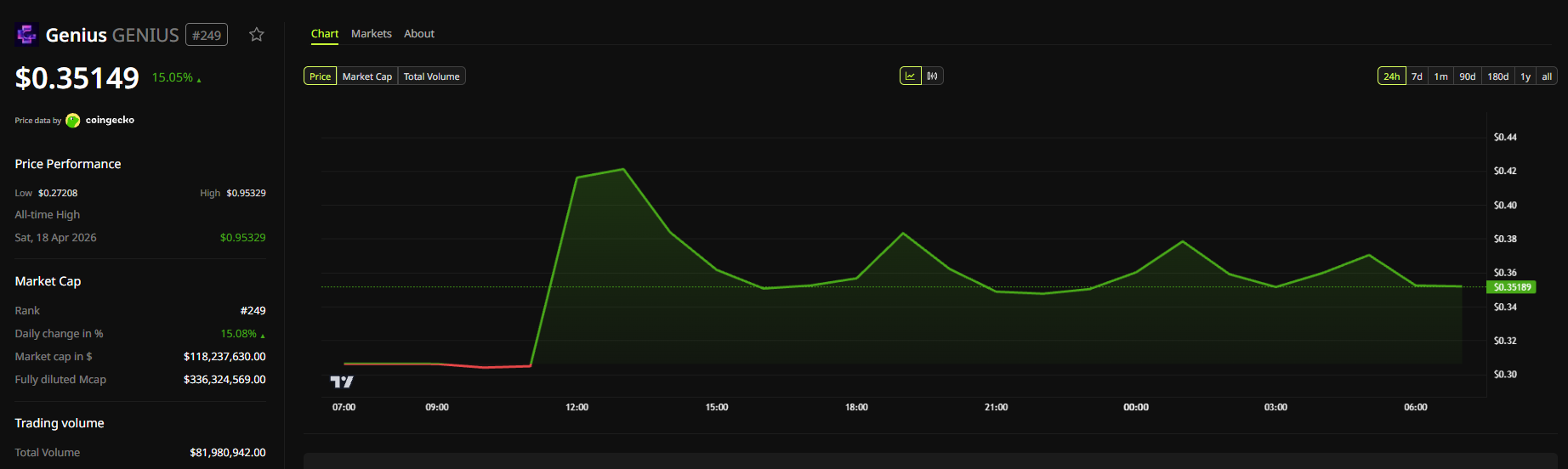
The GENIUS price went near vertical, climbing above $0.42 before drifting back through the day. GENIUS carries a market cap near $118 million, small enough that one post can shift it. The token still trades well below its April high of $0.95.

However, Zhao questioned that link on Friday after one user credited him for the candle. He posts about projects making progress on BNB Chain, he said.
His posts have moved small BNB Chain markets before. One viral message in July handed a single buyer a 357x return on a token named after him.
Traders now watch his account as a market signal, whether or not he intends one.
Inside the New BNB Chain Launchpad
Genius Foundation, the group behind the GENIUS token, opened genius.fun on Thursday. The same team launched an onchain options exchange in June. The launchpad pairs new tokens with tokenized public company shares, known as bStocks, rather than with crypto assets alone.
The team says buyers can send those positions to a foundation that unwraps them into real equity. Holders could then vote in corporate governance. No campaign has taken a stake in any listed company so far.
Established markets dispute that premise. AMC’s chief executive recently called stock tokens fake equity, and stock token voting rights still vary by issuer. BNB Chain nonetheless ranks among the busiest venues for tokenized stock trading.
CZ has argued that initial public offerings will move onchain. Genius.fun tests a blunter version of that idea. Whether any token campaign reaches an actual shareholder vote remains unproven.
The post One Clap From Changpeng Zhao and a BNB Chain Token Went Vertical appeared first on BeInCrypto.


Binance declined to address reports of ECB intervention in its Greek MiCA bid, saying it remains committed to securing authorization in Europe.

WikiLeaks Founder Says “I'm Back.” A Token Most People Forgot Existed Jumps 743%

Young ties WNBA record with 22-point quarter as Aces beat Storm

Silent Angel H1 Pure Music Hub Wants to Be More Than Just a Streamer



-

 Fashion7 days ago
Weekend Open Thread – Corporette.com
-

 Tech5 days ago
The Latest Weird Thing to Play Doom Is the Mapped-Out Brain of a Fruit Fly
-

 Crypto World3 days ago
Kraken Lets xStocks Holders Earn Yield Through DeFi
-

 Crypto World1 day ago
US Charges Robinhood Engineers Over Crypto Listing Trades
-

 Crypto World6 days ago
Can AI Build a Startup in 72 Hours? Elon Musk's Team Will Livestream the Test
-

 News Videos7 days ago
Facing Financial Fears
-

 Crypto World4 days ago
Elon Musk Drops a Bombshell: Grok 5 Could Be the AGI Breakthrough
-

 Entertainment6 days ago
News Specials, Movies, Shows, More
-

 Business5 days ago
Rivals Sam Altman and Elon Musk Rally Behind Dario Amodei’s Call for a Slowdown in AI Development
-
 NewsBeat4 days ago
‘Sick conspiracy’: Trump says only guardrails AI needs is ‘a strong and smart (High IQ!) president’ in all-caps rant
-
 Crypto World5 days ago
New Tesla Roadster Uses SpaceX Tech. Will It Impact the Stock Price?
-

 Crypto World6 days ago
Robinhood Chain Never Stopped But its Blobs Did Stop Reaching Ethereum For 14 Minutes
-

 Crypto World2 days ago
What Is the Status of the U.S.-Iran Peace Talks? Here's What Both Sides Are Saying
-
 Entertainment6 days ago
New Horror Movie Officially Earns a Rare Stephen King Recommendation
-

 Crypto World3 days ago
DOJ Seeks to Seize $61M in Iran Oil Funds From Binance Accounts It Vouched For
-

 Business6 days ago
Marvell: Most Potent Setup Of The AI Factory Decade
-
 Crypto World4 days ago
3 Token Unlocks to Watch in the Third Week of September 2026
-
 Crypto World3 days ago
NVIDIA Analysis: Attempted Rising Wedge Breakout Amid Pressure on the AI Sector
-
 Crypto World6 days ago
Bitcoin ETFs lose $462.7M as Ethereum funds gain $196.9M
-

 Crypto World3 days ago
Revolut Attackers Warn of Ongoing Daily Customer Data Leaks
You must be logged in to post a comment Login