
Crypto World
Bitcoin reserve unlikely to buy BTC under Trump: Bitget CEO



Bitget CEO Gracy Chen has put the chance of the U.S. government buying Bitcoin for its strategic reserve before President Donald Trump leaves office at close to zero.
Summary
- The U.S. reserve holds an estimated 198,000 BTC obtained mainly through forfeiture proceedings.
- Trump’s order permits additional acquisitions only through strategies that impose no extra taxpayer costs.
- Chen said active purchases would require a much larger policy decision and political debate.
- The no-sale rule removes potential government supply but does not create direct market demand.
Speaking in a recent interview, Bitget CEO Gracy Chen said the U.S. government is unlikely to begin buying Bitcoin for its strategic reserve within the next two years.
“From a policy perspective, it’s probably unlikely,” Chen said. “I just don’t see it coming right now.”
Chen said buying Bitcoin would require a more substantial policy decision than retaining assets already controlled by the government. Lawmakers and political parties would need to debate how any purchase program would work, particularly if public money or changes to federal accounting were involved.
Her assessment places the focus on the reserve’s funding rules rather than the administration’s public support for crypto. Trump created the reserve in March 2025, but the order did not provide money for regular purchases on exchanges.
Bitcoin reserve rules limit direct government purchases
President Trump signed the March 2025 executive order establishing the Strategic Bitcoin Reserve and the U.S. Digital Asset Stockpile on March 6, 2025.
Under the order, the Treasury Department must maintain custodial accounts for Bitcoin that has been finally forfeited through criminal or civil proceedings or received through civil penalties. Federal agencies were also instructed to review their holdings and report eligible assets to the Treasury.
Bitcoin transferred into the reserve “shall not be sold,” according to the order, although existing laws allow exceptions for court orders, victim restitution, law enforcement operations and certain asset-forfeiture requirements.
The White House did not completely prohibit the government from obtaining more BTC. Instead, the order directed the Treasury and Commerce departments to develop acquisition strategies that are budget-neutral and impose no additional costs on taxpayers.
No funding mechanism or purchase schedule accompanied the directive. Any plan involving new federal spending would require congressional authorization, while alternatives such as revaluing U.S. gold certificates would face separate legal and political hurdles.
An August reserve policy explainer from crypto.news said gold revaluation has been discussed as one possible funding route. Federal Reserve gold certificates are recorded at a statutory price of $42.22 per ounce, far below the metal’s market value, but using the difference to finance Bitcoin purchases would require legislation.
The reserve removes supply without adding demand
Public estimates have commonly placed U.S. government holdings near 198,000 BTC, equal to about 1% of Bitcoin’s circulating supply. The estimate includes coins connected to major forfeiture cases, though the government has not released a complete public audit confirming how much BTC has been finally forfeited and is eligible for the reserve.
The distinction between seized and forfeited assets matters because the government does not necessarily own every coin held in a federal wallet. Seized assets may remain subject to court proceedings, restitution claims, or eventual return to victims, while finally forfeited assets can become federal property.
At Bitcoin’s recent price near $78,000, a 198,000 BTC position would be worth about $15.4 billion. Its main market effect comes from the order’s prohibition on sales rather than an expected stream of government purchases.
Before Trump established the reserve, the U.S. Marshals Service regularly auctioned Bitcoin obtained in criminal cases. The government sold about 195,000 BTC before the reserve order, according to White House estimates, and administration officials argued that earlier sales cost taxpayers billions of dollars in unrealized gains.
Removing a large federal position from potential sale reduces one known source of market supply. It does not provide the recurring demand that would come from Treasury purchases made at set intervals or price levels.
Bitcoin investors initially expected the reserve announcement to support active accumulation, but the order stopped short of creating such a program. The market’s response therefore depends more on whether the administration identifies a lawful, budget-neutral funding method or Congress passes separate legislation.
Treasury has previously ruled out active Bitcoin buying
Treasury Secretary Scott Bessent gave a similar account of the government’s plans in August 2025, when he said the reserve would grow through confiscated assets rather than direct purchases.
“We’re not going to be buying that [Bitcoin], but are going to use confiscated assets and continue to build that up,” Bessent told Fox Business, adding that the government would “stop selling” its holdings.
A June review of the reserve reported that Bessent valued the federal position at between $15 billion and $20 billion at the time. The report also noted that the executive order asked officials to examine budget-neutral acquisition methods without authorizing an open-market buying program.
Congress could replace the current arrangement with a statutory reserve. Senator Cynthia Lummis’s BITCOIN Act proposed purchasing 1 million BTC over five years, while the American Reserve Modernization Act, introduced in May 2026, proposed a 20-year holding period without retaining the same 1 million BTC target.
Neither proposal has created an active federal purchase program. Congressional approval would also provide firmer legal protection than an executive order, which a future president can amend or revoke.
U.S. investors still face an uncertain reserve balance
For American investors, the reserve does not offer direct exposure comparable to shares in a spot Bitcoin exchange-traded fund. Its immediate relevance lies in federal supply management because the order limits when reserve coins can return to the market.
Public wallet trackers cannot determine the exact size of the reserve. Some services count Bitcoin held in government-linked addresses even when ownership, forfeiture status, or restitution obligations remain unresolved.
Federal custody activity can add to the uncertainty. In July, U.S.-linked wallets transferred nearly $297 million in seized Bitcoin and Ether to Coinbase Prime, including about 3,940 BTC valued at roughly $244 million at the time and 30,000 ETH worth about $53 million.
Coinbase Prime provides custody and trading services, so the transfers did not confirm a sale. Galaxy Research head Alex Thorn linked the Bitcoin to seizures involving Ryan Farace and the closed BTC-e exchange, while the Ether came from wallets tied to a separate federal case involving crypto storage and money laundering.

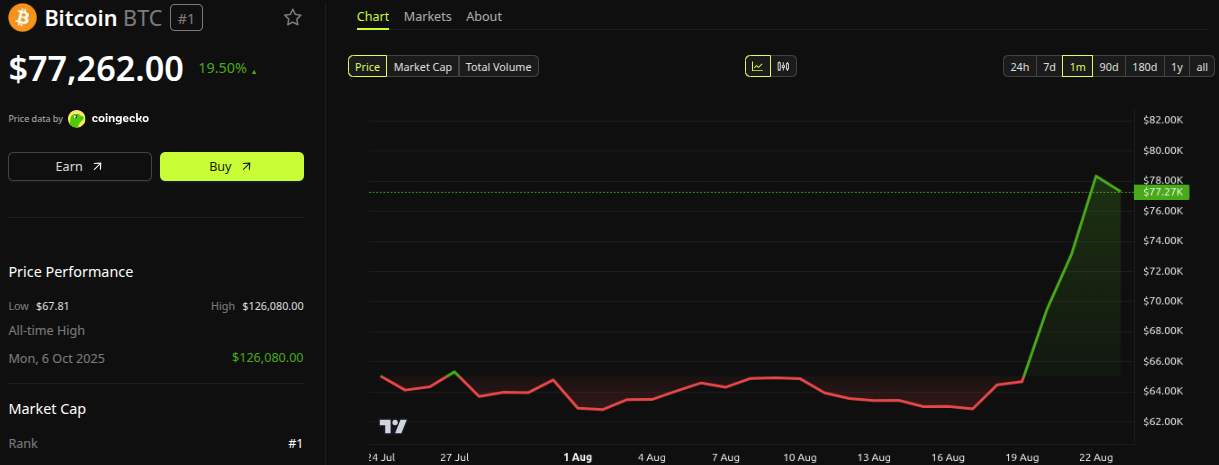
BitMEX co-founder Arthur Hayes delivered a blunt message to investors following a sudden market surge, telling Crypto Banter host Ran Neuner that avoiding risk assets right now would be foolish.
His comments came just after the US Treasury moved to double the size of its debt buybacks.
Note: Arthur Hayes recent crypto trading actions have been anything but examplarary. BeInCrypto published an extensive analysis of his publicly known wallets. KOL comments and discussions shouldn’t be considered as investment advice.
What Triggered Hayes’s Bullish Call
Soft yield curve control refers to central bank or Treasury actions that cap bond yields without formally announcing a fixed target, injecting liquidity through indirect market intervention. Hayes described the buyback expansion in exactly those terms.
“You’re an idiot if you’re not long stocks, long gold, long Bitcoin, long the market,” Arthur Hayes said, linking the Treasury’s actions directly to renewed liquidity-driven gains.
Treasury Secretary Scott Bessent announced the expansion targeting longer-dated Treasuries. Markets had been testing the 5% level in 10-year yields, a threshold many view as unsustainable for US debt servicing.
By increasing buybacks, the Treasury effectively capped yields, injecting liquidity much like previous interventions under Janet Yellen.
Hayes argued that when governments suppress bond yields artificially, private capital flees fixed income in search of scarce alternatives.
“That’s why markets ripped gold, Bitcoin stocks, right? This is the the Yellen put if you want to call it that. Uh she started this. Um, funny at the time, you know, he wasn’t this treasur treasury secretary then. You know, Scott Bessent had a lot of choice words for how moronic it was that uh Janet Yellen was issuing so much debt at the short end,” Hayes explained.
Follow us on X to get the latest news as it happens.
He drew a parallel to the Bank of Japan’s decade-long experiment with yield-curve control, arguing that capped yields inevitably push capital toward equities, gold, and Bitcoin.
Why Hayes Sees This as the Start of a Pattern
The immediate market reaction validated his view. The 30-year Treasury yield fell, Bitcoin broke above key moving averages near $70,000, equities rose, and altcoins turned sharply green.
Hayes called the move a recognition that authorities will keep intervening to defend debt sustainability, creating a series of liquidity injections over time rather than a single event.
With the Federal Reserve holding rates steady to support Treasury operations and additional tools, such as expanded repo facilities, still on the table, Hayes sees the policy bias as firmly pro-asset prices. He added that Trump’s focus on a strong stock market further aligns those incentives.
While acknowledging that part of Bitcoin’s sharp move reflected a short squeeze, Hayes stressed a deeper structural shift: governments now prioritize debt defense over free-market pricing of yields.
“The balance sheet expands infinitely because the market say, ‘Oh, you want to you want a capul 5%? Yours. Here are all these bonds. I want equities. I want gold. I want Bitcoin. I want anything that has a scarce supply if you’re going to create more dollars to artificially manipulate these yields.” BitMEX co-founder noted.

In that environment, he argued, holding cash or staying under-allocated to equities, gold, and Bitcoin becomes the riskier choice. Hayes said he remains heavily positioned, having stayed risk-on for weeks with significant exposure to both Bitcoin and Ethereum.
His words, which also touched on his new project Flop Labs, underscored a simple thesis for the current regime: stay long scarce assets while authorities keep printing and intervening.
“I mean, I’ve been riskon for a, you know, a few weeks now. I mean, we pumped a lot into Ethereum, bought some Athena, bought some Ethery. So, we’re pretty much at probably maximum risk, I would say, right now, uh, given our holdings and so, you know, just sitting back and watching the number go up on the screen. So, it’s nice,” Hayes said.
Subscribe to our YouTube channel to watch leaders and journalists provide expert insights.
The post Arthur Hayes Shares Surprising Tip on Stocks, Gold, and Bitcoin appeared first on BeInCrypto.


NoOnes has shut down, telling users to withdraw funds immediately. The team warned that balances tied to the platform may be flagged after August 23.
The peer-to-peer marketplace served more than 2.5 million users in three years. Sanctions cost it essential partners, leaving withdrawals as the only function still running.
Follow us on X to get the latest news as it happens
NoOnes Shuts Down After Sanctions Hit
NoOnes said it worked to resolve and remove the sanctions, but failed. Blockchain monitoring providers then classified its wallets and transactions as high risk.
This has made it difficult for the platform to process transactions and operate normally.
“We explored every possible option, but continuing NoOnes was no longer sustainable,” the blog read.
The wind-down began on August 17. The P2P marketplace closed on August 21, taking Swap, the Visa card, crypto off-ramps, the gift card store, and Lightning payments with it.
Withdrawals now run only through the Bitcoin (BTC) network and Tether (USDT) on TRON. The team strongly advised users to withdraw their entire balance immediately and no later than Sunday, August 23, 2026.
“Because of the EU sanctions listing, external compliance providers may review or change the risk ratings of certain NoOnes company wallets,” the team said.
The Council of the EU adopted its 21st sanctions package against Russia in late July. Binance will also stop processing transactions involving several platforms on August 23.
Crypto Closures Pile Up While BitMart Changes Course
NoOnes joins a long 2026 list. OrdinalsBot announced its wind-down this week after three years. More than 120 crypto projects have shut down in 2026, according to RootData.
Alea Research reviewed 110 of those cases through mid-August. Decentralized Finance (DeFi) accounted for 40 closures (36%), while centralized exchanges accounted for only 7.
One name has since moved the other way. BitMart said this week that it is weighing a restructuring plan rather than a full liquidation, with a roadmap expected by September 9.
Subscribe to our YouTube channel to watch leaders and journalists provide expert insights
The post Crypto App NoOnes Shuts Down After Sanctions, Affecting 2.5M Users appeared first on BeInCrypto.

Uber Technologies (UBER) stock is back above its 200-day moving average after a rough start to the year for the ride-hailing platform operator. With the stock potentially back in favor with investors, let’s explore using options to create synthetic long exposure for a fraction of the cost of buying shares outright. The strategy is constructed by selling an out-of-the-money put…
Copyright ©2026 Investor’s Business Daily, LLC. All rights reserved. 87990cbe856818d5eddac44c7b1cdeb8

Three biotech stocks are making their mark, hovering around the top of the IBD 50 list, and even held all three top slots at one time over the past week. Eight biotech stocks made the list but Travere Therapeutics (TVTX), Eton Pharmaceuticals (ETON) and Kiniksa (KNSA) stood out. All three names are at or near profitability and their stocks gapped…
Copyright ©2026 Investor’s Business Daily, LLC. All rights reserved. 87990cbe856818d5eddac44c7b1cdeb8

After a week dominated by retail earnings, the upcoming earnings calendar holds a more mixed basket. Nvidia (NVDA) stock is the highlight with second-quarter results expected on Wednesday after the market close. Several software names stand on deck as do a number of retail and artificial intelligence names. Aircraft engine and parts maker Heico (HEI), database play Box (BOX) and…
Copyright ©2026 Investor’s Business Daily, LLC. All rights reserved. 87990cbe856818d5eddac44c7b1cdeb8

It has more than doubled since rallying furiously from 2026 lows. And now enterprise software play JFrog’s (FROG) stock is eyeing a fresh entry as it tests support at a key technical benchmark. The California company operates an end-to-end platform that powers and controls software supply chain. While not a pure-play artificial intelligence equity in the same way as a…
Copyright ©2026 Investor’s Business Daily, LLC. All rights reserved. 87990cbe856818d5eddac44c7b1cdeb8

Franklin Templeton is preparing to put tokenized assets inside its conventional mutual funds and ETFs, Bloomberg reported on Thursday, eight days after SEC staff cleared the firm to hold its $721 million blockchain-based money market fund in those portfolios.
Franklin characterizes relief as the first US regulatory clearance for digitally native products inside conventional funds.
“It is not a rule, regulation, or statement of the Commission, and the Commission has neither approved nor disapproved its content,” the Division of Investment Management wrote on August 12, adding that it “has no legal force or effect.”
Staff set aside paragraphs (b), (e), and (f) of Rule 17f-2 under the Investment Company Act of 1940, the provisions built around vault custody of share certificates.
The Franklin OnChain U.S. Government Money Fund (FOBXX) reported net assets of $720,928,224 on July 31 and a 3.50% seven-day net yield. Franklin Templeton Investor Services will open a separate wallet on Stellar for each investment fund.
Twelve Conditions Attached
Staff attached twelve conditions. Each fund’s board of trustees must approve the arrangement and review it at least annually.
FTIS has to retain the power to correct errors, freeze or migrate wallet records and restore the official ownership record, and if it ever stops acting as transfer agent it must hand the successor administrative control over the smart contracts.
Independent public accountants must verify each fund’s holdings at least three times a fiscal year, two without prior notice. Moreover, funds may use the shares for cash balances and securities lending collateral. CryptoPotato reported in December that BENJI served as collateral in a SemiLiquid credit pilot, staying encumbered across the loan lifecycle.
Relief Rests on a 1992 Letter
Staff granted the position by analogy to a September 24, 1992 letter to Franklin Investors Securities Trust, which covered a master-feeder arrangement where an affiliated transfer agent held fund shares in book-entry form. Franklin argued a Stellar wallet raises the same question, since FTIS still maintains the official ownership record and keeps unilateral control over it.
The letter names 23 investment managers, among them Putnam, Western Asset, ClearBridge, BrandywineGLOBAL, Royce and Clarion Partners. CryptoPotato has covered Franklin’s agreement to buy 250 Digital, the firm spun out of CoinFund, as its digital asset arm passed 50 staff.
On August 18, the SEC proposed the Regulation Crypto Assets with $5 million and $75 million offering paths, a proposed rule carrying a 60-day comment period. Franklin’s request was signed by Navid J. Tofigh, Senior Associate General Counsel, and answered by Taylor Evenson, Senior Counsel.
The post Franklin Templeton Wins SEC Staff Relief for Its $721M Onchain Fund appeared first on CryptoPotato.


Eric Trump denied that anyone was launching a new Trump-linked coin on Saturday, calling contrary claims fraudulent as TRUMP and MELANIA posted double-digit gains over 24 hours. “What a joke… This is absolutely not true,” Trump wrote on his Blue-checkmarked X account. “No one is launching any kind… Read the full story at The Defiant

This week, Binance founder Changpeng Zhao (CZ) finally revealed why he chose to face US prosecutors during his AML violation case despite holding UAE citizenship that could have kept him from the grasp of US law enforcement.
His account offered a rare explanation of his thinking before a four-month prison sentence and the end of his leadership at Binance.
CZ Says Running From the Case Was Never an Option
Zhao talked about the matter in a fireside chat with Anthony Scaramucci on August 19 at the Wyoming Blockchain Symposium in Jackson Hole, stating that he had become a citizen of the United Arab Emirates approximately six months before the Binance case became public and that the country has no extradition treaty with the USA.
He could have stayed in the Middle East and avoided US courts altogether, but he said that option didn’t feel honorable to him.
“Actually, I was granted citizenship of the UAE, but I didn’t want to leverage that,” Zhao explained. “That’s just the wrong thing to do.”
According to him, resolving the case one way or the other was better for himself, Binance, BNB holders, and the wider crypto industry.
“When the US government is going after you, you don’t dodge it,” declared the former Binance CEO. “You shouldn’t be hiding or running away from it.”
But on the other hand, Zhao had quite different expectations about the punishment he would face. He told Scaramucci that he never expected to get imprisoned since his case had no fraud, just one Bank Secrecy Act violation.
CZ also compared his sentence with that of former BitMEX executive Arthur Hayes, who received six months of home confinement after pleading guilty to one count of violating the Bank Secrecy Act by failing to establish adequate AML and KYC at his exchange.
Zhao, meanwhile, got four months in federal prison for fundamentally the same personal offense. And while that was still a much shorter jail term than the three years the Justice Department had recommended, it was certainly more than the no-prison-time his legal team had asked for.
“I think I’m still the single only person that went to jail for a single violation of a Banking Secrecy Act,” he remarked.
A Case That Ended With Prison, Then a Pardon
In the interview, CZ also reflected on Binance’s position at the time of the case. He pointed to its status as the world’s largest crypto platform while stressing that it was neither US-based nor China-based.
“We’re not US-based, we’re not China-based, but look Chinese, so kind of an easy target,” he said. “I don’t blame them. It is what it is.”
The 48-year-old stepped down from his position at the helm of Binance after the exchange agreed to a $4.3 billion settlement with US authorities.
He himself also paid a $50 million personal penalty before heading to the Federal Correctional Institution (FCI) Lompoc II in Santa Barbara, California, to serve out his sentence, leaving the facility near the end of September, 2024.
A year after that, President Donald Trump gave him a full and unconditional pardon.
The post CZ Reveals Why He Didn’t Use UAE Citizenship to Avoid US Charges appeared first on CryptoPotato.
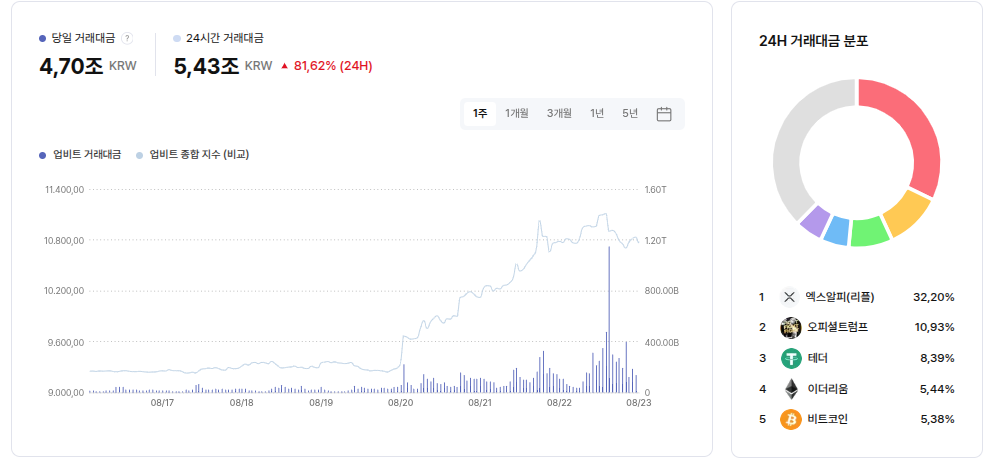
South Korea’s Upbit recorded 1.15 trillion won, roughly $830 million, in trading volume within a single hour on Saturday, with XRP and TRUMP dominating the surge.
The spike extends a rebound that began the previous day, when Upbit’s daily volume already jumped 273%.

What Drove Upbit’s Record Hourly Volume
XRP led the charge by a wide margin. The token accounted for 32.20% of Upbit’s 24-hour trading volume, ranking first among all traded assets, according to Upbit Datalab.
TRUMP ranked second on the exchange, contributing 10.93% of total volume. USDT followed in third place with 8.39%, while Ethereum and Bitcoin rounded out the top five at 5.44% and 5.40%, respectively.
Upbit’s total 24-hour trading volume reached approximately $3.81 billion, while rival exchanges Bithumb and Coinone recorded $1.954 billion and $172 million, respectively.
Saturday’s spike was not an isolated event. On August 21, Upbit’s daily volume had already jumped 273% to roughly $1.84 billion, marking the exchange’s highest daily volume since mid-March.
Follow us on X to get the latest news as it happens.
XRP topped that session too, contributing $418.9 million and ranking ahead of Bitcoin, USDT, and ETH. Bithumb recorded a similar increase that day, with volume climbing 132.9% to about $934.9 million.
Why the Rebound Follows Months of Weaker Activity
That earlier rebound followed months of weaker trading, as South Korean investors favored domestic equities while the KOSPI climbed to record highs on AI-driven semiconductor demand. Upbit and Bithumb both reported declines in operating revenue of nearly 50% during the first half of 2026.
XRP traded near $1.44 at the time of writing, according to BeInCrypto data, up 2.1% over the past 24 hours despite an intraday flash crash and up nearly 50% over the past week. The token’s rally followed Ripple’s backing of a major XRP Ledger amendment, alongside strong ETF inflows.
That gain remains positive despite a brutal 37% flash crash earlier in the day, which briefly pushed XRP as low as $1.36 before it recovered, liquidating hundreds of millions in leveraged positions along the way.
TRUMP held its gains more cleanly. The token traded near $2.34, up 26% in 24 hours and more than 66% over the past week. Its all-time low of $1.37 came just nine days ago, on August 13.
Subscribe to our YouTube channel to watch leaders and journalists provide expert insights.

Speculation around a Robinhood Chain launch has fueled renewed interest in the token, alongside a broader recovery across Solana-based meme assets. Whether this two-day streak marks a lasting rotation back into crypto or another short-lived wave, as seen repeatedly this year, remains an open question for South Korean traders.
The post $830 Million in an Hour: XRP and TRUMP Drive New Record in South Korea appeared first on BeInCrypto.

Hinge Stock Finds Support At Key Level, Nears New Buy Points

Arthur Hayes Shares Surprising Tip on Stocks, Gold, and Bitcoin

Wyndham Clark takes 5-shot lead into final round at BMW Championship



![UNBELIEVABLE: Rotation Of Large Scale Capital Into Bitcoin & Crypto! [Trust It?]](https://wordupnews.com/wp-content/uploads/2026/08/1787446668_maxresdefault-80x80.jpg)


-

 Fashion1 day ago
Weekend Open Thread: Madewell – Corporette.com
-

 Business5 days ago
SMA Solar Technology AG (SMTGY) Q2 2026 Earnings Call Transcript
-

 Tech5 days ago
Qwen3.8-27B runs frontier-class coding agents and reasoning locally, no cloud API required
-

 Politics13 hours ago
6 months on, Irish renters crushed by effects of government housing bill
-

 Crypto World5 days ago
OCC Greenlights Trump Family Crypto Firm for Trust Charter
-

 Crypto World5 days ago
NAVI Prime launches institutional lending framework on Sui
-

 News Videos3 days ago
Don’t Leave Your Financial Future To Chance | August 19, 2026
-

 Crypto World6 days ago
Data of 54K Wallet Users Leaked, Clarity Odds Just 10%: Hodler’s Digest, Aug. 16
-
 NewsBeat16 hours ago
The ‘Lucky Dip Gang’ causing carnage for clicks: After five thugs were killed speeding in the wrong direction on a motorway, GUY ADAMS investigates a sick new trend… and why police aren’t even allowed to pursue them
-

 Politics6 days ago
Britain is facing a housing disaster
-

 Tech7 days ago
What are the rumors about the AirPods Pro 4?
-

 Business4 days ago
Stock Market Today: Tech Futures Slide As Treasury Yields Jump; Nvidia, Micron, Sandisk Sell Off
-

 Business6 days ago
Rebel Creamery files Chapter 11 with $23.8M Van Leeuwen judgment on appeal
-
 Crypto World5 days ago
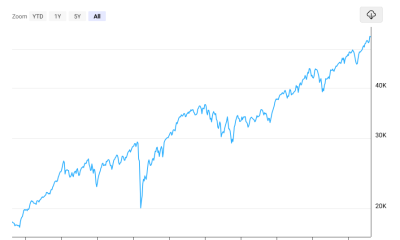
Dow’s 3-Year Winning Run Isn’t a Crash Signal, Still 49% Odds of Double-Digit Gains
-

 Tech6 days ago
Straight Up the Cliff, Yunnan’s New Fuyao Ladder Turns a Three-Hour Climb Into a 50-Second Ride for Students
-
 Tech6 days ago
OpenAI’s new ChatGPT feature logs your keystrokes and stores them in plain text
-

 Tech6 days ago
DeepSeek’s top-ranked V4 Flash stumbles on real agent tasks as its prices surge
-
 Tech5 days ago
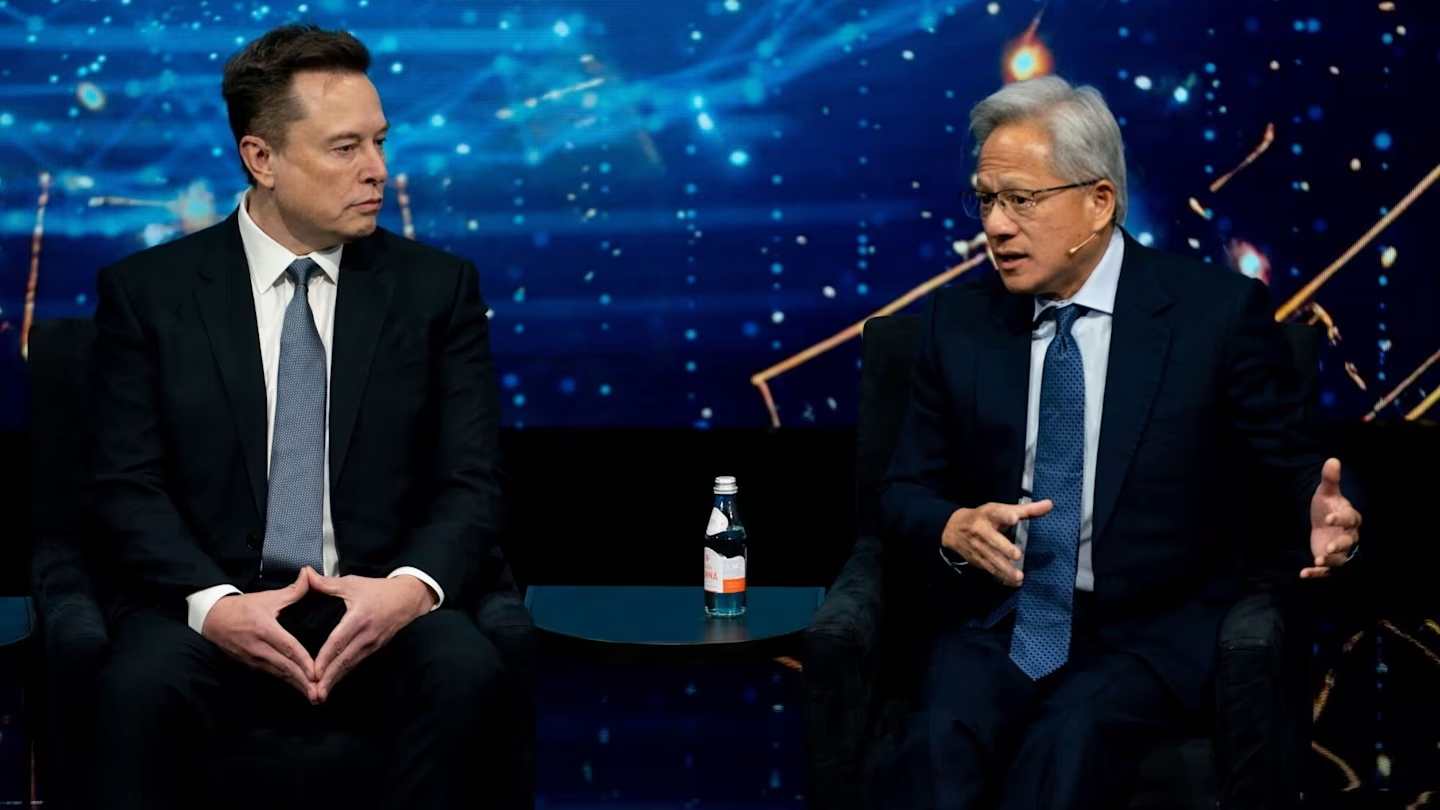
Nvidia discloses $21B stake in SpaceX
-

 Business2 days ago
Five Below: Kids Discount Retailer Reaps Rich Rewards
-

 Tech4 days ago
GLM-5.3 hits the API at $1.4/$4.4 per million tokens
You must be logged in to post a comment Login