
Crypto World
Pentagon Fires Editor and Publisher of U.S. Military Newspaper


News of the firings also comes after Lederer announced on Tuesday that he plans to retire, effective Sept. 30. Lederer, who has been publisher of the newspaper for nearly two decades, said that he came to the decision after he realized that his “understanding of the value and mission of Stars and Stripes” diverged in “fundamental ways” from the Pentagon’s plans for the newspaper. He said he disagreed with parts of the modernization plan revealed in March, including the Pentagon’s desire to transition all print products to digital; Lederer said he worried that the move would affect the accessibility of Stars and Stripes for some service members.
“I think the right step is for me to step down, get out of the way, and let different leadership step in and continue to make this, the great organization that it is, even better,” Lederer told Stars and Stripes.
In April, the Department of Defense fired the newspaper’s ombudsman, Jacqueline Smith. As ombudsman, Smith was tasked with ensuring the organization’s editorial independence. Smith told her colleagues in a message at the time, which was seen by The Washington Post, that the Pentagon didn’t provide a reason for her firing, but that she believed the decision came down because she criticized the agency’s moves to overhaul the newspaper.


Bitget CEO Gracy Chen says Bitcoin’s recent strength may not be enough to break it out of a relatively familiar trading band for the rest of the year. Speaking on Cointelegraph’s Trade Secrets podcast, Chen argued that macroeconomic conditions—especially interest-rate expectations—are likely to remain a major driver of the asset’s direction.
Chen cautioned that forecasting whether Bitcoin finishes 2024 above or below the $70,000 level is inherently uncertain. Her base case, however, points to Bitcoin staying “around the same range,” with a wide but defined margin of error.
Key takeaways
- Chen expects Bitcoin to trade broadly near current levels through year-end, citing interest-rate and macroeconomic uncertainty.
- Higher interest rates could theoretically weigh on prices, reflecting Bitcoin’s growing linkage to traditional finance.
- She described a “more responsible” forecast: Bitcoin could end the year roughly $10,000 to $20,000 above or below current levels.
- Chen is skeptical the US will begin active Bitcoin purchases for a national reserve before the end of President Donald Trump’s term.
Macro pressure and Bitcoin’s sensitivity to rates
Chen’s central point is that Bitcoin is increasingly influenced by the same forces that move risk assets—particularly interest-rate expectations. In her view, the debate for investors is not only about crypto fundamentals, but also about where rates and broader conditions settle as the year progresses.
When asked about the possibility of Bitcoin ending the year above or below $70,000, Chen said it’s difficult to make a clean call. She highlighted that the market could be pressured if interest rates rise. “If any of that happens, the price should go down, at least theoretically,” she said, linking her outlook to Bitcoin’s deeper integration with traditional finance.
That framing matters because it shifts the focus from purely crypto-specific catalysts to a wider macro calendar. In practical terms, traders looking for directional confirmation may need to pay close attention to how rate expectations evolve—rather than assuming momentum from recent rallies automatically translates into sustained upside.
A forecast built around uncertainty
While Chen acknowledged Bitcoin could move meaningfully, she presented her outlook as a range rather than a target. “My guess is maybe around the same range,” she said, adding that Bitcoin could finish the year $10,000 to $20,000 above or below current levels.
Her “more responsible” forecast underscores a key theme: strong momentum does not remove the possibility of setbacks when macro variables turn less supportive. For market participants, the implication is that risk management may deserve more weight than prediction-making—especially when the expected outcome is a broad band rather than a single-number resolution.
US reserve strategy: what’s already in motion
Chen also addressed the question many investors have been tracking: whether the US government will escalate from holding seized or forfeited Bitcoin to actively buying BTC for a national reserve.
Her stance was skeptical. She argued that it is unlikely for the US to begin such purchases before the end of President Donald Trump’s term, calling the scenario improbable within the next two years.
That skepticism comes after a relevant policy development. According to the White House, the administration established a Strategic Bitcoin Reserve in March 2025 using BTC already forfeited to the federal government, while directing officials to explore budget-neutral strategies for acquiring additional BTC.
The distinction between “using forfeited BTC” and “actively purchasing” is important. Chen’s comments suggest that, even in a broadly crypto-friendly political environment, turning reserve plans into sustained market purchases would likely require more than executive direction.
Why active purchases may face political friction
Chen said that actively buying Bitcoin would represent a larger policy decision. In her view, it would likely require debate across lawmakers and political parties, even if the administration has generally signaled support for the industry.
“From a policy perspective, it’s probably unlikely,” she said. “I just don’t see it coming right now.”
On the current holdings side, Chen pointed implicitly to the existing government balance rather than a new buying cycle. BitcoinTreasuries.NET estimates the US government holds about 328,372 BTC, with much of it stemming from law enforcement seizures and asset forfeitures rather than direct purchases. The site’s government holdings page is available at BitcoinTreasuries.NET.
For investors, the takeaway is that the US reserve story may continue to develop on two tracks: (1) managing and reporting existing holdings formed through enforcement actions, and (2) evaluating whether any additional acquisition plans can be implemented in a politically and budgetarily feasible way. Chen’s comments indicate she does not expect the second track to accelerate soon.
Going forward, readers should watch how rate expectations and macro data shape sentiment around Bitcoin’s correlations with traditional markets, and how policymakers operationalize—or delay—any “budget-neutral” acquisition mechanisms tied to the Strategic Bitcoin Reserve. Those two threads may ultimately determine whether Bitcoin keeps trading in its current band or escapes it.


Digital Asset and the American Idea Foundation have selected Canton Network for a three-state US benefits pilot scheduled to begin in the first quarter of 2027, subject to federal approval.
Summary
- Three US states are expected to begin testing the RISE program in early 2027.
- RISE would combine separate benefits into monthly or twice-monthly payments.
- Canton would apply spending rules while limiting access to recipients’ sensitive information.
- The participating states and benefit programs have not yet been disclosed.
Digital Asset and the American Idea Foundation said in a Friday announcement that they will support three states preparing to test the Resources for Independence, Stability, and Employment program, known as RISE.
Former US House Speaker Paul Ryan founded the American Idea Foundation, a Wisconsin-based nonprofit focused on economic policy and programs designed to address poverty. Digital Asset created the Canton Network, which will provide the technology used to distribute and monitor benefits during the pilots.
Subject to federal approval, the first programs are expected to begin in the first quarter of 2027. Neither organization identified the three states, the federal agencies involved in the approval process, nor the benefit programs that would take part.
RISE would combine separate benefit payments
Under the proposed model, states could combine assistance from several programs into one or two payments each month. Digital Asset and the foundation said existing programs often use separate eligibility requirements, reporting procedures, payment dates, and income limits, making them difficult for recipients and agencies to manage together.
RISE would let states assign money to categories such as food, child care, and cash while preserving the rules attached to each program. According to the announcement, the platform could verify a recipient’s identity and participation requirements, provide mobile access, and apply spending restrictions when funds are used.
As household income changes, the system would also recalculate the amount of assistance available to a family. The organizations said the mechanism is intended to reduce sudden losses of support when recipients enter the workforce or earn more money.
Paul Ryan said the pilots would examine whether states can reduce such penalties while keeping benefit programs accountable.
“By combining fragmented benefits, reducing penalties as families earn more, and rigorously measuring results, these pilots can help show what a modern safety net should look like.”
Rather than maintaining separate records for every participating program, authorized agencies would receive access to information covering deposits, purchases, balances, declined transactions, and spending by benefit category. Nonprofit case managers and independent researchers could also view the information permitted for their respective roles.
Digital Asset said government dashboards would show enrollment records, pending approvals, completed tasks, payment eligibility, and the total value of distributed funds. Access would depend on each organization’s permissions, limiting the amount of personal or transaction data visible to parties outside a case.
Canton Network would control data access and payment rules
Canton would coordinate the rules, permissions, and transactions behind each payment while maintaining controls over sensitive information, according to Digital Asset. States could encode individual benefit requirements into the distribution process instead of applying every rule after a payment has been made.
Transaction records would give agencies an audit trail showing how money entered the system and where recipients spent it. Digital Asset said participating governments could use the records to monitor compliance and identify payments that did not follow program conditions.
Yuval Rooz, Digital Asset’s co-founder and CEO, said Canton allows approved participants to coordinate transactions and share rules while retaining the privacy and control required by institutions. RISE would apply the network’s existing permission system to public-benefit administration rather than capital-market settlement.
The evaluation phase is expected to track employment, earnings, benefit use, education, training, housing, and household stability. According to the announcement, governments and independent evaluators would receive transaction and compliance data during the program instead of relying only on later reviews.
Results from the first three states would inform further pilots. The organizations said later versions could be adapted to different state rules, case-management systems, benefit structures, and groups of recipients, although they did not provide a schedule for additional deployments.
Canton has tested private payments and government bonds
Canton’s earlier projects have concentrated on regulated financial transactions that require participants to share selected information without publishing complete records on a public ledger.
In June, crypto.news reported that Visa and Brale had begun a private stablecoin settlement test using SBC, Brale’s US dollar-backed token. The proof of concept examined whether financial institutions could settle payments while restricting confidential transaction data to involved parties and authorized regulators.
Four Mitsubishi UFJ Financial Group companies launched a Japanese bond repo trial in August with Digital Asset and Progmat. The participants are testing automated processing and real-time settlement for transactions backed by Japanese government bonds.
Supported through Japan’s Financial Services Agency Payment Innovation Project, the MUFG test also covers the possible use of tokenized deposits or stablecoins for the payment side of repo trades. A separate April trial involving Japan Securities Clearing Corporation, Mizuho, Nomura and Digital Asset examined whether Japanese government bonds could move as digital collateral while retaining their status under the country’s existing laws.
Institutional access expanded again in August when Interstice Digital introduced a cross-chain swap engine connecting Canton with Ethereum, Solana, and Robinhood Chain. FalconX supplies liquidity for the system, while Interstice said its structure does not require the company to hold users’ assets.
Canton Coin gains a direct US investment route
For US investors, Canton Network already has a connection to the regulated securities market through 21Shares’ exchange-traded fund. The asset manager launched the Nasdaq-listed Canton ETF under the ticker TCAN in May, giving brokerage customers exposure to Canton Coin without requiring them to hold the token directly.
21Shares listed the fund with a 0.50% gross expense ratio and described it as the first US ETF tied to Canton Coin. The issuer said institutions including Goldman Sachs, Microsoft and Deutsche Bank had participated in network testing, validation or governance, while cautioning that their involvement did not amount to an endorsement of the token or ETF.
Canton Coin, used to pay transaction fees through the network’s Global Synchronizer, was trading near $0.107 on Aug. 21. Market data showed a capitalization of about $4.2 billion, a 23rd-place cryptocurrency ranking and a gain of roughly 9% over the previous seven days.


Bitcoin rose to its highest level in three months on Friday, capping a three-day rally that lifted every major token and broke a seven-week range, after President Donald Trump pressed the Senate to pass the CLARITY Act at a White House meeting with crypto executives on Wednesday. The Senate has a… Read the full story at The Defiant


Solana has activated a mainnet feature that cuts its target slot time from 400 milliseconds to 350 milliseconds, the network’s first slot-time reduction since its inception. The change shortens the window for leaders to complete blocks and is intended to give users faster transaction confirmations…. Read the full story at The Defiant

Altcoins could deliver returns ranging from 10x to 1000x after the latest market pullback, according to analyst Matthew Hyland.
He compared the June sell-off with March 2020 and argued that many alts could recover within months rather than years.
Hyland Compares June Altcoin Pullback to 2020
Hyland made the comparison on August 21, arguing that June was essentially an altcoin equivalent of the March 2020 market collapse. He pointed to Ethereum, Cardano, and other tokens as examples of assets that could deliver outsized gains if his comparison plays out.
“IMO you will see 10x-1000x returns from the maximum opportunity over the past few months the same way you did from the March 2020 prices,” the analyst wrote.
He later argued that many altcoins could fully recover within only a few months, with his reasoning resting partly on the speed of previous market recoveries rather than a specific price target.
The market watcher used the S&P 500 as an example. He pointed out that the index took 13 weeks to recover from its March 2025 low by June 2025.
“I don’t know when but when it does start it won’t take years, it will be just a few months,” he wrote.
Other traders were also incredibly bullish, including CrediBULL Crypto, who claimed that the latest move had confirmed a macro bottom, with Bitcoin potentially heading above $100,000 and ETH above $3,500.
Sykodelic made a similar case, stating that BTC had “sliced through the 200D SMA like butter” on its way toward $75,000. The trader also pointed to previous Bitcoin moves after similar breaks, citing gains of 124% in 2019, 724% in 2020, and 511% in 2023.
However, that view comes with an important condition. According to Sykodelic, a fall below $65,000 would weaken the argument that the bottom is in.
Bitcoin Rally Gives Altcoins Room to Catch Up
The latest price data shows why traders are revisiting altcoin recovery scenarios. At the time of writing, Bitcoin was above $76,000, up nearly 9% over 24 hours and more than 19% in seven days. Ethereum was near $2,400, having gained 5% in 24 hours and 26% over the week.
Several major altcoins have moved even faster, for example, XRP, which was around $1.32, up almost 18% in one day and about 29% on the weekly chart. Bitcoin Cash also gained 18% over 24 hours, while Dogecoin rose 12%.
The current run traces back to a Wednesday rally that took BTC from the low $60,000s past $70,000 and eventually to where it sits now, its highest level since May.
That move was helped along by the US Treasury doubling the size of its liquidity-support buybacks for longer-dated government debt and a White House meeting where President Donald Trump pushed for the CLARITY Act and floated further government Bitcoin purchases.
Hyland expects the next phase to bring more attention to altcoins. According to him, the rally could become “the most hated rally in Crypto history” because many traders had concluded that crypto was finished.
The post Altcoins Could See Up to 1,000x Returns Post-Pullback, Analyst Predicts appeared first on CryptoPotato.


Bitget CEO Gracy Chen has put the chance of the U.S. government buying Bitcoin for its strategic reserve before President Donald Trump leaves office at close to zero.
Summary
- The U.S. reserve holds an estimated 198,000 BTC obtained mainly through forfeiture proceedings.
- Trump’s order permits additional acquisitions only through strategies that impose no extra taxpayer costs.
- Chen said active purchases would require a much larger policy decision and political debate.
- The no-sale rule removes potential government supply but does not create direct market demand.
Speaking in a recent interview, Bitget CEO Gracy Chen said the U.S. government is unlikely to begin buying Bitcoin for its strategic reserve within the next two years.
“From a policy perspective, it’s probably unlikely,” Chen said. “I just don’t see it coming right now.”
Chen said buying Bitcoin would require a more substantial policy decision than retaining assets already controlled by the government. Lawmakers and political parties would need to debate how any purchase program would work, particularly if public money or changes to federal accounting were involved.
Her assessment places the focus on the reserve’s funding rules rather than the administration’s public support for crypto. Trump created the reserve in March 2025, but the order did not provide money for regular purchases on exchanges.
Bitcoin reserve rules limit direct government purchases
President Trump signed the March 2025 executive order establishing the Strategic Bitcoin Reserve and the U.S. Digital Asset Stockpile on March 6, 2025.
Under the order, the Treasury Department must maintain custodial accounts for Bitcoin that has been finally forfeited through criminal or civil proceedings or received through civil penalties. Federal agencies were also instructed to review their holdings and report eligible assets to the Treasury.
Bitcoin transferred into the reserve “shall not be sold,” according to the order, although existing laws allow exceptions for court orders, victim restitution, law enforcement operations and certain asset-forfeiture requirements.
The White House did not completely prohibit the government from obtaining more BTC. Instead, the order directed the Treasury and Commerce departments to develop acquisition strategies that are budget-neutral and impose no additional costs on taxpayers.
No funding mechanism or purchase schedule accompanied the directive. Any plan involving new federal spending would require congressional authorization, while alternatives such as revaluing U.S. gold certificates would face separate legal and political hurdles.
An August reserve policy explainer from crypto.news said gold revaluation has been discussed as one possible funding route. Federal Reserve gold certificates are recorded at a statutory price of $42.22 per ounce, far below the metal’s market value, but using the difference to finance Bitcoin purchases would require legislation.
The reserve removes supply without adding demand
Public estimates have commonly placed U.S. government holdings near 198,000 BTC, equal to about 1% of Bitcoin’s circulating supply. The estimate includes coins connected to major forfeiture cases, though the government has not released a complete public audit confirming how much BTC has been finally forfeited and is eligible for the reserve.
The distinction between seized and forfeited assets matters because the government does not necessarily own every coin held in a federal wallet. Seized assets may remain subject to court proceedings, restitution claims, or eventual return to victims, while finally forfeited assets can become federal property.
At Bitcoin’s recent price near $78,000, a 198,000 BTC position would be worth about $15.4 billion. Its main market effect comes from the order’s prohibition on sales rather than an expected stream of government purchases.
Before Trump established the reserve, the U.S. Marshals Service regularly auctioned Bitcoin obtained in criminal cases. The government sold about 195,000 BTC before the reserve order, according to White House estimates, and administration officials argued that earlier sales cost taxpayers billions of dollars in unrealized gains.
Removing a large federal position from potential sale reduces one known source of market supply. It does not provide the recurring demand that would come from Treasury purchases made at set intervals or price levels.
Bitcoin investors initially expected the reserve announcement to support active accumulation, but the order stopped short of creating such a program. The market’s response therefore depends more on whether the administration identifies a lawful, budget-neutral funding method or Congress passes separate legislation.
Treasury has previously ruled out active Bitcoin buying
Treasury Secretary Scott Bessent gave a similar account of the government’s plans in August 2025, when he said the reserve would grow through confiscated assets rather than direct purchases.
“We’re not going to be buying that [Bitcoin], but are going to use confiscated assets and continue to build that up,” Bessent told Fox Business, adding that the government would “stop selling” its holdings.
A June review of the reserve reported that Bessent valued the federal position at between $15 billion and $20 billion at the time. The report also noted that the executive order asked officials to examine budget-neutral acquisition methods without authorizing an open-market buying program.
Congress could replace the current arrangement with a statutory reserve. Senator Cynthia Lummis’s BITCOIN Act proposed purchasing 1 million BTC over five years, while the American Reserve Modernization Act, introduced in May 2026, proposed a 20-year holding period without retaining the same 1 million BTC target.
Neither proposal has created an active federal purchase program. Congressional approval would also provide firmer legal protection than an executive order, which a future president can amend or revoke.
U.S. investors still face an uncertain reserve balance
For American investors, the reserve does not offer direct exposure comparable to shares in a spot Bitcoin exchange-traded fund. Its immediate relevance lies in federal supply management because the order limits when reserve coins can return to the market.
Public wallet trackers cannot determine the exact size of the reserve. Some services count Bitcoin held in government-linked addresses even when ownership, forfeiture status, or restitution obligations remain unresolved.
Federal custody activity can add to the uncertainty. In July, U.S.-linked wallets transferred nearly $297 million in seized Bitcoin and Ether to Coinbase Prime, including about 3,940 BTC valued at roughly $244 million at the time and 30,000 ETH worth about $53 million.
Coinbase Prime provides custody and trading services, so the transfers did not confirm a sale. Galaxy Research head Alex Thorn linked the Bitcoin to seizures involving Ryan Farace and the closed BTC-e exchange, while the Ether came from wallets tied to a separate federal case involving crypto storage and money laundering.
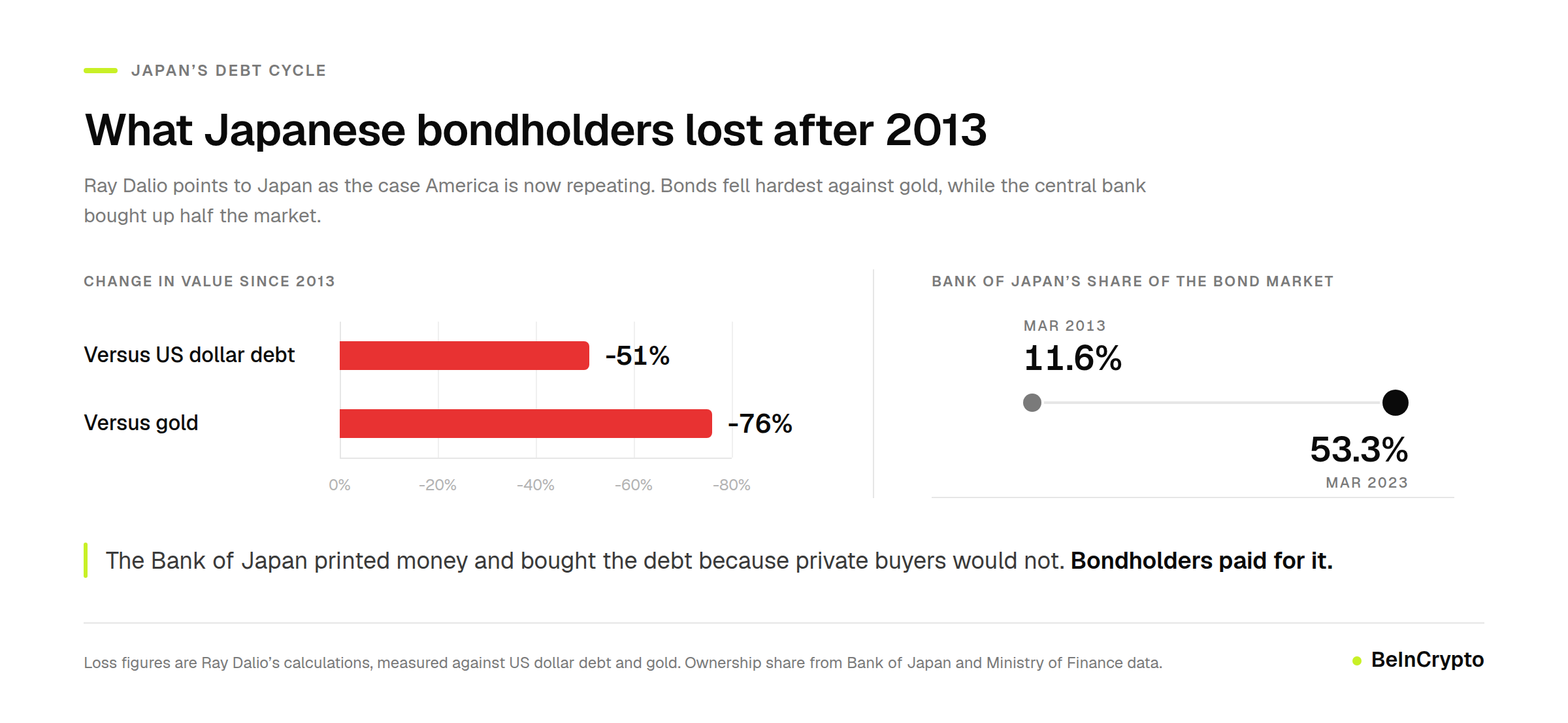
Ray Dalio says the Japan debt story is about to repeat in America, and Japanese bondholders lost most of their money the first time. He wants investors out of government bonds and into gold and Bitcoin.
The Bridgewater Associates founder made the case on Friday. He puts a US debt crisis three years away, give or take two, unless Washington changes course.
Ray Dalio Japan Debt Losses Are the Real Warning
Most coverage led with his three-year clock. However, the harder evidence sits in Japan, where this process already ran its full course.
Start with 2013. That March, the Bank of Japan owned 11.6% of all Japanese government bonds. By March 2023, it owned 53.3%.
The central bank printed money and bought that debt because private buyers would not. That is the exact step Dalio warns about.
In turn, bondholders paid for it. By his math, Japanese government bonds lost 51% against dollar debt after 2013. Against gold, they lost 76%.

Meanwhile, the bill is still arriving. Japan’s four biggest life insurers now sit on roughly $96 billion in paper losses on government bonds.
America’s Debt Bill Is Twice Its Income
Dalio treats the US government like a business. That makes the arithmetic easy to follow.
Washington will collect about $5.5 trillion this year. It owes roughly $1 trillion in interest. It must also refinance another $10 trillion of maturing debt.
Together those payments reach about $11 trillion. That is double what the government takes in.
Separately, independent numbers support the strain. The Congressional Budget Office (CBO), the nonpartisan agency that scores federal spending, puts this year’s deficit at $1.9 trillion.
That equals 5.8% of gross domestic product (GDP). CBO also pegs net interest at $1.039 trillion. Debt held by the public sits at 101% of GDP, and reaches 120% by 2036.
“I am confident that the government’s financial condition is at an inflection point. If this is not dealt with now, the debts will build up to levels where they can’t be managed without great trauma,” Ray Dalio, founder of Bridgewater Associates, in a LinkedIn post.
Follow us on X to get the latest news as it happens
In response, his fix cuts the deficit to 3% of GDP. He points to one American precedent that worked.
The government ran a deficit worth 4.6% of the economy in 1991. By 1998, it ran a surplus instead. Historically, though, that swing needed spending limits, tax rises, and falling rates together.
Gold and Bitcoin Take the Bond Market’s Pain
Markets moved his way this week. The 30-year Treasury yield closed at 5.23% on Thursday, after touching 5.31% on August 17.
Meanwhile, total federal debt crossed $40 trillion. Treasury Secretary Scott Bessent answered by doubling long-dated debt buybacks to at least $4 billion per operation, running from September 9 to November 4.
Dalio therefore reads that response as a symptom rather than a cure.
Hard assets caught the money leaving bonds. Gold traded at $4,604 an ounce on Friday, its best level since May. The metal capped a near 5% week at a three-month high. Bitcoin (BTC) traded near $77,502, up 6.4% in a day. Its market value stands at $1.55 trillion.

“I expect non-government-produced monies like gold and Bitcoin to do relatively well.”
Ray Dalio wrote that in the same post. His allocation advice stays specific. Underweight bonds, hold 10% to 15% of a portfolio in gold, and add a small bitcoin position.
One caution sits inside the trade. Long-run research on the best currency to save shows gold and bitcoin doing different jobs, not the same one.
The next test comes on September 9, when the larger buybacks begin.
The post Ray Dalio Sees Japan Debt Crisis Coming to America: 2 Assets Are His Escape Plan appeared first on BeInCrypto.


Billionaire investor Ray Dalio has renewed his support for holding gold and some Bitcoin as U.S. federal debt has crossed $40 trillion, and BTC has rallied toward $80,000.
Summary
- U.S. federal debt reached $40.05 trillion on Aug. 18, according to Treasury data.
- Dalio advised investors to favor gold and some Bitcoin over debt assets such as bonds.
- Bitcoin has climbed from nearly $63,000 to the upper $70,000 range this week.
- Treasury will double some long-dated debt buybacks to at least $4 billion per operation.
Ray Dalio, writing in an X post, said the U.S. government’s financial position had reached an inflection point as its debt burden approached a level that may become difficult to manage without severe economic pain.
The Bridgewater Associates founder advised investors to spread their exposure across asset classes and countries with strong finances. He also recommended limiting exposure to debt assets such as bonds while holding more gold and a smaller allocation to Bitcoin.
“As general advice, I suggest diversifying well in asset classes and countries that have strong income statements and balance sheets and are not having great internal political and external geopolitical conflicts, underweighting debt assets like bonds, and overweighting gold and a bit of Bitcoin,” Dalio said.
His comments followed another major milestone for U.S. public finances. The federal government’s total outstanding debt reached $40.047 trillion on Aug. 18, up from $39.987 trillion one day earlier, according to the Treasury Department’s Debt to the Penny database.
Of the Aug. 18 total, approximately $32.27 trillion was debt held by the public, while about $7.78 trillion consisted of intragovernmental holdings. The government ended 2025 with $37.64 trillion in federal debt, meaning the total had increased by about $2.4 trillion in less than eight months.
Bitcoin and gold can reduce portfolio risk
Dalio said an allocation of roughly 10% to 15% to gold could lower a portfolio’s overall risk because the metal often behaves differently from stocks and debt securities during periods of financial stress.
Bitcoin received a more limited endorsement. Dalio described it as part of the group of assets investors could hold outside conventional debt markets, though his suggested positioning still placed more weight on gold.
His latest statement follows years of gradually changing views on the cryptocurrency. Dalio disclosed in 2021 that he owned some Bitcoin and later described it as an alternative, gold-like asset, while continuing to question whether governments and central banks would adopt it as reserve money.
In October 2025, crypto.news examined Dalio’s position that Bitcoin was unlikely to become a reserve currency. The report noted that he favored gold because of its long history, liquidity, and acceptance among central banks, even as he recognized Bitcoin as a possible hedge against monetary expansion and heavy government borrowing.
Dalio’s portfolio guidance is not a prediction that Bitcoin will rise whenever federal debt increases. His recommendation rests on diversification and reducing dependence on assets tied to highly indebted governments, rather than replacing an entire investment portfolio with BTC or gold.
For U.S. investors, both assets are available through regulated products as well as direct ownership. Spot Bitcoin exchange-traded funds provide exposure through U.S. brokerage and retirement accounts, while gold can be held through exchange-traded products, mining shares, or physical bullion. Each route carries different fees, custody risks, and tax treatment.
U.S. debt concerns meet Bitcoin’s rally toward $80K
Bitcoin’s advance has placed Dalio’s comments alongside a sharp change in crypto market conditions. BTC fell to the $62,000–$63,000 area earlier this week before recovering through $70,000 and entering the upper $70,000 range.
The move ended several weeks of sideways trading and pushed Bitcoin to its highest level since May. BTC was trading near $77,600 when checked, according to market data, leaving the $80,000 level as the next closely watched psychological barrier.
Forced buying from short sellers helped accelerate the initial breakout. When Bitcoin crossed $69,000, exchanges liquidated more than $1 billion in bearish positions within one hour, requiring some traders to purchase BTC to close leveraged bets.
Spot demand then added support. U.S. spot Bitcoin ETFs attracted about $517 million on Aug. 19 and another $606 million on Aug. 20, according to SoSoValue data cited in recent market coverage. The two sessions generated more than $1.1 billion in combined net inflows.
As previously reported, Bitcoin gained about 18% in two days before clearing $76,000. The report identified $70,000 to $72,000 as an important support area, while resistance remained near $80,000 to $82,000.
ETF inflows offer a direct U.S. connection to the rally because the funds must obtain Bitcoin exposure as investors add capital. Short liquidations, by comparison, represent forced derivatives activity that may fade once leveraged bearish positions have been closed.
Treasury doubles long-dated debt buybacks
Alongside the $40 trillion debt milestone, the U.S. Treasury announced on Aug. 19 that it would increase the size of liquidity-support buybacks for longer-dated nominal government securities.
The maximum purchase size will rise from $2 billion to at least $4 billion per operation for securities in the 10-to-20-year and 20-to-30-year maturity sectors, according to the Treasury’s official announcement. The change takes effect on Sept. 9 and will remain in place through Nov. 4, when the department plans to provide further information during its next quarterly refunding.
Treasury said the increase would provide more liquidity in long-dated sectors where market participants had submitted a high volume of eligible offers. Buybacks allow the government to repurchase older, less-liquid bonds and may improve trading conditions in parts of the Treasury market.
The operations are not Federal Reserve asset purchases, money creation or direct support for cryptocurrency. Market participants nevertheless responded to the announcement as long-dated Treasury yields declined and demand for risk assets improved.
A recent market report linked Bitcoin’s initial 11.4% rise above $71,000 to the buyback announcement, renewed ETF inflows and short liquidations. The report said Treasury’s decision helped the liquidity backdrop but did not establish that bond buybacks alone caused the rally.
Dalio’s warning addressed the underlying debt burden rather than the mechanics of the buyback program. He said government finances should be repaired while economic conditions remain relatively strong because borrowing requirements tend to increase during a contraction.
Policies, political changes, and wars could either speed up or delay the point at which debt becomes unmanageable, according to Dalio. Waiting for an economic downturn would leave policymakers with fewer options because weaker tax revenue and additional government support programs typically increase funding needs.
Fed policy remains a risk for Bitcoin investors
While lower long-term yields have supported Bitcoin, Federal Reserve policy remains a separate source of risk for U.S. investors. The Fed kept its target rate at 3.5% to 3.75% in July but faced three dissenting votes from officials who preferred a quarter-point increase.
In its July policy statement, the Federal Open Market Committee said inflation remained above its 2% goal, partly because supply shocks had raised prices in sectors including energy. The committee also said it would “deliver price stability.”
Fed Chair Kevin Warsh and the committee face another policy decision on Sept. 15–16. Higher interest rates can raise the returns available on cash and government bonds, which may reduce demand for non-yielding assets such as gold and volatile assets such as Bitcoin.
The July vote showed that pressure for tighter policy already existed inside the Fed. Beth Hammack, Neel Kashkari, and Lorie Logan opposed the decision to hold rates steady and supported a 25-basis-point increase instead.


BitMine Chairman Tom Lee has identified BMNR as the US-listed stock most closely tied to Ethereum, citing an 80% correlation while predicting that ETH will outperform Bitcoin during the current cycle.
Summary
- BitMine showed an 80% correlation with ETH in Fundstrat’s comparison of 17 large-cap stocks.
- Lee expects tokenization and AI applications to support Ethereum’s performance against Bitcoin.
- BitMine held 5.82 million ETH, or 4.8% of the token’s supply, as of Aug. 16.
- US spot Ethereum ETFs attracted $365 million in July, compared with $205 million for Bitcoin funds.
Fundstrat said in a Friday post on X that its study covered 17 companies with market values above $2 billion, giving stock investors a list of publicly traded businesses that have moved closely with Bitcoin or Ethereum.
BitMine Immersion Technologies led the Ethereum group with a correlation of 80%, while Coinbase ranked second at 74%. Among stocks linked to Bitcoin, Strategy recorded the highest reading at 78%, followed by Coinbase at 74%.
Lee said he expects Ethereum to beat Bitcoin during the present cycle because tokenization and AI applications could create demand for Ethereum’s network. In his view, the two uses matter more than the themes that supported ETH during earlier market cycles.
The post did not disclose the period used to calculate the correlations or explain whether Fundstrat measured daily, weekly, or monthly returns. Correlations also change as prices and market conditions change, meaning the figures describe the relationship found in Fundstrat’s dataset rather than a fixed link between each stock and the corresponding cryptocurrency.
BitMine stock gives investors an indirect route to Ethereum
BitMine’s position at the top of the list follows its decision to build the world’s largest corporate Ethereum treasury. As of Aug. 16, the company held 5,815,164 ETH, 210 Bitcoin, $78 million in cash and marketable securities, and investments in Beast Industries and Eightco Holdings.
Using an ETH price of $1,893, BitMine valued its combined crypto, cash, securities and other investments at $11.4 billion. The company said its Ethereum position represented 4.8% of the token’s stated 120.7 million supply, placing it 96% of the way toward its target of owning 5%.
During the week ending Aug. 16, BitMine purchased another 9,926 ETH. The company has bought Ether every week since adopting its Ethereum treasury strategy on June 30, 2025, according to its latest update.
An Aug. 10 treasury update previously covered by crypto.news showed BitMine holding approximately 5.81 million ETH after another 7,391-token purchase. At that time, the company had also repurchased three million BMNR shares under a $4 billion authorization.
BitMine added another 1.7 million shares to its repurchases during the following week, taking the total since July to more than 20.8 million. Lee said management considered the common shares undervalued, although that assessment represents the company’s view rather than an independent valuation.
BMNR closed at about $22.72 on Aug. 21, gaining roughly 5.3% during the session. Coinbase rose around 7.5%, while Strategy added about 5.9%, as Bitcoin and several large altcoins advanced during the same trading period.
Ethereum staking has become central to BitMine’s model
Of BitMine’s 5.82 million ETH, 5,067,309 tokens were staked as of Aug. 16. The amount represented about 87% of the company’s Ethereum holdings and was valued at $9.6 billion using the price cited in its announcement.
Based on a seven-day annualized yield of 2.61%, BitMine projected around $250 million in annual staking revenue from the position. The company said potential annual rewards could reach $287 million after its remaining ETH is staked through its MAVAN platform and external partners.
Staking gives BitMine a source of revenue that Strategy cannot generate from its Bitcoin holdings because Bitcoin does not use a proof-of-stake system. BitMine’s estimates, however, depend on Ethereum’s staking yield, ETH’s market price, validator performance and the amount of company-owned Ether placed into staking.
The company also joined the Russell 1000 large-cap index on June 26, giving US fund managers and benchmark-tracking products another route to obtain indirect Ethereum exposure. BMNR trades on the New York Stock Exchange, while its 9.5% Series A perpetual preferred stock trades under the ticker BMNP.
Compared with a spot Ethereum ETF, BMNR carries risks tied to its operating costs, capital decisions, share issuance, staking activity, and other investments. Its market value can also trade above or below the value of the ETH and other assets held on its balance sheet.
Tokenization supports Lee’s Ethereum thesis
Lee has described tokenization as one of the main reasons Ethereum could gain against Bitcoin. In BitMine’s Aug. 17 update, he said the ETH/BTC ratio had risen to 0.02994 and moved above a long-running downward trend.
Earlier ETH/BTC analysis showed the ratio testing resistance near 0.0286 in July after recovering from an early June low around 0.026. The ratio measures how much Bitcoin one Ether can buy, so a rising reading indicates that ETH is gaining value against BTC.
According to Lee, Ethereum’s relative gains during earlier cycles were supported by initial coin offerings in 2017 and 2018, NFTs in 2020 and 2021, and stablecoin adoption in 2025. He expects Wall Street tokenization and blockchain-based AI agents to support the next period of ETH outperformance.
RWA.xyz data offered additional context for the tokenization argument. As of Aug. 21, the analytics platform tracked 2,267 real-world assets on Ethereum and $13.99 billion in RWA transfer volume over 30 days, an increase of 20.45%.
The same database placed the stablecoin market value on Ethereum at $157.11 billion, with 26.6 million holders and $1.55 trillion in 30-day transfer volume. Tokenized-asset platforms listed on the network included Ondo, Securitize, Circle, Tether, and Sky.
Wall Street involvement has also extended beyond companies holding ETH. BlackRock, JPMorgan, and several asset managers have developed or tested tokenized funds, collateral products, and settlement services that use Ethereum or networks compatible with its software.
US Ethereum ETFs show signs of institutional demand
US-listed exchange-traded funds have provided another measure of demand from investors who prefer regulated brokerage products. Spot Ethereum ETFs attracted $365 million in net inflows during July, while spot Bitcoin ETFs received $205 million.
The July result was Ethereum funds’ strongest month on record and the first time their monthly inflows exceeded Bitcoin ETF inflows by more than two to one, according to a recent ETF flow review. On July 23, Ethereum products received $72.64 million, compared with $68.99 million for Bitcoin funds.
Ethereum ETFs added another $53.75 million on Aug. 4, followed by $202 million over the next three trading days. During July, the ETH/BTC ratio rose by about 11%, moving from roughly 0.027 to 0.030.
AI applications form the second part of Lee’s forecast. Ethereum.org says blockchain-based agents can control wallets, execute transactions, interact with smart contracts and use stablecoins to pay for computing resources, data and application access.
Ethereum.org also describes the technology as experimental and warns users to exercise caution. Agent activity does not guarantee demand for ETH because applications can use other blockchains, layer-2 networks, or off-chain payment systems.
Lee has pointed to Robinhood Chain as one example of financial and blockchain services coming together. The Ethereum layer-2 network uses ETH for transaction fees and sends its final transaction records to Ethereum, while Robinhood reported 27.4 million funded customers at the end of the first quarter.
Within weeks of its July launch, the network had recorded almost $9 billion in cumulative decentralized-exchange volume, $431 million in locked assets and more than 250,000 daily active users, according to Robinhood Chain data. More than 80% of its early exchange volume came from memecoins, while temporary fee waivers reduced trading costs during the network’s first 90 days.


Galaxy Research has said the SEC’s proposed Reg Crypto framework could give hundreds of existing tokens a formal route out of investment contract status.
Summary
- The SEC expects about 475 issuers each year to use the proposed safe harbor.
- Galaxy said the exit process could matter more initially than the two fundraising exemptions.
- Reg Crypto would permit qualifying offerings of up to $5 million or $75 million.
- Public comments on the proposed rules are due by Oct. 20.
Galaxy Research, in an Aug. 21 analysis, said the proposal could replace years of uncertainty over when an investment contract tied to a token ends with a filing and a recorded date.
Alex Thorn, Galaxy’s head of firmwide research, said the first visible effect could be the resolution of securities-law questions surrounding tokens already in circulation, rather than a fresh wave of public token sales.
The SEC estimated that about 475 issuers would file transition reports under the investment contract safe harbor each year. By comparison, the agency expects approximately 130 annual offerings across the proposal’s two new fundraising exemptions.
According to Galaxy, the difference suggests that existing projects may have more immediate use for the exit process than new issuers have for the fundraising routes.
“Reg Crypto could provide meaningful regulatory clarity, but only Congress can make that clarity durable,” Thorn said.
Reg Crypto could give legacy tokens a formal exit
Under the proposal, the safe harbor would apply to a crypto asset that is not itself a security but was issued or sold as part of an investment contract. The framework would not cover tokenized stocks, bonds, or arrangements combining tokens with equity or another security.
An issuer could use the safe harbor after completing or permanently ending all essential managerial work promised to buyers. The issuer must also stop making new promises to perform such work and file a transition report with the SEC.
Once the requirements are met, the related investment contract would be treated as terminated under the Securities Act and the Securities Exchange Act. The token could continue to exist and trade without remaining tied to the original contract.
Galaxy described the framework as a workable legal model for a token’s lifecycle because the investment contract could begin when the asset is issued and end after the issuer’s promised work is finished. Unlike corporate stock, the token would not carry permanent securities treatment solely because it was once distributed through an investment contract.
Issuers would drive the process by filing Form TR and certifying that they met the conditions. An earlier comparison of the frameworks noted that the SEC would retain the power to challenge a certification.
Projects would not need to have used either the Reg Crypto fundraising exemption to seek the safe harbor. Galaxy said the standalone route is therefore relevant to tokens issued years before the proposal, including assets whose legal position has remained unsettled through regulatory speeches, enforcement settlements and court cases.
The SEC estimates that preparing a standalone transition report would require an average of 30 burden hours, including work performed by outside professional service providers. Galaxy said the expected workload means most issuers would probably need legal or compliance support to complete the process.
Two exemptions would open token sales to US investors
Alongside the safe harbor, Reg Crypto proposes two exemptions from the registration requirements of the Securities Act of 1933.
As crypto.news previously reported in its coverage of the $75 million exemption, the startup route would allow an issuer to distribute up to $5 million in covered investment contracts during a maximum four-year period. The one-time exemption would require public filings at the beginning and end of the period.
A second route, modeled on Regulation A, would contain two tiers. Tier 1 would permit an issuer to raise up to $20 million in 12 months, while Tier 2 would raise the ceiling to $75 million during the same period.
Offerings under the second route would require SEC qualification, financial statements, and continuing reports. Tier 2 issuers would also need audited financial statements and substantial organizational, management, and asset ties to the United States.
For unaccredited investors, the purchase limit would equal 10% of annual income or net worth, whichever figure is higher. Galaxy said the provision would give US retail buyers lawful access to qualifying token distributions while imposing a defined exposure limit.
Covered investment contracts sold through either exemption would not be restricted securities under the proposal. Unless the issuer added a separate contractual restriction, buyers could resell them immediately without a federal holding period.
Galaxy identified the lack of a resale lockup as a potentially important feature for projects that want tokens to circulate among users instead of remaining with venture investors. The research firm also noted that issuers would accept detailed disclosure and reporting duties in return for that flexibility.
Token disclosures would differ from stock filings
Rather than relying only on disclosure rules written for corporate shares, Reg Crypto would require information tied to how digital assets operate.
Issuers would need to disclose token supply, release schedules, minting and burning systems, governance arrangements, and smart contract permissions. Required information would also include source code, the structure of the project’s ecosystem, development promises, and progress toward completing them.
Galaxy said the list addresses information that token buyers use when assessing a project but that may not appear in a conventional equity filing. Token ownership does not necessarily give buyers the voting, dividend or liquidation rights attached to corporate stock, making supply controls and smart contract access more relevant to the investment decision.
Even with the new pathways, Thorn questioned how many projects would choose the fundraising exemptions. Rule 506 under Regulation D already permits uncapped offerings without an SEC qualification process or continuing public reports, although it does not offer the same public distribution route to non-accredited buyers.
Offshore structures could present another obstacle for larger offerings. According to Galaxy, token projects often use overseas foundations for governance, treasury management and tax planning, while the larger Reg Crypto exemption would require much of the issuer’s organization, management and assets to sit in the United States.
The startup exemption does not impose the same US incorporation condition. Galaxy said smaller domestic offerings could therefore use the $5 million route more readily, despite its lower ceiling.
SEC rules would leave part of the market unresolved
Reg Crypto would preempt state registration and qualification requirements for covered primary offerings and certain secondary transactions, provided that the issuer remained current with its obligations. The state antifraud authority would continue to apply.
The proposal does not establish rules for exchanges, brokers, dealers, or custodians. It also does not determine whether a token that leaves investment contract status becomes a commodity under the Commodity Futures Trading Commission’s supervision.
A separate analysis of Reg Crypto found that the safe harbor could therefore remove SEC treatment without assigning the token to another federal regulator. The CLARITY Act would address that question through legislation dividing oversight between the SEC and CFTC.
Galaxy warned that an agency rule could also be changed by a future commission. Federal legislation would carry more permanence and would override any conflicting SEC rule if Congress enacted it.
The Senate has scheduled a Sept. 15 procedural test for the CLARITY Act, according to recent Senate vote coverage. The cloture motion needs 60 votes and would only allow the chamber to begin considering the bill, not approve its final passage.
The SEC published Reg Crypto in the Federal Register on Aug. 21 under docket S7-2026-27. Chairman Paul Atkins and Commissioners Hester Peirce and Mark Uyeda issued statements supporting the proposal, while the public comment period remains open until Oct. 20.

Oracle Shares Rise as Dip Buyers Return Despite Stock Remaining Down Nearly 60% From Its September Peak

Bitcoin Likely Flat by Year-End, Skeptical on US BTC Buys

Oasis Fans Slam Disney Documentary Trailer: ‘Wrong Cut’

Weekend Open Thread – Corporette.com

Weekend Open Thread: Brooks Brothers

London Mayor Sadiq Khan handed a peerage by Keir Starmer alongside 15 other Labour figures… just days before the PM leaves No10

XRP JUST IN! ELON MUSK AI JUST PREDICTED THE PRICE OF XRP AND IT WILL SHOCK YOU!

Are you actually on track for your financial goals? #personalfinance #finance #investing #budgeting

Reichtum, absolute Freiheit und neues Mindset – der Bitcoin Lifestyle
-

 Fashion4 hours ago
Weekend Open Thread: Madewell – Corporette.com
-

 Sports7 days ago
Birmingham 2026: Day 6 Timetable for Irish Athletes
-
 NewsBeat7 days ago
Myanmar says over 300,000 Rohingya refugees verified for repatriation as exodus enters ninth year
-

 Business3 days ago
SMA Solar Technology AG (SMTGY) Q2 2026 Earnings Call Transcript
-

 Politics6 days ago
SEQ Code: The Three Letter Boarding Pass Code That Could Give You The Worst Seat
-

 Crypto World7 days ago
Pi Network Protocol 27 endgame: last upgrade before what?
-

 Tech4 days ago
Qwen3.8-27B runs frontier-class coding agents and reasoning locally, no cloud API required
-

 Crypto World4 days ago
OCC Greenlights Trump Family Crypto Firm for Trust Charter
-
 Tech6 days ago
Every fusion startup that has raised over $100M
-
 Entertainment7 days ago
Marvel Studios Reveals New X-Men Cast Including Adam Driver and Sadie Sink
-
 Business6 days ago
Monarch Mutual Fund set to enter MF space with maiden overnight fund; files draft with Sebi
-

 Business7 days ago
Cristiano Ronaldo’s Secret Wedding Deepens As Presenter Claims Family Learned ’30 Seconds’ Before
-

 News Videos2 days ago
Don’t Leave Your Financial Future To Chance | August 19, 2026
-

 Business7 days ago
Facebook Down Now? Users Report Login And Loading Problems As Outage Trackers Monitor Ongoing Issues
-

 Crypto World5 days ago
Data of 54K Wallet Users Leaked, Clarity Odds Just 10%: Hodler’s Digest, Aug. 16
-

 Crypto World4 days ago
NAVI Prime launches institutional lending framework on Sui
-

 Politics5 days ago
Britain is facing a housing disaster
-

 Business7 days ago
New Avengers Doomsday Trailer Drops at D23 Showing Robert Downey Jr as Doctor Doom
-
 Business7 days ago
OCC approves World Liberty Financial national bank charter for USD1
-

 Tech7 days ago
How to watch FIH Hockey World Cup 2026: FREE live streams, schedule
You must be logged in to post a comment Login