
Crypto World
Bitcoin Short Squeeze Risk Grows as Open Interest Climbs and Funding Turns Negative

TLDR:
- Bitcoin funding rates have dropped into deeply negative territory, showing strong bearish conviction among traders.
- Rising open interest confirms more capital is entering the market, with the majority positioned on the short side.
- Heavily crowded short trades create structural fragility, making the market vulnerable to a sudden sharp reversal.
- Historical data shows deeply negative funding paired with rising open interest often precedes a strong upward price move.
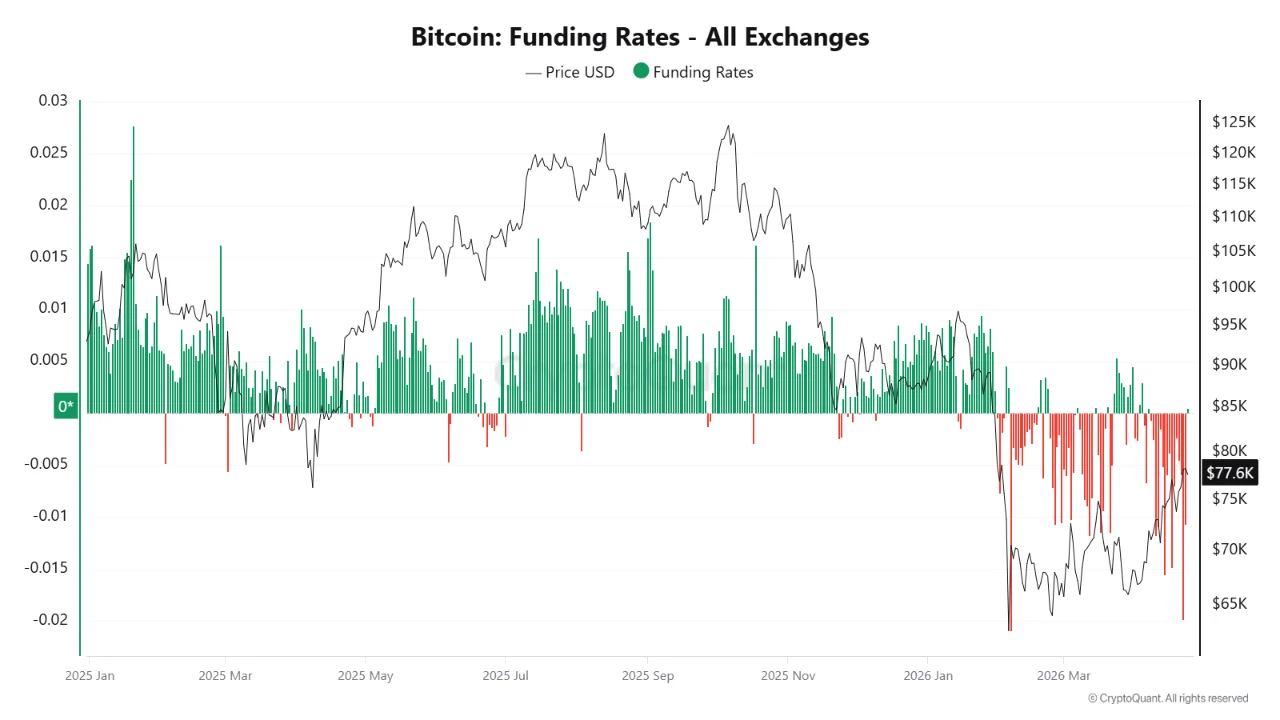
Bitcoin derivatives data is flashing a warning signal that seasoned traders rarely ignore. Funding rates have fallen sharply into negative territory while open interest continues to climb.
Together, these two indicators paint a picture of a market that is heavily positioned toward the downside. The combination raises the possibility of a violent reversal if price momentum shifts.
Negative Funding Rates Reveal Heavy Bearish Conviction in the Market
Bitcoin funding rates have dropped into deeply negative territory across major derivatives exchanges. This means short sellers are currently paying a premium to keep their positions open. The market is not simply leaning bearish — traders are committing real cost to maintain that stance.
CryptoQuant analyst G a a h drew attention to this development through on-chain data. According to the analyst, the depth of negative funding reflects strong confidence among bearish participants. That level of conviction is notable because it often appears near market turning points.
Negative funding alone does not signal a reversal. However, when it reaches extreme levels, history shows that the setup tends to become unstable. The cost of holding short positions builds over time, creating pressure to close those trades.
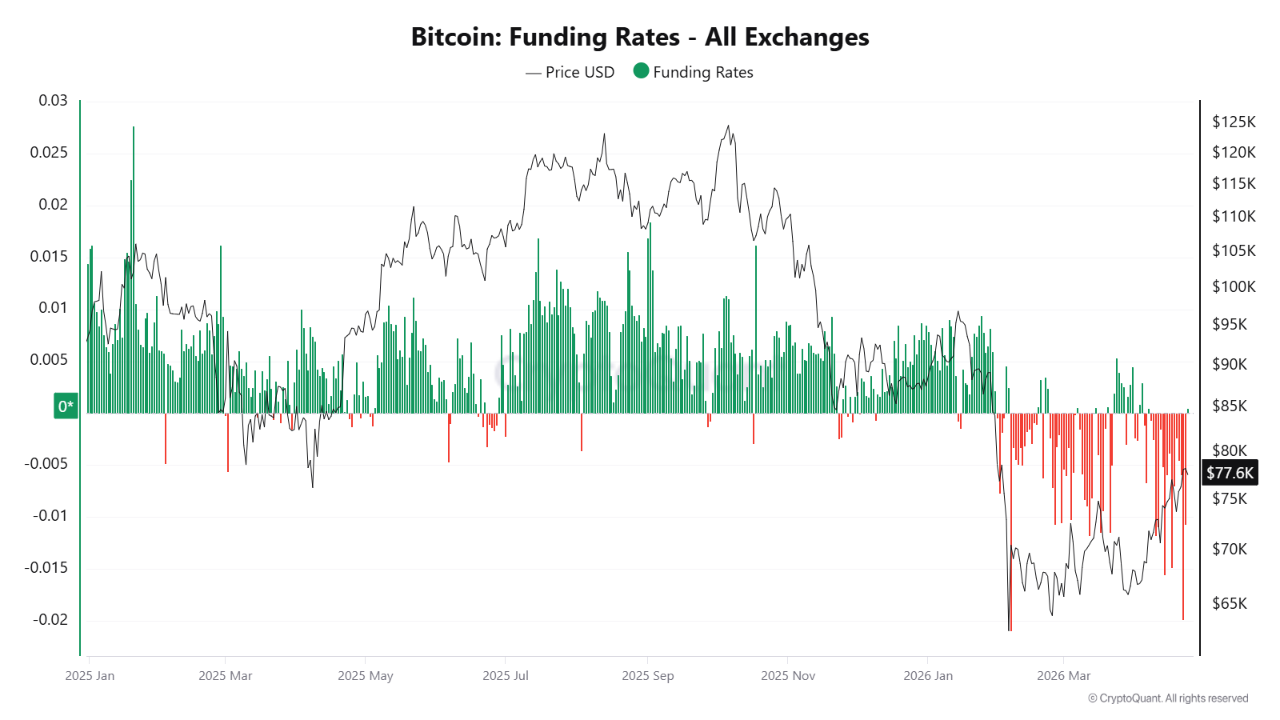
As short sellers face mounting costs, even a modest price increase can trigger a wave of forced buying. That buying pushes prices higher, which in turn forces more shorts to cover. This chain reaction is what traders refer to as a short squeeze.
Rising Open Interest Adds Pressure to an Already Crowded Short Trade
Open interest in Bitcoin futures is rising at the same time funding rates are falling. This means more capital is flowing into the market through new positions. Since funding is negative, the bulk of that capital is entering on the short side.
This creates a structurally fragile setup. A large number of traders are betting on further price declines, and they are all sitting in the same direction. When a trade becomes too crowded, it becomes vulnerable to sharp and sudden reversals.
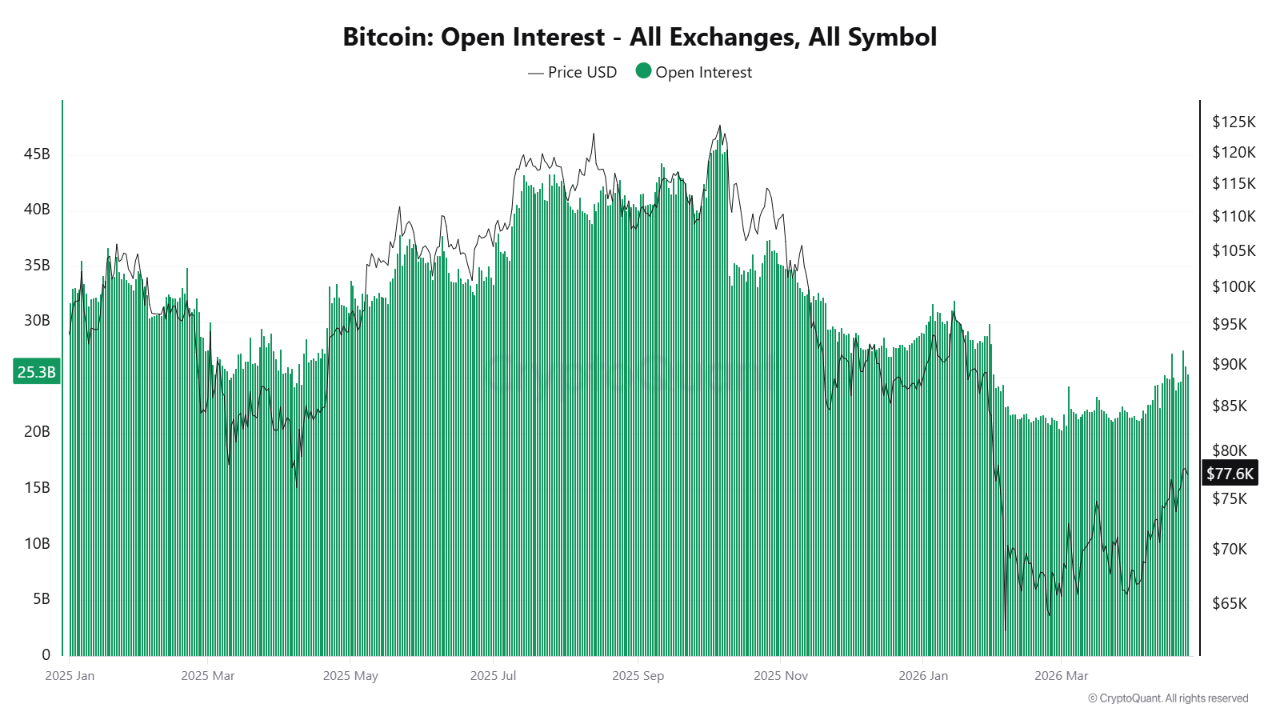
The rise in open interest is not a bearish signal on its own. It simply reflects that more active bets are in play. The direction of those bets, confirmed by negative funding, is what defines the current market condition.
Historically, periods where both open interest rises and funding turns deeply negative have preceded sharp upward price movements.
That pattern does not guarantee a rally. Rather, it points to a market that has built up enough tension to produce a large move in either direction, with upside being the more likely path of least resistance for short-side pressure.


Crypto World
CRISPR Therapeutics (CRSP) Stock Plunges 11% Amid Earnings Disappointment and Competitive Threat

Key Takeaways
- CRSP shares declined by as much as 11.59% during Friday’s session, touching an intraday low of $51.21
- First quarter results disappointed significantly: loss per share of -$1.37 versus analyst expectations of -$1.15; revenues of $0.86M compared to forecasts of $4.72M — representing a 97.8% year-over-year decline
- Competitive headwinds emerged as Regeneron announced its newly authorized gene therapy, Otarmeni, would be provided at no cost to qualifying patients in the United States, creating questions about Casgevy’s pricing sustainability
- Chief Executive Samarth Kulkarni divested 10,349 shares on March 16; company insiders collectively sold 51,828 shares during the previous three-month period
- Wall Street analysts continue to rate the stock as a consensus “Moderate Buy” with a mean price objective of $64.53
CRISPR Therapeutics ($CRSP) experienced a challenging trading session on Friday. Shares plummeted by as much as 11.59%, reaching an intraday bottom of $51.21, before closing near $51.04 — a significant decline from the previous day’s close of $55.18. Trading volume registered approximately 1.36 million shares, running about 27% lighter than typical daily activity.
The sharp downturn stemmed from a confluence of negative catalysts: disappointing quarterly financial results and emerging competitive dynamics from Regeneron.
Regarding financial performance, CRISPR disclosed a loss per share of -$1.37 for the most recent quarter, falling short of Wall Street’s consensus projection of -$1.15. Revenues registered a mere $0.86 million — substantially below analyst forecasts of $4.72 million. This represented a staggering 97.8% contraction compared to the same period last year, surprising market participants.
The biotechnology firm’s return on equity remains negative at -26.31%, while its net margin continues to reflect deep losses. Wall Street analysts are currently projecting a full-year loss per share of -$4.93.
Regeneron’s Complimentary Gene Therapy Creates Competitive Headwinds
The secondary catalyst weighing on shares involves Regeneron’s latest development. The pharmaceutical company secured regulatory authorization for Otarmeni, a gene therapy it intends to distribute without charge to qualified U.S. patients. This represents a significant challenge to the broader gene-editing industry.
CRISPR’s primary commercial product, Casgevy — co-developed alongside Vertex Pharmaceuticals — commands a list price of $2.2 million. Investors are concerned that Regeneron’s zero-cost distribution strategy could reshape pricing dynamics throughout the sector, making it increasingly difficult for high-priced single-administration treatments to defend their valuations.
Casgevy achieved recognition as the inaugural CRISPR-based treatment to receive FDA authorization, representing a historic achievement. However, commercial adoption has progressed slower than anticipated, and Regeneron’s competitive move introduces additional questions regarding the revenue trajectory.
Executive Stock Sales Contribute to Investor Anxiety
Recent insider transactions haven’t bolstered investor confidence. Chief Executive Samarth Kulkarni disposed of 10,349 shares on March 16 at an average transaction price of $48.26, trimming his holdings by approximately 4%. General Counsel James Kasinger simultaneously sold 3,450 shares on the identical date.
During the preceding three-month window, company insiders have collectively divested 51,828 shares, generating approximately $2.58 million in proceeds. Internal stakeholders currently control 4.30% of outstanding shares.
While such divestment activity isn’t uncommon among biotech executives managing equity-based compensation packages, it contributes to the cautious atmosphere surrounding the shares.
From an analyst perspective, the outlook remains somewhat divided but generally supportive. Bank of America maintains a Buy recommendation with an $89 price objective. Needham carries a Buy rating alongside an $82 target. TD Cowen holds a neutral Hold stance with a $45 projection. Citizens JMP assigns a Market Outperform rating with an $80 target. The aggregate consensus lands at Moderate Buy, featuring an average price target of $64.53 — considerably above present trading levels.
The equity’s 50-day moving average registers at $52.68 while the 200-day average stands at $55.70. The company’s market capitalization approximates $4.90 billion with a beta coefficient of 1.80.
Current price action shows CRSP trading around $51, remaining beneath both critical moving average benchmarks.

Key Highlights
- Nvidia’s shares reached an unprecedented closing price of $208.27 on Friday, marking a 4.3% gain
- The company’s valuation surpassed $5 trillion, reclaiming its status as the globe’s largest publicly traded corporation
- Intel’s exceptional quarterly results — posting its strongest single-day gain since 1987 with a 24% surge — ignited momentum across semiconductor stocks
- AMD shares soared 14% while Qualcomm advanced 11% during the same trading session
- Wall Street consensus among 42 analysts shows a Strong Buy rating, with a mean price target of $273.57
On Friday, April 24, Nvidia achieved a historic milestone by closing at its highest price ever recorded. The stock advanced 4.3% to finish at $208.27, elevating its total market capitalization beyond the $5 trillion threshold.
This achievement positions Nvidia as the planet’s most valuable publicly listed enterprise — once more.
The rally was catalyzed by Intel’s quarterly earnings announcement, which came after Thursday’s market close. Intel exceeded analyst projections, propelling its shares upward by 24% on Friday — marking the company’s most impressive daily gain in nearly four decades.
This positive sentiment rippled through the semiconductor industry. AMD jumped 14% and Qualcomm climbed 11%.
Nvidia initially breached the $5 trillion market cap threshold on October 29, 2025. The company had earlier reached $4 trillion on July 9, 2025 — less than twelve months prior.
Merely three years have passed since Nvidia’s valuation first exceeded $1 trillion. The trajectory of expansion has been extraordinary.
Nasdaq Poised for Strongest Monthly Gain Since April 2020
The Nasdaq composite index has surged 15% throughout April, positioning it for its most robust monthly showing in six years. Large-capitalization technology stocks have regained investor attention following a correction fueled by escalating oil prices connected to the Iran conflict and associated supply chain disruptions.
NVDA has multiplied more than fourteen times since December 2022 ended. In the past month alone, shares have appreciated nearly 20%.
Capital has been flowing back into growth-oriented equities, as artificial intelligence infrastructure requirements continue accelerating. Nvidia’s graphics processing units remain the preferred hardware solution for Google, Microsoft, Meta, Amazon, OpenAI, and Anthropic.
Competitive Pressures Intensifying
Alphabet, among Nvidia’s most significant clients, revealed new proprietary chips designed to rival Nvidia’s offerings when they launch for cloud platform customers in the coming months.
Nevertheless, Wall Street sentiment stays overwhelmingly positive. Among 42 equity analysts tracking the stock, 40 recommend Buy, one suggests Hold, and one advises Sell.
The consensus price target stands at $273.57 — suggesting approximately 31% potential appreciation from Friday’s closing price.
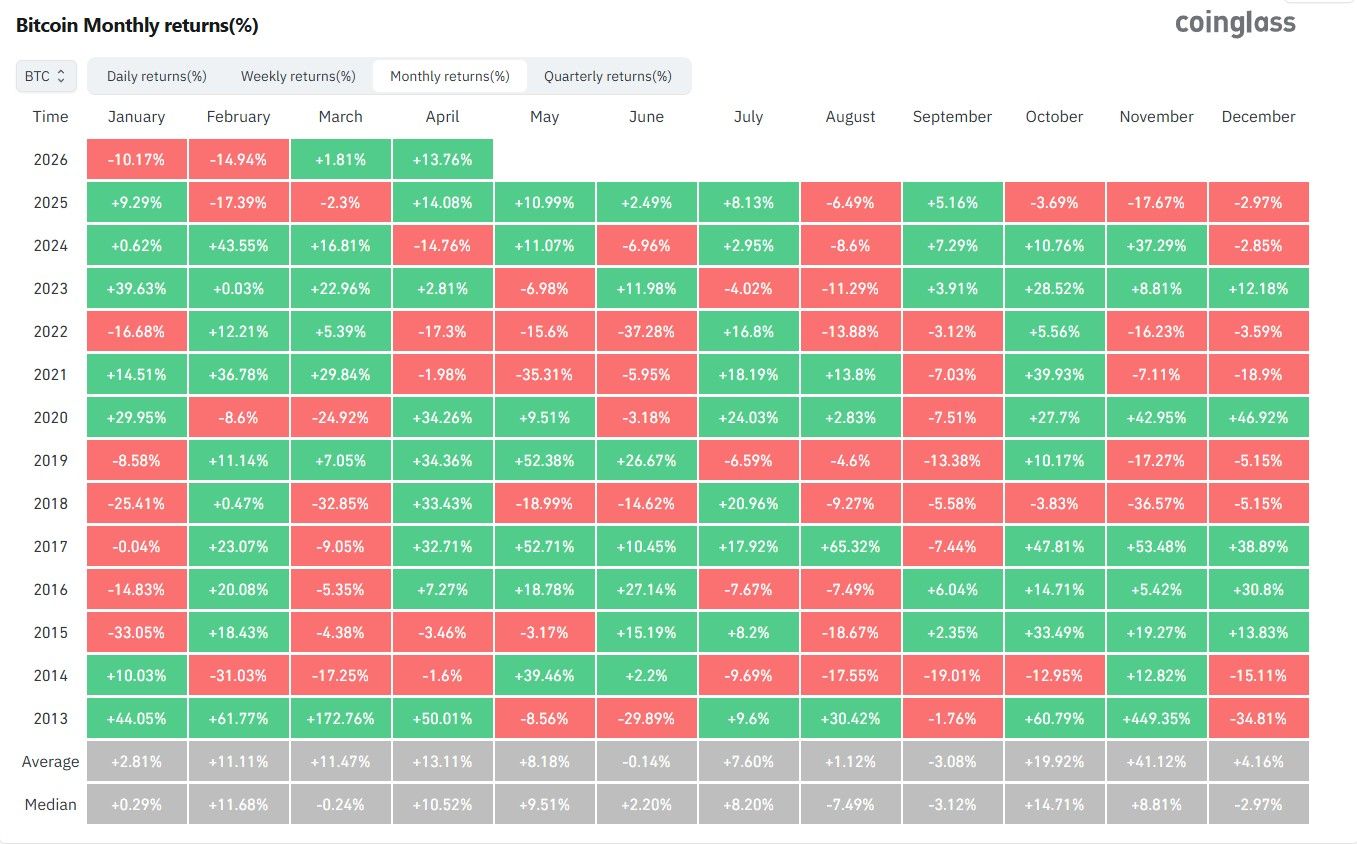
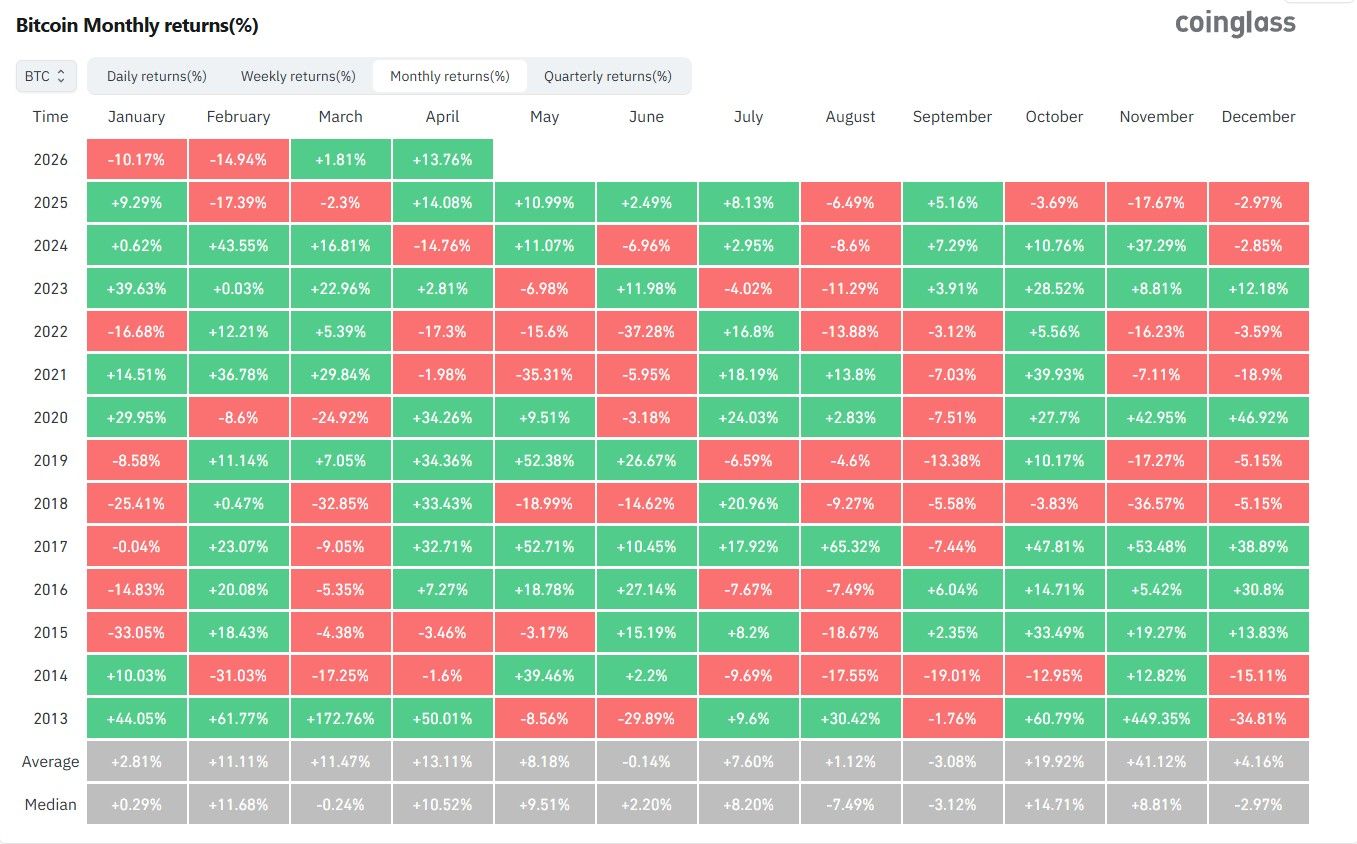
Bitcoin (BTC) is heading into the final week of April 2026 with a +13.71% gain so far. That leaves holders just half a percentage point short of the strongest April performance for the asset in five years.
Only a few days remain before the monthly close. BTC must add roughly 0.5% to surpass April 2025’s +14.08% return. That would secure Bitcoin’s best April since 2020.
April Joins a Familiar Pattern for Bitcoin
April has historically been Bitcoin’s strongest month. The average April gain stands at +13.11%, with a median return of +10.49%, according to Coinglass. The 2026 figure already sits above both benchmarks heading into the final week of trading.
The previous five Aprils tell a mixed story. Bitcoin gained +14.08% in 2025 and +34.26% in 2020, but it lost ground in 2024 (-14.76%), 2022 (-17.30%), and 2021 (-1.98%). The 2023 print of +2.81% rounded out a stretch where positive Aprils were the exception rather than the rule.
The current recovery also stands out against early-year weakness. Bitcoin lost 10.17% in January and another 14.94% in February before adding a small +1.81% in March.
April’s rebound has now reversed about half of those year-to-date losses. Improving ETF flows and a softer dollar print have helped.
Sentiment Still Lags the Price Recovery
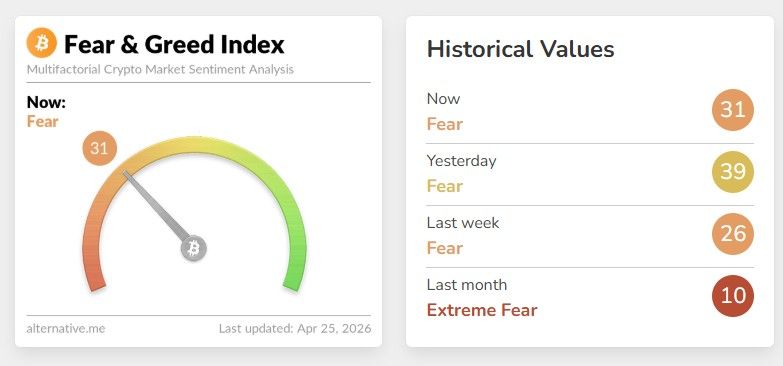
Despite the monthly gain, sentiment data shows that traders remain cautious. The Fear and Greed Index printed 31 on April 25, holding in Fear territory. The same gauge had touched Extreme Fear at 10 just one month earlier.
The reading of 26 last week was actually lower than today, indicating a slow recovery in conviction. Bitcoin is currently trading near $77,500, still about 38% below the ATH of $126,198 reached in October 2025. The gap explains the disconnect between the strong monthly print and the cautious sentiment showing in retail and derivatives positioning.
Persistent geopolitical risk has weighed on broader markets through April. US-Iran tensions and the wider Middle East conflict have kept BTC perpetual funding rates near zero or negative for stretches of the month. The pattern signals that traders have avoided chasing the rally with leverage.
One Week Left to Set the April Record
The final six trading sessions will decide where April 2026 lands in Bitcoin’s record books. A strong close would make it the second-best April since 2020, while a weaker finish would slot it behind 2025. With sentiment cautious and macro headlines unresolved, the path forward is far from certain.
A close roughly 0.5% higher by April 30 would be enough to clear 2025’s +14.08% mark. Whether Bitcoin can hold that level through the weekend remains an open question.
Thin liquidity and continuing geopolitical headlines could test the rally before the monthly close.
The post Bitcoin Has 1 Week to Secure Its Best April Since 2020 appeared first on BeInCrypto.


Mythos, the new AI model from Anthropic that has sparked fear and confusion in traditional tech and finance, is also driving a massive shift in how the crypto industry thinks about security.
For years, decentralized finance has focused its defenses on smart contracts. Code is audited, vulnerabilities are cataloged, and many common exploits are well understood. But Mythos, a model designed to identify and chain together weaknesses across systems, is pushing attention beyond code and into the infrastructure that supports it.
“The bigger risks sit in infrastructure,” said Paul Vijender, head of security at Gauntlet, a risk management firm. “When I think about AI-driven threats, I’m less concerned about smart contract exploits and more focused on AI-assisted attacks against the human and infrastructure layers.”
That includes key management systems, signing services, bridges, oracle networks, and the cryptographic layers that connect them. These components are less visible than smart contracts and are often outside traditional audit scope.
In fact, this month, web infrastructure provider Vercel, which many crypto companies use, disclosed a security breach that may have exposed customer API keys, prompting crypto projects to rotate credentials and review their code. Vercel traced the intrusion to a compromised Google Workspace connection via the third-party AI tool Context.ai, which an employee used.
Mythos belongs to a new class of AI systems built to simulate adversaries. Instead of scanning for known bugs, it explores how protocols interact, testing how small weaknesses can be combined into real-world exploits. That approach has drawn attention beyond crypto. Banks like JP Morgan are increasingly treating AI-driven cyber risk as systemic and are exploring tools like Mythos for stress testing. Earlier this month, Coinbase and Binance both reportedly approached Anthropic to test Mythos.
Early findings from models like Mythos have identified weaknesses in the behind-the-scenes systems that keep crypto platforms secure, including the technology that protects keys and handles communication between systems.
“I think there are two areas where AI models are especially valuable,” Vijender said. “First, multi-step exploit chains that historically only get discovered after money is lost. Second, infrastructure-layer vulnerabilities that traditional audits never touch.”
That shift matters in a system built on composability, where DeFi protocols can connect and build on each other’s services.
DeFi protocols are designed to interconnect. They share liquidity, rely on common oracles, and interact through layers of integrations that are difficult to map in full. That interconnectedness has driven growth, but it also creates pathways for risk to spread, as seen in recent bridge exploits like the Hyperbridge attack, in which an attacker minted $1 billion worth of bridged Polkadot tokens on Ethereum by exploiting a flaw in how cross-chain messages were verified.
“Composability is what makes DeFi capital efficient and innovative,” Vijender said. “But it also means a minor vulnerability in one protocol can become a critical exploit vector with contagion potential across the ecosystem.”
Without AI, those dependencies are hard to trace. With AI, they can be mapped and exploited at scale. The result is a shift from isolated exploits to systemic failures that cascade across protocols.
Evolution of AI attacks
Still, some industry leaders see Mythos as an acceleration rather than a turning point.
At Aave Labs, founder Stani Kulechov said AI reflects the dynamics already at play in DeFi’s adversarial environment.
“Web3 is no stranger to well-funded and motivated adversaries,” he told CoinDesk. “AI models represent an evolution in the tools used to achieve exploits.”
From that perspective, DeFi is already built for machine-speed attacks. Smart contracts execute automatically, and defenses such as liquidation mechanisms and risk parameters operate without human intervention.
“DeFi operates at compute speed, so AI doesn’t introduce a new dynamic,” Kulechov said. “It intensifies an environment that has always required constant vigilance.”
Even so, Aave is seeing AI surface new categories of vulnerabilities, including issues that human auditors may have previously deprioritized.
“The Mythos paper shows that AI can uncover old bugs that were previously deprioritized,” he said.
That breadth still matters in a system where even smaller vulnerabilities can undermine trust or be combined into larger exploits.
If attackers can move faster, the question becomes whether defenses can keep pace.
For both Gauntlet and Aave, the answer lies in changing the security model itself. Audits before deployment and monitoring after were designed for human-paced threats. AI compresses that timeline.
“To defend against offensive AI, we will need to take an AI-centric approach where speed and continuous adaptation are essential,” Vijender of Gauntlet said. That includes continuous auditing, real-time simulation, and systems built with the assumption that breaches will happen.
A ‘greater way’
Aave has already integrated AI into its workflows, using it for simulations and code review alongside human auditors. “We take an AI-first approach where it adds clear value,” Kulechov of Aave Labs said. “But it complements, rather than replaces, human-led auditing.”
In that sense, AI equips both attackers and defenders.
For builders, the long-term effect may be less disruption than divergence.
“We haven’t tested Mythos yet, but we’re genuinely interested in what it and tools like it can do for protocol security,” said Hayden Adams, founder and CEO of Uniswap Labs. “AI gives builders better ways to stress test and harden systems.”
Over time, Adams expects the gap between secure and insecure protocols to widen.
“Projects that prioritize security will have greater ability to test and harden systems before launching,” he said. “Projects that don’t will be most at risk.”
That may be the real shift. Security is no longer about eliminating vulnerabilities. It is about continuously adapting to a system in which those vulnerabilities are constantly rediscovered and recombined.
Read more: Move over bitcoin and quantum risks. Anthropic’s Mythos AI could have major implications for DeFi

The regulatory fight over prediction markets moved to the federal courts this week as the Commodity Futures Trading Commission (CFTC) sued New York state to block its gambling-law actions from applying to federally regulated event-contract platforms. In the Southern District of New York, the CFTC argued that federal law grants it exclusive authority over these markets and asked for a declaratory judgment plus a permanent injunction against New York’s enforcement efforts.
“CFTC-registered exchanges have faced an onslaught of state lawsuits seeking to limit Americans’ access to event contracts and undermine the CFTC’s sole regulatory jurisdiction over prediction markets,” said CFTC Chair Michael Selig. The complaint comes as New York has intensified its own actions against major platforms, including Coinbase and Gemini, with Kalshi having faced prior state-enforcement pressure on its sports-related contracts.
For context, New York’s push against unregistered gambling or gaming activities has been part of a broader state-led wave targeting prediction-market operators. Earlier this week, New York filed suits against Coinbase and Gemini, alleging unlicensed gambling activity. Kalshi, a prominent prediction platform, has also faced regulatory moves in the past. Related coverage has highlighted related enforcement actions in other jurisdictions and ongoing debates about the boundaries between federal financial regulation and state gambling rules.
Key takeaways
- The CFTC asserts exclusive federal jurisdiction over prediction markets and seeks a judicial ruling that New York cannot enforce its gambling rules against federally regulated platforms.
- New York has separately pursued enforcement actions against prominent platforms, illustrating a broader state-led crackdown on prediction-market offerings.
- A coalition of 37 states and Washington, D.C. filed an amicus brief backing Massachusetts in its Kalshi case, arguing federal law does not clearly override state gambling authority.
- Kalshi contends its products are “swaps” regulated under a 2010 financial law, while states argue that the law was not intended to legalize nationwide sports betting or preempt state protections.
- The evolving landscape signals greater regulatory fragmentation for prediction markets, with potential implications for users, developers, and investors.
Federal authority under dispute
The CFTC’s filing in SDNY centers on whether New York’s enforcement actions against prediction-market platforms can stand alongside federal supervision of these markets. The agency asserts that federal law grants it exclusive authority over prediction markets and that state actions risk “undermining the CFTC’s sole regulatory jurisdiction.” The CFTC’s move underscores a broader tension between federal oversight and state gambling regulations as platforms offer event-based contracts tied to real-world outcomes.
In presenting its case, the CFTC highlighted what it sees as a pattern of state-level lawsuits aimed at limiting access to these markets. The agency framed its suit as a necessary step to preserve a uniform federal framework for prediction markets and to prevent a patchwork of state rules that could complicate compliance for federally registered exchanges.
The developing legal dispute sits at the intersection of financial regulation and gambling policy, inviting questions about how federal authority should apply to products that blend financial mechanics with event-betting features. Observers will be watching not only the SDNY proceedings but also how state courts interpret the reach of federal financial statutes in relation to traditional gambling authority.
Massachusetts case and the 37-state amicus brief
In a parallel but closely related thread, a coalition of 37 states and Washington, D.C. filed an amicus brief supporting Massachusetts in its challenge to Kalshi’s sports-betting stance. The filing urges Massachusetts’ highest court to reject Kalshi’s argument that federal law permits nationwide sports betting without adhering to state rules. The amicus brief is available from the Massachusetts attorney general’s office: 37-state backing Massachusetts in Kalshi matter.
Kalshi maintains that its betting products are swaps regulated under a 2010 financial law, a position it frames as federal coverage for certain exchange-traded event contracts. States counter that the law in question was never intended to authorize the expansion of sports betting nationwide or to supersede established state gambling regimes. The states contend that preserving state oversight remains essential for protections such as licensing, age restrictions, fraud prevention, and gambling-addiction safeguards—areas not addressed by federal financial regulation.
Previous coverage has noted that the Kalshi case sits at a critical juncture for the broader debate over federal preemption in financial markets and the role of states in policing everyday gambling-related services. The amicus brief signals a broad, organized effort by state attorneys general to shape how federal law interacts with state gambling controls in the context of prediction markets.
State crackdowns intensify across jurisdictions
The past several months have seen a sharpened stance from states against prediction-market operators. Arizona, Connecticut, and Illinois have pursued efforts to enforce gambling laws against platforms offering prediction contracts. In some cases, regulators have issued cease-and-desist orders or pursued court action to curb unregistered offerings. This trend reflects a growing belief among state authorities that prediction markets straddle long-standing lines between gambling regulation and financial product oversight.
Earlier this month, a Nevada judge extended a prohibition on Kalshi’s event-based contracts within the state, siding with regulators who argued that the products function as unlicensed gambling. The Nevada ruling adds to a string of state-level actions that complicate the operating environment for prediction-market platforms and their users.
These developments come amid broader conversations about how to balance consumer protections with innovative financial instruments. While some observers see potential benefits in prediction markets for information discovery and hedging, others warn of regulatory and compliance risks that could constrain adoption and scale.
As coverage from Cointelegraph and other outlets has noted, the tension between federal preemption and state gambling authority is not new, but the current convergence of high-profile suits, amicus briefs, and court decisions raises the stakes for Kalshi, Polymarket, and similar platforms that tether financial mechanics to live events. The evolving legal framework will likely shape how next-generation prediction services design compliance programs and engage with regulators going forward.
What happens next will hinge on courtroom decisions in the SDNY action and in state courts handling Kalshi’s case. Investors, operators, and users should monitor regulatory filings and rulings closely, as outcomes could redefine the permissible scope of prediction markets in the United States and influence how these platforms structure products, licensing, and risk controls going forward.
Crypto World
Bitcoin (BTC) falls after Trump reportedly canceled Steve Witkoff and Jared Kushner’s Iran-talks trip


Bitcoin edged lower late morning on the U.S. East Coast after U.S. President Donald Trump’s comments signaled a halt to planned diplomatic travel tied to Iran talks.
The largest cryptocurrency dropped about $100 to $77,351 just before noon ET, reversing a modest earlier gain. The move came minutes after a Fox reporter posted Trump’s remarks on X, where he said he had canceled a trip by envoys Steve Witkoff and Trump’s stepson, Jared Kushner.
“I’ve told my people a little while ago they were getting ready to leave, and I said, ‘Nope, you’re not making an 18 hour flight to go there. We have all the cards. They can call us anytime they want, but you’re not going to be making any more 18 hour flights to sit around talking about nothing’,” Trump said, according to the post.
Witkoff and Kushner had been expected to travel to Pakistan for a new round of talks involving Iran. The shift came only hours after Abbas Araghchi, Iran’s foreign minister, left Pakistan, a detail that had fueled disappointment over expectations for near-term discussions.
However, the decline in BTC was limited, suggesting markets viewed the development as a short-term risk signal rather than a shift in the broader outlook.
Market participants will likely watch for follow-up statements from U.S. officials and any response from Iran. Trump is expected to speak at a crypto conference in Palm Beach around noon Eastern time.

Bitcoin hovered near the $78,000 level as fresh U.S. labour data signalled rising unemployment filings. The latest figures showed a modest increase in initial jobless claims, which shaped expectations around monetary policy. Market conditions reflected steady price action, while macroeconomic signals influenced sentiment across digital assets.
Bitcoin Holds Near Resistance Amid Labor Market Signals
Bitcoin remained close to the $78,000 mark despite recent consolidation and resistance pressure. The price showed stability, yet it struggled to break above the $79,000 to $80,000 range. This zone continued to act as a strong barrier due to concentrated selling activity.
Meanwhile, recent US labour data added a new dimension to market direction and expectations. Initial jobless claims reached 214,000, exceeding projections of 211,000 and signaling slight labour market weakness. The increase also surpassed the prior revised figure of 208,000, reinforcing concerns about slowing economic momentum.
As a result, traders adjusted short-term expectations, while price movement remained contained within a defined range. Analysts noted that failure to breach resistance could trigger a move toward lower support levels. Consequently, the $76,000 level emerged as a possible downside target under current conditions.
U.S. Jobless Claims Data Signals Economic Cooling
The U.S. Department of Labor reported higher unemployment benefit applications, which reflected a gradual shift in labor conditions. This data point often serves as an early indicator of economic strength or weakness. Even minor deviations from forecasts tend to influence broader financial markets.
In this context, the latest figures pointed to cooling job growth, although the change remained moderate. However, the trend suggested reduced hiring momentum, which could affect economic expansion. Therefore, policymakers may interpret the data as a signal to reconsider current monetary policy direction.
At the same time, expectations around interest rate adjustments gained traction across financial markets. Lower rates typically increase liquidity, which can support risk-driven assets like cryptocurrencies. As a result, market participants factored in the possibility of future policy easing.
Federal Reserve Outlook Shapes Crypto Market Direction
Attention shifted toward the upcoming Federal Reserve meeting scheduled for late April. The labour data arrived at a critical moment, influencing expectations for policy decisions. A weaker employment outlook could encourage rate cuts aimed at supporting economic activity.
In such scenarios, increased liquidity often flows into alternative assets, including digital currencies. Bitcoin tends to respond positively to looser monetary conditions, as capital seeks higher returns. Therefore, macroeconomic shifts continued to play a key role in shaping price behaviour.
Despite these factors, Bitcoin maintained a stable trajectory without significant volatility. Price action reflected a balance between resistance pressure and supportive macro conditions. Consequently, the market remained range-bound as participants awaited clearer signals from economic data and policy decisions.
Overall, Bitcoin’s movement near $78,000 highlighted the growing link between macroeconomic indicators and digital asset performance. Labour market data, interest rate expectations, and liquidity trends combined to influence price direction. As the Federal Reserve prepares for its next decision, these factors are expected to remain central to market developments.

Metaplanet Expands Bitcoin Treasury Strategy
Metaplanet has moved to expand its Bitcoin reserves through a fresh capital raise, signaling continued corporate adoption of digital assets across the business landscape. The Tokyo-based firm issued $50 million in zero-interest bonds to fund additional Bitcoin purchases and to bolster its treasury expansion plans. Metaplanet has also issued ¥8 billion in zero-interest ordinary bonds to accelerate Bitcoin accumulation, illustrating a diversified use of capital markets to build a Bitcoin-centric treasury. The bonds are structured with a stated maturity date in April 2027, enabling long-duration access to capital without immediate financing costs.
The firm allocated the bond proceeds to EVO FUND, a dedicated vehicle aimed at targeted deployment into Bitcoin purchases. This approach supports a focused treasury model built around a single digital asset, simplifying governance and execution. As a result, the company maintains a clear and consistent acquisition strategy over time.
Metaplanet continues to rely on capital markets tools, including equity and debt instruments, to fund its purchases. This method aligns with the model popularized by Michael Saylor and widely emulated by corporate treasuries seeking long-term Bitcoin exposure. Consequently, the firm strengthens its identity as a Bitcoin-focused corporate entity within a competitive global landscape.
Corporate Bitcoin Holdings Continue to Rise
Metaplanet has increased its Bitcoin holdings to 40,177 BTC, reflecting steady accumulation over recent months and a deliberate expansion strategy. The firm expanded its position after acquiring over 5,000 BTC earlier this month, signaling rapid progress in its treasury buildup. This growth highlights an aggressive approach to treasury management and capital allocation.
Earlier in 2026, the company held more than 35,000 BTC despite market volatility and valuation swings. However, it continued to add to its reserves, showing a long-term commitment to digital assets. The firm now ranks among the largest corporate holders of Bitcoin globally, a status achieved through disciplined purchasing and retention.
Meanwhile, MicroStrategy maintains a significant lead with over 815,000 BTC in holdings. The company recently expanded its reserves through another large acquisition, underscoring the scale at which leading corporate adopters operate. This contrast illustrates the disparity in size and pace between the top holders and the broader corporate community.
Long-Term Targets Signal Aggressive Expansion
Metaplanet has outlined ambitious targets for its Bitcoin treasury growth through 2027. The company aims to reach 100,000 BTC holdings by the end of 2026 and then plans to increase this figure to 210,000 BTC in the following year, indicating an aggressive trajectory.
These targets would represent a notable share of Bitcoin’s total supply, approaching roughly one percent depending on market dynamics. The strategy reflects growing confidence in Bitcoin as a long-term store of value and signals a shift from traditional business operations toward a digital asset-focused model.
The firm has transitioned from a conventional investment model to a dedicated Bitcoin treasury company since 2024. This evolution aligns with broader corporate trends in digital asset adoption, and it positions Metaplanet to compete effectively within a rapidly evolving global landscape.

TLDR:
- Purrlend lost $1.5M across HyperEVM and MegaETH in a suspected coordinated dual-network exploit.
- HyperEVM bore the larger loss at $1.2M, while MegaETH accounted for roughly $324,000 in stolen funds.
- Stolen assets included USDC, USDT0, USDH, wstHYPE, kHYPE, WHYPE, UETH, WETH, and USDm tokens.
- April 2026 is on pace to rank among the worst months for crypto theft, with over $600M lost in 18 days.
Purrlend, a decentralized lending and borrowing protocol built on HyperEVM, suffered a suspected exploit on April 25, 2026.
The attack hit two separate networks simultaneously, HyperEVM and MegaETH. Combined losses reached approximately $1.5 million.
The incident was first flagged by Kirby Ong, founder of HypurrCollective. Purrlend has since paused all protocol operations while its team investigates the breach.
Attack Drains Funds Across Two Blockchain Networks
The exploit targeted Purrlend on both HyperEVM and MegaETH in a coordinated dual-network attack. HyperEVM suffered the larger share of losses, with roughly $1.2 million drained from the protocol. MegaETH accounted for the remaining $324,549 in stolen funds.
Kirby Ong, founder of HypurrCollective, was the first to raise the alarm on social media. He posted a detailed breakdown of stolen assets across both chains. His post read: “Purrlend appears to be exploited on both MegaETH and HyperEVM.”
The stolen assets on HyperEVM included nearly $450,000 in USDC and $214,000 in USDT0. The attacker also took close to $195,000 in USDH, along with wstHYPE, kHYPE, WHYPE, and UETH tokens. On MegaETH, the attacker withdrew $163,000 in USDT0, WETH, and USDm.
Purrlend confirmed the incident shortly after through an official post. The team stated: “We have detected irregular activity on the protocol and are actively investigating.” The protocol remains paused as the investigation continues.
April Emerges as One of the Worst Months for Crypto Theft in 2025
The Purrlend exploit adds to a growing list of attacks recorded in April. More than $600 million has been stolen from crypto protocols in just 18 days this month. That figure places April on pace to surpass even the most damaging months in recent DeFi history.
The bulk of April’s losses trace back to attacks on KelpDAO and Drift Protocol. Together, those two incidents account for an estimated $577 million in losses. Both attacks have drawn sharp attention to the state of security across DeFi platforms.
By comparison, the largest single breach this year remains the $1.4 billion Bybit hack from February 2025. April’s total, however, is approaching that threshold at a rapid pace. That trend has put protocol security practices under growing scrutiny.
For Purrlend, the road to recovery will depend heavily on the findings of its ongoing investigation. The protocol has not yet disclosed the specific attack vector used by the exploiter. Until then, users have been urged to proceed with caution across all connected platforms.
Crypto World
Binance Users Are Looking Beyond Trading To Income; Varntix Is Where Some Capital Is Moving

Investors are starting to question whether traditional crypto earning methods are truly reliable. Platforms like Binance make it easy to earn through staking and advanced yield products, but returns often depend on market conditions. This means income can fluctuate without warning.
That shift is driving capital toward alternatives like Varntix. In a market where timing often fails, Varntix is positioning itself as the solution for traders who want certainty, control, and returns they can actually plan around. Instead of relying on market movement, smart investors can receive fixed and predictable returns that are agreed from the start.
Binance Offers Easy Income but Lacks Guaranteed Returns
Binance is one of the largest crypto exchanges by trading volume, and a popular choice for trading. One way traders earn on the platform is through staking. This allows users to lock up their tokens and receive rewards for supporting blockchain networks.
While this provides an easy way to earn, the returns are not guaranteed. Earnings can also vary depending on network activity and overall market trends.
In addition, the crypto exchange offers Advanced Earn products designed to deliver higher potential returns. While these products can offer attractive APRs, they rely heavily on market conditions and require a higher tolerance for risk.
Even so, Binance is easy to access and its diverse product offerings make it appealing to many investors.
However, investors’ earnings depend on the market. This means returns are not fixed and can change over time. With this in mind, many are seeking platforms with returns that do not rely on broader market performance.
Varntix Provides Clear Returns as Crypto Earnings Remain Unpredictable
Crypto earnings have become increasingly unpredictable. Strategies like staking and borrowing often depend on market performance leaving returns difficult to plan. Because of this, more traders are shifting toward structured income models that offer clarity.
Varntix is one of the platforms leading this shift. It operates as a digital savings platform for crypto, giving users access to fixed and flexible income plans with clearly defined returns.
Fixed plans offer higher, guaranteed returns over a set period. Depending on the duration and allocation, returns can reach up to around 24% APY. For instance, a $10,000 allocation at a 20% APY could yield about $6,000 over three years. The return is known upfront, removing the need to guess market direction.
On the other hand, flexible plans are designed for access. Users can withdraw their funds at any time while still earning. In real terms, a $10,000 allocation at 6% APY would earn roughly $600. All while allowing investors access to the capital.
Additionally, returns are paid in stablecoins like USDC, helping protect value. It also avoids the impact of market volatility during the earnings period.

Varntix Gains Ground as Investors Move Away From Market-Driven Yields
When yields are unpredictable, it’s hard to plan for crypto income. A user might stake with the expectation of steady returns but is disappointed by market conditions.
Binance offers ways to earn passively, but the returns are not fixed. They depend on what is happening in the market, so profits can change at anytime. Because of this, some investors are moving their capital to Varntix to get more stable and predictable returns.
The main difference is in how both platforms work. Market-based platforms like Binance are flexible and easy to use, but they are also more volatile.
Meanwhile, Varntix focuses on reducing the impact of market changes. Users can know their expected returns, how long their funds will be locked, and when they will receive payouts from the beginning.
Take a closer look at Varntix if you want your crypto to work harder.
FAQs
1. Why are Binance users looking for other income options?
Many users are exploring alternatives because earnings on Binance depend on market conditions. Returns from staking and yield products can change at any time, making income hard to predict.
2. Why are structured income models gaining popularity in crypto?
Structured income models offer clearer, more stable returns that investors can plan around.
3. How does Varntix reduce risk compared to market-based platforms?
Varntix provides predefined returns and pays out in stablecoins like USDC, helping reduce exposure to price swings and making earnings more consistent.
Disclaimer: This is a Press Release provided by a third party who is responsible for the content. Please conduct your own research before taking any action based on the content.

Fairground ride smashes to the ground after cable snaps in Spain | News World

ServiceNow Stock: Post-Earnings Meltdown Is Well Overdone (NYSE:NOW)
CRISPR Therapeutics (CRSP) Stock Plunges 11% Amid Earnings Disappointment and Competitive Threat

Manchester United reach agreement with Casemiro over contract clause amid transfer speculation

US brings back mandatory military draft registration

Steven Gerrard disagrees with Gary Neville over ‘shock’ Chelsea and Arsenal claim | Football


-

 Business6 days ago
Powerball Result April 18, 2026: No Jackpot Winner in Powerball Draw: $75 Million Rolls Over
-

 Politics6 days ago
Zack Polanski demands ‘council homes not luxury flats for foreign investors’
-

 Fashion24 hours ago
Weekend Open Thread – Corporette.com
-
Entertainment6 days ago
NBA Analyst Charles Barkley Chimes in on Ice Spice McDonald’s Fiasco
-

 Tech7 days ago
Auto Enthusiast Scores Running Tesla Model 3 for Two Grand and Turns It Into Bare-Bones Go-Kart
-

 Politics5 days ago
Gary Stevenson delivers timely reminder to register to vote as deadline TODAY
-

 Politics3 days ago
Making troops accountable for war crimes threatens US alliance, ex-SAS colonel warns
-

 Business3 days ago
Rolls-Royce Voted UK’s Most Iconic Trade Mark as IPO Register Hits 150
-

 Politics3 days ago
Disabled people challenge government SEND proposals over segregation concerns
-
Crypto World5 days ago
Bank of Hawai’i (BOH) Q1 2026: Net Income Drops to $57.4M as Net Interest Margin Expands
-

 Politics3 days ago
Zack Polanski responds to home secretary’s taser threat
-
Politics3 days ago
Wings Over Scotland | How To Get Away With Crimes
-

 Politics3 days ago
Starmer handler McSweeney to be dragged from shadows by Foreign Affairs Committee
-
Crypto World7 days ago
Kelp DAO rsETH Bridge Hack Drains $292M as DeFi Losses Top $600M in Two Weeks
-

 Politics3 days ago
‘Iran is still a nuclear threat’
-

 Crypto World4 days ago
New York sues Coinbase, Gemini over prediction market offerings
-
 Crypto World4 days ago
Five Value Stocks with Recovery Potential in 2026: PayPal (PYPL), Nike (NKE), and More
-

 Business3 days ago
The Job Benefits Most Men Don’t Know to Negotiate
-

 Crypto World1 day ago
Michael Saylor says BTC winter is over. Market analyst disagrees, says bitcoin was in a pullback
-

 Politics6 days ago
Reform investigating candidate who ‘hates’ the NHS
You must be logged in to post a comment Login