
Crypto World
Anthropic’s new Mythos AI is exposing the hidden cracks in crypto’s foundation

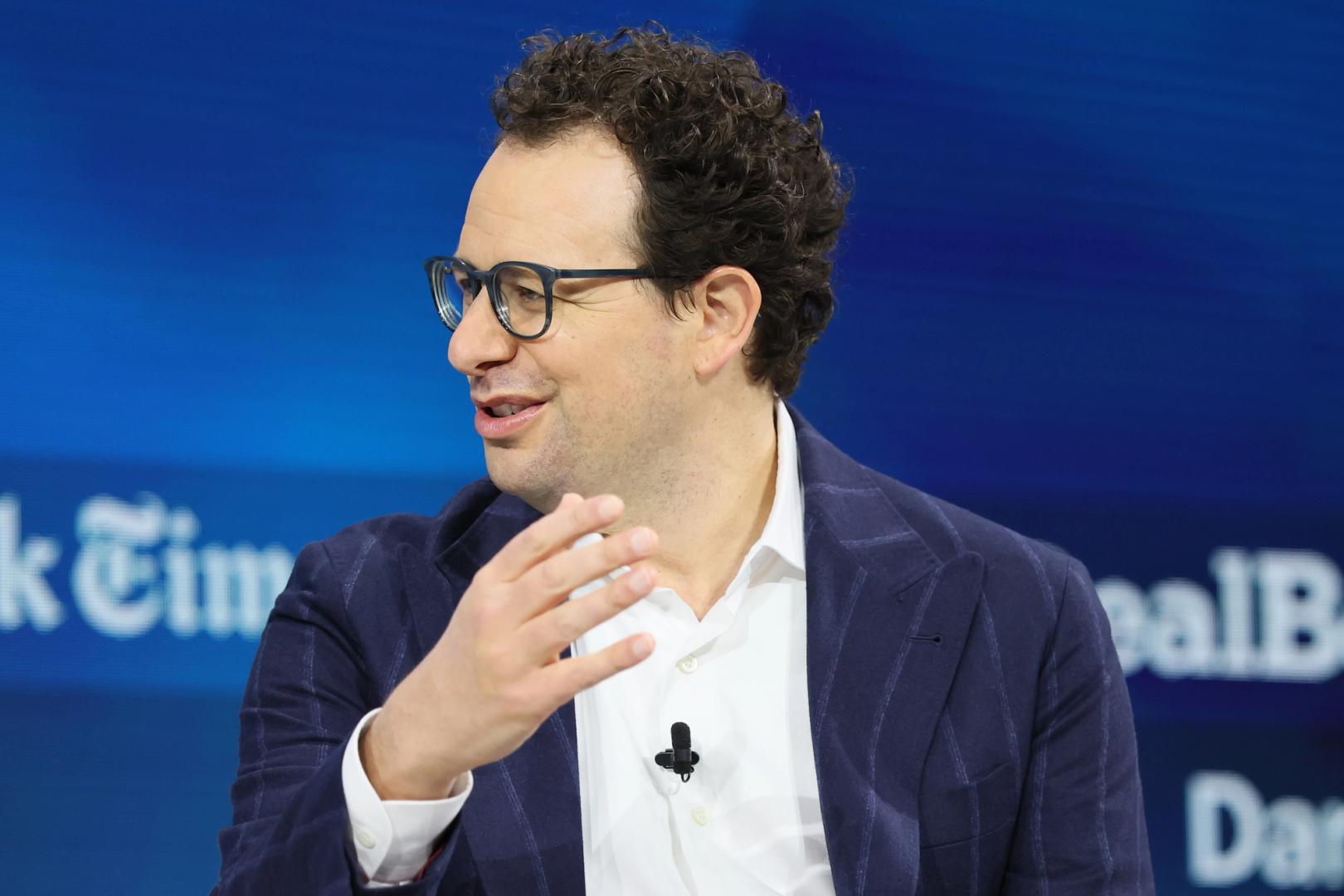
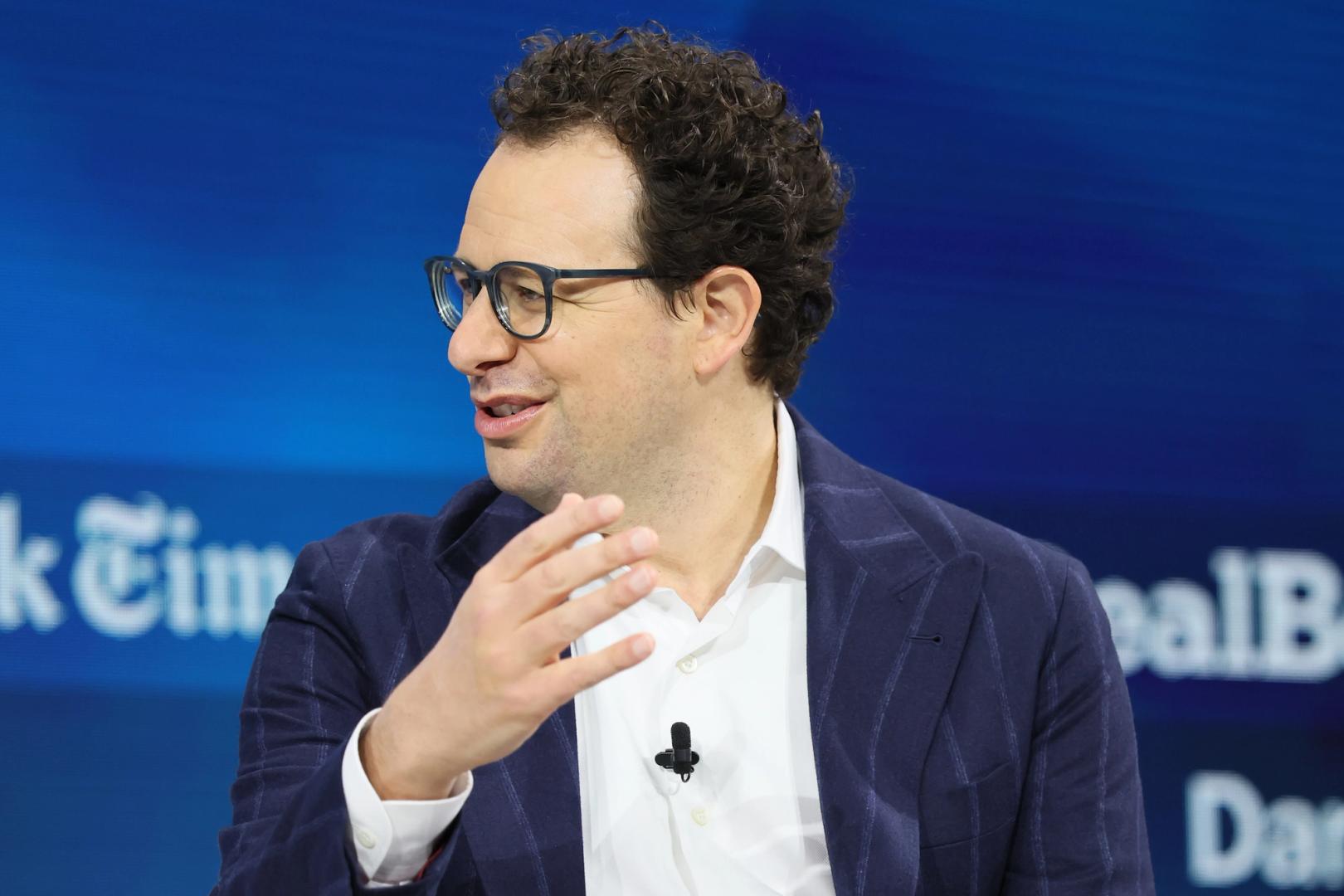
Mythos, the new AI model from Anthropic that has sparked fear and confusion in traditional tech and finance, is also driving a massive shift in how the crypto industry thinks about security.
For years, decentralized finance has focused its defenses on smart contracts. Code is audited, vulnerabilities are cataloged, and many common exploits are well understood. But Mythos, a model designed to identify and chain together weaknesses across systems, is pushing attention beyond code and into the infrastructure that supports it.
“The bigger risks sit in infrastructure,” said Paul Vijender, head of security at Gauntlet, a risk management firm. “When I think about AI-driven threats, I’m less concerned about smart contract exploits and more focused on AI-assisted attacks against the human and infrastructure layers.”
That includes key management systems, signing services, bridges, oracle networks, and the cryptographic layers that connect them. These components are less visible than smart contracts and are often outside traditional audit scope.
In fact, this month, web infrastructure provider Vercel, which many crypto companies use, disclosed a security breach that may have exposed customer API keys, prompting crypto projects to rotate credentials and review their code. Vercel traced the intrusion to a compromised Google Workspace connection via the third-party AI tool Context.ai, which an employee used.
Mythos belongs to a new class of AI systems built to simulate adversaries. Instead of scanning for known bugs, it explores how protocols interact, testing how small weaknesses can be combined into real-world exploits. That approach has drawn attention beyond crypto. Banks like JP Morgan are increasingly treating AI-driven cyber risk as systemic and are exploring tools like Mythos for stress testing. Earlier this month, Coinbase and Binance both reportedly approached Anthropic to test Mythos.
Early findings from models like Mythos have identified weaknesses in the behind-the-scenes systems that keep crypto platforms secure, including the technology that protects keys and handles communication between systems.
“I think there are two areas where AI models are especially valuable,” Vijender said. “First, multi-step exploit chains that historically only get discovered after money is lost. Second, infrastructure-layer vulnerabilities that traditional audits never touch.”
That shift matters in a system built on composability, where DeFi protocols can connect and build on each other’s services.
DeFi protocols are designed to interconnect. They share liquidity, rely on common oracles, and interact through layers of integrations that are difficult to map in full. That interconnectedness has driven growth, but it also creates pathways for risk to spread, as seen in recent bridge exploits like the Hyperbridge attack, in which an attacker minted $1 billion worth of bridged Polkadot tokens on Ethereum by exploiting a flaw in how cross-chain messages were verified.
“Composability is what makes DeFi capital efficient and innovative,” Vijender said. “But it also means a minor vulnerability in one protocol can become a critical exploit vector with contagion potential across the ecosystem.”
Without AI, those dependencies are hard to trace. With AI, they can be mapped and exploited at scale. The result is a shift from isolated exploits to systemic failures that cascade across protocols.
Evolution of AI attacks
Still, some industry leaders see Mythos as an acceleration rather than a turning point.
At Aave Labs, founder Stani Kulechov said AI reflects the dynamics already at play in DeFi’s adversarial environment.
“Web3 is no stranger to well-funded and motivated adversaries,” he told CoinDesk. “AI models represent an evolution in the tools used to achieve exploits.”
From that perspective, DeFi is already built for machine-speed attacks. Smart contracts execute automatically, and defenses such as liquidation mechanisms and risk parameters operate without human intervention.
“DeFi operates at compute speed, so AI doesn’t introduce a new dynamic,” Kulechov said. “It intensifies an environment that has always required constant vigilance.”
Even so, Aave is seeing AI surface new categories of vulnerabilities, including issues that human auditors may have previously deprioritized.
“The Mythos paper shows that AI can uncover old bugs that were previously deprioritized,” he said.
That breadth still matters in a system where even smaller vulnerabilities can undermine trust or be combined into larger exploits.
If attackers can move faster, the question becomes whether defenses can keep pace.
For both Gauntlet and Aave, the answer lies in changing the security model itself. Audits before deployment and monitoring after were designed for human-paced threats. AI compresses that timeline.
“To defend against offensive AI, we will need to take an AI-centric approach where speed and continuous adaptation are essential,” Vijender of Gauntlet said. That includes continuous auditing, real-time simulation, and systems built with the assumption that breaches will happen.
A ‘greater way’
Aave has already integrated AI into its workflows, using it for simulations and code review alongside human auditors. “We take an AI-first approach where it adds clear value,” Kulechov of Aave Labs said. “But it complements, rather than replaces, human-led auditing.”
In that sense, AI equips both attackers and defenders.
For builders, the long-term effect may be less disruption than divergence.
“We haven’t tested Mythos yet, but we’re genuinely interested in what it and tools like it can do for protocol security,” said Hayden Adams, founder and CEO of Uniswap Labs. “AI gives builders better ways to stress test and harden systems.”
Over time, Adams expects the gap between secure and insecure protocols to widen.
“Projects that prioritize security will have greater ability to test and harden systems before launching,” he said. “Projects that don’t will be most at risk.”
That may be the real shift. Security is no longer about eliminating vulnerabilities. It is about continuously adapting to a system in which those vulnerabilities are constantly rediscovered and recombined.
Read more: Move over bitcoin and quantum risks. Anthropic’s Mythos AI could have major implications for DeFi



Oil prices extended their rally on Monday as stalled US-Iran peace talks raised fears of prolonged disruption to Middle East crude supplies.
With the Strait of Hormuz effectively closed, Goldman Sachs has lifted its Brent forecasts, warning of “extreme” inventory draws as the global market grapples with a supply shock.
Goldman Raises Q4 Brent Forecast to $90
In a Monday note, analysts Daan Struyven and Yulia Zhestkova Grigsby projected Brent crude would average $90 per barrel in Q4. This represented a 12.5% jump from their earlier $80 estimate. Goldman also revised its projections upward for both the second and third quarters.
The revised outlook comes as supply disruptions intensify. According to the bank’s estimates, production losses of 14.5 million barrels per day from the Persian Gulf are pulling global oil stockpiles down at a record-breaking pace of 11 to 12 million barrels a day throughout April.
The analysts warned that “extreme inventory draws are not sustainable”, suggesting that an even steeper drop in demand may be needed if the supply crunch drags on.
Goldman also projects a supply deficit of 9.6 million barrels per day for the current quarter. This marks a reversal from the surplus seen during the same period last year.
“We now assume a normalization in Gulf exports by end-June, versus mid-May prior, and a slower Gulf production recovery. The economic risks are larger than our crude base-case alone suggests because of the net upside risks to oil prices, unusually high refined-product prices, product shortages risks, and the unprecedented scale of the shock,” the analysts added.
Recent research indicates that even a swift reopening of the Strait won’t prevent onshore oil inventory draws from materializing. This further raises concerns for energy markets.
Follow us on X to get the latest news as it happens
Meanwhile, diplomatic efforts hit a roadblock over the weekend, reinforcing uncertainty. President Donald Trump cancelled a planned trip to Pakistan for envoys Steve Witkoff and Jared Kushner.
The blockade of the Strait of Hormuz remains the central sticking point. Iranian Foreign Minister Abbas Araghchi flew to Moscow on Monday for talks with President Vladimir Putin. The trip extended a regional shuttle that included Pakistan and Oman over the weekend.
Subscribe to our YouTube channel to watch leaders and journalists provide expert insights
The post Goldman Lifts Brent Forecast as Hormuz Closure Drains Global Oil Inventories appeared first on BeInCrypto.

Cryptocurrency markets are often framed as a battle of information, technology, and strategy. In reality, they are just as much a battlefield of human psychology. Price charts may look mathematical, but the forces driving them—fear, greed, hope, and regret—are deeply emotional.
Understanding the psychology behind investor behavior is not just helpful; it is essential. Many of the most costly mistakes in crypto are not caused by lack of knowledge, but by predictable cognitive and emotional biases that influence decision-making under uncertainty.
1. Why Investors FOMO Into Market Tops and Panic Sell at the Bottom
One of the most persistent patterns in crypto markets is simple but brutal: people buy high and sell low.
This behavior is largely driven by herd mentality and emotional contagion.
When prices rise rapidly, social proof kicks in. Investors see others making money, timelines filled with profit screenshots, and influencers calling for higher targets. The fear of missing out (FOMO) becomes overwhelming. At this stage, decisions are no longer based on valuation or fundamentals, but on urgency and social pressure.
Ironically, this is often when risk is highest.
On the flip side, during downturns, the same crowd dynamic reverses. Fear spreads faster than optimism. Red candles trigger anxiety, and narratives shift from “this will change the world” to “this is going to zero.” Investors panic sell, not because their original thesis changed, but because emotional discomfort becomes intolerable.
This cycle repeats because it is rooted in instinct: humans are wired to follow the crowd in uncertain environments. In crypto, that instinct is financially punished.
2. The Illusion of “Easy Money” in Bull Markets
Bull markets create a dangerous narrative: that making money is easy.
During strong uptrends, almost every asset appreciates. Low-quality projects pump alongside fundamentally sound ones. New investors enter the market and experience early success, often attributing gains to skill rather than favorable conditions.
This leads to overconfidence bias.
Investors begin to believe they have superior insight or timing ability. Risk management becomes an afterthought. Leverage increases. Portfolio concentration rises. Due diligence declines.
The market, however, has not become easier—only more forgiving.
When conditions change, this illusion collapses quickly. Strategies that worked in a rising market fail in a sideways or bearish one. Losses accelerate, and the same investors who once felt invincible struggle to adapt.
The “easy money” phase is not just misleading—it sets the stage for future mistakes.
3. Dopamine and the Addictive Nature of Trading
Crypto trading is not just financially engaging—it is neurologically stimulating.
Every price movement, every trade, every notification triggers the brain’s dopamine reward system. This is the same system activated by gambling, social media, and other habit-forming activities.
- Winning trades create a sense of euphoria.
- Near-misses encourage continued participation.
- Volatility increases engagement by constantly presenting new opportunities.
Over time, this can shift behavior from strategic investing to compulsive trading.
Instead of asking, “Is this a good decision?” the brain begins to seek the next reward. This leads to:
- Overtrading
- Chasing pumps
- Ignoring risk
- Increasing position sizes impulsively
The market effectively becomes a feedback loop, where emotional highs reinforce behavior—even when that behavior is objectively harmful.
Recognizing this dynamic is critical. Without awareness, investors may believe they are acting rationally when, in fact, they are responding to neurological impulses.
4. Survivorship Bias on Crypto Twitter
Social media plays a powerful role in shaping perception—especially in crypto.
Platforms like Crypto Twitter tend to amplify success stories:
- Traders posting massive gains
- Early adopters highlighting life-changing returns
- Influencers showcasing winning strategies
What is missing is equally important: the losses.
This creates survivorship bias, where only successful outcomes are visible, while the majority of unsuccessful participants remain silent. As a result, the ecosystem appears far more profitable—and far less risky—than it actually is.
New investors entering this environment develop distorted expectations. They may believe:
- High returns are common
- Successful trades are easily repeatable
- Losses are rare or due to incompetence
In reality, many profitable accounts benefit from timing, luck, or selective reporting.
Survivorship bias does not just misinform—it pressures individuals to take on excessive risk in an attempt to match an unrealistic standard.
5. Why This Matters More Than Strategy
Most investors spend their time searching for better indicators, earlier signals, or more accurate predictions. While these tools have value, they are often overshadowed by psychological factors.
A well-designed strategy can fail if executed emotionally. Conversely, a simple strategy can succeed if applied with discipline.
The difference lies in behavior.
Understanding the psychological traps in crypto markets allows investors to:
- Recognize emotional decision-making in real time
- Maintain consistency during volatility
- Resist social pressure and hype cycles
- Develop long-term resilience
In a market defined by uncertainty, self-awareness becomes a competitive advantage.
Conclusion
Crypto markets are not just financial systems—they are reflections of collective human behavior under extreme conditions.
FOMO, panic selling, overconfidence, dopamine-driven actions, and survivorship bias are not anomalies. They are the default.
The uncomfortable truth is that most investors are aware of these patterns, yet still fall into them. Not because they lack intelligence, but because emotional responses are fast, automatic, and difficult to override.
Recognizing these tendencies is the first step. Managing them is the real challenge.
Because in crypto, the biggest edge is rarely information.
It is control.
REQUEST AN ARTICLE
In January, Microsoft shares came under pressure following the company’s earnings report. Although both revenue and earnings per share exceeded analysts’ expectations, growth in the Azure cloud platform slowed to 39% year-on-year from 40% in the previous quarter—enough to disappoint investors. The market is now preparing for the next release: on 29 April, after the close of trading, Microsoft will publish results for the third quarter of its 2026 financial year. Analysts forecast adjusted EPS at $4.04, up 17% from the same period last year. The focus remains on Azure’s performance and the expansion of the paid user base for Copilot within Microsoft 365.
Technical Overview
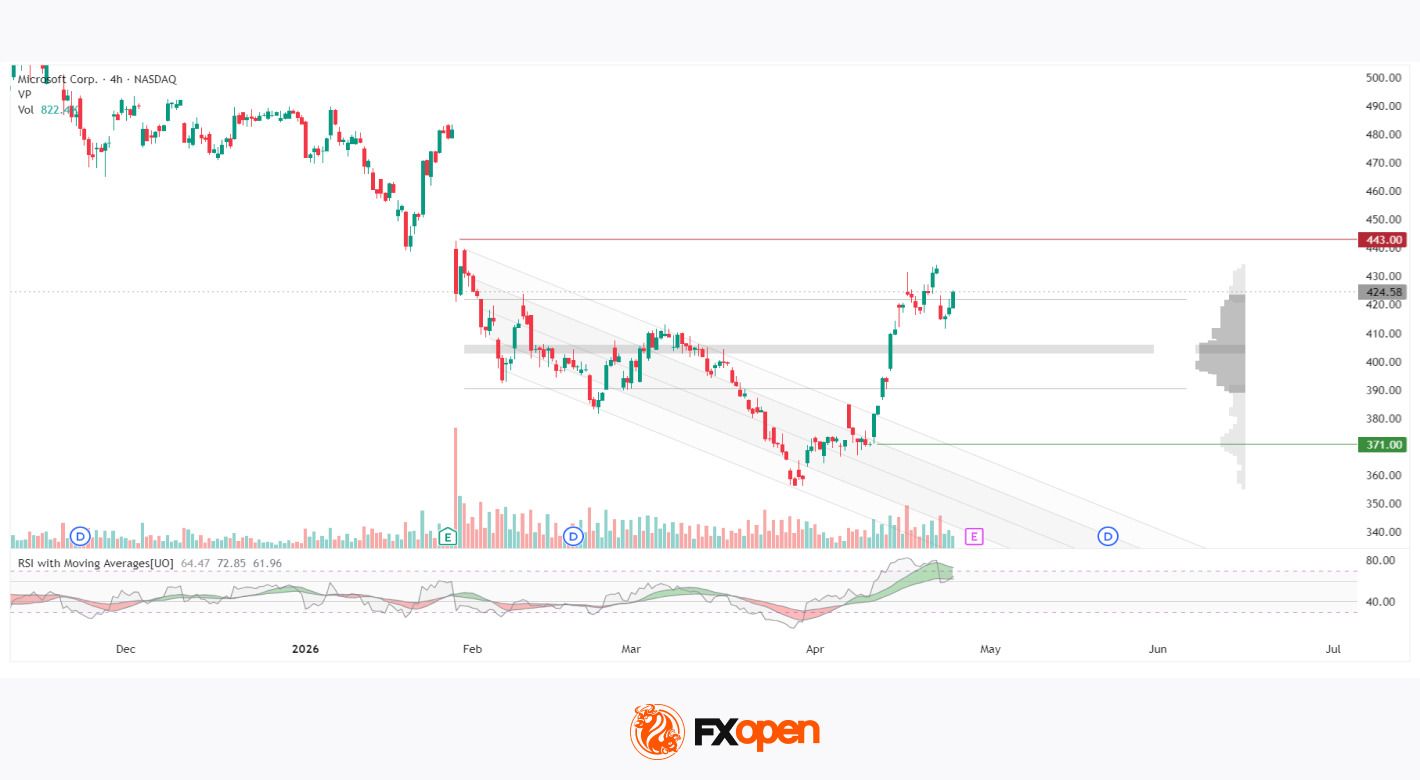
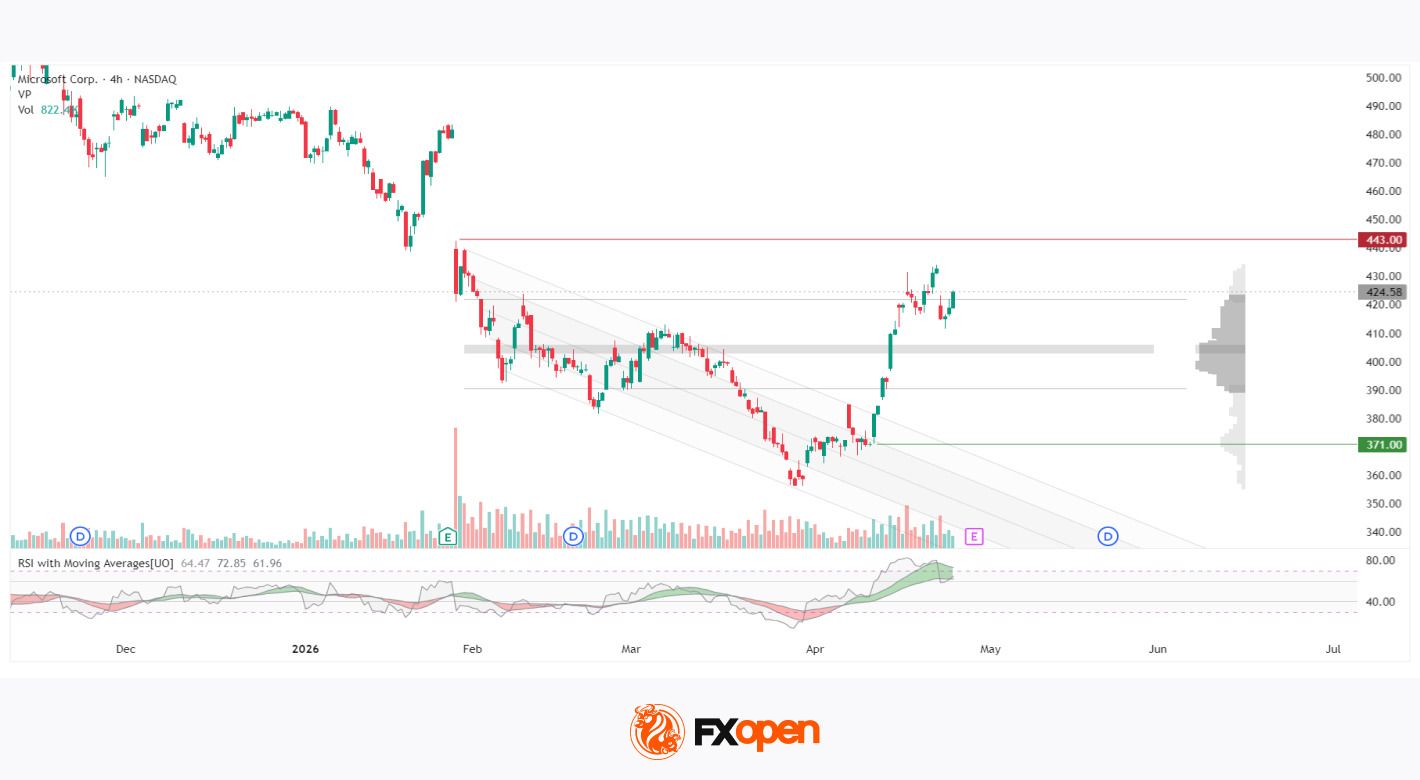
Until late January, Microsoft shares moved sideways, but the 29 January earnings release triggered a sharp gap down accompanied by an abnormal surge in vertical volume, prompting a rapid repricing of the asset. This move laid the foundation for a well-defined downward channel, with the price steadily declining along its boundaries to a low near 357 by the end of March. In April, a recovery pushed the price to around 433, followed by consolidation within the 412–433 range, where it remains ahead of the upcoming earnings announcement.
The horizontal volume balance zone is located at 403–406, with the broader market profile spanning 390–422—current prices are trading above the bulk of accumulated volume. The nearest significant resistance stands at 443, while support levels are seen at 390 and 371. The RSI with moving averages shows readings of 64 / 72 / 61: the oscillator sits between two upward-sloping moving averages, reflecting a bullish bias within the consolidation phase.
Summary
The 412–433 consolidation range is forming just ahead of the 29 April earnings release—an event similar to the one in January that triggered a two-month decline. The volume profile indicates that prices remain above the balance zone at 403–406, while RSI holds in positive territory. The market’s reaction to the upcoming results will determine whether the recovery extends further or the price returns to the prior accumulation range.
Buy and sell stocks of the world’s biggest publicly-listed companies with CFDs on FXOpen’s trading platform. Open your FXOpen account now or learn more about trading share CFDs with FXOpen.
This article represents the opinion of the Companies operating under the FXOpen brand only. It is not to be construed as an offer, solicitation, or recommendation with respect to products and services provided by the Companies operating under the FXOpen brand, nor is it to be considered financial advice.
Crypto World
SK Hynix (000660.KS) Soars to All-Time High Following Intel’s Explosive Earnings Report
TLDR
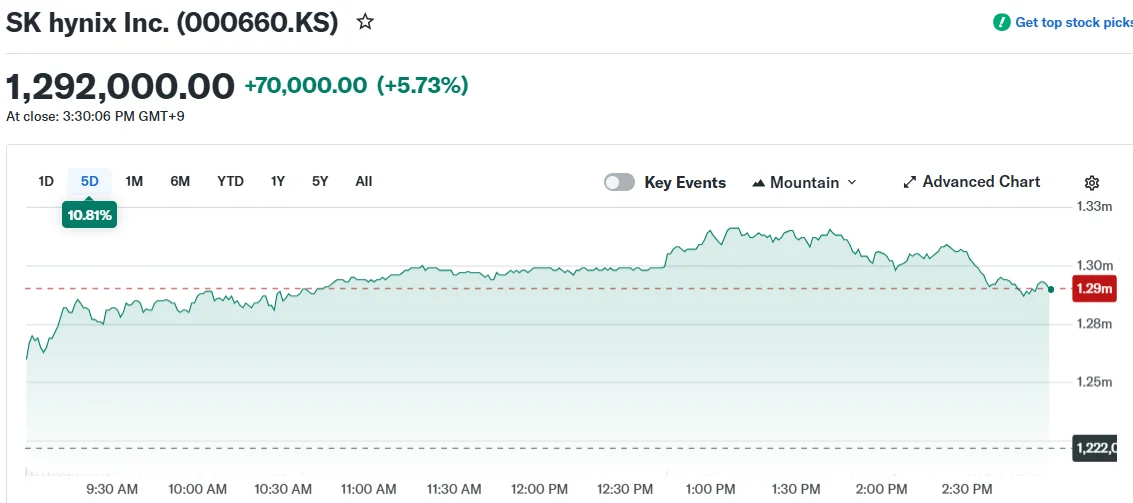
- SK Hynix climbed over 7% during Monday trading, establishing an all-time record
- Intel’s (INTC) robust earnings report triggered the semiconductor sector rally
- The results reinforced bullish sentiment around artificial intelligence chip requirements
- SK Hynix significantly outpaced competitor Samsung Electronics (005930.KS), which advanced 2.5%
- Labor strike threats scheduled for May dampened enthusiasm for Samsung shares
SK Hynix experienced a powerful rally exceeding 7% during Monday’s trading session, establishing a new all-time peak as semiconductor manufacturers benefited from Intel’s impressive quarterly performance.
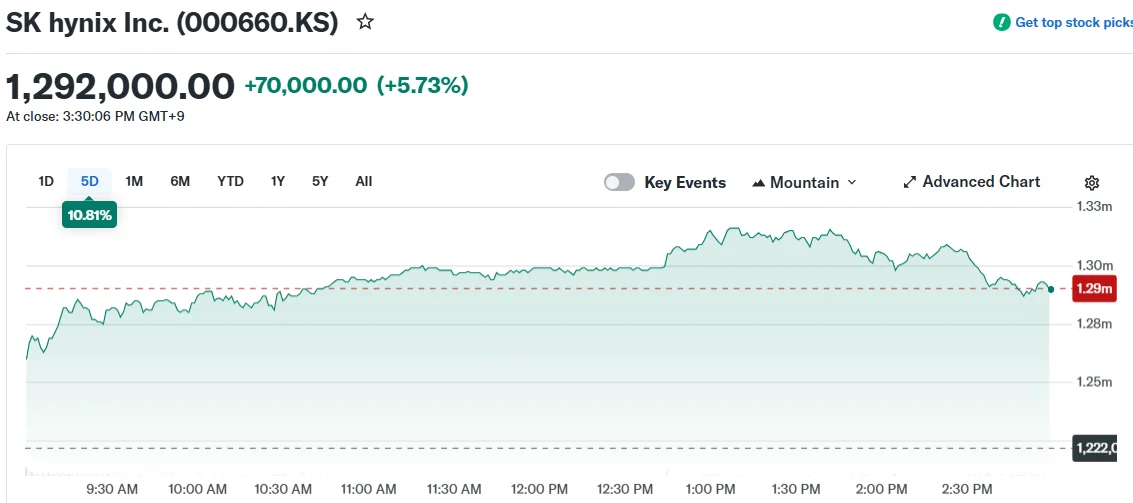
Intel delivered results robust enough to reignite market enthusiasm regarding AI-powered semiconductor requirements. This positive sentiment cascaded throughout the chip industry, with SK Hynix — a critical memory component provider for Nvidia — emerging as one of the session’s top performers.
The advance elevated the South Korean manufacturer to unprecedented territory, underscoring its increasingly vital role within the artificial intelligence infrastructure ecosystem.
Samsung Electronics posted positive movement as well, climbing approximately 2.5% in the same trading period. However, the advance occurred under less favorable circumstances.
The electronics giant confronts potential labor action from unionized employees in South Korea during the upcoming month. This uncertainty constrained Samsung’s upward momentum and expanded the performance differential between the two competitors.
For SK Hynix, the trading day unfolded without complications. No comparable challenges restrained its impressive ascent.
Intel’s Earnings Spark the Move
Intel’s quarterly disclosure served as the primary driver. While Intel itself skyrocketed approximately 23% on the back of its announcement, the broader implications for AI semiconductor demand generated movement across companies like SK Hynix.
Memory components represent essential elements of AI computing architecture. As requirements for AI processing units expand, demand simultaneously increases for the high-bandwidth memory solutions that SK Hynix manufactures. Market participants reacted decisively.
Intel’s earnings triumph provided investors with compelling evidence that AI hardware expenditures remain robust — and SK Hynix occupies a strategic position within that spending trajectory.
SK Hynix vs. Samsung
The performance disparity between SK Hynix’s 7%-plus surge and Samsung’s 2.5% increase reveals an important narrative. While both corporations compete within identical markets, SK Hynix has cultivated stronger positioning within the AI chip landscape through its strategic Nvidia partnership.
Samsung, notwithstanding its considerable size, entered Monday’s session carrying additional concerns. The possible May labor action introduces operational uncertainty that market participants are factoring into valuations, regardless of the ultimate outcome.
SK Hynix currently faces no comparable obstacles, and Monday’s performance illustrated the significance of that advantage.
The stock’s historic peak arrives as worldwide appetite for sophisticated memory components continues its upward trajectory. SK Hynix’s session advance exceeding 7% ranked among the most impressive performances throughout Asian equity markets on Monday.
Intel’s shares jumped approximately 23.7% in response to its earnings announcement, functioning as the catalyst for the comprehensive chip industry rally.



Markets are leaving April with a plethora of macro events to watch. Four major central banks, the Bank of Japan, U.S. Federal Reserve, European Central Bank, and Bank of England, all set interest-rate policy this week.
Layered on top is a slate of U.S. data including first-quarter GDP and March PCE inflation alongside earnings from Visa, Mastercard, Robinhood and some of the biggest tech companies, whose results could either reinforce or unwind the current tone.
Markus Levin, Co-founder of XYO, told CoinDesk that bitcoin is entering the week “with strong momentum around the $78,000 level, and while the Fed is expected to keep rates unchanged, persistent inflation could reinforce a hawkish tone and we could see bitcoin pull back to $72,000–$74,000 range once again in the short-term.”
Tech giants’ earnings, Levin added, could also be a crucial indicator “in reinforcing or challenging the current trajectory given their outsized influence on equity markets, while developments around the U.S.–Iran talks will steer sentiment through oil and dollar movements.”
What to Watch
(All times ET)
- Crypto
- May 1: Full shutdown of Magic Eden’s wallet services.
- Macro
- April 27, 10:00 p.m.: Bank of Japan Interest Rate Decision est. 0.75% (Prev. 0.75%)
- April 29, 8:45 a.m.: Bank of Canada Interest Rate Decision (Prev. 2.25%)
- April 29, 01:00 p.m.: U.S. Fed Interest Rate Decision est. 3.75% (Prev. 3.75%)
- April 30, 4:00 a.m.: Euro Area Inflation Rate YoY Flash for April (Prev. 2.6%)
- April 30, 6:00 a.m.: Bank of England Interest Rate Decision est. 3.75% (Prev. 3.75%)
- April 30, 07:15 a.m.: European Central Bank Interest Rate Decision est. 2.15% (Prev. 2.15%)
- April 30, 07:30 a.m.: U.S. GDP Growth Rate QoQ Adv for Q1 est. 1.5% (Prev. 0.5%)
- April 30, 07:30 a.m.: U.S. PCE Price Index YoY for March(Prev. 2.8%); Core YoY (Prev. 3%)
- April 30, 07:30 a.m.: U.S. Initial Jobless Claims for period ending April 25 est. 219K (Prev. 214K)
- May 1, 09:00 a.m.: U.S. ISM Manufacturing PMI for April est. 52.5 (Prev. 52.7)
- Earnings (Estimates based on FactSet data)
- April 28: Visa (V), post-market, $3.1
- April 28: Robinhood Markets (HOOD), post-market, $0.4
- April 28: Galaxy Digital (GLXY), pre-market, -$0.65
- April 30: Mastercard (MA), pre-market, $4.41
- April 30: Riot Platforms (RIOT), post-market, -$0.32
- April 30: CoinShares (CSHR), annual report expected
- May 1: WisdomTree (WT), pre-market, $0.25
Token Events
- Governance votes & calls
- Frax DAO is voting to add sGHO and USCC as yield strategies within sfrxUSD, expanding the stablecoin’s backing asset set. Voting ends April 26.
- Ether.fi DAO is voting on a treasury contribution to restore rsETH’s backing following the KelpDAO bridge exploit. Voting ends April 27.
- Compound DAO is voting on a proposal to update rsETH price feeds on its WETH and wstETH Ethereum mainnet markets. Voting ends April 27.
- Decentraland DAO is voting on the “2030 Transition Plan,” a strategic roadmap for the platform’s governance and metaverse product positioning. Voting ends April 30.
- Nouns DAO (Prop 959) is voting on a 501(c)(3) feasibility study to explore nonprofit status for the DAO, with significant implications for treasury management and grant-making. Voting ends April 30.
- Beefy DAO is voting on Q2 2026 contributor funding and Staworth contributor renewal. Voting for both ends April 30.
- RootstockCollective is voting on a grant milestone payment for Blockscout’s Global Wallet. Voting ends April 30.
- Arbitrum DAO is voting to transfer 6,000 ETH and roughly $150,000 in idle USDC from its main treasury to the Treasury Management Portfolio. Voting ends May 5.
- Unlocks
- Token Launches
- April 27: Chiliz (CHZ) to roll out FanTokens V2.0
- April 28: Binance to delist Dego Finance (DEGO), DENT (DENT) amd
- April 28: Pharos mainnet launches
- April 30: MegaETH (MEGA) token generation event expected to occur.
- May 1: Venice (VVV) to cut token emissions from 6 million to 5 million per year.
Conferences


Bitcoin (BTC) failed to hold its move toward $80,000 after a sudden wave of selling hit the derivatives market. The price dropped about 2.5% within a few hours and moved back below $78,000.
Summary
- Bitcoin dropped below $78,000 after $1.35 billion in hourly sell pressure hit derivatives markets.
- Binance led the move with about $1.2 billion in sell volume within one hour.
- Analysts said negative funding and falling Binance reserves may point to stronger long-term holders.
CryptoQuant analyst Darkfost said there was no clear announcement behind the move. He linked the correction to strong sell activity in futures markets as BTC approached the $80,000 zone.
Darkfost said Binance recorded about $1.2 billion in sell volume within one hour. Across all exchanges, Bitcoin saw about $1.35 billion in selling pressure during the same period.
The analyst said the data shows Binance remains a key venue for Bitcoin derivatives activity. The sharp move forced BTC to reverse before breaking the $80,000 level.
Funding rates remain deeply negative
Darkfost also noted that Bitcoin funding rates have stayed highly negative for several weeks. He said the 30-day cumulative funding rate has reached -7%, one of the lowest readings on record.
Such negative funding can create short-term pressure when traders build aggressive short positions. However, late short entries can later turn into buying pressure if prices move against them.
On-chain data points to stronger holders
Another CryptoQuant analyst, GugaOnChain, said Bitcoin’s current cycle looks different from past panic phases. He argued that large holders did not sell heavily during the recent geopolitical shock.
The analyst said Bitcoin saw early de-risking after the 2025 top. He said weak hands sold during the decline, while stronger investors absorbed supply near lower price zones.
GugaOnChain also pointed to Bitcoin’s realized price and spot recovery as signs of stronger market structure. He said the spot price recovered toward $79,000 while realized price stayed near $54,100.
The analyst added that Binance reserves fell by about 44,000 BTC after the shock. He described this as evidence that coins moved away from exchanges and into longer-term storage.
Bitcoin now trades in a market split between short-term derivatives pressure and stronger spot behavior. Traders are watching whether negative funding will keep weighing on price or create conditions for a short squeeze.
Key Takeaways
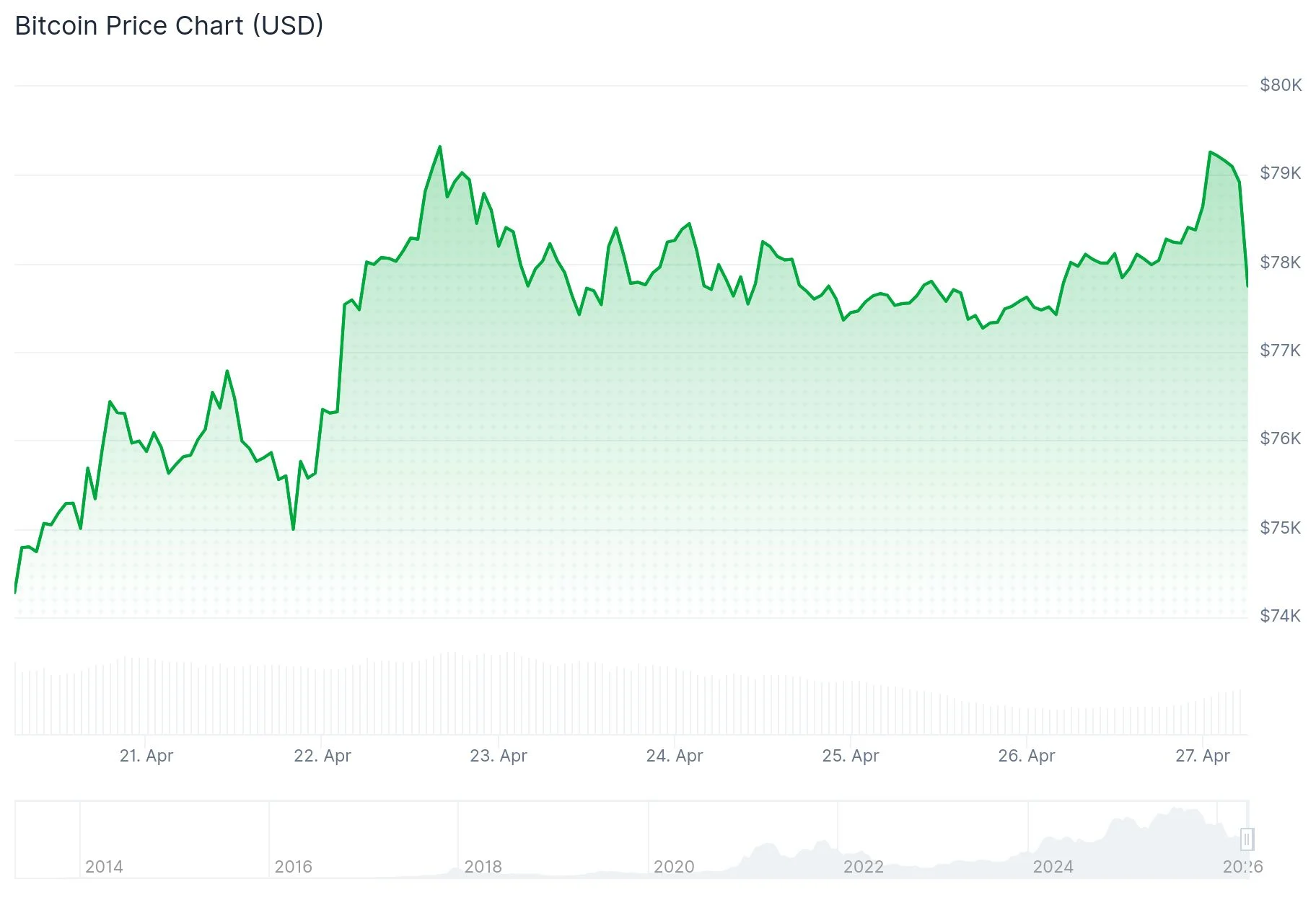
- BTC climbed to a 12-week peak of $79,399 before retreating, representing its fourth unsuccessful attempt to surpass $80,000 recently
- The surge followed news that Iran proposed reopening the Strait of Hormuz, though momentum quickly faded
- April has seen Bitcoin gain 16%, with Strategy accumulating $3.9 billion in BTC during the month
- Equity futures declined Sunday evening as crude oil surged past $100 per barrel amid escalating Iran concerns
- Critical central bank meetings from the Fed and ECB coincide with major technology sector earnings releases this week
Bitcoin surged to $79,399 in overnight trading before encountering resistance and retreating during Monday’s Asian session. The digital asset stabilized near $77,705, representing a modest 0.4% decline over the previous 24-hour period.
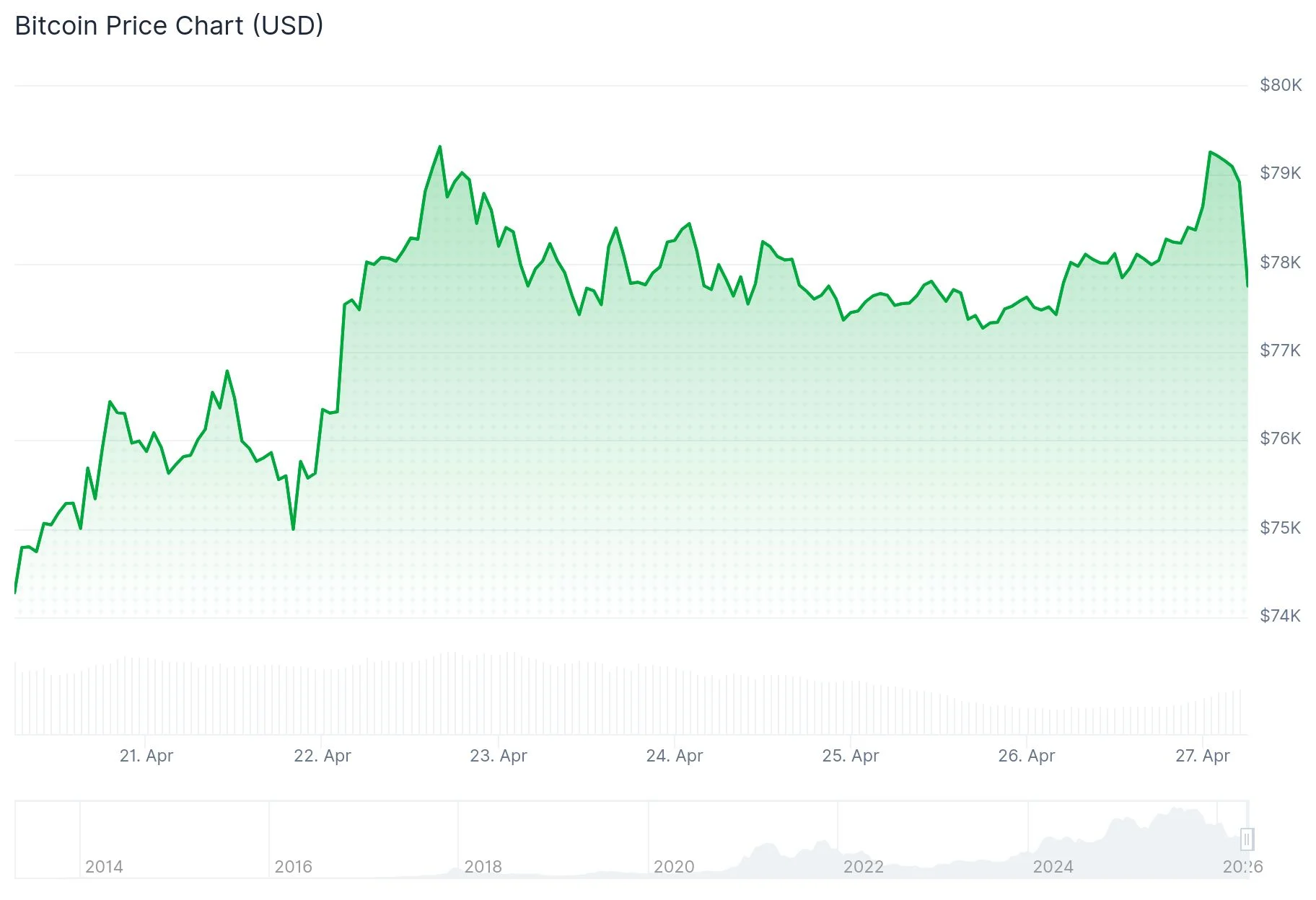
This marked the fourth occasion in recent sessions that bitcoin encountered selling pressure below the $79,000 threshold. The pattern of rejections is establishing a defined resistance zone that traders are monitoring closely.
The upward movement was catalyzed by an Axios report indicating Iran had presented a fresh proposal to restore access to the Strait of Hormuz, connecting nuclear negotiations to the removal of a US naval blockade. The development sent risk-sensitive assets higher initially.
Asian stock markets demonstrated robust gains. The MSCI Asia Pacific Index climbed 1.7%, emerging market indices reached new peaks, and Taiwan Semiconductor Manufacturing jumped 6%. Bitcoin participated in the rally momentarily before momentum evaporated.
Rachael Lucas, an analyst at BTC Markets, noted that the $80,000 price zone represents a breakeven point for numerous recent purchasers. This technical level typically generates selling activity as traders who held losing positions seek to exit without further losses.
The Resistance at $80K Remains Stubborn
Perpetual swap funding rates continue showing negative territory at -0.13% on a seven-day average, data from Coinglass indicates. This dynamic means short position holders are compensating long holders, creating conditions that could produce a short squeeze if bitcoin maintains support above current levels.
Bitcoin is tracking toward its first monthly gain exceeding 10% since May 2025. Strategy executed its largest monthly acquisition in twelve months, purchasing $3.9 billion worth of bitcoin in April, Bloomberg data shows.
Alternative cryptocurrencies also experienced declines. Ether decreased 2.4% to $2,329, Solana retreated 1.9% to $86, while BNB slipped 1.2% to $630.
Equity index futures weakened during Sunday’s overnight session. Dow Jones Industrial Average futures declined approximately 0.2%, with S&P 500 and Nasdaq 100 contracts each falling roughly 0.2%.
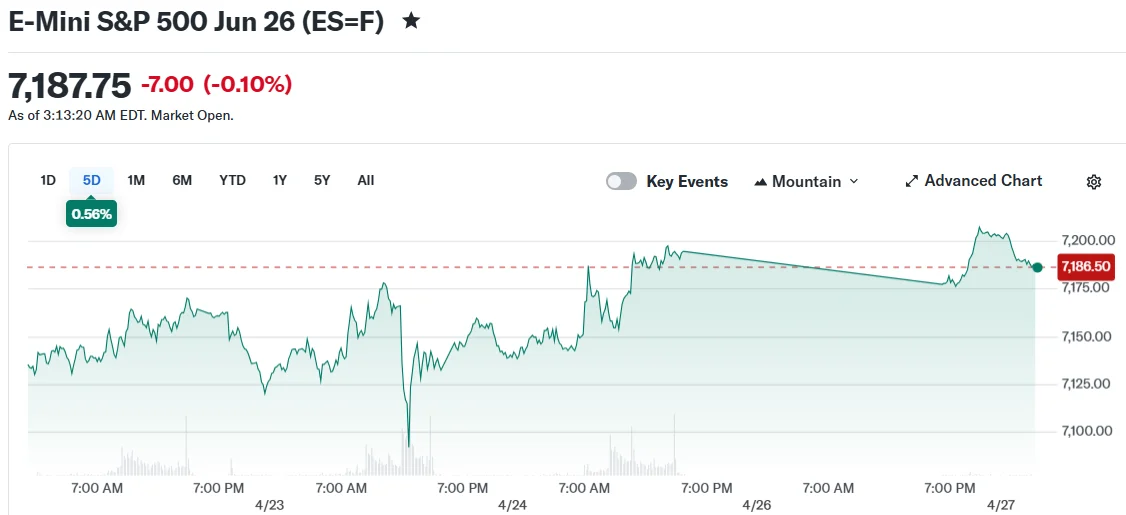
The futures weakness contrasted with last week’s strength, where both the S&P 500 and Nasdaq Composite achieved fresh record closing levels. The S&P 500 advanced more than 9% throughout April while the Nasdaq jumped over 15%.
Critical Week Ahead for Markets
Oil prices extended their advance on geopolitical uncertainty. Brent crude increased approximately 2% to levels exceeding $100 per barrel, with West Texas Intermediate climbing above $96.
Both the Federal Reserve and European Central Bank have monetary policy announcements scheduled this week. This particular Fed meeting holds added significance as one of the final meetings likely chaired by Jerome Powell before Kevin Warsh assumes leadership.
Multiple Magnificent Seven technology companies will report quarterly results this week. Market participants view these earnings as a critical gauge of how mega-cap equities are performing amid current economic conditions.
For bitcoin holders, the focus remains on whether a Fed policy signal or strong corporate earnings can provide the momentum needed to finally breach the stubborn resistance range.
Current market data shows bitcoin trading at $77,705 with persistently negative funding rates and the $80,000 level remaining unconquered after multiple attempts.


South Korea’s internet-only lender KBank has entered into a strategic partnership with Ripple to test blockchain-based cross-border remittances.
Summary
- KBank has partnered with Ripple to test blockchain-based cross-border remittances through a multi-phase proof of concept.
- Testing has moved to a virtual environment where on-chain transfers are being assessed across corridors, including the UAE and Thailand, according to local media reports.
According to multiple local media reports, the collaboration focuses on a proof-of-concept designed to measure improvements in transaction speed, cost efficiency, and transparency using Ripple’s global blockchain network.
Having completed an initial phase, the two firms verified a wallet-based remittance system through an app interface. In the ongoing second phase, reports state that testing has moved to a virtual environment where on-chain transfers are being assessed for stability across corridors, including the UAE and Thailand.
For this stage, KBank is using Ripple’s Palisade platform, a software-as-a-service wallet solution that, according to the same reports, meets international security standards.
Testing expands as regulatory backdrop evolves
Set against South Korea’s upcoming Digital Asset Basic Act, the partnership adds to a growing list of tie-ups between domestic financial institutions and blockchain firms.
Earlier in April, Ripple partnered with Kyobo Life Insurance to support tokenized government bond transactions through its custody platform.
Beyond the proof-of-concept stage, local reports indicate that the KBank partnership could extend into live remittance services and other digital asset initiatives.
As the sole banking partner of Upbit, KBank plays a central role in enabling fiat-to-crypto access under local rules that require exchange users to hold verified bank accounts.
The Upbit relationship has driven user growth, with KBank’s customer base rising from about 2 million in 2020 to 15 million by the end of last year, according to the reported figures.
As previously reported by crypto.news, Ripple recently outlined a four-phase roadmap to secure the XRP Ledger against future quantum computing risks, with Ayo Akinyele stating the threat has moved “from theoretical to credible” and now requires timely preparation.
The plan targets full post-quantum cryptography implementation by 2028, while Phase 2 testing is already underway in 2026, where Ripple’s cryptography team is evaluating NIST-standardised algorithms under live network conditions, including performance impacts on storage, bandwidth, and throughput.

Key Takeaways
- Scallop Protocol experienced a security breach resulting in approximately $142,000 (150,000 SUI tokens) stolen on April 26, 2026
- The vulnerability existed in an outdated V2 rewards contract originally deployed in November 2023
- A critical flaw involving an uninitialized “last_index” variable enabled the attacker to drain the entire rewards balance
- User deposits and primary protocol functions remained secure; normal operations continued within a two-hour window
- The perpetrator has proposed returning 80% of the stolen assets in return for a white-hat reward
A DeFi lending platform operating on Sui Network, Scallop Protocol, suffered a security breach that resulted in approximately $142,000 in SUI tokens being stolen on Sunday following an exploit of a legacy rewards smart contract.
The security incident occurred on April 26, 2026, with Scallop making the breach public at 12:50 UTC through an announcement on X (formerly Twitter).
Rather than compromising the primary protocol infrastructure, the perpetrator focused their attack on an obsolete auxiliary contract connected to Scallop’s sSUI spool—a rewards distribution mechanism designed for SUI token depositors.
The vulnerable smart contract was a V2 spool package that had been deployed in November 2023, making it over 17 months old at the time of exploitation.
On the Sui network, smart contracts become immutable once deployed. Previous versions remain active and accessible unless developers implement explicit version-based access restrictions. This architectural characteristic allowed the legacy contract to persist as an exploitable vulnerability.
The critical security weakness centered on an uninitialized variable named “last_index.” This parameter is designed to monitor accumulated rewards for participants in the staking system. Since this variable was never properly initialized during new account creation, the attacker could join the pool and extract rewards as though they had participated from inception.
The malicious actor staked approximately 136,000 sSUI tokens. Over the preceding 20 months, the spool index had accumulated to roughly 1.19 billion.
This discrepancy enabled the attacker to allocate themselves approximately 162 trillion reward points. Since the rewards distribution system operated on a one-to-one exchange ratio, the entire balance of 150,000 SUI was extracted in a single blockchain transaction.
Blockchain records show the transaction hash 6WNDjCX3W852hipq6yrHhpUaSFHSPWfTxuLKaQkgNfVL documenting the on-chain withdrawal.
Following the theft, the stolen assets were rapidly transferred through a privacy-focused mixing protocol on Sui, comparable to Tornado Cash, significantly complicating recovery efforts.
Team Response and Service Restoration
Scallop’s development team acted swiftly to freeze the compromised contract within minutes of detecting the exploit. Importantly, the core lending and borrowing infrastructure was not suspended. Customer deposits across all other Scallop markets remained fully protected.
The protocol’s leadership confirmed they would absorb 100% of the financial loss using treasury reserves. No reduction in user yield rates will occur as a result of this incident.
By 14:42 UTC, Scallop had reactivated the primary contracts. Standard withdrawal and deposit functionality was restored to normal operation in less than two hours from the initial breach.
Subsequently, the attacker initiated contact with the development team, proposing to return 80% of the stolen funds in exchange for recognition as a white-hat hacker with an associated bounty. The team is currently examining how this vulnerability evaded detection during previous security audits conducted by OtterSec and MoveBit.
DeFi Losses Continue Mounting in April 2026
This security breach comes on the heels of a comparable exploit targeting Volo Protocol earlier this month, which resulted in approximately $3.5 million in losses. Both incidents exploited peripheral contract infrastructure rather than core protocol mechanisms.
April 2026 has witnessed over $600 million in cryptocurrency thefts across 12 significant security incidents. By mid-April, cumulative losses for the month had surpassed $750 million.
Kelp DAO and Drift Protocol together represented approximately 95% of April’s total losses. The Kelp attack independently generated $177 million in bad debt on the Aave lending platform.
Scallop’s team has yet to release a comprehensive post-incident analysis. They have announced plans for an exhaustive security review of all remaining legacy contract packages.
As of this publication, neither the Sui Foundation nor Mysten Labs has issued an official statement regarding the security incident.

About 3.5% of informed traders, including market makers and skilled takers, capture over 30% of profits on prediction platforms, while about 67% of users absorb the entirety of losses.

Stockport quizzer becomes seventh Who Wants To Be A Millionaire?winner
BofA reiterates Nvidia stock rating on shareholder return potential

Goldman Lifts Brent Forecast as Hormuz Closure Drains Global Oil Inventories

Manchester United reach agreement with Casemiro over contract clause amid transfer speculation

US brings back mandatory military draft registration

Steven Gerrard disagrees with Gary Neville over ‘shock’ Chelsea and Arsenal claim | Football


-

 Politics6 days ago
Gary Stevenson delivers timely reminder to register to vote as deadline TODAY
-

 Fashion3 days ago
Weekend Open Thread – Corporette.com
-
Crypto World2 days ago
Hyperliquid $HYPE Rally Builds Momentum as AI Sector Enters Prove-It Phase
-
Crypto World7 days ago
Bank of Hawai’i (BOH) Q1 2026: Net Income Drops to $57.4M as Net Interest Margin Expands
-

 Politics5 days ago
Making troops accountable for war crimes threatens US alliance, ex-SAS colonel warns
-

 Politics5 days ago
Disabled people challenge government SEND proposals over segregation concerns
-

 Business5 days ago
Rolls-Royce Voted UK’s Most Iconic Trade Mark as IPO Register Hits 150
-

 Business3 days ago
Patterson-UTI Energy, Inc. (PTEN) Q1 2026 Earnings Call Transcript
-

 Politics5 days ago
Zack Polanski responds to home secretary’s taser threat
-
 Crypto World6 days ago
Five Value Stocks with Recovery Potential in 2026: PayPal (PYPL), Nike (NKE), and More
-
 Sports20 hours ago
IPL 2026: Ruturaj Gaikwad registers slowest fifty of the season, enters all-time unwanted list | Cricket News
-
Politics5 days ago
Wings Over Scotland | How To Get Away With Crimes
-

 Politics5 days ago
Starmer handler McSweeney to be dragged from shadows by Foreign Affairs Committee
-

 Crypto World5 days ago
New York sues Coinbase, Gemini over prediction market offerings
-
 Business5 days ago
HCL Tech share price tank over 9% after weak Q4. JPMorgan, HSBC & 3 others cut target price
-

 Politics5 days ago
‘Iran is still a nuclear threat’
-
Entertainment6 days ago
Sydney Sweeney cameo cut from “The Devil Wears Prada 2”, source explains why (exclusive)
-

 Fashion6 days ago
Kilkenny Design New Beauty Arrivals for Spring 2026
-

 Crypto World5 days ago
Crypto’s great hope in Senate’s Clarity Act still has a path to survive tight calendar
-
 Sports4 days ago
Tim Bradley names the current best in the world: “Better than Inoue and Usyk”
You must be logged in to post a comment Login