

Crypto World
Bitcoin steadies near $78K as Iran responds to U.S. peace terms

Iran has responded to a U.S. list of conditions for a possible peace deal, according to reports shared by The Kobeissi Letter.
Summary
- Bitcoin stayed near $78,000 as traders weighed Iran’s counterconditions and wider Middle East war risk.
- Crypto.news data showed Bitcoin up slightly daily, but still lower across the past week overall.
- Iran’s demands over sanctions, frozen funds and Hormuz kept oil-linked pressure on risk assets.
Tehran’s stated demands include an end to the war on all fronts across the Middle East, the lifting of U.S. sanctions, the release of frozen Iranian funds, compensation for war damages, and recognition of Iran’s sovereignty over the Strait of Hormuz.
The reported U.S. terms differ sharply. The list includes no compensation for Iran, no release of frozen assets, the transfer of 400 kilograms of uranium to the United States, and only one active nuclear facility. The ceasefire would also depend on further negotiations.
Bitcoin reaction remains cautious
Bitcoin (BTC) traded near $78,400, up 0.69% over 24 hours, based on crypto.news market data. Ethereum (ETH) traded at $2,190, while XRP, BNB, and Solana also posted small daily gains.
The short-term move showed limited relief, not a strong risk rally. Bitcoin remained down 2.94% over seven days, while Ethereum was down 5.81% over the same period. That gap shows traders still view the conflict as a market risk.
Crypto tracks Iran headlines
Crypto.news previously reported that Bitcoin held near $80,000 after President Donald Trump rejected Iran’s earlier peace response. BTC briefly dropped from $81,430 to $80,520 before rebounding above $82,000 within hours.
That pattern has repeated during the conflict. Peace signals have supported short relief rallies, while rejected proposals and military threats have pushed traders back into defensive positions. Earlier market updates said crypto remains sensitive to oil prices, the dollar, and Strait of Hormuz risk.
Notably, the Strait of Hormuz remains a key part of the market reaction. Crypto.news cited Reuters data showing the waterway carried about one-fifth of global oil and liquefied natural gas flows before the war began on February 28.

Crypto World
Justoken Tokenizes $2 Billion in Electricity on XRP Ledger, Driving Structural XRP Demand

TLDR:
- Justoken has tokenized over $2 billion in real electricity production as digital assets on the XRP Ledger.
- Every tokenized asset transaction on XRPL requires XRP for fees, generating constant and measurable network demand.
- New accounts and trust lines formed around tokenized energy assets lock XRP reserves, reducing circulating supply.
- XRP serves as a bridge asset on XRPL’s native DEX, routing liquidity for tokenized electricity trades and settlements.
XRP Ledger has reached a new milestone in real-world asset tokenization. Justoken has placed over $2 billion worth of electricity production onto the XRPL blockchain.
The tokenized assets represent physical energy flowing through power grids. This move turns real energy output into tradable digital financial instruments.
The development creates measurable, ongoing demand for XRP across multiple network functions.
Justoken Brings Physical Energy Assets to XRPL
Justoken has converted real electricity production into digital assets on the XRP Ledger. These are not synthetic instruments or yield-bearing DeFi products.
They represent actual energy generated and distributed through physical power infrastructure. Each tokenized unit carries genuine economic value tied to real-world commodity output.
As X Finance Bull noted in a recent post, “Over $2 billion in electricity is now tokenized on XRP Ledger. Not crypto. Not DeFi yield. Electricity.”
The statement draws attention to the nature of the asset class involved. Energy tokenization at this scale moves XRPL beyond speculative use cases. It positions the network as infrastructure for commodity markets.
Every transaction involving these tokenized assets requires XRP to cover network fees. Issuing, moving, trading, settling, and managing tokens each consume a fraction of XRP.
With $2 billion in tokenized electricity on the network, transactional activity generates constant fee-based demand. That demand is ongoing and tied directly to commodity market activity.
New accounts created to hold or manage these assets also require XRP reserves. More companies, brokers, and settlement wallets mean more accounts.
Each account locks a set amount of XRP just to exist on the ledger. This reserve mechanism removes XRP from circulation with every new market participant.
Trust Lines and Liquidity Routing Drive XRP Demand Further
XRPL tokens operate through a system called trust lines. Each trust line between two parties requires XRP to be held as a reserve.
Thousands of trust lines are expected to form around $2 billion in tokenized energy assets. Each one locks additional XRP in reserve, reducing the circulating supply.
Beyond reserves, the native decentralized exchange on XRPL creates further demand. XRP functions as a bridge asset within payment paths and exchange routes.
When tokenized electricity is traded or settled, liquidity often routes through XRP. This places XRP at the center of commodity-linked financial flows.
The bridge asset function becomes more active as tokenized asset volume grows. More trading pairs, more settlement routes, and more financing activity all pass through XRP.
This is a structural demand driver built into the protocol itself. It operates independently of market sentiment or speculative cycles.
X Finance Bull summarized it directly: “This is not a partnership announcement. This is $2 billion in real-world commodity value creating measurable, ongoing demand for XRP.”
The tokenization of physical energy on XRPL marks a shift in how blockchain infrastructure connects to traditional commodity markets.

USDC users are again asking whether Circle should offer a clearer recovery process for mistaken token transfers.
Summary
- USDC users are questioning Circle’s recovery options after claims of mistaken transfers to inaccessible contracts.
- Tether’s official recovery page says some mistaken USDT deposits may be reviewed case by case.
- Tether freezes far more stablecoin value than Circle across blacklist cases globally.
The debate followed posts from users who said they sent USDC to addresses or contracts they could not access.
One user, Weilin Li, asked on X whether Circle provides a service similar to Tether’s token recovery process after sending USDC to a self-deployed contract.
Blockchain investigator ZachXBT replied that recovery may be technically possible in some cases involving native USDC, but he also criticized Circle’s approach. His comment was an opinion posted on X, not an official finding.
Circle terms warn transfers can be final
Circle’s USDC terms state that once a transaction has been initiated, it cannot be reversed, except as set out in the terms. The company also says USDC transactions are generally nonrefundable.
The same terms warn that sending USDC to a wallet or address that does not support USDC can lead to permanent loss. Circle also says it bears no responsibility for losses from sending USDC to unsupported addresses.
Circle still has address control tools in some cases. Its terms say the company may block certain USDC addresses and freeze related USDC if it links the address to illegal activity or a breach of its rules. Circle also says USDC follows its blocklisting policy.
Tether recovery policy draws comparison
Tether’s official recovery page says Tether token recovery is a process for returning mistakenly deposited Tether tokens. The page warns that sending tokens to the wrong destination can still cause a total loss.
Tether says it may try to help in specific cases at its sole discretion. Its examples include certain contracts that do not correctly support withdrawals, token operation contracts, or other destinations Tether decides may be recoverable.
That difference is central to the current debate. Users are not asking for normal blockchain transfers to be reversed. They are asking whether a stablecoin issuer can freeze trapped tokens and reissue new tokens after identity checks and proof of error.
Crypto.news data shows different issuer behavior
Crypto.news reported that Tether froze about $3.3 billion between 2023 and 2025, compared with about $109 million frozen by Circle. The report said Tether used a freeze, burn, and reissue model in some cases, while Circle mainly acted under court or regulatory orders.
A later report said Tether froze over $514 million USDT across 370 addresses in 30 days, with its 2025 blacklist total reaching $1.26 billion.
Circle has also faced criticism from ZachXBT in other cases. Crypto.news reported in April that he accused Circle of failing to freeze stolen USDC during the Drift Protocol exploit.


Artificial intelligence has ushered in a bull run in stocks that has taken the broader market to new heights. Companies that have tied workforce reductions to the new technology, however, haven’t always fared so well.
CNBC compiled a list of 23 S&P 500 firms across multiple sectors and industries to see how their stocks fared following layoffs linked to AI. Specifically, we looked for companies that explicitly cited artificial intelligence or hinted at increased use of the technology when announcing the workforce reductions.
As of May 15, 13 of those companies, or 56%, have traded in the red from the time of their layoff announcements. For corporations whose shares fell after their AI-linked layoffs, the average decline was about 25%.
Footwear giant Nike cut nearly 800 workers in January, citing a plan to accelerate “automation” at its U.S. distribution centers. As of May 15, the stock was trading down nearly 35% from the time of its workforce reduction.
Similarly, Salesforce has shed about 32% since news of its AI-driven layoffs became public around the end of last summer. The customer relationship management company slashed head count by 4,000 workers in September, noting that its AI-powered team of customer service bots called “Agentforce” had replaced some support engineers.

CRM 1yr chart
Later that month, online marketplace Fiverr also laid off 30% of its staff to become “an AI-first company that’s leaner, faster, with a modern AI-focused tech infrastructure” and a smaller team, according to CEO Micha Kaufman. The stock has plunged 54% from that time to May 15.
While only a small sample size, the data underscores an uncomfortable reality: Investors don’t know what to make of AI and its potential impacts, even as usage of the technology widens, Daniel Keum, associate professor of management at Columbia Business School, told CNBC.
“AI is sort of what we call a sort of macro shock,” Keum said. “There’s a lot of uncertainty in what it will do. No one really has a good grasp of … [its] mid- to long-term impact.”
What’s certain is that AI is being used to cut labor costs in the “vast majority” of cases, despite makers of the technology touting its other applications, he said.
“There’s a zero sumness to productivity gains, meaning yes … I’m using new technologies … to cut staff … but my competitors are doing the same,” Keum said. “If everybody’s sort of improving, then the baseline is just shifting and no one is more profitable.”
Blaming AI?
As AI has attracted buzz, so too has the idea that companies could use the technology to eliminate jobs and otherwise cut costs.
By one estimate, at least 112,000 jobs losses can be tied to AI adoption since the start of 2025. In a study released in November, the Massachusetts Institute of Technology also found that AI can already do the job of 11.7% of the U.S. labor market and save companies as much as $1.2 trillion in wages in a variety of sectors.
However, investors have struggled to discern whether firms are truly making decisions informed by AI or simply using the technology as a way to explain away old-fashioned cost cutting or balance-sheet blunders, according to Ally Warson, partner at AI-focused venture capital firm UP.Partners.
The concept is so top of mind for investors and other members of the public that there’s even a name for it: “AI washing.”
“Companies will leverage whatever is in the media or the accepted narrative to potentially cloak why or why not they may lay people off,” Warson told CNBC.
Investors are also grappling with how to measure the influence of AI on companies as several geopolitical and macroeconomic issues also weigh on their stocks, according to Keum.
“Huge geopolitical shocks” such as the Iran war have led to layoffs, while President Donald Trump’s tariffs unveiled last year have added to pressures to cut costs, Keum said. And, an unwinding of pandemic-era over-hiring also remains at play.
“Then, there’s the true shock of AI,” Keum said. “How much we can attribute to each … everyone’s guessing.”
‘Job cuts aren’t enough’
Amid those uncertainties, investors are looking beyond layoffs to other ways AI can boost bottom lines, according to Noah Hamman, CEO and founder of investment management firm AdvisorShares.
“The job cuts aren’t enough,” Hamman said. “People are looking at what … [companies are] spending and then trying to figure out who’s going to actually get successful returns out of all those investments.”
The investor cited Google, which is owned by publicly traded Alphabet, as an example of a firm that is boosting its business with AI. Its generative AI tool Gemini has contributed to cloud revenue, strengthened search and boosted user engagement across the Google ecosystem, he noted.
GOOGL 1yr
The emerging tech is also powering robotics designed for manufacturing, industrial and construction companies, according to Warson, who invests in physical AI startups. Those robots can make dangerous tasks like window washing or wind turbine inspections more efficient and reduce costly workplace injuries, potentially boosting businesses’ bottom lines.
One thing is clear, though: Layoff announcements tied to great use of artificial intelligence may not be enough to boost a company’s stock price — at least long term.
TLDR:
- OpenAI raised $4B to launch a consulting firm competing directly with Deloitte, PwC, and Ernst & Young
- Anthropic countered with a $1.5B consulting venture backed by Blackstone and Goldman Sachs within weeks
- Goldman Sachs reports software P/E multiples fell to 20x, the lowest absolute reading recorded since 2014
- 88% of organizations running AI agents reported at least one security incident over the past twelve months
The enterprise software sector is undergoing a structural shift as artificial intelligence reshapes how businesses buy and deploy technology.
Valuations across public SaaS companies have declined sharply, with 90% of stocks trading 30–80% below their 52-week highs.
Meanwhile, leading AI labs are moving beyond model development into hands-on consulting. The combined moves signal a broader realignment of where value is created in the software industry.
Low-End SaaS Tools Are Being Replaced by AI Workflows
The first segment to feel the pressure has been lightweight, single-function software products. Tools priced around $49 per seat per month are losing ground to AI agents that replicate their functions automatically.
Businesses no longer purchase a dedicated tool for a narrow task — they describe what they need, and AI builds and executes it.
Milk Road AI noted on X that “the low end of the market is basically finished,” citing investor Chamath Palihapitiya’s recent diagnosis of the sector.
The seat-based pricing model that built the SaaS industry does not translate to this new transaction type. As a result, the economic foundation of many small business software products is eroding.
Goldman Sachs data reflects the broader damage. Software forward price-to-earnings multiples dropped from 35x to 20x — the lowest level since 2014.
That multiple is also the smallest premium to the S&P 500 since 2010, pointing to a sector-wide reassessment of growth prospects.
Mid-market point solutions without proprietary data assets face a similar trajectory. Products that lack defensible data flywheels or deep vertical integration are increasingly vulnerable to displacement by general-purpose AI systems.
AI Labs Are Now Competing Directly With Top Consulting Firms
At the high end of the market, the challenge is different — but no less serious. OpenAI recently raised $4 billion from investors including TPG, Brookfield, Bain, and McKinsey to launch a consulting division. The venture targets direct competition with firms like Deloitte, PwC, Ernst & Young, and Accenture.
The structure of the deal is notable. Investors were guaranteed a 17.5% annual return — roughly $700 million per year — from a company projected to lose $14 billion in 2026.
The move came after OpenAI’s enterprise LLM market share dropped from 50% to 25% between late 2023 and mid-2025, with Anthropic rising to 32%.
Anthropic responded almost immediately with a competing $1.5 billion consulting venture, backed by Blackstone, Goldman Sachs, and Hellman & Friedman.
Together, the two labs committed $5.5 billion to human-powered enterprise deployment within a single month. The scale of that spending reflects how difficult real-world AI implementation remains.
Data supports that difficulty. Some 88% of organizations running AI agents reported a security incident in the past year.
Additionally, 42% of C-suite executives said AI adoption is generating internal organizational conflict. Average year-one implementation costs through consulting run $228,000 — nearly three times the platform-based alternative.


Japan’s major brokerage groups are preparing crypto investment trust products as regulators work toward allowing funds to hold digital assets by 2028.
Summary
- SBI and Rakuten are preparing in-house crypto investment trusts for Japanese retail investors.
- Nomura, Daiwa, SMBC and Mizuho-linked firms are studying crypto fund products as rules evolve.
- Japan’s 2028 roadmap could allow investment trusts and ETFs to hold Bitcoin and Ether.
SBI Securities and Rakuten Securities are already developing products inside their own groups, according to a Nikkei report.
The planned products could give retail investors crypto exposure through regular securities accounts. Today, many Japanese users still need exchange accounts or wallets to buy crypto directly. Investment trusts would reduce that barrier and place Bitcoin and Ethereum exposure inside a familiar fund structure.
SBI and Rakuten build in-house products
SBI Securities plans to sell products developed by SBI Global Asset Management. The funds are expected to focus on highly liquid assets such as Bitcoin and Ethereum, with both exchange-traded funds and investment trusts under review.
Rakuten Securities is also preparing crypto investment trust products through Rakuten Investment Management and other group firms. The company wants users to trade the products directly through smartphone apps, according to the report.
Moreover, Nomura and Daiwa have also announced plans to develop crypto investment trusts once the regulatory framework becomes clear. SMBC Group, including SMBC Nikko, has formed a task force to study possible products, while Asset Management One under Mizuho Financial Group has started early research.
A survey cited in market updates said 11 of 18 major Japanese brokerage firms may offer crypto investment trust products after approval. That shows broad interest from traditional finance, even before the rules are complete.
Japan’s crypto fund roadmap advances
Japan’s Financial Services Agency is expected to revise rules under the Investment Trust Act by 2028. The change would add crypto assets to the list of assets that investment trusts can hold.
Crypto.news reported that Japan recently reclassified crypto as a financial instrument under the Financial Instruments and Exchange Act. The change adds stronger market rules, including annual disclosure requirements and insider trading restrictions.
The same policy shift supports Japan’s plan to approve spot crypto ETFs by 2028. Crypto.news reported earlier that Nomura Holdings and SBI Holdings are expected to be among the first major firms to develop crypto-linked ETF products.
SBI’s broader crypto activity also continues. Market updates from crypto.news said the group has pursued Bitbank subsidiary talks and launched a Visa card offering Bitcoin, Ethereum and XRP rewards. Those moves show how Japan’s brokerage groups are building retail crypto access across funds, exchanges and payment products.
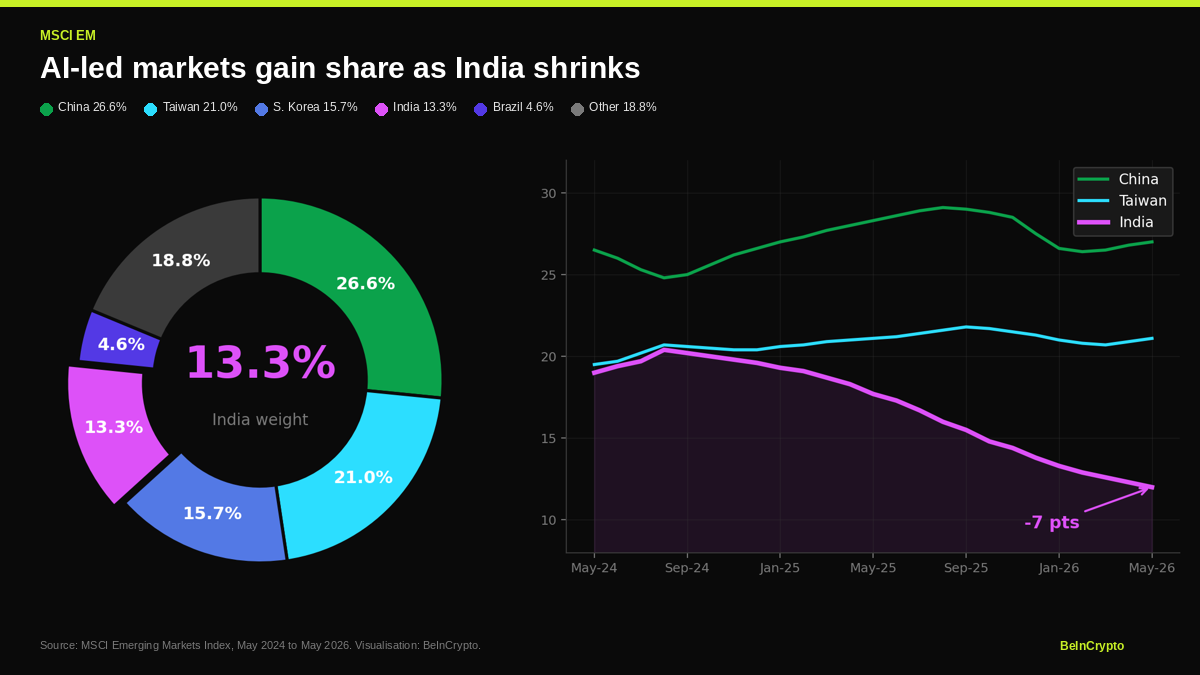
Global investors are rerouting capital away from India and into Asian markets tied to AI infrastructure, leaving the country at risk of falling out of the world’s five largest stock markets for the first time in three years.
The shift goes beyond one quarter of weak earnings. It reflects a structural change in how AI exposure now drives capital allocation across emerging markets, with India holding a few of the names global funds want to own right now.
Capital Flight Pulls India Down the MSCI Rankings
India’s weight in the MSCI Emerging Markets index has dropped to about 12% from roughly 19% a year ago, according to index provider data.

Reports indicate that foreign investors have withdrawn a net $21 billion from Indian equities so far in 2026.
Goldman Sachs estimates foreign ownership of the market sits at a 14-year low and now trails domestic institutions for the first time in more than two decades.
Roughly two-thirds of the reallocation reflects AI positioning, M&G Investments said.
Since the country’s market value peaked near $5.73 trillion in September 2024, about $924 billion has been erased from Indian equities.
Taiwan and South Korea Absorb the Capital India is Losing
Taiwan’s TAIEX has climbed roughly 42% year-to-date, while South Korea’s KOSPI has set fresh highs on AI chip strength, according to exchange data. Together, the two markets have added several trillion dollars in equity value over the past year.

Their listed champions, led by TSMC, Samsung, and SK Hynix, sit directly on the AI buildout that Indian companies do not supply.
The same rotation is bleeding into newer products such as a hybrid crypto-equity benchmark from S&P Global that pairs large-cap stocks with leading AI-linked tokens.
GenAI Squeezes India’s IT Services Giants
The Nifty IT index has fallen about 26% in 2026, while the broader Nifty 50 is down close to 9%.

Tata Consultancy Services and Infosys, which anchor India’s $315 billion IT services sector, hit fresh 52-week lows after OpenAI announced a new enterprise deployment unit.
Generative AI tools are automating the coding, testing, and back-office work that those firms have built their margins on.
Some 15 million Indians work in IT services and global capability centers, putting an entire layer of the economy in the path of AI-driven agents.
Indian policymakers are pushing semiconductor incentives, data center expansion, and a national AI mission. However, the next several quarters will show whether those bets can stop the structural drift away from the country’s equity market.
The post India is Losing Investors Fast Amid Global AI Boom appeared first on BeInCrypto.
TLDR:
- China, the US, and UAE conducted their first-ever joint law enforcement operation targeting crypto fraud in Dubai.
- Authorities dismantled nine fraud compounds and arrested 276 suspects involved in romance-based crypto scams.
- Fraudsters built fake romantic relationships on social media before pushing victims into fraudulent crypto projects.
- China’s Ministry of Public Security pledged deeper global cooperation to combat telecom and cryptocurrency fraud networks.
Police authorities from China, the United States, and the UAE recently carried out their first joint international law enforcement operation in Dubai.
The operation targeted telecom and online fraud networks running cryptocurrency romance scams. Together, the three nations dismantled nine fraud compounds and arrested 276 suspects.
The groups used fake romantic relationships to pull victims into fraudulent crypto investment schemes, causing widespread financial losses globally.
Three Nations Unite Against Crypto Fraud Networks
The joint operation marked a historic step in cross-border law enforcement cooperation. China’s Ministry of Public Security confirmed the details on Sunday through an official statement. The coordinated effort brought together agencies from three major world powers for the first time.
Investigations revealed that the fraud rings operated through social media platforms. Suspects built romantic relationships with unsuspecting victims over time. Once trust was established, they pushed victims toward fake high-return cryptocurrency projects.
These schemes are widely known in the crypto space as “pig-butchering” scams. The term refers to how fraudsters fatten victims financially before draining their funds completely. Victims often lose life savings through these elaborate deceptions.
Xinhua News Agency confirmed the scale of the operation through an official post on X, stating that police from the three nations “dismantled nine fraud dens and captured 276 suspects in the operation.”
Operation Targets Nine Fraud Compounds Across Dubai
The law enforcement teams moved simultaneously across multiple locations in Dubai. Nine fraud compounds were dismantled during the course of the operation. A total of 276 suspects were taken into custody following the raids.
A Chinese Ministry of Public Security official described the operation as a major achievement in international policing.
The official further stated, “Chinese police will continue to deepen pragmatic cooperation with more countries, carry out joint crackdowns, thoroughly dismantle telecom fraud dens.” The statement reflected a firm commitment to sustained cross-border enforcement.
The official added that authorities would “make every effort to apprehend suspects involved in such crimes to effectively safeguard the legitimate rights and interests of people in all countries.”
That position signals a long-term enforcement strategy beyond this single operation. Protecting victims across borders remains a stated priority for Chinese law enforcement.
Crypto romance scams have grown rapidly over the past several years. Fraudsters exploit trust and emotional connection to manipulate victims financially.
Law enforcement agencies worldwide have been working harder to track and shut down these operations. This Dubai operation shows that international coordination is now producing concrete results on the ground.

Harborne Enters Britain’s Rich List with £18.2 Billion Fortune
Financier and cryptocurrency investor Christopher Harborne is up for re-entry on the 2026 Sunday Times Rich List in sixth place, with new political focus on his financial ties with Reform UK leader Nigel Farage.
The annual ranking, released Thursday, put Harborne’s net worth at £18.2 billion, bolstered mainly by his reported 12% stake in a stablecoin platform that has been founded by Tether, which is now estimated to be worth about $200 billion. The figure has made Harborne one of the nation’s wealthiest, and the most affluent British-born, to appear on this year’s list.
Harborne has been residing in Thailand for over 20 years and holds Thai citizenship as Chakrit Sakunkrit, having made his fortune from investments related to digital assets and financial technology. The magazine said his wealth is greater than all of Yorkshire’s 10 wealthiest residents.
Harborne’s financial details came on the same day as Parliament officially launched an investigation into whether Farage broke Commons’ conduct rules by not declaring a £5m gift he allegedly received from Harborne back in early 2024.
The inquiry was initiated by the Parliamentary Standards Commissioner under Rule 5 of the Commons Code of Conduct, which asks whether the payment was required to be recorded in Parliament’s register of members’ interests.
Harborne Emerges as Reform UK’s Largest Financial Backer
Farage has denied any wrongdoing, saying the payment was an “unconditional personal gift” to aid with his security costs. There was, he said, “no case to answer” and the cash was “a reward for campaigning for Brexit for 27 years.”
The row has raised concerns about Farage’s £1.4m property, which he bought within a few months of receiving the money, and which has been subject to a separate investigation into charges of breach of trust by the Leadenham Parish Council.
Since the creation of Reform UK, Harborne has become one of the biggest financial supporters of the party. He has given over £22 million to the party, including a £9 million donation in August 2025, first reported in the public record at the time as the highest donation ever by a living British individual to a political party.
Reform UK also became the first political party in the Westminster system to make public acceptances of cryptocurrency donations, adding to their ties with the digital asset sector.
The impact of Harborne goes beyond Westminster. The Liberal Democrats earlier this year requested the FCA to investigate Farage’s ties with Bitcoin treasury company Stack BTC, given his presence in a promotional video released by the business when he was alleged to hold a 6.31% stake in the company.
The developments put both Harborne and Farage at the heart of debate regarding political transparency, cryptocurrency financing and the increasingly significant role of digital wealth in British politics.
Frequently Asked Questions
Q1: Who Is Christopher Harborne
A British-born crypto investor linked to Tether and digital finance.
Q2: Why Is Harborne in the Spotlight
He entered the UK Rich List while facing scrutiny over ties to Nigel Farage.
Q3: What Is Farage Being Investigated For
Allegedly failing to declare a £5 million gift from Harborne.
Q4: How Much Has Harborne Donated to Reform UK
More than £22 million, including a record £9 million donation.
TLDR:
- A wallet dormant since 2013 transferred 500 BTC, triggering a 3% BTC price drop to $78,000 within hours.
- Alphractal data shows 72% of dormant wallet moves in 2026 resolved as OTC transfers within just 48 hours.
- Long positions near $79,400 were liquidated within 90 minutes of the Whale Alert ping at 19:16 UTC last week.
- The W-R Delta hit -1.8σ on the dump — a back-tested buy zone with 11 profitable resolves across 14 total events.
A dormant Bitcoin wallet that had been inactive since 2013 transferred 500 BTC to a fresh address at 19:16 UTC last week.
The move immediately preceded a 3% price decline, pushing BTC to $78,000. On-chain analysts at Alphractal have been tracking similar events since 2024.
Their data shows these transfers follow a consistent and tradeable pattern rather than a random market shock.
Old Supply Movements Follow a Measurable Structure
Alphractal’s monitoring system classifies dormant Bitcoin wallet transfers by the age of the coins involved. Wallets holding supply dormant for more than five years trigger an Accumulation Cohort Heatmap alert. Wallets inactive for over a decade generate a separate, higher-priority tier.
The distinction matters because supply dormant for ten or more years was acquired below $1,000. That cost basis creates a vastly different seller psychology compared to more recent holders.
When a transfer routes to a fresh, non-exchange address, Alphractal’s data assigns a 72% probability of an over-the-counter settlement. That figure comes from logging every qualifying transfer throughout 2026.
Transfers landing on exchange hot wallets represent only the remaining 28% of outcomes, which analysts treat as a fade signal rather than a directional one.
The 19:16 UTC transfer last week fit the OTC profile. Within 90 minutes of the Whale Alert notification, long positions worth exposure near $79,400 were liquidated.
The liquidation cascade followed the 4-hour chart’s pre-existing risk levels rather than appearing as a random wipeout.
The Sentiment Fade and Entry Signal After the Dump
Beyond liquidation mechanics, every dormant Bitcoin wallet awakening above ten years has reset Holder Sentiment by 8 to 14 points since 2024, per Alphractal’s tracking. That consistent sentiment shift creates a repeatable fade trade on the post-event tape.
Alphractal also cross-references the Smart Money Flow Index during these events. Real distribution, according to their framework, appears on the SMFI 30 minutes before the event and extends up to six hours after. Retail news coverage typically catches up well after that window closes.
The Active Distribution Cohort Index adds a further filter. Old supply unlocking shifts the ADCI’s distribution tail, which serves as a leading signal.
It helps analysts determine whether the move triggers a broader price wave or remains isolated to the immediate event window.
On the W-R Delta metric, last week’s dump registered at negative 1.8 standard deviations. Alphractal has back-tested that extreme across 14 comparable events since 2024, recording 11 profitable long resolves.
As the firm noted via X, “dormant supply moves are NOT bearish events. They’re liquidity transfers. The dump is the entry, not the exit.”
TLDR:
- Binance stablecoin netflows surpassed +$1.5B on May 14, reversing days of heavy outflows.
- ERC20 USDT drove most inflows, with only $99M in TRC20 USDT outflows recorded that same day.
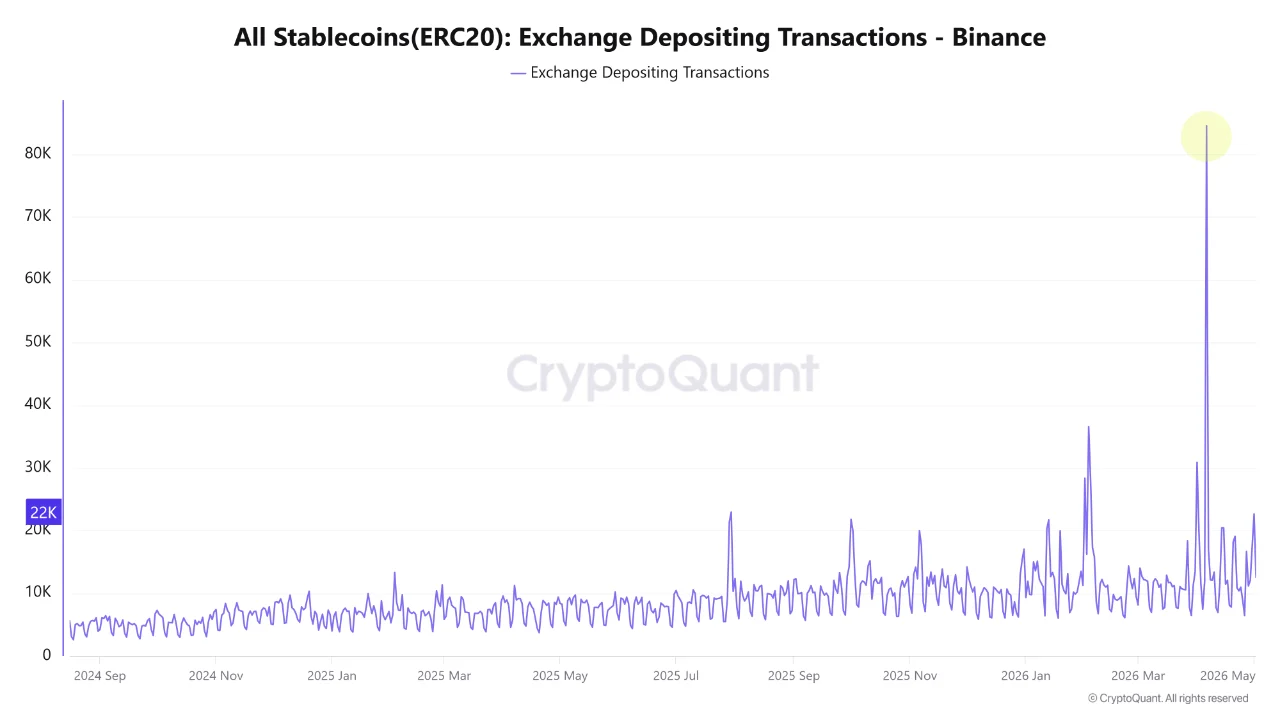
- Deposit transactions on Binance neared 85,000 in a day, reflecting broad wallet-level activity.
- Stablecoin demand stays reactive to BTC price swings between the $80K and $82K trading range.
Binance stablecoin netflows recorded a sharp positive swing on May 14, exceeding +$1.5 billion in a single day. This came after several consecutive days of heavy outflows, including nearly -$1.3 billion on May 12 alone.
The turnaround points to a sudden shift in how investors are positioning liquidity on the exchange. Market sentiment, however, remains closely tied to Bitcoin’s price movements within its current trading range.
ERC20 USDT Leads Inflow Activity on Binance
The bulk of the May 14 inflows came from ERC20 USDT transfers onto the exchange. On-chain data shows only $99 million in TRC20 USDT outflows recorded throughout the same day.
This rules out a straightforward rebalancing between the two USDT networks as the primary driver. The movement, therefore, reflects a genuine directional shift in stablecoin demand.
CryptoQuant analyst Darkfost noted that previous days were dominated mostly by outflows before this reversal occurred. The swing from -$1.3 billion to +$1.5 billion within two days is a notable change in flow dynamics.
Still, Darkfost pointed out that demand remains erratic and largely reactive to short-term price action. Investors appear to move quickly when BTC approaches $82,000, then pull back just as fast below $80,000.
For this trend to carry weight, stablecoin netflows will need to hold consistently in positive territory over time. A single day of strong inflows does not confirm a structural change in market behavior.
Sustained positive flows would be a more reliable indicator of genuine buying interest. Until that happens, the current pattern reflects short-term sentiment rather than a broader accumulation trend.
Analysts continue to monitor these flows as a proxy for how liquidity is being directed across the crypto market. Stablecoin movements into exchanges often precede spot purchases, derivatives activity, or collateral positioning. Tracking them gives a clearer picture of where capital is sitting and how quickly it may deploy.
Deposit Transaction Count Hits Near 85,000 in a Single Day
Beyond raw dollar volume, the number of ERC20 stablecoin deposit transactions on Binance also spiked sharply. According to CryptoQuant researcher Rei Researcher, the metric reached nearly 85,000 transactions per day.
This figure measures individual transfer orders, not total monetary value. The spike points to a broad increase in the number of wallets actively moving funds onto the exchange.
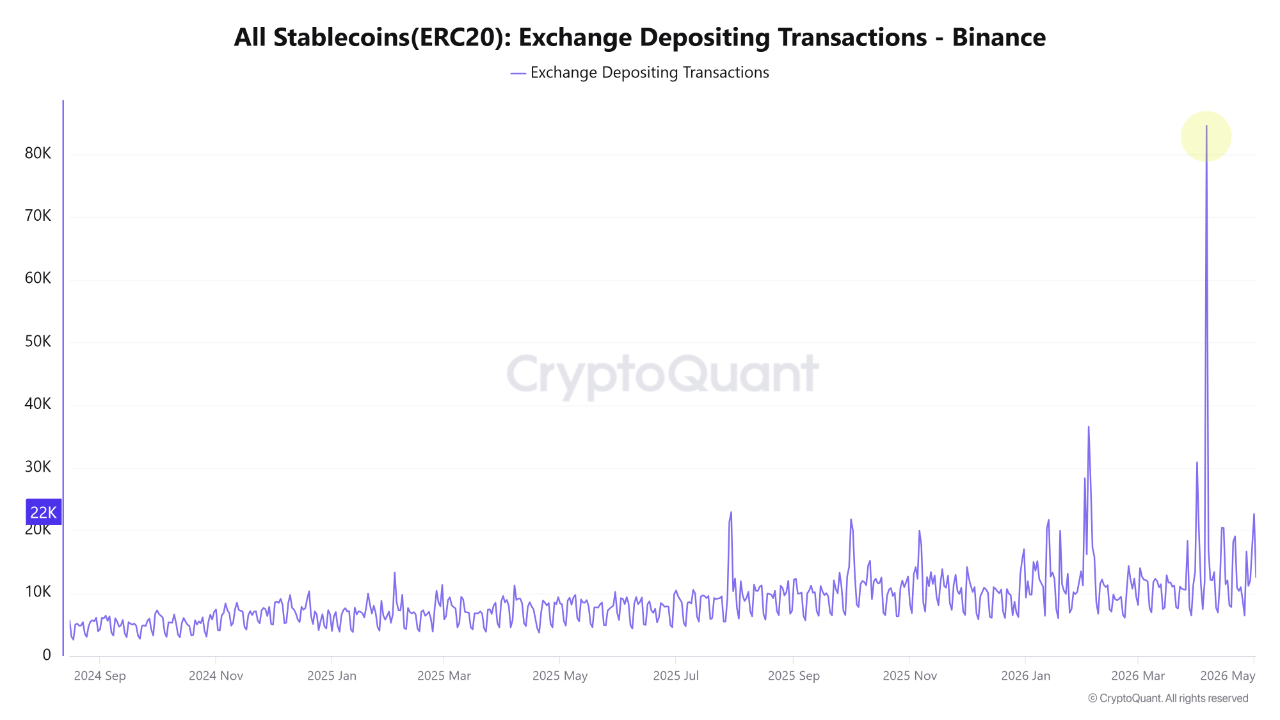
Source: Cryptoquant
During volatile market periods, stablecoin deposits typically serve multiple purposes across different participant types. These include spot portfolio adjustments, collateral allocation, and token swaps.
The surge in transaction count shows that retail and institutional participants alike are responding to current price conditions. This level of activity, even in a slow market, confirms that liquidity interest remains present.
The combination of high inflow volume and elevated transaction counts shows that capital is actively moving, not sitting idle. Whether this translates into sustained buying pressure depends on how price action develops in the near term.
Justoken Tokenizes $2 Billion in Electricity on XRP Ledger, Driving Structural XRP Demand

Padres’ Lucas Giolito ready to feel ‘normal’ in debut vs. Mariners

Corsair Vanguard Air 99 Wireless review: a premium keyboard with great keys and a high price

Manchester United reach agreement with Casemiro over contract clause amid transfer speculation

US brings back mandatory military draft registration

Steven Gerrard disagrees with Gary Neville over ‘shock’ Chelsea and Arsenal claim | Football


-

 Crypto World2 days ago
BloFin War of Whales 2026 Grand Prix opens registration for $5M trading championship
-

 Fashion2 days ago
Weekend Open Thread: Theory – Corporette.com
-

 Crypto World2 days ago
E-Estate Announces 1 Year Live: Washington DC Summit as Real Estate Tokenization Enters Its Next Phase
-

 Fashion6 days ago
Coffee Break: Travel Steam Iron
-

 Fashion6 days ago
What to Know Before Buying a Curling Wand or Curling Iron
-

 Politics6 days ago
What to expect when you’re expecting a budget
-

 Tech2 days ago
Tech Moves: Microsoft AI leader jumps to OpenAI; former AI2 exec joins Meta; and more
-

 Tech6 days ago
GM Agrees To Pay $12.75 Million To Settle California Lawsuit Over Misuse Of Customers’ Driving Data
-
Crypto World4 days ago
Bitcoin Suisse expands with Digital Asset License and Investment Business Act Registration Approval in Bermuda
-

 Tech6 days ago
GM agrees to $12.75M California settlement over sale of drivers’ data
-

 Politics5 days ago
Pakistan to enter Chinese capital market as war inflation bites
-

 Crypto World5 days ago
Bitcoin Suisse expands with Digital Asset License and Investment Business Act Registration Approval in Bermuda
-
 Crypto World3 days ago
Google’s Gemini AI Predicts Incredible Solana Price by the End of 2026
-

 Tech2 days ago
Google reimburses Register sources who were victims of API fraud
-

 Business2 days ago
H&R Real Estate Investment Trust (HR.UN:CA) Q1 2026 Earnings Call Transcript
-
 Entertainment7 days ago
Prime Video’s Forgotten but Brilliant 2-Part Horror Anthology Is a Perfect Binge
-
 Entertainment7 days ago
‘Rivals’ Season 2 Is Bigger, Better, and Raunchier Than Ever
-
 Tech7 days ago
University of Michigan’s $20M early OpenAI investment now worth $2B as Musk trial documents reveal endowment bet
-
 Tech6 days ago
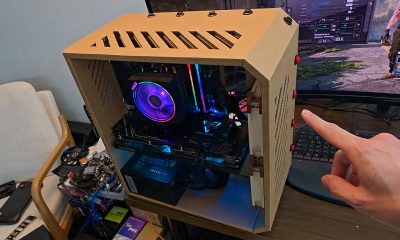
Over-Engineered Cardboard PC Case Houses a Full Computer Without Compromising Style or Performance
-

 Sports2 days ago
Napoleonic enters 2026 Doomben 10,000 field via Abounding withdrawal
You must be logged in to post a comment Login