

Crypto World
India is Losing Investors Fast Amid Global AI Boom

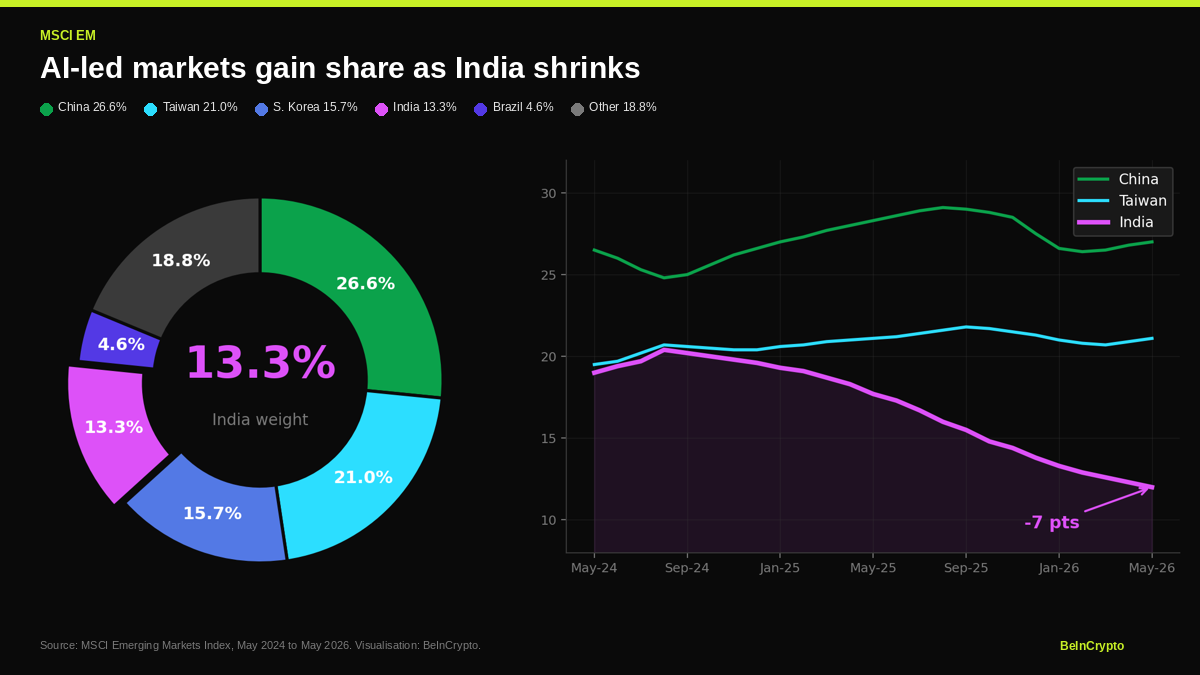
Global investors are rerouting capital away from India and into Asian markets tied to AI infrastructure, leaving the country at risk of falling out of the world’s five largest stock markets for the first time in three years.
The shift goes beyond one quarter of weak earnings. It reflects a structural change in how AI exposure now drives capital allocation across emerging markets, with India holding a few of the names global funds want to own right now.
Capital Flight Pulls India Down the MSCI Rankings
India’s weight in the MSCI Emerging Markets index has dropped to about 12% from roughly 19% a year ago, according to index provider data.

Reports indicate that foreign investors have withdrawn a net $21 billion from Indian equities so far in 2026.
Goldman Sachs estimates foreign ownership of the market sits at a 14-year low and now trails domestic institutions for the first time in more than two decades.
Roughly two-thirds of the reallocation reflects AI positioning, M&G Investments said.
Since the country’s market value peaked near $5.73 trillion in September 2024, about $924 billion has been erased from Indian equities.
Taiwan and South Korea Absorb the Capital India is Losing
Taiwan’s TAIEX has climbed roughly 42% year-to-date, while South Korea’s KOSPI has set fresh highs on AI chip strength, according to exchange data. Together, the two markets have added several trillion dollars in equity value over the past year.

Their listed champions, led by TSMC, Samsung, and SK Hynix, sit directly on the AI buildout that Indian companies do not supply.
The same rotation is bleeding into newer products such as a hybrid crypto-equity benchmark from S&P Global that pairs large-cap stocks with leading AI-linked tokens.
GenAI Squeezes India’s IT Services Giants
The Nifty IT index has fallen about 26% in 2026, while the broader Nifty 50 is down close to 9%.

Tata Consultancy Services and Infosys, which anchor India’s $315 billion IT services sector, hit fresh 52-week lows after OpenAI announced a new enterprise deployment unit.
Generative AI tools are automating the coding, testing, and back-office work that those firms have built their margins on.
Some 15 million Indians work in IT services and global capability centers, putting an entire layer of the economy in the path of AI-driven agents.
Indian policymakers are pushing semiconductor incentives, data center expansion, and a national AI mission. However, the next several quarters will show whether those bets can stop the structural drift away from the country’s equity market.
The post India is Losing Investors Fast Amid Global AI Boom appeared first on BeInCrypto.


TLDR:
- Fold sold ~$45M in Bitcoin at an average price of $71,000 to fund a full balance sheet reset.
- The company repaid $20M in Bitcoin-collateralized debt, eliminating all secured obligations.
- A $25M cash allocation targets Credit Card scaling, new products, and financing partnerships.
- Fold retains a Bitcoin treasury position and keeps its revolving credit facility available.
Fold Holdings has sold approximately $45 million in Bitcoin to eliminate secured debt and fund business expansion.
The Nasdaq-listed Bitcoin financial services company monetized the holdings at an average price of $71,000 per Bitcoin.
Proceeds were split between retiring $20 million in Bitcoin-collateralized debt and allocating $25 million toward growth initiatives.
The move strengthens Fold’s balance sheet ahead of several planned product launches across its consumer and enterprise platforms.
Fold Bitcoin Sale Clears All Secured Debt
The Fold Bitcoin liquidation marks a deliberate shift in the company’s capital strategy. By repaying all Bitcoin-backed secured debt, Fold eliminates monthly cash interest expenses immediately.
This improves the company’s net cash flow position starting in June 2026. Management expects further cash flow gains throughout the year as new products launch and customer activity increases.
Fold retains a meaningful Bitcoin treasury position after the sale. The company also keeps access to its revolving credit facility for future needs.
Management reserves the right to monetize additional Bitcoin holdings when returns justify it. This flexible approach keeps strategic options open as market conditions evolve.
The debt elimination removes a key risk factor tied to Bitcoin price swings. Bitcoin-collateralized loans carry liquidation risk during sharp market downturns.
Clearing that exposure gives Fold more operational stability. It also reduces pressure to make reactive decisions during volatile periods.
CEO Will Reeves positioned the transaction as a forward-looking move. “We believe Fold is poised for near-term growth and investing in that future is exactly what the company needs to do,” Reeves said.
He added that the company has built one of the strongest product roadmaps in its history. The recently launched Bitcoin Credit Card, Bitcoin Gift Cards, and Fold Business products anchor that pipeline.
$25 Million Fuels Fold Bitcoin Credit Card Growth
The $25 million cash allocation is primarily directed toward scaling the Fold Bitcoin Credit Card. Improved liquidity positions Fold to support a larger cardholder base going forward.
The company is also pursuing additional funding relationships to expand the credit program. Management considers the Credit Card among Fold’s highest long-term growth opportunities.
Greater financing flexibility allows Fold to capture more of the economics generated by the card program. As the cardholder base grows, revenue participation from the program increases.
This creates a compounding effect on company revenues over time. The strengthened balance sheet directly enables that participation.
Reeves addressed the strategic rationale directly. “We have reduced financing risk, strengthened our balance sheet, and ensured that short-term market volatility cannot stand in the way of executing our roadmap,” he said.
The statement points to deliberate risk management ahead of several product launches. Fold also plans to introduce additional products in the coming months.
Operating leverage is expected to improve as new products launch and financing partnerships come online. Each factor contributes to a stronger cash flow profile throughout the year.
With debt cleared and cash deployed, Fold Bitcoin operations enter a more stable phase. The company now has the resources to execute its plans without short-term financial constraints.


The European Union is expanding its sanctions toolkit to curb crypto-enabled evasion as part of the 21st package aimed at Russia. A proposed measure would ban transactions on 11 crypto platforms, broadening the bloc’s crackdown beyond traditional banks and energy revenues to the crypto sector believed to facilitate Moscow’s circumvention of existing restrictions.
Kaja Kallas, vice president of the European Commission and the EU’s high representative for foreign affairs and security policy, announced the move in a post on X, saying the package would tighten bans on crypto-asset services to certain third countries, add new designations, and ban transactions on 11 crypto platforms.
According to her remarks, the aim is to close gaps in enforcement where crypto firms may be used to move money or engage in activities that help sanctioned actors avoid penalties. The Commission, however, did not identify the 11 platforms in its public statements, and Cointelegraph sought clarification on which platforms would be affected; no additional details were provided before publication.
EU President Ursula von der Leyen later underscored that the package also targets 31 additional Russian banks and 20 entities in third countries, including banks, crypto platforms and oil traders, arguing these targets have either supported sanctioned individuals or enabled circumvention of EU measures.
EU proposal follows UK sanctions against HTX
The EU move arrives as the United Kingdom earlier in May targeted HTX Global S.A., the Panamanian entity behind HTX, over alleged support for Russia-linked financial networks. UK authorities said there were reasonable grounds to suspect HTX had provided financial services and funds to the Russian government via sanctioned entities such as A7 Limited Liability Company and Garantex.
HTX has denied the allegations, arguing the sanctioned entity is separate from the online exchange. A Global Ledger report later flagged that HTX processed roughly $21.06 billion in high-risk crypto flows from 2021 through May 2026, with about $7.64 billion tied to Russian high-risk entities and darknet markets, including Garantex, its successor Grinex, A7A5 and Hydra.
Regulatory researchers criticized the UK’s broader “tainting at the exchange level” approach, warning it could freeze legitimate users and complicate the effectiveness of on-chain compliance tools designed to trace illicit flows. The ongoing debate highlights the tension between tightening enforcement and preserving usable pathways for compliant market participants.
The wider context: why this matters for markets and policy
The EU’s proposed action reflects a broader shift in how regulators seek to police crypto activity amid geopolitical tensions and a persistent push to align crypto rules with traditional finance safeguards. By naming crypto platforms among the targeted channels for sanctions, Brussels signals a willingness to hold crypto intermediaries to account for facilitating cross-border flows that could bypass conventional restrictions.
For investors and traders, the development introduces additional friction points in cross-border transfers and fiat-to-crypto or crypto-to-fiat transactions that involve sanctioned jurisdictions or entities. Compliance teams at exchanges and custodians will be pressured to tighten screening, identify potential high-risk counterparties, and ensure robust end-to-end transaction monitoring to avoid inadvertent exposure to sanctioned networks.
The absence of publicly named platforms at this stage leaves a noteworthy element of uncertainty. Markets often react to clarity; when regulators publish a definitive list of designated platforms or counterparties, participants typically adjust risk models, pricing, and liquidity considerations accordingly. In the meantime, the signal from Brussels is clear: crypto rails will be scrutinized more intensely as part of international sanctions coordination.
What to watch next: enforcement, clarity, and industry response
Key questions loom as the EU moves toward formalizing these restrictions. Which platforms will be designated, and how quickly will the bloc—together with its member states—implement the ban on crypto-asset services to the specified third countries? How will this interact with existing anti-money-laundering and know-your-customer requirements, and what definitions will regulators rely on to determine “high-risk” crypto flows?
Observers will also be watching the cross-border dimension: will the UK and EU deliver a synchronized approach that minimizes loopholes for sanctioned actors while preserving legitimate access for compliant customers? The HTX case illustrates the delicate balance regulators attempt to strike when sanctioning entities with complex international structures and multiple affiliates.
In parallel, some analysts argue that the regulatory framework around crypto could increasingly favor tokenized and tradable assets that sit more clearly within centralized compliance regimes. Others note the ongoing debate around MiCA (Markets in Crypto-Assets) and how its architecture might evolve to address DeFi, tokenization, and cross-border settlement more explicitly, a topic that has surfaced in related coverage.
As Brussels weighs its 21st sanctions package, the concrete impact on the crypto landscape will hinge on several moving parts: the list of targeted platforms, the practical mechanics of enforcement, and how industry participants adapt to tighter controls without unduly hamstringing legitimate use of digital assets. The Commission’s remarks point to a comprehensive effort to integrate crypto services into the sanctions architecture, not merely as a matter of punitive action but as a strategic tool to prevent abuse of digital financial rails.
For readers tracking regulatory developments, the immediate next step is to watch for the official release of the 11 named platforms, along with any accompanying guidance from the European Commission or member states detailing compliance obligations for exchanges and custodians operating within the EU with respect to sanctioned counterparties.
According to the UK’s stance, the HTX actions and subsequent data-driven analyses underscore the risk that broad enforcement measures can create cascading effects across the crypto ecosystem—affecting liquidity, on-chain tracing, and the ability of compliant users to operate normally in international markets. The industry’s response will likely shape future policy iterations as regulators seek to strike a balance between deterrence and pragmatic usability for legitimate participants.
Related commentary has underscored a potential shift in EU regulatory emphasis toward tokenization and asset-backed structures as a complement or alternative to DeFi-centric regulation, suggesting that the sector may see a broader menu of tools used to regulate cross-border flows and protect sanctions regimes. The ongoing conversation around MiCA, DeFi, and tokenization will intersect with these developments and help define the next phase of Europe’s crypto policy.
Readers should stay tuned for updates on the list of targeted platforms, the specifics of how the ban will be enforced, and any subsequent designations that clarify the scope of the EU’s cross-border crypto-sanctions strategy.
What happens next will shape how crypto firms plan compliance, how sanctions risks are priced into markets, and how regulators coordinate across jurisdictions to close the gaps that currently exist between traditional finance controls and digital-asset rails.
As the EU advances this agenda, market participants should watch for concrete guidance from Brussels and for any parallel actions from national authorities, which together will determine the practical boundaries of sanctioned activity within the European crypto ecosystem.
Source context: EU sanctions package coverage and related UK actions are referenced through official statements and industry reporting, including comments from Kaja Kallas and Ursula von der Leyen, and UK sanctions coverage related to HTX. For background on the HTX allegations and subsequent data flows, see reports discussing HTX’s linkages to Russian-related entities and the broader debate over exchange-level sanction enforcement.

A wallet tied to US government seized FTX Chainlink holdings moved 98,590 Chainlink (LINK) tokens, worth about $768,000, to Coinbase Prime on Wednesday, reviving speculation over a potential sale.
Blockchain trackers flagged the deposit within minutes. However, on-chain data alone does not confirm that the tokens are headed for the open market.

Why the Seized FTX Chainlink Transfer Matters
On-chain tracker Lookonchain first reported the movement, and tracking account Solid Intel flagged the same deposit.
Arkham labels the sending address under its US government entity and has documented earlier movements from the same cluster.
Follow us on X to get the latest news as it happens
The funds originate from assets confiscated after FTX and Alameda Research collapsed in November 2022.
A federal judge later ordered Sam Bankman-Fried to forfeit $11 billion after his fraud conviction, with recovered funds directed toward victim compensation.
The US Marshals Service selected Coinbase Prime in July 2024 to custody and trade its large-cap digital assets.
“After a comprehensive process, the U.S. Marshals Service (USMS), a division of the U.S. Department of Justice, selected Coinbase Prime as its partner to safeguard and trade its “Class 1” (large cap) digital assets,” read an excerpt in a 2024 Coinbase blog.
Therefore, deposits to the platform often precede custody changes, over-the-counter deals, or liquidations.
The agency has managed seized crypto sales for over a decade, beginning with its auction of 30,000 Silk Road bitcoins in 2014.
Historically, it has favored structured sales over open-market dumps.
The transaction also extends a pattern of earlier seized altcoin transfers involving Uniswap (UNI), Render (RNDR), Ethereum (ETH), and The Sandbox (SAND), plus stablecoins.
Meanwhile, the FTX estate keeps repaying customers, with its fourth creditor distribution round delivering $2.2 billion in March.
Analysts See Limited Risk of a LINK Sell-Off
Chainlink’s current price sits near $7.66, down 2% over the past 24 hours. The token holds a $5.57 billion market cap and ranks 21st among cryptocurrencies.

The transferred amount equals less than 0.4% of LINK’s $225 million daily trading volume. It also represents roughly 0.01% of the 727 million tokens in circulation.
Consequently, even an outright sale would barely move market liquidity.
Sentiment around the token remains cautious after a 27% slide over the past 30 days. LINK has also shed 49% over the past year, leaving holders alert to new supply signals.
In contrast, Chainlink’s ETF inflow outlook suggests institutional demand could absorb modest government supply over time.
Whether the tokens move to an over-the-counter desk or stay in custody should become clearer in the coming days.
The wallet’s next transaction will reveal whether the deposit marks routine management or the start of a liquidation.
Until then, the sell-off fears look larger than the numbers behind them.
The post US Government Moves $768,000 Seized FTX Tokens, Sparks Chainlink Sell-Off Fears appeared first on BeInCrypto.
Crypto World
Nightrush.com Responds to the AI Personalization Wave Reshaping iGaming And Raises the Bar

[PRESS RELEASE – Norwich, United Kingdom, June 10th, 2026]
Nightrush.com, an independent iGaming comparison and review platform, today announced a comprehensive restructuring of its editorial operations and platform revamp.
The initiative responds directly to the widespread adoption of artificial intelligence (AI), machine learning, and adaptive personalization technologies by licensed operators, as well as the increasingly fragmented global regulatory landscape.
The goal is to serve intelligence content and provide resources for the players, focusing on responsible gaming advice and education.
The update arrives as data indicates the global iGaming market surpassed $105 billion in 2025 and is projected to exceed $133 billion by the end of 2026 according to the ICRRD Journal.
Market expansion has been accompanied by a shift toward data-driven, compliance-heavy operational environments, where international regulatory bodies are enforcing stricter standards on promotional bonuses, identity verification, and player safety protocols.
To address these market dynamics, Nightrush.com is implementing a modernized scoring and auditing methodology focused on three core operational pillars:
- Advanced Algorithmic Evaluation: The platform’s updated review metrics move beyond standard promotional offerings to analyze the integration of artificial intelligence within casino platforms. The editorial framework now assesses the performance of operator-side technologies, including predictive recommendation engines and responsive user interfaces.
- Behavioral Safety Monitoring: In response to heightened international regulatory standards, Nightrush.com has adjusted its operator qualification benchmarks. The platform now places significant weight on an operator’s deployment of proactive, real-time behavioral monitoring tools designed to detect and mitigate problematic gambling patterns.
- Jurisdictional Compliance Mapping: The editorial team has expanded its regional data coverage across North America, Europe, Scandinavia, and Oceania. This expanded matrix tracks localized licensing updates, legislative shifts, and consumer protection mandates to ensure accurate compliance reporting across distinct jurisdictions.
This operational realignment establishes an independent, verification-based reporting model designed to provide transparent market data for consumers navigating complex digital entertainment sectors.
Olesea Naidion, Brand Manager at Nightrush.com said: “The integration of artificial intelligence is fundamentally changing how platforms interact with users. Our updated editorial infrastructure ensures that our review standards evolve alongside these technical advancements, prioritizing objective transparency and independent validation over superficial marketing metrics.”
About Nightrush.com
Nightrush.com is an independent digital media platform and information resource specializing in the verification, review, and comparison of licensed international iGaming operators. Operating strictly as an informational affiliate platform rather than a gambling operator, the company provides market analysis, compliance tracking, and consumer safety evaluations across North America, Europe, Scandinavia, and Oceania. The platform is dedicated to maintaining high-integrity editorial standards to support informed consumer decision-making within regulated digital gaming markets.
The post Nightrush.com Responds to the AI Personalization Wave Reshaping iGaming And Raises the Bar appeared first on CryptoPotato.


Pennsylvania Gov. Josh Shapiro has unveiled standards for large data center projects seeking state support.
Summary
- Pennsylvania’s GRID Standards require data center developers to secure certification before receiving state incentives, fast permits, or tax benefits.
- The rules require developers to pay for new power generation and disclose project size, water use, and efficiency details.
- Separate bills from state lawmakers could change data center tax exemptions, water rules, power requirements, and local zoning powers.
Duane Morris Government Strategies said the GRID Standards set conditions for incentives, fast permits, and tax benefits. The rules come as residents question power demand, water use, and infrastructure costs.
GRID standards tie incentives to certification
The Governor’sResponsible Infrastructure Development Standards require certification before developers receive state benefits. Two state offices will manage certification. Certified projects can access Pennsylvania’s Permit Fast Track Program and sales tax exemptions for computer equipment. They may also qualify for selected tax programs.
The standards do not give permanent approval to any project. Developers must submit compliance reports before operations and file yearly updates. According to Duane Morris Government Strategies, the framework links economic support with more oversight.
The blog called it one of the most detailed state frameworks. Pennsylvania officials now want lawmakers to codify the GRID Standards through legislation. They also want the data center tax exemption tied to certification.
Energy and local input shape project rules
The standards require developers to pay the full cost of new power generation. The rule prevents developers from shifting costs to current utility customers. New power capacity must come from new or incremental generation resources. The resources must sit within the same PJM Locational Deliverability Area.
Facilities larger than 100,000 square feet must support future solar installations. The requirement places energy planning into early design work. The framework also requires developers to identify facility end users and hold public meetings.
Those meetings must occur before major design decisions. Project disclosures must include size, expected water use, and efficiency metrics. Local governments must receive early consultation before final plans.
Lawmakers advance separate data center bills
Developers must commit at least $250 million in investment to qualify. They must also create at least 200 construction jobs. The standards require 50 permanent jobs within four years. Those jobs must pay at least 125% of Pennsylvania’s average wage.
Hiring plans must explain how local workers can access apprenticeships and construction opportunities. The standards connect state support with job targets. Sen. Tracy Pennycuick has proposed a separate data center bill. Her plan would require large facilities to provide power and meet water limits.
Her proposal would create a Pennsylvania Data Center Advisory Committee. It would ban governments from signing nondisclosure agreements with developers. Sen. Jarrett Coleman and Rep. Jamie Walsh have introduced another bill. Their proposal would repeal the current equipment tax exemption.
Their legislation would allow temporary municipal pauses on data center applications. Municipalities could use that time to update zoning rules. Pennsylvania’s tax exemption could cost over $517 million yearly by fiscal 2030-31. State officials want that exemption tied to GRID certification.
The US Commodity Futures Trading Commission (CFTC) has proposed new rules for prediction markets, signaling that sports event contracts are generally not contrary to the public interest even though federal law classifies them as “gaming.”
Released on Wednesday, the proposal distinguishes sports event contracts from games of pure chance, saying markets based on final scores and win-loss records can aid price discovery. Contracts tied to player injuries, officiating decisions or other outcomes that could encourage manipulation, however, are unlikely to meet the public interest test.
The proposal also clarifies that election contracts are not considered “gaming” under the relevant federal laws. Reuters reported this could further ease regulatory uncertainty for platforms such as Kalshi and Polymarket, which rose to prominence during the 2024 US presidential election as traders increasingly turned to prediction markets to gauge the race’s outcome.
The draft rules are open for public comment for 45 days and could help define the future regulatory framework for US prediction markets.
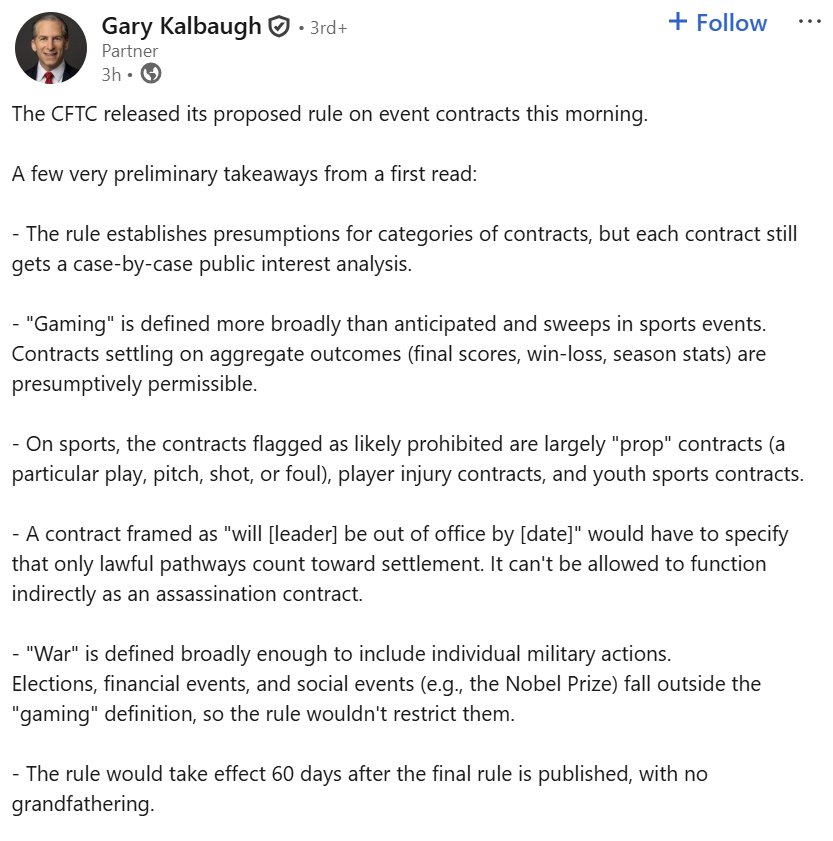
Gary Kalbaugh, a partner at Cahill Gordon & Reindel LLP in New York, said the proposal is principles-based rather than a blanket approval, noting that each contract would still be subject to a case-by-case public interest analysis.
“‘Gaming’ is defined more broadly than anticipated and sweeps in sports events,” Kalbaugh wrote on Wednesday. “Contracts settling on aggregate outcomes (final scores, win-loss, season stats) are presumptively permissible.”
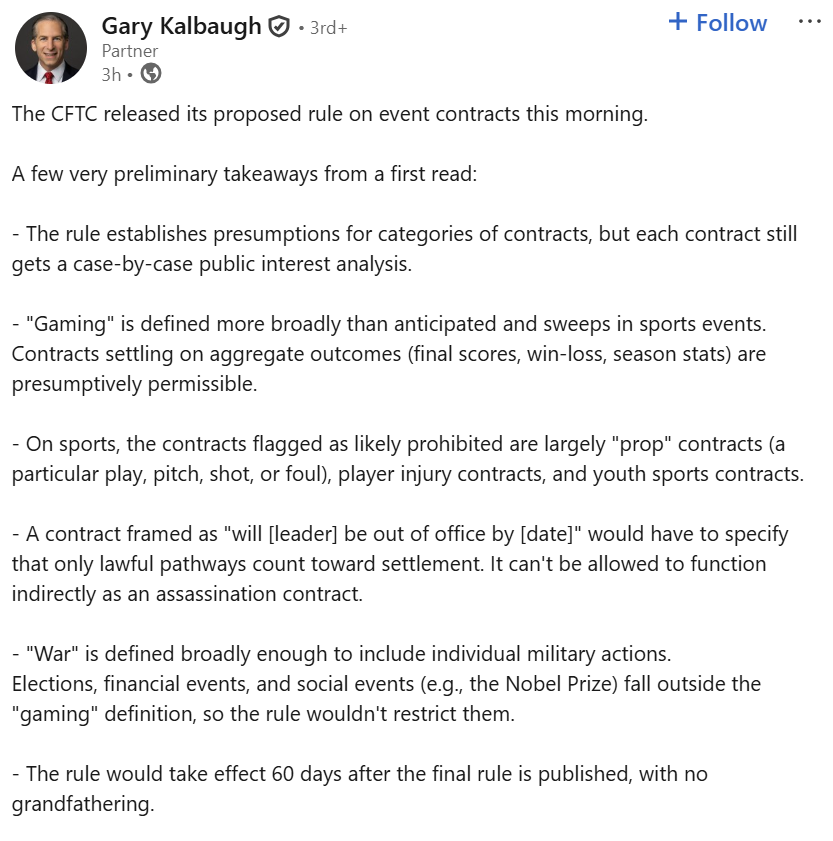
Source: Gary Kalbaugh
Related: Anchorage backs Treasury’s GENIUS AML rules, seeks secondary-market sanctions clarity
Increased regulatory clarity comes as prediction markets see adoption surge
The proposed rules come as prediction markets — described as an “asset class” in the draft — continue to gain momentum, with Kalshi and Polymarket reaching multibillion-dollar valuations amid rising investor and institutional interest.
Both companies have expanded their ties to traditional financial markets. Kalshi recently partnered with Nasdaq to launch a new category of prediction markets that allows users to forecast the future valuations of private companies ahead of their initial public offerings.
Polymarket, meanwhile, has partnered with Dow Jones to integrate real-time prediction market data into its media brands, including The Wall Street Journal.
“The prediction markets continue to become more mainstream, with newly formed partnerships with news organizations and more firms moving quickly into this space,” said Melinda Roth, a professor of sports law and corporate finance at Georgetown University Law Center. “As these markets continue to grow, the unanswered question is if event contracts are financial instruments or are they simply gambling.”
Analysts at Bernstein say prediction markets are seeing growing institutional adoption as investors seek alternative macro-hedging tools through binary-outcome contracts.
Magazine: How to fix suspected insider trading on Polymarket and Kalshi

The European Union has advanced a sanctions package aimed at Russia that extends restrictions to the crypto sector. The 21st set of measures would ban transactions on 11 crypto platforms as part of a broader effort to cut off channels that could enable evasion of the bloc’s restrictions amid Moscow’s war in Ukraine.
In statements on X, Kaja Kallas, vice president of the European Commission and the EU’s foreign policy chief, described the proposal as widening the sanctions regime beyond banks and energy revenues to include crypto firms and other actors outside the bloc. The Commission has not publicly named the 11 platforms under consideration. European Commission President Ursula von der Leyen later framed the package as targeting 31 additional Russian banks and 20 third-country entities, including crypto platforms and oil traders, to curb activity that assists sanctioned individuals or supports attempts to circumvent EU measures.
Key takeaways
- The EU’s 21st sanctions package would ban transactions on 11 crypto platforms, extending sanctions enforcement into the crypto sector and aiming to close gaps used to bypass restrictions.
- The package expands the roster of designated entities to include 31 Russian banks and 20 third-country actors, among them crypto platforms and oil traders, strengthening cross-border enforcement.
- The Commission has not publicly identified the 11 platforms; designation details are expected through formal channels as the package progresses.
- The move follows parallel actions by other jurisdictions, notably the United Kingdom’s sanctions on HTX Global S.A. for alleged support to Russia-linked financial networks, illustrating a trend toward coordinated sanctions pressure on crypto service providers.
- For the crypto industry, the proposal signals heightened regulatory scrutiny, expanding AML/KYC obligations, licensing considerations, and sanctions-screening requirements for EU-pressured operations and counterparties, with potential implications for cross-border liquidity and service provision.
EU expands sanctions to crypto platforms
The EU’s latest sanctions package represents a deliberate step to align digital-asset oversight with traditional financial controls. By extending bans to crypto platforms, the bloc seeks to deprive sanctioned actors of avenues to move funds, access counterparties, or conduct transactions that could contravene existing restrictions. The measures are framed as part of a broader effort to prevent sanctions evasion, with officials arguing that crypto entities outside the EU have, in some cases, facilitated or facilitated access to sanctioned networks.
While the Commission has not named the 11 platforms, the move signals a willingness to apply sanctions pressure at the point of transactional interaction in the crypto markets, not solely on traditional banking rails. The approach reflects ongoing EU policy objectives to bring crypto activity under comprehensive compliance, monitoring, and enforcement standards, particularly in relation to anti-money-laundering (AML) and countering the financing of terrorism (CFT) regimes. In parallel, the EU continues to advance its broader crypto policy agenda, including MiCA and related initiatives intended to provide a harmonized regulatory framework for crypto service providers and market participants across member states.
The designation of entities beyond Russia’s banking sector—such as crypto platforms and oil traders—illustrates the EU’s intent to curb holistic support networks that may enable evasion of asset freezes or sanctions. The lack of immediate public disclosure about the specific platforms under review underscores the procedural nature of sanctions designations, which typically unfold through formal regulations and subsequent compliance guidance.
Compliance, licensing, and enforcement implications
The expansion to crypto platforms is likely to alter the compliance landscape for firms with either EU operations or counterparties connected to EU markets. Crypto exchanges, wallet providers, custodians, and other service operators could face heightened obligations, including rigorous sanctions screening, enhanced due diligence, and stricter transaction monitoring. For banks and financial institutions engaged with crypto entities, the package adds a further layer of risk assessment and regulatory oversight, reinforcing the need for robust know-your-customer (KYC) processes and AML controls in line with EU and global standards.
From a licensing perspective, the EU’s approach may intersect with MiCA provisions and ongoing efforts to clarify the regulatory status of various crypto activities. While MiCA primarily governs the licensing, governance, and disclosure requirements for crypto-asset service providers, the sanctions context adds an external compliance constraint that firms must incorporate into risk management, treasury operations, and cross-border settlement arrangements. Operators seeking or holding EU licenses may also face stricter reporting requirements, heightened scrutiny of third-country ties, and more frequent audits or investigations related to sanctions compliance.
For market participants outside the EU, the development raises considerations about access to EU markets and the ability to service EU customers while complying with potentially expanding restrictions on sanctioned entities. The scope of the designations—particularly if linked to third-country platforms—could influence international cooperation on sanctions enforcement, including data sharing, screening standards, and any mutual recognition arrangements that affect cross-border enforcement efforts. Moreover, the move could drive crypto firms to reassess their counterparties and routing options to avoid inadvertently facilitating sanctioned activity, even if unintentional.
Cross-border action and broader policy context
The EU action follows a widening pattern of cross-border sanctions enforcement against crypto platforms and related entities. In the United Kingdom, authorities imposed sanctions in May on HTX Global S.A., the Panamanian entity behind HTX, on grounds of suspected support for Russia-linked financial networks. UK officials asserted reasonable grounds to suspect that HTX facilitated financial services and funds connected to sanctioned actors via intermediaries such as A7 Limited Liability Company and Grantex, with HTX denying direct ties to the sanctioned entity. This alignment of steps across major jurisdictions highlights how sanctions policy is increasingly threading through crypto markets, regardless of national borders.
Analysts have cautioned that broad exchange-level tainting can have mixed effects on the integrity of tracing illicit flows. On one hand, expanding the sanctions net to cover crypto platforms reduces the channels through which sanctioned actors can maneuver funds. On the other hand, overly broad or opaque designation efforts risk freezing legitimate users or impeding legitimate compliance tools, potentially hindering the ability of investigators to track illicit money flows. Industry researchers have raised concerns about the potential chilling effects on the legitimate crypto ecosystem if enforcement tools are not carefully calibrated to distinguish sanctioned actors from compliant users and compliant service providers.
Background data cited in industry observations show how flows can intersect with sanctioned networks. A Global Ledger analysis noted substantial high-risk activity linked to HTX and related entities, illustrating the scale at which exchanges can interact with high-risk corridors. Such findings underscore the practical challenges that regulators face in maintaining a balance between restricting illicit activity and preserving legitimate access to financial services and lawful movement of value. In this context, the EU’s designation process will be closely watched by financial institutions, exchanges, and compliance teams as they adapt to evolving risk profiles and enforcement expectations.
From a policy standpoint, the EU’s move sits within a broader trajectory of tightening crypto regulatory oversight in the context of EU financial-market integration, consumer protections, and the international stance on sanctions enforcement. For institutions, this means integrating sanctions screening with crypto-asset risk assessments, aligning corporate policies with EU-level guidance, and ensuring that cross-border operations stay within the boundaries of designated entities and restricted channels. In parallel, ongoing policy debates surrounding MiCA and future rulemakings around stablecoins, tokenization, and banking access for crypto firms will influence how sanctions risk interacts with broader market structure and regulatory alignment.
Closing perspective
As the EU clarifies which crypto platforms will be subject to transaction bans, regulators will also weigh the designations’ scope, potential enforcement challenges, and compatibility with broader EU crypto policy objectives. The next steps will likely include formal designation announcements, accompanying guidance for market participants, and possible legal challenges from affected firms. Given the regional and international regulatory momentum, institutions should prepare for intensified due diligence, updated compliance playbooks, and closer attention to MiCA-related licensing pathways as sanctions designations unfold and cross-border cooperation evolves.

The U.S. Commodity Futures Trading Commission has floated a formal rule framework for prediction markets, signaling a cautious but potentially meaningful path toward legitimizing event-based contracts. In the agency’s proposed rules, sports event contracts are not regarded as inherently contrary to the public interest even though federal law classifies gaming as a broad category. The move suggests a nuanced stance: markets that reflect final scores or win-loss records could aid price discovery, while contracts tied to injuries, officiating decisions, or other elements that could invite manipulation are less likely to pass what the CFTC calls a public-interest test.
The CFTC’s draft, released this week, distinguishes sports event contracts from games of pure chance and argues that markets built on verifiable outcomes can contribute to market transparency and price formation. By contrast, contracts that hinge on subjective or manipulable outcomes may fail the test of public interest and could face stricter scrutiny or rejection. The agency’s approach signals a recognition that not all outcome-based contracts are the same, and that the underlying mechanics—how outcomes are determined and settled—will matter as much as the event itself.
The proposal has immediate regulatory implications for platforms that have gained traction in the U.S. prediction-market space, notably Kalshi and Polymarket. Reuters reported that election-focused contracts—central to both platforms during the 2024 U.S. presidential race—are not considered “gaming” under current federal law, a distinction that could ease regulatory uncertainty for such ventures as they expand beyond political bets. The draft rules are open for public comment for 45 days, allowing participants, policymakers, and investors to weigh in before any formal adoption.
The prospect of clearer, principles-based guidance comes at a moment when prediction markets are aggressively positioning themselves as a new, alternative layer of financial information. The industry has already begun to carve out a niche as a form of macro-hedging and data-driven forecasting, attracting interest from traditional finance and media alike.
Gary Kalbaugh, a partner at Cahill Gordon & Reindel LLP, welcomed the proposal’s direction but cautioned that it remains principles-based rather than an outright green light. In his view, each contract would still undergo a case-by-case public-interest analysis under the framework. “Gaming” is defined more broadly than some expect and could sweep in sports events, he noted, yet contracts settling on aggregate outcomes—such as final scores, win-loss records, or season statistics—appear presumptively permissible under the new approach.
Key takeaways
- The CFTC’s proposal frames prediction markets as an asset class that can be lawful if contracts are structured to support price discovery, with sports-based bets treated differently from high-risk, manipulable outcomes.
- Election contracts are not classified as gaming under current federal law, a distinction that could reduce regulatory friction for platforms like Kalshi and Polymarket.
- A 45-day public comment window will shape how regulators, market participants, and lawmakers view the framework and its potential adoption across the U.S. market.
- The rules are intended to be principles-based and contract-specific, meaning a one-size-fits-all approval is unlikely; a case-by-case assessment will determine permissibility.
- Early adoption signs point to growing mainstream interest in prediction markets, with platform partnerships and rising valuations illustrating ongoing institutional engagement.
Regulatory architecture and what changes
The draft marks a shift toward a more nuanced regulatory posture, separating sports-event contracts—where outcomes are typically final and verifiable—from forms of betting that hinge on chance or subjective judgments. In the agency’s view, contracts tied to objective results such as final game outcomes or season stats can contribute to price discovery. This is a departure from a blanket presumption of illegality and implies a more flexible framework that could accommodate a range of contract designs while maintaining guardrails against manipulation or deception.
Analysts and legal experts have underscored that the architecture hinges on case-by-case evaluation under a public-interest standard. The Kalbaugh assessment highlights that the framework’s principles-based nature will require careful scrutiny of each contract’s settlement mechanics, data integrity, and potential for gaming the system. As the CFTC’s proposal invites stakeholder feedback, observers will likely probe how the agency will weigh the balancing act between innovation and investor protection in real-world markets.
Momentum, partnerships, and institutional interest
Even as the regulatory dialogue evolves, the industry’s momentum persists. Prediction markets have increasingly been described as an asset class in their own right, attracting multibillion-dollar valuations for pioneering platforms such as Kalshi and Polymarket. These firms have tapped traditional financial markets to extend their reach and legitimacy. Kalshi has aligned with Nasdaq to launch new categories that enable users to forecast private company valuations ahead of initial public offerings, signaling a bridge between private-market signaling and public market dynamics. Polymarket has pursued a different path, partnering with Dow Jones to weave real-time prediction-market data into its media partnerships, including The Wall Street Journal. The goal appears twofold: deepen market liquidity and provide journalists and investors with data-driven narrative tools that reflect consensus forecasts across a spectrum of events.
Experts see these trends as indicative of broader adoption rather than episodic hype. Georgetown University Law Center professor Melinda Roth noted that prediction markets are becoming more mainstream as partnerships with media and financial institutions expand. The question, she said, is whether event contracts function as recognizable financial instruments or whether they remain closer to speculative bets. Bernstein & Co. has likewise highlighted growing institutional interest, framing prediction markets as potential macro-hedging tools offering binary-outcome payoffs that can diversify risk in a portfolio of macro bets.
For readers watching the regulatory horizon, the combination of clarified rules and expanding market activity creates a nuanced landscape. The CFTC’s proposed framework could lower friction for compliant platforms while preserving guardrails to deter manipulation and abuse. It also underscores a longer arc of regulatory maturation: as the market scales, lawmakers and regulators will be watching how prediction markets interact with traditional financial markets, consumer protection standards, and market integrity mechanisms.
What to watch next
With the public-comment window now open, the next several weeks will reveal how stakeholders respond to the CFTC’s approach. Key questions include how the agency will define and monitor data integrity, what types of contract settlements will be deemed manipulable, and how such markets will interact with existing securities and gaming laws. Investors and users should monitor whether the final rules—potentially refined after public input—create clearer pathways for platform operators to design compliant, price-discovery-focused contracts while guarding against exploitative tactics.
As prediction markets move from an experimental niche to a more integrated part of the financial information ecosystem, readers should stay attuned to how platforms adapt their product designs, data feeds, and regulatory risk management practices. The unfolding framework could shape not only how participants trade today, but how developers, researchers, and media partners leverage these markets to gauge sentiment, forecast events, and inform decision-making in a rapidly evolving landscape.


Solana DEX Raydium confirmed Wednesday that an attacker drained approximately $1.34 million from its legacy AMM V3 program, a deprecated contract phased out in 2021, with current users unaffected and full compensation coming from the protocol treasury. Raydium core contributor Infra disclosed the… Read the full story at The Defiant


Amazon has secured a $17.5 billion delayed draw term loan facility from Citibank and other banks.
Summary
- Amazon secured a $17.5 billion delayed draw term loan facility from Citibank and other banks.
- The company said the loan proceeds will support general corporate purposes, including investments and debt repayment.
- Bloomberg linked the financing to Amazon’s AI spending plans, including infrastructure costs and AI company investments.
The company disclosed the senior unsecured agreement in a June 10 filing with the Securities and Exchange Commission. The financing gives Amazon extra borrowing capacity for corporate needs, capital spending, and debt repayment.
Loan commitments run through Sept. 30
According to Amazon’s SEC filing, bank commitments under the facility expire on Sept. 30. Amazon can draw funds before that date, unless it borrows the full amount earlier. Any loan drawn under the facility will mature three years from the borrowing date. Citibank N.A. serves as the administrative agent for the agreement.
Amazon described the borrowing purpose in narrow terms. “Borrowing under the DDTL Facility will be used for general corporate purposes,” the company said. The filing did not assign proceeds to any single project. However, the structure lets Amazon access funds as business needs arise.
According to a report by Bloomberg, an Amazon spokesperson gave more details on those purposes. The spokesperson said proceeds may support investments, fund capital expenditures, and repay debt.
AI spending forms part of the funding backdrop
The new loan could help Amazon fund artificial intelligence investments. The report linked the facility to Amazon’s technology infrastructure plans.
Amazon has said it plans about $200 billion in AI infrastructure and other capital expenditures this year. Bloomberg cited that figure in its report as well as Amazon’s investments in AI companies. Amazon is expected to invest up to $50 billion in OpenAI.
The report said Amazon has already invested $10 billion in Anthropic. It also said another $15 billion investment in Anthropic may follow. Amazon also continues spending on cloud, data centers, and computing capacity. Amazon did not name any AI project in the SEC filing.
Debt sales add context to financing
Amazon sold 14 billion Canadian dollars of high-grade bonds on June 8. The sale equaled about $10 billion, according to the report. Since March, Amazon has sold bonds in euros, U.S. dollars, and Swiss francs, Bloomberg reported. The Canadian dollar sale came before the loan disclosure.
The company has not said the loan replaces any specific bond sale. It has also not disclosed any drawdown under the facility. The DDTL Credit Agreement includes customary representations, warranties, covenants, and default events, according to Amazon. The filing said it does not contain financial covenants.If a default event occurs, Amazon would have applicable grace periods.
If unresolved or unwaived, unpaid amounts may become immediately due. The filing said lenders may terminate commitments after an unresolved default event. Amazon named the firms as full-service financial institutions with multiple business lines. Their activities may include trading, commercial banking, investment banking, advisory, investment management, research, hedging, brokerage, and market making.

California’s AB 412 Still Demands AI Developers Do The Impossible

AITA for Reminding My Friend That Our Financial Situations Are Different?

Investigation after house in Rillington damaged by fire

HarrisX Poll Found 52% of Registered Voters Support the CLARITY Act

BloFin War of Whales 2026 Grand Prix opens registration for $5M trading championship

Blockchain.com files with SEC for U.S. IPO
AITA for Reminding My Friend That Our Financial Situations Are Different?

Think twice before making THIS investment! #money #finance #stock #invest #spacex

The Financial Reality-Senior Loneliness-2 #loneliness #eldercare #seniorhealth
-

 Fashion5 days ago
Weekend Open Thread: Evereve – Corporette.com
-
 Crypto World5 days ago
Jensen Huang Approves Samsung, SK Hynix, and Micron for NVIDIA (NVDA) HBM4 Memory Supply
-

 Crypto World3 days ago
Anatomy of the June crypto crash: Fed, Iran, Saylor
-
 Entertainment4 days ago
The Best Mystery Series of All Time Is Surging on Streaming 30 Years After It Ended
-

 NewsBeat3 days ago
Alexander Zverev wins the French Open to finally earn a 1st Grand Slam title
-

 Tech5 days ago
Suspicious Polyfill login prompts pop up on Toshiba, Muji websites
-
Crypto World4 days ago
Senator Cynthia Lummis Calls CLARITY Act the Most Consequential Financial Legislation of This Generation
-

 Tech6 days ago
Microsoft launches MXC, an OS-level sandbox for AI agents, with OpenAI and Nvidia already on board
-

 Tech4 days ago
Microsoft unveils seven homegrown AI models in new bid for ‘long term self-sufficiency’
-

 Business6 days ago
(VIDEO) Justin Bieber Delivers Surprise Happy Birthday Serenade to Diners at Los Angeles Mexican Restaurant
-
 Business4 days ago
The Pain Points Taking a Fragile Tech Rally Down a Notch
-
 Crypto World3 days ago
Eli Lilly (LLY) Stock Surges 4% Following Breakthrough Sleep Apnea Trial Results
-
Crypto World6 days ago
LBank Surpasses 25 Million Users Worldwide as AFA Partnership Continues to Drive Global Growth
-

 Tech5 days ago
Von der Leyen’s AI envoy pick draws conflict-of-interest fire
-

 Tech5 days ago
Meta steals a tactic from Tesla and builds data centers in tents
-

 Crypto World3 days ago
Trump’s AI Ownership Plan Could Benefit Anthropic at OpenAI’s Expense
-
 Sports1 day ago
Bangladesh beat Australia after 20 years in ODIs, register only their second win over six-time world champions | Cricket News
-

 Business3 days ago
High Stakes for Wembanyama as New York Pushes for 3-0 Lead
-

 Tech5 days ago
Hackers now exploit SolarWinds Serv-U flaw to crash servers
-

 Tech3 days ago
Notion restores access to Anthropic after service disruption
You must be logged in to post a comment Login