
Crypto World
Bitcoin whale activity hits 2023 low as smart money remains quiet



Bitcoin (BTC) whale activity has slowed to its weakest level since September 2023, adding to signs that large holders have turned cautious.
Summary
- Santiment said whale activity dropped as investors watched uncertainty and conflict in the Middle East.
- Transfers above $100,000 and $1 million fell as Bitcoin struggled to recover after price swings.
- Analysts said short-term holder losses and weaker speculation may mark a new Bitcoin accumulation phase.
Data from Santiment shows that transfers above $100,000 have dropped as Bitcoin trades below recent highs and investors watch policy updates and geopolitical risks.
Santiment said daily Bitcoin transactions above $100,000 fell to 6,417, the lowest reading since September 2023. Transfers above $1 million also dropped to 1,485, their lowest level since October 2024.
The firm said activity rose sharply during Bitcoin’s early February sell-off, when large holders moved funds during heavy volatility. Since then, that pace has faded as the market entered a consolidation period and failed to regain steady momentum.
Santiment said the decline does not confirm a bullish or bearish trend on its own. The firm said whale activity has become “historically quiet” while market participants wait for more clarity around the CLARITY Act and the conflict in the Middle East.
The firm added that “smart money is in the same boat as smaller retail holders at the moment, and have been reluctant to make moves with so much policy and global uncertainty at play.” That view places the current market in a wait-and-see phase rather than a clear trend.
Moreover, Bitcoin recently reached $76,000, its highest level in about six weeks, before sellers pushed it lower. The rejection sent the asset below $68,000, though it later rebounded toward $72,000 before slipping under $70,000 again.
The latest moves show that Bitcoin remains sensitive to external events as traders track war-related headlines and broader market signals. At the same time, the weak recovery in whale activity suggests that large holders have not yet returned with strong conviction.
Analysts point to washout among short-term holders
Ali Martinez said Bitcoin’s Realized Cap for new holders has hit a low level that often appears after speculative interest leaves the market. According to his view, the recent reset has removed many weak hands and left more committed holders in place.
Analyst Michaël van de Poppe also said short-term holders are sitting on heavy losses in what he described as capitulation. He said many traders bought during Bitcoin’s initial drop toward $80,000, only to see positions fall deeper into loss as the price moved below $70,000.
Disclosure: This article does not represent investment advice. The content and materials featured on this page are for educational purposes only.

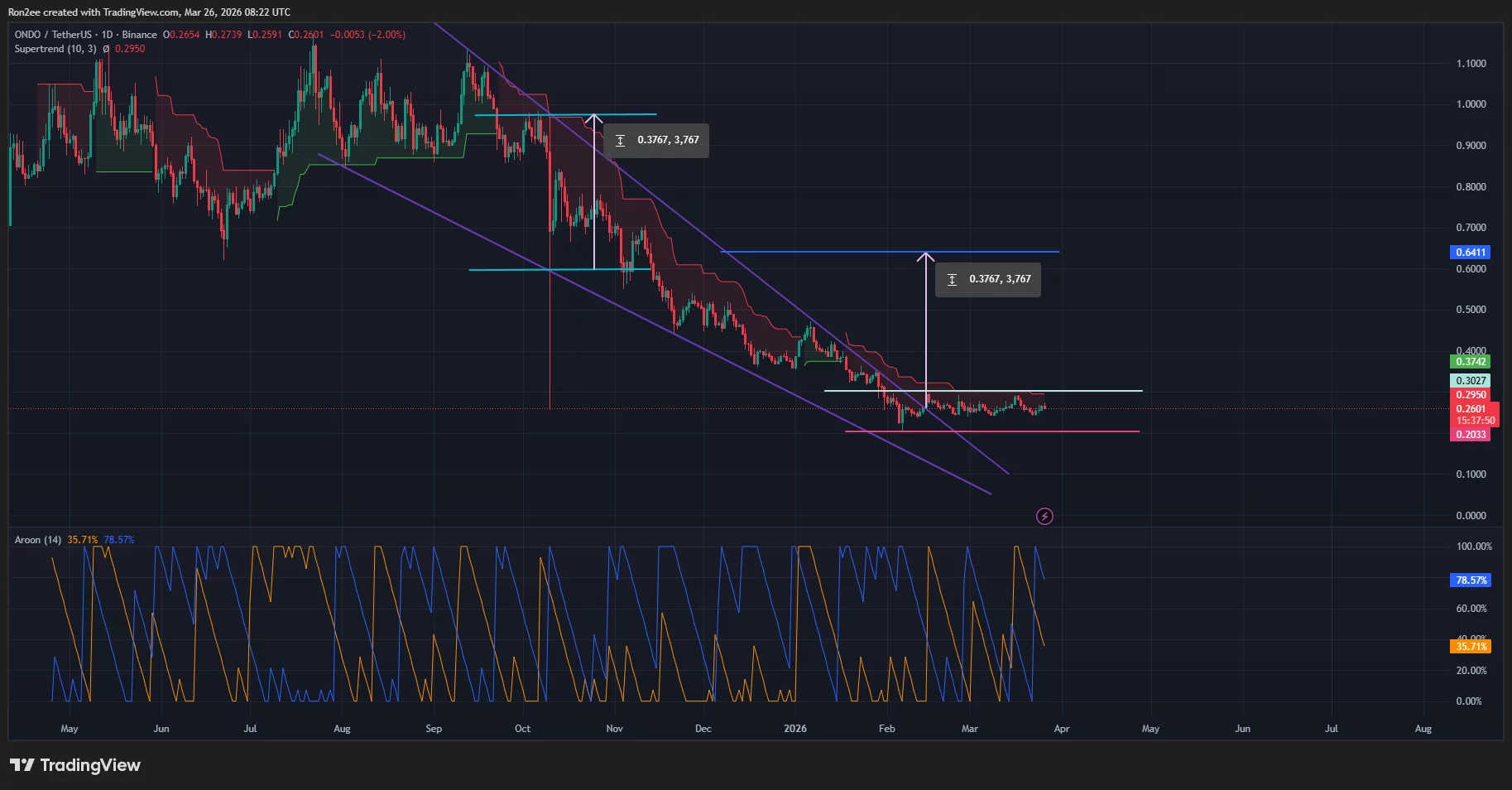
Ondo price jumped 8% following its partnership with Franklin Templeton to launch new tokenized ETFs on the blockchain.
Summary
- Ondo price rose 8% after announcing a partnership with Franklin Templeton to launch tokenized ETFs accessible via crypto wallets.
- The move expands access for global investors and strengthens Ondo’s position in the tokenized real-world asset market.
- A falling wedge breakout signals potential upside, though mixed indicators show that resistance near $0.30 remains a key level.
According to data from crypto.news, Ondo (ONDO) price rallied 8% to a weekly high of $0.27 on Friday, March 26, before rolling back to $0.26 at the time of writing.
Ondo price jumped after it revealed its partnership with Franklin Templeton to bring tokenized versions of the asset manager’s ETFs. The five ETFs, which include exposure to U.S. stocks, bonds, and gold, would be tradable round the clock from crypto wallets, thus distinguishing them from traditional market hours that limit trading.
With these tokenized offerings, non-U.S. investors can now access these assets directly, thus increasing the potential investor base.
The collaboration with the asset manager that holds nearly $1.7 trillion in assets under management increased the visibility and credibility of the token while also increasing the expectation of more widespread adoption by institutional investors.
Ondo Finance currently oversees over $2.7 billion in tokenized assets as it continues to expand in the real-world asset sector. Just days ago, the platform revealed it had added another 60 tokenized US stocks and ETFs to its platform, raising the total number of available assets to over 250 across Ethereum, Solana, and BNB Chain.
On the daily chart, Ondo price has broken out of a falling wedge pattern, a popular bullish reversal pattern formed of two descending and converging trendlines. When an asset breaks out of the upper trend line of the pattern, it typically tends to rally sustainably over multiple following sessions.
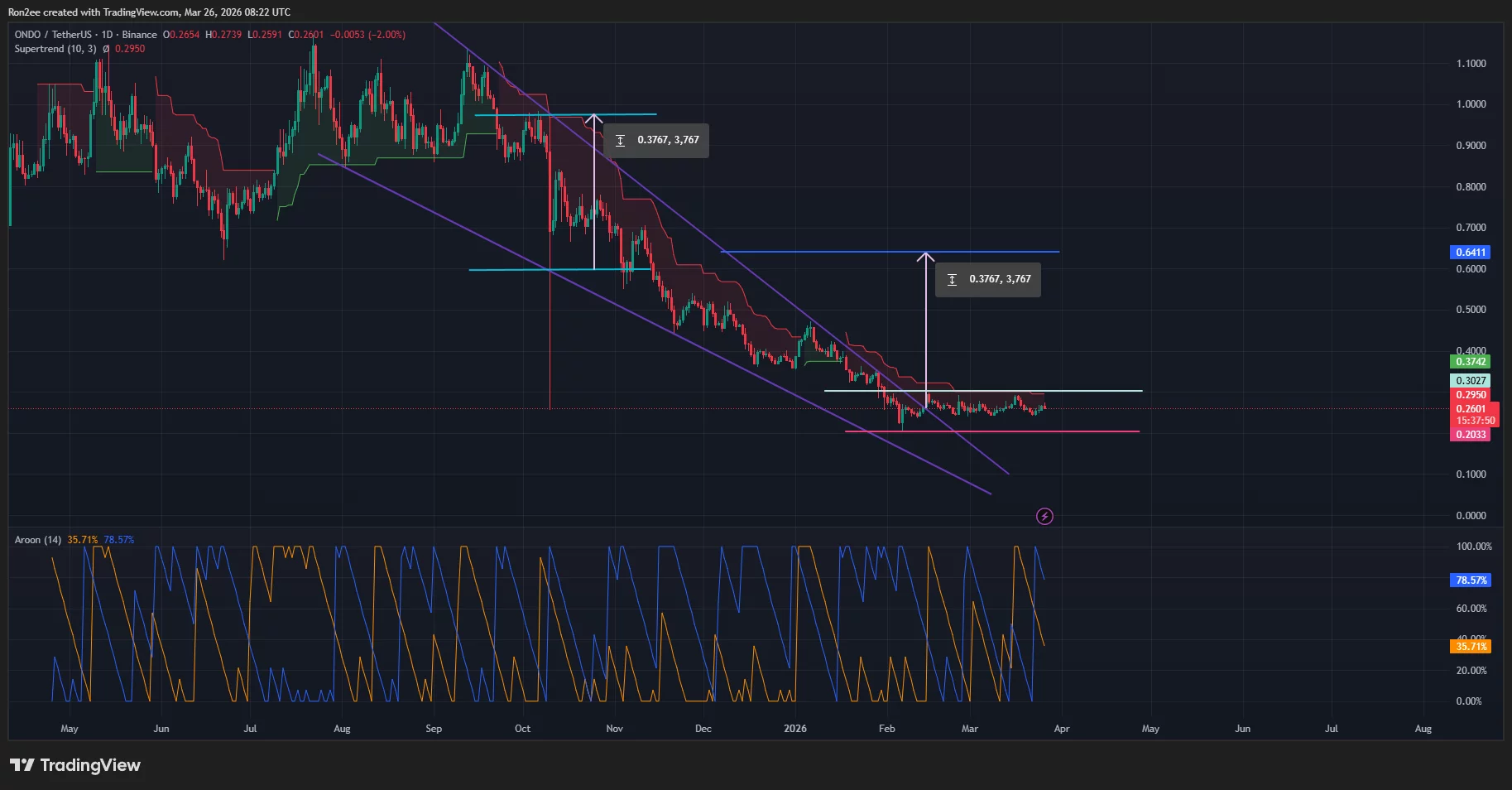
In Ondo’s case, the token could rally, surpassing $0.50 to nearly $0.64, a target calculated by adding the height of the wedge at its widest point to the breakout price level where the breakout occurred.
However, technical indicators seem to present a diverging perspective. The Supertrend has flashed a red signal, suggesting that the market trend was still bearish at the time of writing. The Aroon Down at 78.57% was also far higher than the Aroon up at 35.71%, a sign that selling pressure largely outweighed buying momentum.
For now, the most important resistance level to watch is $0.30, a level where the price has faced stiff resistance since early February. If Ondo surges past this barrier, it could potentially ignite a rally towards the target at $0.50.
On the contrary, a drop below the Feb. 6 low of $0.20 could invalidate the current breakout and lead to further downside momentum.
Disclosure: This article does not represent investment advice. The content and materials featured on this page are for educational purposes only.


US lawmakers have opened a new front in the fight over prediction markets. A bipartisan House bill now aims to stop top federal officials and their families from trading on government-related outcomes, as pressure also builds around sports and war-linked contracts.
Summary
- PREDICT Act would bar Congress, presidents, appointees, spouses, and dependents from government-related prediction market trades.
- Lawmakers tied the proposal to concerns that insiders could profit from war and policy events.
- Separate Senate and House bills also target sports contracts as pressure grows on platforms nationwide.
Representatives Adrian Smith and Nikki Budzinski introduced the Preventing Real-time Exploitation and Deceptive Insider Congressional Trading Act, or PREDICT Act, on March 25, 2026.
The bill would bar members of Congress, their spouses and dependent children, the president, the vice president, and political appointees from trading on political events, policy decisions, and other government actions on prediction markets.
The proposal also sets penalties for violations. Reports on the bill say the measure would impose a civil fine equal to 10% of the contract’s value and require any profit to go to the US Treasury. Budzinski said recent market activity raised questions about whether people with inside knowledge could benefit from these trades.
Budzinski said, “we’ve seen instances of little-known traders making massive profits” on events tied to war and government funding fights. Smith said public service must not become “a pathway to profit.” Their comments placed the bill within a wider debate over access to sensitive information in Washington.
That debate has grown in March. On March 17, Senator Chris Murphy and Representative Greg Casar introduced the BETS OFF Act, which would ban wagering on government actions, terrorism, war, assassination, and events where a person knows or controls the outcome. Murphy’s office said unusual trading before military actions involving Iran and Venezuela raised fresh concerns.
Congress is also moving against sports-related contracts. On March 23, Senators Adam Schiff and John Curtis introduced the Prediction Markets Are Gambling Act. Their bill would stop CFTC-registered entities from listing contracts that resemble sports bets or casino-style games.
Schiff said, “Sports prediction contracts are sports bets.” Curtis said the products belong under state control, not federal regulators. Their offices said sports event contracts now trade across all 50 states, even where local law restricts gambling.
Platforms face state action and new rules
The industry is also under pressure outside Congress. On March 20, a Nevada judge temporarily blocked Kalshi from offering event contracts in the state without a license. The case forms part of a wider fight over whether these products are financial tools or unlicensed gambling.
At the same time, Kalshi and Polymarket have tightened their own rules. Kalshi barred political candidates from trading on their own campaigns, while Polymarket revised its rules to block trades by users with confidential information or direct influence over an outcome.
Key takeaways:
-
Ether struggles to hold $2,400 due to low DEX volumes and declining demand for decentralized applications.
-
Institutional investor-led outflows and weak futures premiums suggest that ETH lacks the bullish demand for a sustainable rally.
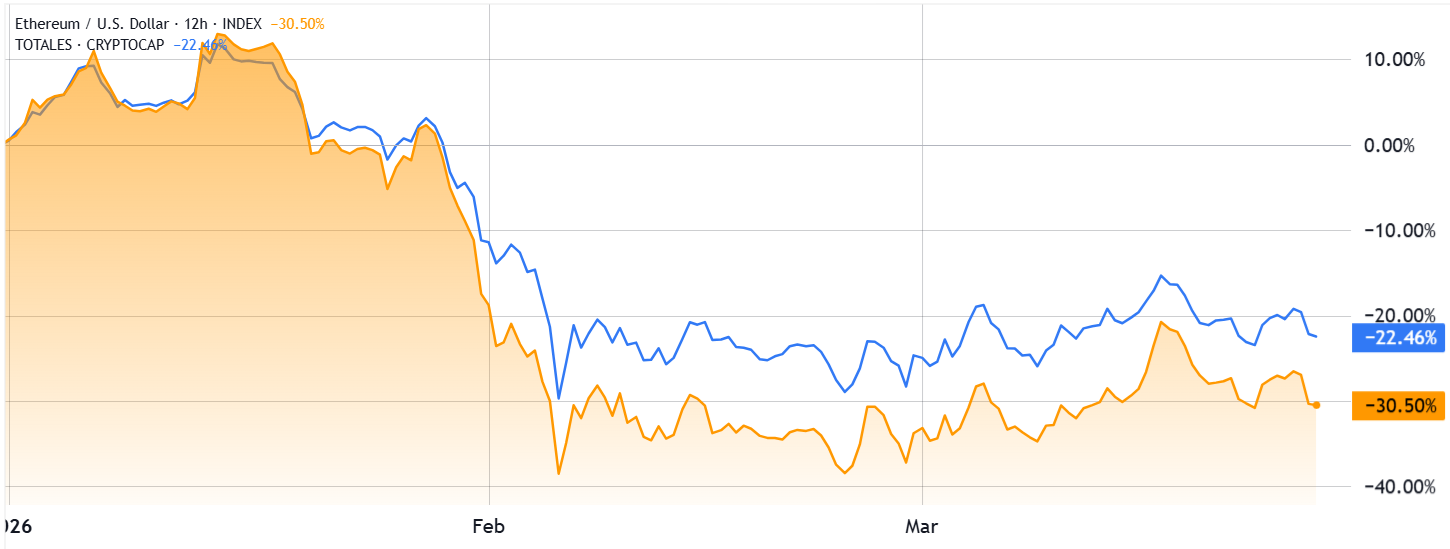
Ether (ETH) experienced a 6% correction between Wednesday and Thursday, retesting the $2,050 level, and reflecting a risk-off environment fueled by uncertainty surrounding the US and Israel-Iran war. Ether has lagged behind the total crypto market cap, leading investors to wonder what might trigger a sustained rally above $2,400.

The price of Ether has dropped 31% since the start of 2026, driven by a dip in decentralized application activity and a cautious mood across the cryptocurrency space. Much of this selling pressure comes from a lack of regulatory progress in the United States, especially since the Trump administration had fueled hope for a more crypto-friendly era.
ETH under pressure due to ETF outflows and onchain activity
The US Senate is now looking into a ban on yield for stablecoins kept on exchanges. While Coinbase is pushing back hard, the move has added another layer of worry for traders. Banking groups argue that the GENIUS Act already prevents stablecoin issuers from paying yields to holders directly, claiming that using exchanges as intermediaries is simply a loophole.
A recent report from the Financial Action Task Force (FATF) also urged nations to tighten oversight as stablecoins become more common in payments and cross-border transfers using self-custody wallets. The global anti-money laundering watchdog stated that peer-to-peer transactions make it more difficult for authorities to detect suspicious financial activity.
Besides regulatory setbacks, several indicators suggest limited short-term upside for Ether.

The US-listed spot Ether ETFs recorded $298 million in net outflows since March 18, marking six consecutive trading days of redemptions. While these flows are not a perfect proxy for institutional demand, especially following the launch of ETFs with embedded staking functionalities, investor risk perception remained unchanged by the 2.8% native staking yield.

The falling activity on Ethereum decentralized exchanges is a major concern as demand for the token weakens. The current weekly average of $9.4 billion stands around 50% lower compared to levels seen in the final three months of 2025. Unless there is a turnaround in this metric, Ether will likely struggle to maintain levels above $2,400.

Ether monthly futures traded at a 2% premium relative to regular spot markets on Thursday, indicating a lack of demand for bullish leverage. Under neutral conditions, this metric should stand between 4% and 8% to compensate for the longer settlement period. ETH bears will likely remain confident until this metric returns to a neutral range.
Related: SEC is no longer a ‘cop on the beat‘ on crypto, says US lawmaker
There is little doubt that socio-economic events, such as the US and Israel-Iran war, have been the main drivers behind the weakness in the stock market over the past two months. This risk-off mood contributed to Ether’s failure to reclaim $2,400. Still, an improvement in Ethereum decentralized exchange activity and higher conviction from institutional investors is needed for sustainable bullish momentum.
The accumulation of Ether by multi-billion dollar companies such as BitMine, SharpLink, and The Ether Machine could act as a catalyst for ETH to outperform the broader cryptocurrency market when the tide shifts favorably. For now, however, the price of Ether remains under pressure.
This article does not contain investment advice or recommendations. Every investment and trading move involves risk, and readers should conduct their own research when making a decision. While we strive to provide accurate and timely information, Cointelegraph does not guarantee the accuracy, completeness, or reliability of any information in this article. This article may contain forward-looking statements that are subject to risks and uncertainties. Cointelegraph will not be liable for any loss or damage arising from your reliance on this information.
Coinbase has raised new concerns over the Senate’s latest stablecoin yield compromise, keeping pressure on a crypto market structure bill that lawmakers still want to move forward.
Summary
- Coinbase rejected revised Senate language that could block exchanges from paying rewards on stablecoin balances.
- Banking groups say stablecoin rewards may pull deposits away from banks and weaken existing rules.
- Lawmakers and White House officials continue talks as pressure builds to move the bill forward.
Reports on March 26 said the exchange told Senate offices it could not support the new language on yield payments, keeping stablecoin rewards at the center of the debate.
Punchbowl News, as cited by several outlets, reported that Coinbase representatives met Senate lawmakers on Monday and pushed back on the revised draft. The reported concern focused on language that could stop third parties, including exchanges, from paying rewards on stablecoin balances.
That issue matters because stablecoin rewards remain a key product for crypto platforms. Banking groups have argued that exchange-paid rewards could draw deposits away from banks and leave a gap around the GENIUS Act, which already bars issuers from paying yield directly to holders.
Senators Thom Tillis and Angela Alsobrooks have led the latest Senate talks on a compromise. Earlier this month, Alsobrooks said lawmakers should not let perfect block progress and said both crypto firms and banks may leave the process “a little bit unhappy.”
The White House has also tried to bridge the gap. Reuters reported in late January that the administration planned meetings with banking and crypto groups, and later reporting showed the White House held at least a third meeting in February as the sides kept working on stablecoin reward terms.
The latest clash comes after a setback in January. Reuters reported that the Senate Banking Committee postponed work on the bill after Coinbase withdrew support and objected to earlier draft language tied to stablecoin rewards.
Lawmakers still face a tight calendar even though the House already moved first. The House passed the CLARITY Act on July 17, 2025, and the Senate now needs to settle its own version before any final package can move ahead.
Lummis and White House advisers signal talks continue
Senator Cynthia Lummis said on X that “bipartisan compromise is necessary” for the CLARITY Act to pass. She added that lawmakers are working to protect stablecoin rewards while also trying to prevent deposit flight from community banks.
White House digital assets adviser Patrick Witt also tried to calm market worries. He wrote that there was “plenty of uninformed FUD” around the issue, a sign that talks remain active even as Coinbase keeps pressing its case.


Bo Shen has reopened efforts to recover about $42 million in crypto stolen from his personal wallet in 2022.
Summary
- Bo Shen offered a recovery bounty after reopening efforts tied to his 2022 personal wallet hack.
- Investigators already helped freeze about $1.2 million connected to the stolen crypto, Shen said publicly.
- Shen said better tracing tools and fresh leads have revived recovery efforts, though uncertainty remains.
The Fenbushi Capital co-founder now offers a bounty to people or groups that help recover the assets, as investigators revisit the case with newer tracing tools and fresh leads.
Bo Shen said he will pay a bounty worth 10% to 20% of any recovered funds. He said the reward will go to any individual or organization that makes a material contribution to the recovery effort.
He also said onchain investigators ZachXBT and Taylor “Tayvano” Monahan have already helped freeze about $1.2 million linked to the stolen assets. Shen said his team will distribute rewards after the recovery process is complete.
The new bounty brings attention back to a case Shen first disclosed in November 2022. At that time, he said attackers drained about $42 million in digital assets from his personal wallet.
Shen said the stolen funds were personal assets and did not affect Fenbushi Capital or related entities. That distinction remains central to the case, as the renewed recovery effort focuses on assets taken from a private wallet rather than company-controlled funds.
Furthermore, blockchain security firm SlowMist later said the theft happened after someone compromised Shen’s mnemonic seed phrase. The firm said the stolen assets included about $38.2 million in USDC, 1,607 Ether, nearly 720,000 USDT, and 4.13 Bitcoin.
According to the case details, the stolen funds later moved through services and exchanges that included ChangeNow and SideShift. These transfers made the recovery effort harder, especially during the early stage of the investigation, when cross-chain tracking tools were still less developed.
New tools give investigators another chance
Shen said tracing tools in 2022 could not fully support a case of this scale and complexity. He said that limit reduced the ability of investigators to follow asset movements across different chains and platforms.
He now says recent progress in artificial intelligence-based analysis and onchain forensics has improved that process. Shen said investigators now have “new leads” and a “clearer picture” of how the funds moved after the hack.


Bitcoin mining margins remain under pressure as lower revenue and higher operating costs narrow the list of viable operators.
Summary
- CoinShares said falling hashprice has pushed part of the Bitcoin mining fleet below profitability levels.
- Older mining machines face the most pressure as electricity costs rise above sustainable operating thresholds.
- Bitcoin difficulty dropped sharply in March, offering some relief while miner margins remained under pressure.
A new CoinShares report says part of the global mining fleet now sits below profitability, with older machines and higher power costs facing the most pressure.
CoinShares said Q4 2025 was the hardest quarter for Bitcoin miners since the April 2024 halving. The firm said lower Bitcoin prices and near-record network hashrate pushed hashprice to five-year lows and lifted the weighted average cash cost to produce one Bitcoin among listed miners to about $79,995 in Q4 2025.
The report said hashprice dropped further to about $29 per PH/s/day in Q1 2026. CoinShares added that current mining economics do not support a broad hardware refresh cycle, as weaker returns continue to pressure balance sheets and daily cash flow across the sector.
CoinShares said the current revenue level makes several machine models unworkable at common power rates. The report stated that any miner running hardware below an S19 XP at electricity costs of 6 cents per kilowatt-hour or more is losing money at a hashprice near $30 per PH/s/day.
The firm estimated that this group accounts for about 15% to 20% of the global Bitcoin mining fleet. That places the current squeeze on operators with older fleets, weaker efficiency, or less favorable power agreements, while larger miners with newer hardware and cheaper energy retain more room to operate.
Moreover, hashrate Index said USD hashprice rose 4.9% in the week to March 23, reaching $33.65 per PH/s/day from $32.08. Even so, the same report said that at about $33 per PH/s/day, hashprice remains at or below breakeven for many miners depending on machine type and operating costs.
The network has already started to reflect that strain. Hashrate Index said Bitcoin’s latest difficulty adjustment on March 20 cut difficulty by 7.76% to 133.79 trillion, reducing the work needed to mine a block and giving some relief to miners that stayed online.
CoinShares sees more stress if Bitcoin stays below key levels
CoinShares head of research James Butterfill said,
“If prices were to stay below US$80k for the remainder of the year, we forecast the hashprice to continue to fall.”
He added that in that scenario, “the hashprice would more likely flatline” as miners switch off unprofitable rigs and network hashrate falls.
CoinShares also said higher-cost miners may face more capitulation in the first half of 2026 unless Bitcoin recovers. The report said the sector is moving toward operators with structural advantages, including low-cost power, better machine efficiency, and the ability to shift part of their business toward AI and data center services.


The crypto market fell 2.5% on Friday to $2.45 trillion as hopes of an end to the ongoing U.S. Iran war faded.
Summary
- Crypto market cap fell 2.5% to $2.45 trillion as geopolitical tensions rose after Iran rejected a U.S. proposal to end the conflict.
- Bitcoin dropped to $69,445 while Ethereum slid 4.4%, triggering over $193 million in long liquidations across derivatives markets.
- Rising oil prices and sustained Fed rate expectations weighed on risk sentiment, pressuring cryptocurrencies and global equities.
According to data from crypto.news, Bitcoin (BTC) price dropped 2.5% on the day to $69,445 at the time of writing as bulls failed to defend the $70,000 psychological support. Ethereum (ETH) was hit harder, falling 4.4% to $2,080, while other major altcoins such as BNB (BNB), XRP (XRP), Solana (SOL), and Dogecoin (DOGE) saw losses ranging between 3% and 5%, respectively.
As crypto prices fell, it triggered a massive unwinding of bullish long positions from traders in the crypto derivatives markets. Data from CoinGlass shows that over $193 million in long positions were liquidated from the crypto market in the past 24 hours. Out of this, Bitcoin accounted for $48.93 million while Ethereum saw $75.93 million in long liquidations.
Liquidations occur when a trader’s margin account can no longer support their open positions due to significant price moves. When longs get liquidated, they are forced to sell their assets, which creates further downside pressure on prices.
The crypto market downturn began after Iranian state media reported that Iranian officials had rejected a U.S. proposal to end the ongoing conflict between the two nations in the Middle East. This sparked uncertainty and deteriorated investor appetite for risk assets.
Asian tech stocks such as Japan’s Nikkei 225, Hong Kong’s Hang Seng, and South Korea’s KOSPI dipped lower on Friday shortly after the news broke. Even gold, touted as a safe haven asset amid times of economic stress, also fell 2.9% over the day to under $4,500. Silver fell 6% to $68.
Meanwhile, crude oil prices regained strength as the Strait of Hormuz remained closed for the fourth consecutive day. WTI crude futures rose 3.3% above $93 per barrel on Friday, while Brent oil rose 3.7% to above $106.
The closure of the key maritime bottleneck has severely disrupted global oil flows, resulting in the loss of millions of barrels of daily supply. This has sparked concerns of surging inflation and a supply chain crisis that could ultimately further push back hopes for Federal Reserve rate cuts this year.
According to the CME Group FedWatch tool, the odds of the Federal Reserve holding interest rates steady at 3.5% to 3.75% remain at 93.8%, while 6.5% expect a 25 basis point rate hike.
Risk assets, including cryptocurrencies, have often rallied when liquidity is high, or the market expects a rate cut, and typically decline when the central bank maintains a hawkish stance on monetary policy.
Disclosure: This article does not represent investment advice. The content and materials featured on this page are for educational purposes only.


Circle has reversed part of its recent USDC enforcement action after one of the 16 frozen wallets regained access to funds.
Summary
- Circle restored access to one frozen wallet, easing pressure after criticism over its broader freeze.
- ZachXBT said the unfrozen address linked to Goated.com held about 130,966 USDC after restoration.
- The partial reversal kept attention on Circle’s process as transparency concerns around the case persisted.
The move has shifted attention from the initial freeze to Circle’s review process, as public questions continue over how the company handled the case.
On-chain investigator ZachXBT said Circle unfroze the wallet address “0x61f…e543,” which he linked to Goated.com. Data cited in current reporting showed the wallet held about 130,966 USDC after access was restored.
ZachXBT also said other affected wallets could be restored soon. That update followed Circle’s earlier action against 16 wallets tied to separate business operations, including exchanges, casinos, and foreign exchange platforms.
Earlier reports said the freeze was linked to a sealed US civil case. At the same time, public reporting said the targeted wallets appeared to belong to unrelated businesses, with no clear public explanation for why all 16 were included in one action.
ZachXBT criticized the decision in strong terms. He wrote,
“In my 5-plus years of investigations, it could potentially be the single most incompetent freeze I have seen.”
He also said Circle had “zero basis” to freeze the funds tied to the case.
In addition, the partial unfreeze has kept the wider debate alive around how centralized stablecoin issuers handle enforcement. Market observers said restoring one wallet does not fully answer the questions raised by the earlier blacklisting.
MetaMask security researcher Taylor Monahan also called for stronger investigative standards and accountability when issuers freeze user funds. Current reporting said she pointed to the need for clearer review procedures when court-backed actions affect active business wallets.
The case has renewed attention on the powers built into centralized stablecoins such as USDC. Public reporting noted that Circle can block addresses, a feature supporters link to compliance needs and critics link to control over user funds.


Disclosure: This article does not represent investment advice. The content and materials featured on this page are for educational purposes only.
Bitcoiners have long theorized the sort of black swan events that could cripple the cryptocurrency network, rendering it unusable. Scenarios postulated range from nuclear apocalypse to a catastrophic internet failure – either of which would of course affect humanity in much more tangible ways than merely their ability to transact onchain.
One of the greatest threats envisaged, and which is now being routinely discussed, concerns the specter of quantum computing. Once sufficiently powerful quantum machines arrive, doomsdayers warn, cryptography could collapse overnight, affecting not just Bitcoin but most blockchains as well as traditional banking and web security.
The reason why this fear has gained mindshare, while other black swans – alien technology, say, or Satoshi’s 1M dormant bitcoins being reactivated – haven’t is because the quantum threat has a realistic chance of materializing. Indeed, many would say it’s inevitable and that it’s just a question of when it arrives.
Are we talking years or decades? If it’s the latter, there’s ample time for the world to migrate to quantum-proof systems. If it’s the former, then Houston we have a problem. Which is why it makes sense to head it off now so that when that day arrives, the world is ready and has implemented solutions to prevent digital assets and the distributed ledgers on which they run from being compromised.
As a result, researchers are increasingly paying attention to cryptographic systems that are quantum-resistant, ensuring they remain secure even in a world where quantum computers exist. Fully Homomorphic Encryption (FHE) falls firmly into this category, which is one of the primary reasons why it’s attracting growing interest across Web3 and traditional computing.
To understand why, we need to unpack the quantum threat and examine how FHE’s underlying mathematics differ from the cryptography most blockchains rely on today.
The Quantum Computing Problem
Most people don’t understand quantum computing at a deep level, which is unsurprising given its complexity. But they do understand the significance of the threat it presents. As you’re likely aware, traditional computers process information as bits that exist in one of two states, 0 or 1. Quantum computers use quantum bits, or qubits, which can exist in multiple states simultaneously thanks to a property known as superposition.
Without going too far down the physics rabbit hole, the practical implication is that certain problems which would take classical computers thousands or millions of years to solve can theoretically be solved far faster on a quantum machine. This matters because many widely used encryption systems depend on mathematical problems that are easy to compute in one direction but extremely difficult to reverse.
Two of the most important examples are RSA encryption, which relies on the difficulty of factoring large prime numbers, and Elliptic Curve Cryptography (ECC), which relies on the difficulty of solving discrete logarithm problems. Both of these are vulnerable to a quantum algorithm known as Shor’s Algorithm, which can efficiently solve the mathematical problems that secure them, and ECC is particularly relevant to blockchain because it forms the backbone of most crypto wallet security.
Why Blockchain Could Be Vulnerable
In most blockchain networks, control of funds ultimately comes down to possession of a private key. When you send a transaction, the network verifies that you own that key by checking a digital signature derived from elliptic curve cryptography. Under classical computing assumptions, deriving the private key from the public key is computationally infeasible.
But with sufficiently powerful quantum hardware running Shor’s Algorithm, that equation changes. A quantum attacker could theoretically derive the private key from the public key, allowing them to forge signatures and potentially drain wallets.
This doesn’t necessarily mean the threat is imminent. Current quantum computers remain far too small and error-prone to perform these attacks at scale. But cryptography operates on long time horizons and assets stored on a blockchain today need to remain secure decades into the future – which brings us back to FHE.
Why FHE is naturally Quantum-Resistant
Fully Homomorphic Encryption is built differently. That’s because most modern FHE implementations rely on lattice-based cryptography, which is based on the difficulty of solving problems involving high-dimensional geometric structures called lattices.
In simple terms, the challenge involves solving large systems of equations that include small amounts of noise or randomness. For classical computers, solving these problems efficiently is extremely difficult and – critically – no known quantum algorithms can solve them dramatically faster.
This makes lattice-based systems among the leading candidates for post-quantum cryptography, and organizations such as the U.S. National Institute of Standards and Technology (NIST) have selected several lattice-based algorithms as future cryptographic standards.
Because most FHE schemes are built on these same mathematical foundations, they inherit the same resistance to quantum attacks. In other words, FHE wasn’t originally designed as a quantum defense mechanism but the mathematics it relies on happens to align with the direction post-quantum cryptography is moving.
What this means for Blockchain
Quantum resistance is particularly important for blockchain systems because they’re designed to be enduring infra. We don’t know what one bitcoin will be worth in 20 years, but we’d like to have the confidence that it will be worth something and thus worth holding as a long-term investment – as well as ultimately bequeathing to our descendants.
Which is another reason why it’s important to be thinking about quantum computing now. It’s also worth noting, at this juncture, that blockchains can’t simply swap out cryptographic systems overnight. Their security assumptions are embedded into everything from consensus mechanisms to wallet architecture.
If a widely used cryptographic primitive becomes vulnerable, migrating an entire blockchain ecosystem would be – as Bane would put it – extremely painful. This is why the industry has begun circling FHE.
Because it allows computation on encrypted data and relies on quantum-resistant mathematics, FHE offers a pathway to privacy-preserving blockchain systems that are also post-quantum secure. This is particularly relevant for applications involving sensitive financial data.
The role of FHE in private DeFi
One of the most promising uses of FHE in blockchain today is encrypted decentralized finance. Public blockchains are of course transparent by design, and while this transparency is valuable for verification, it creates problems in financial markets where strategies and wallet balances become visible to everyone.
Fully Homomorphic Encryption addresses this by allowing smart contracts to operate on encrypted balances. For example, a lending protocol can verify that a borrower has enough collateral to secure a loan without revealing the exact amount and liquidation thresholds can remain hidden, preventing traders from targeting vulnerable positions. Encrypted lending models built on FHE demonstrate how smart contracts can enforce financial rules while keeping sensitive information private.
In this context, FHE delivers two benefits simultaneously: privacy coupled with long-term cryptographic resilience.
A future-proof cryptographic model
The rise of quantum computing has forced cryptographers to rethink the assumptions underpinning modern security. It seems inevitable that technologies built around classical cryptographic primitives may eventually need to be replaced. It could happen slowly or it could occur overnight due to a sudden quantum computing breakthrough.
What matters is that when it does happen, we’re prepped and ready rather than scrambling around for a solution – by which point it may be too late. We don’t know how long the pre-quantum era will last. But we do know that every age eventually comes to pass and when the pre-quantum one does, the blockchains that are protected by Fully Homomorphic Encryption will be spared and their security guarantees unimpaired.
In the here and now, FHE is useful for many things including delivering onchain privacy. But someway down the line, its primary value may be as the defense that ensures blockchain remains immune to the onslaught of the most powerful computers ever conceived.
Disclosure: This content is provided by a third party. Neither crypto.news nor the author of this article endorses any product mentioned on this page. Users should conduct their own research before taking any action related to the company.


Nvidia now faces a certified investor class in a long-running securities case tied to the 2017-2018 crypto mining boom.
Summary
- Judge certified investors as a class in Nvidia’s lawsuit over crypto-linked gaming revenue disclosures today.
- Nvidia faces claims it misled shareholders about mining-driven GPU sales during the 2017 boom period.
- The case now moves forward after courts let investors pursue the securities claims together formally.
A California federal judge ruled on March 25 that shareholders who bought Nvidia stock during a defined period can pursue their claims together, while the case moves into its next stage.
US District Judge Haywood S. Gilliam Jr. certified a class covering investors who acquired Nvidia common stock from August 10, 2017, through November 15, 2018. The ruling focused on whether the alleged statements may have affected Nvidia’s share price, which is a key issue in class certification.
The order does not decide whether Nvidia or Chief Executive Jensen Huang committed fraud. It allows investors to press the case together instead of filing separate lawsuits.
Investors allege that Nvidia and Huang misled the market about how much gaming revenue came from GPU sales tied to cryptocurrency miners. Current reporting says the plaintiffs claim Nvidia concealed more than $1 billion in crypto-related GPU sales during that period.
The complaint links the case to two market reactions in 2018. Court filings cited in the Supreme Court record say Nvidia stock fell 4.9% after the company’s August 16, 2018 earnings update, and then dropped 28.5% over two trading days after its November 15, 2018 revenue warning.
Moreover, the dispute has already survived several legal tests. In December 2024, the US Supreme Court dismissed Nvidia’s appeal and left in place a lower court ruling that allowed the shareholder suit to continue.
The case also follows Nvidia’s 2022 settlement with the US Securities and Exchange Commission. The SEC said Nvidia failed to give investors proper disclosure about the effect of cryptomining on its gaming business, and the company agreed to a cease-and-desist order and a $5.5 million penalty without admitting or denying the findings.
Nvidia prepares for the next stage
Nvidia has continued to reject the claims. After the Supreme Court decision in 2024, a company spokesperson said Nvidia was “fully prepared to continue our defense,” while maintaining that clear standards in securities litigation matter for shareholders and the market.
The court has scheduled a case conference for April 21, 2026, as the lawsuit moves forward after class certification. With that step complete, the case now shifts from the fight over procedure to the evidence that investors and Nvidia will present in court.

Andy Beshear’s 2028 playbook: How a Democrat wins in Trump Country

Mbappe played on despite injury after Real Madrid scanned wrong knee | Football News

English households must follow new bin collection rule starting April


-
 Crypto World6 days ago
NIO (NIO) Stock Plunges 6.5% as Shelf Registration Sparks Dilution Worries
-
 NewsBeat2 days ago
Manchester United reach agreement with Casemiro over contract clause amid transfer speculation
-

 Fashion6 days ago
Weekend Open Thread: Adidas – Corporette.com
-

 Politics6 days ago
Jenni Murray, Long-Serving Woman’s Hour Presenter, Dies Aged 75
-

 Crypto World5 days ago
Best Crypto to Buy Now: Strategy Just Spent $1.57 Billion on Bitcoin During Fear While Early Investors Quietly Enter Pepeto for 150x Potential
-

 Crypto World5 days ago
Bitcoin Price News: Bhutan Sells $72 Million in BTC Under Fiscal Pressure, but the Smart Money Entering Pepeto Sees What the Market Does Not
-

 Tech7 days ago
inKONBINI Lets You Spend Summer Days Behind the Register
-

 News Videos1 day ago
Parliament publishes latest register of MPs’ financial interests
-

 Sports4 days ago
Remo Stars and Kano Pillars Strengthen Survival Hopes in NPFL
-

 Sports4 days ago
Gary Kirsten Accuses Pakistan Cricket Board Of ‘Interference’, Mohsin Naqvi Responds
-

 Tech4 days ago
Give Your Phone a Huge (and Free) Upgrade by Switching to Another Keyboard
-

 Business4 days ago
No Winner in March 21 Drawing as Prize Rolls to $133 Million for Next
-

 Sports6 days ago
2026 Kentucky Derby horses, odds, futures, preview, date: Expert who nailed 12 Derby-Oaks Doubles enters picks
-

 Tech4 days ago
AI enters the chat: New Seattle dating app relies on tech to facilitate meaningful human connections
-
Business6 days ago
Columbia Sportswear enters $500 million credit agreement with JPMorgan Chase
-

 Tech5 days ago
Today’s NYT Connections Hints, Answers for March 22 #1015
-

 News Videos4 days ago
Ch 9 Financial Management Part 1 | Detailed One Shot | Class 12 Business Studies Boards 2026
-

 Business7 hours ago
Instagram, YouTube Found Responsible for Teen’s Mental Health Struggle in Historic Ruling
-

 Business5 days ago
Will Duke Basketball Win It All? Duke Basketball Enters Second Round as Third Favorite to Claim NCAA Title
-

 Business7 days ago
(VIDEO) BTS Drops ‘ARIRANG’ Album Today, Marking Epic Post-Military Comeback With Live Concert
You must be logged in to post a comment Login