
Crypto World
Bitcoin’s $47K Discount: Why Math Shows $123K Target While Price Sits at $76K


TLDR:
- Bitcoin’s power-law z-score at -0.69 indicates 38.2% discount from $122,681 mathematical trend value
- ETF outflows accelerated 265% to $15.25 billion in 30 days, driving persistent mechanical selling
- Open interest dropped 21.6% alongside 19.5% price decline, signaling deleveraging not panic selling
- Maximum gamma at $75K creates price compression with call wall at $90K and flip level at $71K
Bitcoin trades at $76,337 as of writing while mathematical models place its trend value at $122,681, creating a 38.2% discount that stems from mechanical deleveraging rather than fundamental weakness.
Data analyst David highlights this gap between short-term price formation driven by exchange-traded fund flows and long-run anchors determined by fixed supply and production costs.
The power-law z-score stands at -0.69, suggesting the asset trades significantly below its statistical trend despite unchanged underlying fundamentals.
ETF Outflows Drive Persistent Price Pressure
The primary catalyst behind Bitcoin’s current price weakness appears through exchange-traded fund activity.
Estimated net outflows reached $15.25 billion over the past 30 days, representing a 265% acceleration in redemptions. Trading volume remains at 0.8 times normal levels, indicating sustained rather than panicked selling pressure.
David explains that “this is how a scarce asset gets pushed below its ‘map’ without a dramatic capitulation.” The flow remains persistent but measured, avoiding the high-volume liquidation cascades typical of market crashes. Spot trading volume corresponds with gradual position unwinding rather than forced selling.
The distinction matters because mechanical selling creates different market dynamics than sentiment-driven crashes.
Exchange-traded fund investors can redeem shares steadily without triggering the feedback loops that amplify volatility. This steady pressure pushes price lower while maintaining relatively orderly market conditions.
Traditional panic selling typically accompanies volume spikes and accelerating price declines. Current market behavior shows neither characteristic, suggesting the selling pressure stems from portfolio rebalancing or institutional allocation shifts.
The absence of volatility expansion supports this interpretation of gradual rather than distressed selling.
Derivative Positioning Reveals Compression Dynamics
Open interest declined 21.6% over 30 days while price dropped 19.5%, producing a positive correlation of 0.66 between the two metrics.
David notes that “when price falls with collapsing open interest, you’re not seeing panic. You’re seeing balance sheets quietly shrink.” This synchronized decline indicates deleveraging rather than new short positions accumulating.
The paper-to-spot ratio stands at just 1.9%, reflecting reduced derivative activity relative to underlying asset trading. Options market structure shows net gamma exposure at negative $43 million, near neutral territory.
Maximum gamma concentrates at the $75,000 strike, creating a gravitational effect around current prices.
Put walls sit at $75,000 approximately 1.3% below spot, while call walls emerge at $90,000 roughly 18.5% higher. The gamma flip level appears at $70,999, about 6.5% below current trading levels.
David observes that “price feels ‘stuck’ because hedging flows are absorbing movement near the strike. Not because demand disappeared.”
The analyst emphasizes the asymmetric setup this creates, stating that “downside needs the persistent seller to keep selling. Upside mostly needs the seller to stop.”
The derivative structure adds friction to large moves in either direction until flow patterns shift materially or positioning constraints change substantially.


Crypto World
Ethereum Price Prediction: Can ETH Reach $4,000 Again, While Pepeto Presale Looks Like ETH in 2015
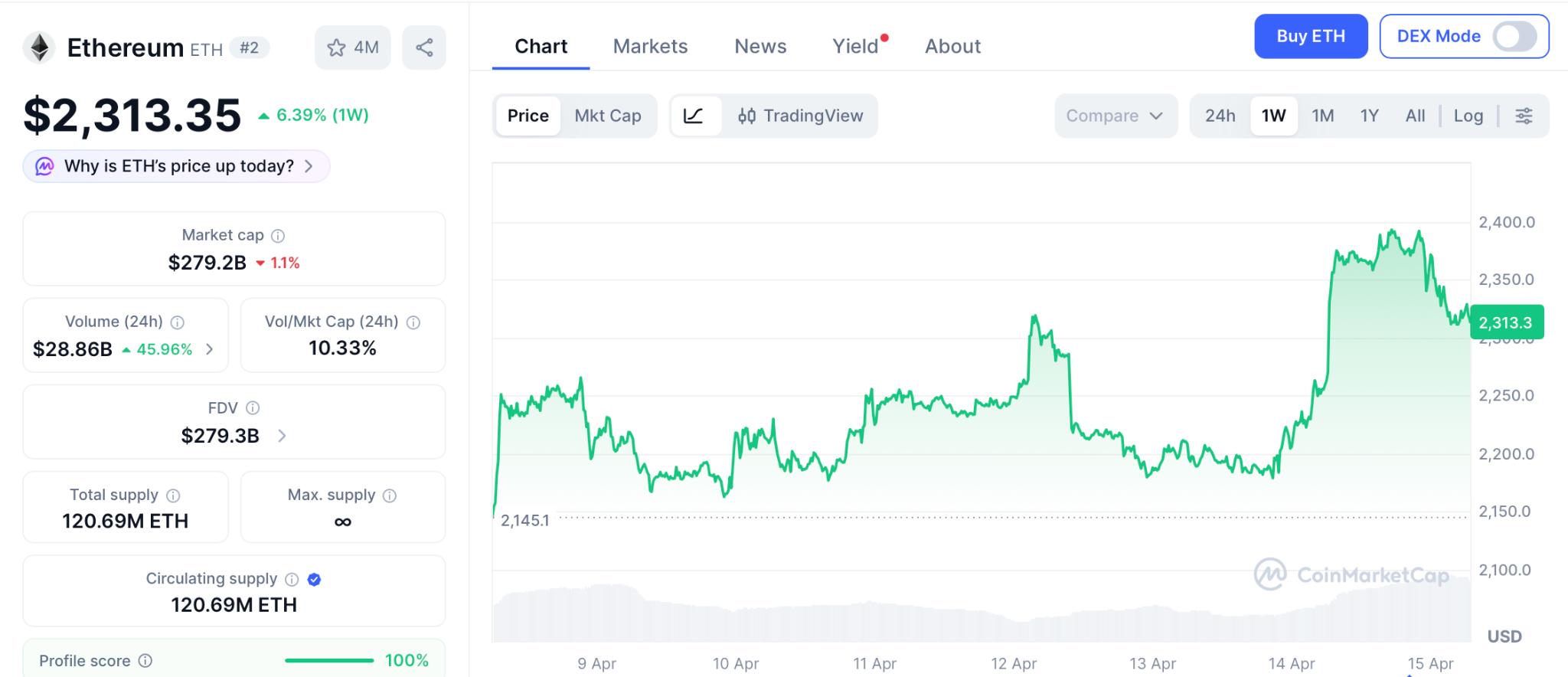
The ethereum price prediction just picked up a catalyst that shifts the math. The Ethereum Foundation launched a $1 million Audit Subsidy Program on April 14, partnering with Chainlink Labs and over 20 audit firms to cut security costs for builders according to CoinDesk. ETH jumped 8% to $2,313 the same day a ceasefire headline lifted the full crypto market.
Pepeto, the presale exchange project from the cofounder who built Pepe into an $11 billion token, keeps pulling wallets that move before headlines hit. While the ethereum price prediction aims at $4,000, the 150x setup around Pepeto creates a direct fight for the same capital.
Ethereum Price Prediction Picks Up Steam as the Foundation Doubles Down on Security
The Ethereum Foundation rolled out its Audit Subsidy backed by a $1 million pool, letting builders access security reviews through Areta’s platform according to CoinDesk. The initiative introduced CROPS principles for censorship resistance, open source, privacy, and security.
ETH trades near $2,313 after rallying 8% on the ceasefire bounce according to CoinGecko. Ethereum launched in 2015 near $0.30, and early buyers who held to the August 2025 peak at $4,946 grabbed over 16,000x. That is the exact math that pulled capital into ETH before anyone knew the name.
That history is impressive, but from $2,313, the ETH outlook counts gains in low multiples.
How the Ethereum Price Prediction, Pepeto Presale, and Security Upgrades Shape April
Pepeto: The Strongest Presale Running Right Now
Most buyers discover a token only after it already ran 10x or 100x. While the ETH forecast keeps traders locked to charts, Pepeto is the exchange built to get you positioned before the rally starts, not after it ends.
The platform is a full trading hub built to protect your capital. The contract scanner screens every token for buried scam code before your wallet gets near it, flagging risks most traders only discover after the money is gone.
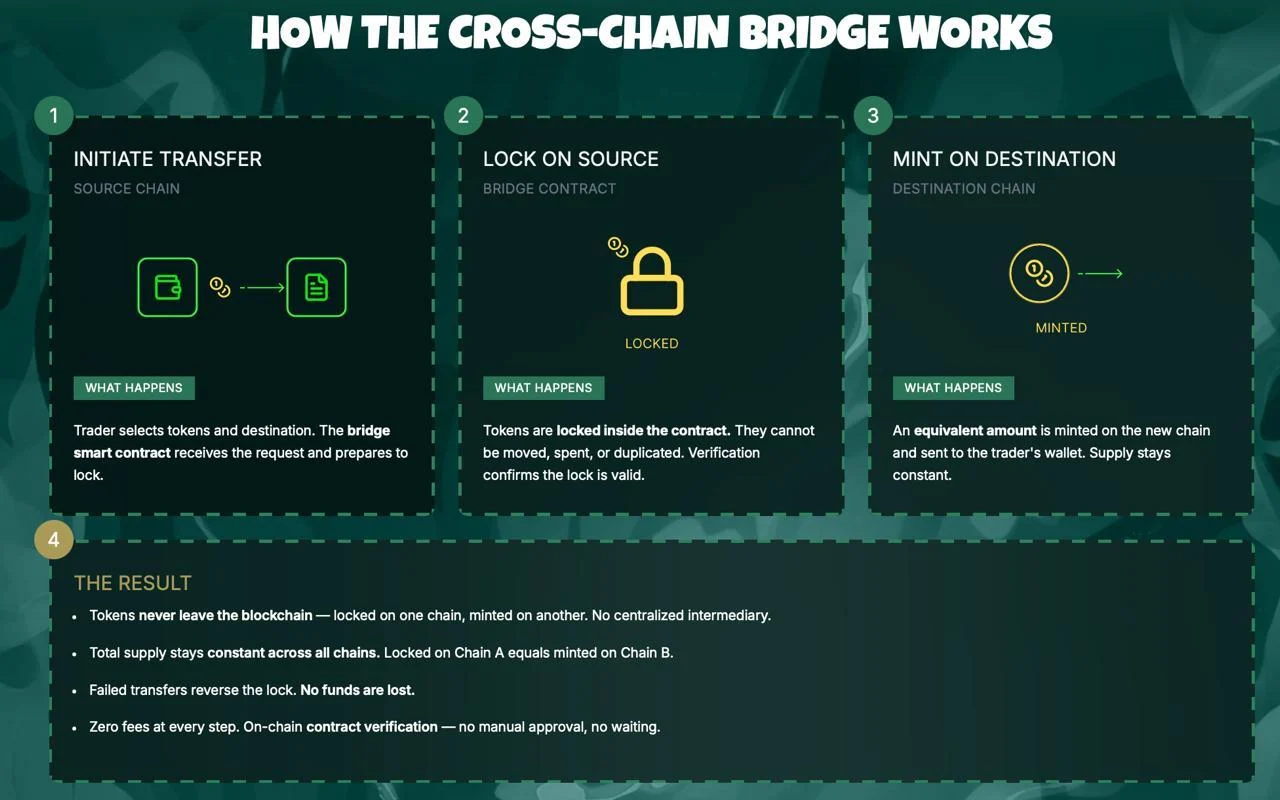
The exchange runs on three live tools. PepetoSwap fills trades at zero cost so your holdings build instead of bleeding. The scanner grades every contract for scam code in seconds. And the multi-chain bridge moves tokens across ETH, BNB, and SOL without taking a single fee.
The presale passed $9.04 million as the Binance listing gets closer. The cofounder who built Pepe to $11 billion is now shipping a real exchange. SolidProof reviewed the full codebase before round one went live, a former Binance team lead runs the technical side, and 183% APY staking grows positions daily at $0.0000001863.
Pepe hit $11 billion on hype alone. Reaching that cap from presale price equals over 150x, and Pepeto ships tools Pepe never had. ETH early buyers grabbed 16,000x by entering at $0.30 when nobody cared, and Pepeto sits in that same early window today. The wallets buying now are locking the positions the ETH forecast would take years to deliver, and every round that closes brings the presale closer to its end.
Ethereum (ETH) Price at $2,313 as Foundation Security Push and Institutional Flows Converge
Ethereum (ETH) trades near $2,313, sitting 52% below its all-time high of $4,946 with a market cap around $285 billion according to CoinMarketCap.
Changelly targets up to $2,618 for April, while CoinDCX projects $2,800 to $3,500 for the year. The ATH at $4,946 proves the token can reach those levels, and Standard Chartered’s $7,500 target gives the recovery real fuel.
But even the bull case at $4,000 is roughly 1.7x from here. That is solid for the second-largest crypto but not the move that changes a life. The ETH outlook pays off over quarters. The presale prints its return the day Binance opens the order book. For traders who want the best of both, the answer is clear.
Conclusion
The ethereum price prediction carries real weight. The Foundation’s security program strengthens the builder layer, and ETH’s rally history shows what early entries produce. But the biggest returns sit in a position bought at the ground floor, where a large cap at $2,313 cannot touch the multiples a presale at fractions of a cent delivers on listing day.
The Binance listing compresses that return into a short window, and wallets buying at presale pricing today hold the positions everyone else will chase once trading goes live. The Pepeto official website is where the ground-floor entry in the hottest exchange launch of this cycle is still available, but the clock is running out and this price will never come back.
Click to Visit Pepeto Website and Enter the Presale

FAQs
What is the ethereum price prediction for 2026 and can ETH reach $4,000?
Changelly targets $2,618 in April while CoinDCX projects $2,800 to $3,500 for the year. The ethereum price prediction toward $4,000 is backed by ETH reaching $4,946 in 2025, and the Foundation’s security push plus institutional ETF flows could fuel the move if macro conditions hold.
Can Pepeto beat the ethereum price prediction from presale pricing?
Pepeto at $0.0000001863 targets over 150x to the cap the same builder already reached with Pepe, a return ETH from $2,313 cannot deliver. The Pepeto official website is where that entry stays open until the Binance listing reprices everything.
Disclaimer: This is a Press Release provided by a third party who is responsible for the content. Please conduct your own research before taking any action based on the content.



Anthropic Trust has appointed Vas Narasimhan, CEO of Novartis, to Anthropic’s board of directors, making him the first pharmaceutical industry executive to join the AI lab’s governing body and tipping Trust-appointed directors to a board majority for the first time.
Summary
- Narasimhan was appointed on April 14 by the Anthropic Long-Term Benefit Trust, the independent body whose members hold no equity in Anthropic and exist solely to elect board directors aligned with the company’s public benefit mission.
- With his appointment, Trust-selected directors now hold a majority of seats on the seven-person board, a governance threshold written into Anthropic’s founding documents but not crossed until now.
- The appointment lands as Anthropic weighs an IPO at a reported $380 billion valuation and deepens its push into healthcare through Claude for Life Sciences and Claude for Healthcare.
Anthropic Trust appointed Vas Narasimhan, CEO of Novartis, to Anthropic’s board of directors on April 14, 2026. With his arrival, directors chosen by the Long-Term Benefit Trust now hold a majority of the seven-person board, crossing a structural governance threshold written into Anthropic’s founding charter but never previously exercised.
Narasimhan is a physician-scientist who has overseen the development and regulatory approval of more than 35 novel medicines and vaccines at Novartis, one of the world’s largest innovative medicines companies. He joins Dario Amodei, Daniela Amodei, Yasmin Razavi, Jay Kreps, Reed Hastings, and Chris Liddell.
The Anthropic Long-Term Benefit Trust is a separate legal body that holds a special class of Anthropic stock whose only purpose is electing board directors. Its three trustees hold no equity in Anthropic, draw no salary from it, and are selected by each other rather than by shareholders. The current trustees are Buddy Shah of the Clinton Health Access Initiative, Richard Fontaine of the Center for a New American Security, and Mariano-Florentino Cuéllar of the Carnegie Endowment for International Peace.
The Trust’s explicit mandate is to ensure Anthropic balances financial success with its public benefit mission of developing AI responsibly. Trust Chair Neil “Buddy” Shah said the group specifically sought someone who had stewarded breakthrough science responsibly in a highly regulated setting.
Narasimhan is the third director the Trust has placed on the board, joining existing Trust appointees Jay Kreps and Reed Hastings. Together they now constitute a majority, a shift that gives the Trust’s safety and public benefit mandate structural weight in board decisions for the first time.
The Healthcare Signal
The appointment is not random timing. Anthropic launched Claude for Life Sciences in October 2025 and Claude for Healthcare in January 2026, adding HIPAA-ready infrastructure and tools aimed at clinical, regulatory, and scientific workflows. The company has partnerships with Eli Lilly, Novo Nordisk, and Genmab to explore how AI can compress drug development timelines.
Bringing in a sitting pharma CEO with two decades of regulated-industry experience gives Anthropic direct expertise on the board as Claude’s deployment in clinical and research environments scales. Narasimhan said on LinkedIn that “speed alone isn’t the goal” in healthcare AI, and that “what matters just as much is how these tools are built, governed, and ultimately applied in the real world.”
Daniela Amodei said Narasimhan “brings something rare to our board. He’s overseen the development and approval of more than 35 novel medicines for the benefit of patients around the world in one of the most regulated industries. Getting powerful new technology to people safely and at scale is what we think about every day at Anthropic.”
IPO Context
Anthropic’s annualized revenue has surpassed $30 billion, up from $9 billion at end-2025, as demand for Claude models accelerates across enterprise. The company is reportedly weighing an IPO at a $380 billion valuation, and board composition is increasingly scrutinized by investors ahead of a public listing.
The addition of a pharma CEO to a Trust-majority board signals that Anthropic wants its safety-first positioning to translate into credibility with regulated-sector institutional buyers, not just a PR narrative. For a company preparing to access public markets, the governance architecture now matches the story.


Voters in New Jersey’s 11th congressional district are heading to the polls today in a special election that could tighten the Republican House majority to its absolute limit, pitting progressive Democrat Analilia Mejia against Republican Joe Hathaway in a district that Democrats carried by 9 points in 2024.
Summary
- The NJ special election fills the seat vacated by Governor Mikie Sherrill, who resigned from Congress in November 2025 after winning the governorship; Democrats hold a 65,000-voter registration advantage in the district.
- A Mejia win would leave House Speaker Mike Johnson able to lose just two GOP votes on party-line legislation, down from the current razor-thin margin of 218 Republican seats plus one independent.
- Mejia, backed by Senators Bernie Sanders and Elizabeth Warren, ran on taxing billionaires and holding Trump accountable; Hathaway positioned himself as a moderate Republican who would not be a “rubber stamp” for the president.
New Jersey voters are deciding today which party fills the vacant House seat in the 11th congressional district, a race that has drawn national attention because of its direct impact on the GOP’s already razor-thin House majority. Progressive Democrat Analilia Mejia faces Republican Joe Hathaway in a district with roughly 65,000 more registered Democrats than Republicans.
The seat opened when Mikie Sherrill resigned in November 2025 after winning the New Jersey governorship. Cook Political Report rated the race “Solid D,” and a March GBAO poll had Mejia leading 53% to 36%.
Republicans currently hold 218 House seats plus one independent who caucuses with them. Democrats hold 213, with four seats vacant. A Mejia win would reduce the GOP margin further, leaving Speaker Mike Johnson able to lose just two Republican votes on any party-line legislation without Democratic support.
That thinning margin has already been felt in 2026. As crypto.news reported, House Republicans are currently deadlocked over FISA reauthorization and budget reconciliation, consuming legislative bandwidth at the exact moment the CLARITY Act needs Senate Banking Committee attention before midterm politics close the window. A narrower majority makes every defection more consequential.
Who the Candidates Are
Mejia, 48, is a progressive activist and former national political director for Senator Bernie Sanders’ 2020 presidential campaign. She won a crowded February primary by narrowly defeating former Congressman Tom Malinowski, whose campaign was broadly seen as damaged by a $2 million ad blitz from a super PAC aligned with AIPAC that backfired with Democratic primary voters. Sanders, Elizabeth Warren, and Alexandria Ocasio-Cortez endorsed Mejia. Her platform centers on taxing billionaires, universal healthcare, holding Trump accountable, and affordability.
Hathaway, 38, is a Randolph Township councilman and former mayor. He ran as a self-described “commonsense, independent” Republican, repeatedly distancing himself from Trump. “I won’t be a rubber stamp,” he said at an April debate. Trump has not endorsed Hathaway. Hathaway raised $500,000 by end of March versus Mejia’s roughly $1 million, with 70% of his donations coming from $1,000 contributions or higher.
Broader Midterm Implications
Beyond the immediate math, the race is being closely watched as a signal of Democratic voter energy heading into November’s midterms. Special elections in recent years have shown Democrats consistently outperforming their expected margins in suburban districts, and political scientists are watching whether Mejia’s margin tracks or exceeds the district’s historical lean.
The race also tests how effective a progressive candidate can be in an affluent suburban district, with Newsweek noting that her performance could shape Democratic candidate strategy in similar districts across the country heading into the midterm cycle.
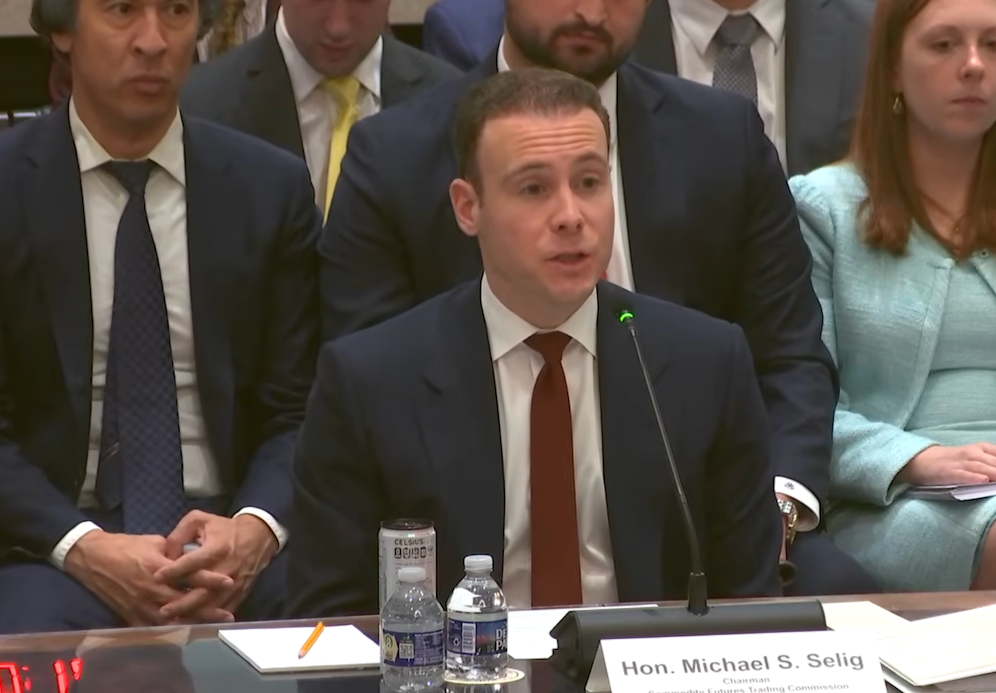
The chair of the Commodity Futures Trading Commission (CFTC), Michael Selig, said he would not wait for the appointment of additional commissioners to lead the regulatory agency before moving ahead on rulemaking potentially related to digital assets and prediction markets.
In a Thursday hearing of the House Agriculture Committee, Selig responded to questions from ranking member Angie Craig, who called out the lack of leadership at the CFTC, which normally has a bipartisan panel of five commissioners. The Minnesota representative asked the chair to commit to not finalizing regulations while he is the only commissioner.
“In the interim, we cannot, for the sake of the American people, slow down in our rulemaking,” said Selig. “It’s very important that we get investor protections, consumer protections and safeguards for our markets. And so, I cannot, unfortunately, commit to not do my job that I was appointed to do by the president.”

Selig, who has served as the CFTC’s sole commissioner and chair since December, has come under scrutiny from many lawmakers for unilaterally leading the agency on rules favoring crypto and prediction markets with no bipartisan group of commissioners. As of Thursday, President Donald Trump had not publicly announced any nominations to staff the agency nor signaled he intended to do so.
“We’re going to do more through rulemaking,” said Selig in response to a question on the CFTC’s leadership from Representative Don Davis. “We can’t have the staff deciding on discretion what the rules are.”
Related: CFTC probes oil futures trades tied to Trump’s moves in Iran: Report
The CFTC chair proposed rulemaking in March that could amend or issue new regulations over event contracts on prediction markets. Selig has been outspoken about claiming that the agency has “exclusive jurisdiction” over prediction markets as the companies behind some platforms face state-level lawsuits related to sports betting laws and proposed legislation to crack down on insider trading.
CFTC’s legal fight over prediction market continues
Gaming authorities in several US states have filed lawsuits against prediction market companies like Kalshi and Polymarket, alleging the platforms offered sports betting in violation of state laws.
New Mexico Representative Gabe Vasquez questioned Selig at Thursday’s hearing with a visual aid showing that bets on event contracts and through state-level gaming “aren’t much of a difference, yet they are regulated completely differently.” He accused the CFTC of using “loopholes” to bypass state laws and requirements for prediction markets, causing some jurisdictions to miss out on revenue.
“The CFTC was not created or intended to regulate sports gambling,” said Vasquez, adding:
“Are we regulating real economic risk, or are we allowing prediction markets to steal billions of dollars in an unregulated free-for-all, with no consumer protection as Congress and the CFTC turns a blind eye?”
Companies like Kalshi have argued that they are under the sole jurisdiction of the CFTC. This argument led the company to court wins in Arizona and New Jersey, where this month judges blocked state officials from taking action against Kalshi.
Magazine: Should users be allowed to bet on war and death in prediction markets?
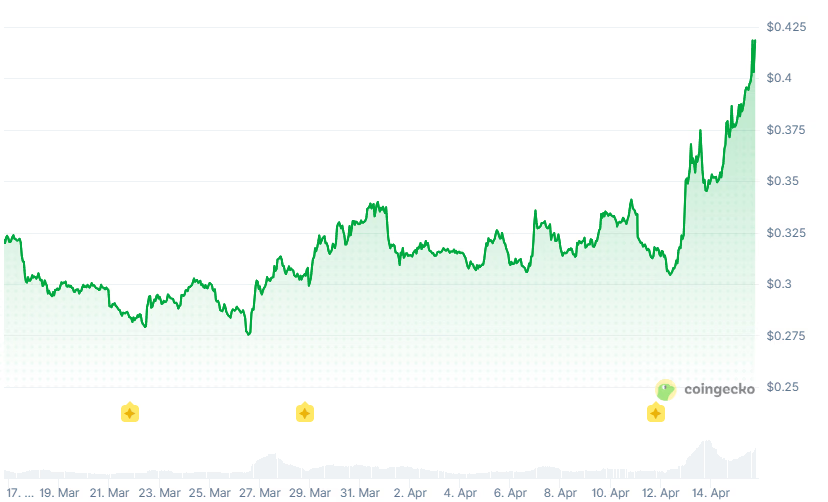
Lido’s token is the only top DeFi token in the green over the past 30 days, fueled by a $20 million treasury repurchase program.
Top Ethereum liquid staking protocol Lido’s governance token has emerged as a rare bright spot in a battered DeFi sector, gaining 30% over the past 30 days while every other major token slid into the red.
LDO is trading at $0.42, up 12% in the past 24 hours, according to CoinGecko.

The contrast with its DeFi peers is stark. Over the same 30-day window, AAVE fell 7%, Uniswap (UNI) dropped 15%, Curve’s CRV slipped 9%, and Etherfi’s ETHFI shed 16%. MORPHO was the closest to breakeven among top DeFi tokens, losing just 0.5%.
The catalyst behind LDO’s outperformance is a $20 million buyback program. The Lido DAO voted to spend up to 10,000 stETH ($23 million) to repurchase LDO tokens from the open market, routing purchases through centralized exchanges and market makers in 1,000 stETH batches due to thin on-chain liquidity. Each batch requires a separate Easy Track governance motion to execute. At current prices, the full program could retire roughly 8% of LDO’s circulating supply, according to the proposal.
The buyback coincides with a broader strategic pivot. In December, the DAO approved a $60 million budget to push Lido beyond its core liquid staking business. That plan began taking shape in March when the protocol launched EarnUSD, its first stablecoin vault, which allocates USDC and USDT deposits across lending markets, real-world asset integrations and structured positions.
But despite the rally, LDO remains down more than 94% from its November 2021 peak of $7.30, and Lido’s share of staked ETH has slipped to a year-to-date low of roughly 23%, according to a Dune dashboard.
The buyback proposal itself acknowledged the token’s distressed valuation, calling the gap between LDO’s price and Lido’s revenue “one of the most significant dislocations” in the project’s history.

TLDR
- CFTC Chairman Mike Selig told lawmakers that AI tools help the agency maintain oversight despite a reduced workforce.
- About 25% of the CFTC staff has left since 2025 following federal workforce cuts.
- Selig said Microsoft Copilot supports internal workflows and investigations across the agency.
- The enforcement division seeks three additional staff positions but remains below 2025 staffing levels.
- Lawmakers questioned whether the CFTC has enough resources to oversee crypto and prediction markets.
The U.S. Commodity Futures Trading Commission is expanding oversight of crypto and prediction markets despite fewer staff. Chairman Mike Selig told lawmakers that AI tools help maintain enforcement capacity. He said the agency continues rulemaking and investigations while operating with reduced personnel.
AI Tools Support Oversight as Workforce Shrinks
Selig told the House Agriculture Committee that AI supports surveillance and investigations. He said Microsoft’s Copilot assists staff across internal workflows and case reviews. He added that the agency runs “more efficiently and effectively” despite staff reductions.
About 25% of CFTC employees have left since 2025 under federal workforce cuts. Agency records show the enforcement division seeks three new hires next year. The request would raise staffing to 108, still 23% below the 140 positions in 2025.
Committee Chairman Glenn “GT” Thompson addressed the expanding mandate over digital assets and prediction markets. He asked Selig to request more qualified staff if operational needs rise. Selig replied, “Absolutely,” and reiterated that enforcement remains a “top priority.”
Representative Angie Craig questioned whether the workforce can meet current demands. She said the agency serves as the primary regulator of two fast-growing markets. Craig urged Congress to provide staff, funding, and statutory authority.
The commission currently operates with only Selig as a member. Federal law calls for five commissioners, including two from the minority party. Lawmakers asked whether Selig would advance major rules alone.
Selig said the agency cannot slow rulemaking for the public’s sake. He confirmed plans to proceed with regulatory actions as a single commissioner. The CFTC has started a preliminary rule process for U.S. prediction markets.
Bitcoin and Ethereum Fall Under Expanding CFTC Role
The Senate continues work on the Digital Asset Market Clarity Act. The bill would assign the CFTC central authority over non-securities crypto trading. That mandate would include bitcoin at $75,158.21 and Ethereum’s ether.
Selig’s predecessor, Rostin Behnam, had argued for more staffing to oversee crypto. He said the agency lacked resources to police expanding prediction markets. Selig now leads the regulator during rapid growth in those markets.
Platforms such as Polymarket and Kalshi have expanded from millions to billions in annual volumes. Selig said the CFTC claims legal jurisdiction over these prediction markets. He acknowledged “numerous investigations ongoing” but declined to share numbers.
Selig said regulated platforms serve as the first line of defense. He described the CFTC as a second line against insider trading and fraud. He warned that violators will face “the full force of the law.”
He said the agency regularly rejects contracts that fail review. He stated, “We’re actively reviewing what’s out there,” and emphasized a “zero tolerance” policy. The CFTC continues to assess hundreds of new binary event markets each day.
HIVE Digital Technologies said it plans to raise $75 million through a private offering of 0% exchangeable senior notes due 2031, with proceeds expected to fund GPU purchases, data center development and other capital investments.
According to Thursday’s announcement, the notes will be issued by a wholly owned subsidiary and offered to qualified institutional buyers, with an option to raise an additional $15 million. Final terms, including the exchange rate, will be set at pricing.
The notes will be exchangeable under certain conditions, with HIVE able to settle conversions in cash, common shares or a combination of both. They will not bear regular interest, will not accrete and are unsecured obligations of the issuer, fully guaranteed by HIVE.
HIVE’s Nasdaq-traded shares (HIVE) sank 11.5% on Thursday while industry tracker CoinShares Bitcoin Mining ETF (WGMI) fell 1.5%, per Yahoo Finance data. HIVE is the seventh-largest holding in that exchange-traded fund, at 4.89% weight.
Proceeds will be directed to the company’s subsidiaries for general corporate purposes, including capital expenditures tied to graphics processing units and data center expansion. HIVE also said it plans to enter capped call transactions with financial counterparties to limit potential dilution from future conversions.
Separately, the company said it has received conditional approval to list its shares on the Toronto Stock Exchange, with trading expected to begin later this month, subject to meeting listing requirements.
HIVE was among the first Bitcoin miners to pivot into high-performance computing in 2022, a shift that is now beginning to show up in its financial results. In its third quarter, the company reported $93.1 million in revenue, up 219% year over year, despite weaker Bitcoin prices and rising network difficulty.
In February, HIVE signed a two-year, $30 million agreement to deploy 504 Nvidia B200 GPUs for enterprise AI cloud services.
Related: Public crypto miners sold more BTC in Q1 2026 than all of 2025: Report
Mining companies lean into AI data center pivot
The fundraising comes as publicly traded Bitcoin miners continue to expand into high-performance computing and AI workloads.
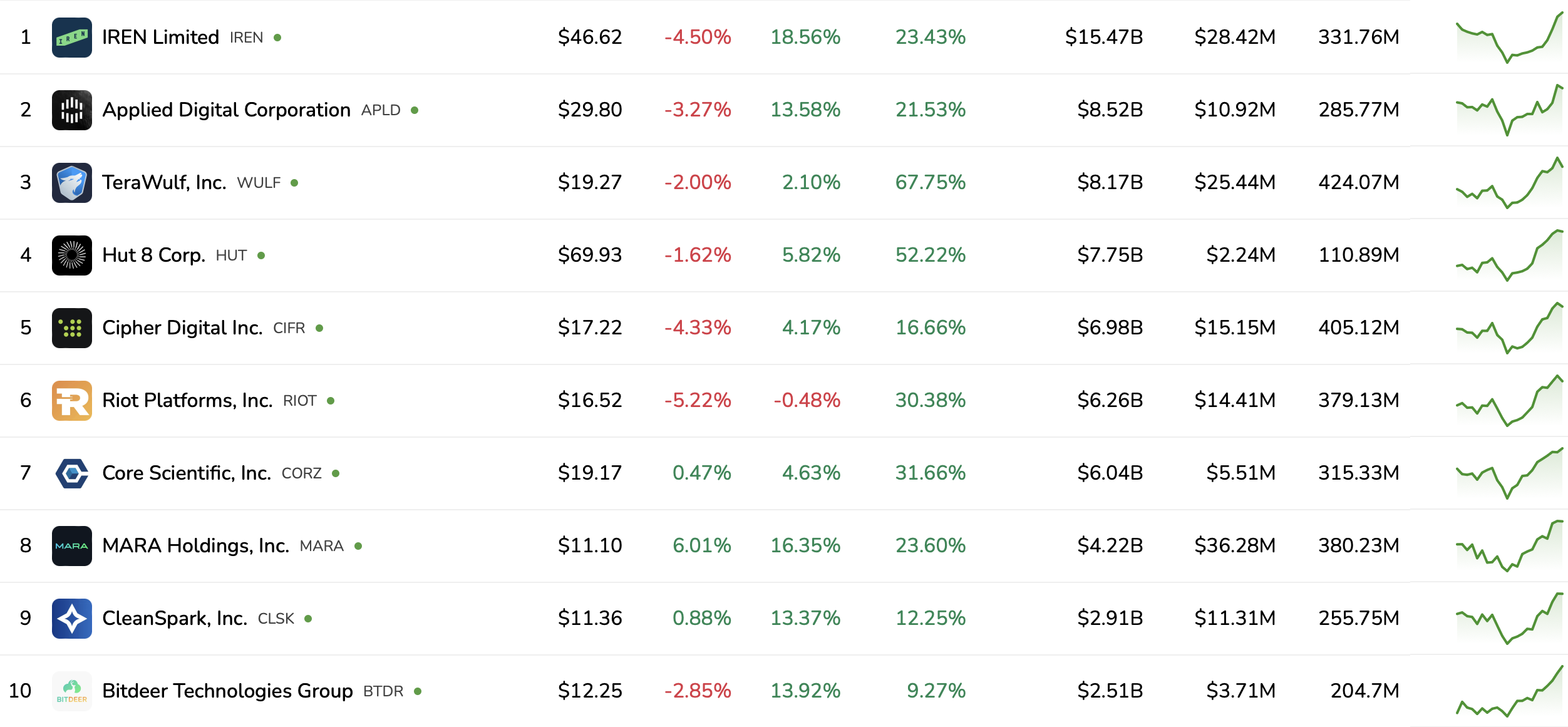
Companies including MARA Holdings, Riot Platforms, Bitdeer Technologies, TeraWulf, Hut 8, CleanSpark and IREN have all made moves into AI and high-performance computing, leveraging existing access to power and data center infrastructure.
In January, CleanSpark agreed to buy 447 acres in Texas to build a 300-megawatt AI-focused data center, with plans to expand to 600 MW, while in February, MARA acquired a majority stake in French computing infrastructure company Exaion as part of its push into AI and cloud services.
Meanwhile, CoreWeave, which began as a crypto mining operator and pivoted toward high-performance computing as early as 2019, has grown into a major provider of AI cloud infrastructure.
On Wednesday, the company announced a $6 billion agreement with Jane Street to provide AI computing capacity across its data centers, alongside a $1 billion equity investment from the firm, days after signing a multi-year deal with Anthropic to support its Claude large language models.
The shift is also extending beyond traditional miners. On Thursday, renewable-powered data center developer Soluna Holdings moved to consolidate ownership of its Texas-based campus, positioning the site for a transition toward AI-focused computing.

Magazine: Forget stablecoin yield, how does the CLARITY Act treat DeFi?
Crypto World
An AI Scientist Proposed an ADHD Treatment on the Blockchain: BIO Price Explodes Is This What DeSci Has Been Waiting For?
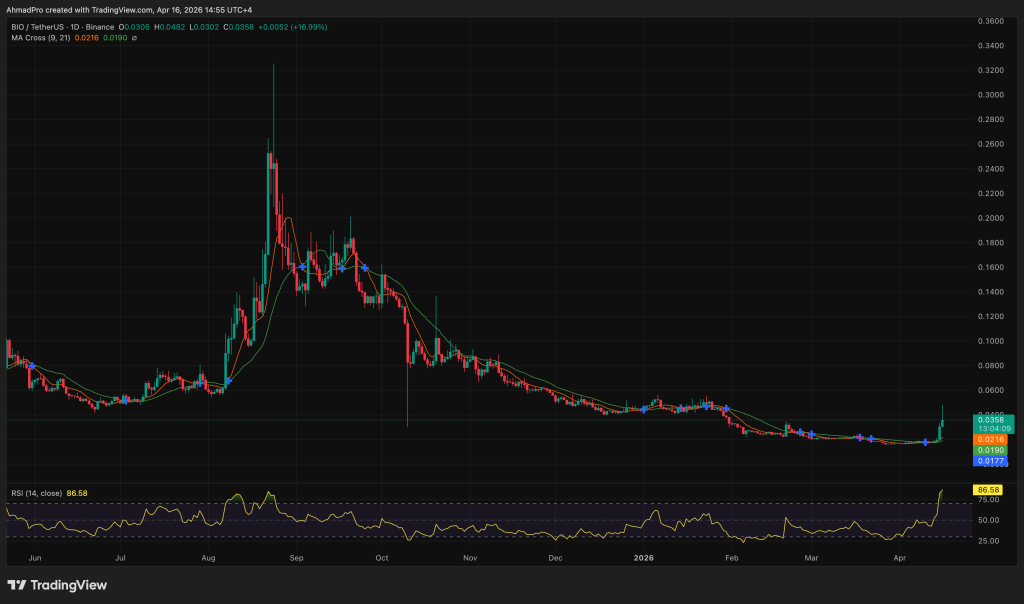
Decentralized science is having a moment. Bio Protocol crypto surged roughly 90% as AI-driven biotech funding collides with onchain infrastructure, and traders are asking whether DeSci has finally found its cycle.
Price data remains thin at the top, but the underlying catalyst is concrete. Bio Protocol’s $6.9M funding round, led by Maelstrom Fund, backed the rollout of Bio V2, a full-stack AI-native platform enabling onchain fundraising and autonomous AI co-scientists called BioAgents.
The AI-scientist angle, including a reported peptide proposal targeting ADHD, lit up crypto-science communities. Broader AI token momentum, visible in FET’s ongoing support test, suggests the narrative has legs beyond a single project pop.
Can BIO Crypto Token Sustain Its +40% Move Or Is a Reversion Incoming?
Bio Protocol’s 40% price spike arrived without a clean technical base, which cuts both ways. The move originated from a low-liquidity range, meaning the rally was fast and thin (classic low-float DeSci behavior).
Without verified exchange-level data, precise support and resistance levels are difficult to pin, but the structural setup follows a familiar pattern: explosive breakout on catalyst, followed by a consolidation or partial giveback before any sustained continuation.
BIO right now is sitting between hype and real utility, and the difference shows up in whether demand actually sticks after the spike, because if DeSci momentum keeps building and the platform starts delivering real results, that is where price can hold higher levels and turn this into a sustained move instead of a one-off event.
But that only works if interest stays tied to actual usage, not just narrative, and that is still being tested.
The risk is simple: if the price cannot hold above its pre-announcement level on a weekly close, it usually means the move was just hype-driven, and once that fades, the price tends to drift back down.
Also worth watching the broader space, because if related tokens start rolling over, that usually drags everything with it, and BIO would not be an exception.
LiquidChain Targets Early Mover Upside as DeSci Momentum Builds Across Chains
Bio Protocol’s spike demonstrates a pattern traders know well: the biggest returns in any emerging narrative go to the earliest positioned capital. By the time a 40% move is on the ticker, the asymmetric entry has already closed. That’s the uncomfortable arithmetic of late-stage entries — real catalyst, shrinking upside.
For traders looking ahead, LiquidChain is building the cross-chain infrastructure layer that emerging DeSci and DeFi applications will require, regardless of which individual token wins.
LiquidChain is a Layer 3 protocol that combines Bitcoin’s capital base, Ethereum’s DeFi depth, and Solana’s execution speed into a single, unified liquidity environment, without asset wrapping.

Its Deploy-Once Architecture means developers build once and access users across all three ecosystems simultaneously.
The LIQUID presale is currently priced at $0.0145, with $674,947.04 raised to date. Features include a Unified Liquidity Layer, Single-Step Execution, and Verifiable Settlement backed by trust-minimized state verification. Presales carry material risk, tokens may not list at a premium, and infrastructure plays require adoption to generate returns.
The post An AI Scientist Proposed an ADHD Treatment on the Blockchain: BIO Price Explodes Is This What DeSci Has Been Waiting For? appeared first on Cryptonews.
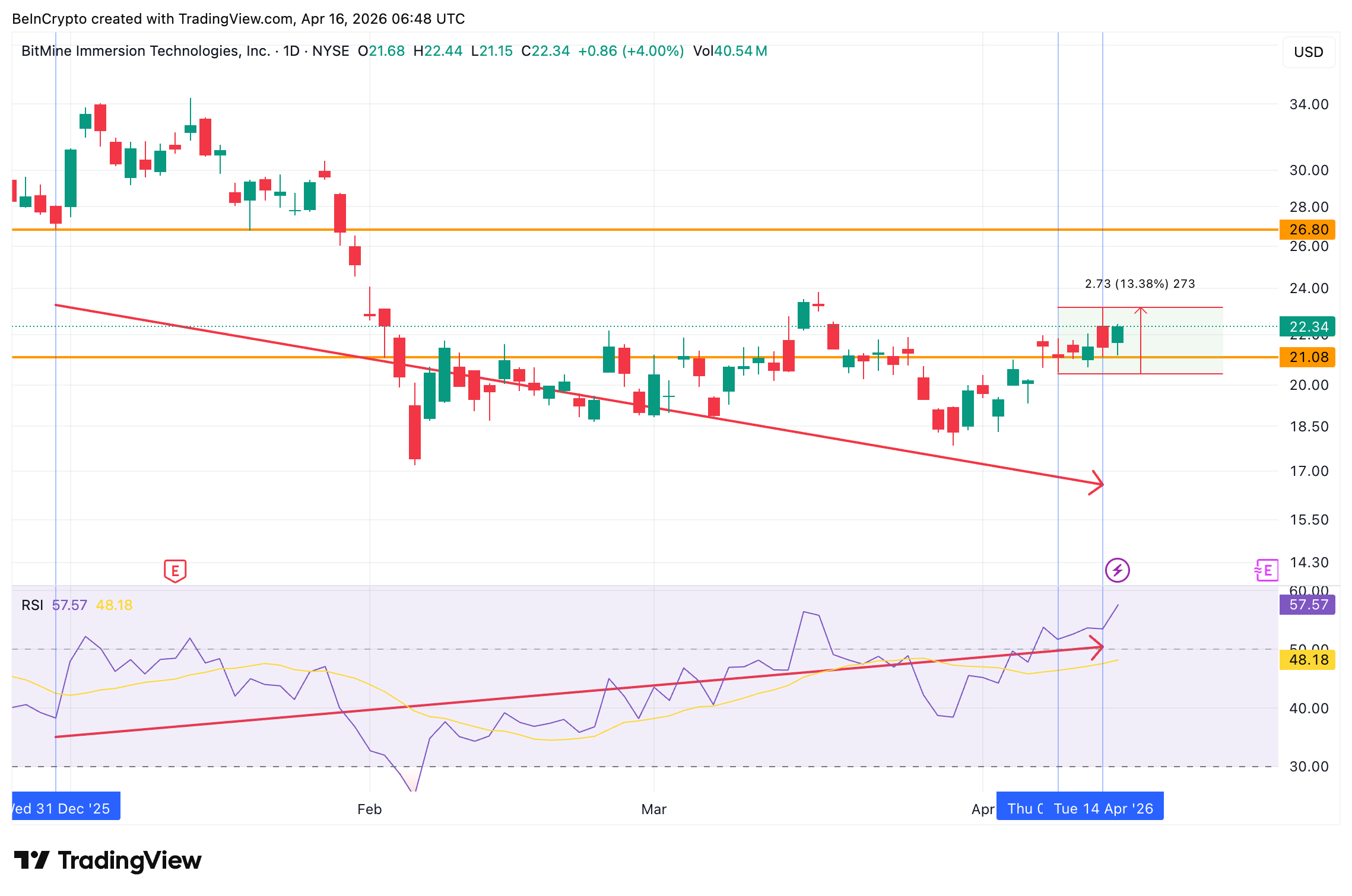
BMNR stock price trades at $22.34, up 4% on the day. A bullish RSI divergence has flashed for the second time in a week and options positioning has shifted toward calls.
Yet Bitmine’s institutional interest remains pinned near zero. Institutional capital is not following the momentum. The last time this divergence appeared, it delivered just a 13% bounce before fading. A head-and-shoulders pattern on the daily chart adds a 23% downside risk if the current move fails.
A Bullish Divergence Flashes Again but the Last One Only Gave 13%
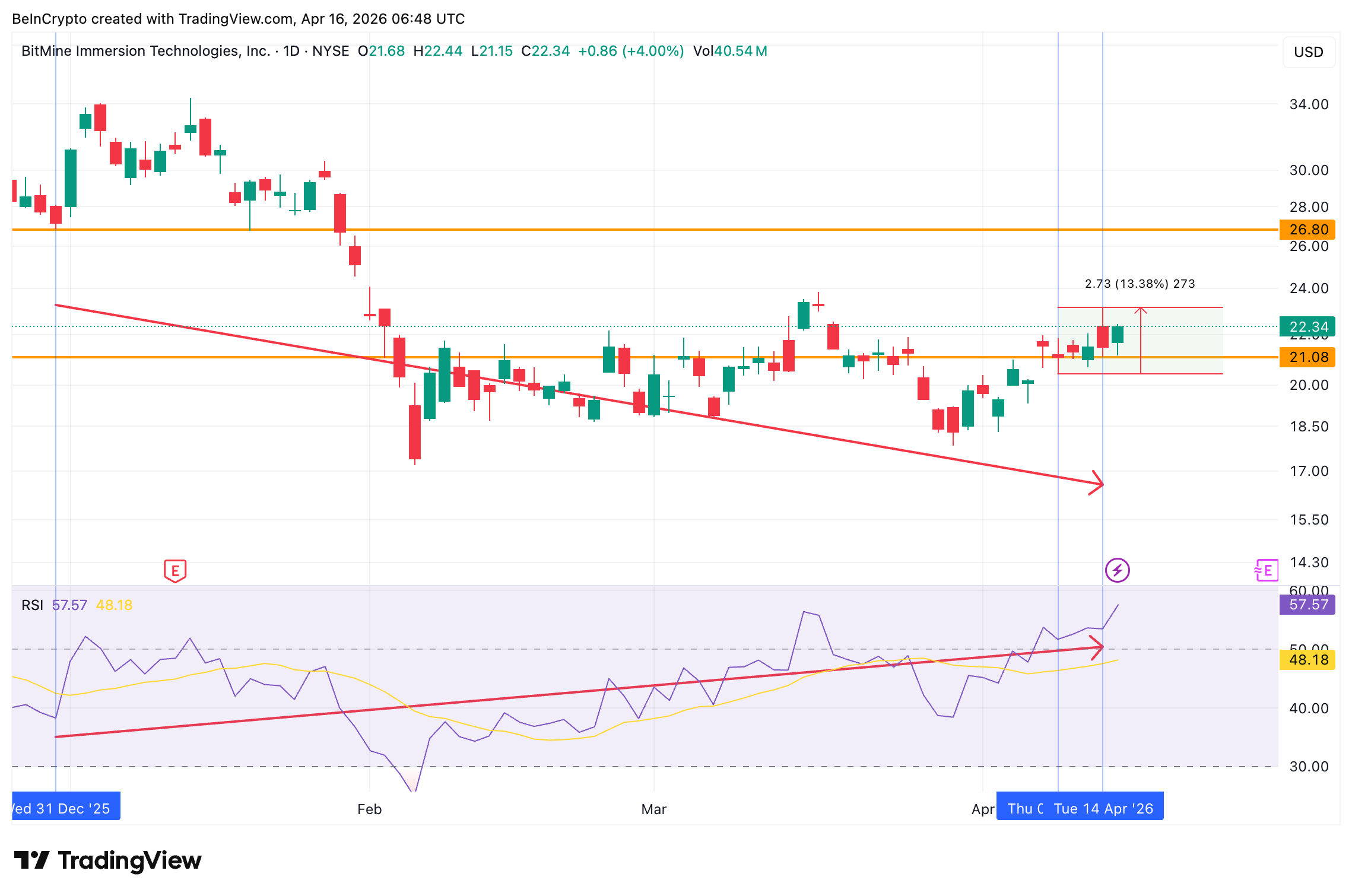
BMNR stock price has been declining since peaking in early January. However, the Relative Strength Index (RSI), a momentum indicator that measures the speed and size of recent price moves, is showing signs of a potential reversal.
Between December 31 and April 9, price made a lower low while the RSI made a higher low. That formed a standard bullish divergence, a signal that selling pressure is weakening. However, that divergence only led to a 13% price rise before the rally stalled.
A similar signal has now flashed between December 31 and April 14. Price again made a lower low while the RSI printed a higher low.
Want more insights like this? Sign up for Editor Harsh Notariya’s Daily Newsletter here.
Options positioning on Bitmine stock supports the near-term shift. In late March, the put-call volume ratio, which compares bearish bets against bullish bets, stood at 1.04. That reflected nearly balanced positioning with a slight bearish tilt. As of April 15, it has dropped to 0.35, heavily favoring calls.
Open interest ratio fell from 0.47 to 0.42. That drop means existing bearish positions are being closed. New activity is favoring calls while old puts are being unwound.
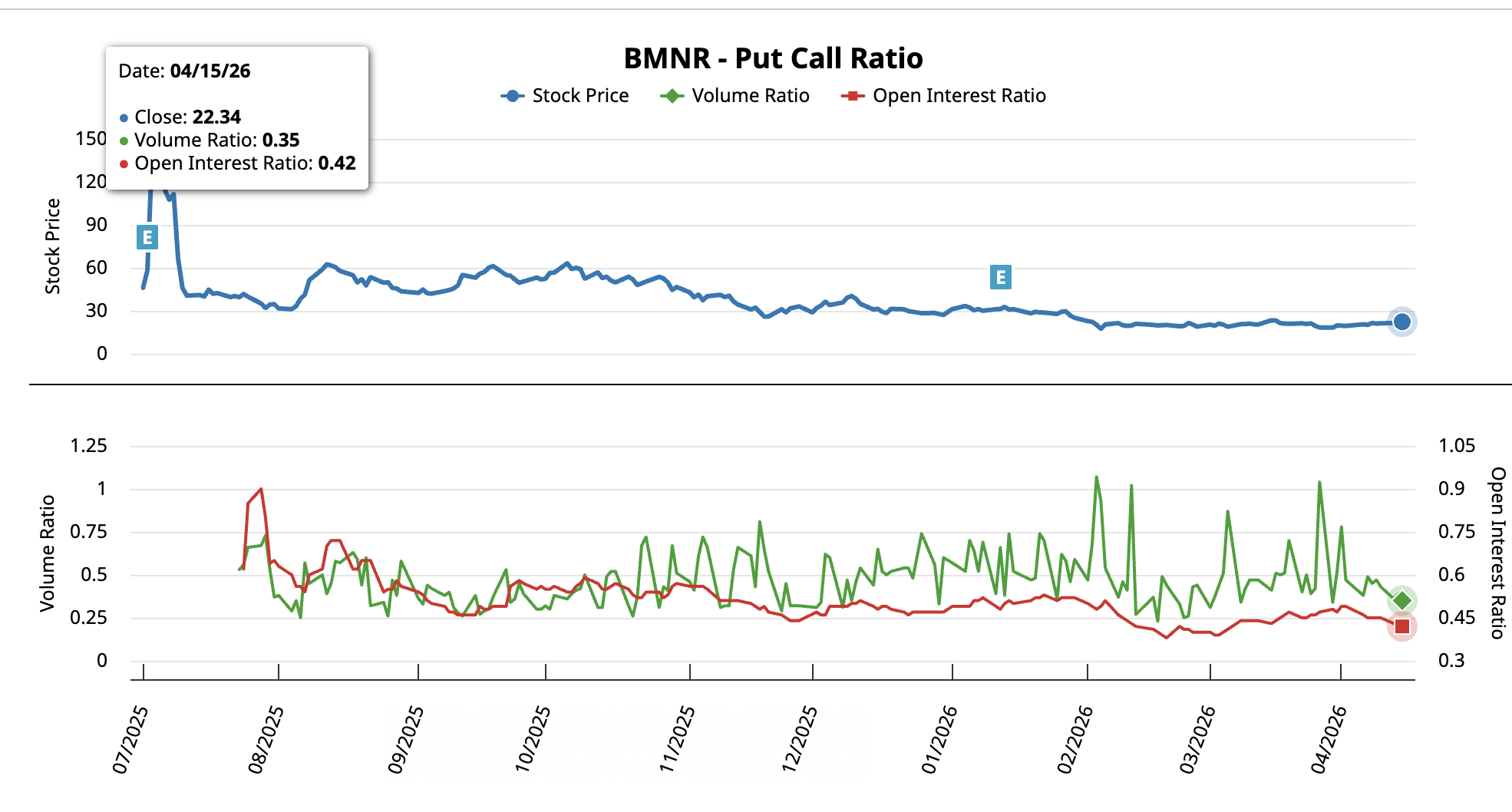
The divergence and options data both point to short-term strength. However, a 13% bounce and a fade is exactly what happened last time. Whether this attempt succeeds depends on one metric that has refused to cooperate.
Institutional Money Flow Hasn’t Crossed the Zero Line
The Chaikin Money Flow (CMF), a proxy for institutional capital sits at 0.00 on the daily chart. It has barely touched the zero line and still leans on the negative side.
Since March, only a few brief instances of CMF crossing above zero have occurred. Each time, the reading quickly fell back below. That pattern means institutional capital has ridden brief bounces but has not committed to accumulating BMNR stock.
The broader structure explains why. The daily chart shows a head-and-shoulders pattern forming, a bearish formation. If the pattern completes, the measured breakdown projects a roughly 23% decline from the neckline.
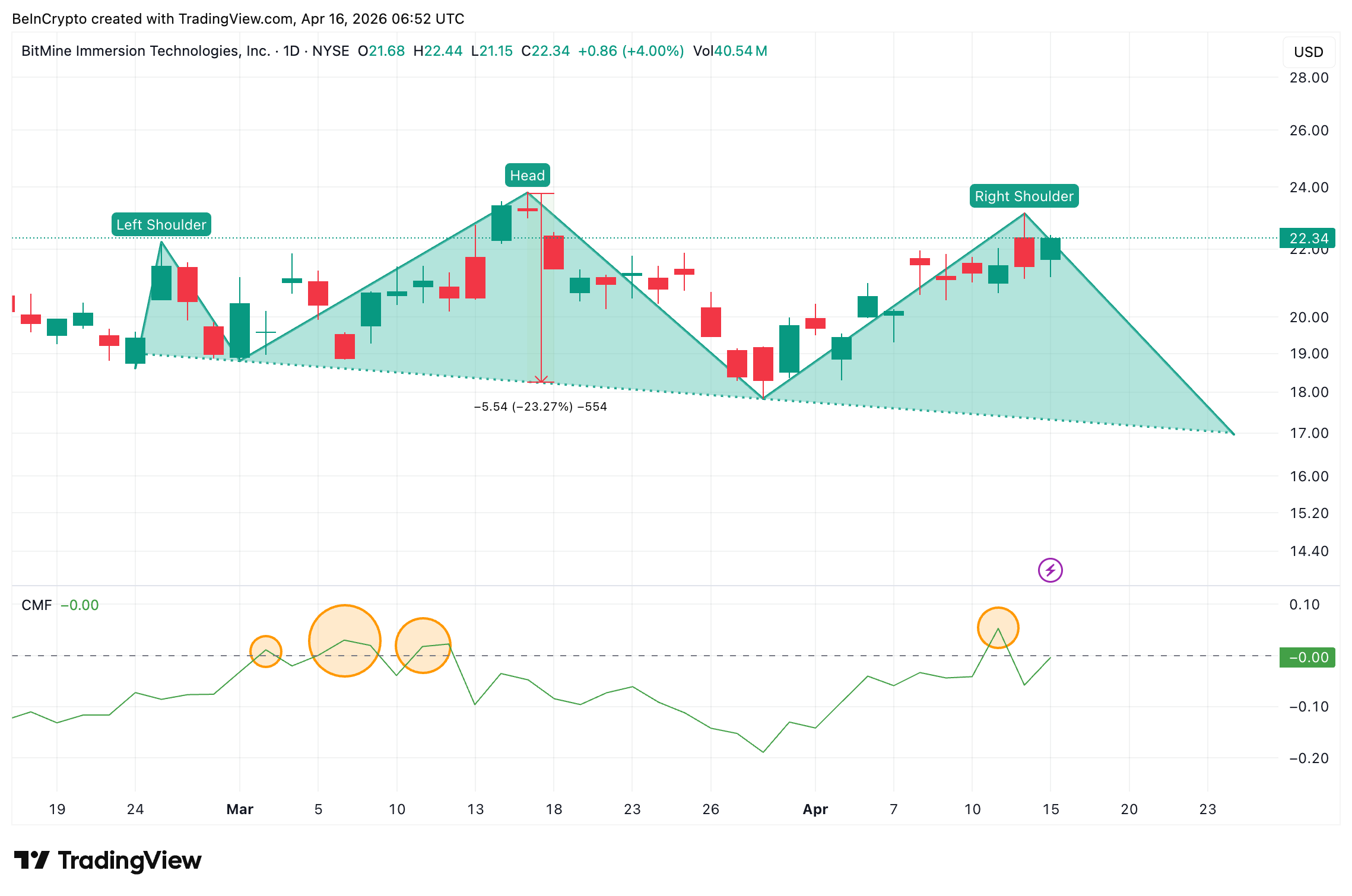
The divergence says bounce. The CMF says institutions are not behind it. The head and shoulders says the larger structure remains bearish. That conflict is what makes the price levels ahead critical.
BMNR Stock Price Levels That Decide Between Bounce and Breakdown
The BitMine price chart maps where stock price either validates the divergence or confirms the bearish pattern.
A drop below $21.08 would invalidate the divergence. That was the swing low where the latest signal formed. Below that, $20.87, the 0.382 Fibonacci level, acts as the next floor. A loss of $19.46, the 0.618 Fibonacci, would suggest the CMF was right. From there, $17.17, the head-and-shoulders neckline, becomes the target. A neckline break projects a BMNR price decline toward $13.14.
Yet a daily close above $23.16 would reclaim the top of the current range. That move would weaken the right shoulder and give the divergence room to run. Beyond that, $23.86 is the head’s peak and the level above which the bearish pattern breaks entirely.
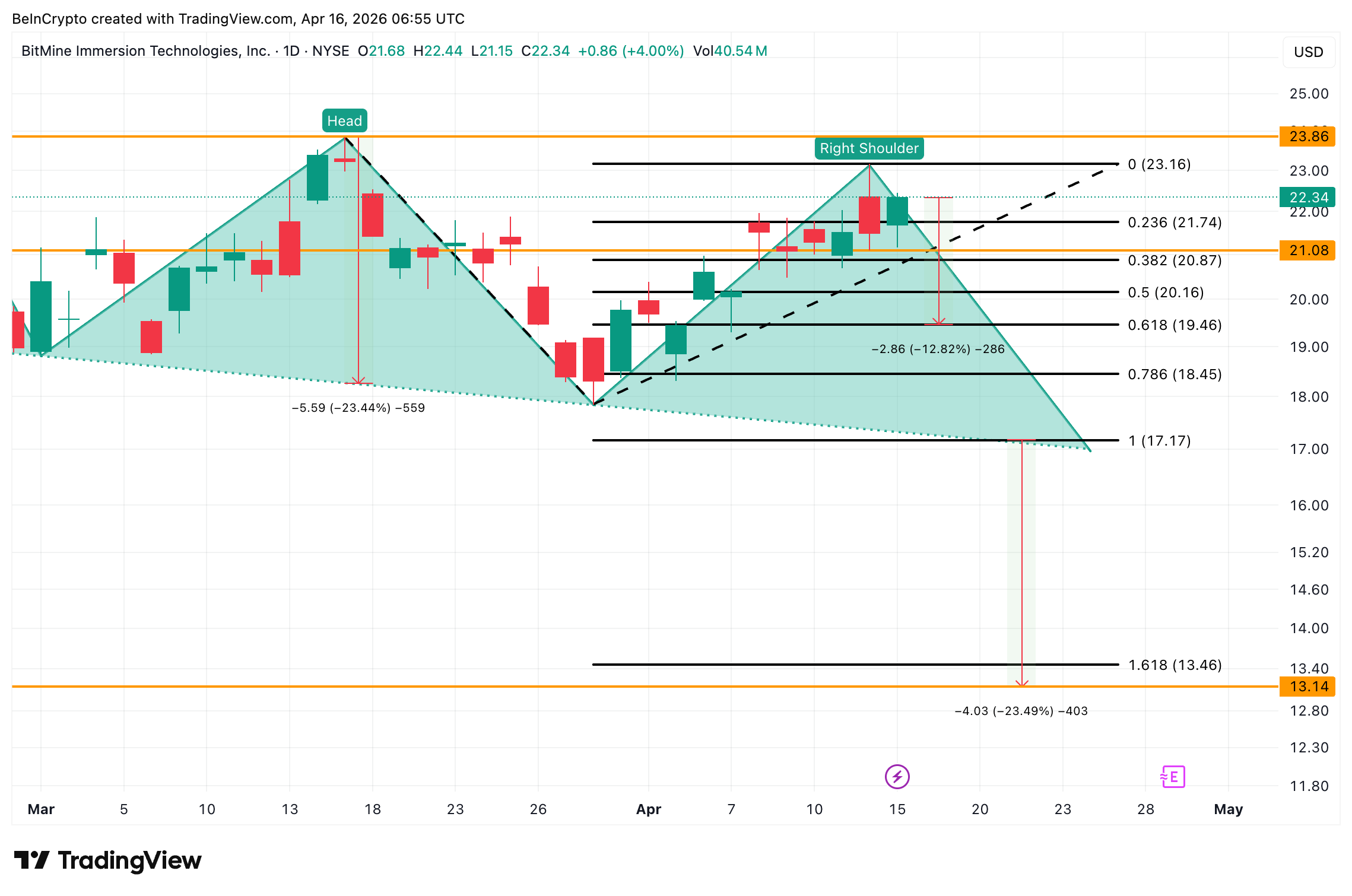
BMNR stock price at $23.16 separates a successful divergence from a repeat of the 13% fade. A close above it gives institutions a reason to follow. A drop below $21.08 hands the chart back to the head and shoulders.
The post A 13% Bounce Is All BMNR Stock Got Last Time: Can This Bullish Attempt Do Better? appeared first on BeInCrypto.
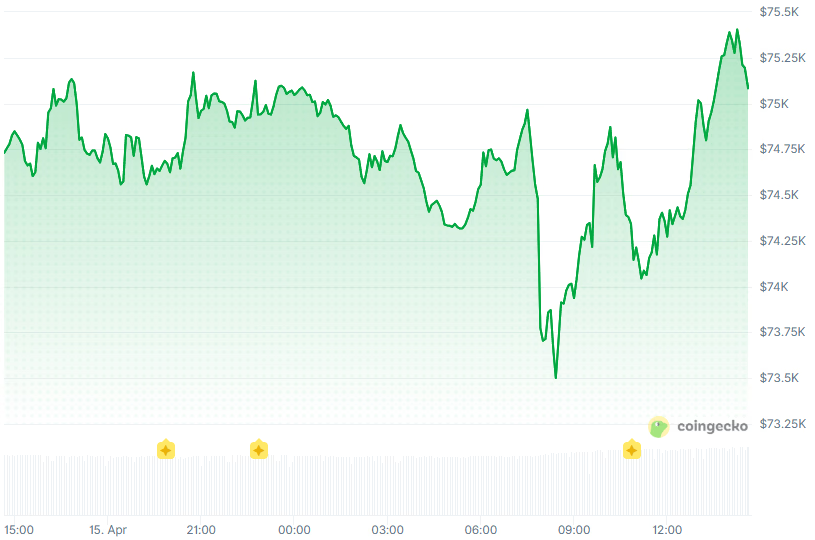
ETH held above $2,300, while SOL reclaimed $90 and XRP jumped to $1.46.
Bitcoin and Ether traded in a tight range on Thursday, consolidating near their highest levels in over two months as profit-taking offset the tailwinds from last week’s ceasefire rally and a fresh wave of ETF inflows.
BTC changed hands at $75,274, up 0.8% over the prior 24 hours and 4.7% on the week, per CoinGecko. Ether slipped 0.3% on the day to $2,355 but held a 6.7% weekly gain. Both assets remain well above the ranges that defined much of February and March, but have stalled since Tuesday’s sharp rally on renewed optimism around U.S.-Iran peace talks.

Altcoins Outpace BTC
Several top-100 altcoins outperformed Bitcoin on the day, led by Solana and XRP. SOL climbed 5.9% over 24 hours, reclaiming the $90 level for the first time since late March as network activity continues to expand and ETF products see sustained inflows. The token is up 7% on the week.
Ripple (XRP) rose 5% to $1.46, buoyed by anticipation around the SEC’s CLARITY Act roundtable and the Senate Banking Committee’s targeted late-April markup. XRP spot ETFs recorded $17.11 million in net inflows on April 15, their largest single-day intake since early February, bringing total assets under management above $1.25 billion.
BNB added 2.0% to $635.75, while the broader altcoin market showed pockets of strength.
Total crypto market capitalization held near $2.64 trillion, with Bitcoin dominance dropping to roughly 57%.
ETF Flows Turn Positive for 2026
Spot Bitcoin ETFs recorded $786 million in net inflows during the last full trading week, according to SoSoValue data, pushing year-to-date BTC ETF flows back into positive territory.
Ether ETFs saw their strongest week since mid-January, pulling in $187 million over the same period and reversing three consecutive weeks of outflows that totaled roughly $308 million. Year-to-date ETH fund flows remain in the red, however, highlighting the uneven demand picture between the two largest cryptocurrencies.
SEC Convenes Roundtable
The SEC convened a public roundtable in Washington on Thursday focused on options market structure. While the session is not directly tied to the CLARITY Act, the digital asset market structure bill that passed the House in July 2025, the commissioners leading the discussion are the same officials steering the agency’s broader crypto agenda.
The Senate Banking Committee is targeting a late-April markup of the CLARITY Act, which would draw a statutory line between the SEC’s and the CFTC’s jurisdiction over digital assets. SEC Chair Paul Atkins has said publicly that both agencies are operationally ready to implement the law once Congress passes it.
Looking Ahead
The next catalyst for directional price action may come less from crypto-native developments than from the geopolitical calendar. The expiration of the Iran ceasefire on April 22 looms as the most consequential near-term event.
A breakdown in talks could revive the risk-off environment that weighed on digital assets throughout February and March, while progress toward a lasting deal would likely extend the rally that brought BTC from the mid-$60,000s to above $75,000 in under two weeks.

M66 crash – Man ‘suffers medical episode’ while driving van

Blue Owl Capital: Don’t Believe The (Negative) Hype (undefined:OWL)

Ethereum Price Prediction: Can ETH Reach $4,000 Again, While Pepeto Presale Looks Like ETH in 2015

Why Israel is blocking foreign journalists from entering

Bitcoin: We’re Entering The Most Dangerous Phase

Alan Cumming Brands Baftas Ceremony A ‘Triggering S**tshow’

Build a Financial Wall Around Your Family #discipline #shorts #motivation #personaldevelopment

There’s money in this claw machine #arcade #clawmachine #bestarcadegames #money #shorts #arcadegames

Get up to 50% OFF on ANY Car (Legally!) #car #business #finance
-

 Politics6 days ago
US brings back mandatory military draft registration
-
 Sports6 days ago
Man United discover Nico Schlotterbeck transfer fee as defender reaches Dortmund agreement
-

 Fashion6 days ago
Weekend Open Thread: Veronica Beard
-

 Politics7 days ago
Malcolm In The Middle OG Turned Down ‘Buckets Of Money’ To Appear In Reboot
-

 Politics4 days ago
World Cup exit makes Italy enter crisis mode
-

 Business6 days ago
Tesla Model Y Tops China Auto Sales in March 2026 With 39,827 Registrations, Beating Cheaper EVs and Gas Cars
-

 Crypto World3 days ago
The SEC Conditionalises DeFi Platforms to Be Avoided for Broker Registration
-

 Crypto World3 days ago
SEC Signals Exemption for Crypto Interfaces From Broker Registration
-

 News Videos2 days ago
Secure crypto trading starts with an FIU-registered
-
 NewsBeat4 days ago
Pep Guardiola and Gary Neville agree over Arsenal title problem that benefits Man City
-

 Business5 days ago
Ireland Fuel Protests Enter Day 5 as Blockades Spark Shortages and Government Prepares Support Package
-

 Business6 days ago
OpenAI Halts Stargate UK Data Centre Project Over Energy Costs and Copyright Row
-

 Politics7 days ago
LBC Presenter Mocks Trump Over Iran War Failures
-

 Crypto World6 days ago
Federal judge blocks Arizona from bringing criminal charges against Kalshi
-

 NewsBeat3 days ago
Trump and Pope Leo: Behind their disagreement over Iran war
-

 Crypto World3 days ago
SEC Proposes Certain Crypto Interfaces Don’t Need to Register as Brokers
-
 NewsBeat5 days ago
JD Vance announces ‘no agreement’ with Iran over nuclear weapons fear
-

 Tech7 days ago
A version of Windows 10 released a decade ago is now eligible for additional security patches
-

 Business6 days ago
IMF retains floor for precautionary balances at SDR 20 billion
-

 Business6 days ago
Former Liverpool CEO eviscerates FIFA for World Cup ticket pricing
You must be logged in to post a comment Login