
Crypto World
Bithumb Announces 2028 IPO Timeline After Internal Controls Overhaul


South Korean crypto exchange Bithumb says it is moving toward a public listing, with plans to apply for a preliminary listing review in 2027 and complete an initial public offering (IPO) in 2028. The timetable is described as flexible and could shift based on market conditions and the scheduling of relevant regulators.
In a statement released Monday, Bithumb linked its IPO roadmap to internal restructuring efforts designed to clarify responsibilities across business units and reduce potential conflicts of interest. The exchange also outlined operational changes it says are part of its preparation for the scrutiny that comes with becoming a listed company.
Key takeaways
- Bithumb plans to pursue a preliminary listing review in 2027 and target an IPO for 2028, subject to regulatory and market timing.
- The exchange says it reorganized its structure, including spinning off Bithumb Asset, to better separate responsibilities and limit conflicts of interest.
- Bithumb is preparing to strengthen internal controls and transition from domestic accounting standards to K-IFRS.
- The company’s listing push follows a separate incident in February involving an over-crediting error tied to a promotional reward mechanism.
Restructuring and accounting changes ahead of an IPO
Bithumb’s IPO plan is anchored in a set of organizational and compliance steps. According to the exchange, it has reorganized its business structure, including spinning off Bithumb Asset, with the stated goal of clarifying what each unit is responsible for. Bithumb said this approach is intended to reduce the risk of conflicts of interest before it enters the listing review process.
Beyond governance and structure, the exchange also said its preparations include upgrading internal controls. It further stated that it plans to move away from domestic accounting standards and adopt K-IFRS, the international accounting framework used by listed companies in South Korea.
While the company set out a broad timeline—application for preliminary review in 2027 and an IPO in 2028—Bithumb emphasized that the schedule is not guaranteed. It said changes could be required depending on market conditions and how quickly authorities complete their review processes.
A crypto market shifting toward traditional finance ties
Bithumb’s move toward going public is unfolding as several South Korean crypto exchanges tighten their relationships with traditional finance and technology groups. The exchange is among five South Korean platforms that offer fiat currency trading via real-name bank accounts, and it operates that service through a partnership with KB Kookmin Bank.
In the broader sector, the competitive landscape has increasingly reflected corporate and financial integration. Rival exchange Korbit saw a major change when Mirae Asset Consulting took control on July 23, while Upbit operator Dunamu is pursuing a share-swap arrangement that would make it a wholly owned subsidiary of Naver Financial, though the transaction is described as subject to regulatory and shareholder approvals.
For investors and market participants, these developments matter because they suggest that the “crypto exchange” category in South Korea is increasingly being treated like a mainstream financial business—one that attracts scrutiny around corporate governance, accounting practices, and the boundaries between crypto operations and affiliated entities.
The February “620,000 BTC” promotional error and governance implications
Bithumb’s listing ambitions arrive after a notable operational failure earlier this year. In a February promotional mistake, the exchange mistakenly credited customer accounts with balances totaling 620,000 Bitcoin instead of distributing 620,000 Korean won in cash rewards, according to earlier coverage. Bithumb later recovered 99.7% of the erroneous credits, but some customers sold about 1,788 BTC before account freezes were applied.
At a February 11 National Assembly parliamentary hearing, Bithumb CEO Lee Jae-won said the exchange’s process for checking the planned distribution against actual holdings had failed. He also stated that the promotional amount had not been set aside in a separate account, a factor that complicated the detection and containment of the error.
While the episode appears to have been addressed through clawback of the majority of the mistaken credits, it is the kind of incident that regulators and auditors often consider when assessing internal controls—precisely the area Bithumb says it is upgrading as part of its IPO preparations.
Listing cleanup for Bithumb-linked public firms continues
Bithumb’s timetable for an IPO also intersects with governance and listing challenges involving entities connected to the exchange. Two Bithumb-linked listed companies have faced ongoing audit and listing issues, with their shares trading suspended since March 2023.
Yonhap reported that Bucket Studio, which indirectly controls Vidente (a major Bithumb shareholder), appointed a former police official as its standing auditor in June. Separately, Vidente has said it plans to appoint a former National Tax Service official to the same auditor role. According to Yonhap, South Korea’s Government Public Service Ethics Committee cleared both hires after concluding there was no close relationship between the officials’ previous duties and their new positions.
These developments are relevant to Bithumb’s listing ambitions because they show how tightly regulated the ecosystem can be in South Korea, not only at the exchange level but also across corporate relationships and audit oversight.
For readers tracking Bithumb’s path to the public markets, the next key indicators will be whether the exchange’s stated internal control upgrades and K-IFRS transition proceed on schedule, and how regulators respond to both the IPO review process and lingering questions raised by prior compliance and governance issues. The 2027/2028 targets are not fixed—so market conditions and authority review timing will likely determine what actually happens next.

The odds of the Digital Asset Market Clarity Act’s (CLARITY) passage are dwindling as the US Senate is scheduled to begin summer recess at the end of this week, threatening another leg down for cryptocurrency valuations, according to wealth manager Bernstein.
Bernstein said that the Senate’s failure to pass the legislation could trigger an immediate negative “industry knee-jerk reaction,” which may result in another leg down for Bitcoin and the broader crypto market.
“From a tactical standpoint, we expect the crypto market to bottom and start showing momentum towards late Q3 and early Q4 prior to the mid-terms,” Bernstein analysts wrote in a Monday report shared with Cointelegraph.
At the same time, however, the analysts said that Senate failure to pass the legislation may bring more proactive policy support from regulators, including the Commodity Futures Trading Commission (CFTC) and the Securities and Exchange Commission (SEC), which may accelerate rulemaking initiatives under Project Crypto.
Project Crypto is a regulatory initiative first announced by SEC Chairman Paul Atkins in July 2025, which was later expanded into a joint staff initiative between the SEC and CFTC in September 2025. The initiative aims to create a workable regulatory framework for digital assets using existing agency authority while Congress finalizes crypto market legislation under the CLARITY Act.
Bernstein said that the two agencies could provide more interpretive releases tied to the taxonomy of tokens, clear rules around decentralized finance (DeFi) and accelerate the innovation exemption for issuing tokens that would be exempted from securities status during a finite period.
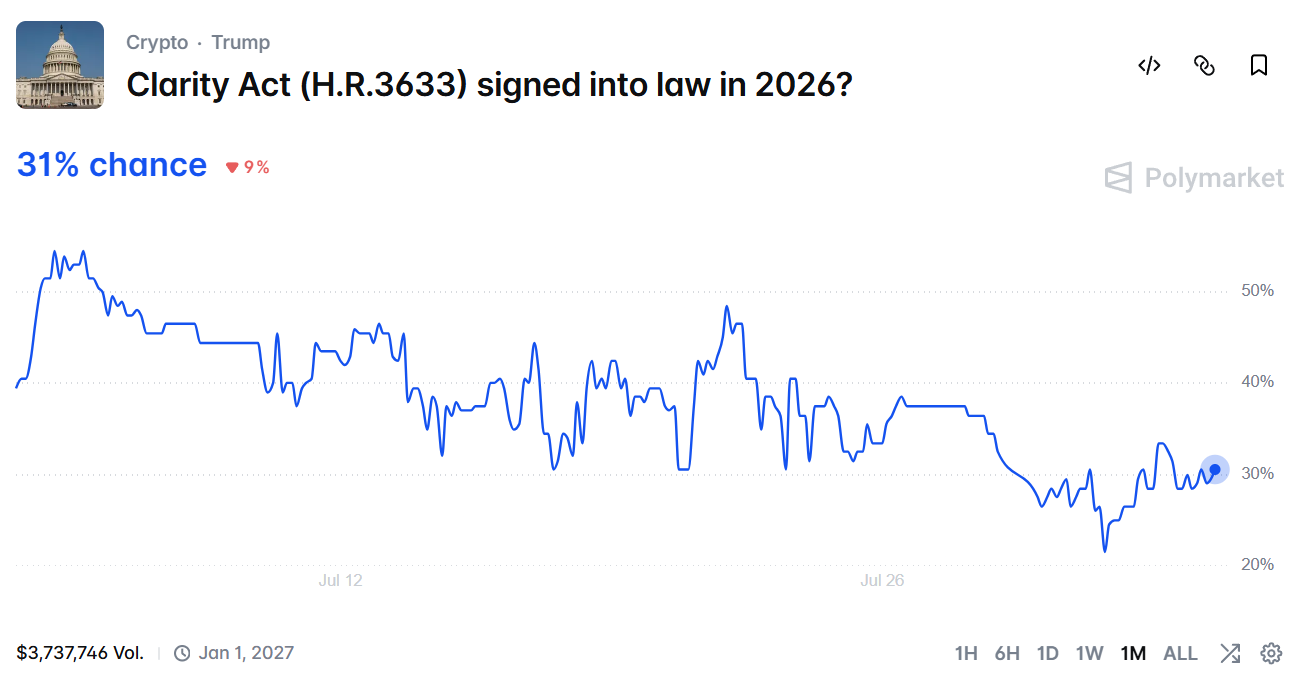
CLARITY Act odds decline to 31%
Bernstein’s skepticism is supported by prediction market traders who are betting against the passage of the CLARITY Act before the end of 2026.
Odds of the legislation’s passage before the end of the year are now at 31%, down 7% in the past week and down 9% in the past month, according to Polymarket, which shows about $3.7 million has been wagered on that prediction.
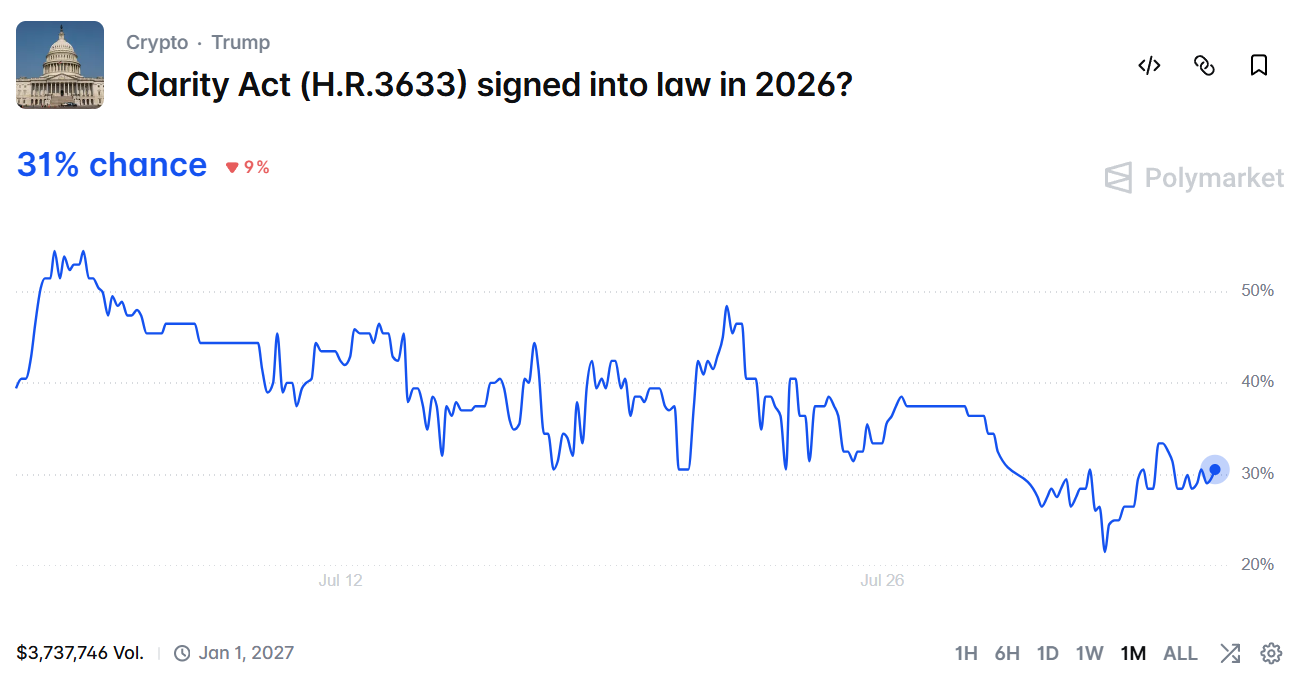
Prediction market odds of the CLARITY Act being signed into law by the end of 2026. Source: Polymarket
Meanwhile, White House officials are reportedly weighing a bipartisan ethics counterproposal received on Thursday, following weeks of negotiations between Republican Senator Thom Tillis and Arizona Democrat Ruben Gallego.
The proposal would enable state attorneys general to sue the Department of Justice if it fails to enforce ethics laws against federal officials, three sources familiar with the matter told crypto journalist Eleanor Terrett.
Related: ABA, state banking groups push back on CLARITY Act stablecoin yield provisions
The CLARITY Act aims to establish the first regulatory framework for digital assets in the US, but it has been met with pushback from the banking industry, which argued that the current draft would allow crypto firms to offer yields on stablecoins without facing the same requirements as traditional financial institutions.
On June 26, Galaxy Digital cut its odds of the CLARITY Act becoming law in 2026 to 50%, warning that the US Senate is running out of time to move the crypto market structure bill before its August recess.
Magazine: How the EU’s crypto tax rules are expected to work for users and platforms


BlackRock has launched two tokenized money market products as the world’s largest asset manager expands its blockchain-based cash management and real-world asset strategy.
Summary
- BSTBL will issue tokenized shares on Ethereum that approved investors can transfer between compliant wallets.
- BRSRV will support multiple blockchains and automatically reinvest dividends each day.
- Both products will hold cash, short-term U.S. Treasuries and Treasury-backed overnight repurchase agreements.
- BlackRock’s cash management group oversees nearly $1.1 trillion across its broader liquidity strategies.
BlackRock launches BSTBL shares on Ethereum
The BlackRock Select Treasury Based Liquidity Fund, or BSTBL, will introduce tokenized shares of an existing money market fund on Ethereum.
Institutional investors will be able to move the shares between approved wallets, subject to regulatory and compliance requirements. This structure brings transferability onto a public blockchain while retaining controls commonly applied to regulated financial products.
BNY Mellon will serve as BSTBL’s transfer agent and tokenization service provider. Its role will connect the fund’s shareholder records and transaction processes with the infrastructure used to issue and transfer the on-chain shares.
BSTBL will invest in cash, short-term U.S. Treasury securities, and overnight repurchase agreements backed by Treasuries. The portfolio aims to preserve principal and liquidity while generating returns from short-duration government debt.
The model differs from a stablecoin because investors hold fund shares rather than tokens designed to maintain a fixed redemption value. Returns will depend on the income generated by the underlying portfolio.
BRSRV targets stablecoin reserve management
BlackRock’s second product, the BlackRock Daily Reinvestment Stablecoin Reserve Vehicle, or BRSRV, is designed for digitally native institutional investors.
Unlike BSTBL’s initial Ethereum-based structure, BRSRV will support access across multiple blockchains. The fund will also reinvest dividends daily, allowing income generated by its assets to remain within the product.
BlackRock said BRSRV could be used in several digital-asset settings, including stablecoin reserve management. Stablecoin issuers typically need liquid, low-risk assets to support redemptions, making Treasury bills and Treasury-backed repurchase agreements common reserve instruments.
Securitize will act as the fund’s transfer agent and tokenization service provider. The company already supplies infrastructure for tokenized securities and previously worked with BlackRock on its blockchain-based investment products.
BRSRV will use the same core asset categories as BSTBL: cash, short-term U.S. government debt and overnight repurchase agreements collateralized by Treasuries.
BlackRock expands its role in tokenized U.S. markets
The two launches extend BlackRock’s involvement in real-world asset tokenization beyond individual blockchain products.
crypto.news reported in July that BlackRock joined a Depository Trust & Clearing Corporation pilot testing tokenized stocks and U.S. Treasuries. The initiative involves securities already held within DTCC’s custody framework, which safeguards about $114 trillion in assets.
JPMorgan, Goldman Sachs, Vanguard, the New York Stock Exchange and nearly 40 other financial firms are also participating. The pilot lets institutions test blockchain-based representations of traditional securities without moving the underlying assets outside established market infrastructure.
For U.S. institutions, that model may reduce the operational gap between conventional securities and on-chain markets. However, wallet transfers, investor eligibility and access will remain subject to regulatory requirements rather than operating as permissionless crypto transactions.
BlackRock’s cash management group now oversees close to $1.1 trillion for corporations, banks, insurers, foundations and public institutions. Its scale could help introduce tokenized fund shares to investors already using its traditional liquidity products.
BlackRock builds across crypto and traditional finance
BlackRock has also expanded its position in regulated cryptocurrency markets through the iShares Bitcoin Trust, its U.S. spot Bitcoin exchange-traded fund.
As previously reported by crypto.news, the U.S. Securities and Exchange Commission approved an increase in the position limit for options tied to the fund. The limit rose fourfold from 250,000 to 1 million contracts, giving eligible traders room to hold larger options positions linked to IBIT.
The tokenized fund launches represent a separate part of BlackRock’s digital-asset strategy. Rather than providing Bitcoin exposure, BSTBL and BRSRV place traditional cash-management assets on blockchain infrastructure.
Their adoption will depend on institutional demand, regulatory access, and whether on-chain transfers provide meaningful operational advantages over existing money market fund systems.
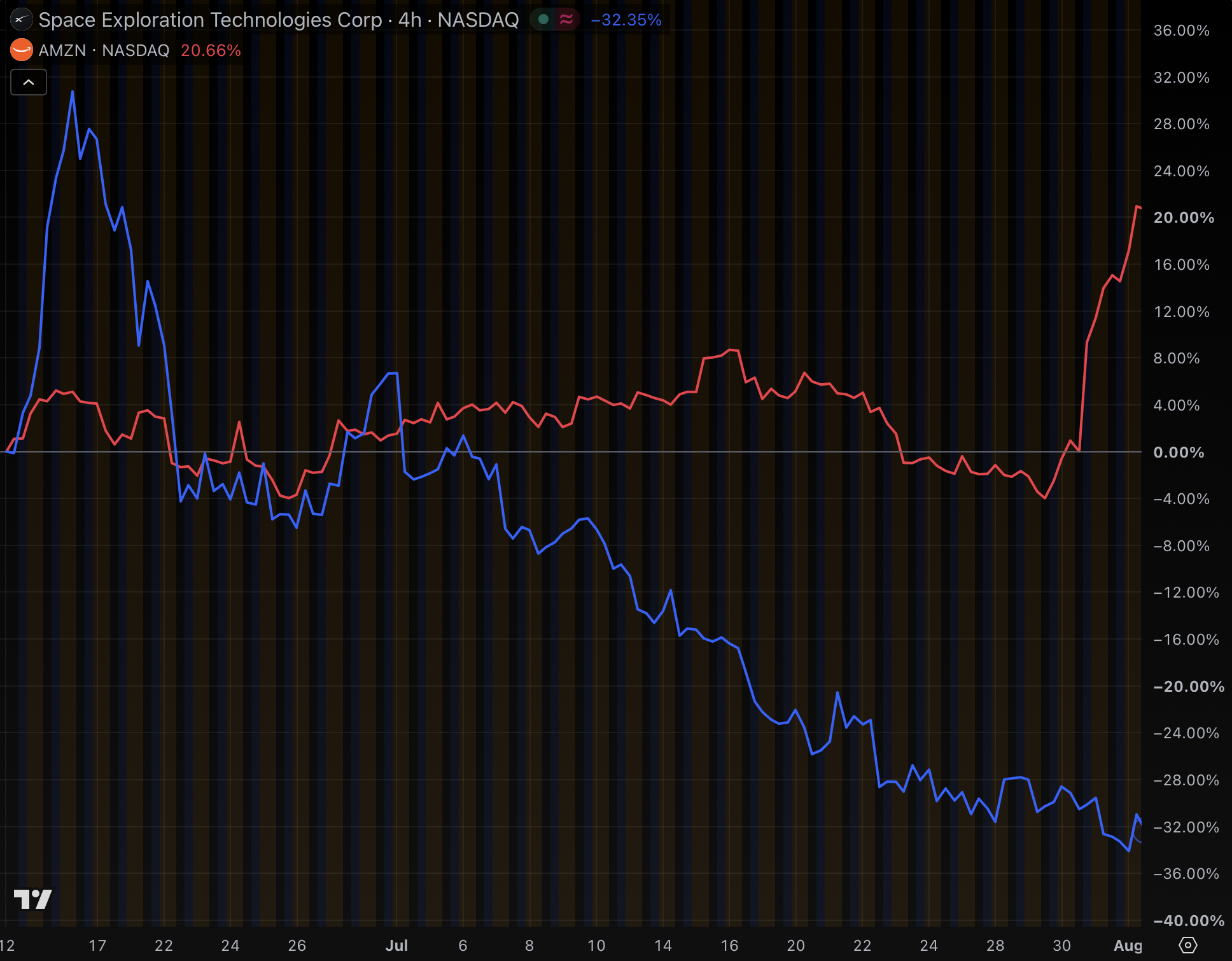
In less than six weeks, Amazon has gained almost as much market capitalization as SpaceX has lost. Since June 26, both companies have swapped precisely $560 billion in market cap.
Believe it or not, as recently as June 16, both companies had the same valuation, each being a $2.65 trillion company.
Since then, however, their valuations have trended in opposite directions.
Shares of Amazon climbed above $284 today, carrying the online retailer’s market value past $3 trillion for the first time. Only four publicly traded companies had ever reached that mark before.
Elon Musk’s rocket, internet, and AI conglomerate SpaceX had a great start after its IPO, running above $2.9 trillion within three days and briefly eclipsing the value of Amazon for one glorious week.
Stock in SpaceX then crashed, crashed, and crashed some more. Over the past month, the stock has lost 32% of its value.
Today, Amazon’s $3.06 trillion market cap is more than twice as valuable as SpaceX’s $1.44 trillion.
A good earnings report from Amazon
Last week, Amazon reported second quarter net sales of $200 billion and operating income up an impressive 43%, largely due to tariff refund checks and an increase in its Anthropic investment.
Its Amazon Web Services division grew at its fastest rate in 18 quarters.
The company posted adjusted earnings of $1.97 per share that beat Wall Street’s $1.82 estimate, on impressive revenue of $200 billion versus an expected $196 billion.
Accelerating cloud-computing growth eased investors’ concerns about Amazon’s heavy AI spending, with analysts framing its AI expenditures as bets that were starting to pay off.
The stock surged 15% the day after the report and was up about 5% again on Monday, marking another record high.
CEO Andy Jassy said, “There’s a lot to be excited about, and we have much more coming for customers in the second half of the year and beyond.”
Some of that excitement came from outside the business. Roughly $53 billion of the quarter’s $62.6 billion net income arrived as non-operating gains, largely on Amazon’s stake in Anthropic.
Amazon even nudged capital spending guidance toward $220 billion, and investors were happy to oblige — bidding up its stock 22% over the past week despite its plans to spend more cash on AI.
Wall Street raised its Amazon price targets. Analysts at JPMorgan raised their price target to $365 from $330, Wells Fargo reiterated its overweight recommendation and $328 price target, and TD Cowen said buy up to $350.
Read more: Some SpaceX bonds have already sunk to junk-like territory
SpaceX reports Tuesday, more stock unlocks Thursday
All of that good news for Amazon contrasts starkly with a terrible few weeks for SpaceX, which priced shares of the largest IPO in history at $135 apiece in June.
Within three trading sessions, it touched an intraday peak near $2.95 trillion — a level it would never regain. In fact, its value has halved since that high.
By this morning, SpaceX traded down to a fresh all-time low near $105. The stock sits well below the price its own underwriters set less than two months ago.
The calendar offers no relief.
SpaceX posts its first quarterly results as a public company after the close of regular trading tomorrow. Investors are obviously not optimistic, given the poor stock performance.
Two days after earnings, a share unlock will free 911 million additional shares for sale. That will more than double the tradable float, adding sell pressure on shares already under steady pressure over the past month.
Got a tip? Send us an email securely via Protos Leaks. For more informed news and investigations, follow us on X, Bluesky, and Google News, or subscribe to our YouTube channel.


The asset manager introduced two blockchain-based money market funds designed to qualify as stablecoin reserve assets under the US GENIUS Act.
Kenya has anchored more than 15 million academic records to the Avalanche C-Chain as it replaces slow, paper-based certificate checks with a national electronic verification system.
Summary
- Kenya has anchored over 15 million records dating to 1989 on Avalanche.
- Nearly 1 million 2025 KCSE certificates are available exclusively through the electronic platform.
- KNEC expects the system to eventually cover about 35 million verifiable records.
- The platform cuts some certificate checks from months to seconds, according to Ava Labs.
Kenya moves academic verification onto Avalanche
The Kenya National Examinations Council launched the system through a local technology provider, according to an Ava Labs announcement published on Aug. 3.
The initial rollout covers more than 15 million historical examination records dating back to 1989. It also includes certificates for nearly 1 million candidates who took the Kenya Certificate of Secondary Education examination in 2025.
Those certificates are now issued exclusively through KNEC’s electronic certificate platform. Students can access and download their credentials, while employers, universities and other institutions can verify them online.
“Candidates no longer have to rely solely on physical certificates. Instead, they can securely access, download and verify their KCSE certificates online, providing a faster, more reliable and more convenient way of managing academic credentials in the digital age,” KNEC CEO David Njengere said.
KNEC plans to expand the system to about 35 million records. Its expected scope includes primary and secondary qualifications, advanced diplomas and government teacher-training certifications.
Avalanche system targets certificate fraud
Academic verification in Kenya previously depended on manual requests, physical files and centralized databases. Ava Labs said individual checks could take a month, while large verification requests from recruiters could take up to six months.
The new platform is designed to reduce that process to seconds. Anchoring certification data on Avalanche creates a tamper-resistant reference that authorized users can check against records presented by candidates.
KNEC also aims to reduce certificate forgery and the use of fraudulent verification websites. However, the announcement did not provide detailed information about which data fields are stored directly on-chain, how personal information is protected, or the cost of operating the platform.
The rollout extends Avalanche’s use in government record systems. In the United States, California’s Department of Motor Vehicles has digitized 42 million vehicle titles using Avalanche, while Bergen County, New Jersey, is using the network in a project covering 370,000 property deeds valued at about $240 billion, according to Ava Labs.
AVAX sees no clear boost from Kenya rollout
The announcement did not produce a clear breakout in AVAX, Avalanche’s native token. crypto.news data showed the token trading near $6.54, with a market capitalization of roughly $2.82 billion.
Its 24-hour trading volume stood near $170 million, down about 35% from the previous day. That suggests the Kenya announcement had not yet generated a sustained increase in market activity.
KNEC’s platform nevertheless adds a nationwide public-sector use case to the Avalanche C-Chain. Its long-term effect will depend on whether the system reaches the planned 35 million records and continues processing new certifications at scale.
Kenya expands blockchain use amid cyber risks
The academic project arrives as Kenya develops broader oversight of digital assets. As crypto.news previously reported, the Capital Markets Authority moved in July to procure surveillance software capable of monitoring Bitcoin, Ethereum and more than 20 other blockchain networks.
The regulator wants the system to trace funds, flag suspicious wallets and identify offshore crypto platforms serving Kenyan users without authorization.
Kenya’s digital expansion also faces cybersecurity risks. Hackers temporarily defaced President William Ruto’s official website on July 18 and demanded five Bitcoin as ransom. Authorities opened an investigation, but the incident was separate from KNEC’s Avalanche deployment.
The next test will be whether KNEC can expand the certification platform while protecting student data, maintaining access and preventing the digital system from creating new points of failure.
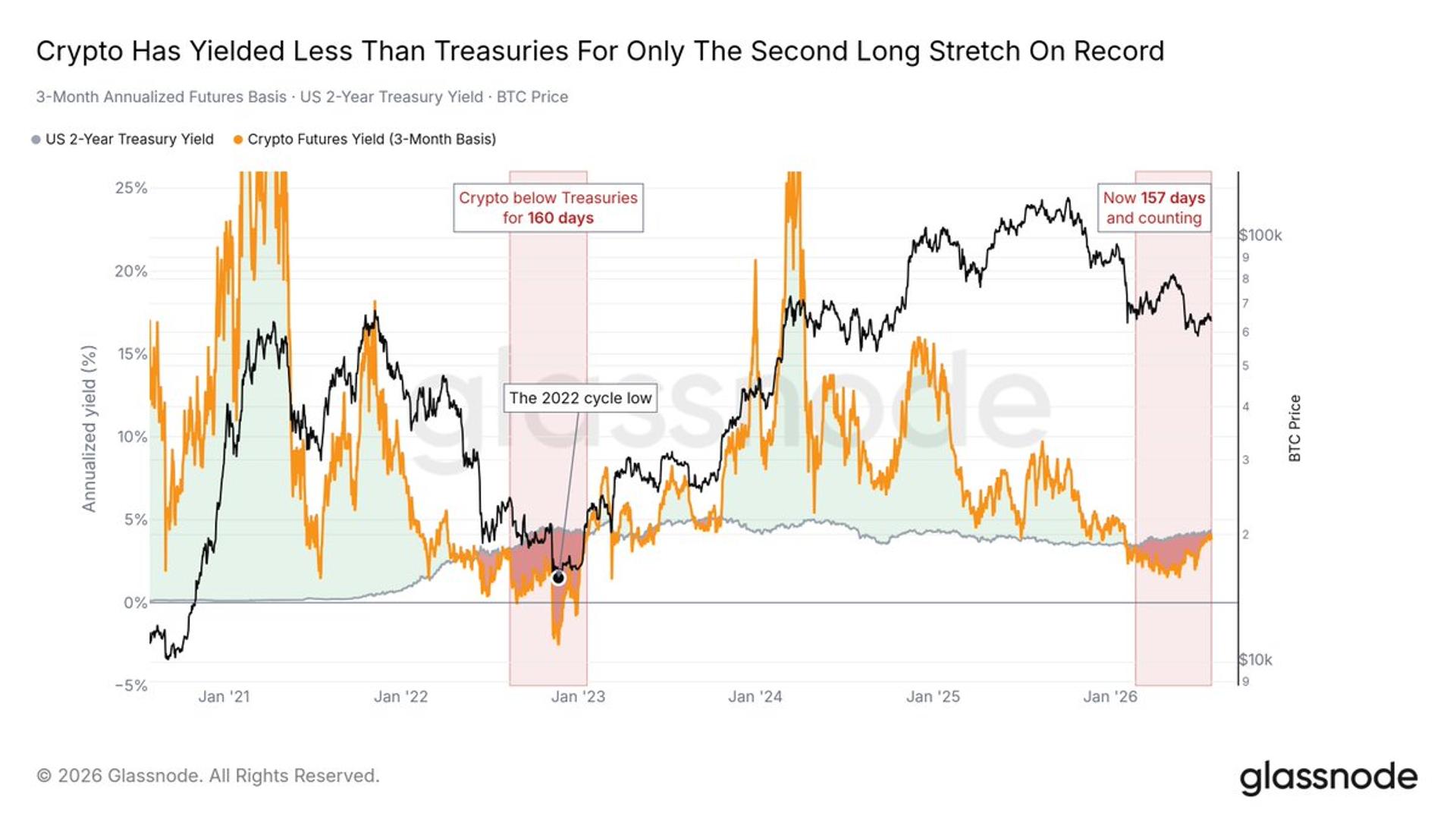
Once a goldmine for carry traders, bitcoin futures have flipped, consistently underperforming plain‑vanilla U.S. Treasuries every month since February.
Carry trades consistently yielded 20% or more across regulated and unregulated crypto exchanges during the 2021 bull market. The strategy involved shorting bitcoin futures while simultaneously buying a spot exchange-traded fund (ETF). Now they return just 3% compared with an average 3.8% yield on two-year Treasuries.
Traders have long used futures, agreements to buy or sell an asset at a set price on a specific date, to set up trades that profited from the gap between futures and spot prices, known as basis. That basis, in annualized terms, has been lower than the two‑year Treasury note continuously for more than five months, according to data source Glassnode.
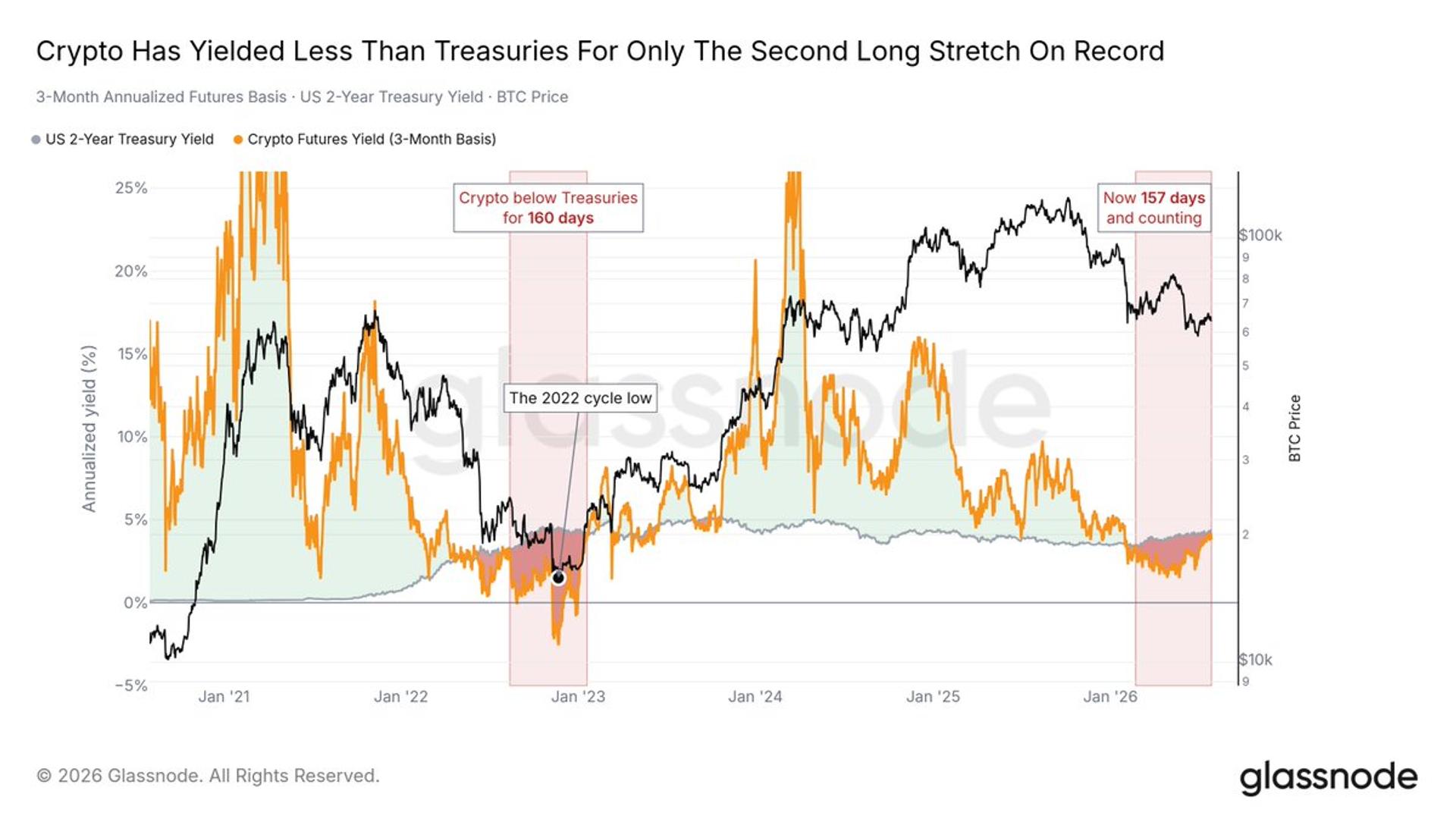
“Three-month futures basis has paid less than a two-year Treasury since February. Only one other stretch on record has run this long: August 2022 into January 2023. It ended at the cycle low,” Glassnode said in a post on Telegram.
The three-month basis has been yielding less than the two-year Treasury note for 157 days, according to Glassnode’s Sunday chart.

Bitcoin analysts are pointing to August as a potential inflection point, hinging on whether the asset can secure a key monthly close that would confirm a technical bear-market bottom signal. Separately, Grayscale research suggests the bottom could have occurred earlier than the typical four-year cycle implies, pushing the focus to macro conditions rather than the calendar.
According to a Monday report shared with Cointelegraph by 10x Research founder Markus Thielen, Bitcoin’s July performance did not meet the threshold needed to validate a technical bottom. However, the firm argues that a monthly close near $63,000 in August could flip several of its cycle indicators to a bullish configuration.
Key takeaways
- 10x Research says a July monthly close failed to confirm its technical bottom signal, but an August monthly close near $63,000 could trigger a reversal indication.
- 10x Research continues to favor long positions, but would turn more neutral if Bitcoin breaks key support levels and moving averages.
- Grayscale’s Zach Pandl told investors in a July 22 report that Bitcoin may have bottomed earlier than the four-year cycle would suggest, potentially placing the cycle low in September or October.
- Macro variables—especially Fed policy and changes in the 10-year Treasury yield—remain central to timing both analysts’ outlooks.
- Other market participants highlight supply-side stress indicators, including the share of Bitcoin held at a loss.
What needs to happen for a 10x Research bottom signal
10x Research’s technical framework centers on cycle indicators tied to Bitcoin’s monthly price behavior. Thielen said in the Monday report that Bitcoin closed July below the level required to confirm the firm’s bear-market bottom setup.
When the analysis was prepared, Bitcoin was trading at $63,140. That matters because 10x Research argues the distance from the July closing level to the next confirmation threshold may be small. In its view, if Bitcoin prints an August monthly close around $63,000, the change could be sufficient to turn multiple cycle indicators bullish.
Importantly, 10x Research is not treating the signal as unconditional. The firm said it continued to favor long positioning, but would shift to a neutral stance if Bitcoin breaks key support levels and moving averages—an acknowledgement that technical confirmation can fail if price action deteriorates before the month ends.
Macro risks remain the timing driver
While the chart-based trigger is specific, 10x Research frames macro policy as the overriding variable. Its base case assumes the Federal Reserve holds interest rates steady. But the firm also flagged two key uncertainties: further increases in the 10-year Treasury yield could raise the probability of a September rate hike, and the Iran conflict adds geopolitical risk that could disrupt risk assets more broadly.
That emphasis on the macro backdrop is also echoed by Grayscale. In a July 22 report, Grayscale head of research Zach Pandl argued that Bitcoin’s timing might not match the traditional four-year cycle pattern, but that macroeconomic conditions—including Fed policy—still represent the primary mechanism shaping Bitcoin’s price.
Grayscale: a bottom may have come early—cycle low could be later
Grayscale’s view diverges from a strict reliance on the four-year cycle. Pandl told investors that Bitcoin may have bottomed earlier than the traditional four-year cycle would suggest. Under that interpretation, the cycle low would still fall in September or October, even if the earliest “bottoming” signals appeared sooner.
For traders and portfolio managers, the practical difference is not just the date—it is what to monitor. If bottoming can occur in phases, then early relief rallies or stabilization periods may not immediately complete the cycle, and investors may need to watch macro catalysts that can either sustain or reverse the improvement.
Supply-side pressure and the loss-held supply signal
In addition to technical and macro narratives, market structure indicators are contributing to the debate about how close Bitcoin may be to a durable bottom.
Earlier in July, crypto brokerage K33 pointed to a supply-side stress measure: more than half of Bitcoin’s supply was held at a loss. K33 described this as another sign that the market could be approaching a bottom, because prior periods with similar loss concentration were followed by strong subsequent returns.
K33 also reported that Bitcoin bottomed within 13 to 31 days of when that threshold was reached in 2017, 2018, and 2022. The key takeaway for investors is that the timeline is not only about price resistance or moving averages—distribution and holder pain can compress into a short window that may precede a broader trend reversal.
Another data point referenced in the broader discussion is long-term holder behavior. In a June interview, Swan Bitcoin CEO Cory Klippsten told Cointelegraph that long-term holders’ record balance of 14.7 million BTC was an indication Bitcoin was nearing a bottom. The idea aligns with a broader pattern often seen during bear markets: if long-term holders absorb supply while not distributing into weakness, downside pressure may eventually fade.
What to watch as the month turns
For now, the near-term question is straightforward: can Bitcoin produce an August monthly close around $63,000 in a way that validates 10x Research’s cycle indicators, while macro conditions do not undermine the setup. Investors should also monitor how supply-side stress measures evolve and whether the market behavior stays consistent with the historical windows flagged by K33—because that combination of technical confirmation and shifting holder dynamics is what will determine whether “bottoming” turns into a sustained trend.


Cointelegraph is committed to providing independent, high-quality journalism across the crypto, blockchain, AI, and fintech industries.
All news, reviews, and analyses are produced with full journalistic independence and integrity. For more details on our standards and processes, please read our Editorial Policy.

Other easily missed breeding spots include a tiny pocket of water beneath the soil in a potted plant, a discarded tire, or a planter saucer. Maintained, chlorinated pools and fountains with moving water generally aren’t the problem. Mosquitoes want still water—and the smaller the pool, the easier it is to miss.
They never walk past a container without glancing inside
Once mosquito experts learn what a breeding spot looks like, they see them everywhere.
In her own yard, a tarp left crumpled over some lumber became a collection of tiny pools after it rained. Buckets and cups forgotten after parties are equally inviting. Then there’s her neighbor’s wheelbarrow, which is full of weeds and refills whenever it rains. “I keep sneaking over there and emptying it out,” Bartholomay says. “The mosquitoes just love it.”
Where you live determines where else you need to look. In parts of Florida, some plants, like ornamental bromeliads, collect water in the cups of their leaves, allowing mosquitoes to breed several feet above the ground. Daniel Markowski, technical advisor with the American Mosquito Control Association, flags children’s toys—dump trucks, sand pails, plastic cups—and buried downspouts that aren’t draining properly. Mosquitoes can breed in the trapped water underground, then fly in and out through the top.
Democratic senators want the Commodity Futures Trading Commission (CFTC) to stop betting on California wildfires. They warn that traders could start fires to win their bets.
The letter went to CFTC Chairman Michael Selig on Monday. Oregon Senator Jeff Merkley led it. It points back to wagers placed while Los Angeles burned in January 2025.
$1.2 Million Wagered While California Wildfires Burned
The Palisades and Eaton fires killed 31 people. They destroyed 16,246 buildings, according to CAL FIRE figures.
Polymarket is the largest betting site for real-world events. It opened its first wildfire bet on January 8, 2025. The fires had started a day earlier.
Traders put $1.2 million into roughly 20 questions. Rutgers historian Jamie L. Pietruska tracked the total.
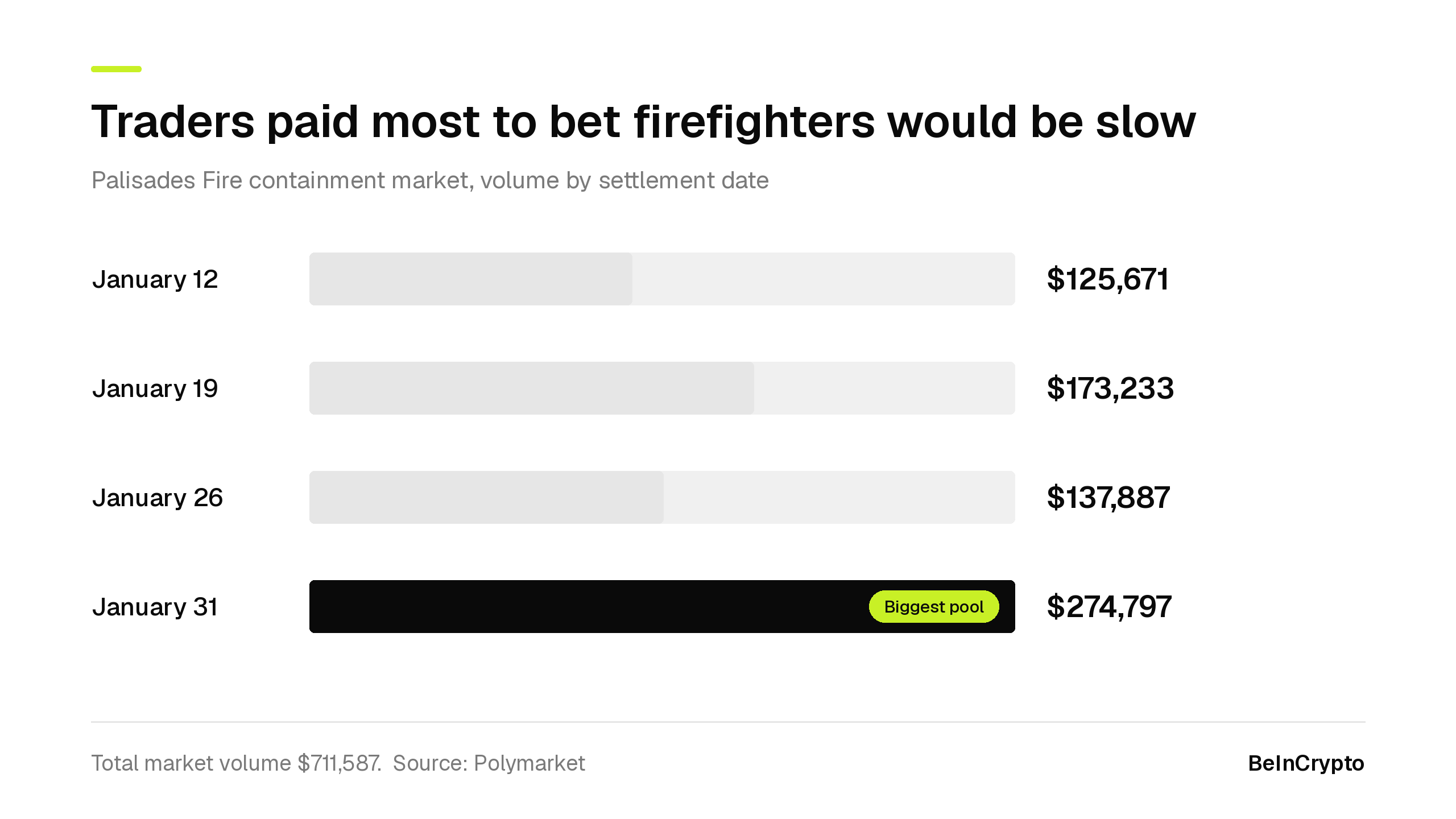
One bet took $711,587 of that. It asked a single thing. When would the Palisades Fire be fully contained?
The biggest pool inside it was $274,797. That money sat on the latest date offered.
In plain terms, traders paid the most to bet firefighters would be slow.

The bet was settled using data from fire.ca.gov, in accordance with its published rules. That is the website of CAL FIRE, the state firefighting agency.
CAL FIRE hands over that data. It refuses to take anything back from these markets.
“Systems that tie financial gain to wildfire outcomes risk encouraging misuse, including arson, and are not compatible with our mission,” US Forest Service spokesperson, reported by High Country News.
Follow us on X to get the latest news as it happens
Fire Is Easier to Rig Than a Thermometer
In April, a Polymarket trader bet $119 on the weather in Paris. He walked away with $21,398. A sensor at Charles de Gaulle Airport had spiked for no clear reason. Météo-France called in the airport police.
The trick is old. In 1950, St. Louis police shut down a weather betting ring worth $2.6 million a year. Gamblers back then bribed officials to fake temperature records.
The Paris weather sensor case shows that one number can still settle a bet.
Fire is worse. Nobody can start a hurricane by hand.
Prosecutors have charged a 29-year-old man with starting the Palisades Fire. He faces up to 45 years and has pleaded not guilty.
Firefighters also know things outsiders do not. That echoes earlier insider trading on Kalshi claims. Polymarket added an on-chain detection system in May.
Why the CFTC Rules Never Mention Fire
The CFTC proposed a new rule on June 10. It checks each contract one at a time.
The test covers terrorism, assassination, war, gaming, and illegal activity. Comments closed on July 27.
Wildfire never made the list.
Arson is illegal. But these bets ask about containment dates, not the crime. That gap is what the senators want closed.
Polymarket has defended the markets. Founder Shayne Coplan told CBS News they carried the least risk and gave the most information. He added that he understood the sensitivity.
The Los Angeles bets ran offshore, where US traders were locked out. Wyldfyre, a play-money site built only for California fire risk, went offline last month.
The CFTC now has one question to answer. Is fire different from weather?
The post California Wildfire Bets Expose Polymarket’s Dark Side appeared first on BeInCrypto.

Kamri Peterson Recalls Finding Out She’s Joining DWTS Troupe

NEW XRP RICHLIST MAKES YOU A MILLIONAIRE WITH 1000 XRP **YES IM SERIOUS** THE CLARITY ACT IS A TRAP

Tech millionaires use donor-advised funds for tax savings and giving

Renter of Home in Anne Heche Crash Denies Settlement With Son

No Jackpot Winner as $257 Million Prize Rolls Over to $269 Million Monday Draw

Weekend Open Thread: Staud – Corporette.com
NEW XRP RICHLIST MAKES YOU A MILLIONAIRE WITH 1000 XRP **YES IM SERIOUS** THE CLARITY ACT IS A TRAP

All financial advisors HATE this man! @CRED_club #LLAShorts 561

Matt Hougan :”My NEW Prediction For The 2026 Crypto Bull Run” (Prepare Now)
-

 Business5 days ago
Why Trees Belong on the Risk Register
-

 Fashion3 days ago
Weekend Open Thread: Wit & Wisdom
-

 Politics3 days ago
Meta enters AI-training agreement with far-right ‘propaganda rag’ Newsmax
-
 Entertainment6 days ago
‘Stargate’ Creator’s New Sci-Fi Series Returns for Season 3 Tomorrow
-

 Crypto World2 days ago
MicroStrategy Post-Earnings CLARITY Act Push Could Add New Catalyst for Its Stock
-

 Politics6 days ago
The Part of the Electric Transition Nobody Wants to Discuss
-

 Business6 days ago
Major shareholder moves on Canyon
-

 Crypto World3 days ago
XRP Ledger v3.3.0 brings five institutional features
-

 News Videos4 days ago
Bitcoin Enters the 3rd Stage of the Bear Market
-

 Crypto World6 days ago
Kraken Enables Retail Access to Jersey Mike’s IPO via Tokenized Shares
-

 Tech7 days ago
New macOS Sequoia & Sonoma security updates for older Macs
-

 News Videos6 days ago
Claude: Build Financial Dashboards in Minutes (2026)
-

 Politics4 days ago
Luke Littler’s dominance sparks GOAT debate
-

 Sports4 days ago
Seema Kaliramna Wins Discus Throw Bronze, Takes India’s CWG Medals Tally To 17
-

 Business6 days ago
Johnson & Johnson agrees to $5.5B settlement over talc cancer claims
-

 Crypto World1 day ago
Crypto PAC spending tops $2M in Michigan House race
-

 Business3 days ago
Trump Announces Hamas Disarmament Agreement as Iran Strikes Kuwait Air Base and US Attacks Pause Overnight
-

 Crypto World3 days ago
New York sues Kalshi over prediction market gambling
-

 Tech5 days ago
Gemini can now summarize the messiest comment threads in Google Docs
-

 Tech2 days ago
ESET tracks rise in malicious AI skills and adaptable malware
You must be logged in to post a comment Login