

Crypto World
Bitmine Buys 111K ETH as Tom Lee Predicts Supercycle

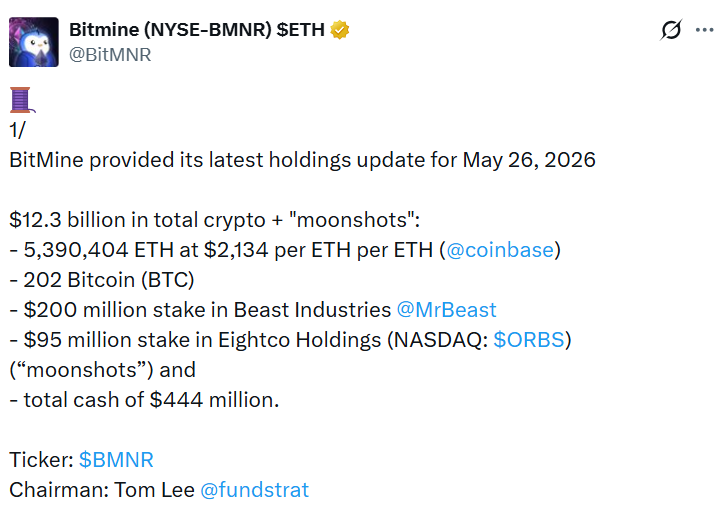
The Ether buying company Bitmine Immersion Technologies has made its biggest purchase so far in 2026 as its chairman, Tom Lee, doubled down on the idea of an impending crypto supercycle.
Lee said Tuesday that in the past week, Bitmine bought 111,942 Ether (ETH) after a recent pullback sent the token below $2,200 and presented an “attractive opportunity.” Ether has traded between $2,025 and $2,147 over the past seven days.
He also reiterated his theory of a supercycle ahead for crypto and Ether, driven by Wall Street’s interest in tokenization and artificial intelligence-powered agents.
“We continue to expect a supercycle ahead for crypto and Ethereum, driven by the dual drivers of Wall Street tokenization and agentic AI. And thus, we continue to steadily acquire ETH, with Bitmine now owning nearly 5.4 million ETH tokens,” Lee said.
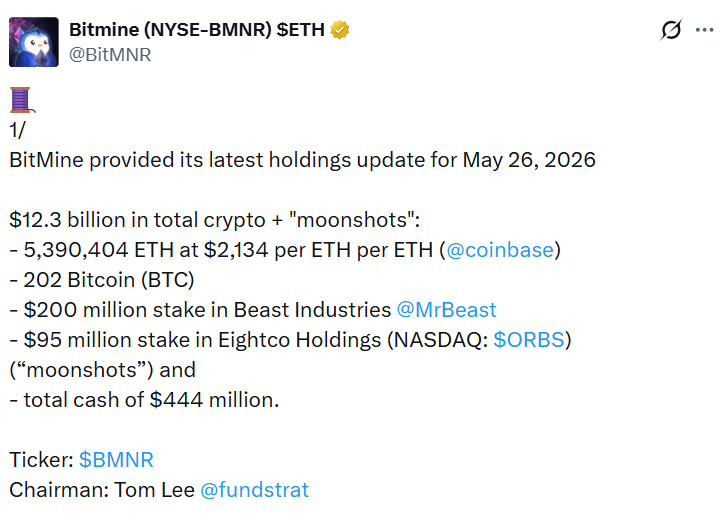
Source: Bitmine
Bitmine slowed its pace of Ether buys earlier this month after having scooped up over 100,000 ETH a week for three straight weeks. It is the largest Ether treasury company and has consistently bought crypto, even during market downturns, following a business model similar to Michael Saylor’s Bitcoin treasury firm Strategy.
Bitmine’s goal is to hold 5% of Ether’s circulating supply of 120.7 million tokens. To reach its target of more than 6 million ETH, Bitmine needs about 644,596 ETH, which Lee said will happen sometime this year.
Ether treasury firms leaning into staking
Bitmine has staked over $4.7 million of its Ether, according to the company, and expects to generate annualized staking revenues of $276 million.
Related: Bitmine’s Tom Lee hints at stock tailwinds after firm considered for Russell 3000
Staking infrastructure provider Everstake said in a report Tuesday that Ether treasury companies are under pressure to generate revenue from staking and other yield strategies as the appeal of public companies just holding the asset has been weakened by interest in spot crypto exchange-traded funds.
Across the wider ecosystem, the amount of staked Ether has hit a new high, with more than 39.2 million, or roughly 32.19% of the supply, locked in and another 3.3 million waiting in the wings, according to the Ethereum Validator Queue. At the same time, the exit queue has about 234,368 Ether waiting to leave.
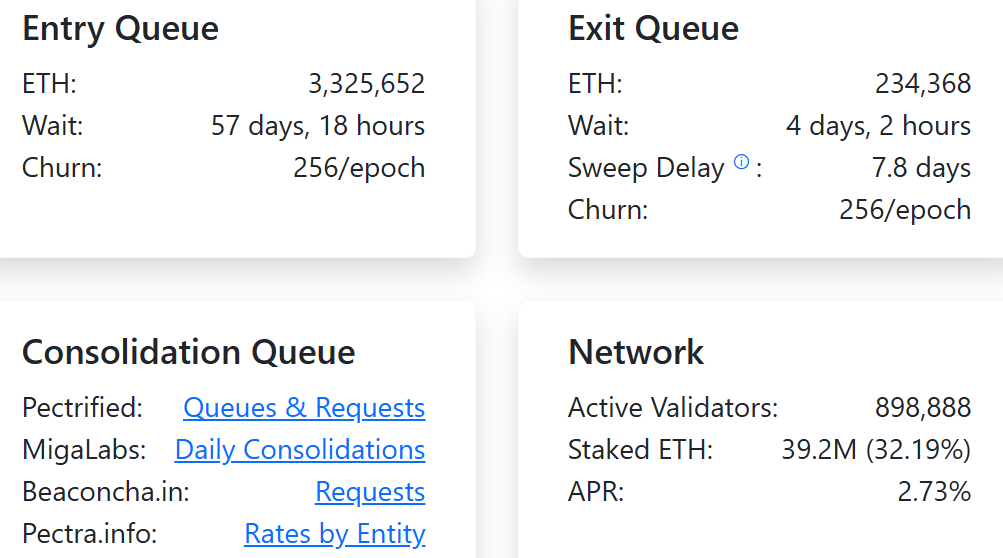
Over 39.2 million Ether is currently staked. Source: Ethereum Validator Queue
Ether reached an all-time high of $4,946 in August 2025 but has since fallen over 58%. Lee previously argued that Ether’s steep drawdowns may offer a buying opportunity.
Magazine: Polymarket seeks Japan entry, Harvard dumps entire ETH position: Hodler’s Digest, May 17 – 23



Crypto-focused political committees are flexing their growing bipartisan political muscle in Texas, spending more than $9 million on races this cycle as Tuesday’s primaries deliver a string of wins for industry-backed candidates across both parties.
Houston Democrat Christian Menefee defeated fellow Democrat Rep. Al Green in the Democratic primary runoff for Texas’s 18th Congressional District, after Republican-led redistricting dismantled Green’s longtime seat and forced the House Financial Services Committee member into a rare incumbent-on-incumbent showdown.
Green had earned an “F” from crypto advocacy group Stand With Crypto after opposing key industry-backed legislation and warning that cryptocurrency could erode U.S. financial leverage abroad.
“Rep. Green’s defeat proves that anti-crypto hostility carries real electoral consequences,” Geoff Vetter, a Fairshake spokesperson, told CoinDesk. “Fairshake was the difference-maker in this race, and we will continue to aggressively back leaders like Rep. Menefee across the country.”
In the Republican Senate primary, Texas Attorney General Ken Paxton toppled longtime Sen. John Cornyn. In other races, Fairshake’s Republican affiliate, Defend American Jobs, and its Democratic counterpart, Protect Progress, backed candidates on opposite sides of the aisle, while the separate crypto-focused Fellowship PAC supported Paxton to the tune of $500,000.
Elsewhere in Texas, Defend American Jobs spent roughly $1.8 million backing four winning Republican candidates: Jon Bonck ($348,433), Tom Sell ($426,279), Carlos De La Cruz ($581,172) and Alex Mealer ($436,278). All four were low-turnout runoffs where the eventual nominee is typically heavily favored in November, making them efficient targets for a well-capitalized political network.
Texas had only one night of primaries, but Tuesday’s results suggest the crypto industry is already positioning aggressively with a well-capitalized war chest for the 2026 midterms, when Democrats are favored — by a slim margin — to sweep both the House and Senate.
David Hoffman, an Ethereum advocate and the co-founder of the media company Bankless, says he sold the remainder of his Ether (ETH) holdings last week as he believes the “ETH is Money” thesis has largely “played out.”
Hoffman said in an X post on Tuesday that “Ethereum got the ETH price it deserves, and I don’t see ETH being rerated as an asset, higher or lower.”
Hoffman said that Ethereum “has done incredibly well, and deserves the market cap that it has,” but the “window of opportunity for ETH to be ‘rerated’ by the market seems to be closing.”
“ETH is, to some degree, money. But not the maximally successful version that we collectively sought out to achieve.”
The “ETH is Money” thesis believes the token is a superior store of value compared to fiat money, as it is decentralized and has introduced mechanisms to try to combat inflation, or the amount of new tokens being created.
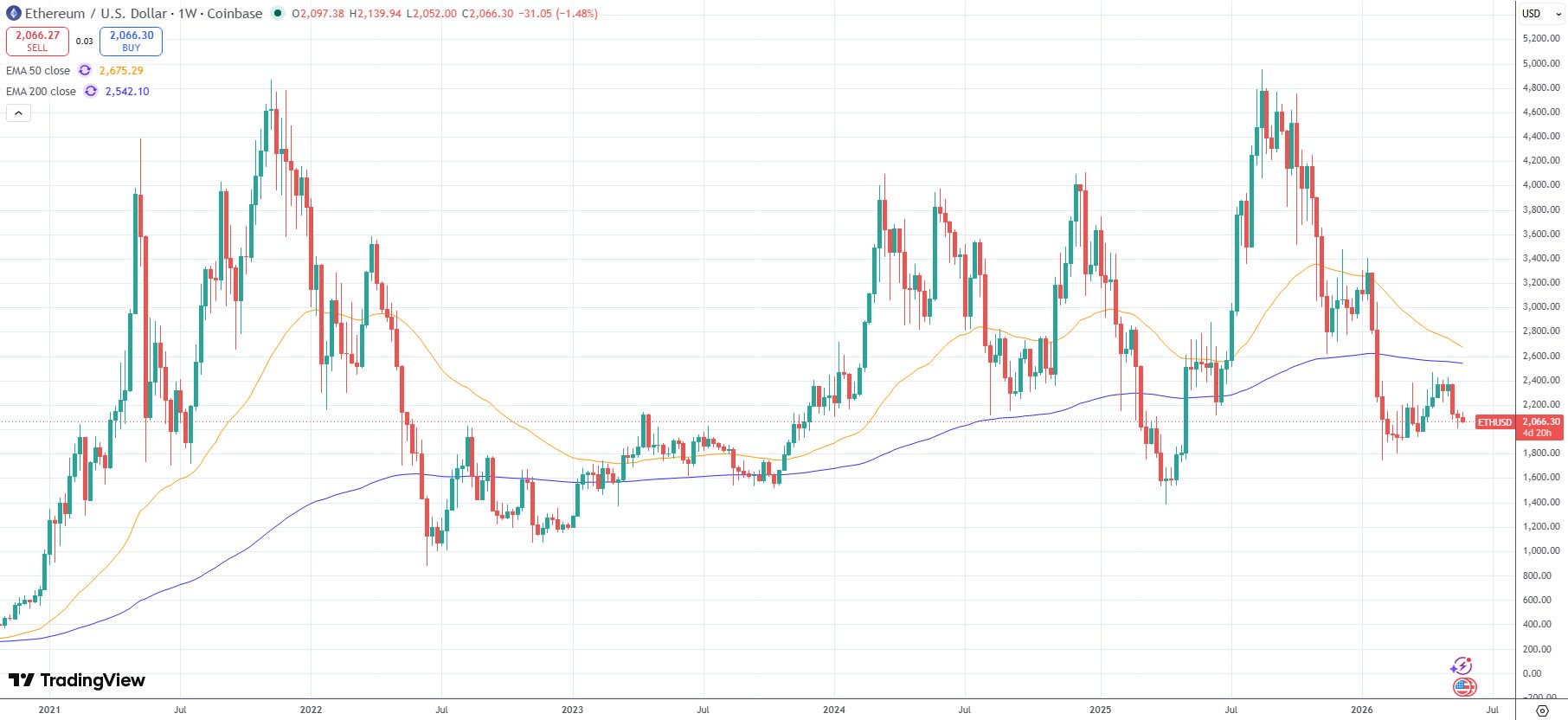
Many Ether backers believed the token could reach the high five-figures, but ETH reached an all-time high of just below $5,000 in August, about equal to its previous bull market peak during the last cycle. It has since dropped by almost 60% from its all-time peak to trade around $2,000.
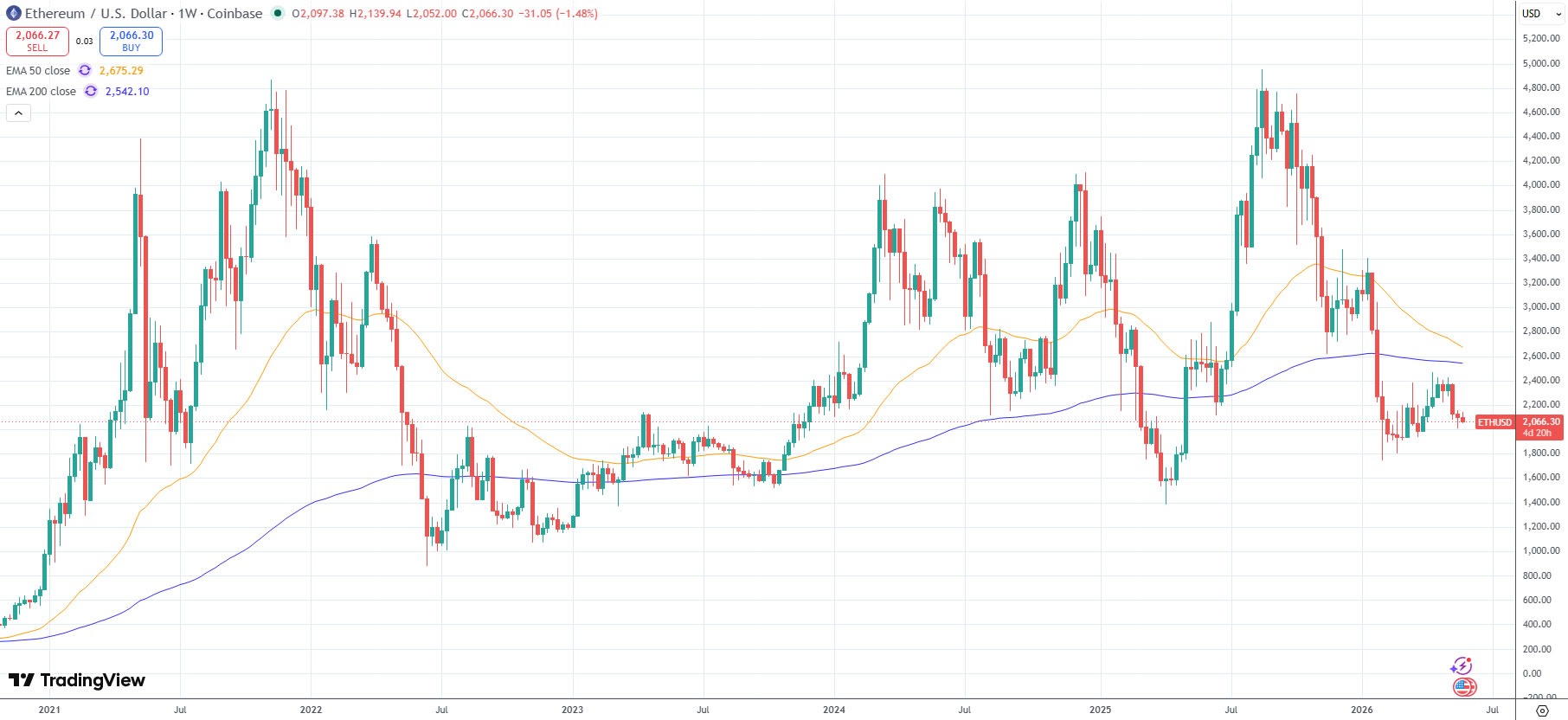
ETH prices have been largely rangebound for five years. Source: TradingView
Hoffman, a long-time Ethereum bull who has written extensively on investment cases for Ether, announced selling his entire ETH holdings, the value of which he did not disclose, on May 21.
He said that Ethereum is a “giver, not a taker,” providing secure blockspace and tokenization at cost while the blockchain’s layer-2 networks capture most of the fees and benefit.
“Ethereum takes no markup for anything it does. This is the nature of open source software, and this is the power of Ethereum. Ethereum supplies its full set of incredibly important values to the world… at cost.”
Hoffman reiterated that he is “massively bullish” on Ethereum, expecting that the network will do “exceptionally well from here on out,” but only a “marginal amount” of that success will be reflected in its token.
Related: Tom Lee predicts supercycle amid Bitmine’s largest Ethereum buy in 2026
Hoffman’s sale saw mixed reactions from ETH backers, with Bankless co-founder Ryan Sean Adams saying it was the “end of an era.”
Former Ethereum core developer Eric Connor said he didn’t really blame Hoffman because ETH has “grossly underperformed the general crypto market for many years now.”
He attributed the lag mainly to selling pressure from the large number of millionaires created during its explosive early run-up rather than fundamental protocol shortcomings.
“At the end of the day, maximalism to a single coin when it comes to portfolio management is pretty silly,” he said.
Magazine: Polymarket seeks Japan entry, Harvard dumps entire ETH position: Hodler’s Digest

TLDR
- Cryptocurrency mining equities rallied strongly Tuesday, with TeraWulf climbing as much as 17% while Hut 8, IREN, and Riot Platforms each advanced over 5%.
- The rally accompanied the S&P 500’s push past 7,500 to new record territory, driven by a 5.6% jump in the Philadelphia Semiconductor Index, which has surged nearly 77% in 2025.
- Bernstein analysis shows 11 publicly listed Bitcoin mining companies command approximately 27 gigawatts of existing and planned electrical capacity, positioning them as key players for AI data center expansion.
- IREN’s partnership agreement with Microsoft could generate approximately $3.7 billion in annual revenue for its AI cloud services division, according to Bernstein’s estimates.
- Industry observers caution that Bitcoin network security may face heightened concentration risks as major miners transition to AI operations, though hybrid models combining both activities appear most viable.
Cryptocurrency mining equities posted substantial gains Tuesday as a powerful rally in chip and technology stocks boosted investor enthusiasm throughout the industry. Market participants increasingly recognize crypto mining operations as emerging participants in the artificial intelligence infrastructure expansion.
Semiconductor Rally Powers Mining Stock Advances
TeraWulf topped the sector’s performance, surging as much as 17% following its announcement of acquiring a Kentucky-based data center facility. Hut 8, IREN, and Riot Platforms each finished the trading session with gains exceeding 5%.
These advances occurred as the S&P 500 established new all-time highs, breaching the 7,500 threshold for the first time ever. The Philadelphia Semiconductor Index posted a robust 5.6% gain and has now appreciated nearly 77% since the start of the year.
Market enthusiasm for mining companies has intensified as additional firms announce intentions to redirect their electrical infrastructure toward high-performance computing and artificial intelligence applications. These operations are perceived as potentially offering greater stability and profitability compared to cryptocurrency mining as a standalone business.
Bernstein’s analysis identified that 11 publicly traded Bitcoin mining enterprises collectively possess roughly 27 gigawatts of current and anticipated electrical capacity. Industry experts argue that dependable electricity access — rather than chip availability — is emerging as the primary constraint for expanding AI infrastructure.
This situation positions mining companies advantageously to function as strategic collaborators for hyperscale cloud providers and artificial intelligence firms seeking established power and data center capabilities.
IREN exemplifies a mining operation already executing this transformation. The firm recently finalized a partnership with Microsoft that Bernstein projects could generate an annual revenue run rate approaching $3.7 billion for its AI cloud infrastructure operations.
Bitcoin Price Dynamics and Industry Transformation
While the AI transformation has elevated mining stock valuations, Schwab analysts observe it simultaneously introduces questions regarding Bitcoin’s underlying fundamentals.
Mining operations have traditionally established a pricing floor for Bitcoin. When Bitcoin prices approach or fall below production costs for less efficient operators, it has historically indicated downside support levels. Glassnode figures from May 2026 position inefficient miner production expenses at approximately $95,000.
Bitcoin previously reached a peak of $126,000 before declining to roughly $60,000, a threshold that aligned closely with the 200-week moving average and efficient miner production costs during that period.
Schwab’s research team highlights that as prominent mining companies redirect resources toward AI applications, the quantity of active Bitcoin miners supporting the network may decrease. This creates increased concentration among the remaining mining participants, which analysts suggest could theoretically elevate transaction censorship risks or compromise network security over extended timeframes.
Nevertheless, most industry analysts anticipate a hybrid operational model will dominate. Bitcoin mining operates continuously around the clock and can utilize capacity during off-peak periods when AI inference demand diminishes. Inference workloads are forecast to constitute over 50% of worldwide data center demand by 2030, though this demand concentrates during standard business hours.
In operational terms, analysts envision miners employing Bitcoin mining as continuous baseline activity while layering AI inference tasks during high-demand periods — an approach that diversifies revenue streams and mitigates the cyclical volatility that has historically challenged the sector.
Schwab assigns Bitcoin a more favored rating among digital currencies and maintains a neutral stance on Ether, while designating XRP and Solana as less favored alternatives.
Regarding governmental backing, Schwab observes that 28 U.S. states are currently evaluating strategic Bitcoin reserve programs. New Hampshire, Arizona, and Texas have already enacted legislation creating such reserves.

Crypto World
Bitcoin Four-Year Cycle Not Dead, Benjamin Cowen Says BTC Bottom Likely in October 2026
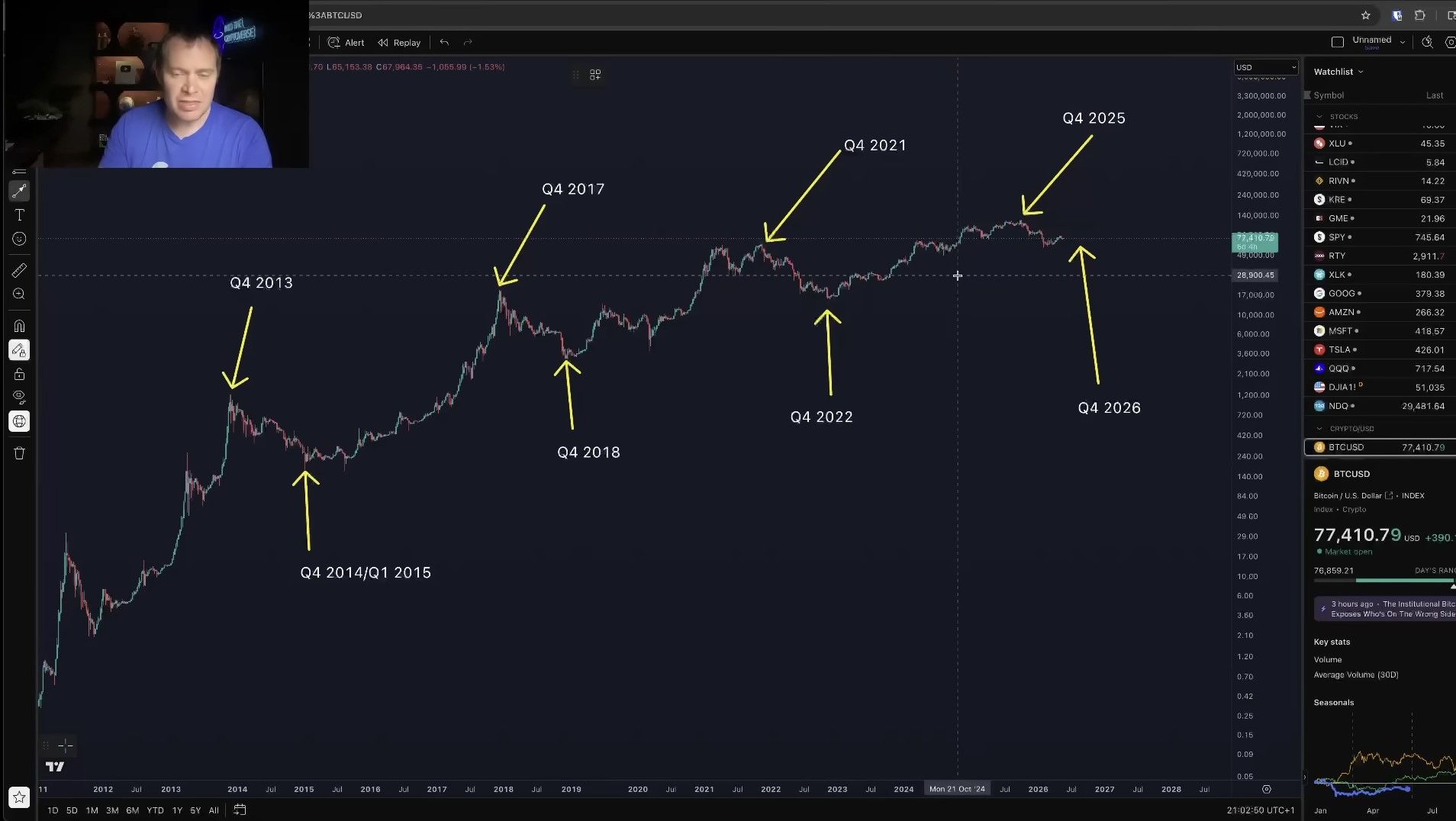
Bitcoin’s four-year cycle is alive and well, says Benjamin Cowen, founder of Into the Cryptoverse. The current top arrived within a week of historical timing, and the next bottom should follow in Q4 2026.
The analyst dismisses claims that spot ETFs, corporate treasury demand, and a Bitcoin reserve narrative have broken the pattern. Every previous cycle saw similar narratives fail before the bear market arrived anyway.
Topped When It Always Tops
In a new video, the founder of Cryptoverse pushed back on the wave of analysts declaring the cycle dead.
“Bitcoin topped within one week of when it historically tops, despite the narratives for calling the four-year cycle dead.”
The two previous cycles topped on day 1,059 and day 1,168 from the prior low. The current cycle topped on day 1,162.
Bitcoin trades near $75,650, down about 40% from its October 6 record of $126,080.

Apathy Top Does Not Cancel a Bear Market
Critics argue Bitcoin topped on apathy rather than euphoria, breaking the historical pattern. Cowen turned to S&P 500 data from 1962 to 1982. He says the four-year low cycle held even when index tops looked nothing like a blow-off.
“Topping on apathy doesn’t mean you don’t have a bear market, because you can see how in the past the stock market topped on apathy arguably and it still had a bear market.”
He sees the current counter-trend rally as weaker than the 46% bounce off the 2022 low. The 16-week run also sits inside the 15 to 25 week range seen in prior midterm-year recoveries.

Benjamin Cowen: The Invalidation Scenario
Cowen acknowledges the call could be wrong, but argues the burden of proof sits with the bulls.
“To pretend like it’s different this time because of some narrative on Wall Street would be the same mistake that people fell for last cycle and the cycle before that.”
Even in a softer outcome, he expects Bitcoin to revisit $60,000 later this year. Any durable bull market would only resume after that test.
His base case for the cyclical low is October 2026. That aligns with the midterm year pattern seen in 2014, 2018 and 2022. It also matches recent analyst predictions for the same bottoming window.
The post Bitcoin Four-Year Cycle Not Dead, Benjamin Cowen Says BTC Bottom Likely in October 2026 appeared first on BeInCrypto.
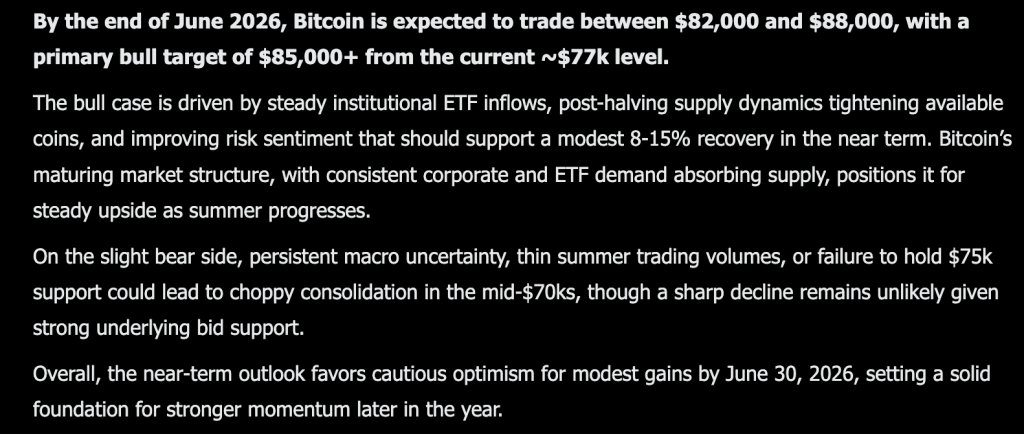
Every other AI in this series swung for the fences on Bitcoin price. Grok AI went the other direction and gave the most grounded near-term predicts yet.
$82,000 to $88,000 by end of June. A modest 8 to 15% recovery. No fireworks, just structure.
Grok’s reasoning is deliberately conservative and that is actually what makes it interesting. The bull case is not built on cycle peaks or institutional adoption narratives at scale. It is built on 3 things that are already visible in the data right now.

Steady institutional ETF inflows are providing consistent demand without the volatility of retail speculation. Post-halving supply dynamics are tightening the supply of available coins as miners hold and long-term holders accumulate.
And improving risk sentiment is creating the macro backdrop for a modest recovery without requiring a full-blown euphoric cycle.
Grok frames this as Bitcoin’s maturing market structure showing itself: consistent corporate and ETF demand absorbing supply and positioning price for steady upside rather than explosive moves as summer progresses.
The AI is essentially saying the days of 50% monthly candles are behind Bitcoin, and the reward for that maturity is a more reliable, less violent grind higher.

The bear case is equally measured. Persistent macro uncertainty, thin summer trading volumes, or failure to hold $75,000 support could lead to choppy consolidation in the mid-$70,000s.
Grok is explicit that a sharp decline remains unlikely given strong underlying bid support. The overall verdict: cautious optimism for modest gains by June 30, setting a solid foundation for stronger momentum later in the year.
Grok AI Predicts $85,000 by June 30: The Chart Shows That Distance Is Smaller Than It Looks
Bitcoin is trading at $77,015 on the daily, pulling back from the recent $82,000 to $84,000 highs that marked the strongest recovery attempt since the February crash to $61,000.
The chart since that low has been a textbook accumulation structure: higher lows, gradual compression, and a series of increasingly serious tests of the $82,000 to $84,000 resistance zone that has defined the ceiling of the recovery range for 3 months.
The pullback from $84,000 to $77,000 over the past 2 weeks is the first meaningful retracement since the April recovery leg began, and it is now testing the $76,000 to $78,000 support zone that Grok identified as the critical hold level.
This range has been the base of every recovery attempt since March, and losing it would confirm Grok’s bear case of choppy mid-$70,000 consolidation rather than the June breakout scenario.
Resistance sits at $82,000 to $84,000, the zone that has rejected 3 separate push attempts since the recovery began. Grok’s primary bull target of $85,000 sits just above that ceiling, meaning the prediction requires clearing the most persistent resistance on the chart.
Above $85,000, the path toward $88,000 opens, and the upper end of Grok’s target range comes into view. Support is $75,000 to $76,000, Grok’s explicit floor, with $72,000 as the next meaningful demand zone below that.
Grok’s $85,000 target is $8,000 above the current price with 35 days to get there. On a chart that covered $20,000 in 10 weeks earlier this year, that is not a stretch. It just needs the $76,000 floor to hold first.
Discover: The best crypto to diversify your portfolio with
Grok Projects That Bitcoin Hyper Could Outperform Bitcoin Next
Some traders rotating between cycles are already looking past large caps entirely.
Bitcoin Hyper is positioning itself for that rotation. The project is building the first Bitcoin Layer 2 with Solana Virtual Machine integration, claiming sub-Solana latency while keeping Bitcoin’s security layer intact.
Fast, low-cost smart contracts on Bitcoin without abandoning its trust model. That is a gap neither Ethereum nor Solana fills directly.
The presale has raised $32 million at $0.013679 per token with high APY staking available for early participants.
The risk profile is different here. Higher upside potential, earlier entry, and significantly more execution risk than anything trading on major exchanges. That tradeoff is the whole point.
The post Elon Musk Grok AI Predicts Bitcoin Price by End of JUNE 2026 appeared first on Cryptonews.

XRP is trading sideways, with no price prediction deciding on what its next move is. The XRP Ledger Foundation’s version 3.1.3 release introduces fixes across NFTs, permissioned domains, vaults, and the lending protocol, and operators have been urged to upgrade nodes immediately.
On May 8, the XRP Ledger Foundation announced on X that rippled v3.1.3 is available, a maintenance and bug-fix upgrade requiring no manual voting. The fixCleanup3_1_3 amendment bundles patches for non-fungible token logic, permissioned domain handling, vault mechanics, and the lending protocol.
It’s a housekeeping release, technically. But tomorrow’s mainnet upgrade could finally send XRP above its flatline zone.
XRP holds a $83 billion market cap, retaining its position as the world’s fifth-largest cryptocurrency, competing with BNB. With altcoin sentiment gearing toward a constructive phase, the upgrade lands at a moment when even a modest narrative shift could move the price.
Discover: The Best Crypto to Diversify Your Portfolio
XRP Price Prediction: $10 Next?
As of now, $1.37 is the first meaningful resistance, with $1.39 as the next ceiling to crack. Short-term momentum reads as neutral, with intraday trend showing limited directional conviction.
No breakout signal yet, but the range is coiled. The v3.1.3 upgrade could serve as a sentiment catalyst if it draws renewed developer and institutional attention to the XRPL ecosystem, particularly around its lending protocol and vault infrastructure.

If XRP can clear $1.40 on upgrade momentum, it could target $1.90, and its long-range base scenario places XRP in the $10+ region in the long run.
However, a break below $1.30 would suggest the consolidation is resolving lower, negating near-term bullish setups entirely. The $10 headline target remains a multi-year thesis. This week’s upgrade is the foundation block.
Discover: The Best Token Presales
Bitcoin Hyper Is “The Upgrade” for BTC
XRP’s $82.6 billion market cap means even a double from current levels requires billions in fresh capital. It’s not impossible, but early-stage infrastructure plays offer asymmetry that large-caps structurally can’t.
Bitcoin Hyper is positioning itself at a category-defining intersection: the first-ever Bitcoin Layer 2 with full Solana Virtual Machine (SVM) integration. That means sub-second finality and fast smart contract execution built on top of Bitcoin’s security layer. Not on a sidechain compromise, but a genuine infrastructure bridge.
The project has raised close to $33 million at a current presale price of $0.0136, with 36% APY staking available for presale participants. The core thesis is breaking Bitcoin’s three core limitations. Slow transactions, high fees, and zero programmability, while preserving BTC’s trust model.
Hyper also features a Decentralized Canonical Bridge for BTC transfers and high-speed, low-cost transaction execution via SVM integration.
The post XRP Price Prediction: Tomorrow’s XRP Ledger Update Could Send XRP Toward $10 appeared first on Cryptonews.
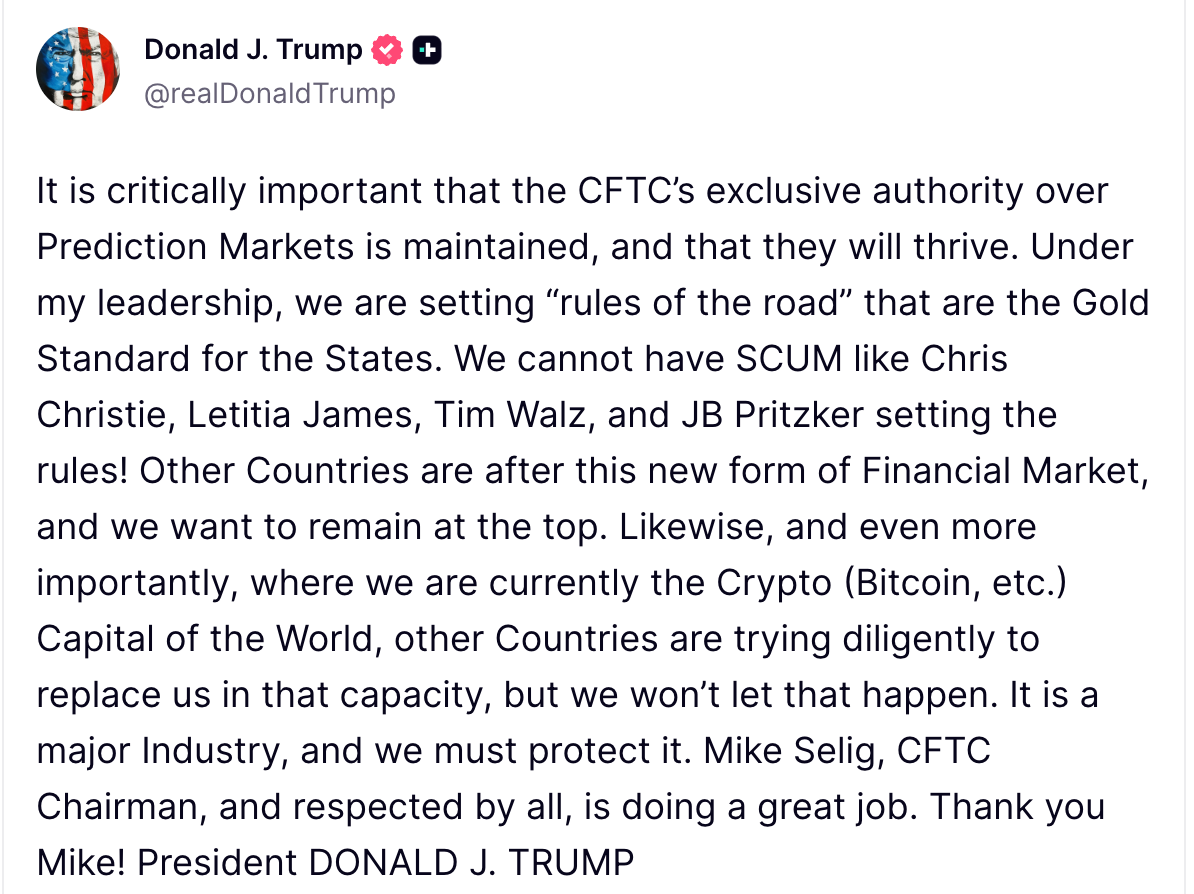
President Donald Trump publicly defended the Commodity Futures Trading Commission’s (CFTC) exclusive authority over prediction markets, framing the regulatory turf war as central to keeping the United States ahead of foreign competitors in finance and crypto.
On May 26, Trump warned that rival countries want to displace the US as the global Bitcoin (BTC) capital. He added that prediction markets, a fast-growing asset class still being defined, face the same competition.
The CFTC’s Prediction Markets Push
Trump’s post praised CFTC Chairman Mike Selig directly, thanking him for steering the agency’s expanding authority over event contracts. Not to mention, Selig is the sole sitting commissioner of the typically five-seat CFTC.

The framing places prediction markets alongside Bitcoin as industries where regulatory clarity could decide whether the US keeps its lead. Kalshi was valued at $22 billion in a May 2026 funding round, signaling fast institutional adoption.
Monthly prediction market trading volumes have surpassed $20 billion, up from roughly $1.2 billion in early 2025. Yet, prediction markets’ legal status remains unresolved across several states.
The post named Chris Christie, Letitia James, Tim Walz, and JB Pritzker as “SCUM,” driving the federal-state regulatory battle.
James joined 38 state attorneys general in April, backing Massachusetts in its lawsuit against Kalshi. The CFTC has filed cases against Arizona, Connecticut, Illinois, New York, and Wisconsin. The agency wants to block state gambling laws from reaching federally regulated venues.
Legal observers expect the dispute to reach the Supreme Court. Until then, the industry sits in regulatory limbo.
The post Donald Trump Calls 4 State Leaders “SCUM” in Push to Keep US the Crypto Capital appeared first on BeInCrypto.

A new draft proposal was submitted to the XRPL Standards repository. It aims to expand XRP Ledger’s automated market maker by allowing liquidity pools to use different pricing curves at their creation.
The Importance of Flexibility
The proposal, which is titled “AMM Swappable Curves” was opened on May 26 by Roman Thpt and Denis Angell. It is currently marked as a draft amendment and is designed to build on XLS-30, the existing XRPL AMM standard.
The core idea behind it is to move the XRPL automated market maker (AMM) beyond a single constant-product model by introducing a pluggable curve architecture.
Under the draft, users who create pools would be allowed to select a curve type when launching their AMM pool. The initially supported curve types include:
- The current constant-product model;
- A concentrated liquidity model, which is similar to Uniswap’s v3;
- a StableSwap-style model designed for correlated assets such as stablecoins.
In the future, the proposal also calls for a weighted Balancer-style curve and a fully programmable smart AMM.
The Motivation Behind it
The purpose behind the proposal is to improve capital efficiency and market flexibility. In today’s version under XLS-30, the AMM spreads liquidity across the full price range. This can make it very inefficient for assets that trade in a narrow range.
Concentrated liquidity, on the other hand, would allow liquidity providers to target specific price bands. With StableSwap, users can enjoy better execution for closely pegged assets.
Moreover, the proposal also retains backward compatibility. This means that existing AMM pools would default to the current constant-product curve, but new curve types would use distinct ledger keys, providing for multiple AMM pools to exist for the same asset pair, each of which would use a different curve.
If the proposal is adopted, it could potentially make XRPL’s native automated market maker more competitive with modern decentralized exchange designs. It could also provide developers with more specialized tools for different market conditions, given the volatile nature of crypto in general.
The post Major Ripple (XRP) Update: Here’s What You Need to Know appeared first on CryptoPotato.
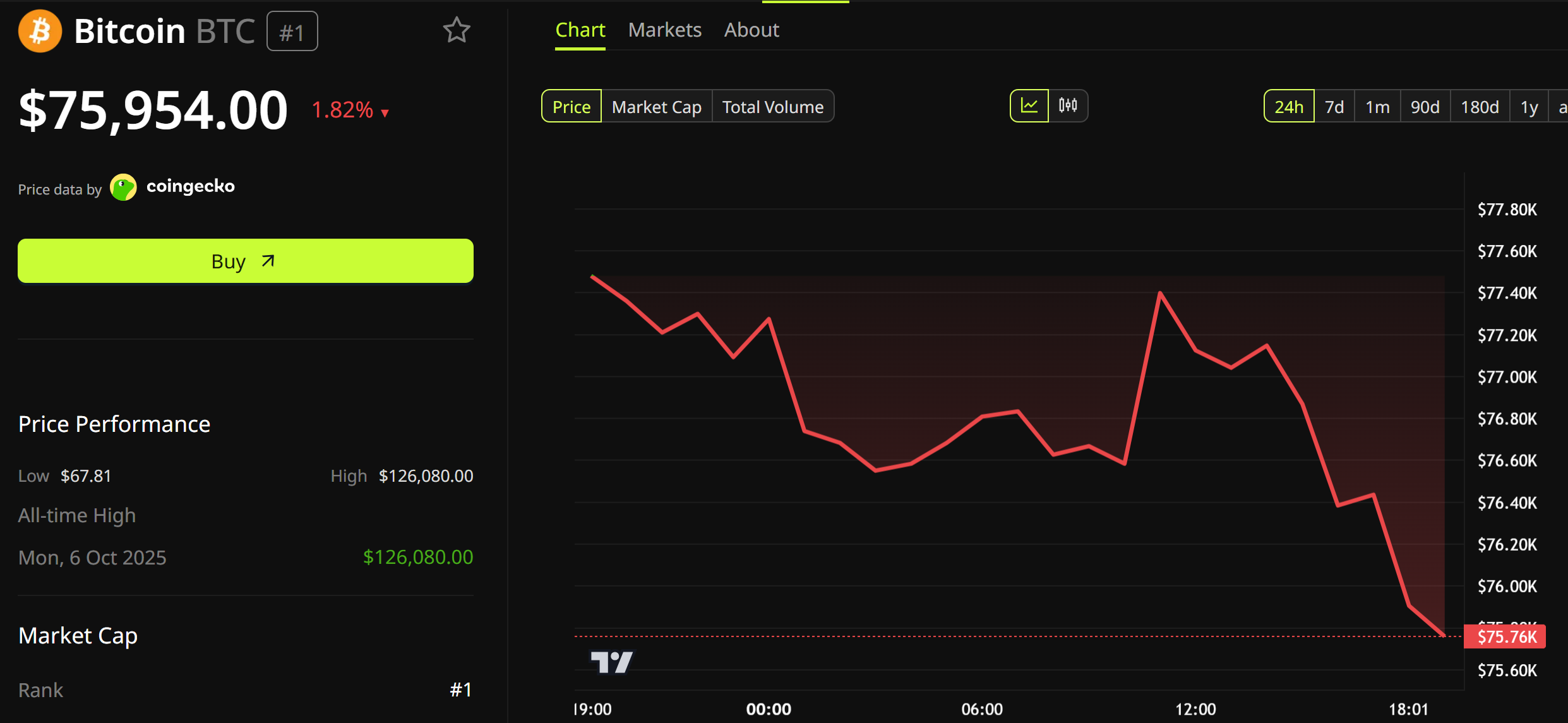
Grayscale Research says SpaceX is on track to become the largest diversified public company holding Bitcoin (BTC). The Elon Musk-led space firm disclosed 18,712 BTC on its balance sheet ahead of an early June listing.
At a current BTC price near $75,954, the holding is worth roughly $1.42 billion. That equals about 0.1% of the $1.75 trillion market capitalization SpaceX is reportedly targeting at IPO.

Why SpaceX Stands Apart From MicroStrategy
Grayscale separates corporate Bitcoin holders into two camps.
- Pure-play digital asset treasuries (DATs) like MicroStrategy hold tokens primarily as a vehicle for equity investors.
MicroStrategy’s record BTC stack now sits near 843,738 coins with limited operating revenue outside that position.
- SpaceX sits in the second camp alongside Tesla’s Bitcoin treasury, Coinbase, and Block.
Its rockets, Starlink network, and government space contracts generate revenue independent of crypto markets. The Bitcoin reserve serves as a small hedge rather than the centerpiece of the balance sheet.
That distinction matters for how investors model the stock. A diversified business with a small BTC position carries different risks than a leveraged Bitcoin proxy.
Follow us on X to get the latest news as it happens
Grayscale Expects More Corporate Adopters
In its report, the firm said corporate buyers often allocate to Bitcoin for the same reason other investors do. The most common motivation cited is portfolio diversification against fiat currency risk.
The asset manager’s 2026 crypto themes point to more diversified businesses following the same path in coming years.

“SpaceX is about to become the largest public company holding Bitcoin,” Grayscale stated.
At least 100 publicly traded firms have adopted some form of BTC treasury policy. Combined holdings now total around 1.24 million Bitcoin, more than 5% of total supply.
The corporate Bitcoin adoption surge keeps drawing in firms outside traditional finance.
MicroStrategy will still dwarf SpaceX in absolute terms. Its stack is more than 45 times larger and trades primarily as a Bitcoin proxy.

SpaceX’s stake, by contrast, will function as a small line item beside its space, satellite, and AI ventures.
SPCX is set to debut on Nasdaq June 12. Early activity in the SpaceX pre-IPO trading market already gives traders a way to position before listing day arrives.
The post Grayscale Reveals The One DAT That Could Beat MicroStrategy’s Bitcoin Treasury appeared first on BeInCrypto.


Pro-crypto Democrat Christian Menefee defeated longtime Representative Al Green in the Democratic primary runoff for Texas’ redrawn 18th Congressional District.
Summary
- Menefee defeated longtime incumbent Al Green after Fairshake-linked PACs made the race a crypto test.
- Fairshake affiliate Protect Progress spent millions backing Menefee and opposing Green before Tuesday’s runoff vote.
- Green’s loss may push crypto policy deeper into Democratic midterm races before November’s 2026 elections.
The Associated Press called the race shortly after polls closed on Tuesday, May 26. Meanwhile, the result ends Green’s two-decade run in Congress and puts Menefee in position for the November election. He will face Republican nominee Ronald Whitfield, according to Axios.
Menefee had already won a special election earlier this year to fill the seat left vacant after former Representative Sylvester Turner’s death. Green entered the race after Texas lawmakers redrew his old district.
Fairshake spending shaped the race
As reported by crypto.news, Protect Progress, a Fairshake-linked super PAC, spent $5 million supporting Menefee and $2.8 million opposing Green before the runoff. The report also said Fairshake had $193 million in cash on hand heading into 2026.
The spending turned the Houston race into one of the clearest early tests of crypto political power in the 2026 cycle. Green had voted against both the GENIUS Act and the CLARITY Act, two bills supported by many crypto policy groups.
Fairshake spokesperson Geoff Vetter said, “Fairshake was the difference-maker in this race.” He added that Green’s defeat showed that anti-crypto positions can carry electoral costs.
Menefee’s crypto stance drew industry support
Menefee has presented himself as open to blockchain policy. His campaign website says blockchain can increase trust, transparency, and efficiency in areas such as finance and supply chains.
Stand With Crypto gives Menefee an A rating and says he strongly supports crypto. The group says he backs clear rules for digital asset businesses, self-custody rights, and clearer definitions for whether assets are securities or commodities.
Green holds an F rating from Stand With Crypto. The group lists his votes against the CLARITY Act, GENIUS Act, FIT21, and other crypto-related measures.
Crypto policy enters the midterm fight
The Texas result comes as crypto policy remains active in Washington. As crypto.news reported, the CLARITY Act faces a tight legislative calendar before the 2026 midterms, while Treasury rulemaking under the GENIUS Act has moved stablecoin oversight deeper into federal compliance work.
The race also follows wider debate over Democrats and crypto. In related coverage, crypto.news reported that Y Combinator co-founder Paul Graham called Senator Elizabeth Warren’s anti-crypto stance a political mistake for Democrats.
Menefee’s win does not settle the national crypto policy debate. It does show that crypto-funded groups can spend heavily in party primaries and point to clear results when candidates take sharply different positions on digital assets.
Japan stocks higher at close of trade; Nikkei 225 up 0.11%

Crypto PACs spend $9 million in Texas and score wins in both parties

Watch: Virat Kohli marks bowling run-up, teases fans during RCB vs GT IPL Qualifier 1 | Cricket News


-

 Crypto World6 days ago
Blockchain.com files with SEC for U.S. IPO
-

 Fashion5 days ago
Holiday Weekend Open Thread – Corporette.com
-

 Business5 days ago
Dell Technologies DELL Stock Surges 15% on AI Server Momentum and Analyst Upgrades in 2026
-

 Crypto World5 days ago
Bitcoin Accumulation Weakens as BTC Realized Losses Hit $600M
-

 Crypto World4 days ago
Robinhood crypto COO Tanya Denisova exits
-

 Crypto World5 days ago
Space X IPO Is ‘Bad News’ for Tech Stocks: But What About Bitcoin?
-

 Politics5 days ago
Makerfield: a tale of two social-media histories
-

 Tech2 days ago
Microsoft’s quiet Claude Code retreat and the real cost of enterprise AI
-

 Business3 days ago
NYT Strands Answers May 24 2026 Revealed for Puzzle No. 812 Theme Summer Essentials
-

 Crypto World5 days ago
MicroStrategy’s Saylor Says Miners No Longer Set Bitcoin Price, Another Force Has Taken Over
-

 Tech5 days ago
WhatsApp ads could make Irish debut after discussions with DPC
-
 Tech5 days ago
A 0.12% parameter add-on gives AI agents the working memory RAG can’t
-

 Crypto World5 days ago
AI infrastructure race heats up as IREN pitches full-stack strategy, WhiteFiber lands $160M deal
-

 Tech5 days ago
You Can Now Add ChatGPT To PowerPoint
-
 Crypto World2 days ago
Nvidia (NVDA) CEO Calls on Super Micro to Strengthen Export Controls Amid Smuggling Probe
-
 NewsBeat6 days ago
Charity run by Reform leader Malcolm Offord accused of ‘law breaking’ over Scottish registration
-

 Tech2 days ago
Westone Audio and Etymotic Acquired by Fidelity Collective in Major IEM Market Move
-

 Business5 days ago
Trump Invests $1M-$5M in Kura Sushi USA Chain With 27 California Locations
-

 Sports5 days ago
2026 CJ Cup Byron Nelson leaderboard: Brooks Koepka finds putting stroke in Round 1
-

 Crypto World6 days ago
Exa Labs raises $250 million in funding led by a16z
You must be logged in to post a comment Login