

Crypto World
Bitmine ETH buying slows after 5.2 million target



Tom Lee has slowed Bitmine ETH purchases after the firm amassed over 5.2 million tokens and 4.3% of Ethereum’s supply.
Summary
- Bitmine bought 26,659 ETH last week, worth roughly $63 million, down from over 100,000 ETH in each of the prior three weekly periods.
- Tom Lee said the previous pace would have taken Bitmine to its 5% Ethereum supply target by mid-July, prompting the slowdown.
- Bitmine holds over 4.7 million ETH staked, generating an estimated $319 million in annualised staking rewards at current yields.
Bitmine Immersion Technologies (BMNR) bought 26,659 ETH last week worth roughly $63 million, sharply down from the more than 100,000 ETH it had been acquiring each week for months. The purchase lifted total holdings to over 5.2 million ETH, worth approximately $12.1 billion, making Bitmine the world’s largest Ethereum treasury company.
Chairman Tom Lee said the firm had deliberately reduced its pace. “We have decided to slow down our pace of weekly accumulation from over 100,000 per week,” he said. “Our previous pace of buys would have us reach 5% by mid-July.”
Why Bitmine is pulling back on purchases
Bitmine originally expected to reach its 5% Ethereum supply target in late 2026. The aggressive accumulation pace shortened that timeline to weeks, prompting a reassessment. The company now holds 4.31% of Ethereum’s circulating supply of approximately 120.7 million ETH.
Lee reiterated his view that “crypto spring” has begun, pointing to Ethereum’s recent price recovery. “If ETH closes above $2,100 at the end of May, this would be the third consecutive monthly gain. This has never been seen in a crypto bear market,” he said.
Since the start of 2026, Bitmine has acquired more than 1 million ETH. Its total crypto, cash, and equity holdings stood at $13.4 billion as of May 10, including 201 Bitcoin, a $200 million stake in Beast Industries, and $775 million in cash.
Staking strategy and what comes next
Bitmine has staked 4,712,917 ETH, representing more than 90% of its total holdings and generating an estimated $319 million in annualised staking rewards based on a 2.86% seven-day yield. That makes it the largest ETH staker of any public company globally.
The company’s MAVAN staking platform, launched earlier in 2026, is being positioned to serve institutional clients alongside Bitmine’s own treasury operations.
Lee said Ethereum’s two primary drivers going forward are Wall Street’s move to tokenization and the rise of agentic AI systems relying on public blockchains for payments and verification.



USDG, still issued by Paxos Singapore and regulated by MAS, will remain in market as one of many institutionally backed dollars as regulators, banks and VCs push toward a fragmented, multi‑issuer “economic OS.”
Summary
- Anchorage Digital, the first federally chartered U.S. crypto bank, is stepping back from leading the Global Dollar (USDG) alliance, saying it wants more neutrality as a stablecoin issuer and custodian.
- CEO Nathan McCauley says about 20 partners are exploring launching stablecoins via Anchorage, so backing USDG too aggressively would misalign incentives as the bank builds a white‑label issuance stack.
Anchorage Digital, the first federally chartered crypto bank in the U.S., is stepping back from a leading role in the Global Dollar (USDG) stablecoin alliance, signaling a shift toward a more neutral, multi‑issuer stablecoin landscape. The alliance — whose members include Robinhood, Kraken, Galaxy Digital, OKX and Visa — was originally framed as a way to build a consortium-backed alternative to single‑issuer dollar tokens, but Anchorage now says it does not want to be seen as the de facto champion of one specific stablecoin as its own issuance and custody business scales.
In comments reported by FinanceFeeds and other outlets, Anchorage co‑founder and CEO Nathan McCauley said the bank will adopt “a higher degree of neutrality” in the stablecoin issuance space, moving away from targeted support for any individual token to better align with its role as a white‑label platform. McCauley noted that roughly 20 potential partners are currently exploring launching stablecoins through Anchorage’s infrastructure, and that the firm needs to “reassess incentive structures and alignment of interests” to avoid conflicts between its own products and those of clients.
USDG itself is not going away. The token is issued by Paxos Digital Singapore and regulated by the Monetary Authority of Singapore, with a current circulating supply around $3 billion, according to figures shared with Coindesk. Paxos — which also operates other regulated dollar tokens — will continue to handle issuance and compliance, while alliance members like Robinhood and Kraken integrate USDG into trading, payments and yield products on their platforms.
What is changing is the balance of power inside the so‑called “stablecoin alliance.” With Anchorage deliberately stepping back from a leadership role, USDG is likely to evolve into one among several institutionally backed dollars rather than the flagship token of a single, highly coordinated consortium. Market participants quoted around the announcement argue that stablecoin issuance is now entering a “parallel development” phase, where multiple institutions and networks roll out their own regulated dollars, often on different chains and under different regimes, instead of converging on one or two dominant consortium coins.
That shift comes as regulators and banks fight over who controls the future of tokenized dollars. In the U.S., the stablecoin yield compromise now before Congress would ban interest‑like rewards on passive balances while still allowing activity‑based incentives, a structure community banks say is necessary to protect deposits but which issuers like Circle and exchanges such as Coinbase argue should not be written so tightly that it kills innovation. At the same time, venture theses from firms like Andreessen Horowitz increasingly describe stablecoins as the base layer of a new “economic operating system,” with multiple issuers, chains and regulatory homes rather than a single monolithic rail.
Anchorage’s recalibration slots neatly into that picture. By positioning itself as a neutral, regulated infrastructure provider that can help dozens of institutions launch their own branded dollars, rather than as the power behind one specific coin like USDG, the bank is betting that the long‑term prize lies in servicing a diversified, multi‑issuer stablecoin ecosystem. For USDG holders, the immediate impact is limited — Paxos still issues the token, MAS still supervises it and alliance members still have skin in the game — but the message to the market is clear: the era of single‑sponsor, single‑network “alliance coins” is giving way to a more fragmented, parallel world where many regulated dollars compete and interoperate, and where the real leverage sits with whoever builds the plumbing they all depend on.

TLDR
- Ripple secured $200 million in funding from Neuberger Berman to expand its prime brokerage platform.
- The company will use the capital to increase margin capacity across traditional and digital asset markets.
- Ripple rebranded Hidden Road as Ripple Prime after acquiring it for $1.25 billion in 2025.
- Ripple Prime reported that its revenue has tripled year over year since the acquisition.
- Noel Kimmel said the funding will improve capital efficiency and support institutional client growth.
Ripple secured a $200 million funding agreement with Neuberger Berman to expand its prime brokerage services. The company will use the capital to increase margin capacity across traditional and digital asset markets. The deal strengthens Ripple’s institutional platform and supports rising client demand.
Ripple Prime Expands With New Institutional Financing
Ripple confirmed it closed a $200 million funding facility with Neuberger Berman on Monday. The company will use the capital to expand margin offerings across traditional and digital assets. Executives said the agreement strengthens liquidity and operational capacity.
The funding supports the continued growth of Ripple Prime. Ripple rebranded Hidden Road as Ripple Prime after acquiring it in 2025. The firm reported that platform revenue has tripled year over year since the acquisition.
Ripple acquired Hidden Road for $1.25 billion in 2025. The deal ranked among the largest transactions in cryptocurrency industry history. The company later agreed to acquire GTreasury for $1 billion to expand treasury services.
Noel Kimmel, President of Ripple Prime, addressed the funding in a statement. He said, “Dependable access to financing and balance sheet strength are critical to institutional participants.” He added that the facility will increase margin capacity and improve capital efficiency.
Kimmel also said Neuberger Specialty Finance brings expertise in asset-based finance. He stated the firm understands Ripple Prime’s services and operating model. The agreement aims to align financing capacity with institutional client growth.
Peter Sterling, Head of Neuberger Specialty Finance, commented on the transaction. He said Ripple Prime built an innovative brokerage platform combining fintech technology with compliance standards. Sterling emphasized the firm’s operational rigor and agility.
Neuberger Berman manages approximately $570 billion in total assets under management. The investment firm operates across multiple asset classes and global markets. The agreement reflects institutional collaboration in digital asset infrastructure.
Institutional Demand Drives Ripple Prime Growth Strategy
Ripple raised $500 million earlier at a $40 billion valuation. Fortress Investment Group and Citadel Securities backed that funding round. The company used that capital to expand custody, stablecoins, and brokerage services.
Institutional participation in digital assets continues to increase. The U.S. administration under President Donald Trump has supported crypto-friendly regulatory initiatives. Market participants have responded with new digital asset offerings.
State Street Corp. announced a digital asset platform earlier this year. Standard Chartered Plc revealed plans to establish a crypto prime brokerage service. These developments reflect expanding institutional infrastructure.
Ripple positioned Ripple Prime as a multi-asset brokerage platform. The company combines fintech systems with bank-level compliance standards. Executives said the new financing will support client responsiveness and balance sheet growth.
Kimmel stated that the facility enables the company to grow alongside institutional clients. He said it will deliver greater responsiveness and expanded margin access. The funding agreement closed as institutional demand for brokerage services continued to rise.

Key Highlights
-
Seadrill achieves Q1 adjusted EBITDA of $97M while expanding contract pipeline beyond $3.1B.
-
Shares of SDRL advance 3.05% following upgraded 2026 financial projections.
-
Offshore driller secures fresh rig agreements spanning Brazil, Angola, and Gulf of Mexico operations.
-
First-quarter net loss shrinks as improved dayrates strengthen operational performance.
-
Intraday trading shows early volatility despite positive earnings metrics and enhanced outlook.
Seadrill Limited delivered improved first-quarter financial performance while announcing contract wins that pushed its total backlog past the $3.1 billion threshold. Shares of SDRL closed at $49.79, marking a 3.05% increase, though the stock retreated from intraday peaks near $53. The quarterly report highlighted strengthening rig market conditions, upgraded forecasts, and extended revenue certainty through 2026.
Offshore Driller Elevates 2026 Financial Projections
Seadrill recorded operating revenue of $358 million during the first quarter, representing a slight decline from the prior quarter’s $362 million. Despite this modest revenue dip, adjusted EBITDA climbed to $97 million compared with $88 million previously. The offshore driller also expanded its adjusted EBITDA margin, excluding reimbursables, reaching 27.9%.
The company narrowed its quarterly net loss to $7 million from $10 million in the preceding period. Diluted loss per share decreased to 11 cents versus 16 cents previously. Operating expenditures declined to $334 million as certain project preparation activities transitioned into capitalized investments.
Management upgraded its 2026 operating revenue forecast to a range of $1.43 billion to $1.48 billion. Adjusted EBITDA guidance for 2026 was similarly raised to between $370 million and $420 million. The company maintained its capital expenditure and long-term maintenance projection at $200 million to $240 million.
Fresh Agreements Expand Backlog Beyond $3.1 Billion
Seadrill supplemented its contract backlog with over $860 million in new awards following its February fleet update. These contract wins originated from operations in the U.S. Gulf of Mexico, Brazil, and Angola. Consequently, the total contract backlog now exceeds $3.1 billion.
The West Polaris rig obtained a three-year extension with Petrobras in Brazil, scheduled to commence in January 2028. This agreement contributed approximately $480 million to the backlog. Meanwhile, West Neptune and West Vela secured Gulf of Mexico assignments with LLOG, collectively adding $260 million.
In Angola, Sonangol Quenguela extended operations with TotalEnergies for roughly 480 days. This extension maintains rig commitment through July 2028. Additionally, West Carina’s Brazil contract received an extension running into June 2026.
Shares Show Positive Movement Despite Intraday Volatility
SDRL stock appreciated 3.05% to $49.79 following the company‘s first-quarter earnings disclosure. However, trading patterns revealed weakening momentum after an initial surge toward $53. Prices subsequently stabilized toward the lower portion of the session’s range.
Market participants responded to Seadrill’s enhanced EBITDA performance, elevated guidance, and expanded contract pipeline. The intraday retreat suggested profit-taking activity following the opening rally. Nevertheless, SDRL maintained positive territory through the session update.
Seadrill specializes in offshore drilling services, deploying deepwater rigs across key energy markets globally. The company gains when oil producers allocate capital toward long-duration offshore exploration and development initiatives. Recent contract additions provide revenue visibility extending into late 2026, throughout 2027, and into portions of 2028.


US spot Bitcoin ETF products drew $622.75 million last week, their sixth straight week of net inflows.
Summary
- SoSoValue data for the week of May 4 to 8 shows $622.75 million in total net inflows across US spot Bitcoin ETF products.
- BlackRock’s IBIT attracted $596 million during the week, bringing its cumulative total to $66.1 billion.
- The six-week streak has pulled nearly $3.4 billion into US Bitcoin ETF products, the longest run since July 2025.
US spot Bitcoin ETF products drew $622.75 million in net inflows during the week of May 4 to 8, extending the streak to six consecutive weeks of positive flows. SoSoValue tracked the figures on May 11.
BlackRock’s IBIT dominated the period with $596 million in net inflows. Grayscale’s GBTC was the notable exception, posting $62 million in net outflows over the same stretch. IBIT’s cumulative total now stands at $66.1 billion.
Six weeks and what comes next
The current run is the longest inflow streak for US spot Bitcoin ETF products since seven consecutive weeks between June and July 2025. Over the six weeks starting April 2, the funds have together absorbed nearly $3.4 billion in fresh capital.
The strongest week of the run came in mid-April at $996.38 million. Last week’s $622.75 million was the second-highest total of the streak. Bitcoin traded between $80,000 and $82,000 during the period before stabilising near $80,800 by the weekend.
Spot Ethereum ETFs drew $70.49 million over the same week, while spot Solana ETFs took in $39.23 million and spot XRP ETFs attracted $34.21 million.
Institutional positioning and context
The six-week run follows sustained institutional demand that has seen IBIT absorb the overwhelming majority of industry flows throughout 2026. IBIT captured 73% of Bitcoin ETF inflows during the week of January 12 to 16, a pattern that has continued across successive reporting periods.
Quantix Finance CEO Jake Seltzer told analysts this week that “the market is entering a phase where liquidity is becoming more selective rather than purely speculative,” pointing to the inflow data as a sign of structural institutional rotation into Bitcoin.
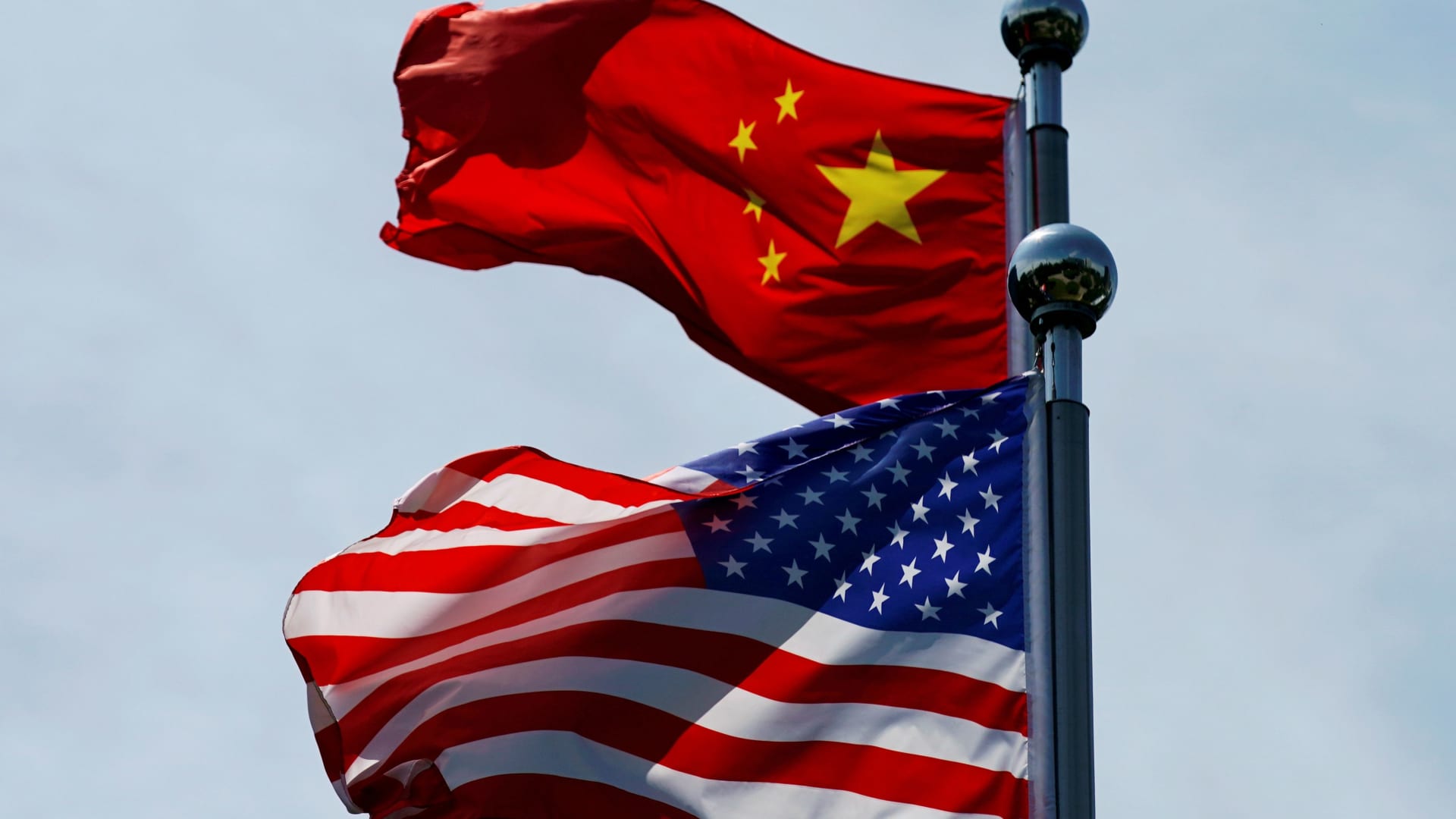
Chinese and U.S. flags flutter near The Bund, before U.S. trade delegation meet their Chinese counterparts for talks in Shanghai, China July 30, 2019.
Aly Song | Reuters
BEIJING — The U.S. and China are rallying their East Asia ties ahead of a highly anticipated presidential summit in Beijing later this week.
Trade negotiators from both countries are slated to meet in Seoul, South Korea, ahead of U.S. President Donald Trump’s meeting with China’s Xi Jinping, scheduled for Thursday and Friday.
The packed itinerary reflects the regional dynamic at play in U.S.-China relations, with the summit being closely watched by leaders globally.
Here’s the full agenda:
Tuesday: Bessent in Japan
U.S. Treasury Secretary Scott Bessent arrived in Japan Monday, where he will meet Japanese Prime Minister Sanae Takaichi, public broadcaster NHK reported.
Japan is one of the countries most affected by the Iran war as the Asian nation relies on the Middle East for about 75% of its oil imports.
Bessent’s visit comes at a time when relations between Beijing and Tokyo have frayed, following Takaichi’s comments in November that indicated Tokyo would support Taiwan if threatened by Beijing’s military, drawing a sharp response from Beijing. She has not softened her statement, despite Beijing’s requests.
During her visit to U.S. in March, Trump and Takaichi “committed to peace and stability across the Taiwan Strait,” according to the White House.
Japan will closely watch the official wording on Taiwan following the Trump-Xi meeting, with the U.S. president on Monday saying that arms sales to Taipei were on the summit’s agenda.
Wednesday: U.S.-China trade talks in South Korea
Vice Premier He Lifeng will lead a delegation to South Korea from Tuesday to Wednesday for trade talks with the U.S, according to China’s Commerce Ministry. The readout didn’t mention other meetings, but referenced the Trump-Xi summit in Busan, South Korea, in October last year.
While it’s not clear whether Bessent accounted for U.S. time zone differences, his announcement only noted that on Wednesday, he will “stop in Seoul for a discussion with Vice Premier He Lifeng of China.”
It’s a sign of the tight planning schedule — and consequently deliverables — for this week’s summit in Beijing. China didn’t officially confirm the meeting until Monday.
“In our view, the summit will be more about avoiding an unnecessary escalation of tensions and managing risks than building up structural mechanisms and forging deep friendships,” Nomura’s Chief China Economist Ting Lu said in a note Monday.
“The most pressing agenda Item is the Iran-Hormuz crisis,” he said.
Thursday: Trump in China
Trump is due to arrive in Beijing on Wednesday evening, according to the White House.
The following morning, he will participate in a welcome ceremony and hold a bilateral meeting with Xi, before they tour the historic Temple of Heaven — a 15th-century landmark in central Beijing. The evening is set to close with a state banquet.
The White House has invited more than a dozen U.S. executives to join Trump on his trip to China. The leaders include Tesla CEO Elon Musk, Apple CEO Tim Cook and Boeing CEO Kelly Ortberg. However, Nvidia CEO Jensen Huang was not on the list.
China’s imports of Boeing aircraft, U.S. soybeans and beef will likely increase as a result of the Trump-Xi summit, but won’t likely recover to highs seen in recent history, according to the Economist Intelligence Unit China.
The amount of China’s purchases will likely be limited by U.S. concessions on tech exports, which in turn are constrained by dynamics in Washington, EIU analysts said.
Friday: Trump departs Beijing
The U.S. president is scheduled to have tea and a working lunch with Xi, before leaving China.
As discussed during last fall’s summit in Busan, Xi is expected to visit the U.S. later this year, and the conclusion of this week’s meeting in Beijing will be closely watched for any sign of an exact travel date.
The Chinese leader visited the U.S. for the Asia-Pacific Economic Cooperation conference in 2023, but has not made a formal state visit since 2015, during the Obama administration. Trump had visited China in 2017 during his first term as well, while his successor Joe Biden had skipped traveling to the Asian country.
Xi could visit the U.S. in December for the G20 meeting in Florida. Trump is expected to attend an Asia-Pacific Economic Cooperation meeting in Shenzhen in November, when the two leaders could meet again.
Next week: A possible Putin visit
Rounding out the high-level political engagement are growing expectations that Russia’s leader Vladimir Putin could visit Beijing as soon as Monday, May 18.
Trump and the expected visit by Putin will round out dozen or so leaders who have come through Beijing in just the first five months of 2026 as China’s clout grows.
Ahead of Trump, Xi hosted Tajikistan’s President Emomali Rahmon. Last week, Iran’s foreign minister also traveled to Beijing for the first time since the Iran war.
Iran will definitely be discussed during the Trump-Xi summit, said Cui Shoujun, a professor at Renmin University of China’s School of International Studies.
China is one of the few countries with relations with Iran and Gulf countries, he pointed out, noting Beijing would want to help resolve the tensions. As for the greater question of U.S.-China relations, Cui emphasized that the two presidents’ meeting this week is just a start of more discussions.


Bored Ape floor prices have doubled in a month as Yuga Labs CEO Michael Figge says blue-chip NFTs were oversold.
Summary
- BAYC floor prices climbed from around 5 ETH to over 10 ETH across the past month, with ApeCoin rallying from below $0.10 to $0.16.
- Yuga Labs CEO Michael Figge said the collection was clearly oversold during the prolonged downturn, calling the rally a recovery rather than hype.
- Pudgy Penguins and other blue-chip collections have also rallied as retail traders return to speculative crypto assets.
Bored Ape Yacht Club floor prices have doubled over the past month, climbing from around 5 ETH to over 10 ETH as traders rotate back into speculative assets. ApeCoin, the ecosystem’s governance token, has also rallied from below $0.10 to roughly $0.16 alongside a sharp increase in trading volumes.
Yuga Labs CEO Michael Figge told analysts the rally reflects genuine market correction. “It’s clear from the numbers that for some time, as far as blue-chip digital collectibles go, it was oversold,” Figge said.
What is driving the Bored Ape comeback
The rebound comes as memecoins and other higher-risk assets outperform more defensive sectors such as DeFi, suggesting retail traders are returning after months of subdued activity.
Pudgy Penguins has also rallied sharply in recent weeks, and traders are speculating about a long-rumoured OpenSea token launch reigniting broader marketplace activity.
Figge acknowledged that speculation remains central. “It would be naive to say financial speculation isn’t a huge driver,” he said. “Whatever happens in this cycle will rhyme with the last one, but it’s never going to be exactly the same.”
Yuga Labs has meanwhile shifted its focus toward community building, hosting more than 30 in-person meetups worldwide over the past month. “A lot of what made Bored Ape work in the first place, the social layer, hasn’t really been serviced in recent years,” Figge said.
Market data and holder context
Figge pushed back on critics noting that unique holder counts have not doubled alongside prices. “A cynic will say prices doubled and the unique holder count didn’t double,” he said. “But that’s really just recovery from a period where things fell disproportionately.”
BAYC’s market capitalisation stood at $251 million as of May 10, with the collection recording $13.42 million in sales over the prior 30 days, per CoinGecko data.
The rebound also coincides with a broader reassessment of digital art: pseudonymous NFT analyst “Van” argued in a recent essay that while speculative mania collapsed after 2021, institutional interest in blockchain-based art has continued quietly at institutions including MoMA and Centre Pompidou.

Key Highlights
- DVLT drops 5.77% in regular trading but recovers 2.76% after hours on infrastructure updates
- Company plans 48,000-GPU distributed edge computing network spanning 100+ U.S. metropolitan areas by 2026
- Upcoming CLARITY Act markup provides regulatory tailwind for digital infrastructure buildout
- Strategic Available Infrastructure collaboration underpins Datavault AI’s coast-to-coast deployment
- Modular micro data center approach positions DVLT for AI workloads, tokenization services, and edge processing
Datavault AI (DVLT) thrust its edge computing infrastructure blueprint into the spotlight Tuesday as the stock experienced intraday volatility. Shares settled at $0.5109, declining 5.77% during regular trading hours following afternoon selling pressure. Yet investors found renewed optimism in extended trading, pushing the stock to $0.5250—a 2.76% gain—after the company detailed its expansion roadmap.
Legislative Momentum from CLARITY Act
Datavault AI tied its infrastructure initiative to anticipated Senate Banking Committee action on the CLARITY Act. Senate Banking Chair Tim Scott scheduled the bill’s markup session for Thursday, May 14, 2026, beginning at 10:30 a.m. Eastern Time. This legislation pursues more transparent federal frameworks for digital asset regulation and market structure.
The CLARITY Act endeavors to establish distinct jurisdictional boundaries between the SEC and CFTC in overseeing digital asset activities. The House approved this bipartisan measure in July 2025 with strong 294-134 support. Senate advancement would move the legislation closer to reconciliation discussions with the House-passed version.
Datavault AI indicated that enhanced regulatory clarity might accelerate adoption of tokenization platforms, protected data operations, and distributed computing services. The firm delivers solutions spanning data monetization, digital credentialing, customer engagement tools, and real-world asset tokenization capabilities. Therefore, management views regulatory certainty as a potential catalyst for broader digital infrastructure deployment.
Expansive GPU Fleet for Metropolitan Coverage
Datavault AI intends to construct a geographically dispersed edge infrastructure through its collaboration with Available Infrastructure spanning major American cities. The initiative aims to reach beyond 100 metro regions before 2026 concludes. Plans also encompass deploying 1,000 urban micro-edge neocloud facilities throughout the nation.
The organization anticipates achieving full commercial operation of its 48,000-GPU arsenal during Q3 2026. Moreover, it projects generating revenue from coast to coast by year’s end as the rollout progresses through local territories. Datavault AI values the complete GPU infrastructure between $1.44 billion and $1.92 billion.
Management calculated this valuation using prevailing market rates for Hopper and Blackwell generation GPU hardware. The firm also projects serviceable addressable market opportunity exceeding $100 million annually per individual network node. Nevertheless, these financial forecasts hinge on successful implementation, market acceptance, deployment velocity, and enterprise adoption rates.
Distributed Architecture Enables Low-Latency Operations
Datavault AI employs compact modular data centers rather than concentrating resources in massive centralized complexes. This approach distributes computational power across numerous geographic points and minimizes single-point vulnerabilities. As a result, the organization claims the architecture enhances redundancy protocols, failover capabilities, operational continuity, and security posture.
The company anticipates the network will facilitate data monetization applications, tokenization platforms, and computation-intensive operations. It also configures the infrastructure for minimal-latency processing proximate to ultimate users and corporate customers. This architectural strategy could address requirements in financial services, enterprise computing, and digital asset infrastructure sectors.
Available Infrastructure further links this deployment to Project Qestral, an overarching sovereign network initiative. That broader effort targets comprehensive presence throughout America’s 100 most populous metropolitan regions. Datavault AI now seeks to monetize this geographic coverage as its edge computing infrastructure becomes operational.
Base Azul is set to go live on mainnet May 13, bringing a multiproof security system to the Coinbase Layer 2.
Summary
- Base Azul combines trusted execution environment proofs with zero-knowledge proofs, allowing either method to finalize proposals independently.
- When both proof systems agree, withdrawal finality can fall to as little as one day, a significant improvement for users moving assets between chains.
- Empty blocks on the Base network fell 99% over the past two months, from roughly 200 per day to around two.
Base Azul, described by the network as its first fully independent upgrade, is set to activate on mainnet on May 13. At the center of the upgrade is a multiproof system combining trusted execution environment proofs with zero-knowledge proofs, giving the network multiple independent paths to finalize transactions.
Either proof type can finalize a proposal independently, providing redundancy and resilience. When both systems agree, Base says withdrawal finality can fall to as little as one day, a major improvement over the standard multi-day wait on optimistic rollups.
What Base Azul changes for users and developers
Azul also changes Base’s backend software stack. The upgrade makes base-reth-node the network’s sole execution client while adding base-consensus, a new client derived from Kona. All other execution and consensus clients are being dropped, requiring node operators to migrate before mainnet.
Base said reliability has already improved ahead of the launch. Empty blocks fell by roughly 99% over the past two months, from approximately 200 per day to around two. The network also sustained multiple transaction bursts of up to 5,000 transactions per second during the same window, a sharp contrast to the congestion issues that affected the network in January.
The upgrade also aligns Base with Ethereum’s Osaka execution-layer specifications, reducing breaking changes for most developers and applications. Base is running an Immunefi audit competition offering rewards of up to $250,000 for critical vulnerabilities in Azul code.
Context and what comes next
Base is the Coinbase-incubated Ethereum Layer 2 and one of the most active networks by transaction volume in 2026. Azul is framed as a step toward Stage 2 decentralization, a goal the network has pursued progressively since introducing permissionless fault proofs in 2024.
The next Base upgrade after Azul is expected by end of June and will include an enshrined token standard, Flashblock Access Lists, and further withdrawal time reductions.
Base has also confirmed VibeNet will launch as a public devnet in mid-May, giving developers an early environment to test upcoming features before they reach mainnet.


Kraken’s parent Payward has filed a Payward charter application with the OCC to establish a federally regulated national trust company.
Summary
- Payward filed for an OCC national trust charter on May 8, proposing a new entity called Payward National Trust Company focused on digital asset custody.
- The trust would offer federally regulated custody to institutional clients without taking deposits or making loans.
- Co-CEO Arjun Sethi said the OCC filing and Kraken’s existing Wyoming SPDI are complementary pillars of Payward’s regulated banking strategy.
Kraken’s parent Payward has filed a Payward charter application with the US Office of the Comptroller of the Currency, proposing a federally regulated entity called Payward National Trust Company. The filing was announced on May 8 alongside a statement from Payward co-CEO Arjun Sethi.
If approved, Payward National Trust Company would provide bank-level digital asset custody to institutional clients who require a federally regulated qualified custodian. It would not take deposits or make loans in the traditional sense.
What the OCC charter means for Kraken
“A national trust company provides the certainty institutions require and establishes the infrastructure to build the next generation of custody,” Sethi said. “This is not about being first; it is about getting the framework right.”
Sethi described the OCC application and Kraken’s existing Wyoming Special Purpose Depository Institution as “complementary pillars” of Payward’s regulated banking strategy. Kraken Financial, the Wyoming-chartered arm, secured a Federal Reserve master account in March 2026, the first crypto-native firm to gain direct access to the Fed’s payment rails.
The OCC has already issued conditional approvals to several crypto firms this cycle. Ripple, Circle, Paxos, BitGo, and Fidelity Digital Assets received conditional national trust bank charters in December 2025. Crypto.com received its own conditional OCC approval in February 2026.
Context and what comes next
Payward has been rapidly building out its regulated US infrastructure. Its acquisition of Bitnomial for up to $550 million added a full CFTC derivatives stack, while its $1.5 billion purchase of NinjaTrader in 2025 gave it retail futures access.
The Payward charter would extend that regulatory footprint to federal custody, completing a vertically integrated platform spanning trading, clearing, and safekeeping of digital assets.
The OCC approval process is expected to be thorough and multi-stage. Anchorage Digital remains the only crypto-native firm to hold a full national charter to date, with all other recent approvals still conditional.


A newly formed Delaware entity will consolidate and liquidate remaining assets, with “strategic alternatives” coming in the next few weeks.

Soldier on parachuting to Tristan da Cunha for Hantavirus aid

Michael Burry warns of stock crash as tech jump echoes 2000 peak

Anchorage steps back from USDG as stablecoin alliances decentralize

Manchester United reach agreement with Casemiro over contract clause amid transfer speculation

US brings back mandatory military draft registration

Steven Gerrard disagrees with Gary Neville over ‘shock’ Chelsea and Arsenal claim | Football


-
 Crypto World4 days ago
HarrisX Poll Found 52% of Registered Voters Support the CLARITY Act
-

 Fashion3 days ago
Weekend Open Thread: Marianne Dress
-

 Crypto World5 days ago
Upbit adds B3 Korean won pair as Base token gains Korea access
-
 NewsBeat5 days ago
NCP car park operator enters administration putting 340 UK sites at risk of closure
-

 Tech2 days ago
Auto Enthusiast Carves Functional Two-Stroke Engine from Solid Metal
-

 Politics5 hours ago
What to expect when you’re expecting a budget
-

 Politics3 days ago
Politics Home Article | Starmer Enters The Danger Zone
-
 Business3 days ago
Ignore market noise, India’s long-term story intact, say D-Street bulls Ramesh Damani and Sunil Singhania
-

 Fashion10 hours ago
Coffee Break: Travel Steam Iron
-

 Fashion1 day ago
What to Know Before Buying a Curling Wand or Curling Iron
-

 Crypto World7 days ago
UAE Free Zone Deploys Blockchain IDs to Verify Registered Firms
-

 Tech21 hours ago
GM Agrees To Pay $12.75 Million To Settle California Lawsuit Over Misuse Of Customers’ Driving Data
-

 Crypto World6 days ago
BlackRock CEO Larry Fink Discusses a New Asset Class
-

 Crypto World5 days ago
Robinhood says Wall Street is building onchain
-

 Entertainment5 days ago
Sarah Paulson Called Out For Met Gala ‘Hypocrisy’
-
 Sports6 days ago
NBA playoff winners and losers: Austin Reaves is not loving Lakers vs. Thunder matchup, but Chet Holmgren is
-

 Tech6 days ago
Apple and Samsung are dominating smartphone sales so thoroughly that only one other company makes the top 10
-

 Entertainment5 days ago
Bold and Beautiful Early Spoilers May 11-15: Steffy Revolted & Liam Overjoyed!
-

 Fashion5 days ago
The Best Work Pants for Women in 2026
-

 Entertainment4 days ago
General Hospital: Ric & Ava Bombshell – Ric’s Massive Secret Exposed!
You must be logged in to post a comment Login