
Crypto World
Bitmine, Sharplink and Joe Lubin Back Ethereum R&D Nonprofit

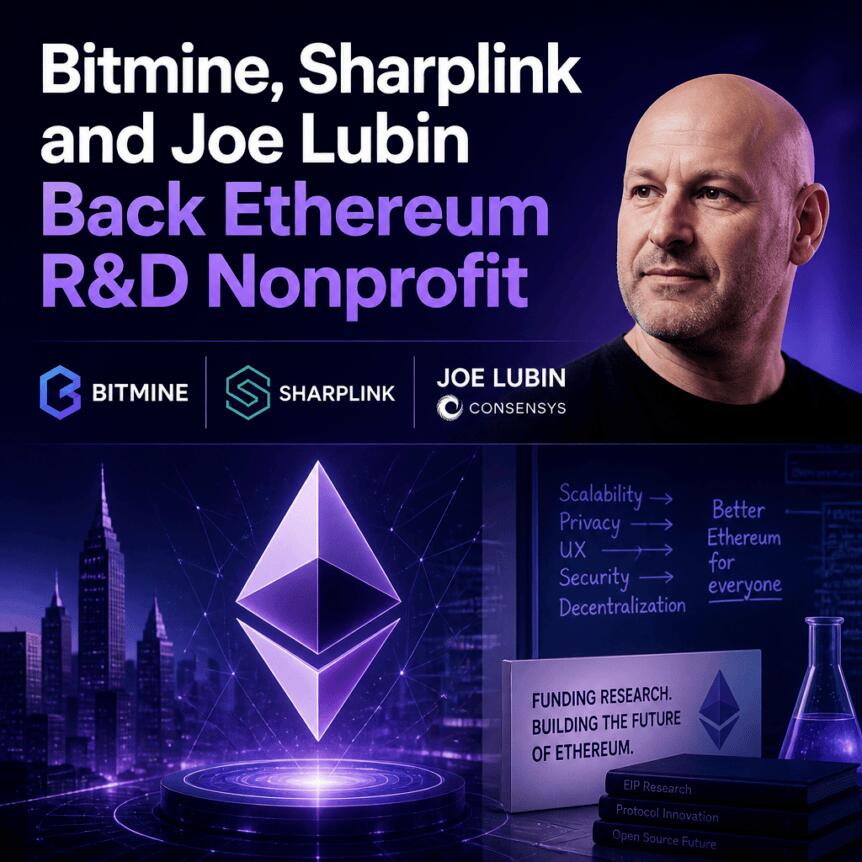
Ethlabs, a newly launched Ethereum-focused research and development nonprofit, says it was created to help prepare the network for what it describes as the next wave of institutional adoption. Backed by former Ethereum Foundation contributors and funded by firms including Bitmine and Sharplink—along with support from Ethereum co-founder Joe Lubin—the initiative is positioned as a dedicated, long-term home for core technical work.
Sharplink said in its announcement that Ethlabs exists to ensure Ethereum can absorb increasing on-chain activity at scale, pointing to the growing movement of stablecoins, tokenized real-world assets, funds, and autonomous AI commerce onto public networks. The launch arrives amid renewed attention to Ethereum’s governance and funding challenges, including warnings from former Ethereum Foundation contributor Trenton Van Epps about a potential “slow-burning funding crisis.”
Key takeaways
- Ethlabs is a new nonprofit designed to support Ethereum’s research and core development with stable, long-term funding.
- Its backers include Sharplink, Bitmine, and Ethereum co-founder Joe Lubin, alongside former senior Ethereum Foundation researchers.
- The announcement frames Ethereum as a “neutral, credibly permissionless settlement layer” for institutional on-chain activity.
- The timing underscores ongoing scrutiny of Ethereum Foundation resources and leadership turnover.
A dedicated institutional-ready R&D push
Ethlabs was launched to “ready Ethereum for the next phase of institutional adoption,” according to Sharplink’s statement. In that framing, Ethereum’s role expands beyond a base layer for crypto-native trading and apps—toward the settlement layer for global financial activity as more assets and services migrate on-chain.
Sharplink emphasized that as stablecoins and tokenized assets grow in use, demand is increasingly converging on Ethereum. Ethlabs’ stated goal is to make sure the network is technically prepared for that shift, particularly in terms of scaling and readiness for enterprise-grade usage.
The organization was presented as a continuation of research work traditionally tied to Ethereum’s deepest infrastructure and upgrade cycles. Sharplink said Ethlabs brings together technologists who have helped guide the network through major upgrades over the past decade, and that the project offers that work a more “institutional” structure with stable funding rather than relying exclusively on short-term cycles.
Who’s behind Ethlabs
Ethlabs was co-founded by five former senior Ethereum Foundation researchers: Ansgar Dietrichs, Barnabé Monnot, Caspar Schwarz-Schilling, Josh Rudolf, and Julian Ma. The nonprofit is also tied to funding support from Bitmine and Sharplink, according to Ethlabs’ launch announcement.
Joe Lubin, an Ethereum co-founder, said Ethereum is “entering its next stage of evolution,” and argued that multiple “steward nodes of Ethereum” should help grow the blockchain’s utilization. In his statement, he linked Ethlabs directly to a long-term effort to support independent research and development aligned with Ethereum’s core values.
Lubin added that giving researchers and developers “a long-term, independent home” could be instrumental in preparing Ethereum for the “next major wave of adoption.” The implication is that Ethlabs is meant not only to contribute technical research, but also to preserve continuity of expertise during periods when institutional attention and funding structures are under pressure.
Context: renewed debate over Ethereum Foundation funding
The Ethlabs launch comes just days after Trenton Van Epps—described as a former Ethereum Foundation contributor—warned Ethereum could face a “core development funding crisis.” His concern fits into broader commentary that Ethereum may be drifting toward a funding squeeze for long-term protocol work.
At the Foundation level, the issue has been publicly discussed before. Earlier this year, Vitalik Buterin stated that the Ethereum Foundation’s resources were limited, noting it held about 0.16% of the total supply of ether (ETH). While the figure alone doesn’t determine whether core development is funded adequately, it has become part of the public narrative about whether the Foundation’s current structure and holdings can sustain the ecosystem’s ongoing engineering demands.
Leadership changes have also kept pressure on Ethereum’s institutional arrangements. The article notes an ongoing wave of departures from the Ethereum Foundation, most recently the departure of co-executive director Hsiao-Wei Wang, who left last week.
Crypto educator David Hoffman was cited as saying the Foundation was “intentionally leaving a power vacuum” for new structures to step in and influence Ethereum’s direction. Hoffman added that Ethlabs’ approach represents a “brightest future” for Ethereum—commentary that reflects a belief that the new nonprofit could help stabilize or reshape how long-term research is supported.
What investors and builders should watch next
For market participants and builders, the real question is how Ethlabs’ “institutional home” translates into measurable continuity for Ethereum development. The narrative emphasizes stable funding and dedicated research leadership, which—if sustained—could reduce the risk of stop-start engineering cycles that can slow protocol work.
At the same time, the timing suggests Ethlabs is attempting to address not only technical scaling needs, but also the ecosystem’s trust and governance concerns around who funds and stewards the next phase of Ethereum’s roadmap. With public debate ongoing about Ethereum Foundation resource constraints and the direction of core development, Ethlabs may become one of the key organizations shaping the next chapter.
Ether price performance is also part of the broader backdrop mentioned in the report, with ETH trading about 65% below its peak near $1,700, levels last seen in October 2023 and April 2025, amid what the article characterizes as “crypto winter” sentiment lows. While price doesn’t validate a development strategy on its own, funding concerns and builder incentives often become more acute when market conditions are weak.
Readers should watch whether Ethlabs moves beyond announcements into sustained research output, clear funding commitments, and ongoing collaboration with Ethereum’s broader development ecosystem. The organization’s success will likely depend on whether it can maintain long-term support while demonstrating concrete technical contributions that match the network’s scaling and institutional adoption priorities.



A Hong Kong woman reportedly lost around $3.3 million after an online romantic partner directed her to a fraudulent cryptocurrency investment platform.
Summary
- 25 romance-linked investment scams were reported in Hong Kong between July 24 and 30.
- Combined losses from the cases approached nearly $9 million, according to local police statistics.
- One victim saw supposed returns of more than 800% before the platform blocked withdrawals.
- Hong Kong also recorded a 92.1% rise in online employment scams during early 2025.
Crypto romance scams cost victims nearly $9M
Hong Kong authorities recorded 25 investment fraud cases involving online romantic relationships during the week ending July 30, according to police statistics cited by Binance Square News.
The reported losses totaled nearly HK$70 million, or roughly $9 million. One case accounted for more than a third of that amount.
A 50-year-old insurance professional reportedly met a person online who presented himself as a car dealer. After establishing a romantic relationship, the person persuaded her to invest in virtual currencies through an unfamiliar platform.
The victim continued transferring money after the platform displayed rising account balances. By last month, it claimed that her portfolio had generated returns exceeding 800%.
However, the platform denied her withdrawal request. The purported romantic partner and an alleged investment adviser then stopped responding, leaving the woman with cumulative losses exceeding HK$26 million or around $3.3 million.
Authorities did not disclose which cryptocurrencies were involved or whether any of the transferred funds had been recovered.
Fake profits kept the victim investing
The case follows a common pattern in relationship-based cryptocurrency fraud. Scammers first build trust through dating applications, social media or messaging services before introducing an investment opportunity.
Victims are then directed to trading websites or applications controlled by the fraudsters. These platforms may display fabricated profits, allow a small initial withdrawal, or encourage victims to increase their deposits.
The scheme typically becomes apparent when a victim attempts to withdraw a larger amount. Operators may block the transaction or demand additional payments described as taxes, processing charges or penalties.
Hong Kong police urged investors to treat investment recommendations from newly established online contacts with caution. Warning signs include guaranteed returns, unusually high profits and requests to transfer funds through an unfamiliar platform.
The FBI describes the same method, saying criminals control the supposed investments and often steal all funds deposited by victims.
Hong Kong employment scams also surged
The romance cases add to a wider increase in online fraud affecting Hong Kong residents.
Police recorded 2,148 online employment scams between January and May 2025, up 92.1% from the same period a year earlier, according to figures reported by the South China Morning Post and HRD Asia.
Reported losses increased from HK$260 million to HK$480 million, an 89% rise. Authorities registered 621 cases in May alone, with 60% originating on WhatsApp and another 22% on Telegram.
Investigators attributed much of the increase to “click farming” schemes. Fraudsters initially pay participants small commissions for completing simple online tasks, such as following social media accounts or purchasing products to inflate a seller’s activity.
After gaining trust, scammers ask victims to commit larger sums for higher-paying assignments. Withdrawal attempts are then rejected, with operators claiming the victim made an error or damaged a company system and must pay a penalty.
US crypto fraud losses reached $7.2B
Similar investment schemes remain a major threat to US users. Cryptocurrency investment fraud produced $7.2 billion in reported US losses during 2025, making it the country’s largest category of financial loss reported to the FBI’s Internet Crime Complaint Center.
The FBI’s 2025 report said scammers commonly approach victims through social media, dating platforms and unsolicited messages before moving conversations to private messaging services.
US authorities advise victims to stop sending money immediately and preserve wallet addresses, transaction hashes, platform domains and communications. The FBI also warns against paying supposed recovery services, which may operate a second scam targeting people who have already lost funds.
Hong Kong police similarly advised users not to lower their financial safeguards because of emotional attachment or trust. Investors should independently verify platforms and avoid offers promising guaranteed or abnormally high returns.

One of the most recognizable and well-known figures in the cryptocurrency space has displayed a somewhat controversial approach to his Ethereum investments over the past few months.
The most recent data shared by Lookonchain doubled down on his sporadic approach, as he had realized another loss.
The analytics resource informed that the former BitMEX CEO deposited nearly 2,365 ETH into Cumberland and Galaxy Digital earlier today, and received 4.3 million USDC in return.
According to the analysts, this meant that his selling price was at $1,821 given the asset’s retreat over the past few days from a multi-month peak of $1,980.
Hayes secured a sizeable loss of $241,000 (or 5.3%) on this trade because he went on an accumulation spree during the aforementioned ascent from ETH. As previously reported, he bought 7,213 ETH for $13.87 million at an average price of $1,923.
Arthur Hayes(@CryptoHayes) bought high and sold low again!
Over the past 2 hours, he deposited 2,364.38 $ETH into Cumberland and Galaxy Digital, receiving 4.3M $USDC in return.
His selling price was $1,821, resulting in a loss of $241K (-5.3%).
He had previously bought 7,213… pic.twitter.com/4AVZpjANZD
— Lookonchain (@lookonchain) August 1, 2026
What’s interesting here is that this is not the first time Hayes has lost on ETH by buying high only to sell low weeks later. His previous major ETH trade was several weeks ago, when he accumulated at prices well over $1,900 again after the token jumped to $1,950.
Once it started to nosedive, though, Hayes was quick to sell off his stash at an average price of under $1,700. Thus, he incurred another major loss in just weeks, while ETH’s price rebounded shortly after.
The post Arthur Hayes Does It Again: Buys ETH High, Sells It Low appeared first on CryptoPotato.


XRP Ledger developers are preparing five proposed amendments for the upcoming xrpld 3.3.0 release, targeting privacy, atomic settlement, and easier institutional onboarding.
Summary
- Five proposed amendments are expected to accompany the xrpld 3.3.0 software release.
- Confidential MPT would support private token balances and transfer amounts using cryptographic proofs.
- Batch transactions would enable delivery-versus-payment and atomic settlement across multiple accounts.
- Amendments require validator approval before they can activate on the XRP Ledger.
XRP Ledger v3.3.0 targets institutional transactions
Jazzi Cooper, head of product at RippleX, outlined the proposed changes in a post on X. The xrpld 3.3.0 release is anticipated next week, although releasing the software will not immediately activate its amendments.
“XRPL has already proven it can support tokenized assets at scale. Now it’s time to put these assets to use: global transfers, trading, collateralizing, and settling,” Cooper said.
She added that the five amendments would move the network closer to supporting those activities. The proposals cover confidential token transactions, transaction batching, delegated permissions, sponsored costs, and adjustable token properties.
Each amendment must pass through the XRP Ledger’s validator-governed approval process. Amendments affecting transaction processing generally need at least 80% support from trusted validators for two consecutive weeks before taking effect.
The upgrade follows the activation of fixCleanup3_2_0 on July 29. XRPScan data showed that the amendment received support from 30 of 35 participating trusted validators, equivalent to 85.71%.
Its activation made version 3.2.0 the minimum software release compatible with the updated mainnet rules. Nodes running version 3.1.0 or earlier became amendment-blocked and could no longer follow validated ledgers correctly.
Confidential MPT would add token privacy
Confidential MPT would add native privacy features for Multi-Purpose Tokens on XRPL. The proposal uses elliptic-curve encryption and zero-knowledge proofs to conceal token balances and transfer amounts while allowing authorized verification.
Issuers and holders could keep transaction data private from the public while granting access to a designated third party, such as an auditor or regulator. The arrangement is intended to balance commercial confidentiality with institutional reporting and compliance requirements.
“For financial institutions, privacy is often a prerequisite for using public blockchain infrastructure,” Cooper said.
The proposal could be relevant to US-regulated institutions evaluating public blockchains for tokenized assets. Banks, broker-dealers and asset managers often need transaction confidentiality while retaining records that can be reviewed by auditors or regulators.
However, the amendment would represent a network-level technical function, not regulatory approval for any specific financial product or activity.
Batch and delegated permissions support settlement
The proposed Batch amendment would allow transactions involving multiple accounts to execute atomically within one ledger. Either every part of the batch would succeed, or the entire operation would fail.
The structure can support delivery-versus-payment, where the transfer of an asset and its corresponding payment occur together. It could also reduce settlement risk in more complicated workflows involving several accounts or assets.
Permission Delegation would allow an account holder to grant narrowly defined transaction permissions without transferring control of the account’s signing authority. An institution could therefore authorize a treasury or operations team to perform specific tasks while keeping its issuance keys under separate control.
Sponsored Fees and Reserves would address another onboarding issue by allowing a bank, issuer, or platform to cover transaction fees and account reserves for users.
“Users continue to own their accounts and keys, while removing one of the biggest onboarding hurdles: requiring every participant to acquire and manage XRP before they can interact with the network,” Cooper said.
Dynamic MPT would make issued tokens adjustable
Dynamic MPT, the fifth proposed amendment, would let issuers modify selected token properties after issuance. Adjustable fields could include transfer fees, metadata, and other predefined features.
Issuers currently may need to create a replacement token when important terms require changes. Dynamic MPT is intended to provide limited flexibility without requiring an entirely new issuance, although the final amendment specifications will determine which properties can be changed.
The proposed features arrive as XRPL records increased tokenized real-world asset activity. RWA.xyz data showed that the network added approximately $2.6 billion in RWA value during the six months through July 26, excluding stablecoins.
That ranked XRPL second among tracked networks for net RWA inflows, behind BNB Chain at about $3 billion and ahead of Stellar at roughly $2.1 billion. XRPL’s combined distributed and represented RWA value reached approximately $4.38 billion.
Validator operators will be able to review the amendments as their specifications become available. Activation will depend on whether each proposal independently secures the required consensus after xrpld 3.3.0 is released.
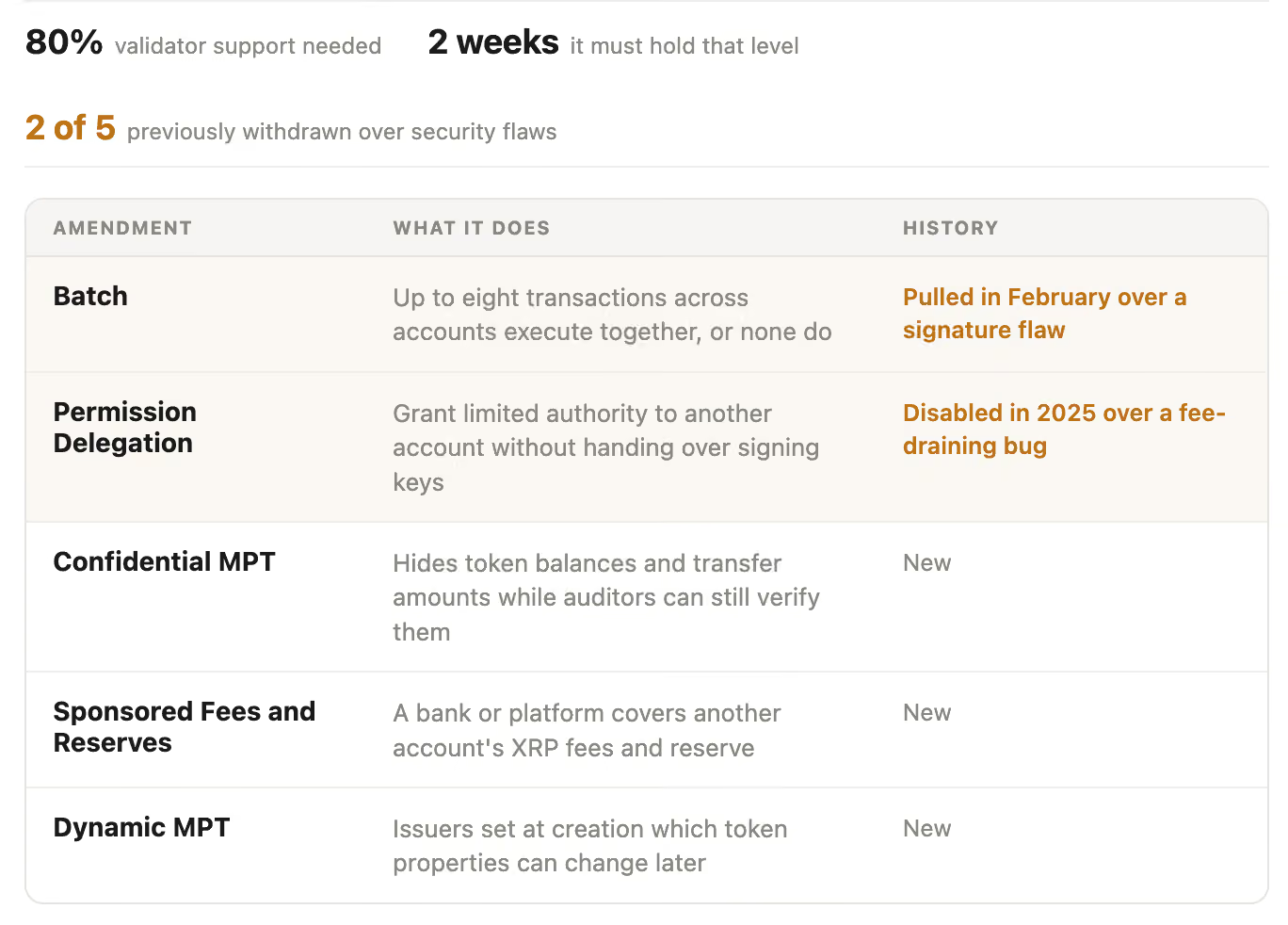
Validators (entities that supply their resources to run and maintain a network) were advised to reject it, and an emergency server release marked it unsupported to prevent activation. No funds were lost, because it never reached the main network.
Permission Delegation, which lets an institution grant another account narrowly scoped authority without handing over full signing power, was disclosed as vulnerable in September 2025 and disabled.
The bug allowed one account to charge transaction fees to another and potentially drain its balance. The ledger’s documentation has listed both amendments as obsolete since, to be replaced by revised versions.

The other three are new. Confidential MPT combines zero-knowledge proofs, which let someone prove a statement is true without revealing the underlying data, with elliptic-curve encryption, so that balances and transfer amounts on Multi-Purpose
Tokens stay private while auditors or regulators can still verify them when required.
Sponsored Fees and Reserves lets a bank or platform cover another account’s XRP fees and reserve requirement, removing the need for every user to acquire XRP before transacting.
Lastly, Dynamic MPT lets an issuer specify at creation which token properties can be changed later, avoiding a full migration to a new token when fees or metadata need updating.
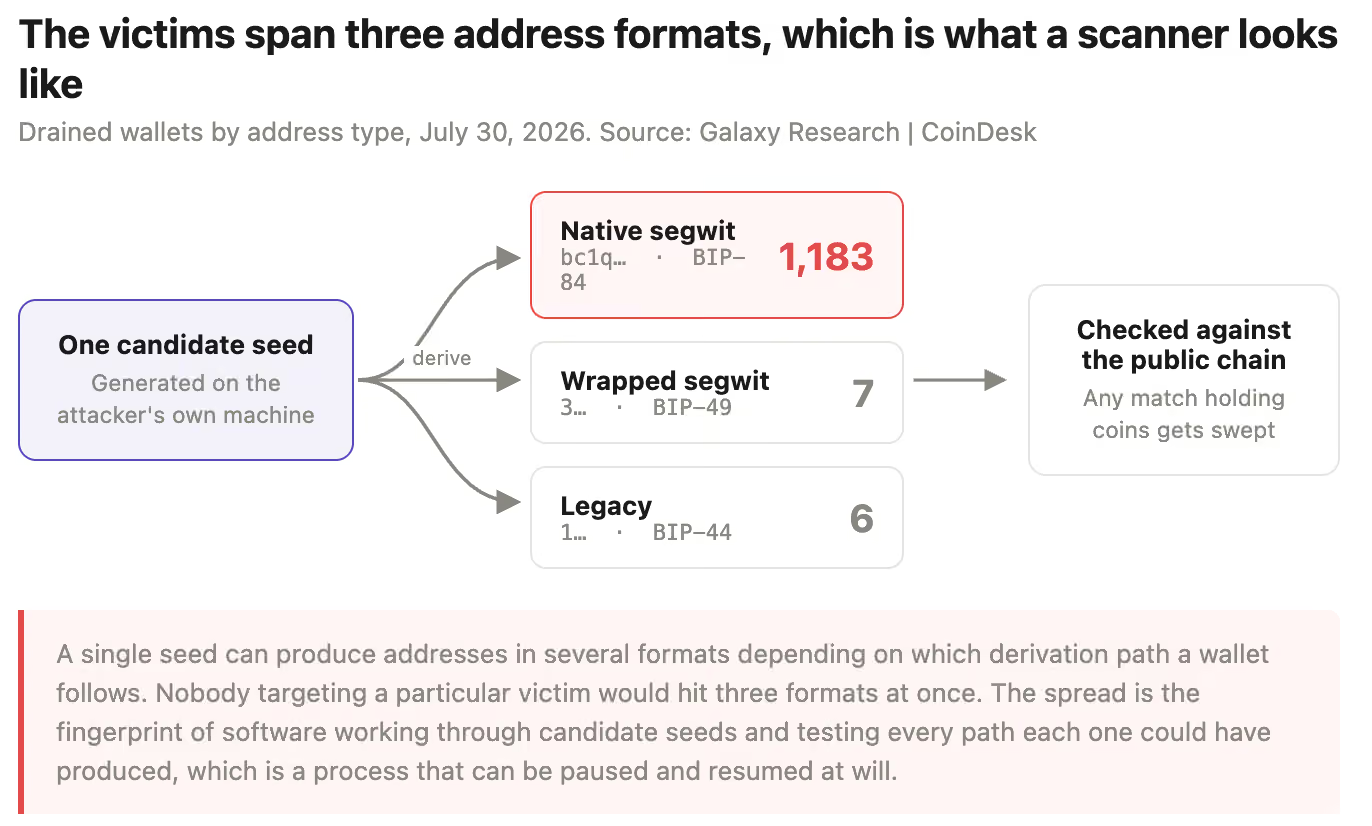
Every step of that runs on the attacker’s machine. The victim’s device is not involved at any point and could be powered off in a safe on another continent.
Galaxy’s breakdown shows the process running. Of the drained wallets, 1,183 used the modern native segwit address format, seven used an older standard and six an older one still. Nobody targets a specific victim across three address formats at once.
That is systematic enumeration, checking each candidate seed against every path it might have produced. The operator can widen the search, refine it and return whenever they choose.
Galaxy warned further waves are likely if owners do not move their funds.

Nor can an owner determine whether they are exposed. There is no test to run against your own wallet that reveals whether your seed sits inside the reproducible range.
Attack might not be fully finished
Coinkite, Coldcard’s maker, has warned Mk3 owners and says its newer devices are unaffected, while Block’s report places the Mk2, Mk4, Q and Mk5 in scope as well. Until that is resolved, anyone who generated a seed on the affected firmware has to assume the worst rather than verify it.
The attacker did make one mistake, however.
Block’s Clay Garrett said on X that the operator used a paid account at a “well-known blockchain data provider” to query the source addresses during the sweeps, and that the provider’s internal logs matched the suspected workflow with what he called extraordinary specificity, down to the number, timing and sequence of requests.
Bitcoin tried but failed at $65,000 on several occasions in the past week, and there are now multiple and different signals suggesting that another leg down is on the cards.
From war escalation to ETF withdrawals, let’s dive in.
Macro Factors
Let’s start with the Wednesday developments on US soil when the central bank decided to leave interest rates unchanged. At first glance, this doesn’t sound too bearish, right? After all, the alternative was to hike them, and there was a real possibility.
However, history shows that essentially all recent FOMC meetings, no matter what the outcome was, have been followed by a BTC price correction. Popular analysts have caught this rather negative pattern, which materialized with a $3,000 price decline over the past few days.
On the plus side, we can argue that the Friday correction to a 2-week low of $62,400 has priced in that almost mandatory post-FOMC retracement.
But there’s another macro factor that tends to harm risk-on assets like bitcoin: the war in the Middle East. Tension escalated over the past 24 hours, which included Iran reportedly striking tankers under US escort in the Strait of Hormuz.
Subsequent reports from the WSJ claimed that Trump has ordered a fresh attack on Iran to get it to surrender. According to CBS News, the US plans to attack Iranian energy assets, and this substantial escalation is expected to begin over the weekend.
Internal Reasons
The first in this section comes from the ETF behavior. The financial vehicles had a solid three-week run in which they attracted over $200 million in net inflows. However, the tides turned once again last week, with $61.53 million in net outflows. Friday was the day that changed the course, as investors pulled out over $265 million to reverse the $233 million in net inflows on Thursday.
Lastly, let’s explore a technical tool. Ali Martinez warned that the TD Sequential, a metric used to determine whether the underlying asset might reverse its price trend soon, has flashed a major sell signal on the 3-day chart.
The analyst added that this red sign comes as August begins, which has historically been associated with BTC pullbacks.
“History doesn’t have to repeat, but it’s a setup worth watching,” he added.
One for the Bulls
Let’s not begin the month only with negativity and review the opposite side of the coin. Michaël van de Poppe noted earlier that BTC could be primed for a major rebound due to its historical connection with the Nasdaq and South Korea’s KOSPI. Both major indices skyrocketed at the end of the business week, with KOSPI notching a massive 18% surge.
“The last time this happened, Bitcoin rallied to $83,000,” said van de Poppe. His expectation contrasts Ali Martinez’s warning for a weak start to August.
An enormous bounce on the Nasdaq and therefore a massive weekly candle, just as $KOSPI has bounced upwards.
I repeat, the last time this happened, #Bitcoin rallied to $83,000.
I would expect to see a strong start of August coming week for #Bitcoin as a response to the current… https://t.co/EJF8PcmOSI
— Michaël van de Poppe (@CryptoMichNL) July 31, 2026
The post BTC Price Warning: 4 Reasons Bitcoin Could Drop Further Next Week appeared first on CryptoPotato.
The broader crypto market posted some much-needed gains in July, and Ripple’s cross-border token extended a very impressive streak that began in 2020.
However, the new month is already here, and the past four Augusts weren’t very bullish for the asset. Can XRP defy its painful August performance, or is another leg down looming?
7 in a Row
Before we get to the four-in-a-row streak for August, let’s examine XRP’s most bullish one. Data from CryptoRank shows that the cross-border token has just equaled its best performance in terms of monthly gains. With the July 2026 edition coming with a minor 3% increase, this meant that eight Julys since 2014 (the first one after the asset saw the light of day) have been in the green out of 13. The only other month that has seen similar increases is April.
What’s even more favorable for the relationship between the altcoin and July, though, is its consecutive streak. As the subheading of this paragraph suggests, XRP managed to close its seventh July in a row with gains. This trend extends to July 2020, when the token skyrocketed by over 48%.
Other honorable mentions in terms of July gains came in 2023 (47.6%), 2024 (31.2%), and 2025 (35%). 2026’s minor 3% increase is quite modest, and in fact, it’s the lowest gain of all previous green Julys. The reason is the ongoing bear market, global uncertainty, inflation fears, and a few raging wars.
Nevertheless, Ripple’s coin still managed to rebound slightly from the June dump, when it plummeted by over 22%.
And Now The Bad News
Let’s get straight to it – the past four editions of the eighth month of the year have been in the red for XRP. In 2022, the asset fell by 13.6%. It dumped a lot harder a year later, losing 26.6% of its value. More modest but still red Augusts followed, with a 9.17% decline in 2024 and an 8.15% drop in 2025.
History shows that only four out of the 13 Augusts on record have ended higher for the cross-border token. Two of those brought massive gains: a 52% surge in 2017 and a massive 60% rise in 2021. Both of those took place during a bull market, something we are clearly not experiencing at the moment. Separately, the median data shows a 6.57% decline throughout previous Augusts, which is in stark contrast to the 6.91% gain for July.

The post Four in a Row: Will XRP Buck Its Bearish August Streak? appeared first on CryptoPotato.


Every twelve seconds, the Ethereum network asks a question that would have seemed absurd before 2022: who gets to write the next page of a $400 billion ledger, and how do you stop them from lying? The answer, for Ethereum and the majority of active blockchains by market value, is proof of stake, a consensus mechanism that replaced the energy-intensive puzzle-solving of proof of work with a simpler, older idea: put your money where your mouth is. Validators lock cryptocurrency as collateral, propose and verify blocks, and face the destruction of their deposit if they cheat. No mining rigs, no electricity arms race, no warehouse full of ASICs. Just capital at risk and code that enforces the consequences.
Summary
- Proof of stake secures blockchains by requiring validators to lock cryptocurrency as collateral, replacing the computational competition of proof of work with economic incentives and penalties.
- Ethereum’s September 2022 Merge was the largest proof-of-stake transition in history, cutting the network’s energy use by 99.95% while enabling a path to future scaling upgrades.
- The mechanism now underpins the majority of major blockchains by market cap, but carries its own risks: centralization of stake, slashing penalties, lock-up periods, and an evolving US regulatory landscape around staking services.
The idea predates crypto itself. Traditional finance has always understood that people with money on the line behave differently from people without it. Margin requirements, performance bonds, insurance deposits – the financial system is built on collateral as a behavior constraint. Proof of stake applied the same logic to distributed consensus: instead of proving you spent electricity (proof of work), you prove you have wealth locked up that the protocol can destroy if you misbehave. The mechanism was first described in a 2012 Peercoin whitepaper by Sunny King and Scott Nadal, spent a decade in Bitcoin’s shadow while proof of work dominated the conversation, and then became the consensus mechanism of choice for virtually every major blockchain launched after 2020. Ethereum’s adoption of it in 2022, the single largest infrastructure migration in crypto’s history, settled the debate about whether proof of stake could secure serious money. It can. It does. And the questions that remain are not about whether it works, but about the particular ways it concentrates, centralizes, and regulates differently from the mechanism it replaced.
The core mechanism: how validators replace miners
In proof of work, security comes from physical scarcity: miners burn electricity to find a hash that satisfies the network’s difficulty target, and the cost of that electricity is what makes attacks expensive. The security guarantee is thermodynamic. You cannot fake the work because the work is physics.
Proof of stake replaces this with economic scarcity. Instead of burning electricity, validators deposit tokens, their stake, into a smart contract controlled by the protocol. This stake serves three purposes simultaneously: it is the validator’s entry ticket (you cannot validate without it), their incentive (correct behavior earns staking rewards), and their punishment (incorrect or malicious behavior triggers slashing, the partial or total destruction of the deposit). The protocol’s security guarantee is economic: attacking the network requires acquiring and risking an enormous amount of the network’s own currency, and a successful attack would destroy the value of the very asset the attacker holds. The mechanism is self-referential by design. The thing securing the network is the thing the network produces, and that circularity is both the mechanism’s elegance and its most debated vulnerability.
The practical difference for the network is dramatic. Proof of work requires specialized hardware running continuously, consuming energy on the scale of a small country. Proof of stake requires a server, a stable internet connection, and the staked capital. Ethereum’s energy consumption dropped by an estimated 99.95% the day it switched, from roughly 78 terawatt-hours per year to the equivalent of a few thousand homes. The environmental argument for proof of stake is settled. The security argument is subtler, and understanding it requires walking through how a block actually gets produced.
The lifecycle of a block under proof of stake
Ethereum’s implementation, the most battle-tested proof-of-stake system by value secured, runs on a twelve-second heartbeat called a slot. Every slot, the protocol selects one validator to propose a block and a committee of validators to attest that the proposal is valid. The selection process uses a pseudorandom algorithm seeded by on-chain data, weighted by stake size: a validator with 64 ETH staked has twice the chance of selection as one with 32 ETH, but the randomness prevents anyone from predicting assignments more than a few minutes ahead.
The proposer assembles a block from the transaction pool, constructs it according to protocol rules, and broadcasts it. The committee members, typically several hundred validators per slot, then independently verify the block: they check that transactions are valid, that the proposer followed the rules, and that the block builds correctly on the chain’s history. Each committee member publishes an attestation, a signed vote that says “this block is valid and extends the chain correctly.” These attestations accumulate, and when enough are collected, the block is considered justified.
Finalization, the point at which a block becomes irreversible, takes longer. Ethereum uses a finality gadget called Casper FFG that finalizes blocks once two-thirds of the total staked ETH has attested to them across two consecutive epochs (each epoch is 32 slots, roughly 6.4 minutes). After finalization, reversing the block would require at least one-third of all staked ETH to be slashed, a cost that currently exceeds $35 billion. This is the concrete security guarantee: the price of rewriting Ethereum’s history is the destruction of tens of billions of dollars of capital.
The fork-choice rule, the algorithm validators use to decide which chain is the “real” one when they see competing versions, is called LMD-GHOST (Latest Message-Driven Greedy Heaviest Observed SubTree). It follows the branch with the most recent attestation weight, meaning the chain that the most stake has most recently voted for wins. Together, Casper FFG and LMD-GHOST create a system where blocks are produced quickly (every 12 seconds), justified within minutes, and finalized within roughly 13 minutes, with finality backed by the full economic weight of staked ETH.
Proof of stake vs proof of work: the real tradeoffs
The debate between proof of stake and proof of work is one of the oldest in crypto, and it is not as settled as either side claims. Both mechanisms solve the same fundamental problem, how to reach agreement in a network where participants do not trust each other, but they do so with genuinely different security models, and those differences produce different failure modes.
Proof of work ties security to the physical world. Mining requires electricity and hardware, both of which have real, external costs that cannot be faked or printed. An attacker needs to acquire 51% of the network’s hash rate, which means outspending the entire existing mining infrastructure. The cost of attacking Bitcoin is, roughly, the cost of all the mining hardware and electricity currently deployed to secure it, a cost that exists regardless of Bitcoin’s token price. This externality, security coming from outside the system, is what proof-of-work advocates consider its fundamental advantage: it anchors the digital to the physical.
Proof of stake ties security to the system’s own token. An attacker needs to acquire roughly one-third of all staked tokens (for finality-breaking attacks) or one-half (for censorship attacks), which means buying an enormous position in the network’s own currency. The attack is self-deterring because the act of attacking would crash the token’s price, destroying the attacker’s own holdings. But the security is circular: the network is secured by its token’s value, and its token’s value depends on the network being secure. Critics argue this creates a reflexivity problem that proof of work avoids. Defenders argue that the economic incentives are strong enough that the circularity is academic rather than practical.
The energy argument is overwhelmingly one-sided. Proof of work networks consume enormous amounts of electricity: Bitcoin alone uses an estimated 150 terawatt-hours per year, comparable to a medium-sized country. Proof of stake networks use a tiny fraction of that. Whether Bitcoin’s energy consumption is “wasteful” or “the cost of decentralized security” is a values question, not a technical one, but the gap in energy use is not debatable.
Hardware centralization cuts differently in each model. Proof of work has centralized around ASIC manufacturers (principally Bitmain) and regions with cheap electricity. Proof of stake centralizes around large token holders and staking service providers. Both mechanisms concentrate influence; they just concentrate it in different places. On Ethereum, Lido controls approximately 28% of all staked ETH as of mid-2026, a concentration that would be alarming in a proof-of-work context and is increasingly alarming in proof of stake as well.
Finality is the clearest practical advantage of proof of stake. Bitcoin transactions are never truly “final” in the mathematical sense; each new block makes reversal harder but never impossible, and merchants conventionally wait for six confirmations (roughly an hour) before considering a payment settled. Ethereum’s proof of stake provides deterministic finality: once a block is finalized by Casper FFG, reversing it requires destroying at least one-third of all staked ETH. The transaction is done, period, within roughly 13 minutes.
Why Ethereum switched: the Merge and what it changed
Ethereum’s transition from proof of work to proof of stake, called the Merge, occurred on September 15, 2022. It was the most complex and consequential upgrade in blockchain history: a live, $200 billion network switched its entire consensus mechanism without downtime, without a chain split, and without losing a single block. The execution was flawless, which tends to make people forget how extraordinary it was.
The Merge had been planned since Ethereum’s earliest days. Vitalik Buterin’s original roadmap always envisioned proof of stake as the endgame; proof of work was an interim measure while the research team, principally Vlad Zamfir and later the Ethereum Foundation’s consensus team, worked out the formal properties of a secure PoS protocol. The Beacon Chain, Ethereum’s proof-of-stake chain, launched in December 2020 as a parallel system running alongside the proof-of-work chain. Validators staked ETH on the Beacon Chain for nearly two years before the Merge merged the two systems into one.
What the Merge changed immediately: energy consumption dropped by 99.95%. Ethereum went from consuming roughly as much electricity as Chile to consuming roughly as much as a small town. Mining ceased entirely. GPU prices dropped as miners sold off their hardware. Ethereum’s environmental narrative reversed overnight.
What the Merge changed economically: issuance dropped by approximately 90%. Under proof of work, Ethereum issued roughly 13,000 ETH per day to miners. Under proof of stake, issuance fell to approximately 1,700 ETH per day to validators. Combined with EIP-1559’s fee-burning mechanism, which destroys a portion of every transaction fee, this made Ethereum’s supply dynamics deflationary during periods of high network activity. More ETH is burned than issued, and the total supply slowly decreases, a property no proof-of-work chain can replicate because miners need revenue to cover their physical costs.
What the Merge did not change: gas fees, transaction speed, and throughput remained the same. The Merge was a consensus-layer change, not an execution-layer change. Scaling improvements depend on layer-2 solutions, Arbitrum, Optimism, Base, and others, that settle batches of transactions on Ethereum’s mainnet. The Merge was a prerequisite for these scaling plans, because future upgrades like danksharding require proof of stake’s validator architecture to process data blobs, but the Merge itself did not make Ethereum faster or cheaper. The common misconception that the Merge would reduce gas fees was one of the most persistent communication failures of the entire project.
The landscape: which blockchains use proof of stake
Proof of stake is no longer an alternative; it is the default. The overwhelming majority of blockchains launched since 2020 use some variant of proof of stake, though the implementations differ significantly in their validator economics, finality properties, and centralization profiles.
Ethereum uses the Casper FFG and LMD-GHOST combination described above, with a minimum stake of 32 ETH per validator (approximately $110,000 at current prices). The high minimum creates a barrier to solo validation that has driven much of the staking volume toward pooling services. As of mid-2026, approximately 33 million ETH is staked, roughly 27% of the total supply, across over 1 million active validators.
Solana uses proof of stake combined with proof of history, a cryptographic clock that timestamps transactions before they enter consensus, enabling the network to order events without validators needing to communicate about sequencing. This architecture allows Solana to process thousands of transactions per second with sub-second finality, though it requires significantly more powerful hardware to validate than Ethereum, which introduces its own centralization pressures. Solana’s validator count is smaller and its hardware requirements higher, a deliberate tradeoff of accessibility for performance.
Cardano runs Ouroboros, a proof-of-stake protocol developed through academic peer review at the University of Edinburgh and IOHK. Ouroboros divides time into epochs and slots, uses a verifiable random function for leader selection, and was the first proof-of-stake protocol to be formally proven secure under a rigorous cryptographic model. Cardano’s approach prioritizes formal correctness over speed, a philosophy that has earned it both respect in academic circles and criticism for slower development velocity.
Polkadot uses nominated proof of stake, a system where nominators back validators with their tokens and share in both rewards and slashing risk. Polkadot’s unique contribution is its relay chain architecture, where a central chain provides consensus and security for multiple application-specific parachains that run in parallel. The staking mechanism secures not just one chain but an entire ecosystem of connected chains.
Cosmos, through its Tendermint BFT consensus engine, pioneered delegated proof of stake with instant finality. Tendermint produces blocks that are final the moment they are committed, with no possibility of reversal, a property that makes it especially suitable for financial applications. The Cosmos ecosystem’s hub-and-spoke model, where independent chains communicate through the Inter-Blockchain Communication protocol, has made it the backbone for dozens of application-specific blockchains, from the Osmosis DEX to dYdX’s order-book exchange.
Avalanche uses a novel consensus protocol based on repeated random sampling: validators poll random subsets of other validators about their preferences, and consensus emerges through the accumulation of confidence, similar to how snowflakes form through repeated crystallization, hence the consensus family’s name: Snowball, Snowflake, Snowman. The approach achieves sub-second finality and high throughput while maintaining a relatively low hardware barrier.
BNB Chain, Binance’s blockchain, uses proof of staked authority, a hybrid where a small set of 21 validators are elected through staking but also meet identity and reputation requirements. This is the most centralized of the major proof-of-stake implementations, trading decentralization for performance and the institutional backing of Binance.
Bitcoin remains the most prominent proof-of-work holdout, and its community has shown no inclination to switch. The Bitcoin argument against proof of stake is philosophical as much as technical: proof of work anchors security to the physical world, and that anchoring is considered a feature that proof of stake cannot replicate. Whether this position will hold indefinitely as the industry standardizes around proof of stake is an open question, but as of 2026, it holds firmly.
The risks validators and stakers actually face
The staking ecosystem has matured enough that its risks are well-documented, and they are not trivial.
Slashing is the mechanism’s enforcement tool: validators who provably violate protocol rules, principally by signing two conflicting blocks or attestations, lose a portion of their staked tokens. On Ethereum, the minimum slashing penalty is 1/32 of a validator’s stake, roughly 1 ETH, but the penalty scales with how many other validators are slashed in the same time period. If a single validator is slashed in isolation, the penalty is modest. If hundreds are slashed simultaneously, suggesting a coordinated attack or a catastrophic infrastructure failure, the penalties escalate toward total stake destruction. This correlation penalty is by design: it punishes systemic threats more than individual mistakes, but it also means that a bug in a widely-used validator client could trigger mass slashing of validators who did nothing individually wrong. The concentration of the validator ecosystem around a few major clients, principally Prysm and Lighthouse on Ethereum, makes this a non-theoretical risk.
Lock-up and unbonding periods vary by network but create real liquidity risk. Ethereum introduced withdrawals in April 2023 with the Shanghai/Capella upgrade, but the withdrawal queue can extend to days or weeks during periods of high exit demand. Other networks impose fixed unbonding periods: Cosmos chains typically require 21 days, Polkadot requires 28 days, and during those windows the staker cannot sell or use their tokens regardless of market conditions. A 28-day lock-up during a market crash is not a theoretical concern; it has happened.
Liquid staking protocols solve the liquidity problem but introduce smart contract risk. When you stake through Lido, your ETH goes into Lido’s smart contracts, and you receive stETH, a liquid token that represents your staked position. This stETH can be used across DeFi: lent, borrowed against, or provided as liquidity. But the arrangement is only as safe as Lido’s contracts. A bug or exploit in a liquid staking protocol could result in the loss of all deposited tokens, and because liquid staking concentrates enormous amounts of stake in single contract systems, the blast radius of such an exploit would be severe. Lido holds roughly $15 billion in staked ETH as of mid-2026; Rocket Pool, the second-largest, holds several billion more. These are among the largest smart-contract honeypots in existence.
Centralization pressure is the most debated long-term risk. On Ethereum, Lido controls approximately 28% of all staked ETH. If Lido’s governance were compromised or its operators coordinated, they could theoretically influence block production or censorship decisions for a significant fraction of the network. The Ethereum community has debated self-imposed caps on liquid staking dominance, and Lido has made governance decentralization changes, but the structural incentive favoring large staking pools, economies of scale, professional operations, integration with DeFi, has not changed. Proof of stake does not inherently centralize, but it centralizes differently from proof of work, and the patterns are already visible.
Validator MEV, the extraction of value from transaction ordering, affects proof of stake validators just as it affected proof-of-work miners, but the dynamics differ. Under proof of work, MEV accrued to miners who could order transactions within blocks. Under proof of stake, MEV accrues to the block proposer for that slot, and the MEV-Boost system, which allows proposers to outsource block construction to specialized builders, has created a sophisticated supply chain around transaction ordering. The relationship between validators, builders, relays, and searchers is complex, and the MEV flowing through this pipeline represents billions of dollars per year, revenue that disproportionately benefits sophisticated operators and further concentrates the staking economy.
Proof of stake and US regulation: where it stands
The US regulatory treatment of proof of stake is fragmented across multiple agencies, each approaching staking through a different lens.
The SEC’s interest in staking crystallized in February 2023 when it charged Kraken with offering unregistered securities through its staking-as-a-service program. Kraken settled for $30 million and shut down its US staking service. The SEC’s theory was that Kraken’s staking program, where users deposited tokens with Kraken and received yield in return, constituted an investment contract under the Howey test: users invested money in a common enterprise with an expectation of profit derived from Kraken’s efforts. The action targeted the service model, not the proof-of-stake mechanism itself, but it sent a clear signal that centralized staking services would face scrutiny. Coinbase challenged a similar SEC action and secured partial judicial skepticism about the SEC’s approach, but the legal landscape remains unsettled.
The tax treatment of staking rewards is the most practically consequential question for individual stakers. The IRS treats staking rewards as ordinary income, taxable at fair market value when received. This creates an immediate tax liability on tokens that may subsequently lose value. In 2023, a Tennessee couple won a partial victory in Jarrett v. United States, where the court accepted their argument that newly created staking rewards, like newly created property, should not be taxable until sold. The IRS refunded the Jarretts’ taxes but has not adopted their reasoning as policy, and the question remains unresolved. The practical implication: most tax advisors still recommend treating staking rewards as income at receipt, because the IRS’s position has not formally changed.
State-level regulation has been more accommodating. Wyoming’s blockchain-friendly legislation explicitly addresses staking as a permitted activity. Several states have introduced or passed legislation recognizing that operating a proof-of-stake validator is distinct from issuing securities. The patchwork of state approaches creates complexity but also creates jurisdictions where staking operations can operate with legal clarity.
The GENIUS Act and other proposed federal legislation may eventually clarify the regulatory framework, particularly around stablecoins and digital asset classification, but as of mid-2026, staking regulation in the US is primarily a product of enforcement actions and court decisions rather than comprehensive legislation. The gap between how the technology works and how regulators categorize it remains wide.
How to stake: the three paths and what each costs
For someone who has decided to stake, the choice comes down to three models, each with a distinct risk-reward profile.
Exchange staking is the simplest entry point. Coinbase, Binance, and other major exchanges offer one-click staking for supported tokens. You deposit your tokens, the exchange handles validator operations, and you receive rewards minus a commission, typically 10-25% of the yield. The advantage is simplicity: no technical knowledge, no hardware, no key management. The disadvantage is custodial risk: your tokens are held by the exchange, which means you are exposed to the exchange’s solvency, security, and regulatory risk. The collapse of FTX in November 2022, where customers lost billions in deposits, is the cautionary tale that hangs over every custodial staking arrangement. Exchange staking yields on Ethereum currently run 2.5-3.5% APR after the platform’s commission.
Liquid staking offers a middle path. Protocols like Lido, Rocket Pool, Jito (on Solana), and others accept deposits and return a liquid receipt token, stETH, rETH, JitoSOL, that represents the staked position plus accumulated rewards. The receipt token can be traded, used as collateral in lending protocols, or deposited into liquidity pools, allowing the staker to earn additional yield on top of staking rewards. This composability is liquid staking’s core advantage: your capital works twice. The risks are smart contract exposure (the protocol’s contracts hold your tokens), oracle risk (the receipt token’s exchange rate depends on accurate price feeds), and the possibility of depegging, where the liquid staking token trades below its theoretical value during periods of market stress, as stETH briefly did during the Three Arrows Capital collapse in June 2022. Liquid staking typically charges a 10% fee on rewards, yielding net returns of roughly 3-3.5% APR for Ethereum.
Solo staking is the gold standard for decentralization and the most operationally demanding option. On Ethereum, solo staking requires depositing 32 ETH (approximately $110,000 at current prices), running a validator node on dedicated hardware or a cloud server with reliable uptime, and maintaining the software through upgrades. The staker earns the full yield, currently around 3.5-4% APR, with no intermediary taking a cut, and keeps full custody of their withdrawal keys. The staker also contributes maximally to network decentralization, because each solo validator is an independent node that makes its own attestation decisions. The barriers are capital (32 ETH is a significant commitment), technical competence (running a validator is not difficult but requires ongoing attention), and responsibility (downtime means missed rewards and minor penalties, and a misconfigured setup risks slashing). Ethereum’s community actively encourages solo staking through resources like ethstaker.cc and various client diversity initiatives, recognizing that the network’s long-term health depends on maintaining a large base of independent validators rather than concentrating stake in a few large operators.
The decision between these paths is ultimately about what risks you are comfortable with. Exchange staking trades custodial risk for convenience. Liquid staking trades smart contract risk for capital efficiency. Solo staking trades operational burden for maximum independence. There is no universally correct choice, only the one that matches a given staker’s capital, technical ability, and risk tolerance, and the honest answer is that most people should start with the simplest option and graduate to more self-sovereign approaches as their understanding and commitment deepen.
Frequently asked questions
Is proof of stake safe?
Proof of stake secures hundreds of billions of dollars across Ethereum, Solana, Cardano, and dozens of other networks. Ethereum’s implementation has been live since the Beacon Chain launch in December 2020 and operating as the sole consensus mechanism since September 2022, without a consensus-level exploit. The main risks are not in the mechanism itself but in its surrounding infrastructure: smart contract bugs in staking protocols, centralization of stake among a few large operators, and the potential for correlated slashing events caused by validator client bugs.
Can you lose money staking crypto?
Yes, in several ways. If the price of the staked token drops, your position loses value regardless of staking rewards, and a 3% annual yield does not protect against a 50% price decline. Validators can lose tokens through slashing penalties if their infrastructure fails or is misconfigured. Staking through liquid staking protocols adds smart contract risk: a bug or exploit could result in the loss of deposited funds. And on networks with unbonding periods, you cannot sell during market downturns, potentially locking in losses.
How much can you earn staking crypto?
Annual yields depend on the network, the staking method, and market conditions. Ethereum staking yields approximately 3-4% APR as of mid-2026. Solana offers roughly 6-7%. Cosmos ecosystem chains range from 8-15% depending on the specific chain. Newer or smaller networks may offer higher rates to attract validators, but higher rates almost always correlate with higher risk: token volatility, smaller validator sets, less-audited code, and thinner liquidity for exits.
Does Bitcoin use proof of stake?
No, and the Bitcoin community has firmly resisted any suggestion of switching. Bitcoin uses proof of work, secured by an enormous global network of ASIC miners. The Bitcoin argument is that proof of work’s energy expenditure is not a bug but a feature: it anchors the network’s security to physical reality, costs that exist outside the system and cannot be manipulated within it. Whether this philosophical position will hold as the rest of the industry standardizes on proof of stake is an open question, but there is currently no serious proposal to change Bitcoin’s consensus mechanism.
What happens if a validator goes offline?
On Ethereum, validators that go offline lose a small amount of their stake through inactivity penalties, designed to be mild for short outages (a few hours or days of missed attestations cost a fraction of the rewards earned during normal operation) but significant for extended downtime. If a validator is offline for weeks, the inactivity leak accelerates to drain the validator’s balance until it falls below the minimum (16 ETH, the ejection threshold). Crucially, going offline is not slashing: validators are only slashed for provably malicious behavior like signing two conflicting blocks or attestations. The distinction matters because slashing is rare and severe, while brief offline periods are routine and their penalties are designed to be recoverable.
Disclaimer: This article is for informational purposes only and should not be considered financial or investment advice.


In April 2024, a single on-chain vote moved $165 million from Uniswap’s treasury into a two-year grants program. No CEO signed off. No board convened. A collection of token holders, pseudonymous and scattered across every time zone, debated the proposal on a forum, cast their votes through a smart contract, and the funds moved, automatically, irreversibly, exactly as the code specified. This is what a decentralized autonomous organization does: it replaces the corporate hierarchy of officers, boards, and bylaws with token-weighted voting and smart contracts that execute the results. Whether that replacement is an upgrade, a sidegrade, or a new category of organizational failure depends entirely on which DAO you examine and when you examine it.
Summary
- A DAO is an internet-native organization governed by smart contracts and token-holder votes, replacing traditional corporate hierarchy with programmable governance rules.
- DAOs manage over $30 billion in combined treasury assets across hundreds of active organizations, governing everything from DeFi protocols and investment funds to social clubs and collector groups.
- The model solves real coordination problems, particularly for open-source protocols with global stakeholders, but faces persistent challenges: voter apathy, plutocratic voting, governance attacks, legal ambiguity, and the fundamental tension between decentralization and decisiveness.
The concept emerged from a simple observation: if a blockchain can execute financial transactions without intermediaries, it should also be able to execute organizational decisions without intermediaries. The first serious attempt, confusingly named “The DAO,” launched on Ethereum in April 2016, raised $150 million in a crowdfunding campaign, and was drained of $60 million by an attacker who exploited a recursive call vulnerability in its smart contract within two months. The hack was so catastrophic that it split Ethereum itself into two chains, Ethereum and Ethereum Classic, and cast a shadow over the concept of decentralized governance that took years to lift. The shadow was worth remembering, because it established the central truth about DAOs: code is law until the code has a bug, and then the humans behind the code must decide what law actually is.
The model survived The DAO’s failure because the underlying need was real. Open-source protocols with billions in treasury assets, global communities of stakeholders who had never met, token-based economies that needed parameter adjustments, all of these required some decision-making mechanism, and the traditional options (a company, a foundation, a benevolent dictator) all introduced the centralization that the protocols were designed to avoid. DAOs became that mechanism, imperfect but structurally aligned with the decentralized systems they governed. By 2026, DAOs collectively manage over $30 billion in treasury assets across hundreds of active organizations, and the governance infrastructure, voting systems, delegation platforms, proposal frameworks, has matured into a small industry of its own.
The anatomy of a DAO: how token governance works
The standard DAO governance cycle has five stages, and understanding each reveals where the mechanism works and where it breaks.
The first stage is token distribution. Governance power in a DAO is represented by tokens, typically ERC-20 tokens on Ethereum, that grant voting rights proportional to holdings. How these tokens are distributed determines the DAO’s power structure from birth. Some DAOs airdrop tokens broadly to past users (Uniswap distributed UNI to every wallet that had ever made a swap). Others sell tokens in public sales, grant them to early investors and team members with vesting schedules, or distribute them through liquidity mining programs. The initial distribution is the most consequential decision a DAO makes, because it sets the electorate. A DAO where 40% of tokens are held by the founding team and investors is not meaningfully decentralized, regardless of what the governance documentation says.
The second stage is proposal submission. Any token holder meeting a minimum threshold can submit a governance proposal. On Uniswap, the threshold is 2.5 million UNI (roughly $15 million worth), a bar so high that most proposals are submitted by delegates, large holders, or protocol teams rather than individual community members. On smaller DAOs, the threshold may be as low as a single token. Proposals are typically structured documents specifying the action to be taken, the rationale, the implementation details, and the expected impact. They are published on governance forums, usually hosted on Discourse, Commonwealth, or Snapshot.
The third stage is deliberation. Before a formal vote, proposals are discussed in forums and on governance calls. This phase is the most important and the least automated: it is where arguments are refined, concerns are raised, alternatives are proposed, and the community’s actual preferences emerge. The quality of deliberation varies enormously between DAOs. Some, like MakerDAO (now Sky), have developed sophisticated governance frameworks with working groups, delegates, and structured feedback processes. Others are chaotic free-for-alls where discussions are dominated by a few vocal participants while the majority remains silent.
The fourth stage is the on-chain vote. Token holders cast their votes, weighted by the number of tokens they hold. Most DAOs use a simple token-weighted model: one token equals one vote. Some have experimented with quadratic voting (where the cost of additional votes increases quadratically, giving more weight to breadth of support over depth) or conviction voting (where the longer you stake your vote, the more weight it carries). The vote requires reaching both a quorum, a minimum level of participation, and a passing threshold, typically a simple majority or supermajority. Voting mechanisms include on-chain transactions (expensive, gas costs apply) and off-chain signature-based systems like Snapshot (free, but not binding without a separate execution step).
The fifth stage is execution. If the vote passes, the proposed action is executed. In the most mature DAOs, execution is automatic: the governance contract, typically a timelock controller like OpenZeppelin’s Governor or Compound’s GovernorBravo, queues the approved transaction and executes it after a delay period (usually 24-48 hours), giving the community time to react if something unexpected was approved. In less mature DAOs, execution may depend on a multisig, a set of trusted signers who manually execute the approved action, reintroducing human trust into a system designed to eliminate it.
The species: what kinds of DAOs exist
The DAO model has diversified into several distinct categories, each with different governance challenges and success metrics.
Protocol DAOs govern decentralized protocols and are the largest by treasury size. Uniswap DAO controls over $1.5 billion in treasury assets and governs the most widely-used decentralized exchange. Aave DAO manages the parameters of a lending protocol with billions in deposits: interest rate curves, collateral factors, risk parameters, and new asset listings. MakerDAO (now Sky) governs DAI, one of crypto’s most important stablecoins, making decisions about what assets can serve as collateral, what stability fees to charge, and how to manage the protocol’s balance sheet. These DAOs face the most consequential decisions, because governance failures can directly threaten the deposits of millions of users who never participate in governance themselves.
Investment DAOs pool capital from members to invest collectively. The LAO, MetaCartel Ventures, and Flamingo DAO pioneered the model, using token-based voting to make investment decisions that traditional venture capital structures handle through partnership agreements. The legal structure of investment DAOs is complex, typically involving a Delaware LLC wrapper and compliance with securities regulations, which limits most investment DAOs to accredited investors.
Social DAOs organize around shared identity or interests. Friends With Benefits (FWB) uses a token-gated membership model for cultural events, media projects, and community access. The token serves as both a membership credential and a governance instrument, and FWB has navigated the tension between exclusivity and decentralization more visibly than most social DAOs.
Collector DAOs pool funds to acquire high-value assets. PleasrDAO has acquired culturally significant NFTs and assets, including the original Doge meme photograph. ConstitutionDAO raised $47 million in a week to bid on a first-edition copy of the US Constitution at Sotheby’s auction in November 2021. ConstitutionDAO lost the auction but demonstrated the model’s fundraising power, and its aftermath, a chaotic refund process where gas costs consumed a significant portion of small contributors’ deposits, demonstrated the model’s operational limitations.
Service DAOs function as decentralized agencies or talent networks. Raid Guild coordinates web3 development projects, and its members vote on project acceptance, pricing, and revenue distribution. The model replaces the traditional agency’s management hierarchy with contributor-led governance, though it faces the challenge that client relationships and project management require responsiveness that token-based voting does not always provide.
The case studies: DAOs that defined the model
Three DAOs illustrate the spectrum of governance outcomes more clearly than any theoretical framework.
Uniswap DAO is the clearest success story, though even its success requires qualification. Since launching in September 2020, UNI governance has directed billions in treasury spending, deployed the protocol to over a dozen blockchains, managed the protocol’s fee switch debate (whether to direct trading fees to UNI holders), and funded a multi-year grants program. The governance process works, proposals are submitted, debated, voted on, and executed, but it works slowly and with low participation. Typical governance proposals pass with less than 5% of tokens voting. The effective governing body is a small number of large delegates, protocol team members, and active community participants, perhaps a few hundred people governing a protocol used by millions. The question of whether this is a decentralized organization or a representative democracy with extremely low voter turnout is left as an exercise.
MakerDAO, now rebranded to Sky, is the most ambitious governance experiment in crypto. Since its inception, MKR holders have governed every parameter of the DAI stablecoin system: stability fees, collateral ratios, debt ceilings, oracle configurations, and the onboarding of new collateral types including real-world assets like US Treasury bonds. In 2024, MakerDAO underwent a radical restructuring, rebranding to Sky and splitting into specialized SubDAOs, each focused on specific functions like lending, real-world assets, and growth. The restructuring was itself a governance decision, approved through the DAO’s voting process, making it perhaps the only example of an organization voting to fundamentally redesign itself while continuing to operate billions of dollars in financial infrastructure. Whether the SubDAO structure succeeds in solving Maker’s governance scalability challenges remains to be seen.
Arbitrum DAO illustrates governance’s failure modes. When Arbitrum launched its ARB token in March 2023, the foundation published a proposal requesting ratification of actions it had already taken, including the spending of $1 million. The community reacted furiously to what it perceived as retroactive governance theater: asking for a vote on something already done. The episode exposed the tension between operational speed (the foundation needed to act quickly) and governance legitimacy (the community expected to be asked first). Arbitrum has since developed a more structured governance process, but the early controversy established that DAOs cannot simply bolt governance onto an organization that was built to operate without it. The culture of governance must precede the mechanics.
The original sin: The DAO hack and Ethereum’s fork
No discussion of DAOs is complete without the event that gave the concept its first, and most brutal, stress test. The DAO, launched in April 2016, was a venture fund governed by token holders on Ethereum. It raised $150 million in a crowdfunding campaign, making it the largest crowdfund in history at that time, and it was hacked within two months.
The exploit used a reentrancy vulnerability in The DAO’s smart contract. The attacker called the withdraw function in a way that allowed them to withdraw their share repeatedly before the contract updated its balance, draining approximately $60 million worth of ETH, roughly one-third of The DAO’s holdings. The attack was not a hack in the traditional sense: the attacker did not break into a system or guess a password. They used the code exactly as written. The code allowed the drain; the code was law; and by the code’s own logic, the attacker had done nothing wrong.
The Ethereum community did not accept this argument. After intense debate, the network executed a hard fork, a retroactive change to the blockchain’s history, that reversed the theft and returned the funds to The DAO’s depositors. The fork was approved by the majority of the community but rejected by a minority who argued that “code is law” must mean something, even when the law produces unjust outcomes. That minority continued operating the unforked chain as Ethereum Classic (ETC), which still exists today.
The DAO hack established several principles that continue to shape DAO design. First: smart contract risk is existential, and no amount of governance sophistication matters if the contract holding the treasury has a bug. Second: the “code is law” ideology has limits that are tested by real money and real consequences. Third: decentralized governance is only as strong as the community’s willingness to act when the code fails, and acting requires the very centralized decision-making that decentralization is supposed to eliminate. The tension has never been resolved. It has only been managed, through audits, timelocks, bug bounties, and the hard-won institutional knowledge of a community that watched $60 million disappear into a recursive function call.
The failure modes: what actually goes wrong
A decade of DAO operations has produced a well-documented catalog of failure modes, and they are not the failures most people expect.
Voter apathy is the most pervasive problem. On paper, DAOs are governed by their entire token-holder base. In practice, they are governed by whoever shows up, which is usually less than 5% of token holders. Uniswap governance proposals routinely pass with a fraction of the total supply participating. Compound governance once had a proposal pass with votes from three wallets. The dynamic is structurally familiar: it is the same low-turnout problem that plagues democratic elections, intensified by the fact that governance tokens often have no direct economic incentive to vote (your token’s value is the same whether you participate or not) and each vote requires either a gas-cost transaction or the minor friction of signing a message.
Plutocracy is the flip side. One token, one vote means that governance power is proportional to wealth. A single whale holding 2% of a token’s supply can outvote thousands of smaller holders combined, and in practice, many important DAO votes are decided by fewer than ten wallets. Delegation systems, where small holders delegate their voting power to trusted representatives, partially address this, but delegates are themselves subject to capture and often represent narrow interests. The quadratic voting model, where each additional vote costs exponentially more, has been proposed as a solution but faces its own problem: sybil attacks, where one person splits their holdings across many wallets to circumvent the cost curve.
Governance attacks represent the most acute risk. In 2024, BonkDAO lost approximately $20 million when an attacker accumulated enough voting power to pass a proposal draining the treasury. The attack exploited the DAO’s low quorum requirements and the community’s governance apathy: by the time enough legitimate voters noticed the malicious proposal, it had already passed. The BonkDAO incident is the clearest illustration of a paradox at the heart of DAO governance: the same permissionless participation that makes DAOs open also makes them vulnerable to anyone willing to acquire enough tokens to cross the governance threshold.
Speed is a structural disadvantage. Corporate decisions happen in hours: a CEO convenes the relevant people, a decision is made, and execution begins immediately. DAO proposals typically require a discussion period (3-7 days), a voting period (3-7 days), and a timelock period (1-2 days), meaning even urgent decisions take one to three weeks to execute. During the March 2023 banking crisis, when USDC briefly depegged and MakerDAO needed to adjust its collateral parameters, the slow governance process was a real liability. Some DAOs have introduced emergency governance mechanisms, guardian multisigs that can act quickly in crises, but these mechanisms reintroduce centralization through the back door.
Legal ambiguity is the final persistent problem. Most DAOs have no legal entity, which means they cannot sign contracts, open bank accounts, hire employees, pay taxes, or defend lawsuits. When a DAO is sued, the question of who is liable, all token holders? The founders? The active voters?, has no settled answer. This ambiguity does not prevent DAOs from operating, but it creates a latent risk that grows as DAOs manage larger treasuries and interact more with the traditional legal system.
DAOs and US law: the liability question
The legal status of DAOs in the United States is evolving through a combination of state legislation, federal enforcement, and case law, with no comprehensive framework yet in place.
Wyoming became the first state to recognize DAOs as legal entities in 2021, passing legislation that allows DAOs to register as limited liability companies. A Wyoming DAO LLC provides its members with the same liability protection as a traditional LLC, shielding them from personal liability for the organization’s debts and legal obligations. The tradeoff is compliance: the DAO must designate a registered agent, maintain a Wyoming presence, and file annual reports. Tennessee and Utah have passed similar legislation, creating a small but growing number of jurisdictions where DAOs can operate with legal clarity.
Federal enforcement has taken a different approach. The CFTC’s 2023 action against Ooki DAO established that DAO token holders who actively participate in governance can be held personally liable for the DAO’s activities. Ooki DAO operated a decentralized margin trading platform without proper registration, and the CFTC argued that voters who participated in governance were functioning as the DAO’s operators. The ruling sent shockwaves through the DAO community: it suggested that merely voting on a governance proposal could expose a participant to regulatory liability. The practical impact has been chilling but selective, affecting DAOs that clearly operated in regulated financial activities while leaving non-financial DAOs largely unaffected.
The SEC has approached DAOs primarily through the lens of securities law. The SEC’s 2017 DAO Report, published after The DAO hack, concluded that DAO tokens sold to investors as part of a common enterprise with an expectation of profit may constitute securities. This framework has informed subsequent enforcement actions and created uncertainty around governance tokens that also carry economic rights, such as fee sharing, buybacks, or revenue distribution. The distinction between a governance token (which grants only voting rights) and a securities token (which grants economic rights) is legally significant but practically blurry: many governance tokens have both properties, and the SEC has not drawn a clear line.
Tax treatment compounds the complexity. The IRS has not issued specific guidance on DAO treasury distributions, but income received through DAO participation, whether through grants, contributor payments, or token distributions, is generally treated as taxable. DAO treasuries themselves exist in a tax gray area: they are not corporations, not partnerships, not trusts, and not individuals, and the appropriate tax treatment depends on the specific legal structure, if any, that the DAO has adopted.
For US residents considering DAO participation, the practical guidance is straightforward: participation in governance carries legal risk that scales with the DAO’s activities and your level of involvement. Registering as a DAO LLC in Wyoming or a similar jurisdiction provides liability protection. Active participation in governance of unregistered DAOs that operate in regulated financial markets carries the most risk. Passive token holding without governance participation carries the least, though even this is not risk-free in the wake of the Ooki DAO ruling.
DAOs vs corporations: the honest comparison
The comparison between DAOs and traditional corporations reveals that DAOs are not replacements for corporations in most contexts, but genuine improvements in a few specific ones.
DAOs excel at governing shared resources where no single party should have unilateral control. Open-source protocol treasuries, community funds, and parameter governance for decentralized financial infrastructure are the use cases where DAOs have proven most effective. The Uniswap protocol, used by millions and holding billions in user deposits, benefits from having its governance distributed across thousands of token holders rather than concentrated in a corporate board. The alignment of incentives, where token holders benefit from the protocol’s success, creates a governance model that is structurally resistant to the kind of extraction that corporate governance sometimes enables.
Corporations excel at speed, accountability, and operational execution. A CEO can make a decision in an hour, fire an underperforming employee in a day, and pivot the company’s strategy in a week. A DAO cannot do any of these things without a multi-week governance process, and the lack of formal employment relationships means that “firing” an underperforming contributor is a governance proposal rather than a management decision. The DAO model’s inefficiency is not a bug that will be fixed with better tooling; it is an inherent property of distributed decision-making, and any DAO that becomes efficient enough to operate like a company has, in practice, centralized its decision-making around a small group of active participants.
The honest assessment is that DAOs are a useful tool for a specific set of problems: governing shared on-chain infrastructure, managing community treasuries, and making decisions that affect large numbers of stakeholders who do not trust each other. They are not a general-purpose replacement for companies, and the projects that have tried to run DAO-governed startups have generally either recentralized (reintroducing de facto management structures behind a governance facade) or stalled (unable to make operational decisions fast enough to compete). The mechanism works where it works, and the wisdom is in knowing the difference.
How to participate in a DAO
Getting involved in a DAO is permissionless by design, but effective participation requires more than holding a token.
Start by identifying a DAO aligned with your interests. DeepDAO.io tracks active DAOs, their treasury sizes, voter participation rates, and governance activity. Boardroom and Tally aggregate governance proposals across major DAOs. Reading a DAO’s governance forum for a few weeks before participating gives you context that token holding alone does not provide.
Acquire the governance token through a decentralized exchange (Uniswap, Jupiter) or a centralized exchange (Coinbase, Binance). Some DAOs also distribute tokens through participation: contributing to the protocol, writing documentation, moderating forums, or completing bounties. Gitcoin, Dework, and Layer3 are platforms where DAOs post contribution opportunities.
If you lack the time or expertise to evaluate every proposal, delegate your voting power. Most major DAOs support delegation, and platforms like Agora and Tally make it straightforward to find and select delegates who align with your values. Delegation is revocable: you can reclaim your voting power at any time.
For deeper involvement, join the DAO’s working groups or committees. Many DAOs organize their operations around thematic working groups, grants, treasury management, risk assessment, growth, that handle specialized decisions. Working group participation is where governance becomes less about voting and more about the messy, valuable work of research, debate, and relationship building that produces good proposals in the first place.
Contribution is the most effective path to influence. DAOs need writers, researchers, marketers, community managers, and strategists as much as they need developers. Many DAOs compensate contributors through grants, retroactive funding, or working-group budgets. The contributors who shape a DAO’s direction are not always the largest token holders; they are often the people who show up consistently, do the work, and build the trust that makes governance function.
Frequently asked questions
Are DAOs legal?
DAOs exist in a legal gray area in most jurisdictions. Wyoming, Tennessee, and Utah have passed laws recognizing DAOs as legal entities, specifically as LLCs, which provides members with liability protection. In most other states and countries, DAOs lack formal legal status, creating potential liability for active governance participants. The CFTC’s action against Ooki DAO established that governance voters can be held liable for a DAO’s activities, making legal registration increasingly advisable for DAOs managing significant assets.
Can you make money with a DAO?
Some DAOs distribute protocol revenue to token holders through fee sharing, buybacks, or staking rewards. Governance tokens can also appreciate in value if the protocol they govern grows. However, most DAO participation is unpaid, governance tokens are volatile, and the correlation between governance activity and token price is weak. DAOs are coordination tools, not passive income vehicles, and treating them primarily as investment opportunities tends to produce both poor governance and poor returns.
What was “The DAO” hack?
In June 2016, an attacker exploited a reentrancy vulnerability in The DAO, an early investment DAO on Ethereum, draining approximately $60 million worth of ETH. The attacker used a recursive call pattern that allowed repeated withdrawals before the contract updated its balance. The Ethereum community voted to hard fork the blockchain and reverse the theft, creating Ethereum (ETH) and Ethereum Classic (ETC) as separate chains. The event remains the most consequential smart contract failure in crypto’s history and established that smart contract risk is the existential threat to DAO treasuries.
How is a DAO different from a company?
A company has legal personhood, officers, employees, and is governed by corporate law enforced by courts. A DAO typically has no legal personhood (unless registered as a DAO LLC), no officers, and is governed by smart contracts and token votes. Companies can sign contracts, open bank accounts, sue and be sued. Most DAOs cannot do these things without a legal wrapper. Companies optimize for speed and accountability; DAOs optimize for transparency and distributed control. The tradeoffs are real, and the right structure depends on what the organization is trying to accomplish.
Do you need to know how to code to join a DAO?
No. The majority of DAO participation involves voting, discussion, and non-technical contribution. DAOs need writers for documentation and communication, analysts for treasury and risk management, marketers for growth, moderators for community management, and strategists for governance design. Many DAOs have non-technical working groups and compensate contributors through grants and bounties. Technical knowledge helps but is not a prerequisite for meaningful participation in most DAOs.
Disclaimer: This article is for informational purposes only and should not be considered financial or investment advice.


In the summer of 2020, a governance token called COMP turned decentralized finance inside out. Compound, a lending protocol on Ethereum, began distributing COMP tokens to anyone who lent or borrowed on the platform, and within weeks, hundreds of millions of dollars flowed into smart contracts that had held a fraction of that the month before. Users were not just earning interest on deposits; they were earning a second layer of rewards, governance tokens, on top of the base yield, and then depositing those tokens elsewhere to earn a third layer. The practice acquired a name, yield farming, and for a brief, fevered period, annual returns exceeded 1,000% on major platforms. The rates were unsustainable, the risks were poorly understood, and the strategies were genuinely novel. Three years later, the fever broke, the unsustainable yields collapsed, and what remained was a permanent feature of the DeFi economy: the practice of actively deploying capital across protocols to maximize returns. Yield farming did not disappear after DeFi Summer. It grew up.
Summary
- Yield farming is the practice of depositing cryptocurrency into DeFi protocols to earn returns from trading fees, lending interest, governance token rewards, or protocol incentive programs.
- The strategy encompasses multiple categories: liquidity provision on decentralized exchanges, lending on money markets, automated vault strategies, and points-based programs that convert to future token allocations.
- Sustainable yields in DeFi typically range from 3-15% for stable pairs and 10-30% for volatile pairs, with higher advertised rates usually reflecting temporary subsidies, token inflation, or risks that are not priced into the headline number.
The term “farming” is borrowed from gaming culture, where players repeat actions to accumulate resources. In DeFi, the resource is yield, and the repeated action is depositing capital wherever the return is highest. The analogy extends further than most people realize: farming in games is tedious, repetitive, and rewards those who optimize ruthlessly. DeFi yield farming is the same. The casual farmer deposits stablecoins into Aave and earns 4%. The professional farmer splits capital across eight protocols on four chains, compounds rewards hourly through automated strategies, hedges impermanent loss with options positions, and earns 12-20% while monitoring smart contract risk across every position. The difference between the casual and professional farmer is not just in returns; it is in the understanding of where yield comes from, because yield that appears to come from nowhere always comes from somewhere, and the farmer who does not know the source is usually the source.
The mechanics: what happens when you deposit
Yield farming, stripped to its simplest form, involves three steps: you deposit tokens into a smart contract, the protocol uses your tokens for some productive purpose, and you receive a share of the value that purpose generates. The productive purposes vary by protocol type, but they fall into a small number of categories.
On a decentralized exchange like Uniswap or Curve, the productive purpose is market-making. You deposit a pair of tokens, say ETH and USDC, into a liquidity pool, and the DEX uses your tokens to facilitate trades between those assets. Every time a trader swaps ETH for USDC or vice versa, they pay a fee (typically 0.3% on Uniswap v2, variable on v3), and that fee is distributed proportionally among all liquidity providers in the pool. Your return depends on the volume of trades flowing through the pool relative to its total size: a pool with $10 million in deposits and $1 million in daily trading volume generates a different return profile than one with $10 million in deposits and $100,000 in daily volume. The yield is real, it comes from fees paid by real traders, but it is not free: providing liquidity exposes you to impermanent loss, a cost that can exceed the fees earned if the price ratio of your deposited tokens changes significantly.
On a lending protocol like Aave, Compound, or Morpho, the productive purpose is credit intermediation. You deposit tokens, the protocol lends them to borrowers who pay interest, and you receive a share of that interest. Borrowers must overcollateralize their loans (deposit more value than they borrow), which protects lenders from default risk at the protocol level, though smart contract risk remains. Lending yields fluctuate with demand: when lots of people want to borrow USDC (often to lever up during bull markets), the interest rate rises; when borrowing demand drops, yields compress. Stablecoin lending rates have ranged from below 1% to above 15% in recent years, driven almost entirely by the market cycle.
On a yield aggregator like Yearn Finance, Beefy, or Sommelier, the productive purpose is strategy execution. You deposit tokens into a vault, and the vault’s smart contract automatically executes a farming strategy: depositing into lending protocols, providing liquidity, claiming reward tokens, swapping them for the base asset, and redepositing. The vault automates the compounding and rebalancing that a manual farmer would need to do themselves, charging a performance fee (typically 10-20% of profits) in exchange. Vaults are the passive farmer’s tool: they abstract away the complexity of multi-protocol strategies and reduce gas costs by batching operations across all depositors. The tradeoff is opacity, you are trusting the vault’s strategy and its smart contract code, and a layered risk: the vault contract can fail, the underlying protocol contracts can fail, and the strategy itself can underperform if market conditions change faster than the vault rebalances.
The taxonomy: types of yield farming
The yield farming landscape has diversified into several distinct categories, each with different return profiles and risk characteristics.
Liquidity provision farming is the oldest and most straightforward form. You deposit token pairs into DEX pools and earn trading fees. On concentrated liquidity DEXs like Uniswap v3, you can specify a price range for your liquidity, concentrating your capital where trading activity is highest and earning more fees per dollar deployed. The tradeoff is that concentrated liquidity amplifies impermanent loss when prices move outside your range, and managing positions actively requires constant attention or automated position managers.
Incentivized farming adds a second yield layer. Protocols distribute their own governance tokens to liquidity providers as a subsidy to attract deposits. During DeFi Summer 2020, COMP, SUSHI, and dozens of other tokens were distributed this way, producing triple-digit APYs that attracted billions in capital. The incentive model has evolved: modern incentive programs tend to be more targeted (rewarding specific pools or behaviors) and time-limited (vesting schedules, lock-ups, or decreasing emission rates). The fundamental dynamic has not changed: incentivized yields are subsidized by token inflation, and the sustainability of the return depends entirely on whether the token’s price holds while emissions dilute the supply.
Lending farming is lower-risk and lower-return. Depositing stablecoins into Aave or Compound earns a base interest rate from borrower payments. Some lending protocols add governance token incentives on top, creating a total yield that exceeds the base rate. The appeal is simplicity and the absence of impermanent loss: your deposit stays in the asset you deposited, and your return is denominated in the same asset. The risk is primarily smart contract exposure and, for non-stablecoin deposits, the underlying token’s price volatility.
Points farming emerged in 2024-2025 as a new incentive model. Instead of distributing tokens directly, protocols award off-chain “points” for depositing capital or using the product. Points are expected to convert to governance tokens at a future token generation event, but the conversion ratio is unknown until that event occurs. EigenLayer’s restaking points, Blast’s ecosystem points, Ethena’s shard system, and Hyperliquid’s points program all used this model. Points farming introduces a unique risk: you are earning a claim on a future asset whose value, issuance, and distribution rules are all unknown. The speculative element is explicit, and the returns are entirely dependent on the eventual token’s price and your share of the total point supply.
Recursive or leveraged farming amplifies returns and risks. A farmer deposits collateral into a lending protocol, borrows against it, deposits the borrowed tokens into another protocol (or the same one), and repeats. Each loop earns an additional layer of yield but also increases the farmer’s exposure to liquidation risk: if any of the underlying assets drops in price, the chain of positions can unwind in a cascade of forced sales. Leveraged farming was responsible for some of the most spectacular blowups in DeFi’s history, and it remains a strategy reserved for operators who understand exactly what they are leveraging and what triggers their liquidation.
The math that lies: APY, APR, and what the numbers actually mean
Yield farming returns are universally quoted as APY or APR, and both numbers lie, though in different ways.
APR, annual percentage rate, is the simple interest rate without compounding. If a pool earns 1% per month on deposits, its APR is 12%. The number is honest about what the rate has been but says nothing about what it will be: APR is backward-looking, a measurement of recent performance extrapolated to a year, and DeFi rates change daily or hourly based on capital flows and demand. A pool showing 50% APR when you check it may show 5% APR a week later because $100 million in new deposits arrived and diluted the yield.
APY, annual percentage yield, includes the effect of compounding. The same 1% per month, compounded, produces an APY of 12.68%. In DeFi, the compounding frequency varies: some vaults compound daily, others weekly, and the difference in APY can be significant for high-yield positions. The number is useful for comparing strategies with different compounding frequencies but adds a layer of abstraction that can obscure the underlying rate.
Both metrics share a critical flaw when applied to incentivized farming: they value the reward tokens at their current price. A pool showing 200% APY in governance token rewards assumes the governance token maintains its current price for the entire year. If the token drops 80%, which is not unusual for newly-launched DeFi tokens, the real APY is 40%, and if everyone who farmed the token sells their rewards simultaneously (which is what typically happens), the selling pressure itself drives the price down, creating a reflexive loop where the advertised yield self-destructs.
The honest way to evaluate yield farming returns is to decompose the yield into its sources and assess the sustainability of each. Fee-based yield from trading volume is sustainable as long as the trading volume persists. Interest from lending is sustainable as long as borrowing demand exists. Governance token incentives are sustainable only if the token’s price absorbs the emission schedule without collapsing. Points-based yields are entirely speculative until the token launches. Any headline APY above 15-20% for stablecoin strategies or 30-50% for volatile pair strategies should be treated with skepticism and decomposed into its sources before capital is committed.
Impermanent loss: the cost the headline yield hides
Impermanent loss is the single most important concept in yield farming, and it is the one most farmers understand least well. It occurs whenever you provide liquidity to a constant-product AMM (like Uniswap) and the price ratio of your deposited tokens changes relative to when you deposited them.
The mechanism is mathematical and unavoidable. A constant-product AMM maintains the invariant x * y = k, where x and y are the quantities of the two tokens in the pool and k is a constant. When an external price change occurs, arbitrageurs trade against the pool to bring its internal price in line with the market price, and this rebalancing changes the composition of your position. If you deposited 50% ETH and 50% USDC and ETH doubles in price, arbitrageurs will buy ETH from the pool (cheap relative to the market) and sell USDC into it, leaving the pool with less ETH and more USDC. Your position is now worth less than if you had simply held the original tokens in your wallet.
The magnitude depends on the price change. A 1.25x price move produces approximately 0.6% impermanent loss. A 2x move produces 5.7%. A 5x move produces 25.5%. For concentrated liquidity positions, where capital is allocated to a narrow price range, the impermanent loss is amplified proportionally to the concentration factor, creating a tradeoff between higher fee earnings and higher impermanent loss exposure.
The term “impermanent” is misleading. The loss is impermanent only in the sense that it reverses if the price ratio returns to its original value. In practice, prices rarely return to exactly where they were, and for trending assets, the loss is permanent and growing. For stablecoin-stablecoin pairs (USDC/USDT), impermanent loss is negligible because both tokens track the same price. For volatile pairs (ETH/MEME, SOL/bonk), impermanent loss can easily exceed the trading fees earned, producing a net loss despite a seemingly positive APY.
The practical implication: impermanent loss must be subtracted from the headline yield to determine the real return. A pool showing 30% APY in trading fees but experiencing 15% impermanent loss is actually yielding 15%. A pool showing 10% APY with 12% impermanent loss is losing money. Tools like APY.vision, Revert.finance, and DeBank allow farmers to track their actual P&L including impermanent loss, and anyone providing liquidity without tracking this number is flying blind.
The risk stack: what can go wrong, ranked by frequency
Yield farming risks form a hierarchy, and the most common risks are not the ones that make headlines.
Token price decline is the most frequent source of loss. If you farm with volatile tokens and the token price drops 40%, your 15% APY is irrelevant: you lost money. This is not a DeFi-specific risk but a market risk that yield farming amplifies because it encourages deploying capital into the highest-yield (often the highest-volatility) opportunities.
Impermanent loss, as described above, is the second most common source of loss for liquidity providers. It is predictable, measurable, and almost universally underestimated.
Smart contract exploits are the most consequential risk. DeFi protocols are code, and code has bugs. In 2024, over $1.7 billion was stolen from DeFi protocols through smart contract exploits, oracle manipulation, and governance attacks. Your deposited funds are held in smart contracts that can be exploited, and the composability of DeFi, where one protocol deposits into another which deposits into a third, creates cascading risk: a bug in a downstream protocol can affect every protocol built on top of it. Audits reduce but do not eliminate this risk; some of the largest exploits have targeted audited code.
Rug pulls and protocol abandonment are distinct from exploits. In smaller, newer protocols, the development team may drain the protocol’s funds and disappear, or simply stop maintaining the code and let the protocol decay. Rug pulls are less common on major, established protocols but remain a significant risk in the long tail of DeFi, particularly on newer chains where the protocol ecosystem is less mature.
Liquidation risk applies to leveraged farming strategies. If you borrow against your deposits and the collateral value drops, the protocol liquidates your position, selling your collateral to repay the loan, often at a significant loss. During sharp market downturns, cascading liquidations create forced selling that amplifies the crash, and leveraged farmers are the first casualties.
Regulatory risk is the slowest-moving but potentially the most disruptive. Centralized yield products, Celsius, BlockFi, Gemini Earn, were shut down or restructured under SEC enforcement. Pure DeFi yield farming, interacting directly with permissionless smart contracts, has not been directly targeted, but the regulatory boundary between “decentralized” and “centralized” is legally ambiguous, and the DeFi frontends that most users interact with are operated by companies subject to jurisdiction.
The Curve Wars and the economics of liquidity incentives
No discussion of yield farming is complete without the episode that revealed the mechanism’s deepest dynamics: the Curve Wars.
Curve Finance, a DEX optimized for stablecoin and similar-asset swaps, introduced a system where CRV token holders who locked their tokens for up to four years (receiving vote-escrowed CRV, or veCRV) could direct the protocol’s token emissions to specific liquidity pools. Pools receiving more emissions attracted more liquidity providers, which deepened liquidity, which improved trading execution, which attracted more volume, which generated more fees. The right to direct CRV emissions became, in effect, the right to attract liquidity, and protocols whose stablecoins or tokens needed deep Curve pools began competing for that right.
The competition took the form of bribes: protocols paid veCRV holders to vote for their preferred pools. Convex Finance emerged as the dominant intermediary, aggregating CRV deposits and voting power and selling governance votes to the highest bidder. At the peak of the Curve Wars, protocols were paying $1.50-2.00 in bribes per $1 of CRV emissions directed to their pools, a ratio that only made sense because the liquidity those emissions attracted was worth more to the protocol than the bribe cost.
The Curve Wars revealed a fundamental truth about yield farming economics: liquidity is a commodity that goes to the highest bidder, and yield farming returns are, in the long run, determined by the cost protocols are willing to pay to rent that liquidity. When protocols pay high incentives, yields are high. When they stop paying, yields collapse and capital migrates elsewhere. The farmer who understands this dynamic, that they are selling a service (liquidity) to protocols willing to rent it, has a fundamentally clearer view of their position than the farmer who believes high yields are a natural property of DeFi.
Yield farming and US taxes: the compliance reality
US tax treatment of yield farming is complex, largely ungoverned by specific guidance, and imposes significant record-keeping burdens on active farmers.
Every yield farming reward is a taxable event. The IRS treats tokens received as farming rewards, whether from trading fees, lending interest, governance token distributions, or vault profits, as ordinary income at fair market value when received. If you claim 100 COMP tokens worth $50 each, you owe income tax on $5,000, regardless of whether you sell the tokens. If you later sell those tokens at $80 each, you owe capital gains tax on the $3,000 gain ($30 per token times 100 tokens). If you sell at $20 each, you have a $3,000 capital loss that can offset other gains.
Compounding creates a tax nightmare. Vaults that auto-compound, selling reward tokens and redepositing the proceeds, generate a taxable event at every compound cycle. A vault that compounds daily creates 365 taxable events per year, each requiring the fair market value of the tokens at the moment of compounding. No DeFi protocol issues 1099 forms. The burden of tracking every event falls entirely on the farmer.
Impermanent loss has no clear tax treatment. The IRS has not addressed whether impermanent loss constitutes a realized loss (deductible against income) or an unrealized loss (not deductible until the LP position is closed). Most tax advisors treat impermanent loss as realized only upon withdrawal of the LP position, but the treatment is not settled.
Token swaps within a strategy are taxable. If a vault sells governance tokens for stablecoins as part of its compounding strategy, each swap is a taxable disposition. Multi-hop strategies that involve three or four token swaps per cycle generate taxable events at each hop.
The practical advice for US yield farmers: use a crypto tax tracking platform (Koinly, CoinTracker, TokenTax, ZenLedger) from day one. Retroactive tracking across multiple chains, protocols, and wallet addresses is exponentially harder than real-time tracking. Budget for tax compliance as a cost of farming, because the marginal gains of active yield farming can be significantly reduced by the tax and accounting costs of documenting them.
How to start: a practical path for beginners
If you want to explore yield farming, a progressive approach minimizes your risk while building your understanding.
Begin with stablecoin lending. Deposit USDC or USDT into Aave on Ethereum mainnet or Arbitrum. The yield is modest, currently 3-8% depending on market conditions, but the risk profile is the simplest in DeFi: no impermanent loss, single-asset exposure, and Aave is one of the most audited and battle-tested protocols in the ecosystem. This step teaches you the mechanics of connecting a wallet, approving transactions, depositing, and monitoring a position.
Graduate to stablecoin LP positions. Providing USDC/USDT liquidity on Curve earns trading fees from stablecoin swaps with minimal impermanent loss (both tokens track the dollar). The yield is typically higher than pure lending, and the experience teaches you how LP positions work, how to read pool statistics, and how to claim and compound rewards.
Explore yield aggregator vaults. Depositing into a Yearn or Beefy vault automates the compounding process and exposes you to the vault’s strategy, which may span multiple protocols. Read the vault’s strategy description, understand what protocols it deposits into, and check the TVL and age of the vault (older, larger vaults have been more heavily tested).
Only after you are comfortable with these steps should you consider volatile pair liquidity provision, concentrated liquidity positions, or leveraged strategies. Each step up the complexity ladder adds risk, and the most common yield farming losses come from farmers who jumped to advanced strategies before understanding the basics.
Regardless of strategy, follow these operational principles: use established protocols with multiple audits and significant TVL. Deploy capital you can afford to lose. Monitor your positions regularly. Use hardware wallets for large deposits. Diversify across multiple protocols and chains. Track your taxes from day one. And remember the fundamental question: if you do not know where the yield comes from, you are the yield.
Frequently asked questions
Is yield farming still profitable in 2026?
Yes, but the character of profitability has changed. The triple-digit APYs of DeFi Summer 2020 are gone for mainstream protocols. Sustainable yields on stablecoin deposits range from 3-10%. Volatile pair liquidity provision yields 10-30% but carries impermanent loss risk. Points farming and early-protocol incentives can produce higher short-term returns but with significant uncertainty. Professional yield farmers earn competitive returns through active management across multiple protocols and chains, but casual farming with set-and-forget deposits produces modest, savings-account-level yields on stablecoins.
What is the difference between yield farming and staking?
Staking secures a proof-of-stake blockchain network and earns validator rewards. Yield farming provides liquidity, lending capital, or strategic deposits to DeFi protocols and earns trading fees, interest, or incentive tokens. The risk profiles differ: staking risk is primarily slashing and lock-up periods; yield farming risk includes impermanent loss, smart contract exploits, token price collapse, and liquidation (for leveraged strategies). Some activities blur the line: depositing liquid staking tokens like stETH into a DeFi lending protocol combines both staking and yield farming in a single position.
Can you yield farm with Bitcoin?
Not directly on Bitcoin’s blockchain, which does not natively support the smart contracts required for DeFi protocols. However, wrapped Bitcoin (WBTC on Ethereum, tBTC via Threshold Network) can be deposited into Ethereum DeFi protocols for yield farming. Some Bitcoin layer-2 networks and sidechains are building native DeFi capabilities, but the ecosystem is much smaller and less battle-tested than Ethereum’s. The wrapping process itself introduces risk: your BTC is held by a custodian or smart contract that issues the wrapped token, and that intermediary is a single point of failure.
What is the safest yield farming strategy?
Lending stablecoins (USDC, USDT, DAI) on established, multi-year, multiply-audited lending protocols (Aave, Compound, Morpho) on Ethereum mainnet or major layer-2 networks. This strategy eliminates impermanent loss, minimizes token price risk, and uses the most heavily-tested smart contracts in DeFi. The yield is modest, typically 3-8% APR, but the risk-reward profile is the most conservative available in decentralized finance. Even this strategy carries non-zero smart contract risk and stablecoin depeg risk, but both are well-understood and historically rare on established platforms.
How much money do you need to start yield farming?
The answer depends entirely on which blockchain you use. On Ethereum mainnet, gas costs for depositing, claiming rewards, and withdrawing can run $50-200 per transaction, making yield farming impractical with less than $5,000-10,000 in capital. On layer-2 networks like Arbitrum, Base, or Optimism, gas costs are typically under $1, allowing meaningful farming with $500-1,000. On Solana, transaction costs are fractions of a cent, and farming is accessible with even smaller amounts. The minimum is set by gas economics, not by protocol requirements: most protocols have no minimum deposit, but if your gas costs exceed your expected yield, the position is economically irrational.
Disclaimer: This article is for informational purposes only and should not be considered financial or investment advice.

10 Greatest Action Comedy Shows of All Time

MAJOR XRP WARNING: This Coin is Now Threatening to WIPE OUT XRP in August.

‘Masterpiece’ BBC period drama that rivals Downton Abbey


-
 Sports5 days ago
Commonwealth Games boxing: Jadumani Singh seals dominant 5-0 win over Pakistan’s Sumama Rehman to enter quarter-finals | Commonwealth Games News
-

 Business2 days ago
Why Trees Belong on the Risk Register
-

 Fashion13 hours ago
Weekend Open Thread: Wit & Wisdom
-

 Politics10 hours ago
Meta enters AI-training agreement with far-right ‘propaganda rag’ Newsmax
-

 Tech5 days ago
Intel is reversing course and bringing hyper-threading back to its server chips
-

 Crypto World7 days ago
Ripple bought a bank in pieces. The $4 billion audit
-

 Politics5 days ago
Luke Littler dismantles Gerwyn Price to retain title in Blackpool
-

 Politics4 days ago
The Part of the Electric Transition Nobody Wants to Discuss
-

 News Videos5 days ago
BITCOIN JUST ENTERED THIS CRITICAL ZONE…
-
 Entertainment3 days ago
‘Stargate’ Creator’s New Sci-Fi Series Returns for Season 3 Tomorrow
-

 Crypto World6 days ago
XRP Ledger adds $2.6B as RWA inflows rank second
-

 Business3 days ago
Major shareholder moves on Canyon
-

 Politics6 days ago
Spain sweeps the board at 2026 World Cup with individual awards
-

 News Videos2 days ago
Bitcoin Enters the 3rd Stage of the Bear Market
-

 Entertainment6 days ago
Sara Gilson Killed By Husband After Viral “Pedophile” TikTok Video
-

 Crypto World3 days ago
Kraken Enables Retail Access to Jersey Mike’s IPO via Tokenized Shares
-

 Tech4 days ago
New macOS Sequoia & Sonoma security updates for older Macs
-

 News Videos3 days ago
Claude: Build Financial Dashboards in Minutes (2026)
-

 Politics2 days ago
Luke Littler’s dominance sparks GOAT debate
-

 Crypto World6 days ago
Upbit expands KRW market with two major DeFi token listings
You must be logged in to post a comment Login