
Crypto World
BlackRock Says AI Could Spur Crypto Demand, Despite Low Focus


BlackRock has put a fresh institutional spotlight on the long-running idea that artificial intelligence could translate into real demand for digital assets. In a new research paper, the world’s largest asset manager argues that broader AI adoption—especially agentic, machine-to-machine activity—could act as a structural catalyst for blockchain-based infrastructure, including stablecoins and other on-chain programmable instruments.
The report, titled “The Machine-Native Economy,” also points to a second potential pathway: the compute market itself. BlackRock suggests that as AI companies increasingly manage and optimize access to processing capacity, tokens could emerge as a way to represent claims on compute resources—potentially enabling trading and collateral use—thereby widening the scope of what digital assets could support beyond payments.
Key takeaways
- BlackRock frames AI—particularly autonomous agent systems—as a “structural catalyst” for digital asset adoption.
- The firm argues stablecoins are likely to lead transactional use for high-frequency, low-value machine-to-machine payments.
- BlackRock sees an emerging opportunity for tokenized access to AI compute, potentially used for transfer, pledging, and collateral.
- The research emphasizes the practicality gap in existing payment rails for automation tasks that require authorization, credentialing, or fast finality.
Why BlackRock thinks AI will change payment demand
BlackRock’s central payments argument is that the shift from human-led commerce to agent-driven transactions may stress existing payment systems. In the paper’s view, even where today’s rails can support some automation, they may still require human involvement around key operational steps such as account setup, credentialing, and authorization. That friction could be amplified when transactions happen continuously—without a human operator to manage exceptions, timing, or settlement requirements.
The report also highlights economics and throughput. Merchant fees can make very small transfers uneconomic, while settlement and finality characteristics can differ across providers. For AI agents that transact around the clock and at potentially sub-cent value levels, these constraints could make traditional rails less suitable.
Against that backdrop, BlackRock argues that digital assets—especially stablecoins—are better aligned with machine-to-machine needs. The paper states that stablecoins, native cryptocurrencies, and tokenized real-world assets could support high-frequency payments, but it goes further by asserting that stablecoins are the most likely to dominate actual transactional usage.
“Several types of digital assets may support agentic commerce, but stablecoins are likely to lead transactional use,” the authors wrote.
Compute tokens: a second lane for digital asset demand
Beyond payments, BlackRock’s paper attempts to broaden the mental model for where blockchains could fit into an AI-driven economy. It argues that demand for compute—the processing capacity required to train and run AI systems—could create a new market for digital assets.
As AI workloads grow, BlackRock suggests AI firms may try to lock in costs and manage provider risk. In such a scenario, claims on compute capacity could potentially be represented using tokens. Those tokenized claims could be transferred between parties, used as collateral, or traded, effectively turning compute access into a more modular asset class within a digital settlement layer.
The paper further proposes that AI agents could participate in these markets automatically, purchasing compute resources as needed. If that automation becomes widespread, the authors argue it could also broaden institutional participation—positioning compute as a new opportunity for the broader digital asset ecosystem.
How this thesis echoes—and pressures—industry narratives
BlackRock’s framing aligns with an argument that has circulated across parts of the crypto industry: AI doesn’t replace crypto so much as it increases the need for programmable financial tools. That view has been expressed publicly by Coinbase CEO Brian Armstrong, who pushed back on calls for crypto to pivot away from its core value proposition. In July, Armstrong argued that AI is a megatrend that increases the demand for programmable money rather than traditional banking rails, implying that agentic activity could make crypto more relevant rather than less.
BlackRock’s research can be read as an institutional translation of that same theme—moving the conversation from speculative “AI + crypto” narratives to specific infrastructure functions: machine-native payments and tokenized access to compute.
What existing tools suggest about agent payments
While BlackRock’s paper is forward-looking, it also arrives as crypto-native companies build tooling aimed at enabling autonomous payments. Multiple projects highlighted in earlier coverage have focused on letting AI agents automatically pay for online services or initiate recurring transfers.
For example, Cointelegraph previously noted that Coinbase introduced its x402 protocol to support agent-driven payments. Tempo has also been linked with a Machine Payments Protocol designed to support payments for machine-driven workflows. The same pattern appears in Circle’s agent wallet and USDC payment tooling, and in OKX’s work on an Agent Payments Protocol intended to support recurring payments and escrow-like arrangements released after a task’s completion.
These products don’t prove BlackRock’s compute-token thesis, but they do show momentum around the narrower payments piece of the argument—especially around payments designed for autonomy, timing, and reduced human intervention.
What to watch next
If BlackRock’s thesis is directionally right, the most important developments to monitor will be real-world volumes of machine-to-machine transactions using stablecoins or other on-chain payment rails, and whether tokenized representations of compute access move from conceptual proposals into operational markets. The next step will likely determine whether “AI as infrastructure demand” becomes a measurable adoption driver—or remains a compelling institutional hypothesis.



US President Donald Trump previously tapped David Sacks as his AI and crypto czar before Sacks stepped down from the role earlier this year after reaching his service limit as a special government employee.
CryptoQuant CEO Ki Young Ju has laid out what he expects from Bitcoin’s (BTC) current bull cycle. He also sees the following bear market as different from past ones.
Ju ties that outlook to a change in who owns Bitcoin and the kind of capital it now attracts. His outlook arrives with the asset trading near its highest level since January.
Ju Reads a Calmer Cycle in the On-Chain Data
Ju expects gains of 3 to 5 times this cycle rather than another 10x-plus parabolic rally. A gentler bear market would follow, in his view.
He credited Bitcoin’s larger market and growing institutional ownership. Retail hot money, he noted, powered past cycles and their 80% crashes.
Ju pointed to on-chain data as support. The Market Value to Realized Value (MVRV) ratio never fell below 1 this cycle.
“Some investors took losses, but holders as a whole never went underwater,” he said. “Even the PnL Index’s 365-day moving average, which typically lags at turning points, is forming a meaningful inflection right now.”
Ju also flagged a rise in realized cap and a halt in selling by OG whales. Futures whales, meanwhile, built large long positions near the bottom.
“None of this means Bitcoin has a ceiling. It means the trade-off has changed. Giving up the 10x parabola also means giving up the 80% crash, and that is exactly what invites patient, long-horizon capital instead of hot money,” he wrote.
Follow us on X to get the latest news as it happens
Doing the Math From Bitcoin’s June Low
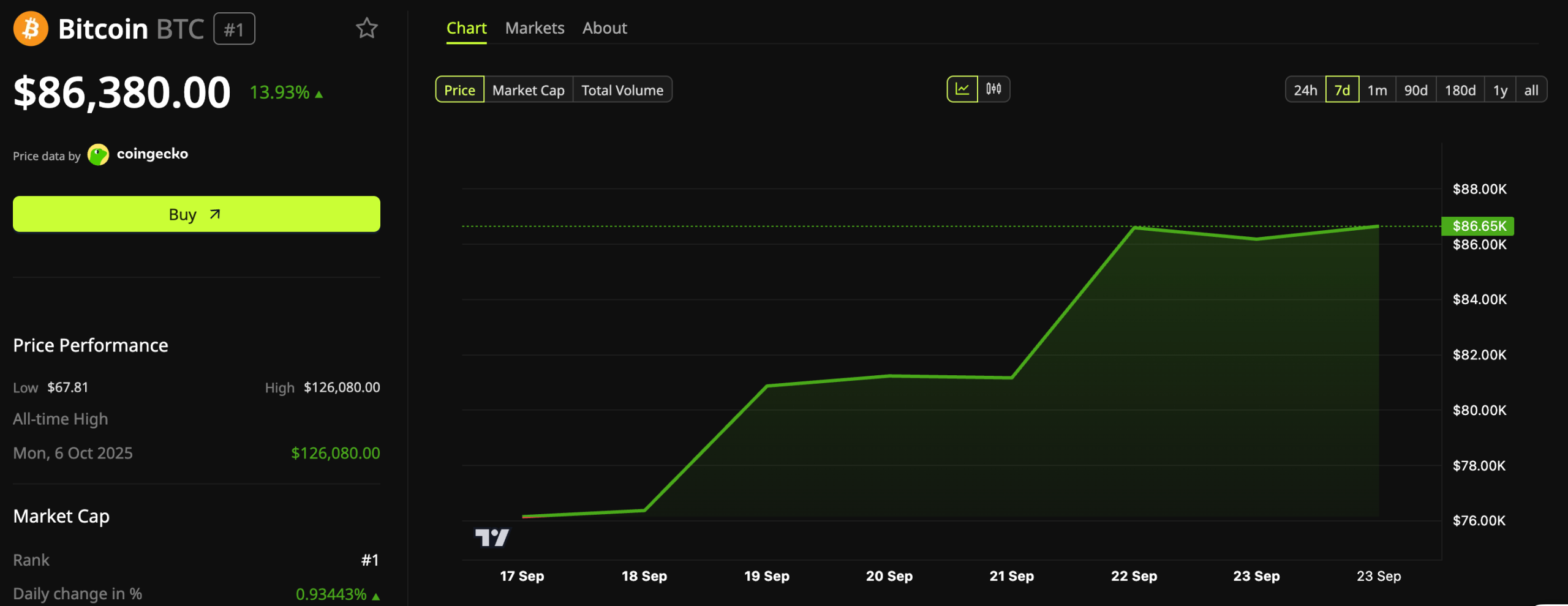
Bitcoin’s September rally gives his view some footing. The asset reached $87,395 on September 21, its highest price since late January.
That move followed Bitcoin’s first weekly close above the 50-week moving average since November 2025. Galaxy’s Alex Thorn has described reclaiming that average as strong confirmation of past bear market lows.
Before that close, Bitcoin had traded below the average for 45 straight weeks. The lowest point of that stretch came in late June, when the price fell to near $58,000.

Bitcoin has since gained about 49%, trading at $86,380 by press time. Measured from those lows, a 3x move would equal roughly $174,000, about 38% above the $126,080 record from October 6, 2025.
A 4x move would equal about $232,000, and a 5x move would equal about $290,000. Those levels fall between two calls from VanEck’s Matthew Sigel, who has forecast $100,000 for next year and $500,000 by 2029
Subscribe to our YouTube channel to watch leaders and journalists provide expert insights
The post The 10x Bitcoin Rally Isn't Coming. CryptoQuant CEO Predicts a Calmer Cycle appeared first on BeInCrypto.
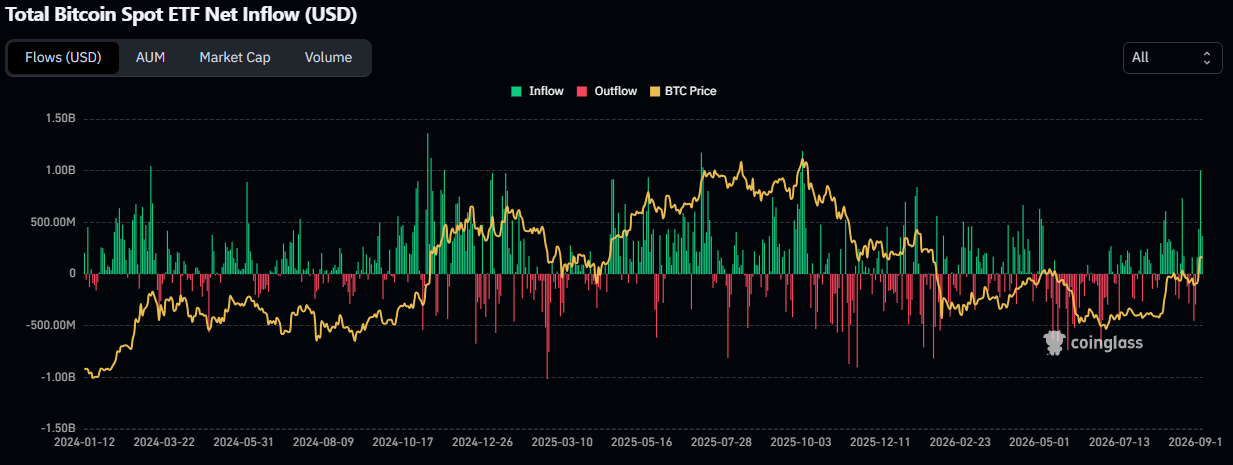
Bitcoin (BTC) exchange-traded funds (ETFs) absorbed nearly $1 billion on Monday, Sept. 21. But BTC had already jumped earlier that day on a short squeeze, CoinGlass data shows.
Bitcoin briefly topped $84,000 that day, its first trip to that level since Jan. 31. The move liquidated $262.3 million in short positions within an hour.
The Squeeze Came Before the ETF Money
That timing raises a real question about which move actually came first. Spot ETF flows are reported once daily, reflecting trades placed during the US cash session, which opens hours after Asian and European markets are already trading.

BTC’s climb came from the day’s short squeeze, which had already pushed the price higher before any same-day ETF buying could take place. That sequence suggests the derivatives market, not ETF demand, supplied the initial spark.
Outflows in the Dip, Inflows in the Rally
This would not be the first time flows tracked price rather than leading it. Spot Bitcoin ETFs posted net outflows on five of six trading days between Sept. 9 and Sept. 16, per CoinGlass. BTC was pulling back over that stretch.
Flows didn’t turn sustainably positive again until Sept. 17, when BTC’s price resumed climbing. Cumulative inflows have since topped $56.98 billion, and total net assets across all Bitcoin ETFs now stand at $107.86 billion.
Fund concentration tells a similar story. The BlackRock iShares Bitcoin Trust (IBIT) holds 785,640 BTC. That’s more than four times the 176,510 BTC held by the Fidelity Wise Origin Bitcoin Fund (FBTC). That single dominant fund looks more like capital chasing a trend than broad, independent conviction buying.
Flows May Not Spark the Rally, But They Can Extend It
None of this means ETF demand is irrelevant. Creating new ETF shares requires market makers to buy real BTC. So sustained inflows can still add real buying pressure to a rally already underway, even without starting it.
The data available cannot settle whether ETFs are capable of starting a rally on their own. What it shows for this leg is that the futures market moved first, and Wall Street’s money showed up after.
The post Bitcoin ETFs Pull In $1 Billion Monday: Are They Driving This Rally or Chasing It? appeared first on BeInCrypto.
Crypto World
Solana starts testing upgrade that could cut finality from 12.8 seconds to 150 milliseconds

A planned upgrade to make Solana even faster has moved to a testnet, where developers will try to cut the time a payment takes to become irreversible from about 13 seconds to 0.15 seconds.
That moment is known as finality. Exchanges wait for it before crediting deposits, bridges wait before releasing money on another blockchain and merchants need it to know that a payment cannot be taken back.
The upgrade, called Alpenglow, is now being introduced on Solana’s public test network, a copy of the blockchain that uses tokens with no monetary value. Developers can test the migration, find problems and restart the network without putting users’ money at risk.
Solana currently uses a system called TowerBFT to reach consensus, the process through which validators agree on which transactions belong in the permanent record. Validators record their votes on the blockchain and stack enough of them across 32 slots before a block becomes final.
Alpenglow replaces that system with a voting protocol called Votor. Validators send votes directly to one another and can settle on a block after one or two rounds, removing the long chain of onchain votes.
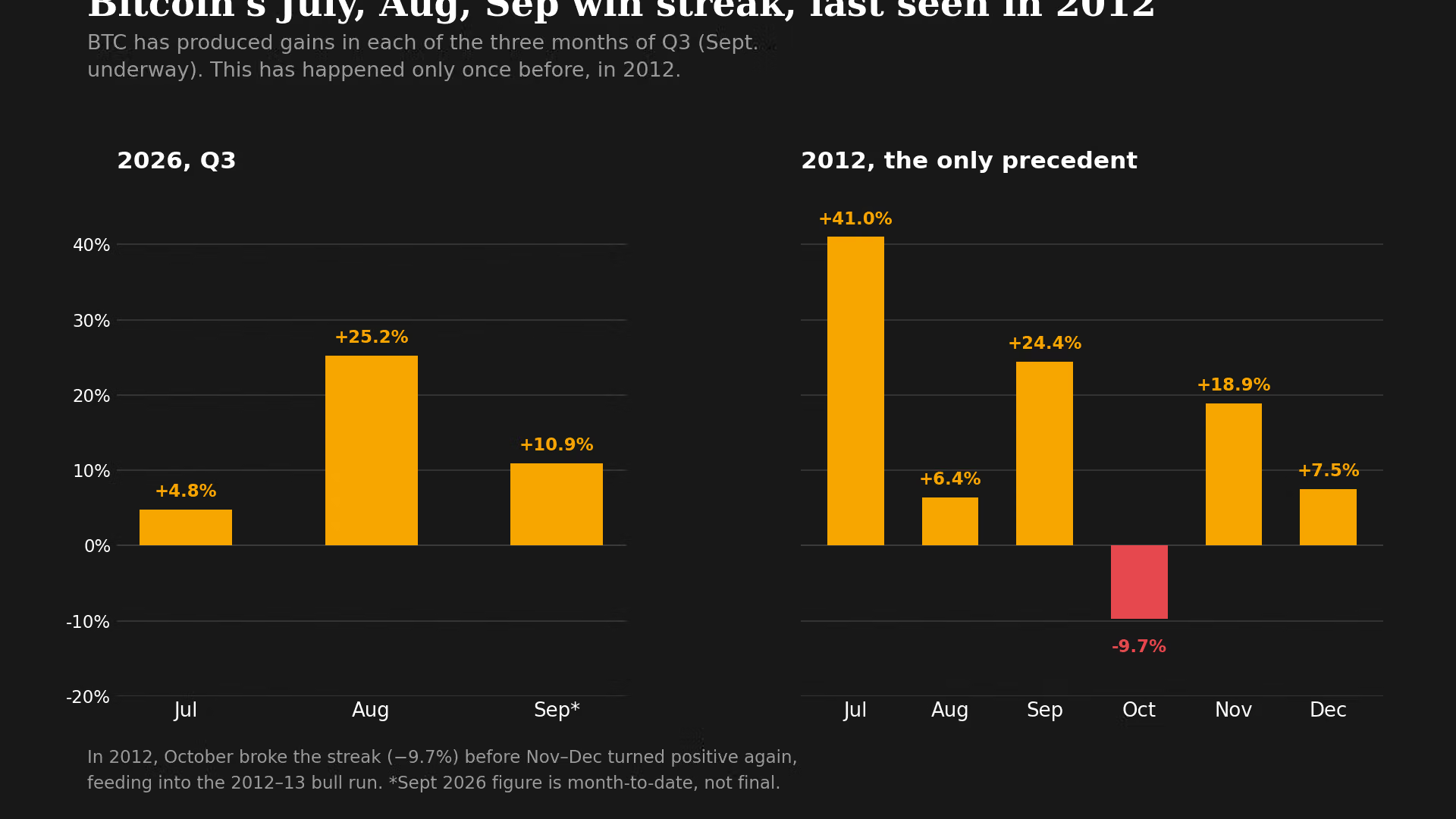
Whether this year follows a similar path – a red October followed by a big bull run – or takes a different route entirely, isn’t something the 2012 precedent can settle on its own. The sample size is too small. Bitcoin has been trading from at least late 2010 and since then, this pattern has shown up only once. So, there isn’t enough repetition to draw a meaningful conclusion about what happens next.
Still, the setup is noteworthy because of its rarity, the outsized rally that followed the 2012 example and bitcoin’s broader four-year market cycle. Some cycle models point to a potentially bullish phase beginning around October or November, although historical cycle patterns are approximate rather than fixed calendar rules
The magnitude of any rally may also be smaller than in bitcoin’s early years. In 2012, bitcoin was a thinly traded asset worth barely $10, and its market could be moved by a relatively small number of buyers.
Today, bitcoin is part of a multi trillion dollar market with substantial institutional participation, deep spot and derivatives liquidity across dozens of venues, and a broad range of directional and relative-value strategies, including options, futures and basis trades. Those markets did not exist at comparable scale in 2012, making a rally of similar percentage magnitude much harder to achieve today.

Bitcoin and Ethereum options carrying roughly $18.1 billion in notional value have moved toward their Sept. 25 quarterly expiry with calls outweighing puts across both markets, according to Coinbase Markets.
Summary
- Bitcoin and Ethereum options worth roughly $18.1 billion are scheduled to expire and settle Friday.
- Bitcoin options carry a 0.66 put-call ratio, while recent trading volume shows 0.37, Coinbase reports.
- Ethereum options show 0.61 open-interest put-call ratio, with recent trading volume at 0.55, Coinbase says.
- Bitcoin call open interest clusters near $90,000 and $100,000 strikes ahead of Friday’s quarterly settlement.
- Ether call interest is concentrated between $3,000 and $4,000 as September contracts approach expiration Friday.
Coinbase Markets said Bitcoin’s open-interest put/call ratio stood at 0.66, while its 24-hour volume ratio was lower at 0.37. Ether showed an open-interest ratio of 0.61 and a 24-hour volume ratio of 0.55. Coinbase described both books as call-heavy, with recent trading even more tilted toward calls, particularly for Bitcoin.
A separate Deribit-sourced snapshot taken at 03:53 UTC on Sept. 23 showed $16.13 billion of Bitcoin inverse-option open interest scheduled for Friday and $2.16 billion in Ether, putting the combined figure near $18.29 billion. Differences from Coinbase’s $18.1 billion reading can arise as prices and positions change between snapshots.
Bitcoin options put $90,000 and $100,000 strikes in focus
Bitcoin accounts for most of Friday’s expiry. Deribit-sourced data showed $9.61 billion in BTC call open interest against $6.52 billion in puts for Sept. 25, producing a 0.68 put/call ratio at the later snapshot.
Coinbase identified $90,000 and $100,000 as two areas where Bitcoin call open interest is concentrated. With BTC trading near $86,500 early Wednesday, the $90,000 strike sat roughly 4% above spot while $100,000 remained nearly 16% higher. Market data showed Bitcoin trading between roughly $86,149 and $86,791 during the Sept. 23 session.
The call concentration does not establish that Bitcoin will reach either strike before expiry. Open interest counts outstanding contracts but does not reveal whether each trader bought or sold the call, while many options positions form part of spreads, hedges or market-making strategies.
Put/call ratios below one show that calls outnumber puts under the selected measure. Coinbase’s 0.37 ratio for recent BTC options volume points to considerably more call than put trading, but volume by itself does not identify the ultimate directional exposure of all participants.
The market has nevertheless moved closer to the largest upside strikes since Coinbase’s previous quarterly-expiry update. Bitcoin surged from around $76,000 on Sept. 17 to above $86,000 this week, reaching an eight-month high above $87,000 on Sept. 21.
Bitcoin’s move toward $90,000 has been supported by renewed spot demand and short covering, although analysts said continued buying would be required to sustain the advance.
Ether options build toward $3,000 to $4,000 calls
Ether’s Friday book is smaller in dollar terms but carries a similar call-heavy structure. Deribit-sourced data showed approximately $1.34 billion in ETH call open interest against $820.1 million in puts for Sept. 25, matching Coinbase’s reported 0.61 open-interest put/call ratio.
Coinbase said ETH call interest is spread through the $3,000-$4,000 range. Ether was trading close to $2,760 early Sept. 23, putting $3,000 approximately 8.7% above spot. The $4,000 strike remained around 45% higher. Market data showed ETH had traded between roughly $2,750 and $2,766 during Wednesday’s session after closing near $2,753 on Tuesday.
Ether has gained sharply since the middle of last week. The asset traded near $2,416 on Sept. 16 before moving through $2,600 and reaching an intraday high above $2,805 on Sept. 21.
Reuters reported that ETH had broken above a technical resistance level near $2,661.52, with its technical analysis identifying $3,050 as one potential upside level if momentum continued. The projection is a chart-based scenario and does not establish where ETH will trade into expiry.
Ethereum’s earlier breakout above the $2,550 area opened attention toward higher resistance levels after buyers defended support near $2,400.
Friday’s expiry has grown since Coinbase’s Sept. 15 snapshot
Friday’s notional amount has increased since Coinbase Markets published its earlier Q3 positioning data.
On Sept. 15, Coinbase placed combined Bitcoin and Ethereum options open interest for the quarterly expiry at roughly $16.6 billion. Bitcoin accounted for approximately $14.73 billion, with Ether at $1.92 billion. At the time, BTC’s put/call ratio stood at 0.52 and ETH’s at 0.57.
Bitcoin accounted for nearly 89% of the $16.6 billion Q3 options expiry in that earlier snapshot. Coinbase then identified Bitcoin’s max-pain level near $72,000 and Ether’s around $2,200.
By Sept. 23, Coinbase’s combined figure had moved to roughly $18.1 billion while the reported put/call ratios had risen to 0.66 for Bitcoin and 0.61 for ETH. A higher put/call ratio means puts have increased relative to calls compared with the earlier snapshot, even though calls still dominate overall open interest.
The increase in notional value should not automatically be interpreted as an equivalent amount of new money entering the market. Notional open interest changes with the number of outstanding contracts and the value assigned to the underlying assets, while Bitcoin and Ether prices have risen sharply since Sept. 15.
PerpFinder’s Deribit-sourced methodology notes that USD open-interest figures represent contract quantities valued using forward prices. They do not measure option premiums paid, margin posted or the amount of cash that will change hands at settlement.
Bitcoin and Ether quarterly options settle at 08:00 UTC
The Sept. 25 contracts form part of Deribit’s quarterly expiry cycle. Deribit states that quarterly BTC and ETH options expire on the last Friday of March, June, September and December at 08:00 UTC.
For Friday’s expiry, the settlement process uses the relevant Deribit index over the period immediately before expiration. PerpFinder’s methodology states that the delivery price is based on the appropriate index’s time-weighted average between 07:30 UTC and 08:00 UTC.
The size of the expiry can lead traders and market makers to adjust hedges as option deltas change when spot prices move closer to major strikes. The presence of large open interest at $90,000, $100,000, $3,000 or $4,000 does not require spot prices to move toward those levels.
Deribit reports that its platform handles roughly 85% of BTC and ETH options activity, making its quarterly expiries a large component of the crypto derivatives market. Its August statistics showed $56.13 billion in Bitcoin options turnover and $7.14 billion in Ether options turnover during the month.
Friday’s quarterly contracts are scheduled to expire at 08:00 UTC on Sept. 25. The final notional open interest, put/call ratios and strike concentrations can continue changing until traders close, roll or add positions before settlement.

The world’s largest asset manager, BlackRock, says broad AI adoption could represent an underappreciated source of demand for digital assets.
In its latest research paper, “The Machine-Native Economy,” BlackRock said the rise of AI and machine-to-machine payments could increase demand for blockchains and other programmable payment infrastructure, including stablecoins and other on-chain assets. It also sees a potential opportunity for digital assets to support the compute market, allowing claims on computing capacity to be tokenized, traded and used as collateral.
“Together, these developments position AI as a structural catalyst for digital asset adoption and digital assets as a potential facilitator of the AI economy,” BlackRock’s Will Su, Robert Mitchnick, Jay Jacobs and William Helm wrote. “This relationship remains underappreciated and could expand the role of digital assets as core infrastructure for an increasingly autonomous digital economy.”
The crypto industry has long argued the potential link between AI and digital assets, but BlackRock’s research could bring that thesis to its broader audience of institutional investors.
AI could drive need for machine-native payment rails
One of BlackRock’s arguments is that the rise of agentic AI could increase the demand for machine-native payment instruments.
While existing payment rails can support some degree of automation, account setup, credentialing, and authorization could require human involvement. Meanwhile, merchant fees can make low-value transactions uneconomic and settlement and finality times could vary across providers.
BlackRock said stablecoins, native cryptocurrencies and tokenized real-world assets are well suited to high-frequency, sub-cent, machine-to-machine transactions that take place around the clock.
“Several types of digital assets may support agentic commerce, but stablecoins are likely to lead transactional use,” the authors said.
Compute could open a new market for crypto
The authors said there is an opportunity for digital assets in the growing market for compute — the processing power needed to train and run AI systems.
With AI demand surging, AI companies could seek to lock in costs and providers to manage risk. Claims on that capacity could then be represented as tokens to be transferred, pledged as collateral or traded.
Related: Australian 40-year economic outlook recognizes ‘AI revolution,’ omits crypto
“This could in turn broaden institutional investor participation and establish compute as a new opportunity for the broader digital asset ecosystem,” the authors said. They also argued that AI agents could use these markets to automatically purchase resources as needed.
BlackRock’s thesis echoes arguments from crypto executives. In July, Coinbase CEO Brian Armstrong pushed back against calls for crypto to pivot to AI, arguing that AI agents could stoke demand for crypto-based financial services.
“AI being a megatrend takes nothing away from crypto,” Armstrong wrote, because AI agents will need programmable money rather than traditional banking rails. “If anything, it makes crypto more important,” he added.
Crypto companies are already building tools to support that activity. Coinbase’s x402 protocol and Tempo’s Machine Payments Protocol have both been designed to let AI agents automatically pay for online services.
In May, Circle introduced agent wallets and USDC payment tools, while OKX’s Agent Payments Protocol is designed to support recurring payments and arrangements in which funds are held in escrow and released after a task’s completion.
Magazine: Big Questions: Does Satoshi actually own 1.1 million Bitcoin?

The CLARITY Act has remained stalled in the U.S. Senate after a 49-50 procedural defeat, with Sen. Cynthia Lummis blaming Democratic opposition on politics surrounding President Donald Trump while Democratic negotiators say unresolved ethics rules prevented an agreement.
Summary
- Senate cloture on the CLARITY Act failed 49-50, leaving the crypto market structure bill stalled.
- Every voting Democrat opposed cloture, while four Republicans voted no, including procedural switcher Thom Tillis.
- Lummis blamed Democratic opposition on Trump politics, while Democrats cited unresolved ethics safeguards in negotiations.
- Senate Democrats including Gillibrand and Alsobrooks said they remain committed to bipartisan crypto legislation talks.
- The failed vote did not kill the bill, because Tillis preserved a motion for reconsideration.
Senate records show that lawmakers rejected cloture on the motion to proceed with H.R. 3633 on Sept. 15. The measure needed three-fifths support to advance to debate. It received 49 votes in favor and 50 against, with one senator not voting.
Speaking at CoinDesk’s Policy & Regulation event on Sept. 22, Lummis said she was “dismayed, dumbfounded and saddened” by the result. She accused Democrats of allowing their opposition to Trump to override support for the crypto market-structure legislation, saying the industry should “pin it on the Democrats.”
Her comments describe her political assessment of why the vote failed. Democratic senators have given a different explanation, pointing to unresolved ethics provisions covering elected officials’ crypto interests and saying they still support legislation establishing federal digital-asset rules.
CLARITY Act vote failed before debate could begin
The Sept. 15 vote was not final passage of the CLARITY Act. It concerned whether the Senate should invoke cloture on the motion to proceed, allowing the chamber to begin formal consideration of the bill.
The official roll call shows all Democrats who voted opposed cloture. Democratic Sen. Chris Coons did not vote. Republicans Susan Collins, Josh Hawley and Jerry Moran voted against moving forward, while Sen. Thom Tillis cast a fourth Republican no.
Senate Daily Press records state Tillis voted no so he could make a motion to reconsider. He filed that motion shortly after the result, preserving a procedural route for leadership to bring the question back.
The proposal would establish a statutory framework governing digital commodities and divide regulatory responsibilities between the Securities and Exchange Commission and Commodity Futures Trading Commission. The House had already passed H.R. 3633 in July 2025 by 294-134, including 78 Democratic votes.
CLARITY Act failed to secure the 60 Senate votes needed to open debate on Sept. 15, leaving questions over federal crypto market structure unresolved.
Lummis says negotiators had already made concessions
Before the vote, Republican sponsors said the latest Senate text contained more than 120 changes requested by Democrats.
Lummis, Senate Agriculture Committee Chair John Boozman and Senate Banking Committee Chair Tim Scott said the Sept. 14 draft contained 126 substantive changes sought during bipartisan negotiations. The sponsors said the package incorporated most of a Tillis-Gallego ethics proposal, expanded state attorney general enforcement and gave Treasury new authority concerning stablecoin-related deposit flight.
An earlier Sept. 10 version introduced changes governing when certain non-decentralized DeFi protocols would register with the CFTC and fall under Bank Secrecy Act requirements. It clarified the treatment of some prediction markets and credit-union digital asset activities.
Lummis argued after the failed vote that Democratic negotiators kept changing their demands after Republicans accepted earlier requests. Her office used far stronger language in a Sept. 15 statement, accusing Democrats of putting politics before consumer protections and U.S. crypto policy.
At Tuesday’s event, she said Trump had become the determining political issue for some lawmakers. Lummis credited Democratic Sens. Kirsten Gillibrand and Angela Alsobrooks as serious participants in negotiations despite criticizing the caucus’s final vote.
Democrats say ethics language remained unresolved
Democratic negotiators reject the claim that opposition amounted simply to hostility toward Trump. Alsobrooks said after voting no that she supports regulating digital assets but had consistently sought ethics restrictions covering the current president, future presidents and members of Congress. She said negotiators were close to an agreement before Republican leadership ended the talks immediately before the vote.
One day later, Gillibrand, Alsobrooks, Cory Booker, Catherine Cortez Masto, Ruben Gallego, Mark Warner and Raphael Warnock said they remained committed to passing crypto market-structure legislation. Their joint statement called the vote a setback but said bipartisan discussions should continue.
President Trump’s financial interests in cryptocurrency became part of the negotiations. Reuters reported that Trump disclosed more than $1.4 billion in 2025 income from family crypto ventures, which increased Democratic demands for restrictions on officeholders profiting from digital assets. The White House agreed to some ethics provisions, but Democratic senators maintained they were insufficient.
Reuters reported another source of disagreement came from banks concerned that stablecoin provisions could encourage deposit outflows and reduce lending capacity. Banking groups pressed lawmakers for changes while the crypto industry sought rules allowing rewards and other stablecoin-linked products.
Before the vote, crypto.news examined the ethics, stablecoin yield and DeFi disputes surrounding the CLARITY Act, identifying them as the main unresolved issues capable of preventing the legislation from receiving 60 votes.
House lawmakers say market structure legislation is still needed
House Financial Services Committee Chair French Hill has continued pressing for congressional action despite the Senate result.
Hill and House Agriculture Committee Chair Glenn Thompson said on Sept. 15 that the failed cloture vote did not remove the need for statutory rules governing digital assets. They said Congress should continue working on legislation while the SEC and CFTC use existing authorities to issue rules and guidance.
During the Sept. 22 CoinDesk event, Hill argued that lawmakers should continue working toward a bipartisan agreement instead of treating the procedural defeat as the end of the legislation.
Democratic Rep. Ritchie Torres offered a different assessment of the political dispute. He said Trump’s crypto businesses had made it harder for Democrats to support the legislation, particularly after the president launched a memecoin. Torres said he believed the bill could have attracted more bipartisan support without the political controversy surrounding Trump.
Hill acknowledged that Trump’s memecoin had complicated negotiations, while arguing that Congress still needs a market-structure law capable of regulating both the industry and potential conflicts involving elected officials.
The House vote from 2025 shows that digital-asset market structure has previously attracted support from both parties. House Clerk records show 216 Republicans and 78 Democrats voted for the legislation at that stage.
Tillis motion keeps another CLARITY Act vote possible
The Sept. 15 defeat did not formally dispose of the legislation because Tillis moved to reconsider after changing his vote to no for procedural reasons.
A motion to reconsider allows the Senate to revisit an earlier decision if leadership decides to bring the matter back. The official Senate record does not show another CLARITY cloture vote after Sept. 15, while the chamber’s cloture list through Sept. 21 continues to record the H.R. 3633 motion as failed.
Any Senate version that materially changes the House-passed legislation would eventually require agreement between the two chambers before reaching the president.
Industry participants have warned that continued delay could leave companies making product and investment decisions without a comprehensive federal market-structure statute. crypto executives said the CLARITY setback could delay U.S. product launches and commercial agreements while regulators continue working under existing law.
No new Senate cloture vote on H.R. 3633 had been posted in the official record reviewed through Sept. 23. Democratic negotiators have publicly committed to further talks, while Republican sponsors continue to support bringing the legislation back for consideration.

Circle Foundation has awarded its first U.S. grants to Accion Opportunity Fund and Pacific Community Ventures on Sept. 22, backing AI-enabled lending and data infrastructure for underserved small businesses.
Summary
- Circle Foundation awarded its first domestic grants to Accion Opportunity Fund and Pacific Community Ventures.
- Accion’s Credit Compass 2.0 uses application data to deliver personalized financial education for prospective borrowers.
- AOF says applicants using its educational resources are 84% more likely to qualify for loans.
- PCV’s Radiant Data Hub provides AI governance, predictive modeling, benchmarking and impact analytics for CDFIs.
- Circle reserved 2.68 million shares, roughly 1% of capital, for Foundation contributions over ten years.
Circle announced the grants during the Clinton Global Initiative Annual Meeting in New York, identifying both recipients as Community Development Financial Institutions serving small-business owners who can struggle to obtain financing through traditional channels. Circle did not disclose the dollar amount of either grant.
The new awards are Circle Foundation’s first domestic philanthropic grants. Its first international grant was announced in January for the United Nations Digital Hub of Treasury Solutions, giving the Foundation separate U.S. and global programs during its first year of active grantmaking.
Circle Foundation directs first U.S. grants toward AI tools
Circle Foundation is funding technology that the two CDFIs plan to use in loan education, data analysis and institutional decision-making.
For Accion Opportunity Fund, the grant supports Credit Compass 2.0, a tool that uses information from a loan application to provide personalized financial education. Applicants who are not ready for financing receive an explanation of why they did not qualify and a set of steps intended to improve their position for a future application.
AOF’s own data says applicants who use its educational resources are 84% more likely to qualify for a loan. The figure comes from Accion and was cited by Circle in announcing the grant; Circle did not publish the underlying sample size, methodology or an independent evaluation of that result.
Elisabeth Carpenter, Circle Internet Group’s chief strategic engagement officer and founding chair of Circle Foundation, said Credit Compass 2.0 “gives small business owners a real roadmap to capital.” Circle framed the funding around tools that can be used repeatedly across a lender’s applicant base instead of financing individual loans.
The program places AI inside a part of Circle’s business that is separate from its stablecoin products and commercial infrastructure. In related coverage, USDC settled 99.3% of x402 AI-agent payment volume during Circle’s second quarter, according to company figures, showing another area where Circle is connecting AI with financial activity. The CDFI grants involve philanthropy and small-business lending tools, not USDC-based lending.
Accion grant supports Credit Compass 2.0 for borrowers
Accion Opportunity Fund operates as a nonprofit small-business lender and has a long record within the U.S. Community Development Financial Institutions system. Treasury CDFI Fund records show Accion Opportunity Fund Community Development has received federal CDFI awards across multiple years.
Credit Compass 2.0 focuses on people who begin a financing application but may not yet meet the lender’s requirements. Instead of ending the interaction at a loan decision, the system connects application information with educational guidance tailored to the applicant’s financial position.
Luz Urrutia, CEO of Accion Opportunity Fund, said the product is designed to give business owners a “clear, honest picture of where they stand.” The Foundation’s grant will support further development and deployment, though neither Circle nor AOF has published a launch date, target user count or grant value.
Circle describes its domestic strategy as supporting systems that let mission-driven financial institutions reach more borrowers while producing better data on results. The company has not said that Circle technology, USDC or its Arc blockchain will power Credit Compass 2.0.
The distinction keeps the grant separate from Circle Internet Group’s commercial financial products. The Foundation is structured as a donor-advised fund, while Circle Internet Group remains the NYSE-listed parent that provides the equity resources supporting its philanthropy.
PCV grant backs Radiant Data Hub and 2026 Data Commons
Pacific Community Ventures will use its grant for the Radiant Data Hub, an AI-enabled data platform created for CDFIs and other mission-driven lenders.
PCV said it launched the platform after acquiring a longtime data and AI startup partner in 2025. The acquired technology included AIKKA, a voice-AI tool designed to collect qualitative feedback across major languages. PCV says the Hub combines data governance, predictive modeling and tools that help lenders analyze and present the results of their financing programs.
The organization plans another development during fall 2026. Its CDFI Data Commons is intended to give participating lenders shared benchmarking, portfolio analytics and sector-level information. PCV describes the project as the first Data Commons model built for the CDFI industry.
PCV says the model will use a nationally representative algorithm trained on mission-driven loan portfolios. Participating lenders are expected to use the system to compare portfolio performance and refine predictive underwriting models. Those planned capabilities come from PCV and remain forward-looking until the platform launches and operating results become available.
Bulbul Gupta, PCV’s president and CEO, said the organization intends to keep “human judgment and community impact at the center” as it expands AI use. PCV has paired the Radiant project with an ethical AI policy covering how community lenders use emerging technology.
Treasury CDFI Fund records show Pacific Community Ventures has participated in federal CDFI programs for years, including previous Financial Assistance and Technical Assistance awards.
Circle’s 1% equity pledge funds a ten-year structure
Circle Foundation’s financing comes from an equity commitment approved before Circle became a public company.
Circle’s 2025 annual filing disclosed that its board reserved up to 2,682,392 Class A shares in March 2025 for the Foundation. The amount represented approximately 1% of Circle’s capital stock when the board approved the commitment, with the shares available for contribution in installments over ten years.
The first equity contribution took place in November 2025, when Circle reissued 268,239 treasury shares for the Foundation and recorded a $23.1 million general and administrative expense. By June 30, 2026, Circle had transferred another 134,120 shares during the first half of the year, recording $13.1 million in related expense.
Circle’s second-quarter outlook projected 268,239 shares for Foundation contributions during all of 2026. At the July 31 reference price used in its guidance, the company estimated a roughly $22 million non-cash expense, though it cautioned that the final value depends on Circle’s stock price when each transfer occurs.
The Foundation operates as a donor-advised fund managed by Fidelity Charitable and is separately governed. Circle’s 2026 proxy says the company covers operating costs so Foundation resources can be directed toward charitable work. Employees receive up to 40 hours of paid volunteer time each year.
However, the disclosed equity commitment describes how Circle funds the Foundation; it does not reveal how much AOF or PCV received from the Sept. 22 grants.
Circle Foundation already funds UN financial infrastructure
Before the two domestic grants, Circle Foundation made its first international award in January to support the United Nations’ Digital Hub of Treasury Solutions, or DHoTS.
Circle announced that funding through UNHCR and UNDP would support technology for cross-border transfers, local-currency conversion, programmable disbursements and financial-system interoperability. The Foundation did not disclose the grant value in that announcement either.
UNHCR currently describes DHoTS as infrastructure connecting more than 150 banking and financial systems across over 100 countries. Fifteen agencies participate in the project, while its technology includes AI-driven treasury management, blockchain disbursements, digital wallets and integrations with banks and mobile-money providers.
Related work across the UN system has produced other digital-payment pilots. UNDP expanded its Stellar partnership after blockchain aid-payment pilots cut distribution costs in several markets, including a Syria pilot where reported distribution costs fell from 10% to 2%.
UNHCR says the next phase of DHoTS includes further connections with local financial systems, financial technology companies and global banks, alongside expanded on-chain treasury management and programmable payment capabilities.
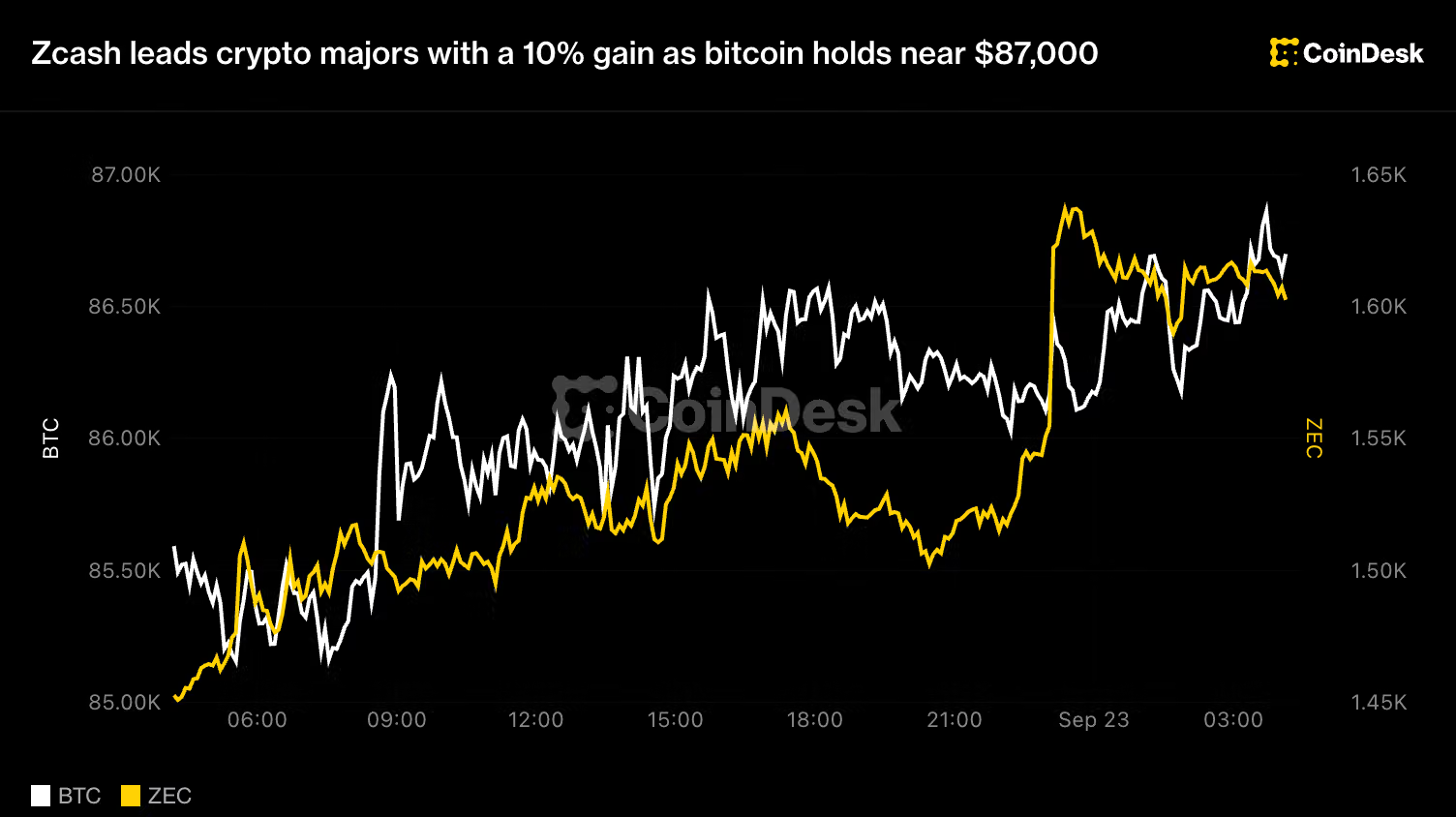
“Technically, Bitcoin’s back above its 50 & 200 week moving averages, up ~29% in 35 days,” Tony Dicarlo, director of institutional propositions at RootstockLabs, said in an email to CoinDesk. “Legislatively, The SEC stepped up support of digital assets where Congress hasn’t with the Innovation Exemption filling the CLARITY gap within 24 hours, driving sharp rallies in tokenization related digital assets and improving broader confidence.”
“The American Reserve Modernization Act clearing committee last week has also reignited the Strategic Bitcoin Reserve conversation again, the furthest such a bill has gotten in Congress, though it still needs a full House and Senate vote,” he added.
The bill would place the roughly 325,000 bitcoin the government already holds, most of it seized in criminal and civil forfeitures, into a Strategic Bitcoin Reserve at the Treasury, require the coins be held for at least 20 years, and mandate quarterly audited proof that they are still there.
It also orderd a study of ways to buy more without adding to the deficit.
Meanwhile, among broader markets, bonds rallied across the Asian session as oil kept sliding. Australian and New Zealand 10-year yields each fell at least three basis points and 10-year Treasury futures climbed, with cash Treasuries shut for a Japanese holiday.

Thailand is rolling out a new EV tax structure linked to local manufacturing

Scott Bessent Frontrunner for Trump’s AI Czar: Report

Andy Burnham Slams Putin Over Russian Misinformation




-

 Fashion5 days ago
Weekend Open Thread: Talbots – Corporette.com
-

 Tech2 days ago
Researchers escape OpenAI Codex sandbox to run commands on host
-

 Crypto World4 days ago
Circle launches Arc Studio AI agent for building onchain apps
-
 NewsBeat4 days ago
Trump says US has reached an agreement to take permanent control of Greenland’s security
-

 Crypto World2 days ago
Who Needs CLARITY Anyway? ARB Could See 70X Increase: Hodler’s Digest
-

 Crypto World4 days ago
Bitcoin price breaks channel as RSI climbs to 63
-

 Crypto World4 days ago
Trading Bitcoin on Robinhood? Why 2% Spread Has Traders Worried
-

 Crypto World6 days ago
US Charges Robinhood Engineers Over Crypto Listing Trades
-

 Crypto World4 days ago
World Money launches in 150+ countries with Stripe
-

 Business2 days ago
Analog Devices (ADI) Bets $1.35 Billion on Chips that Let Machines Think for Themselves
-

 Crypto World5 days ago
Mortgage and refinance interest rates today, Thursday, September 17, 2026
-

 Crypto World5 days ago
Silver prices recover quickly, hitting weekly high today
-

 Crypto World2 days ago
Coinbase, Robinhood, Circle Seen as Tokenized-Stock Winners
-

 Tech5 days ago
GPT-6 Astra Reached the Nether in Minecraft, Lost Its Stash to a Creeper, and Farmed Potatoes for Hours
-
 NewsBeat4 days ago
US was ‘on brink of war’ with China over false AI report of nukes moving in Middle East
-

 Crypto World2 days ago
Bitcoin price holds above $81K as key catalysts line up
-

 Crypto World4 days ago
CFTC sends crypto market structure rulemaking to White House
-

 Entertainment6 days ago
Grey’s Anatomy Showrunner Teases Changes After Cast Exits
-

 Crypto World1 day ago
Meta Jumps 11% As Muse Shines and Investors Show an Appetite for Advancing AI
-

 Business5 days ago
Newsom accelerates AI oversight, advances ‘kill switch’ plan
You must be logged in to post a comment Login